John 6:43

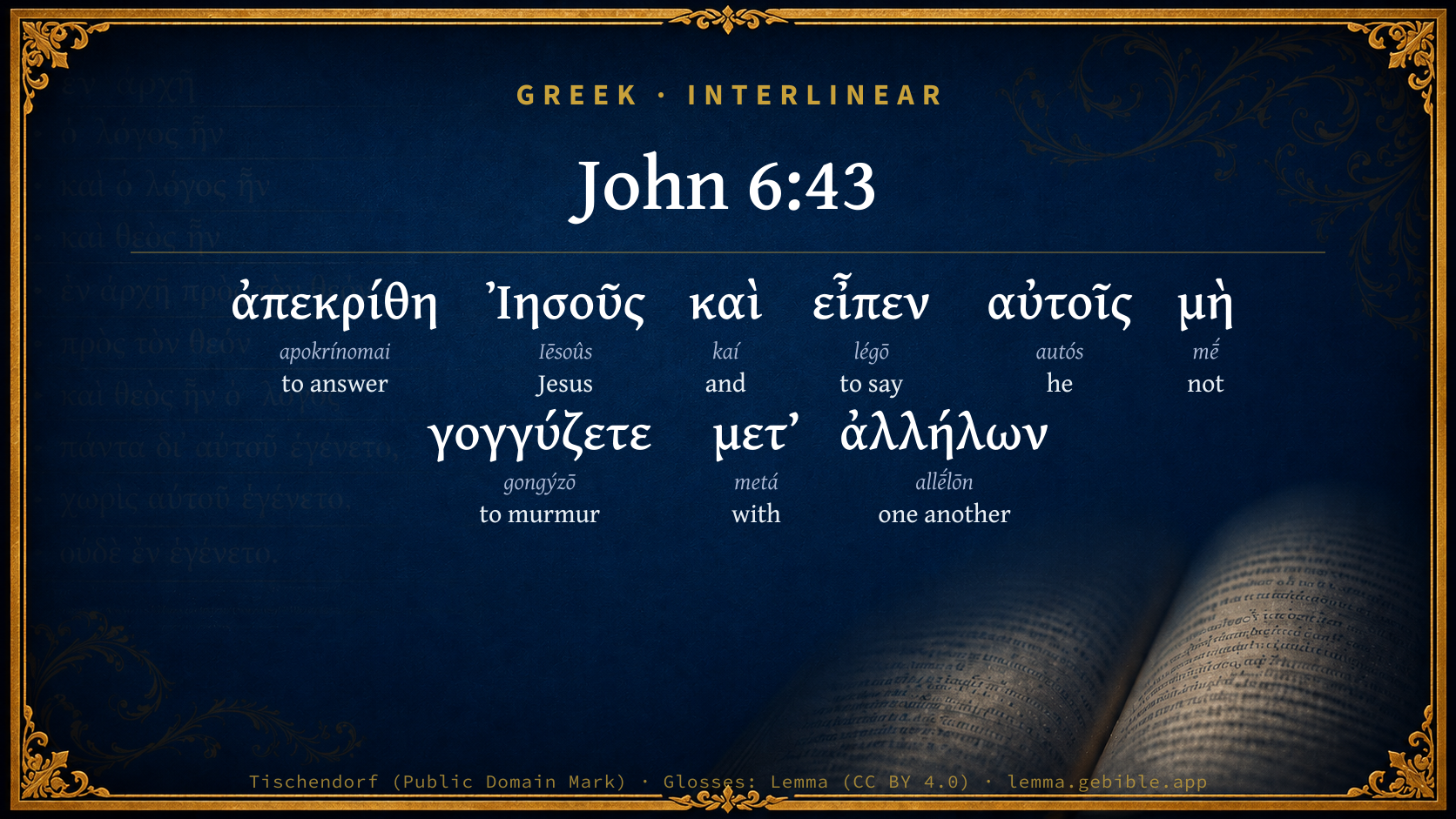
Greek (Tischendorf 8th ed.) John 6:43 appears in the Greek New Testament. The text above is from the Tischendorf 8th edition. Each word links to its Strong’s number and a concise gloss. Click any word for its full Thayer’s Greek Lexicon entry.
Download image
Cite this verse

John 6:43 (World English Bible). Public Domain. Lemma interlinear Bible study tool, https://lemma.gebible.app/v/john/6/43.

Show BibTeX & RIS
BibTeX
RIS
English Translation
Therefore Jesus answered them, "Don't murmur among yourselves.
World English Bible · Public Domain
Download a study sheet

One document with this verse’s original text, its word-by-word gloss line, the meaning frame, cross-references with their text, attributed commentary, and full source and license credits — printable, and it pastes into notes with its structure intact.

This verse Autodidact and up

Study sheet (.html) Plain text (.txt)

A passage Seminary Student

Up to 50 verses in one chapter. A passage sheet keeps up to 6 commentary sources and 12 cross-references per verse, in the order this page ranks them, and says so on the sheet whenever that leaves anything out. Ask for a single verse and you get the Autodidact verse sheet above.

Everything on this page stays free to read, with no account — the sheet is a download of what is already on screen, not access to it.

Want to remove ads? Support Godless Engineer
Compare translations 3

The same verse in 3 English versions, stacked beneath the original-language interlinear above. Click any original word for its lexicon entry.

Each is an independent rendering of the whole verse — the interlinear is not word-aligned to these translations.

Highlighted words mark where these versions differ — a whole-verse word diff, not a word-by-word alignment.

  • World English Bible Public Domain
    Therefore Jesus answered them, "Don't murmur among yourselves.
  • King James Version Public Domain
    Jesus therefore answered and said unto them, Murmur not among yourselves.
  • unfoldingWord Literal Text CC BY-SA 4.0
    Jesus replied and said to them, “Do not murmur among yourselves.

unfoldingWord Literal Text — © unfoldingWord, licensed CC BY-SA 4.0. Word-aligned USFM3 via Door43 (git.door43.org/unfoldingWord/en_ult).

Versions to compare (up to 4)

3 of 4 selected

Show all 19 translations

Every available English version of this verse, each an independent rendering of the whole verse.

  • World English Bible Public Domain
    Therefore Jesus answered them, "Don't murmur among yourselves.
  • Berean Standard Bible Public Domain
    “Stop grumbling among yourselves,” Jesus replied.
  • Majority Standard Bible Public Domain
    “Stop grumbling among yourselves,” Jesus therefore replied.
  • King James Version Public Domain
    Jesus therefore answered and said unto them, Murmur not among yourselves.
  • American Standard Version (1901) Public Domain
    Jesus answered and said unto them, Murmur not among yourselves.
  • Revised Version (1885) Public Domain
    Jesus answered and said unto them, Murmur not among yourselves.
  • Geneva Bible (1599) Public Domain
    Iesus then answered, and saide vnto them, Murmure not among your selues.
  • Douay-Rheims (1899) Public Domain
    Jesus therefore answered, and said to them: Murmur not among yourselves.
  • Young's Literal Translation Public Domain
    Jesus answered, therefore, and said to them, `Murmur not one with another;
  • Literal Standard Version CC BY-SA 4.0
    Jesus answered, therefore, and said to them, “Do not murmur with one another;
  • Unlocked Literal Bible CC BY-SA 4.0
    Jesus replied and said to them, “Stop grumbling among yourselves.
  • unfoldingWord Literal Text CC BY-SA 4.0
    Jesus replied and said to them, “Do not murmur among yourselves.
  • Darby Bible Public Domain
    Jesus therefore answered and said to them, Murmur not among yourselves.
  • World Messianic Bible Public Domain
    Therefore Yeshua answered them, “Don’t murmur among yourselves.
  • Webster's Bible Public Domain
    Jesus therefore answered and said to them, Murmur not among yourselves.
  • Free Bible Version CC BY-SA 4.0
    “Stop grumbling to each other,” Jesus said.
  • Bible in Basic English Public Domain
    Jesus made answer and said, Do not say things against me, one to another.
  • Text-Critical English NT CC BY 4.0
    Jesus answered them, “Do not grumble among yourselves.
  • Tyndale New Testament (1534) Public Domain
    Iesus answered and sayde vnto them. Murmur not betwene youre selves.

Literal Standard Version (2020), Covenant Press — licensed CC BY-SA 4.0. Text via the HelloAO Bible API (eBible.org). Unlocked Literal Bible (unfoldingWord) — licensed CC BY-SA 4.0. Text via the HelloAO Bible API (eBible.org). unfoldingWord Literal Text — © unfoldingWord, licensed CC BY-SA 4.0. Word-aligned USFM3 via Door43 (git.door43.org/unfoldingWord/en_ult). Free Bible Version, Dr. Jonathan Gallagher — licensed CC BY-SA 4.0. Text via the HelloAO Bible API (eBible.org).

Word by word

More ways to search: Search by grammar → Find every occurrence → Compare this word →

Practice this passage: Drill this verse → Learn its vocabulary →

About this verse

These counts appear in no published source. They are computed here, from the morphology-tagged text and Lemma’s own curated glosses. What Lemma adds →

9
words
9
distinct lemmas
Gospels
section

Notable vocabulary

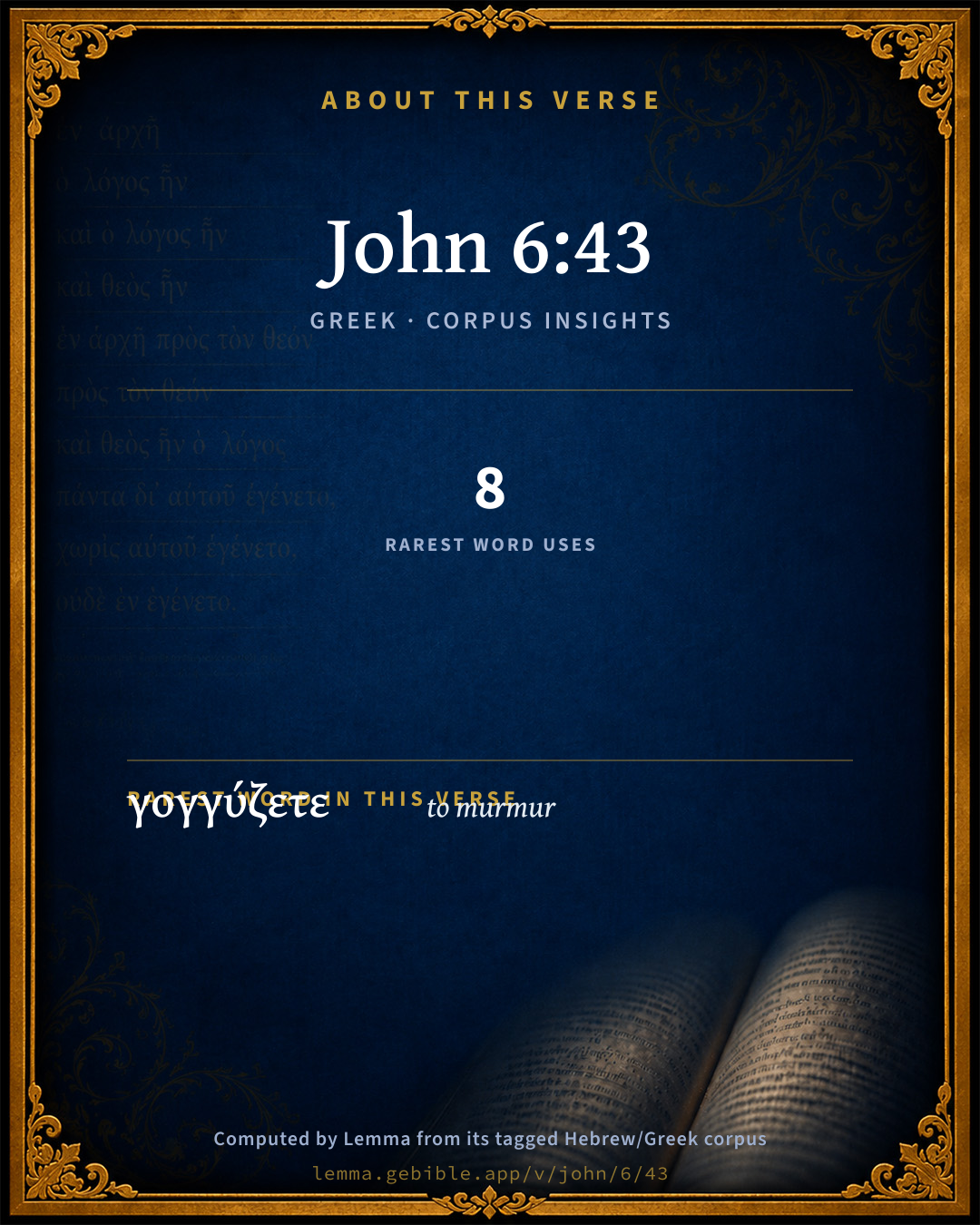
The rarest word here is γογγύζετε to murmur G1111 — appearing just 8 times in the whole Greek New Testament.

Shared distinctive vocabulary

γογγύζετε to murmur G1111 occurs in 7 verses of the Greek New Testament. Also found in:

Cross-references

5

Topical passages linked to John 6:43 in the Treasury of Scripture Knowledge — connected by theme and wording, ordered by reader-vote popularity; previews shown in the World English Bible.

  • Hebrews 4:13 There is no creature that is hidden from his sight, but all things are naked and laid open before the eyes of him with whom we have to do.
  • John 6:64 But there are some of you who don't believe." For Jesus knew from the beginning who they were who didn't believe, and who it was who would betray him.
  • Matthew 16:8 Jesus, perceiving it, said, "Why do you reason among yourselves, you of little faith, 'because you have brought no bread?'
  • Mark 9:33 He came to Capernaum, and when he was in the house he asked them, "What were you arguing among yourselves on the way?"
  • John 16:19 Therefore Jesus perceived that they wanted to ask him, and he said to them, "Do you inquire among yourselves concerning this, that I said, 'A little while, and you won't see me, and again a little while, and you will see me?'

Cross-references courtesy of OpenBible.info (CC BY 4.0).

Where the printed editions differ

1 variant

Places in this verse where the major printed Greek editions disagree on the wording in a way that affects the translation — a comparison of editions, not a manuscript-by-manuscript collation. The editions are the modern critical texts (Nestlé-Aland 28/27, SBL, Westcott-Hort, Tregelles, Tyndale House) and the traditional texts behind the KJV (the Textus Receptus and the Byzantine/Majority text). It is not a claim about which reading is original.

  1. Extra text
    οὖν

    “therefore”

    In TRByz Not in NA28NA27TynSBLWHTreg

    οὖν (oun) 'therefore' is only in traditional manuscripts (TR+Byz)

Textual data: Translators Amalgamated Greek New Testament (STEPBible TAGNT) · CC BY 4.0.

Commentary

Notes on John 6:43 from classic Christian and Jewish commentators (each source and its license shown beneath its notes). The classic Christian expositions comment on the surrounding passage and are grouped to its opening verse, so a note may address several verses; the Jewish commentaries on the Tanakh (Rashi and others) are per-verse, so they appear only where the commentator wrote on this verse.

Lemma curates 59 commentaries, every one of them public domain or Creative Commons licensed, each selected and text-cleaned for this edition rather than reprinted as found. About our sources →

Tyndale Open Study Notes

Tyndale Open Resources

6:43-51 Stop complaining: Rather than defending himself against their complaint (6:42), Jesus turns to the problem of their spiritual receptivity. Those who love the Father and listen to him will believe in Jesus.

Tyndale Open Study Notes — © Tyndale Open Resources, licensed CC BY-SA 4.0. Text via the HelloAO Bible API.

Meyer's Critical & Exegetical Commentary

Heinrich August Wilhelm Meyer

Joh_6:43-44. Jesus does not enter upon a solution of this difficulty, but admonishes them not to trouble themselves with it; they should not dwell upon such questions, but upon something far higher; the drawing of the Father is the condition of participation in His salvation.

The ἑλκύειν is not simply a strengthening of the διδόναι in Joh_6:37-38, but specifies the method of it, an inner drawing and leading to Christ through the working of divine grace (comp. LXX. Jer_31:3), which, however, does not annul human freedom, but which, by means of the enlightening, animating, and impelling influence, and of the instruction appropriated by the man, wins him over. Comp. Joh_12:32. Ἑλκύειν (Joh_6:45) includes the Fathers teaching by His witness to Christ (Weiss), but this is not all that it comprehends; it denotes rather the whole of that divine influence whereby hearts are won to the Son. In the consciousness of those who are thus won, this represents itself as a holy necessity, to which they have yielded. Comp. Wis_19:4, where the opposite, the attraction of evil, appears as a necessity which draws them along, yet without destroying freedom. See Grimm, Handb. p. 292 f. Comp. also the classical ἕλκομαι ἦτορ (Pind. Nem. iv. 56), ἕλκει τὸ τῆς φύσεως βάρβαρον (Dem. 563, 14), and the like. Augustine already compares from the Latin the trahit sua quemque voluptas of Virgil. The word[235] in itself may denote what involves force, and is involuntary (Act_16:19; 3Ma_4:7; 4Ma_11:9; Homer, Il. xi. 258; xxiv. 52, 417; Soph. O. C. 932; Aristoph. Eq. 710; Plato, Rep. iv. p. 539 B, and often; see Ast, Lex. Plat. I. p. 682), which is always expressed by σύρειν (comp. Tittm. Syn. p. 56 ff.); but the context itself shows that this is not meant here (in the classics it may even stand for invitare; see Jacobs, ad Anthol. IX. 142). Accordingly it is not, as Calvin judges, false and impious to say: non nisi volentes trahi; and Bezas Volumus, quia datum est, ut velimus, is true and pious only in the sense of Php_2:13. Comp. Augustine: non ut homines, quod fieri non potest, nolentes credant, sed ut volentes ex nolentibus fiant.

ὁ πέμψ. με] a specific relationship with which the saving act of the ἙΛΚΎΕΙΝ essentially corresponds.

ΚΑῚ ἘΓῺ ἈΝΑΣΤΉΣΩ, Κ.Τ.Λ.] the same solemn promise which we have already, Joh_6:39-40, but with the ἘΓΏ of Messianic authority and power, as in Joh_6:54.

[235] The Attics also prefer the Aorist form of ἑλκύω to that of ἕλκω, but they form the future ἕλξω rather than ἑλκύσω (Joh_12:32). See Lobeck, Paral. p. 35 f.

Meyer — Critical and Exegetical Commentary on the New Testament — English translation by Peter Christie, edited by Frederick Crombie (T&T Clark, 1880) — public domain. Text from a community e-Sword module.

Expositor's Greek Testament

ed. W. Robertson Nicoll

Joh 6:43 . Therefore He merely says Μὴ γογγύζετε μετʼ ἀλλήλων . That was not the way to light. Nor could He expect to convince all of them, for οὐδεὶς … ἑλκύσῃ αὐτόν , “no one can come to me unless the Father who hath sent me draw him”. ἑλκύειν has the same latitude of meaning as “draw”. It is used of towing a ship, dragging a cart, or pulling on a rope to set sails. But it is also used, Joh 12:32 , of a gentle but powerful moral attraction; “I, if I be lifted up, ἑλκύσω , will draw, etc.” Here, however, it is an inward disposing of the soul to come to Christ, and is the equivalent of the Divine teaching of Joh 6:45 . And what is affirmed is that without this action of God on the individual no one can come to Christ. In order to apprehend the significance of Christ and to give ourselves to Him we must be individually and inwardly aided by God. [Augustine says: “Si trahitur, ait aliquis, invitus venit. Si invitus venit, non credit, si non credit, nec venit. Non enim ad Christum ambulando currimus, sed credendo, nec motu corporis, sed voluntate cordis accedimus. Noli te cogitare invitum trahi: trahitur animus et amore.” And Calvin says: “Quantum ad trahendi modum spectat, non est ille quidem violentus qui hominem cogat externo impulsu, sed tamen efficax est motus Spiritus Sancti, qui homines ex nolentibus et invitis reddit voluntarios”. All that Calvin objects to is that men should be said “proprio motu” to yield themselves to the Divine drawing. cf. a powerful passage from Luther’s De libero Arbitrio quoted in Lampe; or as Beza concisely puts it: “Verum quidem est, neminem credere invitum, quum Fides sit assensus. Sed volumus quia datum est nobis ut velimus.”]

The Expositor's Greek Testament, edited by W. Robertson Nicoll (1897–1910) — public domain. Text from a community e-Sword module.

Jamieson, Fausset & Brown

Robert Jamieson, A. R. Fausset & David Brown

Murmur not . . . No man--that is, Be not either startled or stumbled at these sayings; for it needs divine teaching to understand them, divine drawing to submit to them.

Jamieson, Fausset & Brown — Commentary Critical and Explanatory on the Whole Bible (1871) — public domain (CC PDM 1.0). Text via the HelloAO Bible API.

John Calvin's Commentaries

43. Murmur not among yourselves. He throws back on them the blame of the murmuring, as if he had said, “My doctrine contains no ground of offense, but because you are reprobate, it irritates your envenomed breasts, and the reason why you do not relish it is, that you have a vitiated taste.”

John Calvin's Commentaries (1540-1563) — public domain. Text from the Calvin Translation Society English edition (1840s-50s) via the Christian Classics Ethereal Library (ccel.org). Calvin's coverage is partial (roughly two-thirds of the Bible); uncommented books and verses are honest gaps, never fabricated. The 19th-century editor's footnotes and remarks are omitted so the notes are faithfully Calvin's own voice.

Ellicott's Commentary for English Readers

(43) He does not meet their difficulty. It does not appear, indeed, that it was expressed to Him. He seeks to silence the interruption which their murmuring among themselves has caused, and resumes the discourse broken at Joh_6:40.

A Bible Commentary for English Readers, edited by Charles John Ellicott (1878–1897) — public domain. Text from a community e-Sword module.

The Cambridge Bible for Schools and Colleges

gen. ed. J. J. S. Perowne

43–46. Digression on the difficulty of coming to Christ as a believer

43. Murmur not] Christ does not answer their objection or explain. Even among the first Christians the fact of his miraculous conception seems to have been made known only gradually, so foul were the calumnies which the Jews had spread respecting His Mother. This certainly was not the place to proclaim it. He directs them to something of more vital importance than the way by which He came into the world, viz. the way by which they may come to Him.

The Cambridge Bible for Schools and Colleges (gen. ed. J. J. S. Perowne; Cambridge University Press, 1878–1918) — public domain. Text from a community e-Sword module.

John Gill's Exposition

No man can come to me,.... That is, by faith, as in Joh 6:35; for otherwise they could corporeally come to him, but not spiritually; because they had neither power nor will of themselves; being dead in trespasses and sins, and impotent to everything that is spiritual: and whilst men are in a state of unregeneracy, blindness, and darkness, they see no need of coming to Christ, nor anything in him worth coming for; they are prejudiced against him, and their hearts are set on other things; and besides, coming to Christ and believing in Christ being the same thing, it is certain faith is not of a man's self, it is the gift of God, and the operation of his Spirit; and therefore efficacious grace must be exerted to enable a soul to come to Christ; which is expressed in the following words,

except the Father which hath sent me, draw him: which is not to be understood of moral persuasion, or a being persuaded and prevailed upon to come to Christ by the consideration of the mighty works which God had done to justify that he was the true Messiah, but of the internal and powerful influence of the grace of God; for this act of drawing is something distinct from, and superior to, both doctrine and miracles. The Capernaites had heard the doctrine of Christ, which was taught with authority, and had seen his miracles, which were full proofs of his being the Messiah, and yet believed not, but murmured at his person and parentage. This gave occasion to Christ to observe to them, that something more than these was necessary to their coming to him, or savingly believing in him; even the powerful and efficacious grace of the Father in drawing: and if it be considered what men in conversion are drawn off "from" and "to", from their beloved lusts and darling righteousness; to look unto, and rely upon Christ alone for salvation; from that which was before so very agreeable, to that which, previous to this work, was so very disagreeable; to what else can this be ascribed, but to unfrustrable and insuperable grace? but though this act of drawing is an act of power, yet not of force; God in drawing of unwilling, makes willing in the day of his power: he enlightens the understanding, bends the will, gives an heart of flesh, sweetly allures by the power of his grace, and engages the soul to come to Christ, and give up itself to him; he draws with the bands of love. Drawing, though it supposes power and influence, yet not always coaction and force: music draws the ear, love the heart, and pleasure the mind. "Trahit sua quemque voluptas", says the poet. The Jews have a saying (t), that the proselytes, in the days of the Messiah, shall be all of them, , "proselytes drawn": that is, such as shall freely and voluntarily become proselytes, as those who are drawn by the Father are.

And I will raise him at the last day; See Gill on Joh 6:40; compare with this verse Joh 6:40.

(t) T. Bab. Avoda Zara, fol. 3. 2. & 24. 1.

John Gill's Exposition of the Whole Bible (1746–1763) — public domain (CC PDM 1.0). Text via the HelloAO Bible API.

Trapp's Complete Commentary

John Trapp

43 Jesus therefore answered and said unto them, Murmur not among yourselves.

Ver. 43. Murmur not among yourselves] q.d. I give you no just cause so to do. You carry your galls in your ears, as some creatures are said to do, hence you are so embittered; your mouths are out of taste, and hence you so disrelish my doctrine.

John Trapp, A Commentary or Exposition upon All the Books of the Old and New Testament (1647–1656) — public domain. Text from a community e-Sword module.

Matthew Poole's English Annotations

By this our Saviour gives them another proof of his Divine nature, viz. in his knowing of their hearts and thoughts; for though they were inwardly angry, and in a rage, yet we read not of any words spoken by them; but our Saviour needed not their words to tell him what was in the secret of their hearts. Our Saviour bids them not murmur at this, for he had much more than this to tell them, as followeth.

Matthew Poole's English Annotations on the Holy Bible (1683–1685) — public domain. Text from a community e-Sword/MySword module.

Whedon's Commentary on the Bible

Daniel D. Whedon

43. Murmur not—There is the stern authority of a future judge in this supreme silencing of the mutter of these unhappy men. He hushes them as reprobates condemned already.

Daniel D. Whedon (gen. ed.), Commentary on the Old and New Testaments (1874–1909) — public domain. Text from a community e-Sword module.

The Pulpit Commentary

Vers. 43, 44. Jesus answeredand said to them, Murmur not among yourselves; or, with one another. He had searched out a deeper reason for their murmuring than their probable involuntary ignorance of certain miraculous facts. No man can come (is able to come) to me except the Father, who hath sent me draw him: and I will raise him up at the last day. In the previous utterance "all" which the Father "gives" to the Son "comes" to him, reaches him, enters into close relationship with him. Here "no one is able" by the nature of the case "to come" except this process and method of a Divine giving is realized. The Father"s "giving" to him is described in new terms, as "the drawing" by the Father who hath sent him. The word elkuein almost always implies resistless or at least successful force, in the stretching of a sail, the dragging of a net, the force applied to a prisoner, the drawing of a sword. (Joh_18:10 Joh_21:6, 11 Act_16:19 Jam_2:6) It is used also in Attic writers for the internal drawing of desire towards pleasure (Plato, "Phaedr.," p. 238, a; cf. Virgil, "Ecl.," 2:65, Trahit sua quemque voluptas"). Our Lord also uses the word for his own attractive force, for the Divine magnetism of his cross, "If I be lifted up, I will draw all men to me;" I will counteract all the power of the prince of this world. (see Joh_12:32, note) This drawing of the Father to the Son by an internal operation on the heart must be interpreted by the attractive force of the love and sacrifice of the Father which is seen in Christ"s being lifted up; and still further explained by his own subsequent assertion in ch. 14., "No man cometh unto the Father but by me." So that, while the whole action centres in Christ, the process begins and ends in the Father"s heart. The Father loves the world; the Father would have all men come to him, have access to himself. To secure this Divine result he sends forth his Son with all the attractive force of love and death. This Divine humanity is a sufficient revelation of the perfect will and infinite love of God. The drawing of Christ to himself is nothing less than the drawing of the Father to Himself; for Christ came to do the will of him that sent him. Nor is this all, for all the "internal pressing" and revelation of need and peril, the conviction of sin and righteousness and judgment by the Comforter, is at once the Father"s drawing and also the attraction of the Son, and the veritable "coming" of a soul through Christ to the Father. The Father "gives" to the Son by this double process:

(1) he manifests his own fatherly heart in Christ;

(2) he opens men"s eyes to see the Father in the Son.

No man can come to me except the Father, which hath sent me, draw him: and I will raise him up at the last day. I," says Christ, "will complete and consummate his life at my great day of coronation and triumph." The several thoughts must be taken together, and they explain one another. The coming of men to the Father, access to God himself in the glory of the resurrection life, is the sublime consummation. Christ is sent, the Only Begotten is given, he is lifted up to draw men by the revelation of the Father"s heart to himself, and thus in seeing and knowing that Christ is in the Father and the Father in him, the soul is drawn by the Father to the Son is drawn by the Son to the Father. Yet the subjective work of the Father in the mind, moving it even to see the full meaning of the Christ and to yield to his attractive force, is strongly suggested. The direct contact of God himself with each soul that seeks, finds, and comes to him through Christ is made evident. There is, as Reuss says, " la base mystique de la theologic Chretienne," rather than the announcement of a predestinating decree. Even Calvin says, "As to the kind of drawing, it is not violent, so as to compel men by external force; but still it is a powerful influence of the Holy Spirit which makes men willing who formerly were unwilling."

The Pulpit Commentary (1880–1919), ed. H.D.M. Spence-Jones & Joseph S. Exell — public domain. Text from a community e-Sword module.

unfoldingWord translationNotes

Door43 World Missions Community

Connecting Statement:

Jesus continues speaking to the crowd and now also to the Jewish leaders.

raise him up

This is an idiom. AT: "cause him to live again" (See: Idiom)

draws

This can mean 1) "pulls" or 2) "attracts."

It is written in the prophets

This is a passive statement that can be translated in an active form. AT: "The prophets wrote" (See: Active or Passive)

Everyone who has heard and learned from the Father comes to me

The Jews thought Jesus was the "son of Joseph" (See: John 6:42), but he is the Son of God because his Father is God, not Joseph. Those who truly learn from God the Father believe in Jesus, who is God the Son.

Father

This is an important title for God. (See: Translating Son and Father)

translationWords

God the Father

last day

written

prophet

unfoldingWord translationNotes — © Distant Shores Media and the Door43 World Missions Community, licensed CC BY-SA 4.0. Source: git.door43.org/Door43/en_tn.

Cambridge Greek Testament for Schools and Colleges

43–46. Digression on the difficulty of coming to Christ as a believer

43. Christ does not answer their objections or explain. Even among the first Christians the fact of His miraculous conception seems to have been made known only gradually, so foul were the calumnies which the Jews had spread respecting His Mother. This certainly was not the place to proclaim it. He directs them to something of more vital importance than the way by which He came into the world, viz. the way by which they may come to Him.

Cambridge Greek Testament for Schools and Colleges (Cambridge University Press, 1896; 21 vols, various authors incl. Carr, Maclear, Plummer, Farrar, Lumby, Moule, M. R. James, Simcox) — public domain. Text from a community e-Sword module.

Alford’s Greek Testament

Henry Alford

43.] Our Lord does not answer their objection, because it lay far from His present purpose to disclose aught of those mysteries which the answer must have indicated. It was not till the faith of the apostolic Christians was fully fixed on Him as the Son of God, and the outline of the doctrine of His Person was firmly sketched out, that the Spirit brought out those historical records which assure us of His supernatural conception (see Nitzsch, cited by Stier, iv. 244, edn. 2).

Henry Alford, The Greek Testament (1849–1861) — public domain. Text from a community e-Sword module.

International Critical Commentary

43. Jesus does not answer the objection as to His parentage being known. As at 3:3, He proceeds to point out a fundamental misunderstanding on the part of His interlocutors. They must be “taught of God” before they can accept His heavenly origin.

For the construction ἀπεκρίθη Ἰησοῦς καὶ εἶπεν, see on 1:50. The rec. adds οὖν after ἀπεκρ. with אADNWΓΔΘ, but om. BCLT. So, too, the rec. prefixes the def. art. ὁ before Ἰησοῦς with ADNWΘ, but om. אBLT. See on 1:29 above.

μὴ γογγύζετε μετʼ ἀλλήλων. They will not reach a true understanding by whispering to each other. They must seek enlightenment from God.

International Critical Commentary — older volumes (1896–1929), various authors — public domain. Text from a community e-Sword module.

Godet's Commentaries

Frédéric Louis Godet

Vv. 43, 44. “Jesus therefore answered and said to them: Murmur not among yourselves: 44. No one can come to me except the Father who sent me draw him; and I will raise him up at the last day.”

In other words: “A truce to these murmurs; it is not my word that is absurd; it is you who are incapable of comprehending it, and all your “hows” will serve no purpose, so long as you remain in this moral condition.” Jesus goes back again to the source of their discontent; the spiritual drawing which results from the inward teaching of God is wanting to them. This is what Joh 6:37-40 already made known to us. The word οὐδείς, no one, is the antithesis of πᾶν, all, Joh 6:37. There, Jesus said: all that which is given shall certainly come: here, nothing which is not drawn shall succeed in understanding and believing. This second declaration has a direct application to the hearers.

The drawing of the Father designates the same fact as the gift (Joh 6:37), but this term serves to explain the mode of it; the gift is effected by means of an inward drawing which makes itself felt in the soul. We shall see at Joh 6:45 that this drawing is not a blind instinct, like the natural inclinations, but that it is luminous in its nature, like God Himself from whom it proceeds; it is a teaching. This teaching should have been accomplished by means of the writings of Moses taken seriously (Joh 6:46-47), by the Word of God inwardly received (Joh 6:38). The law by making the Jew feel the insufficiency of his obedience and the opposition between his feelings and the Divine will, and prophecy, by exciting the expectation of Him who should remedy the evil, make Jesus a being known and desired, towards whom a profound attraction cannot fail to make itself felt as soon as He appears. Weiss sees in the drawing and teaching of the Father the divine testimony by means of miracles,Joh 5:36, rendered efficacious in the heart by the Holy Spirit. This seems to me too external; and why then exclude the principal divine witness, that of the Word mentioned also in chap. 5?

We must observe the correlation between the subject he that sent me and the verb draw; the God who sends Jesus for souls, on the other hand, draws souls to Jesus. The two divine works, external and internal, answer to and complete each other. The happy moment in which they meet in the heart, and in which the will is thus gained, is that of the gifton God’s part, of faith on man’s part. Jesus adds that, as the initiative in salvation belongs to the Father, thecompletion of it is the task of the Son. The Father draws and gives; the Son receives and keeps, and this even to the glorious crowning of the work, the final resurrection. Between these two extremes is included the entire development of salvation. The sense of the last words is: And I will bring the whole to its end.

Frédéric Louis Godet — Commentaries on Luke, John, Romans, and 1 Corinthians — English translation (T&T Clark, Edinburgh, 1870s–1890s) — public domain. Text from a community e-Sword module.

Lesson kit

Teaching starters — assembled from the data on this page, not authored interpretation. Every prompt links to the verse data it draws on. Edit before teaching.

John, in the Gospels, opens this verse with 9 words (9 distinct Greek lemmas). Its most distinctive word is gongýzō (“to murmur”). A historical commentator’s framing appears above. Read the whole chapter for the surrounding context.

Discussion questions

  1. The word gongýzō carries the sense “to murmur.” How does it shape the verse?
  2. Matthew 20:11 shares the word «to murmur» with this verse. How do the two illuminate each other?
  3. The translations on this page render this verse differently — a whole-verse word diff, not a word-by-word alignment. What might account for the different wordings?
  4. Reading how Tyndale Open Study Notes and Meyer's Critical & Exegetical Commentary read this verse, where do the two commentators agree and where do they part?

Things to notice

Reading settings

Reading text

Shown beneath each verse's original-language words.

Old Testament
Old Testament edition

Read the OT as the Masoretic Hebrew (MT) or the Greek Septuagint (LXX).

English shown for the Greek Septuagint (in the Hebrew ↔ Greek comparison).

Comparing translations? Open the Compare panel on any verse page to stack up to four side by side.