
Joshua 22:32

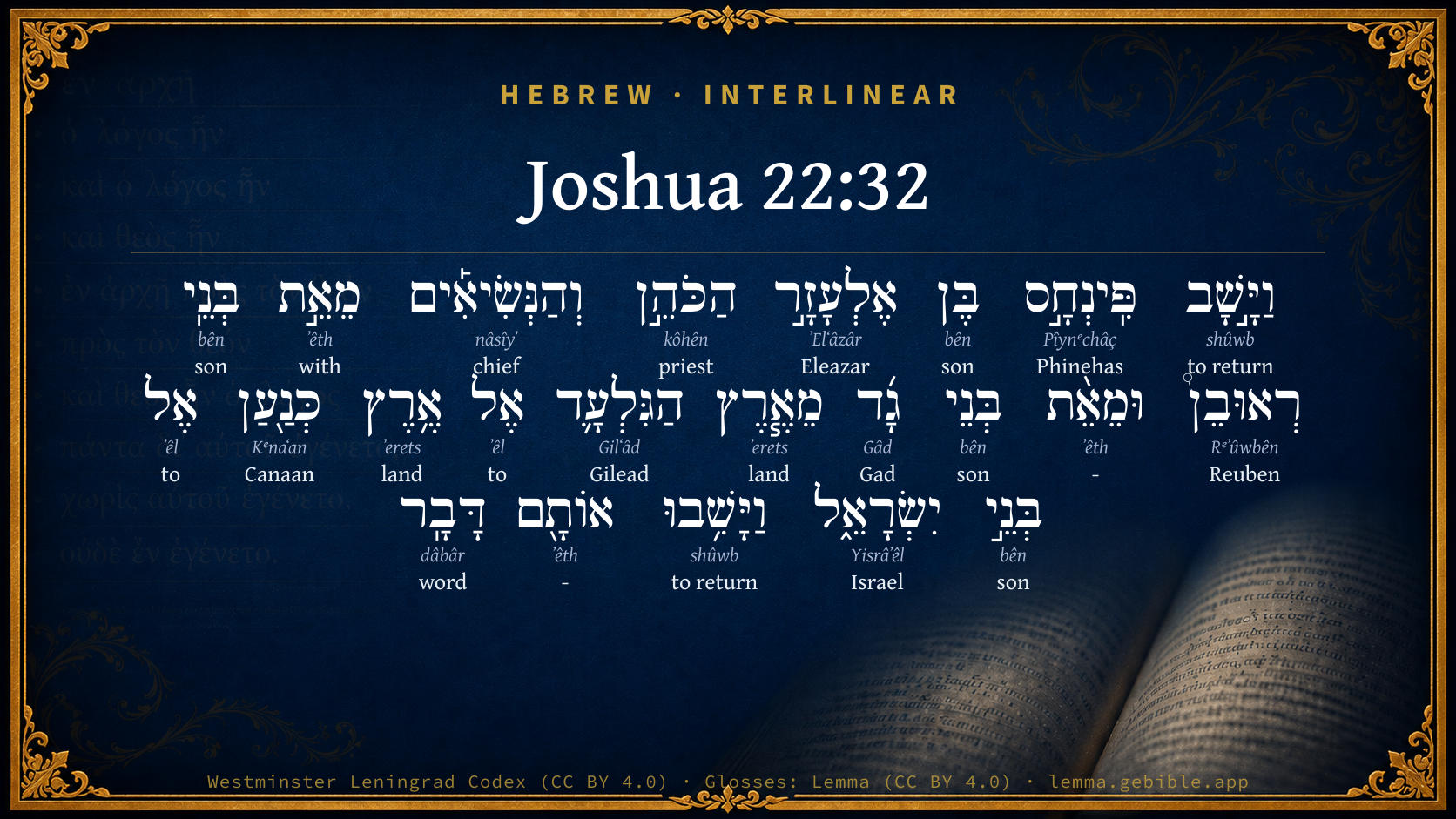
Hebrew (Westminster Leningrad Codex) Joshua 22:32 appears in the Hebrew Old Testament. The text above is from the Westminster Leningrad Codex. Each word links to its Strong’s number, a concise gloss, and parsing drawn from the Open Scriptures Hebrew Bible morphology. Click any word for its full Brown-Driver-Briggs (BDB) entry.
Download image
Cite this verse

Joshua 22:32 (World English Bible). Public Domain. Lemma interlinear Bible study tool, https://lemma.gebible.app/v/joshua/22/32.

Show BibTeX & RIS
BibTeX
RIS
English Translation
Phinehas the son of Eleazar the priest, and the princes, returned from the children of Reuben, and from the children of Gad, out of the land of Gilead, to the land of Canaan, to the children of Israel, and brought them word again.
World English Bible · Public Domain
Download a study sheet

One document with this verse’s original text, its word-by-word gloss line, the meaning frame, cross-references with their text, attributed commentary, and full source and license credits — printable, and it pastes into notes with its structure intact.

This verse Autodidact and up

Study sheet (.html) Plain text (.txt)

A passage Seminary Student

Up to 50 verses in one chapter. A passage sheet keeps up to 6 commentary sources and 12 cross-references per verse, in the order this page ranks them, and says so on the sheet whenever that leaves anything out. Ask for a single verse and you get the Autodidact verse sheet above.

Everything on this page stays free to read, with no account — the sheet is a download of what is already on screen, not access to it.

Want to remove ads? Support Godless Engineer
Compare translations 3

The same verse in 3 English versions, stacked beneath the original-language interlinear above. Click any original word for its lexicon entry.

Each is an independent rendering of the whole verse — the interlinear is not word-aligned to these translations.

Highlighted words mark where these versions differ — a whole-verse word diff, not a word-by-word alignment.

  • World English Bible Public Domain
    Phinehas the son of Eleazar the priest, and the princes, returned from the children of Reuben, and from the children of Gad, out of the land of Gilead, to the land of Canaan, to the children of Israel, and brought them word again.
  • King James Version Public Domain
    And Phinehas the son of Eleazar the priest, and the princes, returned from the children of Reuben, and from the children of Gad, out of the land of Gilead, unto the land of Canaan, to the children of Israel, and brought them word again.
  • unfoldingWord Literal Text CC BY-SA 4.0
    And Phinehas, the son of Eleazar the priest, and the leaders returned from with the sons of Reuben and from with the sons of Gad, from the land of Gilead to the land of Canaan, to the sons of Israel. And they brought them a word.

unfoldingWord Literal Text — © unfoldingWord, licensed CC BY-SA 4.0. Word-aligned USFM3 via Door43 (git.door43.org/unfoldingWord/en_ult).

Versions to compare (up to 4)

3 of 4 selected

Show all 18 translations

Every available English version of this verse, each an independent rendering of the whole verse.

  • World English Bible Public Domain
    Phinehas the son of Eleazar the priest, and the princes, returned from the children of Reuben, and from the children of Gad, out of the land of Gilead, to the land of Canaan, to the children of Israel, and brought them word again.
  • Berean Standard Bible Public Domain
    Then Phinehas son of Eleazar the priest, together with the other leaders, returned to the Israelites in the land of Canaan and brought back a report regarding the Reubenites and Gadites in the land of Gilead.
  • Majority Standard Bible Public Domain
    Then Phinehas son of Eleazar the priest, together with the other leaders, returned to the Israelites in the land of Canaan and brought back a report regarding the Reubenites and Gadites in the land of Gilead.
  • King James Version Public Domain
    And Phinehas the son of Eleazar the priest, and the princes, returned from the children of Reuben, and from the children of Gad, out of the land of Gilead, unto the land of Canaan, to the children of Israel, and brought them word again.
  • American Standard Version (1901) Public Domain
    And Phinehas the son of Eleazar the priest, and the princes, returned from the children of Reuben, and from the children of Gad, out of the land of Gilead, unto the land of Canaan, to the children of Israel, and brought them word again.
  • Revised Version (1885) Public Domain
    And Phinehas the son of Eleazar the priest, and the princes, returned from the children of Reuben, and from the children of Gad, out of the land of Gilead, unto the land of Canaan, to the children of Israel, and brought them word again.
  • Geneva Bible (1599) Public Domain
    Then Phinehas the sonne of Eleazar the Priest with the princes returned from the children of Reuben, and from the children of Gad, out of the land of Gilead, vnto the land of Canaan, to the children of Israel, and brought them answere.
  • Douay-Rheims (1899) Public Domain
    And he returned with the princes from the children of Ruben and Gad, out of the land of Galaad, into the land of Chanaan, to the children of Israel, and brought them word again.
  • Young's Literal Translation Public Domain
    And Phinehas son of Eleazar the priest, and the princes, turn back from the sons of Reuben, and from the sons of Gad, out of the land of Gilead, unto the land of Canaan, unto the sons of Israel, and bring them back word;
  • Literal Standard Version CC BY-SA 4.0
    And Phinehas son of Eleazar the priest, and the princes, turn back from the sons of Reuben, and from the sons of Gad, out of the land of Gilead, to the land of Canaan, to the sons of Israel, and bring them back word;
  • Unlocked Literal Bible CC BY-SA 4.0
    Then Phinehas son of Eleazar the priest, and the leaders returned from the Reubenites and the Gadites, out of the land of Gilead, back to the land of Canaan, to the people of Israel, and brought back word to them.
  • unfoldingWord Literal Text CC BY-SA 4.0
    And Phinehas, the son of Eleazar the priest, and the leaders returned from with the sons of Reuben and from with the sons of Gad, from the land of Gilead to the land of Canaan, to the sons of Israel. And they brought them a word.
  • Darby Bible Public Domain
    And Phinehas the son of Eleazar the priest, and the princes, returned from the children of Reuben, and from the children of Gad, out of the land of Gilead, to the land of Canaan, to the children of Israel, and brought them word again.
  • World Messianic Bible Public Domain
    Phinehas the son of Eleazar the priest, and the princes, returned from the children of Reuben, and from the children of Gad, out of the land of Gilead, to the land of Canaan, to the children of Israel, and brought them word again.
  • Webster's Bible Public Domain
    And Phinehas the son of Eleazar the priest, and the princes, returned from the children of Reuben, and from the children of Gad, from the land of Gilead, to the land of Canaan, to the children of Israel, and brought them word again.
  • Free Bible Version CC BY-SA 4.0
    Then Phinehas and the Israelite leaders left the tribes of Reuben and Gad, and the half-tribe of Manasseh in the land of Gilead and returned to the land of Canaan to explain the situation to the Israelites.
  • Bible in Basic English Public Domain
    Then Phinehas, the son of Eleazar the priest, and the chiefs went back from the land of Gilead, from the children of Reuben and the children of Gad, and came to the children of Israel in Canaan and gave them the news.
  • JPS Tanakh (1917) Public Domain
    And Phinehas the son of Eleazar the priest, and the princes, returned from the children of Reuben, and from the children of Gad, out of the land of Gilead, unto the land of Canaan, to the children of Israel, and brought them back word.

Literal Standard Version (2020), Covenant Press — licensed CC BY-SA 4.0. Text via the HelloAO Bible API (eBible.org). Unlocked Literal Bible (unfoldingWord) — licensed CC BY-SA 4.0. Text via the HelloAO Bible API (eBible.org). unfoldingWord Literal Text — © unfoldingWord, licensed CC BY-SA 4.0. Word-aligned USFM3 via Door43 (git.door43.org/unfoldingWord/en_ult). Free Bible Version, Dr. Jonathan Gallagher — licensed CC BY-SA 4.0. Text via the HelloAO Bible API (eBible.org).

Word by word

More ways to search: Search by grammar → Find every occurrence → Compare this word →

Practice this passage: Drill this verse → Learn its vocabulary →

פִּֽינְחָ֣ס
Pîynᵉchâç
H6372
“Phinehas”
Noun, Proper
Part of Speech
Noun
Type
Proper
Full BDB Definition

Origin: apparently from H6310 and a variation of H5175

TWOT: None

Phinehas = "mouth of brass" - son of Eleazar and grandson of Aaron; his zealousness for the Lord averted a plague on Israel and gained him the promise of the Lord of an everlasting priesthood in his family - a priest and the son of the priest Eli - the father of a helper of Ezra
  1. וַיָּ֣שָׁב shûwb H7725 “and · to return” Conjunction + Verb, Qal, Sequential Imperfect, 3rd Person, Masculine, Singular
  2. בֶּן bên H1121 “son of” Noun, Common, Masculine, Singular, Construct
  3. אֶלְעָזָ֣ר ʼElʻâzâr H499 “Eleazar” Noun, Proper
  4. הַכֹּהֵ֣ן kôhên H3548 “the · priest” Particle, Definite Article + Noun, Common, Masculine, Singular, Absolute
  5. וְהַנְּשִׂיאִ֡ים nâsîyʼ H5387 “and · the · chiefs” Conjunction + Particle, Definite Article + Noun, Common, Masculine, Plural, Absolute
  6. מֵאֵ֣ת ʼêth H854 “from · with” Preposition + Preposition
  7. בְּנֵֽי bên H1121 “sons of” Noun, Common, Masculine, Plural, Construct
  8. רְאוּבֵן֩ Rᵉʼûwbên H7205 “Reuben” Noun, Proper
  9. וּמֵאֵ֨ת ʼêth H853 “and · from · -” Conjunction + Preposition + Particle, Direct Object
  10. בְּנֵי bên H1121 “sons of” Noun, Common, Masculine, Plural, Construct
  11. גָ֜ד Gâd H1410 “Gad” Noun, Proper
  12. מֵאֶ֧רֶץ ʼerets H776 “from · land of” Preposition + Noun, Common, Both, Singular, Construct
  13. הַגִּלְעָ֛ד Gilʻâd H1568 “the · Gilead” Particle, Definite Article + Noun, Proper
  14. אֶל ʼêl H413 “to” Preposition
  15. אֶ֥רֶץ ʼerets H776 “land of” Noun, Common, Both, Singular, Construct
  16. כְּנַ֖עַן Kᵉnaʻan H3667 “Canaan” Noun, Proper
  17. אֶל ʼêl H413 “to” Preposition
  18. בְּנֵ֣י bên H1121 “sons of” Noun, Common, Masculine, Plural, Construct
  19. יִשְׂרָאֵ֑ל Yisrâʼêl H3478 “Israel” Noun, Proper
  20. וַיָּשִׁ֥בוּ shûwb H7725 “and · to return” Conjunction + Verb, Hiphil, Sequential Imperfect, 3rd Person, Masculine, Plural
  21. אוֹתָ֖ם ʼêth H853 “- · them” Particle, Direct Object + Suffix, Personal, 3rd Person, Masculine, Plural
  22. דָּבָֽר dâbâr H1697 “word” Noun, Common, Masculine, Singular, Absolute

About this verse

These counts appear in no published source. They are computed here, from the morphology-tagged text and Lemma’s own curated glosses. What Lemma adds →

23
words
16
distinct lemmas
Historical
section

Notable vocabulary

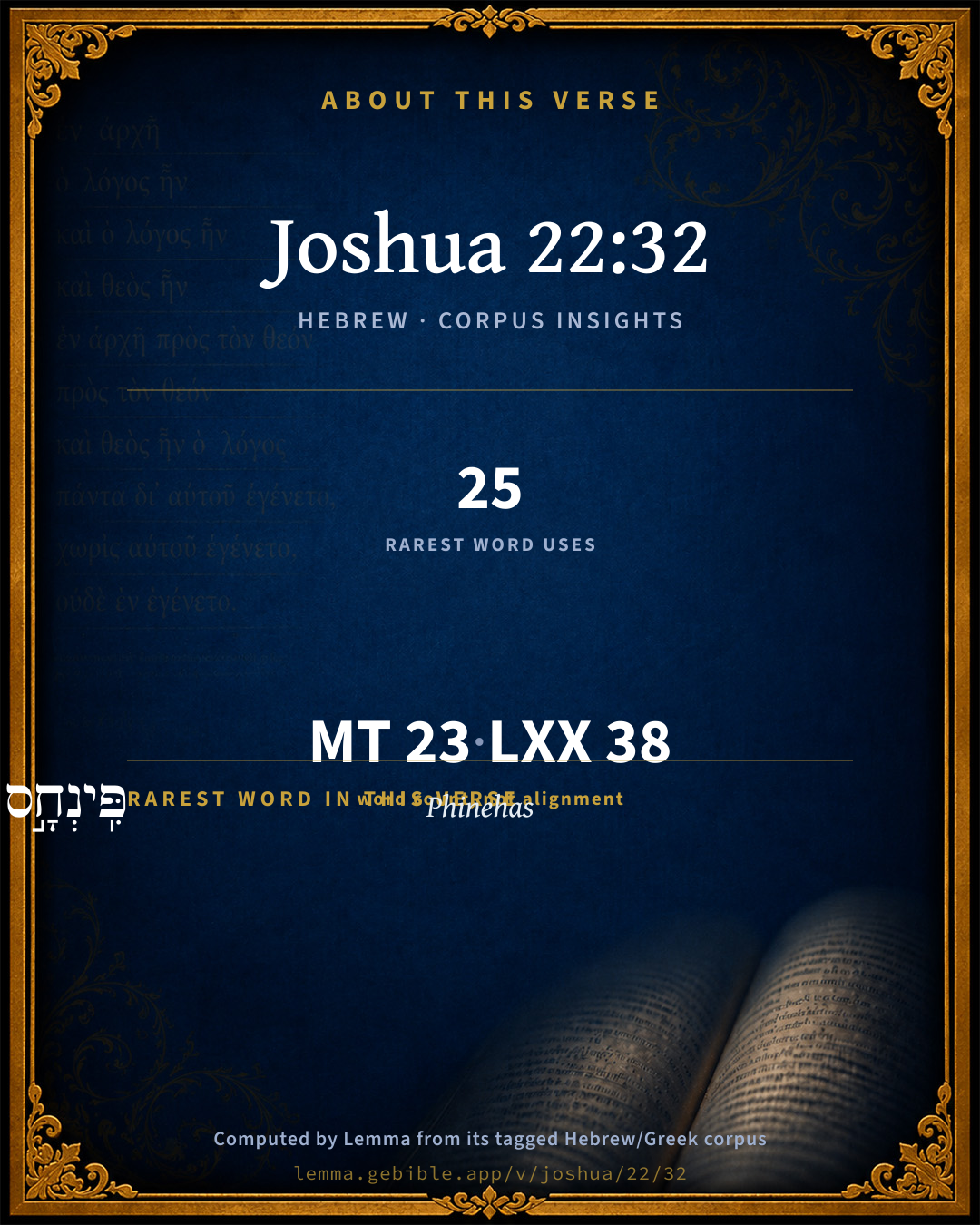
The rarest word here is פִּֽינְחָ֣ס Phinehas H6372 — appearing just 25 times in the whole Hebrew Bible.

Shared distinctive vocabulary

פִּֽינְחָ֣ס Phinehas H6372 occurs in 24 verses of the Hebrew Bible. Also found in:

Grammatical profile

  • 2 verbs
  • 16 nouns
  • 3 prepositions
  • 2 particles

Verb forms

  • וַיָּ֣שָׁב Qal · Sequential Imperfect
  • וַיָּשִׁ֥בוּ Hiphil · Sequential Imperfect

Repetition

Words recur within this verse — often emphatic in Hebrew:

  • בֶּן son H1121 ×4
  • וַיָּ֣שָׁב to return H7725 ×2
  • מֵאֶ֧רֶץ land H776 ×2
  • אֶל to H413 ×2

Hebrew & Septuagint length

In English translation the verse runs 43 words from the Hebrew and 45 from the Septuagint (LXX English) — closely comparable.

A rough comparison of the two English renderings, which tokenize alike — not a word-level alignment.

Word counts can differ between the Hebrew and the Greek without any difference in meaning — e.g. the Hebrew direct-object marker אֵת has no separate Greek word, and Greek often adds the article ὁ.

In the original languages it is 23 Hebrew tokens and 38 Greek tokens — but the two are counted differently (Hebrew bundles its prefixes and suffixes into one token; the Greek is in lemma form), so that isn’t a like-for-like length.

Cross-references

2

Topical passages linked to Joshua 22:32 in the Treasury of Scripture Knowledge — connected by theme and wording, ordered by reader-vote popularity; previews shown in the World English Bible.

  • Joshua 22:12–14 When the children of Israel heard of it, the whole congregation of the children of Israel gathered themselves together at Shiloh, to go up against them to war.
  • Proverbs 25:13 As the cold of snow in the time of harvest, So is a faithful messenger to those who send him; For he refreshes the soul of his masters.

Cross-references courtesy of OpenBible.info (CC BY 4.0).

Hebrew and Greek witnesses Masoretic Hebrew ↔ Greek Septuagint

The same verse in the two great witnesses to the Old Testament, shown verse-for-verse.

These are two independent witnesses, not word-aligned to each other, and the Septuagint is shown in lemma (dictionary) form.

Hebrew Joshua 22:32 Masoretic · Westminster Leningrad Codex

וַיָּ֣שָׁב פִּֽינְחָ֣ס בֶּן אֶלְעָזָ֣ר הַכֹּהֵ֣ן וְהַנְּשִׂיאִ֡ים מֵאֵ֣ת בְּנֵֽי רְאוּבֵן֩ וּמֵאֵ֨ת בְּנֵי גָ֜ד מֵאֶ֧רֶץ הַגִּלְעָ֛ד אֶל אֶ֥רֶץ כְּנַ֖עַן אֶל בְּנֵ֣י יִשְׂרָאֵ֑ל וַיָּשִׁ֥בוּ אוֹתָ֖ם דָּבָֽר

Phinehas the son of Eleazar the priest, and the princes, returned from the children of Reuben, and from the children of Gad, out of the land of Gilead, to the land of Canaan, to the children of Israel, and brought them word again.

World English Bible · Public Domain

Greek LXX Joshua 22:32 Septuagint · lemma form

καί ἀποστρέφω φινεες ὁ ἱερεύς καί ὁ ἄρχων ἀπό ὁ υἱός ρουβην καί ἀπό ὁ υἱός γαδ καί ἀπό ὁ ἥμισυς φυλή μανασσή ἐκ γῆ γαλαάδ εἰς γῆ χανααν πρός ὁ υἱός ἰσραήλ καί ἀποκρίνω αὐτός ὁ λόγος

So Phinees the priest and the princes departed from the children of Ruben, and from the children of Gad, and from the half tribe of Manasse out of Galaad into the land of Chanaan to the children of Israel; and reported the words to them.

LXX2012 (modern English Septuagint) · Public Domain

Hebrew: Westminster Leningrad Codex (CC BY 4.0). Greek: Septuagint (public domain); English from LXX2012 (modern English Septuagint) (Public Domain). How the Septuagint differs from the Hebrew →

Targum (Aramaic paraphrase)

1

The Targum is the ancient Jewish Aramaic paraphrase of the Hebrew Scriptures — an interpretive translation, not the Hebrew text itself. Onkelos (literal) and Pseudo-Jonathan (expansive) render the Torah, and Jonathan the Prophets. Coverage is partial: where no permissively-licensed English translation exists for a verse, only the Aramaic is shown. This is verse-level text, not a word-by-word alignment to the Hebrew.

  1. Targum Jonathan Prophets (Joshua–Malachi)
    וְתַב פִינְחָס בַּר אֶלְעָזָר כַּהֲנָא וְרַבְרְבַיָא מִלְוַת בְּנֵי רְאוּבֵן וּמִלְּוַת בְּנֵי גָד מֵאַרְעָא גִלְעָד לְאַרְעָא דִכְנָעַן לְוַת בְּנֵי יִשְׂרָאֵל וַאֲתִיבוּ יַתְהוֹן פִּתְגָמָא:

    (no public-domain English translation for this verse)

    Targum Jonathan — Aramaic: “Mikraot Gedolot” (public domain). English: “Sefaria Community Translation” (CC0 1.0 (public-domain dedication)); “London "Chaldee Paraphrase," 1871” (public domain). Text via Sefaria.

Commentary

Notes on Joshua 22:32 from classic Christian and Jewish commentators (each source and its license shown beneath its notes). The classic Christian expositions comment on the surrounding passage and are grouped to its opening verse, so a note may address several verses; the Jewish commentaries on the Tanakh (Rashi and others) are per-verse, so they appear only where the commentator wrote on this verse.

Lemma curates 59 commentaries, every one of them public domain or Creative Commons licensed, each selected and text-cleaned for this edition rather than reprinted as found. About our sources →

John Gill's Exposition

And the thing pleased the children of Israel,.... They were quite satisfied with the account of things, and were pleased and delighted with what their brethren, the other two tribes, had done:

and the children of Israel blessed God: returned thanks to him, that there was no trespass committed against him, and no schism like to be made among them, nor any wrath to come upon them:

and did not intend to go up against them in battle; for though upon first hearing of their building an altar, which they supposed was for idolatry, they had intended to make war against them, but now understanding the design of that building, they laid aside all thoughts of that kind:

to destroy the land wherein the children of Reuben and Gad dwelt; which they judged by the law in Deu 13:12 they were obliged to do. The Greek version here adds also, "and the half tribe of Manasseh", and renders the last clause, and "they dwelt in it"; continued to dwell in it undisturbed by their brethren.

John Gill's Exposition of the Whole Bible (1746–1763) — public domain (CC PDM 1.0). Text via the HelloAO Bible API.

Haydock's Catholic Bible Commentary

Into, &c. (finium Chanaan) "of the confines of Chanaan," which is ambiguous. (Haydock) --- But the Hebrew removes the difficulty in this manner.

George Leo Haydock (1774–1849), Haydock's Catholic Family Bible and Commentary, 1859 edition — public domain. Excludes Psalms (Douay-Rheims chapter numbering differs from Protestant) and Deuterocanonical books (Catholic canon only).

Keil & Delitzsch

C. F. Keil & F. Delitzsch

They then returned to Canaan and informed the congregation. And the thing pleased them, so that they praised the Lord, sc., for having kept their brethren on the other side from rebellion, and they thought no more of going to war against them, or laying waste the land of the tribes on the east of the Jordan.

Keil & Delitzsch — Biblical Commentary on the Old Testament (1861–1891) — public domain (CC PDM 1.0). Text via the HelloAO Bible API. (Old Testament only.)

unfoldingWord translationNotes

Door43 World Missions Community

Their report was good in the eyes of the people

Here "good in the eyes" means "accepted." AT: "The people accepted the report of the leaders" (See: Idiom)

destroy the land

"destroy everything in the land"

translationWords

Gilead

Canaan

bless

unfoldingWord translationNotes — © Distant Shores Media and the Door43 World Missions Community, licensed CC BY-SA 4.0. Source: git.door43.org/Door43/en_tn.

Lesson kit

Teaching starters — assembled from the data on this page, not authored interpretation. Every prompt links to the verse data it draws on. Edit before teaching.

Joshua, in the Historical, opens this verse with 23 words (16 distinct Hebrew lemmas). Its most distinctive word is Pîynᵉchâç (“Phinehas”). A historical commentator’s framing appears above. Read the whole chapter for the surrounding context.

Discussion questions

  1. What does “Phinehas” (Pîynᵉchâç) contribute to the verse as a whole?
  2. How does Exodus 6:25, which shares the word «Phinehas», read alongside this verse?
  3. What does the repetition of “son” (4× in this one verse) do in this verse?
  4. These translations render this verse differently; the difference is in the English rendering, not the original. What questions does that raise?
  5. «וַיָּ֣שָׁב» is a Qal Sequential Imperfect verb. How does that grammatical form shape the action described?
  6. Compare how John Gill's Exposition and Haydock's Catholic Bible Commentary read this verse. Where do they agree or differ?

Things to notice

Reading settings

Reading text

Shown beneath each verse's original-language words.

Old Testament
Old Testament edition

Read the OT as the Masoretic Hebrew (MT) or the Greek Septuagint (LXX).

English shown for the Greek Septuagint (in the Hebrew ↔ Greek comparison).

Comparing translations? Open the Compare panel on any verse page to stack up to four side by side.