

Luke 9:41
Greek (Tischendorf 8th ed.) Luke 9:41 appears in the Greek New Testament. The text above is from the Tischendorf 8th edition. Each word links to its Strong’s number and a concise gloss. Click any word for its full Thayer’s Greek Lexicon entry.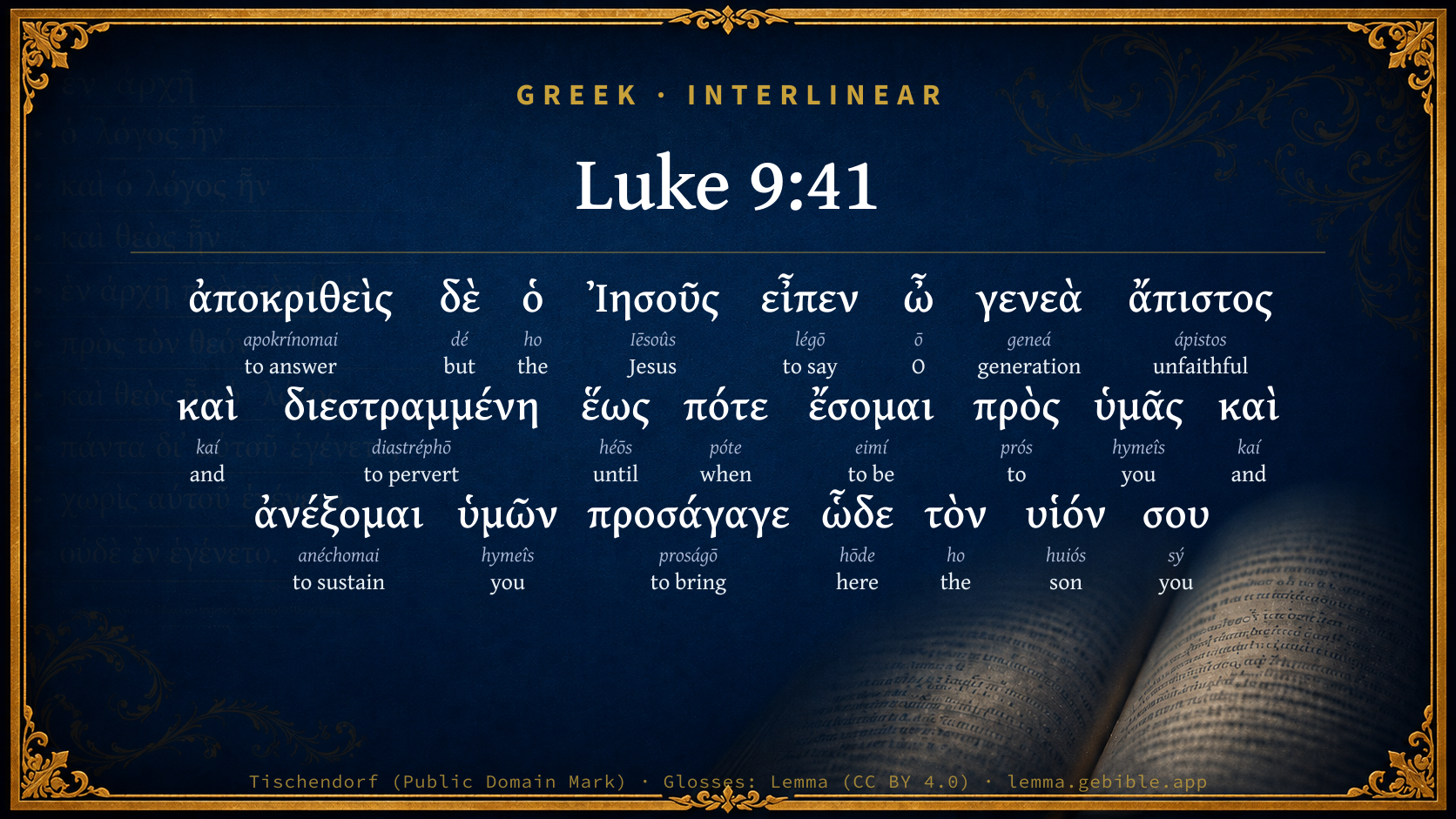
Jesus answered, "Faithless and perverse generation, how long shall I be with you and bear with you? Bring your son here."
Download a study sheet
One document with this verse’s original text, its word-by-word gloss line, the meaning frame, cross-references with their text, attributed commentary, and full source and license credits — printable, and it pastes into notes with its structure intact.
This verse Autodidact and up
A passage Seminary Student
Up to 50 verses in one chapter. A passage sheet keeps up to 6 commentary sources and 12 cross-references per verse, in the order this page ranks them, and says so on the sheet whenever that leaves anything out. Ask for a single verse and you get the Autodidact verse sheet above.
Everything on this page stays free to read, with no account — the sheet is a download of what is already on screen, not access to it.
Compare translations 3
The same verse in 3 English versions, stacked beneath the original-language interlinear above. Click any original word for its lexicon entry.
Each is an independent rendering of the whole verse — the interlinear is not word-aligned to these translations.
Highlighted words mark where these versions differ — a whole-verse word diff, not a word-by-word alignment.
-
World English Bible Public Domain
Jesus answered, "Faithless and perverse generation, how long shall I be with you and bear with you? Bring your son here."
-
King James Version Public Domain
And Jesus answering said, O faithless and perverse generation, how long shall I be with you, and suffer you? Bring thy son hither.
-
unfoldingWord Literal Text CC BY-SA 4.0
But answering, Jesus said, “O unbelieving and perverted generation, until when will I be with you and bear with you? Bring your son here.”
unfoldingWord Literal Text — © unfoldingWord, licensed CC BY-SA 4.0. Word-aligned USFM3 via Door43 (git.door43.org/unfoldingWord/en_ult).
Show all 19 translations
Every available English version of this verse, each an independent rendering of the whole verse.
-
World English Bible Public Domain
Jesus answered, "Faithless and perverse generation, how long shall I be with you and bear with you? Bring your son here."
-
Berean Standard Bible Public Domain
“O unbelieving and perverse generation!” Jesus replied. “How long must I remain with you and put up with you? Bring your son here.”
-
Majority Standard Bible Public Domain
“O unbelieving and perverse generation!” Jesus replied. “How long must I remain with you and put up with you? Bring your son here.”
-
King James Version Public Domain
And Jesus answering said, O faithless and perverse generation, how long shall I be with you, and suffer you? Bring thy son hither.
-
American Standard Version (1901) Public Domain
And Jesus answered and said, O faithless and perverse generation, how long shall I be with you, and bear with you? bring hither thy son.
-
Revised Version (1885) Public Domain
And Jesus answered and said, O faithless and perverse generation, how long shall I be with you, and bear with you? bring hither thy son.
-
Geneva Bible (1599) Public Domain
Then Iesus answered, and said, O generation faithlesse, and crooked, howe long now shall I be with you, and suffer you? bring thy sonne hither.
-
Douay-Rheims (1899) Public Domain
And Jesus answering, said: O faithless and perverse generation, how long shall I be with you, and suffer you Bring hither thy son.
-
Young's Literal Translation Public Domain
And Jesus answering said, `O generation, unstedfast and perverse, till when shall I be with you, and suffer you? bring near hither thy son;'
-
Literal Standard Version CC BY-SA 4.0
And Jesus answering said, “O generation, unsteadfast and perverse, until when will I be with you, and endure you? Bring your son near here”;
-
Unlocked Literal Bible CC BY-SA 4.0
Jesus answered and said, “You unbelieving and depraved generation, how long must I be with you and put up with you? Bring your son here.”
-
unfoldingWord Literal Text CC BY-SA 4.0
But answering, Jesus said, “O unbelieving and perverted generation, until when will I be with you and bear with you? Bring your son here.”
-
Darby Bible Public Domain
And Jesus answering said, O unbelieving and perverted generation, how long shall I be with you and suffer you? Bring hither thy son.
-
World Messianic Bible Public Domain
Yeshua answered, “Faithless and perverse generation, how long shall I be with you and bear with you? Bring your son here.”
-
Webster's Bible Public Domain
And Jesus answering, said, O faithless and perverse generation, how long shall I be with you, and suffer you? Bring thy son hither.
-
Free Bible Version CC BY-SA 4.0
“What an unbelieving and corrupt people you are! How long do I have to remain here with you, and put up with you?” said Jesus. “Bring your son here.”
-
Bible in Basic English Public Domain
And Jesus said, O generation without faith and false in heart, how long will I have to be with you and put up with you? let your son come here.
-
Text-Critical English NT CC BY 4.0
Jesus answered, “O faithless and perverse generation, how long shall I be with you and bear with you? Bring yoʋr son here.”
-
Tyndale New Testament (1534) Public Domain
Iesus answered and sayde: O generacion with oute fayth and croked: how longe shall I be with you? and shall suffre you? Bringe thy sonne hidder.
Literal Standard Version (2020), Covenant Press — licensed CC BY-SA 4.0. Text via the HelloAO Bible API (eBible.org). Unlocked Literal Bible (unfoldingWord) — licensed CC BY-SA 4.0. Text via the HelloAO Bible API (eBible.org). unfoldingWord Literal Text — © unfoldingWord, licensed CC BY-SA 4.0. Word-aligned USFM3 via Door43 (git.door43.org/unfoldingWord/en_ult). Free Bible Version, Dr. Jonathan Gallagher — licensed CC BY-SA 4.0. Text via the HelloAO Bible API (eBible.org).
Word by word
More ways to search: Search by grammar → Find every occurrence → Compare this word →
Practice this passage: Drill this verse → Learn its vocabulary →
- Appears 4× in the Greek New Testament
- First appears here
- Part of Speech
- Verb
- Tense
- Aorist
- Voice
- Active
- Mood
- Imperative
- Person
- 2nd person
- Number
- Singular
Full Thayer's Definition
- ἀποκριθεὶς apokrínomai G611 “to answer” Verb, Aorist, Passive deponent, Participle, Nominative, Singular, Masculine
- δὲ dé G1161 “but” Conjunction
- ὁ ho G3588 “the” Article, Nominative, Singular, Masculine
- Ἰησοῦς Iēsoûs G2424 “Jesus” Noun, Nominative, Singular, Masculine
- εἶπεν légō G3004 “to say” Verb, Aorist, Active, Indicative, 3rd person, Singular
- ὦ ō G5599 “O” Interjection
- γενεὰ geneá G1074 “generation” Noun, Vocative, Singular, Feminine
- ἄπιστος ápistos G571 “unfaithful” Adjective, Vocative, Singular, Feminine
- καὶ kaí G2532 “and” Conjunction
- διεστραμμένη diastréphō G1294 “to pervert” Verb, Perfect, Passive, Participle, Nominative, Singular, Feminine
- ἕως héōs G2193 “until” Adverb
- πότε póte G4219 “when” Particle, Interrogative
- ἔσομαι eimí G1510 “to be” Verb, Future, Middle deponent, Indicative, 1st person, Singular
- πρὸς prós G4314 “to” Preposition
- ὑμᾶς hymeîs G5210 “you” Personal pronoun, 2nd person, Accusative, Plural
- καὶ kaí G2532 “and” Conjunction
- ἀνέξομαι anéchomai G430 “to sustain” Verb, Future, Middle deponent, Indicative, 1st person, Singular
- ὑμῶν hymeîs G5210 “you” Personal pronoun, 2nd person, Genitive, Plural
- προσάγαγε proságō G4317 “to bring” Verb, Aorist, Active, Imperative, 2nd person, Singular
- ὧδε hōde G5602 “here” Adverb
- τὸν ho G3588 “the” Article, Accusative, Singular, Masculine
- υἱόν huiós G5207 “son” Noun, Accusative, Singular, Masculine
- σου sý G4771 “you” Personal pronoun, 2nd person, Genitive, Singular
About this verse
These counts appear in no published source. They are computed here, from the morphology-tagged text and Lemma’s own curated glosses. What Lemma adds →
- 23
- words
- 20
- distinct lemmas
- Gospels
- section
Notable vocabulary
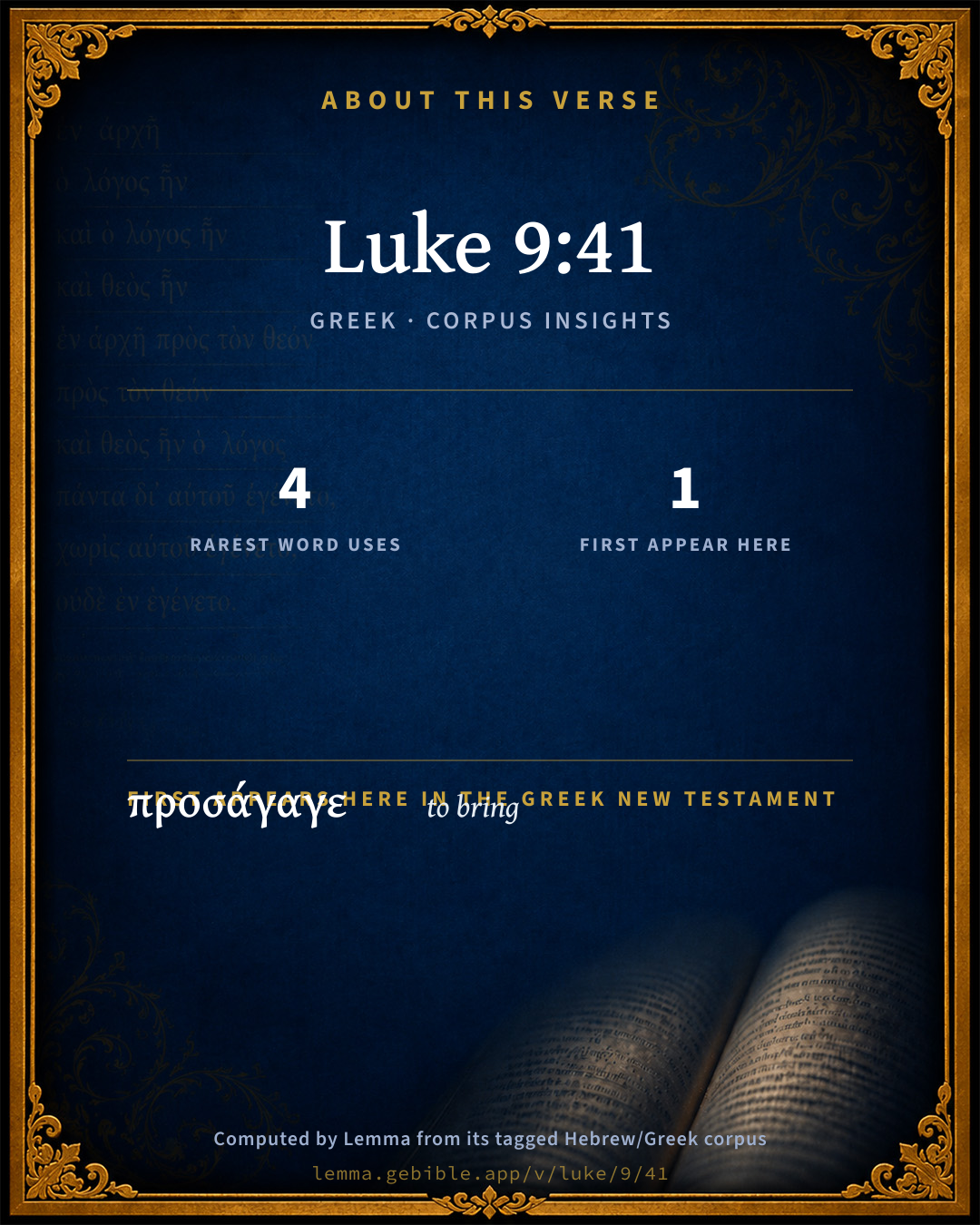
The rarest word here is προσάγαγε to bring G4317 — appearing just 4 times in the whole Greek New Testament.
First appearance in Scripture
This word makes its first canonical appearance in the Greek New Testament here:
- προσάγαγε to bring G4317
Shared distinctive vocabulary
προσάγαγε to bring G4317 occurs in 4 verses of the Greek New Testament. Also found in:
Cross-references
28Topical passages linked to Luke 9:41 in the Treasury of Scripture Knowledge — connected by theme and wording, ordered by reader-vote popularity; previews shown in the World English Bible.
- Deuteronomy 32:5 They have dealt corruptly with him, [they are] not his children, [it is] their blemish; [They are] a perverse and crooked generation.
- Matthew 16:4 An evil and adulterous generation seeks after a sign, and there will be no sign given to it, except the sign of the prophet Jonah." He left them, and departed.
- Matthew 17:17 Jesus answered, "Faithless and perverse generation! How long will I be with you? How long will I bear with you? Bring him here to me."
- Mark 9:19 He answered him, "Unbelieving generation, how long shall I be with you? How long shall I bear with you? Bring him to me."
- John 14:9 Jesus said to him, "Have I been with you such a long time, and do you not know me, Philip? He who has seen me has seen the Father. How do you say, 'Show us the Father?'
- John 20:27 Then he said to Thomas, "Reach here your finger, and see my hands. Reach here your hand, and put it into my side. Don't be unbelieving, but believing."
- Romans 2:4 Or do you despise the riches of his goodness, forbearance, and patience, not knowing that the goodness of God leads you to repentance?
- Exodus 10:3 Moses and Aaron went in to Pharaoh, and said to him, "This is what Yahweh, the God of the Hebrews, says: 'How long will you refuse to humble yourself before me? Let my people go, that they may serve me.
- Exodus 16:28 Yahweh said to Moses, "How long do you refuse to keep my commandments and my laws?
- Numbers 14:11 Yahweh said to Moses, How long will this people despise me? and how long will they not believe in me, for all the signs which I have worked among them?
- Numbers 14:27 How long [shall I bear] with this evil congregation, that murmur against me? I have heard the murmurings of the children of Israel, which they murmur against me.
- 2 Kings 5:8 It was so, when Elisha the man of God heard that the king of Israel had torn his clothes, that he sent to the king, saying, Why have you torn your clothes? let him come now to me, and he shall know that there is a prophet in Israel.
- Jeremiah 4:14 Jerusalem, wash your heart from wickedness, that you may be saved. How long shall your evil thoughts lodge within you?
- Matthew 3:7 But when he saw many of the Pharisees and Sadducees coming for his baptism, he said to them, "You offspring of vipers, who warned you to flee from the wrath to come?
- Matthew 12:39 But he answered them, "An evil and adulterous generation seeks after a sign, but no sign will be given it but the sign of Jonah the prophet.
- Acts 2:40 With many other words he testified, and exhorted them, saying, "Save yourselves from this crooked generation!"
- Hebrews 3:9–11 Where your fathers tested me by proving me, And saw my works for forty years.
- Hebrews 3:19 We see that they were not able to enter in because of unbelief.
- Hebrews 4:2 For indeed we have had good news preached to us, even as they also did, but the word they heard didn't profit them, because it wasn't mixed with faith by those who heard.
- Hebrews 4:11 Let us therefore give diligence to enter into that rest, lest anyone fall after the same example of disobedience.
- Hebrews 7:25 Therefore he is also able to save to the uttermost those who draw near to God through him, seeing he ever lives to make intercession for them.
- Psalms 78:8 And might not be as their fathers, A stubborn and rebellious generation, A generation that didn't make their hearts loyal, Whose spirit was not steadfast with God.
- Matthew 12:45 Then he goes, and takes with himself seven other spirits more evil than he is, and they enter in and dwell there. The last state of that man becomes worse than the first. Even so will it be also to this evil generation."
- Matthew 23:36 Most assuredly I tell you, all these things will come upon this generation.
- Mark 10:14 But when Jesus saw it, he was moved with indignation, and said to them, "Allow the little children to come to me! Don't forbid them, for the Kingdom of God belongs to such as these.
- Mark 10:49 Jesus stood still, and said, "Call him." They called the blind man, saying to him, "Cheer up! Get up. He is calling you!"
- Luke 8:25 He said to them, "Where is your faith?" Being afraid they marveled, saying one to another, "Who is this, then, that he commands even the winds and the water, and they obey him?"
- Acts 13:18 For a period of about forty years he put up with them in the wilderness.
Cross-references courtesy of OpenBible.info (CC BY 4.0).
Lesson kit
Teaching starters — assembled from the data on this page, not authored interpretation. Every prompt links to the verse data it draws on. Edit before teaching.
Luke, in the Gospels, opens this verse with 23 words (20 distinct Greek lemmas). Its most distinctive word is proságō (“to bring”). A historical commentator’s framing appears above. Read the whole chapter for the surrounding context.
Discussion questions
- What does “to bring” (proságō) contribute to the verse as a whole?
- This is the first place “to bring” appears in Scripture (first appears here). What does its debut here establish?
- How does Acts 16:20, which shares the word «to bring», read alongside this verse?
- What does the repetition of “the” (2× in this one verse) do in this verse?
- These translations render this verse differently; the difference is in the English rendering, not the original. What questions does that raise?
- Compare how Tyndale Open Study Notes and The Cambridge Bible for Schools and Colleges read this verse. Where do they agree or differ?
Things to notice
- 1 word makes its first canonical appearance in Scripture here.
- These translations choose different wording for 18 words in this verse.
- “the” occurs 2× in this single verse.
- 20 distinct Greek lemmas span 23 words in this verse.
Commentary
Notes on Luke 9:41 from classic Christian and Jewish commentators (each source and its license shown beneath its notes). The classic Christian expositions comment on the surrounding passage and are grouped to its opening verse, so a note may address several verses; the Jewish commentaries on the Tanakh (Rashi and others) are per-verse, so they appear only where the commentator wrote on this verse.
Lemma curates 59 commentaries, every one of them public domain or Creative Commons licensed, each selected and text-cleaned for this edition rather than reprinted as found. About our sources →
Tyndale Open Study Notes
Tyndale Open Resources
Tyndale Open Study Notes — © Tyndale Open Resources, licensed CC BY-SA 4.0. Text via the HelloAO Bible API.
The Cambridge Bible for Schools and Colleges
gen. ed. J. J. S. Perowne
The Cambridge Bible for Schools and Colleges (gen. ed. J. J. S. Perowne; Cambridge University Press, 1878–1918) — public domain. Text from a community e-Sword module.
John Gill's Exposition
John Gill's Exposition of the Whole Bible (1746–1763) — public domain (CC PDM 1.0). Text via the HelloAO Bible API.
The Pulpit Commentary
The Pulpit Commentary (1880–1919), ed. H.D.M. Spence-Jones & Joseph S. Exell — public domain. Text from a community e-Sword module.
unfoldingWord translationNotes
Door43 World Missions Community
unfoldingWord translationNotes — © Distant Shores Media and the Door43 World Missions Community, licensed CC BY-SA 4.0. Source: git.door43.org/Door43/en_tn.
Cambridge Greek Testament for Schools and Colleges
Cambridge Greek Testament for Schools and Colleges (Cambridge University Press, 1896; 21 vols, various authors incl. Carr, Maclear, Plummer, Farrar, Lumby, Moule, M. R. James, Simcox) — public domain. Text from a community e-Sword module.
International Critical Commentary
International Critical Commentary — older volumes (1896–1929), various authors — public domain. Text from a community e-Sword module.
Vincent's Word Studies in the New Testament
Marvin R. Vincent
Marvin R. Vincent, Word Studies in the New Testament (1887–1900) — public domain. Text from a community e-Sword/MySword module.
Godet's Commentaries
Frédéric Louis Godet
Frédéric Louis Godet — Commentaries on Luke, John, Romans, and 1 Corinthians — English translation (T&T Clark, Edinburgh, 1870s–1890s) — public domain. Text from a community e-Sword module.