Luke 17:37

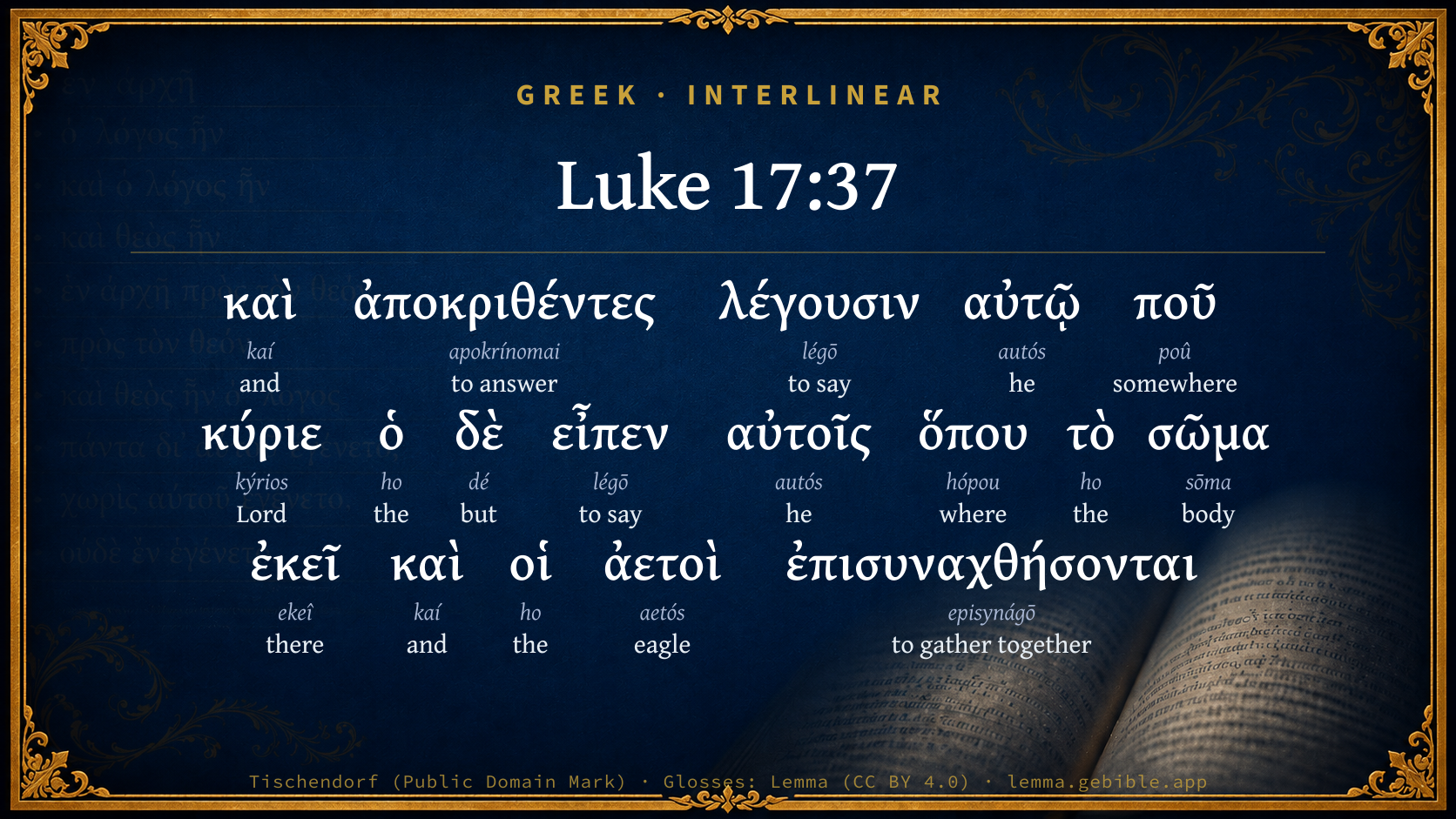
Greek (Tischendorf 8th ed.) Luke 17:37 appears in the Greek New Testament. The text above is from the Tischendorf 8th edition. Each word links to its Strong’s number and a concise gloss. Click any word for its full Thayer’s Greek Lexicon entry.
Download image
Cite this verse

Luke 17:37 (World English Bible). Public Domain. Lemma interlinear Bible study tool, https://lemma.gebible.app/v/luke/17/37.

Show BibTeX & RIS
BibTeX
RIS
English Translation
They answering, asked him, "Where, Lord?" He said to them, "Where the body is, there will the vultures also be gathered together."
World English Bible · Public Domain
Download a study sheet

One document with this verse’s original text, its word-by-word gloss line, the meaning frame, cross-references with their text, attributed commentary, and full source and license credits — printable, and it pastes into notes with its structure intact.

This verse Autodidact and up

Study sheet (.html) Plain text (.txt)

A passage Seminary Student

Up to 50 verses in one chapter. A passage sheet keeps up to 6 commentary sources and 12 cross-references per verse, in the order this page ranks them, and says so on the sheet whenever that leaves anything out. Ask for a single verse and you get the Autodidact verse sheet above.

Everything on this page stays free to read, with no account — the sheet is a download of what is already on screen, not access to it.

Want to remove ads? Support Godless Engineer
Compare translations 3

The same verse in 3 English versions, stacked beneath the original-language interlinear above. Click any original word for its lexicon entry.

Each is an independent rendering of the whole verse — the interlinear is not word-aligned to these translations.

Highlighted words mark where these versions differ — a whole-verse word diff, not a word-by-word alignment.

  • World English Bible Public Domain
    They answering, asked him, "Where, Lord?" He said to them, "Where the body is, there will the vultures also be gathered together."
  • King James Version Public Domain
    And they answered and said unto him, Where, Lord? And he said unto them, Wheresoever the body is, thither will the eagles be gathered together.
  • unfoldingWord Literal Text CC BY-SA 4.0
    And answering, they say to him, “Where, Lord?” So he said to them, “Where the body, there also the vultures will be gathered together.”

unfoldingWord Literal Text — © unfoldingWord, licensed CC BY-SA 4.0. Word-aligned USFM3 via Door43 (git.door43.org/unfoldingWord/en_ult).

Versions to compare (up to 4)

3 of 4 selected

Show all 19 translations

Every available English version of this verse, each an independent rendering of the whole verse.

  • World English Bible Public Domain
    They answering, asked him, "Where, Lord?" He said to them, "Where the body is, there will the vultures also be gathered together."
  • Berean Standard Bible Public Domain
    “Where, Lord?” they asked. Jesus answered, “Wherever there is a carcass, there the vultures will gather.”
  • Majority Standard Bible Public Domain
    “Where, Lord?” they asked. Jesus answered, “Wherever there is a carcass, there the vultures will gather.”
  • King James Version Public Domain
    And they answered and said unto him, Where, Lord? And he said unto them, Wheresoever the body is, thither will the eagles be gathered together.
  • American Standard Version (1901) Public Domain
    And they answering say unto him, Where, Lord? And he said unto them, Where the body `is', thither will the eagles also be gathered together.
  • Revised Version (1885) Public Domain
    And they answering say unto him, Where, Lord? And he said unto them, Where the body is, thither will the eagles also be gathered together.
  • Geneva Bible (1599) Public Domain
    And they answered, and saide to him, Where, Lord? And he said vnto them, Wheresoeuer the body is, thither shall also the eagles bee gathered together.
  • Douay-Rheims (1899) Public Domain
    Who said to them: Wheresoever the body shall be, thither will the eagles also be gathered together.
  • Young's Literal Translation Public Domain
    And they answering say to him, `Where, sir?' and he said to them, `Where the body `is', there will the eagles be gathered together.'
  • Literal Standard Version CC BY-SA 4.0
    And they answering say to Him, “Where, Lord?” And He said to them, “Where the body [is], there the eagles will be gathered together.”
  • Unlocked Literal Bible CC BY-SA 4.0
    They asked him, “Where, Lord?” and he said to them, “Where there is a body, there will the vultures also be gathered together.”
  • unfoldingWord Literal Text CC BY-SA 4.0
    And answering, they say to him, “Where, Lord?” So he said to them, “Where the body, there also the vultures will be gathered together.”
  • Darby Bible Public Domain
    And answering they say to him, Where, Lord? And he said to them, Where the body [is], there the eagles will be gathered together.
  • World Messianic Bible Public Domain
    They, answering, asked him, “Where, Lord?” He said to them, “Where the body is, there the vultures will also be gathered together.”
  • Webster's Bible Public Domain
    And they answered and said to him, Where Lord? And he said to them, Wherever the body is, thither will the eagles be collected.
  • Free Bible Version CC BY-SA 4.0
    “Where, Lord?” they asked. “Where the carcass is, that's where the vultures gather,” Jesus replied.
  • Bible in Basic English Public Domain
    And they, answering him, said, Where, Lord? And he said to them, Where the body is, there will the eagles come together.
  • Text-Critical English NT CC BY 4.0
    Then the disciples said to him in response, “Where, Lord?” He said to them, “Where the body is, there the vultures will be gathered together.”
  • Tyndale New Testament (1534) Public Domain
    And they answered and sayde to him: wheare Lorde? And he sayd vnto the: whersoever the body shalbe thyther will the egles resoorte.

Literal Standard Version (2020), Covenant Press — licensed CC BY-SA 4.0. Text via the HelloAO Bible API (eBible.org). Unlocked Literal Bible (unfoldingWord) — licensed CC BY-SA 4.0. Text via the HelloAO Bible API (eBible.org). unfoldingWord Literal Text — © unfoldingWord, licensed CC BY-SA 4.0. Word-aligned USFM3 via Door43 (git.door43.org/unfoldingWord/en_ult). Free Bible Version, Dr. Jonathan Gallagher — licensed CC BY-SA 4.0. Text via the HelloAO Bible API (eBible.org).

Word by word

More ways to search: Search by grammar → Find every occurrence → Compare this word →

Practice this passage: Drill this verse → Learn its vocabulary →

ἀετοὶ
aetós
G105
“eagle”
Noun, Nominative, Plural, Masculine
Part of Speech
Noun
Case
Nominative
Number
Plural
Gender
Masculine
Full Thayer's Definition

Origin: from the same as G109

TDNT: None

1. an eagle: since eagles do not usually go in quest of carrion, this may to a vulture that resembles an eagle 2. an eagle as a standard (Roman Military)
  1. καὶ kaí G2532 “and” Conjunction
  2. ἀποκριθέντες apokrínomai G611 “to answer” Verb, Aorist, Passive deponent, Participle, Nominative, Plural, Masculine
  3. λέγουσιν légō G3004 “to say” Verb, Present, Active, Indicative, 3rd person, Plural
  4. αὐτῷ autós G846 “he” Personal pronoun, Dative, Singular, Masculine
  5. ποῦ poû G4226 “somewhere” Particle, Interrogative
  6. κύριε kýrios G2962 “Lord” Noun, Vocative, Singular, Masculine
  7. ὁ ho G3588 “the” Article, Nominative, Singular, Masculine
  8. δὲ dé G1161 “but” Conjunction
  9. εἶπεν légō G3004 “to say” Verb, Aorist, Active, Indicative, 3rd person, Singular
  10. αὐτοῖς autós G846 “he” Personal pronoun, Dative, Plural, Masculine
  11. ὅπου hópou G3699 “where” Adverb
  12. τὸ ho G3588 “the” Article, Nominative, Singular, Neuter
  13. σῶμα sōma G4983 “body” Noun, Nominative, Singular, Neuter
  14. ἐκεῖ ekeî G1563 “there” Adverb
  15. καὶ kaí G2532 “and” Conjunction
  16. οἱ ho G3588 “the” Article, Nominative, Plural, Masculine
  17. ἐπισυναχθήσονται episynágō G1996 “to gather together” Verb, Future, Passive, Indicative, 3rd person, Plural

About this verse

These counts appear in no published source. They are computed here, from the morphology-tagged text and Lemma’s own curated glosses. What Lemma adds →

18
words
13
distinct lemmas
Gospels
section

Notable vocabulary

The rarest word here is ἀετοὶ eagle G105 — appearing just 5 times in the whole Greek New Testament.

Shared distinctive vocabulary

ἀετοὶ eagle G105 occurs in 5 verses of the Greek New Testament. Also found in:

Repetition

Words recur within this verse:

  • λέγουσιν to say G3004 ×2
  • ὁ the G3588 ×3
  • καὶ and G2532 ×2
  • αὐτῷ he G846 ×2

Cross-references

7

Topical passages linked to Luke 17:37 in the Treasury of Scripture Knowledge — connected by theme and wording, ordered by reader-vote popularity; previews shown in the World English Bible.

  • Matthew 24:28 For wherever the carcass is, there will the vultures be gathered together.
  • Job 39:29–30 From there he spies out the prey. His eyes see it afar off.
  • Revelation 19:17–18 I saw an angel standing in the sun. He cried with a loud voice, saying to all the birds that fly in the sky, "Come! Be gathered together to the great supper of God,
  • Zechariah 13:8–9 It shall happen that in all the land," says Yahweh, Two parts in it will be cut off and die; But the third will be left in it.
  • Amos 9:1–4 I saw the Lord standing beside the altar, and he said, "Strike the tops of the pillars, that the thresholds may shake; and break them in pieces on the head of all of them; and I will kill the last of them with the sword: there shall not one of them flee away, and there shall not one of them escape.
  • Zechariah 14:2 For I will gather all nations against Jerusalem to battle; and the city will be taken, the houses rifled, and the women ravished. half of the city will go out into captivity, and the rest of the people will not be cut off from the city.
  • Daniel 9:26–27 After the sixty-two weeks the Anointed One shall be cut off, and shall have nothing: and the people of the prince who shall come shall destroy the city and the sanctuary; and the end of it shall be with a flood, and even to the end shall be war; desolations are determined.

Cross-references courtesy of OpenBible.info (CC BY 4.0).

Commentary

Notes on Luke 17:37 from classic Christian and Jewish commentators (each source and its license shown beneath its notes). The classic Christian expositions comment on the surrounding passage and are grouped to its opening verse, so a note may address several verses; the Jewish commentaries on the Tanakh (Rashi and others) are per-verse, so they appear only where the commentator wrote on this verse.

Lemma curates 59 commentaries, every one of them public domain or Creative Commons licensed, each selected and text-cleaned for this edition rather than reprinted as found. About our sources →

The Biblical Illustrator

Joseph S. Exell

Luk_17:37

Wheresoever the body is

Gods judgments

The twofold inquiry that always greets the prophet is Where?

and When? These two questions are prompted by curiosity and self-interest. The passionate desires of human nature to know the future are testified to by the whole history of superstition and imposture. Even inspired prophecy has been treated in the spirit of this desire. Our Lord teaches us how such questions should be answered, and how such a spirit should be dealt with. He does not answer the Where and When; not even in the revelation to His beloved disciple does He do so.

I. Observe how in A VERY REAL SENSE HE DOES ANSWER THE QUESTIONS. The answer in effect is this: My judgment shall come upon the earth as come the vultures upon the dead by an unerring and terrible instinct. So truly then as there is ripeness for judgment, and wherever there is that ripeness, there shall come the judgment of the day of the Lord.

II. MARK WHAT THESE WORDS TELL US CONCERNING THE GREAT LAWS OF GODS JUDGMENT. These judgments are not arbitrary judgments, but are joined to the offence by a natural and necessary law. Where there is ripeness for them there is no escape from them; but they only fall where there is that ripeness. We learn also, that before the last and crowning judgment there must be many lesser and preliminary days of judgment.

III. WHERE ARE WE TO LOOK FOR SIGNS OF OUR LORDS COMING? Not to the heavens far off, but at the dead thing which lies, it may be, at your very feet. Can we discern here and there the corpse that calls and the eagles of judgment that come at its calling. In the case of individuals it is not wise to judge; but with families, churches, nations, there is no judgment sound but a present judgment. The practical lesson is, Judge therefore, yourselves, brethren, that ye be not judged by the Lord. (Bishop Magee.)

The carcass and the eagles

In the sphere of human life, that which is the life of things is their use. When that is spent, all things else conspire to have them not only disabled but abolished. On sea and land where man is not, it may be only contingent, though usual, that where the carcass is, there the eagles are gathered together; but where man is, it is certain. Steam and electricity are new ideas, new forces by which man has extended his command over material resources indispensable for his existence. As surely as these new ideas are introduced, there is found to be implied in them destruction as well as creation. A host of things in which there was life because there was use become refuse and old lumber--hand-looms, wooden ships, mail coaches--and with regard to them the question is how they are to be got rid of. A new gun is invented in America or in England, and all the stands of arms in all places of arms throughout the world become lumber until they have undergone a process of conversion which is a process of destruction. Belshazzars feast is not a spectacle pleasing to gods or men, that small part of mankind excepted for whom the lights flare upon rude riot and excess. It may be a product of civilization and of national struggles and aspirations. It is not exuberant life, but rampant disease and corruption, and as such it is marked for dissolution and destruction. Always when it is at its height there is to be seen the handwriting on the wall, telling that tyranny and oppression have but their day, that they are weighed in the balance and found wanting, that the next thing to heedless excess is destruction. The doctrine of constitutional liberty gains a footing in a country ignorant of it before--the result, if not at once, inevitably is, that institutions, laws, privileges, class distinctions, offices and officers, lose what vitality they had, and with regard to them, as with regard to all that is dead, the question is, what is the swiftest and most effectual method of destruction. In every department of human life the same process is at work, that which lives and grows necessitating the dissolution and removal of that which is useless and corrupt. In this view of it, the process is a necessary part of the fulfilment of the Divine order on the side of progress and improvement. It is beneficent. That which so often makes it seem other than beneficent--and this too has to be recognized as a fact--is the redundance of vested interests--it is that in so many instances the interests and affections of men and nations are linked rather with what may have been once good than with that which being better is destined to dissolve and to replace it. This is why destruction which goes along with creation is so often a painful and terrible experience. It is not unfortunate or unnecessary for mankind that Belshazzar and his courtiers should have but their day, or rather their night; but, when the handwriting on the wall makes its appearance, the mighty king and his court cannot well be expected to welcome it. There is comfort and satisfaction for a benevolent and thoughtful mind in the reflection that the sanatory arrangements of the universe are as wonderful as any of the other arrangements in it; but for men and nations whose habits and feelings are involved in the existence and perpetuation of what is opposed to them and inconsistent with them, these arrangements cannot but be felt to act often in a harsh, peremptory, ruthless, unsparing manner. It is well, however, to accustom ourselves to look at them in the proper light, namely, as beneficent, not only that we may not miss or misread a great deal which is written for our learning in the pages of history, but that in the changing fashions of our theology we may be always mindful of one thing, to recognize God as not a God of the dead but of the living. (J. Service, D. D.)

The gathering of the eagles

It will be necessary here to compare the ancient and modern interpretations of the verse--for wheresoever the carcass is, there will the eagles be gathered together.

1. The generally received modern interpretation sees here the great law of Divine judgment condensed into one terrible image. The carcass, according to this, is the putrid carrion; the eagles are, strictly speaking, vultures. Thus, to the modern mind, we have here the condensed image of the continuous judgment of God. In hot countries God has so moulded the instincts of the winged scavengers of cliff and peak, that far away, as they wheel and circle over the awful depths into which the traveller looks with reeling brain, they scent the slain in battle, or the bodies that taint the air. So, wherever there is a body of moral and spiritual death--something rotten in Church or State--the vultures of judgment, the punishers and avengers that belong to it in the very nature of things, come mysteriously from their places, and with boding voices, deepening upon the breezes, gather round the spoil. So with Jerusalem falling to pieces in its last decomposition and self-dissolution. The flap of avenging wings was heard overhead by prophetic ears. The vultures were wheeling on the steaming air, under the vault of the Syrian sky, barking in the far mountain glens, and collecting together to gorge themselves upon the glittering rottenness. This view is not only rhetorically powerful, but something more and higher.

2. Notwithstanding this, the ancient interpretation represents more truly the Divine thought in the symbol of the eagles and their food. And so this image of the eagle belongs to the glorious Lord and to His Christ. And His people are as His eaglets--nay, themselves eagles of God. Is it not written--Ye have seen how I bare you on eagles wings? And more fully--As an eagle stirreth up her nest, fluttereth over her young, taketh them, beareth them on her wings: so the Lord alone did bear him. Is not the Church the woman to whom were given the wings of the eagle, that great eagle, which is Christ? Even here and now, wherever the corpse is, wherever Jesus is evidently set forth crucified, there, mysteriously raised above earthly things, made lofty and royal in their graces, Christs eagles gather round Him who is the spiritual food and the life eternal of all such eagles. The meaning, then, on the whole, according to this interpretation, is as follows: The carcass--the corpse of Jesus Christ as crucified--that is the meeting-point of human souls, the centre of attraction in the world of spirits. The Lord of nature, in the Book of Job, says of the eagle, His creature--she abideth upon the rock from thence she seeketh the prey; her eyes behold afar off … where the slain are, there is she. The Lord of grace adds His application--as the eaglets gather round the corpse, so the souls of men, and especially of the elect, gather round Jesus. Ay, and round Jesus, not always as the eternal Word, not always as in His glory, but in the pathetic beauty of His weakness, staggering under the weight of His cross.

Nay more, dying, with the red drops of the Passion upon His brow; dead--nay, fallen in His sacred helplessness. There are mysterious instincts inevery heart that turn to Jesus crucified. Keen and swift as eagles for the prey are Christians for the Lord who died. It is the same underlying thought with that noble utterance in the twelfth chapter of St. John. There the few Greeks are to that prophetic eye the first shoreward ripple of the great springtide of humanity which is to break in thunder at His feet. The lifting up a few feet above the soil of Golgotha becomes, by a majestic irony, the elevation above the earth, the centre of attraction for uncounted souls. I, if I be lifted up from the earth, will draw all men unto Me. So He seems to promise--I, if I be fallen upon the earth, the helpless, lifeless, ruined thing which men call a corpse, will yet gather round Me every eagle that clasps the crag, or soars upward with the sunlight in his glorious eye. (Bp. Wm. Alexander.)

The gathering of the eagles

1. These words have many meanings for us. First we may think of them as referring to the fall of Jerusalem. There indeed was the body, the dead corrupt body of the Jews, who had refused to hear the message of salvation, and had taken and slain the Son of God outside the wall of their fated city. And where the body was, there were the eagles gathered together. That enemy, of which the prophets had spoken long ago, had come, and encompassed Jerusalem in on every side. The Roman eagles glittered upon their helmets, and flashed upon their standards. They set up their banners for tokens, even within the sacred courts of the temple, and so was fulfilled the prophecy of the abomination of desolation standing in the holy place.

2. Again, we take the words of the text as applying to the hour of death, and first of the death of the body. Whoever has stood at a good mans death-bed must feel that the dying man is not alone, nor allowed in that last hour for any pains of death to fall from God. Where that poor worn-out body lies, there are the eagles of Gods host gathered together, strengthening, comforting the dying man, ready to bear his soul as swift as on eagles wings to Paradise. There is a beautiful fancy of the East which makes Azrael, the angel of death, speak thus to a dying saint:--

Thou blessed one, the angel said, I bring thy time of peace,

When I have touched thee on the eyes, lifes latest ache will cease;

God bade me come as I am seen amid the heavenly host,--

No enemy of awful mould, but he who loveth most.

So looks the Christian on death, as being a fair and gracious messenger from God, bringing to the captive liberty, and to the weary rest. Wheresoever the body is, thither will the eagles be gathered together.

3. These words are terribly true of the death of the godless and impenitent. Julian, the apostate emperor, took for his crest an eagle pierced through the heart by an arrow feathered from his own wing, and as a motto the words, Our death flies to us with our own feather. So every sinner who dies impenitent knows that the arrow of remorse which pierces him is of his own making, that the dark spectres, which are gathered like eagles around him, are of his own inviting.

4. Once more, and in another and brighter sense, we will take tile text as applying to the Blessed Sacrament of the altar; so it has always been understood by the old writers of the Church. One of them says--

Where the sacred body lieth, eagle souls together speed;

There the saints and there the angels find refreshment in their need.

And the sons of earth and heaven on that one Bread ever feed.

When we kneel at that altar and receive the Body of our Lord, we are not alone. The very word Communion teaches us that we are encompassed by a great cloud of witnesses. Not only are we in that Sacrament made one with Christ, and with all true members of His Church, but we join in the work of saints and angels, and they take part with us. Thus we say, With angels and archangels, and all the company of heaven, we laud and magnify Thy glorious name. Wheresover the body is, wheresoever the Body of Jesus Christ is present in the Sacrament, there will the faithful worshippers be gathered together like eagles, and there too will be high and holy ones present, although unseen by us, making the altar a ladder between earth and heaven, and the angels of God ascending and descending upon it. (H. J.Wilmot Buxton, M. A.)

.

The Biblical Illustrator, edited by Joseph S. Exell (c. 1880s–1900s) — public domain. Text from a community e-Sword module.

Godbey's Commentary on the New Testament

William B. Godbey

THE CARCASS AND THE EAGLES

Luk 17:37. “And responding, they say to Him, Where, Lord? And He said to them, Where the carcass is, there the eagles will also be gathered.” This statement is momentously significant. Humanity has always been a failure, every dispensation winding up with tremendous calamities — Eden, with the fall; the Antediluvian, with the flood; the Patriarchal, with slavery, the desolating plagues, the death of the first-born, and the drowning of Pharaoh’s army. Now, the awful doom o£ Judaism is hastening and her destruction ripening. Jesus sees the Roman armies coming to obliterate the nation and annihilate the Jewish polity. Judaism at that time, both political and ecclesiastical, was well comparable to an old carcass, full of diseases, rotten, odoriferous, and already seeming up the birds of prey. The vulture belongs to the eagle species, mad is here really meant, as the bird of all others most voracious of carrion. It would be an exceedingly superficial view of these prophecies that would restrict them to their merely preliminary fulfillment in the destruction of Jerusalem; whereas you see plainly that the great moment is our Lord’s second coming, which did not take place at that time. He began this discourse by reminding His disciples of His speedy death, resurrection, ascension, and utter removal from the earth, and their subsequent anxiety “to see one of the days of the Son of man.” Hence you observe the emphasis laid on His personal coming throughout, and at the same time the warning He gives them in reference to the signs which would precede the destruction of Jerusalem, posting them lest they be led astray with reference to His coming, and at the same time assuring them that His personal return to the earth will be so distinctly marked that no one can possibly be mistaken, as “every eye shall see Him.” Now, we know that this prophecy has not yet been fulfilled, neither the rapture of the saints nor the gathering of the eagles, except in a preliminary sense at the termination of preceding dispensations.

“I beheld till the thrones were cast down, and the Ancient of Days did sit, whose garment was white as snow, and the hair of His head like the pure wool; His throne was like the fiery flame, and His wheels as burning fire. A fire stream issued, and came forth from before Him; a thousand thousands ministered unto Him, and ten thousand times ten thousand stood before Him… I saw in the night visions, and, behold, one like the Son of man came with the clouds of heaven, and came to the Ancient of Days, and they brought Him near before Him. And there was given Him dominion, and glory, and a kingdom that all people, nations, and languages should serve Him. His dominion is an everlasting dominion, which shall not pass away, and His kingdom that which shall not be destroyed.” (Dan 7:9-14.)

This is a clear and unmistakable prophecy setting forth the glorious pre- millennial coming of the Lord, preceded by the Ancient of Days — i. e., the Father — who has nobody, and is consequently invisible, but will come, and, as you here see, shake every monarch from his throne, both political and ecclesiastical, thus clearing the way for the coronation of His Son, according to His promise, “Sit Thou on My right hand, until I may make Thine enemies Thy footstool.” Do you not see in the above quotation from Daniel, that when the Father comes to “cast down the thrones,” He will be accompanied by innumerable hosts of angels? Quite legitimate is the conclusion that these are angels of vengeance — i. e., destroying angels — executive of the just retribution which the righteous government will inflict upon the usurpers of earth when the awful castigatory wars of Armageddon, so prominent in the prophecies, shall vacate every human throne for the coronation of the Son, as you see in verse 14, King of kings and Lord of lords, to reign forever. Hence these destroying angels are symbolized by the eagles, that will devour the old, corrupt, and debauched body of the Gentile dispensation, both political and ecclesiastical, thus literally verifying the “great tribulation.”

William B. Godbey, Commentary on the New Testament (1896–1900) — public domain. Text from a community e-Sword module.

Tyndale Open Study Notes

Tyndale Open Resources

17:37 so these signs indicate that the end is near: This clause, which does not appear explicitly in the Greek, explains the significance of the cryptic saying about the vulture.

Tyndale Open Study Notes — © Tyndale Open Resources, licensed CC BY-SA 4.0. Text via the HelloAO Bible API.

Bengel's Gnomon

Johann Albrecht Bengel

Luk 17:37. Ποῦ, where) Where shall that occur, which is described in Luk 17:34-35?—ὁποῦ, where) The Lord indicates, by a periphrasis, the where, when He is now interrogated as to the calamities about to come, just as in Luk 17:21 He had answered on the question as to “the kingdom.”—[τὸ σῶμα, the body) The whole Jewish nation, assembled at Jerusalem on the feast of Passover.—οἱ ἀετοὶ, the eagles) The Romans.—V. g.]

Bengel's Gnomon of the New Testament — English translation (T&T Clark, Edinburgh, 1860) — public domain. Text from a community e-Sword module.

Meyer's Critical & Exegetical Commentary

Heinrich August Wilhelm Meyer

Luk_17:37. Ποῦ] not: quomodo (Kuinoel), against which ungrammatical rendering even the following ὅπου ought to have guarded him; but: where will this separation occur? As to what follows, see on Mat_24:28. On σῶμα, corpse (of man or beast, the latter here), see Duncan, Lex. Homer. ed. Rost, p. 1069. Comp. Luk_23:52; Act_9:40.

REMARK.

With regard to the discourses which are set forth here, Luk_17:22-37, but in Matthew 24 at another time and in another connection, viz. in that of the great discourse on the end of the world (comp. Luke 21), some have attributed (Schleiermacher, p. 215 ff., 265 ff., Neander, Olshausen, Bleek), others have denied (de Wette), originality to Luke. The latter view depends upon the assertion of a want of connection, and partial inappropriateness of the expressions in Luke, which assumption, however, is not justified by the exposition. But the former cannot be allowed at the expense of Matthew (see especially Schleiermacher, who supposes in Matthew a mingling of the originally separate discourses, Luk_17:22 ff; Luk_21:5 ff.), since even in Matthew everything stands in strictly linked connection; but Luke 21, in the same way as Matthew, places the Parousia in connection with the destruction of Jerusalem, Luk_21:25 ff. (comp. Strauss, II. p. 338). Without doing injustice to the one or the other evangelist, originality is to be conceded to both, so that Luk_17:22 ff. has preserved, in accordance with his original source, a discourse spoken by Jesus, which, not preserved by Matthew, and belonging to an earlier period than Matthew 24 and Luke 21, has the characteristic feature that it remains entirely apart from connection with the destruction of Jerusalem. That the substance of its contents was repeated by Jesus Himself in the great discourse of Matthew 24, is, in respect of the similarity of the material, intelligible enough, and this holds good especially of the characteristic wordslightning, deluge, eagles. But it cannot be decided how much in the execution and form is carried over from the one discourse into the other by the mingling processes of reminiscence and tradition, the rather that in general we can ascribe to the discourses in the synoptic Gospels on the end of the world originality only within certain limits, i.e. originality modified by the reflection and expectation of the church (see on Matthew 24, Remarks).

Meyer — Critical and Exegetical Commentary on the New Testament — English translation by Peter Christie, edited by Frederick Crombie (T&T Clark, 1880) — public domain. Text from a community e-Sword module.

Expositor's Greek Testament

ed. W. Robertson Nicoll

Luk 17:37 . σῶμα , the carcase = πτῶμα , Mat 24:28 ; so used in Homer, who employs δέμας for the living body.

The Expositor's Greek Testament, edited by W. Robertson Nicoll (1897–1910) — public domain. Text from a community e-Sword module.

Geneva Bible (1599)

Geneva Bible translators

The only way to continue is to cleave to Christ.

Geneva Bible (1599) marginal notes — public domain. Text via Bolls.life.

Jamieson, Fausset & Brown

Robert Jamieson, A. R. Fausset & David Brown

Where--shall this occur?

Wheresoever, &c.--"As birds of prey scent out the carrion, so wherever is found a mass of incurable moral and spiritual corruption, there will be seen alighting the ministers of divine judgment," a proverbial saying terrifically verified at the destruction of Jerusalem, and many times since, though its most tremendous illustration will be at the world's final day.

Next: Luke Chapter 18

Jamieson, Fausset & Brown — Commentary Critical and Explanatory on the Whole Bible (1871) — public domain (CC PDM 1.0). Text via the HelloAO Bible API.

Adam Clarke's Commentary

Verse 37. Where, Lord?] In what place shall all these dreadful evils fall? The answer our Lord gives in a figure, the application of which they are to make themselves. Where the dead carcass is, there will be the birds of prey - where the sin is, there will the punishment be. See Clarke on Mt 24:28.

Thither will the eagles (or vultures) be gathered together. The jackal or chakal is a devourer of dead bodies; and the vulture is not less so: it is very remarkable how suddenly these birds appear after the death of an animal in the open field, though a single one may not have been seen on the spot for a long period before. The following chapter seems to be a continuation of this discourse: at least it is likely they were spoken on the same occasion. Both contain truths which the reader should carefully ponder, and receive in the spirit of prayer and faith, that he may not come into the same condemnation into which these have fallen.

Adam Clarke's Commentary on the Bible (1810–1826) — public domain. Text from a community e-Sword/MySword module.

Ellicott's Commentary for English Readers

(37) Where, Lord?—The question comes in naturally here, where the future had been foreshadowed in parables and dark sayings. It would not have been natural in Mat_24:28, where the whole context determined the locality of which our Lord was speaking.

Wheresoever the body is.—See Note on Mat_24:28, the only variation being the use of “body” instead of “carcase.” The repetition of the half-proverbial saying at a later period indicates its importance as a law of God’s government. Men ask where His judgments fall, and the answer is that they fall wherever they are needed.

A Bible Commentary for English Readers, edited by Charles John Ellicott (1878–1897) — public domain. Text from a community e-Sword module.

The Cambridge Bible for Schools and Colleges

gen. ed. J. J. S. Perowne

37. Where, Lord?] This question also our Lord declines to answer. The Coming of God’s Kingdom is not to be limited either by chronological or by geographical conditions.

Wheresoever the body A] Rather, the carcass, although here the specific word for carcass (ptoma) is not used as in Mat_24:28.

thither will the eagles be gathered together] Rather, the vultures.

The same generic word is indeed used for both genera of birds, but the eagle does not feed on carcasses. Some commentators both ancient and modern have interpreted ‘the body’ to mean Christ, and ‘the eagles’ His gathering Saints. Scriptural usage seems to make such an interpretation impossible, especially as there is probably a direct allusion to Job_39:30, “Her young ones also suck up blood: and where the slain are, there is she.” See too Hab_1:8; Hos_8:1; Rev_19:17-21. Sometimes a reference is supposed to the eagle-standards of Rome. (Comp. Deu_28:49-52; Joh_11:48.) This is very possible especially as the Jews were very familiar with the Roman eagle, and so strongly detested it that the mere erection of the symbol in Jerusalem was sufficient to lash them into insurrection (Jos. Antt. xvii. 6, § 3).

But the proverb has a far wider significance, and is illustrated by the rush of avenging forces whenever the life of a nation has fallen into dissolution and decay. See the vision of the eagle in 2Es_11:45, “And therefore appear no more, O eagle, nor thy horrible wings, nor thy wicked feathers, nor thy malicious heads, nor thy hurtful claws, nor all thy vain body.”

The Cambridge Bible for Schools and Colleges (gen. ed. J. J. S. Perowne; Cambridge University Press, 1878–1918) — public domain. Text from a community e-Sword module.

Trapp's Complete Commentary

John Trapp

37 And they answered and said unto him, Where, Lord? And he said unto them, Wheresoever the body is, thither will the eagles be gathered together.

Ver. 37. Where, Lord?] Or, whither, Lord, viz. shall they be taken of whom thou speakest? To heaven, saith he. See the notes on Mat 24:28.

There the eagles] Those vulturine eagles that are said to fly two or three days before to the place where armies are to meet and carcases shall be.

John Trapp, A Commentary or Exposition upon All the Books of the Old and New Testament (1647–1656) — public domain. Text from a community e-Sword module.

Albert Barnes' Notes on the Bible

See the notes at Mat 24:26.

Where, Lord? - Where, or in what direction, shall these calamities come? The answer implies that it would be where there is the most “guilt and wickedness.” Eagles flock where there is prey. So, said he, these armies will flock to the place where there is the most wickedness; and by this their thoughts were directed at once to Jerusalem, the place of eminent wickedness, and the place, therefore, where these calamities might be expected to begin.

Albert Barnes' Notes on the Bible (1834–1885) — public domain. Text from a community e-Sword/MySword module.

Haydock's Catholic Bible Commentary

To the question of his disciples in the preceding verse, our blessed Saviour only returns this enigmatical answer, which seems to mean, that where-ever there are guilty Jews, there shall their enemies pursue them and find them out, not only in Jerusalem, but in all the cities of Judea, Galilee, &c. every where the vengeance of the Lord shall follow them, and overtake them. For the interpretation of other parts of this chapter, see St. Matthew chap. xxiv. (Calmet) --- If we observe some discrepancies between the precise words of our Lord, as given by St. Matthew and St. Luke, as in St. Matthew chap. xxiv. ver. 40, and in Luke xvii. 34, and alibi passim [elsewhere in various places], we can reconcile those apparent variations, by supposing that our Lord, in the course of his conversation, made use of both expressions. (Haydock)

====================

George Leo Haydock (1774–1849), Haydock's Catholic Family Bible and Commentary, 1859 edition — public domain. Excludes Psalms (Douay-Rheims chapter numbering differs from Protestant) and Deuterocanonical books (Catholic canon only).

Matthew Poole's English Annotations

Concerning the sense of this proverbial expression, and the various application of it by interpreters, See Poole on "Mat 24:28". In our evangelist (where it is σωμα, not πτωμα, as in Matthew, the word there properly signifying a dead body, the word here a living body) it seems to be applied to Christ’s glorious coming to judgment: Where I shall be, who am to be the Judge both of the quick and the dead, thither shall all the world be gathered before me, but my saints especially, who have eagles eyes, senses exercised to discern betwixt good and evil, to discern me as their Redeemer, and the true Messiah; according to that, Psa 1:5,6. Gather my saints together unto me; those that have made a covenant with me by sacrifice. And the heavens shall declare his righteousness: for God is judge himself.

Matthew Poole's English Annotations on the Holy Bible (1683–1685) — public domain. Text from a community e-Sword/MySword module.

Whedon's Commentary on the Bible

Daniel D. Whedon

37. Where, Lord—See notes on Mat_24:28. It is plain that the words Where, Lord, etc., are a fragment detached from some connected discourse. From what discourse? To no other place in the world can it be referred but to Mat_24:28. In our note on that verse, (vol. i, p. 283,) we have so “incorporated Matthew and Luke together” in a little Harmony, as to present, probably, our Lord’s real words. Let us add this present fragment to that little Harmony, and suppose the disciples to ask, Where, Lord, shall the battlefields of that great slaughter be? Our Lord would reiterate his reply, Where the carcase, there the eagles. Wherever a company of Jews makes a stand, a cohort of Romans shall be upon them.

Daniel D. Whedon (gen. ed.), Commentary on the Old and New Testaments (1874–1909) — public domain. Text from a community e-Sword module.

The Pulpit Commentary

And they answered and said unto him, Where, Lord? The disciples were still unable to grasp the full meaning of their Master"s words when he spoke of his second advent being visible in all parts of the world, comparing it to a flash of lightning which gleams at the same instant in every point of the horizon. "Where, Lord, will all this take place which thou hast been telling us about?" And he said unto them, Wheresoever the body is, thither will the eagles be gathered together. The imagery is taken from Job_39:30, "Where the slain are, there is she" (the eagle); the bird intended being most probably the great vulture, well known in Syria. It is seen, for instance, travellers tell us, in hundreds on the Plain of Gennesaret; it is a hideous looking bird, equal to the eagle in size and strength, and acts as a scavenger to purify the earth from the putrid carcases with which it would otherwise be encumbered. "Do you ask where all this will take place? As the curtain of the future rolls up be fore my inward eye, I see the vultures of Divine vengeance flying in flocks athwart the whole area of the earth; the sky is darkened with their numbers; far as my eye can reach, I still see them. Alas l for the habitable earth, my Father"s goodly world... it is rank everywhere with corruption..., wheresoever the carcase is, there the vultures will gather together" (Dr. Morrison). The Lord"s answer to the question was that his words applied to the whole earth. The terrible and awful scenes he had pictured would take place everywhere. The carcase, as Godet phrases it, is "humanity, entirely secular and destitute of the life of God The eagles (vultures) represent punishment alighting on such a society." There is another interpretation of these words, which, although many great expositors favour it, must be rejected as improbable, being so alien to the context of the whole passage." The dead body (the carcase), according to these interpreters, is the body of Christ, and the eagles are his saints, who flock to his presence, and who feed upon him, especially in the act of Holy Communion.

The Pulpit Commentary (1880–1919), ed. H.D.M. Spence-Jones & Joseph S. Exell — public domain. Text from a community e-Sword module.

John Wesley's Explanatory Notes

Matt. xxiv, 28.

John Wesley, Explanatory Notes Upon the Whole Bible (1754–1765) — public domain. Text via the GEBible commentary corpus.

Scofield Reference Notes

C. I. Scofield

Wheresoever

See "Armageddon" Rev 16:14; Rev 19:17. (See Scofield "Rev 19:17").

The Scofield Reference Bible (1917 edition), notes by C. I. Scofield — public domain. Text from a community e-Sword module.

Burkitt's Expository Notes on the New Testament

William Burkitt

The disciples hearing our Saviour speak of such tremendous calamities, enquire, where these judments should fall. He answers them figuratively, and by a proverbial speech, that where the carcass is, there will the eagles be gathered together: signifying, that Jerusalem, and the obdurate nation of the Jews, was the carcass which the Roman armies, whose ensign was the eagle, would quickly find out and feed upon; and that Judea in general, and Jerusalem in particular, would be the theatre and stage of those tragical calamities.

Learn thence, that the appointed messengers of God’s wrath, and the instruments of his vengeance, will suddenly gather together, certainly find out, and severely punish, an impenitent people devoted to destruction. Where the carcass is, (that is, the body of the Jewish nation,) there will the eagles, that is, the Roman soldiers, be gathered together.

William Burkitt's Expository Notes on the New Testament (1700–1703) — public domain. Text from a community e-Sword module.

The People's New Testament

B. W. Johnson

37. See notes on Matt. 24:28.

B. W. Johnson's The People's New Testament with Notes (1889–1891) — public domain. Electronic text from the Christian Classics Ethereal Library (CCEL) ThML edition.

unfoldingWord translationNotes

Door43 World Missions Community

General Information:

The disciples ask Jesus a question about his teaching and he answers them.

Where, Lord?

"Lord, where will this happen?"

Where there is a body, there will the vultures also be gathered together

Apparently this is a proverb that means "It will be obvious" or "You will know it when it happens." AT: "As vultures gathering shows that there is a dead body, so these things show that the Son of Man is coming" (See: Proverbs)

vultures

Vultures are large birds that fly together and eat the flesh of dead animals that they find. You could describe these birds this way or use the word for local birds that do this. (See: Translate Unknowns)

translationWords

lord

unfoldingWord translationNotes — © Distant Shores Media and the Door43 World Missions Community, licensed CC BY-SA 4.0. Source: git.door43.org/Door43/en_tn.

Cambridge Greek Testament for Schools and Colleges

37. ποῦ, κύριε; This question also our Lord declines to answer. The Coming of God’s Kingdom is not to be limited either by chronological or by geographical conditions.

τὸ σῶμα. ‘The carcass,’ although here the specific word for carcass (πτῶμα) is not used as in Mat 24:28. Comp. Luk 23:52.

οἱ ἀετοί. ‘The vultures.’ The same generic word is indeed used for both genera of birds, but the eagle does not feed on carcasses. Some commentators both ancient and modern have interpreted “the body” to mean Christ, and “the eagles” His gathering Saints. Scriptural usage seems to make such an interpretation impossible, especially as there is probably a direct allusion to Job 39:30, “Her young ones also suck up blood: and where the slain are, there is she.” See too Hab 1:8; Hos 8:1; Rev 19:17-21. Sometimes a reference is supposed to the eagle-standards of Rome. (Comp. Deu 28:49-52; Joh 11:48.) This is very possible, especially as the Jews were very familiar with the Roman eagle, and so strongly detested it that the mere erection of the symbol in Jerusalem was sufficient to lash them into insurrection (Jos. Antt. XVII. 6, § 3). But the proverb has a far wider significance, and is illustrated by the rush of avenging forces whenever the life of a nation has fallen into dissolution and decay. See the vision of the eagle in 2Es 11:45, “And therefore appear no more, O eagle, nor thy horrible wings, nor thy wicked feathers, nor thy malicious heads, nor thy hurtful claws, nor all thy vain body.”

Cambridge Greek Testament for Schools and Colleges (Cambridge University Press, 1896; 21 vols, various authors incl. Carr, Maclear, Plummer, Farrar, Lumby, Moule, M. R. James, Simcox) — public domain. Text from a community e-Sword module.

Alford’s Greek Testament

Henry Alford

37.] ποῦ, not ‘how?’ (Kuinoel) but literal—where shall this happen? The disciples know not the universality of this which our Lord is announcing to them, and which His dark and awful saying proclaims, see note on it, Mat 24:28.

Observe, there is not a word, except so far as the greater coming includes the lesser, in all this, of the destruction of Jerusalem. The future παρουσία of the Lord is the only subject: and thus it is an entirely distinct discourse from that in Mat_24, or our ch. 21.

Henry Alford, The Greek Testament (1849–1861) — public domain. Text from a community e-Sword module.

International Critical Commentary

37. Ποῦ, κύριε; The question is one of curiosity which Christ does not gratify. Moreover, it assumes, what He has just been denying, that the Second Advent will be local—limited to one quarter of the earth.

Ὅπου τὸ σῶμα, ἐκεῖ καὶ οἱ ἀετοί. This was perhaps a current proverb. The application is here quite general. “Where the conditions are fulfilled, there and there only will the revelation of the Son of Man take place.” Or possibly, “Where the dead body of human nature, clinging to earthly things, is, there the judgments of God will come”: ubi peccatores, ibi Dei judicia. Jesus thus sets aside all questions as to the time (ver. 20) or the place (ver. 37) of His return. One thing is certain; that all who are not ready will suffer (VV. 27, 29). Upon all who are dead to the claims of the Kingdom ruin will fall (37). The πτῶμα of Mat 24:28 expresses more definitely than σῶμα that the body is a dead one: comp. Mat 14:12; Mar 6:29, Mar 6:15:45; Rev 11:8, Rev 11:9. But σῶμα for a dead body is quite classical, and is always so used in Homer, a living body being δέμας: comp. Act 9:40.

οἱ ἀετοί. “The vultures.” Here, as in Mic 1:16, the griffon vulture (vultur fulvus) is probably meant: comp. Job 39:27-30; Hab 1:8; Hos 8:1, and see Tristram, Nat. Hist, of B. p. 172; D. B.2 art. “Eagle.” Eagles neither fly in flocks nor feed on carrion. During the Crimean War, griffon vultures, which had previously been scarce round Sebastopol, collected in great numbers, “from the ends of the earth,” as the Turks said. In the less general interpretation of this saying of Christ the ἀετοί are the ministers of judgment which overtake the ungodly. A reference to the eagles of the Roman standards is not in point here, although it is possible Mat 24:28. The patristic interpretation of the saints gathering round the glorified body of Christ is equally unsuitable to the context.1 See Didon, JC ch. 9. p. 613, ed. 1891; also Hastings, DB. i. p. 632.

RV. Revised Version.

Sin. Sinaitic.

Win. Winer, Grammar of N.T. Greek (the page refers to Moulton’s edition).

Burton. Burton, N.T. Moods and Tenses.

Clem. Hom. Clementine Homilies.

Greg. Gregory, Prolegomena ad Tischendorfii ed. N. T.

§ Found in Luke alone.

om. omit.

אԠא Cod. Sinaiticus, sæc. iv. Brought by Tischendorf from the Convent of St. Catherine on Mt. Sinai; now at St. Petersburg. Contains the whole Gospel complete.

A A. Cod. Alexandrinus, sæc. v. Once in the Patriarchal Library at Alexandria; sent by Cyril Lucar as a present to Charles 1. in 1628, and now in the British Museum. Complete.

B B. Cod. Vaticanus, sæc. 4. In the Vatican Library certainly since 15331 (Batiffol, La Vaticane de Paul 3, etc., p. 86).

L L. Cod. Regius Parisiensis, sæc. viii. National Library at Paris. Contains the whole Gospel.

X X. Cod. Monacensis, sæc. ix. In the University Library at Munich. Contains 1:1-37, 2:19-3:38, 4:21-10:37, 11:1-18:43, 20:46-24:53.

Latt. Latin.

Boh. Bohairic.

Aeth. Ethiopic.

Arm. Armenian.

Goth. Gothic.

D D. Cod. Bezae, sæc. vi. Given by Beza to the University Library at Cambridge 1581. Greek and Latin. Contains the whole Gospel.

C

C. Cod. Ephraemi Rescriptus, sæc. 5. In the National Library at Paris. Contains the following portions of the Gospel: 1:2-2:5, 2:42-3:21, 4:25-6:4, 6:37-7:16, or 17, 8:28-12:3, 19:42-20:27, 21:21-22:19, 23:25-24:7, 24:46-53.

These four MSS. are parts of what were once complete Bibles, and are designated by the same letter throughout the LXX and N.T.

Cod. Am. Codex Amiatimus.

Syr Syriac.

1 “Two points may be urged in favour of those who identify the two trees: (1) In LXX every instance in which the Hebrew has Shikmin the Greek has συκάμινος, although the fig, and not the mulberry, is certainly intended. (2) As to the mulberry it has yet to be shown that it was then known in Palestine: and further the mulberry is more easily plucked by the roots than any other tree of the size in the country, and the things is oftener done” (Groser, Trees and Plants in the Bible, pp. 121, 123).

Wic. Wiclif.

Tyn. Tyndale.

Cov. Coverdale.

Rhem. Rheims (or Douay).

Vulg. Vulgate.

Luth. Luther.

AV. Authorized Version.

Gen. Geneva.

WH. Westcott and Hort.

Beng. Bengel.

Tisch. Tischendorf.

Treg. Tregelles.

Wetst. Wetstein.

F F. Cod. Boreeli, sæc. ix. In the Public Library at Utrecht. Contains considerable portions of the Gospel.

Jos. Josephus.

Grot. Grotius.

G G. Cod. Harleianus, sæc. ix. In the British Museum. Contains considerable portions.

Iren. Irenæus.

R R. Cod. Nitriensis Rescriptus, sæc. 8. Brought from a convent in the Nitrian desert about 1847, and now in the British Museum. Contains 1:1-13, 1:69-2:4, 16-27, 4:38-5:5, 5:25-6:8, 18-36, 39, 6:49-7:22, 44, 46, 47, 8:5-15, 8:25-9:1, 12-43, 10:3-16, 11:5-27, 12:4-15, 40-52, 13:26-14:1, 14:12-15:1, 15:13-16:16, 17:21-18:10, 18:22-20:20, 20:33-47, 21:12-22:15, 42-56, 22:71-23:11, 38-51. By a second hand 15:19-21.

Eus. Eusebius of Cæsarea

D. B. Smith’s Dictionary of the Bible, 2nd edition.

1 Ὄταν ὁ υἱὸς τοῦ ἀνθρώπον παραγένηται, τότε δὴ πάντες οἱ ἀετοί, τουτέστν οἱ τὰ ὑψηλὰ πετόμενοι, καὶ τῶν ἐπιγείων καὶ κοσμικῶν ἀνενηγμένοι πραγυάτων, ἐπʼ αἰτὸν συνδραμοῦνται (Cyr. Alex., Migne, 52:848). Justorum animæ aquilis comparantur, quod alta petant, humilia derelinquant, longævam ducere ferantur atatem (Ambr., Migne, 15:1781). Comp. Paschasius Radbertus on Mat 24:28.

Didon, Père Didon, Jésus Christ

International Critical Commentary — older volumes (1896–1929), various authors — public domain. Text from a community e-Sword module.

Vincent's Word Studies in the New Testament

Marvin R. Vincent

Eagles. See on Mt 24:28. ===Luk18

CHAPTER XVIII

THE PARABLES OF THE UNJUST JUDGE AND THE PHARISEE AND PUBLICAN.

Peculiar to Luke. 1 - 14.

Marvin R. Vincent, Word Studies in the New Testament (1887–1900) — public domain. Text from a community e-Sword/MySword module.

Lesson kit

Teaching starters — assembled from the data on this page, not authored interpretation. Every prompt links to the verse data it draws on. Edit before teaching.

Luke, in the Gospels, opens this verse with 18 words (13 distinct Greek lemmas). Its most distinctive word is aetós (“eagle”). A historical commentator’s framing appears above. Read the whole chapter for the surrounding context.

Discussion questions

  1. How does “eagle” (aetós) shape what this verse is saying?
  2. How does Matthew 24:28, which shares the word «eagle», read alongside this verse?
  3. What does the repetition of “to say” (2× in this one verse) do in this verse?
  4. These translations render this verse differently. What is at stake in choosing one wording over another?
  5. Compare how The Biblical Illustrator and Godbey's Commentary on the New Testament read this verse. Where do they agree or differ?

Things to notice

Reading settings

Reading text

Shown beneath each verse's original-language words.

Old Testament
Old Testament edition

Read the OT as the Masoretic Hebrew (MT) or the Greek Septuagint (LXX).

English shown for the Greek Septuagint (in the Hebrew ↔ Greek comparison).

Comparing translations? Open the Compare panel on any verse page to stack up to four side by side.