John 13:36

Greek (Tischendorf 8th ed.) John 13:36 appears in the Greek New Testament. The text above is from the Tischendorf 8th edition. Each word links to its Strong’s number and a concise gloss. Click any word for its full Thayer’s Greek Lexicon entry.
Download image
Cite this verse

John 13:36 (World English Bible). Public Domain. Lemma interlinear Bible study tool, https://lemma.gebible.app/v/john/13/36.

Show BibTeX & RIS
BibTeX
RIS
English Translation
Simon Peter said to him, "Lord, where are you going?" Jesus answered, "Where I am going, you can't follow now, but you will follow afterwards."
World English Bible · Public Domain
Download a study sheet

One document with this verse’s original text, its word-by-word gloss line, the meaning frame, cross-references with their text, attributed commentary, and full source and license credits — printable, and it pastes into notes with its structure intact.

This verse Autodidact and up

Study sheet (.html) Plain text (.txt)

A passage Seminary Student

Up to 50 verses in one chapter. A passage sheet keeps up to 6 commentary sources and 12 cross-references per verse, in the order this page ranks them, and says so on the sheet whenever that leaves anything out. Ask for a single verse and you get the Autodidact verse sheet above.

Everything on this page stays free to read, with no account — the sheet is a download of what is already on screen, not access to it.

Want to remove ads? Support Godless Engineer
Compare translations 3

The same verse in 3 English versions, stacked beneath the original-language interlinear above. Click any original word for its lexicon entry.

Each is an independent rendering of the whole verse — the interlinear is not word-aligned to these translations.

Highlighted words mark where these versions differ — a whole-verse word diff, not a word-by-word alignment.

  • World English Bible Public Domain
    Simon Peter said to him, "Lord, where are you going?" Jesus answered, "Where I am going, you can't follow now, but you will follow afterwards."
  • King James Version Public Domain
    Simon Peter said unto him, Lord, whither goest thou? Jesus answered him, Whither I go, thou canst not follow me now; but thou shalt follow me afterwards.
  • unfoldingWord Literal Text CC BY-SA 4.0
    Simon Peter says to him, “Lord, where are you going?” Jesus answered him, “Where I go, you are not able to follow me now, but you will follow later.”

unfoldingWord Literal Text — © unfoldingWord, licensed CC BY-SA 4.0. Word-aligned USFM3 via Door43 (git.door43.org/unfoldingWord/en_ult).

Versions to compare (up to 4)

3 of 4 selected

Show all 19 translations

Every available English version of this verse, each an independent rendering of the whole verse.

  • World English Bible Public Domain
    Simon Peter said to him, "Lord, where are you going?" Jesus answered, "Where I am going, you can't follow now, but you will follow afterwards."
  • Berean Standard Bible Public Domain
    “Lord, where are You going?” Simon Peter asked. Jesus answered, “Where I am going, you cannot follow Me now, but you will follow later.”
  • Majority Standard Bible Public Domain
    “Lord, where are You going?” Simon Peter asked. Jesus answered, “Where I am going, you cannot follow Me now, but you will follow Me later.”
  • King James Version Public Domain
    Simon Peter said unto him, Lord, whither goest thou? Jesus answered him, Whither I go, thou canst not follow me now; but thou shalt follow me afterwards.
  • American Standard Version (1901) Public Domain
    Simon Peter saith unto him, Lord, whither goest thou? Jesus answered, Whither I go, thou canst not follow now; but thou shalt follow afterwards.
  • Revised Version (1885) Public Domain
    Simon Peter saith unto him, Lord, whither goest thou? Jesus answered, Whither I go, thou canst not follow me now; but thou shalt follow afterwards.
  • Geneva Bible (1599) Public Domain
    Simon Peter said vnto him, Lord, whither goest thou? Iesus answered him, Whither I goe, thou canst not follow me nowe: but thou shalt follow me afterward.
  • Douay-Rheims (1899) Public Domain
    Simon Peter saith to him: Lord, whither goest thou Jesus answered: Whither I go, thou canst not follow me now; but thou shalt follow hereafter.
  • Young's Literal Translation Public Domain
    Simon Peter saith to him, `Sir, whither dost thou go away?' Jesus answered him, `Whither I go away, thou art not able now to follow me, but afterward thou shalt follow me.'
  • Literal Standard Version CC BY-SA 4.0
    Simon Peter says to Him, “Lord, to where do You go away?” Jesus answered him, “To where I go away, you are not able now to follow Me, but afterward you will follow Me.”
  • Unlocked Literal Bible CC BY-SA 4.0
    Simon Peter said to him, “Lord, where are you going?” Jesus answered, “Where I am going, you cannot follow me now, but you will follow later.”
  • unfoldingWord Literal Text CC BY-SA 4.0
    Simon Peter says to him, “Lord, where are you going?” Jesus answered him, “Where I go, you are not able to follow me now, but you will follow later.”
  • Darby Bible Public Domain
    Simon Peter says to him, Lord, where goest thou? Jesus answered him, Where I go thou canst not follow me now, but thou shalt follow me after.
  • World Messianic Bible Public Domain
    Simon Peter said to him, “Lord, where are you going?” Yeshua answered, “Where I am going, you can’t follow now, but you will follow afterwards.”
  • Webster's Bible Public Domain
    Simon Peter said to him, Lord, whither goest thou? Jesus answered him, Whither I go, thou canst not follow me now; but thou shalt follow me afterward.
  • Free Bible Version CC BY-SA 4.0
    Simon Peter asked him, “Where are you going, Lord?” Jesus answered, “You can't follow me now where I'm going. You will follow me later.”
  • Bible in Basic English Public Domain
    Simon Peter said to him, Lord, where are you going? Jesus said in answer, Where I am going you may not come with me now, but you will come later.
  • Text-Critical English NT CC BY 4.0
    Simon Peter said to him, “Lord, where are yoʋ going?” Jesus answered him, “Yoʋ cannot follow me now to the place where I am going, but afterward yoʋ will follow me.”
  • Tyndale New Testament (1534) Public Domain
    Simon Peter sayd vnto him: Lorde whither goest thou? Iesus answered him: whither I goo thou canst not folowe me now but thou shalt folowe me afterwardes.

Literal Standard Version (2020), Covenant Press — licensed CC BY-SA 4.0. Text via the HelloAO Bible API (eBible.org). Unlocked Literal Bible (unfoldingWord) — licensed CC BY-SA 4.0. Text via the HelloAO Bible API (eBible.org). unfoldingWord Literal Text — © unfoldingWord, licensed CC BY-SA 4.0. Word-aligned USFM3 via Door43 (git.door43.org/unfoldingWord/en_ult). Free Bible Version, Dr. Jonathan Gallagher — licensed CC BY-SA 4.0. Text via the HelloAO Bible API (eBible.org).

Word by word

More ways to search: Search by grammar → Find every occurrence → Compare this word →

Practice this passage: Drill this verse → Learn its vocabulary →

ὕστερον
hýsteron
G5305
“later”
Adverb, Comparative
Part of Speech
Adverb
Degree
Comparative
Full Thayer's Definition

Origin: neuter of G5306 as adverb

TDNT: 17:52,1

1. latter, later, coming after, the second 2. afterward, after this, later, lastly
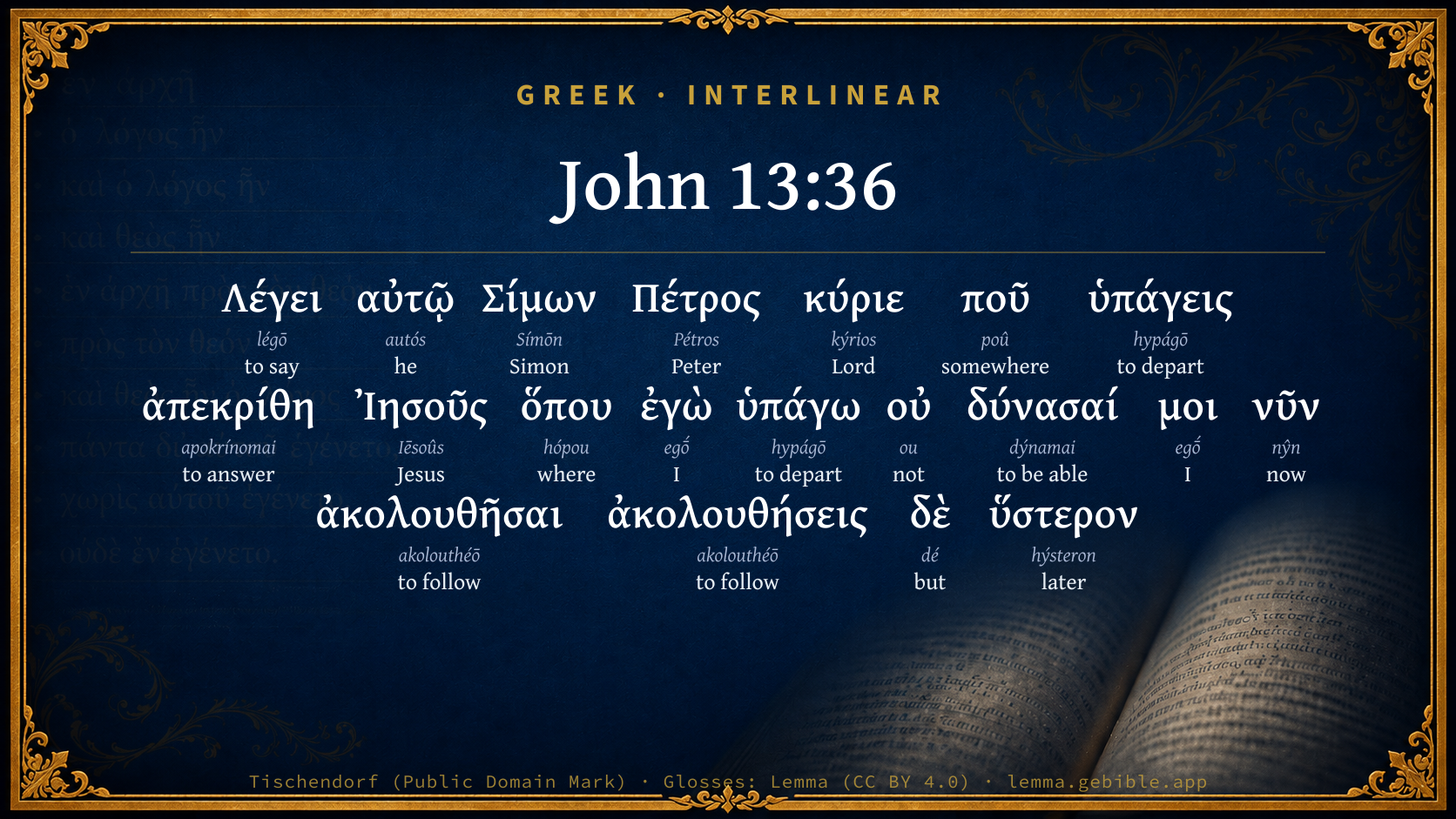
  1. Λέγει légō G3004 “to say” Verb, Present, Active, Indicative, 3rd person, Singular
  2. αὐτῷ autós G846 “he” Personal pronoun, Dative, Singular, Masculine
  3. Σίμων Símōn G4613 “Simon” Noun, Nominative, Singular, Masculine
  4. Πέτρος Pétros G4074 “Peter” Noun, Nominative, Singular, Masculine
  5. κύριε kýrios G2962 “Lord” Noun, Vocative, Singular, Masculine
  6. ποῦ poû G4226 “somewhere” Particle, Interrogative
  7. ὑπάγεις hypágō G5217 “to depart” Verb, Present, Active, Indicative, 2nd person, Singular
  8. ἀπεκρίθη apokrínomai G611 “to answer” Verb, Aorist, Middle deponent, Indicative, 3rd person, Singular
  9. Ἰησοῦς Iēsoûs G2424 “Jesus” Noun, Nominative, Singular, Masculine
  10. ὅπου hópou G3699 “where” Adverb
  11. ἐγὼ egṓ G1473 “I” Personal pronoun, 1st person, Nominative, Singular
  12. ὑπάγω hypágō G5217 “to depart” Verb, Present, Active, Indicative, 1st person, Singular
  13. οὐ ou G3756 “not” Particle, Negative
  14. δύνασαί dýnamai G1410 “to be able” Verb, Present, Middle or Passive deponent, Indicative, 2nd person, Singular
  15. μοι egṓ G1473 “I” Personal pronoun, 1st person, Dative, Singular
  16. νῦν nŷn G3568 “now” Adverb
  17. ἀκολουθῆσαι akolouthéō G190 “to follow” Verb, Aorist, Active, Infinitive
  18. ἀκολουθήσεις akolouthéō G190 “to follow” Verb, Future, Active, Indicative, 2nd person, Singular
  19. δὲ dé G1161 “but” Conjunction

About this verse

These counts appear in no published source. They are computed here, from the morphology-tagged text and Lemma’s own curated glosses. What Lemma adds →

20
words
17
distinct lemmas
Gospels
section

Notable vocabulary

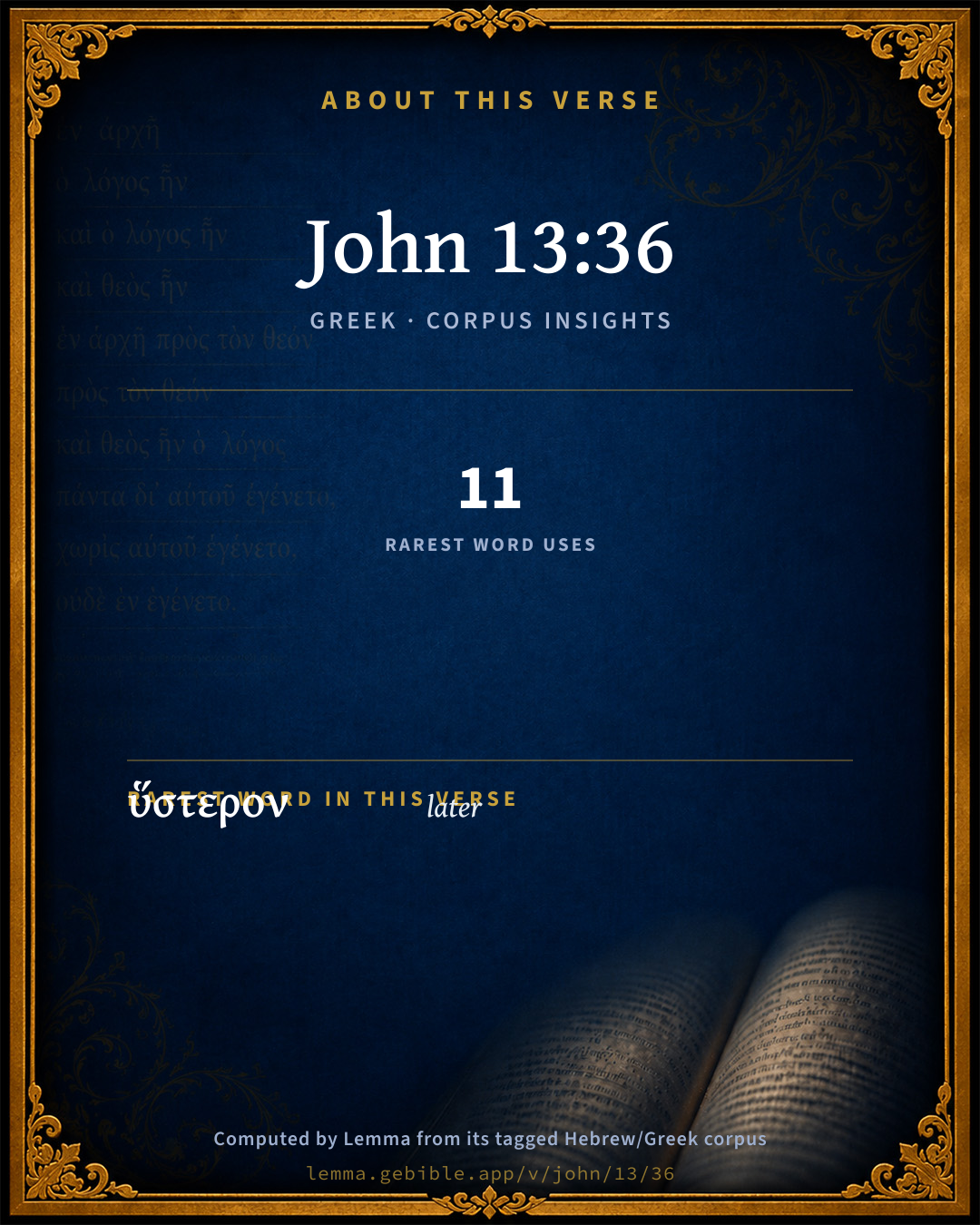
The rarest word here is ὕστερον later G5305 — appearing just 11 times in the whole Greek New Testament.

Shared distinctive vocabulary

ὕστερον later G5305 occurs in 11 verses of the Greek New Testament. Also found in:

Repetition

Words recur within this verse:

  • ὑπάγεις to depart G5217 ×2
  • ἀκολουθῆσαι to follow G190 ×2
  • ἐγὼ I G1473 ×2

Cross-references

7

Topical passages linked to John 13:36 in the Treasury of Scripture Knowledge — connected by theme and wording, ordered by reader-vote popularity; previews shown in the World English Bible.

  • John 21:21–22 Peter seeing him, said to Jesus, "Lord, what about this man?"
  • 2 Peter 1:14 knowing that the putting off of my tent comes swiftly, even as our Lord Jesus Christ made clear to me.
  • John 13:33 Little children, I will be with you a little while longer. You will seek me, and as I said to the Jews, 'Where I am going, you can't come,' so now I tell you.
  • John 14:2 In my Father's house are many mansions. If it weren't so, I would have told you. I am going to prepare a place for you.
  • John 21:18–19 Most assuredly I tell you, when you were young, you dressed yourself, and walked where you wanted to. But when you are old, you will stretch out your hands, and another will dress you, and carry you where you don't want to go."
  • John 14:4–5 Where I go, you know, and you know the way."
  • John 16:17 Some of his disciples therefore said to one another, "What is this that he says to us, 'A little while, and you won't see me, and again a little while, and you will see me;' and, 'Because I go to the Father?'"

Cross-references courtesy of OpenBible.info (CC BY 4.0).

Commentary

Notes on John 13:36 from classic Christian and Jewish commentators (each source and its license shown beneath its notes). The classic Christian expositions comment on the surrounding passage and are grouped to its opening verse, so a note may address several verses; the Jewish commentaries on the Tanakh (Rashi and others) are per-verse, so they appear only where the commentator wrote on this verse.

Lemma curates 59 commentaries, every one of them public domain or Creative Commons licensed, each selected and text-cleaned for this edition rather than reprinted as found. About our sources →

Matthew Henry's Commentary

In these verses we have,

I. Peter's curiosity, and the check given to that.

1. Peter's question was bold and blunt (Joh 13:36): Lord, whither goest thou? referring to what Christ had said (Joh 13:33), Whither I go, you cannot come. The practical instructions Christ had given them concerning brotherly love he overlooks, and asks no questions upon them, but fastens upon that concerning which Christ purposely kept them in the dark. Note, It is a common fault among us to be more inquisitive concerning things secret, which belong to God only, than concerning things revealed, which belong to us and our children, more desirous to have our curiosity gratified than our consciences directed, to know what is done in heaven than what we may do to get thither. It is easy to observe it in the converse of Christians, how soon a discourse of that which is plain and edifying is dropped, and no more said to it, the subject is exhausted; which in a matter of doubtful disputation runs into an endless strife of words.

2. Christ's answer was instructive. He did not gratify him with any particular account of the world he was going to, nor ever foretold his glories and joys so distinctly as he did his sufferings, but said what he had said before (Joh 13:36): Let this suffice, thou canst not follow me now, but shalt follow me hereafter, (1.) We may understand it of his following him to the cross: "Thou hast not yet strength enough of faith and resolution to drink of my cup;" and it appeared so by his cowardice when Christ was suffering. For this reason, when Christ was seized, he provided for the safety of his disciples. Let these go their way, because they could not follow him now. Christ considers the frame of his disciples, and will not cut out for them that work and hardship which they are not as yet fit for; the day shall be as the strength is. Peter, though designed for martyrdom, cannot follow Christ now, not being come to his full growth, but he shall follow him hereafter; he shall be crucified at last, like his Master. Let him not think that because he escapes suffering now he shall never suffer. From our missing the cross once, we must not infer that we shall never meet it; we may be reserved for greater trials than we have yet known. (2.) We may understand it of his following him to the crown. Christ was now going to his glory, and Peter was very desirous to go with him: "No," saith Christ, "thou canst not follow me now, thou art not yet ripe for heaven, nor hast thou finished thy work on earth. The forerunner must first enter to prepare a place for thee, but thou shalt follow me afterwards, after thou hast fought the good fight, and at the time appointed." Note, Believers must not expect to be glorified as soon as they are effectually called, for there is a wilderness between the Red Sea and Canaan.

II. Peter's confidence, and the check given to that.

1. Peter makes a daring protestation of his constancy. He is not content to be left behind, but asks, "Lord why cannot I follow thee now? Dost thou question my sincerity and resolution? I promise thee, if there be occasion, I will lay down my life for thy sake." Some think Peter had a conceit, as the Jews had in a like case (Joh 7:35), that Christ was designing a journey or voyage into some remote country, and that he declared his resolution to go along with him wherever he went; but, having heard his Master so often speak of his own sufferings, surely he could not understand him any otherwise than of his going away by death; and he resolves as Thomas did that he will go and die with him; and better die with him than live without him. See here, (1.) What an affectionate love Peter had to our Lord Jesus: "I will lay down my life for thy sake, and I can do no more." I believe Peter spoke as he thought, and though he was inconsiderate he was not insincere, in his resolution. Note, Christ should be dearer to us than our own lives, which therefore, when we are called to it, we should be willing to lay down for his sake, Act 20:24. (2.) How ill he took it to have it questioned, intimated in that expostulation, "Lord, why cannot I follow thee now? Dost thou suspect my fidelity to thee?" Sa1 29:8. Note, It is with regret that true love hears its own sincerity arraigned, as Joh 21:17. Christ had indeed said that one of them was a devil, but he was discovered, and gone out, and therefore Peter thinks he may speak with the more assurance of his own sincerity; "Lord, I am resolved I will never leave thee, and therefore why cannot I follow thee?" We are apt to think that we can do any thing, and take it amiss to be told that this and the other we cannot do, whereas without Christ we can do nothing.

2. Christ gives him a surprising prediction of his inconstancy, Joh 13:38. Jesus Christ knows us better than we know ourselves, and has many ways of discovering those to themselves whom he loves, and will hide pride from. (1.) He upbraids Peter with his confidence: Wilt thou lay down thy life for my sake? Me thinks, he seems to have said this with a smile: "Peter, thy promises are too large, too lavish to be relied on; thou dost not consider with what reluctancy and struggle a life is laid down, and what a hard task it is to die; not so soon done as said." Christ hereby puts Peter upon second thoughts, not that he might retract his resolution, or recede from it, but that he might insert into it that necessary proviso, "Lord, thy grace enabling me, I will lay down my life for thy sake." "Wilt thou undertake to die for me? What! thou that trembledst to walk upon the water to me? What! thou that, when sufferings were spoken of, criedst out, Be it far from thee, Lord? It was an easy thing to leave thy boats and nets to follow me, but not so easy to lay down thy life." His Master himself struggled when it came to his, and the disciple is not greater than his Lord. Note, It is good for us to shame ourselves out of our presumptuous confidence in ourselves. Shall a bruised reed set up for a pillar, or a sickly child undertake to be a champion? What a fool am I to talk so big. (2.) He plainly foretels his cowardice in the critical hour. To stop the mouth of his boasting, lest Peter should say it again, Yea Master, that I will, Christ solemnly asserts it with, Verily, verily, I say unto thee, the cock shall not crow till thou hast denied me thrice. He does not say as afterwards, This night, for it seems to have been two nights before the passover; but, "Shortly thou wilt have denied me thrice within the space of one night; nay, within so short a space as between the first and last crowing of the cock: The cock shall not crow, shall not have crowed his crowing out, till thou has again and again denied me, and that for fear of suffering." The crowing of the cock is mentioned, [1.] To intimate that the trial in which he would miscarry thus should be in the night, which was an improbable circumstance, but Christ's foretelling it was an instance of his infallible foresight. [2.] Because the crowing of the cock was to be the occasion of his repentance, which of itself would not have been if Christ had not put this into the prediction. Christ not only foresaw that Judas would betray him though he only in heart designed it, but he foresaw that Peter would deny him though he did not design it, but the contrary. He knows not only the wickedness of sinners, but the weakness of saints. Christ told Peter, First, That he would deny him, would renounce and abjure him: "Thou wilt not only not follow me still, but wilt be ashamed to own that ever thou didst follow me." Secondly, That he would do this not once only by a hasty slip of the tongue, but after he had paused would repeat it a second and third time; and it proved too true. We commonly give it as a reason why the prophecies of scripture are expressed darkly and figuratively, because, if they did plainly describe the event, the accomplishment would thereby either be defeated or necessitated by a fatality inconsistent with human liberty; and yet this plain and express prophecy of Peter's denying Christ did neither, nor did in the least make Christ accessary to Peter's sin. But we may well imagine what a mortification it was to Peter's confidence of his own courage to be told this, and to be told it in such a manner that he durst not contradict it, else he would have said as Hazael, What! is thy servant a dog? This could not but fill him with confusion. Note, The most secure are commonly the least safe; and those most shamefully betray their own weakness that most confidently presume upon their own strength, Co1 10:12.

Matthew Henry's Commentary on the Whole Bible (1708–1710) — public domain (CC PDM 1.0). Text via the HelloAO Bible API.

The Biblical Illustrator

Joseph S. Exell

Joh_13:36-38

Lord, whither goest Thou?

Unlawful curiosity

It is a common fault among us to be more inquisitive concerning things secret, which belong to God only, than concerning things revealed, which belong to us and to our children--more desirous to have our curiosity gratified, than our conscience directed--to know what is done in heaven, than what we ought to do to getthither. It is easy to observe it in the conversation of Christians, how soon a discourse of what is plain and edifying is dropped, and no more is said of it; the subject is exhausted; while matter of doubtful disputation runs into an endless strife of words. (M. Henry.)

Peters curiosity and presumption

I. His CURIOSITY. The question was occasioned by Joh_13:33; and as soon as our Saviour paused, Peter suddenly makes the inquiry.

1. Here is something which we know not how entirely to censure. The imperfections of good men betray their excellences. We see Peters love to his Lord, and concern for His presence. When Elijah was going to be taken up, Elisha followed him. When Jonathan and David were about to separate, they fell upon each others neck and wept. When, at Miletus, Paul kneeled down and prayed with the brethren, they all wept sore. But think of Christ! What a Benefactor, what a Master was He! Could Peter then view His removal with indifference?

2. But if our Saviour blames Peter, Peter was blameworthy. He was a little too curious--a fault by no means uncommon. For how many are more anxious to know secret things than to improve the things revealed. We are all fender of speculation than practice. Whereas, we ought to remember, that, in a state where we have so much to do, and so little time to do it in, we should secure ourselves from all superfluous engagements.

3. Our Saviour, therefore, never encouraged this principle. When a man asked Him, Lord, are there few that shall be saved? He did not even notice the trifler: He said unto them, Strive to enter in at the strait gate. So here He shows His judgment of the inquiry by eluding it. But though He does not gratify, He instructs. In two senses, Peter was to follow Him, in due time

(1) To glory. It was what our Lord prayed for, and what He promised Joh_17:24). So we are to be forever with the Lord. He has gone to prepare a place for us. But for every thing there is a season. He could not follow Him now. Though our Saviours hour was come, Peters was not; though the Master had finished the work given Him to do, the servant had scarcely begun his--and we are all immortal till our work is done. Christians are sometimes impatient, but this is wrong. The best frame we can be in is to be ready to go, and willing to stay. The eagerness is not only wrong, but useless. What would it avail the husbandman to fret? Would this bring harvest the sooner? He cannot reap in May, the order of nature forbids it. There is also an order in grace. Why cannot you follow Him now? You have an aged mother to support, or an infant charge to rear, or an institution of charity to found, or to exemplify religion in your practice, or to recommend it by your sufferings.

(2) To the cross. But he could not follow Him now, because he had not sufficient faith and resolution to suffer. This shows us that our Lords dealings with His people are founded not only in kindness, but in wisdom and prudence. He adapts the burden to the shoulder, or fits the shoulder to the burden. As thy day, so shall thy strength be. Sufficient for the day is the evil thereof--and what is better, sufficient for it too will be the grace.

II. HIS PRESUMPTION (verses 37, 38). Ah, Peter, this is sooner said than done. Life is not so easily parted with. You trembled upon the water; be not so confident now. Note

1. The crime was heinous. To deny his Master was unfaithfulness: his Friend, perfidy: his Benefactor, ingratitude: his Redeemer, impiety. This, too, was the conduct of one who had been called from a low condition in life to the high honour of apostleship--of one who had seen His miracles, etc. Three aggravations are here mentioned.

(1) He was warned--he could not plead ignorance.

(2) The sin was immediately committed. Things soon wear off from the mind; but here was no time for forgetfulness.

(3) It was repeated, thrice. A man may be surprised and overtaken in a fault; but, the moment after, reflection may return; and he may flee. But Peter, after his first offence, renews it again--and again--and each time waxes worse and worse.

2. The lessons:

1. The foreknowledge of our Saviour.

2. What reason have we to exclaim, with David, Lord, what is man! Survey him under the greatest advantages and obligations. There is nothing too vile for us to fall into, if we are left of Him who alone can keep us from failing.

3. How little we are acquainted with ourselves. Peter spoke according to his feelings. But sincerity is not constancy. There is a goodness, compared to the morning cloud and early dew, that soon passeth away. Peter did not consider the difference between an impulse and a principle; between an hour of ease and a moment of trial. Hazaels case is a strong one; but it will apply, in various degrees, to ourselves. God only knows how much of our innocency has been owing to principle, or the absence of temptation; or what we should have been in conditions the reverse of those which have sheltered our weakness.

4. The most confident are the most exposed; and the most humble the most safe. When I am weak, then I am most strong. Hold Thou me up, and I shall be safe. Conclusion: We do not wonder at this sad revolution in Peter. He is proud and self-sufficient. Pride goes before destruction, etc. I never saw a professor of religion full of confidence in himself, and speaking censoriously of others, but who fell into some gross crime, or into some great calamity. (W. Jay.)

Not now, but afterwards

1. Children will have everything now: afterwards is a word that plagues them. As life advances we become more intimately acquainted with the word, and come to like it. We know that yesterday has gone beyond recall, and that tomorrow is coming and always available.

2. This is the second time the same thing has been said, on this same occasion, to the same man, and both times in a Masters tone, delivered with a brothers heart and voice (Joh_13:7). So this child-man was constantly put back and told to wait till the clock struck, and the hour had come when he should have the keener vision, the more sensitive heart, the more receptive spirit and understanding mind. This was the training that Peter needed. He was a man who wanted everything done instantaneously. The Lord knowing this said the most vexing words, Not now. We want it too, and when we are mad with impatience He says it quietly and sovereignly; but adds afterwards in the same tone, for Christ lived in tomorrow.

I. LOOK AT THIS IN THE DIRECTION OF

1. Revelation. We cannot follow any great doctrine in all the range of its thoughts and in all the possibilities of its issues. Who can explain the atonement? We begin in the right spirit when we begin in the spirit of waiting. I need the cross; I accept it, but cannot tell the measure of the oblation or its efficacy. But afterwards there will be a higher school, additional facilities, then I shall know.

2. The mysteries of daily providence. Thou canst not follow Me--not from one locality to another, but in thought, purpose, and sovereign decree. Who can keep pace with the Great Walker? I halt, stagger, fall, half rise again, and am down before I can straighten myself I cannot follow except in the dim far distance now, but afterward. Our strange constitution, individuality, sufferings, are heavy burdens. Explanation would help us to bear them. Why should I wear this chain? be encompassed by this cloud? The answer is not now, but afterward. No chastening, for the present seemeth joyous, etc.

II. THERE CANNOT BE AN AFTERWARD OF REVELATION UNLESS THERE IS A NOW OF OBEDIENCE.

1. The now is not evacuated of all meaning. To obey in the darkness is the great thing. Were I to say, I will trust God in the seventh trouble because He has delivered me in six, it would be historically true and full of solace, but no indication of growth in grace. But he has grown in grace who says, Though He slay me yet will I trust in Him.

2. Obedience now is revelation afterward. He that doeth the will shall know of the doctrine. We do not know the joy which is laid up for us in complete obedience to the words, Stand still and see the salvation of God. The next piece of knowledge comes easily. Were the child to be compelled to overleap seven years of the process of education, he would be overcome. What he has to do is to read the next line, and then to turn over the next page. What we as Christian students have to do is to keep to the present truth, do the next duty, and then the revelation will steal upon us without the violence of haste and the unrest of surprise. We cannot tell how the light grows, so in mental illumination and spiritual culture. (J. Parker, D. D.)

The now and then of following Christ

The first words spoken to Peter were Follow Me; almost the last were Thou canst not follow Me now. After a long attachment to the Saviour it was a hard word. There is, however, always a staying hand in life as well as a beckoning. The pillar of cloud moves and halts.

I. THE NEGATIVE PRESENT. When had it been that Simon could not go with his Master? He had accompanied Him to Bethany when seeking rest after tumult and turmoil; to the Mount of Transfiguration when Jesus was pre-glorified. Now he may not follow Him. Nor was this strange. The high priest only could enter the Holy of Holies on the Day of Atonement, and Peter might not understand, but we do, that the great Day of Atonement had dawned. On to the cross, into the tomb, within the veil, only Jesus must go. Yet by this access to God was given. And now into the crucified life, as dead with Christ to the world; into the risen life, as new creatures in Him, we may follow Jesus; but further than this we may not go now; into the ascension life we are forbidden to enter at present, but we shall be permitted afterwards.

II. THE POSITIVE FUTURE. It was in the human life Jesus commanded Peter to follow Him, saying He would make them fishers of men. They were to observe His modes of action and drink of His Spirit. And so with us. But is it not rather into the higher risen life that He bids us follow Him--the life of pardon, peace, sanctity, and spiritual power? And to this He is the Way; and by following that Way we shall reach the afterwards of His presence and glory (1Jn_3:2). (I. Watts.)

Why cannot I follow Thee now?

1. Why, indeed? There could be no doubt of his sincerity and attachment to his Master. I cannot believe that our Lord merely referred to the time for Peters departure. Further, Peter did follow Christ so far as he could without dying; for there was still a considerable portion of ground to be traversed by those sacred feet. There lay before Him the way of sorrows, crowned with the cross on Calvary. Up to that point Simon Peter might have followed Christ, although he did not. Our Lord was referring to this first, though His words may have reached on to the glory that was at last to be revealed. The time was already come when His disciples were to be scattered and to leave Him alone. And knowing this, He says, Whither I go, etc. And it is equally true that this same Simon Peter did follow the Lord Jesus Christ afterwards in the same sense in which he was now precluded from following Him.

2. As we ask Peters question, we are led to consider our own experience. Is it not true that there sometimes seems to rise up in the very path of our inclinations and spiritual aspirations a strange, indescribable barrier--an inexorable cannot--that seems to bar the way to further progress? It is wise to ask this question, for if it be honestly put, the Holy Spirit of God will sooner or later show us what gives strength to this cruel and pitiless cannot. Why could not Simon follow Jesus then? Because

I. HE THOUGHT HE COULD. I will lay down my life for Thy sake. There is nothing more common amongst Christians than the admission of our frailty and weakness. But what a great difference there is between making orthodox admissions and having a real consciousness of our own helplessness and dependence on a higher power. Sometimes, feeling ourselves to be a little weaker than we should be, we are ashamed of our infirmity. And sometimes, taught by many disasters, we entertain serious apprehensions about ourselves; but it is wonderful how self-confidence rebounds from the most distressing humiliations. We are quite determined to be more careful in the future. But how slow we are to abandon all confidence in the flesh! And it is not until we have learnt our helpless dependence that we can hope to follow Jesus. For flesh and blood can no more participate in the fellowship of Jesus sufferings than they can inherit the kingdom of God. But Simon Peter was a man of strong determination; and such characters find it very hard to renounce all confidence in their moral vigour. It seemed incredible that he should turn his back upon his Master, and we can scarcely bring ourselves to believe that we could condescend to the sin, which subsequently we commit; and then by and by we learn our weakness amidst bitter tears, as Simon Peter did.

II. HE WAS AT THIS TIME WALKING BY SIGHT RATHER THAN BY FAITH. We do not reach the life of real faith till we are fully conscious of our own helplessness. How can we really trust Christ unless we have thoroughly learnt to distrust ourselves? Peter, walking by sight, his firmness was greatly dependent upon outward circumstances. As long as he saw Christ performing prodigies, or greeted by hosannas, it appeared easy to follow Him; but when all His glory seemed departed, his courage forsook him. Ah! how many of us are fair-weather sailors 1 and how few in their daily life by faith possess themselves of God.

III. HE WAS WALKING IN THE FLESH RATHER THAN IN THE SPIRIT. This same Peter, only a few weeks afterwards, when baptized with the Holy Ghost, stood before the rulers of his country with unblanched countenance, for that Master whom He denied. And for us also that Spirit is given. This qualification for following Jesus is closely connected with the other. They represent the two sides of a healthy spiritual experience. Faith on our side brings us into contact with the Divine, and puts the soul in the attitude of reception; the gift of the Holy Ghost on Gods side brings the Divine into contact with us, and fills us according to our capacity. Received ye the Spirit by the works of the law, or by the hearing of faith? But, if we live in the Spirit, let us also walk in the Spirit; and Pauls charge against the Galatians is that, having begun in the Spirit, they had gone on to be made perfect in the flesh. Is not this where many of us lose our capacity to follow Christ? The energies of the flesh may be never so strong and well-intentioned, but they cannot take the place of the powers of the Holy Ghost; and there is a point beyond which they cannot go in disposing us to follow Christ.

IV. BECAUSE HE WAS OUT OF SYMPATHY WITH CHRISTS MIND. Can two walk together except they be agreed? Christ was meditating on the Fathers will, while Simon Peter savoured of the things that be of men. And if we are to follow Jesus we must rise into the inner circle of His fellowship, and see things from His point of view. It is not by saying, I will follow Thee that we succeed in following Him. It is by bringing our hearts into full harmony with His Divine will. And the first step towards accepting the Divine will is taken when we repose our full confidence in it. Jesus Christ was at this moment fulfilling in His own experience the language of the Psalm, Lo! I come to do Thy will. Peter, on the other hand, preferred to trust to his own will. He had daydreams of material aggrandisement, and political power, so that he had no room for the fellowship of the mind of Jesus Christ. And when Jesus began to open up His own purposes to him, he shrank from them with aversion. Now, here is our lesson. You, who seek after popularity, who are wishing to be on good terms with the world, how can you follow Jesus until you are in sympathy with Him and with His aims? If any man will come after Me, let him deny himself, take up his cross, and follow Me.

V. HE WAS INWARDLY CLINGING ALL THE WHILE TO A BESETTING SIN--self-assertion, or self-confidence, mingled with not a little worldly pride. We see this evil habit of soul exhibiting itself in his attempt to dissuade his Master from facing the Cross; and in his conduct at the supper table. How many of you are kept back from following Jesus now by some cherished sin? Conclusion: Perhaps some of you are asking, Can we not go to heaven without all this? We are not discussing the minimum qualification for heaven. What it is God only knows. We are talking of following Jesus, and that is far more to the purpose. I have no desire to solve the problem. Here is a consideration which is very profitable: How much spiritual benefit is it possible for a man to get out of his religion? (W. Hay Aitken, M. A.)

The withheld completions of life

St. Peter felt dimly that the life of Jesus was opening into something so large that all which had gone before would be seen to have been only the vestibule and preparation for what was yet to come. And just then, when his expectation was keenest, and his love most eager, an iron curtain fell across his view. The completion was withheld. And that is what is always happening. It would be intolerable to us if we could not trace tendencies in our life. If everything stood still, or only moved round in a circle, it would be a dreary and a dreadful thing to live. But we rejoice in life because it seems to be carrying us somewhere. We bear with incompleteness, because of the completion which is prophesied and hoped for. But it is the delay or barrier that distresses us. The tendency that is not allowed to reach the fulfilment, which alone gave it value, seems a mockery. You watch your plant growing, and see its wonderful building of the woody fibre, its twining of the strong roots, its busy life blood hurrying along its veins. Some morning the deep-red flower is blazing full blown on the stem, and all is plain. The completion has justified the process. But suppose the plant to have been all the time conscious of the coming flower, and yet to have felt itself held back from blossoming, would it not be a very puzzled and impatient and unhappy little plant? Now, there are certain conditions which are to all good life just what the flower is to the plant. There are certain fine results of feeling which are the true and recognized results of the best ways of living. But when the life, conscious of the character in itself out of which these conditions ought to come, finds that it pauses on the brink of its completion and cannot blossom, then come impatient questionings and doubts.

I. LET US TAKE SOME INSTANCES DRAWN FROM DAILY LIFE. Suppose we have someone devoted to the good of others. A poor obscure woman in a sick room giving her days and nights, health and strength, to some poor invalid; or a great brilliant man out in the world neglecting his personal interests in the desire that some of the lagging causes of God may be helped forward. Now such a life has its legitimate completion. The natural flower which should crown that life is mens gratitude. Perhaps in ringing cheers, perhaps only in the silent pressure of the hand. The man who does no good expects no thanks. The selfish life feels and shows the unnaturalness if men make a mistake and lavish their gratitude upon it. It is as if men tied the glorious flower on to the top of a wooden post. And now suppose that the gratitude does not come. Is there no disappointment; no sense of a withheld completion? What does it mean? you ask with wonder, even with impatience. And in answer to your question there are two things to he said.

1. That such a suspension of the legitimate result, shows a condition of disorder. The natural result of your self-devotion has not come because the state of things in which you live is unnatural. That must he recognized. If you let your surprise appear, men will misunderstand you, and cry, Oh, after all, then, you were not unselfish. But they are wrong; you did not work for thanks. When the thanks do not come it is not your loss; it is the deranged state of things that troubles you. When Jesus wept over Jerusalem, did He not feel its ingratitude? But was it not the disturbed world, where such ingratitude was possible, which lay at the bottom of His grief? When your child is ungrateful to you, is it the neglect of yourself, or the demoralized home, that saddens you? It is the violation of a deep, true instinct.

2. But because any state of things is unnatural, it does not prove that there can come out of it no blessing. So it is here. The service that a man does to his fellow men does not bring down their gratitude. What then? The withholding of the legitimate completion of his service may throw him back upon the nature of the act itself, and compel him to find his satisfaction there. That has been the support of many a despised reformer and misunderstood friend. The essence of any act is more and finer than its consequences are. Because Christ was despised and rejected of men, we are able to see more clearly how truly He was His Fathers well-beloved Son.

II. AS WE COME INTO THE REGIONS OF SPIRITUAL EXPERIENCE THIS TRUTH BECOMES MORE STRIKING, and often much more puzzling.

1. Look, e.g., at the connection of duty and happiness. Happiness is the natural flower of duty. The good man ought to be a thoroughly bright and joyous man. To disbelieve this would be to bow down at the footstool of a devil or a chance, and which of these would be the most terrible master who can say? With this conviction strong in us we come to some good mans life, and that life is all gloomy. Duty is done day after day, but done in utter dreariness; good without gladness, shocking and perplexing our deep certainty that to be good and to be glad belong together. To such we want to bring the two before-mentioned considerations. To recognize that it is unnatural, and so to struggle against it, and yet, while it must last, to get what blessing we can out of it, by letting it drive us down deeper, for our joy and comfort, into the very act and fact of doing righteousness. The plant ought to come to flower, but if it fails it is still a plant. The duty should open into joy, but it may still be duty; still hold the duty. Do righteousness and forget happiness, and so it is most likely that happiness will come. This will help a man to be hopeful without impatience, and patient without despair.

2. But take another case. There are promises in the Bible which declare that dedication to God shall bring communion with God. Draw near to Me, and I will draw near to you. And yet sometimes the man does give himself to God, and the promise seems to fail; and the man given to God trembles when he hears other men talk of the joy of Divine communion, because no such ever comes to him. Once more, to such a soul there are the same two messages to bring. Never, no matter how long such exclusion from the presence of God may seem to last, make up your mind to it that it is right; never cease to expect that you will be admitted to all the joy of your Fathers felt love. And seek even more deeply the satisfaction which is in your consecration itself; and that you may find it, consecrate yourself more and more completely. There are two great anxieties which I do feel for such souls. One is, lest you should give up expecting that privilege of communion which is certainly yours in possibility, and must certainly be yours some day in possession. The other is, lest, since the consecration has not brought you the communion, you should think that the consecration is unreal, and so lose the power to be blessed by it, and the impulse to increase it. Multitudes of saints would tell you how in their hindered lives God kept them true to such experience as they had attained; and so it was that, by and by, either before or after the great enlightenment of death, the hindrance melted away, and they now follow the Lamb withersoever He goeth.

3. Among Christs promises there is none that is dearer to one class of minds than this. If any man wills to do My will, he shall know of the doctrine, etc. Such souls have not found that the thousand curious questions of theology were answered, and all the mystery rolled away out of the sky of truth. Christ did not promise that. But they have found what He did promise: that, coming near to Him in obedience, they have been made sure of the true divinity that was in Him and in the teachings that He gave. Everywhere the flower of obedience is intelligence. Obey a man with cordial loyalty and you will understand him. And now, are there any of us from whom that completion seems to have been withheld? They must be sure, first, that they are right: that they have not really come to an essential faith that the doctrine of Jesus is divine. They must be sure, again, that their will to serve Christ has been indeed true. And what then? Sure of all this, still the darkness and the doubts remain. Then they must come to the two principles; they must say, This is unnatural. I will not rest until my service of Christ completes itself in the knowledge of Christ; and yet all the time while I am waiting I will find joy in the service of Him, however dimly I may apprehend Him. (Phillips Brooks, D. D.)

Readiness for death

The most natural explanation of Christs words to one who knew Him as intimately as Peter did was that, while shrinking from no danger Himself, He would not involve His followers in that danger. But Christs meaning was that the time had not come for Peter to die. Had Peter known this he would still have desired thus to follow Christ: but in reality he was not ready. Desiring to die and readiness for death are two different things.

I. THERE WAS A WORK YET TO BE DONE IN PETER.

1. His knowledge of Christ and of Divine things needed to be increased. He knew a great deal, being Divinely taught, but he had yet to learn that Christ must suffer and enter into His glory. Our Lord had indeed spoken of this, but nothing short of the event itself could teach the full truth. There was the teaching, too, supplied by the Resurrection, Ascension, and Pentecost. Compare what Peter knew in later years with what he knew now, and you see the reason for our Lords words. Here, then, is one of the reasons why God keeps us here. We are to learn Christ as He can be learnt nowhere else, by experiencing His wonderful love and almighty grace. What will not men endure to become acquainted with man or nature? Shall we complain then because we are called for a season to endure hardships that we may know Christ.

2. His character needed chastening and strengthening. He was weaker morally than he thought himself. I will lay down, etc. Wilt thou? etc. Life was a furnace by means of which the baser parts of his character were re moved, and the truer and nobler made manifest. Peter went to heaven a better man than he would have done had he followed Christ now. There is no explanation of human life satisfactory but this. Once accepted the axe is laid at the root of all impatience and disgust.

II. THERE WAS A WORK YET TO BE DONE BY PETER.

1. Indeed the work done in Peter was with a view to that to be done by him. To regard our knowledge and experience only as a fitting us for heaven is only selfishness. Christ taught that both were for the sake of others. They could only follow Him as they gave themselves for their fellow men, as He did. Doubtless Peter soon understood this, and acquiesced in the afterwards.

2. Our work here is a preparation for the life hereafter. That will be no state of inactivity, and by serving Christ here in our inward and outward life we are to learn how to work for Him in heaven. (H. S. Toms.)

Speech and action

1. Peter meant what he said, but he did not measure the meaning of his words. Sometimes our words are bigger than we are, and all exaggeration is weakness. Peter spoke out of his passion, not out of his reason, and the only passion that endures is reason-on-fire. If he had said less, he would have done more. The strongest man has only so much energy, and if that be spent in wild speech, it will not be spent in well-directed actions. Hear a man talk much about the poor, and the probability is he is not going to do much for the poor. How to spend our limited amount of energy to the greatest effect ought to be the inquiry of every earnest man. We want more Bible reading, deeper devotion--the strengthening of our inner life--and then the expenditure will be with ease, and be a great beneficence.

2. Thunder frightens people; the light is welcome to all, and how quietly it comes. Let your light so shine, etc. I quote this passage because there is a danger lest this doctrine of action, as opposed to speech, should be perverted. Persons excuse themselves from saying anything about their religion, and say that they seek the shade. Dont believe them. The shade is never difficult to find. To talk about humility is not to practice it. Action and speech must go together. Love the shade, certainly; but remember that God made the light, and that everything does not grow in the shade, and dont undervalue the light. Are you sure that you are honest in professing to love the shade? Is it not when someone asks you to do something that you dont like that you become so modest? Christ wants speech and action, open conduct, that everybody, if needful, can see and estimate. There are times when the shadow will be right welcome; but let the light make the shade.

3. Peters boast is one of the expressions which outdo themselves by their own bigness. Beware of outdoing yourself by your own words. There are men whose geese are all swans, and their swans eagles. Christ demands that our words be weighed and directed to His Cross and service. He asks no man to lay down his life, in this tragical sense, on a manufactured occasion--that will come by and by as a practical necessity. There are many who are ready to do some tremendous thing for us when we dont want anything tremendous done. A dying master told his old slave that he had arranged in his will that he (the slave) was to be buried in the family grave: to which he made reply, Ten dollars would suit Cato better. We cannot live on tragedies--give us bread and water. My mother, sir! says the wild youth, I would walk fifty miles on burning metal for her! But his mother wants no filial piety so tragical as that; but she would like him home a little earlier at night. Dont say that you would lay down your life for her--lay down your glass, your pipe, your cards; lay down something as an instalment. My pastor! sir, I would die for him! No, no; he wants nothing so tragic, all he wants is for you to take a sitting, come in time, and pay your subscription occasionally.

4. Peters boast was a broken sentence. Christ only could complete it, and did. I have power to take it again. To serve friends after death, as well as in it, was reserved for Him alone. Therefore economize life. You can serve others better by living than by dying--even Christ. I beseech you therefore … present your bodies a living sacrifice. And if we live for Christ we shall certainly die for Him. (J. Parker, D. D.)

We must watch our weak points

A great commander was engaged in besieging a strongly fortified city. After a while he concentrated his forces at a point where the fortifications were stronger than at any other, and at two p.m., under a bright sun and a clear sky, ordered an assault. When expostulated with by an under officer, the commander replied: At this point such a general is in command. At this hour of the day he is invariably accustomed to retire for a long sleep. When informed of our approach he will deny the fact, and send a messenger for information. Before the messenger returns we shall gain possession of the fortress. The facts turned out exactly as predicted. Yonder weak point, said the commander, is held by General There is no use in attempting to surprise him; he is never for a moment off his guard. (A. Mahan, D. D.)

.

The Biblical Illustrator, edited by Joseph S. Exell (c. 1880s–1900s) — public domain. Text from a community e-Sword module.

Joseph Benson's Commentary

Joh 13:36-38. Simon Peter saith, Lord, whither goest thou, &c. — The exalted virtue which our Lord had just inculcated, did not make so strong an impression on Peter’s mind, as the words which he had before spoken, concerning his going away to a place where his disciples could not come. He therefore replies by thus asking whither he was going. He seems to have supposed that Christ, in consequence of being rejected by the Jews, was about to go to some other part of the earth to erect his throne, where he might reign without disturbance, according to the gross notion which he had of Christ’s kingdom. Jesus answered, Whither I go thou canst not follow me now, &c. — Thou art too weak at present to follow me in my sufferings: but thou shalt be enabled to do it afterward. From this clause “we gather that the declaration, (Joh 13:33,) Whither I go ye cannot come, is one of those general propositions whereof there are many in Scripture, which were spoken with a limitation not expressed. Here we are directed to add the limitation, thus, Whither I go ye cannot come NOW. For they were all, equally with Peter, to follow Jesus afterward, by suffering a violent death.” — Macknight. Peter said, Lord, why cannot I follow thee now? — He was very unwilling to believe that he was so weak as Christ’s words intimated he was. He thought he was prepared to do or suffer any thing for his dear Master; adding, I will lay down my life for thy sake — As if he had said, Is there any road more terrible than the dark valley of the shadow of death? Yet through these black and gloomy shades I am willing to accompany thee this moment. Jesus answered, Wilt thou lay down thy life, &c. — Alas! Peter, thy promises are too large, and uttered with too much confidence to be relied on: thou dost not consider with what reluctance life is parted with, and what a hard task it is to suffer death. Verily, the cock shall not crow, &c. — Notwithstanding thy pretended affection and fortitude, a few hours shall not pass till, in great consternation at the danger with which I and my disciples will be threatened, thou shalt basely deny three several times that thou art my disciple. Peter, therefore, had no reason to be elated, though on a former occasion he had confessed Jesus to be the Son of God. And his behaviour, in this instance, affords a very affecting example of human vanity, in the midst of the greatest weakness.

Joseph Benson's Commentary on the Old and New Testaments (1811–1818) — public domain. Text from a community e-Sword module.

Whedon's Commentary on the Bible

Daniel D. Whedon

§ 125.—JESUS FORETELLS TO HIS APOSTLES THE FALL OF PETER, Joh_13:36-38.

Mat_26:31-35; Mar_14:27-31; Luk_22:31-38.

Many harmonists insert at the close of the last paragraph the institution of the Lord’s Supper. This they do with no little plausibility, inasmuch as the topic of that paragraph, namely, the new commandment of love, based upon Christ’s sacrificial death, has a natural relation to that institute, Nevertheless we follow the order of Newcome in placing it subsequent to the present section.

36. Peter said… whither goest thou?—Peter evidently imagined that our Lord is going through some terrible ordeal of danger, and perhaps death, to a result of glory. As his senior apostle he wishes to know the route, and to follow most closely in the track.

Now… afterwards—What our Saviour had said to the Jews in wrath, and to the disciples in love, he now says to Peter with a qualification and a promise. The Jews should die in their sins, and where Christ is they should never come. Peter can follow not now but afterwards.

Daniel D. Whedon (gen. ed.), Commentary on the Old and New Testaments (1874–1909) — public domain. Text from a community e-Sword module.

The Preacher's Complete Homiletical Commentary

Joseph S. Exell (gen. ed.)

EXPLANATORY AND CRITICAL NOTES

Joh_13:36-38. “Thou canst not now be a Peter, for the Petra (or Rock) has not yet consolidated thee with His Spirit; but thou shalt follow Me by dying on the cross as I shall die for thee” (Augustine in Wordsworth’s Greek Testament) (Joh_21:18-19). “Peter imagined that he could lay down his life for Christ, whereas Christ had come to lay down His life for all, among whom was Peter. Peter imagined he could precede his Guide. Presumptuous supposition! It was necessary that Christ should first lay down His life for the salvation of Peter, before Peter could be able to lay down his life for the Gospel of Christ” (Idem).

MAIN HOMILETICS OF THE PARAGRAPH.—Joh_13:36-38

The self-confident apostle: “Let him that thinketh he standeth take heed.”—The man who spoke here so confidently was Simon son of Jona, not Peter, the Rock. He was still the impulsive fisherman of Galilee, still slow of heart to believe all that was written in the prophets, etc., concerning Christ. He was to learn by sad experience to forego for ever that self-trust and to put his trust in the Saviour. To strengthen his faith the Redeemer foretold him of what would happen; for the remembrance of this and of the kind and gracious words, “Thou shalt follow Me afterward,”. “I have prayed for thee, that thy faith fail not” (Luk_22:32), would keep the apostle from falling into Judas-like despair.

I. The impatience of Peter.—

1. The apostle was not content to receive our Lord’s words with implicit trust in His wisdom and love. Where will his Master go that they cannot follow Him? Had they not the promise that He would appoint the disciples a kingdom, that they should sit on thrones (Luk_22:29)?

2. Our Lord’s gentle reply only increased the apostle’s impatience. Afterwards! Why not now? Why wait for some to-morrow when we have to-day? The apostle in this is a type of many. They would be men before they are prepared for the work of life. They would clutch at joy to-day, would seek to leap to the summit in place of slowly toiling upward, or waiting till the means of transit are ready.

3. Peter was not yet ready to follow Christ. Christ must first do His work for him on the bitter cross, and in him by the Galilean lake and at Pentecost, ere the impatient apostle could be fitted to follow Him. So may Christian men who are impatient to enter on such and such work, or to occupy some other position, learn not to fret impatiently that their prayers are not at once answered. The Lord will prepare us to follow Him, if we are His, in His own time and way. Peter had a glorious work to do, far other than he thought. So may we have. Let us rest trustingly on the divine wisdom and love.

II. Peter’s rash self-confidence.—

1. “I will lay down my life,” etc. Here he showed his want of true self-knowledge. He over-estimated greatly his own strength. The others may fail—he will not. However dark the way Christ has to tread he will follow, even though it should be to death. Had he not come with the Master to Judæa in face of danger (Joh_11:16)? No, he will not fail,

2. What must have been his thoughts then when Jesus spoke solemnly, “Verily, verily, I say unto thee,” etc.—I, whom you believe to be the Son of God? Did he say in his heart, “Is thy servant a dog,” etc.? At all events his voice led in the asseveration of all the disciples. “Though I should die with Thee,” etc. (Mat_26:35).

3. “What the song says with fine sentiment,

‘If all should be unfaithful,

Yet I’ll to Thee be true,’

is in Simon’s style, not in Peter’s, and must have been composed before the hour of trial” (Besser). Men need a stronger arm than their own to lean upon in this world of trial and temptation. “Let him that thinketh he standeth take heed”; “Watch and pray,” etc.

III. Peter’s ardent love and zealous devotion.—

1. The apostle, though weakly over-confident, was really devoted to the Redeemer, and at the moment meant what he said. He believed Jesus to be the Son of God, and was willing to bring Him the highest offering in his power—his life.

2. And the Lord received the imperfect offering, and blessed him with the promise, “Thou shalt follow Me afterward” (Joh_21:18-19).

3. Like love and devotion will be followed by like promises. Let but our love and zeal in Christ’s service be genuine, and we too shall be strengthened in weakness like Peter, and be enabled also, though far off, to follow Christ through life and in death.

ILLUSTRATION

Joh_13:37. The folly of over-self-confidence.—Even the best should not think themselves absolved from the duty of self-examination, for even the best are not clean, the best cannot be certain of themselves. Even a John dare not be confident overmuch, even a Peter has his hours of weakness, a Nathanael his spots, a Paul glories not as if he had attained, and a Demas can again love this present world. Therefore genuine disciples of the Lord must ever be on their guard, must ever watch, ever prove themselves and ask, “Lord, is it I” whom Thou dost charge? And for such earnest self-examination the Lord’s Supper gives a special opportunity; there ought to be true friends of Jesus around Him, there He will give us of the best that He has for us. No unworthy one should be there, no foe, no traitor, not even one who is indifferent. And even the best should there look within and ask, “Lord, is it I?” hast Thou aught against me?… When you ask your own hearts, you will not do it thoroughly. The answer will be quickly forthcoming, No, it is not thee; thou art no Judas, no betrayer of the Master; thou art a good Christian, better perhaps than many hundreds of others, an honest citizen, a skilful workman, a diligent housewife; thou canst hold up thy head before God and men. And when you ask men, there also you will get no reliable judgment. Your names may stand well in the world, your walk may be blameless. The world will speak well of you if you will of it. Its balances are other than those of the high and holy places. So many are self-deceived their whole life long, are their own eulogists, have the best of witnesses as to their good name in the world; and behold! when they reach eternity those witnesses are of no avail, and their calculations are found to be false.—Karl Gerok, “Predigt.”

The Preacher's Complete Homiletical Commentary (gen. ed. Joseph S. Exell; Funk & Wagnalls, c. 1892) — public domain (pre-1929). A full-Bible homiletical/sermon-outline anthology covering 65 of 66 books (2 John is absent from the source module). Text from a community e-Sword module.

Godbey's Commentary on the New Testament

William B. Godbey

JESUS PREDICTS THE FALL OF PETER AND THE DISPERSION OF THE APOSTLES

Mat 26:31-35; Mar 14:27-31; Luk 22:31-38;Joh 13:36-38. N.B. — They are all still at the supper-table except Judas, who, at nightfall, went away alone — and not alone, for Satan went with him. “Simon Peter says to Him, Lord, whither art Thou going? Jesus responded to him, Whither I go, thou art not able to follow Me now; but shall follow Me hereafter. Peter says to Him, Lord, wherefore am I not able to follow Thee now? I will lay down my life for Thee.” Peter absolutely and sincerely meant all he said, and yet in a few hours denied Him, illustrating the horrific instability of unsanctified humanity. After Peter received the fiery baptism, he was more than a match for earth and hell, living a hero and dying a martyr. What an admonition is Peter’s case to all to get sanctified!

Mat 26:31. “Then Jesus says to them, All you will be offended in Me this night. For it has been written, I will smite the shepherd, and the sheep of the flock shall be scattered.” (Zec 13:7) The application of this is very plain and simple, as it was fulfilled in Gethsemane about three hours after this utterance. “And after I am risen, I will go before you into Galilee.” Jesus had repeatedly predicted to them that He would meet them in Galilee, His native land and that of most of His apostles, whither they all went soon after His resurrection, and He met them on the bank of the Galilean Sea, after a night of toil in dragging their nets through the waters; but then, to their unutterable surprise, pursuant to His mandate, casting the net on the right side of the ship, they caught one hundred and fifty-three large fish. He also met them on one of the mountains of Galilee, not named.

“Peter, responding, said to Him, If all shall be offended in Thee, I will never be offended.” Peter was no hypocrite. He meant all he said; yet before the crowing of the cock that very night, he denied that he knew Him.

Luk 22:31. “The Lord said, Simon, Simon, behold, Satan sought after you, to sift you like wheat.” Here the pronoun “you” is humas, the plural number, including not only Peter, but all of the apostles. All the depravity in human nature belongs to Satan, because he put it there in the fall. All sin is the crop of Satan’s own sowing. So long as there is anything in you which Satan can sift out, you are not ready for heaven. Satan could not sift Jesus, because when he came to Him, he found nothing in Him belonging to him. After the apostles were all sanctified at Pentecost, Satan’s sifting was fruitless toil, as the celestial flame had consumed all the chaff, straw, cheat, cockle, and trash, leaving nothing but the pure wheat, ready for the Lord’s mill. “But I prayed for you, that your faith may not fail.” “You” is in the singular number, meaning Peter alone, as the especial subject of the Savior’s prayer in this case, lest he might be gobbled up by Satan. Jesus here tells them, “You will all be offended in Me this night.” This word is from scandalon, “a stumbling-block,” showing that they all ran over a great stumbling-block, which jostled them exceedingly, and Peter, the most sanguine of all, became more seriously upset than any of his comrades. This word, however, does not convey the idea of a total apostasy, but a stumbling and temporary backsliding, the prayer of Jesus prevailing, so that the faith, though terribly tried, did not utterly let go. “And you, having turned, then strengthen your brethren.” “When thou art converted,” E. V., is too strong a rendering of epistrepsas, which simply means “having turned,” being in the active voice; i. e., “Having turned from your backsliding, strengthen your brethren.” Peter was the senior apostle, his house in Capernaum being headquarters of Jesus during the two and a half years of His ministry in Galilee. Therefore he wielded a very potent influence over his brethren, who, of course, being jostled by his backsliding, would need confirmation by his confession and testimony. “And he said to Him, Lord, I am ready to go with Thee to prison, and to death.” Mar 14:30 : “And Jesus says to him, Truly I say unto thee, that this night, before the cock crows twice, thou shall deny Me thrice. And he continued to say the more positively, If it may be necessary for me to die along with Thee, I will not deny Thee. And all the others said likewise.” You see how sanguine Peter was, feeling perfectly sure; and yet when the emergency came he failed. A significant illustration of the bold utterances of unsanctified Christians, believing indubitably that they will do just what they say; but signally failing, because they have an indwelling enemy stronger than they.

Luk 22:35-38. “And He said to them, When I sent you out without purse, valise, and sandals, did you lack anything? And they said, Nothing. Then He said to them, But now, let the one having purse take it, likewise also valise; and let every one not having a sword, sell his cloak and purchase one. For I say unto you, that it behooveth that which has been written yet to be fulfilled in Me, And He was numbered with the transgressors [Isa 53:12]; and those things concerning Me have an end. And they said, Lord, behold, here are two swords. And He said to them, It is sufficient.” While our Savior was with them on the earth, He miraculously fed, clothed, and protected them when it was necessary. Consequently they could go without these provisions, incident to human life, indiscriminately. But now that He is going away to leave them, they must take heed and give the necessary attention to the temporalities essential to their physical support and protection. The Orientals wear two garments — the cheiton, interior, and the himation, exterior. The outer garment they frequently carried while traveling and laid aside when at labor, keeping it for night and storms. Jesus here tells them, if necessary, to sell the himation and buy a sword. I never could understand why He told them to take a sword till I traveled in that country and saw the necessity of carrying weapons. I did not carry any, as I did not know how to use them; but a sanctified preacher in our company carried a revolver, our dragman also being armed with a revolver and a dagger. In some places we were compelled to hire an armed escort to keep the robbers off. “Why were you compelled to do it?” Our guide refused to go without the armed escort. Going round in Jerusalem, men, as a rule, had no visible weapons; but traveling through the country, all we met were armed with guns, swords, or huge clubs, almost as large as an American rifle, and convenient to kill a man with a single stroke. The guide-books advise all travelers to go armed, but not to use their weapons, their utility being that of intimidation, as robbers abound everywhere, who do not content themselves by simply taking your money, but take everything you possess, leaving you utterly destitute of clothing, baggage, etc. In that day there were no firearms, the sword being the most common weapon of defense; also regarded as a badge of itinerancy. You see, when they pointed out these two swords, He said they were sufficient. The presumption is that the sword was a prudential, peace, and safety provision, for the intimidation of robbers and for personal security in case of emergency, as persons openly avowing the absence of all protecting weapons in their peregrinations would soon fall a prey to the robbers. Along the road from Jerusalem down to Jericho, where the traveler (Luke 10) was attacked by the robbers, the Roman Government had a garrison of armed men to protect the travelers, as the robbers were so troublesome.

William B. Godbey, Commentary on the New Testament (1896–1900) — public domain. Text from a community e-Sword module.

Bengel's Gnomon

Johann Albrecht Bengel

Joh 13:36. [342] ΠΈΤΡΟς, Peter) Peter speaks in this place, then Thomas, then Philip, then Judas, ch. Joh 14:5; Joh 14:8; Joh 14:22, then all the disciples, ch. Joh 16:29. [Those very interlocutory speeches, noted down in ch, 14., seem to imply that Peter and John had not returned, and that the paschal lamb had not yet been got ready. And though this be so, John had no less power to describe the speeches (subjects) contained in that chapter, than had Luke those in his ch. Luke 1., etc. Would any one readily venture to describe those speeches, even though he had heard or read them a hundred times? It (the power) was divinely given to the sacred winters. But if you are of opinion, that the discourse which meets us in ch. 14. was delivered before that Peter and John had departed into the city, no doubt the series of the remaining parts of the narrative is not disarranged thereby: however, the rest of the discourse, on this supposition, will have to be separated from the short clause, Arise, etc., ch. Joh 14:31.—Harm., p. 506, etc.]—ποῦ, whither) Joh 13:33, “Ye shall seek Me; as I said unto the Jews, Whither I go, ye cannot come; so now I say to you.” Peter was asking the question, as one who was supposing that he could follow the Lord. The heart of Peter had clung close to Jesus: ch. Joh 6:68, “Lord, to whom shall we go? Thou hast the words of eternal life;” Joh 21:7, “When Simon Peter heard that it was the Lord, he girt his fisher’s coat unto him, and did cast himself into the sea.”—ἀπεκρίθη, answered) To the question whither, He answers, after an interval, ch. Joh 14:2, “In My Father’s house, etc., I go to prepare a place for you,” etc., 12, “I go unto My Father,” 28, Joh 16:5, “Now I go My way to Him that sent Me.”—οὐ δύνασαι, thou canst not) Neither did the circumstances admit of it, nor the weakness of Peter; but Peter has regard to this latter alone in his objection in reply. Peter did ‘follow,’ ch. Joh 18:15 [at Jesus’ apprehension], but it was “afar off” [Mat 26:58], and not without loss to himself.—ἀκολουθήσεις, thou shalt follow) ch. Joh 21:19; Joh 21:22, “This (as to “another girding him”) spake Jesus, signifying by what death Peter should glorify God. And when He had spoken this, He saith unto Him, Follow Me.”—“If I will that he (John) tarry till I come, what is that to thee? Follow thou Me.”

[342] ἐν ἀλλήλοις, among yourselves, one toward the other) Men of the world love one another mutually, ch. Joh 15:19, “If ye were of the world, the world would love his own.” The disciples of Christ much more love mutually and are beloved. The men of the world account the disciples of Christ as an object of hatred: therefore he who cherishes love towards the latter, is himself a disciple.—V. g.

Bengel's Gnomon of the New Testament — English translation (T&T Clark, Edinburgh, 1860) — public domain. Text from a community e-Sword module.

Meyer's Critical & Exegetical Commentary

Heinrich August Wilhelm Meyer

Joh_13:36-38. The words spoken in Joh_13:33 are still in Peters mind; he has not understood them, but can the less therefore get quit of them, and hence asks: ποῦ ὑπάγεις; Jesus does not directly answer this, but points him to the personal experience of a later future, in which he (on the way to a martyrs death) will follow after Him (comp. Joh_21:18-19), which at present is not possible. The latter statement surprises the fiery disciple, since he already feels that he is ready to sacrifice his very life for Him. Jesus then quenches this fire, Joh_13:38. οὐ δύνασαι] not meant of moral ability (against Tholuck, Hengstenberg), as Peter took it, but of objective possibility as in Joh_13:33. The disciple also has his hour, and Peter had first a great calling before him, Joh_21:15 ff.; Mat_16:18.

τ. ψυχ. θήσω] See on Joh_10:11. In the zeal of love he mistakes the measure of his moral strength.

On the discrepancy, that Matthew and Mark place the prediction of the denial on the way to Gethsemane (Luk_22:23 agrees substantially with John), see on Luk_22:31. The declaration of Joh_13:38 itself is certainly more original in John and Mat_26:34, Luk_22:34 (without δίς), than in Mar_14:30.

NOTE.

The question, to what place in Johns narrative the celebration of the Supper belongs, is not to be more precisely determined on the ground of Mat_26:23-25 (against Luk_22:21), than that the Supper finds its place, not before the departure of Judas,[137] consequently first after Joh_13:30. Nothing more definite can be said (Paulus, B. Crusius, Kahnis, place it immediately after. Joh_13:30, against which, however, is the reading οὖν before ἘΞῆΛΘΕ in Joh_13:30; Lücke, Maier, and several others, between Joh_13:33-34, opposed to which is the question of Peter, Joh_13:36, which looks back to Joh_13:33; Neander, Ammon, and Ebrard, after Joh_13:32; Tholuck, in Joh_13:34; Lange, indeed, says: the ἘΝΤΟΛῊ ΚΑΙΝΉ, Joh_13:34, is the ordainment of the Supper itself; Olshausen, after Joh_13:38), since the entire arrangement of John in these chapters leaves the Supper completely out of consideration, and, what is to be particularly noted here in Joh_13:30; Joh_14:1 ff., is so inseparably connected together, that, in reality, there remains nowhere in his representation an opening for its insertion. This betrays, indeed, the free concatenation of the discourses on the part of John, but not his non-acquaintance with the institution (Strauss), and cannot justify the extreme assumptions, that it is to be placed, in spite of the periodic-structure of Joh_13:1-4, already before the feet-washing (Sieffert, Godet), or first after Joh_14:31 (Kern). So also Bengel, Wichelhaus, and Röpe, in so far as they make Jesus, in Joh_14:31, to be setting out for the Paschal Supper to Jerusalem. See on Joh_14:31. According to Schenkel, the feet-washing does not fall within the last hours of Jesus, but at an earlier period, whereby, of course, all difficulty would be removed.

[137] That Judas did not join in celebrating the Supper (Beza and several others), has been recently (also by Kahnis, not by Hofmann and Hengstenberg, who places the celebration before ἐξῆλθεν, ver. 30) almost universally recognised, although formerly (even already in the Fathers) the opposite view preponderated, and, owing to a dogmatic interest, was supported in the Lutheran Church against the Reformed, on account of the participation of the unworthy. See Wichelhaus, Komm. zur Leidensgesch. p. 256 f. In quite a different interest has Schenkel maintained that Jesus did not exclude the traitor from the solemnity; that He, in fact, desired thereby to remove even the pretext for its again being made an ordinance, and that without preparation or antecedent confession He granted an unconditional freedom of participation.

Meyer — Critical and Exegetical Commentary on the New Testament — English translation by Peter Christie, edited by Frederick Crombie (T&T Clark, 1880) — public domain. Text from a community e-Sword module.

Expositor's Greek Testament

ed. W. Robertson Nicoll

Joh 13:36 . On this announcement of Jesus that He was shortly to leave them follow four characteristic utterances of the disciples. First as usual, λέγει αὐτῷ Σίμων Πέτρος , Κύριε ποῦ ὑπάγεις ; “Lord, where are you going?” referring to Joh 13:33 . The Vulgate renders “Domine, quo vadis?” the words which the legend ascribes to Peter when withdrawing from persecution in Rome he met Jesus entering the city. Jesus does not needlessly excite them by plainly telling them of His death, for He has much to say to them which He wishes them to listen to undisturbed. He assures Peter that though he cannot now accompany his Master, he will afterwards follow, and so rejoin Him; cf. Joh 21:19 .

The Expositor's Greek Testament, edited by W. Robertson Nicoll (1897–1910) — public domain. Text from a community e-Sword module.

Geneva Bible (1599)

Geneva Bible translators

An heavy example of rash trust and confidence.

Geneva Bible (1599) marginal notes — public domain. Text via Bolls.life.

Jamieson, Fausset & Brown

Robert Jamieson, A. R. Fausset & David Brown

Peter said--seeing plainly in these directions how to behave themselves, that He was indeed going from them.

Lord, whither guest thou?--having hardly a glimmer of the real truth.

Jesus answered, . . . thou canst not follow me now, but thou shalt follow me afterwards--How different from what He said to the Jews: "Whither I go ye cannot come" (Joh 8:21).

Jamieson, Fausset & Brown — Commentary Critical and Explanatory on the Whole Bible (1871) — public domain (CC PDM 1.0). Text via the HelloAO Bible API.

Adam Clarke's Commentary

Verse 36. Thou canst not follow me now] Thou hast not faith strong enough to die for me, nor is thy work yet done; but hereafter thou shalt suffer for my sake, and die in defence of my truth. See Joh 21:18.

Adam Clarke's Commentary on the Bible (1810–1826) — public domain. Text from a community e-Sword/MySword module.

John Calvin's Commentaries

36. Lord, whither goest thou? This question is founded on that saying of Christ,

I said to the Jews, that whither I go you cannot come, so now I say to you, (John 13:33.)

From this it is evident how ignorant Peter was, who, after having been so frequently warned about Christ’s departure, was as greatly perplexed as if he had heard something new. Yet in this respect we are too like him; for we hear daily from the mouth of Christ all that is fitted for usefulness in life, and all that is necessary to be known, and, when we come to practice, we are as much astonished as apprentices to whom not a word had ever been spoken. Besides, Peter shows that he is under the influence of an immoderate desire of Christ’s bodily presence; for he reckons it absurd that, while he remains, Christ shall go elsewhere.

Whither I go. By these words Christ restrains Peter’s excessive desire. His language is concise, as becomes a Master, but immediately softens the hardness of his statement. He shows that it will only be for a time that he shall be separated from his disciples. We are taught by this passage to subject all our desires to God, that they may not go beyond their proper bounds; and if at any time they become extravagant and foolish, let us at least submit to be held in by this bridle. That we may not lose courage, let us avail ourselves of the consolation which is immediately added, when Christ promises that we shall one day be gathered to him.

But thou shalt follow me afterwards. He means that Peter is not yet ripe for bearing the cross, but, like corn still in the blade, must be formed and strengthened by the progress of time, that he may follow. We ought therefore to pray to God to carry forward to a higher degree of excellence what he has begun in us. In the meantime, we must creep, till we are able to run more swiftly. Now as Christ bears with us, while we are tender and delicate, so let us learn not to reject weak brethren, who are still very far from the goal. It is desirable, indeed, that all should run with the greatest eagerness, and we ought to encourage all to quicken their pace; but if there are any who walk more slowly, we ought to hope well concerning them, provided that they keep the road.

John Calvin's Commentaries (1540-1563) — public domain. Text from the Calvin Translation Society English edition (1840s-50s) via the Christian Classics Ethereal Library (ccel.org). Calvin's coverage is partial (roughly two-thirds of the Bible); uncommented books and verses are honest gaps, never fabricated. The 19th-century editor's footnotes and remarks are omitted so the notes are faithfully Calvin's own voice.

Ellicott's Commentary for English Readers

(36) Simon Peter said unto him, Lord, whither goest thou?—Comp. Joh_13:33. The earnest, loving nature of the Apostle dwells upon the words which tell of the Master’s departure. He is prepared to follow Him to danger, or even to death, and, that he may do so, asks whither it is that He is going.

Whither I go, thou canst not follow me now.—Our Lord does not give the answer which St. Peter had sought, but repeats the statement of Joh_13:33. For St. Peter, as for the others, the place must be prepared and the way opened before they could follow (Joh_14:2). For him, as for his Master, the day’s work was to be done before the night would come, and it was not done yet. But that night would come, and he would hereafter follow his Master in a more literal sense than any of which he thought. (See Notes on Joh_21:18-19.)

A Bible Commentary for English Readers, edited by Charles John Ellicott (1878–1897) — public domain. Text from a community e-Sword module.

The Cambridge Bible for Schools and Colleges

gen. ed. J. J. S. Perowne

36. Lord, whither goest thou?] The affectionate Apostle is absorbed by the declaration ‘Whither I go, ye cannot come,’ and he lets all the rest pass. His Master is going away out of his reach; he must know the meaning of that.

thou shalt follow me afterwards] Alluding probably not merely to the Apostle’s death, but also to the manner of it: comp. Joh_21:18-19. But his hour has not yet come; he has a great mission to fulfil first (Mat_16:18). The beautiful story of the Domine, quo vadis? should be remembered in connexion with this verse. See Introduction to the Epistles of S. Peter, p. 56.

The Cambridge Bible for Schools and Colleges (gen. ed. J. J. S. Perowne; Cambridge University Press, 1878–1918) — public domain. Text from a community e-Sword module.

John Gill's Exposition

Simon Peter said unto him,.... One might have expected that Peter would have taken some notice of what Christ said last, about love to one another; but he passes over it, and takes no manner of notice of it; which did not arise from inattention to it, or from any dislike of it, or disaffection to it; for it appears from his whole conduct and writings, that he had the utmost regard for it; he very frequently presses it, and most fervently practised it; but having observed some words which dropped from Christ's lips, "whither I go ye cannot come", Joh 13:33; his mind was intent upon them, was uneasy about them, and very much wanted to know the meaning of them; and as soon as Christ had done speaking, took the opportunity to put the question:

Lord, whither goest thou? imagining he was going to some distant place in the country, and which was difficult of access; whereby he betrayed his weakness and ignorance, as the Jews did, Joh 6:25.

Jesus answered him, whither I go thou canst not follow me now; which words imply, that Christ was going somewhere in a little time; he was going to the garden to surrender himself up into the hands of his enemies, and hither Peter could, and did follow him, and therefore is not here meant; he was going to die for his people, in order to take away the sting of death and the curse of the law, and work out salvation for them; he was going to his Father in heaven, to receive gifts for men, and to send the Comforter; to open the way to heaven, take possession of it, and prepare it for his saints; to plead the cause, and transact the business of his dear children; and to receive a kingdom for himself, and return: now hither, as yet, Peter could not follow him; for his time of suffering death was not yet come; Christ had some other work for him to do first; he must open the door of faith to the Gentiles, and preach the Gospel to them:

but thou shall follow me afterwards; when thy time is come, and thou hast done the work allotted for thee, thou shalt follow me by dying for me; and thou shall follow me into my kingdom and glory, and be for ever with me: all the saints shall follow Christ to heaven, who is their forerunner for them entered; and as sure as he is there, so sure shall they be also; the counsels of God are unalterable, the covenant of grace is firm and sure, the blood of Christ can never be spilled in vain, his prayers and preparations cannot be fruitless, nor the work of the Spirit be ever lost; wherefore not one of those who are given to Christ, and come to him, and follow him here, but shall follow him hereafter.

John Gill's Exposition of the Whole Bible (1746–1763) — public domain (CC PDM 1.0). Text via the HelloAO Bible API.

Trapp's Complete Commentary

John Trapp

36 Simon Peter said unto him, Lord, whither goest thou? Jesus answered him, Whither I go, thou canst not follow me now; but thou shalt follow me afterwards.

Ver. 36. Whither goest thou?] That deep conceit he had drunk in of an earthly kingdom, so hung in his light, that he could not see whither Christ was ascending. A little saucer held close to the eyes hinders the sight of a huge hill.

But thou shalt follow me] Perhaps in the same kind of death; but to heaven, most certainly.

John Trapp, A Commentary or Exposition upon All the Books of the Old and New Testament (1647–1656) — public domain. Text from a community e-Sword module.

Haydock's Catholic Bible Commentary

You cannot follow me yet to the dying for justice sake, for you are not yet prepared for martyrdom; you cannot yet follow me to the glory of my body, when risen from the dead, but must wait till the general resurrection; you cannot follow me to the bosom of my Father, being not yet sufficiently perfected in charity. (St. Augustine, tract. 64. in Joan.)

George Leo Haydock (1774–1849), Haydock's Catholic Family Bible and Commentary, 1859 edition — public domain. Excludes Psalms (Douay-Rheims chapter numbering differs from Protestant) and Deuterocanonical books (Catholic canon only).

Matthew Poole's English Annotations

Peter yet understood not his Lord and Master, and therefore asked him whither he went? Our Saviour spake of his ascension into heaven, after his suffering death upon the cross; whither he tells Peter he could not at present follow him, but afterwards should. Believers shall be ever with the Lord, but they must wait the Lord’s time, and first finish the work which he hath given them to do upon the earth.

Matthew Poole's English Annotations on the Holy Bible (1683–1685) — public domain. Text from a community e-Sword/MySword module.

The Pulpit Commentary

Ver. 36 Joh_14:4. (3) The question of Simon Peter, with the terrible response and bitter grief of the entire group, followed by the consoling promise.

Here follows another characteristic question of Simon Peter, who said to him, Lord, whither goest thou? This inquiry points backs to ver. 33, where Jesus warned his disciples that they could not now follow him. Jesus answered (him) (the "him" is omitted by B, C, L, Vulgate, and Coptic, by Westcott and Hort, and R.T.), Whither I go, thou canst not follow me now (nun), at this crisis; but thou shalt follow me afterwards. Peter felt that the central teaching of the entire conversation turned upon the Lord"s departure and his separation, not only from the Jews who misunderstood him, but from the disciples themselves, lie wanted something more than the sacred power of love to his own brethren; he yearned after more utter identification with his Master, rather than closer interdependence of love and mutual ministries among the shattered group of half-taught disciples. Whither goest thou? If to the battle-field, to the condemned cell, to the martyr"s death, I will go with thee. "Not now," is the reply, but "afterwards," after thou hast strengthened thy brethren, (see Luk_22:32) after thou hast shepherded my lambs and my sheep, and fed the sheep themselves with the finest pasture, then thou shalt come my way. It is very impressive that, in the beautiful legend that has been commemorated in the Church of "Domine, quo vadis?" in Rome, Peter should at the last have been supposed to put his personal feelings before his Master"s will. Fleeing from persecution at Rome, he is said to have met his Lord entering the city, and, after putting this question, received the reply, "Ibam ad urbem, iterum crucifigi." The disciple, after his wont, accepted the rebuke, immediately returned to the city, and "then another bound him, and led him whither he would not". (Joh_21:18, Joh_21:19)

The Pulpit Commentary (1880–1919), ed. H.D.M. Spence-Jones & Joseph S. Exell — public domain. Text from a community e-Sword module.

John Wesley's Explanatory Notes

Peter saith, Lord, whither goest thou? - St. Peter seems to have thought, that Christ, being rejected by the Jews, would go to some other part of the earth to erect his throne, where he might reign without disturbance, according to the gross notions he had of Christ's kingdom. Thou canst not follow me now - But Peter would not believe him. And he did follow him, Chap. xviii, 15. But it was afar off. And not without great loss.

John Wesley, Explanatory Notes Upon the Whole Bible (1754–1765) — public domain. Text via the GEBible commentary corpus.

Kretzmann's Popular Commentary

Paul E. Kretzmann

Peter’s boast and the Lord’s correction:

v. 36. Simon Peter said unto Him, Lord, whither guest Thou? Jesus answered him, Whither I go thou canst not follow Me now; but thou shalt follow Me afterwards.

v. 37. Peter said unto Him, Lord, why cannot I follow Thee now? I will lay down my life for Thy sake.

v. 38. Jesus answered him, Wilt thou lay down thy life for My sake? Verily, verily, I say unto thee, The cock shall not crow till thou hast denied Me thrice.

Peter was not yet altogether clear in his mind as to the glorification of his Master. That one thought had struck Peter’s consciousness, that the Lord was going away, that He would be removed from them, and he wanted to know whither. Jesus patiently explained to Peter what He indicated to them all, that he could not accompany his Master now, but that he could and should follow later. It was necessary for Peter to learn many a lesson, to go through many an experience, to suffer and to labor for his Lord in many countries. He should therefore patiently wait until such a time as the Lord would call him to his eternal reward. But Peter was impetuous and impatient. Like a spoiled child he wanted to know the reason for being denied his desire. Right now he is willing, he proudly asserts, to lay down his life for his Master. That was no exhibition of strong faith, but a rash promise proceeding from the flesh. Let no man think he can do anything good without the assistance of Christ and God. The answering exclamation of Jesus sounds almost sarcastic: Thy life thou wouldst lay down for Me? The fact that without Christ he can do nothing had not yet been brought home to Peter. The prophecy of the Lord, accompanied as it was with the solemn words of emphasis, must have come to him as a distinct shock: The cock will not crow, the time of cock-crowing will not come this night, before thou hast denied Me thrice. These earnest words of Christ should have brought Peter to his senses; but he was too full of self-confidence and belief in his own powers to heed them earnestly, as he should have done. Every believer in Christ should earnestly examine himself in this respect, whether his love and faithfulness in Christianity depends merely upon his personal feeling or on the Word of the eternal God. Faithfulness unto death is possible only in the power of the Lord.

Summary.Jesus washes the feet of His disciples at the Passover meal, makes the application of His action to them and to their circumstances, speaks words of warning concerning the traitor at the table, rejoices in His glorification, and rebukes the self-confidence of Peter.

Paul E. Kretzmann, Popular Commentary of the Bible (1921–1924) — public domain. Text from a community e-Sword module.

Burkitt's Expository Notes on the New Testament

William Burkitt

Here we find Peter reflecting upon what our Saviour had said just before, Whither I go, ye cannot come Joh 13:33 : he is inquisitive to know of Christ whither he went. Our Lord tells him, that for the present he could not follow him, but should hereafter; he was not yet strong enough to suffer for him, as he should and did afterwards. St. Peter, grieved at this, rashly resolves to follow him, though he should die for his sake. Christ advises him not to be over-confident of his own strength and standing, for he should deny him thrice, within the time of cock-crowing.

Observe here, 1. How that fond conceit, which our Lord’s disciples had of his temporal kingdom here in the world, did abide and continue with them to the very last; for when Christ speaks of leaving them by ascending into heaven, Peter understands him of a removal that was earthly, fom one place to another, whereas Christ intended it of a removal from earth to heaven.

The opinion, that the Messias was to be a temporal prince, and that his kingdom should be of this world, was so deeply rooted in the minds of the Jews, that they stumbled at it fatally: and Christ’s own disciples had so drank in the notion, that they wonder to hear Christ say, that he is going from them, and that whither he goes they cannot come.

Observe, 2. That Christ’s disciples shall certainly follow their Master afterwards, and be forever with the Lord; but they must wait their Lord’s time, and finish their Lord’s work: they must patiently wait for their change, and not peevishly to heaven, they shall follow him afterwards.

Observe, 3. The greatness of St. Peter’s self-confidence: I will lay down my life for thy sake.

Good man! he resolved honestly, but too, too much in his own strength. Little, O little did he think what a feather he should be in the wind of temptation, if once God left him to the power and prevalency of his own fears! The holiest of men knows not his own strength, till temptation brings him to the trial.

Observe lastly, how detestable St. Peter’s presumption and self-confidence was to Christ, and how fatal and pernicious to himself; Wilt thou lay down thy life for my sake? As if Christ had said, "Peter thou sayest more than thou canst do; thine own strength will fail thee, and thy self-confidence deceive thee; I know thy heart better than thou dost thyself; and I foresee, that before the cock crows thou shalt deny me thrice."

Thence learn, That none are so near falling, as those that are most confident of their own standing.

William Burkitt's Expository Notes on the New Testament (1700–1703) — public domain. Text from a community e-Sword module.

The People's New Testament

B. W. Johnson

36–38. Simon Peter said. For notes on Peter's Denial, see Matt. 26:31–35. Compare Mark 14:29–31; Luke 22:31–34.

B. W. Johnson's The People's New Testament with Notes (1889–1891) — public domain. Electronic text from the Christian Classics Ethereal Library (CCEL) ThML edition.

unfoldingWord translationNotes

Door43 World Missions Community

lay down my life

"give up my life" or "die"

Will you lay down your life for me?

This remark appears in the form of a question to add emphasis to Jesus' statement. AT: "You say that you will die for me, but the truth is that you will not!" (See: Rhetorical Question)

the rooster will not crow before you have denied me three times

"you will say that you do not know me three times before the rooster crows"

translationWords

Peter

lord

amen

unfoldingWord translationNotes — © Distant Shores Media and the Door43 World Missions Community, licensed CC BY-SA 4.0. Source: git.door43.org/Door43/en_tn.

Cambridge Greek Testament for Schools and Colleges

36. ποῦ ὑπάγεις; The affectionate Apostle is absorbed by the words, ‘Whither I go, ye cannot come,’ and he lets all the rest pass. His Lord is going away, out of his reach; he must know the meaning of that. The Lord’s reply alludes probably not merely to the Apostle’s death, but also to the manner of it: comp. Joh 21:18-19. But his hour has not yet come; he has a great mission to fulfil first (Mat 16:18). The beautiful story of the Domine, quo vadis? should be remembered in connexion with this verse. See Introduction to the Epistles of S. Peter, p. 56.

Cambridge Greek Testament for Schools and Colleges (Cambridge University Press, 1896; 21 vols, various authors incl. Carr, Maclear, Plummer, Farrar, Lumby, Moule, M. R. James, Simcox) — public domain. Text from a community e-Sword module.

Alford’s Greek Testament

Henry Alford

36.] This announcement of Peter’s denial is probably the same with that in Luk 22:33 ff., where see notes: but distinct from that on the way to Gethsemane, Mat 26:34: Mar 14:30.

ἀκ. δὲ ὕστ., alluding probably both to the future reception of His Apostle into His glory, and to the particular path by which he should come to that glory;—as in ch. 21:18, 19.

Henry Alford, The Greek Testament (1849–1861) — public domain. Text from a community e-Sword module.

International Critical Commentary

36. The story of the warning to Peter, and the prediction that he would deny Jesus, are common to all four Gospels (cf. Mar 14:27f., Mat 26:31f., Luk 22:31f.). Mk., followed by Mt., says the warning was given after they had left the house and were on the way to Gethsemane. Jn. agrees with Lk. in placing the incident in the upper room; but the narrative of Jn. connects it more closely with what went before, sc. the announcement of the approaching departure of Jesus, than does that of Lk.

λέγει αὐτῷ Σίμων Π. As usual, Peter is the first with his question, and he fastens on what Jesus had said about His “going away,” not only in its relation to Him, but in its relation to the disciples. What is to happen to them? They had already found difficulty in the saying ὑπάγω πρὸς τὸν πατέρα (16:17, where see note).

κύριε, ποῦ ὑπάγεις; Domine, quo uadis? words which became very familiar from their use in the beautiful legend of the death of Peter, found in Acta Petri et Pauli, § 82. See on 14:5.

For ὑπάγειν, see on 7:33; and cf. 16:5.

ἀπεκρίθη Ἰησοῦς. So BC*L; the rec. has ἀπεκρίθη αὐτῷ ὁ Ἰησοῦς. See on 1:26 and on 1:50.

ὅπου ὑπάγω. אD and fam. 13 ins. ἐγώ after ὅπου (as in v. 33); om. ABCWΘ.

οὐ δύνασαί μοι κτλ., “thou canst not follow me now,” sc. into the heavenly places; see on v. 33.

ἀκολουθήσεις δὲ ὕστερον, “thou shalt follow afterwards.” There is no reference, as it seems, to Peter`s death by martyrdom (cf. 21:19, 2Pe 1:14); the promise is not confined to martyrs (cf. 14:2, 3).

International Critical Commentary — older volumes (1896–1929), various authors — public domain. Text from a community e-Sword module.

Godet's Commentaries

Frédéric Louis Godet

Vv. 36-38. “Simon Peter says to him, Lord, whither goest thou? Jesus answered him, Whither I go, thou canst not follow me now, but thou shalt follow me afterwards. 37. Peter says to him, Lord, why cannot I follow thee now?I will lay down my life for thee. 38. Jesus answered him, Wilt thou lay down thy life for me? Verily, verily, I say unto thee, The cock shall not crow, till thou hast denied me thrice.”

What especially impressed St. Peter in the preceding words is the thought of Joh 13:33 : “Whither I go, you cannot come.” Jesus is going to glory: Peter does not doubt this (Joh 13:32); why then, after having walked with Him on the waters and having ascended with Him the Mount of Transfiguration, can he not follow Him to glory, to return with Him soon to the earth, when he will establish His kingdom? Peter had merely said:Whither goest thou? but evidently, as a child who, when asking his father: Whither art thou going? means: Cannot I go with thee? Jesus understood the purpose of his question, and He replies to it by saying: Thou canst not. The temporary separation is inevitable; does Jesus think of the task which Peter will have still to accomplish here on earth by his apostolic ministry (Weiss)?

Or must this word can be understood in a purely moral sense: “Thou art not yet capable of making the sacrifice necessary for following me” (Tholuck)? The words of Joh 14:2-3 cause us rather to think of reasons of another nature, at once objective and subjective. On the one hand, the redemption is not yet effected, and consequently the place of Peter is not yet prepared in heaven; on the other, Peter himself is not yet prepared for the place; the Holy Spirit has not yet made of him a new man. Peter, however, imagines that Jesus speaks thus only because He believes him incapable of facing death; and in the ardor of his zeal, exaggerating the measure of his moral strength, he declares himself ready to undergo martyrdom (Joh 13:37). Jesus, who knows him better than he knows himself, then declares to him that, even in this respect, he is still incapable of accompanying Him (Joh 13:38).

The cock- crowing of which Jesus speaks is that which properly bore this name; the second, that which precedes the break of day, about three o’clock in the morning (Mar 13:35). In the prediction of the denial in Mark (Mar 14:30) allusion is also made to the first, the one at midnight.—The prediction of his denial seems to have produced on the apostle a very profound impression; he is, as it were, thunder-struck by it, and from this moment he does not speak any more until the end of these discourses.

Frédéric Louis Godet — Commentaries on Luke, John, Romans, and 1 Corinthians — English translation (T&T Clark, Edinburgh, 1870s–1890s) — public domain. Text from a community e-Sword module.

Lesson kit

Teaching starters — assembled from the data on this page, not authored interpretation. Every prompt links to the verse data it draws on. Edit before teaching.

John, in the Gospels, opens this verse with 20 words (17 distinct Greek lemmas). Its most distinctive word is hýsteron (“later”). A historical commentator’s framing appears above. Read the whole chapter for the surrounding context.

Discussion questions

  1. How does “later” (hýsteron) shape what this verse is saying?
  2. Matthew 4:2 shares the word «later» with this verse. How do the two illuminate each other?
  3. “to depart” occurs 2× in this one verse. What is the effect of the repetition?
  4. These translations render this verse differently; the difference is in the English rendering, not the original. What questions does that raise?
  5. Reading how Matthew Henry's Commentary and The Biblical Illustrator read this verse, where do the two commentators agree and where do they part?

Things to notice

  • These translations choose different wording for 16 words in this verse.
  • “to depart” occurs 2× in this single verse.
  • 17 distinct Greek lemmas span 20 words in this verse.

Reading settings

Reading text

Shown beneath each verse's original-language words.

Old Testament
Old Testament edition

Read the OT as the Masoretic Hebrew (MT) or the Greek Septuagint (LXX).

English shown for the Greek Septuagint (in the Hebrew ↔ Greek comparison).

Comparing translations? Open the Compare panel on any verse page to stack up to four side by side.