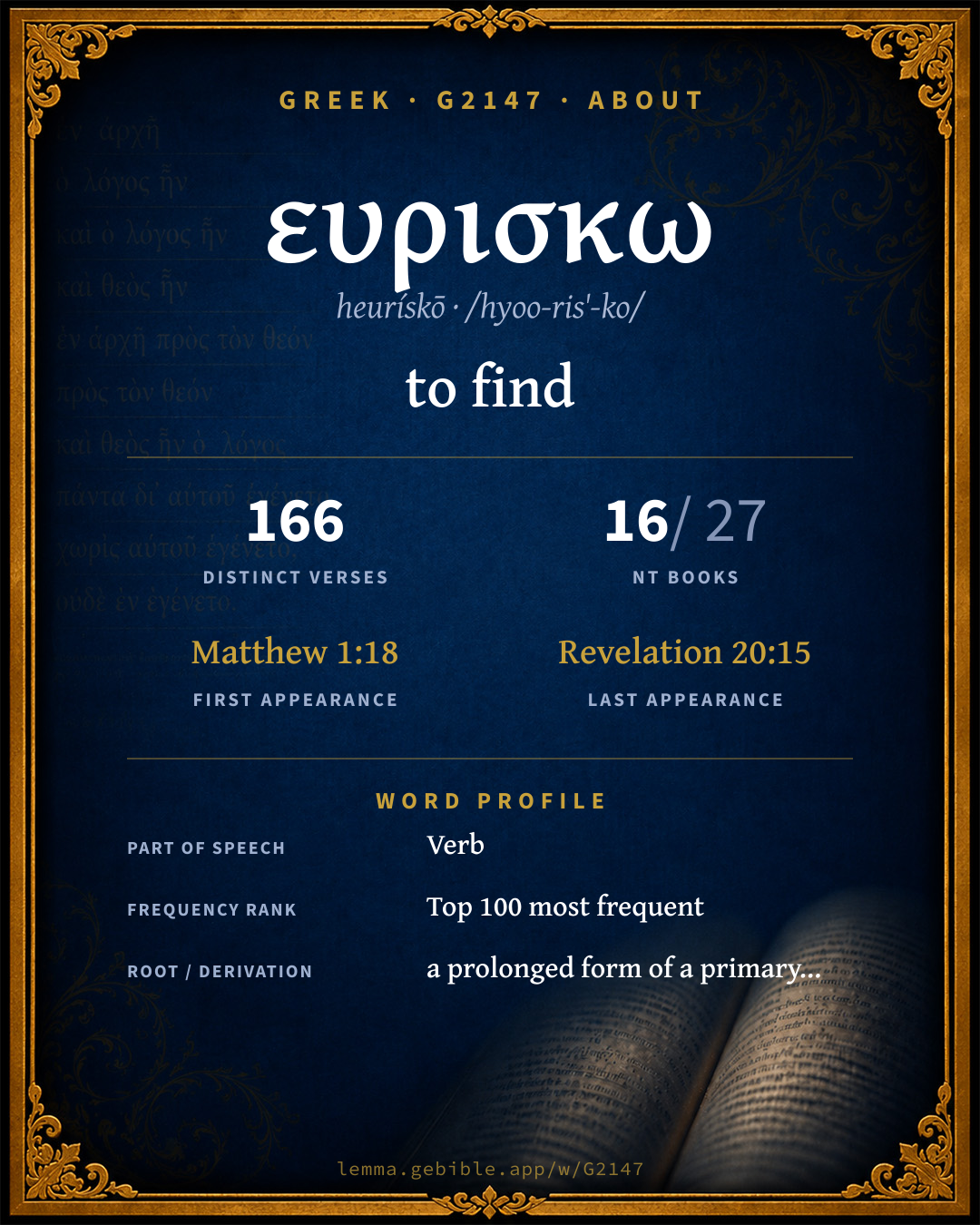
εὑρίσκω
to find
‘to find’ is one of 3 main senses fuller range ↓
Full lexicon entry — Thayer's Greek Lexicon
From Thayer's Greek Lexicon
Where this word appears
See every Aorist-tense verb in the Greek New Testament →
Grammar key — what these labels mean
Part of speech
- Verb
- An action or state-of-being word.
Tense
- Aorist
- Action viewed as a simple whole, without regard to duration — often past (perfective aspect).
- Present
- Ongoing or general action in present time (imperfective aspect).
- Future
- Action expected in future time.
- Imperfect
- Continuous or repeated action in past time (“was writing”).
- Perfect
- A completed past action with continuing present results.
Voice
- Active
- The subject performs the action.
- Passive
- The subject receives the action.
- Middle
- The subject acts on or for itself, or with special interest in the action.
Mood
- Indicative
- States a fact or asks a factual question (the mood of reality).
- Participle
- A verbal adjective (“writing,” “having written”).
- Infinitive
- A verbal noun (“to write”), unmarked for person or number.
- Subjunctive
- Expresses probability, purpose, or possibility (the mood of contingency).
- Optative
- Expresses a wish or a remote possibility.
Case
- Nominative
- The case of the subject (and the predicate nominative).
Person
- 3rd person
- The one spoken about (“he / she / it / they”).
- 2nd person
- The one addressed (“you”).
- 1st person
- The speaker (“I / we”).
Gender
- Masculine
- Grammatically masculine.
- Feminine
- Grammatically feminine.
- Neuter
- Grammatically neuter.
Number
- Plural
- More than one.
- Singular
- One.
Grammatical forms 44 distinct
- Verb, Aorist, Active, Indicative, 3rd person, Plural 24 times (14%)
- Verb, Aorist, Active, Indicative, 3rd person, Singular 16 times (9%)
- Verb, Aorist, Passive, Indicative, 3rd person, Singular 13 times (7%)
- Verb, Present, Active, Indicative, 3rd person, Singular 12 times (7%)
- Verb, Aorist, Active, Participle, Nominative, Singular, Masculine 10 times (6%)
- Verb, Future, Active, Indicative, 2nd person, Plural 10 times (6%)
- Verb, Aorist, Active, Indicative, 1st person, Singular 9 times (5%)
- Verb, Aorist, Active, Participle, Nominative, Plural, Masculine 8 times (5%)
+36 more forms (73 occurrences)
Parsed forms decoded from the imported morphology (Robinson–Tischendorf, public domain), counted across 175 parsed occurrences — not distinct verses.
Every verse where G2147 appears — 166 distinct verses across 16 books. Click any verse to open its interlinear word-by-word view. Verse text shown in the World English Bible for context — . Each verse’s Greek form is shown with its reference; the English is not keyword-highlighted, since the data carries no word-level English alignment. Use “Compare translations” on any verse to read it across multiple English versions. This concordance covers the Greek New Testament; Septuagint (Greek Old Testament) occurrences of this word are not indexed here.
Matthew 26 verses
- Matthew 1:18 εὑρέθη aor pass ind 3sg Now the birth of Jesus Christ was like this; for after his mother, Mary, was engaged to Joseph, before they came together, she was found pregnant by the Holy Spirit.
- Matthew 2:8 εὕρητε aor act subj 2pl He sent them to Bethlehem, and said, "Go and search diligently for the young child. When you have found him, bring me word, so that I also may come and worship him."
- Matthew 7:7 εὑρήσετε fut act ind 2pl "Ask, and it will be given you. Seek, and you will find. Knock, and it will be opened for you.
- Matthew 7:8 εὑρίσκει pres act ind 3sg For everyone who asks receives. He who seeks finds. To him who knocks it will be opened.
- Matthew 7:14 εὑρίσκοντες pres act ptcp nom pl masc How narrow is the gate, and restricted is the way that leads to life! Few are those who find it.
- Matthew 8:10 εὗρον aor act ind 1sg When Jesus heard it, he marveled, and said to those who followed, "Most assuredly I tell you, I haven't found so great a faith, not even in Israel.
- Matthew 10:39 εὑρὼν εὑρήσει aor act ptcp nom sg masc fut act ind 3sg He who finds his life will lose it; and he who loses his life for my sake will find it.
- Matthew 11:29 εὑρήσετε fut act ind 2pl Take my yoke upon you, and learn from me, for I am gentle and lowly in heart; and you will find rest for your souls.
- Matthew 12:43 εὑρίσκει pres act ind 3sg But the unclean spirit, when he is gone out of the man, passes through waterless places, seeking rest, and doesn't find it.
- Matthew 12:44 εὑρίσκει pres act ind 3sg Then he says, 'I will return into my house from which I came out,' and when he has come back, he finds it empty, swept, and put in order.
- Matthew 13:44 εὑρὼν aor act ptcp nom sg masc "Again, the Kingdom of Heaven is like a treasure hidden in the field, which a man found, and hid. In his joy, he goes and sells all that he has, and buys that field.
- Matthew 13:46 εὑρὼν aor act ptcp nom sg masc who having found one pearl of great price, he went and sold all that he had, and bought it.
- Matthew 16:25 εὑρήσει fut act ind 3sg For whoever desires to save his life will lose it, and whoever will lose his life for my sake will find it.
- Matthew 17:27 εὑρήσεις fut act ind 2sg But, lest we cause them to stumble, go to the sea, and cast a hook, and take up the first fish that comes up. When you have opened its mouth, you will find a stater coin. Take that, and give it to them for me and you."
- Matthew 18:13 εὑρεῖν aor act inf If he finds it, most assuredly I tell you, he rejoices over it more than over the ninety-nine which have not gone astray.
- Matthew 18:28 εὗρεν aor act ind 3sg "But that servant went out, and found one of his fellow servants, who owed him one hundred denarii, and he grabbed him, and took him by the throat, saying, 'Pay me what you owe!'
- Matthew 20:6 εὗρεν aor act ind 3sg About the eleventh hour he went out, and found others standing idle. He said to them, 'Why do you stand here all day idle?'
- Matthew 21:2 εὑρήσετε fut act ind 2pl saying to them, "Go into the village that is opposite you, and immediately you will find a donkey tied, and a colt with her. Untie them, and bring them to me.
- Matthew 21:19 εὗρεν aor act ind 3sg Seeing a fig tree by the road, he came to it, and found nothing on it but leaves. He said to it, "Let there be no fruit from you forever!" Immediately the fig tree withered away.
- Matthew 22:9 εὕρητε aor act subj 2pl Go therefore to the intersections of the highways, and as many as you may find, invite to the marriage feast.'
- Matthew 22:10 εὗρον aor act ind 3pl Those servants went out into the highways, and gathered together as many as they found, both bad and good. The wedding was filled with guests.
- Matthew 24:46 εὑρήσει fut act ind 3sg Blessed is that servant whom his lord finds doing so when he comes.
- Matthew 26:40 εὑρίσκει pres act ind 3sg He came to the disciples, and found them sleeping, and said to Peter, "What, couldn't you watch with me for one hour?
- Matthew 26:43 εὗρεν aor act ind 3sg He came again and found them sleeping, for their eyes were heavy.
- Matthew 26:60 εὗρον aor act ind 3pl and they found none. Even though many false witnesses came forward, they found none. But at last two false witnesses came forward,
- Matthew 27:32 εὗρον aor act ind 3pl As they came out, they found a man of Cyrene, Simon by name, and they compelled him to go with them, that he might carry his cross.
Mark 10 verses
- Mark 1:37 εὗρον aor act ind 3pl and they found him, and told him, "Everyone is looking for you."
- Mark 7:30 εὗρεν aor act ind 3sg She went away to her house, and found the child having been laid on the bed, with the demon gone out.
- Mark 11:2 εὑρήσετε fut act ind 2pl and said to them, "Go your way into the village that is opposite you. Immediately as you enter into it, you will find a young donkey tied, on which no one has sat. Untie him, and bring him.
- Mark 11:4 εὗρον aor act ind 3pl They went away, and found a young donkey tied at the door outside in the open street, and they untied him.
- Mark 11:13 εὑρήσει εὗρεν fut act ind 3sg aor act ind 3sg Seeing a fig tree afar off having leaves, he came to see if perhaps he might find anything on it. When he came to it, he found nothing but leaves, for it was not the season for figs.
- Mark 13:36 εὕρῃ aor act subj 3sg lest coming suddenly he might find you sleeping.
- Mark 14:16 εὗρον aor act ind 3pl His disciples went out, and came into the city, and found things as he had said to them, and they prepared the Passover.
- Mark 14:37 εὑρίσκει pres act ind 3sg He came and found them sleeping, and said to Peter, "Simon, are you sleeping? Couldn't you watch one hour?
- Mark 14:40 εὗρεν aor act ind 3sg Again he returned, and found them sleeping, for their eyes were very heavy, and they didn't know what to answer him.
- Mark 14:55 εὕρισκον impf act ind 3pl Now the chief priests and the whole council sought witnesses against Jesus to put him to death, and found none.
Luke 44 verses
- Luke 1:30 εὗρες aor act ind 2sg The angel said to her, "Don't be afraid, Mary, for you have found favor with God.
- Luke 2:12 εὑρήσετε fut act ind 2pl This is the sign to you: you will find a baby wrapped in strips of cloth, lying in a feeding trough."
- Luke 2:45 εὑρόντες aor act ptcp nom pl masc When they didn't find him, they returned to Jerusalem, looking for him.
- Luke 2:46 εὗρον aor act ind 3pl It happened after three days they found him in the temple, sitting in the midst of the teachers, both listening to them, and asking them questions.
- Luke 4:17 εὗρεν aor act ind 3sg The book of the prophet Isaiah was handed to him. He opened the book, and found the place where it was written,
- Luke 5:19 εὑρόντες aor act ptcp nom pl masc Not finding a way to bring him in because of the multitude, they went up to the housetop, and let him down through the tiles with his cot into the midst before Jesus.
- Luke 6:7 εὕρωσιν aor act subj 3pl The scribes and the Pharisees watched him, to see whether he would heal on the Sabbath, that they might find an accusation against him.
- Luke 7:9 εὗρον aor act ind 1sg When Jesus heard these things, he marveled at him, and turned and said to the multitude who followed him, "I tell you, I have not found such great faith, no, not in Israel."
- Luke 7:10 εὗρον aor act ind 3pl Those who were sent, returning to the house, found that the servant who had been sick was well.
- Luke 8:35 εὗρον aor act ind 3pl People went out to see what had happened. They came to Jesus, and found the man from whom the demons had gone out, sitting at Jesus' feet, clothed and in his right mind; and they were afraid.
- Luke 9:12 εὕρωσιν aor act subj 3pl The day began to wear away; and the twelve came, and said to him, "Send the multitude away, that they may go into the surrounding villages and farms, and lodge, and get food, for we are here in a deserted place."
- Luke 9:36 εὑρέθη aor pass ind 3sg When the voice came, Jesus was found alone. They were silent, and told no one in those days any of the things which they had seen.
- Luke 11:9 εὑρήσετε fut act ind 2pl "I tell you, keep asking, and it will be given you. Keep seeking, and you will find. Keep knocking, and it will be opened to you.
- Luke 11:10 εὑρίσκει pres act ind 3sg For everyone who asks receives. He who seeks finds. To him who knocks it will be opened.
- Luke 11:24 εὑρίσκον pres act ptcp nom sg neut The unclean spirit, when he has gone out of the man, passes through dry places, seeking rest, and finding none, he says, 'I will turn back to my house from which I came out.'
- Luke 11:25 εὑρίσκει pres act ind 3sg When he returns, he finds it swept and put in order.
- Luke 12:37 εὑρήσει fut act ind 3sg Blessed are those servants, whom the lord will find watching when he comes. Most assuredly I tell you, that he will dress himself, and make them recline, and will come and serve them.
- Luke 12:38 εὕρῃ aor act subj 3sg They will be blessed if he comes in the second or third watch, and finds them so.
- Luke 12:43 εὑρήσει fut act ind 3sg Blessed is that servant whom his lord will find doing so when he comes.
- Luke 13:6 εὗρεν aor act ind 3sg He spoke this parable. "A certain man had a fig tree planted in his vineyard, and he came seeking fruit on it, and found none.
- Luke 13:7 εὑρίσκω pres act ind 1sg He said to the vine dresser, 'Behold, these three years I have come looking for fruit on this fig tree, and found none. Cut it down. Why does it waste the soil?'
- Luke 15:4 εὕρῃ aor act subj 3sg "Which of you men, if you had one hundred sheep, and lost one of them, wouldn't leave the ninety-nine in the wilderness, and go after the one that was lost, until he found it?
- Luke 15:5 εὑρὼν aor act ptcp nom sg masc When he has found it, he carries it on his shoulders, rejoicing.
- Luke 15:6 εὗρον aor act ind 1sg When he comes home, he calls together his friends and his neighbors, saying to them, 'Rejoice with me, for I have found my sheep which was lost!'
- Luke 15:8 εὕρῃ aor act subj 3sg Or what woman, if she had ten drachma coins, if she lost one drachma coin, wouldn't light a lamp, sweep the house, and seek diligently until she found it?
- Luke 15:9 εὑροῦσα εὗρον aor act ptcp nom sg fem aor act ind 1sg When she has found it, she calls together her friends and neighbors, saying, 'Rejoice with me, for I have found the drachma which I had lost.'
- Luke 15:24 εὑρέθη aor pass ind 3sg for this, my son, was dead, and is alive again. He was lost, and is found.' They began to celebrate.
- Luke 15:32 εὑρέθη aor pass ind 3sg But it was appropriate to celebrate and be glad, for this, your brother, was dead, and is alive again. He was lost, and is found.'"
- Luke 17:18 εὑρέθησαν aor pass ind 3pl Were there none found who returned to give glory to God, except this stranger?"
- Luke 18:8 εὑρήσει fut act ind 3sg I tell you that he will avenge them quickly. Nevertheless, when the Son of Man comes, will he find faith on the earth?"
- Luke 19:30 εὑρήσετε fut act ind 2pl saying, "Go your way into the village on the other side, in which, as you enter, you will find a colt tied, whereon no man ever yet sat. Untie it, and bring it.
- Luke 19:32 εὗρον aor act ind 3pl Those who were sent went away, and found things just as he had told them.
- Luke 19:48 εὕρισκον impf act ind 3pl They couldn't find what they might do, for all the people hung on to every word that he said.
- Luke 22:13 εὗρον aor act ind 3pl They went, found things as he had told them, and they prepared the Passover.
- Luke 22:45 εὗρεν aor act ind 3sg When he rose up from his prayer, he came to the disciples, and found them sleeping because of grief,
- Luke 23:2 εὕραμεν aor act ind 1pl They began to accuse him, saying, "We found this man perverting the nation, forbidding paying taxes to Caesar, and saying that he himself is Christ, a king."
- Luke 23:4 εὑρίσκω pres act ind 1sg Pilate said to the chief priests and the multitudes, "I find no basis for a charge against this man."
- Luke 23:14 εὗρον aor act ind 1sg and said to them, "You brought this man to me as one that perverts the people, and see, I have examined him before you, and found no basis for a charge against this man concerning those things of which you accuse him.
- Luke 23:22 εὗρον aor act ind 1sg He said to them the third time, "Why? What evil has this man done? I have found no capital crime in him. I will therefore chastise him and release him."
- Luke 24:2 εὗρον aor act ind 3pl They found the stone rolled away from the tomb.
- Luke 24:3 εὗρον aor act ind 3pl They entered in, and didn't find the Lord Jesus' body.
- Luke 24:23 εὑροῦσαι aor act ptcp nom pl fem and when they didn't find his body, they came saying that they had also seen a vision of angels, who said that he was alive.
- Luke 24:24 εὗρον aor act ind 3pl Some of us went to the tomb, and found it just like the women had said, but they didn't see him."
- Luke 24:33 εὗρον aor act ind 3pl They rose up that very hour, returned to Jerusalem, and found the eleven gathered together, and those who were with them,
John 17 verses
- John 1:42 εὑρίσκει εὑρήκαμεν pres act ind 3sg perf act ind 1pl He brought him to Jesus. Jesus looked at him, and said, "You are Simon the son of Jonah. You shall be called Cephas" (which is by interpretation, Peter).
- John 1:44 εὑρίσκει pres act ind 3sg Now Philip was from Bethsaida, of the city of Andrew and Peter.
- John 1:46 εὑρίσκει εὑρήκαμεν pres act ind 3sg perf act ind 1pl Nathanael said to him, "Can any good thing come out of Nazareth?" Philip said to him, "Come and see."
- John 2:14 εὗρεν aor act ind 3sg He found in the temple those who sold oxen, sheep, and doves, and the changers of money sitting.
- John 5:14 εὑρίσκει pres act ind 3sg Afterward Jesus found him in the temple, and said to him, "Behold, you are made well. Sin no more, so that nothing worse happens to you."
- John 6:25 εὑρόντες aor act ptcp nom pl masc When they found him on the other side of the sea, they asked him, "Rabbi, when did you come here?"
- John 7:34 εὑρήσετε fut act ind 2pl You will seek me, and won't find me; and where I am, you can't come."
- John 7:35 εὑρήσομεν fut act ind 1pl The Jews therefore said among themselves, "Where will this man go that we won't find him? Will he go to the Dispersion among the Greeks, and teach the Greeks?
- John 7:36 εὑρήσετέ fut act ind 2pl What is this word that he said, 'You will seek me, and won't find me; and where I am, you can't come?'"
- John 9:35 εὑρὼν aor act ptcp nom sg masc Jesus heard that they had thrown him out, and finding him, he said, "Do you believe in the Son of God?"
- John 10:9 εὑρήσει fut act ind 3sg I am the door. If anyone enters in by me, he will be saved, and will go in and go out, and will find pasture.
- John 11:17 εὗρεν aor act ind 3sg So when Jesus came, he found that he had been in the tomb four days already.
- John 12:14 εὑρὼν aor act ptcp nom sg masc Jesus, having found a young donkey, sat on it. As it is written,
- John 18:38 εὑρίσκω pres act ind 1sg Pilate said to him, "What is truth?" When he had said this, he went out again to the Jews, and said to them, "I find no basis for a charge against him.
- John 19:4 εὑρίσκω pres act ind 1sg Then Pilate went out again, and said to them, "Behold, I bring him out to you, that you may know that I find no basis for a charge against him."
- John 19:6 εὑρίσκω pres act ind 1sg When therefore the chief priests and the officers saw him, they shouted, saying, "Crucify! Crucify!" Pilate said to them, "Take him yourselves, and crucify him, for I find no basis for a charge against him."
- John 21:6 εὑρήσετε fut act ind 2pl He said to them, "Cast the net on the right side of the boat, and you will find some." They cast it therefore, and now they weren't able to draw it in for the multitude of fish.
Acts 32 verses
- Acts 4:21 εὑρίσκοντες pres act ptcp nom pl masc When they had further threatened them, they let them go, finding no way to punish them, because of the people; for everyone glorified God for that which was done.
- Acts 5:10 εὗρον aor act ind 3pl She fell down immediately at his feet, and died. The young men came in and found her dead, and they carried her out and buried her by her husband.
- Acts 5:22 εὗρον aor act ind 3pl But the officers who came didn't find them in the prison. They returned and reported,
- Acts 5:23 εὕρομεν εὕρομεν aor act ind 1pl aor act ind 1pl "We found the prison shut and locked, and the guards standing before the doors, but when we opened them, we found no one inside!"
- Acts 5:39 εὑρεθῆτε aor pass subj 2pl But if it is of God, you will not be able to overthrow it, and you would be found even to be fighting against God!"
- Acts 7:11 εὕρισκον impf act ind 3pl Now a famine came over all the land of Egypt and Canaan, and great affliction. Our fathers found no food.
- Acts 7:46 εὗρεν εὑρεῖν aor act ind 3sg aor act inf who found favor in the sight of God, and asked to find a habitation for the God of Jacob.
- Acts 8:40 εὑρέθη aor pass ind 3sg But Philip was found at Azotus. Passing through, he preached the Gospel to all the cities, until he came to Caesarea.
- Acts 9:2 εὕρῃ aor act subj 3sg and asked for letters from him to the synagogues of Damascus, that if he found any who were of the Way, whether men or women, he might bring them bound to Jerusalem.
- Acts 9:33 εὗρεν aor act ind 3sg There he found a certain man named Aeneas, who had been bedridden for eight years, because he was paralyzed.
- Acts 10:27 εὑρίσκει pres act ind 3sg As he talked with him, he went in and found many gathered together.
- Acts 11:25 εὑρὼν aor act ptcp nom sg masc Barnabas went out to Tarsus to look for Saul.
- Acts 12:19 εὑρών aor act ptcp nom sg masc When Herod had sought for him, and didn't find him, he examined the guards, and commanded that they should be put to death. He went down from Judea to Caesarea, and stayed there.
- Acts 13:6 εὗρον aor act ind 3pl When they had gone through the island to Paphos, they found a certain sorcerer, a false prophet, a Jew, whose name was Bar Jesus,
- Acts 13:22 εὗρον aor act ind 1sg When he had removed him, he raised up David to be their king, to whom he also testified, 'I have found David the son of Jesse, a man after my heart, who will do all my will.'
- Acts 13:28 εὑρόντες aor act ptcp nom pl masc Though they found no cause for death, they still asked Pilate to have him killed.
- Acts 17:6 εὑρόντες aor act ptcp nom pl masc When they didn't find them, they dragged Jason and certain brothers before the rulers of the city, crying, "These who have turned the world upside down have come here also,
- Acts 17:23 εὗρον aor act ind 1sg For as I passed along, and observed the objects of your worship, I found also an altar with this inscription: 'TO AN UNKNOWN GOD.' What therefore you worship in ignorance, this I announce to you.
- Acts 17:27 εὕροιεν aor act opt 3pl that they should seek the Lord, if perhaps they might reach out for him and find him, though he is not far from each one of us.
- Acts 18:2 εὑρών aor act ptcp nom sg masc He found a certain Jew named Aquila, a man of Pontus by race, who had recently come from Italy, with his wife Priscilla, because Claudius had commanded all the Jews to depart from Rome. He came to them,
- Acts 19:1 εὑρεῖν aor act inf It happened that, while Apollos was at Corinth, Paul, having passed through the upper country, came to Ephesus, and found certain disciples.
- Acts 19:19 εὗρον aor act ind 3pl Many of those who practiced magical arts brought their books together and burned them in the sight of all. They counted the price of them, and found it to be fifty thousand pieces of silver.
- Acts 21:2 εὑρόντες aor act ptcp nom pl masc Having found a ship crossing over to Phoenicia, we went aboard, and set sail.
- Acts 23:9 εὑρίσκομεν pres act ind 1pl A great clamor arose, and some of the scribes of the Pharisees part stood up, and contended, saying, "We find no evil in this man. But if a spirit or angel has spoken to him, let's not fight against God!"
- Acts 23:29 εὗρον aor act ind 1sg I found him to be accused about questions of their law, but to have nothing laid to his charge worthy of death or of bonds.
- Acts 24:5 εὑρόντες aor act ptcp nom pl masc For we have found this man to be a plague, an instigator of insurrections among all the Jews throughout the world, and a ringleader of the sect of the Nazarenes.
- Acts 24:12 εὗρόν aor act ind 3pl In the temple they didn't find me disputing with anyone or stirring up a crowd, either in the synagogues, or in the city.
- Acts 24:18 εὗρόν aor act ind 3pl amid which certain Jews from Asia found me purified in the temple, not with a mob, nor with turmoil.
- Acts 24:20 εὗρον aor act ind 3pl Or else let these men themselves say what injustice they found in me when I stood before the council,
- Acts 27:6 εὑρὼν aor act ptcp nom sg masc There the centurion found a ship of Alexandria sailing for Italy, and he put us on board.
- Acts 27:28 εὗρον εὗρον aor act ind 3pl aor act ind 3pl They took soundings, and found twenty fathoms. After a little while, they took soundings again, and found fifteen fathoms..
- Acts 28:14 εὑρόντες aor act ptcp nom pl masc where we found brothers, and were entreated to stay with them for seven days. So we came to Rome.
Romans 4 verses
- Romans 4:1 εὑρηκέναι perf act inf What then will we say that Abraham, our forefather, has found according to the flesh?
- Romans 7:10 εὑρέθη aor pass ind 3sg The commandment, which was for life, this I found to be for death;
- Romans 7:21 εὑρίσκω pres act ind 1sg I find then the law, that, to me, while I desire to do good, evil is present.
- Romans 10:20 εὑρέθην aor pass ind 1sg Isaiah is very bold, and says, "I was found by those who didn't seek me. I was revealed to those who didn't ask for me."
1 Corinthians 2 verses
- 1 Corinthians 4:2 εὑρεθῇ aor pass subj 3sg Here, moreover, it is required of stewards, that they be found faithful.
- 1 Corinthians 15:15 εὑρισκόμεθα pres pass ind 1pl Yes, we are found false witnesses of God, because we testified about God that he raised up Christ, whom he didn't raise up, if it is so that the dead are not raised.
2 Corinthians 5 verses
- 2 Corinthians 2:13 εὑρεῖν aor act inf I had no relief for my spirit, because I didn't find Titus, my brother, but taking my leave of them, I went out into Macedonia.
- 2 Corinthians 5:3 εὑρεθησόμεθα fut pass ind 1pl if so be that being clothed we will not be found naked.
- 2 Corinthians 9:4 εὕρωσιν aor act subj 3pl so that I won't by any means, if there come with me any of Macedonia and find you unprepared, we (to say nothing of you) should be disappointed in this confident boasting.
- 2 Corinthians 11:12 εὑρεθῶσιν aor pass subj 3pl But what I do, that I will do, that I may cut off occasion from them that desire an occasion, that in which they boast, they may be found even as we.
- 2 Corinthians 12:20 εὕρω εὑρεθῶ aor act subj 1sg aor pass subj 1sg For I am afraid that by any means, when I come, I might find you not the way I want to, and that I might be found by you as you don't desire; that by any means there would be strife, jealousy, outbursts of anger, factions, slander, whisperings, proud thoughts, riots;
Galatians 1 verse
Philippians 2 verses
- Philippians 2:7 εὑρεθεὶς aor pass ptcp nom sg masc but emptied himself, taking the form of a servant, being made in the likeness of men.
- Philippians 3:9 εὑρεθῶ aor pass subj 1sg and be found in him, not having a righteousness of my own, that which is of the law, but that which is through faith in Christ, the righteousness which is from God by faith;
2 Timothy 2 verses
Hebrews 4 verses
- Hebrews 4:16 εὕρωμεν aor act subj 1pl Let us therefore draw near with boldness to the throne of grace, that we may receive mercy, and may find grace for help in time of need.
- Hebrews 9:12 εὑράμενος aor mid ptcp nom sg masc nor yet through the blood of goats and calves, but through his own blood, entered in once for all into the Holy Place, having obtained eternal redemption.
- Hebrews 11:5 ηὑρίσκετο impf pass ind 3sg By faith, Enoch was taken away, so that he wouldn't see death, and he was not found, because God translated him. For he has had testimony given to him that before his translation he had been well pleasing to God.
- Hebrews 12:17 εὗρεν aor act ind 3sg For you know that even when he afterward desired to inherit the blessing, he was rejected, for he found no place for a change of mind though he sought it diligently with tears.
1 Peter 2 verses
- 1 Peter 1:7 εὑρεθῇ aor pass subj 3sg that the proof of your faith, which is more precious than gold that perishes even though it is tested by fire, may be found to result in praise, glory, and honor at the revelation of Jesus Christ--
- 1 Peter 2:22 εὑρέθη aor pass ind 3sg who did not sin, "neither was deceit found in his mouth."
2 Peter 1 verse
2 John 1 verse
Revelation 13 verses
- Revelation 2:2 εὗρες aor act ind 2sg "I know your works, and your toil and perseverance, and that you can't tolerate evil men, and have tested those who call themselves apostles, and they are not, and found them false.
- Revelation 3:2 εὕρηκά perf act ind 1sg Wake up, and keep the things that remain, which you were about to throw away, for I have found no works of yours perfected before my God.
- Revelation 5:4 εὑρέθη aor pass ind 3sg And I wept much, because no one was found worthy to open the book, or to look in it.
- Revelation 9:6 εὑρήσουσιν fut act ind 3pl In those days people will seek death, and will in no way find it. They will desire to die, and death will flee from them.
- Revelation 12:8 εὑρέθη aor pass ind 3sg They didn't prevail, neither was a place found for him any more in heaven.
- Revelation 14:5 εὑρέθη aor pass ind 3sg In their mouth was found no lie, for they are blameless.
- Revelation 16:20 εὑρέθησαν aor pass ind 3pl Every island fled away, and the mountains were not found.
- Revelation 18:14 εὑρήσουσιν fut act ind 3pl The fruits which your soul lusted after have been lost to you, and all things that were dainty and sumptuous have perished from you, and you will find them no more at all.
- Revelation 18:21 εὑρεθῇ aor pass subj 3sg A mighty angel took up a stone like a great millstone and cast it into the sea, saying, "Thus with violence will Babylon, the great city, be thrown down, and will be found no more at all.
- Revelation 18:22 εὑρεθῇ aor pass subj 3sg The voice of harpists, minstrels, flute players, and trumpeters will be heard no more at all in you. No craftsman, of whatever craft, will be found any more at all in you. The sound of a mill will be heard no more at all in you.
- Revelation 18:24 εὑρέθη aor pass ind 3sg In her was found the blood of prophets and of saints, and of all who have been slain on the earth."
- Revelation 20:11 εὑρέθη aor pass ind 3sg I saw a great white throne, and him who sat on it, from whose face the earth and the heaven fled away. There was found no place for them.
- Revelation 20:15 εὑρέθη aor pass ind 3sg If anyone was not found written in the book of life, he was cast into the lake of fire.
About this entry
At a glance — auto-summarized from this page’s data, not written by a person. Every figure links to its source below. This summary describes the numbers; it doesn’t interpret them.
The Greek verb ευρισκω centers on the idea of “to find.” Debuting at Matthew 1:18, it then recurs through the corpus. It appears 166 verses across 16 books of the Greek New Testament, among its common vocabulary. The word gravitates to Luke (27%), then Acts and Matthew. Thayer's distinguishes 3 senses for it. For the data behind this summary, explore the sense tree and the renderings breakdown below.
Gloss history
Strong's 1890 vs modern scholarship

About this word
Strong's G2147 catalogs a Greek word from the Greek New Testament.
These counts are not copied from any lexicon or concordance. They are computed here, from the morphology-tagged Greek New Testament. What Lemma adds →
- 166
- distinct verses
- The word appears in 166 distinct verses.
- 16 / 27
- NT books
- The word appears in 16 of 27 New Testament books.
- #90
- by frequency
- Top 100 most frequent Greek words (rank 90 of 5,347 Greek words by occurrence).
View all 166 occurrences in the concordance →
By section of the New Testament
By traditional corpus
Conventional, traditional groupings — biblical authorship is debated, so this is a traditional corpus grouping, not an authorship claim. Some books belong to more than one corpus (Luke is in both the Gospels and the Lukan corpus, and so on), so these shares overlap and need not total 100%. Each figure is a share of the word’s 166 distinct verses.
- Gospels 97 verses · 58%
- Lukan (Luke–Acts) 76 verses · 46%
- Johannine 31 verses · 19%
- Pauline corpus 16 verses · 10%
- Revelation 13 verses · 8%
- Hebrews 4 verses · 2%
- General (Catholic) Epistles 4 verses · 2%
How translations render this word
Counts come from each version’s own published word-to-Strong’s tagging or interlinear alignment — an approximate guide to how each version renders this word, not a word-level alignment the data otherwise carries. Because each total is that version’s own tagged count, the per-version totals vary from one another and need not match the appearance or distinct-verse counts above. These counts may also differ from a printed concordance because Lemma counts each distinctly tagged rendering and does not collapse phrase taggings into a single head-word total. This is a fixed set of word-tagged versions (KJV, ASV, BSB, ULT) and does not change with the reading translation you choose elsewhere. Each version’s license is shown beside its name below (and on Sources).
- King James Version: Found 40×, Find 16×, Findeth 9×
- American Standard Version: Found 41×, Find 14×, They found 13×
- Berean Standard Bible: Found 21×, He found 13×, They found 12×
- unfoldingWord Literal Text: Found 22×, Find 16×, They found 15×
King James Version Public Domain
Renders G2147 across 194 tagged occurrences — most commonly:
Plus other, less common renderings. Plus 41 renderings that appear only once — usually multi-word phrases or single function words the recovered tagging swept in, not distinct renderings.
American Standard Version Public Domain
Renders G2147 across 194 tagged occurrences — most commonly:
Plus other, less common renderings. Plus 40 renderings that appear only once — usually multi-word phrases or single function words the recovered tagging swept in, not distinct renderings.
Berean Standard Bible Public Domain
Renders G2147 across 172 tagged occurrences — most commonly:
Plus other, less common renderings. Plus 45 renderings that appear only once — usually multi-word phrases or single function words the recovered tagging swept in, not distinct renderings. Not rendered by a distinct English word in 4 further occurrences.
unfoldingWord Literal Text CC BY-SA 4.0
Renders G2147 across 224 tagged occurrences — most commonly:
Plus other, less common renderings. Plus 45 renderings that appear only once — usually multi-word phrases or single function words the recovered tagging swept in, not distinct renderings.
Senses in Thayer's
The 3 senses Thayer's distinguishes for this word, in lexicon order (not ranked by frequency or importance). The full entry — with sub-senses — is in the Lexicon Entry tab.
- to come upon, hit upon, to meet with
- to find by enquiry, thought, examination, scrutiny, observation, to find out by practice and experience
- to find out for one's self, to acquire, get, obtain, procure
Word origin
Origin: a prolonged form of a primary heuro hyoo'-ro, which (together with another cognate form heureo hyoo-reh'-o) is used for it in all the tenses except the present and imperfect
A prolonged form of a primary word εὕρω heurō which (together with another cognate form εὑρέω heureō ) is used for it in all the tenses except the present and imperfect; to find (literally or figuratively): - find get obtain perceive see.
— Strong’s Exhaustive Concordance (1890), public domain.
Forms in the corpus
The 48 distinct written forms G2147 takes in the Greek New Testament, most frequent first — each parse links to that tense’s occurrences in the concordance.
Septuagint usage
The same Greek word ευρισκω appears 445 times in the Greek Old Testament (Septuagint), across 416 verses in 33 books.
- 445
- LXX occurrences
- Tagged occurrences of this Greek word in the Septuagint.
- 416
- verses
- Distinct Septuagint verses containing this word.
- 33 / 39
- OT books
- The word appears in 33 of the 39 Old Testament books.
Sample Septuagint occurrences
- Genesis 2:20 εὑρίσκω
- Exodus 5:11 εὑρίσκω
- Leviticus 5:11 εὑρίσκω
- Numbers 6:21 εὑρίσκω
- Deuteronomy 4:29 εὑρίσκω
- Joshua 2:22 εὑρίσκω
- Judges 5:30 εὑρίσκω
- Ruth 1:9 εὑρίσκω
- 1 Samuel 1:18 εὑρίσκω
- 2 Samuel 7:27 εὑρίσκω
- 1 Kings 1:3 εὑρίσκω
- 2 Kings 2:17 εὑρίσκω
Septuagint occurrences (same lexeme)
Every verse where the same Strong’s number (G2147) appears in the Greek Septuagint — showing the first 50 of 416. Verse text shown in the World English Bible for context; the Greek form is the matched word — the English is not keyword-highlighted.
- Genesis 2:20 εὑρίσκω The man gave names to all cattle, and to the birds of the sky, and to every animal of the field; but for man there was not found a helper suitable for him.
- Genesis 4:14 εὑρίσκω Behold, you have driven me out this day from the surface of the ground. I will be hidden from your face, and I will be a fugitive and a wanderer in the earth. It will happen that whoever finds me will kill me."
- Genesis 4:15 εὑρίσκω Yahweh said to him, "Therefore whoever slays Cain, vengeance will be taken on him sevenfold." Yahweh appointed a sign for Cain, lest any finding him should strike him.
- Genesis 5:24 εὑρίσκω Enoch walked with God, and he was not, for God took him.
- Genesis 6:8 εὑρίσκω But Noah found favor in Yahweh's eyes.
- Genesis 8:9 εὑρίσκω but the dove found no place to rest her foot, and she returned to him into the ark; for the waters were on the surface of the whole earth. He put forth his hand, and took her, and brought her to him into the ark.
- Genesis 11:2 εὑρίσκω It happened, as they traveled east, that they found a plain in the land of Shinar; and they lived there.
- Genesis 16:7 εὑρίσκω The angel of Yahweh found her by a fountain of water in the wilderness, by the fountain in the way to Shur.
- Genesis 18:3 εὑρίσκω and said, "My lord, if now I have found favor in your sight, please don't go away from your servant.
- Genesis 18:26 εὑρίσκω Yahweh said, "If I find in Sodom fifty righteous within the city, then I will spare all the place for their sake."
- Genesis 18:28 εὑρίσκω What if there will lack five of the fifty righteous? Will you destroy all the city for lack of five?" He said, "I will not destroy it, if I find forty-five there."
- Genesis 18:29 εὑρίσκω He spoke to him yet again, and said, "What if there are forty found there?" He said, "I will not do it for the forty's sake."
- Genesis 18:30 εὑρίσκω He said, "Oh don't let the Lord be angry, and I will speak. What if there are thirty found there?" He said, "I will not do it, if I find thirty there."
- Genesis 18:31 εὑρίσκω He said, "See now, I have taken it on myself to speak to the Lord. What if there are twenty found there?" He said, "I will not destroy it for the twenty's sake."
- Genesis 18:32 εὑρίσκω He said, "Oh don't let the Lord be angry, and I will speak yet but this once. What if ten are found there?" He said, "I will not destroy it for the ten's sake."
- Genesis 19:19 εὑρίσκω See now, your servant has found favor in your sight, and you have magnified your loving kindness, which you have shown to me in saving my life. I can't escape to the mountain, lest evil overtake me, and I die.
- Genesis 26:12 εὑρίσκω Isaac sowed in that land, and reaped in the same year one hundred times what he planted. Yahweh blessed him.
- Genesis 26:19 εὑρίσκω Isaac's servants dug in the valley, and found there a well of springing water.
- Genesis 26:32 εὑρίσκω It happened the same day, that Isaac's servants came, and told him concerning the well which they had dug, and said to him, "We have found water."
- Genesis 27:20 εὑρίσκω Isaac said to his son, "How is it that you have found it so quickly, my son?" He said, "Because Yahweh your God gave me success."
- Genesis 30:14 εὑρίσκω Reuben went in the days of wheat harvest, and found mandrakes in the field, and brought them to his mother, Leah. Then Rachel said to Leah, "Please give me some of your son's mandrakes."
- Genesis 30:27 εὑρίσκω Laban said to him, "If now I have found favor in your eyes, stay here, for I have divined that Yahweh has blessed me for your sake."
- Genesis 31:32 εὑρίσκω With whoever you find your gods, he shall not live. Before our relatives, discern what is yours with me, and take it." For Jacob didn't know that Rachel had stolen them.
- Genesis 31:33 εὑρίσκω Laban went into Jacob's tent, into Leah's tent, and into the tent of the two maid-servants; but he didn't find them. He went out of Leah's tent, and entered into Rachel's tent.
- Genesis 31:35 εὑρίσκω She said to her father, "Don't let my lord be angry that I can't rise up before you; for the manner of women is on me." He searched, but didn't find the teraphim.
- Genesis 31:37 εὑρίσκω Now that you have felt around in all my stuff, what have you found of all your household stuff? Set it here before my relatives and your relatives, that they may judge between us two.
- Genesis 32:6 εὑρίσκω The messengers returned to Jacob, saying, "We came to your brother Esau. Not only that, but he comes to meet you, and four hundred men with him."
- Genesis 32:20 εὑρίσκω You shall say, 'Not only that, but behold, your servant, Jacob, is behind us.'" For, he said, "I will appease him with the present that goes before me, and afterward I will see his face. Perhaps he will accept me."
- Genesis 33:8 εὑρίσκω Esau said, "What do you mean by all this company which I met?" Jacob said, "To find favor in the sight of my lord."
- Genesis 33:10 εὑρίσκω Jacob said, "Please, no, if I have now found favor in your sight, then receive my present at my hand, because I have seen your face, as one sees the face of God, and you were pleased with me.
- Genesis 33:15 εὑρίσκω Esau said, "Let me now leave with you some of the folk who are with me." He said, "Why? Let me find favor in the sight of my lord."
- Genesis 34:11 εὑρίσκω Shechem said to her father and to her brothers, "Let me find favor in your eyes, and whatever you will tell me I will give.
- Genesis 36:24 εὑρίσκω These are the children of Zibeon: Aiah and Anah. This is Anah who found the hot springs in the wilderness, as he fed the donkeys of Zibeon his father.
- Genesis 37:15 εὑρίσκω A certain man found him, and behold, he was wandering in the field: and the man asked him, saying, "What are you looking for?"
- Genesis 37:17 εὑρίσκω The man said, "They have left here, for I heard them say, 'Let us go to Dothan.'" Joseph went after his brothers, and found them in Dothan.
- Genesis 37:32 εὑρίσκω They took the coat of many colors, and they brought it to their father, and said, "We have found this. Examine it, now, whether it is your son's coat or not."
- Genesis 38:20 εὑρίσκω Judah sent the kid of the goats by the hand of his friend, the Adullamite, to receive the pledge from the woman's hand, but he didn't find her.
- Genesis 38:22 εὑρίσκω He returned to Judah, and said, "I haven't found her; and also the men of the place said, 'There has been no prostitute here.'"
- Genesis 38:23 εὑρίσκω Judah said, "Let her keep it, lest we be shamed. Behold, I sent this kid, and you haven't found her."
- Genesis 39:4 εὑρίσκω Joseph found favor in his sight. He ministered to him, and he made him overseer over his house, and all that he had he put into his hand.
- Genesis 41:38 εὑρίσκω Pharaoh said to his servants, "Can we find such a one as this, a man in whom is the Spirit of God?"
- Genesis 44:6 εὑρίσκω He overtook them, and he spoke to them these words.
- Genesis 44:8 εὑρίσκω Behold, the money, which we found in our sacks' mouths, we brought again to you out of the land of Canaan. How then should we steal silver or gold out of your lord's house?
- Genesis 44:9 εὑρίσκω With whoever of your servants it be found, let him die, and we also will be my lord's bondservants."
- Genesis 44:10 εὑρίσκω He said, "Now also let it be according to your words: he with whom it is found will be my bondservant; and you will be blameless."
- Genesis 44:12 εὑρίσκω He searched, beginning with the eldest, and ending at the youngest. The cup was found in Benjamin's sack.
- Genesis 44:16 εὑρίσκω Judah said, "What will we tell my lord? What will we speak? Or how will we clear ourselves? God has found out the iniquity of your servants. Behold, we are my lord's bondservants, both we, and he also in whose hand the cup is found."
- Genesis 44:17 εὑρίσκω He said, "Far be it from me that I should do so. The man in whose hand the cup is found, he will be my bondservant; but as for you, go up in peace to your father."
- Genesis 44:34 εὑρίσκω For how will I go up to my father, if the boy isn't with me? Lest I see the evil that will come on my father."
- Genesis 47:14 εὑρίσκω Joseph gathered up all the money that was found in the land of Egypt, and in the land of Canaan, for the grain which they bought: and Joseph brought the money into Pharaoh's house.
These are occurrences of the same Greek lexeme (G2147) in the Septuagint — not a translation of any one Hebrew word. The store carries no word-level Hebrew↔Greek alignment, so no Hebrew original is asserted here. Counts come from the recovered LXX Strong's tagging — high-frequency vocabulary is well covered, while rare or late forms may be untagged — so they reflect tagged occurrences and may slightly undercount.