

2 Corinthians 12:20
Greek (Tischendorf 8th ed.) 2 Corinthians 12:20 appears in the Greek New Testament. The text above is from the Tischendorf 8th edition. Each word links to its Strong’s number and a concise gloss. Click any word for its full Thayer’s Greek Lexicon entry.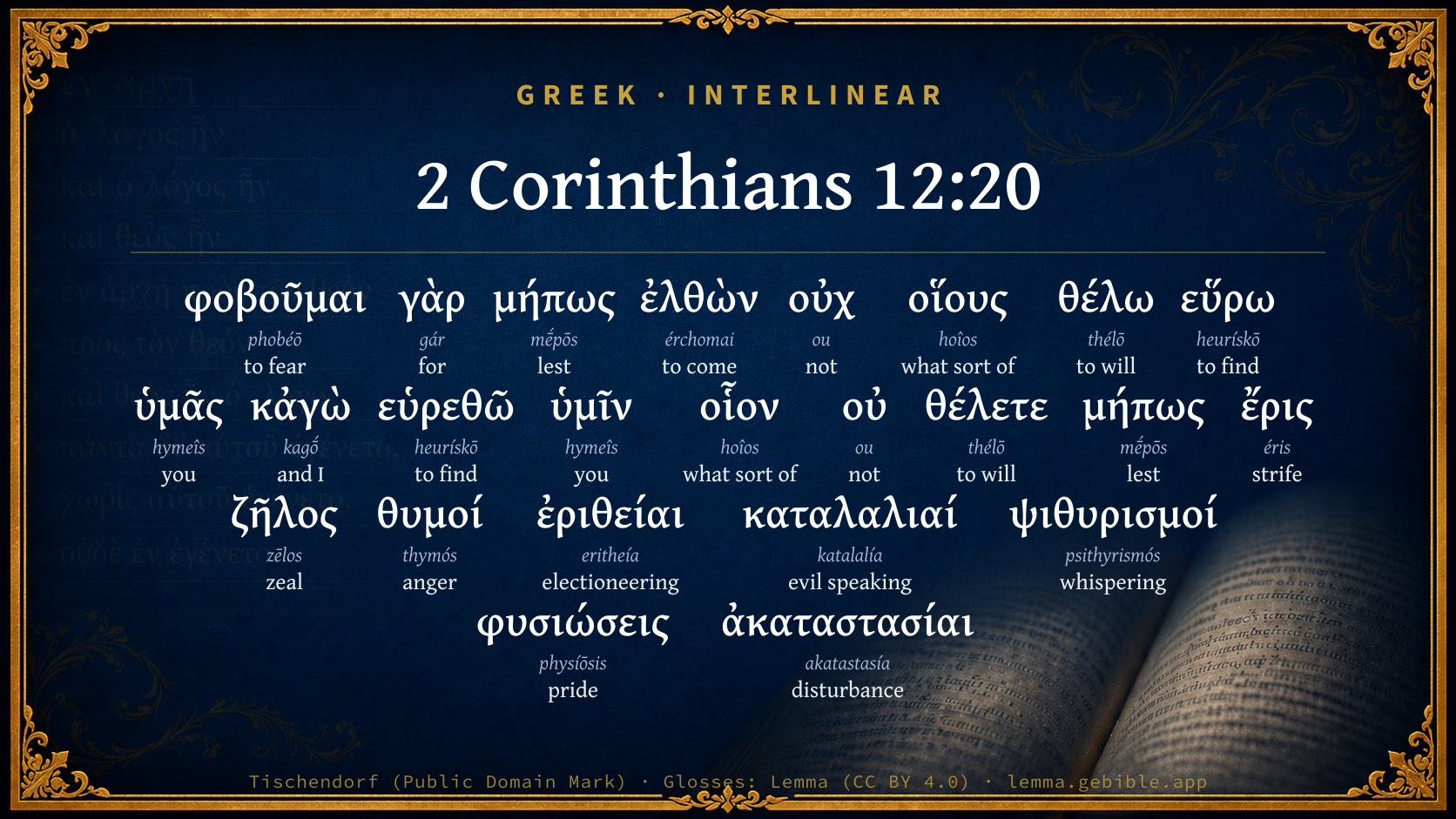
For I am afraid that by any means, when I come, I might find you not the way I want to, and that I might be found by you as you don't desire; that by any means there would be strife, jealousy, outbursts of anger, factions, slander, whisperings, proud thoughts, riots;
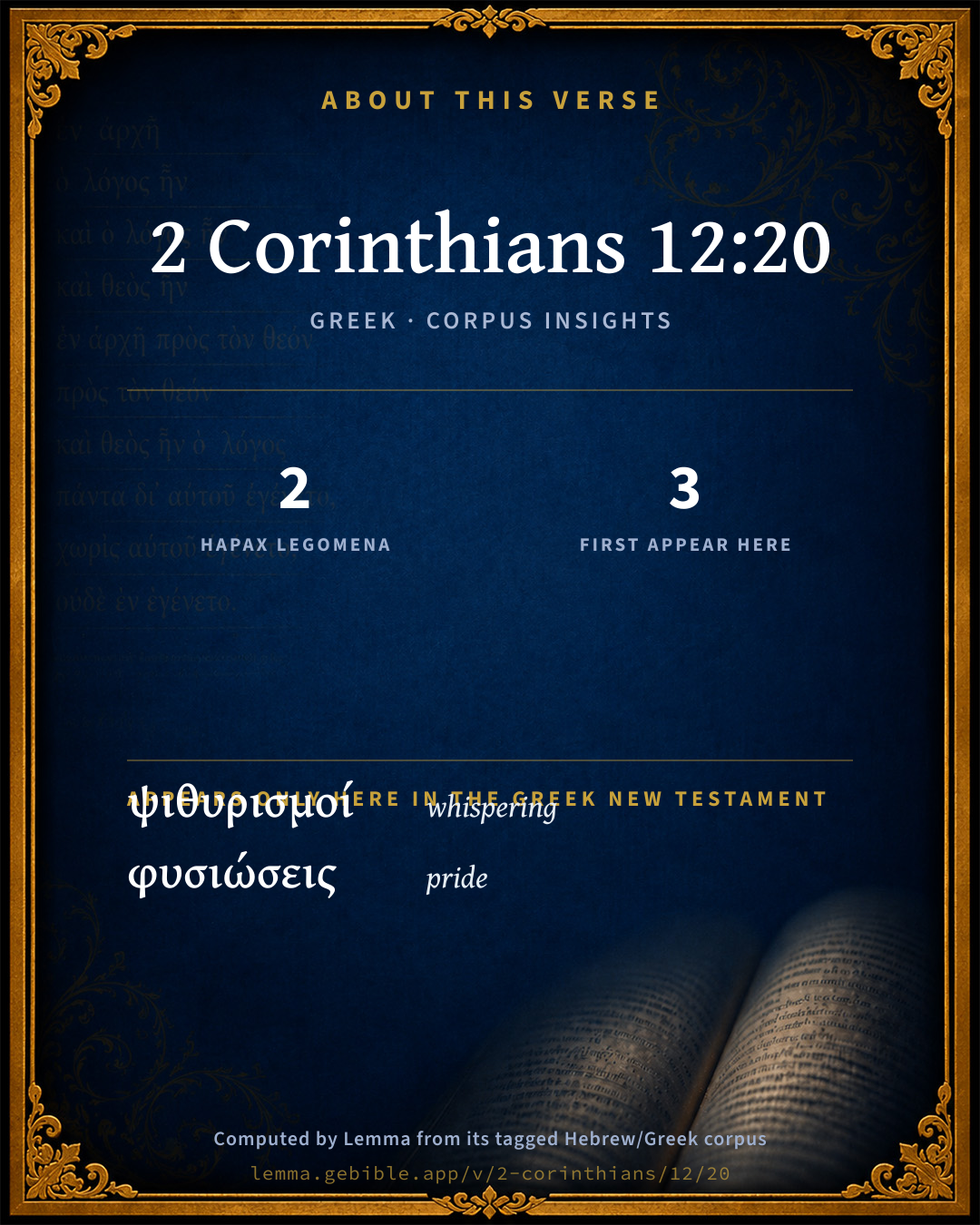
- 2 hapax legomena — only here in the Greek New Testament
- 3 first appearances in the Greek New Testament
Download a study sheet
One document with this verse’s original text, its word-by-word gloss line, the meaning frame, cross-references with their text, attributed commentary, and full source and license credits — printable, and it pastes into notes with its structure intact.
This verse Autodidact and up
A passage Seminary Student
Up to 50 verses in one chapter. A passage sheet keeps up to 6 commentary sources and 12 cross-references per verse, in the order this page ranks them, and says so on the sheet whenever that leaves anything out. Ask for a single verse and you get the Autodidact verse sheet above.
Everything on this page stays free to read, with no account — the sheet is a download of what is already on screen, not access to it.
Compare translations 3
The same verse in 3 English versions, stacked beneath the original-language interlinear above. Click any original word for its lexicon entry.
Each is an independent rendering of the whole verse — the interlinear is not word-aligned to these translations.
Highlighted words mark where these versions differ — a whole-verse word diff, not a word-by-word alignment.
-
World English Bible Public Domain
For I am afraid that by any means, when I come, I might find you not the way I want to, and that I might be found by you as you don't desire; that by any means there would be strife, jealousy, outbursts of anger, factions, slander, whisperings, proud thoughts, riots;
-
King James Version Public Domain
For I fear, lest, when I come, I shall not find you such as I would, and that I shall be found unto you such as ye would not: lest there be debates, envyings, wraths, strifes, backbitings, whisperings, swellings, tumults:
-
unfoldingWord Literal Text CC BY-SA 4.0
For I fear that somehow, having come, I might find you not such as I wish, and I might be found by you not such as you wish; that somehow quarreling, jealousy, ragings, rivalries, slanders, gossips, inflated egos, riots,
unfoldingWord Literal Text — © unfoldingWord, licensed CC BY-SA 4.0. Word-aligned USFM3 via Door43 (git.door43.org/unfoldingWord/en_ult).
Show all 19 translations
Every available English version of this verse, each an independent rendering of the whole verse.
-
World English Bible Public Domain
For I am afraid that by any means, when I come, I might find you not the way I want to, and that I might be found by you as you don't desire; that by any means there would be strife, jealousy, outbursts of anger, factions, slander, whisperings, proud thoughts, riots;
-
Berean Standard Bible Public Domain
For I am afraid that when I come, I may not find you as I wish, and you may not find me as you wish. I fear that there may be quarreling, jealousy, rage, rivalry, slander, gossip, arrogance, and disorder.
-
Majority Standard Bible Public Domain
For I am afraid that when I come, I may not find you as I wish, and you may not find me as you wish. I fear that there may be quarrels, jealousies, rage, rivalry, slander, gossip, arrogance, and disorder.
-
King James Version Public Domain
For I fear, lest, when I come, I shall not find you such as I would, and that I shall be found unto you such as ye would not: lest there be debates, envyings, wraths, strifes, backbitings, whisperings, swellings, tumults:
-
American Standard Version (1901) Public Domain
For I fear, lest by any means, when I come, I should find you not such as I would, and should myself be found of you such as ye would not; lest by any means `there should be' strife, jealousy, wraths, factions, backbitings, whisperings, swellings, tumults;
-
Revised Version (1885) Public Domain
For I fear, lest by any means, when I come, I should find you not such as I would, and should myself be found of you such as ye would not; lest by any means there should be strife, jealousy, wraths, factions, backbitings, whisperings, swellings, tumults;
-
Geneva Bible (1599) Public Domain
For I feare least when I come, I shall not finde you such as I would: and that I shalbe found vnto you such as ye woulde not, and least there be strife, enuying, wrath, contentions, backebitings, whisperings, swellings and discord.
-
Douay-Rheims (1899) Public Domain
For I fear lest perhaps when I come I shall not find you such as I would, and that I shall be found by you such as you would not. Lest perhaps contentions, envyings, animosities, dissensions, detractions, whisperings, swellings, seditions, be among you.
-
Young's Literal Translation Public Domain
for I fear lest, having come, not such as I wish I may find you, and I -- I may be found by you such as ye do not wish, lest there be strifes, envyings, wraths, revelries, evil-speakings, whisperings, puffings up, insurrections,
-
Literal Standard Version CC BY-SA 4.0
for I fear lest, having come, I may not find you such as I wish, and I may be found by you such as you do not wish, lest there be strifes, envyings, wraths, revelries, slanders, whisperings, puffings up, insurrections,
-
Unlocked Literal Bible CC BY-SA 4.0
For I fear that when I come I may not find you as I wish. I fear that you might not find me as you wish. I fear that there may be quarreling, jealousy, outbursts of anger, rivalries, slander, gossip, arrogance, and disorder.
-
unfoldingWord Literal Text CC BY-SA 4.0
For I fear that somehow, having come, I might find you not such as I wish, and I might be found by you not such as you wish; that somehow quarreling, jealousy, ragings, rivalries, slanders, gossips, inflated egos, riots,
-
Darby Bible Public Domain
For I fear lest perhaps coming I find you not such as I wish, and that *I* be found by you such as ye do not wish: lest [there might be] strifes, jealousies, angers, contentions, evil speakings, whisperings, puffings up, disturbances;
-
World Messianic Bible Public Domain
For I am afraid that perhaps when I come, I might find you not the way I want to, and that I might be found by you as you don’t desire, that perhaps there would be strife, jealousy, outbursts of anger, factions, slander, whisperings, proud thoughts, or riots,
-
Webster's Bible Public Domain
For I fear, lest, when I come, I shall not find you such as I would, and that I shall be found by you such as ye would not: lest there be debates, envyings, wraths, strifes, backbitings, whisperings, swellings, tumults:
-
Free Bible Version CC BY-SA 4.0
I do worry when I visit that somehow I won't find you as I would want to, and that you won't find me as you would want to! I'm afraid that there will be arguments, jealousy, anger, rivalry, slander, gossip, arrogance, and disorder.
-
Bible in Basic English Public Domain
For I have a fear that, when I come, you may not be answering to my desire, and that I may not be answering to yours; that there may be fighting, hate, angry feeling, divisions, evil talk about others, secrets, thoughts of pride, outbursts against authority;
-
Text-Critical English NT CC BY 4.0
For I fear that when I come I may not find you as I wish, and that you may not find me as you wish. I fear that there may be quarrels, jealousies, fits of anger, selfish ambitions, insults, words of gossip, puffed up behaviors, and disorderly actions.
-
Tyndale New Testament (1534) Public Domain
For I feare lest it come to passe that when I come I shall not fynde you soche as I wolde: and I shalbe foude vnto you soche as ye wolde not: I feare lest ther be founde amonge you debate envyinge wrath stryfe backbytynges whisperynges swellynges and discorde.
Literal Standard Version (2020), Covenant Press — licensed CC BY-SA 4.0. Text via the HelloAO Bible API (eBible.org). Unlocked Literal Bible (unfoldingWord) — licensed CC BY-SA 4.0. Text via the HelloAO Bible API (eBible.org). unfoldingWord Literal Text — © unfoldingWord, licensed CC BY-SA 4.0. Word-aligned USFM3 via Door43 (git.door43.org/unfoldingWord/en_ult). Free Bible Version, Dr. Jonathan Gallagher — licensed CC BY-SA 4.0. Text via the HelloAO Bible API (eBible.org).
Word by word
More ways to search: Search by grammar → Find every occurrence → Compare this word →
Practice this passage: Drill this verse → Learn its vocabulary →
- Appears 1× in the Greek New Testament
- First appears here
- Part of Speech
- Noun
- Case
- Nominative
- Number
- Plural
- Gender
- Masculine
Full Thayer's Definition
- φοβοῦμαι phobéō G5399 “to fear” Verb, Present, Middle or Passive deponent, Indicative, 1st person, Singular
- γὰρ gár G1063 “for” Conjunction
- μήπως mḗpōs G3381 “lest” Conjunction, Negative
- ἐλθὼν érchomai G2064 “to come” Verb, Aorist, Active, Participle, Nominative, Singular, Masculine
- οὐχ ou G3756 “not” Particle, Negative
- οἵους hoîos G3634 “what sort of” Correlative pronoun, Accusative, Plural, Masculine
- θέλω thélō G2309 “to will” Verb, Present, Active, Indicative, 1st person, Singular
- εὕρω heurískō G2147 “to find” Verb, Aorist, Active, Subjunctive, 1st person, Singular
- ὑμᾶς hymeîs G5210 “you” Personal pronoun, 2nd person, Accusative, Plural
- κἀγὼ kagṓ G2504 “and I” Personal pronoun, 1st person, Nominative, Singular, Aramaic form
- εὑρεθῶ heurískō G2147 “to find” Verb, Aorist, Passive, Subjunctive, 1st person, Singular
- ὑμῖν hymeîs G5210 “you” Personal pronoun, 2nd person, Dative, Plural
- οἷον hoîos G3634 “what sort of” Correlative pronoun, Accusative, Singular, Masculine
- οὐ ou G3756 “not” Particle, Negative
- θέλετε thélō G2309 “to will” Verb, Present, Active, Indicative, 2nd person, Plural
- μήπως mḗpōs G3381 “lest” Conjunction, Negative
- ἔρις éris G2054 “strife” Noun, Nominative, Singular, Feminine
- ζῆλος zēlos G2205 “zeal” Noun, Nominative, Singular, Masculine
- θυμοί thymós G2372 “anger” Noun, Nominative, Plural, Masculine
- ἐριθείαι eritheía G2052 “electioneering” Noun, Nominative, Plural, Feminine
- καταλαλιαί katalalía G2636 “evil speaking” Noun, Nominative, Plural, Feminine
- ψιθυρισμοί psithyrismós G5587 “whispering” Noun, Nominative, Plural, Masculine
- φυσιώσεις physíōsis G5450 “pride” Noun, Nominative, Plural, Feminine
- ἀκαταστασίαι akatastasía G181 “disturbance” Noun, Nominative, Plural, Feminine
About this verse
These counts appear in no published source. They are computed here, from the morphology-tagged text and Lemma’s own curated glosses. What Lemma adds →
- 24
- words
- 18
- distinct lemmas
- Pauline Epistles
- section
Notable vocabulary
2 hapax legomena — words that appear only here in the entire Greek New Testament:
First appearance in Scripture
These words make their first canonical appearance in the Greek New Testament here:
Shared distinctive vocabulary
καταλαλιαί evil speaking G2636 occurs in 2 verses of the Greek New Testament. Also found in:
Cross-references
27Topical passages linked to 2 Corinthians 12:20 in the Treasury of Scripture Knowledge — connected by theme and wording, ordered by reader-vote popularity; previews shown in the World English Bible.
- Galatians 5:19–21 Now the works of the flesh are obvious, which are: adultery, sexual immorality, uncleanness, lustfulness,
- 1 Peter 2:1 Putting away therefore all wickedness, all deceit, hypocrisies, envies, and all evil speaking,
- Romans 1:29 being filled with all unrighteousness, sexual immorality, wickedness, covetousness, maliciousness; full of envy, murder, strife, deceit, evil habits, secret slanderers,
- 1 Corinthians 1:11 For it has been reported to me concerning you, my brothers, by those who are from Chloe's household, that there are contentions among you.
- Proverbs 16:28 A perverse man stirs up strife. A whisperer separates close friends.
- Galatians 5:15 But if you bite and devour one another, be careful that you don't consume one another.
- Jude 1:16 These are murmurers and complainers, walking after their lusts (and their mouth speaks proud things), showing respect of persons to gain advantage.
- James 4:1–5 Where do wars and fightings among you come from? Don't they come from your pleasures that war in your members?
- Psalms 41:7 All who hate me whisper together against me. They imagine the worst for me.
- 1 Corinthians 3:3–4 for you are still fleshly. For insofar as there is jealousy, strife, and factions among you, aren't you fleshly, and don't you walk in the ways of men?
- 1 Corinthians 4:6–8 Now these things, brothers, I have in a figure transferred to myself and Apollos for your sakes, that in us you might learn not to think beyond the things which are written, that none of you be puffed up against one another.
- 1 Corinthians 4:18–21 Now some are puffed up, as though I were not coming to you.
- 1 Corinthians 5:3–5 For I most assuredly, as being absent in body but present in spirit, have already, as though I were present, judged him who has done this thing.
- 1 Corinthians 6:7–8 Therefore it is already altogether a defect in you, that you have lawsuits one with another. Why not rather be wronged? Why not rather be defrauded?
- 1 Corinthians 11:16–19 But if any man seems to be contentious, we have no such custom, neither do God's assemblies.
- 2 Corinthians 12:21 that again when I come my God would humble me before you, and I would mourn for many of those who have sinned before now, and not repented of the uncleanness and sexual immorality and lustfulness which they committed.
- 2 Corinthians 13:9–10 For we rejoice when we are weak and you are strong. And this we also pray for, even your perfecting.
- Galatians 5:26 Let's not become conceited, provoking one another, and envying one another.
- Ephesians 4:31–32 Let all bitterness, wrath, anger, outcry, and slander, be put away from you, with all malice.
- James 3:14–16 But if you have bitter jealousy and selfish ambition in your heart, don't boast and don't lie against the truth.
- 2 Peter 2:18 For, uttering great swelling words of emptiness, they entice in the lusts of the flesh, by licentiousness, those who are indeed escaping from those who live in error;
- 1 Corinthians 14:33 for God is not a God of confusion, but of peace. As in all the assemblies of the saints,
- 1 Corinthians 14:36–37 What? Was it from you that the word of God went out? Or did it come to you alone?
- 2 Corinthians 1:23–2:4 But I call God for a witness to my soul, that I didn't come to Corinth to spare you.
- 2 Corinthians 10:2 Yes, I beg you that I may not, when present, show courage with the confidence with which I intend to be bold against some, who consider us to be walking according to the flesh.
- 2 Corinthians 10:8–9 For though I should boast somewhat abundantly concerning our authority, (which the Lord gave for building you up, and not for casting you down) I will not be disappointed,
- 2 Corinthians 13:2 I have said beforehand, and I do say beforehand, as when I was present the second time, so now, being absent, I write to those who have sinned before now, and to all the rest, that, if I come again, I will not spare;
Cross-references courtesy of OpenBible.info (CC BY 4.0).
Lesson kit
Teaching starters — assembled from the data on this page, not authored interpretation. Every prompt links to the verse data it draws on. Edit before teaching.
2 Corinthians, in the Pauline Epistles, opens this verse with 24 words (18 distinct Greek lemmas). Its most distinctive word is psithyrismós (“whispering”). A historical commentator’s framing appears above. Read the whole chapter for the surrounding context.
Discussion questions
- The word psithyrismós carries the sense “whispering.” How does it shape the verse?
- 2 words here appear nowhere else in the Greek New Testament. Why might the author reach for such rare wording?
- 3 words make their first appearance in Scripture here. What does this debut establish?
- How does 1 Peter 2:1, which shares the word «evil speaking», read alongside this verse?
- What does the repetition of “lest” (2× in this one verse) do in this verse?
- The translations on this page render this verse differently — a whole-verse word diff, not a word-by-word alignment. What might account for the different wordings?
- Compare how Tyndale Open Study Notes and Bengel's Gnomon read this verse. Where do they agree or differ?
Things to notice
- 2 words in this verse appear nowhere else in the Greek New Testament.
- 3 words make their first canonical appearance in Scripture here.
- These translations choose different wording for 43 words in this verse.
- “lest” occurs 2× in this single verse.
- 18 distinct Greek lemmas span 24 words in this verse.
Commentary
Notes on 2 Corinthians 12:20 from classic Christian and Jewish commentators (each source and its license shown beneath its notes). The classic Christian expositions comment on the surrounding passage and are grouped to its opening verse, so a note may address several verses; the Jewish commentaries on the Tanakh (Rashi and others) are per-verse, so they appear only where the commentator wrote on this verse.
Lemma curates 59 commentaries, every one of them public domain or Creative Commons licensed, each selected and text-cleaned for this edition rather than reprinted as found. About our sources →
Tyndale Open Study Notes
Tyndale Open Resources
Tyndale Open Study Notes — © Tyndale Open Resources, licensed CC BY-SA 4.0. Text via the HelloAO Bible API.
Bengel's Gnomon
Johann Albrecht Bengel
Bengel's Gnomon of the New Testament — English translation (T&T Clark, Edinburgh, 1860) — public domain. Text from a community e-Sword module.
Meyer's Critical & Exegetical Commentary
Heinrich August Wilhelm Meyer
Meyer — Critical and Exegetical Commentary on the New Testament — English translation by Peter Christie, edited by Frederick Crombie (T&T Clark, 1880) — public domain. Text from a community e-Sword module.
Expositor's Greek Testament
ed. W. Robertson Nicoll
The Expositor's Greek Testament, edited by W. Robertson Nicoll (1897–1910) — public domain. Text from a community e-Sword module.
Geneva Bible (1599)
Geneva Bible translators
Geneva Bible (1599) marginal notes — public domain. Text via Bolls.life.
Jamieson, Fausset & Brown
Robert Jamieson, A. R. Fausset & David Brown
Jamieson, Fausset & Brown — Commentary Critical and Explanatory on the Whole Bible (1871) — public domain (CC PDM 1.0). Text via the HelloAO Bible API.
Adam Clarke's Commentary
Adam Clarke's Commentary on the Bible (1810–1826) — public domain. Text from a community e-Sword/MySword module.
John Calvin's Commentaries
John Calvin's Commentaries (1540-1563) — public domain. Text from the Calvin Translation Society English edition (1840s-50s) via the Christian Classics Ethereal Library (ccel.org). Calvin's coverage is partial (roughly two-thirds of the Bible); uncommented books and verses are honest gaps, never fabricated. The 19th-century editor's footnotes and remarks are omitted so the notes are faithfully Calvin's own voice.
Ellicott's Commentary for English Readers
A Bible Commentary for English Readers, edited by Charles John Ellicott (1878–1897) — public domain. Text from a community e-Sword module.
The Cambridge Bible for Schools and Colleges
gen. ed. J. J. S. Perowne
The Cambridge Bible for Schools and Colleges (gen. ed. J. J. S. Perowne; Cambridge University Press, 1878–1918) — public domain. Text from a community e-Sword module.
Trapp's Complete Commentary
John Trapp
John Trapp, A Commentary or Exposition upon All the Books of the Old and New Testament (1647–1656) — public domain. Text from a community e-Sword module.
Albert Barnes' Notes on the Bible
Albert Barnes' Notes on the Bible (1834–1885) — public domain. Text from a community e-Sword/MySword module.
Haydock's Catholic Bible Commentary
George Leo Haydock (1774–1849), Haydock's Catholic Family Bible and Commentary, 1859 edition — public domain. Excludes Psalms (Douay-Rheims chapter numbering differs from Protestant) and Deuterocanonical books (Catholic canon only).
Matthew Poole's English Annotations
Matthew Poole's English Annotations on the Holy Bible (1683–1685) — public domain. Text from a community e-Sword/MySword module.
Whedon's Commentary on the Bible
Daniel D. Whedon
Daniel D. Whedon (gen. ed.), Commentary on the Old and New Testaments (1874–1909) — public domain. Text from a community e-Sword module.
The Pulpit Commentary
The Pulpit Commentary (1880–1919), ed. H.D.M. Spence-Jones & Joseph S. Exell — public domain. Text from a community e-Sword module.
McGarvey & Pendleton's Commentaries
J. W. McGarvey
J. W. McGarvey (with Philip Y. Pendleton), Commentaries on the New Testament (The Fourfold Gospel, 1914; Acts; and the epistles) — public domain. Text from a community e-Sword/MySword module.
The People's New Testament
B. W. Johnson
B. W. Johnson's The People's New Testament with Notes (1889–1891) — public domain. Electronic text from the Christian Classics Ethereal Library (CCEL) ThML edition.
unfoldingWord translationNotes
Door43 World Missions Community
unfoldingWord translationNotes — © Distant Shores Media and the Door43 World Missions Community, licensed CC BY-SA 4.0. Source: git.door43.org/Door43/en_tn.
Cambridge Greek Testament for Schools and Colleges
Cambridge Greek Testament for Schools and Colleges (Cambridge University Press, 1896; 21 vols, various authors incl. Carr, Maclear, Plummer, Farrar, Lumby, Moule, M. R. James, Simcox) — public domain. Text from a community e-Sword module.
Alford’s Greek Testament
Henry Alford
Henry Alford, The Greek Testament (1849–1861) — public domain. Text from a community e-Sword module.
International Critical Commentary
International Critical Commentary — older volumes (1896–1929), various authors — public domain. Text from a community e-Sword module.
Vincent's Word Studies in the New Testament
Marvin R. Vincent
Marvin R. Vincent, Word Studies in the New Testament (1887–1900) — public domain. Text from a community e-Sword/MySword module.