Genesis 38:23

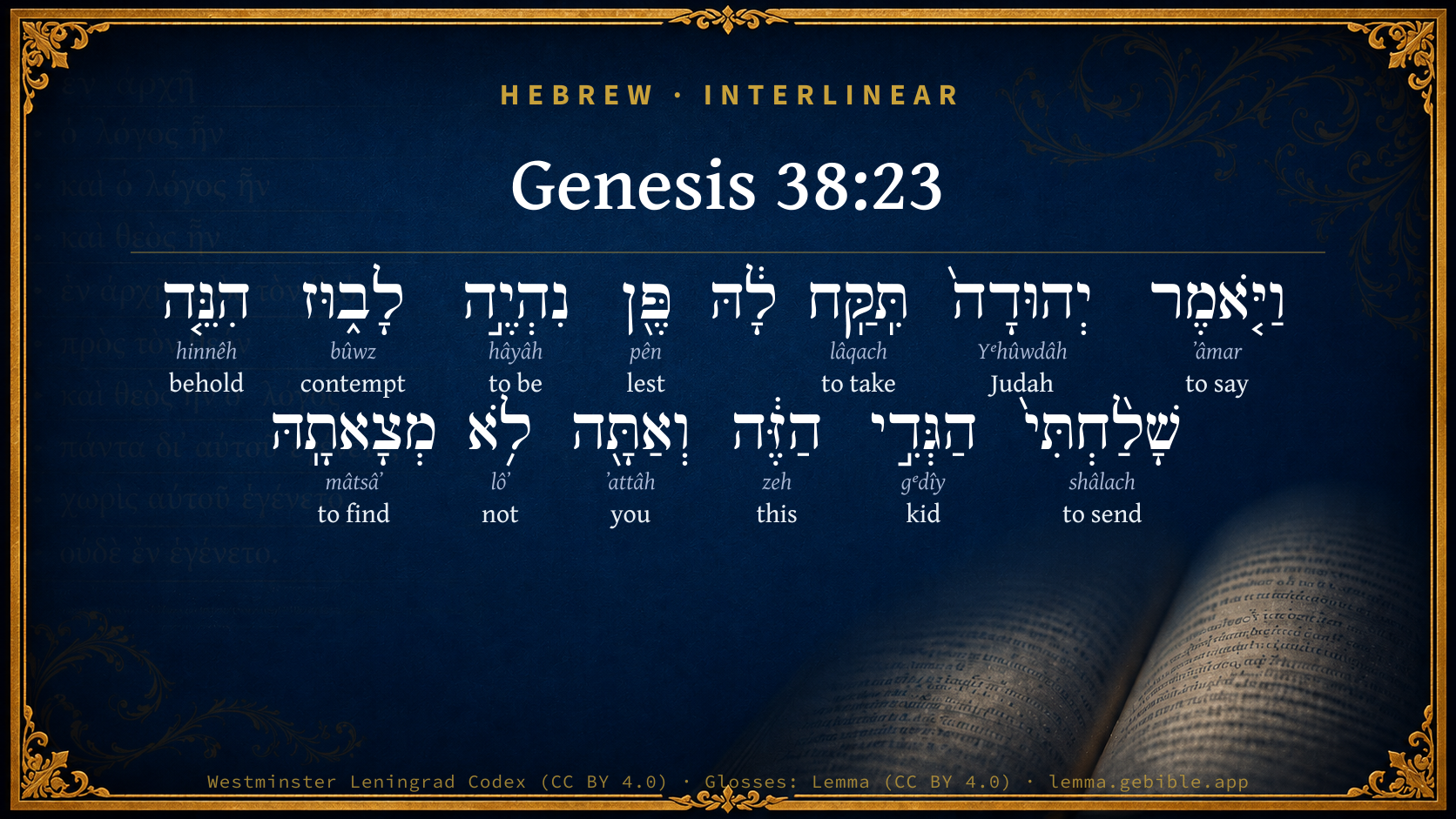
Hebrew (Westminster Leningrad Codex) Genesis 38:23 appears in the Hebrew Old Testament. The text above is from the Westminster Leningrad Codex. Each word links to its Strong’s number, a concise gloss, and parsing drawn from the Open Scriptures Hebrew Bible morphology. Click any word for its full Brown-Driver-Briggs (BDB) entry.
Download image
Cite this verse

Genesis 38:23 (World English Bible). Public Domain. Lemma interlinear Bible study tool, https://lemma.gebible.app/v/genesis/38/23.

Show BibTeX & RIS
BibTeX
RIS
English Translation
Judah said, "Let her keep it, lest we be shamed. Behold, I sent this kid, and you haven't found her."
World English Bible · Public Domain
Highlights
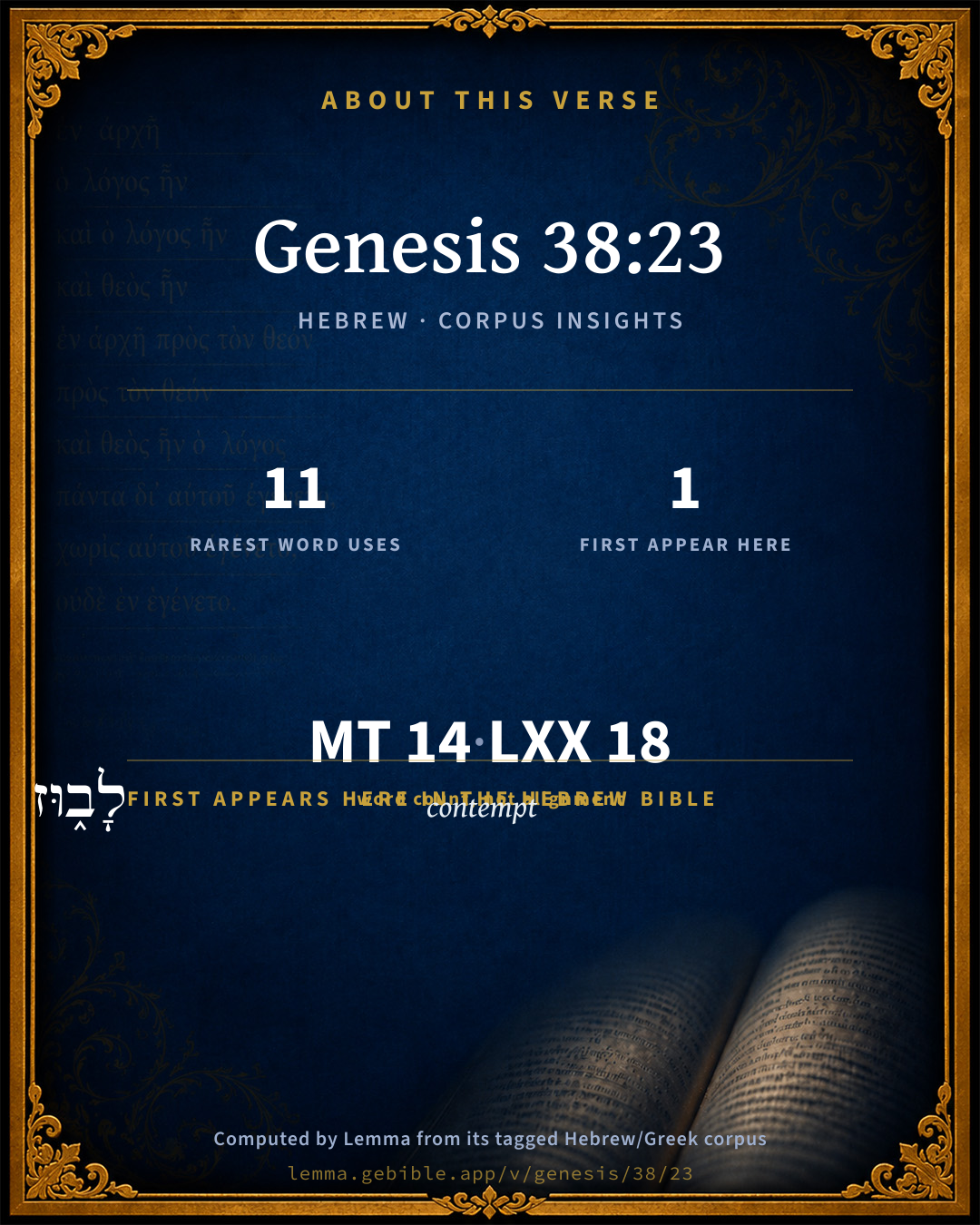
  • 1 first appearance in the Hebrew Bible
Full analysis ↓
Download a study sheet

One document with this verse’s original text, its word-by-word gloss line, the meaning frame, cross-references with their text, attributed commentary, and full source and license credits — printable, and it pastes into notes with its structure intact.

This verse Autodidact and up

Study sheet (.html) Plain text (.txt)

A passage Seminary Student

Up to 50 verses in one chapter. A passage sheet keeps up to 6 commentary sources and 12 cross-references per verse, in the order this page ranks them, and says so on the sheet whenever that leaves anything out. Ask for a single verse and you get the Autodidact verse sheet above.

Everything on this page stays free to read, with no account — the sheet is a download of what is already on screen, not access to it.

Want to remove ads? Support Godless Engineer
Compare translations 3

The same verse in 3 English versions, stacked beneath the original-language interlinear above. Click any original word for its lexicon entry.

Each is an independent rendering of the whole verse — the interlinear is not word-aligned to these translations.

Highlighted words mark where these versions differ — a whole-verse word diff, not a word-by-word alignment.

  • World English Bible Public Domain
    Judah said, "Let her keep it, lest we be shamed. Behold, I sent this kid, and you haven't found her."
  • King James Version Public Domain
    And Judah said, Let her take it to her, lest we be shamed: behold, I sent this kid, and thou hast not found her.
  • unfoldingWord Literal Text CC BY-SA 4.0
    And Judah said, “Let her take for herself so that we do not become a laughingstock. Behold, I sent this kid, but you did not find her.”

unfoldingWord Literal Text — © unfoldingWord, licensed CC BY-SA 4.0. Word-aligned USFM3 via Door43 (git.door43.org/unfoldingWord/en_ult).

Versions to compare (up to 4)

3 of 4 selected

Show all 18 translations

Every available English version of this verse, each an independent rendering of the whole verse.

  • World English Bible Public Domain
    Judah said, "Let her keep it, lest we be shamed. Behold, I sent this kid, and you haven't found her."
  • Berean Standard Bible Public Domain
    “Let her keep the items,” Judah replied. “Otherwise we will become a laughingstock. After all, I did send her this young goat, but you could not find her.”
  • Majority Standard Bible Public Domain
    “Let her keep the items,” Judah replied. “Otherwise we will become a laughingstock. After all, I did send her this young goat, but you could not find her.”
  • King James Version Public Domain
    And Judah said, Let her take it to her, lest we be shamed: behold, I sent this kid, and thou hast not found her.
  • American Standard Version (1901) Public Domain
    And Judah said, Let her take it to her, lest we be put to shame: behold, I sent this kid, and thou hast not found her.
  • Revised Version (1885) Public Domain
    And Judah said, Let her take it to her, lest we be put to shame: behold, I sent this kid, and thou hast not found her.
  • Geneva Bible (1599) Public Domain
    Then Iudah said, Let her take it to her, lest we be shamed: beholde, I sent this kid, and thou hast not found her.
  • Douay-Rheims (1899) Public Domain
    He returned to Juda, and said to him: I have not found her; moreover the men of that place said to me, that there never sat a harlot there.
  • Young's Literal Translation Public Domain
    and Judah saith, `Let her take to herself, lest we become despised; lo, I sent this kid, and thou hast not found her.'
  • Literal Standard Version CC BY-SA 4.0
    and Judah says, “Let her take to herself, lest we become despised; behold, I sent this kid, and you have not found her.”
  • Unlocked Literal Bible CC BY-SA 4.0
    Judah said, “Let her keep the things, that we not be put to shame. Indeed, I sent this young goat, but you did not find her.”
  • unfoldingWord Literal Text CC BY-SA 4.0
    And Judah said, “Let her take for herself so that we do not become a laughingstock. Behold, I sent this kid, but you did not find her.”
  • Darby Bible Public Domain
    Then Judah said, Let her take [it] for herself, lest we be put to shame. Behold, I sent this kid, and thou hast not found her.
  • World Messianic Bible Public Domain
    Judah said, “Let her keep it, lest we be shamed. Behold, I sent this young goat, and you haven’t found her.”
  • Webster's Bible Public Domain
    And Judah said, Let her take it to her, lest we be shamed: behold, I sent this kid, and thou hast not found her.
  • Free Bible Version CC BY-SA 4.0
    “Let her keep what I gave her,” Judah replied. “We'll look ridiculous to people if we go on searching. In any case I did try to send her the young goat as promised but you couldn't find her.”
  • Bible in Basic English Public Domain
    And Judah said, Let her keep the things, so that we may not be shamed; I sent the young goat, but you did not see the woman.
  • JPS Tanakh (1917) Public Domain
    And Judah said: 'Let her take it, lest we be put to shame; behold, I sent this kid, and thou hast not found her.'

Literal Standard Version (2020), Covenant Press — licensed CC BY-SA 4.0. Text via the HelloAO Bible API (eBible.org). Unlocked Literal Bible (unfoldingWord) — licensed CC BY-SA 4.0. Text via the HelloAO Bible API (eBible.org). unfoldingWord Literal Text — © unfoldingWord, licensed CC BY-SA 4.0. Word-aligned USFM3 via Door43 (git.door43.org/unfoldingWord/en_ult). Free Bible Version, Dr. Jonathan Gallagher — licensed CC BY-SA 4.0. Text via the HelloAO Bible API (eBible.org).

Word by word

More ways to search: Search by grammar → Find every occurrence → Compare this word →

Practice this passage: Drill this verse → Learn its vocabulary →

לָב֑וּז
bûwz
H937
“to/for · contempt”
Preposition + Noun, Common, Masculine, Singular, Absolute
Part of Speech
Preposition + Noun
Type
Common
Gender
Masculine
Number
Singular
State
Absolute
Full BDB Definition

Origin: from H936

TWOT: 213a

contempt - springing from evil - springing from prosperity - springing from judgment
  1. וַיֹּ֤אמֶר ʼâmar H559 “and · to say” Conjunction + Verb, Qal, Sequential Imperfect, 3rd Person, Masculine, Singular
  2. יְהוּדָה֙ Yᵉhûwdâh H3063 “Judah” Noun, Proper
  3. תִּֽקַּֽח lâqach H3947 “to take” Verb, Qal, Imperfect, 3rd Person, Feminine, Singular
  4. פֶּ֖ן pên H6435 “lest” Conjunction
  5. נִהְיֶ֣ה hâyâh H1961 “to be” Verb, Qal, Imperfect, 1st Person, Common, Plural
  6. הִנֵּ֤ה hinnêh H2009 “behold” Particle, Demonstrative
  7. שָׁלַ֨חְתִּי֙ shâlach H7971 “to send” Verb, Qal, Perfect, 1st Person, Common, Singular
  8. הַגְּדִ֣י gᵉdîy H1423 “the · kid” Particle, Definite Article + Noun, Common, Masculine, Singular, Absolute
  9. הַזֶּ֔ה zeh H2088 “the · this” Particle, Definite Article + Pronoun, Demonstrative, Masculine, Singular
  10. וְאַתָּ֖ה ʼattâh H859 “and · you” Conjunction + Pronoun, Personal, 2nd Person, Masculine, Singular
  11. לֹ֥א lôʼ H3808 “not” Particle, Negative
  12. מְצָאתָֽהּ mâtsâʼ H4672 “to find · her” Verb, Qal, Perfect, 2nd Person, Masculine, Singular + Suffix, Personal, 3rd Person, Feminine, Singular

About this verse

These counts appear in no published source. They are computed here, from the morphology-tagged text and Lemma’s own curated glosses. What Lemma adds →

14
words
13
distinct lemmas
Pentateuch
section

Notable vocabulary

The rarest word here is לָב֑וּז contempt H937 — appearing just 11 times in the whole Hebrew Bible.

First appearance in Scripture

This word makes its first canonical appearance in the Hebrew Bible here:

  • לָב֑וּז contempt H937

Shared distinctive vocabulary

לָב֑וּז contempt H937 occurs in 11 verses of the Hebrew Bible. Also found in:

Grammatical profile

  • 5 verbs
  • 3 nouns
  • 2 pronouns
  • 1 preposition
  • 1 conjunction
  • 2 particles

Verb forms

  • וַיֹּ֤אמֶר Qal · Sequential Imperfect
  • תִּֽקַּֽח Qal · Imperfect
  • נִהְיֶ֣ה Qal · Imperfect
  • שָׁלַ֨חְתִּי֙ Qal · Perfect
  • מְצָאתָֽהּ Qal · Perfect

Hebrew & Septuagint length

In English translation the verse runs 20 words from the Hebrew and 23 from the Septuagint (LXX English) — closely comparable.

A rough comparison of the two English renderings, which tokenize alike — not a word-level alignment.

Word counts can differ between the Hebrew and the Greek without any difference in meaning — e.g. the Hebrew direct-object marker אֵת has no separate Greek word, and Greek often adds the article ὁ.

In the original languages it is 14 Hebrew tokens and 18 Greek tokens — but the two are counted differently (Hebrew bundles its prefixes and suffixes into one token; the Greek is in lemma form), so that isn’t a like-for-like length.

Cross-references

6

Topical passages linked to Genesis 38:23 in the Treasury of Scripture Knowledge — connected by theme and wording, ordered by reader-vote popularity; previews shown in the World English Bible.

  • 2 Samuel 12:9 Why have you despised the word of Yahweh, to do that which is evil in his sight? You have struck Uriah the Hittite with the sword, and have taken his wife to be your wife, and have slain him with the sword of the children of Ammon.
  • Proverbs 6:33 He will get wounds and dishonor. His reproach will not be wiped away.
  • Romans 6:21 What fruit then did you have at that time in the things of which you are now ashamed? For the end of those things is death.
  • 2 Corinthians 4:2 But we have renounced the hidden things of shame, not walking in craftiness, nor handling the word of God deceitfully; but by the manifestation of the truth commending ourselves to every man's conscience in the sight of God.
  • Ephesians 5:12 For the things which are done by them in secret, it is a shame even to speak of.
  • Revelation 16:15 "Behold, I come like a thief. Blessed is he who watches, and keeps his clothes, so that he doesn't walk naked, and they see his shame."

Cross-references courtesy of OpenBible.info (CC BY 4.0).

Hebrew and Greek witnesses Masoretic Hebrew ↔ Greek Septuagint

The same verse in the two great witnesses to the Old Testament, shown verse-for-verse.

These are two independent witnesses, not word-aligned to each other, and the Septuagint is shown in lemma (dictionary) form.

Hebrew Genesis 38:23 Masoretic · Westminster Leningrad Codex

וַיֹּ֤אמֶר יְהוּדָה֙ תִּֽקַּֽח לָ֔הּ פֶּ֖ן נִהְיֶ֣ה לָב֑וּז הִנֵּ֤ה שָׁלַ֨חְתִּי֙ הַגְּדִ֣י הַזֶּ֔ה וְאַתָּ֖ה לֹ֥א מְצָאתָֽהּ

Judah said, "Let her keep it, lest we be shamed. Behold, I sent this kid, and you haven't found her."

World English Bible · Public Domain

Greek LXX Genesis 38:23 Septuagint · lemma form

εἶπον δέ ἰούδας ἔχω αὐτός ἀλλά μήποτε καταγελάω ἐγώ μέν ἀποστέλλω ὁ ἔριφος οὗτος σύ δέ οὐ εὑρίσκω

And Judas said, Let her have them, but let us not be ridiculed; I sent this kid, but you have not found her.

LXX2012 (modern English Septuagint) · Public Domain

Hebrew: Westminster Leningrad Codex (CC BY 4.0). Greek: Septuagint (public domain); English from LXX2012 (modern English Septuagint) (Public Domain). How the Septuagint differs from the Hebrew →

Targum (Aramaic paraphrase)

2

The Targum is the ancient Jewish Aramaic paraphrase of the Hebrew Scriptures — an interpretive translation, not the Hebrew text itself. Onkelos (literal) and Pseudo-Jonathan (expansive) render the Torah, and Jonathan the Prophets. Coverage is partial: where no permissively-licensed English translation exists for a verse, only the Aramaic is shown. This is verse-level text, not a word-by-word alignment to the Hebrew.

  1. Targum Onkelos Torah (Genesis–Deuteronomy)
    וַאֲמַר יְהוּדָה תִּסַּב לַהּ דִילְמָא נְהֵי לְחוֹךְ הָא שַׁדָּרִית גַּדְיָא הָדֵין וְאַתְּ לָא אַשְׁכְּחִתַּהּ

    (no public-domain English translation for this verse)

    Targum Onkelos — Aramaic: “Onkelos Genesis” (public domain); “Onkelos Exodus” (public domain); “Onkelos Leviticus” (public domain); “Onkelos Numbers” (public domain); “Onkelos Deuteronomy” (public domain). English: “Sefaria Community Translation” (CC0 1.0 (public-domain dedication)); “J.W. Etheridge. The Targums of Onkelos and Jonathan Ben Uzziel on the Pentateuch. London: Longmans, Green, 1862” (public domain). Text via Sefaria.

  2. Targum Pseudo-Jonathan Torah (Genesis–Deuteronomy)
    וַאֲמַר יְהוּדָה תִּסַב לָהּ מַשְׁכּוֹנְיָא דִילְמָא נֶהֱוֵי לִגְחוּךְ הָא שַׁדְרִית יַת גַדְיָא הָדֵין וְאַנְתְּ לָא אַשְׁכַּחְתָּהּ

    And Jehuda said, Lest she should have taken the pledge, lest we become a laughing stock, behold, I have sent this goat, and thou canst not find her.

    Targum Pseudo-Jonathan — Aramaic: “Targum Jonathan on Genesis” (public domain); “Targum Jonathan on Exodus” (public domain); “Targum Jonathan on Leviticus” (public domain); “Targum Jonathan on Numbers” (public domain); “Targum Jonathan on Deuteronomy” (public domain). English: “The Targum of Jonathan ben Uzziel, trans. J. W. Etheridge, London, 1862” (public domain). Text via Sefaria.

Commentary

Notes on Genesis 38:23 from classic Christian and Jewish commentators (each source and its license shown beneath its notes). The classic Christian expositions comment on the surrounding passage and are grouped to its opening verse, so a note may address several verses; the Jewish commentaries on the Tanakh (Rashi and others) are per-verse, so they appear only where the commentator wrote on this verse.

Lemma curates 59 commentaries, every one of them public domain or Creative Commons licensed, each selected and text-cleaned for this edition rather than reprinted as found. About our sources →

Trapp's Complete Commentary

John Trapp

Gen 38:23 And Judah said, Let her take [it] to her, lest we be shamed: behold, I sent this kid, and thou hast not found her.

Ver. 23. Lest we be shamed.] His care was more to shun shame, than sin. How much better that heathen! Satis nobis persuasum esse debet, &c.; this we should be fully persuaded of, saith he, that although we could conceal the matter from all, both gods and men, yet we should do nothing covetously, nothing unjustly, nothing against chastity, or common honesty. {a} Though I were sure, saith another philosopher, {b} that all men would be ignorant of what evil I do, and that all the gods would forgive it me; yet, for the filthiness that is in sin, I would not commit it. Plato condemns the poets for saying, that it were no matter though men did commit sin, so they could hide it. {c} Si non caste, saltem caute. How much better the Christian poet! Turpe quid acturus, te, sine teste, time. "Wherefore hast thou despised the commandment of the Lord, to do evil in his sight," though none else saw thee? said God to David. {2Sa 12:9} And David, in his sorrowful confession, saith as much to God upon the matter; "Against thee, thee only, have I sinned"; viz., in respect of the secrecy of my sin; therefore it is added, "and done this evil in thy sight." {Psa 51:4}

Behold, I sent this kid, &c.] He comforts himself in the loss of his pledge, that yet he had been as good as his word: but not a word we hear of sorrow for his sin; which, if he can but keep secret, he rests secure. This is a piece of natural atheism; and it is general. {d}

{a} Nihil tamen avare, nihil iniuste, nihil libidinose, nihil incontinenter esse faciendum. - Cicero Offic.

{b} Si scirem homines ignoraturos, et Deos ignoscituros, tamen propter peccati turpitudinem peccare non vellem. - Sen.

{c} Wς λυσιτελει το αδικειν εαν λανθανη. - Auson.

{d} Quasi dicat, Ego steti promissis, hoc mihi sufficit.

John Trapp, A Commentary or Exposition upon All the Books of the Old and New Testament (1647–1656) — public domain. Text from a community e-Sword module.

Joseph Benson's Commentary

Gen 38:23. Lest we be ashamed — Either, 1st, Lest his sin should come to be known publicly; or, 2d, Lest he should be laughed at as a fool for trusting a whore with his signet and his bracelets. He expresses no concern about the sin, only about the shame. There are many who are more solicitous to preserve their reputation with men, than to secure the favour of God; lest we be ashamed, goes further with them than lest we be damned.

Joseph Benson's Commentary on the Old and New Testaments (1811–1818) — public domain. Text from a community e-Sword module.

Geneva Bible (1599)

Geneva Bible translators

He feareth man more than God.

Hebrew, in contempt.

Geneva Bible (1599) marginal notes — public domain. Text via Bolls.life.

Adam Clarke's Commentary

Verse 23. Lest we be shamed] Not of the act, for this he does not appear to have thought criminal; but lest he should fall under the raillery of his companions and neighbours, for having been tricked out of his signet, bracelets, and staff, by a prostitute.

Adam Clarke's Commentary on the Bible (1810–1826) — public domain. Text from a community e-Sword/MySword module.

Ellicott's Commentary for English Readers

(23) Lest we be shamed.—Maimonides asserts that Judah had committed no breach of the Law, the utmost therein commanded being that no Jewish woman should become a kedeshah (Deu_23:17). But Judah evidently regards what he had done as shameful, and having big friend’s testimony, if needed, to prove that he had performed what he promised, he bears with the loss of his signet and staff, rather than let the people know that he had been guilty of an act which they too would condemn.

A Bible Commentary for English Readers, edited by Charles John Ellicott (1878–1897) — public domain. Text from a community e-Sword module.

The Cambridge Bible for Schools and Colleges

gen. ed. J. J. S. Perowne

23. Let her take it to her] i.e. let her retain the pledges, lest by making enquiries Judah should be exposed to shame.

The Cambridge Bible for Schools and Colleges (gen. ed. J. J. S. Perowne; Cambridge University Press, 1878–1918) — public domain. Text from a community e-Sword module.

John Gill's Exposition

And it came to pass about three months after,.... The above affair happened, and when the pregnancy of Tamar began to be somewhat visible, as it does in women with child about that time:

that it was told Judah, saying, Tamar thy daughter in law hath played the harlot: her being with child being observed by some of the family, or her neighbours, and knowing that she did not cohabit with Shelah, who, according to custom, ought to have been her husband, concluded that she had had a criminal conversation with some other person, which they were officious enough to report to Judah:

and also, behold, she is with child by whoredom; which was judged to be a plain proof and evidence that she had played the harlot:

and Judah said, bring her forth, and let her be burnt: not that Judah can be thought to be a civil magistrate in a Canaanitish and Heathen city where he sojourned, and as such pronounced this sentence on her at once, or even had the power of life and death in his own family; and besides Tamar was not in his, but in her own father's house: but the sense seems to be, that as he was a man of credit and esteem in the neighbourhood, and had an influence and interest in it; he moved that she might be brought out of her father's house, and take her trial before the civil magistrates, and be committed to prison until she was delivered, for it would have been barbarous, and contrary to the law and light of nature, to have burnt her when quick with child, and then indeed to be burnt to death, according to the usage of this country; and as we find adultery in later times was punished with this kind of death, even among Heathens, Jer 29:22; as it was in Egypt in the times of Sesostris the second (f); so Salaethus, prince of Croton in Italy, made a law that adulterers should be burnt alive, as Lucian (g) relates; as did also Macrinus the emperor, that those that were guilty of adultery should be burnt alive together, their bodies joined to each other (h): and this criminal action of Tamar was judged adultery, because she was, of right, and according to a custom or law then in use, the wife of Shelah: the Targum of Jonathan intimates, she was judged deserving of this death, because the daughter of a priest; the same law obtaining among the patriarchs as did in the times of Moses, Lev 21:9; and some, as Jarchi relates, say she was the daughter of Shem (i), the same with Melchizedek, priest of the most high God: one reason why Judah was in haste to have the sentence pronounced on her, and as soon as could be executed, was not only the disgrace she brought upon his family, but that she might be dispatched, and so his son Shelah freed from being obliged to marry her, which he did not care he should, and was glad of this opportunity to prevent it.

(f) Diodor. Sicul. l. 1. p. 54. (g) "Pro mercede conductis". (h) Alex. ab Alex. Genial. Dier. l. 4. c. 1. (i) Shalshalet Hakabala, fol. 4. 1.

John Gill's Exposition of the Whole Bible (1746–1763) — public domain (CC PDM 1.0). Text via the HelloAO Bible API.

Haydock's Catholic Bible Commentary

A lie. Hebrew, "lest we be exposed to shame," by making any farther search. (Menochius)

George Leo Haydock (1774–1849), Haydock's Catholic Family Bible and Commentary, 1859 edition — public domain. Excludes Psalms (Douay-Rheims chapter numbering differs from Protestant) and Deuterocanonical books (Catholic canon only).

Matthew Poole's English Annotations

Note, that fornication was esteemed sinful and shameful amongst the heathens.

Matthew Poole's English Annotations on the Holy Bible (1683–1685) — public domain. Text from a community e-Sword/MySword module.

Whedon's Commentary on the Bible

Daniel D. Whedon

23. Let her take it to her — That is, let her keep what she has obtained. He feared the shame, contempt, and ridicule, which he would incur by further attempts to recover his signet and cord, and preferred to lose them.

Daniel D. Whedon (gen. ed.), Commentary on the Old and New Testaments (1874–1909) — public domain. Text from a community e-Sword module.

The Pulpit Commentary

And Judah said, Let her take it to her, literally, let her take to herself (sc. the pledge)lest we be shamed (literally, become a contempt, i.e. by inquiring after her. Though not afraid to sin against God, Judah was pained at the idea of losing his reputation before men): behold, I sent this kid (i.e. I take you to witness that I have fulfilled my premise), and thou hast not found her.

The Pulpit Commentary (1880–1919), ed. H.D.M. Spence-Jones & Joseph S. Exell — public domain. Text from a community e-Sword module.

John Wesley's Explanatory Notes

Lest we be shamed - Either,

1. Lest his sin should come to be known publicly, Or

2. Lest he should be laughed at as a fool for trusting a whore with his signet and his bracelets. He expresses no concern about the sin, only about the shame. There are many who are more solicitous to preserve their reputation with men, than to secure the savour of God, lest we be shamed goes farther with them than lest we be damned.

John Wesley, Explanatory Notes Upon the Whole Bible (1754–1765) — public domain. Text via the GEBible commentary corpus.

Rashi

Rabbi Shlomo Yitzchaki (Rashi)

תקח לה Let that remain hers which she has in her possession (i.e. LET HER KEEP IT).

פן נהיה לבוז LEST WE BECOME A SCORN — if you seek her further the matter will become public and disgrace will follow, for what more can I do to redeem my promise? (for I have sent this kid etc and I can do no more).

הנה שלחתי את הגדי הזה BEHOLD, I SENT THIS KID — Because Judah had deceived his father through a kid of the goats — for he had dipped Joseph’s coat in its blood — therefore he, too, was deceived through a kid of the goats (Genesis Rabbah 85:9).

Rashi on the Tanakh — English translations: “The Judaica Press complete Tanach with Rashi, translated by A. J. Rosenberg” (CC BY 4.0); “Pentateuch with Rashi's commentary by M. Rosenbaum and A.M. Silbermann, 1929-1934” (public domain); “The Metsudah Tanach series, Lakewood, N.J” (CC BY 4.0); and “The Book of Joshua, Metsudah Publications, 1997” (CC BY 4.0). Text via Sefaria.

Radak

Rabbi David Kimhi (Radak)

תקח לה, “let her keep it for herself so that we will not look like fools chasing these trinkets and the fact that I slept with a prostitute will become public knowledge.” In Bereshit Rabbah 85,9 the Midrash quotes Proverbs 8,31 משחקת בתבל ארצו as the Torah rejoicing (making fun) of people. Yehudah who had deceived his father by inviting him to guess Joseph’s fate by showing him the bloody and tattered remains of his striped coat, now had in turn been deceived and would become publicly embarrassed through the incident with Tamar. It is remarkable that in both instances the male goat, שעיר עזים, is featured as part of the process of deception, i.e. as the sin. [perhaps this accounts for that animal being a prime species for sacrifices meant to atone for sin. Ed.]

Radak on the Tanakh — English translations: “Sefaria Community Translation” (CC0 1.0 (public-domain dedication)); “Eliyahu Munk, HaChut Hameshulash” (CC BY 4.0); “Rabbi Mike Feuer, Jerusalem Anthology” (CC BY 4.0); and “R. David Kimhi on the first book of Psalms, Translated by R.G. Finch, London, 1919” (public domain). Text via Sefaria.

Ibn Ezra

Rabbi Abraham ibn Ezra

Lest we are humiliated. Lest I become a subject of ridicule for yielding up my ring, my wrap and my staff for such an ignoble purpose.

Ibn Ezra on the Tanakh — English translations: “Sefaria Community Translation” (CC0 1.0 (public-domain dedication)); “Yalkut, Sifsei Chachomim Chumash, Metsudah Publications, 2009” (CC BY 4.0); and “Commentary of Ibn Ezra on Isaiah - trans. by M. Friedlander, 1873” (public domain). Text via Sefaria.

Lesson kit

Teaching starters — assembled from the data on this page, not authored interpretation. Every prompt links to the verse data it draws on. Edit before teaching.

Genesis, in the Pentateuch, opens this verse with 14 words (13 distinct Hebrew lemmas). Its most distinctive word is bûwz (“contempt”). A historical commentator’s framing appears above. Read the whole chapter for the surrounding context.

Discussion questions

  1. The word bûwz carries the sense “contempt.” How does it shape the verse?
  2. The word “contempt” first appears here in Scripture. What is being introduced at this debut?
  3. Job 12:5 shares the word «contempt» with this verse. How do the two illuminate each other?
  4. These translations render this verse differently; the difference is in the English rendering, not the original. What questions does that raise?
  5. The verb «וַיֹּ֤אמֶר» is Qal Sequential Imperfect. How does its form color the action?
  6. Reading how Trapp's Complete Commentary and Joseph Benson's Commentary read this verse, where do the two commentators agree and where do they part?

Things to notice

Reading settings

Reading text

Shown beneath each verse's original-language words.

Old Testament
Old Testament edition

Read the OT as the Masoretic Hebrew (MT) or the Greek Septuagint (LXX).

English shown for the Greek Septuagint (in the Hebrew ↔ Greek comparison).

Comparing translations? Open the Compare panel on any verse page to stack up to four side by side.