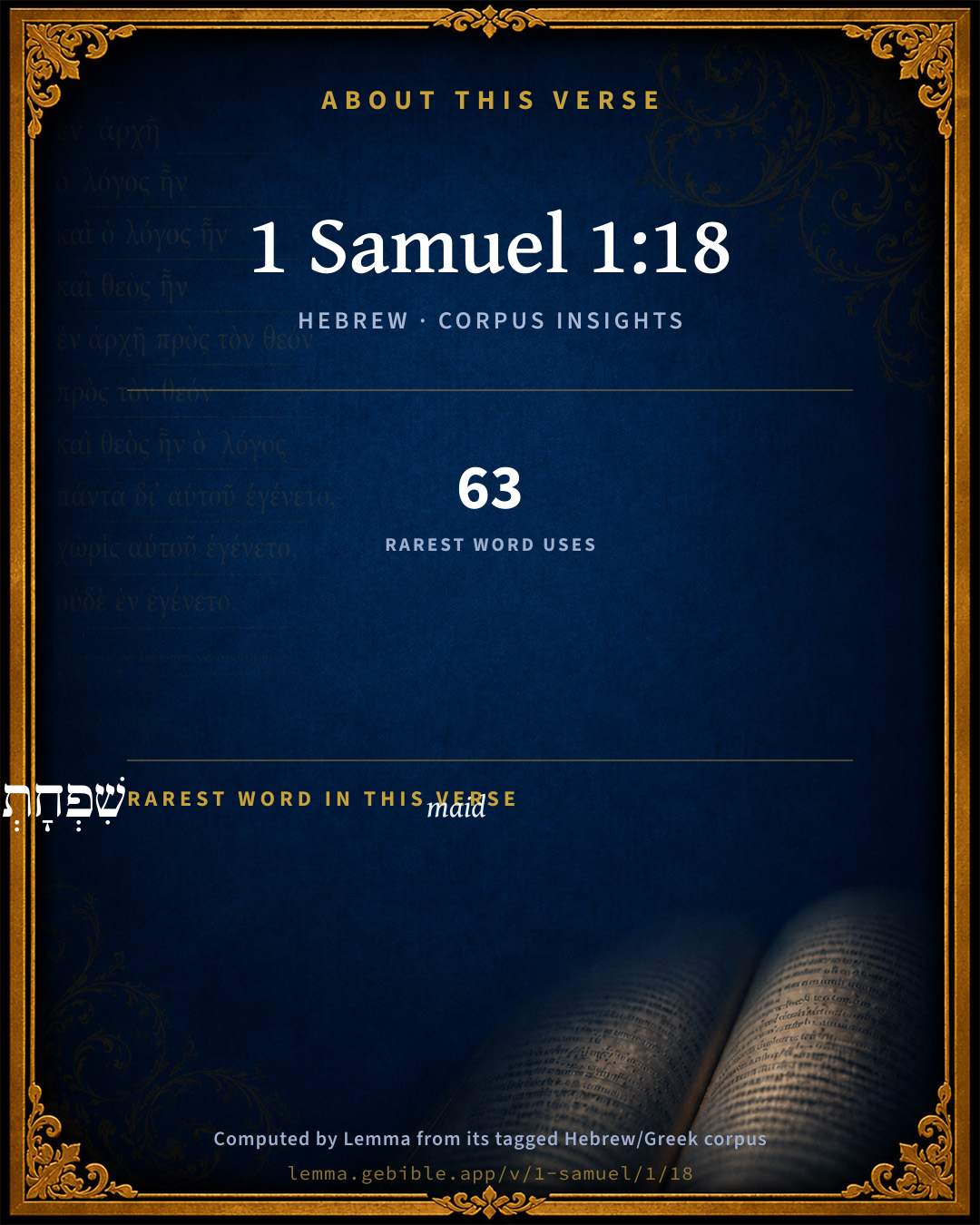
1 Samuel 1:18

Hebrew (Westminster Leningrad Codex) 1 Samuel 1:18 appears in the Hebrew Old Testament. The text above is from the Westminster Leningrad Codex. Each word links to its Strong’s number, a concise gloss, and parsing drawn from the Open Scriptures Hebrew Bible morphology. Click any word for its full Brown-Driver-Briggs (BDB) entry.
Download image
Cite this verse

1 Samuel 1:18 (World English Bible). Public Domain. Lemma interlinear Bible study tool, https://lemma.gebible.app/v/1-samuel/1/18.

Show BibTeX & RIS
BibTeX
RIS
English Translation
She said, Let your handmaid find favor in your sight. So the woman went her way, and ate; and her facial expression wasn't sad any more.
World English Bible · Public Domain
Download a study sheet

One document with this verse’s original text, its word-by-word gloss line, the meaning frame, cross-references with their text, attributed commentary, and full source and license credits — printable, and it pastes into notes with its structure intact.

This verse Autodidact and up

Study sheet (.html) Plain text (.txt)

A passage Seminary Student

Up to 50 verses in one chapter. A passage sheet keeps up to 6 commentary sources and 12 cross-references per verse, in the order this page ranks them, and says so on the sheet whenever that leaves anything out. Ask for a single verse and you get the Autodidact verse sheet above.

Everything on this page stays free to read, with no account — the sheet is a download of what is already on screen, not access to it.

Want to remove ads? Support Godless Engineer
Compare translations 3

The same verse in 3 English versions, stacked beneath the original-language interlinear above. Click any original word for its lexicon entry.

Each is an independent rendering of the whole verse — the interlinear is not word-aligned to these translations.

Highlighted words mark where these versions differ — a whole-verse word diff, not a word-by-word alignment.

  • World English Bible Public Domain
    She said, Let your handmaid find favor in your sight. So the woman went her way, and ate; and her facial expression wasn't sad any more.
  • King James Version Public Domain
    And she said, Let thine handmaid find grace in thy sight. So the woman went her way, and did eat, and her countenance was no more sad.
  • unfoldingWord Literal Text CC BY-SA 4.0
    And she said, “May your maidservant find favor in your eyes.” And the woman went on her way, and she ate. And her face was no longer to her.

unfoldingWord Literal Text — © unfoldingWord, licensed CC BY-SA 4.0. Word-aligned USFM3 via Door43 (git.door43.org/unfoldingWord/en_ult).

Versions to compare (up to 4)

3 of 4 selected

Show all 18 translations

Every available English version of this verse, each an independent rendering of the whole verse.

  • World English Bible Public Domain
    She said, Let your handmaid find favor in your sight. So the woman went her way, and ate; and her facial expression wasn't sad any more.
  • Berean Standard Bible Public Domain
    “May your maidservant find favor with you,” said Hannah. Then she went on her way, and she began eating again, and her face was no longer downcast.
  • Majority Standard Bible Public Domain
    “May your maidservant find favor with you,” said Hannah. Then she went on her way, and she began to eat, and her face was no longer downcast.
  • King James Version Public Domain
    And she said, Let thine handmaid find grace in thy sight. So the woman went her way, and did eat, and her countenance was no more sad.
  • American Standard Version (1901) Public Domain
    And she said, Let thy handmaid find favor in thy sight. So the woman went her way, and did eat; and her countenance was no more `sad'.
  • Revised Version (1885) Public Domain
    And she said, Let thy servant find grace in thy sight. So the woman went her way, and did eat, and her countenance was no more sad.
  • Geneva Bible (1599) Public Domain
    She sayd againe, Let thine handmayd finde grace in thy sight: so the woman went her way, and did eate, and looked no more sad.
  • Douay-Rheims (1899) Public Domain
    And she said: Would to God thy handmaid may find grace in thy eyes. So the woman went on her way, and ate, and her countenance was no more changed.
  • Young's Literal Translation Public Domain
    And she saith, `Let thy handmaid find grace in thine eyes;' and the woman goeth on her way, and eateth, and her countenance hath not been `sad' for it any more.
  • Literal Standard Version CC BY-SA 4.0
    And she says, “Let your handmaid find grace in your eyes”; and the woman goes on her way, and eats, and her face has not been [downcast] for herself anymore.
  • Unlocked Literal Bible CC BY-SA 4.0
    She said, “Let your servant find favor in your eyes.” Then the woman went her way and ate; her face was no longer sad.
  • unfoldingWord Literal Text CC BY-SA 4.0
    And she said, “May your maidservant find favor in your eyes.” And the woman went on her way, and she ate. And her face was no longer to her.
  • Darby Bible Public Domain
    And she said, Let thy bondwoman find grace in thy sight. And the woman went her way, and did eat, and her countenance was no more [as before].
  • World Messianic Bible Public Domain
    She said, “Let your servant find favor in your sight.” So the woman went her way and ate; and her facial expression wasn’t sad any more.
  • Webster's Bible Public Domain
    And she said, Let thy handmaid find grace in thy sight. So the woman went her way, and did eat, and her countenance was no more sad.
  • Free Bible Version CC BY-SA 4.0
    “Thank you for your kindness to your servant,” she said. Then she went on her way, had something to eat, and she didn't look sad any more.
  • Bible in Basic English Public Domain
    And she said, May your servant have grace in your eyes. So the woman went away, and took part in the feast, and her face was no longer sad.
  • JPS Tanakh (1917) Public Domain
    And she said: 'Let thy servant find favour in thy sight.' So the woman went her way, and did eat, and her countenance was no more sad.

Literal Standard Version (2020), Covenant Press — licensed CC BY-SA 4.0. Text via the HelloAO Bible API (eBible.org). Unlocked Literal Bible (unfoldingWord) — licensed CC BY-SA 4.0. Text via the HelloAO Bible API (eBible.org). unfoldingWord Literal Text — © unfoldingWord, licensed CC BY-SA 4.0. Word-aligned USFM3 via Door43 (git.door43.org/unfoldingWord/en_ult). Free Bible Version, Dr. Jonathan Gallagher — licensed CC BY-SA 4.0. Text via the HelloAO Bible API (eBible.org).

Word by word

More ways to search: Search by grammar → Find every occurrence → Compare this word →

Practice this passage: Drill this verse → Learn its vocabulary →

שִׁפְחָתְךָ֛
shiphchâh
H8198
“maid · your”
Noun, Common, Feminine, Singular, Construct + Suffix, Personal, 2nd Person, Masculine, Singular
Part of Speech
Noun
Type
Common
Gender
Feminine
Number
Singular
State
Construct
Full BDB Definition

Origin: from the same as H8207 ">H8207 )

TWOT: None

maid, maid-servant, slavegirl - maid, maid-servant (as belonging to a mistress) - of address, speaker, humility (figuratively)
  1. וַתֹּ֕אמֶר ʼâmar H559 “and · to say” Conjunction + Verb, Qal, Sequential Imperfect, 3rd Person, Feminine, Singular
  2. תִּמְצָ֧א mâtsâʼ H4672 “to find” Verb, Qal, Jussive, 3rd Person, Feminine, Singular
  3. חֵ֖ן chên H2580 “grace” Noun, Common, Masculine, Singular, Absolute
  4. בְּעֵינֶ֑יךָ ʻayin H5869 “in/at · eyes · your” Preposition + Noun, Common, Both, Dual, Construct + Suffix, Personal, 2nd Person, Masculine, Singular
  5. וַתֵּ֨לֶךְ yâlak H3212 “and · to walk” Conjunction + Verb, Qal, Sequential Imperfect, 3rd Person, Feminine, Singular
  6. הָאִשָּׁ֤ה ʼishshâh H802 “the · woman” Particle, Definite Article + Noun, Common, Feminine, Singular, Absolute
  7. לְדַרְכָּהּ֙ derek H1870 “to/for · way · her” Preposition + Noun, Common, Both, Singular, Construct + Suffix, Personal, 3rd Person, Feminine, Singular
  8. וַתֹּאכַ֔ל ʼâkal H398 “and · to eat” Conjunction + Verb, Qal, Sequential Imperfect, 3rd Person, Feminine, Singular
  9. וּפָנֶ֥יהָ pânîym H6440 “and · face(s) · her” Conjunction + Noun, Common, Both, Plural, Construct + Suffix, Personal, 3rd Person, Feminine, Singular
  10. לֹא lôʼ H3808 “not” Particle, Negative
  11. הָיוּ hâyâh H1961 “to be” Verb, Qal, Perfect, 3rd Person, Common, Plural
  12. עֽוֹד ʻôwd H5750 “still” Adverb

About this verse

These counts appear in no published source. They are computed here, from the morphology-tagged text and Lemma’s own curated glosses. What Lemma adds →

14
words
13
distinct lemmas
Historical
section

Grammatical profile

  • 5 verbs
  • 6 nouns
  • 1 preposition
  • 1 adverb
  • 1 particle

Verb forms

  • וַתֹּ֕אמֶר Qal · Sequential Imperfect
  • תִּמְצָ֧א Qal · Jussive
  • וַתֵּ֨לֶךְ Qal · Sequential Imperfect
  • וַתֹּאכַ֔ל Qal · Sequential Imperfect
  • הָיוּ Qal · Perfect

Hebrew & Septuagint length

In English translation the verse runs 26 words from the Hebrew and 36 from the Septuagint (LXX English) — closely comparable.

A rough comparison of the two English renderings, which tokenize alike — not a word-level alignment.

Word counts can differ between the Hebrew and the Greek without any difference in meaning — e.g. the Hebrew direct-object marker אֵת has no separate Greek word, and Greek often adds the article ὁ.

Cross-references

8

Topical passages linked to 1 Samuel 1:18 in the Treasury of Scripture Knowledge — connected by theme and wording, ordered by reader-vote popularity; previews shown in the World English Bible.

  • Ruth 2:13 Then she said, Let me find favor in your sight, my lord, because you have comforted me, and because you have spoken kindly to your handmaid, though I am not as one of your handmaidens.
  • Romans 15:13 Now may the God of hope fill you with all joy and peace in believing, that you may abound in hope, in the power of the Holy Spirit.
  • Ecclesiastes 9:7 Go your way--eat your bread with joy, and drink your wine with a merry heart; for God has already accepted your works.
  • Genesis 33:15 Esau said, "Let me now leave with you some of the folk who are with me." He said, "Why? Let me find favor in the sight of my lord."
  • Genesis 33:8 Esau said, "What do you mean by all this company which I met?" Jacob said, "To find favor in the sight of my lord."
  • John 16:24 Until now, you have asked nothing in my name. Ask, and you will receive, that your joy may be made full.
  • Philippians 4:6–7 In nothing be anxious, but in everything, by prayer and petition with thanksgiving, let your requests be made known to God.
  • Genesis 32:5 I have oxen, donkeys, flocks, men-servants, and maid-servants. I have sent to tell my lord, that I may find favor in your sight.'"

Cross-references courtesy of OpenBible.info (CC BY 4.0).

Hebrew and Greek witnesses Masoretic Hebrew ↔ Greek Septuagint

The same verse in the two great witnesses to the Old Testament, shown verse-for-verse.

These are two independent witnesses, not word-aligned to each other, and the Septuagint is shown in lemma (dictionary) form.

Hebrew 1 Samuel 1:18 Masoretic · Westminster Leningrad Codex

וַתֹּ֕אמֶר תִּמְצָ֧א שִׁפְחָתְךָ֛ חֵ֖ן בְּעֵינֶ֑יךָ וַתֵּ֨לֶךְ הָאִשָּׁ֤ה לְדַרְכָּהּ֙ וַתֹּאכַ֔ל וּפָנֶ֥יהָ לֹא הָיוּ לָ֖הּ עֽוֹד

She said, Let your handmaid find favor in your sight. So the woman went her way, and ate; and her facial expression wasn't sad any more.

World English Bible · Public Domain

Greek LXX 1 Samuel 1:18 Septuagint · lemma form

καί εἶπον εὑρίσκω ὁ δούλη σύ χάρις ἐν ὀφθαλμός σύ καί πορεύομαι ὁ γυνή εἰς ὁ ὁδός αὐτός καί εἰςἔρχομαι εἰς ὁ κατάλυμα αὐτός καί ἐσθίω μετά ὁ ἀνήρ αὐτός καί πίνω καί ὁ πρόσωπον αὐτός οὐ συνπίπτω ἔτι

And she said, Your handmaid has found favor in your eyes: and the woman went her way, and entered into her lodging, and ate and drank with her husband, and her countenance was no more sad.

LXX2012 (modern English Septuagint) · Public Domain

On this verse, Haydock's Catholic Bible Commentary discusses the Septuagint’s reading. Read the note in Commentary ↓

Hebrew: Westminster Leningrad Codex (CC BY 4.0). Greek: Septuagint (public domain); English from LXX2012 (modern English Septuagint) (Public Domain). How the Septuagint differs from the Hebrew →

Targum (Aramaic paraphrase)

1

The Targum is the ancient Jewish Aramaic paraphrase of the Hebrew Scriptures — an interpretive translation, not the Hebrew text itself. Onkelos (literal) and Pseudo-Jonathan (expansive) render the Torah, and Jonathan the Prophets. Coverage is partial: where no permissively-licensed English translation exists for a verse, only the Aramaic is shown. This is verse-level text, not a word-by-word alignment to the Hebrew.

  1. Targum Jonathan Prophets (Joshua–Malachi)
    וַאֲמַרַת תַּשְׁכַּח אַמְתָךְ רַחֲמִין בְּעֵינָךְ וַאֲזָלַת אִתְּתָא לְאוֹרְחָהּ וַאֲכָלַת וְאַפִין בִּישִׁין לָא הֲווֹ לָהּ עוֹד:

    (no public-domain English translation for this verse)

    Targum Jonathan — Aramaic: “Mikraot Gedolot” (public domain). English: “Sefaria Community Translation” (CC0 1.0 (public-domain dedication)); “London "Chaldee Paraphrase," 1871” (public domain). Text via Sefaria.

Commentary

Notes on 1 Samuel 1:18 from classic Christian and Jewish commentators (each source and its license shown beneath its notes). The classic Christian expositions comment on the surrounding passage and are grouped to its opening verse, so a note may address several verses; the Jewish commentaries on the Tanakh (Rashi and others) are per-verse, so they appear only where the commentator wrote on this verse.

Lemma curates 59 commentaries, every one of them public domain or Creative Commons licensed, each selected and text-cleaned for this edition rather than reprinted as found. About our sources →

Trapp's Complete Commentary

John Trapp

1Sa 1:18 And she said, Let thine handmaid find grace in thy sight. So the woman went her way, and did eat, and her countenance was no more [sad].

Ver. 18. Let thine handmaid find grace in thy sight.] Ineam tecum hanc gratiam ut pro me ores. Oh that I might be so happy as to have the benefit of thy prayers for me still! Herein I recommend myself to thy fatherly favour and goodwill.

So the woman went away, and did eat.] She took the high priest’s answer as an oracle, and was comforted by a sweet motion of the Holy Ghost, met by a motion of her own mind, resting in that comfort, as unfailable because proceeding from faith unfeigned.

And her countenance was no more sad.] Vultum vocat faciem illam vultuosam: she was blithe and cheery. God’s children use to pray down their distempers, as David oft.

John Trapp, A Commentary or Exposition upon All the Books of the Old and New Testament (1647–1656) — public domain. Text from a community e-Sword module.

Geneva Bible (1599)

Geneva Bible translators

That is, pray unto the Lord for me.

Geneva Bible (1599) marginal notes — public domain. Text via Bolls.life.

Adam Clarke's Commentary

Verse 18. Let thine handmaid find grace] Continue to think favourably of me, and to pray for me.

Adam Clarke's Commentary on the Bible (1810–1826) — public domain. Text from a community e-Sword/MySword module.

Ellicott's Commentary for English Readers

(18) Let thine handmaid find grace.—In other words, Hannah’s reply to his loving farewell asked the old man to think kindly of her, and to pray for her with his mighty power of prayer.

Did eat, and her countenance was no more sad.—A beautiful example of the composing influence of prayer. “Hannah had cast her burden upon the Lord, and so her own spirit was relieved of its load. She now returned to the family feast, and ate her portion with a cheerful heart.”—Speaker’s Commentary.

A Bible Commentary for English Readers, edited by Charles John Ellicott (1878–1897) — public domain. Text from a community e-Sword module.

The Cambridge Bible for Schools and Colleges

gen. ed. J. J. S. Perowne

18. grace] i.e. favour, as in 1Sa_25:8.

The Cambridge Bible for Schools and Colleges (gen. ed. J. J. S. Perowne; Cambridge University Press, 1878–1918) — public domain. Text from a community e-Sword module.

John Gill's Exposition

And she said, let thine handmaid find grace in thy sight,.... She had found favour in his sight she perceives, and she desires it might be continued and increased; and that as he had prayed for her, he would still use his interest at the throne of grace for her:

so the woman went her way; took her leave of Eli, and went from the tabernacle to her husband: and did eat; what remained of the peace offerings, which were to be eaten that night, and not left till the morning; and though she would not eat her dinner, her heart was so full of grief, yet she could now make a good supper, being eased and relieved in her mind:

and her countenance was no more sad; sorrowful and dejected, but cheerful, brisk, and lively; believing that her prayers, and those of the high priest, would be answered.

John Gill's Exposition of the Whole Bible (1746–1763) — public domain (CC PDM 1.0). Text via the HelloAO Bible API.

Albert Barnes' Notes on the Bible

A beautiful example of the composing influence of prayer. Hannah had cast her burden upon the Lord, and so her own spirit was relieved of its load. She now returned to the family feast, and ate her portion with a cheerful heart. Act 2:46-47.

The word “sad” is not in the Hebrew text, but it fairly supplies the meaning intended.

Albert Barnes' Notes on the Bible (1834–1885) — public domain. Text from a community e-Sword/MySword module.

Haydock's Catholic Bible Commentary

Eyes: that thou wouldst lay aside thy suspicions against my character, and pray (Calmet) that I may obtain so great a happiness. --- Changed. Hebrew, "no more," as it had been sad, and defaced with tears. (Haydock) --- She was now full of hope and joy. (Menochius) --- Septuagint, "her countenance fell not." She was not moved with anger or with jealousy, Genesis iv. 6. (Calmet)

George Leo Haydock (1774–1849), Haydock's Catholic Family Bible and Commentary, 1859 edition — public domain. Excludes Psalms (Douay-Rheims chapter numbering differs from Protestant) and Deuterocanonical books (Catholic canon only).

Matthew Poole's English Annotations

Grace in thy sight; that favourable opinion, and good will, and gracious prayer, which thou hast expressed on my behalf, be pleased to continue toward me.

Her countenance was no more sad; her heart being cheered by the priest’s comfortable words, and especially by God’s Spirit setting them home upon her, and assuring her that both his and her prayers should be heard, it quickly appeared in her countenance. Heb. her indignation, or vexation, (as the word face is sometimes understood, as Gen 32:20; Psa 21:9; 34:16) was no more, i.e. it vanished away.

Matthew Poole's English Annotations on the Holy Bible (1683–1685) — public domain. Text from a community e-Sword/MySword module.

John Wesley's Explanatory Notes

Find grace - That favourable opinion and gracious prayer which thou hast expressed on my behalf, be pleased to continue towards me. Sad - Her heart being cheared by the priest's comfortable words, and especially by God's spirit setting them home upon her, and assuring her that both his and her prayers should be heard, it quickly appeared in her countenance.

John Wesley, Explanatory Notes Upon the Whole Bible (1754–1765) — public domain. Text via the GEBible commentary corpus.

Keil & Delitzsch

C. F. Keil & F. Delitzsch

Hannah then went her way, saying, "Let thine handmaid find grace in thine eyes," i.e., let me be honoured with thy favour and thine intercession, and was strengthened and comforted by the word of the high priest, which assured her that her prayer would be heard by God; and she did eat, "and her countenance was no more," sc., troubled and sad, as it had been before. This may be readily supplied from the context, through which the word countenance (פּנים) acquires the sense of a troubled countenance, as in Job 9:27.

Keil & Delitzsch — Biblical Commentary on the Old Testament (1861–1891) — public domain (CC PDM 1.0). Text via the HelloAO Bible API. (Old Testament only.)

Rashi

Rabbi Shlomo Yitzchaki (Rashi)

May your maidservant find favor. To beg for compassion on her behalf.

And no longer had the [sad] look on her face. Meaning the face of anger.

Rashi on the Tanakh — English translations: “The Judaica Press complete Tanach with Rashi, translated by A. J. Rosenberg” (CC BY 4.0); “Pentateuch with Rashi's commentary by M. Rosenbaum and A.M. Silbermann, 1929-1934” (public domain); “The Metsudah Tanach series, Lakewood, N.J” (CC BY 4.0); and “The Book of Joshua, Metsudah Publications, 1997” (CC BY 4.0). Text via Sefaria.

Radak

Rabbi David Kimhi (Radak)

On her way: She went to her home and ate. It appears that she had not eaten with her husband; or it is possible that she ate a little when her husband had pleaded. But now her heart was gladdened and she ate. And in the homiletical teachings: What is, "on her way" - that she began to menstruate, like (Genesis 31:35), "since the way of women is with me."

And her face: She no longer had a [long] face. And likewise did Yonatan translate [in the Targum], "and a bad face."

Radak on the Tanakh — English translations: “Sefaria Community Translation” (CC0 1.0 (public-domain dedication)); “Eliyahu Munk, HaChut Hameshulash” (CC BY 4.0); “Rabbi Mike Feuer, Jerusalem Anthology” (CC BY 4.0); and “R. David Kimhi on the first book of Psalms, Translated by R.G. Finch, London, 1919” (public domain). Text via Sefaria.

Lesson kit

Teaching starters — assembled from the data on this page, not authored interpretation. Every prompt links to the verse data it draws on. Edit before teaching.

1 Samuel, in the Historical, opens this verse with 14 words (13 distinct Hebrew lemmas). Its most distinctive word is shiphchâh (“maid”). A historical commentator’s framing appears above. Read the whole chapter for the surrounding context.

Discussion questions

  1. How does “maid” (shiphchâh) shape what this verse is saying?
  2. Ruth 2:13 shares this passage’s theme. How do the two illuminate each other?
  3. The translations on this page render this verse differently — a whole-verse word diff, not a word-by-word alignment. What might account for the different wordings?
  4. The verb «וַתֹּ֕אמֶר» is Qal Sequential Imperfect. How does its form color the action?
  5. Reading how Trapp's Complete Commentary and Geneva Bible (1599) read this verse, where do the two commentators agree and where do they part?

Things to notice

Reading settings

Reading text

Shown beneath each verse's original-language words.

Old Testament
Old Testament edition

Read the OT as the Masoretic Hebrew (MT) or the Greek Septuagint (LXX).

English shown for the Greek Septuagint (in the Hebrew ↔ Greek comparison).

Comparing translations? Open the Compare panel on any verse page to stack up to four side by side.