
2 Corinthians 5:3

Greek (Tischendorf 8th ed.) 2 Corinthians 5:3 appears in the Greek New Testament. The text above is from the Tischendorf 8th edition. Each word links to its Strong’s number and a concise gloss. Click any word for its full Thayer’s Greek Lexicon entry.
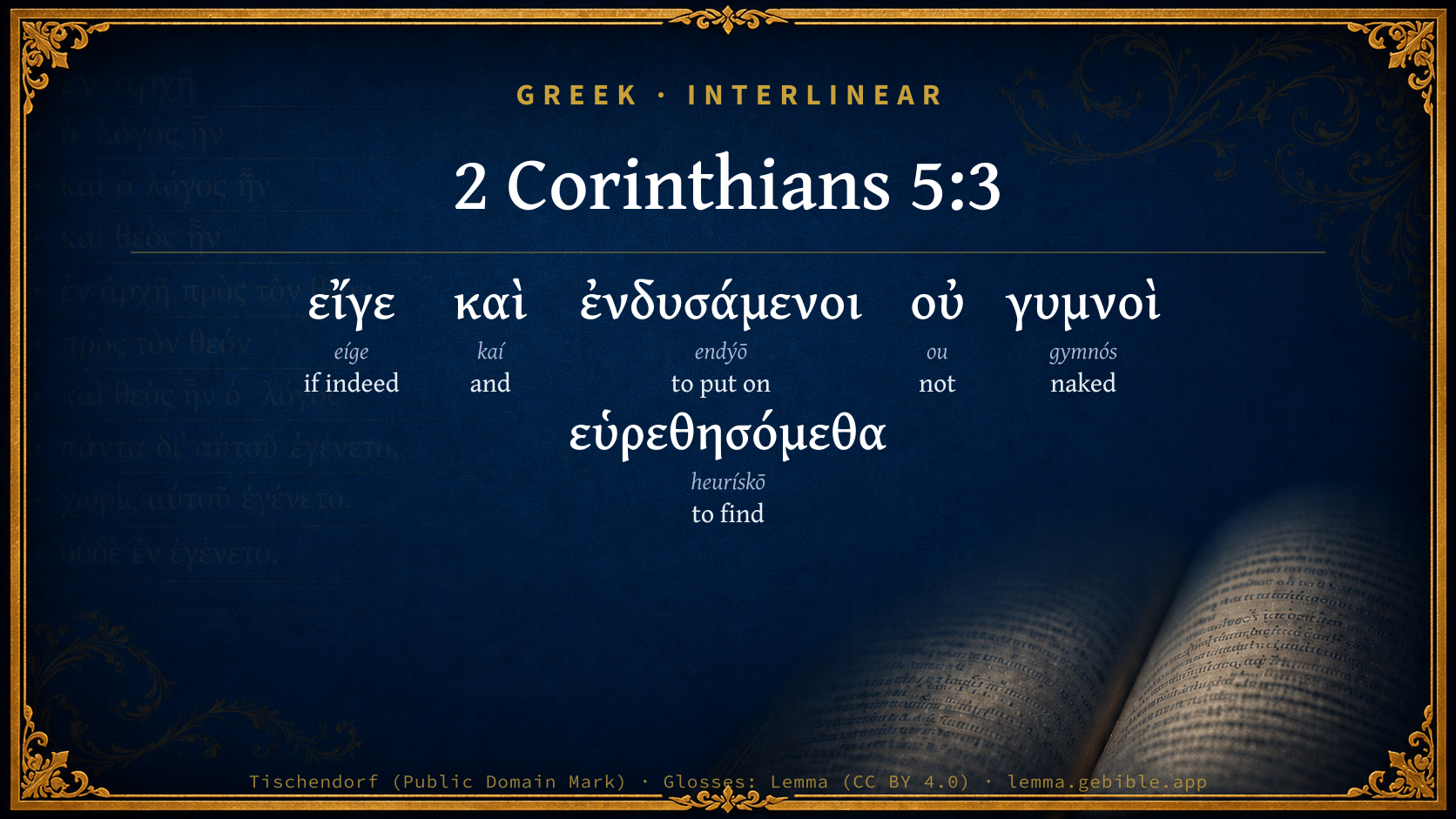
Download image
Cite this verse

2 Corinthians 5:3 (World English Bible). Public Domain. Lemma interlinear Bible study tool, https://lemma.gebible.app/v/2-corinthians/5/3.

Show BibTeX & RIS
BibTeX
RIS
English Translation
if so be that being clothed we will not be found naked.
World English Bible · Public Domain
Highlights
  • 1 first appearance in the Greek New Testament
Full analysis ↓
Download a study sheet

One document with this verse’s original text, its word-by-word gloss line, the meaning frame, cross-references with their text, attributed commentary, and full source and license credits — printable, and it pastes into notes with its structure intact.

This verse Autodidact and up

Study sheet (.html) Plain text (.txt)

A passage Seminary Student

Up to 50 verses in one chapter. A passage sheet keeps up to 6 commentary sources and 12 cross-references per verse, in the order this page ranks them, and says so on the sheet whenever that leaves anything out. Ask for a single verse and you get the Autodidact verse sheet above.

Everything on this page stays free to read, with no account — the sheet is a download of what is already on screen, not access to it.

Want to remove ads? Support Godless Engineer
Compare translations 3

The same verse in 3 English versions, stacked beneath the original-language interlinear above. Click any original word for its lexicon entry.

Each is an independent rendering of the whole verse — the interlinear is not word-aligned to these translations.

Highlighted words mark where these versions differ — a whole-verse word diff, not a word-by-word alignment.

  • World English Bible Public Domain
    if so be that being clothed we will not be found naked.
  • King James Version Public Domain
    If so be that being clothed we shall not be found naked.
  • unfoldingWord Literal Text CC BY-SA 4.0
    and if indeed having clothed ourselves, we will not be found naked.

unfoldingWord Literal Text — © unfoldingWord, licensed CC BY-SA 4.0. Word-aligned USFM3 via Door43 (git.door43.org/unfoldingWord/en_ult).

Versions to compare (up to 4)

3 of 4 selected

Show all 19 translations

Every available English version of this verse, each an independent rendering of the whole verse.

  • World English Bible Public Domain
    if so be that being clothed we will not be found naked.
  • Berean Standard Bible Public Domain
    because when we are clothed, we will not be found naked.
  • Majority Standard Bible Public Domain
    because when we are clothed, we will not be found naked.
  • King James Version Public Domain
    If so be that being clothed we shall not be found naked.
  • American Standard Version (1901) Public Domain
    if so be that being clothed we shall not be found naked.
  • Revised Version (1885) Public Domain
    if so be that being clothed we shall not be found naked.
  • Geneva Bible (1599) Public Domain
    Because that if we be clothed, we shall not be found naked.
  • Douay-Rheims (1899) Public Domain
    Yet so that we be found clothed, not naked.
  • Young's Literal Translation Public Domain
    if so be that, having clothed ourselves, we shall not be found naked,
  • Literal Standard Version CC BY-SA 4.0
    if so be that, having clothed ourselves, we will not be found naked,
  • Unlocked Literal Bible CC BY-SA 4.0
    We long for this because by putting it on we will not be found to be naked.
  • unfoldingWord Literal Text CC BY-SA 4.0
    and if indeed having clothed ourselves, we will not be found naked.
  • Darby Bible Public Domain
    if indeed being also clothed we shall not be found naked.
  • World Messianic Bible Public Domain
    if indeed being clothed, we will not be found naked.
  • Webster's Bible Public Domain
    If so be that being clothed we shall not be found naked.
  • Free Bible Version CC BY-SA 4.0
    When we put on this clothing we won't be seen naked.
  • Bible in Basic English Public Domain
    So that our spirits may not be unclothed.
  • Text-Critical English NT CC BY 4.0
    because when we are clothed, we will not be found naked.
  • Tyndale New Testament (1534) Public Domain
    so yet if that we be founde clothed and not naked.

Literal Standard Version (2020), Covenant Press — licensed CC BY-SA 4.0. Text via the HelloAO Bible API (eBible.org). Unlocked Literal Bible (unfoldingWord) — licensed CC BY-SA 4.0. Text via the HelloAO Bible API (eBible.org). unfoldingWord Literal Text — © unfoldingWord, licensed CC BY-SA 4.0. Word-aligned USFM3 via Door43 (git.door43.org/unfoldingWord/en_ult). Free Bible Version, Dr. Jonathan Gallagher — licensed CC BY-SA 4.0. Text via the HelloAO Bible API (eBible.org).

Word by word

More ways to search: Search by grammar → Find every occurrence → Compare this word →

Practice this passage: Drill this verse → Learn its vocabulary →

About this verse

These counts appear in no published source. They are computed here, from the morphology-tagged text and Lemma’s own curated glosses. What Lemma adds →

6
words
6
distinct lemmas
Pauline Epistles
section

Notable vocabulary

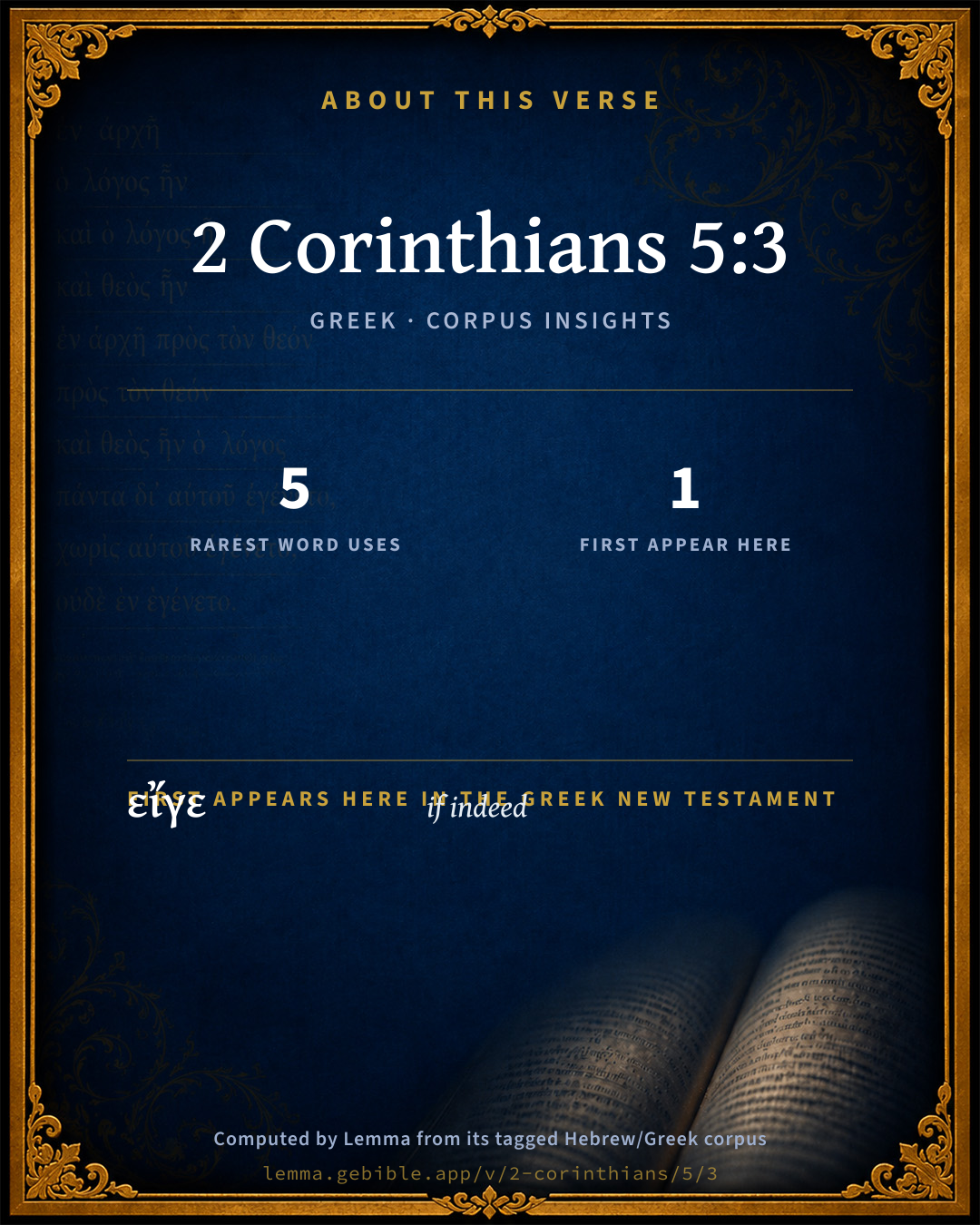
The rarest word here is εἴγε if indeed G1489 — appearing just 5 times in the whole Greek New Testament.

First appearance in Scripture

This word makes its first canonical appearance in the Greek New Testament here:

  • εἴγε if indeed G1489

Shared distinctive vocabulary

εἴγε if indeed G1489 occurs in 5 verses of the Greek New Testament. Also found in:
Cross-references

4

Topical passages linked to 2 Corinthians 5:3 in the Treasury of Scripture Knowledge — connected by theme and wording, ordered by reader-vote popularity; previews shown in the World English Bible.

  • Genesis 3:7–11 Both of their eyes were opened, and they knew that they were naked. They sewed fig leaves together, and made themselves aprons.
  • Revelation 16:15 "Behold, I come like a thief. Blessed is he who watches, and keeps his clothes, so that he doesn't walk naked, and they see his shame."
  • Revelation 3:18 I counsel you to buy from me gold refined by fire, that you may become rich; and white garments, that you may clothe yourself, and that the shame of your nakedness may not be revealed; and eye salve to anoint your eyes, that you may see.
  • Exodus 32:25 When Moses saw that the people had broken loose, (for Aaron had let them loose for a derision among their enemies),

Cross-references courtesy of OpenBible.info (CC BY 4.0).

Where the printed editions differ

1 variant

Places in this verse where the major printed Greek editions disagree on the wording in a way that affects the translation — a comparison of editions, not a manuscript-by-manuscript collation. The editions are the modern critical texts (Nestlé-Aland 28/27, SBL, Westcott-Hort, Tregelles, Tyndale House) and the traditional texts behind the KJV (the Textus Receptus and the Byzantine/Majority text). It is not a claim about which reading is original.

  1. Different wording
    ἐκδυσάμενοι

    “having put off”

    In NA28NA27 Not in TynSBLWHTregTRByz

    ἐνδυσάμενοι (endusamenoi) 'having put on' occurs in traditional manuscripts (Tyn+SBL+WH+Treg+TR+Byz) instead of ἐκδυσάμενοι (ekdusamenoi) 'having put off' in older manuscripts (NA28+NA27)

Textual data: Translators Amalgamated Greek New Testament (STEPBible TAGNT) · CC BY 4.0.

Commentary

Notes on 2 Corinthians 5:3 from classic Christian and Jewish commentators (each source and its license shown beneath its notes). The classic Christian expositions comment on the surrounding passage and are grouped to its opening verse, so a note may address several verses; the Jewish commentaries on the Tanakh (Rashi and others) are per-verse, so they appear only where the commentator wrote on this verse.

Lemma curates 59 commentaries, every one of them public domain or Creative Commons licensed, each selected and text-cleaned for this edition rather than reprinted as found. About our sources →

Bengel's Gnomon

Johann Albrecht Bengel

2Co 5:3. Εἴγε καὶ, if indeed even [if so be]) That, which is wished for, 2Co 5:2, has place [holds good] should the last day find us alive.—ἐνδυσάμενοι, being clothed) We are clothed with the body, 2Co 5:4, in the beginning.—οὐ γυμνοὶ) not naked, in respect to [not stripped of] this body, i.e. dead.—εὐρεθησόμεθα, we shall be found) by the day of the Lord.

Bengel's Gnomon of the New Testament — English translation (T&T Clark, Edinburgh, 1860) — public domain. Text from a community e-Sword module.

Meyer's Critical & Exegetical Commentary

Heinrich August Wilhelm Meyer

2Co_5:3. After 2Co_5:2 a comma only is to be placed, for 2Co_5:3 contains a supplementary definition to what precedes (comp. Hartung, Partikell. I. pp. 391, 395 f.), inasmuch as the presupposition is stated under which the ἐπενδύσασθαι ἐπιποθοῦμεν takes place: in the presupposition, namely, that we shall be found also clothed, not naked, i.e. that we shall be met with at the Parousia really clothed with a body, and not bodiless. The apostles view is that, while Christ at the Parousia descends from heaven, the Christians already dead first rise, then those still alive are transformed, whereupon both are then caught away into the higher region of the air (εἰς ἀέρα) to meet the Lord, so that they thus at their meeting with the Lord shall be found not bodiless (οὐ γυμνοί), but clothed with a corporeal covering[211] (ἐνδυσάμενοι). See 1Th_4:16-17, and Lünemanns note thereon. This belief is here laid down as certainty by εἴγε κ.τ.λ., and as such it conditions and justifies the longing desire expressed in 2Co_5:2, which, on the contrary, would be vain and empty dreaming, if that belief were erroneous, i.e. if we at the Parousia should be found as mere spirits without corporeality; so that thus those still living, instead of being transformed, would have to die, in order to appear as spirits before the descending Christ. We cannot fail to see in the words an incidental reference to those of the Corinthians who denied the resurrection, and without the thought of them Paul would have had no occasion for adding 2Co_5:3; but the reference is such, as takes for granted that the deniers are set aside and the denied fact is certain. As the whole of this explanation is quite in keeping with the context and the conceptions of the apostle, so is it with the words, regarding which, however, it is to be observed that the certainty of what is posited by εἴγε, if namely, is not implied in this particle by itself (in opposition to Hermanns canon, ad Viger. p. 834), but in the connection of the conception and discourse. Comp. on Eph_3:2, Gal_3:4, and Baeumlein, Partik. p. 64 f. On καί, also, in the sense of really, see Hartung, Partikell. I. p. 132; and on εἴ γε καί, comp. Xen. Mem. iii. 6. 13. The participle ἐνδυσάμενοι refers, however, to the act of clothing previous to the εὑρεθησόμεθα, so that the aorist is quite in its right place (in opposition to Hofmanns objection, that the perfect is required); and finally, the asyndeton ἐνδυσάμ., οὐ γυμνοί makes the contrasts come into more vivid prominence, like γάλα, οὐ βρῶμα, 1Co_3:2; Rom_2:29; 1Th_2:17, and often; comp. 2Co_5:7. See Kühner, II. p. 461; Fritzsche, ad Marc. p. 31; Hermann, ad Viger. p. 887.

The most current exposition on the part of others is: Si nos iste dies deprehendet cum corpore, non exutos a corpore, si erimus inter mutandos, non inter mortuos, Grotius. So, following Tertullian (de Resurr. 41, though he reads ἐκδυσ.), Cajetanus, Castalio, Estius, Wolf, Bengel, Mosheim, Emmerling, Schrader, Rinck, and others, and, in the main, Billroth also, who, however, decides in favour of the reading εἴπερ, and deletes the comma after ἐνδυσάμ.: which (i.e. the being clothed upon) takes place, if we shall be found (on the day of the Lord) otherwise than already once clothed (with the earthly body), not naked (like the souls of the dead), so that ἐνδυσάμ. οὐ γυμνοὶ εὑρ. together would be: utpote jam semel induti non nudi inveniemur. Against that common explanation, which J. Müller, von der Sünde, II. p. 422 f., ed. 5, also follows with the reading εἴπερ, the aorist participle is decisive (it must have been ἐνδεδυμένοι).[212] Billroth, however, quite arbitrarily imports the already once, and, what could be more unnecessary, nay, vapid, than to give a reason for οὐ γυμνοί by means of ἐνδυσάμ. in the assumed sense: since we indeed have already once received a body! which would mean nothing else than: since we indeed are not born bodiless. Against Billroth, besides, see Reiche, p. 357 f. According to Fritzsche, Diss. I. p. 55 ff., ἐνδυσάμ. is held to be in essential meaning equivalent to ἐπενδυσάμ.: Superinduere (immortale corpus vivi ad nos recipere) volumus, quandoquidem (quod certo scimus et satis constat, εἴγε) etiam superinduti (immortali corpore) non nudi sc. hoc immortali corpore, sumus futuri h. e. quandoquidem vel sic ad regni Mess. ἀφθαρσίαν perveniemus. But while the ἐπενδυσάμενοι may be included as a species among the ἐνδυσάμενοι, as opposed to the γυμνοί, they cannot be meant exclusively. Besides, the thought: since we too clothed upon will not be without the immortal body, would be without logical import, because the superinduere is just the assumption of the future body, with which we attain to the ἀφθαρσία of the Messianic kingdom. According to de Wette, Paul says: if, namely, also (in reality) clothed, we shall be found not naked (bodiless), i.e. as we then certainly presuppose that that heavenly habitation will be also a body. So, in the main, Lechler, Apost. u. nachapost. Zeitalt. p. 138 f., Ernesti, Urspr. d. Sünde, I. p. 118, the latter taking εἴγε καί as although indeed. But the whole explanation is absurd, since the ἔνδυσις could not at all be conceived as at the same time its opposite, as γυμνότης; and had Paul wished to lay emphasis on the fact that the clothing would be none other than with a body (which, however, was quite obvious of itself), he must have used not the simple γυμνοί (not the simple opposite of ἐνδυσάμ.), but along with it the more precise definition with which he was concerned, something, therefore, like οὐ σώματος γυμνοί (Plato, Crat. p. 403 B, and the passages in Wetstein and Loesner). According to Delitzsch, l.c. p. 436, εἰ καί is taken as although, and ἐνδυσάμ. as contrast of ἐπενδυσάμ., so that there results as the meaning: though, indeed, we too, having acquired the heavenly body by means of clothing (not clothing over), shall be found not naked. As if this were not quite obvious of itself! When clothed, one certainly is not naked! no matter whether we have drawn the robe on or o2Co 5:Chrysostom, Theodoret, Theophylact, and Oecumenius take ἐνδυσάμ. as equivalent to σῶμα ἄφθαρτον λαβόντες, but γυμνοί as equivalent to γυμνοὶ δόξης, for the resurrection is common to all, but not the δόξα. So also Usteri, Lehrbegr. p. 392 f.: We long after being clothed upon, which event, however, is desirable for us only under the condition or presupposition that we, though clothed, shall not be found naked in another sense, namely, denuded of the garland which we should have gained. Here also we may place Olshausen (comp. Pelagius, Anselm, Calvin, Calovius, and others), who takes οὐ γυμνοί as epexegetical of ἐνδυσάμ., and interprets the two thus: if we, namely, are found also clothed with the robe of righteousness, not denuded of it. Comp. also Osiander, who thinks of the spiritual ornament of justification and sanctification; further, Hofmann on the passage and in his Schriftbew. II. 2, p. 473, who, putting a comma after εἴγε (if we, namely, in consequence of the fact that we also have put on, shall be found not naked), understands ἐνδυσάμενοι as a designation of the Christian status (the having put on Christ), which one must have in order not to stand forth naked and, therefore, unfitted for being clothed o2Co 5:But where in the text is there any suggestion of a garland, a robe, an ornament of righteousness, a putting on of Christ (Gal_3:27; Rom_13:14), or of the Christian status (1Th_5:8; Eph_6:14; Eph_4:24; Col_3:10), or anything else, which does not mean simply the clothing with the future body? Olshausen, indeed, is of opinion that there lies in καί a hint of a transition to another figure; but without reason, as is at once shown by what follows; and with equal justice any change in the figure at our pleasure might be admitted! This also in opposition to Ewalds interpretation: if we at least being also clothed (after we have had ourselves clothed, i.e. raised again) be found not naked, namely, guilty, like Adam and Eve, Gen_3:11. This would point to the resurrection of the wicked, Rev_20:12-15; if we belonged to these, we should certainly not have the putting on of glorification to hope for. But such a reference was just as remote from the mind of the apostle, who is speaking of himself and those like him, as the idea of Adam and Eve, of whom Beza also thinks in γυμνοί, must, in the absence of more precise indication, have remained utterly remote from the mind of the reader.

[211] That is, with the new body, no longer with the old. See, in opposition to Klöpper, Hofmann, p. 130.

[212] Even Müller acknowledges that the aorist is anomalous, but makes an irrelevant appeal to Eph_6:14; 1Th_5:8. In both passages, in fact, the having put on is longed for, and the aorist is therefore quite in order.

REMARK.

Whether the reading ἐχδυσ. or ἐνδυσ. be adopted, it is not to be explained of an interim body between death and resurrection (Flatt, p. 69; Schneckenburger, l.c. p. 130; Schott; Auberlen in the Stud. u. Krit. 1852, p. 709; Martensen, § 276; Nitzsch, Göschel, Rinck, and others, including Reiche,[213] l.c.), of which conception there is no trace in the New Testament;[214] but rather, since γυμνοί can only refer to the lack of a body: if we, namely, even in the case that we shall be unclothed (shall have died before the Parousia), shall be found not naked (bodiless), in which the idea would be implied: assuming, namely, that we in every case, even in the event of our having died before the Parousia, will not appear before Christ without a body; hence the wish of attaining the new body without previous death is all the better founded (ἐπενδύσασθαι). Similarly Rückert. Kling (in the Stud. u. Krit. 1839, p. 511) takes it inaccurately: although we, even if an unclothing has ensued, will not be found bare, by which Paul is held to say: even if the severing process of death has ensued, yet the believers will not appear bodiless on the day of the Lord, since God gives them the resurrection-body.[215] The error of this view lies in although. No doubt Kling, with Lachmann, reads εἴπερ. But even this never means quamvis (not even in 1Co_8:5), and the Homeric use of εἴπερ in the sense: if also nevertheless, if even ever so much (Odyss. i. 167; Il. i. 81, and Nägelsbachs note thereon, p. 43, ed. 3), especially with a negative apodosis (see Hartung, I. p. 339; Kühner, II. p. 562), passed neither into the Attic writers nor into the N. T.

[213] Reiche, p 364: Quo certior nobis est gloriosae immortalitatis spes (γάρ, c. 2), eo impensiore quidem desiderio, ut morte non intercedente propediem ad summum beatitudinis fastigium evehamur, flagramus; attamen vero etiam corpore hoc per mortem exuti sentiendi agendique instrumento non carebimus. εἴγε καί is, in his view, concessive, moderating the desire to assume the heavenly body without previously dying (ἐπενδύσασθαι, ver. 2): Si igitur Deus votis (ver. 2) non annuerit, animum haud despondemus anxiive futura anhelamus, persuasi scilicet, et post mortem illico mentem nostram immortalem in statum beatissimum evectum iri, etc. It is true that Reiche himself declares against the view that Paul here speaks of a body intermediate between death and resurrection; but his own view amounts to much the same thing, since Paul, according to it, is supposed to grant that we, unclothed of the earthly body by death, will yet post mortem illico be found not naked,

[214] The manner also in which the origin of this corporeality has been conceived, namely, as the souls self-embodiment by putting on the elements of the higher world (see, especially, Güder, Ersch. Chr. unt. d. Todten, p. 336, also West. in the Stud. u. Krit. 1858, p. 280), has nowhere in Scripture any basis whatever. See, in opposition to it, Delitzsch, p. 438; Thomasius, Chr. Pers. u. Werk, III. 2, p. 436, who, however (p. 74 f.), for his part, answers in the affirmative the question, whether we are to think of a change of clothing and clothing over of the new man out of the transfigured corporeality of the Lord, whose communion is the blessed bread and the blessed cup. In any case, γυμνοί the negation of corporeality. But the question remains untouched (comp. the cautious remarks of J. Müller, p. 425), what organ of its activity the soul retains in death, when it is divested of the body. On this point we have no instruction in Scripture, and conjectures (like Weisses conception of the nerve-spirit) lead to nothing. The opinion that the Lords Supper has a transfiguring power over the body goes partly against Scripture (because it presupposes the participation of the transfigured body of Christ) and partly beyond Scripture (because the latter contains nothing regarding any power of the Lords Supper over the body). Ultra quod scriptum est is also the conception in Delitzsch of the body-like appearance of the bodiless soul itself, or of an outline of the same resembling in form its true inward state. Such theories bring us into the realm of phantasmagoric hypotheses.

[215] So in the main did Chrysostom interpret the reading ἐκδυσάμινοι (for so we are to read in the explanation first quoted by him, comp. Matthaei in loc.): κἂν ἀποθώμεθα τὸ σῶμα, οὐ χωρὶς σώματος ἐκεῖ παραστησόμεθα, ἀλλὰ καὶ μετὰ τοῦ αὐτοῦ ἀφθάρτου γενομένου.

Meyer — Critical and Exegetical Commentary on the New Testament — English translation by Peter Christie, edited by Frederick Crombie (T&T Clark, 1880) — public domain. Text from a community e-Sword module.

Expositor's Greek Testament

ed. W. Robertson Nicoll

2Co 5:3 . εἴ γε καὶ ἐνδυσάμενοι κ . τ . λ .: if so be that ( εἴ γε = siquidem; cf. Eph 3:2 ; Eph 4:21 , Col 1:23 ) we shall be found also clothed, sc. , with the heavenly body (note ἐνδυς ., not ἐπενδυς ., which would only be appropriate of the body to be “superindued” in the case of one surviving to the Second Advent), not naked, sc. , disembodied spirits at the Day of His Appearing, a condition from the thought of which he shrinks. γυμνός was commonly used in this sense in Greek philosophy; Alford quotes Plato, Cratyl. , p. 277 c. , ἡ ψυχὴ γυμνὴ τοῦ σώματος (see 1Co 15:37 ); cf. also Philo de Hum. , 4, τῆς ψυχῆς ἀπογυμνουμένης .

The Expositor's Greek Testament, edited by W. Robertson Nicoll (1897–1910) — public domain. Text from a community e-Sword module.

Geneva Bible (1599)

Geneva Bible translators

An exposition of the former saying: We do not without cause, desire to be clad with the heavenly house, that is, with that everlasting and immortal glory, as with a garment: for when we depart hence, we shall not remain naked, having once cast off the covering of this body, but we shall take our bodies again, which shall put on as it were another garment besides: and therefore we sigh not for the weariness of this life, but for the desire of a better life. Neither is this desire in vain, for we are made to that life, the pledge whereof we have, even the Spirit of adoption.

Geneva Bible (1599) marginal notes — public domain. Text via Bolls.life.

Jamieson, Fausset & Brown

Robert Jamieson, A. R. Fausset & David Brown

If so be, &c.--Our "desire" holds good, should the Lord's coming find us alive. Translate, "If so be that having ourselves clothed (with our natural body, compare Co2 5:4) we shall not be found naked (stripped of our present body)."

Jamieson, Fausset & Brown — Commentary Critical and Explanatory on the Whole Bible (1871) — public domain (CC PDM 1.0). Text via the HelloAO Bible API.

Adam Clarke's Commentary

Verse 3. If so be that being clothed] That is, fully prepared in this life for the glory of God;

We shall not be found naked.] Destitute in that future state of that Divine image which shall render us capable of enjoying an endless glory.

Adam Clarke's Commentary on the Bible (1810–1826) — public domain. Text from a community e-Sword/MySword module.

John Calvin's Commentaries

3. Since clothed He restricts to believers, what he had stated respecting the certainty of a future life, as it is a thing peculiar to them. For the wicked, too, are stripped of the body, but as they bring nothing within the view of God, but a disgraceful nakedness, they are, consequently, not clothed with a glorious body. Believers, on the other hand, who appear in the view of God, clothed with Christ, and adorned with His image, receive the glorious robe of immortality. For I am inclined to take this view, rather than that of Chrysostom and others, who think that nothing new is here stated, but that Paul simply repeats here, what he had previously said as to putting on an eternal habitation. The Apostle, therefore, makes mention here of a twofold clothing, with which God invests us — the righteousness of Christ, and sanctification of the Spirit in this life; and, after death, immortality and glory. The first is the cause of the second, because

those whom God has determined to glorify, he first justifies. (Romans 8:30.)

This meaning, too, is elicited from the particle also, which is without doubt introduced for the purpose of amplifying — as if Paul had said, that a new robe will be prepared for believers after death, since they have been clothed in this life also.

John Calvin's Commentaries (1540-1563) — public domain. Text from the Calvin Translation Society English edition (1840s-50s) via the Christian Classics Ethereal Library (ccel.org). Calvin's coverage is partial (roughly two-thirds of the Bible); uncommented books and verses are honest gaps, never fabricated. The 19th-century editor's footnotes and remarks are omitted so the notes are faithfully Calvin's own voice.

Ellicott's Commentary for English Readers

(3) If so be that being clothed . . .—The Greek particles express rather more than the English phrase does, the truth of what follows. “If, as I believe . . .,” though not a translation, would be a fair paraphrase. The confident expectation thus expressed is that in the resurrection state the spirit will not be “naked,” will have, i.e., its appropriate garment, a body—clothing it with the attributes of distinct individuality. To the Greek, Hades was a world of shadows. Of Hades, as an intermediate state, St. Paul does not here speak, but he is sure that, in the state of glory which seemed to him so near, there will be nothing shadowy and unreal. The conviction is identical with that expressed in 1Co_15:35-49, against those who, admitting the immortality of the spirit, denied the resurrection of the body.

A Bible Commentary for English Readers, edited by Charles John Ellicott (1878–1897) — public domain. Text from a community e-Sword module.

The Cambridge Bible for Schools and Colleges

gen. ed. J. J. S. Perowne

3. if so be that being clothed we shall not be found naked] Rather, with Tyndale, whom Cranmer follows, yet if (some recent editors, following another reading, would render seeing) that we shall be found clothed, not naked. This passage has been variously explained. Some regard it (1) as asserting that at the last day we are certain to receive a Resurrection-body, and not to be left as disembodied spirits. Others, as Bp Wordsworth, remembering that γυμνός does not mean literally naked, but (Joh_21:7; cf. Xen. Anab. iv. iv. 12) destitute of the upper garment, interpret it (2) ‘if we shall be found in the Resurrection-body at the last day,’ not in the frail mortal tenement which we must otherwise resume. The chief objection to these interpretations is that the word ‘found’ applies rather to the condition in which we are, than to that in which we are to be when Christ comes. It will therefore be best to follow the interpretation which regards the passage as referring to the possibility of St Paul and those to whom he is speaking being alive at the coming of Christ (see 1Th_4:17 and note on 1Co_15:51), and to translate if (in that day) we shall be found clothed (with the body), not naked (i.e. disembodied). The various readings which are found in this passage increase the difficulty of explaining it. For (1) the word translated if so be is found in two different forms in the early Greek copies of this Epistle, the one expressing a greater, the other a less degree of uncertainty. Then (2) some copies read ‘unclothed’ for ‘clothed,’ so that the passage then runs if when unclothed (of the body) we shall not be found naked. But this reading was probably introduced by some copyist who could not comprehend the passage as it stood.

The Cambridge Bible for Schools and Colleges (gen. ed. J. J. S. Perowne; Cambridge University Press, 1878–1918) — public domain. Text from a community e-Sword module.

John Gill's Exposition

If so be that being clothed,.... This supposition is made with respect to the saints who shall be alive at Christ's second coming, who will not be stripped of their bodies, and so will "not be found naked", or disembodied, and shall have a glory at once put upon them, both soul and body; or these words are an inference from the saints' present clothing, to their future clothing, thus; "seeing we are clothed", have not only put on the new man, and are clothed and adorned with the graces of the Spirit, but are arrayed with the best robe, the wedding garment, the robe of Christ's righteousness,

we shall not be found naked; but shall be clothed upon with the heavenly glory, as soon as we are dismissed from hence. Some read these words as a wish, "O that we were clothed, that we might not be found naked!" and so is expressive of one of the sighs, and groans, and earnest desires of the saints in their present situation after the glories of another world.

John Gill's Exposition of the Whole Bible (1746–1763) — public domain (CC PDM 1.0). Text via the HelloAO Bible API.

Trapp's Complete Commentary

John Trapp

3 If so be that being clothed we shall not be found naked.

Ver. 3. If so be that, &c.] q.d. Howbeit, I know not whether we shall be so clothed upon, that is, whether we that are now alive shall be found alive at Christ’s coming to judgment, whether we shall then be found clothed with our bodies, or naked, that is, stripped of our bodies.

John Trapp, A Commentary or Exposition upon All the Books of the Old and New Testament (1647–1656) — public domain. Text from a community e-Sword module.

Albert Barnes' Notes on the Bible

If so be that being clothed - This passage has been interpreted in a great many different ways. The view of Locke is given above. Rosenmuller renders it, “For in the other life we shall not be wholly destitute of a body, but we shall have a body.” Tyndale renders it, “If it happen that we be found clothed, and not naked.” Doddridge supposes it to mean, “since being so clothed upon, we shall not be found naked, and exposed to any evil and inconvenience, how entirely soever we may be stripped of everything we can call our own here below.” Hammond explains it to mean, “If, indeed, we shall, happily, be among the number of those faithful Christians, who will be found clothed upon, not naked.” Various other expositions may be seen in the larger commentaries. The meaning is probably this:

(1) The word “clothed” refers to the future spiritual body of believers; the eternal habitation in which they shall reside.

(2) The expression implies an earnest desire of Paul to be thus invested with that body.

(3) It is the language of humility and of deep solicitude, as if it were possible that they might fail, and as if it demanded their utmost care and anxiety that they might thus be clothed with the spiritual body in heaven.

(4) It means that in that future state, the soul will not be naked; that is, destitute of any body, or covering. The present body will be laid aside. It will return to corruption, and the disembodied Spirit will ascend to God and to heaven. It will be disencumbered of the body with which it has been so long clothed. But we are not thence to infer that it will be destitute of a body; that it will remain a naked soul. It will be clothed there in its appropriate glorified body; and will have an appropriate habitation there. This does not imply, as Bloomfield supposes, that the souls of the wicked will be destitute of any such habitation as the glorified body of the saints; which may be true - but it means simply that the soul shall not be destitute of an appropriate body in heaven, but that the union of body and soul there shall be known as well as on earth.

Albert Barnes' Notes on the Bible (1834–1885) — public domain. Text from a community e-Sword/MySword module.

Haydock's Catholic Bible Commentary

that we any be found clothed, not naked,[2] not divested of the body, as before; i.e. we desire immortal happiness without dying: though some expound it, not naked; i.e. not deprived of the glory we hope for. (Witham)

===============================

[BIBLIOGRAPHY]

Si tamen vestiti, non nudi inveniamur, Greek: eige kai endusamenoi: some read, Greek: ekdusamenoi. See St. John Chrysostom.

George Leo Haydock (1774–1849), Haydock's Catholic Family Bible and Commentary, 1859 edition — public domain. Excludes Psalms (Douay-Rheims chapter numbering differs from Protestant) and Deuterocanonical books (Catholic canon only).

Matthew Poole's English Annotations

Some make the clothing here spoken of different from the clothing before mentioned; and make this verse restrictive of what the apostle had before said, of the certainty which some have of being clothed upon with a glorious body.

If so be (saith the apostle) we shall not be found naked, but clothed, i.e. with the wedding garment of Christ’s righteousness; for concerning those that do not die in the Lord, that do not watch, and keep their garments, it is said, Rev 16:15, they shall walk naked, and men shall see their shame. But considering the clothing before mentioned was not this clothing, but the superinducing of an immortal, incorruptible, glorious state of body, upon our mortal, corruptible state, some judicious interpreters think, that the clothing here mentioned is the clothing of the soul with the body. It is manifest that the apostles apprehended Christ’s second coming much nearer than it hath proved. Therefore he saith, 1Th 4:15; We that are alive (supposing that generation might live) to Christ’s second coming; and 1Co 15:51; We shall not all sleep, but we shall all be changed. This some think (and that not improbably) is the cause of this passage; the sense of which they judge to be this: If so be that we be, at the resurrection, found in the flesh, clothed still with our bodies, and shall not be found naked, that is, stripped of our flesh, and dead before that time.

Matthew Poole's English Annotations on the Holy Bible (1683–1685) — public domain. Text from a community e-Sword/MySword module.

Whedon's Commentary on the Bible

Daniel D. Whedon

3. If so be—By the best reading, since it will be, the apostle expresses no doubt.

Clothed… not… naked—Commentators who, like Meyer, Alford, and Stanley, are haunted with the phantasm of Paul’s expectation of an immediate advent, make sad work here. St. Paul, say they, here expresses the hope that he may not die, and so be found naked, disembodied spirit; but may live until the resurrection change of 1 Corinthians 15. He did, no doubt, prefer the resurrection state to the disembodied, for he held it to be that consummation of glory which the intermediate state delays. That delay, though a higher glory than belongs to earth, is inferior to the final glory. It is imparadised, but not heavenly, bliss. It is a state of disorganization, produced by sin, and under the shadow of death waiting for that day to which St. Paul’s wish darts at once, when mortality shall be swallowed up of life, 2Co_5:4. The disembodied spirit is as unprepared to enter the heavenly mansions beyond the resurrection as an undressed person to enter a parlour.

Daniel D. Whedon (gen. ed.), Commentary on the Old and New Testaments (1874–1909) — public domain. Text from a community e-Sword module.

The Pulpit Commentary

If so be that. The verse may be rendered, "If, that is, being clothed, we shall not be found naked." The word "naked" must then mean "bodiless," and the reference will be to those whom, at his coming, Christ shall find clothed in these mortal bodies, and not separated from them, i.e. quick and not dead (1Th_4:17; 1Co_15:51) This seems to be the simplest and most natural of the multitude of strange interpretations with which the pages of commentators are filled. It is true that the aorist endusamenoi, means literally, "having clothed ourselves," and that, in taking this meaning, we should have expected the perfect participle endedumenoi, having been clothed. If this be thought an insuperable difficulty, we must suppose the verse to mean "If, that is, in reality we shall be found at Christ"s coming after having put on some intermediate body, and therefore not as mere disembodied spirits." But there is no allusion in Scripture to any intermediate body, nor is any gleam of light shed on the mode of life among the dead between death and resurrection, though the Church rejects the dream of Psychopannychia, or an interval of unconscious sleep. The uncertainty of the meaning is increased by two various readings, ei per instead of ei ge, which latter expresses greater doubt about the matter; and ekdusamenoi (D, F, G), which would mean "if in reality, after unclothing ourselves i.e. after "shuffling off this mortal coil", we shall not be found naked." This seems to be the conjecture of some puzzled copyists, who did not see that a contrast, and not a coincidence, between the two expressions is intended. If this reading were correct, it would mean, as Chrysostom says, "Even if we would lay aside the body. we shall not there be presented without a body, but with the same body which has then become incorruptible." It is quite untenable to make "clothed" mean "clothed with righteousness," as Olshausen does. In the Talmud, "Shabbath" (f. 152, 2), the righteous are compared to men who keep from stain the robes given them by a king (i.e. their bodies), which robes the king deposits in his treasury and sends the wearers away (bodiless) in peace; but foolish servants stain these robes, and the king sends the robes to the wash, and the wearers in prison.

The Pulpit Commentary (1880–1919), ed. H.D.M. Spence-Jones & Joseph S. Exell — public domain. Text from a community e-Sword module.

John Wesley's Explanatory Notes

If being clothed - That is, with the image of God, while we are in the body. We shall not be found naked - Of the wedding garment.

John Wesley, Explanatory Notes Upon the Whole Bible (1754–1765) — public domain. Text via the GEBible commentary corpus.

Burkitt's Expository Notes on the New Testament

William Burkitt

That is, if so be, at our passage hence, we shall have the happiness to be of the number of those who are found clothed with glory, or clothed with holiness and good works, to fit us for our clothing in glory; that we may not be found naked, in our natural turpitude of sin and spiritual nakedness, which will render us abominable in the sight of God.

Learn hence, That none can groan or long for heaven but such as are clothed with a gospel-righteousness, that of justification, sanctification, and new obedience: none shall be clothed upon with glory hereafter, but such as are clothed with grace and holiness here.

William Burkitt's Expository Notes on the New Testament (1700–1703) — public domain. Text from a community e-Sword module.

McGarvey & Pendleton's Commentaries

J. W. McGarvey

if so be that being clothed we shall not be found naked .

J. W. McGarvey (with Philip Y. Pendleton), Commentaries on the New Testament (The Fourfold Gospel, 1914; Acts; and the epistles) — public domain. Text from a community e-Sword/MySword module.

The People's New Testament

B. W. Johnson

3. If so be that, being clothed, we shall not be found naked. This shall come to pass, provided the spirit is clothed with a spiritual body at the resurrection, and not disembodied or naked. This is an allusion to the errors so prevalent at Corinth which he had combated in 1 Cor. ch. 15. It was a Greek theory that when the spirit left the mortal body that it remained without a body, but Paul says: “If we too, clothed upon, shall not be without an immortal body.” See Meyer on this passage. Many hold that Paul's language is due to the belief that they would meet the Lord in the mortal body in that age at his speedy coming. This, I am sure, is a wrong interpretation.

B. W. Johnson's The People's New Testament with Notes (1889–1891) — public domain. Electronic text from the Christian Classics Ethereal Library (CCEL) ThML edition.

Cambridge Greek Testament for Schools and Colleges

3. It is not easy to decide between εἴ γε (אCKLP) and εἴπερ (BDFG).

ἐνδυσάμενοι (אBCD3KLP, Vulg. Syrr. Copt. Arm. Aeth.) rather than ἐκδυσάμενοι (DFG, Lat. Vet., Tert.). Chrysostom in different places adopts both readings.

3. εἴ γε καὶ ἐνδυσάμενοι οὐ γυμνοὶ εὑρεθησόμεθα. See critical note. Here the metaphor of the garment is uppermost. Comp. the argument in Plato, Phaedo 87. In the Gorgias 523, the dead, having been deprived of their bodies, are called γυμνοί: and here γυμνός seems to mean ‘without a body.’ Comp. Crat. 403 and Orig. c. Cels. ii. 43. A man without his ἐπενδύτης was called γυμνός (Joh 21:7): still more would he be called γυμνός if he had also thrown off his χιτών. But if the ἐπενδύτης was on him the absence of the χιτών would not be felt. The clause explains the latter half of 2Co 5:2. ‘I say clothed upon, of course on the supposition that, when we are clothed upon, we shall not be found without any covering at all.’ Only those who are still in the body at the Second Advent (to which crisis the aorists refer) can be said to be clothed upon. The dead, who have left their bodies, may be said to be clothed, when they receive a heavenly body, but not clothed upon. Cremer (Lex. p. 163) contends that here γυμνός means ‘stripped of righteousness, guilty.’ But the passage is one of which the meaning is uncertain. See notes in the Speaker’s Commentary, pp. 418, 424. The καί adds emphasis to the assumption; ‘if indeed it so be,’ ‘if it really is the case.’ But this is perhaps too pronounced, and the force of the καί may be better given in intonation. Lightfoot on Gal 3:4 remarks that εἴ γε “leaves a loophole for doubt, and καὶ widens this, implying an unwillingness to believe on the part of the speaker.” Elsewhere S. Paul speaks of the body, when the life is gone, as γυμνός (1Co 15:37). Comp. Enoch lxii. 15, 16; Secrets of Enoch xxii. 8.

Cambridge Greek Testament for Schools and Colleges (Cambridge University Press, 1896; 21 vols, various authors incl. Carr, Maclear, Plummer, Farrar, Lumby, Moule, M. R. James, Simcox) — public domain. Text from a community e-Sword module.

Alford’s Greek Testament

Henry Alford

3.] seeing that (εἴ γε (see var. readd.) is used ‘de re, quæ jure sumta creditur:’ εἴπερ, when ‘in incerto relinquitur, utrum jure an injuria sumatur.’ Herm. ad Viger., p. 834. So Xen. Mem. ii. 17, ἀλλὰ γάρ, ὦ Σ., οἱ εἰς τὴν βασιλικὴν τέχνην παιδευόμενοι, ἢν δοκεῖς μοι σὺ νομίζειν εὐδαιμονίαν εἶναι, τί διαφέρουσι τῶν ἐξ ἀνάγκης κακοπαθούντων, εἴ γε πεινήσουσι κ. διψήσουσι, κ.τ.λ.,—‘if they are to hunger and thirst, &c.’ and for εἴπερ, Æsch. Ag. 29 f. εἴπερ Ἰλίου πόλις ἑάλωκεν, ὡς ὁ φρυκτὸς ἀγγέλλων πρέπει, ‘if, that is, the city, &c.’) we shall really (καί, ‘in very truth:’ so Soph. Antig. 766, ἄμφω γὰρ αὐτὰ καὶ κατακτεῖναι νοεῖς; ‘dost thou intend verily to kill them both?’ and Æsch. Sept. Theb. 810, ἐκεῖθι κἦλθον; ‘have they really come to that?’ See more examples in Hartung, Partikellehre, i. 132) be found (shall prove to be) clothed (‘having put on clothing,’ viz. a body), not naked (without a body—“ἐνδυς., οὐ γυμν., as γάλα, οὐ βρῶμα, 1Co 3:2 and often, cf. ver. 7.” Meyer. See Stanley’s note). The verse asserts strongly, with a view to substantiate and explain ver. 2, the truth of the resurrection or glorified body; and, with Meyer, I see in it a reference to the deniers of the resurrection, whom the Apostle combated in 1 Cor. 15.: its sense being this: “For I do assert again, that we shall in that day prove to be clothed with a body, and not disembodied spirits.”

Several other renderings have been given:—(1) ‘Si nos iste dies deprehendet cum corpore, non exutos a corpore,—si erimus inter mutandos, non inter mortuos,’ Grot.: Estius, Bengel, Conyb., al. To this there are three objections,—that εἴγε should be εἴπερ (the force of this objection is however much weakened by the amount of authority which can be adduced for εἴπερ),—that καί is not rendered at all,—and that ἐνδυσάμενοι, the aor. mid., should be ἐνδεδυμένοι, the perf. pass. (2) The same objections apply to Billroth’s rendering, ‘If we, having been once clothed (with the earthly body), shall not be found naked’ (without the body). (3) De Wette renders: ‘seeing that when we are also (really) clothed, we shall not be found naked:’ i.e. ‘setting down for certain as we do, that that heavenly dwelling will also be a body.’ To this Meyer rightly objects, that it is open to the difficulty of making ἔνδυσις and γυμνότης, and that in the very sense in which they are opposites, to co-exist;—no clothing but that of a body is thought of here, or else οὐ σώματος γυμνοί must have been expressed. (4) This latter objection applies to the rendering of Chrys., Theodoret, Theophyl., Œcum., al., who take ἐνδυσάμενοι = σῶμα ἄφθαρτον λαβόντες, and γυμνοί to mean γυμνοὶ δόξης. Similarly Anselm explains γυμνοί, ‘nudi Christo;’ Pelagius, Hunnius, and Baldwin, ‘vacui fide:’ Erasm. Paraphr. ‘si tamen hoc exuti corpore non omnino nudi reperiamur, sed ex bonæ vitæ fiducia spe immortalitatis amicti:’ in part too Calvin,—restricting it however to the faithful only,—‘if at least we, having put on Christ in this life, shall not be found naked then.’ Olshausen too takes οὐ γυμνοί as an expansion of ἐνδυσάμενοι, ‘provided that we shall be found clothed with the robe of righteousness, not denuded of it.’ Of all these we may say, that if the Apostle had meant by γυμνοί to hint at any other kind of γυμνότης than that which the similitude obviously implies, he would have certainly indicated it. (5) The rendering of εἰ ‘utinam,’ ‘utinam etiam induti, non nudi reperiamur!’ as Knatchbull and Homberg, need hardly be refuted. (6) Another class of renderings arise from the reading ἐκδυσάμενοι in a few cursives, which in connexion with εἴπερ was evidently adopted in consequence of the views of expositors. It stood as a conditional sentence,—‘provided, that is, that’ … and in the idea that it referred to the time after putting off the mortal body, ἐν was altered to ἐκ.

For much of the reference to opinions in this note I am indebted to Meyer and De Wette.

Henry Alford, The Greek Testament (1849–1861) — public domain. Text from a community e-Sword module.

International Critical Commentary

3. εἴ γε καὶ ἐνδυσάμενοι. Here the metaphor of the garment becomes more distinct; ‘if so be that being clothed we shall not be found naked,’ i.e. without either a material or a spiritual body.* This possibility is excluded by the fact that the heavenly οἰκητήριον envelops the earthly σκῆνος, which is not destroyed until it is replaced by something very much better. The force of the καί is to strengthen the doubt expressed by εἴ γε, and this may be done by emphasizing the ‘if.’ Comp. Xen. Mem. III. vi. 13, Λέγεις παμμέγαθες πρᾶγμα, εἴ γε καὶ τῶν τοιούτων ἐπιμελεῖσθαι δεήσει. ‘Of course, on the supposition that,’ is the meaning. The ἐνδυσάμενοι refers to the same fact as ἐπενδύσασθαι, for here the simple verb suffices, and its relation to εὑρησόμεθα shows that it refers to some future clothing, which, when it takes place, will prevent the calamity of being found γυμνοί, like the souls in Sheol, without form, and void of all power of activity.† Some would place a comma after ἐνδυσάμενοι, and treat ἐνδυσάμενοι, οὐ γυμνοί as a case of asyndeton, like γάλα, οὐ βρῶπα (1Co 3:2), προσώπῳ, οὐ καρδιᾳ (1Th 2:17); ‘on the supposition that we shall be found clothed, not naked.’ The construction is not admissible, and the instances quoted in support of it are not parallel to it, being both of them pairs of substantives, not an aorist participle with an adjective. Others would understand some such word as ‘wondering’ or ‘doubting’ before εἴ γε, which might be implied in στεν. ἐπιποθοῦντες, ‘we groan, wondering whether we really shall be found clothed, not naked.’

The sentence is a kind of afterthought, added to v. 2, as if to anticipate a misgiving, or objection. Some might suggest that our στενάζομεν ἑπιποθοῦντες proves no more than that we have a strong desire to be freed from the suffering body; it gives no security for the acquisition of a better body. Such an objection might easily be felt by those Corinthians who doubted about a resurrection. The Apostle rejects it with decision. No one yearns for the γυμνότης of being a bodiless spirit, and God has better things in store for us.

εἵ γε (א C K L P) is perhaps to be preferred to εἵπερ (B D F G 17). ἐνδυσάμενοι (א B C D3 E K L P, Vulg. Syrr. Copt. Arm. Aeth. Goth.) is certainly to be preferred to ἐκδυσάμενοι (D* F G, d e g, Tert.), which is an early alteration to avoid apparent tautology. Pseudo-Primasius adopts the Vulg. vestiti and yet explains expoliati corpore.

International Critical Commentary — older volumes (1896–1929), various authors — public domain. Text from a community e-Sword module.

Vincent's Word Studies in the New Testament

Marvin R. Vincent

If so be [ει γε] . Assuming that.

Being clothed. Compare Job 10:11.

Naked [γυμνοι] . Without a body. The word was used by Greek writers of disembodied spirits. See the quotation from Plato's "Gorgias" in note on Luk 12:20; also "Cratylus," 403, where, speaking of Pluto, Socrates says : "The foolish fears which people have of him, such as the fear of being always with him after death, and of the soul denuded [γυμνη] of the body going to him." Stanley cites Herodotus' story of Melissa, the Corinthian queen, who appeared to her husband after death, entreating him to burn dresses for her as a covering for her disembodied spirit (v., 92). The whole expression, being clothed - naked is equivalent to we shall not be found naked because we shall be clothed.

Marvin R. Vincent, Word Studies in the New Testament (1887–1900) — public domain. Text from a community e-Sword/MySword module.

Lesson kit

Teaching starters — assembled from the data on this page, not authored interpretation. Every prompt links to the verse data it draws on. Edit before teaching.

2 Corinthians, in the Pauline Epistles, opens this verse with 6 words (6 distinct Greek lemmas). Its most distinctive word is eíge (“if indeed”). A historical commentator’s framing appears above. Read the whole chapter for the surrounding context.

Discussion questions

  1. The word eíge carries the sense “if indeed.” How does it shape the verse?
  2. The word “if indeed” first appears here in Scripture. What is being introduced at this debut?
  3. Galatians 3:4 shares the word «if indeed» with this verse. How do the two illuminate each other?
  4. These translations render this verse differently. What is at stake in choosing one wording over another?
  5. Reading how Bengel's Gnomon and Meyer's Critical & Exegetical Commentary read this verse, where do the two commentators agree and where do they part?

Things to notice

  • 1 word makes its first canonical appearance in Scripture here.
  • These translations choose different wording for 6 words in this verse.
  • 6 distinct Greek lemmas span 6 words in this verse.

Reading settings

Reading text

Shown beneath each verse's original-language words.

Old Testament
Old Testament edition

Read the OT as the Masoretic Hebrew (MT) or the Greek Septuagint (LXX).

English shown for the Greek Septuagint (in the Hebrew ↔ Greek comparison).

Comparing translations? Open the Compare panel on any verse page to stack up to four side by side.