Galatians 2:17

Greek (Tischendorf 8th ed.) Galatians 2:17 appears in the Greek New Testament. The text above is from the Tischendorf 8th edition. Each word links to its Strong’s number and a concise gloss. Click any word for its full Thayer’s Greek Lexicon entry.
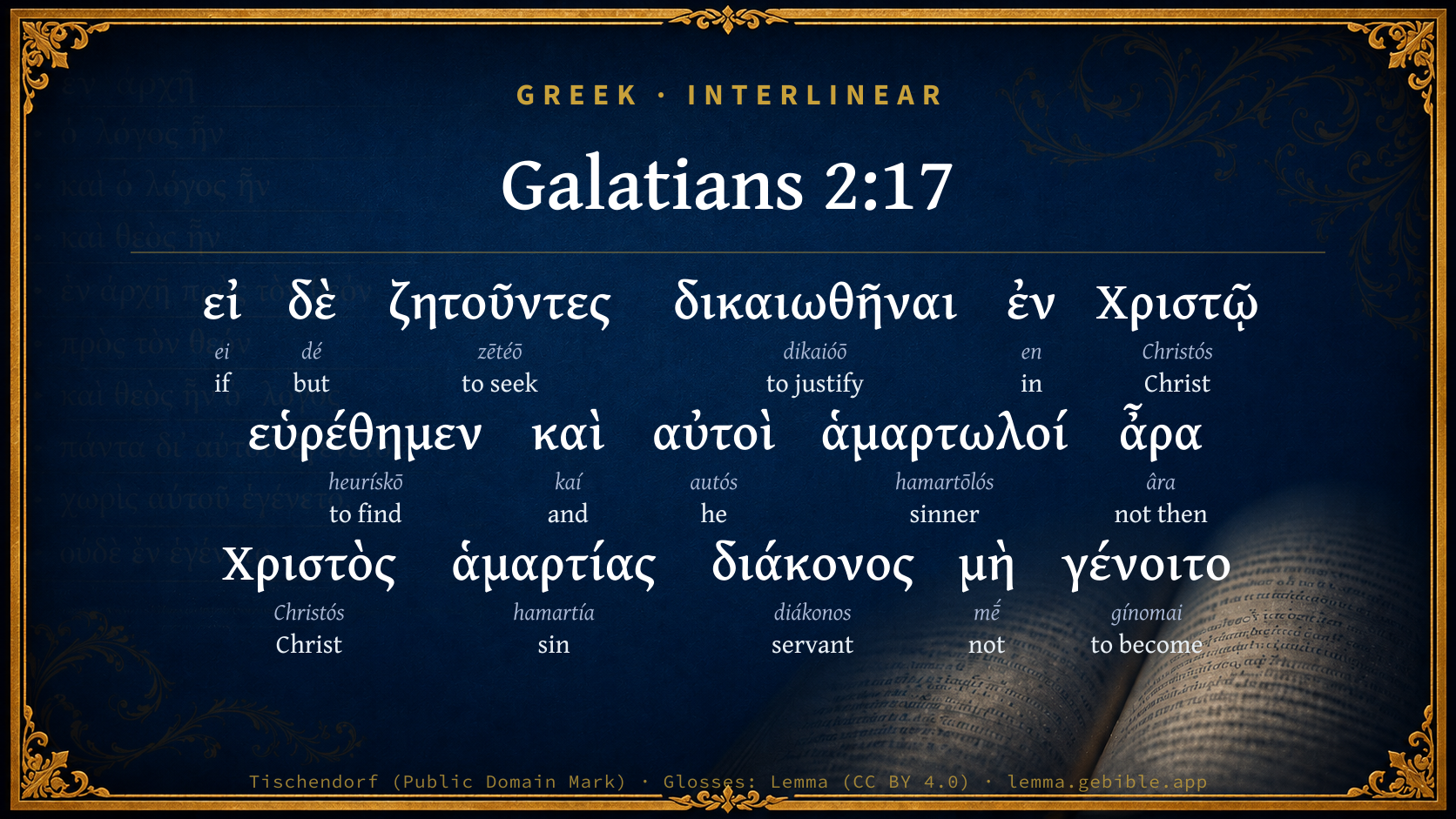
Download image
Cite this verse

Galatians 2:17 (World English Bible). Public Domain. Lemma interlinear Bible study tool, https://lemma.gebible.app/v/galatians/2/17.

Show BibTeX & RIS
BibTeX
RIS
English Translation
But if, while we sought to be justified in Christ, we ourselves also were found sinners, is Christ a servant of sin? Certainly not!
World English Bible · Public Domain
Download a study sheet

One document with this verse’s original text, its word-by-word gloss line, the meaning frame, cross-references with their text, attributed commentary, and full source and license credits — printable, and it pastes into notes with its structure intact.

This verse Autodidact and up

Study sheet (.html) Plain text (.txt)

A passage Seminary Student

Up to 50 verses in one chapter. A passage sheet keeps up to 6 commentary sources and 12 cross-references per verse, in the order this page ranks them, and says so on the sheet whenever that leaves anything out. Ask for a single verse and you get the Autodidact verse sheet above.

Everything on this page stays free to read, with no account — the sheet is a download of what is already on screen, not access to it.

Want to remove ads? Support Godless Engineer
Compare translations 3

The same verse in 3 English versions, stacked beneath the original-language interlinear above. Click any original word for its lexicon entry.

Each is an independent rendering of the whole verse — the interlinear is not word-aligned to these translations.

Highlighted words mark where these versions differ — a whole-verse word diff, not a word-by-word alignment.

  • World English Bible Public Domain
    But if, while we sought to be justified in Christ, we ourselves also were found sinners, is Christ a servant of sin? Certainly not!
  • King James Version Public Domain
    But if, while we seek to be justified by Christ, we ourselves also are found sinners, is therefore Christ the minister of sin? God forbid.
  • unfoldingWord Literal Text CC BY-SA 4.0
    But if, seeking to be justified in Christ, we ourselves were also found sinners, Christ then a minister of sin? May it never be!

unfoldingWord Literal Text — © unfoldingWord, licensed CC BY-SA 4.0. Word-aligned USFM3 via Door43 (git.door43.org/unfoldingWord/en_ult).

Versions to compare (up to 4)

3 of 4 selected

Show all 19 translations

Every available English version of this verse, each an independent rendering of the whole verse.

  • World English Bible Public Domain
    But if, while we sought to be justified in Christ, we ourselves also were found sinners, is Christ a servant of sin? Certainly not!
  • Berean Standard Bible Public Domain
    But if, while we seek to be justified in Christ, we ourselves are found to be sinners, does that make Christ a minister of sin? Certainly not!
  • Majority Standard Bible Public Domain
    But if, while we seek to be justified in Christ, we ourselves are found to be sinners, does that make Christ a minister of sin? Certainly not!
  • King James Version Public Domain
    But if, while we seek to be justified by Christ, we ourselves also are found sinners, is therefore Christ the minister of sin? God forbid.
  • American Standard Version (1901) Public Domain
    But if, while we sought to be justified in Christ, we ourselves also were found sinners, is Christ a minister of sin? God forbid.
  • Revised Version (1885) Public Domain
    But if, while we sought to be justified in Christ, we ourselves also were found sinners, is Christ a minister of sin? God forbid.
  • Geneva Bible (1599) Public Domain
    If then while we seeke to be made righteous by Christ, we our selues are found sinners, is Christ therefore the minister of sinne? God forbid.
  • Douay-Rheims (1899) Public Domain
    But if while we seek to be justified in Christ, we ourselves also are found sinners; is Christ then the minister of sin? God forbid.
  • Young's Literal Translation Public Domain
    And if, seeking to be declared righteous in Christ, we ourselves also were found sinners, `is' then Christ a ministrant of sin? let it not be!
  • Literal Standard Version CC BY-SA 4.0
    And if, seeking to be declared righteous in Christ, we were also ourselves found sinners, [is] Christ then a servant of sin? Let it not be!
  • Unlocked Literal Bible CC BY-SA 4.0
    But if, while we seek to be justified in Christ, we too, were found to be sinners, does Christ then promote sin? Absolutely not!
  • unfoldingWord Literal Text CC BY-SA 4.0
    But if, seeking to be justified in Christ, we ourselves were also found sinners, Christ then a minister of sin? May it never be!
  • Darby Bible Public Domain
    Now if in seeking to be justified in Christ we also have been found sinners, then [is] Christ minister of sin? Far be the thought.
  • World Messianic Bible Public Domain
    But if while we sought to be justified in Messiah, we ourselves also were found sinners, is Messiah a servant of sin? Certainly not!
  • Webster's Bible Public Domain
    But if, while we seek to be justified by Christ, we ourselves also are found sinners, is therefore Christ the minister of sin? By no means.
  • Free Bible Version CC BY-SA 4.0
    For if, as we look to be made right in Christ, we ourselves prove to be sinners, does that then mean that Christ is in the service of sin? Of course not!
  • Bible in Basic English Public Domain
    But if, while we were desiring to get righteousness through Christ, we ourselves were seen to be sinners, is Christ a servant of sin? In no way!
  • Text-Critical English NT CC BY 4.0
    But if we ourselves have also been found to be sinners while seeking to be justified in Christ, is Christ then an agent of sin? Certainly not!
  • Tyndale New Testament (1534) Public Domain
    Yf then whill we seke to be made rightewes by Christ we oure selves are founde synners is not then Christ the minister of synne? God forbyd.

Literal Standard Version (2020), Covenant Press — licensed CC BY-SA 4.0. Text via the HelloAO Bible API (eBible.org). Unlocked Literal Bible (unfoldingWord) — licensed CC BY-SA 4.0. Text via the HelloAO Bible API (eBible.org). unfoldingWord Literal Text — © unfoldingWord, licensed CC BY-SA 4.0. Word-aligned USFM3 via Door43 (git.door43.org/unfoldingWord/en_ult). Free Bible Version, Dr. Jonathan Gallagher — licensed CC BY-SA 4.0. Text via the HelloAO Bible API (eBible.org).

Word by word

More ways to search: Search by grammar → Find every occurrence → Compare this word →

Practice this passage: Drill this verse → Learn its vocabulary →

ἆρα
âra
G687
“not then”
Particle, Interrogative
Part of Speech
Particle
Degree
Interrogative
Full Thayer's Definition

Origin: a form of G686 , denoting an interrogation to which a negative answer is presumed

TDNT: None

1. a Greek interrogative particle that implies anxiety or impatience on the part of the questioner
  1. εἰ ei G1487 “if” Conditional
  2. δὲ dé G1161 “but” Conjunction
  3. ζητοῦντες zētéō G2212 “to seek” Verb, Present, Active, Participle, Nominative, Plural, Masculine
  4. δικαιωθῆναι dikaióō G1344 “to justify” Verb, Aorist, Passive, Infinitive
  5. ἐν en G1722 “in” Preposition
  6. Χριστῷ Christós G5547 “Christ” Noun, Dative, Singular, Masculine
  7. εὑρέθημεν heurískō G2147 “to find” Verb, Aorist, Passive, Indicative, 1st person, Plural
  8. καὶ kaí G2532 “and” Conjunction
  9. αὐτοὶ autós G846 “he” Personal pronoun, Nominative, Plural, Masculine
  10. ἁμαρτωλοί hamartōlós G268 “sinner” Adjective, Nominative, Plural, Masculine
  11. Χριστὸς Christós G5547 “Christ” Noun, Nominative, Singular, Masculine
  12. ἁμαρτίας hamartía G266 “sin” Noun, Genitive, Singular, Feminine
  13. διάκονος diákonos G1249 “servant” Noun, Nominative, Singular, Masculine
  14. μὴ mḗ G3361 “not” Particle, Negative
  15. γένοιτο gínomai G1096 “to become” Verb, Aorist, Middle deponent, Optative, 3rd person, Singular

About this verse

These counts appear in no published source. They are computed here, from the morphology-tagged text and Lemma’s own curated glosses. What Lemma adds →

16
words
15
distinct lemmas
Pauline Epistles
section

Notable vocabulary

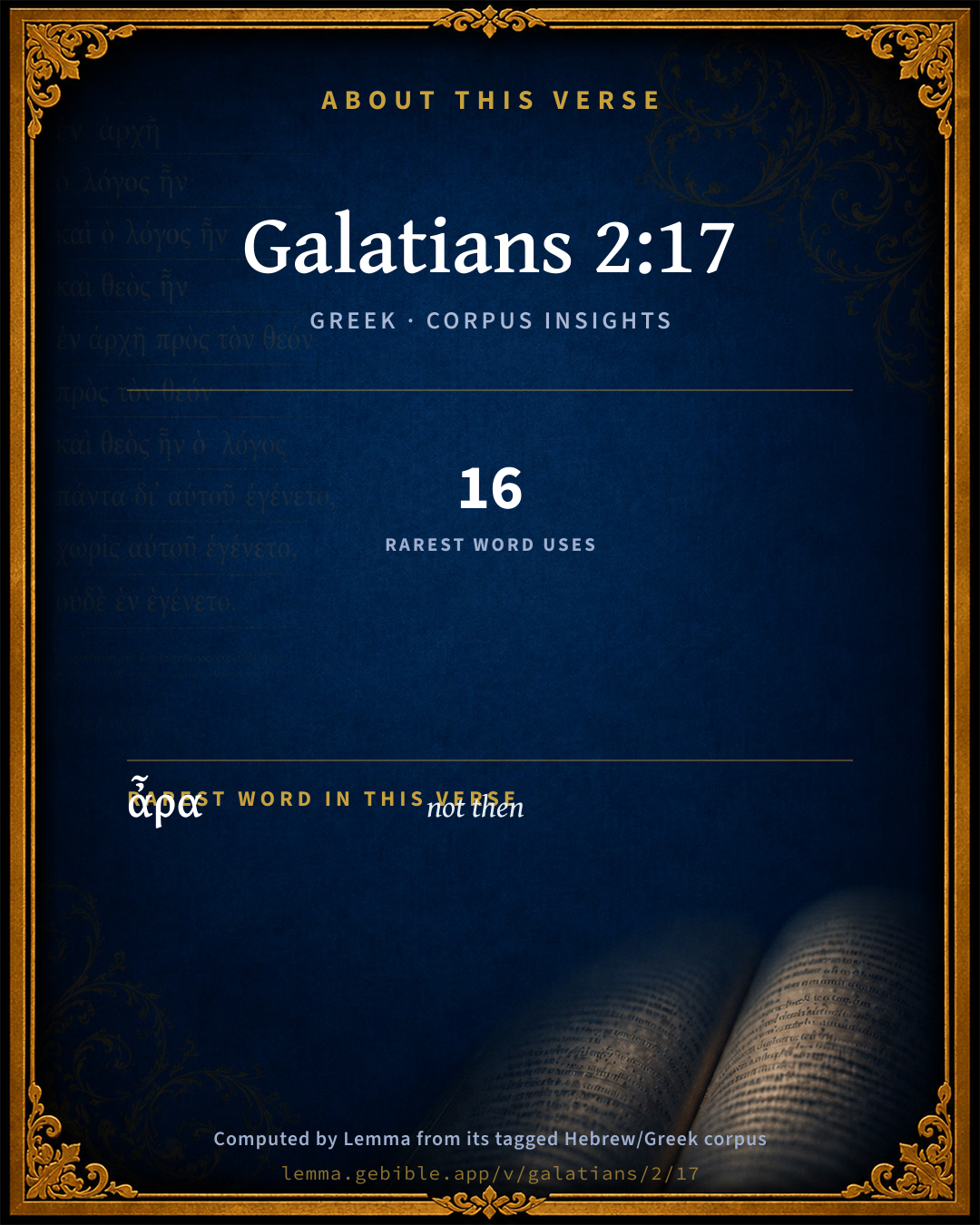
The rarest word here is ἆρα not then G687 — appearing just 16 times in the whole Greek New Testament.

Shared distinctive vocabulary

ἆρα not then G687 occurs in 16 verses of the Greek New Testament. Also found in:

Repetition

A word recurs within this verse:

  • Χριστῷ Christ G5547 ×2

Cross-references

15

Topical passages linked to Galatians 2:17 in the Treasury of Scripture Knowledge — connected by theme and wording, ordered by reader-vote popularity; previews shown in the World English Bible.

  • Romans 6:1–2 What shall we say then? Shall we continue in sin, that grace may abound?
  • 1 John 3:8–10 He who sins is of the devil, for the devil has been sinning from the beginning. To this end the Son of God was revealed, that he might destroy the works of the devil.
  • 1 John 3:5 You know that he was revealed to take away our sins, and in him is no sin.
  • Galatians 2:15 "We, being Jews by nature, and not Gentile sinners,
  • Matthew 1:21 She shall bring forth a son. You shall call his name Jesus, for it is he who shall save his people from their sins."
  • Romans 9:30–33 What shall we say then? That the Gentiles, who didn't follow after righteousness, attained to righteousness, even the righteousness which is of faith;
  • Romans 11:7 What then? That which Israel seeks for, that he didn't obtain, but the chosen ones obtained it, and the rest were hardened.
  • Romans 3:4 May it never be! Yes, let God be found true, but every man a liar. As it is written, "That you might be justified in your words, And might prevail when you come into judgment."
  • Romans 3:6 May it never be! For then how will God judge the world?
  • Romans 15:8 Now I say that Christ has been made a minister of the circumcision for the truth of God, that he might confirm the promises given to the fathers,
  • 2 Corinthians 3:7–9 But if the service of death, written engraved on stones, came with glory, so that the children of Israel could not look steadfastly on the face of Moses for the glory of his face; which was passing away:
  • Galatians 2:11 But when Peter came to Antioch, I resisted him to the face, because he stood condemned.
  • Galatians 3:21 Is the law then against the promises of God? Certainly not! For if there had been a law given which could make alive, most assuredly righteousness would have been of the law.
  • Hebrews 7:24–28 But he, because he lives forever, has his priesthood unchangeable.
  • Hebrews 8:2 a minister of the sanctuary, and of the true tabernacle, which the Lord pitched, not man.

Cross-references courtesy of OpenBible.info (CC BY 4.0).

Commentary

Notes on Galatians 2:17 from classic Christian and Jewish commentators (each source and its license shown beneath its notes). The classic Christian expositions comment on the surrounding passage and are grouped to its opening verse, so a note may address several verses; the Jewish commentaries on the Tanakh (Rashi and others) are per-verse, so they appear only where the commentator wrote on this verse.

Lemma curates 59 commentaries, every one of them public domain or Creative Commons licensed, each selected and text-cleaned for this edition rather than reprinted as found. About our sources →

The Biblical Illustrator

Joseph S. Exell

Gal_2:17

But if, while we seek to be Justified by Christ.

I. The blasphemy of making Christ the minister of sin.

II. The perfect sufficiency of Christ for the justification of His people.

III. The impertinence of the doctrine of justification by works; as--

1. Impossible.

2. Needless.

IV. The motive that the justified have to live righteously. (W. Perkins.)

Justification by Christ guarded

I. A privilege.

1. Christ has done for us what we could not do for ourselves.

(1) Fulfilled the law;

(2) borne the penalty of its infractions; and thus

(3) delivered us from its claims.

2. He has secured for us

(1) pardon,

(2) acceptance,

(3) Divine privileges.

II. The abuse of this privilege.

1. The legalists nullified it, and thus became sinners by

(1) sinfully rejecting the only means of salvation;

(2) seeking justification in that which could only intensify the sense of sin. The Antinomians who made it an encouragement to sin.

III. The logical consequences of this abuse.

1. In the case of the legalists: if Christ fails to remove sin and the works of the law are still necessary, then Christ ministers to sin by delusive offers of salvation.

2. In the case of the Antinomians: if justification is only an incentive to presumption, Christ is morally chargeable with its guilt.

IV. The apostles horror at this conclusion.

1. It is blasphemous.

2. It is preposterous.

(1) Justification in Christ is complete and effectual.

(2) It is the strongest incentive to righteousness (Gal_2:19).

Grace and Duty

Griffiths says that travellers in Turkey carry with them lozenges of opium, on which is stamped mash Allah, the gift of God. Too many sermons are just such lozenges. Grace is preached but duty denied. Divine predestination is cried up, but human responsibility is rejected. Such teaching ought to be shunned as poisonous, but those who by reason of use have grown accustomed to the sedative, condemn all other preaching, and cry up their opium lozenges of high doctrine as the truth, the precious gift of God. It is to be feared that this poppy-juice doctrine has sent many souls to sleep who will wake up in hell. (C. H. Spurgeon.)

The wickedness of Christians no argument against Christianity

One of the greatest and most plausible objections alleged by unbelievers against the Divine institution of the christian religion, is the smallness of the influence it may seem to have upon the lives and manners of its professors. It were natural to expect, if God condescended to give men an express revealed law, and to send so extraordinary a person as His own Son to promulgate that law upon earth; it were natural to expect, it should have some very visible and remarkable effect in the world, answerable to the dignity of the thing itself, and worthy of its great Author. Are there to be met withal, in the lives and manners of Christians, any considerable marks or distinguishing characters, by which it might be judged that they are really under the influence and peculiar guidance of such a Divine director? Is there, among those who call themselves Christians, less of profaneness and impiety towards God, less of fraud, injustice, and unrighteousness toward men, than among the professors of other religions? Is there not too plainly the same boundless ambition, the same insatiable covetousness, the same voluptuousness and debauchery of manners, to be found among them, as among other men? Nay, have not moreover the pretences even of religion itself, been the immediate and direct occasion of the bitterest and most implacable animosities, of the cruellest and most bloody wars, of the most barbarous and inhumane persecutions? Have not the greatest vices and immoralities of all kinds received too plain an encouragement from the reliance upon a power of repeating continually certain regular and periodical absolutions: and, much more, from an imagination that the practices of a vicious life may be compensated before God by the observance of certain weak and ridiculous ceremonies, and made amends for by superstitious commutations? Lastly, and beyond all this, hath not even the grace of God, as the apostle expresses it, been itself too frequently turned into wantonness?

I. The wickedness of the lives of those who call themselves Christians is no argument at all against the truth and excellency of the Christian religion itself. Natural and necessary causes always and necessarily produce effects proportional to their natural powers; so that from the degree or quantity of the effect, may always certainly be judged the degree of power and efficacy in the cause. But in moral causes the case is necessarily and essentially otherwise. In these, how efficacious soever the cause be, yet the effect always depends on the will of the person upon whom the effect is to be worked, whether the cause shall at all produce its proper effect or no. For as, where no Law is, there is no transgression; so on the other side, and for the same reason, where there is law, not obeyed, that law worketh wrath; and sin, by this commandment, becomes exceeding sinful. Were therefore the effect always to be the measure, in judging of the goodness and excellency of a cause, the best and wisest laws would often, upon account of their very excellency, be the worst. And the same may, in proportion, be said concerning reason itself, even the absolute and necessary reason of things. The more we are sensible of the reasonableness and necessity of moral obligations, the worse is our condition if we act unreasonably. Yet reason is of essential excellency, eternally and immutably; being the necessary result of the nature and truth of things: and the commandments of God who cannot err, are always holy and just and good (Rom_7:12). If, therefore, it be no objection against the excellency of reason itself, that it very often is not able to make men act reasonably, and no diminution to the Divine commandments in general, that they frequently not only fail of reforming mens manners, but even on the contrary do moreover make sin to become the more exceedingly sinful; then, for the same reason, neither against the truth and excellency of Christianity in particular can any argument be drawn from the wickedness of the lives of those who profess themselves Christians. But--

II. Though the practice of any wickedness whatsoever, affords no real argument against Christianity itself, yet it is always matter of very great and just reproach to the professors of this holy religion, as being the utmost contradiction and the highest possible inconsistency with their profession. Just as the Jews of old, who perpetually styled themselves the people of God, and yet fell into the vices of the heathen nations. But when anything which is a part of the Christian doctrine is itself in particular made a direct ground and immediate cause of wickedness, the case then is infinitely worse, and the reproach unspeakably greater. When the gospel is not only rendered ineffectual to prevent sin, but Christ (as the apostle in the text expresses it) made to be Himself the minister of sin; this is what St. Jude calls, Turning the grace of God into lasciviousness; or, in St. Peters language, it is, by means of the very promise of liberty, making men the servants of corruption. And of the same kind are those Christians at all times and in all places, who, upon any pretence whatsoever, set up any expedients, of whatever sort they be, either in point of doctrine or practice; as equivalents to be accepted of God, in the stead of virtue and true goodness.

III. The third and last thing I proposed to show, was, that from what has been said, there arises a very plain and easy rule by which we may judge of the malignity and dangerousness of any error in matters of religion. In proportion as the error tends to reconcile any vicious practice with the profession of religion, or (as the text expresses it) to make Christ the minister of sin, in the same proportion is the doctrine pernicious, and the teachers of it justly to be deemed corrupt. By their fruits ye shall know them. All other tests may possibly be deceitful. Fair speeches, great learning and abilities, fervent zeal, numbers, authority, strict observance of ceremonies, even worldly austerities, and the appearances of the most devotional piety; all these may possibly accompany a very false and very wicked religion. But the fruits of virtue and true goodness, these are marks which admit no counterfeit. (S. Clarke, D. D.)

The Biblical Illustrator, edited by Joseph S. Exell (c. 1880s–1900s) — public domain. Text from a community e-Sword module.

Joseph Benson's Commentary

Gal 2:17-19. But if while we seek to be justified by Christ — Through the merit of his obedience unto death, by simply believing in him, and in the truths and promises of his gospel; we ourselves are still found sinners — Continue in sin; if we are still under the guilt and power of sin, in an unpardoned, unrenewed state; is therefore Christ the minister of sin — Does he countenance sin, by giving persons reason to suppose that they are justified through believing in him as the true Messiah, while they continue to live in the commission of sin? God forbid — That any thing should ever be insinuated so much to the dishonour of God, and of our glorious Redeemer. For if I build again — By my sinful practice; the things which I destroyed — Or professed that I wished to destroy, by my preaching, or by my believing; I make myself a transgressor — I show that I act very inconsistently, building up again what I pretended I was pulling down. In other words, I show myself, not Christ, to be a transgressor; the whole blame lies on me, not on him or his gospel. As if he had said, The objection were just, if the gospel promised justification to men continuing in sin. But it does not. Therefore if any, who profess the gospel, do not live according to it, they are sinners, it is certain, but not justified; and so the gospel is clear. For I through the law — Understood in its spirituality, extent, and obligation; applied by the Holy Spirit to my conscience, and convincing me of my utter sinfulness, guilt, and helplessness; am dead to the law — To all hope of justification by it, and therefore to all dependance upon it; see notes on Rom 7:7-14; That I may live to God — Not that I may continue in sin. For this very end, I am delivered from the condemnation in which I was involved, am justified, and brought into a state of favour and acceptance with God, that I might be animated by nobler views and hopes than the law could give, and engaged, through love to God, his people, and all mankind, to a more generous, sublime, and extensive obedience than the law was capable of producing.

Joseph Benson's Commentary on the Old and New Testaments (1811–1818) — public domain. Text from a community e-Sword module.

Tyndale Open Study Notes

Tyndale Open Resources

2:17-21 The false teachers probably claimed that Paul’s law-free Good News would lead to lawlessness, that people would flaunt their sinfulness, and that Christ would thus be seen as leading people into sin (2:17). Paul shows that this is false, because those who place their faith in Christ are empowered by the Holy Spirit to live holy, God-honoring lives (see 5:13-26).

Tyndale Open Study Notes — © Tyndale Open Resources, licensed CC BY-SA 4.0. Text via the HelloAO Bible API.

Bengel's Gnomon

Johann Albrecht Bengel

Gal 2:17.—Εἰ δὲ, but if) When Peter withdrew himself, and refused to hold any longer that communion in living [food] with the Gentiles, which he had begun; it was the same thing as if he had said, that he had lived a heathen sinner, by the fact of and during the continuance of that communion. But Christ had formed a close relationship with the Gentiles, on account of which he had very properly eaten with them. Wherefore if Peter committed sin in eating with them, the consequence will be that Christ was the minister of that sin. Paul so shrinks back from the impropriety of such a consequence, that he not only subjoins, God forbid, but immediately softens the expression by turning it into an interrogation, and by using also the word διάκονος, minister, which is well adapted to mark the indignity implied in this passage. There is no blame attached to Christ, conferring righteousness and holiness upon the Gentiles; but the whole blame lies with him, who renews [builds again] a separation from the Gentiles, after they had been converted to Christ; see following verse.—ζητοῦντες) while we seek, ever since we have received faith and freedom from the law. This word, to seek, is represented [virtually expressed] in the preceding verse; and “if while seeking—we are found,” is a strong antithesis to it.—εὑρέθημεν, we are found) now, anew.—καὶ αὐτοὶ) we ourselves also, of our own accord.—Χριστὸς, Christ) by [in] whom, however, we seek to be justified.

Bengel's Gnomon of the New Testament — English translation (T&T Clark, Edinburgh, 1860) — public domain. Text from a community e-Sword module.

Meyer's Critical & Exegetical Commentary

Heinrich August Wilhelm Meyer

Gal_2:17. The δέ dialectically carries on the refutation of Peter; but the protasis beginning with εἰ cannot have its apodosis in εὑρέθημεν κ. ἀ. ἁμ. (Hofmann[98]); on the contrary, it runs on as far as ἉΜΑΡΤΩΛΟΊ, which is then followed by the interrogatory apodosis. Consequently: But if we (in order to show thee, from what has been just said, how opposed to Christ thy conduct was), although we sought to he justified in Christ, were found even on our part sinners. This protasis supposes that which must have been the case, if Peters Judaizing conduct had been in the right; namely, that the result would then have been that faith does not lead to, or does not suffice for, justification, but that it is requisite to combine with it the observance of the Jewish law. If faith does not render the Ἰουδαΐζειν superfluous, as was naturally to be concluded from the course of conduct pursued by Peter, then this seeking after justification in Christ has shown itself so ineffectual, that the believer just stands on an equality with the Gentiles, because he has ceased to be a Jew and yet has not attained to righteousness in Christ: he is therefore now nothing else than an ἁμαρτωλός, just as the Gentile is. But if this is the case, the apodosis now asks, Is Christ, therefore, minister of sin (and not of righteousness)?seeing that our faith in Him, which seeks for righteousness by Him, has the sad result that we have been found like the Gentiles in a state of sin. The answer to this question is, Far be it! It is a result to be abhorred, that Christ, instead of bringing about the righteousness sought in Him, should be the promoter of sin. Consequently the state of things supposed in the protasis is an anti-Christian absurdity.

The subject of ζητοῦντες and ΕὙΡΈΘΗΜΕΝ is, as before, Peter and Paul.

ΖΗΤΟῦΝΤΕς] emphatically prefixed, in reference to the preceding sentence of purpose, ἵνα δικαιωθῶμεν κ.τ.λ.; so that this ΖΗΤΕῖΝ ΔΙΚΑΙΩΘ. is not in reality different from the ΠΙΣΤΕΎΕΙΝ ΕἸς ΧΡΙΣΤ., but denotes the same thing as respects its tendency. To the ζητοῦντες then corresponds the ΕὙΡΈΘΗΜΕΝ, which introduces an entirely different result: if we have been found, if it has turned out as a matter of fact, that, etc. (Rom_7:10; 1Co_4:2; 1Co_15:15; 2Co_11:12). As to εὑρέθημεν we must, however, notice thatas in the apodosis ἈΡᾺ ΧΡΙΣΤΌς Κ.Τ.Λ. we cannot without proceeding arbitrarily supply anything but the simple ἘΣΤΊΝ, and not ἌΝ ἮΝ (Gal_3:21)the aorist requires the explanation: inventi sumus (Vulgate, Beza, Calvin, and many others[99]), and therefore neither reperimur (Erasmus, Castalio) nor inventi essemus (de Wette and many others), nor should be found (Luther), nor were to be found (Schott). Observe, moreover, that in εὑρέθ., in contrast to ζητοῦντες κ.τ.λ., the accessory idea of something unexpected suggests itself (comp. on Mat_1:20).

ἐν Χριστῷ] nothing else than what was previously put as ἐκ πίστεως Χριστοῦ, but expressed according to the notion that in Christ, whose person and work form the object of faith, justification has its causal basis (2Co_5:21; Act_13:39; Rom_3:24). Its opposite: ἐν νόμῳ, Gal_3:11, and the ἰδία δικαιοσύνη, Rom_10:3.

καὶ αὐτοί] et ipsi, also on our part, includes Peter and Paul in the class of ἁμαρτωλοί previously referred to in Gal_2:15.

ἆρα Χ. ἁμαρτ. διάκ] is, at any rate, a question (Vulgate, numquid), for with Paul μὴ γένοιτο is always preceded by a question (Rom_3:4; Rom_6:2; Gal_3:21, et al.). With this, however, either mode of writing, ἄρα (Lachmann) or ἆρα (Tischendorf), may stand. Both express igitur, rebus sic se habentibus; but ἆρα (Luk_18:8; Act_8:30), although Paul does not elsewhere use it (but just as little does he use an interrogative ἄρα[100]), is the livelier and stronger. See Klotz, ad Devar. p. 180; Baeumlein, Partik. p. 39 f. To take ἆρα for ἆρʼ οὔ, nonne (Olshausen, Schott), is a purely arbitrary suggestion, which fails to apprehend the subtlety of the passage, the question in which (not ἆρα in itself, as held by Hartung) bears the trace of an ironical suspicion of doubtfulness (comp. Buttmann, ad Plat. Charmid. 14, ed. Heind.). Besides, ἆρα is never really used for ἆρʼ οὔ, although it sometimes seems so (Herm. ad Viger. p. 823; Heind. ad Plat. Theaet. p. 476; Ellendt, Lex. Soph. I. p. 216). See Kühner, ad Xen. Mem. ii. 6. 1. Rückert has mistaken the sense of the whole passage: If we, although we seek grace with God through Christ, nevertheless continue to sin, etc., do ye think that Christ will then take pleasure in us, greater pleasure than in the Gentiles, and thus strengthen and further us in our sin? Against this it may be urged, that Paul has not written εὑρισκόμεθα; that the comparison with the Gentiles implied in καὶ αὐτοί would be unsuitable, for the sin here reproved would be hypocritical Judaizing; and that Gal_2:18 would not, as is most arbitrarily assumed, give the reason for the μὴ γένοιτο, but, passing over the μὴ γένοιτο and the apodosis, would carry us back to the protasis and prove this latter. The nearest to this erroneous interpretation is that of Beza and Wieseler, who (so also essentially Reithmayr) find expressed here the necessity of the union of sanctification with justification.[101] But the right sense of the passage, as given above, is found in substance, although with several modifications, and in some cases with an incorrect apprehension of the aorist εὑρέθημεν (see above), in Chrysostom, Theodoret, Oecumenius, Theophylact, Erasmus, Luther, Castalio, Calvin, Calovius, Estius, Wolf, Wetstein, and others; also Semler, Koppe, Borger, Flatt, Winer, Usteri, Matthies, Schott, Baumgarten-Crusius, de Wette, Hilgenfeld, Ewald, Matthias; several of whom, however, such as the Greek Fathers, Luther, Calovius, Koppe, Usteri, Lachmann, taking the accentuation ἄρα, do not assume any question, which does not alter the essential sense, but does not correspond with the μὴ γένοιτο which follows; while Hilgenfeld unnecessarily supposes a breviloquence: then I ask, Is then Christ, etc.?

Χριστός] in quo tamen quaerimus justificari, Bengel.

ἁμαρτ. διάκ.] ἁμαρτ. emphatically prefixed, in contrast to the δικαιωθῆναι: one, through whom sin receives service rendered, sin is upheld and promoted.[102] The opposite, διάκονοι δικαιοσύνης, 2Co_11:15.

[98] Hofmann explains it, as if Paul had written εἰ δὲ ἐζητοῦμεν (if we, when we became believers, sought, etc.) δικαιωθῆναι ἐν Χριστῷ, εὑρέθημεν κ.τ.λ. (we thereby exhibit ourselves at the same time as sinners). According to Hofmann, the εὑρέθημεν is intended to apply to both members of the sentence,a forced, artificial view for which the context affords neither right nor reason.

[99] So correctly also Lipsius in Hilgenfelds Zeitschr. 1861, p. 73 ff. He, however, improving on Holstens similar interpretation, thus explains the whole passage: If we, being born Jews, have, by our seeking after the salvation in Christ, confessed our sinfulness (and consequently, at the same time, the impotence of the law to make us righteous), does it thence follow that Christ, by inviting also us Jews to seek righteousness in Him and not in the law, has led us astray to a life in Gentile impurity? But this inference does not stand in logical consistency with the protasis, and could not even suggest itself as a false conclusion; for ἁμαρτίας is assumed to be taken in a different sense from ἁμαρτωλοί,the latter in the sense of defectus justitiae, the former as vitiositas ethnica. Holsten also understands ἁμαρτίας as the unfettering of sin in the moral life (comp. Gal_5:13; Rom_1:6 f., et al.),an idea which is here foreign to the context.

[100] Which is assumed by Wieseler, Buttmann, Hofmann.

[101] They take the essential sense to be: If the man who is justified in Christ has sinned, Christ is not to blame for this; for (ver. 18) the man himself is to blame for the transgression, because he builds again the dominion of sin which He had destroyed. So Wieseler. This interpretation is utterly unsuitable, if ver. 15 ff. is still addressed to Peter. It may be urged also against it, that Paul, by using εὑρέθημεν (instead of εὑρισκόμεθα), would have written in a way both obscure and misleading; further, that the relapse of the justified man into sin did not at all suggest or presume as probable the conclusion that Christ was to blame for it; moreover, that the expression ἁμαρτίας διάκονος must assert something of a far stronger and more positive character (namely, sin-producer); lastly, that ver. 18, taken in Wieselers sense, would, notwithstanding its carefully-chosen expressions, contain nothing more than an almost meaningless and self-evident thought, in which, moreover, the destruction of the dominion of sin, which has been accomplished by Christ or by the justifying grace of God (Rom_8:3), would be attributed to man (κατέλυσα).

[102] Luthers gloss: Whoever desires to become pious by means of works, acts just as if Christ by His ministry, office, preaching, and sufferings, made us first of all to be sinners who must become pious through the law; thus is Christ denied, crucified again, slandered, and sin is built up again, which had previously been done away by the preaching of faith.

Meyer — Critical and Exegetical Commentary on the New Testament — English translation by Peter Christie, edited by Frederick Crombie (T&T Clark, 1880) — public domain. Text from a community e-Sword module.

Expositor's Greek Testament

ed. W. Robertson Nicoll

Gal 2:17 . εἰ δὲ … ἁμαρτωλοί . The last verse arrived at the conclusion that Jewish converts by their own act condemned themselves to be guilty of a broken law. The argument now proceeds on this assumption “ If it be true (as has been shown) that we by seeking to be justified in Christ were found to be ourselves also sinners as well as the Gentiles if our sin was then discovered, and it be admitted that confession of sin lies at the root of all Christian life, what then is the attitude of Christ toward sin?” ἆρα Χ . ἁ . διάκονος ; This clause is clearly interrogative, and the true reading is ἆρα , not ἄρα (inferential). For here, as always elsewhere In Pauline language, μὴ γένοιτο repudiates a monstrous suggestion, put forward in the form of a question, the mere statement of which is repugnant to the moral sense.

It was objected to this doctrine of God’s free grace in Christ to guilty sinners that it held out a license to sin by doing away the wholesome restraints of the Law, and so encouraged men to continue in sin by its assurance of pardon. The fallacy is here dismissed with scorn on the strength of the very nature of Christ, but is more fully exposed in the sixth chapter to the Romans.

The Expositor's Greek Testament, edited by W. Robertson Nicoll (1897–1910) — public domain. Text from a community e-Sword module.

Cambridge Greek Testament for Schools and Colleges

17. εἰ δὲ. The adversative thought is that in the process of being justified we are found to be sinners.

ζητοῦντες. The effort was real and lasting.

δικαιωθῆναι ἐν Χριστῷ εὑρέθημεν. The tense of εὑρ. may be “timeless,” but more probably refers to the time when we first sought etc. εὑρ. is more than ἧμεν; it includes acknowledgment; if we were found by our own experience, Rom 7:10. The mere effort to be justified in Christ proved to us that as far as the demands of the Law went we were still sinners.

καὶ αὐτοὶ. Parallel to καὶ ἡμεῖς (Gal 2:16), even we Jews who passed over from Judaism to faith on Christ, and also were seeking etc.

ἁμαρτωλοί, Gal 2:15, i.e. no better than Gentiles. When seeking to be justified we came to recognize our sinfulness as no less than that of Gentiles.

ἆρα of an argument which is only superficially true.

Χριστὸς ἁμαρτίας διάκονος; does Christ bring us into a condition of real sin? There is a double thought: Does the consciousness of being sinners make us more sinners than before, and, if so, is it Christ’s fault that we are worse sinners?

μὴ γένοιτο. For the use of this when an argument followed out to its apparently logical conclusion is seen to be contrary to the elements of the Christian faith cf. Gal 3:21; Rom 11:1 al.

Other interpretations of this difficult verse are:

(a) St Paul is arguing that if by leaving the Law we become in the sight of God sinners (which we do not) then Christ brings sin, which is absurd; i.e. St Paul is showing that it cannot be wrong to abandon the Law. Gal 2:18 then means, as with the first and right interpretation of Gal 2:17, that not leaving the Law, but returning to it, is wrong.

(b) The verse represents the thought of an objector. If to be justified in Christ means to leave the Law (a sinful action), and thus to be in sight of God and man no better than a Gentile, Christ becomes a minister of sin. St Paul answers, God forbid. But Gal 2:18 is then unintelligible.

(c) If when seeking etc. we do commit sins, Christ cannot be blamed for this. We are to be blamed (Gal 2:18) because it is contrary to our profession and earlier action.

Cambridge Greek Testament for Schools and Colleges (Cambridge University Press, 1896; 21 vols, various authors incl. Carr, Maclear, Plummer, Farrar, Lumby, Moule, M. R. James, Simcox) — public domain. Text from a community e-Sword module.

Geneva Bible (1599)

Geneva Bible translators

Before he goeth any further, he meeteth with their objection, which abhorred this doctrine of free justification by faith, because say they, men are by this means withdrawn from the study of good works. And in this sort is the objection, If sinners should be justified through Christ by faith without the Law Christ should approve sinners, and should as it were exhort them thereunto by his ministry. Paul answereth that this consequence is false, because that Christ destroyeth sin in the believers: For so saith he do men flee unto Christ, through the terror and fear of the Law that being quit from the curse of the Law and justified, they may be saved by him, that together therewithall, he beginneth in them by little and little, that strength and power of his which destroyeth sin: to the end that this old man being abolished by the virtue of Christ crucified, Christ may live in them, and they may consecrate themselves to God. Therefore if any man give himself to sin after he hath received the Gospel, let him not accuse Christ nor the Gospel, but himself, for that he destroyeth the work of God in himself.

He goeth from justification to sanctification, which is another benefit we receive by Christ, if we lay hold on him by faith.

Geneva Bible (1599) marginal notes — public domain. Text via Bolls.life.

Jamieson, Fausset & Brown

Robert Jamieson, A. R. Fausset & David Brown

Greek, "But if, seeking to be justified IN (that is, in believing union with) Christ (who has in the Gospel theory fulfilled the law for us), we (you and I) ourselves also were found (in your and my former communion with Gentiles) sinners (such as from the Jewish standpoint that now we resume, we should be regarded, since we have cast aside the law, thus having put ourselves in the same category as the Gentiles, who, being without the law, are, in the Jewish view, "sinners," Gal 2:15), is therefore Christ, the minister of sin?" (Are we to admit the conclusion, in this case inevitable, that Christ having failed to justify us by faith, so has become to us the minister of sin, by putting us in the position of "sinners," as the Judaic theory, if correct, would make us, along with all others who are "without the law," Rom 2:14; Co1 9:21; and with whom, by eating with them, we have identified ourselves?) The Christian mind revolts from so shocking a conclusion, and so, from the theory which would result in it. The whole sin lies, not with Christ, but with him who would necessitate such a blasphemous inference. But his false theory, though "seeking" from Christ, we have not "found" salvation (in contradiction to Christ's own words, Mat 7:7), but "have been ourselves also (like the Gentiles) found" to be "sinners," by having entered into communion with Gentiles (Gal 2:12).

Jamieson, Fausset & Brown — Commentary Critical and Explanatory on the Whole Bible (1871) — public domain (CC PDM 1.0). Text via the HelloAO Bible API.

Adam Clarke's Commentary

Verse 17. But if while we seek to be justified] If, while we acknowledge that we must be justified by faith in Christ, we ourselves are found sinners, enjoining the necessity of observing the rites and ceremonies of the law, which never could and never can justify, and yet, by submitting to circumcision, we lay ourselves under the necessity of fulfilling the law, which is impossible, we thus constitute ourselves sinners; is, therefore, Christ the minister of sin? Christ, who has taught us to renounce the law, and expect justification through his death?. God forbid! that we should either act so, or think so.

Adam Clarke's Commentary on the Bible (1810–1826) — public domain. Text from a community e-Sword/MySword module.

John Calvin's Commentaries

17. If, while we seek to be justified. He now returns to the Galatians. We must take care not to connect this verse with the preceding one, as if it were a part of the speech addressed to Peter: for what had Peter to do with this argument? It certainly has very little, if anything, to do with the speech; but let every one form his own opinion.

Chrysostom, and some other commentators, make the whole passage to be an affirmation, and interpret it thus: “If, while we seek to be justified by Christ, we are not yet perfectly righteous, but still unholy, and if, consequently, Christ is not sufficient for our righteousness, it follows that Christ is the minister of the doctrine which leaves men in sin:” supposing that, by this absurd proposition, Paul insinuates a charge of blasphemy against those who attribute a part of justification to the law. But as the expression of indignant abhorrence immediately follows, which Paul is never accustomed to employ but in answer to questions, I am rather inclined to think that the statement is made for the purpose of setting aside an absurd conclusion which his doctrine appeared to warrant. He puts a question, in his usual manner, into the mouth of his antagonists. “If, in consequence of the righteousness of faith, we, who are Jews and were ‘sanctified from the womb,’ (Jeremiah 1:5 Galatians 1:15,) are reckoned guilty and polluted, shall we say that Christ makes sin to be powerful in his own people, and that he is therefore the author of sin?”

This suspicion arose from his having said that Jews, by believing in Christ, renounce the righteousness of the law; for, while they are still at a distance from Christ, Jews, separated from the ordinary pollution of the Gentiles, appear to be in some respects exempted from the appellation of sinners. The grace of Christ places them on a level with the Gentiles; and the remedy, which is common to both, shews that both had labored under the same disease. This is the force of the particle also, — we ourselves also, — meaning not any description of men, but the Jews, who stood highest.

Far from it. He properly rejects that inference. Christ, who discovers the sin which lay concealed, is not therefore the minister of sin; as if, by depriving us of righteousness, he opened the gate to sin, or strengthened its dominion. The Jews were mistaken in claiming any holiness for themselves apart from Christ, while they had none. Hence arose the complaint: “Did Christ come to take from us the righteousness of the law, to change saints into polluted men, to subject us to sin and guilt?” Paul denies it, and repels the blasphemy with abhorrence. Christ did not bring sin, but unveiled it; he did not take away righteousness, but stripped the Jews of a false disguise.

John Calvin's Commentaries (1540-1563) — public domain. Text from the Calvin Translation Society English edition (1840s-50s) via the Christian Classics Ethereal Library (ccel.org). Calvin's coverage is partial (roughly two-thirds of the Bible); uncommented books and verses are honest gaps, never fabricated. The 19th-century editor's footnotes and remarks are omitted so the notes are faithfully Calvin's own voice.

Ellicott's Commentary for English Readers

(17) We sought justification in Christ. But if, with all our seeking, something more was needed: viz., a rigid performance of the Law—that Law which we had abandoned—then there was still something wanting to our justification. We were sinners on a par with the Gentiles, and all that Christianity seemed to have done for us was to lead us deeper into sin. A profane thought!

By Christ.—Strictly, in Christ—i.e., by the relation into which we are brought with Him. The reference is here, however, not exactly to the mystical union with Christ, which is regarded by the Apostle rather in connection with sanctification (the actual growth in holiness) than with justification (the judicial absolution from guilt). In the present instance the Apostle is speaking of justification; and when he says that “we are justified in Christ,” he means practically through faith in Him, or through that circle of forces within which we are brought by faith.

We ourselves also.—We who were by our birth Jews, as well as the Gentiles.

Are found.—Strictly, were found—i.e., at a time subsequent to our embracing Christianity, if the only result of our Christianity was that we were still sinners.

Sinners.—Sinners actually, through our positive transgressions, and sinners theoretically or judicially (in the eyes of God), through the fact that we have lost the old Jewish justification through the fulfilment of the Law; while, according to this Judaising theory which St. Paul is combating, our new Christian justification is insufficient.

Is therefore Christ the minister of sin?—Our English version is probably right in making this a question. It is put ironically, and as a sort of reductio ad absurdum of the Judaising position. The Judaisers maintained the necessity of a strict fulfilment of the Mosaic law. They, however, still called themselves Christians; and here St. Paul had a hold upon them. “You call yourselves Christians,” he says, “and yet you insist upon the Mosaic law. You say that a man cannot be justified without it: it follows that we, who have exchanged the service of the Law for the service of Christ, are not justified. In other words, our relation to Christ has made us, not better, but worse—a thought which no Christian can entertain.”

No doubt St. Paul used some such argument as this in his controversy with St. Peter at Antioch, but it would probably be stated in a simpler and less speculative form: “If you still fall back upon the separatist Jewish observances, what is the good of being a Christian?” Here, in writing to the Galatians, the Apostle paraphrases what he had said in language more suited to a theological treatise and to the natural speculative bias of his own mind.

God forbid.—The Judaising theory was quite sufficiently condemned by showing the consequences to which it would lead. It makes Christ Himself a minister of sin—a suggestion which the Apostle puts away with pious horror.

A Bible Commentary for English Readers, edited by Charles John Ellicott (1878–1897) — public domain. Text from a community e-Sword module.

The Cambridge Bible for Schools and Colleges

gen. ed. J. J. S. Perowne

17. while we seek] Rather, while seeking, i.e. earnestly desiring. The reference is to the time when they embraced the Gospel. Hence, for ‘are found’, read, “were found”, found ourselves in the same position as those ‘sinners’ of the Gentiles, whom we had been accustomed to look down upon, and needing, like them, a free salvation.

we ourselves] not necessarily, ‘I and Peter’ (see note on Gal_2:14), but we who, as Jews, inherited the advantages of the chosen race.

is therefore … of sin?] Are we to accept the inference that Christ is the minister of sin? The word ‘sin’ has direct reference to ‘sinners’ in the former clause. The Judaizers might taunt the Apostle with the suggestion, that, as faith in Christ had made them ‘sinners’, Christ had become a minister to a state of sin.

minister of sin] The antithesis occurs 2Co_11:15, “ministers of righteousness”. Is Christ, who is the author and finisher of our faith, employed in a service, which so far from emancipating men from sin, promotes sin?

God forbid] Lit. let it not come to pass! This formula is used by St Paul fourteen times to express a strong denial and utter repudiation of some proposition, either put forward by himself, or suggested by an opponent. “Away with such a thought!” There is of course neither ‘God’ nor ‘forbid’ in the Greek, but the English phrase is an excellent idiomatic equivalent.

17–21. The argument of these verses is somewhat obscure—an obscurity due, partly to the inadequacy of language to express the intensity of the Apostle’s feelings, partly to the introduction of metaphorical expressions, which elude the attempt to define them accurately.

St Paul, like other Jewish believers, earnestly desiring to escape the penalty of conscious sin, had abandoned all trust in the law, and had thrown himself entirely on the mercy of God in Jesus Christ. If he is now told that in doing this, he and they had foregone their privileges as children of Abraham, and reduced themselves to the position of sinners of the Gentiles (Gal_2:15), it might be said that Christ is a minister of sin. Away with such a false conclusion! St Paul had swept away all notion of justification by obedience to the law, because he knew that a man is justified by faith apart from such obedience, and to build up the edifice which he had pulled down would be to stand self-convicted as a transgressor of the law. ‘I’, he says, ‘for one, through the law, through experience of its inability to give life, turned my back on it for ever as a ground of justification before God. I died to the law. Thenceforth, as a ground of justification, it was no more to me than to a dead man. I did this, not that I might be free from the law, as a rule of life, but that I should live the only life worth living—a life impossible to me so long as I sought justification by the law—a life consecrated to God. I have been speaking of dying. There is another sense in which I died. I am crucified with Christ, a partaker of His death, a death issuing in resurrection; and this resurrection life, which I share with and derive from my Divine Lord, itself not natural but spiritual, transforms my whole natural and earthly life, so that I live this latter in the faith of Jesus Christ, who loved me and gave Himself for me. I do not, like the Judaizers, set at nought that grace of God to which I owe so much. And yet to seek justification by works would be practically to nullify it: for if by the law man obtains justification, Christ’s death was purposeless and superfluous’.

The Cambridge Bible for Schools and Colleges (gen. ed. J. J. S. Perowne; Cambridge University Press, 1878–1918) — public domain. Text from a community e-Sword module.

John Gill's Exposition

But if while we seek to be justified by Christ,.... As they did, and not only sought for, but obtained what they sought for, because they sought for it at the hands of Christ, and not as it were by works, but by faith, even a justifying righteousness in him.

We ourselves also are found sinners; that is, either we should be so, were we not to rest here, but seek to join our own works with Christ's righteousness for our justification, and so make Christ the minister of sin, of an imperfect righteousness, which cannot justify, which God forbid should ever be done by us; or we are reckoned sinners by you, judaizing Christians, for leaving the law, and going to Christ for righteousness; and if so, Christ must be the minister of sin, for he has directed and taught us so to do; but God forbid that any such thing should be said of him: or if we are still sinners, and unjustified persons, notwithstanding we seek to Christ to be justified by him, but need the law, and the works of it to justify us, then Christ, instead of being a minister of righteousness, is a minister of the law, the strength of sin, which accuses for it, and is the ministration of condemnation and death on account of it, which God forbid should ever be: or this is an objection of the adversary to the doctrine of free justification by the righteousness of Christ, as if it made void the law, discouraged the performance of good works, opened a door to licentiousness that men might continue sinners, and live as they wish, being under no restraints of the law, or under obligation to obedience it, and by such doctrine make

Christ the minister of sin; who hereby teaches men to live in sin, and in the neglect of duty; to which the apostle answers,

God forbid; as holding such consequences in the utmost abhorrence and detestation; see Rom 6:1.

John Gill's Exposition of the Whole Bible (1746–1763) — public domain (CC PDM 1.0). Text via the HelloAO Bible API.

Albert Barnes' Notes on the Bible

But if, while we seek to be justified by Christ - The connection here is not very clear, and the sense of the verse is somewhat obscure. Rosenmuller supposes that this is an objection of a Jew, supposing that where the Law of Moses is not observed there is no rule of life, and that therefore there must be sin; and that since the doctrine of justification by faith taught that there was no necessity of obeying the ceremonial law of Moses, therefore Christ, who had introduced that system, must be regarded as the author and encourager of sin. To me it seems probable that Paul here has reference to an objection which has in all ages been brought against the doctrine of justification by faith, and which seems to have existed in his time, that the doctrine leads to licentiousness. The objections are that it does not teach the necessity of the observance of the Law in order to acceptance with God. That it pronounces a man justified and accepted who is a violator of the Law. That his acceptance does not depend on moral character.

That it releases him from the obligation of law, and that it teaches that a man may be saved though he does not conform to law. These objections existed early, and have been found everywhere where the doctrine of justification by faith has been preached. I regard this verse, therefore, as referring to these objections, and not as being especially the objection of a Jew. The idea is, “You seek to be justified by faith without obeying the Law. You professedly reject that, and do not hold that it is necessary to yield obedience to it. If now it shall turn out that you are sinners; that your lives are not holy; that you are free from the wholesome restraint of the Law, and are given up to lives of sin, will it not follow that Christ is the cause of it; that he taught it; and that the system which he introduced is responsible for it? And is not the gospel therefore responsible for introducing a system that frees from the restraint of the Law, and introduces universal licentiousness?” To this Paul replies by stating distinctly that the gospel has no such tendency, and particularly by referring in the following verses to his own case, and to the effect of the doctrine of justification on his own heart and life.

We ourselves are found sinners - If it turns out that we are sinners, or if others discover by undoubted demonstration that we lead lives of sin; if they see us given up to a lawless life, and find us practicing all kinds of evil; if it shall be seen not only that we are not pardoned and made better by the gospel, but are actually made worse, and are freed from all moral restraint.

Is therefore Christ the minister of sin? - Is it to be traced to him? Is it a fair and legitimate conclusion that this is the tendency of the gospel? Is it to be charged on him, and on the plan of justification through him, that a lax morality prevails, and that people are freed from the wholesome restraints of law?

God forbid - It is not so. This is not the proper effect of the gospel of Christ, and of the doctrine of justification by faith. The system is not suited to produce such a freedom from restraint, and if such a freedom exists, it is to be traced to something else than the gospel.

Albert Barnes' Notes on the Bible (1834–1885) — public domain. Text from a community e-Sword/MySword module.

Matthew Poole's English Annotations

Some interpreters think, that the apostle here begins his discourse to the Galatians upon the main argument of his Epistle, viz. justification by faith in Christ; though others think it began, Gal 2:15.

If, while we seek to be justified by Christ, we ourselves also are found sinners; if (saith the apostle) you make us grievous offenders in our expectation of being justified by Christ, and not by the works of the law, you make

Christ the minister of sin, who hath taught us this. But others think that the apostle here obviateth a common objection which was then made, (as it is also in our age), against the doctrine of justification by faith in Christ; viz. That it opens a door of liberty to the flesh, and so makes Christ a minister of sin, as if he relaxed men’s obligation to the law of God; which is the same objection which the apostle answered in his Epistle to the Romans, Rom 6:1-23. If while, we plead for justification by Christ, we live in a course of notorious disobedience to the law of God, then Christ must be to us a minister of sin, and come into the world to purchase for us a possibility of salvation, though we live in never so much notorious disobedience to the law of God. As if there were no obligation upon men to keep the law, unless by their obedience to it they might obtain pardon of sin and justification. This calumny the apostle disavows, first, by a general aversation:

God forbid!

Matthew Poole's English Annotations on the Holy Bible (1683–1685) — public domain. Text from a community e-Sword/MySword module.

Whedon's Commentary on the Bible

Daniel D. Whedon

17. Are found—By our own confession, expressed in keeping the law.

Sinners—Are in an unjustified state. Is therefore Christ, confessedly on our part, the minister of, the contributor to, sin, or non-justification?

Daniel D. Whedon (gen. ed.), Commentary on the Old and New Testaments (1874–1909) — public domain. Text from a community e-Sword module.

The Pulpit Commentary

But if, while we seek to be justified by Christ (eij de zhtountev dikaiwqhnai ejn Cristw); but if while seeking to be justified in Christ. The present participle, "while seeking," that is," while we sought," is referred back to the time indicated in the words, "we believed," of the preceding verse the time, that is, when, made aware that works of the Law could not justify, they, Cephas and Paul, severally set themselves to find righteousness in Christ. At that time they in heart utterly renounced the notion that "works of the Law" had any effect upon a man"s standing before God; they saw that his doing them could not make him righteous, as well as that his not doing them would not make him a sinner. (see Mat_15:10-20) This was an essential feature of their state of mind in seeking righteousness in Christ. They distinguished Levitical purity and pollution from spiritual and real. And the principle was not only embraced in their hearts, but, in course of time, it embodied itself also, as occasion served, in outward deed. They, both Paul and Cephas himself, were bold to "live after the manner of Gentiles" (ver. 14), and with Gentiles to freely associate. If this was wrong, it was most heinously wrong; for it would be nothing short of a presumptuous setting at nought of God"s own Law by which they flagrantly proved themselves to be, in a fatal and damning sense, sinners. But it was by the gospel that they had been led to think thus and to act thus; in other words, by Christ himself. Would it not, then, follow that Christ was a minister to them, not of righteousness, but of sin, of damning guilt? The participle "seeking" does not merely mark the time at which they were found to be sinners, but also and indeed much more, the course of conduct by which they proved themselves such. The words, "in Christ," are not equivalent to "through Christ," though the former idea includes the latter; the preposition is used in the same sense as in the sentences, "In God the Father and the Lord Jesus Christ"; (1Th_1:1) "Of him are ye in Christ Jesus"; (1Co_1:30) "Sanctified in Christ Jesus". (1Co_1:2) It denotes a state of intimate association, union, with Christ, involving justification by necessary consequence. Comp. qhmen Php_3:9, "That I may be found in him, not having a righteousness of mine own, even that which is of the Law, but that which is through faith in Christ." We ourselves also are found sinners (euJre) kai aujtoirtwloi; we ourselves also were found sinners. The word "found" hints a certain measure of surprise (Mat_1:18; Act_8:40; Rom_7:21; 2Co_10:12 2Co_12:20) Cephas was behaving now as if to his painful surprise he had found himself to have been previously acting m a most guilty manner. The word "sinners" appears to denote more than the state of ceremonial uncleanness incurred by violating the prescriptions of Levitical purity; indeed, it meant more even as used by thorough-going ceremonialists (as in ver. 15); it points to the gross outrage which would in the case supposed have been put upon the majesty of God"s Law. In the next verse "transgressor" is used as a convertible term. "Ourselves also as truly as any Gentile of them all. There is a touch of sarcasm in the clause, having a covert reference to St. Peter having turned his back upon his Gentile brethren as unfit for him to associate with; he thereby was treating them as "sinners." Is therefore Christ the minister of sin? (ara Cristoav diakonov;); is Christ a minister of sin? Ara is found in the New Testament besides only in Luk_18:8 and fun Act_8:30, in both which passages it simply propounds a question, without indicating whether the answer is expected to be negative or affirmative. So Soph., ("Ed. T.," ar e kakov; ar oujci pav anagnov; The inference here is so shocking that the apostle is unwilling to put it forward except as a question that might fairly be asked upon such premisses. This gives the sentence a less repulsive tone than the reading, which without an interrogative puts it thus: Ara Cristoav diakonov. God forbid (mhnoito). "Abhorred be the thought!" we both say; but (the apostle means his interlocutor to understand) since it cannot without horrid impiety be said that Christ was a minister to us of sin and not of righteousness, it follows of necessity that we did not sin against God when we set the works of the Law aside and sought righteousness in Christ alone without any respect had to them. The Greek phrase is one of several renderings which the Septuagint gives to the Hebrew word chali"lah, ad profana, which is frequently used interjectionally to relegate some thought to the category of what is utterly abhorrent and polluted. The Hebrew word is discussed fully in Gesenius"s "Thesaurus," in verb. St. Paul uses the Greek phrase twice again in this Epistle (once absolutely, 3:21, and once inweaved in a sentence, 6:14); ten times absolutely in his Epistle to the Romans (3, 4, 6, etc.). It occurs also Luk_20:16. It is impossible to mend the vigorous rendering of our Authorized Version.

Vers. 17-19.

An objection met.

if, while we are seeking to be justified in Christ our union with Christ being the spring and fount of all our blessings ourselves also as well as these Galatians who are sinners and Gentiles found to be sinners, is Christ a minister of sin? God forbid!

I THE TRUE ATTITUDE OF ALL JUSTIFIED PERSONS IN RELATION TO SIN AND CHRIST.

1. They renounce all legal righteousness, such as the Judaists boast of, and reduce themselves to the level of Gentile "sinners." There is no difference between Jew and Gentile at the first point of contact between the soul and the Saviour. They are alike guilty before God.

2. They look for justification only in Christ. They are pronounced just by God because they are in Christ.

3. Because the Jewish Christians, in renouncing the Law, reduced themselves to the level of sinners like the Gentiles, Christ did not therefore become a minister of sin, because that renunciation was carried out under his authority. Yet Peter seemed to say by his conduct that the renunciation was altogether wrong.

II THE INCONSISTENCY OF PETER"S CONDUCT. "For if I build again as you, Peter, are proposing very things which I destroyed, I am proving myself a transgressor" Because the work of legal reconstruction would imply that my work of demolition was wrong. You, Peter, prove by your conduct that your former setting aside of the Law was a transgression.

III THE LAW WAS ITSELF DESIGNED TO MAKE WAY FOR SOMETHING BETTER THAN ITSELF. "For I through the Law died to the Law, that I might live unto God.

1. The apostle"s death to the Law. "I died to the Law." The Law in question is the Mosaic Law. The apostle"s readers could understand it in no other sense. This death came through "the body of Christ." "Ye also became dead to the Law by the body of Christ". (Rom_7:4) He bore its penalty, and was therefore no more under its curse; and therefore, as "I have been crucified with him "(ver. 20), so that his death is my death, died to the Law in him.

2. The Law itself led directly to that death. "I through the Law died to the Law." Not merely because it was a schoolmaster to lead me to Christ or manifested its own helplessness to justify, but because it was through the Law that sin wrought death in me. (Rom_7:8) The Law took action upon me as a sinner. It wrought its will upon Christ when it seized him and put him to death. But in that death the Law lost its dominion over him, and therefore over us. Thus Christ is shown to be the "end of the Law for righteousness." Thus the apostle might say to Peter that "in abandoning the Law he did but follow the leading of the Law itself.

3. Death to the Law is followed by life to God as its great purpose. "I died to the Law that I might live unto God." It is suggestive that this was the very end of Christ"s death. "For in that he died, he died unto sin once; in that he liveth, he liveth unto God". (Rom_6:10) We are, therefore, to reckon ourselves" alive unto God through Jesus Christ our Lord." This death to the Law does not involve lawlessness or freedom from moral restraints; for in its very nature it involves "death" to that sin, which is the strength of the Law. As we live in Christ, and Christ lives in God, our life is wrapped up in God. Therefore we cannot "serve him any longer in the oldness of the letter, but in the newness of the Spirit the newness of life;" "bringing forth fruit unto God."

The Pulpit Commentary (1880–1919), ed. H.D.M. Spence-Jones & Joseph S. Exell — public domain. Text from a community e-Sword module.

John Wesley's Explanatory Notes

But if while we seek to be justified by Christ, we ourselves are still found sinners - If we continue in sin, will it therefore follow, that Christ is the minister or countenancer of sin?

John Wesley, Explanatory Notes Upon the Whole Bible (1754–1765) — public domain. Text via the GEBible commentary corpus.

Luther on Galatians

Martin Luther

VERSE 17. But if, while we seek to be justified by Christ, we ourselves also are found sinners, is therefore Christ the minister of sin? God forbid.

Either we are not justified by Christ, or we are not justified by the Law. The fact is, we are justified by Christ. Hence, we are not justified by the Law. If we observe the Law in order to be justified, or after having been justified by Christ, we think we must further be justified by the Law, we convert Christ into a legislator and a minister of sin.

"What are these false apostles doing?" Paul cries. "They are turning Law into grace, and grace into Law. They are changing Moses into Christ, and Christ into Moses. By teaching that besides Christ and His righteousness the performance of the Law is necessary unto salvation, they put the Law in the place of Christ, they attribute to the Law the power to save, a power that belongs to Christ only."

The papists quote the words of Christ: "If thou wilt enter into life, keep the commandments." (Mat 19:17.) With His own words they deny Christ and abolish faith in Him. Christ is made to lose His good name, His office, and His glory, and is demoted to the status of a law enforcer, reproving, terrifying, and chasing poor sinners around.

The proper office of Christ is to raise the sinner, and extricate him from his sins.

Papists and Anabaptists deride us because we so earnestly require faith. "Faith," they say, "makes men reckless." What do these law-workers know about faith, when they are so busy calling people back from baptism, from faith, from the promises of Christ to the Law?

With their doctrine these lying sects of perdition deface the benefits of Christ to this day. They rob Christ of His glory as the Justifier of mankind and cast Him into the role of a minister of sin. They are like the false apostles. There is not a single one among them who knows the difference between law and grace.

We can tell the difference. We do not here and now argue whether we ought to do good works, or whether the Law is any good, or whether the Law ought to be kept at all. We will discuss these questions some other time. We are now concerned with justification. Our opponents refuse to make this distinction. All they can do is to bellow that good works ought to be done. We know that. We know that good works ought to be done, but we will talk about that when the proper time comes. Now we are dealing with justification, and here good works should not be so much as mentioned.

Paul’s argument has often comforted me. He argues: "If we who have been justified by Christ are counted unrighteous, why seek justification in Christ at all? If we are justified by the Law, tell me, what has Christ achieved by His death, by His preaching, by His victory over sin and death? Either we are justified by Christ, or we are made worse sinners by Him."

The Sacred Scriptures, particularly those of the New Testament, make frequent mention of faith in Christ. "Whosoever believeth in him is saved, shall not perish, shall have everlasting life, is not judged," etc. In open contradiction to the Scriptures, our opponents misquote, "He that believeth in Christ is condemned, because he has faith without works." Our opponents turn everything topsy-turvy. They make Christ over into a murderer, and Moses into a savior. Is not this horrible blasphemy?

VERSE 17. Is therefore Christ the minister of sin?

This is Hebrew phraseology, also used by Paul in 2 Corinthians, chapter 3. There Paul speaks of two ministers: The minister of the letter, and the minister of the spirit; the minister of the Law, and the minister of grace; the minister of death, and the minister of life. "Moses," says Paul, "is the minister of the Law, of sin, wrath, death, and condemnation."

Whoever teaches that good works are indispensable unto salvation, that to gain heaven a person must suffer afflictions and follow the example of Christ and of the saints, is a minister of the Law, of sin, wrath, and of death, for the conscience knows how impossible it is for a person to fulfill the Law. Why, the Law makes trouble even for those who have the Holy Spirit. What will not the Law do in the case of the wicked who do not even have the Holy Spirit?

The Law requires perfect obedience. It condemns all do not accomplish the will of God. But show me a person who is able to render perfect obedience. The Law cannot justify. It can only condemn according to the passage: "Cursed is every one that continueth not in all things which are written in the book of the law to do them."

Paul has good reason for calling the minister of the Law the minister of sin, for the Law reveals our sinfulness. The realization of sin in turn frightens the heart and drives it to despair. Therefore all exponents of the Law and of works deserve to be called tyrants and oppressors.

The purpose of the Law is to reveal sin. That this is the purpose of the Law can be seen from the account of the giving of the Law as reported in the nineteenth and twentieth chapters of Exodus. Moses brought the people out of their tents to have God speak to them personally from a cloud. But the people trembled with fear, fled, and standing aloof they begged Moses: "Speak thou with us, and we will hear: but let not God speak with us, lest we die." The proper office of the Law is to lead us out of our tents, in other words, out of the security of our self-trust, into the presence of God, that we may perceive His anger at our sinfulness.

All who say that faith alone in Christ does not justify a person, convert Christ into a minister of sin, a teacher of the Law, and a cruel tyrant who requires the impossible. All merit-seekers take Christ for a new lawgiver.

In conclusion, if the Law is the minister of sin, it is at the same time the minister of wrath and death. As the Law reveals sin it fills a person with the fear of death and condemnation. Eventually the conscience wakes up to the fact that God is angry. If God is angry with you, He will destroy and condemn you forever. Unable to stand the thought of the wrath and judgment of God, many a person commits suicide.

VERSE 17. God forbid.

Christ is not the minister of sin, but the Dispenser of righteousness and the Giver of life. Christ is Lord over law, sin and death. All who believe in Him are delivered from law, sin and death.

The Law drives us away from God, but Christ reconciles God unto us, for "He is the Lamb of God, that taketh away the sins of the world." Now if the sin of the world is taken away, it is taken away from me. If sin is taken away, the wrath of God and His condemnation are also taken away. Let us practice this blessed conviction.

Martin Luther — Commentary on the Epistle to the Galatians (1535), English translation by Theodore Graebner (Zondervan, 1939) — public domain (U.S. copyright not renewed). Text from a community e-Sword module.

Scofield Reference Notes

C. I. Scofield

we seek

That is, "we" Jews. Rom 3:19-23. The passage might be thus paraphrased: If we Jews, in seeking to be justified by faith in Christ, take our places as mere sinners, like the Gentiles, is it therefore Christ who makes us sinners? By no means. It is by putting ourselves again under law after seeking justification through Christ, that we act as if we were still unjustified sinners, seeking to become righteous through law-works. Gal 5:1-4.

sinners Sin. (See Scofield "Rom 3:23").

The Scofield Reference Bible (1917 edition), notes by C. I. Scofield — public domain. Text from a community e-Sword module.

Burkitt's Expository Notes on the New Testament

William Burkitt

These words are generally looked upon as an objection, which the adversaries of the doctrine of justification by faith, have been always ready to make against it, namely, "That if persons be not justified by their obedience to the law, then they may live as they list in the breach and violation of the law, and freely indulge themselves in sin, and consequently make Christ the minister of sin, as if he had relaxed the duty." The apostle rejects this inference and deduction with the greatest abhorrence and detestation, saying, God forbid.

Hence note, that it is no new prejudice, though a very unjust one, against the doctrine of justification by faith alone, and not by works, that it opens a door to licentiousness, and makes Christ the minister of sin.

Observe farther, a second objection here suggested. Some might pretend that he built up by his practice, what he had destroyed: No says the apostle, I have, together with the doctrine of free justification, preached to you, pressed upon you, the duty of mortification, as of indispensible necessity to be practiced by you; should therefore my preaching or my practice be otherwise than it has been, I should build again what I have destroyed, and destroy what I have already builded; and thus by encouraging sin, and discouraging holiness and obedience, I should be a transgressor against the law of righteousness.

Learn hence, that the doctrine of justification by faith alone, cannot be rightly preached, except the duty of mortification of sin be urged and enforced with it; for the same faith that depends upon Christ for pardon of sin, doth look up unto him for power and strength to vanquish and subdue sin; If we do not the latter, Christ will never do the former.

William Burkitt's Expository Notes on the New Testament (1700–1703) — public domain. Text from a community e-Sword module.

McGarvey & Pendleton's Commentaries

J. W. McGarvey

But if, while we sought to be justified in Christ, we ourselves also were found sinners, is Christ a minister of sin? God forbid . [But if we were forced by Christ's light to confess that we were sinners under the law, so that we turned our backs upon the law as a means of justification; and if we were now so disappointed and dissatisfied with the justification which we have obtained from Christ, that we in turn abandon him and seek to return to the law, what will be said of Christ? Will not all be compelled to say that, so far as we are concerned, he has proved himself not a minister to our justification, but rather a minister to our sense of sin? And is he indeed such a minister? God forbid the thought! We may regard Paul's reproof as closing here and look upon the rest of the chapter as an elaboration of the thought addressed to the Galatians. But his address to them begins properly at Gal_3:1 ; so we prefer to take it as a continuation of the reproof, wherein Paul drops the plural for the singular that he may declare to Peter his own intentions in the matter.]

J. W. McGarvey (with Philip Y. Pendleton), Commentaries on the New Testament (The Fourfold Gospel, 1914; Acts; and the epistles) — public domain. Text from a community e-Sword/MySword module.

The People's New Testament

B. W. Johnson

17. But if … we were found sinners. We, Paul and Peter. We came to Christ for justification, because the gospel revealed to us that we were sinners, though professing to keep the law of Moses. Is therefore Christ the minister of sin? Did Christ make us Jews sinners? No, but when the knowledge of the gospel comes, they find that they are and have been sinners like the Gentiles. Christ only reveals to them their sinful state.

B. W. Johnson's The People's New Testament with Notes (1889–1891) — public domain. Electronic text from the Christian Classics Ethereal Library (CCEL) ThML edition.

unfoldingWord translationNotes

Door43 World Missions Community

while we seek to be justified in Christ

The phrase "justified in Christ" means justified because we are united with Christ and justified by means of Christ.

we too, were found to be sinners

The words "were found to be" are an idiom that emphasizes that "we are" certainly sinners. AT: "we see that we also certainly are sinners" (See: Idiom)

Absolutely not!

"Of course, that is not true!" This expression gives the strongest possible negative answer to the preceding rhetorical question "Does Christ become a servant of sin?" You may have a similar expression in your language that you could use here. (See: Rhetorical Question)

translationWords

God

just

in Christ

sin

law

life

unfoldingWord translationNotes — © Distant Shores Media and the Door43 World Missions Community, licensed CC BY-SA 4.0. Source: git.door43.org/Door43/en_tn.

Alford’s Greek Testament

Henry Alford

17.] Continues the argument. But if, seeking (put first for emphasis—in the course of our earnest endeavour) to be justified in Christ (as the element—the Body, comprehending us the members. This is lost sight of by rendering ‘through Christ’), we ourselves also (you and I, addressed to Peter) were found to be sinners (as we should be, if we regarded the keeping of the law as necessary; for we should be just in the situation of those Gentiles who in the Judaistic view are ἁμαρτωλοί, faith having failed in obtaining righteousness for us, and we having cast aside the law which we were bound to keep) is therefore Christ the minister of sin (i.e. are we to admit the consequence which would in that case be inevitable, that Christ, having failed to obtain for his own the righteousness which is by faith, has left them sinners, and so has done all His work only to minister to a state of sin)?

Whether we read ἄρα or ἆρα matters little; either will express the meaning, but the latter more pungently than the former. The clause must be interrogative, as μὴ γένοιτο always follows a question in St. Paul; see reff.

Those who would take ἆρα for ἆρʼ οὐ (qu. can it ever be so taken, in spite of Matthiæ (Gr. Gr. § 641), Winer (comm. h. l., but not in Gr. Exo_6, § 57. 2, where he allows the translation given above), Monk (on Eur. Alcest. 353), and Porson (pref. to Hec. p. x)?) seem to me to miss altogether the fine irony of the question, which, as it stands, presupposes the ἆρʼ οὐ question already asked, the inevitable answer given, and now puts the result, ‘Can we believe, are we to hold henceforth, such a consequence?’ The same might be said of all the passages alleged by the above scholars in support of their view. Theodoret expresses well the argument: εἰ δὲ ὅτι τὸν νόμον καταλιπόντες τῷ χριστῷ προσεληλύθαμεν, διὰ τῆς ἐπʼ αὐτὸν πίστεως τῆς δικαιοσύνης ἀπολαύσασθαι προσδοκήσαντες, παράβασις τοῦτο νενόμισται, εἰς αὐτὸν ἡ αἰτία χωρήσει τὸν δεσπότην χριστόν· αὐτὸς γὰρ ἡμῖν τὴν καινὴν ὑπέδειξε διαθήκην· ἀλλὰ μὴ γένοιτο ταύτην ἡμᾶς τολμῆσαι τὴν βλασφημίαν.

Henry Alford, The Greek Testament (1849–1861) — public domain. Text from a community e-Sword module.

International Critical Commentary

17. εἰ δὲ ζητοῦντες δικαιωθῆναι ἐν Χριστῷ “But if through seeking to be justified in Christ.” The most frequent use of this oft-recurring Pauline phrase ἐν Χριστῷ is that by which, representing Christ as the sphere within which the Christian lives, it expresses the intimate fellowship of the believer with Christ. See Th. ἐν, I 6 b. Cf. Frame on 1Th 1:1 and literature there referred to, esp. Deissmann, Die neutestamentliche Formel “In Christo Jesu.” But this can be adopted here only by assuming that by an ellipsis of some such words as διὰ τὸ εἶναι the phrase ἐν Χριστῷ really stands for “by virtue of being in Christ.” For this reason and because ἐν with δικαιόω usually has its causal and basal sense (see Th. ἐν I 6 c) it is best to give it the latter force here. Cf. for this use of ἐν 3:11: ἐν νόμῳ οὐδεὶς δικαιοῦται. Rom 3:24, διὰ τῆς ἀπολυτρώσεως τῆς ἐν Χριστῷ Ἰησοῦ. Rom 5:9, δικαιωθέντες νῦν ἐν τῷ αἵματι αὐτοῦ. Act 13:39: ἀπὸ πάντων ὧν οὐκ ἠδυνήθητε ἐν νόμῳ Μωυσέως δικαιωθῆναι ἐν τούτῳ πᾶς ὁ πιστεύων δικαιοῦται. Thus interpreted the expression ἐν Χριστῷ is in a sense the complement of διὰ πίστεως or ἐκ πίστεως of the preceding v., the former expressing that on which justification rests, that which renders it possible, the latter the subjective conditioning cause.

εὐρέθημεν καὶ αὐτοὶ ἁμαρτωλοί, “we ourselves also were found to be sinners.” The emphatic pronoun αὐτοί, indicating that the apostle has definite persons or a definite class in mind, is most naturally understood to refer to Paul and Peter, and indicates that Paul is still maintaining the point of view of his address to Peter. The addition of καί in connection with αὐτοί and ἁμαρτωλοί carries the thought back to the expression οὐκ ἐξ ἐθνῶν ἀμαρτωλοί in v.15 and indicates that ἁμαρτωλοί is to be taken here in the sense suggested by that verse, “men outside of the law,” “violators of the law,” having reference to the disregard of the statutes of the law, especially those concerning clean and unclean meats, which statutes Paul, and for a time Peter also, had violated, and which Paul maintained ought not under the circumstances existing at Antioch to be kept. That they had become sinners by seeking to be justified in Christ, Paul would admit in the sense that they had become violators of law, but deny what the judaisers would affirm, that this was equivalent to saying that they had become actual sinners, wrongdoers, violators of God’s will. The supposed case, ζητοῦντες…ἀμαρτωλοί, Paul probably takes from the mouth of an actual or supposed objector, and accepts it as a correct statement of the situation in a sense of the words which he recognises as current. For confirmation of this interpretation, see on μὴ γένοιτο below.

The passive force of εὐρέθημεν “were discovered” [by some one] can not be pressed. Not only is it true in general that many passives have in later Greek a middle or intransitive force (Butt. p. 52), so that εὑρέθημεν might easily mean, “we found ourselves,” but it is clear from N. T. examples that εὐρέθην in particular had the sense “prove to be,” “turn out to be,” almost “to become,” without special thought of the discovery of the fact. See 1Co 4:2, 2Co 5:3, Act 5:39, etc. Yet it is also possible that the apostle has in mind, and is in a measure quoting here the language of his opponents, who, referring to his violation of the statutes of the law, would put their charge in the form: “You who profess to be seeking to be justified in Christ are found sinners.” Cf. Rom 7:10, 1Co 15:15, 2Co 11:12, 1Pe 1:7.

ἄρα Χριστὸς ἁμαρτίας διάκονος; “is Christ therefore a minister of sin?” The sentence is to be taken as a question rather than an assertion because of the following μὴ γένοιτο, which in Paul regularly follows a rhetorical question.* ἁμαρτίας διάκονος is not ἁμαρτίας δοῦλος, “one who is in bondage to sin” (cf. Joh 8:34), but “one who ministers to sin,” one who furthers the interests of sin, promotes, encourages it. Cf. Rom 15:8, 2Co 3:6, 2Co 11:15. Whatever the meaning of ἁμαρτωλοί above (on this, as will appear below, interpreters disagree), the noun ἁμαρτία is doubtless to be taken here in its proper sense, “conduct which is not in accordance with true righteousness.” The noun ἁμαρτία is apparently never used in the formal sense, violation of law, in N. T., and though in view of the use of ἁμαρτωλός the possibility of it could not be denied, yet the absence of any example of it is against it and the nature of the argument here even more decisively so. The conclusion which Paul by μὴ γένοιτο emphatically rejects manifestly pertains not to sin in any formal or Pharisaic sense, but to veritable guilty wrong-doing. The whole speciousness of the objection which Paul is answering turns on the seeming identity, the real diversity, of the conceptions of sin implied in ἁματωλοί and ἁμαρτίας respectively. See detached note on Ἀμαρτία, p. 436.

μὴ γένοιτο· “by no means,” lit. “let it not be.” This phrase used in N. T. almost exclusively by Paul (elsewhere in Luk 20:16 only) is uniformly employed by him to repel as abhorrent to him a suggested thought. When standing alone (it is otherwise only in 6:14) it invariably follows a rhetorical question and rejects the suggested thought as one which the previous premises, themselves accepted as true, do not justify; and usually (1Co 6:15 and possibly Rom 11:1 are the only exceptions), a conclusion which may be speciously but falsely deduced from his own previous statements. See chap. 3:21, Rom 3:4, Rom 3:6, Rom 3:6:2, Rom 3:15, Rom 3:7:7, Rom 3:13, Rom 3:9:14, Rom 3:11:11. These facts concerning Paul’s usage of this phrase are important. They not only show that the preceding words must, as stated above, be taken as a question, but make it practically certain that what μὴ γένοιτο denies is not the supposition εἰ … ἁμαρτωλοί and with it the conclusion based upon it, but the validity of the deduction of the conclusion from the premises. The apostle accepts the premises; denies that the conclusion follows. In other words, he admits that they became sinners, violators of law, by seeking to be justified in Christ, but denies that from this fact one can legitimately draw the conclusion which his opponents allege to follow and by which they seek to discredit his position, viz., that Christ is therefore a minister of sin.

Of this sentence as a whole there have been very many interpretations. It will be sufficient here to direct attention to a few. The differences between them may be most easily made clear by setting down the three propositions which are involved in the verse: (1) We are seeking to be justified in Christ. (2) We were found sinners. (3) Christ is a minister of sin. Proposition (1) Paul undoubtedly accepts; proposition (3) he undoubtedly denies. All interpretations agree that “sin” is used in proposition (3) in its strict and proper Pauline sense, veritable wrong-doing. The differences of interpretation turn mainly upon two questions: What is the sense of the word “sinners,” ἁμαρτωλοί, in prop. (2)? Is (2) admitted or denied?

According to the view of many commentators, both ancient and modern,* ἁμαρτωλοί is used in a sense corresponding to that of ἁμαρτίας in the next clause, “sinners” in the proper sense of the word, and μὴ γένοιτο denies both (2) and (3); it is tacitly assumed that they stand or fall together, as must indeed be the case if ἀμαρτωλοί and ἁμαρτίας correspond in meaning. This interpretation takes on two slightly different forms, according as εἰ … διάκονος is supposed to be an affirmation of an objector quoted by Paul, or a question put by Paul himself. In the former case the objector, a legalist Jewish Christian, tacitly assuming that violation of law is sin, reasons that by their abandonment of law in their effort to obtain justification in Christ the Jewish Christians have themselves become sinners and thus have made Christ a minister of sin, from the objector’s point of view a reductio ad absurdum which discredits the whole Pauline position. To this Paul replies denying that (by violating law) they have been found sinners, and denying therefore that there is any ground for affirming that they have made Christ a minister of sin. If on the other hand the sentence is a question, Paul himself asks whether in seeking to be justified in Christ (without law) they have become veritable sinners, and thus made Christ a minister of sin, and as before by μὴ γένοιτο denies that they have (by abandoning law) become sinners, and hence that there is any ground for saying that they have made Christ a minister of sin. In either case Paul uses ἁμαρτωλοί in the sense of real sinners, admits that premise and conclusion go together, and denying (on the unstated ground that abandonment of law is not sin) that they are found sinners, with it denies the conclusion. It is an objection to this interpretation in all of its forms that it disregards both the obvious force of μὴ γένοιτο in relation to the preceding sentence and the apostle’s regular usage of it. As Zahn well points out, the question which μὴ γένοιτο answers (that it is a question, see above on μὴ γένοιτο) is by its very terms not an inquiry whether the premises are true, but whether the alleged conclusion follows from the premise. The placing of εὑρέθημεν in the conditional clause along with the unquestionably admitted ζητοῦντες etc., implies that it is only Χριστὸς ἁμαρτίας διάκονος that is called in question. If εὑρέθημεν … ἁμαρτωλοί were also disputed the sentence ought to have been as follows: “Seeking to be justified in Christ, were we ourselves also found to be sinners, and is Christ accordingly a minister of sin?” This conclusion as to the meaning of the sentence is still further confirmed by the fact that by μὴ γένοιτο, as stated above, Paul regularly negatives a false conclusion from premises which he accepts.

Of the interpretations which, giving the necessary weight to the usage of μὴ γένοιτο, find in it a denial not of prop. (2) and a consequent denial of (3), but of the legitimacy of the deduction of the conclusion (prop. 3) from the premise (2) the correctness of which is thereby implied, the following types may be mentioned:

Wies., et al., understand ἀμαρτωλοί as meaning sinners in the strict sense, and make εὑρέθημεν…ἁμαρτωλοί refer to the sins which even the justified is found to commit. This view manifestly involves an idea remote from the context, and is generally regarded as incorrect by modern interpreters.

Several modern interpreters take ἁμαρτωλοί in the sense suggested by ἁμαρτωλοί in v. 15, sinners in that like the Gentiles they are outside of law, find in εὑρέθἡμεν … ἀμαρτωλοί, a consequence which Paul admits follows logically from the attempt to be justified in Christ, and in Χριστὸς ἀμαρτίας διάκονος an inference, the legitimacy of which Paul denies in μὴ γένοιτο. Thus it may be supposed that Paul has in mind an objector who alleges that, inasmuch as the apostle’s own reasoning is to the effect that to make faith in Christ the basis of justification involves for the Jew putting himself on the plane of the Gentile, therefore he makes Christ the minister of sin; to which Paul, in reply, admits that this is his reasoning so far as the relation of the believer to law is concerned, but denies that the conclusion that Christ is the minister of sin legitimately follows. So clearly Ltft., who states his view thus: “Seeing that in order to be justified in Christ it was necessary to abandon our old ground of legal righteousness and to become sinners (i. e., to put ourselves in the position of heathen), may it not be argued that Christ is thus made a minister of sin?” So also substantially Zahn, who definitely maintains that the being found sinners took place in the very fact of conversion, and that ζητοῦντες… χριστῷ is practically equivalent to πιστεύοντες; and Sief., who paraphrases thus: “In that we Christians, however, on our part sought to be justified not by works of the law but in Christ only, it is proved that we, just like the heathen, are sinners; this, in fact, follows from what was just said (v. 16). This being the case is not Christ, then, with whom confessed sinners can, repudiating the righteousness based on works of law, seek justification, a promoter of sin?” In favour of this general interpretation it is to be said that it recognises the significance of μὴ γένοιτο and of the structure of the sentence, takes ἁμαρτωλοί in a sense suggested by καὶ αὐτοί, explains the introduction of παραβάτης below, which is brought in when Paul leaves behind the ambiguity of ἁμαρτωλοί, and does not make the argument turn on remote and unsuggested premises. It may be doubted, however, whether it does not err in that it goes too far afield for its explanation of the word ἁμαρτωλοί, detaches the argument too much from the situation at Antioch as depicted in vv. 11-14, and finds the occasion for the apostle’s question in a supposed logical inference from the doctrine of justification in itself rather than in the actual and recent conduct of Peter and Paul. Whether these words were actually uttered in substance at Antioch or not, the Antioch incident furnishes their background. It is probable, therefore, that the question there at issue is still in mind, and that in εὑρέθημεν καὶ αὐτοὶ ἁμαρτωλοί he refers to himself and Peter, or possibly to the Jewish Christians who had associated themselves with his movement, and describes them as becoming, or as being discovered to be, violators of the Jewish law. The sentence thus takes on a definite and concrete meaning appropriate to the context.

But this interpretation again assumes two forms, according as one supposes Paul to be replying to an objection, or himself presenting to Peter’s mind an inference from his recent conduct in ceasing to eat with the Gentile Christians. In the former case the sentence means: “If, then, our seeking to be justified in Christ issued in our becoming like the Gentiles, violators of law as was the case at Antioch, and in that sense sinners, does it follow, as my critics allege, that Christ becomes a minister of sin?” In the latter case it means: “You will admit, Peter, that it was while seeking to be justified in Christ that we were led to become violators of law at Antioch; are you willing, then, to admit that Christ is a minister of sin, as would follow from what was implied in your conduct in refusing to eat with the Gentiles, viz.: that not to obey the statutes of the law is sin?” Either of these interpretations is possible. They are alike in that they connect the thought with the Antioch event and that, recognising the usage of μὴ γένοιτο, they make the sentence a question and μὴ γένοιτο a denial of the conclusion, not of the expressed premise, and base the denial on the rejection of the suppressed premise that violation of the statutes of law is (real) sin. But it is in favour of the form which finds in them an answer to an objection that εὑρέθημεν is more suggestive of the attitude of a critic than of an original statement of Paul (see above on εὐρεθ.), and especially that μὴ γένοιτο is more naturally understood as repudiating the conclusion and false reasoning of an objector, than as a comment of the apostle on his own argument addressed to Peter. To combine the two interpretations, as Bous. apparently attempts to do, is impossible, because in the one case it is the critic of Paul’s position who is supposed to allege that Paul’s view makes Christ a minister of sin, and in the other case it is Paul who points out to Peter that his recent conduct issues in this impossible conclusion.

International Critical Commentary — older volumes (1896–1929), various authors — public domain. Text from a community e-Sword module.

Vincent's Word Studies in the New Testament

Marvin R. Vincent

Are found [ευρεθημεν] . More correctly, were found : were discovered and shown to be. See Rom 6:10; 1Co 14:15; 2Co 5:3; Phi 2:8; Phi 3:9.

Sinners [αμαρτωλοι] . Like the Gentiles, verse 15. Paul assumes that this was actually the case : that, seeking to be justified in Christ, they were found to be sinners. To seek to be justified by Christ is an admission that there is no justification by works; that the seeker is unjustified, and therefore a sinner. The effort to attain justification by faith in Christ develops the consciousness of sin. It compels the seeker, whether Jew or Gentile, to put himself upon the common plane of sinners. The Jew who calls the Gentile a sinner, in seeking to be justified by faith, finds himself a sinner also. The law has failed him as a justifying agency. But Paul is careful to repudiate the false inference from this fact, stated in what immediately follows, namely, that Christ is a minister of sin.

Minister of sin. A promoter of sin by causing us to abandon the law. God forbid [μη γενοιτο] . See on Rom 3:4. Not a reply merely to the question "is Christ a minister of sin ?" but to the whole supposition from "if while we seek." The question is not whether Christ is in general a minister of sin, but whether he is such in the case supposed. Paul does not assume that this false inference has been drawn by Peter or the other Jewish Christians.

Gal 2:20I build again the things which I destroyed [α κατελυσα ταυτα παλιν οικοδομω] . Peter, by his Christian profession, had asserted that justification was by faith alone; and by his eating with Gentiles had declared that the Mosaic law was no longer binding upon him. He had thus, figuratively, destroyed or pulled down the Jewish law as a standard of Christian faith and conduct. By his subsequent refusal to eat with Gentiles he had retracted this declaration, had asserted that the Jewish law was still binding upon Christians, and had thus built again what he had pulled down. Building and pulling down are favorite figures with Paul. See Rom 14:20; 1Co 8:1, 10; 1Co 10:23; 1Co 14:17; Eph 2:20 f. For kataluein destroy, see on Rom 14:20; 2Co 5:1. I make myself [εμαυτον συνιστανω] . Better, prove myself. The verb originally means to put together : thence to put one person in contact with another by way of introducing him and bespeaking for him confidence and approval. To commend, as Rom 16:1; comp. Rom 5:8; 2Co 3:1; 2Co 4:2; 2Co 5:12. As proof, or exhibition of the true state of a case is furnished by putting things together, the word comes to mean demonstrate, exhibit the fact, as here, Rom 3:5; 2Co 6:11. A transgressor [παραβατην] . See on Jas 2:11, and on parabasiv transgression, Rom 2:23. In reasserting the validity of the law for justification, which he had denied by seeking justification by faith in Christ, he proves himself a transgressor in that denial, that pulling down.

Marvin R. Vincent, Word Studies in the New Testament (1887–1900) — public domain. Text from a community e-Sword/MySword module.

Lesson kit

Teaching starters — assembled from the data on this page, not authored interpretation. Every prompt links to the verse data it draws on. Edit before teaching.

Galatians, in the Pauline Epistles, opens this verse with 16 words (15 distinct Greek lemmas). Its most distinctive word is âra (“not then”). A historical commentator’s framing appears above. Read the whole chapter for the surrounding context.

Discussion questions

  1. The word âra carries the sense “not then.” How does it shape the verse?
  2. Matthew 18:1 shares the word «not then» with this verse. How do the two illuminate each other?
  3. “Christ” occurs 2× in this one verse. What is the effect of the repetition?
  4. These translations render this verse differently. What is at stake in choosing one wording over another?
  5. Reading how The Biblical Illustrator and Joseph Benson's Commentary read this verse, where do the two commentators agree and where do they part?

Things to notice

Reading settings

Reading text

Shown beneath each verse's original-language words.

Old Testament
Old Testament edition

Read the OT as the Masoretic Hebrew (MT) or the Greek Septuagint (LXX).

English shown for the Greek Septuagint (in the Hebrew ↔ Greek comparison).

Comparing translations? Open the Compare panel on any verse page to stack up to four side by side.