
Revelation 5:4

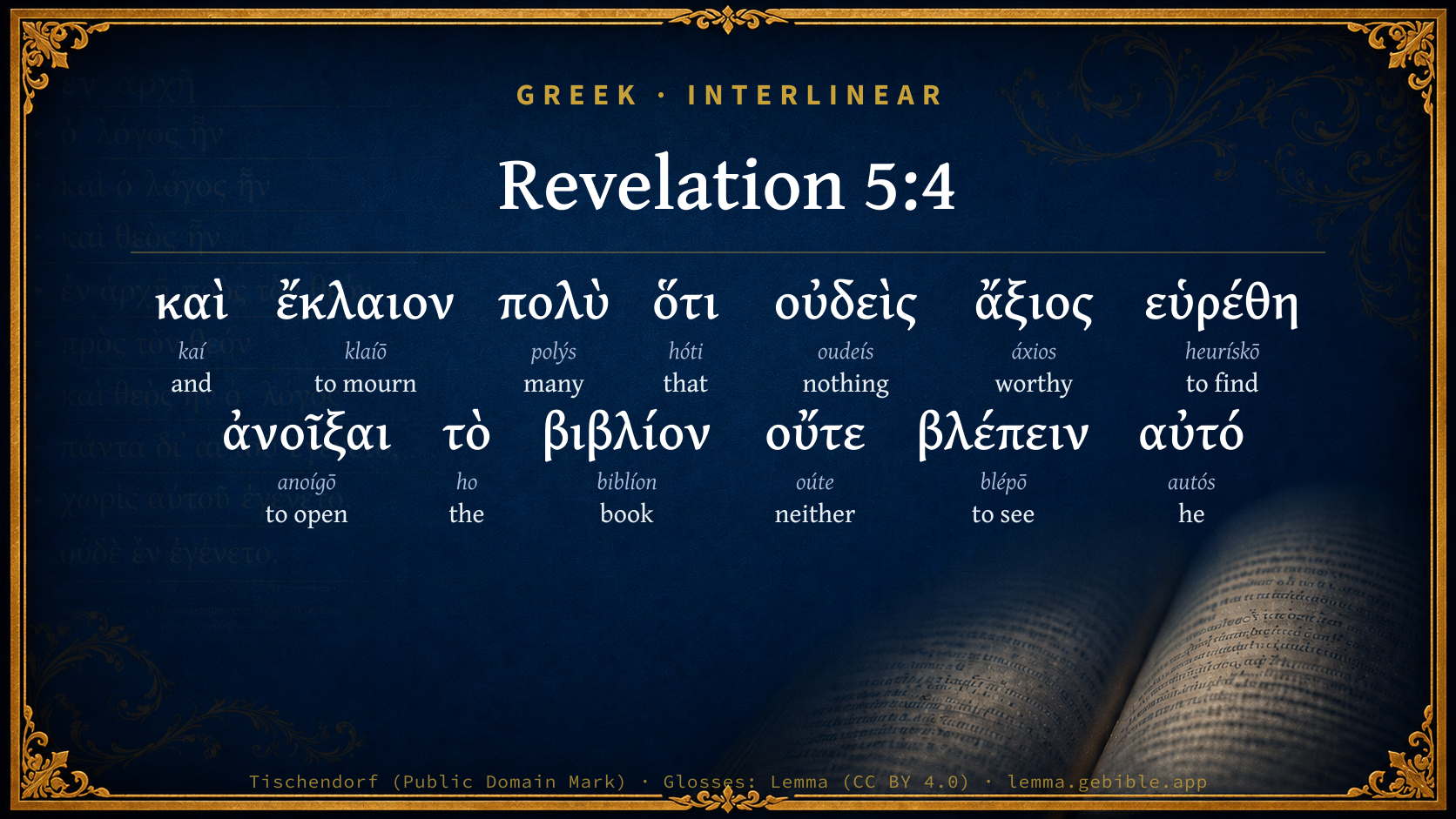
Greek (Tischendorf 8th ed.) Revelation 5:4 appears in the Greek New Testament. The text above is from the Tischendorf 8th edition. Each word links to its Strong’s number and a concise gloss. Click any word for its full Thayer’s Greek Lexicon entry.
Download image
Cite this verse

Revelation 5:4 (World English Bible). Public Domain. Lemma interlinear Bible study tool, https://lemma.gebible.app/v/revelation/5/4.

Show BibTeX & RIS
BibTeX
RIS
English Translation
And I wept much, because no one was found worthy to open the book, or to look in it.
World English Bible · Public Domain
Download a study sheet

One document with this verse’s original text, its word-by-word gloss line, the meaning frame, cross-references with their text, attributed commentary, and full source and license credits — printable, and it pastes into notes with its structure intact.

This verse Autodidact and up

Study sheet (.html) Plain text (.txt)

A passage Seminary Student

Up to 50 verses in one chapter. A passage sheet keeps up to 6 commentary sources and 12 cross-references per verse, in the order this page ranks them, and says so on the sheet whenever that leaves anything out. Ask for a single verse and you get the Autodidact verse sheet above.

Everything on this page stays free to read, with no account — the sheet is a download of what is already on screen, not access to it.

Want to remove ads? Support Godless Engineer
Compare translations 3

The same verse in 3 English versions, stacked beneath the original-language interlinear above. Click any original word for its lexicon entry.

Each is an independent rendering of the whole verse — the interlinear is not word-aligned to these translations.

Highlighted words mark where these versions differ — a whole-verse word diff, not a word-by-word alignment.

  • World English Bible Public Domain
    And I wept much, because no one was found worthy to open the book, or to look in it.
  • King James Version Public Domain
    And I wept much, because no man was found worthy to open and to read the book, neither to look thereon.
  • unfoldingWord Literal Text CC BY-SA 4.0
    And I was weeping much because no one was found worthy to open the scroll or to read it.

unfoldingWord Literal Text — © unfoldingWord, licensed CC BY-SA 4.0. Word-aligned USFM3 via Door43 (git.door43.org/unfoldingWord/en_ult).

Versions to compare (up to 4)

3 of 4 selected

Show all 19 translations

Every available English version of this verse, each an independent rendering of the whole verse.

  • World English Bible Public Domain
    And I wept much, because no one was found worthy to open the book, or to look in it.
  • Berean Standard Bible Public Domain
    And I began to weep bitterly, because no one was found worthy to open the scroll or look inside it.
  • Majority Standard Bible Public Domain
    And I began to weep bitterly, because no one was found worthy to open the scroll or look inside it.
  • King James Version Public Domain
    And I wept much, because no man was found worthy to open and to read the book, neither to look thereon.
  • American Standard Version (1901) Public Domain
    And I wept much, because no one was found worthy to open the book, or to look thereon:
  • Revised Version (1885) Public Domain
    And I wept much, because no one was found worthy to open the book, or to look thereon:
  • Geneva Bible (1599) Public Domain
    Then I wept much, because no man was foud worthy to open, and to reade the Booke, neither to looke thereon.
  • Douay-Rheims (1899) Public Domain
    And I wept much, because no man was found worthy to open the book, nor to see it.
  • Young's Literal Translation Public Domain
    And I was weeping much, because no one was found worthy to open and to read the scroll, nor to behold it,
  • Literal Standard Version CC BY-SA 4.0
    And I was weeping much, because no one was found worthy to open and to read the scroll, nor to behold it,
  • Unlocked Literal Bible CC BY-SA 4.0
    I wept bitterly because no one was found worthy to open the scroll or to read it.
  • unfoldingWord Literal Text CC BY-SA 4.0
    And I was weeping much because no one was found worthy to open the scroll or to read it.
  • Darby Bible Public Domain
    And *I* wept much because no one had been found worthy to open the book nor to regard it.
  • World Messianic Bible Public Domain
    Then I wept much, because no one was found worthy to open the book or to look in it.
  • Webster's Bible Public Domain
    And I wept much, because no man was found worthy to open, and to read the book, neither to look upon it.
  • Free Bible Version CC BY-SA 4.0
    I cried many tears because nobody could be found who was worthy to open the book and read it.
  • Bible in Basic English Public Domain
    And I was very sad, because there was no one able to get the book open or to see what was in it.
  • Text-Critical English NT CC BY 4.0
    So I began to weep loudly because no one was found who was worthy to open the scroll or look inside it.
  • Tyndale New Testament (1534) Public Domain
    And I wepte moche because no man was founde worthy to open and to rede the boke nether to loke thereon.

Literal Standard Version (2020), Covenant Press — licensed CC BY-SA 4.0. Text via the HelloAO Bible API (eBible.org). Unlocked Literal Bible (unfoldingWord) — licensed CC BY-SA 4.0. Text via the HelloAO Bible API (eBible.org). unfoldingWord Literal Text — © unfoldingWord, licensed CC BY-SA 4.0. Word-aligned USFM3 via Door43 (git.door43.org/unfoldingWord/en_ult). Free Bible Version, Dr. Jonathan Gallagher — licensed CC BY-SA 4.0. Text via the HelloAO Bible API (eBible.org).

Word by word

More ways to search: Search by grammar → Find every occurrence → Compare this word →

Practice this passage: Drill this verse → Learn its vocabulary →

βιβλίον
biblíon
G975
“book”
Noun, Accusative, Singular, Neuter
Part of Speech
Noun
Case
Accusative
Number
Singular
Gender
Neuter
Full Thayer's Definition

Origin: a diminutive of G976

TDNT: 11:17,1

1. a small book, a scroll, a written document 2. a sheet on which something has been written a. a bill of divorcement
  1. καὶ kaí G2532 “and” Conjunction
  2. ἔκλαιον klaíō G2799 “to mourn” Verb, Imperfect, Active, Indicative, 1st person, Singular
  3. πολὺ polýs G4183 “many” Adjective, Accusative, Singular, Neuter
  4. ὅτι hóti G3754 “that” Conjunction
  5. οὐδεὶς oudeís G3762 “nothing” Adjective, Nominative, Singular, Masculine, Negative
  6. ἄξιος áxios G514 “worthy” Adjective, Nominative, Singular, Masculine
  7. εὑρέθη heurískō G2147 “to find” Verb, Aorist, Passive, Indicative, 3rd person, Singular
  8. ἀνοῖξαι anoígō G455 “to open” Verb, Aorist, Active, Infinitive
  9. τὸ ho G3588 “the” Article, Accusative, Singular, Neuter
  10. οὔτε oúte G3777 “neither” Conjunction, Negative
  11. βλέπειν blépō G991 “to see” Verb, Present, Active, Infinitive
  12. αὐτό autós G846 “he” Personal pronoun, Accusative, Singular, Neuter

About this verse

These counts appear in no published source. They are computed here, from the morphology-tagged text and Lemma’s own curated glosses. What Lemma adds →

13
words
13
distinct lemmas
Revelation
section

Shared distinctive vocabulary

βιβλίον book G975 occurs in 27 verses of the Greek New Testament. Also found in:
Cross-references

2

Topical passages linked to Revelation 5:4 in the Treasury of Scripture Knowledge — connected by theme and wording, ordered by reader-vote popularity; previews shown in the World English Bible.

  • Daniel 12:8–9 I heard, but I didn't understand: then said I, my lord, what shall be the issue of these things?
  • Revelation 4:1 After these things I looked and saw a door opened in heaven, and the first voice that I heard, like a trumpet speaking with me, was one saying, "Come up here, and I will show you the things which must happen after this."

Cross-references courtesy of OpenBible.info (CC BY 4.0).

Where the printed editions differ

1 variant

Places in this verse where the major printed Greek editions disagree on the wording in a way that affects the translation — a comparison of editions, not a manuscript-by-manuscript collation. The editions are the modern critical texts (Nestlé-Aland 28/27, SBL, Westcott-Hort, Tregelles, Tyndale House) and the traditional texts behind the KJV (the Textus Receptus and the Byzantine/Majority text). It is not a claim about which reading is original.

  1. Extra text
    καὶ ἀναγνῶναι

    “and to read”

    In TR Not in NA28NA27TynSBLWHTregByz

    καὶ ἀναγνῶναι (kai anagnōnai) 'and to read' is only in traditional manuscripts (TR)

Textual data: Translators Amalgamated Greek New Testament (STEPBible TAGNT) · CC BY 4.0.

Commentary

Notes on Revelation 5:4 from classic Christian and Jewish commentators (each source and its license shown beneath its notes). The classic Christian expositions comment on the surrounding passage and are grouped to its opening verse, so a note may address several verses; the Jewish commentaries on the Tanakh (Rashi and others) are per-verse, so they appear only where the commentator wrote on this verse.

Lemma curates 59 commentaries, every one of them public domain or Creative Commons licensed, each selected and text-cleaned for this edition rather than reprinted as found. About our sources →

Joseph Benson's Commentary

Rev 5:4-5. And I wept much — Being greatly affected with the thought that no being whatsoever was to be found able to understand, reveal, and accomplish the divine counsels, fearing they would still remain concealed from the church. This weeping of the apostle sprang from greatness of mind. The tenderness of heart which he always had, appeared more clearly now he was out of his own power. The Revelation was not written without tears: neither without tears will it be understood. How far are they from the temper of St. John, who require after any thing rather than after the contents of this book! Yea, who applaud their own clemency, if they excuse those that do inquire into them! And one of the elders — One of the four and twenty mentioned chap. Rev 4:4; saith unto me, Weep not — He relieved my fears, and comforted me, saying, Behold, the Lion, &c. — Though no one is yet found able to reveal and execute these purposes of God, respecting future events, there is one person described in ancient prophecy as the Lion of the tribe of Juda — The victorious Prince, who is, like a lion, able to tear his enemies in pieces; the Root of David — As God, the root and source of David’s family Isa 11:1; Isa 11:10; hath prevailed to open the book — Hath overcome all obstructions, and obtained the honour and the power to disclose the divine counsels to the church, and ensure their accomplishment.

Joseph Benson's Commentary on the Old and New Testaments (1811–1818) — public domain. Text from a community e-Sword module.

Tyndale Open Study Notes

Tyndale Open Resources

5:4 John wept because even though the revelation had been promised to him, he thought he would be denied knowledge of the divine script—God’s plan for history (4:1; see 10:4). John’s weeping highlights the significance of the anticipated revelation.

Tyndale Open Study Notes — © Tyndale Open Resources, licensed CC BY-SA 4.0. Text via the HelloAO Bible API.

Bengel's Gnomon

Johann Albrecht Bengel

Rev 5:4. Ἔκλαιον, I wept) By an excellent example, John places himself as an eager and teachable learner of the Apocalypse. Comp. ch. Rev 10:10, Rev 17:1, Rev 21:9, Rev 22:8. They are far from perceiving the meaning of John, in this part at any rate, who seek anything rather than the argument of this book, as opened by the Lamb; and who think themselves indulgent, if they concede a pardon to others who do seek it. The very things which even angels had desired to look into during the time of the Divine silence, now, after they have been brought to light and shine forth in the word of prophecy, though they ought to be known and admired to the glory of God, are despised by wayfaring men as circumstantial and useless.—πολὺ) So πολὺ, Luk 7:47.—ἀνοῖξαι) See App. Crit., Ed. ii., on this passage. An inelegant arrangement of the words is produced, not to open, not to read, not to see. In Rev 5:1, John saw the book; in Rev 5:4, he says that the book could not be seen, an expression which itself means, be read: although the language, without the word read (ἀναγνῶναι[65]), is more royal, and better adapted to the majesty of the Lamb.

[65] So Rec. Text, without good authority, reads. B Vulg. Orig. 2,525c, Cypr. Hil. omit ἀναγνῶναι.—E.

Bengel's Gnomon of the New Testament — English translation (T&T Clark, Edinburgh, 1860) — public domain. Text from a community e-Sword module.

Meyer's Critical & Exegetical Commentary

Heinrich August Wilhelm Meyer

Rev_5:4. καὶ ἐγώ ἔκλαιον πολύ. This expressly emphasizes what John on his part (ἐγώ) did under the circumstances described in Rev_5:2-3. His violent[1872] weeping is caused simply by the fact that it seems as though the revelation ardently expected, and, according to Rev_4:1, to be hoped for, would not follow. John did not observe any one advancing at the call of the angel, to render this office for the Church. So Vitr. correctly, who nevertheless, in violation of the context, precipitately interprets[1873] it chiefly of purely personal interests of John, which in no way are here represented by the church.[1874]

Inapplicable is the remark of Hengstenb.: The weeping of John has his weakness of faith as its foundation. Without it, he would not have wept at the impossibility for all creatures to loose the seals, but would, on the contrary, have triumphed in Christ. Without it, also, the book of the future, according to all which the prophets of the O. T. and the Lord had said, would not have been absolutely closed to him. John was satisfied, rather, in all humility of faith, even though weeping, that, according to what he had just heard, the book must remain closed to him.[1875] The Lamb had not as yet entered to open the book. But the reference to the predictions of the O. T. prophets, and of the Lord himself, is inapposite; because, if the entire scene is not to be senseless, it treats of such revelations as had not as yet been made. The only objection against the weeping of John that could be raised from the context is, that after Rev_4:1 sqq., he need not at all have been anxious about being compelled to be without the revelation as to the contents of the sealed book; but even this objection can be raised only from the standpoint of a reflection which is here entirely out of place.[1876]

[1872] πολύ, Luk_7:47.

[1873] Cf. N. de Lyra, Beng., Ebrard, etc.

[1874] Hengstenb.

[1875] Cf. Act_1:7; Mat_24:36; Mar_13:32.

[1876] Against Klief., who does not hesitate to ascribe to John a harassing doubt as to whether, because of the unworthiness of creatures, the Divine ultimate purpose, at least with respect to Gods will of love, must remain unaccomplished.

Meyer — Critical and Exegetical Commentary on the New Testament — English translation by Peter Christie, edited by Frederick Crombie (T&T Clark, 1880) — public domain. Text from a community e-Sword module.

Expositor's Greek Testament

ed. W. Robertson Nicoll

Rev 5:4 . A naïve expression of disappointment, the expectation of Rev 4:1 being apparently thwarted. The sense of consolation and triumph is so strong in this book that no tears are shed in self-pity. The prophet only weeps at the apparent check to revelation.

The Expositor's Greek Testament, edited by W. Robertson Nicoll (1897–1910) — public domain. Text from a community e-Sword module.

Jamieson, Fausset & Brown

Robert Jamieson, A. R. Fausset & David Brown

and to read--inserted in English Version Greek text without good authority. One oldest manuscript, ORIGEN, CYPRIAN, and HILARY omit the clause. "To read" would be awkward standing between "to open the book" and "to look thereon." John having been promised a revelation of "things which must be hereafter," weeps now at his earnest desire being apparently frustrated. He is a pattern to us to imitate, as an eager and teachable learner of the Apocalypse.

Jamieson, Fausset & Brown — Commentary Critical and Explanatory on the Whole Bible (1871) — public domain (CC PDM 1.0). Text via the HelloAO Bible API.

Adam Clarke's Commentary

Verse 4. I wept much] Because the world and the Church were likely to be deprived of the knowledge of the contents of the book.

Adam Clarke's Commentary on the Bible (1810–1826) — public domain. Text from a community e-Sword/MySword module.

Ellicott's Commentary for English Readers

(4) And I wept much, because no man (better, no one) was found worthy to open . . . the book (omit, “and to read”).—The Apostle is not ashamed to call attention to his tears. I, indeed, for my part (the “I” is emphatic) wept much. It was not a failure of faith; it was the outburst of an earnest heart, to which the knowledge of God and the destinies of his fellowmen were very dear. Those who have longed to see the end of oppression, fraud, and sorrow on the earth, to know something of the laws which govern the present, and of their issue in the future, will understand these tears. “The words, ‘ I wept much,’ can only be understood by those who have lived in great catastrophes of the Church, and entered with the fullest sympathy into her sufferings Without tears the Revelation was not written, neither can it without tears be understood.”

A Bible Commentary for English Readers, edited by Charles John Ellicott (1878–1897) — public domain. Text from a community e-Sword module.

The Cambridge Bible for Schools and Colleges

gen. ed. J. J. S. Perowne

4. And I] The pronoun is emphatic: “no one could open it: I for my part wept for the impossibility.” Why he wept will be variously explained, according to the view taken of the meaning of the Book. If it be the Book of Life, the reason is obvious: if it be the future purposes of God, the impossibility of opening it threatened to disappoint the promise of Rev_4:1.

The Cambridge Bible for Schools and Colleges (gen. ed. J. J. S. Perowne; Cambridge University Press, 1878–1918) — public domain. Text from a community e-Sword module.

John Gill's Exposition

And I wept much,.... Not so much on his own account, because he feared his curiosity would not be gratified, and that strong desire answered, which were raised in him upon sight of the book, and increased by the angel's proclamation; but for the sake of the church of God, whose representative he was, and to whom the knowledge of this book, and the things contained in it, he judged must be very useful and profitable. The Ethiopic version reads, "and many wept"; many of those that were about the throne, as well as John:

because no man was found worthy to open and to read the book,

neither to look thereon; because there was no creature in heaven, earth, or under it, that were of dignity and authority, as well as of ability, to open the book by unsealing it; and read and deliver out the prophecies in it upon the taking off of every seal; and so not to look into it, and foresee and foretell what was hereafter to come to pass, in the church and world: the phrase of being worthy to look on it seems to be Jewish; of the book of the generation of Adam, Gen 5:1, the Jews say (e) that

"it descended to the first man, and by it he knew the wisdom which is above; and this book came to the sons of God, the wise men of the age, , "whoever is worthy to look in it", knows by it the wisdom which is from above.''

The whole verse is left out in the Alexandrian copy; and the phrase, "to read", is neither in the Vulgate Latin, nor in any of the Oriental versions.

(e) Zohar in Gen. fol. 28. 2.

John Gill's Exposition of the Whole Bible (1746–1763) — public domain (CC PDM 1.0). Text via the HelloAO Bible API.

Trapp's Complete Commentary

John Trapp

4 And I wept much, because no man was found worthy to open and to read the book, neither to look thereon.

Ver. 4. And I wept] Out of a deep desire of knowing the contents of this book. And as our Saviour, going toward his cross, turned again to the weeping women, and comforted them, so he soon satisfied the desire of this his dejected disciple. Tears are effectual orators. Luther got much of his insight into God’s matters by this means. So did Melancthon when he wept on those words, Quos fugiamas habemus (pontificios) quos sequatour non intellgimus. It is said of Sir Philip Sidney, that when he met with anything that he well understood not, he would break out into tears, -faciles motus mens generosa capit. The spouse, seeking him whom her soul loved, had eyes like the pools of Heshbon glazed with tears, Son 7:4. And Daniel had greatest revelations after three weeks of heaviness, Rev 10:3.

John Trapp, A Commentary or Exposition upon All the Books of the Old and New Testament (1647–1656) — public domain. Text from a community e-Sword module.

Albert Barnes' Notes on the Bible

And I wept much, because no man was found worthy ... - Greek, as in Rev 5:3, no one. It would seem as if there was a pause to see if there were any response to the proclamation of the angel. There being none, John gave way to his deep emotions in a flood of tears. The tears of the apostle here may be regarded as an illustration of two things which are occurring constantly in the minds of people:

(1) The strong desire to penetrate the future; to lift the mysterious veil which shrouds what is to come; to find some way to pierce the dark wall which seems to stand up before us, and which shuts from our view what is to be hereafter. There have been no more earnest efforts made by people than those which have been made to read the scaled volume which contains the record of what is yet to come. By dreams, and omens, and auguries, and astrology, and the flight of birds, and necromancy, people have sought anxiously to ascertain what is to be hereafter. Compare, for an expression of that intense desire, Foster’s Life and Correspondence, vol. i. p. 111, and vol. ii. pp. 237, 238.

(2) The weeping of the apostle may be regarded as an instance of the deep grief which people often experience when all efforts to penetrate the future fail, and they feel that after all they are left completely in the dark. Often is the soul overpowered with grief, and often are the eyes filled with sadness at the reflection that there is an absolute limit to the human powers; that all that man can arrive at by his own efforts is uncertain conjecture, and that there is no way possible by which he can make nature speak out and disclose what is to come. Nowhere does man find himself more fettered and limited in his powers than here; nowhere does he feel that there is such an intense disproportion between his desires and his attainments. In nothing do we feel that we are more absolutely in need of divine help than in our attempts to unveil the future; and were it not for revelation man might weep in despair.

Albert Barnes' Notes on the Bible (1834–1885) — public domain. Text from a community e-Sword/MySword module.

Matthew Poole's English Annotations

As it is the nature of man to desire to know secret and hidden things, especially such as we apprehend of concernment to ourselves, or those whom we love, or are interested in it; and to be troubled, if we know they may be known, and are at a loss for due means whereby to come to the knowledge of them.

Matthew Poole's English Annotations on the Holy Bible (1683–1685) — public domain. Text from a community e-Sword/MySword module.

Whedon's Commentary on the Bible

Daniel D. Whedon

4. I—Emphatic. My response was weeping; the sole echo in the universal silence—the silence of despair to the Church, for the revelation of her future, which was to have been her guiding star, is now forever shut up for want of a solver of the seals.

Challenge accepted and the Book taken by the Lamb, 5-7.

Daniel D. Whedon (gen. ed.), Commentary on the Old and New Testaments (1874–1909) — public domain. Text from a community e-Sword module.

The Pulpit Commentary

And I wept much (eklaion); I burst into tears, and continued weeping. A strong expression in the imperfect tense. Because no man was found worthy to open and to read the book, neither to look thereon. The words, "and to read? should be omitted. They are found in few manuscripts. The equivalent phrase follows, "neither to look thereon."

The Pulpit Commentary (1880–1919), ed. H.D.M. Spence-Jones & Joseph S. Exell — public domain. Text from a community e-Sword module.

John Wesley's Explanatory Notes

And I wept much - A weeping which sprung from greatness of mind. The tenderness of heart which he always had appeared more clearly now he was out of his own power. The Revelation was not written without tears; neither without tears will it be understood. How far are they from the temper of St. John who inquire after anything rather than the contents of this book! yea, who applaud their own clemency if they excuse those that do inquire into them!

John Wesley, Explanatory Notes Upon the Whole Bible (1754–1765) — public domain. Text via the GEBible commentary corpus.

The People's New Testament

B. W. Johnson

4, 5. And I wept much, because, etc. The exiled apostle is filled with anxiety to penetrate the secrets of futurity, and to know the fortunes of that Church which he loved better than he loved his own life. He was then a prisoner on a rocky isle of the sea. It was a time of persecution. He was separated from the saints, and ardently desires to know the results, in the future, of all the struggles, sufferings and blood of a persecuted people.

B. W. Johnson's The People's New Testament with Notes (1889–1891) — public domain. Electronic text from the Christian Classics Ethereal Library (CCEL) ThML edition.

Cambridge Greek Testament for Schools and Colleges

4. καὶ [ἐγὼ]. The pronoun if genuine is emphatic: “no one could open it: I for my part wept for the impossibility.” Why he wept will be variously explained, according to the view taken of the meaning of the Book. If it be the Book of Life, the reason is obvious: if it be the future purposes of God, the impossibility of opening it threatened to disappoint the promise of Rev 4:1.

Cambridge Greek Testament for Schools and Colleges (Cambridge University Press, 1896; 21 vols, various authors incl. Carr, Maclear, Plummer, Farrar, Lumby, Moule, M. R. James, Simcox) — public domain. Text from a community e-Sword module.

Alford’s Greek Testament

Henry Alford

4.] And I (ἐγώ emphatic, ‘I, for my part’) wept much, because no one was found worthy to open the book nor to look upon it (“per hunc fletum designatur Johannis desiderium de sciendo ecclesiæ futurum processum.” Lyra. It had been promised to him, ch. 4:1, that he should be shewn future events: and now it seemed as if this promise were about to be frustrated by the lack of one worthy to open the book. There was no weakness of faith, as Hengstb. fancies: indeed such a supposition is entirely out of place here: St. John is in this book the simple recipient of the Apocalypse: for that he is summoned to the heavenly scene, for that he is waiting in humility: but that now seems to be precluded, and his tears burst forth in the earnestness of disappointed desire after the fulfilment of the promise. Christ, as the opener of the book, is not yet revealed to him: and to have him anticipating that revelation by the power of his individual faith, would be to put him out of his place and violate consistency).

Henry Alford, The Greek Testament (1849–1861) — public domain. Text from a community e-Sword module.

Vincent's Word Studies in the New Testament

Marvin R. Vincent

I wept [εκλαιον] . Audible weeping. See on Luk 6:21.

Marvin R. Vincent, Word Studies in the New Testament (1887–1900) — public domain. Text from a community e-Sword/MySword module.

Lesson kit

Teaching starters — assembled from the data on this page, not authored interpretation. Every prompt links to the verse data it draws on. Edit before teaching.

Revelation, in the Revelation, opens this verse with 13 words (13 distinct Greek lemmas). Its most distinctive word is biblíon (“book”). A historical commentator’s framing appears above. Read the whole chapter for the surrounding context.

Discussion questions

  1. What does “book” (biblíon) contribute to the verse as a whole?
  2. Matthew 19:7 shares the word «book» with this verse. How do the two illuminate each other?
  3. The translations on this page render this verse differently — a whole-verse word diff, not a word-by-word alignment. What might account for the different wordings?
  4. Reading how Joseph Benson's Commentary and Tyndale Open Study Notes read this verse, where do the two commentators agree and where do they part?

Things to notice

Reading settings

Reading text

Shown beneath each verse's original-language words.

Old Testament
Old Testament edition

Read the OT as the Masoretic Hebrew (MT) or the Greek Septuagint (LXX).

English shown for the Greek Septuagint (in the Hebrew ↔ Greek comparison).

Comparing translations? Open the Compare panel on any verse page to stack up to four side by side.