1 Peter 2:22

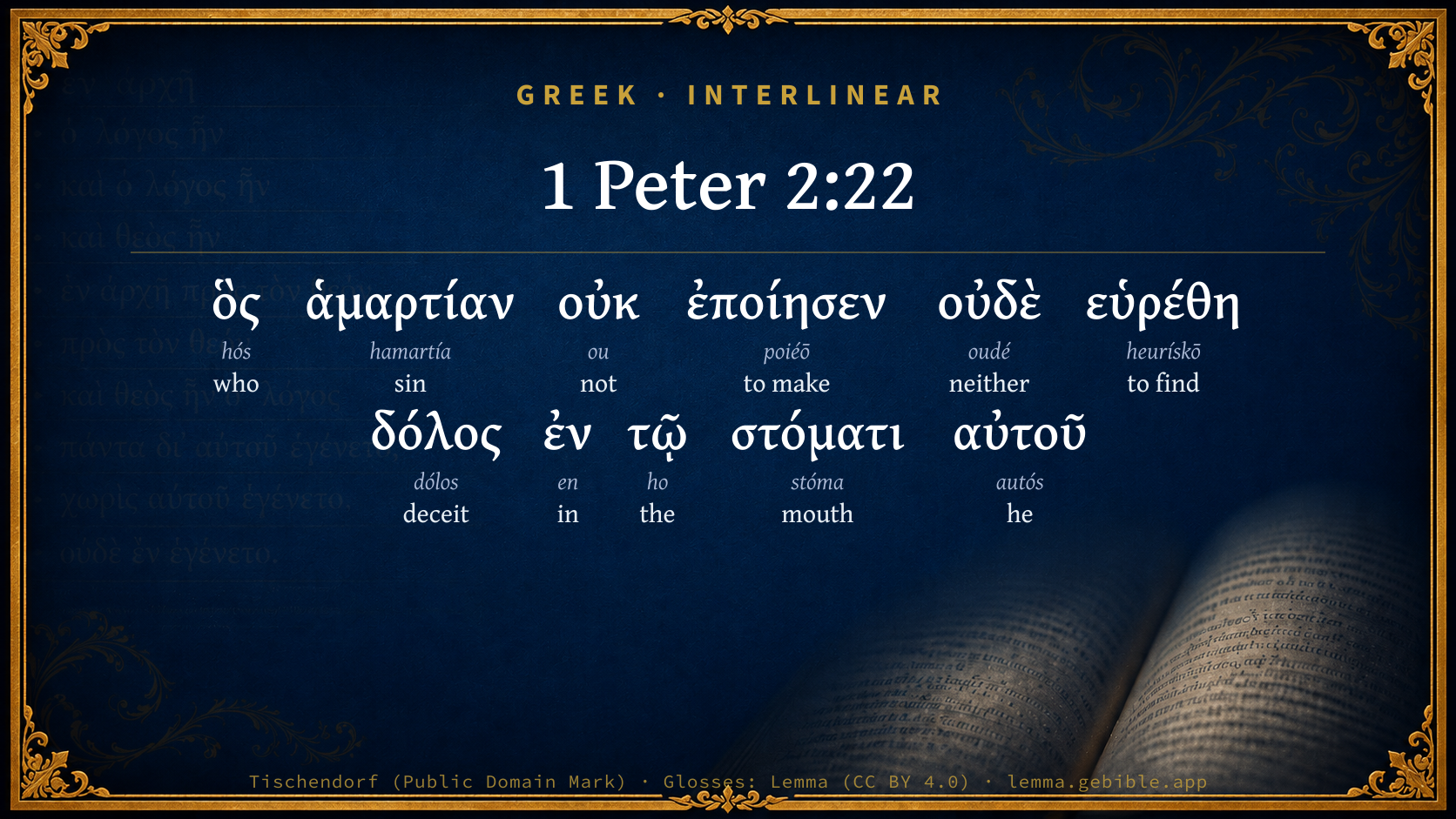
Greek (Tischendorf 8th ed.) 1 Peter 2:22 appears in the Greek New Testament. The text above is from the Tischendorf 8th edition. Each word links to its Strong’s number and a concise gloss. Click any word for its full Thayer’s Greek Lexicon entry.
Download image
Cite this verse

1 Peter 2:22 (World English Bible). Public Domain. Lemma interlinear Bible study tool, https://lemma.gebible.app/v/1-peter/2/22.

Show BibTeX & RIS
BibTeX
RIS
English Translation
who did not sin, "neither was deceit found in his mouth."
World English Bible · Public Domain
Download a study sheet

One document with this verse’s original text, its word-by-word gloss line, the meaning frame, cross-references with their text, attributed commentary, and full source and license credits — printable, and it pastes into notes with its structure intact.

This verse Autodidact and up

Study sheet (.html) Plain text (.txt)

A passage Seminary Student

Up to 50 verses in one chapter. A passage sheet keeps up to 6 commentary sources and 12 cross-references per verse, in the order this page ranks them, and says so on the sheet whenever that leaves anything out. Ask for a single verse and you get the Autodidact verse sheet above.

Everything on this page stays free to read, with no account — the sheet is a download of what is already on screen, not access to it.

Want to remove ads? Support Godless Engineer
Compare translations 3

The same verse in 3 English versions, stacked beneath the original-language interlinear above. Click any original word for its lexicon entry.

Each is an independent rendering of the whole verse — the interlinear is not word-aligned to these translations.

Highlighted words mark where these versions differ — a whole-verse word diff, not a word-by-word alignment.

  • World English Bible Public Domain
    who did not sin, "neither was deceit found in his mouth."
  • King James Version Public Domain
    Who did no sin, neither was guile found in his mouth:
  • unfoldingWord Literal Text CC BY-SA 4.0
    “who did no sin, neither was deceit found in his mouth;”

unfoldingWord Literal Text — © unfoldingWord, licensed CC BY-SA 4.0. Word-aligned USFM3 via Door43 (git.door43.org/unfoldingWord/en_ult).

Versions to compare (up to 4)

3 of 4 selected

Show all 19 translations

Every available English version of this verse, each an independent rendering of the whole verse.

  • World English Bible Public Domain
    who did not sin, "neither was deceit found in his mouth."
  • Berean Standard Bible Public Domain
    “He committed no sin, and no deceit was found in His mouth.”
  • Majority Standard Bible Public Domain
    “He committed no sin, and no deceit was found in His mouth.”
  • King James Version Public Domain
    Who did no sin, neither was guile found in his mouth:
  • American Standard Version (1901) Public Domain
    who did no sin, neither was guile found in his mouth:
  • Revised Version (1885) Public Domain
    who did no sin, neither was guile found in his mouth:
  • Geneva Bible (1599) Public Domain
    Who did no sinne, neither was there guile found in his mouth.
  • Douay-Rheims (1899) Public Domain
    Who did no sin, neither was guile found in his mouth.
  • Young's Literal Translation Public Domain
    who did not commit sin, nor was guile found in his mouth,
  • Literal Standard Version CC BY-SA 4.0
    who did not commit sin, nor was guile found in His mouth,
  • Unlocked Literal Bible CC BY-SA 4.0
    “He committed no sin, neither was any deceit found in his mouth.”
  • unfoldingWord Literal Text CC BY-SA 4.0
    “who did no sin, neither was deceit found in his mouth;”
  • Darby Bible Public Domain
    who did no sin, neither was guile found in his mouth;
  • World Messianic Bible Public Domain
    who didn’t sin, “neither was deceit found in his mouth.”
  • Webster's Bible Public Domain
    Who committed no sin, neither was guile found in his mouth:
  • Free Bible Version CC BY-SA 4.0
    He never sinned, he never lied;
  • Bible in Basic English Public Domain
    Who did no evil, and there was no deceit in his mouth:
  • Text-Critical English NT CC BY 4.0
    He committed no sin, nor was deceit found in his mouth.
  • Tyndale New Testament (1534) Public Domain
    which dyd no sinne nether was ther gyle founde in his mouth:

Literal Standard Version (2020), Covenant Press — licensed CC BY-SA 4.0. Text via the HelloAO Bible API (eBible.org). Unlocked Literal Bible (unfoldingWord) — licensed CC BY-SA 4.0. Text via the HelloAO Bible API (eBible.org). unfoldingWord Literal Text — © unfoldingWord, licensed CC BY-SA 4.0. Word-aligned USFM3 via Door43 (git.door43.org/unfoldingWord/en_ult). Free Bible Version, Dr. Jonathan Gallagher — licensed CC BY-SA 4.0. Text via the HelloAO Bible API (eBible.org).

Word by word

More ways to search: Search by grammar → Find every occurrence → Compare this word →

Practice this passage: Drill this verse → Learn its vocabulary →

About this verse

These counts appear in no published source. They are computed here, from the morphology-tagged text and Lemma’s own curated glosses. What Lemma adds →

11
words
11
distinct lemmas
General Epistles
section

Notable vocabulary

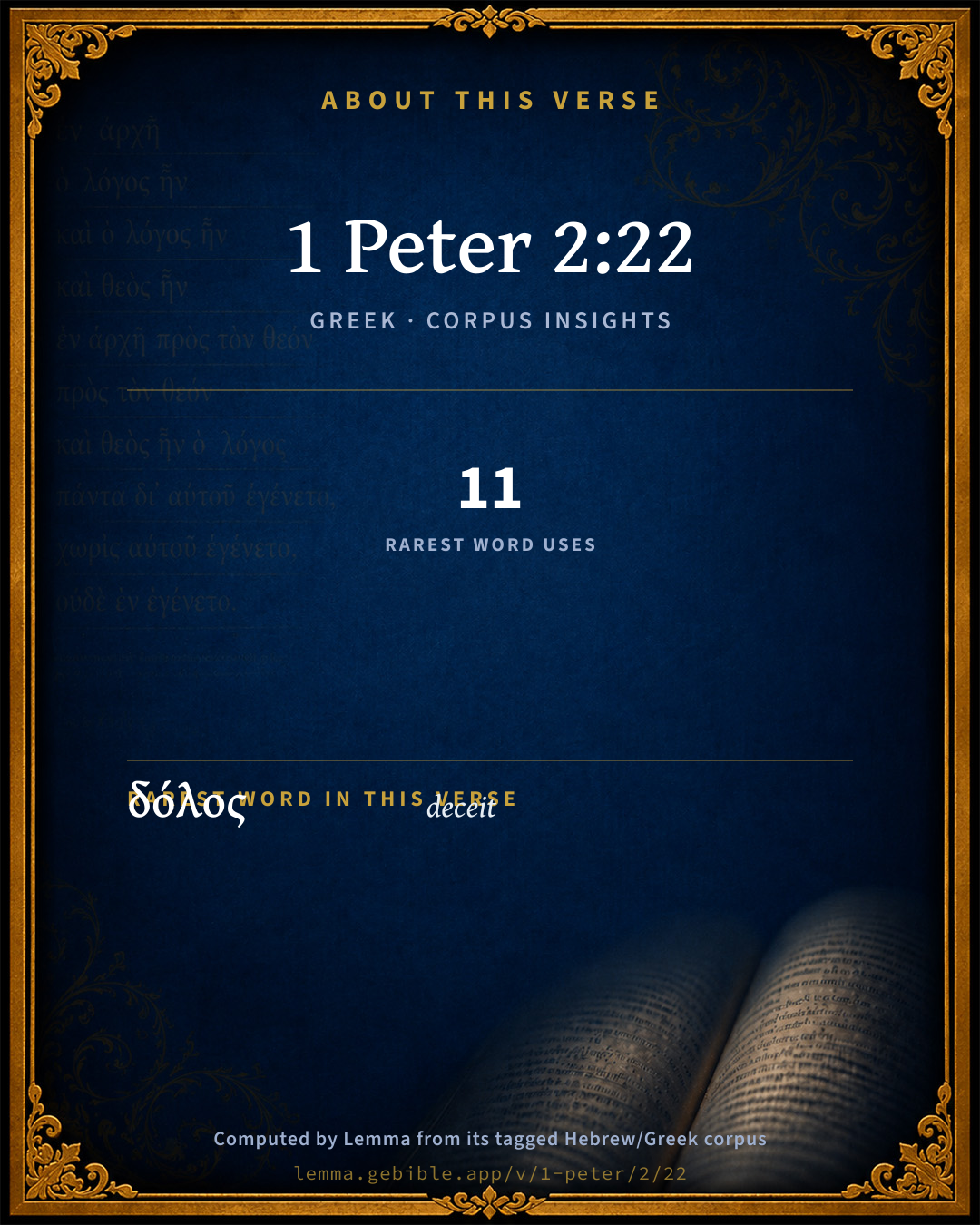
The rarest word here is δόλος deceit G1388 — appearing just 11 times in the whole Greek New Testament.

Shared distinctive vocabulary

δόλος deceit G1388 occurs in 11 verses of the Greek New Testament. Also found in:

Cross-references

15

Topical passages linked to 1 Peter 2:22 in the Treasury of Scripture Knowledge — connected by theme and wording, ordered by reader-vote popularity; previews shown in the World English Bible.

  • Isaiah 53:9 They made his grave with the wicked, and with a rich man in his death; although he had done no violence, neither was any deceit in his mouth.
  • Hebrews 4:15 For we don't have a high priest who can't be touched with the feeling of our infirmities, but one who has been in all points tempted like we are, yet without sin.
  • 2 Corinthians 5:21 For him who knew no sin he made to be sin on our behalf; so that in him we might become the righteousness of God.
  • 1 John 3:5 You know that he was revealed to take away our sins, and in him is no sin.
  • Hebrews 7:26–27 For such a high priest was fitting for us: holy, guiltless, undefiled, separated from sinners, and made higher than the heavens;
  • 1 John 2:1 My little children, I write these things to you so that you may not sin. If anyone sins, we have a Counselor with the Father, Jesus Christ, the righteous.
  • Revelation 14:5 In their mouth was found no lie, for they are blameless.
  • Luke 23:41 And we indeed justly, for we receive the due reward for our deeds, but this man has done nothing wrong."
  • Hebrews 9:28 so Christ also, having been once offered to bear the sins of many, will appear a second time, without sin, to those who are eagerly waiting for him for salvation.
  • Matthew 27:4 saying, "I have sinned in that I betrayed innocent blood." But they said, "What is that to us? You see to it."
  • Matthew 27:19 While he was sitting on the judgment seat, his wife sent to him, saying, "Have nothing to do with that righteous man, for I have suffered many things this day in a dream because of him."
  • Matthew 27:23–24 But the governor said, "Why? What evil has he done?" But they cried out exceedingly, saying, "Let him be crucified!"
  • Luke 23:47 When the centurion saw what was done, he glorified God, saying, "Certainly this was a righteous man."
  • John 1:47 Jesus saw Nathanael coming to him, and said about him, "Behold, an Israelite indeed, in whom is no deceit!"
  • John 8:46 Which of you convicts me of sin? If I tell the truth, why do you not believe me?

Cross-references courtesy of OpenBible.info (CC BY 4.0).

Commentary

Notes on 1 Peter 2:22 from classic Christian and Jewish commentators (each source and its license shown beneath its notes). The classic Christian expositions comment on the surrounding passage and are grouped to its opening verse, so a note may address several verses; the Jewish commentaries on the Tanakh (Rashi and others) are per-verse, so they appear only where the commentator wrote on this verse.

Lemma curates 59 commentaries, every one of them public domain or Creative Commons licensed, each selected and text-cleaned for this edition rather than reprinted as found. About our sources →

Bengel's Gnomon

Johann Albrecht Bengel

1Pe 2:22. Ὃς ἁμαρτίαν οὐκ ἐποίησεν, οὐδὲ εὑρέθη δόλος, κ.τ.λ., who did no sin, neither was guile found, etc.) Isa 53:9, Septuagint, ὅτι ἀνομίαν οὐκ ἐποίησεν, οὐδὲ δόλον ἐν τῷ στόματι αὐτοῦ, that is, He committed neither open nor secret sin. Words most suitable for the admonition of servants, who easily fall into sins and deceits, reproaches towards their fellow-servants, and threats, arising from anger without strength.

Bengel's Gnomon of the New Testament — English translation (T&T Clark, Edinburgh, 1860) — public domain. Text from a community e-Sword module.

Meyer's Critical & Exegetical Commentary

Heinrich August Wilhelm Meyer

1Pe_2:22. The first feature in the exemplary nature of Christs sufferings: His innocence.

After Isa_53:9, LXX.: ἀνομίαν οὐκ ἐποίησε, οὐδὲ δόλον ἐν τῷ στόματι αὐτοῦ (Cod. Alex. οὐδὲ εὑρέθη δόλος ἐν τῷ στ. αὐτοῦ). Gerhard: nec verbo nec facto unquam peccavit. The second half of the sentence expresses truth in speech. With δόλος, cf. chap. 1Pe_2:1, Joh_1:48. For the difference between εὑρίσκεσθαι and εἶναι, cf. Winer, p. 572 [E. T. 769].

Meyer — Critical and Exegetical Commentary on the New Testament — English translation by Peter Christie, edited by Frederick Crombie (T&T Clark, 1880) — public domain. Text from a community e-Sword module.

Expositor's Greek Testament

ed. W. Robertson Nicoll

1Pe 2:22 = Isa 43:9 , ἁμ . being put for ἀνομίαν ( חמם ) and εὑρ . δόλος (so [149] c [150] [151]

[152] , etc.) for δόλον (= Heb.) of LXX. The latter variation is due to conjunction of Zep 3:13 , οὐ μὴ εὑρεθῇ έν τῷ στόματι αὐτῶν γλῶσσα δολία : Christ being identified with the Remnant. The former appears in the Targum: “that they might not remain who work sin and might not speak guile with their mouth”.

[149] Codex Sinaiticus (sæc. iv.), now at St. Petersburg, published in facsimile type by its discoverer, Tischendorf, in 1862.

[150] a Codex Sinaiticus (sæc. iv.), now at St. Petersburg, published in facsimile type by its discoverer, Tischendorf, in 1862.

[151] Codex Alexandrinus (sæc. v.), at the British Museum, published in photographic facsimile by Sir E. M. Thompson (1879).

[152] An eighth century version of Codex Vaticanus

The Expositor's Greek Testament, edited by W. Robertson Nicoll (1897–1910) — public domain. Text from a community e-Sword module.

Jamieson, Fausset & Brown

Robert Jamieson, A. R. Fausset & David Brown

Illustrating Christ's well-doing (Pe1 2:20) though suffering.

did--Greek aorist. "Never in a single instance did" [ALFORD]. Quoted from Isa 53:9, end, Septuagint.

neither--nor yet: not even [ALFORD]. Sinlessness as to the mouth is a mark of perfection. Guile is a common fault of servants. "If any boast of his innocency, Christ surely did not suffer as an evildoer" [CALVIN], yet He took it patiently (Pe1 2:20). On Christ's sinlessness, compare Co2 5:21; Heb 7:26.

Jamieson, Fausset & Brown — Commentary Critical and Explanatory on the Whole Bible (1871) — public domain (CC PDM 1.0). Text via the HelloAO Bible API.

Adam Clarke's Commentary

Verse 22. Who did no sin] He suffered, but not on account of any evil he had either done or said. In deed and word he was immaculate, and yet he was exposed to suffering; expect the same, and when it comes bear it in the same spirit. It is very likely that the apostle mentions guile, because those who do wrong generally strive to screen themselves by prevarication and lies. These words appear to be a quotation from Isa 53:9.

Adam Clarke's Commentary on the Bible (1810–1826) — public domain. Text from a community e-Sword/MySword module.

John Calvin's Commentaries

22 Who did no sin This belongs to the present subject; for, if any one boasts of his own innocence, he must know that Christ did not suffer as a malefactor. He, at the same time, shews how far we come short of what Christ was, when he says, that there was no guile found in his mouth; for he who offends not by his tongue, says James, is a perfect man. (James 3:2.) He then declares that there was in Christ the highest perfection of innocency, such as no one of us can dare claim for himself. It hence appears more fully how unjustly he suffered beyond all others. There is, therefore, no reason why any one of us should refuse to suffer after his example, since no one is so conscious of having acted rightly, as not to know that he is imperfect.

John Calvin's Commentaries (1540-1563) — public domain. Text from the Calvin Translation Society English edition (1840s-50s) via the Christian Classics Ethereal Library (ccel.org). Calvin's coverage is partial (roughly two-thirds of the Bible); uncommented books and verses are honest gaps, never fabricated. The 19th-century editor's footnotes and remarks are omitted so the notes are faithfully Calvin's own voice.

Ellicott's Commentary for English Readers

(22) Who did no sin.—This verse is not to be taken by itself, but in the closest conjunction with the following. It is not the sinlessness of Christ by itself that is here set as an example before the servants, but His sinlessness in combination with His ill-treatment, or rather, His meekness under the combination. St. Peter again adapts the words of Isaiah (Isa_53:9) to his purpose. The word there was one of violent transgression; St. Peter substitutes the simple word which he had used in 1Pe_2:20, “fault”—“who never made a fault”—such as household servants were often committing—“neither was guile found in His mouth”—again referring to what was common with servants—petty acts of dishonesty, and petty deceits to screen themselves from punishment. One thing which lends special point to the allusion to Isaiah’s prophecy is that Israel is in that passage spoken of under the title of God’s “servant,” a thought familiar to St. Peter long ago in connection with Christ. (See Note on Act_3:13.)

A Bible Commentary for English Readers, edited by Charles John Ellicott (1878–1897) — public domain. Text from a community e-Sword module.

The Cambridge Bible for Schools and Colleges

gen. ed. J. J. S. Perowne

22. Who did no sin, neither was guile found in his mouth] It is suggestive as indicating the line of prophetic interpretation in which the Apostle had been led on, that as soon as he begins to speak of the sufferings of Christ, he falls, as it were, naturally into the language of Isa_53:9, as he found it (with the one exception that he gives “sin” for “iniquity”) in the LXX. version. The two clauses assert for the righteous sufferer a perfect sinlessness both in act and word.

The Cambridge Bible for Schools and Colleges (gen. ed. J. J. S. Perowne; Cambridge University Press, 1878–1918) — public domain. Text from a community e-Sword module.

John Gill's Exposition

Who when he was reviled, reviled not again,.... When he was reproached as a glutton, a winebibber, a friend of publicans and sinners, all the reply he made was, that Wisdom is justified of her children; and when he was charged with casting out devils by Beelzebub, the prince of devils, he defended himself, not with bad language, but with strong reasonings; and when he was said to be a Samaritan, and had a devil, his only answer was, that he had not, that he honoured his Father, and they dishonoured him; and when he was reviled on the cross, by those that passed by, by the chief priests, and Scribes, and the thieves that were crucified with him, he made no return, he opened not his mouth, and much less in a recriminating way,

When he suffered he threatened not; when he endured buffetings, and scourgings in his body, when the officers in the palace of the high priests spit in his face, buffeted him, and smote him with the palms of their hands, and bid him prophesy who smote him, all which were very provoking; yet he said not one word to them, much less threatened them with what he would do to them for such usage another day, when he would let them know, with vengeance, who it was that smote him; no, he took all patiently from them, and from Pilate, and the Roman soldiers, when scourged by them; he gave his back to the smiters, and his cheeks to them that plucked off the hair; and when he suffered crucifixion, and was put to such distressing pains and agonies, he did not threaten his crucifiers with a future judgment, when he would take vengeance, and execute his wrath upon them, but prays to his Father for the forgiveness of their sins: and, as it follows,

but committed himself to him that judgeth righteously; he commended his Spirit, or soul, to God his Father, and committed his cause to him, to vindicate it in what way he should think fit, who he knew was the Judge of all the earth, that would do right; and so the Syriac version supplies it with "his judgment": which he left with God, the righteous Judge, to whom vengeance belongs; and which is an example, and an instruction to the saints to do so likewise; not to render railing for railing, or to seek revenge, but to leave their cause with their God, who will, in his own time, avenge the wrongs and injuries done them. The Vulgate Latin version reads, contrary to all the Greek copies, and other versions, "but delivered himself to him that judgeth unjustly"; the sense of which is, that Christ delivered himself into the hands of Pilate, who unjustly condemned him to death; but is neither the reading, nor sense of the text.

John Gill's Exposition of the Whole Bible (1746–1763) — public domain (CC PDM 1.0). Text via the HelloAO Bible API.

Trapp's Complete Commentary

John Trapp

22 Who did no sin, neither was guile found in his mouth:

Ver. 22. Who did no sin] St Paul saith, "He knew no sin," 2Co 5:21, to wit, with a practical knowledge (we know no more than we practise); with an intellectual he did, for else he could not have reproved it.

Neither was guile found in his mouth] Which imports that they sought it. The wicked seek occasion against the godly.

John Trapp, A Commentary or Exposition upon All the Books of the Old and New Testament (1647–1656) — public domain. Text from a community e-Sword module.

Albert Barnes' Notes on the Bible

Who did no sin - Who was in all respects perfectly holy. There is an allusion here to Isa 53:9; and the sense is, that he was entirely innocent, and that he suffered without having committed any crime. In this connection the meaning is, that we are to be careful that, if we suffer, it should be without committing any crime. We should so live, as the Saviour did, as not to deserve to be punished, and thus only shall we entirely follow his example. It is as much our duty to live so as not to deserve the reproaches of others, as it is to bear them with patience when we are called to suffer them. The first thing in regard to hard treatment from others, is so to live that there shall be no just occasion for it; the next is, if reproaches come upon us when we have not deserved them, to bear them as the Saviour did. If he suffered unjustly, we should esteem it to be no strange thing that we should; if he bore the injuries done him with meekness, we should learn that it is possible for us to do it also; and should learn also that we have not the spirit of his religion unless we actually do it. On the expression used here, compare the Isa 53:9 note; Heb 7:26 note.

Neither was guile found in his mouth - There was no deceit, hypocrisy, or insincerity. He was in all respects what he professed to be, and he imposed on no one by any false and unfounded claim. All this has reference to the time when the Saviour was put to death; and the sense is, that though he was condemned as an impostor, yet that the charge was wholly unfounded. As in his whole life before he was perfectly sincere, so he was eminently on that solemn occasion.

Albert Barnes' Notes on the Bible (1834–1885) — public domain. Text from a community e-Sword/MySword module.

Matthew Poole's English Annotations

i.e. There was no guile in his mouth; it is a Hebraism; to be found is the same as to be, and not to be found the same as not to be, Gen 2:20; Isa 39:2; see Rom 7:10. This signifies Christ’s absolute perfection, in that he did not offend so much as with his mouth, Jam 3:2. The sense is, Christ was free from all manner of sin, and yet he suffered patiently; and therefore well may ye be content to suffer too, though wrongfully; seeing, though ye may be innocent in your sufferings, yet you come so far short of Christ’s perfection.

Matthew Poole's English Annotations on the Holy Bible (1683–1685) — public domain. Text from a community e-Sword/MySword module.

Whedon's Commentary on the Bible

Daniel D. Whedon

22. The constant, unvarying innocency of Christ, in both act and word, predicted in Isa_53:9, is testified to by his chosen apostle, who speaks of his own knowledge in almost the exact words of the prophet.

Daniel D. Whedon (gen. ed.), Commentary on the Old and New Testaments (1874–1909) — public domain. Text from a community e-Sword module.

The Pulpit Commentary

Who did no sin, neither was guile found in his mouth. St. Peter is quoting the Septuagint Version ofan, Isa_53:9, almost exactly, the word aJmarti sin, being substituted for ajnomian, lawlessness ("violence" in our version). We should notice that the Messiah, whose example is here set before Christian slaves, is called by the prophet "the Servant of Jehovah" (Isaiah lit. 13). Slaves were often tempted to deceit and guile; they must look to the Lord Jesus, and strive to copy his innocence and his truth. The verb euJriskesqai, to be found, is sometimes said to be used, by a Hebraism, for the simple verb "to be." Winer says, "Between these two verbs, however, there is always this distinction, that, whilst ei+nai, indicates the quality of a thing in itself, euJriskesqai indicates the quality in so far as it is discovered, detected, recognized, in the subject" ("Greek Grammar," 65:8).

The Pulpit Commentary (1880–1919), ed. H.D.M. Spence-Jones & Joseph S. Exell — public domain. Text from a community e-Sword module.

John Wesley's Explanatory Notes

In all these instances the example of Christ is peculiarly adapted to the state of servants, who easily slide either into sin or guile, reviling their fellowservants, or threatening them, the natural result of anger without power. He committed himself to him that judgeth righteously - The only solid ground of patience in affliction. Isaiah liii, 4, 6, 7, 9.

22, 23. In all these instances the example of Christ is peculiarly adapted to the state of servants, who easily slide either into sin or guile, reviling their fellowservants, or threatening them, the natural result of anger without power. He committed himself to him that judgeth righteously - The only solid ground of patience in affliction.

John Wesley, Explanatory Notes Upon the Whole Bible (1754–1765) — public domain. Text via the GEBible commentary corpus.

Scofield Reference Notes

C. I. Scofield

sin

Sin. (See Scofield "Rom 3:23").

The Scofield Reference Bible (1917 edition), notes by C. I. Scofield — public domain. Text from a community e-Sword module.

Burkitt's Expository Notes on the New Testament

William Burkitt

Our apostle proceeds to represent and recommend our Lord Jesus Christ as the mirror and perfect pattern of patience under the sharpest sufferings; he acquaints us,

1. With his pure and spotless innocency; he did no sin, therefore could not suffer for doing evil; no guile was found in his mouth neither in his expressions, nor in his actions; he never did ill either in word or deed, but was a perfect pattern of unblamable holiness.

Next, our apostle recommends to us his invincible patience under all his sufferings, telling us, that although Christ was most shamefully reviled, having the dirt of a thousand scandals, slanders, reproaches, and blasphemies, cast upon him, yet he reviled not again not giving them one ill word for all.

And when he suffered all manner of injuries and indignities at once, being buffeted, spit upon, crowned with thorns, and crucified, though he had power sufficient to look them into nothing, to frown them into hell, yet he threatened them not with the least revenge, but prayed for his murderers, and committed his cause to a just and righteous God: He threatened not, but committed himself to him that judgeth righteously.

Blessed Jesus! help us to imitate thy patience under sufferings, and reproaches, and never let us be found rendering to any, evil for evil, or railing for railing, but contrariwise, blessing for cursing, courtesies for injuries, affability for affronts; let us at no time be overcome of evil, but labour at all times to overcome evil with good.

Note, lastly, How our apostle takes notice, that the sufferings of Christ were not only exemplary, but satisfactory; he did not only suffer patiently, but meritoriously; He his own self bare our sins in his own body upon the tree.

Note here, 1. What was borne, our sin, that is, the guilt and punishment of our sin.

2. Who bare it, Christ his own self.

This imports, 1. The singularity of his sufferings, he had no partner or sharer with him in what he bare, he trod the wine-press alone.

2. The sufficiency of his sufferings, he himself bare our sins; he who was God-man, the Lamb of God, and as such took away the sin of the world.

3. How he bare it, in his own body upon the tree; that is, in his human nature upon the cross. Christ suffered in his soul as well as in his body, and both were satisfactory to divine justice, but his bodily sufferings are only mentioned, because these were most visible.

4. The great ends of his sufferings, namely, expiation of sin, and mortification of sin; our sins were expiated on the tree by Christ’s suffering for us in his own body; and by his death he also purchased virtue for mortifying sin in us, and for quickening us unto holiness of life, that, as he died for sin, we should die unto sin; and as he rose again and revived, never to die more, so should we, being dead unto sin, live no longer therein: He himself bare our sins in his own body upon the tree, that we, being dead to sin, should live unto righteousness, by whose stripes, that is, by whose expiatory sufferings, we are healed; the wounds made in our souls by the guilt and power of sin, are mercifully and meritoriously healed; the guilt of sin is pardoned, the power of sin subdued, and all the invaluable fruits and benefits of the Redeemer’s death obtained. Thanks be to God for Jesus Christ.

William Burkitt's Expository Notes on the New Testament (1700–1703) — public domain. Text from a community e-Sword module.

The People's New Testament

B. W. Johnson

22. Who did no sin. He had no fault.

B. W. Johnson's The People's New Testament with Notes (1889–1891) — public domain. Electronic text from the Christian Classics Ethereal Library (CCEL) ThML edition.

Cambridge Greek Testament for Schools and Colleges

22. ὃς ἁμαρτίαν οὐκ ἐποίησεν οὐδὲ εὑρέθη δόλος ἐν τῷ στόματι αὐτοῦ. In the LXX. of Isa 53:9, the words are ὅτι ἀνομίαν οὐκ ἐποίησεν οὐδὲ δόλον ἐν τῷ στόματι αὐτοῦ. The description in Isaiah 53 of the ideal servant of Jehovah, suffering as the representative of the people, is quoted by St Peter in these verses (22–24) as being fulfilled in Christ.

Cambridge Greek Testament for Schools and Colleges (Cambridge University Press, 1896; 21 vols, various authors incl. Carr, Maclear, Plummer, Farrar, Lumby, Moule, M. R. James, Simcox) — public domain. Text from a community e-Sword module.

Alford’s Greek Testament

Henry Alford

22.] Further expansion of this example of Christ, making it plain that He ἀγαθοποιῶν καὶ πάσχων ὑπέμεινεν:—who never did (the aor. gives the force, as distinguished from the imperf. ἐποίει, of “never in a single instance”) sin (the words are almost a citation from Isa 53:9, A[א3a], ἀνομίαν οὐκ ἐποίησεν, οὐδὲ εὑπέθη δόλος ἐν τῷ στόματι αὐτοῦ) nor yet (climax: not only did He never sin in act, but not even …) was guile ever found (“non deprehendebatur fraudulenta locutus,” Wiesinger: cf. Winer, § 65. 8, on this sense of εὑρίσκομαι) in His mouth:

Henry Alford, The Greek Testament (1849–1861) — public domain. Text from a community e-Sword module.

Vincent's Word Studies in the New Testament

Marvin R. Vincent

Found [ευρεθη] . Stronger than the simple was, and indicating a guilelessness which had stood the test of scrutiny. Compare Mt 26:60; Joh 18:38; Joh 19:4, 6. Christ 's sinlessness had also stood the test of Peter's intimacy.

Marvin R. Vincent, Word Studies in the New Testament (1887–1900) — public domain. Text from a community e-Sword/MySword module.

Lesson kit

Teaching starters — assembled from the data on this page, not authored interpretation. Every prompt links to the verse data it draws on. Edit before teaching.

1 Peter, in the General Epistles, opens this verse with 11 words (11 distinct Greek lemmas). Its most distinctive word is dólos (“deceit”). A historical commentator’s framing appears above. Read the whole chapter for the surrounding context.

Discussion questions

  1. What does “deceit” (dólos) contribute to the verse as a whole?
  2. How does Matthew 26:4, which shares the word «deceit», read alongside this verse?
  3. These translations render this verse differently. What is at stake in choosing one wording over another?
  4. Compare how Bengel's Gnomon and Meyer's Critical & Exegetical Commentary read this verse. Where do they agree or differ?

Things to notice

Reading settings

Reading text

Shown beneath each verse's original-language words.

Old Testament
Old Testament edition

Read the OT as the Masoretic Hebrew (MT) or the Greek Septuagint (LXX).

English shown for the Greek Septuagint (in the Hebrew ↔ Greek comparison).

Comparing translations? Open the Compare panel on any verse page to stack up to four side by side.