
Mark 14:55

Greek (Tischendorf 8th ed.) Mark 14:55 appears in the Greek New Testament. The text above is from the Tischendorf 8th edition. Each word links to its Strong’s number and a concise gloss. Click any word for its full Thayer’s Greek Lexicon entry.
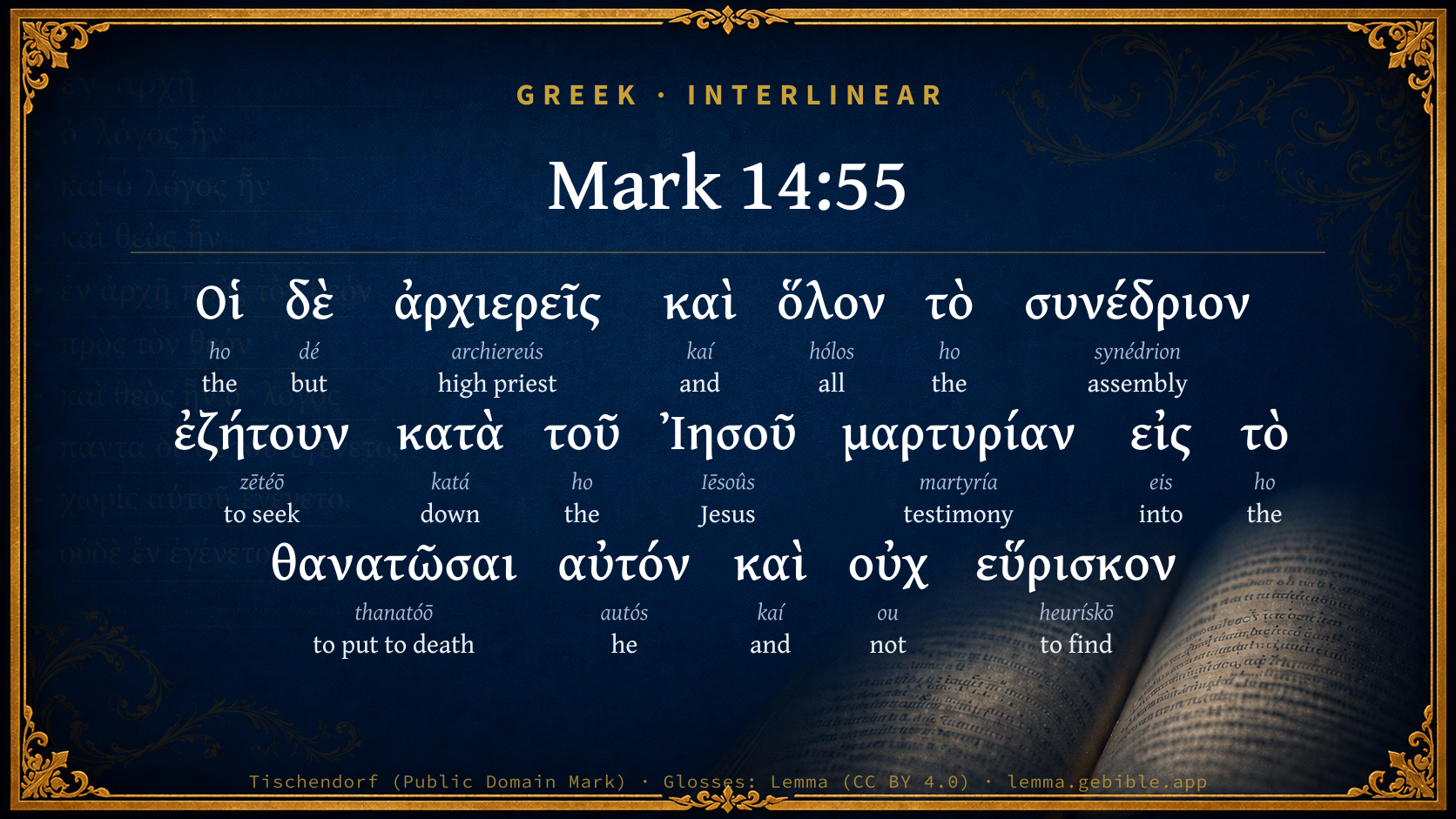
Download image
Cite this verse

Mark 14:55 (World English Bible). Public Domain. Lemma interlinear Bible study tool, https://lemma.gebible.app/v/mark/14/55.

Show BibTeX & RIS
BibTeX
RIS
English Translation
Now the chief priests and the whole council sought witnesses against Jesus to put him to death, and found none.
World English Bible · Public Domain
Highlights
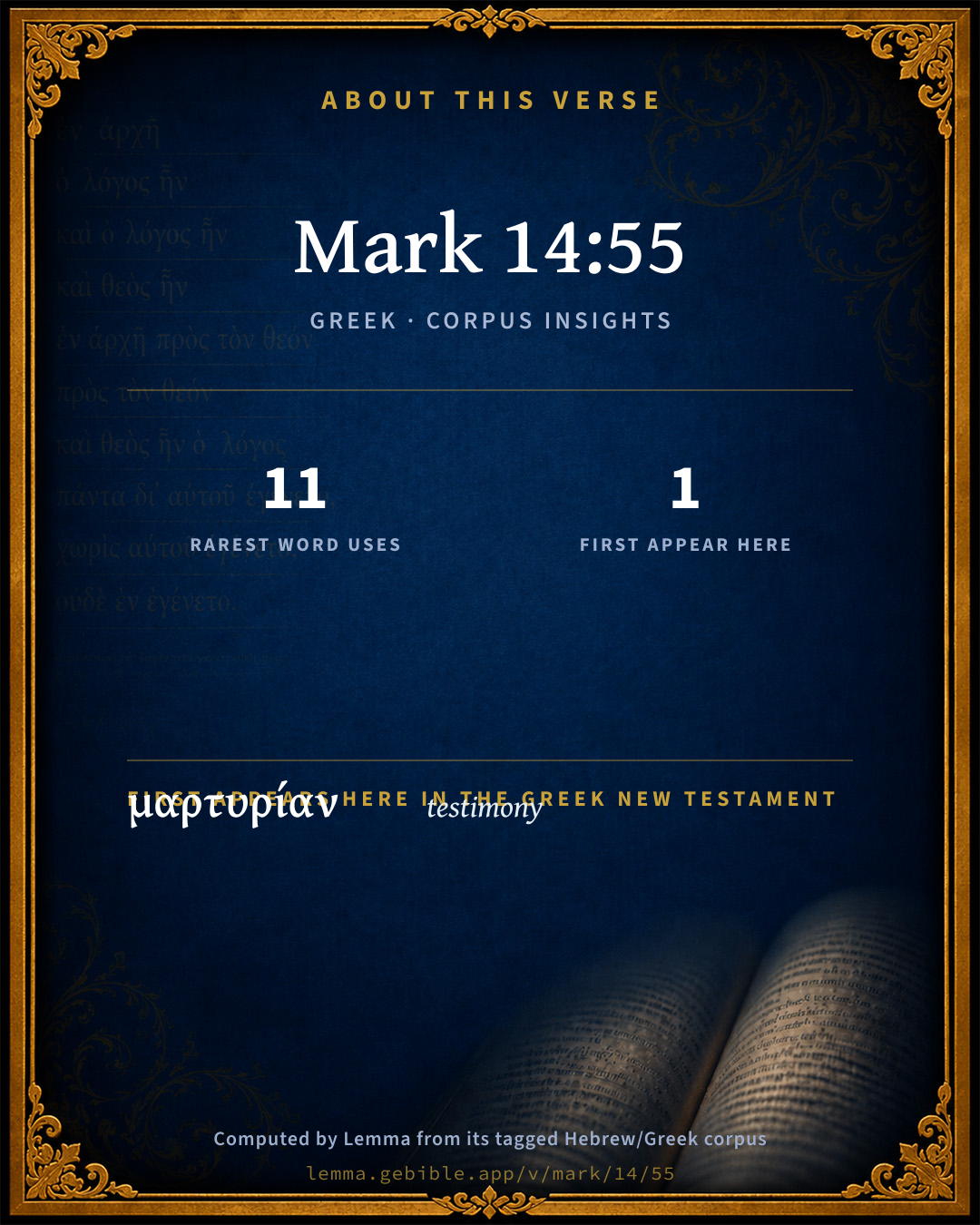
  • 1 first appearance in the Greek New Testament
Full analysis ↓
Download a study sheet

One document with this verse’s original text, its word-by-word gloss line, the meaning frame, cross-references with their text, attributed commentary, and full source and license credits — printable, and it pastes into notes with its structure intact.

This verse Autodidact and up

Study sheet (.html) Plain text (.txt)

A passage Seminary Student

Up to 50 verses in one chapter. A passage sheet keeps up to 6 commentary sources and 12 cross-references per verse, in the order this page ranks them, and says so on the sheet whenever that leaves anything out. Ask for a single verse and you get the Autodidact verse sheet above.

Everything on this page stays free to read, with no account — the sheet is a download of what is already on screen, not access to it.

Want to remove ads? Support Godless Engineer
Compare translations 3

The same verse in 3 English versions, stacked beneath the original-language interlinear above. Click any original word for its lexicon entry.

Each is an independent rendering of the whole verse — the interlinear is not word-aligned to these translations.

Highlighted words mark where these versions differ — a whole-verse word diff, not a word-by-word alignment.

  • World English Bible Public Domain
    Now the chief priests and the whole council sought witnesses against Jesus to put him to death, and found none.
  • King James Version Public Domain
    And the chief priests and all the council sought for witness against Jesus to put him to death; and found none.
  • unfoldingWord Literal Text CC BY-SA 4.0
    Now the chief priests and the entire Sanhedrin were seeking testimony against Jesus to put him to death, and they were not finding.

unfoldingWord Literal Text — © unfoldingWord, licensed CC BY-SA 4.0. Word-aligned USFM3 via Door43 (git.door43.org/unfoldingWord/en_ult).

Versions to compare (up to 4)

3 of 4 selected

Show all 19 translations

Every available English version of this verse, each an independent rendering of the whole verse.

  • World English Bible Public Domain
    Now the chief priests and the whole council sought witnesses against Jesus to put him to death, and found none.
  • Berean Standard Bible Public Domain
    Now the chief priests and the whole Sanhedrin were seeking testimony against Jesus to put Him to death, but they did not find any.
  • Majority Standard Bible Public Domain
    Now the chief priests and the whole Sanhedrin were seeking testimony against Jesus to put Him to death, but they did not find any.
  • King James Version Public Domain
    And the chief priests and all the council sought for witness against Jesus to put him to death; and found none.
  • American Standard Version (1901) Public Domain
    Now the chief priests and the whole council sought witness against Jesus to put him to death; and found it not.
  • Revised Version (1885) Public Domain
    Now the chief priests and the whole council sought witness against Jesus to put him to death; and found it not.
  • Geneva Bible (1599) Public Domain
    And the hie Priests, and all the Councill sought for witnesse against Iesus, to put him to death, but found none.
  • Douay-Rheims (1899) Public Domain
    And the chief priests and all the council sought for evidence against Jesus, that they might put him to death, and found none.
  • Young's Literal Translation Public Domain
    And the chief priests and all the sanhedrim were seeking against Jesus testimony -- to put him to death, and they were not finding,
  • Literal Standard Version CC BY-SA 4.0
    And the chief priests and all the Sanhedrin were seeking testimony against Jesus—to put Him to death, and they were not finding,
  • Unlocked Literal Bible CC BY-SA 4.0
    Now the chief priests and the entire Jewish council were seeking testimony against Jesus so they might put him to death. But they did not find any.
  • unfoldingWord Literal Text CC BY-SA 4.0
    Now the chief priests and the entire Sanhedrin were seeking testimony against Jesus to put him to death, and they were not finding.
  • Darby Bible Public Domain
    And the chief priests and the whole sanhedrim sought testimony against Jesus to cause him to be put to death, and did not find [any].
  • World Messianic Bible Public Domain
    Now the chief priests and the whole council sought witnesses against Yeshua to put him to death, and found none.
  • Webster's Bible Public Domain
    And the chief priests, and all the council sought for testimony against Jesus to put him to death; and found none.
  • Free Bible Version CC BY-SA 4.0
    Inside the chief priests and the whole governing council were trying to find some evidence to have Jesus put to death, but they couldn't find anything.
  • Bible in Basic English Public Domain
    Now the chief priests and all the Sanhedrin were looking for witness against Jesus so that they might put him to death; and they were unable to get any.
  • Text-Critical English NT CC BY 4.0
    Now the chief priests and the whole Sanhedrin were seeking testimony against Jesus so that they could put him to death, but they did not find any.
  • Tyndale New Testament (1534) Public Domain
    And the hye prestes and all the counsell sought for witnes agaynste Iesu to put him to death and founde noone.

Literal Standard Version (2020), Covenant Press — licensed CC BY-SA 4.0. Text via the HelloAO Bible API (eBible.org). Unlocked Literal Bible (unfoldingWord) — licensed CC BY-SA 4.0. Text via the HelloAO Bible API (eBible.org). unfoldingWord Literal Text — © unfoldingWord, licensed CC BY-SA 4.0. Word-aligned USFM3 via Door43 (git.door43.org/unfoldingWord/en_ult). Free Bible Version, Dr. Jonathan Gallagher — licensed CC BY-SA 4.0. Text via the HelloAO Bible API (eBible.org).

Word by word

More ways to search: Search by grammar → Find every occurrence → Compare this word →

Practice this passage: Drill this verse → Learn its vocabulary →

θανατῶσαι
thanatóō
G2289
“to put to death”
Verb, Aorist, Active, Infinitive
Part of Speech
Verb
Tense
Aorist
Voice
Active
Mood
Infinitive
Full Thayer's Definition

Origin: from G2288

TDNT: 03:21,3

1. to put to death 2. metaph. a. to make to die i.e. destroy, render extinct b. by death to be liberated from the bond of anything, literally to be made dead in relation to (something)
  1. Οἱ ho G3588 “the” Article, Nominative, Plural, Masculine
  2. δὲ dé G1161 “but” Conjunction
  3. ἀρχιερεῖς archiereús G749 “high priest” Noun, Nominative, Plural, Masculine
  4. καὶ kaí G2532 “and” Conjunction
  5. ὅλον hólos G3650 “all” Adjective, Nominative, Singular, Neuter
  6. τὸ ho G3588 “the” Article, Nominative, Singular, Neuter
  7. συνέδριον synédrion G4892 “assembly” Noun, Nominative, Singular, Neuter
  8. ἐζήτουν zētéō G2212 “to seek” Verb, Imperfect, Active, Indicative, 3rd person, Plural
  9. κατὰ katá G2596 “down” Preposition
  10. τοῦ ho G3588 “the” Article, Genitive, Singular, Masculine
  11. Ἰησοῦ Iēsoûs G2424 “Jesus” Noun, Genitive, Singular, Masculine
  12. μαρτυρίαν martyría G3141 “testimony” Noun, Accusative, Singular, Feminine
  13. εἰς eis G1519 “into” Preposition
  14. τὸ ho G3588 “the” Article, Accusative, Singular, Neuter
  15. αὐτόν autós G846 “he” Personal pronoun, Accusative, Singular, Masculine
  16. καὶ kaí G2532 “and” Conjunction
  17. οὐχ ou G3756 “not” Particle, Negative
  18. εὕρισκον heurískō G2147 “to find” Verb, Imperfect, Active, Indicative, 3rd person, Plural

About this verse

These counts appear in no published source. They are computed here, from the morphology-tagged text and Lemma’s own curated glosses. What Lemma adds →

19
words
15
distinct lemmas
Gospels
section

Notable vocabulary

The rarest word here is θανατῶσαι to put to death G2289 — appearing just 11 times in the whole Greek New Testament.

First appearance in Scripture

This word makes its first canonical appearance in the Greek New Testament here:

  • μαρτυρίαν testimony G3141

Shared distinctive vocabulary

θανατῶσαι to put to death G2289 occurs in 11 verses of the Greek New Testament. Also found in:
Repetition

Words recur within this verse:

Cross-references

10

Topical passages linked to Mark 14:55 in the Treasury of Scripture Knowledge — connected by theme and wording, ordered by reader-vote popularity; previews shown in the World English Bible.

  • Matthew 5:22 But I tell you, that everyone who is angry with his brother without a cause shall be in danger of the judgment; and whoever shall say to his brother, 'Raca!' shall be in danger of the council; and whoever shall say, 'You fool!' shall be in danger of the fire of Gehenna.
  • Matthew 26:59–60 Now the chief priests, the elders, and the whole council sought false testimony against Jesus, that they might put him to death;
  • Acts 24:1–13 After five days, the high priest, Ananias, came down with certain elders and an orator, one Tertullus. They informed the governor against Paul.
  • 1 Peter 3:16–18 having a good conscience; that, while you are spoken against as evildoers, they may be disappointed who curse your good manner of life in Christ.
  • 1 Kings 21:13 The two men, the base fellows, came in and sat before him: and the base fellows bore witness against him, even against Naboth, in the presence of the people, saying, Naboth did curse God and the king. Then they carried him forth out of the city, and stoned him to death with stones.
  • Psalms 27:12 Don't deliver me over to the desire of my adversaries, For false witnesses have risen up against me, Such as breathe out cruelty.
  • Psalms 35:11 Unrighteous witnesses rise up. They ask me about things that I don't know about.
  • Daniel 6:4 Then the presidents and the satraps sought to find occasion against Daniel as touching the kingdom; but they could find no occasion nor fault, because he was faithful, neither was there any error or fault found in him.
  • Acts 6:11–13 Then they secretly induced men to say, "We have heard him speak blasphemous words against Moses and God."
  • 1 Kings 21:10 and set two men, base fellows, before him, and let them testify against him, saying, You did curse God and the king. Then carry him out, and stone him to death.

Cross-references courtesy of OpenBible.info (CC BY 4.0).

Commentary

Notes on Mark 14:55 from classic Christian and Jewish commentators (each source and its license shown beneath its notes). The classic Christian expositions comment on the surrounding passage and are grouped to its opening verse, so a note may address several verses; the Jewish commentaries on the Tanakh (Rashi and others) are per-verse, so they appear only where the commentator wrote on this verse.

Lemma curates 59 commentaries, every one of them public domain or Creative Commons licensed, each selected and text-cleaned for this edition rather than reprinted as found. About our sources →

The Biblical Illustrator

Joseph S. Exell

Mar_14:55

All the council sought for witness against Jesus.

The Council-Jesus before the Jewish Council

The world, in its best moods, exalts justice; and, in its worst moods, defeats it. Everything depends on the mood for the time being. Multitudes on the first day of Holy Week strewed the way with their clothes for their king to ride over; it was their mood. Only five days later a mob, bearing lanterns and torches, sought Him as if He were a thief, and led Him a prisoner over that same highway. The mood had changed. Mob law prevailed.

I. The tribunal. No gathering of star chamber was ever more lawless.

1. The law decreed that no court should sit before sunrise; this trial followed immediately upon the midnight arrest-while Jerusalem was asleep.

2. The law required that anyone accused should have an advocate; here the Nazarene stood alone, with none to question in His behalf.

3. The law demanded that witnesses should be summoned for every prisoner; here no one was called to testify.

4. The judge of that court was Caiaphas, who had already declared the necessity of the death of Jesus, in order that the factions of the people might be harmonized.

5. Like a travesty reads the record: The chief priests and all the council sought for witness against Jesus to put Him to death. Their aim was to establish guilt, not to find justice.

6. It was the law that no sentences of death should be passed upon the same day as the trial; yet, in spite of their subterfuge, declaring the sentence of death just after sunrise, it was on the same day, since the Jewish day began at evening.

II. The indictment. Full of flaws. Hopelessly confused. Even the testimony of bribed witnesses was too inconsistent to be of any use. The only seeming ground for a charge was a distortion of a saying in His earlier ministry concerning the destruction of the temple which He called His body, but which they declared was the pride of Jerusalem; but even this was no crime, as even His judges knew. Their case had failed. Their miserable charges were not sustained.

III. The prisoner. The one sinless Person among men. No enemy has ever found a flaw in His pure character. No charge, even of haste or imprudence, has ever been preferred. By His greatness and goodness, He throws all other human attainments into obscurity.

1. The best character is no protection against human hatred. The higher the character the more isolated it stands. The treatment accorded the Master will be meted out to His disciples. Persecution for righteousness sake is a natural outcome of being righteous.

2. The best character does not always command friendship in the time of trial. It is not an infallible mark of piety to be always surrounded with friends.

IV. The sentence. Death, that cry of assassins; death, cold and cruel, blanching in a moment the ruddiest face; death, the breaking down of human life; death, the guardian of the cross; this was the word they hissed out-He is guilty of death. To beckon such a death the laws of Moses and of the Romans were torn to shreds; mockery clothed itself in ermine; Pilate washed his guilty hands; and priests and rabble shouted themselves hoarse. (David O. Mears.)

The Sanhedrin

The Council of the Jews, commonly called the Sanhedrin, was composed of seventy-one persons. It consisted of three Courts or Houses,-the Sopherim, or Teachers of the Law, the College of the High Priest, and the house of the Elders. The president, or head of the Council, bore the title of Nasi, and was not necessarily the High Priest. In Num_11:16, we read that God commanded Moses to call together seventy of the Elders of Israel, and to put his spirit upon them. The Council was composed in like manner of seventy, to represent these Elders, chosen and ordained by Moses, and the seventy-first, the president, represented Moses; but as the Council was summoned by Moses, and not by Aaron, the High Priest was not necessarily the head of it. This president, or Nasi, was also called the Prince of Israel, and must be of the house of David, and the once became for many generations an inheritance of the family of Hillel, which descended from David. The First, or Upper House, was the House of the Lawyers, and it had originally supreme control of life and death. But when the Romans conquered Palestine, and converted Judea into a Roman Province, then this power was taken from them, and all those cases which had been tried by the Court of the Lawyers were heard by the Roman Prater. This House accordingly was practically dissolved; it had nothing to do, the sceptre was taken from it, and its lawgiver was divested of all power. The Second House was that of the Chief Priests; at the head of it sat the High Priest, and it was made up of the heads of the twenty-four priestly families and of the heads of the departments connected with the ministry in the Temple. The members all bore the title of Chief Priests (ἀρχιερεῖς). They decided in all spiritual matters, as to faith and heresy. This House remained in full activity after the practical abrogation of the First, and thus the High Priest became the virtual head of the Jewish Council. The Third House was that of the Elders, and was made up of representatives of the great Jewish families and of Rabbis of note. They went by the name of the Elders, and continued to sit along with the Second House. (S. Baring Gould, M. A.)

The Biblical Illustrator, edited by Joseph S. Exell (c. 1880s–1900s) — public domain. Text from a community e-Sword module.

Joseph Benson's Commentary

Mar 14:55-59. And all the council sought for witness against Jesus to put him to death — Which they were determined to do. They had seized him as a malefactor; and now they had him, they had no indictment to prefer against him, no crime to lay to his charge: but they sought for witnesses against him. They artfully sifted some by sly interrogatories, offered bribes to others to prevail on them to accuse him, and endeavoured by threats to compel other, to do it. The chief priests and elders were, by the law, intrusted with the prosecuting and punishing of false witnesses, Deu 19:16, yet they were now ringleaders in a crime that tended to the overthrow of all justice. Deplorable is the condition of a country, when those that should be the conservators of peace and equity are the corrupters of both! And found none — What an amazing proof of the overruling providence of God, considering both their authority, and the rewards they could offer, that no two consistent witnesses could be procured to charge him with any gross crime! Their witness, their evidences, agreed not together — So also the Vulgate, Convenientia testimonia non erant. But the Greek words, ισαι ουκ ησαν, which, literally rendered, are, were not equal, are understood by many to signify, Not equal to the charge of a capital crime. So Dr. Hammond; they did not accuse him of that upon which a sentence of death might be founded; no, not by the utmost stretch of their law. Dr. Campbell, who considers the phrase in the same light, renders it, Their testimonies were insufficient; observing, “On a doubtful point, where the words appear susceptible of either interpretation, we ought to be determined by the circumstances of the case. Now there is nothing in the whole narrative that insinuates the smallest discrepancy among the witnesses. On the contrary, in the gospels the testimony specified is mentioned as given by all the witnesses. The differences in Matthew and Mark, one saying, I will rebuild, another, I can rebuild; one adding, made with hands, another omitting it; not only are of no moment in themselves, but are manifestly differences in the reports of the evangelists, not in the testimony of the witnesses; nor are they greater than those which occur in most other facts related from memory. What therefore perplexed the pontiffs and the scribes was, that, admitting all that was attested, it did not amount to what could be accounted a capital crime. This made the high-priest think of extorting from our Lord’s mouth a confession which might supply the defect of evidence. This expedient succeeded to their wish; Jesus, though not outwitted by their subtlety, was no way disposed to decline suffering, and therefore readily supplied them with the pretext they wanted.” The same expression is used in the 59th verse. See the note on Mat 26:59-61. There arose certain, and bare false witness — There is no wickedness so black, no villany so horrid, but there may be found among mankind fit tools to be used in it: so miserably depraved and vitiated is human nature! Saying, We heard him say, I will destroy this temple, &c. — It is observable, that the words which they thus misrepresented were spoken by Christ at least three years before, (Joh 2:19.) Their going back so far to find matter for the charge was a glorious, though silent attestation, of the unexceptionable manner wherein he had behaved, through the whole course of his public ministry.

Joseph Benson's Commentary on the Old and New Testaments (1811–1818) — public domain. Text from a community e-Sword module.

MacLaren's Expositions of Holy Scripture

Alexander MacLaren

Mark

THE CONDEMNATION WHICH CONDEMNS THE JUDGES

Mar 14:55 - Mar 14:65.

Mark brings out three stages in our Lord’s trial by the Jewish authorities-their vain attempts to find evidence against Him, which were met by His silence; His own majestic witness to Himself, which was met by a unanimous shriek of condemnation; and the rude mockery of the underlings. The other Evangelists, especially John, supply many illuminative details; but the essentials are here. It is only in criticising the Gospels that a summary and a fuller narrative are dealt with as contradictory. These three stages naturally divide this paragraph.

I. The judges with evil thoughts, the false witnesses, and the silent Christ {Mar 14:55}.

The criminal is condemned before He is tried. The judges have made up their minds before they sit, and the Sanhedrim is not a court of justice, but a slaughter-house, where murder is to be done under sanction of law. Mark, like Matthew, notes the unanimity of the ‘council,’ to which Joseph of Arimathea-the one swallow which does not make a summer-appears to have been the only exception; and he probably was absent, or, if present, was silent. He did ‘not consent’; but we are not told that he opposed. That ill-omened unanimity measures the nation’s sin. Flagrant injustice and corruption in high places is possible only when society as a whole is corrupt or indifferent to corruption. This prejudging of a case from hatred of the accused as a destroyer of sacred tradition, and this hunting for evidence to bolster up a foregone conclusion, are preeminently the vices of ecclesiastical tribunals and not of Jewish Sanhedrim or Papal Inquisition only. Where judges look for witnesses for the prosecution, plenty will be found, ready to curry favour by lies. The eagerness to find witnesses against Jesus is witness for Him, as showing that nothing in His life or teaching was sufficient to warrant their murderous purpose. His judges condemn themselves in seeking grounds to condemn Him, for they thereby show that their real motive was personal spite, or, as Caiaphas suggested, political expediency.

The single specimen of the worthless evidence given may be either a piece of misunderstanding or of malicious twisting of innocent words; nor can we decide whether the witnesses contradicted one another or each himself. The former is the more probable, as the fundamental principle of the Jewish law of evidence {‘two or three witnesses’} would, in that case, rule out the testimony. The saying which they garble meant the very opposite of what they made it mean. It represented Jesus as the restorer of that which Israel should destroy. It referred to His body which is the true Temple; but the symbolic temple ‘made with hands’ is so inseparably connected with the real, that the fate of the one determines that of the other. Strangely significant, therefore, is it, that the rulers heard again, though distorted, at that moment when they were on their trial, the far-reaching sentence, which might have taught them that in slaying Jesus they were throwing down the Temple and all which centred in it, and that by His resurrection, His own act, He would build up again a new polity, which yet was but the old transfigured, even ‘the Church, which is His body.’ His work destroys nothing but ‘the works of the devil.’ He is the restorer of the divine ordinances and gifts which men destroy, and His death and resurrection bring back in nobler form all the good things lost by sin, ‘the desolations of many generations.’ The history of all subsequent attacks on Christ is mirrored here. The foregone conclusion, the evidence sought as an after-thought to give a colourable pretext, the material found by twisting His teaching, the blindness which accuses Him of destroying what He restores, and fancies itself as preserving what it is destroying, have all reappeared over and over again.

Our Lord’s silence is not only that of meekness, ‘as a sheep before her shearers is dumb.’ It is the silence of innocence, and, if we may use the word concerning Him, of scorn. He will not defend Himself to such judges, nor stoop to repel evidence which they knew to be worthless. But there is also something very solemn and judicial in His locked lips. They had ever been ready to open in words of loving wisdom; but now they are fast closed, and this is the penalty for despising, that He ceases to speak. Deaf ears make a dumb Christ, What will happen when Jesus and His judges change places, as they will one day do? When He says to each, ‘Answerest thou nothing? What is it which these, thy sins, witness against thee?’ each will be silent with the consciousness of guilt and of just condemnation by His all-knowing justice.

II. Christ’s majestic witness to Himself received with a shriek of condemnation.

What a supreme moment that was when the head of the hierarchy put this question and received the unambiguous answer! The veriest impostor asserting Messiahship had a right to have his claims examined; but a howl of hypocritical horror is all which Christ’s evoke. The high priest knew well enough what Christ’s answer would be. Why, then, did he not begin by questioning Jesus, and do without the witnesses? Probably because the council wished to find some pretext for His condemnation without bringing up the real reason; for it looked ugly to condemn a man for claiming to be Messias, and to do it without examining His credentials. The failure, however, of the false witnesses compelled the council to ‘show their hands,’ and to hear and reject our Lord solemnly and, so to speak, officially, laying His assertion of dignity and office before them, as the tribunal charged with the duty of examining His proofs. The question is so definite as to imply a pretty full and accurate knowledge of our Lord’s teaching about Himself. It embraces two points-office and nature; for ‘the Christ’ and ‘the Son of the Blessed’ are not equivalents. The latter title points to our Lord’s declarations that He was the Son of God, and is an instance of the later Jewish superstition which avoided using the divine name. Loving faith delights in the name of the Lord. Dead formalism changes reverence into dread, and will not speak it.

Sham reverence, feigned ignorance, affected wish for information, the false show of judicial impartiality, and other lies and vices not a few, are condensed in the question; and the fact that the judge had to ask it and hear the answer, is an instance of a divine purpose working through evil men, and compelling reluctant lips to speak words the meaning and bearing of which they little know. Jesus could not leave such a challenge unanswered. Silence then would have been abandonment of His claims. It was fitting that the representatives of the nation should, at that decisive moment, hear Him declare Himself Messiah. It was not fitting that He should be condemned on any other ground. In that answer, and its reception by the council, the nation’s rejection of Jesus is, as it were, focused and compressed. This was the end of centuries of training by miracle, prophet and psalmist-the saddest instance in man’s long, sad history of his awful power to frustrate God’s patient educating! Our Lord’s majestic ‘I am,’ in one word answers both parts of the question, and then passes on, with strange calm and dignity, to point onwards to the time when the criminal will be the judge, and the judges will stand at His bar. ‘The Son of Man,’ His ordinary designation of Himself, implies His true manhood, and His representative character, as perfect man, or, to use modern language, the ‘realised ideal’ of humanity. In the present connection, its employment in the same sentence as His assertion that He is the Son of God goes deep into the mystery of His twofold nature, and declares that His manhood had a supernatural origin and wielded divine prerogatives. Accordingly there follows the explicit prediction of His assumption of the highest of these after His death. The Cross was as plain to Him as ever; but beyond it gleamed the crown and the throne. He anticipates ‘sitting on the right hand of power,’ which implies repose, enthronement, judicature, investiture with omnipotence, and administration of the universe. He anticipates ‘coming in the clouds of heaven,’ which distinctly claims to be the future Judge of the world. His hearers could scarcely fail to discern the reference to Daniel’s prophecy.

Was ever the irony of history more pungently exemplified than in an Annas and Caiaphas holding up hands of horror at the ‘blasphemies’ of Jesus? They rightly took His words to mean more than the claim of Messiahship as popularly understood. To say that He was the Christ was not ‘blasphemy,’ but a claim demanding examination; but to say that He, the Son of Man, was Son of God and supreme Judge was so, according to their canons. How unconsciously the exclamation, ‘What need we further witnesses?’ betrays the purpose for which the witnesses had been sought, as being simply His condemnation! They were ‘needed’ to compass His death, which the council now gleefully feels to be secured. So with precipitate unanimity they vote. And this was Israel’s welcome to their King, and the outcome of all their history! And it was the destruction of the national life. That howl of condemnation pronounced sentence on themselves and on the whole order of which they were the heads. The prisoner’s eyes alone saw then what we and all men may see now-the handwriting on the wall of the high priest’s palace: ‘Weighed in the balance, and found wanting.’

III. The savage mockers and the patient Christ {Mar 14:65}.

There is an evident antithesis between the ‘all’ of Mar 14:64 and the ‘some’ of Mar 14:65, which shows that the inflictors of the indignities were certain members of the council, whose fury carried them beyond all bounds of decency. The subsequent mention of the ‘servants’ confirms this, especially when we adopt the more accurate rendering of the Revised Version, ‘received Him with blows.’ Mark’s account, then, is this: that, as soon as the unanimous howl of condemnation had beep uttered, some of the ‘judges’{!} fell upon Jesus with spitting and clumsy ridicule and downright violence, and that afterwards He was handed over to the underlings, who were not slow to copy the example set them at the upper end of the hall.

It was not an ignorant mob who thus answered His claims, but the leaders and teachers-the crème de la crème of the nation. A wild beast lurks below the Pharisee’s long robes and phylacteries; and the more that men have changed a living belief in religion for a formal profession, the more fiercely antagonistic are they to every attempt to realise its precepts and hopes. The ‘religious’ men who mock Jesus in the name of traditional religion are by no means an extinct species. It is of little use to shudder at the blind cruelty of dead scribes and priests. Let us rather remember that the seeds of their sins are in us all, and take care to check their growth. What a volcano of hellish passion bursts out here! Spitting expresses disgust; blinding and asking for the names of the smiters is a clumsy attempt at wit and ridicule; buffeting is the last unrestrained form of hate and malice. The world has always paid its teachers and benefactors in such coin; but all other examples pale before this saddest, transcendent instance. Love is repaid by hate; a whole nation is blind to supreme and unspotted goodness; teachers steeped in ‘law and prophets’ cannot see Him of and for whom law and prophets witnessed and were, when He stands before them. The sin of sins is the failure to recognise Jesus for what He is. His person and claims are the touchstone which tries every beholder of what sort He is.

How wonderful the silent patience of Jesus! He withholds not His face ‘from shame and spitting.’ He gives ‘His back to the smiters.’ Meek endurance and passive submission are not all which we have to behold there. This is more than an uncomplaining martyr. This is the sacrifice for the world’s sin; and His bearing of all that men can inflict is more than heroism. It is redeeming love. His sad, loving eyes, wide open below their bandage, saw and pitied each rude smiter, even as He sees us all. They were and are eyes of infinite tenderness, ready to beam forgiveness; but they were and are the eyes of the Judge, who sees and repays His foes, as those who smite Him will one day find out.

Alexander MacLaren, Expositions of Holy Scripture (1904–1910) — public domain. Text from a community e-Sword module.

Godbey's Commentary on the New Testament

William B. Godbey

JESUS CONDEMNED BY THE SANHEDRIN

Mat 26:59-68; Mar 14:55-65; Luk 22:63-71;Joh 18:19-24. “Then the high priest asked Jesus concerning His disciples and teaching. Jesus responded to Him, I spoke boldly to the world. I always taught in the synagogue, and in the temple, where all the Jews come together, and I spoke nothing in secret. Why do you ask Me? Ask those who heard what I said to them; behold, they know the things which I said. He, speaking these things, one of the officers standing by struck Jesus with his hand, saying, Do you thus answer the high priest? Jesus responded to him, If I spoke wickedly, testify concerning the wickedness; but if truly, why do you smite Me? Then Annas sent Him bound to Caiaphas the high priest.” Evidently, Annas and Caiaphas had their tribunals in the same great quadrangular building standing on Mount Zion, and now visited by the thirty thousand pilgrims annually going to Jerusalem. Having first been arraigned at the tribunal of Annas, He is now, about day-dawn, led bound to the tribunal of Caiaphas. You see how the high priest endeavored to make Him confess, hoping to utilize His own testimony against Himself, as they had no witnesses to amount to anything, and thus condescended to a very cowardly stratagem, which even if he had succeeded, the law pronounces the weakest of all evidence. It was awfully barbaric for that officer to smite a prisoner in bonds. You see, Jesus vindicates Himself reminding the man of the criminal impropriety of this uncouth assault upon a defenseless prisoner illustrating the right of all His followers to vindicate themselves from false accusation, violence, and tyranny, and refuting the idea somewhat prevalent that we are never to advocate our rights and vindicate ourselves against the oppression of the wicked.

Luk 22:66. “And when it was day, the eldership of the people, the chief priests, and the scribes were assembled, and led Him into the Sanhedrin.” As they had been on His track, like bloodhounds, three years, eager to take, His life (but restrained by the fear of the people; and well they might be, because a bloody civil war would have broken out immediately), such is their fear of the people that they attack Him at midnight, aiming to secure the death-warrant and kill Him before day. In this they are disappointed and woefully disconcerted, being unable to convene the Sanhedrin till day dawn, though keeping couriers running at race-horse speed all night, (notifying and urging them up. The Sanhedrin was the highest court of the politico-ecclesiasticism, the successor of the eldership organized by Jethro, the father-in-law of Moses, during their wilderness peregrinations.

Mar 14:55-59. “And the high priest and all the Sanhedrin continued to seek testimony against Jesus to put him to death, and they found none.” Matthew says “false testimony.” Of course, they preferred true testimony if they could get it; but as there was none, they were anxious to take any kind they could get. “For many continued to testify falsely against Him, and their testimonies were not equal,” i. e., they contradicted one another, which in law invalidates both, so that they are thrown out of court. “And certain ones, rising up, falsely testified against Him, saying, We heard Him saying, That I will destroy this temple, made with hands, and in three days I will build another, made without hands. Indeed their testimony was not equal;” i. e., they contradicted one another. Perhaps some of the witnesses gave it correctly; but you have only to look at Joh 2:19, “Destroy this temple, and I will build it in three days,” to see that the above witnesses were false, as they testified that He said, “I will destroy this temple, made with hands, and build another, made without hands.” By comparison, you see that these witnesses did not quote Him correctly, as their testimony would make it mean that great stone edifice standing on Mount Moriah; while He did not mean that at all, but the temple of His body. Why did He not correct them when so grossly misrepresenting Him? Because it would have done no good, as Satan was in them, and they were thirsting for His blood.

Mat 26:62-66. “The high priest, standing up, said to Him, Do You answer nothing? What are they witnessing against Thee? And Jesus was silent.” Under temptation, the better policy is, like Jesus, to keep silent. You should never speak while under severe provocation. “The high priest, responding, said to Him, I assure Thee by the living God, that Thou mayest tell us if Thou art the Christ, the Son of God. Jesus says to him, Thou sayest it.” That is an Oriental form of affirmation. Here, you see, Jesus answers while under oath of affirmation, administered by the high priest. Hence you see His indirect approval appertaining to the civil oath of affirmation. Paul (1Th 5:23) administers a solemn oath to the Thessalonian saints to read his letter to all the members of the Church.

“Moreover I say unto you, Hereafter you shall see the Son of man sitting on the right hand of power and coming in the clouds of heaven.” The first clause of this wonderful prophecy of our Lord was fulfilled when they saw Him rise from the dead and ascend up to heaven from Mount Olivet; while the second clause, “coming in the clouds of heaven,” will be fulfilled when Jesus shall ride down on a cloud and receive all the kingdoms of this world (Dan 7:9-14) and reign forever. In this wonderful sentence there is not so much as a comma, yet those two clauses are separated by many centuries, the former being verified in a few days, and the latter still pending.

“Then the high priest tore His robes, saying, That He blasphemed; what need of testimony have we yet? Behold, now , you have heard His blasphemy. What seems good to you? And they, responding, said, He is worthy of death.” Mark says this verdict was unanimous, So here you see the issue of His prosecution before the Sanhedrin They unanimously condemned Him to die for blasphemy, according to the law of Moses. (Lev 24:16.) Thus you see, good and just laws become vehicles of tyranny and persecution when in the hands of bad men, and are no guarantee of fight and justice when the devil is in the administrators. Jesus died under the verdict of Divine law, and so did all the martyrs, there being no trouble about the law; but Satan was in the preachers and ruling elders. So it is this day. Some of the brightest saints that walk beneath the skies, have been excommunicated, while drunkards, libertines, blasphemers, and thieves have been retained without impeachment. Such was the case in the days of Luther and Wesley, and always will be so when Diabolus gets into the clergy and official laity.

Luk 22:63-65. “And the men who had charge of Jesus began to mock Him, beating Him; and covering Him, continued to strike His face, and ask Him, saying, Prophesy, who is the one smiting thee? And blaspheming Him as to many other things, they continued to speak against Him.” The truth of it is, Jesus had no trial, it was a mockery; to their infinite shame, barbarically abusing Him while a prisoner in chains, which is revolting to the very idea of civil, not to say ecclesiastical administration. Nicodemus certifies that Jewish law never condemned a man till he met his accusers face to face, and had a fair and impartial trial. Festus, the Roman proconsul, makes the same statement in reference to imperial law. Hence, Jesus was mobbed and outlawed. But did He not come into the world to die? Most assuredly; and He would have died to redeem the world from sin, death, and hell if neither Judas nor Caiphas had ever been born. Yet that is no apology for the diabolical treason, perfidy, and murder which they committed, overtly, without excuse.

William B. Godbey, Commentary on the New Testament (1896–1900) — public domain. Text from a community e-Sword module.

Tyndale Open Study Notes

Tyndale Open Resources

14:55-59 The trial took place before the entire high council (Greek Sanhedrin), which had seventy members and was led by the high priest. The Gospels portray a formal trial: There was a search for witnesses (14:55), eyewitness testimony (14:56-59), Jesus being placed under oath (Matt 26:63), Jesus being allowed to defend himself (Mark 14:60), the high priest tearing his robe (14:63), and the concluding verdict by the Sanhedrin (14:64). This does not mean that it was a fair trial—the decision to put Jesus to death had already been made. Evidence was not sought to determine the truth, but to obtain a guilty verdict and death sentence. • False witnesses giving false testimony misrepresented what Jesus said about the destruction and rebuilding of the Temple (see 15:29; John 2:19; Acts 6:14). Because the false witnesses contradicted each other, their testimony was unacceptable (Num 35:30; Deut 17:6; 19:15).

Tyndale Open Study Notes — © Tyndale Open Resources, licensed CC BY-SA 4.0. Text via the HelloAO Bible API.

Meyer's Critical & Exegetical Commentary

Heinrich August Wilhelm Meyer

Mar_14:55-65. See on Mat_26:59-68.

Mar_14:56. καὶ ἴσαι κ.τ.λ.] and the testimonies were not alike[170] (consonant, agreeing). At least two witnesses had to agree together; Deu_17:6; Deu_19:15; Lightfoot, p. 658; Michaelis, Mos. R. § 299; Saalschütz, p. 604. The καί is the simple: and. Many testified falsely and dissimilarly.

Mar_14:58. ἡμεῖς] we, on our part: the ἐγώ also which follows has corresponding emphasis.

χειροποίητον … ἄλλον ἀχειροποίητον] peculiar to Mark, but certainly (comp. on Mar_15:29) a later form of the tradition resulting from reflection (at variance with Johns own interpretation) as to the meaning of the utterance in Joh_2:19, according to which there was found in that saying a reference to the new spiritual worship of God, which in a short time Christ should put in the place of the old temple-service. Comp. Act_6:14. Matthew is here more simple and more original.

ἀχειροπ.] is an appositional more precise definition to ἄλλον. See van Hengel, Annotat. p. 55 ff. Comp. on Luk_23:32.

Mar_14:59. οὐδὲ οὕτως] and not even thus (when they gave this statement) was their testimony consonant. The different witnesses must therefore have given utterance to not unimportant variations in details (not merely in their mode of apprehending the saying, as Schenkel would have it). It is plain from this that one witness was not heard in the presence of the other. Comp. Michaelis, Mos. R. § 299, p. 97. Others, like Erasmus, Grotius, Calovius, in opposition to linguistic usage and to the context (see Mar_14:56), hold that ἴσος is here and at Mar_14:56 : sufficiens.

Mar_14:60. Two questions, as at Mat_26:62. If we assume only one, like the Vulgate, and take τί for ὅ, τι: answerest thou nothing to that, which, etc. (Bornemann in the Stud. u. Krit. 1843, p. 120 f.; Lachmann, Tischendorf, Ewald, Bleek, and various others), it is true that the construction ἀποκρίνεσθαί τι is not opposed to it (see on Matthew), but the address is less expressive of the anxiety and urgency that are here natural to the questioner. Buttmann, neut. Gr. p. 217 [E. T. 251], harshly suggests that hearing should be supplied before ὅ, τι.

Mar_14:61. Well known parallelismus antitheticus, with emphasis. Inversely at Act_18:9.

ὁ εὐλογητός]κατʼ ἐξοχήν, הַבָּרוּךְ, God. Used absolutely thus only here in the N. T. The Sanctus benedictus of the Rabbins is well known (Schoettgen, ad Rom_9:5). The expression makes us feel the blasphemy, which would be involved in the affirmation. But it is this affirmation which the high priest wishes (hence the form of his question: Thou art the Messiah?), and Jesus gives it, but with what a majestic addition in this deep humiliation!

Mar_14:62. The ἀπʼ ἄρτι in Mat_26:64, which is wanting in Mark, and which requires for what follows the figurative meaning, is characteristic and certainly original. On ΜΕΤᾺ Τ. ΝΕΦΕΛ., comp. Dan_7:13 (עִם); Rev_1:7. That figurative meaning is, moreover, required in Mark by ἐκ δεξιῶν καθήμ τ. δυν., although Keim finds in this interpretation arbitrariness without measure. Luke only, Luk_22:69, while abbreviating and altering the saying, presents the literal meaning.

Mar_14:63. ΤΟῪς ΧΙΤῶΝΑς] a more accurate statement, in accordance with the custom of rending the garments, than the general ΤᾺ ἹΜΆΤΙΑ in Mat_26:65; see in loc. People of rank wore two under-garments (Winer, Realw.); hence τοὺς χιτ.

Mar_14:64. κατέκριναν κ.τ.λ.] they condemned Him, to be guilty of death[171] On κατακρ. with an infinitive, comp. Herod, vi. 85, ix. 93; Xen. Hier. vii. 10.

Mar_14:65. ἤρξαντο] when the guilty! had heen uttered. A vivid representation of the sequel.

ΤΙΝΈς] comp. previously ΟἹ ΔῈ ΠΆΝΤΕς, hence: some of the Sanhedrists. The servants, i.e. the servants of the court, follow afterwards.

προφήτευσον] usually: who struck thee, according to the amplifying narratives of Matthew and Luke; Mark, however, does not say this, but generally: prophesy! which as Messiah thou must be able to do! They wish to bring Him to prophesy by the κολαφίζειν! The narrative of Mark, regarded as an abbreviation (Holtzmann), would be a singularity without motive. Matthew and Luke followed another tradition. The veiling of the face must, according to Mark, be considered merely as mocking mummery.

And after some of the Sanhedrists had thus mocked and maltreated Him, the servants received Him with strokes of the rod. To them He was delivered for custody until further orders. This is the meaning according to the reading ἔλαβον (see the critical remarks). On the explanation of the reading ἜΒΑΛΛΟΝ, they struck Him, see Bornemann in the Stud. u. Krit. 1843, p. 138. As to ῥαπίσμασιν, see on Mat_26:67 The dative denotes the form, the accompanying circumstances, with which on the part of the servants the ἔλαβον took place. Bernhardy, p. 100 f. Comp. the Latin accipere aliquem verberibus (Cic. Tusc. ii. 14. 34).

[170] It is not to be accented ἶσος, as in Homer, but ἴσος, as with the Attic and later writers. See Fritzsche in loc.; Bentley, ad Menandr. fragm., p. 533, ed. Meinek.; Brunck, ad Arist. Plut. 1113; Lipsius, grammat. Unters. p. 24.

[171] This was the result, which was already from the outset a settled point with the court, and to the bringing about of which the judicial procedure had merely to lend the form of legality. The defence of the procedure in Saalschütz, Mos. R. p. 623 ff., only amounts to a pitiful semblance of right. Against the fact as it stood, that Jesus claimed to be the Messiah, they had no law; this claim, therefore, was brought into the sphere of the spiritual tribunal under the title of blasphemy, and before the Roman tribunal under that of high treason. And into the question as to the ground and truth of the claimalthough in the confession of Jesus there was implied the exceptio veritatisthey prudently did not enter at all.

Meyer — Critical and Exegetical Commentary on the New Testament — English translation by Peter Christie, edited by Frederick Crombie (T&T Clark, 1880) — public domain. Text from a community e-Sword module.

Expositor's Greek Testament

ed. W. Robertson Nicoll

Mar 14:55-65 . The trial and condemnation .

Mar 14:55 . μαρτυρίαν : Mt. has ψευδομαρτυρίαν , justly so characterised, because the Sanhedrists wanted evidence for a foregone conclusion: evidence that would justify a sentence of death.

The Expositor's Greek Testament, edited by W. Robertson Nicoll (1897–1910) — public domain. Text from a community e-Sword module.

Geneva Bible (1599)

Geneva Bible translators

Christ, who was so innocent that he could not be oppressed, no not by false witnesses, is at the length, for confessing God to be his father, condemned of impiety before the high Priest: that we, who denied God and were indeed wicked, might be quit before God.

Geneva Bible (1599) marginal notes — public domain. Text via Bolls.life.

The Cambridge Bible for Schools and Colleges

gen. ed. J. J. S. Perowne

55. And the chief priests] St Mark passes over the details of the examination before Annas and the first commencement of insult and violence, recorded only by St John (Joh_18:19-24). He places us in the mansion of Caiaphas, whither our Lord was conducted across the courtyard, and where a more formal assembly of the council of the nation had met together.

sought for witness] By the Law they were bound to secure the agreement of two witnesses on some specific charge. Before Annas an attempt had been made to entangle the Accused with insidious questions. A more formal character must now be given to the proceedings.

The Cambridge Bible for Schools and Colleges (gen. ed. J. J. S. Perowne; Cambridge University Press, 1878–1918) — public domain. Text from a community e-Sword module.

John Gill's Exposition

We heard him say,.... In a discourse of his, recorded in Joh 2:19,

I will destroy this temple that is made with hands, and within three days I will build another made without hands; which was a very false testimony; for Christ did not say be would destroy any temple at all, only put the Jews on doing it; much less did he point at, or design the temple of Jerusalem, but his own body; nor did he use the distinction of a temple, made with and without hands; nor did he affirm that he would build another; only said, he would raise up in three days, that which they should destroy. By this testimony these witnesses would suggest, that Christ had a design upon their temple to demolish it, and that he must be a sorcerer, or a magician, to pretend to build a temple without hands in three days time; See Gill on Mat 26:61.

John Gill's Exposition of the Whole Bible (1746–1763) — public domain (CC PDM 1.0). Text via the HelloAO Bible API.

Trapp's Complete Commentary

John Trapp

55 And the chief priests and all the council sought for witness against Jesus to put him to death; and found none.

Ver. 55. {See Trapp on "Mat 26:59"}

John Trapp, A Commentary or Exposition upon All the Books of the Old and New Testament (1647–1656) — public domain. Text from a community e-Sword module.

Haydock's Catholic Bible Commentary

Though the law prescribed there should be only one high priest, yet at this time there were many, being appointed yearly by the Roman governor; and those are here called chief priests who had once been invested with the dignity of high priest, but were at that time out of office. (Theophylactus)

George Leo Haydock (1774–1849), Haydock's Catholic Family Bible and Commentary, 1859 edition — public domain. Excludes Psalms (Douay-Rheims chapter numbering differs from Protestant) and Deuterocanonical books (Catholic canon only).

The Pulpit Commentary

Now the chief priests and the whole council sought witness against Jesus to put him to death, and found it not. Their supreme object was to put him to death; but. they wished to accomplish their object in a manner consistent with their own honor, so as not to appear to have put him to death without reason. So they sought for false witnesses against him, that they might deliver the Author of life and the Savior of the world to death. For in real truth, although they knew it not, and were the instruments in his hands, he had determined by the death of Christ to bestow on us both present and eternal life.

The Pulpit Commentary (1880–1919), ed. H.D.M. Spence-Jones & Joseph S. Exell — public domain. Text from a community e-Sword module.

John Wesley's Explanatory Notes

All the council sought for witness and found none - What an amazing proof of the overruling providence of God, considering both their authority, and the rewards they could offer, that no two consistent witnesses could be procured, to charge him with any gross crime. Matt. xxvi, 59.

John Wesley, Explanatory Notes Upon the Whole Bible (1754–1765) — public domain. Text via the GEBible commentary corpus.

unfoldingWord translationNotes

Door43 World Missions Community

Now

This word is used here to mark a shift in the story line as the author continues telling us about Jesus being put on trial.

they might put him to death

They were not the ones who would execute Jesus; rather, they would order someone else to do it. AT: "they might have Jesus executed" or "they might have someone execute Jesus" (See: Metonymy)

But they did not find any

They did not find testimony against Jesus with which they could convict him and have him put to death. AT: "But they did not find any testimony with which to convict him" (See: Assumed Knowledge and Implicit Information)

brought false testimony against him

Here speaking false testimony is described as if it were a physical object that someone can carry. AT: "accused him by speaking false testimony against him" (See: Metaphor)

their testimony did not agree

This can be written in positive form. "but their testimony contradicted each other"

translationWords

chief priests

council

seek

testimony

die

corrupt witness

unfoldingWord translationNotes — © Distant Shores Media and the Door43 World Missions Community, licensed CC BY-SA 4.0. Source: git.door43.org/Door43/en_tn.

Cambridge Greek Testament for Schools and Colleges

55. ἐζήτουν … οὐχ εὕρισκον. Their failure to get evidence on which He could be condemned to death was as continuous as their seeking for it. Ecclesiastical tribunals have often been prone to decide first and then seek for evidence to justify the decision.

Cambridge Greek Testament for Schools and Colleges (Cambridge University Press, 1896; 21 vols, various authors incl. Carr, Maclear, Plummer, Farrar, Lumby, Moule, M. R. James, Simcox) — public domain. Text from a community e-Sword module.

International Critical Commentary

55. ἐζήτουν μαρτυρίαν … εἰς τὸ θανατῶσαι—sought witness … to put him to death. They did not act as judges, but having formed the purpose to put him to death, they sought witness against him. Nominally, they were judges; really, they were prosecutors.1

International Critical Commentary — older volumes (1896–1929), various authors — public domain. Text from a community e-Sword module.

Lesson kit

Teaching starters — assembled from the data on this page, not authored interpretation. Every prompt links to the verse data it draws on. Edit before teaching.

Mark, in the Gospels, opens this verse with 19 words (15 distinct Greek lemmas). Its most distinctive word is thanatóō (“to put to death”). A historical commentator’s framing appears above. Read the whole chapter for the surrounding context.

Discussion questions

  1. What does “to put to death” (thanatóō) contribute to the verse as a whole?
  2. The word “testimony” first appears here in Scripture. What is being introduced at this debut?
  3. Matthew 10:21 shares the word «to put to death» with this verse. How do the two illuminate each other?
  4. “the” occurs 4× in this one verse. What is the effect of the repetition?
  5. The translations on this page render this verse differently — a whole-verse word diff, not a word-by-word alignment. What might account for the different wordings?
  6. Reading how The Biblical Illustrator and Joseph Benson's Commentary read this verse, where do the two commentators agree and where do they part?

Things to notice

  • 1 word makes its first canonical appearance in Scripture here.
  • These translations choose different wording for 14 words in this verse.
  • “the” occurs 4× in this single verse.
  • 15 distinct Greek lemmas span 19 words in this verse.

Reading settings

Reading text

Shown beneath each verse's original-language words.

Old Testament
Old Testament edition

Read the OT as the Masoretic Hebrew (MT) or the Greek Septuagint (LXX).

English shown for the Greek Septuagint (in the Hebrew ↔ Greek comparison).

Comparing translations? Open the Compare panel on any verse page to stack up to four side by side.