Acts 24:18

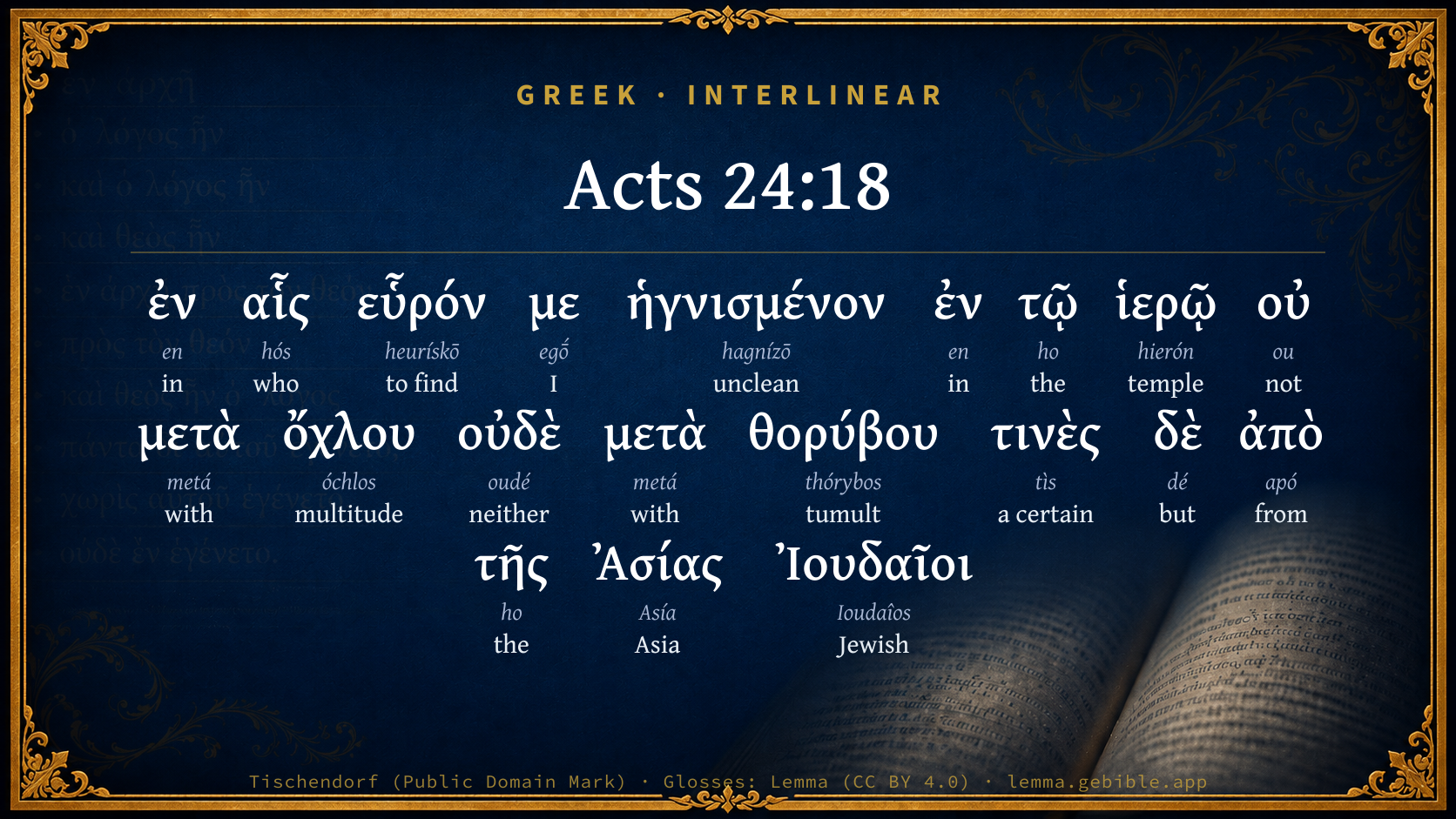
Greek (Tischendorf 8th ed.) Acts 24:18 appears in the Greek New Testament. The text above is from the Tischendorf 8th edition. Each word links to its Strong’s number and a concise gloss. Click any word for its full Thayer’s Greek Lexicon entry.
Download image
Cite this verse

Acts 24:18 (World English Bible). Public Domain. Lemma interlinear Bible study tool, https://lemma.gebible.app/v/acts/24/18.

Show BibTeX & RIS
BibTeX
RIS
English Translation
amid which certain Jews from Asia found me purified in the temple, not with a mob, nor with turmoil.
World English Bible · Public Domain
Download a study sheet

One document with this verse’s original text, its word-by-word gloss line, the meaning frame, cross-references with their text, attributed commentary, and full source and license credits — printable, and it pastes into notes with its structure intact.

This verse Autodidact and up

Study sheet (.html) Plain text (.txt)

A passage Seminary Student

Up to 50 verses in one chapter. A passage sheet keeps up to 6 commentary sources and 12 cross-references per verse, in the order this page ranks them, and says so on the sheet whenever that leaves anything out. Ask for a single verse and you get the Autodidact verse sheet above.

Everything on this page stays free to read, with no account — the sheet is a download of what is already on screen, not access to it.

Want to remove ads? Support Godless Engineer
Compare translations 3

The same verse in 3 English versions, stacked beneath the original-language interlinear above. Click any original word for its lexicon entry.

Each is an independent rendering of the whole verse — the interlinear is not word-aligned to these translations.

Highlighted words mark where these versions differ — a whole-verse word diff, not a word-by-word alignment.

  • World English Bible Public Domain
    amid which certain Jews from Asia found me purified in the temple, not with a mob, nor with turmoil.
  • King James Version Public Domain
    Whereupon certain Jews from Asia found me purified in the temple, neither with multitude, nor with tumult.
  • unfoldingWord Literal Text CC BY-SA 4.0
    in which they found me in the temple, having been cleansed, not with a crowd, nor with an uproar.

unfoldingWord Literal Text — © unfoldingWord, licensed CC BY-SA 4.0. Word-aligned USFM3 via Door43 (git.door43.org/unfoldingWord/en_ult).

Versions to compare (up to 4)

3 of 4 selected

Show all 19 translations

Every available English version of this verse, each an independent rendering of the whole verse.

  • World English Bible Public Domain
    amid which certain Jews from Asia found me purified in the temple, not with a mob, nor with turmoil.
  • Berean Standard Bible Public Domain
    At the time they found me in the temple, I was ceremonially clean and was not inciting a crowd or an uproar. But there are some Jews from the province of Asia
  • Majority Standard Bible Public Domain
    At the time they found me in the temple, I was ceremonially clean and was not inciting a crowd or an uproar. But there are some Jews from the province of Asia
  • King James Version Public Domain
    Whereupon certain Jews from Asia found me purified in the temple, neither with multitude, nor with tumult.
  • American Standard Version (1901) Public Domain
    amidst which they found me purified in the temple, with no crowd, nor yet with tumult: but `there were' certain Jews from Asia--
  • Revised Version (1885) Public Domain
    amidst which they found me purified in the temple, with no crowd, nor yet with tumult: but there were certain Jews from Asia—
  • Geneva Bible (1599) Public Domain
    At what time, certaine Iewes of Asia founde mee purified in the Temple, neither with multitude, nor with tumult.
  • Douay-Rheims (1899) Public Domain
    In which I was found purified in the temple: neither with multitude, nor with tumult.
  • Young's Literal Translation Public Domain
    in which certain Jews from Asia did find me purified in the temple, not with multitude, nor with tumult,
  • Literal Standard Version CC BY-SA 4.0
    in which certain Jews from Asia found me purified in the temple, not with multitude, nor with tumult,
  • Unlocked Literal Bible CC BY-SA 4.0
    When I did this, certain Jews from Asia found me in a purification ceremony in the temple, not with a crowd or an uproar.
  • unfoldingWord Literal Text CC BY-SA 4.0
    in which they found me in the temple, having been cleansed, not with a crowd, nor with an uproar.
  • Darby Bible Public Domain
    Whereupon they found me purified in the temple, with neither crowd nor tumult. But it was certain Jews from Asia,
  • World Messianic Bible Public Domain
    amid which certain Jews from Asia found me purified in the temple, not with a mob, nor with turmoil.
  • Webster's Bible Public Domain
    Upon which certain Jews from Asia found me purified in the temple, neither with multitude, nor with tumult.
  • Free Bible Version CC BY-SA 4.0
    That's what they found me doing in the Temple—completing the ceremony of purification. There was no crowd and no disturbance.
  • Bible in Basic English Public Domain
    And having been made clean, I was in the Temple, but not with a great number of people, and not with noise: but there were certain Jews from Asia,
  • Text-Critical English NT CC BY 4.0
    While I was doing this, some Jews from Asia found me in the temple courts as I was completing the rite of purification, without any crowd or commotion.
  • Tyndale New Testament (1534) Public Domain
    Howbeit there were certayne Iewes out of Asia

Literal Standard Version (2020), Covenant Press — licensed CC BY-SA 4.0. Text via the HelloAO Bible API (eBible.org). Unlocked Literal Bible (unfoldingWord) — licensed CC BY-SA 4.0. Text via the HelloAO Bible API (eBible.org). unfoldingWord Literal Text — © unfoldingWord, licensed CC BY-SA 4.0. Word-aligned USFM3 via Door43 (git.door43.org/unfoldingWord/en_ult). Free Bible Version, Dr. Jonathan Gallagher — licensed CC BY-SA 4.0. Text via the HelloAO Bible API (eBible.org).

Word by word

More ways to search: Search by grammar → Find every occurrence → Compare this word →

Practice this passage: Drill this verse → Learn its vocabulary →

ἡγνισμένον
hagnízō
G48
“unclean”
Verb, Perfect, Passive, Participle, Accusative, Singular, Masculine
Part of Speech
Verb
Tense
Perfect
Voice
Passive
Mood
Participle
Case
Accusative
Number
Singular
Gender
Masculine
Full Thayer's Definition

Origin: from G53

TDNT: 03:03,2

1. ceremonially a. to make pure, purify, cleanse 2. morally
  1. ἐν en G1722 “in” Preposition
  2. αἷς hós G3739 “who” Relative pronoun, Dative, Plural, Feminine
  3. εὗρόν heurískō G2147 “to find” Verb, Aorist, Active, Indicative, 3rd person, Plural
  4. με egṓ G1473 “I” Personal pronoun, 1st person, Accusative, Singular
  5. ἐν en G1722 “in” Preposition
  6. τῷ ho G3588 “the” Article, Dative, Singular, Neuter
  7. ἱερῷ hierón G2411 “temple” Noun, Dative, Singular, Neuter
  8. οὐ ou G3756 “not” Particle, Negative
  9. μετὰ metá G3326 “with” Preposition
  10. ὄχλου óchlos G3793 “multitude” Noun, Genitive, Singular, Masculine
  11. οὐδὲ oudé G3761 “neither” Conjunction, Negative
  12. μετὰ metá G3326 “with” Preposition
  13. θορύβου thórybos G2351 “tumult” Noun, Genitive, Singular, Masculine
  14. τινὲς tìs G5100 “a certain” Indefinite pronoun, Nominative, Plural, Masculine
  15. δὲ dé G1161 “but” Conjunction
  16. ἀπὸ apó G575 “from” Preposition
  17. τῆς ho G3588 “the” Article, Genitive, Singular, Feminine
  18. Ἀσίας Asía G773 “Asia” Noun, Genitive, Singular, Feminine
  19. Ἰουδαῖοι Ioudaîos G2453 “Jewish” Adjective, Nominative, Plural, Masculine

About this verse

These counts appear in no published source. They are computed here, from the morphology-tagged text and Lemma’s own curated glosses. What Lemma adds →

20
words
17
distinct lemmas
Acts
section

Notable vocabulary

The rarest word here is ἡγνισμένον unclean G48 — appearing just 7 times in the whole Greek New Testament.

Shared distinctive vocabulary

ἡγνισμένον unclean G48 occurs in 7 verses of the Greek New Testament. Also found in:

Repetition

Words recur within this verse:

Cross-references

3

Topical passages linked to Acts 24:18 in the Treasury of Scripture Knowledge — connected by theme and wording, ordered by reader-vote popularity; previews shown in the World English Bible.

  • Acts 21:26–30 Then Paul took the men, and the next day, purified himself and went with them into the temple, declaring the fulfillment of the days of purification, until the offering was offered for every one of them.
  • Acts 26:21 For this reason the Jews seized me in the temple, and tried to kill me.
  • Acts 24:12 In the temple they didn't find me disputing with anyone or stirring up a crowd, either in the synagogues, or in the city.

Cross-references courtesy of OpenBible.info (CC BY 4.0).

Commentary

Notes on Acts 24:18 from classic Christian and Jewish commentators (each source and its license shown beneath its notes). The classic Christian expositions comment on the surrounding passage and are grouped to its opening verse, so a note may address several verses; the Jewish commentaries on the Tanakh (Rashi and others) are per-verse, so they appear only where the commentator wrote on this verse.

Lemma curates 59 commentaries, every one of them public domain or Creative Commons licensed, each selected and text-cleaned for this edition rather than reprinted as found. About our sources →

Bengel's Gnomon

Johann Albrecht Bengel

Act 24:18. Ἐν, οἷς, in which) viz. occupations, aims.—ὄχλου—θορύβου) Ὄχλος, a crowd of men; θόρυβος, a crowd or confusion of things: ὄχλος is something more fortuitous; θόρυβος, a crowd, denotes something more violent, and attempted with more deliberate purpose.—τίνες δὲ) Δὲ is genuine, being established by very many MSS.[139] Understand ΕἾΔΟΝ, saw me.

[139] AB (according to Lachm.) CEe Vulg. Meraph. Theb. later Syr. have the δέ; but Elzevir Rec. Text omits it, with B (Judging from the silence of collators), according to Tisch.—E. and T.

Bengel's Gnomon of the New Testament — English translation (T&T Clark, Edinburgh, 1860) — public domain. Text from a community e-Sword module.

Meyer's Critical & Exegetical Commentary

Heinrich August Wilhelm Meyer

Act_24:18-19. Ἐν οἷς, during which (applies to the προσφοράς), during which sacrificial occupations. Graeci, licet alius generis nomen praecesserit, saepe neutro plurali pronominis utuntur, generalem vocabuli notionem respicientes, Kühner, ad Xen. Anab. vii. 7. 14. Comp. Matthiae, p. 987; Poppo, ad Thuc. iii. 97. 3.

ἡγνισμένον] purified, as a Nazarite (see Act_21:27), thus, in an unobjectionable and holy condition, without multitude and without tumult.

A point is not, with Griesbach, Scholz, and de Wette, to be placed after θορύβου, because otherwise τινὲς δὲ κ.τ.λ. would be an imperfect sentence, which the simplicity of the structure of the discourse (it is otherwise in Act_24:5 f.) does not justify our assuming. Lachmann, Tischendorf, and Bornemann have correctly put only a comma. It is accordingly to be explained in such a way, that Paul with εὗρον … τινὲς δὲ κ.τ.λ. glances back to what was said in Act_24:5 f., which had sounded as if the Sanhedrists had found him. On the other hand, τινὲς δέ forms the contrast, introducing the actual position of the matter, in which δέ withal refers to suppressam aliquam partem sententiae (Hermann, ad Philoctet. 16), thus: Thereupon there found menot these, as they asserted, Act_24:5,but doubtless certain Asiatic Jews. Comp. Bornemann, Schol. in Luk. p. 184, and in Rosenmüller, Repert. II. p. 278.

ἔδει] The sense of the praeterite, and that without ἄν, is here essential; for the Asiatics must have appeared, like the Sanhedrists, before the procurator, if they, etc. That this did not happen, is a fact of the past. Comp. Buttmann, neut. Gr. p. 187 [E. T. 216 f.].

εἴ τι ἔχοιεν, in so far as they should have ought (subjective possibility). On εἰ with the optative, and in the following sentence the indicative, see Bernhardy, p. 386 f.; Winer, p. 276 [E. T. 367].

Meyer — Critical and Exegetical Commentary on the New Testament — English translation by Peter Christie, edited by Frederick Crombie (T&T Clark, 1880) — public domain. Text from a community e-Sword module.

Expositor's Greek Testament

ed. W. Robertson Nicoll

Act 24:18 . ἐν οἷς , see critical note. If we read ἐν αἷς = “amidst which,” R.V., “in presenting which,” margin, with reference to προσφοράς , including not only the offerings in connection with the Apostle’s association of himself with the poor men in the Nazirite vow, but also offerings such as those referred to in Act 24:17 . ἐν οἷς = inter quæ (Winer-Schmiedel, pp. 193, 228), i.e. , in reference to these matters generally, cf. Act 26:12 . εὗρον , cf. Act 24:5 : “they found me,” indeed, as they have said, but οὐ μετὰ ὄχλου κ . τ . λ .; a direct answer to the charge of profaning the Temple: he had gone there for worship and sacrifice, “then how did I profane it?” Chrys., Hom. , . ἡγνισμένον : the expression is generally taken to refer to the offerings involved in the association with the vow, Act 21:26 , but it may also include other acts of worship and purification in the Temple. τινὲς : in A.V. the word is simply referred to εὗρον and there is no difficulty; but if we insert δέ after it (see critical note). R.V. renders “but there were certain Jews from Asia,” etc. The sentence breaks off, and the speaker makes no direct reference to Act 21:27 , but implies that these Asiatic Jews should have been present to accuse him if they had any accusation to make their absence was in the prisoner’s favour; “the passage as it stands ( i.e. , with this break) is instinct with life, and seems to exhibit the abruptness so characteristic of the Pauline Epistles,” cf. Act 26:9 , see Page’s note in loco . Others take δέ though less forcibly as more strictly in opposition to the preceding words, meaning that his accusers had not found him as they alleged, and as Tertullus alleged, Act 24:5 , but that certain Jews of Asia had found him. Hackett retains δέ , and sees in the words a retort of the charge of riot upon the true authors of it: “but certain Jews from Asia” it is they who excited a tumult, not I; the verb could be omitted, a true picture of the Apostle’s earnestness, because so readily suggested from θορύβου , but this interpretation seems hardly borne out by the context.

The Expositor's Greek Testament, edited by W. Robertson Nicoll (1897–1910) — public domain. Text from a community e-Sword module.

Geneva Bible (1599)

Geneva Bible translators

And while I was busy about those things.

Hereby it appeareth that these of Asia were Saul’s enemies, and those that stirred up the people against him.

Geneva Bible (1599) marginal notes — public domain. Text via Bolls.life.

Jamieson, Fausset & Brown

Robert Jamieson, A. R. Fausset & David Brown

found me purified in the temple--not polluting it, therefore, by my own presence, and neither gathering a crowd nor raising a stir: If then these Asiatic Jews have any charge to bring against me in justification of their arrest of me, why are they not here to substantiate it?

Jamieson, Fausset & Brown — Commentary Critical and Explanatory on the Whole Bible (1871) — public domain (CC PDM 1.0). Text via the HelloAO Bible API.

Adam Clarke's Commentary

Verse 18. Found me purified in the temple] And the Jews of Asia, who stirred up the persecution against me in Jerusalem, found me purified in the temple, regularly performing the religious vow into which I had entered; giving no cause for suspicion; for I made no tumult, nor had I any number of people with me, by whom I could have accomplished any seditious purpose.

Adam Clarke's Commentary on the Bible (1810–1826) — public domain. Text from a community e-Sword/MySword module.

Ellicott's Commentary for English Readers

(18) Whereupon certain Jews from Asia . . .—Literally, in which things, or wherein. Many of the better MSS. give the relative pronoun in the feminine, as agreeing with “offerings,” and indicating that he was, as it were, occupied with them at the very time when the Jews from Asia found him, not profaning the Temple, but purified with all the completeness which the Nazarite vow required.

A Bible Commentary for English Readers, edited by Charles John Ellicott (1878–1897) — public domain. Text from a community e-Sword module.

The Cambridge Bible for Schools and Colleges

gen. ed. J. J. S. Perowne

18. Whereupon] According to the best MSS. the relative here, by its gender, must be referred to the “offerings” which have just been named. Read (with Rev. Ver.) Amidst which, i.e. engaged in offering which oblations.

certain Jews from Asia] These words should, according to all authorities, be placed in the latter clause of the verse. Read “Amidst which they found, &c.”

found me purified] i.e. abstaining from all things forbidden by the law of the Nazarites. See Num_6:3-8.

neither with multitude, &c.] The gathering of a crowd and raising a disturbance would have been the first steps towards some act of profanation. But even this he had not done. The original requires that we should continue the sentence, “but there were certain Jews from Asia,” as in the Rev. Ver. It was from the Asiatic Jews, perhaps those from Ephesus, that the uproar had at first been originated. It would appear also that part of Tertullus’ argument was derived from their information. Of these Asiatic Jews St Paul was now about to speak, but he checks himself, and does not say any word against them, only that they ought to have been here to explain the offence for which he had been assailed.

The Cambridge Bible for Schools and Colleges (gen. ed. J. J. S. Perowne; Cambridge University Press, 1878–1918) — public domain. Text from a community e-Sword module.

John Gill's Exposition

Who ought to have been here before thee,.... For they were the only persons who saw him in the temple, and what he was doing; and who by an hideous outcry raised a mob upon him, who took things upon hearsay from them:

and object, if they had ought against me; either with respect to sedition, or blasphemy, error or heresy, if they were capable of proving anything.

John Gill's Exposition of the Whole Bible (1746–1763) — public domain (CC PDM 1.0). Text via the HelloAO Bible API.

Trapp's Complete Commentary

John Trapp

18 Whereupon certain Jews from Asia found me purified in the temple, neither with multitude, nor with tumult.

Ver. 18. Purified in the temple] Therefore surely not profaning of it: unless they will say of me, as Diogenes did of Antipater (who being vicious, wore a white cloak, the ensign of innocence), that he did virtutis stragulam pudefacere, put honesty to an open shame: or unless they will concur in opinion with their utter enemy Florus, who calleth the temple at Jerusalem impiae gentis arcanum, libidinum sacrarium, &c. secret place of a wicked nation, a shrine of lust. Virgil.

John Trapp, A Commentary or Exposition upon All the Books of the Old and New Testament (1647–1656) — public domain. Text from a community e-Sword module.

Albert Barnes' Notes on the Bible

Certain Jews from Asia - Act 21:27.

Found me purified in the temple - Act 21:26-27. They found me engaged in the sacred service of completing the observance of my vow.

Neither with multitude - Not having introduced a multitude with me - in a quiet and peaceful manner.

Albert Barnes' Notes on the Bible (1834–1885) — public domain. Text from a community e-Sword/MySword module.

Matthew Poole's English Annotations

Whereupon; upon my bringing up those alms now mentioned; whilst I was employed for the good of my countrymen who now accuse me.

Purified in the temple; performing all things which the law did require of Nazarites, or those who had made a vow, and in which their legal purification did consist.

Neither with multitude, nor with tumult; the multitude was of their own gathering together; and the tumult, if any, was made by themselves. It is no new thing that Christians should be charged with those mischiefs which their enemies themselves did to make them odious.

Matthew Poole's English Annotations on the Holy Bible (1683–1685) — public domain. Text from a community e-Sword/MySword module.

Whedon's Commentary on the Bible

Daniel D. Whedon

18. In the temple— Act_21:26-29.

Daniel D. Whedon (gen. ed.), Commentary on the Old and New Testaments (1874–1909) — public domain. Text from a community e-Sword module.

The Pulpit Commentary

Amidst which for whereupon, A.V. and T.R.; they found me purified in the temple with no crowd, nor yet with tumult: but there were certain Jews from Asia for certain Jews from Asia found me purified in the temple, neither with multitude, nor with tumult, A.V and T.R. Amidst which (ejn aiv, R.T.) refers to the alms and offerings The T.R. has ejn oiv, under which circumstances," "at the transaction of which deeds," or, briefer, "whereupon," A.V. But there were. Most manuscripts followed by the R.T., read tinev de ajpoav, thus giving a broken unfinished sentence instead of the plain and complete one of the T.R., which agrees, moreover, exactly with Act_21:27.

The Pulpit Commentary (1880–1919), ed. H.D.M. Spence-Jones & Joseph S. Exell — public domain. Text from a community e-Sword module.

McGarvey & Pendleton's Commentaries

J. W. McGarvey

See notes on verse 10

J. W. McGarvey (with Philip Y. Pendleton), Commentaries on the New Testament (The Fourfold Gospel, 1914; Acts; and the epistles) — public domain. Text from a community e-Sword/MySword module.

Cambridge Greek Testament for Schools and Colleges

18. ἐν αἶς, amidst which, i.e. engaged in offering these oblations.

εὗρόν με ἡγνισμένον, they found me purified, i.e. abstaining from all things forbidden by the Law of the Nazirites (see Num 6:3-8). A man who religiously purified himself could by no means be suspected as likely to defile the Temple. All things tell the same way.

οὐ μετὰ ὄχλου οὐδὲ μετὰ θορύβου, neither with multitude nor with tumult. The two things that would be steps towards profanity in such a place, would have been to gather a crowd and then to raise an uproar. Nothing of the sort could be laid to Paul’s charge.

τινὲς δὲ ἀπὸ τῆς Ἀσίας Ἰουδαῖοι, but there were certain Jews of Asia. It was from the Asiatic Jews, perhaps those from Ephesus, that the uproar had at first originated. It would appear also that part of Tertullus’ argument was derived from their information. Of these Asiatic Jews St Paul was now about to speak, but he checks himself, and does not say any word against them, only that they ought to have been here to explain the offence for which he had been assailed.

Cambridge Greek Testament for Schools and Colleges (Cambridge University Press, 1896; 21 vols, various authors incl. Carr, Maclear, Plummer, Farrar, Lumby, Moule, M. R. James, Simcox) — public domain. Text from a community e-Sword module.

Alford’s Greek Testament

Henry Alford

18.] De W. observes, that ἡγνισμ. can only refer to προσφ., not to ἐλεημ.: thus αἷς may have been altered to οἷς, to give a general neuter sense, amidst which occupations: and the sense will be among or engaged in which offerings: it being in the temple. But this seems far-fetched and unlikely, and Meyer’s supposition, that οἷς has been altered to αἷς to suit προσφοράς, certainly has an air of probability. The use of a verb referring to two substantives, to only one of which it is applicable, is too common to require illustration. But, as so often in this book, we must follow the best mss., our only fixed evidence, as against any questionable subjective considerations.

The construction is irregular. A subject to εὗρον has to be supplied by a reference to some nominative case implied in οὐ μετὰ ὄχ. οὐδ. μ. θορ., thus: amidst which they found me purified in the temple, none who detected me in the act of raising a tumult … but certain Asiatic Jews.… This would leave it to be inferred that no legal officers had apprehended him, but certain private individuals, illegally; who besides had not come forward to substantiate any charge against him. Bornemann would supply οὐχ οὗτοι μέν before τινες δέ; but the objection to this is, that the negative οὐ μετὰ ὄχ … stands already as the proper opponent clause to τινες δέ, and we should thus have two negative clauses together.

On this sense of δέ, see Viger, ed. Hermann, p. 16, note 24; and Hermann’s note, p. 702. 19. The latter remarks, “intelligitur in hac formula, quam malum, stultum est, vel simile quid.”

Henry Alford, The Greek Testament (1849–1861) — public domain. Text from a community e-Sword module.

Vincent's Word Studies in the New Testament

Marvin R. Vincent

Whereupon [εν οις] . More correctly, in which (occupation); while so engaged. The best texts, however, read ejn ai=v, in which, the pronoun agreeing in gender with offerings. The sense, according to this, is, as Rev., margin, in presenting which (offerings).

Marvin R. Vincent, Word Studies in the New Testament (1887–1900) — public domain. Text from a community e-Sword/MySword module.

Lesson kit

Teaching starters — assembled from the data on this page, not authored interpretation. Every prompt links to the verse data it draws on. Edit before teaching.

Acts, in the Acts, opens this verse with 20 words (17 distinct Greek lemmas). Its most distinctive word is hagnízō (“unclean”). A historical commentator’s framing appears above. Read the whole chapter for the surrounding context.

Discussion questions

  1. How does “unclean” (hagnízō) shape what this verse is saying?
  2. John 11:55 shares the word «unclean» with this verse. How do the two illuminate each other?
  3. “in” occurs 2× in this one verse. What is the effect of the repetition?
  4. These translations render this verse differently. What is at stake in choosing one wording over another?
  5. Reading how Bengel's Gnomon and Meyer's Critical & Exegetical Commentary read this verse, where do the two commentators agree and where do they part?

Things to notice

Reading settings

Reading text

Shown beneath each verse's original-language words.

Old Testament
Old Testament edition

Read the OT as the Masoretic Hebrew (MT) or the Greek Septuagint (LXX).

English shown for the Greek Septuagint (in the Hebrew ↔ Greek comparison).

Comparing translations? Open the Compare panel on any verse page to stack up to four side by side.