

2 Corinthians 11:12
Greek (Tischendorf 8th ed.) 2 Corinthians 11:12 appears in the Greek New Testament. The text above is from the Tischendorf 8th edition. Each word links to its Strong’s number and a concise gloss. Click any word for its full Thayer’s Greek Lexicon entry.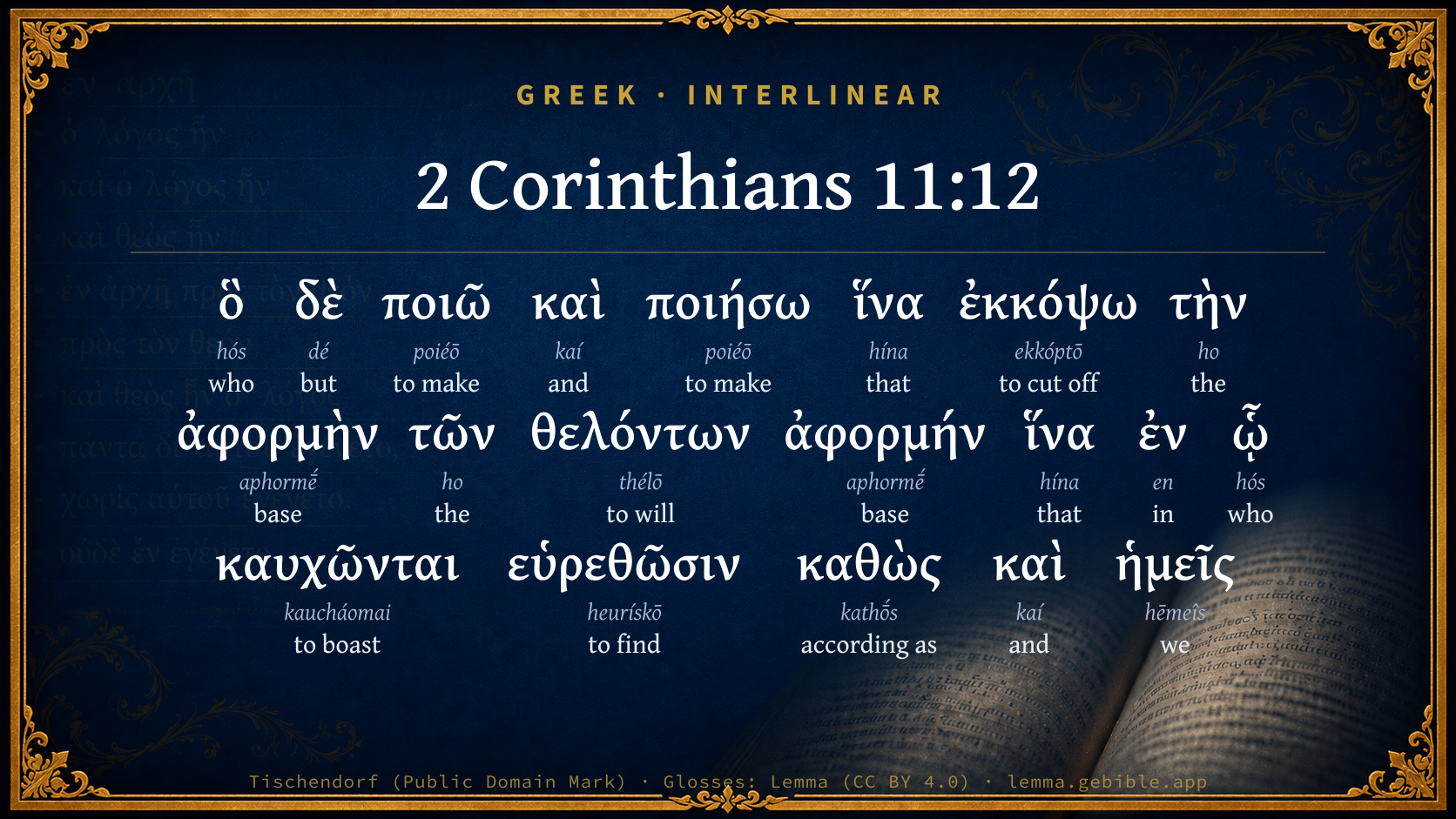
But what I do, that I will do, that I may cut off occasion from them that desire an occasion, that in which they boast, they may be found even as we.
Download a study sheet
One document with this verse’s original text, its word-by-word gloss line, the meaning frame, cross-references with their text, attributed commentary, and full source and license credits — printable, and it pastes into notes with its structure intact.
This verse Autodidact and up
A passage Seminary Student
Up to 50 verses in one chapter. A passage sheet keeps up to 6 commentary sources and 12 cross-references per verse, in the order this page ranks them, and says so on the sheet whenever that leaves anything out. Ask for a single verse and you get the Autodidact verse sheet above.
Everything on this page stays free to read, with no account — the sheet is a download of what is already on screen, not access to it.
Compare translations 3
The same verse in 3 English versions, stacked beneath the original-language interlinear above. Click any original word for its lexicon entry.
Each is an independent rendering of the whole verse — the interlinear is not word-aligned to these translations.
Highlighted words mark where these versions differ — a whole-verse word diff, not a word-by-word alignment.
-
World English Bible Public Domain
But what I do, that I will do, that I may cut off occasion from them that desire an occasion, that in which they boast, they may be found even as we.
-
King James Version Public Domain
But what I do, that I will do, that I may cut off occasion from them which desire occasion; that wherein they glory, they may be found even as we.
-
unfoldingWord Literal Text CC BY-SA 4.0
But what I do I will also do so that I may cut off the opportunity of the ones desiring an opportunity that in what they are boasting about they may be found just as we also.
unfoldingWord Literal Text — © unfoldingWord, licensed CC BY-SA 4.0. Word-aligned USFM3 via Door43 (git.door43.org/unfoldingWord/en_ult).
Show all 19 translations
Every available English version of this verse, each an independent rendering of the whole verse.
-
World English Bible Public Domain
But what I do, that I will do, that I may cut off occasion from them that desire an occasion, that in which they boast, they may be found even as we.
-
Berean Standard Bible Public Domain
But I will keep on doing what I am doing, in order to undercut those who want an opportunity to be regarded as our equals in the things of which they boast.
-
Majority Standard Bible Public Domain
But I will keep on doing what I am doing, in order to undercut those who want an opportunity to be regarded as our equals in the things of which they boast.
-
King James Version Public Domain
But what I do, that I will do, that I may cut off occasion from them which desire occasion; that wherein they glory, they may be found even as we.
-
American Standard Version (1901) Public Domain
But what I do, that I will do, that I may cut off occasion from them that desire an occasion; that wherein they glory, they may be found even as we.
-
Revised Version (1885) Public Domain
But what I do, that I will do, that I may cut off occasion from them which desire an occasion; that wherein they glory, they may be found even as we.
-
Geneva Bible (1599) Public Domain
But what I doe, that will I doe: that I may cut away occasion from them which desire occasion, that they might be found like vnto vs in that wherein they reioyce.
-
Douay-Rheims (1899) Public Domain
But what I do, that I will do, that I may cut off the occasion from them that desire occasion, that wherein they glory, they may be found even as we.
-
Young's Literal Translation Public Domain
and what I do, I also will do, that I may cut off the occasion of those wishing an occasion, that in that which they boast they may be found according as we also;
-
Literal Standard Version CC BY-SA 4.0
And what I do, I also will do, that I may cut off the occasion of those wishing an occasion, that in that which they boast they may be found according as we also;
-
Unlocked Literal Bible CC BY-SA 4.0
And what I do I will keep doing, in order that I may take away the claim for criticizing me and the claim for which they want to boast—that they are found to be doing the same work that we are doing.
-
unfoldingWord Literal Text CC BY-SA 4.0
But what I do I will also do so that I may cut off the opportunity of the ones desiring an opportunity that in what they are boasting about they may be found just as we also.
-
Darby Bible Public Domain
But what I do, I will also do, that I may cut off the opportunity of those wishing [for] an opportunity, that wherein they boast they may be found even as we.
-
World Messianic Bible Public Domain
But what I do, that I will continue to do, that I may cut off opportunity from those who desire an opportunity, that in which they boast, they may be recognized just like us.
-
Webster's Bible Public Domain
But what I do, that I will do, that I may cut off occasion from them who desire occasion; that in what they glory, they may be found even as we.
-
Free Bible Version CC BY-SA 4.0
I'll continue to do what I've always done, so as to remove any opportunity for those who want to boast that their work is the same as ours.
-
Bible in Basic English Public Domain
But what I do, that I will go on doing, so that I may give no chance to those who are looking for one; so that, in the cause of their pride, they may be seen to be the same as we are.
-
Text-Critical English NT CC BY 4.0
But what I am doing I will continue to do, so that I may deny any opportunity to those who want to be regarded as our equals in what they boast about.
-
Tyndale New Testament (1534) Public Domain
Neverthe lesse what I doo that will I do to cut awaye occasion from them which desyre occasion that they myght be founde lyke vnto vs in that wherin they reioyce.
Literal Standard Version (2020), Covenant Press — licensed CC BY-SA 4.0. Text via the HelloAO Bible API (eBible.org). Unlocked Literal Bible (unfoldingWord) — licensed CC BY-SA 4.0. Text via the HelloAO Bible API (eBible.org). unfoldingWord Literal Text — © unfoldingWord, licensed CC BY-SA 4.0. Word-aligned USFM3 via Door43 (git.door43.org/unfoldingWord/en_ult). Free Bible Version, Dr. Jonathan Gallagher — licensed CC BY-SA 4.0. Text via the HelloAO Bible API (eBible.org).
Word by word
More ways to search: Search by grammar → Find every occurrence → Compare this word →
Practice this passage: Drill this verse → Learn its vocabulary →
- Appears 7× in the Greek New Testament
- First appears at Romans 7:8
- Part of Speech
- Noun
- Case
- Accusative
- Number
- Singular
- Gender
- Feminine
Full Thayer's Definition
- ὃ hós G3739 “who” Relative pronoun, Accusative, Singular, Neuter
- δὲ dé G1161 “but” Conjunction
- ποιῶ poiéō G4160 “to make” Verb, Present, Active, Indicative, 1st person, Singular
- καὶ kaí G2532 “and” Conjunction
- ποιήσω poiéō G4160 “to make” Verb, Future, Active, Indicative, 1st person, Singular
- ἵνα hína G2443 “that” Conjunction
- ἐκκόψω ekkóptō G1581 “to cut off” Verb, Aorist, Active, Subjunctive, 1st person, Singular
- τὴν ho G3588 “the” Article, Accusative, Singular, Feminine
- ἀφορμὴν aphormḗ G874 “base” Noun, Accusative, Singular, Feminine
- τῶν ho G3588 “the” Article, Genitive, Plural, Masculine
- θελόντων thélō G2309 “to will” Verb, Present, Active, Participle, Genitive, Plural, Masculine
- ἀφορμήν aphormḗ G874 “base” Noun, Accusative, Singular, Feminine
- ἵνα hína G2443 “that” Conjunction
- ἐν en G1722 “in” Preposition
- ᾧ hós G3739 “who” Relative pronoun, Dative, Singular, Neuter
- καυχῶνται kaucháomai G2744 “to boast” Verb, Present, Middle or Passive deponent, Indicative, 3rd person, Plural
- εὑρεθῶσιν heurískō G2147 “to find” Verb, Aorist, Passive, Subjunctive, 3rd person, Plural
- καθὼς kathṓs G2531 “according as” Adverb
- καὶ kaí G2532 “and” Conjunction
- ἡμεῖς hēmeîs G2249 “we” Personal pronoun, 1st person, Nominative, Plural
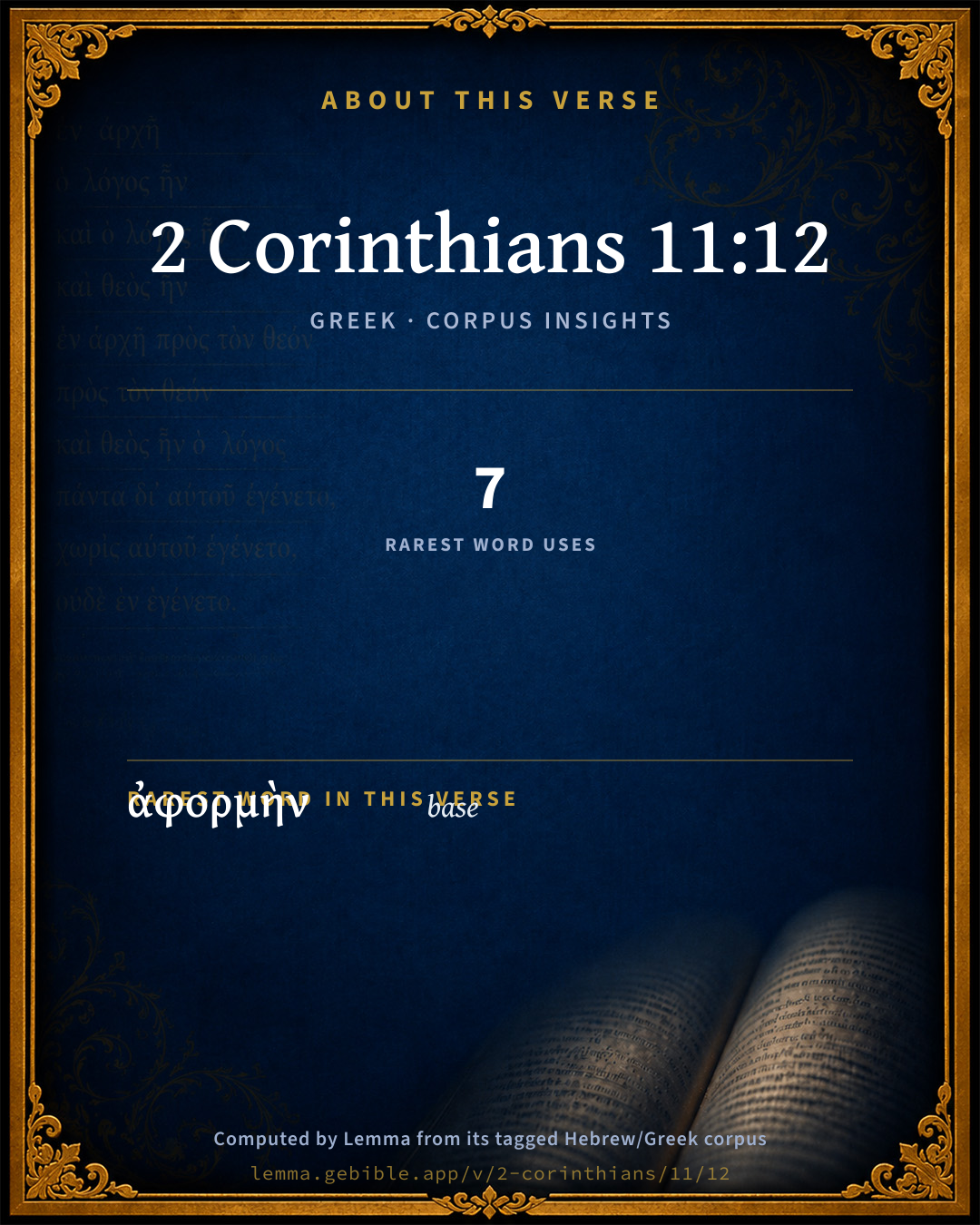
About this verse
These counts appear in no published source. They are computed here, from the morphology-tagged text and Lemma’s own curated glosses. What Lemma adds →
- 20
- words
- 14
- distinct lemmas
- Pauline Epistles
- section
Cross-references
12Topical passages linked to 2 Corinthians 11:12 in the Treasury of Scripture Knowledge — connected by theme and wording, ordered by reader-vote popularity; previews shown in the World English Bible.
- 1 Corinthians 9:12 If others partake of this right over you, don't we yet more? Nevertheless we did not use this right, but we bear all things, that we may cause no hindrance to the Gospel of Christ.
- Job 23:13 But he stands alone, and who can oppose him? What his soul desires, even that he does.
- 1 Corinthians 5:6 Your boasting is not good. Don't you know that a little yeast leavens the whole lump?
- 2 Corinthians 1:17 When I therefore was thus determined, did I show fickleness? Or the things that I purpose, do I purpose according to the flesh, that with me there should be the "Yes, yes" and the "No, no?"
- 2 Corinthians 5:12 For we are not commending ourselves to you again, but speak as giving you occasion of boasting on our behalf, that you may have something to answer those who boast in appearance, and not in heart.
- 2 Corinthians 10:17 But "he who boasts, let him boast in the Lord."
- 2 Corinthians 11:9 When I was present with you and was in need, I wasn't a burden on anyone, for the brothers, when they came from Macedonia, supplied the measure of my need. In everything I kept myself from being burdensome to you, and I will continue to do so.
- 2 Corinthians 11:18 Seeing that many boast after the flesh, I will also boast.
- Galatians 1:7 and there isn't another gospel. Only there are some who trouble you, and want to pervert the Gospel of Christ.
- Galatians 6:13–14 For even they who receive circumcision don't keep the law themselves, but they desire to have you circumcised, that they may boast in your flesh.
- Philippians 1:15–30 Some indeed preach Christ even out of envy and strife, and some also out of good will.
- 1 Timothy 5:14 I desire therefore that the younger widows marry, bear children, rule the household, and give no occasion to the adversary for reviling.
Cross-references courtesy of OpenBible.info (CC BY 4.0).
Lesson kit
Teaching starters — assembled from the data on this page, not authored interpretation. Every prompt links to the verse data it draws on. Edit before teaching.
2 Corinthians, in the Pauline Epistles, opens this verse with 20 words (14 distinct Greek lemmas). Its most distinctive word is aphormḗ (“base”). A historical commentator’s framing appears above. Read the whole chapter for the surrounding context.
Discussion questions
- How does “base” (aphormḗ) shape what this verse is saying?
- How does Romans 7:8, which shares the word «base», read alongside this verse?
- What does the repetition of “to make” (2× in this one verse) do in this verse?
- These translations render this verse differently; the difference is in the English rendering, not the original. What questions does that raise?
- Compare how The Preacher's Complete Homiletical Commentary and Tyndale Open Study Notes read this verse. Where do they agree or differ?
Things to notice
- These translations choose different wording for 14 words in this verse.
- “to make” occurs 2× in this single verse.
- 14 distinct Greek lemmas span 20 words in this verse.
Commentary
Notes on 2 Corinthians 11:12 from classic Christian and Jewish commentators (each source and its license shown beneath its notes). The classic Christian expositions comment on the surrounding passage and are grouped to its opening verse, so a note may address several verses; the Jewish commentaries on the Tanakh (Rashi and others) are per-verse, so they appear only where the commentator wrote on this verse.
Lemma curates 59 commentaries, every one of them public domain or Creative Commons licensed, each selected and text-cleaned for this edition rather than reprinted as found. About our sources →
The Preacher's Complete Homiletical Commentary
Joseph S. Exell (gen. ed.)
The Preacher's Complete Homiletical Commentary (gen. ed. Joseph S. Exell; Funk & Wagnalls, c. 1892) — public domain (pre-1929). A full-Bible homiletical/sermon-outline anthology covering 65 of 66 books (2 John is absent from the source module). Text from a community e-Sword module.
Tyndale Open Study Notes
Tyndale Open Resources
Tyndale Open Study Notes — © Tyndale Open Resources, licensed CC BY-SA 4.0. Text via the HelloAO Bible API.
Bengel's Gnomon
Johann Albrecht Bengel
Bengel's Gnomon of the New Testament — English translation (T&T Clark, Edinburgh, 1860) — public domain. Text from a community e-Sword module.
Meyer's Critical & Exegetical Commentary
Heinrich August Wilhelm Meyer
Meyer — Critical and Exegetical Commentary on the New Testament — English translation by Peter Christie, edited by Frederick Crombie (T&T Clark, 1880) — public domain. Text from a community e-Sword module.
Expositor's Greek Testament
ed. W. Robertson Nicoll
The Expositor's Greek Testament, edited by W. Robertson Nicoll (1897–1910) — public domain. Text from a community e-Sword module.
Geneva Bible (1599)
Geneva Bible translators
Geneva Bible (1599) marginal notes — public domain. Text via Bolls.life.
Jamieson, Fausset & Brown
Robert Jamieson, A. R. Fausset & David Brown
Jamieson, Fausset & Brown — Commentary Critical and Explanatory on the Whole Bible (1871) — public domain (CC PDM 1.0). Text via the HelloAO Bible API.
Adam Clarke's Commentary
Adam Clarke's Commentary on the Bible (1810–1826) — public domain. Text from a community e-Sword/MySword module.
John Calvin's Commentaries
John Calvin's Commentaries (1540-1563) — public domain. Text from the Calvin Translation Society English edition (1840s-50s) via the Christian Classics Ethereal Library (ccel.org). Calvin's coverage is partial (roughly two-thirds of the Bible); uncommented books and verses are honest gaps, never fabricated. The 19th-century editor's footnotes and remarks are omitted so the notes are faithfully Calvin's own voice.
Ellicott's Commentary for English Readers
A Bible Commentary for English Readers, edited by Charles John Ellicott (1878–1897) — public domain. Text from a community e-Sword module.
The Cambridge Bible for Schools and Colleges
gen. ed. J. J. S. Perowne
The Cambridge Bible for Schools and Colleges (gen. ed. J. J. S. Perowne; Cambridge University Press, 1878–1918) — public domain. Text from a community e-Sword module.
John Gill's Exposition
John Gill's Exposition of the Whole Bible (1746–1763) — public domain (CC PDM 1.0). Text via the HelloAO Bible API.
Trapp's Complete Commentary
John Trapp
John Trapp, A Commentary or Exposition upon All the Books of the Old and New Testament (1647–1656) — public domain. Text from a community e-Sword module.
Albert Barnes' Notes on the Bible
Albert Barnes' Notes on the Bible (1834–1885) — public domain. Text from a community e-Sword/MySword module.
Haydock's Catholic Bible Commentary
George Leo Haydock (1774–1849), Haydock's Catholic Family Bible and Commentary, 1859 edition — public domain. Excludes Psalms (Douay-Rheims chapter numbering differs from Protestant) and Deuterocanonical books (Catholic canon only).
Matthew Poole's English Annotations
Matthew Poole's English Annotations on the Holy Bible (1683–1685) — public domain. Text from a community e-Sword/MySword module.
Whedon's Commentary on the Bible
Daniel D. Whedon
Daniel D. Whedon (gen. ed.), Commentary on the Old and New Testaments (1874–1909) — public domain. Text from a community e-Sword module.
The Pulpit Commentary
The Pulpit Commentary (1880–1919), ed. H.D.M. Spence-Jones & Joseph S. Exell — public domain. Text from a community e-Sword module.
John Wesley's Explanatory Notes
John Wesley, Explanatory Notes Upon the Whole Bible (1754–1765) — public domain. Text via the GEBible commentary corpus.
McGarvey & Pendleton's Commentaries
J. W. McGarvey
J. W. McGarvey (with Philip Y. Pendleton), Commentaries on the New Testament (The Fourfold Gospel, 1914; Acts; and the epistles) — public domain. Text from a community e-Sword/MySword module.
unfoldingWord translationNotes
Door43 World Missions Community
unfoldingWord translationNotes — © Distant Shores Media and the Door43 World Missions Community, licensed CC BY-SA 4.0. Source: git.door43.org/Door43/en_tn.
Cambridge Greek Testament for Schools and Colleges
Cambridge Greek Testament for Schools and Colleges (Cambridge University Press, 1896; 21 vols, various authors incl. Carr, Maclear, Plummer, Farrar, Lumby, Moule, M. R. James, Simcox) — public domain. Text from a community e-Sword module.
Alford’s Greek Testament
Henry Alford
Henry Alford, The Greek Testament (1849–1861) — public domain. Text from a community e-Sword module.
International Critical Commentary
International Critical Commentary — older volumes (1896–1929), various authors — public domain. Text from a community e-Sword module.
Vincent's Word Studies in the New Testament
Marvin R. Vincent
Marvin R. Vincent, Word Studies in the New Testament (1887–1900) — public domain. Text from a community e-Sword/MySword module.