Genesis 27:20

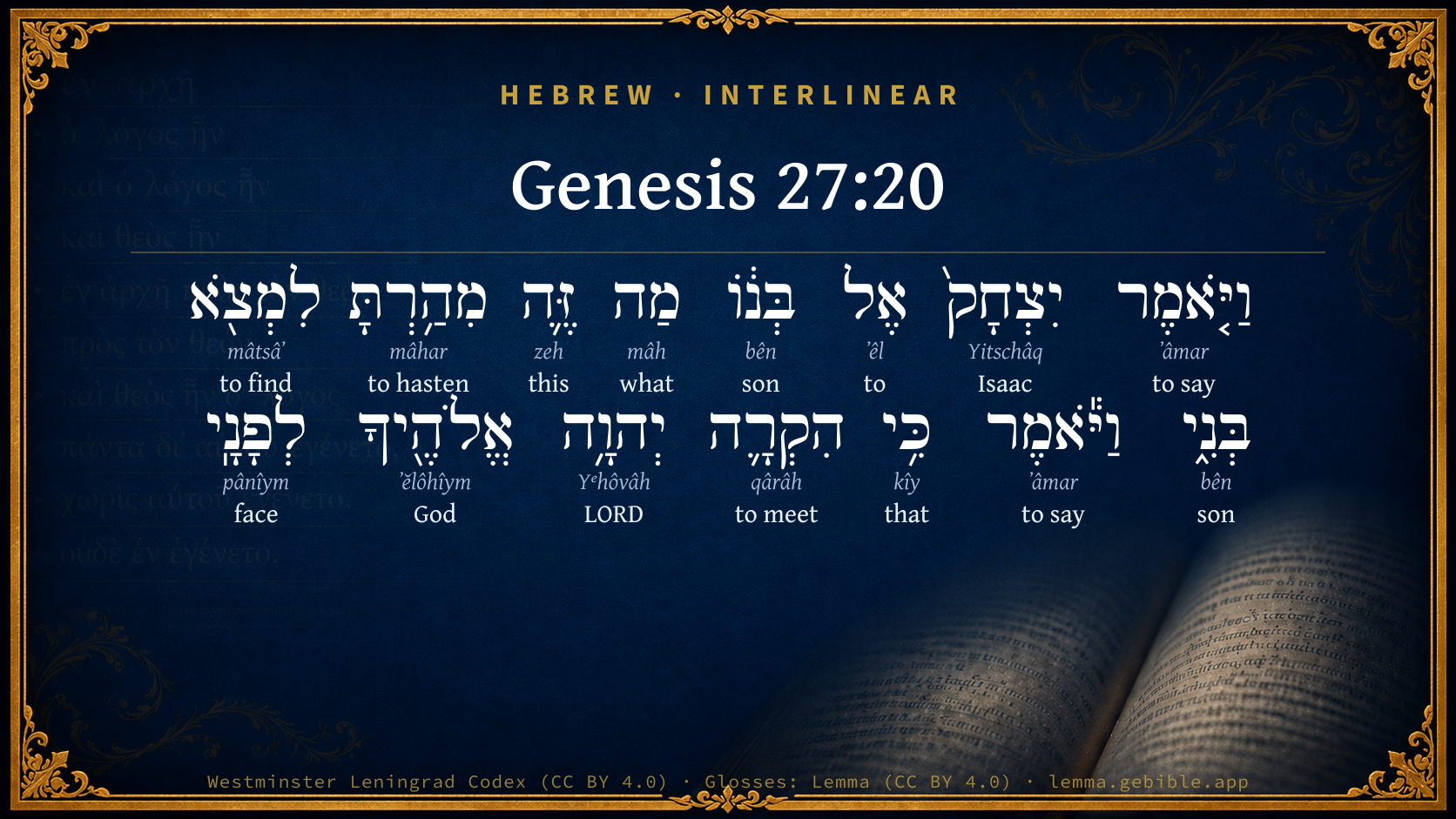
Hebrew (Westminster Leningrad Codex) Genesis 27:20 appears in the Hebrew Old Testament. The text above is from the Westminster Leningrad Codex. Each word links to its Strong’s number, a concise gloss, and parsing drawn from the Open Scriptures Hebrew Bible morphology. Click any word for its full Brown-Driver-Briggs (BDB) entry.
Download image
Cite this verse

Genesis 27:20 (World English Bible). Public Domain. Lemma interlinear Bible study tool, https://lemma.gebible.app/v/genesis/27/20.

Show BibTeX & RIS
BibTeX
RIS
English Translation
Isaac said to his son, "How is it that you have found it so quickly, my son?" He said, "Because Yahweh your God gave me success."
World English Bible · Public Domain
Download a study sheet

One document with this verse’s original text, its word-by-word gloss line, the meaning frame, cross-references with their text, attributed commentary, and full source and license credits — printable, and it pastes into notes with its structure intact.

This verse Autodidact and up

Study sheet (.html) Plain text (.txt)

A passage Seminary Student

Up to 50 verses in one chapter. A passage sheet keeps up to 6 commentary sources and 12 cross-references per verse, in the order this page ranks them, and says so on the sheet whenever that leaves anything out. Ask for a single verse and you get the Autodidact verse sheet above.

Everything on this page stays free to read, with no account — the sheet is a download of what is already on screen, not access to it.

Want to remove ads? Support Godless Engineer
Compare translations 3

The same verse in 3 English versions, stacked beneath the original-language interlinear above. Click any original word for its lexicon entry.

Each is an independent rendering of the whole verse — the interlinear is not word-aligned to these translations.

Highlighted words mark where these versions differ — a whole-verse word diff, not a word-by-word alignment.

  • World English Bible Public Domain
    Isaac said to his son, "How is it that you have found it so quickly, my son?" He said, "Because Yahweh your God gave me success."
  • King James Version Public Domain
    And Isaac said unto his son, How is it that thou hast found it so quickly, my son? And he said, Because the LORD thy God brought it to me.
  • unfoldingWord Literal Text CC BY-SA 4.0
    Then Isaac said to his son, “How this you were quick to find, my son?” And he said, “Because Yahweh your God caused to happen before me.”

unfoldingWord Literal Text — © unfoldingWord, licensed CC BY-SA 4.0. Word-aligned USFM3 via Door43 (git.door43.org/unfoldingWord/en_ult).

Versions to compare (up to 4)

3 of 4 selected

Show all 18 translations

Every available English version of this verse, each an independent rendering of the whole verse.

  • World English Bible Public Domain
    Isaac said to his son, "How is it that you have found it so quickly, my son?" He said, "Because Yahweh your God gave me success."
  • Berean Standard Bible Public Domain
    But Isaac asked his son, “How did you ever find it so quickly, my son?” “Because the LORD your God brought it to me,” he replied.
  • Majority Standard Bible Public Domain
    But Isaac asked his son, “How did you ever find it so quickly, my son?” “Because the LORD your God brought it to me,” he replied.
  • King James Version Public Domain
    And Isaac said unto his son, How is it that thou hast found it so quickly, my son? And he said, Because the LORD thy God brought it to me.
  • American Standard Version (1901) Public Domain
    And Isaac said unto his son, How is it that thou hast found it so quickly, my son? And he said, Because Jehovah thy God sent me good speed.
  • Revised Version (1885) Public Domain
    And Isaac said unto his son, How is it that thou hast found it so quickly, my son? And he said, Because the LORD thy God sent me good speed.
  • Geneva Bible (1599) Public Domain
    Then Izhak said vnto his sonne, Howe hast thou founde it so quickly my sonne? Who sayde, Because the Lord thy God brought it to mine hande.
  • Douay-Rheims (1899) Public Domain
    And Isaac said to his son: How couldst thou find it so quickly, my son?
  • Young's Literal Translation Public Domain
    And Isaac saith unto his son, `What `is' this thou hast hasted to find, my son?' and he saith, `That which Jehovah thy God hath caused to come before me.'
  • Literal Standard Version CC BY-SA 4.0
    And Isaac says to his son, “What [is] this you have hurried to find, my son?” And he says, “That which your God YHWH has caused to come before me.”
  • Unlocked Literal Bible CC BY-SA 4.0
    Isaac said to his son, “How is it that you have found it so quickly, my son?” He said, “Because Yahweh your God brought it to me.”
  • unfoldingWord Literal Text CC BY-SA 4.0
    Then Isaac said to his son, “How this you were quick to find, my son?” And he said, “Because Yahweh your God caused to happen before me.”
  • Darby Bible Public Domain
    And Isaac said to his son, How is it that thou hast found [it] so quickly, my son? And he said, Because Jehovah thy God put [it] in my way.
  • World Messianic Bible Public Domain
    Isaac said to his son, “How is it that you have found it so quickly, my son?” He said, “Because the LORD your God gave me success.”
  • Webster's Bible Public Domain
    And Isaac said to his son, How is it that thou hast found it so quickly, my son? And he said, Because the LORD thy God brought it to me.
  • Free Bible Version CC BY-SA 4.0
    “How did you find an animal so fast, my son?” Isaac asked. “Because the Lord your God sent it my way,” Jacob replied.
  • Bible in Basic English Public Domain
    And Isaac said, How is it that you have got it so quickly, my son? And he said, Because the Lord your God made it come my way.
  • JPS Tanakh (1917) Public Domain
    And Isaac said unto his son: 'How is it that thou hast found it so quickly, my son?' And he said: 'Because the LORD thy God sent me good speed.'

Literal Standard Version (2020), Covenant Press — licensed CC BY-SA 4.0. Text via the HelloAO Bible API (eBible.org). Unlocked Literal Bible (unfoldingWord) — licensed CC BY-SA 4.0. Text via the HelloAO Bible API (eBible.org). unfoldingWord Literal Text — © unfoldingWord, licensed CC BY-SA 4.0. Word-aligned USFM3 via Door43 (git.door43.org/unfoldingWord/en_ult). Free Bible Version, Dr. Jonathan Gallagher — licensed CC BY-SA 4.0. Text via the HelloAO Bible API (eBible.org).

Word by word

More ways to search: Search by grammar → Find every occurrence → Compare this word →

Practice this passage: Drill this verse → Learn its vocabulary →

הִקְרָ֛ה
qârâh
H7136
“to meet”
Verb, Hiphil, Perfect, 3rd Person, Masculine, Singular
Part of Speech
Verb
Stem
Hiphil
Form
Perfect
Person
3rd Person
Gender
Masculine
Number
Singular
Full BDB Definition

Origin: a primitive root

TWOT: 2068 , 2068e

to encounter, meet, befall, happen, come to meet - (Qal) - to encounter, meet - to befall - (Niphal) - to encounter, meet (without pre-arrangement) - to chance to be present - to come to meet - (Hiphil) to cause to meet, appoint - to build with beams - (Piel) to lay the beams of, furnish with beams
  1. וַיֹּ֤אמֶר ʼâmar H559 “and · to say” Conjunction + Verb, Qal, Sequential Imperfect, 3rd Person, Masculine, Singular
  2. יִצְחָק֙ Yitschâq H3327 “Isaac” Noun, Proper
  3. אֶל ʼêl H413 “to” Preposition
  4. בְּנ֔וֹ bên H1121 “son · his” Noun, Common, Masculine, Singular, Construct + Suffix, Personal, 3rd Person, Masculine, Singular
  5. מַה mâh H4100 “what” Particle, Interrogative
  6. זֶּ֛ה zeh H2088 “this” Pronoun, Demonstrative, Masculine, Singular
  7. מִהַ֥רְתָּ mâhar H4116 “to hasten” Verb, Piel, Perfect, 2nd Person, Masculine, Singular
  8. לִמְצֹ֖א mâtsâʼ H4672 “to find” Preposition + Verb, Qal, Infinitive Construct
  9. בְּנִ֑י bên H1121 “son · my” Noun, Common, Masculine, Singular, Construct + Suffix, Personal, 1st Person, Common, Singular
  10. וַיֹּ֕אמֶר ʼâmar H559 “and · to say” Conjunction + Verb, Qal, Sequential Imperfect, 3rd Person, Masculine, Singular
  11. כִּ֥י kîy H3588 “that” Conjunction
  12. יְהוָ֥ה Yᵉhôvâh H3068 “LORD” Noun, Proper
  13. אֱלֹהֶ֖יךָ ʼĕlôhîym H430 “God(s) · your” Noun, Common, Masculine, Plural, Construct + Suffix, Personal, 2nd Person, Masculine, Singular
  14. לְפָנָֽי pânîym H6440 “to/for · face(s) · my” Preposition + Noun, Common, Both, Plural, Construct + Suffix, Personal, 1st Person, Common, Singular

About this verse

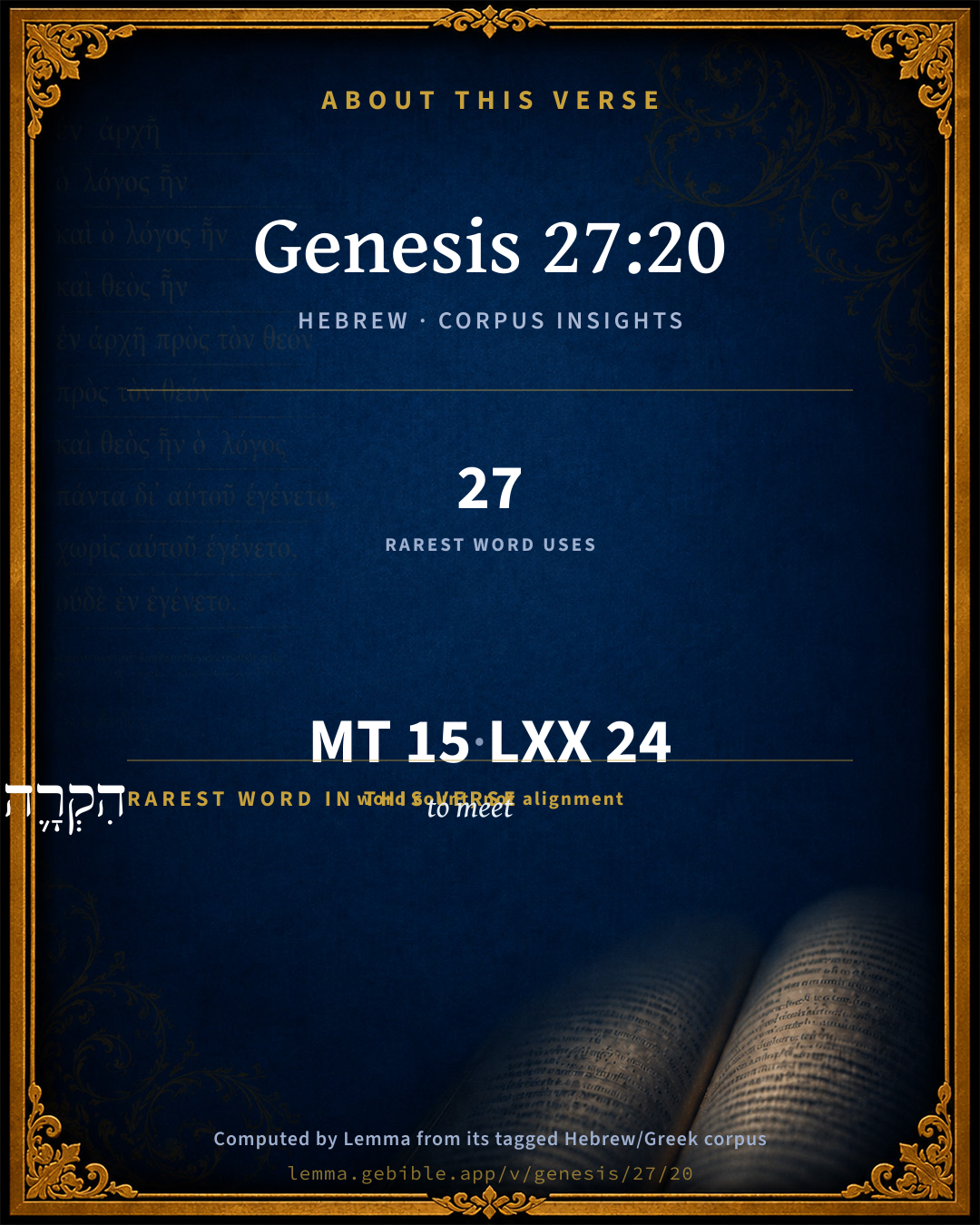
These counts appear in no published source. They are computed here, from the morphology-tagged text and Lemma’s own curated glosses. What Lemma adds →

15
words
13
distinct lemmas
Pentateuch
section

Shared distinctive vocabulary

הִקְרָ֛ה to meet H7136 occurs in 27 verses of the Hebrew Bible. Also found in:

Grammatical profile

  • 5 verbs
  • 6 nouns
  • 1 pronoun
  • 1 preposition
  • 1 conjunction
  • 1 particle

Verb forms

  • וַיֹּ֤אמֶר Qal · Sequential Imperfect
  • מִהַ֥רְתָּ Piel · Perfect
  • לִמְצֹ֖א Qal · Infinitive Construct
  • וַיֹּ֕אמֶר Qal · Sequential Imperfect
  • הִקְרָ֛ה Hiphil · Perfect

Repetition

Words recur within this verse — often emphatic in Hebrew:

  • וַיֹּ֤אמֶר to say H559 ×2
  • בְּנ֔וֹ son H1121 ×2

Hebrew & Septuagint length

In English translation the verse runs 26 words from the Hebrew and 26 from the Septuagint (LXX English) — the same length.

A rough comparison of the two English renderings, which tokenize alike — not a word-level alignment.

Word counts can differ between the Hebrew and the Greek without any difference in meaning — e.g. the Hebrew direct-object marker אֵת has no separate Greek word, and Greek often adds the article ὁ.

In the original languages it is 15 Hebrew tokens and 24 Greek tokens — but the two are counted differently (Hebrew bundles its prefixes and suffixes into one token; the Greek is in lemma form), so that isn’t a like-for-like length.

Cross-references

3

Topical passages linked to Genesis 27:20 in the Treasury of Scripture Knowledge — connected by theme and wording, ordered by reader-vote popularity; previews shown in the World English Bible.

  • Genesis 24:12 He said, "Yahweh, the God of my master Abraham, please give me success this day, and show kindness to my master Abraham.
  • Exodus 20:7 "You shall not take the name of Yahweh your God in vain, for Yahweh will not hold him guiltless who takes his name in vain.
  • Job 13:7 Will you speak unrighteously for God, And talk deceitfully for him?

Cross-references courtesy of OpenBible.info (CC BY 4.0).

Hebrew and Greek witnesses Masoretic Hebrew ↔ Greek Septuagint

The same verse in the two great witnesses to the Old Testament, shown verse-for-verse.

These are two independent witnesses, not word-aligned to each other, and the Septuagint is shown in lemma (dictionary) form.

Hebrew Genesis 27:20 Masoretic · Westminster Leningrad Codex

וַיֹּ֤אמֶר יִצְחָק֙ אֶל בְּנ֔וֹ מַה זֶּ֛ה מִהַ֥רְתָּ לִמְצֹ֖א בְּנִ֑י וַיֹּ֕אמֶר כִּ֥י הִקְרָ֛ה יְהוָ֥ה אֱלֹהֶ֖יךָ לְפָנָֽי

Isaac said to his son, "How is it that you have found it so quickly, my son?" He said, "Because Yahweh your God gave me success."

World English Bible · Public Domain

Greek LXX Genesis 27:20 Septuagint · lemma form

εἶπον δέ ισαακ ὁ υἱός αὐτός τίς οὗτος ὅς ταχύς εὑρίσκω ὦ τέκνον ὁ δέ εἶπον ὅς παραδίδωμι κύριος ὁ θεός σύ ἐναντίον ἐγώ

And Isaac said to his son, What is this which you have quickly found? And he said, That which the Lord your God presented before me.

LXX2012 (modern English Septuagint) · Public Domain

Hebrew: Westminster Leningrad Codex (CC BY 4.0). Greek: Septuagint (public domain); English from LXX2012 (modern English Septuagint) (Public Domain). How the Septuagint differs from the Hebrew →

Targum (Aramaic paraphrase)

2

The Targum is the ancient Jewish Aramaic paraphrase of the Hebrew Scriptures — an interpretive translation, not the Hebrew text itself. Onkelos (literal) and Pseudo-Jonathan (expansive) render the Torah, and Jonathan the Prophets. Coverage is partial: where no permissively-licensed English translation exists for a verse, only the Aramaic is shown. This is verse-level text, not a word-by-word alignment to the Hebrew.

  1. Targum Onkelos Torah (Genesis–Deuteronomy)
    וַאֲמַר יִצְחָק לִבְרֵהּ מָה דֵּין אוֹחֵיתָא לְאַשְׁכָּחָא בְּרִי וַאֲמַר אֲרֵי זַמִּין יְיָ אֱלָהָךְ קֳדָמַי

    (no public-domain English translation for this verse)

    Targum Onkelos — Aramaic: “Onkelos Genesis” (public domain); “Onkelos Exodus” (public domain); “Onkelos Leviticus” (public domain); “Onkelos Numbers” (public domain); “Onkelos Deuteronomy” (public domain). English: “Sefaria Community Translation” (CC0 1.0 (public-domain dedication)); “J.W. Etheridge. The Targums of Onkelos and Jonathan Ben Uzziel on the Pentateuch. London: Longmans, Green, 1862” (public domain). Text via Sefaria.

  2. Targum Pseudo-Jonathan Torah (Genesis–Deuteronomy)
    וַאֲמַר יִצְחָק לִבְרֵיהּ מַה דֵין אוֹחִיתָא לְאַשְׁכְּחָא בְּרִי וַאֲמַר אֲרוּם זַמִין יְיָ אֱלָהָךְ קֳדָמַי

    And Izhak said to his son, What is this that thou hast found so soon, my son? And he said, Because the Lord thy God had prepared it before me.

    Targum Pseudo-Jonathan — Aramaic: “Targum Jonathan on Genesis” (public domain); “Targum Jonathan on Exodus” (public domain); “Targum Jonathan on Leviticus” (public domain); “Targum Jonathan on Numbers” (public domain); “Targum Jonathan on Deuteronomy” (public domain). English: “The Targum of Jonathan ben Uzziel, trans. J. W. Etheridge, London, 1862” (public domain). Text via Sefaria.

Commentary

Notes on Genesis 27:20 from classic Christian and Jewish commentators (each source and its license shown beneath its notes). The classic Christian expositions comment on the surrounding passage and are grouped to its opening verse, so a note may address several verses; the Jewish commentaries on the Tanakh (Rashi and others) are per-verse, so they appear only where the commentator wrote on this verse.

Lemma curates 59 commentaries, every one of them public domain or Creative Commons licensed, each selected and text-cleaned for this edition rather than reprinted as found. About our sources →

Trapp's Complete Commentary

John Trapp

Gen 27:20 And Isaac said unto his son, How [is it] that thou hast found [it] so quickly, my son? And he said, Because the LORD thy God brought [it] to me.

Ver. 20. How is it that thou hast found it so quickly?] A man may very well ask our common Protestants this question concerning the faith they so much boast of, but came by it too quickly to be fight. They were never yet in the furnace of mortification, - felt the spirit of bondage, the terrors of God in their consciences. Their faith is like Jonah’s gourd, that grew up in a night; or a bullet in a mould, that is made in a moment. Let ours be like the water of Bethlehem, much longed for, and hardly come by, &c. {2Sa 23:15}

John Trapp, A Commentary or Exposition upon All the Books of the Old and New Testament (1647–1656) — public domain. Text from a community e-Sword module.

Joseph Benson's Commentary

Gen 27:20. The Lord thy God brought it to me — Is this Jacob? It is certainly written not for our imitation, but our admonition. Here we see how one lie draws on another. Let him that standeth, take heed lest he fall.

Now let us see how Isaac gave Jacob his blessing.

Joseph Benson's Commentary on the Old and New Testaments (1811–1818) — public domain. Text from a community e-Sword module.

Tyndale Open Study Notes

Tyndale Open Resources

27:20-27 Isaac voiced his suspicion three times but was finally deceived by his senses, which were not functioning well (see study note on 27:1-4).

Tyndale Open Study Notes — © Tyndale Open Resources, licensed CC BY-SA 4.0. Text via the HelloAO Bible API.

Ellicott's Commentary for English Readers

(20) Because the Lord thy God brought it to me.—Jacob does not keep up his acting well here, for it was not in accordance with Esau’s character to see anything providential in his success in hunting. This may have helped to arouse Isaac’s suspicions, who immediately proceeds to examine him.

A Bible Commentary for English Readers, edited by Charles John Ellicott (1878–1897) — public domain. Text from a community e-Sword module.

The Cambridge Bible for Schools and Colleges

gen. ed. J. J. S. Perowne

20. How is it … quickly] Isaac’s question implies a second shadow of doubt. This time it arises not from the voice, but from the disquieting thought of the extraordinary rapidity of the huntsman’s good fortune.

Because the Lord thy God] Jacob takes a third step in deceitfulness. To the lie and the vaunt of Gen_27:19 he now adds the profanity of claiming the Divine assistance. But, at least, he says “the Lord thy God”: his conscience does not quite permit him to say “the Lord my God.”

sent me good speed] Lit. “caused it opportunely to come into my presence,” the same word as in Gen_24:12. Lat. voluntas Dei fuit ut cito occurreret mihi quod volebam. The reference to the Divine Name adds to the deceit a taint of pious hypocrisy.

The Cambridge Bible for Schools and Colleges (gen. ed. J. J. S. Perowne; Cambridge University Press, 1878–1918) — public domain. Text from a community e-Sword module.

John Gill's Exposition

And Isaac said unto his son,.... Supposing him to be Esau:

how is it that thou hast found it so quickly, my son? that is, the venison; that he had met with it so soon in, the field, and got it dressed and ready in so short a time, which was not common, and seemed to be too little for doing all this in it, and so still created some suspicion of deceit:

and he said, because the Lord thy God brought it to me; which was another falsehood; for it was not the Lord, but his mother brought it to him: and this seems to be the most marvellous of all, that so good a man should dare to bring the name of the Lord God into this affair; indeed he does not say the Lord my God, or our God, but thy God; which some think was done on purpose, the more to cover the deceit, because they suppose that Esau, whom Jacob impersonated, was an idolater, but this is not so evident; rather it looks as if Jacob had not the confidence to call the Lord his God with a lie in his mouth.

John Gill's Exposition of the Whole Bible (1746–1763) — public domain (CC PDM 1.0). Text via the HelloAO Bible API.

Whedon's Commentary on the Bible

Daniel D. Whedon

20. The Lord thy God brought it to me — The bold and daring way in which Jacob utters his falsehoods here, and this use of the name Jehovah, is amazing. Isaac seems to have detected Jacob’s voice, and he became suspicious. But he probably mistrusted his own hearing as he did his eyesight. “The scene of the fraud,” says Kalisch, “is described with a psychological skill which rivets the interest, and excites the admiration of the reader.”

Daniel D. Whedon (gen. ed.), Commentary on the Old and New Testaments (1874–1909) — public domain. Text from a community e-Sword module.

The Pulpit Commentary

Vers. 20, 21. And Isaac (still dissatisfied, but still resolving to proceed with caution) said unto his son, How is it that thou hast found it so quickly, my son? Giving expression to a natural surprise at the speedy success which had attended Esau"s hunting expedition; an interrogation to which Jacob replied With daring boldness (Murphy), with consummate effrontery (Bush), not without perjury (Calvin), and even with reckless blasphemy (Kalisch, Alford). And he said, Because the Lord thy God brought it to me. Literally, caused it to come before me; by the concurrence, of course, of his pro vide nce; which, though in one sense true, yet as used by Jacob was an impious falsehood. Solemn as this declaration was, it failed to lull the suspicions or allay the disquiet of the aged invalid.

And Isaac said unto Jacob, Come near, I pray thee, that I may feel thee, my son, the very thing which Jacob had suggested as likely to happen (ver. 12)whether thou be my very son Esau (literally, this, my son Esau) or not.

The Pulpit Commentary (1880–1919), ed. H.D.M. Spence-Jones & Joseph S. Exell — public domain. Text from a community e-Sword module.

John Wesley's Explanatory Notes

The Lord thy God brought it to me - Is this Jacob? It is certainly written not for our imitation, but our admonition, Let him that, standeth, take heed lest he fall. Now let us see how Isaac gave Jacob his blessing. 27-1. He kissed him; in token of particular affection to him. Those that are blessed of God are kissed with the kisses of his mouth, and they do by love and loyalty kiss the son, Psalm ii, 12. 2. He praised him. Upon occasion of the sweet smell of his garments he said, See the smell of my son is as the smell of a field which the Lord hath blessed - That is, like that of the most fragrant flowers and spices. Three things Jacob is here blessed with, (1.) Plenty, ver. 28. Heaven and earth concurring to make him rich. (2.) Power, ver. 29. Particularly dominion over his brethren, viz. Esau and his posterity. (3.) Prevalency with God, and a great interest in heaven, Cursed be every one that curseth thee - Let God be a friend to all thy friends, and an enemy to all thine enemies. Now, certainly more is comprised in this blessing than appears at first; it must amount to an entail of the promise of the Messiah: that was in the patriarchal dialect the blessing; something spiritual doubtless is included in it. First, That from him should come the Messiah, that should have a sovereign dominion on earth. See Num. xxiv, 19. Out of Jacob shall come he that shall have dominion, the star and scepter, Num. xxiv, 17. Jacob's dominion over Esau was to be only typical of this, chap. xlix, 10. Secondly, That from him should come the church that should be particularly owned and favoured by Heaven. It was part of the blessing of Abraham when he was first called to be the father of the faithful, chap. xii, 3. I will bless them that bless thee; therefore when Isaac afterwards confirmed the blessing to Jacob, he called it the blessing of Abraham, chap. xxviii, 4.

John Wesley, Explanatory Notes Upon the Whole Bible (1754–1765) — public domain. Text via the GEBible commentary corpus.

unfoldingWord translationNotes

Door43 World Missions Community

He said

"Jacob replied"

brought it to me

This is an idiom meaning that God caused it to happen. AT: "helped me to succeed while hunting" (See: Idiom)

whether you are my true son Esau or not

"if you are really my son Esau"

translationWords

Isaac

Yahweh

God

unfoldingWord translationNotes — © Distant Shores Media and the Door43 World Missions Community, licensed CC BY-SA 4.0. Source: git.door43.org/Door43/en_tn.

Radak

Rabbi David Kimhi (Radak)

ויאמר יצחק, because of the sound of Yaakov’s voice his mind had been alerted so that he began to examine the person standing before him more closely. The fact that so little time had elapsed since he instructed Esau to go hunting made him suspicious that it might not be Esau standing there.

כי הקרה ה' אלוקיך, “your merit has assisted me to accomplish my mission so quickly, seeing that what I did was for your sake.”

Radak on the Tanakh — English translations: “Sefaria Community Translation” (CC0 1.0 (public-domain dedication)); “Eliyahu Munk, HaChut Hameshulash” (CC BY 4.0); “Rabbi Mike Feuer, Jerusalem Anthology” (CC BY 4.0); and “R. David Kimhi on the first book of Psalms, Translated by R.G. Finch, London, 1919” (public domain). Text via Sefaria.

Lesson kit

Teaching starters — assembled from the data on this page, not authored interpretation. Every prompt links to the verse data it draws on. Edit before teaching.

Genesis, in the Pentateuch, opens this verse with 15 words (13 distinct Hebrew lemmas). Its most distinctive word is qârâh (“to meet”). A historical commentator’s framing appears above. Read the whole chapter for the surrounding context.

Discussion questions

  1. The word qârâh carries the sense “to meet.” How does it shape the verse?
  2. How does Genesis 24:12, which shares the word «to meet», read alongside this verse?
  3. What does the repetition of “to say” (2× in this one verse) do in this verse?
  4. These translations render this verse differently; the difference is in the English rendering, not the original. What questions does that raise?
  5. «וַיֹּ֤אמֶר» is a Qal Sequential Imperfect verb. How does that grammatical form shape the action described?
  6. Compare how Trapp's Complete Commentary and Joseph Benson's Commentary read this verse. Where do they agree or differ?

Things to notice

Reading settings

Reading text

Shown beneath each verse's original-language words.

Old Testament
Old Testament edition

Read the OT as the Masoretic Hebrew (MT) or the Greek Septuagint (LXX).

English shown for the Greek Septuagint (in the Hebrew ↔ Greek comparison).

Comparing translations? Open the Compare panel on any verse page to stack up to four side by side.