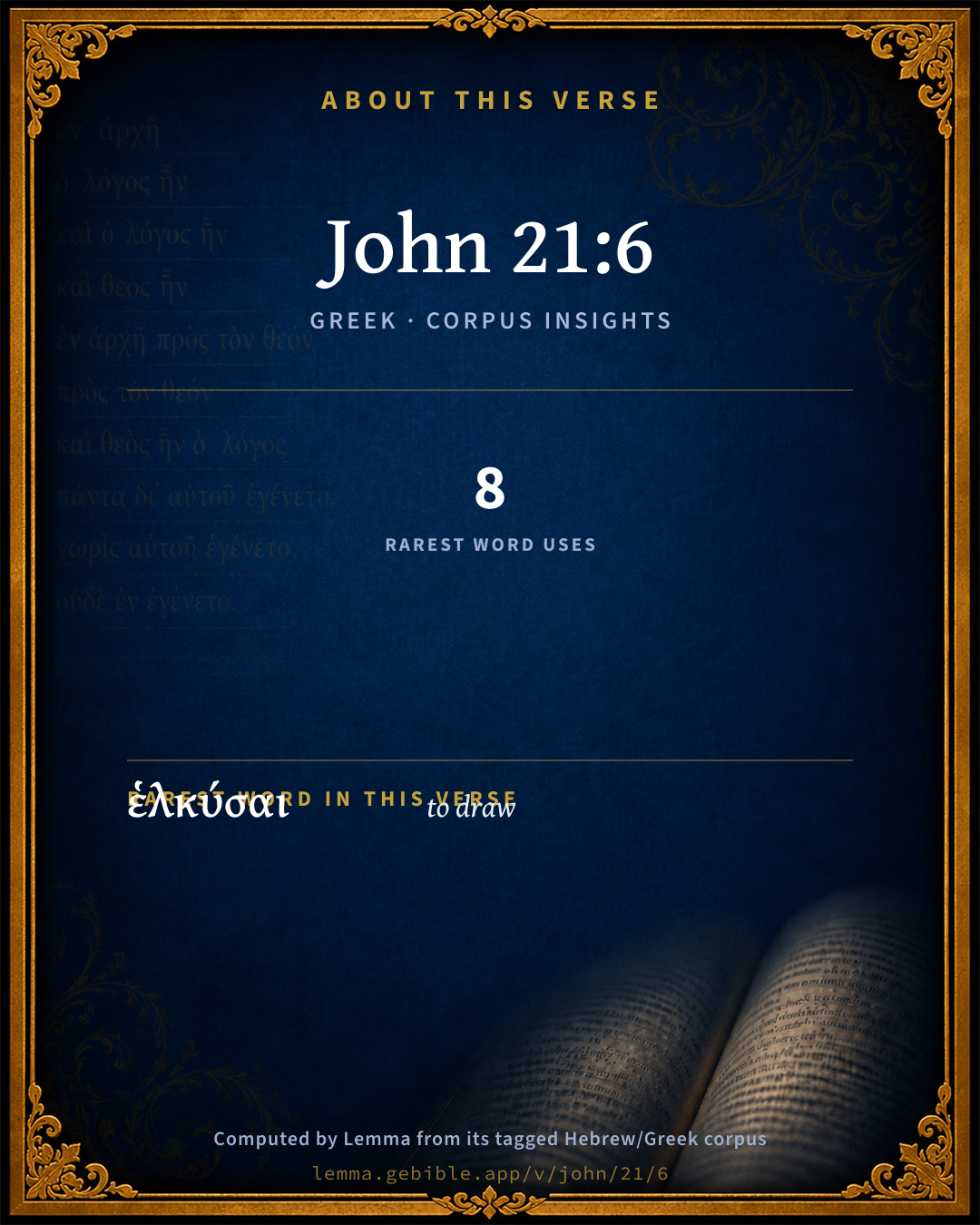
John 21:6

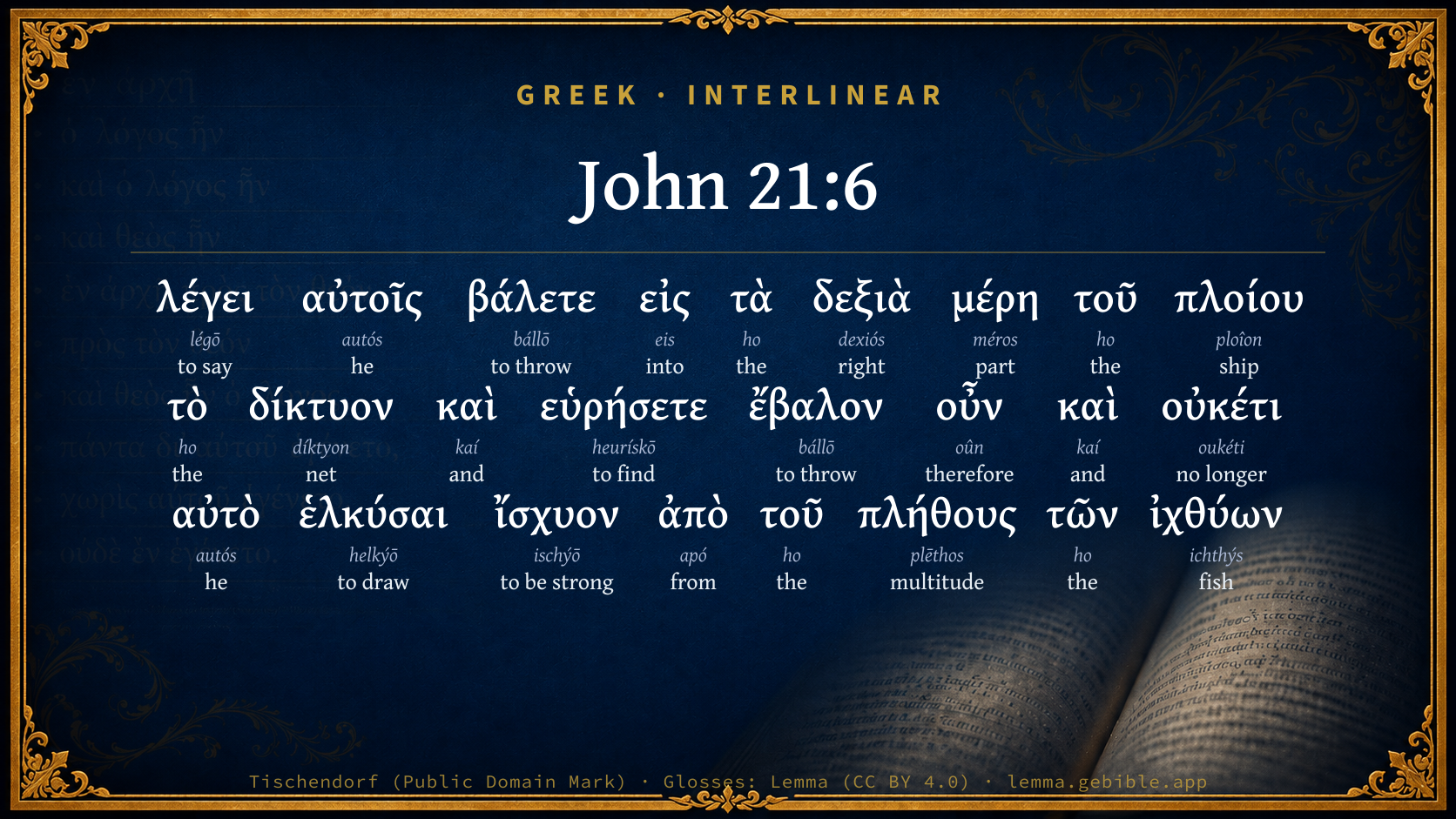
Greek (Tischendorf 8th ed.) John 21:6 appears in the Greek New Testament. The text above is from the Tischendorf 8th edition. Each word links to its Strong’s number and a concise gloss. Click any word for its full Thayer’s Greek Lexicon entry.
Download image
Cite this verse

John 21:6 (World English Bible). Public Domain. Lemma interlinear Bible study tool, https://lemma.gebible.app/v/john/21/6.

Show BibTeX & RIS
BibTeX
RIS
English Translation
He said to them, "Cast the net on the right side of the boat, and you will find some." They cast it therefore, and now they weren't able to draw it in for the multitude of fish.
World English Bible · Public Domain
Download a study sheet

One document with this verse’s original text, its word-by-word gloss line, the meaning frame, cross-references with their text, attributed commentary, and full source and license credits — printable, and it pastes into notes with its structure intact.

This verse Autodidact and up

Study sheet (.html) Plain text (.txt)

A passage Seminary Student

Up to 50 verses in one chapter. A passage sheet keeps up to 6 commentary sources and 12 cross-references per verse, in the order this page ranks them, and says so on the sheet whenever that leaves anything out. Ask for a single verse and you get the Autodidact verse sheet above.

Everything on this page stays free to read, with no account — the sheet is a download of what is already on screen, not access to it.

Want to remove ads? Support Godless Engineer
Compare translations 3

The same verse in 3 English versions, stacked beneath the original-language interlinear above. Click any original word for its lexicon entry.

Each is an independent rendering of the whole verse — the interlinear is not word-aligned to these translations.

Highlighted words mark where these versions differ — a whole-verse word diff, not a word-by-word alignment.

  • World English Bible Public Domain
    He said to them, "Cast the net on the right side of the boat, and you will find some." They cast it therefore, and now they weren't able to draw it in for the multitude of fish.
  • King James Version Public Domain
    And he said unto them, Cast the net on the right side of the ship, and ye shall find. They cast therefore, and now they were not able to draw it for the multitude of fishes.
  • unfoldingWord Literal Text CC BY-SA 4.0
    But he said to them, “Throw the net to the right side of the boat, and you will find some.” Therefore, they threw and did not have the strength to draw it in, because of the large number of fish.

unfoldingWord Literal Text — © unfoldingWord, licensed CC BY-SA 4.0. Word-aligned USFM3 via Door43 (git.door43.org/unfoldingWord/en_ult).

Versions to compare (up to 4)

3 of 4 selected

Show all 19 translations

Every available English version of this verse, each an independent rendering of the whole verse.

  • World English Bible Public Domain
    He said to them, "Cast the net on the right side of the boat, and you will find some." They cast it therefore, and now they weren't able to draw it in for the multitude of fish.
  • Berean Standard Bible Public Domain
    He told them, “Cast the net on the right side of the boat, and you will find some.” So they cast it there, and they were unable to haul it in because of the great number of fish.
  • Majority Standard Bible Public Domain
    He told them, “Cast the net on the right side of the boat, and you will find some.” So they cast it there, and they were unable to haul it in because of the great number of fish.
  • King James Version Public Domain
    And he said unto them, Cast the net on the right side of the ship, and ye shall find. They cast therefore, and now they were not able to draw it for the multitude of fishes.
  • American Standard Version (1901) Public Domain
    And he said unto them, Cast the net on the right side of the boat, and ye shall find. They cast therefore, and now they were not able to draw it for the multitude of fishes.
  • Revised Version (1885) Public Domain
    And he said unto them, Cast the net on the right side of the boat, and ye shall find. They cast therefore, and now they were not able to draw it for the multitude of fishes.
  • Geneva Bible (1599) Public Domain
    Then he said vnto them, Cast out the net on the right side of the ship, and ye shall finde. So they cast out, and they were not able at all to draw it, for the multitude of fishes.
  • Douay-Rheims (1899) Public Domain
    He saith to them: Cast the net on the right side of the ship, and you shall find. They cast therefore; and now they were not able to draw it, for the multitude of fishes.
  • Young's Literal Translation Public Domain
    they answered him, `No;' and he said to them, `Cast the net at the right side of the boat, and ye shall find;' they cast, therefore, and no longer were they able to draw it, from the multitude of the fishes.
  • Literal Standard Version CC BY-SA 4.0
    They answered Him, “No”; and He said to them, “Cast the net at the right side of the boat, and you will find [some]”; they cast, therefore, and no longer were they able to draw it, from the multitude of the fishes.
  • Unlocked Literal Bible CC BY-SA 4.0
    He said to them, “Throw your net on the right side of the boat, and you will find some.” So they threw their net and were not able to draw it in because of the large number of fish.
  • unfoldingWord Literal Text CC BY-SA 4.0
    But he said to them, “Throw the net to the right side of the boat, and you will find some.” Therefore, they threw and did not have the strength to draw it in, because of the large number of fish.
  • Darby Bible Public Domain
    And he said to them, Cast the net at the right side of the ship and ye will find. They cast therefore, and they could no longer draw it, from the multitude of fishes.
  • World Messianic Bible Public Domain
    He said to them, “Cast the net on the right side of the boat, and you will find some.” They cast it therefore, and now they weren’t able to draw it in for the multitude of fish.
  • Webster's Bible Public Domain
    And he said to them, Cast the net on the right side of the boat, and ye shall find. They cast therefore, and now they were not able to draw it for the multitude of fishes.
  • Free Bible Version CC BY-SA 4.0
    “Throw the net out on the right side of the boat, and you'll find some,” he told them. So they threw out the net, and they weren't able to haul it in because it had so many fish.
  • Bible in Basic English Public Domain
    And he said to them, Let down the net on the right side of the boat and you will get some. So they put it in the water and now they were not able to get it up again because of the great number of fish.
  • Text-Critical English NT CC BY 4.0
    He said to them, “Cast the net on the right side of the boat, and you will find some.” So they cast it and were unable to draw it in because of the large number of fish.
  • Tyndale New Testament (1534) Public Domain
    And he sayde vnto them: cast out the net on the ryght syde of the ship and ye shall fynde. They cast out and anone they were not able to drawe it for the multitude of fysshes

Literal Standard Version (2020), Covenant Press — licensed CC BY-SA 4.0. Text via the HelloAO Bible API (eBible.org). Unlocked Literal Bible (unfoldingWord) — licensed CC BY-SA 4.0. Text via the HelloAO Bible API (eBible.org). unfoldingWord Literal Text — © unfoldingWord, licensed CC BY-SA 4.0. Word-aligned USFM3 via Door43 (git.door43.org/unfoldingWord/en_ult). Free Bible Version, Dr. Jonathan Gallagher — licensed CC BY-SA 4.0. Text via the HelloAO Bible API (eBible.org).

Word by word

More ways to search: Search by grammar → Find every occurrence → Compare this word →

Practice this passage: Drill this verse → Learn its vocabulary →

ἑλκύσαι
helkýō
G1670
“to draw”
Verb, Aorist, Active, Infinitive
Part of Speech
Verb
Tense
Aorist
Voice
Active
Mood
Infinitive
Full Thayer's Definition

Origin: probably akin to G138

TDNT: 10:23,2

1. to draw, drag off 2. metaph., to draw by inward power, lead, impel
  1. λέγει légō G3004 “to say” Verb, Present, Active, Indicative, 3rd person, Singular
  2. αὐτοῖς autós G846 “he” Personal pronoun, Dative, Plural, Masculine
  3. βάλετε bállō G906 “to throw” Verb, Aorist, Active, Imperative, 2nd person, Plural
  4. εἰς eis G1519 “into” Preposition
  5. τὰ ho G3588 “the” Article, Accusative, Plural, Neuter
  6. δεξιὰ dexiós G1188 “right” Adjective, Accusative, Plural, Neuter
  7. μέρη méros G3313 “part” Noun, Accusative, Plural, Neuter
  8. τοῦ ho G3588 “the” Article, Genitive, Singular, Neuter
  9. πλοίου ploîon G4143 “ship” Noun, Genitive, Singular, Neuter
  10. τὸ ho G3588 “the” Article, Accusative, Singular, Neuter
  11. δίκτυον díktyon G1350 “net” Noun, Accusative, Singular, Neuter
  12. καὶ kaí G2532 “and” Conjunction
  13. εὑρήσετε heurískō G2147 “to find” Verb, Future, Active, Indicative, 2nd person, Plural
  14. ἔβαλον bállō G906 “to throw” Verb, Aorist, Active, Indicative, 3rd person, Plural
  15. οὖν oûn G3767 “therefore” Conjunction
  16. καὶ kaí G2532 “and” Conjunction
  17. οὐκέτι oukéti G3765 “no longer” Adverb, Negative
  18. αὐτὸ autós G846 “he” Personal pronoun, Accusative, Singular, Neuter
  19. ἴσχυον ischýō G2480 “to be strong” Verb, Imperfect, Active, Indicative, 3rd person, Plural
  20. ἀπὸ apó G575 “from” Preposition
  21. τοῦ ho G3588 “the” Article, Genitive, Singular, Neuter
  22. πλήθους plēthos G4128 “multitude” Noun, Genitive, Singular, Neuter
  23. τῶν ho G3588 “the” Article, Genitive, Plural, Masculine
  24. ἰχθύων ichthýs G2486 “fish” Noun, Genitive, Plural, Masculine

About this verse

These counts appear in no published source. They are computed here, from the morphology-tagged text and Lemma’s own curated glosses. What Lemma adds →

25
words
18
distinct lemmas
Gospels
section

Notable vocabulary

The rarest word here is ἑλκύσαι to draw G1670 — appearing just 8 times in the whole Greek New Testament.

Shared distinctive vocabulary

ἑλκύσαι to draw G1670 occurs in 8 verses of the Greek New Testament. Also found in:

Repetition

Words recur within this verse:

  • βάλετε to throw G906 ×2
  • τὰ the G3588 ×5
  • αὐτοῖς he G846 ×2
  • καὶ and G2532 ×2

Cross-references

5

Topical passages linked to John 21:6 in the Treasury of Scripture Knowledge — connected by theme and wording, ordered by reader-vote popularity; previews shown in the World English Bible.

  • Luke 5:4–7 When he had finished speaking, he said to Simon, "Put out into the deep, and let down your nets for a catch."
  • Acts 2:41 Then those who gladly received his word were baptized. There were added that day about three thousand souls.
  • John 2:5 His mother said to the servants, "Whatever he says to you, do it."
  • Acts 4:4 But many of those who heard the word believed, and the number of the men came to be about five thousand.
  • Hebrews 2:6–9 But one has somewhere testified, saying, "What is man, that you think of him? Or the son of man, that you care for him?

Cross-references courtesy of OpenBible.info (CC BY 4.0).

Commentary

Notes on John 21:6 from classic Christian and Jewish commentators (each source and its license shown beneath its notes). The classic Christian expositions comment on the surrounding passage and are grouped to its opening verse, so a note may address several verses; the Jewish commentaries on the Tanakh (Rashi and others) are per-verse, so they appear only where the commentator wrote on this verse.

Lemma curates 59 commentaries, every one of them public domain or Creative Commons licensed, each selected and text-cleaned for this edition rather than reprinted as found. About our sources →

The Biblical Illustrator

Joseph S. Exell

Joh_21:6

Cast the net on the right side of the ship, and ye shall find

Old instrumentalities, but new method, an emblem of Christs redemptive method

Christ commanded the disciples to cast the old net in a new way.

Thus He ever does in redeeming souls.

I. HE EMPLOYS OLD INSTRUMENTALITIES. There are many of them, but they are all old.

1. The same old natural facts. He employs the phenomena of nature to quicken, educate and elevate souls. We have nothing more of nature than the men of remotest generations.

2. The same old gospel principles. Biblical truths are His redemptive forces, but the youngest of them is eighteen hundred years old.

3. The same old mental faculties. In regenerating men Christ does not create a new intellect, memory, imagination. He brings out the new moral creature with the old mental idiosyncrasies.

II. HE EMPLOYS OLD INSTRUMENTALITIES IN A NEW WAY. He directs men

1. To a new method of studying natural facts. Thoughtfully, inductively, devoutly--regarding them all as mirrors of the Divine.

2. To a new method of dealing with gospel truths. Not desultorily, speculatively, controversially, but inductively, systematically and practically.

3. To a new method of employing mental faculties. Turning the mental powers away from time to eternity, from the creature to the Creator. (D. Thomas, D. D.)

Ministerial encouragements

It was quite natural that this miracle should carry their thoughts back to that draught when their nets brake--the type of those poor tentative trial missions which alone these men had been capable of when they knew Christ only after the flesh. This erie was a type of the works greater than His own which Christ promised. Note

I. THE ASSURANCE THAT THERE IS A DIRECTING VOICE AND A GUIDING HAND. The disciples did not yet know the voice, and we do not always discern it; for Christ speaks in many tones--by circumstance, character, influence. What a relief and comfort this is!

II. It is no play on the words to say that there is A RIGHT AND A WRONG SIDE OF THE SHIP FOR THE CASTING OF THE NET. When Christ says the right side we must not choose the left. There is an awkward, clumsy, inappropriate way of offering truth and love to men as well as a way that is suitable, winning--to use the figure here, adroit, dexterous, and therefore Christs way.

III. WHAT IS CAST MUST BE THE NET, THE GOSPEL NET.

1. A prophet speaks of those who sacrifice to their own net. We may have a net of our own, and take great pains with it in making and mending, and think highly of it as an instrument for catching, and even fancy that it has caught, because there is a thronging and pressing to hear, and because men praise the thing heard--and lo! there is what God calls nothing in the net.

2. The great elements of gospel revelation must find place in all teaching--sin, the Divine Saviour, the Holy indwelling Spirit, sanctification, &c.

these things, not rawly or roughly flung out, but tenderly and sweetly impressed, must never be thrown behind in comparison with topics of the day.

IV. YE SHALL FIND. He does not say, All at once, nor all you would, nor so as to see it now; but He puts no limit to our hope and prayer. Not one earnest sermon falls to the ground. Some conscience is quickened, some sorrow comforted, or some life guided. (Dean Vaughan.)

Fishing for souls

Many men there are who make fishing rods who never use them. To make fishing rods is one thing, and to catch fish is another. Many men can make good lines who never think of going out to fish. There are plenty of mechanics that stand by the stithy and make all sorts of hooks who never catch fish. Many of the men who make reels and baskets do not catch fish. The man who, having these things at his command, knows where the trout lie, and how to throw his line, and how to draw back when the fish rises to the hook, he after all is the fisherman. Now there are hundreds of men who, when they go into the pulpit, make rods and lines (very long lines), and hooks, and reels, and baskets. They take this or that doctrine and pound it out into a hook, bending it and kinking it just so, and stick it up on a paper, and label it, and that is the end of it. And this is called preaching! To know how to make rods and lines, &c., is called sound, regular, and approved preaching; but Christ says that is preaching which catches men. And, so far from teaching you that you have no right to introduce into the pulpit anything but the substance of doctrines, I affirm that the man who does not do it will never catch men. Gods sovereignty may, out of the literal foolishness of his preaching, catch some men; but the commission of Christ to every man that undertakes to preach is, Follow Me, and I will make you a fisher of men. The business of a preacher is to catch men--proud, wicked, worldly men: and to catch them out of temptations, out of snares, out of wealth, out of poverty: for men are in more pools, ten thousand times than fishes are And that man who knows all kinds, and what sort of bait each loves, and how to coax him, and how to catch him, knows how to preach; but the man who does not know these things though he knows everything else--lacks a knowledge of the very thing he was sent to do. (H. W. Beecher.)

The two draughts of fishes

(Text, and Luk_5:4):--The whole life of Christ was a sermon. The miracles attest His mission; but a higher reason for them is to be found in the instruction which they convey. Some ministers have often preached from the same text, but never the same discourse. The like may be said of Christ. The two miracles seem to the casual observer to be alike; but though the text is the same in both, the discourse is full of variations. Note--I. THE POINTS OF UNIFORMITY. They are both intended to set forth the way in which Christs kingdom shall increase; viz., that

1. The means must be used. In the first case, the fish did not leap into Simons boat, nor in the second, did they lay themselves down upon the coals. No, the fishermen must go out in their boat, cast the net, and then either drag it ashore, or fill the boats with its contents. It is a miracle, but human agency is not ignored. In saving souls God works by means. So long as the economy of grace shall stand, God will by the foolishness of preaching save them that believe. God works by means of men whom He specially calls to His work, and not as a rule without them. The outcry against the one man ministry comes not of God, but of proud self-conceit. The new ways of catching fish without nets, and saving souls without ministers, will never answer. I know not a church that has despised instrumentality but it has come to an end within a few years either by schism or decay.

2. Means of themselves are utterly unavailing. In both cases there was failure--why? They were no raw hands; they had toiled, and toiled all night. There was no deficiency of fish, for as soon as the Master comes there they are by shoals. What, then, is the reason? Because there is no power in the means apart from the presence of Christ. Without Christ we can do nothing. Not by might, &c. Put no dependence upon societies, committees, ministries, &c. Let us work as if all depended upon us; but let us depend upon God, knowing that it rests with Him alone.

3. It is Christs presence that confers success. It was His will that drew the fish to the net as He sat in Peters boat. It was His presence on the dry land that drew the fish to the right side of the ship. Christs presence in the midst of the Church is the Churchs power.

4. The success developed human weakness. In the first instance the net breaks and the ship began to sink, and Peter says, Depart, &c. The very abundance of Gods mercy made him feel his own nothingness. In the last case, they were scarcely able to draw the net because of the multitude of fishes. If the Lord gives us success in winning souls we shall soon find out what nothings we are. Little increases such as have been common in our churches for years, are quite consistent with great self-congratulation, and so is utter barrenness; mark the pompous carriage of many a fruitless preacher. The man humbles himself in the dust when hundreds are ingathered, for this cannot be the minister; this is the finger of God.

II. THE DISSIMILARITY. The first picture represents the Church of God as we see it; the second as it really is. Luke tells us what the crowd see; John, what Christ showed to His disciples alone.

1. There is a difference in the orders given. In the first, it is, Launch out into the deep, &c. In the second, Cast the net on the right side of the ship. The first is Christs order to every minister; the second is the secret work of His spirit in the Word. The first shows us that the ministry is to fish everywhere. The preacher is not to single out any particular character. Those who preach only to the elect should remember this. What if we be in town, or city, or village? what if we be among the rich or poor, learned or illiterate? we have nothing to do with that--our duty is to launch out into the deep, and let down the net. Christ will find the fish. The secret truth is, that when we are doing this, the Lord knows how to guide us, so that we cast the net on the right side of the ship. That is the invisible work of the Spirit, whereby He so adapts our ministry that He makes it particular and special.

2. In the first instance there is a distinct plurality. The fishermen have nets and boats, and each man comes out distinctly. In the next, they are all in one boat, and unitedly drag one net. This is the visible and the invisible.

(1) To us the means are various. We are in one boat but there is another over yonder, and whenever our boat gets too full, we should beckon to our partners in the other ship to come and help us. We ought not to look upon those brethren who differ from us, as though they were emptying the sea and rivalling us. The plurality of agency involved in denominations is a great blessing. We stir one another up, and do far more good then if there were only one nominal church. There will always be a Paul and a Barnabas, who cannot get on together.

(2) But let us look to the inward. In John they are all on one boat fishing together, dragging one net. This is what is really the fact. We do not see it, but all Gods ministers are dragging one net, and all Gods Church is in one ship. It is no use striving after outward uniformity. Neither the texture of the human mind nor the will of God require it, It is the unity of the Spirit in Christ Jesus, in love that God would have us regard.

3. In the first case a great multitude of fish were caught. In the second a hundred and fifty and three. It were impossible to reckon how many have been taken in the outward net of the visible Church. But it is possible for it to be known of God how many shall be brought at last, and how many now are in the invisible Church. They shall be in heaven a number that no man can number, for Gods elect are not few; but the Lord knoweth them that are His.

4. The fish that were taken the first time appear to have been of all sorts. The net was broken, and therefore doubtless some of them got out again; there were some So little that they were not worth eating, and doubtless were thrown away: They shall gather the good into vessels and throw the bad away. In the second ease the net was full of great fishes; they were all great fishes, all good and worth the keeping. The first gives us the outward and visible effect of the ministry. We gather into Christs Church a great number, and there will always be some that are not good, and not really called of God. Sometimes we have Church-meetings in which we have to throw the bad away. Let no man be surprised if the tares grow up with the wheat--if there be wolves in sheeps clothing--it always will be so. There was a Judas among the twelve. Not so in the invisible Church. In that there is none to throw away. No; the Lord who brought them into the net brought the right sort in.

5. In the first case, in the visible Church the net breaks. No doubt it is a bad thing for nets to break; but you need not wonder at it. It is the necessary consequence of our being what we are. Instead of having some one denomination, we have twenty or thirty? I do not grieve over it. For until you get a set of perfect men, you never will have anything but these divisions. But the net does not break in reality, for the invisible Church is one. Take care of the fish and leave the net alone, but still maintain the unity of the Spirit in the bond of perfectness.

6. In the first case, you see human weakness; there is the boat ready to sink, the net broken, the men all out of heart, begging the Master to go away. In the other ease, they are made strong, dragging the fish to shore. So in the visible Church you will often have to mourn over human weakness: but in the invisible Church God will make His servants just strong enough to drag their fish to shore.

7. In the first case, in the visible Church they launched out into the deep. In the second case, they were not far from the shore. So today our preaching seems to us to be going out into the great stormy deep after fish. We appear to have a long way to reach before we shall bring these precious souls to land. But in the sight of God we are not far from shore; and when a soul is saved, it is not far from heaven. To us there are years of temptation, and trial, and conflict; but to God, it is finished.

8. In the first case, the disciples had to forsake all and follow Christ. In the second, they sat down to feast with Him at the banquet which He had spread. So in the visible Church we have to bear trial and self-denial for Christ, but the eye of faith perceives that we shall soon sit down and feast in the kingdom of God.

III. THE LESSON WHICH THE TWO NARRATIVES IN COMMON SEEM TO TEACH. In the first case, Christ was in the ship. Christ is in His Church, though she launch out into the deep. In the second case, Christ was on the shore. Christ is in heaven. But whether He be in the Church, or in heaven, all our nights toiling shall, by His presence, have a rich reward. This is the lesson. Mother, will you learn it? You have been toiling long for your children. It has been night with you as yet. Your nights toiling shall have an end; you shall at last cast the net on the right side of the ship. Sunday-school teacher, minister, church, the night is far spent, and the Master shall soon appear; and His advent shall bring success. (C. H. Spurgeon.)

The Biblical Illustrator, edited by Joseph S. Exell (c. 1880s–1900s) — public domain. Text from a community e-Sword module.

Tyndale Open Study Notes

Tyndale Open Resources

21:6 “Throw out your net on the right-hand side”: Casting a net into the sea at random was futile. But when they did as the stranger said, the immense catch was immediate (21:11).

Tyndale Open Study Notes — © Tyndale Open Resources, licensed CC BY-SA 4.0. Text via the HelloAO Bible API.

Bengel's Gnomon

Johann Albrecht Bengel

Joh 21:6. Δεξιὰ, the right side) A most precise and unerring command. The power of the Lord collected together the fishes thither.—ἑλκύσαι) [to draw] The verb σύρειν, Joh 21:8 [to drag], implies the employment of greater force.

Bengel's Gnomon of the New Testament — English translation (T&T Clark, Edinburgh, 1860) — public domain. Text from a community e-Sword module.

Expositor's Greek Testament

ed. W. Robertson Nicoll

Joh 21:6 . Ὁ δὲ εἶπεν … καὶ εὑρήσετε . “Cast your net on the right side of the boat, and you will find.” They supposed the stranger had been making observations from the shore, had seen a shoal or some sign of fish, and unwilling to come in empty, ἔβαλον οὖν … ἰχθύων . “They cast therefore, and were no longer (as they had been before) able to draw it [ ἑλκύσαι , not ἑλκῦσαι , see Veitch’s Irreg. Verbs , seems here to be used as we use ‘draw’ in connection with a net, meaning to draw over the side of the boat so as to secure the fish. Contrast σύροντες in Joh 21:8 ] for the multitude of fishes”; ἀπό often means “on account of” in Dionysius Hal., Plutarch, and even in Thucydides and Sophocles as shown by Kypke.

The Expositor's Greek Testament, edited by W. Robertson Nicoll (1897–1910) — public domain. Text from a community e-Sword module.

Jamieson, Fausset & Brown

Robert Jamieson, A. R. Fausset & David Brown

he said unto them, Cast the net on the right side of the ship--no doubt, by this very specific direction, intending to reveal to them His knowledge of the deep and power over it.

Jamieson, Fausset & Brown — Commentary Critical and Explanatory on the Whole Bible (1871) — public domain (CC PDM 1.0). Text via the HelloAO Bible API.

Adam Clarke's Commentary

Verse 6. And ye shall find.] The AEthiopic, three copies of the Itala, and St. Cyril, add, They said therefore unto him, we have laboured all the night and caught nothing, nevertheless at thy command we will let down the net. This is borrowed from Lu 5:5.

For the multitude of fishes.] This was intended as an emblem of the immense number of souls which should be converted to God by their ministry; according to the promise of Christ, Mt 4:19.

Adam Clarke's Commentary on the Bible (1810–1826) — public domain. Text from a community e-Sword/MySword module.

John Calvin's Commentaries

6. Cast the net on the right side of the ship. Christ does not command with authority and power as Master and Lord, but gives advice like one of the people; and the disciples, being at a loss what to do, readily obey him, though they did not know who he was. If, before the first casting of the net, any thing of this sort had been said to them, they would not have so quickly obeyed. I mention this, that no one may wonder that they were so submissive, for they had already been worn out by long and useless toil. Yet it was no small proof of patience and perseverance, that, though they had labored unsuccessfully during the whole night, they continue their toil after the return of daylight. And, indeed, if we wish to allow an opportunity for the blessing of God to descend on us, we ought constantly to expect it; for nothing can be more unreasonable than to withdraw the hand immediately from labor, if it do not give promise of success.

That Simon Peter Was Naked, is a proof that the disciples had labored in earnest; and yet they do not hesitate to cast the net again to make another trial, that they may not neglect any opportunity. Their obedience to the command of Christ cannot be ascribed to faith; for they hear him speak as a person who was unknown to them. Now, if we dislike our calling, because the labor which we undertake appears to be unproductive, yet, when the Lord exhorts us to steadiness and perseverance, we ought to take courage; in the end we shall obtain a happy result, but it will be at the proper time.

And now they were not able to draw it Christ here exhibited two proofs of his Divine power. The first consisted in their taking so large a draught of fishes; and the second was, when, by his concealed power, he preserved the net whole, which otherwise must unavoidably have been broken in pieces. Other circumstances are mentioned, namely, that the disciples find burning coals on the shore, that fishes are laid on them, and that bread is also prepared. As to the number of the fishes, we ought not to look for any deep mystery in it. Augustine enters into ingenious reasonings about the statement of the number, and says that it denotes the Law and the Gospel; but if we examine the matter carefully, we shall find that this is childish trifling.

John Calvin's Commentaries (1540-1563) — public domain. Text from the Calvin Translation Society English edition (1840s-50s) via the Christian Classics Ethereal Library (ccel.org). Calvin's coverage is partial (roughly two-thirds of the Bible); uncommented books and verses are honest gaps, never fabricated. The 19th-century editor's footnotes and remarks are omitted so the notes are faithfully Calvin's own voice.

Ellicott's Commentary for English Readers

(6) Cast the net on the right side of the ship.—Comp. Note on Luk_5:6. Here the special direction is to cast the net on the right side. We must suppose that the net was cast on the left side, and that they think the speaker who stands on the shore sees some indication of fishes on the other side, for He is still as a stranger to them, and yet they at once obey Him.

They were not able to draw it for the multitude of fishes.—That is, they were not able to draw it up into the boat. In Joh_21:8 they are described as dragging it to the shore.

A Bible Commentary for English Readers, edited by Charles John Ellicott (1878–1897) — public domain. Text from a community e-Sword module.

The Cambridge Bible for Schools and Colleges

gen. ed. J. J. S. Perowne

6. They cast therefore] Perhaps they thought the stranger saw fish on the right side. Fish are at times seen “in dense masses” in the lake.

The Cambridge Bible for Schools and Colleges (gen. ed. J. J. S. Perowne; Cambridge University Press, 1878–1918) — public domain. Text from a community e-Sword module.

John Gill's Exposition

And he said unto them,.... Willing to make himself known by a miracle, since they knew him not by his person, nor voice:

cast the net on the right side of the ship, and ye shall find; that is, a large multitude of fish, as they did. The ship was an emblem of the church in its present afflicted state; the right side of it points to the elect, and where they are to be found in this world; the casting of the net signifies the preaching of the Gospel; the promise of finding fish, the assurance Christ gives of the success of his word, which he owns and blesses for the conversion of elect sinners:

they cast therefore; the net, willing to try what success they might have at the instance of this person, whom they knew not. The Ethiopic version reads the passage thus, "and they said unto him, we have laboured all night, and have found nothing, but at thy word we will let down"; which seems to be taken out of Luk 5:5. However, they obeyed his orders and directions, as the faithful ministers of the Gospel do, and should, and, succeeded.

And now they were not able to draw it for the multitude of fishes. The Syriac adds, "which it held"; being in number, as in Joh 21:11 an hundred and fifty, and three great fishes; which was an emblem and presage of that large number of souls both among the Jews and Gentiles, which they should be instrumental in bringing to Christ, through the preaching of the Gospel.

John Gill's Exposition of the Whole Bible (1746–1763) — public domain (CC PDM 1.0). Text via the HelloAO Bible API.

Trapp's Complete Commentary

John Trapp

6 And he said unto them, Cast the net on the right side of the ship, and ye shall find. They cast therefore, and now they were not able to draw it for the multitude of fishes.

Ver. 6. Cast the net on the right side, &c.] This counsel he gives as a stranger, who haply might see a confluence of fish there, being on the shore, which they in the ship saw not. They obey him therefore, as content to lose one labour more, if it must be so; they knew not what another draught might produce. It is good to be doing in God’s way: sooner or later success will ensue. Bind not the Lord to a day; wake not my beloved till he please; he will pay us for all our pains and patience. Consider but our, 1. distance, 2. dependence, and we will wait.

John Trapp, A Commentary or Exposition upon All the Books of the Old and New Testament (1647–1656) — public domain. Text from a community e-Sword module.

Albert Barnes' Notes on the Bible

On the right side - Why the right side is mentioned is not known. Grotius supposes that it was the side nearest the shore, where there was less probability of taking fish. It does not appear that they yet recognized the Lord Jesus, but from some cause they had sufficient confidence in him to make another trial. Perhaps they judged that he was one skilled in that employment, and knew where there was the greatest probability of success.

Albert Barnes' Notes on the Bible (1834–1885) — public domain. Text from a community e-Sword/MySword module.

Matthew Poole's English Annotations

Though they had before laboured in vain, yet their Master’s command encourages them to go to work again; then they take a multitude of fishes; a presage, say some, of that great success which the apostles should have in their fishing for men.

Matthew Poole's English Annotations on the Holy Bible (1683–1685) — public domain. Text from a community e-Sword/MySword module.

Whedon's Commentary on the Bible

Daniel D. Whedon

6. The right side—His divine power could have given the same success to the left side; but he makes and announces his choice that they might see that the result was produced by his will and power. The apostles here knew not, thus far, this stranger; but he directs them with a persuasive power by which they are induced to make the trial he directs.

Daniel D. Whedon (gen. ed.), Commentary on the Old and New Testaments (1874–1909) — public domain. Text from a community e-Sword module.

John Wesley's Explanatory Notes

They were not able to draw it for the multitude of fishes - This was not only a demonstration of the power of our Lord, but a kind supply for them and their families, and such as might be of service to them, when they waited afterward in Jerusalem. It was likewise an emblem of the great success which should attend them as fishers of men.

John Wesley, Explanatory Notes Upon the Whole Bible (1754–1765) — public domain. Text via the GEBible commentary corpus.

Cambridge Greek Testament for Schools and Colleges

6. ἴσχυον (אBCDLA) for ἴσχυσαν (AP to suit ἔβαλον).

6. There is no need to seek symbolical meanings for the right and left side. The difference is not between right and left, but between working with and without Divine guidance.

Cambridge Greek Testament for Schools and Colleges (Cambridge University Press, 1896; 21 vols, various authors incl. Carr, Maclear, Plummer, Farrar, Lumby, Moule, M. R. James, Simcox) — public domain. Text from a community e-Sword module.

Alford’s Greek Testament

Henry Alford

6.] See Luk 5:6.

Henry Alford, The Greek Testament (1849–1861) — public domain. Text from a community e-Sword module.

International Critical Commentary

6. Then Jesus, perhaps having noticed from the shore that a shoal of fish was gathering at the farther side of the boat, calls to the fishermen, “Cast your net towards the right of the boat, and you will have a take.”

εις τα δεξια μερη τοῦ πλοιου is a cumbrous phrase for which no linguistic parallel seems to be forthcoming. In Luk 5:4 the advice of Jesus was similar, although expressed differently, viz. to let down the nets in deeper water. As the story is told, it would seem that Peter jumped into the water on the side of the boat nearest the land, being unimpeded by the net which now was on the other (the right) side, farther from the shore.2

δίκτυον does not occur again in Jn., and is the word used Luk 5:2, Luk 5:4, Luk 5:5; but nothing can be inferred from this, as it is the common word for a fishing-net.

After εὑρήσετε, אca and several Latin texts mostly of the Irish school (e.g., ardmach, dim., stowe, corp., and Rawl. 1673) interpolate Luk 5:5, “but they said, Master, we toiled all night and took nothing; but at Thy word we will let down the net.” This interpolation shows that the similarity between the two narratives of a great draught of fishes in Lk. and Jn. had been observed long before the dawn of modern criticism.

καὶ οὐκέτι αὐτὸ ἑλκύσαι ἴσχυον. The rec. has ἴσχυσαν but the more vivid ἴσχυον is read by אBCDLN. For the verb ἑλκύειν see on 6:44. ἰσχύειν is not found in the body of the Gospel.

ἀπὸ τοῦ πλήθους τῶν ἰχθύων. For the same constr cf. 2Ch 5:6 of the animals that “could not be numbered for multitude,” οἳ οὐ λογισθήσονται ἀπὸ τοῦ πλήθους. Nothing is said here of the breaking of the net, which Simon and Andrew feared in the parallel story (Luk 5:6).

The Sea of Galilee still swarms with fish;1 and it is noteworthy that this great catch is not described as a σημεῖον, nor is it suggested that it was miraculous.

International Critical Commentary — older volumes (1896–1929), various authors — public domain. Text from a community e-Sword module.

Vincent's Word Studies in the New Testament

Marvin R. Vincent

The net [δικτυον] . See on Mt 4:18; Mt 13:47.

Were not able [ουκ ισχυσαν] . See on Luk 14:30; Luk 16:3; Jas 5:16.

To draw [ελκυσαι] . Into the boat. Compare surontev, ver. 8, dragging the net behind the boat.

Marvin R. Vincent, Word Studies in the New Testament (1887–1900) — public domain. Text from a community e-Sword/MySword module.

Lesson kit

Teaching starters — assembled from the data on this page, not authored interpretation. Every prompt links to the verse data it draws on. Edit before teaching.

John, in the Gospels, opens this verse with 25 words (18 distinct Greek lemmas). Its most distinctive word is helkýō (“to draw”). A historical commentator’s framing appears above. Read the whole chapter for the surrounding context.

Discussion questions

  1. What does “to draw” (helkýō) contribute to the verse as a whole?
  2. John 6:44 shares the word «to draw» with this verse. How do the two illuminate each other?
  3. “to throw” occurs 2× in this one verse. What is the effect of the repetition?
  4. The translations on this page render this verse differently — a whole-verse word diff, not a word-by-word alignment. What might account for the different wordings?
  5. Reading how The Biblical Illustrator and Tyndale Open Study Notes read this verse, where do the two commentators agree and where do they part?

Things to notice

  • These translations choose different wording for 21 words in this verse.
  • “to throw” occurs 2× in this single verse.
  • 18 distinct Greek lemmas span 25 words in this verse.

Reading settings

Reading text

Shown beneath each verse's original-language words.

Old Testament
Old Testament edition

Read the OT as the Masoretic Hebrew (MT) or the Greek Septuagint (LXX).

English shown for the Greek Septuagint (in the Hebrew ↔ Greek comparison).

Comparing translations? Open the Compare panel on any verse page to stack up to four side by side.