
Acts 27:6

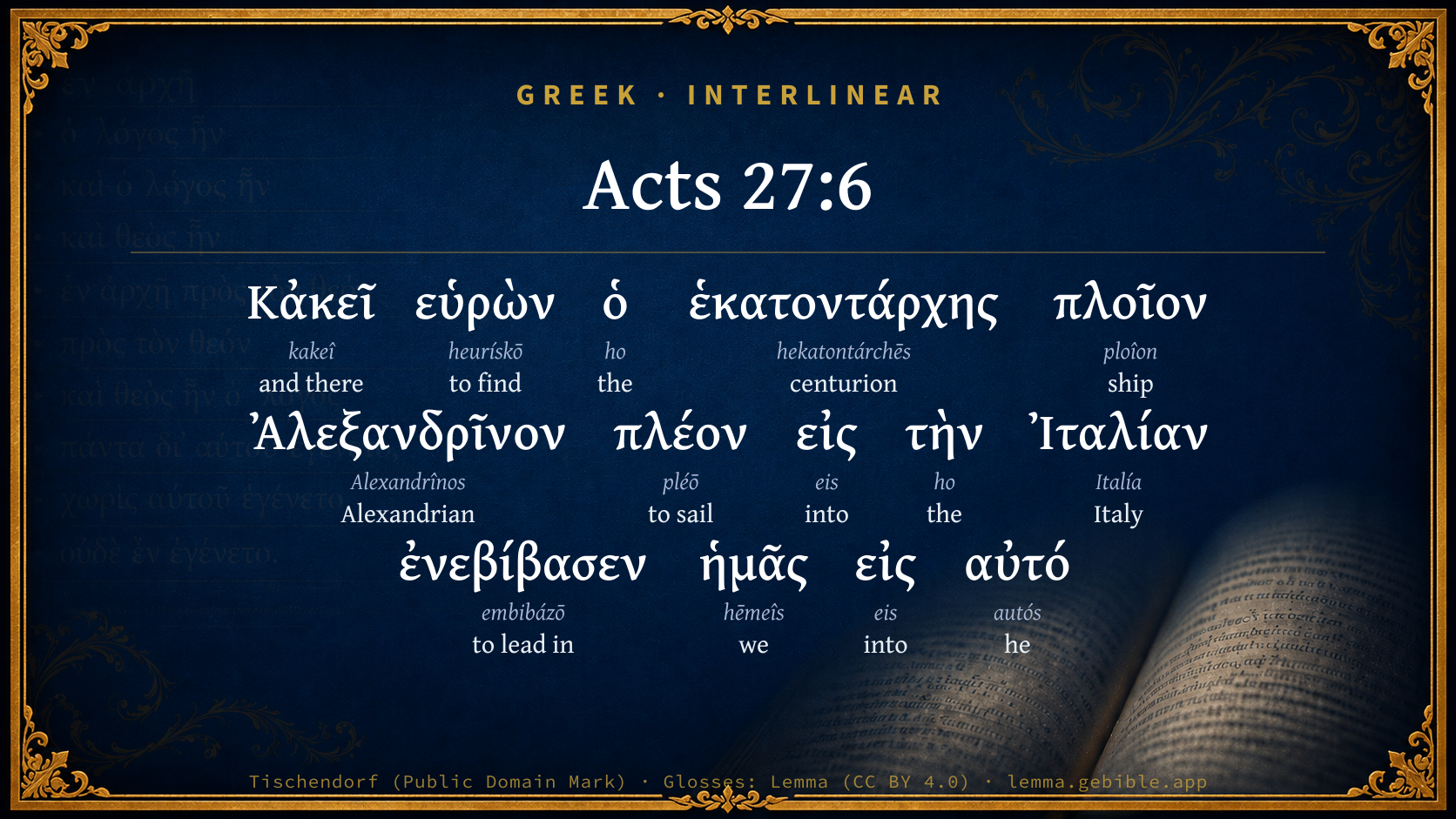
Greek (Tischendorf 8th ed.) Acts 27:6 appears in the Greek New Testament. The text above is from the Tischendorf 8th edition. Each word links to its Strong’s number and a concise gloss. Click any word for its full Thayer’s Greek Lexicon entry.
Download image
Cite this verse

Acts 27:6 (World English Bible). Public Domain. Lemma interlinear Bible study tool, https://lemma.gebible.app/v/acts/27/6.

Show BibTeX & RIS
BibTeX
RIS
English Translation
There the centurion found a ship of Alexandria sailing for Italy, and he put us on board.
World English Bible · Public Domain
Highlights
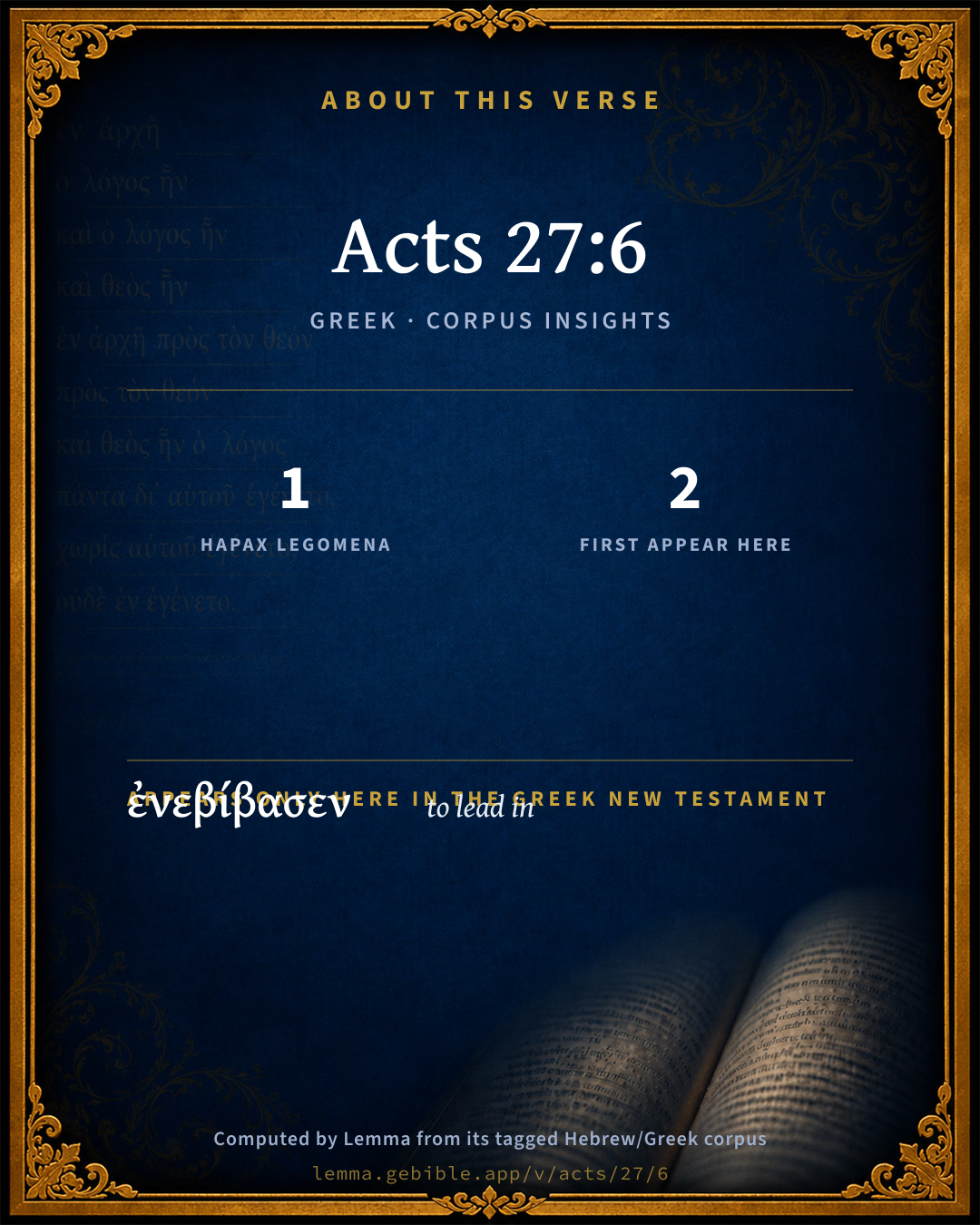
  • 1 hapax legomenon — only here in the Greek New Testament
  • 2 first appearances in the Greek New Testament
Full analysis ↓
Download a study sheet

One document with this verse’s original text, its word-by-word gloss line, the meaning frame, cross-references with their text, attributed commentary, and full source and license credits — printable, and it pastes into notes with its structure intact.

This verse Autodidact and up

Study sheet (.html) Plain text (.txt)

A passage Seminary Student

Up to 50 verses in one chapter. A passage sheet keeps up to 6 commentary sources and 12 cross-references per verse, in the order this page ranks them, and says so on the sheet whenever that leaves anything out. Ask for a single verse and you get the Autodidact verse sheet above.

Everything on this page stays free to read, with no account — the sheet is a download of what is already on screen, not access to it.

Want to remove ads? Support Godless Engineer
Compare translations 3

The same verse in 3 English versions, stacked beneath the original-language interlinear above. Click any original word for its lexicon entry.

Each is an independent rendering of the whole verse — the interlinear is not word-aligned to these translations.

Highlighted words mark where these versions differ — a whole-verse word diff, not a word-by-word alignment.

  • World English Bible Public Domain
    There the centurion found a ship of Alexandria sailing for Italy, and he put us on board.
  • King James Version Public Domain
    And there the centurion found a ship of Alexandria sailing into Italy; and he put us therein.
  • unfoldingWord Literal Text CC BY-SA 4.0
    And there, the centurion having found an Alexandrian ship sailing to Italy, he put us on it.

unfoldingWord Literal Text — © unfoldingWord, licensed CC BY-SA 4.0. Word-aligned USFM3 via Door43 (git.door43.org/unfoldingWord/en_ult).

Versions to compare (up to 4)

3 of 4 selected

Show all 19 translations

Every available English version of this verse, each an independent rendering of the whole verse.

  • World English Bible Public Domain
    There the centurion found a ship of Alexandria sailing for Italy, and he put us on board.
  • Berean Standard Bible Public Domain
    There the centurion found an Alexandrian ship sailing for Italy and put us on board.
  • Majority Standard Bible Public Domain
    There the centurion found an Alexandrian ship sailing for Italy and put us on board.
  • King James Version Public Domain
    And there the centurion found a ship of Alexandria sailing into Italy; and he put us therein.
  • American Standard Version (1901) Public Domain
    And there the centurion found a ship of Alexandria sailing for Italy; and he put us therein.
  • Revised Version (1885) Public Domain
    And there the centurion found a ship of Alexandria sailing for Italy; and he put us therein.
  • Geneva Bible (1599) Public Domain
    And there the Centurion found a ship of Alexandria, sayling into Italie, and put vs therein.
  • Douay-Rheims (1899) Public Domain
    And there the centurion finding a ship of Alexandria sailing into Italy, removed us into it.
  • Young's Literal Translation Public Domain
    and there the centurion having found a ship of Alexandria, sailing to Italy, did put us into it,
  • Literal Standard Version CC BY-SA 4.0
    and there the centurion having found a ship of Alexandria, sailing to Italy, put us into it,
  • Unlocked Literal Bible CC BY-SA 4.0
    There, the centurion found a ship from Alexandria that was going to sail to Italy. He put us in it.
  • unfoldingWord Literal Text CC BY-SA 4.0
    And there, the centurion having found an Alexandrian ship sailing to Italy, he put us on it.
  • Darby Bible Public Domain
    and there the centurion having found a ship of Alexandria sailing to Italy, he made us go on board her.
  • World Messianic Bible Public Domain
    There the centurion found a ship of Alexandria sailing for Italy, and he put us on board.
  • Webster's Bible Public Domain
    And there the centurion found a ship of Alexandria sailing into Italy; and he put us therein.
  • Free Bible Version CC BY-SA 4.0
    There the centurion found a ship from Alexandria that would be sailing to Italy, and arranged for us to join it.
  • Bible in Basic English Public Domain
    And there the captain came across a ship of Alexandria, sailing for Italy, and put us in it.
  • Text-Critical English NT CC BY 4.0
    There the centurion found an Alexandrian ship that was sailing to Italy and put us on board.
  • Tyndale New Testament (1534) Public Domain
    And there the vnder captayne founde a shippe of Alexander redy to sayle into Italy and put vs therin.

Literal Standard Version (2020), Covenant Press — licensed CC BY-SA 4.0. Text via the HelloAO Bible API (eBible.org). Unlocked Literal Bible (unfoldingWord) — licensed CC BY-SA 4.0. Text via the HelloAO Bible API (eBible.org). unfoldingWord Literal Text — © unfoldingWord, licensed CC BY-SA 4.0. Word-aligned USFM3 via Door43 (git.door43.org/unfoldingWord/en_ult). Free Bible Version, Dr. Jonathan Gallagher — licensed CC BY-SA 4.0. Text via the HelloAO Bible API (eBible.org).

Word by word

More ways to search: Search by grammar → Find every occurrence → Compare this word →

Practice this passage: Drill this verse → Learn its vocabulary →

ἐνεβίβασεν
embibázō
G1688
“to lead in”
Verb, Aorist, Active, Indicative, 3rd person, Singular
Part of Speech
Verb
Tense
Aorist
Voice
Active
Mood
Indicative
Person
3rd person
Number
Singular
Full Thayer's Definition

Origin: from G1722 and bibazo (to mount, causative of G1684 )

TDNT: None

1. to put in or on, lead in, cause to enter
  1. Κἀκεῖ kakeî G2546 “and there” Adverb, Aramaic form
  2. εὑρὼν heurískō G2147 “to find” Verb, Aorist, Active, Participle, Nominative, Singular, Masculine
  3. ὁ ho G3588 “the” Article, Nominative, Singular, Masculine
  4. ἑκατοντάρχης hekatontárchēs G1543 “centurion” Noun, Nominative, Singular, Masculine
  5. πλοῖον ploîon G4143 “ship” Noun, Accusative, Singular, Neuter
  6. Ἀλεξανδρῖνον Alexandrînos G222 “Alexandrian” Adjective, Accusative, Singular, Neuter
  7. πλέον pléō G4126 “to sail” Verb, Present, Active, Participle, Accusative, Singular, Neuter
  8. εἰς eis G1519 “into” Preposition
  9. τὴν ho G3588 “the” Article, Accusative, Singular, Feminine
  10. Ἰταλίαν Italía G2482 “Italy” Noun, Accusative, Singular, Feminine
  11. ἡμᾶς hēmeîs G2249 “we” Personal pronoun, 1st person, Accusative, Plural
  12. εἰς eis G1519 “into” Preposition
  13. αὐτό autós G846 “he” Personal pronoun, Accusative, Singular, Neuter

About this verse

These counts appear in no published source. They are computed here, from the morphology-tagged text and Lemma’s own curated glosses. What Lemma adds →

14
words
12
distinct lemmas
Acts
section

Notable vocabulary

1 hapax legomenon — a word that appears only here in the entire Greek New Testament:

  • ἐνεβίβασεν to lead in G1688

First appearance in Scripture

These words make their first canonical appearance in the Greek New Testament here:

  • Ἀλεξανδρῖνον Alexandrian G222
  • ἐνεβίβασεν to lead in G1688

Shared distinctive vocabulary

Ἀλεξανδρῖνον Alexandrian G222 occurs in 2 verses of the Greek New Testament. Also found in:
Repetition

Words recur within this verse:

Cross-references

4

Topical passages linked to Acts 27:6 in the Treasury of Scripture Knowledge — connected by theme and wording, ordered by reader-vote popularity; previews shown in the World English Bible.

  • Acts 28:11 After three months, we set sail in a ship of Alexandria which had wintered in the island, whose sign was "The Twin Brothers."
  • Acts 6:9 But some of those who were of the synagogue called "The Libertines," and of the Cyrenians, of the Alexandrians, and of those of Cilicia and Asia arose, disputing with Stephen.
  • Acts 18:24 Now a certain Jew named Apollos, an Alexandrian by race, an eloquent man, came to Ephesus. He was mighty in the Scriptures.
  • Acts 27:1 When it was determined that we should sail for Italy, they delivered Paul and certain other prisoners to a centurion named Julius, of the Augustan band.

Cross-references courtesy of OpenBible.info (CC BY 4.0).

Commentary

Notes on Acts 27:6 from classic Christian and Jewish commentators (each source and its license shown beneath its notes). The classic Christian expositions comment on the surrounding passage and are grouped to its opening verse, so a note may address several verses; the Jewish commentaries on the Tanakh (Rashi and others) are per-verse, so they appear only where the commentator wrote on this verse.

Lemma curates 59 commentaries, every one of them public domain or Creative Commons licensed, each selected and text-cleaned for this edition rather than reprinted as found. About our sources →

Whedon's Commentary on the Bible

Daniel D. Whedon

2. From Myra to Fair Havens, Act_27:6-12.

6. A ship of Alexandria—Egypt, with her fertile Nile-valley, was at this time the wheat field of Rome. During the navigable months her ships laden with merchandises in multitudes plied their merry way to the great metropolis. Their shortest route was along the coast of Africa until they neared the Syrtes, and then a northwest line. But when the autumnal west winds begin to grow powerful, they take the Syrian coast and avail themselves of the powerful western current along the shores of Asia Minor. Dr. Hackett has shown with great clearness that the season of Paul’s arrival at Myra would be the very height of the wheat trade from Egypt, when vessels from Alexandria would be surest found.

Into Italy— The direct route would have been past Rhodes, westward along south of Peloponnesus, through the straits of Messina to Puteoli.

Daniel D. Whedon (gen. ed.), Commentary on the Old and New Testaments (1874–1909) — public domain. Text from a community e-Sword module.

Meyer's Critical & Exegetical Commentary

Heinrich August Wilhelm Meyer

Act_27:6-7. Whether the Alexandrian ship was freighted with grain (which at least is not to be proved from Act_27:38) or with other goods, cannot be determined; as also whether it was by wind and weather, or by affairs of trade, that it was constrained not to sail directly from Alexandria to Italy, but first to run into the Lycian port.

πλέον] It was already on its voyage from Alexandria to Italy.

ἐνεβ. ἡμᾶς] he embarked us, put us on board, a vox nautica.[167] See examples in Palairet and Wolf.

Act_27:7. But when we had made slow way for a considerable number of days, and had come with difficulty toward Cnidus (into its neighbourhood, thus in the offing, having passed along by Rhodes), so that the wind did not allow us (to land at Cnidus), we sailed under Crete, near Salmone. The wind thus came from the north, so that the vessel was drawn away from Cnidus and downward towards Crete.

προσεῶντος] finds a definite reference in the immediately preceding ΚΑΤᾺ ΤῊΝ ΚΝΊΔΟΝ, and hence the view of Grotius (following the Peshito), that rectum tenere cursum should be supplied, is to be rejected.

Cnidus was a city of Caria on the peninsula of Cnidia, celebrated for the worship of Aphrodite and for the victory of Cimon over Pisander. See Forbiger, Geogr. II. p. 221.

The promontory Σαλμώνη, on the east coast of Crete, is called in Strabo, x. p. 727, ΣΑΛΜΏΝΙΟΝ, and in Dionys. Perieg. 110, ΣΑΛΜΩΝΊς.

[167] Baumgarten, II. p. 373 f., collects the nautical expression of this chapter, adducing, however, much that belongs to the general language.

Meyer — Critical and Exegetical Commentary on the New Testament — English translation by Peter Christie, edited by Frederick Crombie (T&T Clark, 1880) — public domain. Text from a community e-Sword module.

Expositor's Greek Testament

ed. W. Robertson Nicoll

Act 27:6 . πλοῖον : St. Luke does no mention what kind of ship, but the fact that it was on its way from Egypt to Italy, and that in Act 27:38 the cargo was evidently grain, makes it a reasonable inference that the ship was carrying corn for conveyance to Rome. On this trade to Rome, Seneca, Epist. , 77, and for the large size of the ships ( cf. Act 27:37 ) so employed cf. references in Wetstein to Lucian and Plutarch, and Breusing, p. 157, Goerne, and also for the reputation of the Alexandrian ships and sailors. εὑρὼν : there was nothing unlikely in this, if Myra was situated as above described. The ship, therefore, Ramsay holds, had not been blown out of her course, and the westerly winds, prejudicial to the run of the Adramyttian ship from Sidon to Myra, were favourable for the direct run of a ship from Alexandria, cf. Act 27:9 , and the course taken by the Alexandrian ship was probably a customary one during a certain season of the year for the voyage from Alexandria to Italy. Blass, on the other hand, quoting from Lucian, maintains that the ship was obliged to quit the usual course owing to the winds, but Ramsay has here the entire support of J. Smith, u. s. , p. 73. ἐνεβίβασεν : vox nautica , Holtz-mann, cf. Thuc., i., 53.

The Expositor's Greek Testament, edited by W. Robertson Nicoll (1897–1910) — public domain. Text from a community e-Sword module.

Jamieson, Fausset & Brown

Robert Jamieson, A. R. Fausset & David Brown

there . . . found a ship of Alexandria, sailing into Italy, and he put us therein--(See on Act 27:2). As Egypt was the granary of Italy, and this vessel was laden with wheat (Act 27:35), we need not wonder it was large enough to carry two hundred seventy-six souls, passengers and crew together (Act 27:37). Besides, the Egyptian merchantmen, among the largest in the Mediterranean, were equal to the largest merchantmen in our day. It may seem strange that on their passage from Alexandria to Italy they should be found at a Lycian port. But even still it is not unusual to stand to the north towards Asia Minor, for the sake of the current.

Jamieson, Fausset & Brown — Commentary Critical and Explanatory on the Whole Bible (1871) — public domain (CC PDM 1.0). Text via the HelloAO Bible API.

Adam Clarke's Commentary

Verse 6. A ship of Alexandria] It appears, from Ac 27:38, that this ship was laden with wheat, which she was carrying from Alexandria to Rome. We know that the Romans imported much corn from Egypt, together with different articles of Persian and Indian merchandise.

Adam Clarke's Commentary on the Bible (1810–1826) — public domain. Text from a community e-Sword/MySword module.

Ellicott's Commentary for English Readers

(6) A ship of Alexandria sailing into Italy.—A glance at the map will show that the ship, which was probably one of those engaged in the corn-trade between Egypt and Rome, must have been driven out of its course. This may have been owing to the prevalence of the westerly winds already noticed. The Alexandrian traders, however, as a rule, avoided taking the course along the coast of Africa, through fear of the quicksands of the great Syrtis, and took that between Crete and the Peloponnesus. The presence of this merchantship led to a change of plan. It seemed an easier and more expeditious route to go straight to Rome, instead of landing at Mysia, and then taking another ship to Macedonia in order to journey by land to the coast of the Adriatic. A local inscription describes Myra as a “horrea,” or store-house of corn (Lewin’s St. Paul, ii. p. 187), and the Alexandrian ship may therefore have gone thither to discharge part of its cargo. It has been assumed, but on insufficient grounds, that Aristarchus here parted from St. Paul, and went on in the Adramyttium ship.

A Bible Commentary for English Readers, edited by Charles John Ellicott (1878–1897) — public domain. Text from a community e-Sword module.

The Cambridge Bible for Schools and Colleges

gen. ed. J. J. S. Perowne

6. a ship of Alexandria] They found a means of transport into Italy sooner perhaps than they had expected. It may be that the same strong contrary winds from the west which had altered already the course of their voyage from Sidon, had carried this vessel across the Mediterranean to the Asiatic coast. Myra was certainly out of the way for persons sailing from N. Africa to Italy.

The Cambridge Bible for Schools and Colleges (gen. ed. J. J. S. Perowne; Cambridge University Press, 1878–1918) — public domain. Text from a community e-Sword module.

John Gill's Exposition

And there the centurion found a ship of Alexandria,.... Alexandria was the chief city in Egypt, built by Alexander the great, from whom it took its name; it was situated near the sea, and had a famous haven or port, which R. Benjamin (n) calls , "the port of Alexandria"; from hence ships were sent into several parts for trade and commerce, and one of these Julius found at Myra: the top sail was a distinguishing sign of a ship of Alexandria, for none might spread their top sails but ships of Alexandria (o); these were not obliged to strike sail when they came into a port: the Jewish writers make frequent mention of , "a ship of Alexandria" (p); by which they intend a ship of a large bulk, which had a cistern in it for fresh water for a long voyage; and by this they distinguish ships of bulk from those small ones, that were used about their coasts; a ship of Alexandria with them was a ship that went from the land of Israel to Alexandria; whereas here it seems to design one that belonged to Alexandria, and went from thence to other parts: and this ship was

sailing into Italy; and it was usual for ships to go from Alexandria to Puteoli in Italy, and from thence to Alexandria upon trade and business (q).

and he put us therein; the centurion removed Paul and his companions, and the rest of the prisoners, with whatsoever soldiers were under his care, out of the ship of Adramyttium, into the ship of Alexandria; that is, he ordered them to remove out of one into the other.

(n) Itinerar. p. 121. (o) Senec. Ep. 77. Alex. ab Alex. Genial. Dier. l. 4. c. 2. (p) T. Bab. Sabbat, fol. 35. 1. & Erubin, fol. 14. 2. & Gloss. in ib. Misn. Ohalot, c. 8. sect. 1. & Celim, c. 15. sect. 1. & Maimon. & Bartenora in ib. (q) Senec. Ep. 77. Philo in Flaccum, p. 968, 969.

John Gill's Exposition of the Whole Bible (1746–1763) — public domain (CC PDM 1.0). Text via the HelloAO Bible API.

Trapp's Complete Commentary

John Trapp

6 And there the centurion found a ship of Alexandria sailing into Italy; and he put us therein.

Ver. 6. Sailing into Italy] To show that they had a terrible tempestuous time of it all along, from Sidon to Malta. So have the saints of God here, for the most part, ab utero ad urnam, from the womb to the tomb, from the birth to the burial. This made Solomon prefer his coffin before his cradle, Ecc 7:1, yea, before his crown; as Queen Elizabeth also did; for indeed, this life is pestered with so many miseries and molestations, satanical and secular, that it were to be accounted little better than hell were it not for the hopes of heaven, that sweetest harbour and haven of happiness. (Bernard.)

John Trapp, A Commentary or Exposition upon All the Books of the Old and New Testament (1647–1656) — public domain. Text from a community e-Sword module.

Albert Barnes' Notes on the Bible

A ship of Alexandria - A ship belonging to Alexandria. Alexandria was in Egypt, and was founded by Alexander the Great. It appears from Act 27:38 that the ship was laden with wheat. It is well known that great quantities of wheat were imported from Egypt to Rome, and it appears that this was one of the large ships which were employed for that purpose. Why the ship was on the coast of Asia Minor is not known But it is probable that it had been driven out of its way by adverse winds or tempests.

Albert Barnes' Notes on the Bible (1834–1885) — public domain. Text from a community e-Sword/MySword module.

Matthew Poole's English Annotations

Alexandria; a famous port town in Egypt, formerly called No, of which we read, Jer 46:25; unto this place the ship did belong, which was now in the road or haven of Myra, intending for Italy, whither they carried corn, and Persian and Indian commodities, from thence.

Matthew Poole's English Annotations on the Holy Bible (1683–1685) — public domain. Text from a community e-Sword/MySword module.

The Pulpit Commentary

For, for into, A.V.. He put us therein; ejnebibasen, only here in the New Testament, and once in the LXX. (Pro_4:11) It is a nautical term for embarking men on board ship (Thucydides, Xenophon, Lucian, etc.), and is also used by medical writers for "placing patients in a bath." The corn-vessel (naris frumentaria) from Alexandria to Italy may very probably have been driven out of its direct course by the same contrary winds which forced St. Paul to sail under Cyprus (see Howson, vol. it. p. 325, note 5), or commercial objects may have brought it to Lycia, to carry Asiatic merchandize to Rome, in addition to its cargo of Egyptian wheat possibly "timber from the woody mountains of Lycia" (Lewin, vol. it. p. 188, note).

The Pulpit Commentary (1880–1919), ed. H.D.M. Spence-Jones & Joseph S. Exell — public domain. Text from a community e-Sword module.

Godbey's Commentary on the New Testament

William B. Godbey

6, 7. At that time Alexandria, Egypt, was one of the greatest mercantile cities in the world; at the mouth of the Nile valley, the most productive country on the globe, it becomes the emporium whence vast quantities of wheat are shipped to Rome. Hence Egypt was pronounced the granary of Rome. So here Julius, finding an Alexandrian corn-ship bound for Rome, embarks with all of his prisoners. Cnidus is a peninsula at the entrance of the Aegean Sea between the islands of Cos and Rhodes, around which the ship is awfully impeded in her passage because of contrary winds. After many days of slow and toilsome progress they have succeeded in reaching the island of Crete opposite the city of Salmone, endeavoring to sail round on the north side of it, using it as a protection from the winds.

William B. Godbey, Commentary on the New Testament (1896–1900) — public domain. Text from a community e-Sword module.

McGarvey & Pendleton's Commentaries

J. W. McGarvey

See notes on verse 5

J. W. McGarvey (with Philip Y. Pendleton), Commentaries on the New Testament (The Fourfold Gospel, 1914; Acts; and the epistles) — public domain. Text from a community e-Sword/MySword module.

The People's New Testament

B. W. Johnson

6–8. Found a ship of Alexandria. The object was to meet a vessel on a voyage to Italy. Here was found such a ship, one of the great grain ships that sailed from Egypt. These were often large, of from 500 to 1,000 tons burden.

Sailed slowly. On account of contrary winds. From Myra to Cnidus was only 137 miles, yet it required “many days.” The language seems to imply that the ship was not able to come into the port of Cnidus, a good harbor, fit for wintering, on the Carian coast. We sailed under Crete. From Cnidus, they ought to have sailed west, but the headwinds compelled them to direct their course to the south, where they took shelter under the lee of Crete. The winds were still evidently from the northwest.

With difficulty they reached a place called Fair Havens. On the south coast of Crete. It retains the same name to this day. It is a roadstead, near the city of Lasea. It was supposed that all trace of this city was lost until recently, but it is now known that the natives apply this name to the ruins of an ancient town about five miles from Fair Havens.

B. W. Johnson's The People's New Testament with Notes (1889–1891) — public domain. Electronic text from the Christian Classics Ethereal Library (CCEL) ThML edition.

Cambridge Greek Testament for Schools and Colleges

6. πλοῖον Ἀλεξανδρινόν, a ship of Alexandria. They found a means of transport into Italy sooner perhaps than they had expected. It may be that the same strong contrary winds from the west, which had altered already the course of their own voyage from Sidon, had carried this vessel across the Mediterranean to the Asiatic coast. Myrrha was certainly out of the way for persons sailing from N. Africa to Italy.

Cambridge Greek Testament for Schools and Colleges (Cambridge University Press, 1896; 21 vols, various authors incl. Carr, Maclear, Plummer, Farrar, Lumby, Moule, M. R. James, Simcox) — public domain. Text from a community e-Sword module.

Alford’s Greek Testament

Henry Alford

6.] The Alexandrian ship may have been laden with corn for Rome; but this cannot be inferred from ver. 38, for the ship had been lightened before, ver. 18.

On her size, see below, ver. 37.

Most probably this ship had been prevented taking the direct course to Italy, which was by the south of Crete, by the prevailing westerly winds. Under such circumstances, says Mr. Smith (p. 32), “ships, particularly those of the ancients, unprovided with a compass, and ill calculated to work to windward, would naturally stand to the N. till they made the land of Asia Minor, which is peculiarly favourable for such a mode of navigation, because the coast is bold and safe, and the elevation of the mountains makes it visible at a great distance; it abounds in harbours, while the sinuosities of its shores and the westerly current would enable them, if the wind was at all off the land, to work to windward, at least as far as Cnidus, where these advantages ceased. Myra lies due N. from Alexandria, and its bay is well calculated to shelter a wind-bound ship. The Alexandrian ship was not, therefore, out of her course at Myra, even if she had no call to touch there for the purposes of commerce.”

πλέον, the present, should be rendered on her voyage.

Henry Alford, The Greek Testament (1849–1861) — public domain. Text from a community e-Sword module.

Vincent's Word Studies in the New Testament

Marvin R. Vincent

A ship of Alexandria. Employed in the immense corn trade between Italy and Egypt. See verse 38. The size of the vessel may be inferred from verse 37.

Marvin R. Vincent, Word Studies in the New Testament (1887–1900) — public domain. Text from a community e-Sword/MySword module.

Lesson kit

Teaching starters — assembled from the data on this page, not authored interpretation. Every prompt links to the verse data it draws on. Edit before teaching.

Acts, in the Acts, opens this verse with 14 words (12 distinct Greek lemmas). Its most distinctive word is embibázō (“to lead in”). A historical commentator’s framing appears above. Read the whole chapter for the surrounding context.

Discussion questions

  1. The word embibázō carries the sense “to lead in.” How does it shape the verse?
  2. This verse holds 1 word here found nowhere else in the Greek New Testament. What might the rare word draw attention to?
  3. 2 words here appear for the first time in Scripture. What is being introduced at this debut?
  4. Acts 28:11 shares the word «Alexandrian» with this verse. How do the two illuminate each other?
  5. “into” occurs 2× in this one verse. What is the effect of the repetition?
  6. The translations on this page render this verse differently — a whole-verse word diff, not a word-by-word alignment. What might account for the different wordings?
  7. Reading how Whedon's Commentary on the Bible and Meyer's Critical & Exegetical Commentary read this verse, where do the two commentators agree and where do they part?

Things to notice

  • 1 word in this verse appears nowhere else in the Greek New Testament.
  • 2 words make their first canonical appearance in Scripture here.
  • These translations choose different wording for 6 words in this verse.
  • “into” occurs 2× in this single verse.
  • 12 distinct Greek lemmas span 14 words in this verse.

Reading settings

Reading text

Shown beneath each verse's original-language words.

Old Testament
Old Testament edition

Read the OT as the Masoretic Hebrew (MT) or the Greek Septuagint (LXX).

English shown for the Greek Septuagint (in the Hebrew ↔ Greek comparison).

Comparing translations? Open the Compare panel on any verse page to stack up to four side by side.