1 Corinthians 4:2

Greek (Tischendorf 8th ed.) 1 Corinthians 4:2 appears in the Greek New Testament. The text above is from the Tischendorf 8th edition. Each word links to its Strong’s number and a concise gloss. Click any word for its full Thayer’s Greek Lexicon entry.
Download image
Cite this verse

1 Corinthians 4:2 (World English Bible). Public Domain. Lemma interlinear Bible study tool, https://lemma.gebible.app/v/1-corinthians/4/2.

Show BibTeX & RIS
BibTeX
RIS
English Translation
Here, moreover, it is required of stewards, that they be found faithful.
World English Bible · Public Domain
Download a study sheet

One document with this verse’s original text, its word-by-word gloss line, the meaning frame, cross-references with their text, attributed commentary, and full source and license credits — printable, and it pastes into notes with its structure intact.

This verse Autodidact and up

Study sheet (.html) Plain text (.txt)

A passage Seminary Student

Up to 50 verses in one chapter. A passage sheet keeps up to 6 commentary sources and 12 cross-references per verse, in the order this page ranks them, and says so on the sheet whenever that leaves anything out. Ask for a single verse and you get the Autodidact verse sheet above.

Everything on this page stays free to read, with no account — the sheet is a download of what is already on screen, not access to it.

Want to remove ads? Support Godless Engineer
Compare translations 3

The same verse in 3 English versions, stacked beneath the original-language interlinear above. Click any original word for its lexicon entry.

Each is an independent rendering of the whole verse — the interlinear is not word-aligned to these translations.

Highlighted words mark where these versions differ — a whole-verse word diff, not a word-by-word alignment.

  • World English Bible Public Domain
    Here, moreover, it is required of stewards, that they be found faithful.
  • King James Version Public Domain
    Moreover it is required in stewards, that a man be found faithful.
  • unfoldingWord Literal Text CC BY-SA 4.0
    In this case, it is required in the stewards that one may be found faithful.

unfoldingWord Literal Text — © unfoldingWord, licensed CC BY-SA 4.0. Word-aligned USFM3 via Door43 (git.door43.org/unfoldingWord/en_ult).

Versions to compare (up to 4)

3 of 4 selected

Show all 19 translations

Every available English version of this verse, each an independent rendering of the whole verse.

  • World English Bible Public Domain
    Here, moreover, it is required of stewards, that they be found faithful.
  • Berean Standard Bible Public Domain
    Now it is required of stewards that they be found faithful.
  • Majority Standard Bible Public Domain
    Now it is required of stewards that they be found faithful.
  • King James Version Public Domain
    Moreover it is required in stewards, that a man be found faithful.
  • American Standard Version (1901) Public Domain
    Here, moreover, it is required in stewards, that a man be found faithful.
  • Revised Version (1885) Public Domain
    Here, moreover, it is required in stewards, that a man be found faithful.
  • Geneva Bible (1599) Public Domain
    And as for the rest, it is required of the disposers, that euery man be found faithfull.
  • Douay-Rheims (1899) Public Domain
    Here now it is required among the dispensers, that a man be found faithful.
  • Young's Literal Translation Public Domain
    and as to the rest, it is required in the stewards that one may be found faithful,
  • Literal Standard Version CC BY-SA 4.0
    and as to the rest, it is required in the stewards that one may be found faithful,
  • Unlocked Literal Bible CC BY-SA 4.0
    Now what is required of stewards is that they are found to be trustworthy.
  • unfoldingWord Literal Text CC BY-SA 4.0
    In this case, it is required in the stewards that one may be found faithful.
  • Darby Bible Public Domain
    Here, further, it is sought in stewards, that a man be found faithful.
  • World Messianic Bible Public Domain
    Here, moreover, it is required of stewards that they be found faithful.
  • Webster's Bible Public Domain
    Moreover, it is required in stewards that a man be found faithful.
  • Free Bible Version CC BY-SA 4.0
    More than this, those who have such responsibilities are required to be trustworthy.
  • Bible in Basic English Public Domain
    And it is right for such servants to be safe persons.
  • Text-Critical English NT CC BY 4.0
    Now it is required of stewards that they be found faithful.
  • Tyndale New Testament (1534) Public Domain
    Furthermore it is requyred of the disposers that they be founde faithfull.

Literal Standard Version (2020), Covenant Press — licensed CC BY-SA 4.0. Text via the HelloAO Bible API (eBible.org). Unlocked Literal Bible (unfoldingWord) — licensed CC BY-SA 4.0. Text via the HelloAO Bible API (eBible.org). unfoldingWord Literal Text — © unfoldingWord, licensed CC BY-SA 4.0. Word-aligned USFM3 via Door43 (git.door43.org/unfoldingWord/en_ult). Free Bible Version, Dr. Jonathan Gallagher — licensed CC BY-SA 4.0. Text via the HelloAO Bible API (eBible.org).

Word by word

More ways to search: Search by grammar → Find every occurrence → Compare this word →

Practice this passage: Drill this verse → Learn its vocabulary →

οἰκονόμοις
oikonómos
G3623
“steward”
Noun, Dative, Plural, Masculine
Part of Speech
Noun
Case
Dative
Number
Plural
Gender
Masculine
Full Thayer's Definition

Origin: from G3624 and the base of G3551

TDNT: 07:29,7

1. the manager of household or of household affairs a. esp. a steward, manager, superintendent (whether free-born or as was usually the case, a freed-man or a slave) to whom the head of the house or proprietor has intrusted the management of his affairs, the care of receipts and expenditures, and the duty of dealing out the proper portion to every servant and even to the children not yet of age b. the manager of a farm or landed estate, an overseer c. the superintendent of the city's finances, the treasurer of a city (or of treasurers or quaestors of kings) 2. metaph. the apostles and other Christian teachers and bishops and overseers
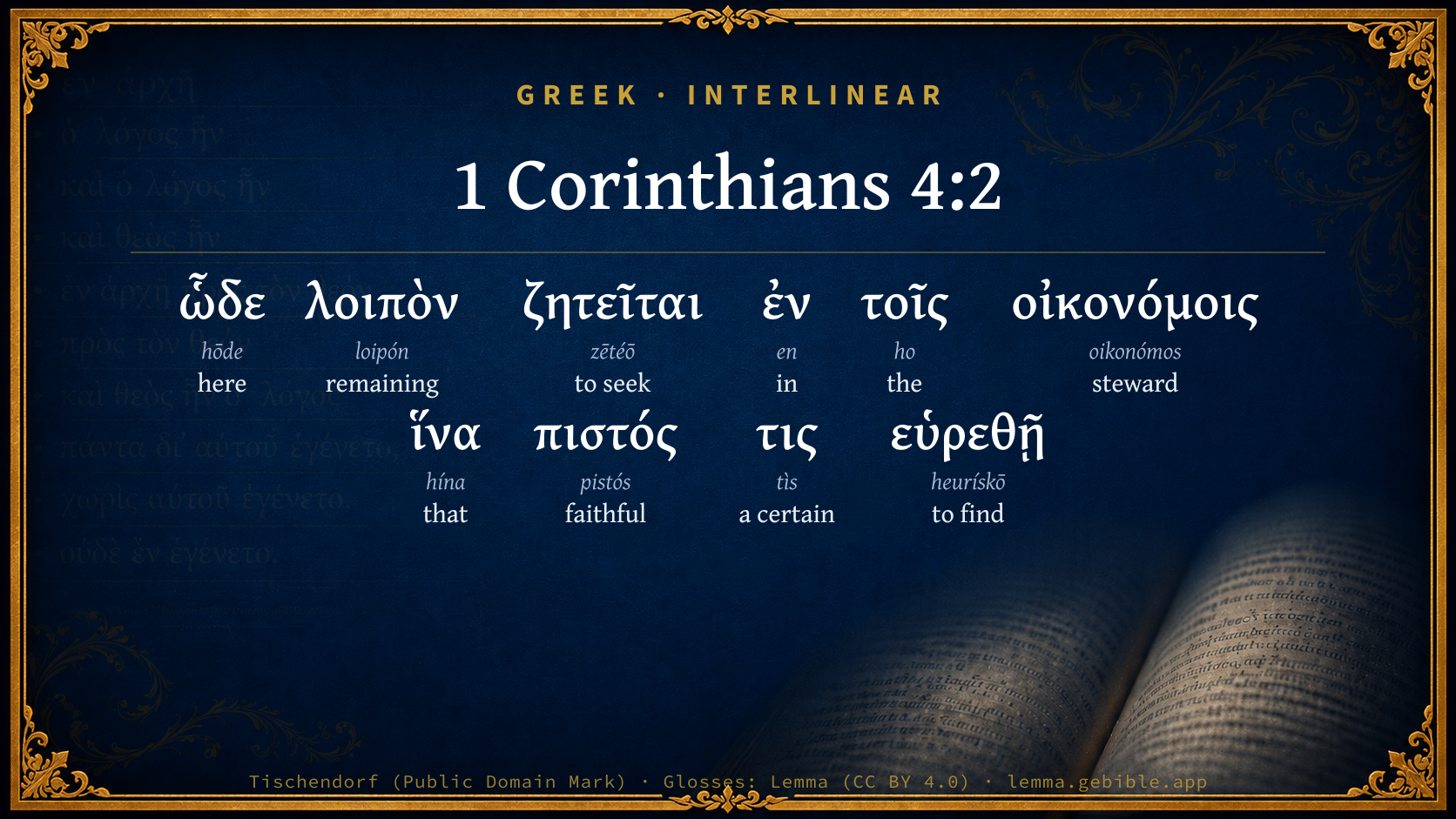
  1. ὧδε hōde G5602 “here” Adverb
  2. λοιπὸν loipón G3063 “remaining” Adjective, Accusative, Singular, Neuter
  3. ζητεῖται zētéō G2212 “to seek” Verb, Present, Passive, Indicative, 3rd person, Singular
  4. ἐν en G1722 “in” Preposition
  5. τοῖς ho G3588 “the” Article, Dative, Plural, Masculine
  6. ἵνα hína G2443 “that” Conjunction
  7. πιστός pistós G4103 “faithful” Adjective, Nominative, Singular, Masculine
  8. τις tìs G5100 “a certain” Indefinite pronoun, Nominative, Singular, Masculine
  9. εὑρεθῇ heurískō G2147 “to find” Verb, Aorist, Passive, Subjunctive, 3rd person, Singular

About this verse

These counts appear in no published source. They are computed here, from the morphology-tagged text and Lemma’s own curated glosses. What Lemma adds →

10
words
10
distinct lemmas
Pauline Epistles
section

Notable vocabulary

The rarest word here is οἰκονόμοις steward G3623 — appearing just 10 times in the whole Greek New Testament.

Shared distinctive vocabulary

οἰκονόμοις steward G3623 occurs in 10 verses of the Greek New Testament. Also found in:

Cross-references

13

Topical passages linked to 1 Corinthians 4:2 in the Treasury of Scripture Knowledge — connected by theme and wording, ordered by reader-vote popularity; previews shown in the World English Bible.

  • Matthew 25:21 "His lord said to him, 'Well done, good and faithful servant. You have been faithful over a few things, I will set you over many things. Enter into the joy of your lord.'
  • Luke 12:42 The Lord said, "Who then is the faithful and wise steward, whom his lord will set over his household, to give them their portion of food at the right times?
  • Luke 16:10–12 He who is faithful in a very little is faithful also in much. He who is dishonest in a very little is also dishonest in much.
  • Proverbs 13:17 A wicked messenger falls into trouble, But a trustworthy envoy gains healing.
  • Numbers 12:7 My servant Moses is not so; he is faithful in all my house:
  • Matthew 25:23 "His lord said to him, 'Well done, good and faithful servant. You have been faithful over a few things, I will set you over many things. Enter into the joy of your lord.'
  • 2 Corinthians 2:17 For we are not as so many, peddling the word of God. But as of sincerity, but as of God, in the sight of God, we speak in Christ.
  • Colossians 4:17 Tell Archippus, "Take heed to the ministry which you have received in the Lord, that you fulfill it."
  • Colossians 1:7 even as you learned of Epaphras our beloved fellow servant, who is a faithful minister of Christ on our behalf,
  • 1 Corinthians 4:17 Because of this I have sent Timothy to you, who is my beloved and faithful child in the Lord, who will remind you of my ways which are in Christ, even as I teach everywhere in every assembly.
  • 1 Corinthians 7:25 Now concerning virgins, I have no commandment from the Lord, but I give my judgment as one who has obtained mercy from the Lord to be trustworthy.
  • Colossians 4:7 All my affairs will be made known to you by Tychicus, the beloved brother, faithful servant, and fellow bondservant in the Lord.
  • 2 Corinthians 4:2 But we have renounced the hidden things of shame, not walking in craftiness, nor handling the word of God deceitfully; but by the manifestation of the truth commending ourselves to every man's conscience in the sight of God.

Cross-references courtesy of OpenBible.info (CC BY 4.0).

Commentary

Notes on 1 Corinthians 4:2 from classic Christian and Jewish commentators (each source and its license shown beneath its notes). The classic Christian expositions comment on the surrounding passage and are grouped to its opening verse, so a note may address several verses; the Jewish commentaries on the Tanakh (Rashi and others) are per-verse, so they appear only where the commentator wrote on this verse.

Lemma curates 59 commentaries, every one of them public domain or Creative Commons licensed, each selected and text-cleaned for this edition rather than reprinted as found. About our sources →

Jamieson, Fausset & Brown

Robert Jamieson, A. R. Fausset & David Brown

Moreover--The oldest manuscripts read, "Moreover here" (that is, on earth). The contrast thus is between man's usage as to stewards (Co1 4:2), and God's way (Co1 4:3). Though here below, in the case of stewards, inquiry is made, that one man be found (that is, proved to be) faithful; yet God's steward awaits no such judgment of man, in man's day, but the Lord's judgment in His great day. Another argument against the Corinthians for their partial preferences of certain teachers for their gifts: whereas what God requires in His stewards is faithfulness (Sa1 3:20, Margin; Heb 3:5); as indeed is required in earthly stewards, but with this difference (Co1 4:3), that God's stewards await not man's judgment to test them, but the testing which shall be in the day of the Lord.

Jamieson, Fausset & Brown — Commentary Critical and Explanatory on the Whole Bible (1871) — public domain (CC PDM 1.0). Text via the HelloAO Bible API.

Ellicott's Commentary for English Readers

(2) Moreover it is required . . .—Better, Moreover here (on earth) inquiry is made in the case of stewards in order that it may be found that one is faithful. The word “found” having the force of “discovered,” or “proved to be” (as in Mat_1:18; Rom_7:10). The argument here is that, as in the case of an earthly steward, inquiry is made into his character as to whether he be trustworthy—so it will be with them who are stewards of the mysteries of God. That inquiry is, of course, made in regard to an earthly steward by his master in whose service he is; and so the Lord alone, whose stewards the Apostles were, shall be the inquirer into their faithfulness. If we take 1Co_4:2 as it is in our English version, it would seem to imply that on this point of faithfulness the Church might prefer one steward to another. This would be to suggest that to some extent, therefore, party-spirit might exist, which would be contrary to the whole argument from the commencement of the Epistle, and strikingly at variance with the remarks which immediately follow in 1Co_4:5. The rendering adopted above is a more literal translation of the best Greek texts, and also perfectly in harmony with the general sense of the passage.

A Bible Commentary for English Readers, edited by Charles John Ellicott (1878–1897) — public domain. Text from a community e-Sword module.

Joseph Benson's Commentary

1Co 4:2-5. Moreover — As for what remains to be done in the discharge of this office; it is required of stewards — Since they also, as well as lower servants in the family, are subject to account; that a man be found faithful — That he act according to his commission, and neither withhold any privilege, or any part of God’s will from the people; nor deliver his own notions as the will of God, nor take more authority upon him than God has given him; as also that he discover and communicate divine truths and blessings as the hearers are able to receive them. With me it is a very small thing — A thing that concerns me very little; that I should be judged of you — Ινα ανακριθω, that I should be examined, as the word properly signifies, namely, in order to the being judged, or to a judicial sentence being passed, which is evidently the meaning of the same word in the last clause of the verse; or of man’s judgment — A judgment passed by any man whatsoever, though in the most solemn manner. The original expression, ανθρωπινης ημερας, is literally, human day; namely, of judgment, in allusion to the great day of judgment. Yea, I judge not myself — Namely, finally, infallibly, definitively: my final state is not to be determined by my own judgment. For I know nothing by myself — I am not conscious to myself of doing any thing evil, or of any unfaithfulness or negligence in the discharge of my ministry; yet am I not hereby justified — Acquitted from all fault in God’s sight, who observes those failings in us which we cannot discern in ourselves; for who can understand his errors?

Psa 19:12 : or, I do not depend on my own conscience not condemning me, as a sufficient justification of myself in God’s sight: but he that judgeth me is the Lord — By his sentence I must stand or fall. Therefore judge nothing before the time — Appointed for judging all men; until the Lord come — To judge the world in righteousness; who — In order to pass a righteous judgment, which otherwise would be impossible; will both bring to light the hidden things of darkness — The things covered with the veil of impenetrable obscurity, and will make manifest the counsels of the heart — The most secret springs of action, the principles and intentions of every heart: and then shall every man — Who is sincere, faithful, and praiseworthy; have praise of God — Both commendation and reward.

Joseph Benson's Commentary on the Old and New Testaments (1811–1818) — public domain. Text from a community e-Sword module.

Bengel's Gnomon

Johann Albrecht Bengel

1Co 4:2. Ὃ δὲ) Furthermore what God requires, and men too, in their stewards, is, that a man be found faithful. 1Co 4:3 corresponds to this paraphrase.—ζητεῖται, is inquired after [is required]) by investigation, when the time comes. The correlative is, may be found.—πιστὸς, faithful) The Corinthians were not content with that.—εὑρεθῇ, may be found) Every man in the mean time wishes to be thought faithful.

Bengel's Gnomon of the New Testament — English translation (T&T Clark, Edinburgh, 1860) — public domain. Text from a community e-Sword module.

Meyer's Critical & Exegetical Commentary

Heinrich August Wilhelm Meyer

1Co_4:2. If we read ὧδε (see the critical remarks), we must understand the verse thus: Such being the state of the case, it is, for the rest, required of the stewards, etc., so that λοιπόν (1Co_1:16) would express something which, in connection with the relationship designed in 1Co_4:1, remained now alone to be mentioned as pertaining thereto, while ὧδε[600] again, quite in accordance with the old classical usage (see Lehrs, Arist. p. 84 ff.), would convey the notion of sic, i.e. cum eo statu res nostrae sint (Ellendt, Lex. Soph. II. p. 991). We might paraphrase, therefore, as follows: Such being the nature of our position as servants, the demand to be made upon the stewards of households[601] of course takes effect. If we abide by the Recept[602], ὃ δὲ λοιπόν must be rendered: But as to what remains, i.e. but as respects what else there is which has its place in connection with the relationship of service spoken of in 1Co_4:1, this is the demand, etc.; comp on Rom_6:10. It is a perversion of the passage to make it refer, as Billroth does, to the preceding depreciation of the supposed merits of the teachers: but what still remains for them is, that they can at least strive for the praise of faithfulness. The rest of the verse says nothing at all about a being able to strive; for ζητεῖται ἐν means nothing else but: it is sought at their hand (requiritur), i.e. demanded of them. See Wetstein. Hofmanns interpretation, too, is an impossible one. He makes ὁ δὲ λοιπόν down to εὑρεθῇ to be the protasis; ἐμοὶ δὲ κ.τ.λ[604], and that running on as far as ΚΎΡΙΌς ἘΣΤΙΝ in 1Co_4:4, to be the apodosis: As respects that, however, which … is further required, namely, that one be found faithful, it is to me, etc. This interpretation gives us, instead of the simple, clearly progressive sentences of the apostle, a long, obscurely and clumsily involved period, against which on linguistic grounds there are the two considerations(1) that Ὃ ΔῈ ΛΟΙΠῸΝ ΖΗΤΕῖΤΑΙ would presuppose some demand already conveyed in ver 1, to which a new one was now added; and (2) that the ΔΈ of the apodosis in 1Co_4:3 would require to find its antithetic reference in the alleged protasis in 1Co_4:2 (comp Act_11:17; Baeumlein, Partik. p. 92 f.), namely, to this effect: to me, on the contrary, not concerned about this required faithfulness, it is, etc. Now the first is not the case, and the second would be absurd. Neither the one difficulty nor the other is removed by the arbitrarily inserted thoughts, which Hofmann seeks to read between the lines.[606]

ἵνα] is sought with the design, that there be found. Hence the object of the seeking is conveyed in the form expressive of design. That εὑρίσκεσθαι is not equivalent to ΕἾΝΑΙ (Wolff, Flatt, Pott, and others) is plain here, especially from the correlation in which it stands to ΖΗΤΕῖΤΑΙ.

ΤΙς] i.e. any one of them. See Matthiae, p. 1079; Nägelsbach on the Iliad, p. 299, ed. 3.

πιστός] Luk_12:42; Luk_16:10 ff.; Mat_25:21 ff.; Eph_6:21, al[607] The summing up of the duties of spiritual service.

[600] The word would be singularly superfluous, and would drag behind in the most awkward way, were we, with Lachmann, to treat it as belonging to ver. 1, and to separate it by a point from λοιπόν.

[601] This ἐν τοῖς οἰκονόμ. is not uncalled for and superfluous after ὧδε (as Hofmann objects); for Paul had, in ver. 1, described the official service of the teachers by two designations, but now desires to attach what more he has to say in ver. 2 specially of the second of these designations, and hence he has again to bring in the οἰκονόμοι.

[602] ecepta Textus receptus, or lectio recepta (Elzevir).

[604] .τ.λ. καὶ τὰ λοιπά.

[606] In λοιπόν he finds: Besides this, that the stewards act in accordance with their name. By the antithetic ἐμοὶ δέ, again, Paul means: in contrast to those who conduct themselves as though he must consider it of importance to him. By interpolations of this sort, everything may be moulded into what shape one will.

[607] l. and others; and other passages; and other editions.

Meyer — Critical and Exegetical Commentary on the New Testament — English translation by Peter Christie, edited by Frederick Crombie (T&T Clark, 1880) — public domain. Text from a community e-Sword module.

Expositor's Greek Testament

ed. W. Robertson Nicoll

1Co 4:2 . ὧδε λοιπὸν ( proinde igitur ) ζητεῖται , ἐν τοῖς οἰκονόμοις κ . τ . λ .: “In such case, it is further sought in stewards (to be sure) that one be found faithful”. ὧδε gathers up the position given to “us” in 1Co 4:1 ; ἐν τοῖς οἰκονόμοις is therefore pleonastic, but repeated for distinctness and by reference to the well-understood rule for stewards (Luk 12:48 ). λοιπὸν brings in the supplement to an imperfect representation: it is not enough to be steward a faithful steward is looked for (an echo of Luk 12:42 f.). ζητεῖται … ἵνα resembles παρακαλῶ ἵνα , 1Co 1:10 (see note): the telic force of the conj. has not disappeared; one “seeks” a thing in order to “find” it.

The Expositor's Greek Testament, edited by W. Robertson Nicoll (1897–1910) — public domain. Text from a community e-Sword module.

Hodge's Commentary on Romans, Ephesians & First Corinthians

Charles Hodge

1Co_4:2

Moreover, it is required in stewards, that a man be found faithful.

Moreover, (ὃ δὲ λοιπόν) but what remains is; as to the rest. Instead of the words just mentioned Lachmann and Tischendorf adopt the reading ὧδε, here, i.e. in the earth, or, in this matter. The most ancient MSS. are in favor of this reading, and the sense is good. The great requisite for the discharge of the office of a steward is fidelity. As he is a servant he must be faithful to his master; as he is a dispenser, he must be faithful to those subject to his oversight. He must not neglect to dispense to them their food; neither may he adulterate it, or substitute any thing in the place of that which is given them to distribute. The application of this to the case of ministers is plain. The great thing required of them is fidelity. Fidelity to Christ as servants; not arrogating to themselves any other man ministerial power, or venturing to go beyond his commands. Fidelity also to the people, not failing to dispense to them the truths which God has revealed, nor mixing those truths with their own speculations, much less substituting for those doctrines human knowledge or wisdom.

Charles Hodge — Commentary on Romans (1835), First Corinthians (1857), and Ephesians (1856) — public domain. Text from a community e-Sword module.

Geneva Bible (1599)

Geneva Bible translators

Last of all, he warneth the ministers that they also behave themselves not as lords, but as faithful servants, because they must render an account of their stewardship unto God.

Geneva Bible (1599) marginal notes — public domain. Text via Bolls.life.

John Calvin's Commentaries

2. But it is required in ministers It is as though he had said, it is not enough to be a steward if there be not an upright stewardship. Now the rule of an upright stewardship, is to conduct one’s self in it with fidelity. It is a passage that ought to be carefully observed, for we see how haughtily Papists require that everything that they do and teach should have the authority of law, simply on the ground of their being called pastors. On the other hand, Paul is so far from being satisfied with the mere title, that, in his view, it is not even enough that there is a legitimate call, unless the person who is called conducts himself in the office with fidelity. On every occasion, therefore, on which Papists hold up before us the mask of a name, for the purpose of maintaining the tyranny of their idol, let our answer be, that Paul requires more than this from the ministers of Christ, though, at the same time, the Pope and his attendant train are wanting not merely in fidelity in the discharge of the office, but also in the ministry itself, if everything is duly considered.

This passage, however, militates, not merely against wicked teachers, but also against all that have any other object in view than the glory of Christ and the edification of the Church. For every one that teaches the truth is not necessarily faithful, but, only he who desires from the heart to serve the Lord and advance Christ’s kingdom. Nor is it without good reason that Augustine assigns to hirelings, (John 10:12,) a middle place between the wolves and the good teachers. As to Christ’s requiring wisdom also on the part of the good steward, (Luke 12:42,) he speaks, it is true, in that passage with greater clearness than Paul, but the meaning is the same. For the faithfulness of which Christ speaks is uprightness of conscience, which must be accompanied with sound and prudent counsel. By a faithful minister Paul means one who, with knowledge as well as uprightness, discharges the office of a good and faithful minister.

John Calvin's Commentaries (1540-1563) — public domain. Text from the Calvin Translation Society English edition (1840s-50s) via the Christian Classics Ethereal Library (ccel.org). Calvin's coverage is partial (roughly two-thirds of the Bible); uncommented books and verses are honest gaps, never fabricated. The 19th-century editor's footnotes and remarks are omitted so the notes are faithfully Calvin's own voice.

The Cambridge Bible for Schools and Colleges

gen. ed. J. J. S. Perowne

2. Moreover it is required in stewards] The majority of MSS. and versions read here at the beginning of this verse. The sense would then be, “in this world, moreover, it is customary to make diligent inquiry for a trustworthy man.”

The Cambridge Bible for Schools and Colleges (gen. ed. J. J. S. Perowne; Cambridge University Press, 1878–1918) — public domain. Text from a community e-Sword module.

John Gill's Exposition

Moreover, it is required in stewards,.... Upon mentioning that part of the character of Gospel preachers, as stewards, the apostle is put in mind of, and so points out that which is principally necessary in such persons: as,

that a man be found faithful; to the trust reposed in him; to his Lord and master that has appointed him to this office; and to the souls that are under his care: and then may a minister be said to be so, and which is his greatest glory, when he preaches the pure Gospel of Christ without any human mixtures, the doctrines and inventions of men; and the whole Gospel, declaring all the counsel of God, keeping back nothing which may be profitable to souls; when he seeks not to please men, but God; and not his own glory, and the applause of men, but the honour of Christ, and the good of souls: and such a faithful steward was the apostle himself.

John Gill's Exposition of the Whole Bible (1746–1763) — public domain (CC PDM 1.0). Text via the HelloAO Bible API.

Trapp's Complete Commentary

John Trapp

2 Moreover it is required in stewards, that a man be found faithful.

Ver. 2. That a man be found faithful] Giving every man his due proportion of fit food, Mat 24:45, not as he in the emblem, that gave straw to the dog, and a bone to the ass.

John Trapp, A Commentary or Exposition upon All the Books of the Old and New Testament (1647–1656) — public domain. Text from a community e-Sword module.

Albert Barnes' Notes on the Bible

Moreover ... - The fidelity required of stewards seems to be adverted to here, in order to show that the apostles acted from a higher principle than a desire to please man, or to be regarded as at the head of a party; and they ought so to esteem them as bound, like all stewards, to be faithful to the master whom they served.

It is required ... - It is expected of them; it is the “main” or “leading” thing in their office. Eminently in that office fidelity is required as an indispensable and cardinal virtue. Fidelity to the master, faithfulness to his trust, as the virtue which by way of eminence is demanded there. In other offices other virtues may be particularly required. But here fidelity is demanded. This is required particularly because it is an office of trust; because the master’s goods are at his disposal; because there is so much opportunity for the steward to appropriate those goods to his own use, so that his master cannot detect it. There is a strong similarity between the office of a steward and that of a minister of the gospel. But it is not needful here to dwell on the resemblance. The idea of Paul seems to be:

(1) That a minister, like a steward, is devoted to his master’s service, and should regard himself as such.

(2) That he should be faithful to that trust, and not abuse or violate it.

(3) That he should not be judged by his fellow-stewards, or fellow-servants, but that his main desire should be to meet with the approbation of his master - A minister should be faithful for obvious reasons. Because:

He is appointed by Jesus Christ; Because he must answer to him; Because the honor of Christ, and the welfare of his kingdom is entrusted to him; and, Because of the importance of the matter committed to his care; and the importance of fidelity can be measured only by the consequences of his labors to those souls in an eternal heaven or an eternal hell.

Albert Barnes' Notes on the Bible (1834–1885) — public domain. Text from a community e-Sword/MySword module.

Matthew Poole's English Annotations

It is required of all servants, but especially of chief servants, such as stewards are, who are intrusted with their masters’ goods, to be dispensed out to others. The faithfulness of a steward in dispensing out his master’s goods lies in his giving them out according to his master’s order, giving to every one their portion, not detaining any thing from others which it is his master’s will they should have; as Paul gloried, Act 20:20,27, that he had kept back from the Ephesians nothing that was profitable for them, nor shunned to declare to them all the counsel of God; not giving holy things to dogs, or casting pearls before swine, contrary to Christ’s direction, Mat 7:6.

Matthew Poole's English Annotations on the Holy Bible (1683–1685) — public domain. Text from a community e-Sword/MySword module.

Whedon's Commentary on the Bible

Daniel D. Whedon

2. Faithful—The sophos, or sage, was expected to be original, fertile, creative of plausible and, if possible, true theories. Of the steward could only be required that he be faithful in transmitting and communicating what he had received.

Daniel D. Whedon (gen. ed.), Commentary on the Old and New Testaments (1874–1909) — public domain. Text from a community e-Sword module.

The Pulpit Commentary

Moreover. The true reading (a, A, B, C, D, F) is wde koipon, here, moreover; i.e. "on this earth." It may be required of him as a minister that he should be faithful, but if, being faithful, he is misjudged and depreciated, his appeal lies to a truer and loftier tribunal. It is required. This is the reading of a, A, C, D. Other manuscripts have "ye require;" but the sound of the two words in Hellenistic Greek would have been almost indistinguishable. That a man be found faithful. We have a right to demand that on trial he be proved to be honest and diligent. So our Lord has described the "faithful and wise steward" in Luk_12:42, Luk_12:43. What is required of ministers is neither brilliancy, nor eloquence, nor profound knowledge, nor success, but only fidelity.

HOMILIES BY J. WAITE Ver. 2.

Faithful stewardship.

This is a principle approved alike of God and man. Stewardship implies responsibility, and responsibility demands faithfulness. The principle is applicable specially to the ministry of the Word. No responsibility like that of those who are called to keep watch and guard over the mysteries of God, to minister in Christ"s Name the richest treasures of his grace. Note St. Paul"s own profound sense of his responsibility. It was a comparatively "small thing" to him to be "judged of man"s judgment;" but the consciousness of the righteous judgment of God was always present with him, and the anxiety to approve himself to him as one who "needed not to be ashamed" was perhaps the deepest and strongest emotion he knew. And the principle may be applied to everything that distinguishes us personally among men, and that puts any power for good into our hands (Parables of the Unjust Steward, of the Talents, etc.). Intellectual capacity, educational advantages, wealth, social position, power of speech, any kind of artistic or constructive skill, vigour of physical health, abundance of leisure time, these and such as these are endowments that put the possibility of incalculable good within our reach, and for the use of which we must give account. All human life is a sacred stewardship. In every position in which Providence has placed us our fidelity is being put to the test, our loyalty to God and to conscience, to the eternal principles of truth and righteousness, to the sovereign authority of the Law of Christ. It is required of us that we should be faithful always and in everything. And if at heart we are faithful men, it will be seen to be so. Observe respecting this stewardship

I THAT IT IS INDEPENDENT OF WHAT SEEMS TO BE THE RELATIVE IMPORTANCE OF THE POSITIONS WE OCCUPY AND THE MATTERS WITH WHICH WE HAVE TO DEAL. What we call the trivial and commonplace affairs of life are quite as effectual a test of moral faithfulness as the greater; often more so. We are prone to treat lightly what seem to us to be "little things," and for that very reason they are often the truest revealers of our character. Our real dispositions come out most clearly in the way in which we deal with them, because then our behaviour is most spontaneous, unpremeditated, free from artifice. If you want to know what a man really is, don"t judge of him as he appears on the broad open platform of public life, but follow him into his more private ways, and see how he speaks and acts when he feels himself to be beyond the ear and eye of the world, and in matters on which no great consequence seems to hang. It is quite possible to raise a purely artificial standard of moral obligation, and to magnify unwisely certain scruples of conscience. But a really conscientious man will be conscientious in everything. And as a feather or a straw will show which way the stream is flowing, so do the trivial circumstances of life reveal the moral drift of our being. (Note the bearing of this on the probation to which Adam was subject: "Thou shalt not eat," etc.) What is daily life to every one of us but a series of silent tests of our inward fidelity? We are hedged in by little restrictions, called to take upon us manfully the burden of many unwelcome duties; to suffer many abstinences, rebukes, self mortifications. And when we are disposed to overstep the boundary, because at certain points it seems so narrow or so low, we show that we have not learnt the full surrender of the spirit of obedience. "Offending in one point" of the law of our allegiance, we betray a spirit that is "guilty of all." So as regards the right use of faculty and passing opportunities of doing good. The temptations that belong to a low order of personal faculty and a narrow range of personal influence are often greater than those that belong to the highest and the largest. You do nothing because the utmost you can do is so little; or you do carelessly and half heartedly what, as it seems to you, for anything the world would really be the better for it, you might neglect to do at all. The spirit that dictates this is one that would trifle with the loftiest powers and abuse the noblest possibilities of life. "He that is faithful in that which is least," etc.. (Luk_16:10)

II ALL PRACTICAL FIDELITY IN THE STEWARDSHIP OF LIFE HAS A TENDENCY TO DEVELOP INTO HIGHER CAPACITY AND NOBLER DEED. Note here the power of habit. Accustom yourself with an earnest spirit to meet the claims of every day duty as in the Master"s sight, and you call to your aid a power and obey a law of life by which the highest moral victories shall ultimately, be won. Let our children be trained to act from principle and not from mere passion or policy, to habits of self surrender, to simple forms of Christian service, and they will become so habituated to the right way that when the heavier responsibilities of life begin to fall upon them they will be prepared bravely to meet them the "yoke will be easy and the burden light." Thus is it given to us all to educate ourselves for what awaits us in the future. The Jews say of David that "God tried him first with those few sheep in the wilderness, and then, because he faithfully and bravely kept them, took him from the sheepfolds to feed his people Israel." Only use manfully whatever moral power you possess, and you need not fear any strain that shall ever be put upon it. Cast yourself freely upon your faith, and though it be now but as a "grain of mustard seed," it shall be mighty enough one day "to remove mountains.

III SUCH FIDELITY LEADS TO BLESSED ISSUES IN THE GREAT FUTURITY. It is not given to us to trace the path of moral threes very far in this world. Our judgments are often at fault, our forecasts often strangely falsified. Only very.imperfectly and with cautious hesitating steps can we follow the winding and widening stream of earthly issues. And who shall say how some of the unnoticed doings of every human life, and the results that grow out of them, will appear in the all revealing light of the day when "God will bring every work into judgment and every secret thing, whether it be good or bad"? But of this we may be perfectly well assured, that to a lifelong endeavour to serve and please the Lord Jesus Christ there must be a blessed eternal reward. Let our life be a faithful one, a work faithfully wrought out in his Name, and we need not fear but that it will prove itself to be a life worth living and that ends well "Be thou faithful unto death, and I will give thee a crown of life". (Rev_2:10) W.

The Pulpit Commentary (1880–1919), ed. H.D.M. Spence-Jones & Joseph S. Exell — public domain. Text from a community e-Sword module.

McGarvey & Pendleton's Commentaries

J. W. McGarvey

Here, moreover, it is required in stewards, that a man be found faithful . [It was not expected of the steward that he would procure or provide; he was merely to distribute that which was provided by the master. The apostles were not philosophers burdened with the discovery and invention of truth, but were mere dispensers of truth revealed to them by God--truth which must be thus revealed because it can not be discovered by any process of ratiocination. If the apostles faithfully rehearsed that which was revealed, nothing more could be asked of them.]

J. W. McGarvey (with Philip Y. Pendleton), Commentaries on the New Testament (The Fourfold Gospel, 1914; Acts; and the epistles) — public domain. Text from a community e-Sword/MySword module.

The People's New Testament

B. W. Johnson

2. Moreover it is required of stewards, etc. The supreme quality required in a steward is fidelity to his trust.

B. W. Johnson's The People's New Testament with Notes (1889–1891) — public domain. Electronic text from the Christian Classics Ethereal Library (CCEL) ThML edition.

Cambridge Greek Testament for Schools and Colleges

2. ὧδε אABCDFG Vetus Lat. Vulg. Peshito. Rec. ὃ δέ with E.

2. ὧδε. According to Meyer, this being so, though Dean Alford would interpret it here on earth. R.V. translates here, moreover. Lachmann connects it with the last verse, and puts the period after it. But this yields a poor meaning, and makes a very unusual sentence. The rec. ὃ δὲ λοιπόν would mean simply moreover.

ἵνα. Great endeavours have been made by Classical purists to make ἵνα bear the telic sense here. Thus Meyer translates ‘it is sought’ (what is sought he does not say), ‘in order that a man be found faithful.’ But it is impossible, in the face of innumerable passages, to maintain this rendering. See Winer, Gr. Gram. Pt III. § 44.8, and Mar 6:25; Mar 9:30; Joh 4:34, &c. The fact is (see Prof. Jebb’s Appendix to Vincent and Dickson’s Modern Greek Grammar, p. 320), that colloquial Greek had undergone gradual changes, which had affected written Greek in the Apostles’ time. Cf. Dion. Halic. (25 B.C.) I. 215 δεήσασθαι ἔμελλον ἵνα ἀγάγοι, I was going to ask her to bring me, where, as in many passages in the N. T., ἵνα is no more than the sign of the infinitive, like the modern Greek νά. See also next verse.

Cambridge Greek Testament for Schools and Colleges (Cambridge University Press, 1896; 21 vols, various authors incl. Carr, Maclear, Plummer, Farrar, Lumby, Moule, M. R. James, Simcox) — public domain. Text from a community e-Sword module.

Alford’s Greek Testament

Henry Alford

2.] Moreover, here (on earth) (see var. readd. and reff. ὧδε is emphatic, and points to what follows, that though in the case of stewards enquiry was necessarily made here below, yet he, God’s steward, awaited no such enquiry ὑπὸ ἀνθρωπίνης ἡμέρας, but one at the coming of the Lord. Lachmann, I cannot but think somewhat strangely, places ὧδε at the end of ver. 1: οἰκονόμους μυστηρίων θεοῦ ὧδε. Stanley takes ὧδε for ‘in this matter,’ and supports the meaning by Rev 13:10, Rev 13:18; Rev 14:12; Rev 17:9) enquiry is made in the case of stewards (or, it is required in the case of stewards), in order that (or that, the purport of the requirement expressed as its purpose) a man may be found (proved to be) faithful (emph.).

Henry Alford, The Greek Testament (1849–1861) — public domain. Text from a community e-Sword module.

International Critical Commentary

2. ὧδε. ‘Here,’ i.e. ‘on earth and in human life,’ or perhaps ‘in these circumstances.’ See on 1:16 for λοιπόν.

ζητεῖται κ.τ.λ. The AV. cannot be improved upon; ‘It is required in stewards that a man be found faithful.’ See on 1:10 for this use of ἵνα: the attempts to maintain its full ‘telic’ force here are too clumsy to deserve discussion: see further on v. 2, and compare εὑρεθῇ in 1Pe 1:7.

πιστός. Cf. Luk 12:42, Luk 12:16:10; Num 12:7; 1Sa 22:14: the meaning is ‘trustworthy.’ To be an οἰκονόμος is not enough.*

ὧδε (א A B C D* F G P 17, e Vulg.) rather than ὃ δέ (D3 E L). In Luk 16:25 there is a similar corruption in some texts. ζητεῖται (B L, d e f g Vulg. Copt. Syrr.) rather than ζητεῖτε (א A C D P and F G- ητε). Here, as in φθερεῖ (3:17), d e f g support the better reading against D E F G. Lachmann takes ωδε at the end of v. 1, —an improbable arrangement.

International Critical Commentary — older volumes (1896–1929), various authors — public domain. Text from a community e-Sword module.

Vincent's Word Studies in the New Testament

Marvin R. Vincent

It is required [ζητειται] . Lit., it is sought for; thus agreeing with found in the following clause.

Marvin R. Vincent, Word Studies in the New Testament (1887–1900) — public domain. Text from a community e-Sword/MySword module.

Godet's Commentaries

Frédéric Louis Godet

Vv. 2. “Now what remains to require of stewards is, that a man be found faithful.” — The meaning of the received reading (ὃ δὲ λοιπὸν ζητεῖται...ἵνα) is this: “As to what may be required moreover (λοιπόν, for the rest) of stewards, it is that...” According to this reading, the apostle means: the ministry of teaching being once confided by God to a man, the question is no longer if he is more or less eloquent, more or less profound, more or less captivating,

God, who chose and sent him, has alone to do with all these questions,—but only if he is faithful, that is to say, if he gives out conscientiously what is committed to him, if he puts all the gifts and powers with which he is endowed into the service of this task; if, as a devoted servant, he has only one interest, the cause of his Master. He can only be called to account for the conscientious use of what he has received.

This clear and natural meaning suits the context and leaves nothing to be desired. But several Mjj. of the three families present different readings. Some (A C D F G P) read ὧδε λοιπὸν ζητεῖτε, which would signify: “For the rest in these circumstances seek in stewards that each be found faithful...” This meaning is inadmissible. In such a sentence two things, it is plain, are mixed up: an exhortation addressed to particular persons, the Corinthian readers (seek), and a general principle (in stewards; each, τίς). The Sinaït. attempts to remedy this awkwardness by introducing after λοιπόν a τι, which can only be taken in an interrogative sense: “In these circumstances, moreover, what else seek ye in stewards, than that each...?” The meaning is good in itself; only, instead of in stewards, there would need to be in us. For if this question expresses a consequence to be drawn from 1Co 4:1, as the word ὧδε would demand in this state of things, it would require to be in us (these particular stewards), and not in stewards in general. The τις following is likewise suitable only to a maxim.

There remains the reading of B: ὧδε λοιπὸν ζητεῖται ἵνα: “In this state of things, the only thing sought (λοιπόν, the only thing which remains) in stewards is that...” This reading, though admitted by most commentators of our day, is no more admissible than the preceding, and for the same reason. The ὧδε, in this state of things, can relate only to the case of 1Co 4:1, and consequently to the ministers denoted by the ἡμᾶς, us (Paul and Apollos), while the words: in stewards, give to this saying the character of an entirely general rule of conduct. We must therefore return to the reading and sense of the T. R. This is one of those cases in which all the presumptions of external criticism are of no avail, whatever may be said against exegetical reasons. It is easy enough to explain what has given rise to the corruption of the text in part of the documents of the three families, and so early as in the old versions. The beginning was made by substituting for ζητεῖται, is sought, the imperative ζητεῖτε, seek, either to continue the series of the preceding imperatives (καυχάσθω, λογιζέσθω), and to give to the sentence a hortative turn (the same error as in most of the Mjj., Rom 5:1: ἔχωμεν, and 1Co 15:49: φορέσωμεν), or as a mistake arising from the pronunciation of αι (in ζητεῖται) as ε. The imperative once admitted, led to the change of ὃ δέ into ὧδε to make this verse an application of the idea of the preceding verse.

Λοιπόν, moreover, that is to say: beyond what God and Christ give to their agents; comp. the expressions: “the grace given unto me,” 1Co 3:10, and the ὡς ἔδωκεν, 1Co 3:5.

The relation between the two ideas of seeking and finding is evident. It is this relation which justifies the use of the conjunction ἵνα, that. Men seek with the view of finding.

The idea of the verse therefore is: that the only thing for which the steward is responsible, is his fidelity. Now this is the very point on which man’s judgment is incompetent, 1Co 4:3-5.

Frédéric Louis Godet — Commentaries on Luke, John, Romans, and 1 Corinthians — English translation (T&T Clark, Edinburgh, 1870s–1890s) — public domain. Text from a community e-Sword module.

Lesson kit

Teaching starters — assembled from the data on this page, not authored interpretation. Every prompt links to the verse data it draws on. Edit before teaching.

1 Corinthians, in the Pauline Epistles, opens this verse with 10 words (10 distinct Greek lemmas). Its most distinctive word is oikonómos (“steward”). A historical commentator’s framing appears above. Read the whole chapter for the surrounding context.

Discussion questions

  1. What does “steward” (oikonómos) contribute to the verse as a whole?
  2. How does Luke 12:42, which shares the word «steward», read alongside this verse?
  3. These translations render this verse differently. What is at stake in choosing one wording over another?
  4. Compare how Jamieson, Fausset & Brown and Ellicott's Commentary for English Readers read this verse. Where do they agree or differ?

Things to notice

Reading settings

Reading text

Shown beneath each verse's original-language words.

Old Testament
Old Testament edition

Read the OT as the Masoretic Hebrew (MT) or the Greek Septuagint (LXX).

English shown for the Greek Septuagint (in the Hebrew ↔ Greek comparison).

Comparing translations? Open the Compare panel on any verse page to stack up to four side by side.