
Luke 24:33

Greek (Tischendorf 8th ed.) Luke 24:33 appears in the Greek New Testament. The text above is from the Tischendorf 8th edition. Each word links to its Strong’s number and a concise gloss. Click any word for its full Thayer’s Greek Lexicon entry.
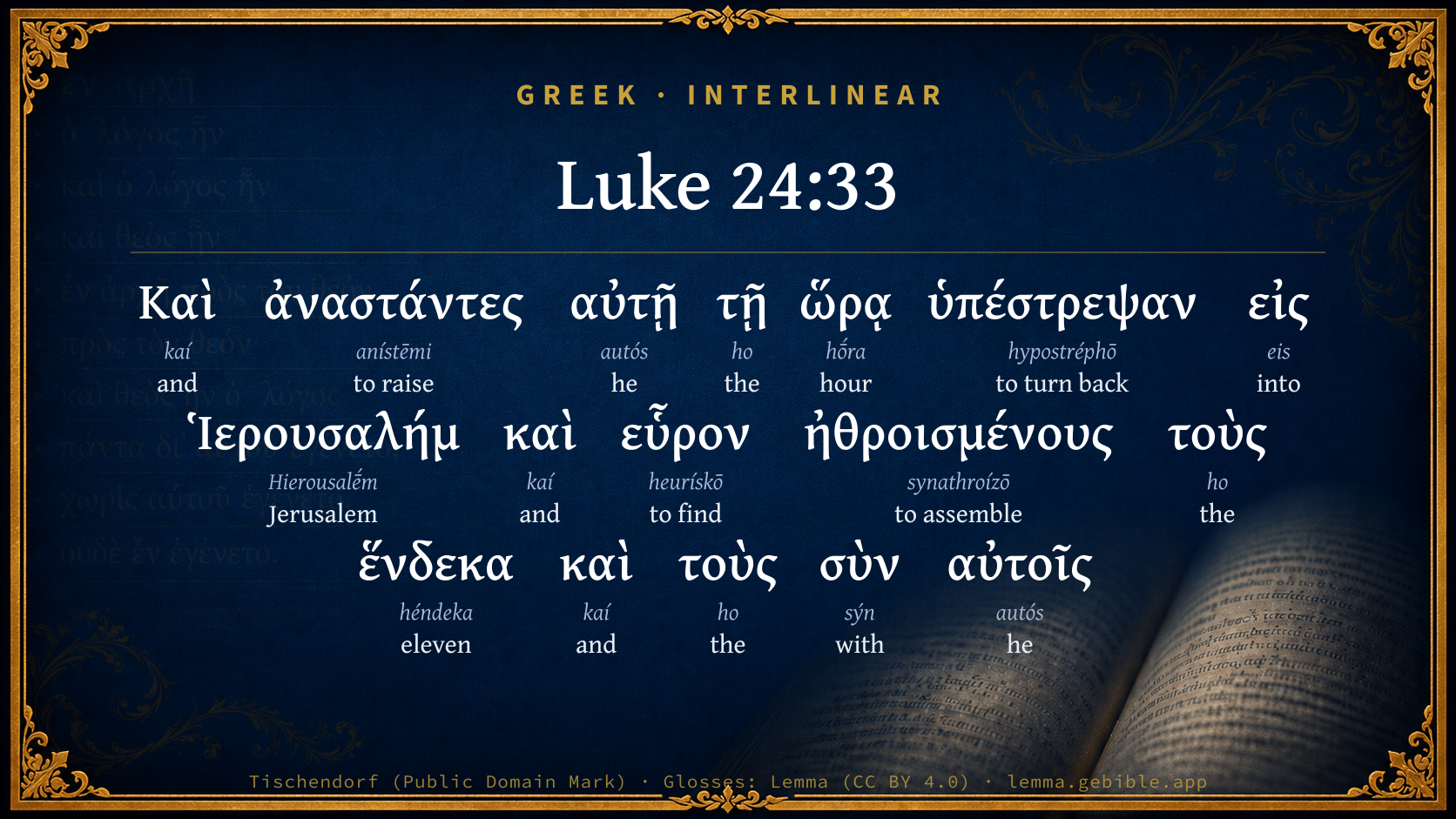
Download image
Cite this verse

Luke 24:33 (World English Bible). Public Domain. Lemma interlinear Bible study tool, https://lemma.gebible.app/v/luke/24/33.

Show BibTeX & RIS
BibTeX
RIS
English Translation
They rose up that very hour, returned to Jerusalem, and found the eleven gathered together, and those who were with them,
World English Bible · Public Domain
Highlights
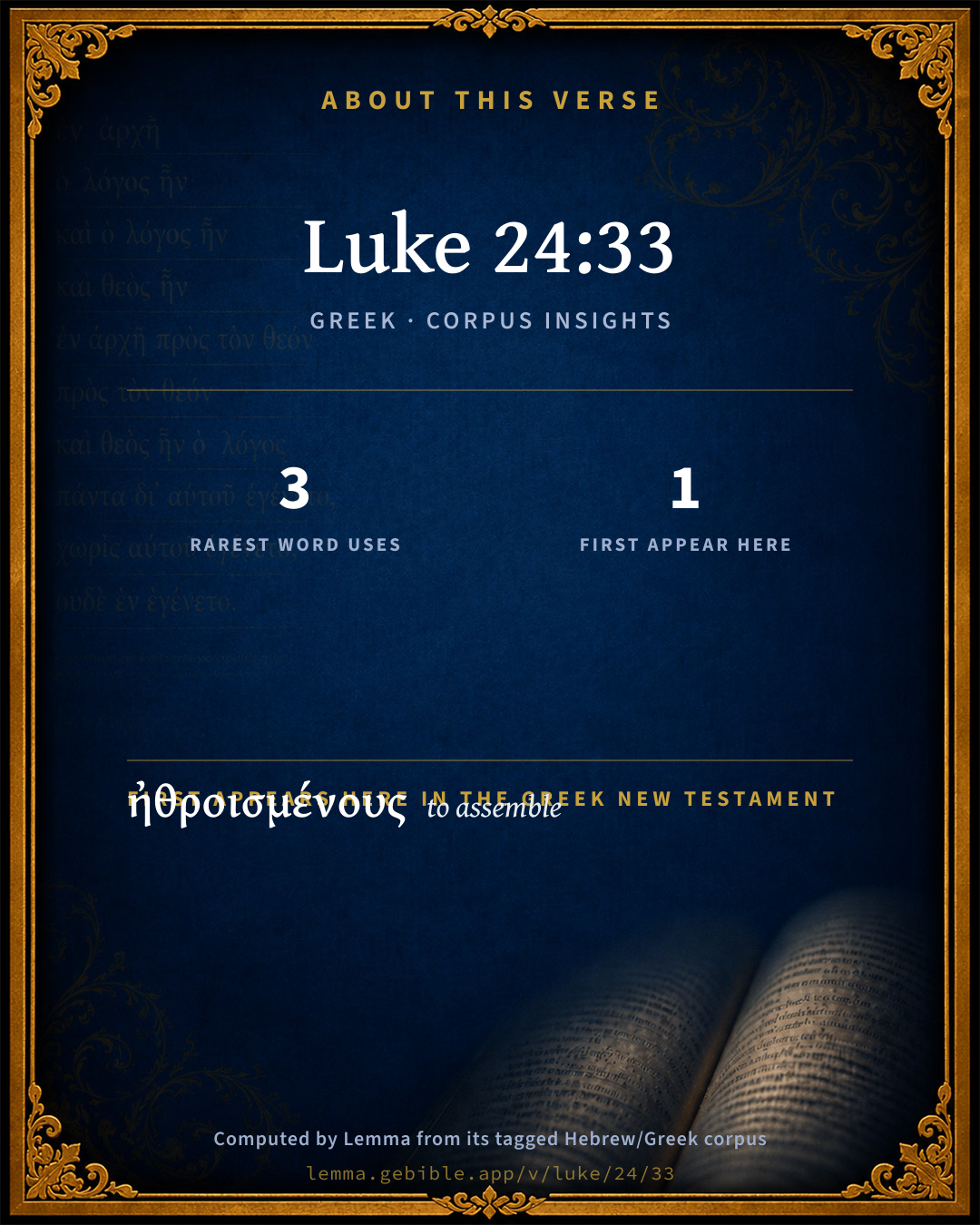
  • 1 first appearance in the Greek New Testament
Full analysis ↓
Download a study sheet

One document with this verse’s original text, its word-by-word gloss line, the meaning frame, cross-references with their text, attributed commentary, and full source and license credits — printable, and it pastes into notes with its structure intact.

This verse Autodidact and up

Study sheet (.html) Plain text (.txt)

A passage Seminary Student

Up to 50 verses in one chapter. A passage sheet keeps up to 6 commentary sources and 12 cross-references per verse, in the order this page ranks them, and says so on the sheet whenever that leaves anything out. Ask for a single verse and you get the Autodidact verse sheet above.

Everything on this page stays free to read, with no account — the sheet is a download of what is already on screen, not access to it.

Want to remove ads? Support Godless Engineer
Compare translations 3

The same verse in 3 English versions, stacked beneath the original-language interlinear above. Click any original word for its lexicon entry.

Each is an independent rendering of the whole verse — the interlinear is not word-aligned to these translations.

Highlighted words mark where these versions differ — a whole-verse word diff, not a word-by-word alignment.

  • World English Bible Public Domain
    They rose up that very hour, returned to Jerusalem, and found the eleven gathered together, and those who were with them,
  • King James Version Public Domain
    And they rose up the same hour, and returned to Jerusalem, and found the eleven gathered together, and them that were with them,
  • unfoldingWord Literal Text CC BY-SA 4.0
    And having risen up that same hour, they returned to Jerusalem. And they found the Eleven having been gathered, and the ones with them,

unfoldingWord Literal Text — © unfoldingWord, licensed CC BY-SA 4.0. Word-aligned USFM3 via Door43 (git.door43.org/unfoldingWord/en_ult).

Versions to compare (up to 4)

3 of 4 selected

Show all 19 translations

Every available English version of this verse, each an independent rendering of the whole verse.

  • World English Bible Public Domain
    They rose up that very hour, returned to Jerusalem, and found the eleven gathered together, and those who were with them,
  • Berean Standard Bible Public Domain
    And they got up that very hour and returned to Jerusalem. There they found the Eleven and those with them, gathered together
  • Majority Standard Bible Public Domain
    And they got up that very hour and returned to Jerusalem. There they found the Eleven and those with them, gathered together
  • King James Version Public Domain
    And they rose up the same hour, and returned to Jerusalem, and found the eleven gathered together, and them that were with them,
  • American Standard Version (1901) Public Domain
    And they rose up that very hour, and returned to Jerusalem, and found the eleven gathered together, and them that were with them,
  • Revised Version (1885) Public Domain
    And they rose up that very hour, and returned to Jerusalem, and found the eleven gathered together, and them that were with them,
  • Geneva Bible (1599) Public Domain
    And they rose vp the same houre, and returned to Hierusalem, and found the Eleuen gathered together, and them that were with them,
  • Douay-Rheims (1899) Public Domain
    And rising up, the same hour, they went back to Jerusalem: and they found the eleven gathered together, and those that were staying with them,
  • Young's Literal Translation Public Domain
    And they, having risen up the same hour, turned back to Jerusalem, and found gathered together the eleven, and those with them,
  • Literal Standard Version CC BY-SA 4.0
    And they, having risen up the same hour, turned back to Jerusalem, and found the Eleven gathered together, and those with them,
  • Unlocked Literal Bible CC BY-SA 4.0
    They rose up that very hour, and returned to Jerusalem. They found the eleven gathered together, and those who were with them,
  • unfoldingWord Literal Text CC BY-SA 4.0
    And having risen up that same hour, they returned to Jerusalem. And they found the Eleven having been gathered, and the ones with them,
  • Darby Bible Public Domain
    And rising up the same hour, they returned to Jerusalem. And they found the eleven, and those with them, gathered together,
  • World Messianic Bible Public Domain
    They rose up that very hour, returned to Jerusalem, and found the eleven gathered together, and those who were with them,
  • Webster's Bible Public Domain
    And they rose the same hour, and returned to Jerusalem, and found the eleven assembled, and them that were with them,
  • Free Bible Version CC BY-SA 4.0
    They got up right away and returned to Jerusalem. There they found the eleven disciples and those who were with them meeting together,
  • Bible in Basic English Public Domain
    And that very hour they got up and went back to Jerusalem, where the eleven and the others had come together.
  • Text-Critical English NT CC BY 4.0
    So they rose that very hour and returned to Jerusalem, where they found the eleven gathered together with their companions,
  • Tyndale New Testament (1534) Public Domain
    And they roose vp the same houre and returned agayne to Ierusalem and founde the eleven gadered to geder and them that were with them

Literal Standard Version (2020), Covenant Press — licensed CC BY-SA 4.0. Text via the HelloAO Bible API (eBible.org). Unlocked Literal Bible (unfoldingWord) — licensed CC BY-SA 4.0. Text via the HelloAO Bible API (eBible.org). unfoldingWord Literal Text — © unfoldingWord, licensed CC BY-SA 4.0. Word-aligned USFM3 via Door43 (git.door43.org/unfoldingWord/en_ult). Free Bible Version, Dr. Jonathan Gallagher — licensed CC BY-SA 4.0. Text via the HelloAO Bible API (eBible.org).

Word by word

More ways to search: Search by grammar → Find every occurrence → Compare this word →

Practice this passage: Drill this verse → Learn its vocabulary →

ἠθροισμένους
synathroízō
G4867
“to assemble”
Verb, Perfect, Passive, Participle, Accusative, Plural, Masculine
Part of Speech
Verb
Tense
Perfect
Voice
Passive
Mood
Participle
Case
Accusative
Number
Plural
Gender
Masculine
Full Thayer's Definition

Origin: from G4862 and athroizo (to hoard)

TDNT: None

1. to gather together with others 2. to assemble 3. to be gathered together i.e. to come together
  1. Καὶ kaí G2532 “and” Conjunction
  2. ἀναστάντες anístēmi G450 “to raise” Verb, Aorist, Active, Participle, Nominative, Plural, Masculine
  3. αὐτῇ autós G846 “he” Personal pronoun, Dative, Singular, Feminine
  4. τῇ ho G3588 “the” Article, Dative, Singular, Feminine
  5. ὥρᾳ hṓra G5610 “hour” Noun, Dative, Singular, Feminine
  6. ὑπέστρεψαν hypostréphō G5290 “to turn back” Verb, Aorist, Active, Indicative, 3rd person, Plural
  7. εἰς eis G1519 “into” Preposition
  8. Ἱερουσαλήμ Hierousalḗm G2419 “Jerusalem” Noun, Proper, indeclinable
  9. καὶ kaí G2532 “and” Conjunction
  10. εὗρον heurískō G2147 “to find” Verb, Aorist, Active, Indicative, 3rd person, Plural
  11. τοὺς ho G3588 “the” Article, Accusative, Plural, Masculine
  12. ἕνδεκα héndeka G1733 “eleven” Adjective, Numeral (indeclinable)
  13. καὶ kaí G2532 “and” Conjunction
  14. τοὺς ho G3588 “the” Article, Accusative, Plural, Masculine
  15. σὺν sýn G4862 “with” Preposition
  16. αὐτοῖς autós G846 “he” Personal pronoun, Dative, Plural, Masculine

About this verse

These counts appear in no published source. They are computed here, from the morphology-tagged text and Lemma’s own curated glosses. What Lemma adds →

17
words
12
distinct lemmas
Gospels
section

Notable vocabulary

The rarest word here is ἠθροισμένους to assemble G4867 — appearing just 3 times in the whole Greek New Testament.

First appearance in Scripture

This word makes its first canonical appearance in the Greek New Testament here:

  • ἠθροισμένους to assemble G4867

Shared distinctive vocabulary

ἠθροισμένους to assemble G4867 occurs in 3 verses of the Greek New Testament. Also found in:
Repetition

Words recur within this verse:

Cross-references

3

Topical passages linked to Luke 24:33 in the Treasury of Scripture Knowledge — connected by theme and wording, ordered by reader-vote popularity; previews shown in the World English Bible.

  • Mark 16:13 They went away and told it to the rest. They didn't believe them, either.
  • John 20:19–26 When therefore it was evening, on that day, the first day of the week, and when the doors were locked where the disciples were assembled, for fear of the Jews, Jesus came and stood in the midst, and said to them, "Peace be to you."
  • Acts 1:14 All these with one accord continued steadfastly in prayer and supplication, along with the women, and Mary the mother of Jesus, and with his brothers.

Cross-references courtesy of OpenBible.info (CC BY 4.0).

Commentary

Notes on Luke 24:33 from classic Christian and Jewish commentators (each source and its license shown beneath its notes). The classic Christian expositions comment on the surrounding passage and are grouped to its opening verse, so a note may address several verses; the Jewish commentaries on the Tanakh (Rashi and others) are per-verse, so they appear only where the commentator wrote on this verse.

Lemma curates 59 commentaries, every one of them public domain or Creative Commons licensed, each selected and text-cleaned for this edition rather than reprinted as found. About our sources →

Bengel's Gnomon

Johann Albrecht Bengel

Luk 24:33. Αὐτῇ τῇ ὥρᾳ, the same hour) of the night or the evening. Now no longer have they any fear of the journey by night, which they had previously dissuaded their unknown companion against in Luk 24:29.—[ὑπέστρεψαν, they returned) actively.—V. g.]—συνηθροισμένους, gathered together) as persons who meet to consult on some sudden emergency.

Bengel's Gnomon of the New Testament — English translation (T&T Clark, Edinburgh, 1860) — public domain. Text from a community e-Sword module.

Expositor's Greek Testament

ed. W. Robertson Nicoll

Luk 24:33 . αὐτῇ τῇ ὥρᾳ : no time lost, meal perhaps left half finished, no fear of a night journey; the eleven must be told at once what has happened. “They ran the whole way from overjoy” ( ὑπὸ περιχαρείας ), Euthy. Zig.

The Expositor's Greek Testament, edited by W. Robertson Nicoll (1897–1910) — public domain. Text from a community e-Sword module.

Godet's Commentaries

Frédéric Louis Godet

4. The Appearance to the Apostles: Luk 24:33-43.

Vers. 33-43. The two travellers, immediately changing their intended route, return to Jerusalem, where they find the apostles assembled and full of joy. An appearance of Jesus to Peter had overcome all the doubts left by the accounts of the women. This appearance should probably be placed at the time when Peter returned home (Luk 24:12), after his visit to the tomb. Paul places it (1 Corinthians 15) first of all. He omits Luke’s first (the two going to Emmaus) and John’s first (Mary Magdalene). For where apostolic testimony is in question, as in that chapter, unofficial witnesses, not chosen (Act 1:2), are left out of account. Peter was not at that time restored as an apostle (comp. John 21), but he received his pardon as a believer. If tradition had invented, would it not, above all, have imagined an appearance to John?

This account refers to the same appearance as Joh 20:19-23. The two Gospels place it on the evening of the resurrection day. The sudden appearance of Jesus, Luk 24:36, indicated by the words: He stood in the midst of them, is evidently supernatural, like His disappearance (Luk 24:31). Its miraculous character is expressed still more precisely by John, The doors were shut. The salutation would be the same in both accounts: Peace be unto you, were we not obliged to give the preference here to the text of the Cantab. and of some copies of the Itala, which rejects these words. The T. R. has probably been interpolated from John.

The term πνεῦμα (Luk 24:37) denotes the spirit of the dead returning without a body from Hades, and appearing in a visible form as umbra, φάντασμα (Mat 14:26). This impression naturally arose from the sudden and miraculous appearance of Jesus. The διαλογισμοί, inward disputings, are contrasted with the simple acknowledgment of Him who stands before them.

At Luk 24:39, Jesus asserts His identity: “That it is I myself,” and then His corporeity: “Handle me, and see.” The sight of His hands and feet proves those two propositions by the wounds, the marks of which they still bear. Luk 24:40 is wanting in D. Italiq. It might be suspected that it is taken from Joh 20:20, if in this latter passage, instead of His feet, there was not His side.

In Luk 24:41-43, Jesus gives them a new proof of His corporeity by eating meats which they had to offer Him. Their very joy prevented them from believing in so great a happiness, and formed an obstacle to their faith.

Strauss finds a contradiction between the act of eating and the notion of a glorified body. But the body of Jesus was in a transition state. Our Lord Himself says to Mary Magdalene: “I am not yet ascended..., but I ascend” (Joh 20:17). On the one hand, then, He still had His terrestrial body. On the other, this body was already raised to a higher condition. We have no experience to help us in forming a clear idea of this transition, any more than of its goal, the glorified body.

The omission of the words: and of an honey-comb, in the Alex., is probably due to the confusion of the καί which precedes with that which follows.

This appearance of Jesus in the midst of the apostles, related by John and Luke, is also mentioned by Mark (Mar 16:14) and by Paul (1Co 15:5). But John alone distinguishes it from that which took place eight days after in similar circumstances, and at which the doubts of Thomas were overcome. And would it be too daring to suppose that, as the first of those appearances was meant to gather together the apostles whom Jesus wished to bring to Galilee, the second was intended to complete this reunion, which was hindered by the obstinate resistance of Thomas; consequently, that it was the unbelief of this disciple which prevented the immediate return of the apostles to Galilee, and forced them to remain at Jerusalem during the whole paschal week? Jesus did not lead back the flock until He had the number completed: “Of those whom Thou gavest me none is lost.”

Frédéric Louis Godet — Commentaries on Luke, John, Romans, and 1 Corinthians — English translation (T&T Clark, Edinburgh, 1870s–1890s) — public domain. Text from a community e-Sword module.

Ellicott's Commentary for English Readers

(33) They rose up the same hour.—As it was towards evening when they had arrived at Emmaus, and its distance from Jerusalem was about eight miles, they must have reached the chamber where the Eleven were assembled after nightfall. If we identify this gathering with that of Joh_20:19, there were but ten Apostles present, Thomas being absent.

A Bible Commentary for English Readers, edited by Charles John Ellicott (1878–1897) — public domain. Text from a community e-Sword module.

The Cambridge Bible for Schools and Colleges

gen. ed. J. J. S. Perowne

33. and returned to Jerusalem] “They fear no longer the night journey from which they had dissuaded their unknown companion.” Bengel.

The Cambridge Bible for Schools and Colleges (gen. ed. J. J. S. Perowne; Cambridge University Press, 1878–1918) — public domain. Text from a community e-Sword module.

John Gill's Exposition

And they told what things were done in the way,.... That is, when the eleven had done speaking, and had finished their report, which they did with great joy and pleasure; then "these two disciples", as the Persic version expresses it, to confirm them the more in the truth of Christ's resurrection, gave them a particular account, how, as they were travelling, Jesus joined himself to them, and entered into a conversation with them, and opened the Scriptures in a sweet and powerful manner to them; and yet their eyes were holden all the while, so that they did not perceive who he was:

and how he was known of them in breaking bread; that so it was, that whilst he was breaking bread, and giving it to them, and they were eating together, their eyes were opened, and they saw plainly who he was: now, though this was a common meal, and not the ordinance of the Lord's supper, yet since Christ made himself known to his disciples at an ordinary meal, may not his followers expect that he will make himself known to them, and grant them communion with him at his table? and which should be no small argument to engage believers to a constant attendance on it.

John Gill's Exposition of the Whole Bible (1746–1763) — public domain (CC PDM 1.0). Text via the HelloAO Bible API.

Trapp's Complete Commentary

John Trapp

33 And they rose up the same hour, and returned to Jerusalem, and found the eleven gathered together, and them that were with them,

Ver. 33. The same hour] Late though it were, and they weary, yet they return the same night, not sparing themselves to do good to others.

John Trapp, A Commentary or Exposition upon All the Books of the Old and New Testament (1647–1656) — public domain. Text from a community e-Sword module.

Albert Barnes' Notes on the Bible

The same hour - Though it was late, and they had stopped, as they thought, for the night, yet such was their joy that they hastened to tell it to their companions and friends. This was natural and proper, and it shows how quick and ready they who have found the Saviour are to tell it to others. Compare Joh 1:41-45. Young converts to Christ “should hasten” to tell their joy, and should not shrink at self-denial to proclaim to others what God hath done for the soul, Psa 66:16.

“My lips and cheerful heart, prepare.

To make his mercies known:

Come, ye that fear my God, and hear.

The wonders he hath done.

“When on my head huge sorrows fell,

I sought his heavenly aid;

He saved my sinking soul from hell,

And death’s eternal shade.”

The eleven - The eleven apostles. Judas was now dead. This shows that the two that went to Emmaus were not apostles.

Albert Barnes' Notes on the Bible (1834–1885) — public domain. Text from a community e-Sword/MySword module.

Matthew Poole's English Annotations

Luk 24:34, compared with 1Co 15:5, makes some great authors think, that Simon was one of the two, and that Cleopus (who was the other) spake this. They make no stay at Emmaus, but come presently to Jerusalem, and acquaint the disciples, that for certain Christ was risen, and that he had appeared to them in the way, and was known of them at their breaking of bread.

Matthew Poole's English Annotations on the Holy Bible (1683–1685) — public domain. Text from a community e-Sword/MySword module.

Whedon's Commentary on the Bible

Daniel D. Whedon

33. Rose… hour—Their fatigue is gone, and the darkness with which they deterred and detained their guest detains not them.

Returned to Jerusalem—A night walk over a rough uneven road.

The eleven—So called as their official number; but as Thomas was absent and Judas dead, there were but ten.

Daniel D. Whedon (gen. ed.), Commentary on the Old and New Testaments (1874–1909) — public domain. Text from a community e-Sword module.

The Pulpit Commentary

Vers. 33, 34. And they rose up the same hour, and returned to Jerusalem. "They fear no longer the night-journey from which they had dissuaded their unknown Companion" (Bengel). And found the eleven gathered together, and them that were with them, saying, The Lord is risen indeed, and hath appeared to Simon. Late that evening Cleopas and his friend arrived from Emmaus at Jerusalem. Hastening to the accustomed meeting-place of the disciples of Jesus, to tell their wondrous story of the meeting with the risen Master, they find the eleven together full of joy. Peter had seen and had no doubt conversed with his Master. What a meeting must that have been! The once eager and devoted apostle had probably not gazed on that form in life since he caught the sorrowful look bent on him in the courtyard, when Jesus, bound, passed through and heard his servant denying him with oaths and curses. This appearance to Peter is not recorded in the Gospels. It is, however, placed first of all by St. Paul in his records of the manifestation of the Risen. (1Co_15:4-8)

Vers. 33-43. Sense and spirit: the Resurrection.

The story of the Resurrection in its relation to the disciples of our Lord suggests to us thoughts concerning

I THE TRIUMPH OF THE SPIRIT OVER THE FLESH. These two disciples who had walked from Jerusalem to Emmaus, and who persuaded the mysterious Stranger to remain because the day was far gone, and subsequently spent some time in earnest converse with him, now hastened back to Jerusalem (ver. 33). This was quite contrary to their intention when they set out from the city; it was not in the natural order of things to start out again on a long two-hours" walk after the fatigues of that eventful day. But their minds were so enlarged, their hearts so filled with joy, their souls so stirred with animating and vivifying hope, that they could not remain where they were; they must impart the transporting and transforming tidings to the crushed and sorrowing brethren they had left behind them that afternoon. It was late and dark, and (when they thought of it) they were tired. But what were these considerations? They were things not to be entertained for a moment, they were a mere feather"s weight in the scale; and we may be certain that they set off to Jerusalem with a much lighter step in the evening, and far more alacrity of spirit, than they left that city in the afternoon of the day. In one sense "we are but dust and ashes," but "animated clay;" our soul is subject to certain limitations from its close connection with the body. Yet can the spirit triumph nobly over the flesh. Let but the kindling truth come down from heaven, let the Divine hand but touch the secret springs of the soul, and all our bodily sensations and our lower instincts go down and disappear. Fatigue, loss, danger, death itself, is nothing to a soul alight with the celestial fire. A new hope, a new faith, a new purpose, can carry the weary frame along the dusty road of duty, or up the steep ascent of arduous or dangerous achievement, better than angels" wings. Our true self is not the tabernacle of the flesh, but the indwelling and victorious spirit.

II THE ESSENTIAL SERVICE WHICH THE FLESH RENDERS TO THE SPIRIT. Christianity is essentially spiritual. It makes its appeal to the spiritual nature; its aim is spiritual; and the weapons of its warfare are also spiritual the efforts of the spirit of man and the energies of the Spirit of God. But it rests largely on a basis of facts attested by our senses the fact of the Incarnation, "God manifested in the flesh," the "Word made flesh;" the fact of the miracles of Christ, miracles wrought before the eyes of men, and assured by their sensible observation of them; the fact of a blameless life lived in the bodily presence of eye-witnesses; the fact of the death at Calvary, borne witness to by those who actually beheld it; and the great crowning fact of the Resurrection, the return of Jesus Christ in the flesh to his disciples. The entire fabric of our religion rests upon the history of the Man Christ Jesus; and the acceptance of him as a Divine Teacher, whose word can be trusted and whose character can be honoured, stands or falls with the truth of the Resurrection. For if he did not rise again, he certainly was not the One he claimed to be. Of what service to us, then, these physical facts here recorded his eating with the two at Emmaus; the sound of the familiar voice in many words of intercourse; the sight of his hands and feet with the imprint of the cruel nails; the sight and feeling of the "flesh and bones," which a spirit has not but which they found he had; and the act of sitting down at the table and eating of the fish and honeycomb before their eyes? The sight of his face, the sound of his voice, the style of his speech, the handling of his limbs ("handle me, and see," ver. 39), supplemented by his eating and drinking before them, all this at length convinced their incredulity that it was indeed the risen Lord himself, returned according to his word. And all this accumulated evidence of all the senses is as good for us as it was for them. We are thankful for this multiplication of the material evidence, for, taken with other considerations, it substantiates the great fact of facts, and gives to us not only a marvellously original Thinker, but an unmistaken and faultless Exemplar, a Divine Lord and Master. The human senses never rendered to the human soul so great a service as when they attested the supreme fact of the resurrection of Jesus Christ. But they still do render very valuable service in every Christian life.

1. The control and regulation of our senses for Christ"s sake and in obedience to his word is a continual tribute to the power of his truth.

2. Our feet can carry us forth on errands of Christian charity.

3. Our hands can be put daily to deeds of righteousness, of justice, of excellency.

4. Our lips can sing the praises of our Lord, and can speak words of kindness to the young, of sympathy to the suffering and sorrowing, of hope to the dying.

5. Our eye can read, our ears can heal the truths which impart or which sustain the inner life of the spirit. Through our bodily senses God"s own living truth, and with his truth himself also, comes continually into our soul; and through these same senses there go forth from us all healing, all helpful, all saving influences to the world; and thus we enrich and are enriched. C.

The Pulpit Commentary (1880–1919), ed. H.D.M. Spence-Jones & Joseph S. Exell — public domain. Text from a community e-Sword module.

John Wesley's Explanatory Notes

The same hour - Late as it was.

John Wesley, Explanatory Notes Upon the Whole Bible (1754–1765) — public domain. Text via the GEBible commentary corpus.

Scofield Reference Notes

C. I. Scofield

eleven

(See Scofield "Mar 16:14").

The Scofield Reference Bible (1917 edition), notes by C. I. Scofield — public domain. Text from a community e-Sword module.

Burkitt's Expository Notes on the New Testament

William Burkitt

Observe, 1. That these two disciples at Emmaus, being fully satisfied in the truth of Christ’s resurrection, by his appearing to them in breaking of bread, they arose presently, and went from Emmaus to Jerusalem. It must needs be late at night, being after supper, and seven miles distant; yet considering the sorrows that the disciples were under, these two leave all their private affairs, and hasten to comfort them with the glad tidings of our Lord’s resurrection.

Teaching us, that all secular affairs, all private and particular business, must give place to the glory of God, and the comfort and salvation of souls.

Observe, 2. The great endeavors which our Saviour used, to confirm his disciples’ faith in the doctrine of the resurrection; He comes and stands in the midst of them, and says, Peace be unto you; next he shows them his pierced hands, side, and feet, with the scars and marks, which he yet retained, that they might see it was their crucified Master: after all this, He eats before them a piece of a broiled fish, and honeycomb: not that he needed it, his body being now become immortal; but to assure them that it was his own person; and that he had still the same body. Yet so slack and backward were they to believe that Christ was risen, that all the predictions of the scripture, all the assurances they had from our Saviour’s mouth, and the several appearings of Christ unto them, were little enough to establish and confirm their faith in the resurrection of our Saviour.

Observe, 3. The highest and fullest evidence which our Saviour offers to evince and prove the certainty of his resurrection, namely, by appealing to their senses; Handle me and see. Christ admits the testimony of our senses, to assure it to be his real body. And if the church of Rome will not allow us to believe our senses, we shall lose the best external evidence we can have to prove the truth of the Christian religion; namely, the miracles of Christ: for how can I know that those miracles were true, but by the judgment of my senses? Now, as our senses tell us, that Christ’s miracles were true, so they assure us, that the doctrine of transubstantiation is false.

William Burkitt's Expository Notes on the New Testament (1700–1703) — public domain. Text from a community e-Sword module.

The People's New Testament

B. W. Johnson

33–35. They rose up the same hour. They could not keep such news until the next day. Found the eleven. This is probably the meeting recorded in John 20:19–23.

Hath appeared to Simon. See 1 Cor. 15:5.

B. W. Johnson's The People's New Testament with Notes (1889–1891) — public domain. Electronic text from the Christian Classics Ethereal Library (CCEL) ThML edition.

unfoldingWord translationNotes

Door43 World Missions Community

Connecting Statement:

The two men go to Jerusalem to the eleven disciples to tell them about Jesus.

They rose up

"They" refers to the two men.

rose up

"got up" or "stood up"

the eleven ... and those who were with them, saying

"the eleven ... and those who were with them, and those people told the two men"

the eleven

This refers to Jesus' apostles. Judas was no longer included with them.

So they told

"So the two men told them"

the things that happened on the way

This refers to Jesus appearing to them while they were on their way to the village of Emmaus.

how Jesus was shown to them

This can be stated in active form. AT: "how they recognized Jesus" (See: Active or Passive)

in the breaking of the bread

"when Jesus broke the bread" or "when Jesus tore the bread"

translationWords

hour, hours

Jerusalem

the twelve

lord

raise

Peter

unfoldingWord translationNotes — © Distant Shores Media and the Door43 World Missions Community, licensed CC BY-SA 4.0. Source: git.door43.org/Door43/en_tn.

Cambridge Greek Testament for Schools and Colleges

33. ὑπέστρεψαν. “They fear no longer the night journey from which they had dissuaded their unknown companion.” Bengel.

Cambridge Greek Testament for Schools and Colleges (Cambridge University Press, 1896; 21 vols, various authors incl. Carr, Maclear, Plummer, Farrar, Lumby, Moule, M. R. James, Simcox) — public domain. Text from a community e-Sword module.

Alford’s Greek Testament

Henry Alford

33.] ‘Jam non timent iter nocturnum, quod antea dissuaserant ignoto comiti.’ Bengel. The whole eleven were not there—Thomas was not present, if at least the appearance which follows be the same as that in Joh 20:19, which there seems no reason to doubt. Some have derived an argument from this incompleteness in their number, for the second of the travellers being also an Apostle: see above on ver. 13.

Who these οἱ σὺν αὐτοῖς are, we learn from Act 1:14.

Henry Alford, The Greek Testament (1849–1861) — public domain. Text from a community e-Sword module.

International Critical Commentary

33-43. §The Manifestation to the Eleven and the other Disciples at Jerusalem. We cannot determine whether this is the same appearance as Joh 20:19. If it is. then τοὺς ἕνδεκα is not exact, for on that occasion Thomas was absent; and in any case it is improbable that he was present. If he was, why was the incident which convinced him delayed for a week? Can we suppose that he withdrew between vv. 35, 36? It is much simpler to suppose that“the Eleven” is used inaccurately.

33. αὐτῇ τῇ ὥρᾳ. “That very hour”: comp. 10:7. The lateness of the hour, which they had urged upon their guest (ver. 29), does not deter them. Note the characteristic ἀναστάντες (1:39, 4:29, etc.) and ὑπέστρεψαν (1:56, 2:20, 43, 45, 4:1, etc.). It was in order that others might share their great joy that they returned at once to Jerusalem. Yet D c d e Sah. insert λυπούμενοι (tristes contristati) after ἀναστάτες

ἠθροισμένους. This is the reading of א B L 33, adopted by all the best editors. The verb is not rare in LXX. but occurs here only in N.T. TR. has συνηθρ. with A L P X etc., a verb which is found in N,T. only in Act 12:19:25.

τοὺς σὺν αὐτοῖς. Much the same as πάντες οἱ λοιποί (ver. 9). Comp Act 1:14.

International Critical Commentary — older volumes (1896–1929), various authors — public domain. Text from a community e-Sword module.

Lesson kit

Teaching starters — assembled from the data on this page, not authored interpretation. Every prompt links to the verse data it draws on. Edit before teaching.

Luke, in the Gospels, opens this verse with 17 words (12 distinct Greek lemmas). Its most distinctive word is synathroízō (“to assemble”). A historical commentator’s framing appears above. Read the whole chapter for the surrounding context.

Discussion questions

  1. The word synathroízō carries the sense “to assemble.” How does it shape the verse?
  2. This is the first place “to assemble” appears in Scripture (first appears here). What does its debut here establish?
  3. How does Acts 12:12, which shares the word «to assemble», read alongside this verse?
  4. What does the repetition of “and” (3× in this one verse) do in this verse?
  5. These translations render this verse differently. What is at stake in choosing one wording over another?
  6. Compare how Bengel's Gnomon and Expositor's Greek Testament read this verse. Where do they agree or differ?

Things to notice

  • 1 word makes its first canonical appearance in Scripture here.
  • These translations choose different wording for 9 words in this verse.
  • “and” occurs 3× in this single verse.
  • 12 distinct Greek lemmas span 17 words in this verse.

Reading settings

Reading text

Shown beneath each verse's original-language words.

Old Testament
Old Testament edition

Read the OT as the Masoretic Hebrew (MT) or the Greek Septuagint (LXX).

English shown for the Greek Septuagint (in the Hebrew ↔ Greek comparison).

Comparing translations? Open the Compare panel on any verse page to stack up to four side by side.