Revelation 14:5

Greek (Tischendorf 8th ed.) Revelation 14:5 appears in the Greek New Testament. The text above is from the Tischendorf 8th edition. Each word links to its Strong’s number and a concise gloss. Click any word for its full Thayer’s Greek Lexicon entry.
Download image
Cite this verse

Revelation 14:5 (World English Bible). Public Domain. Lemma interlinear Bible study tool, https://lemma.gebible.app/v/revelation/14/5.

Show BibTeX & RIS
BibTeX
RIS
English Translation
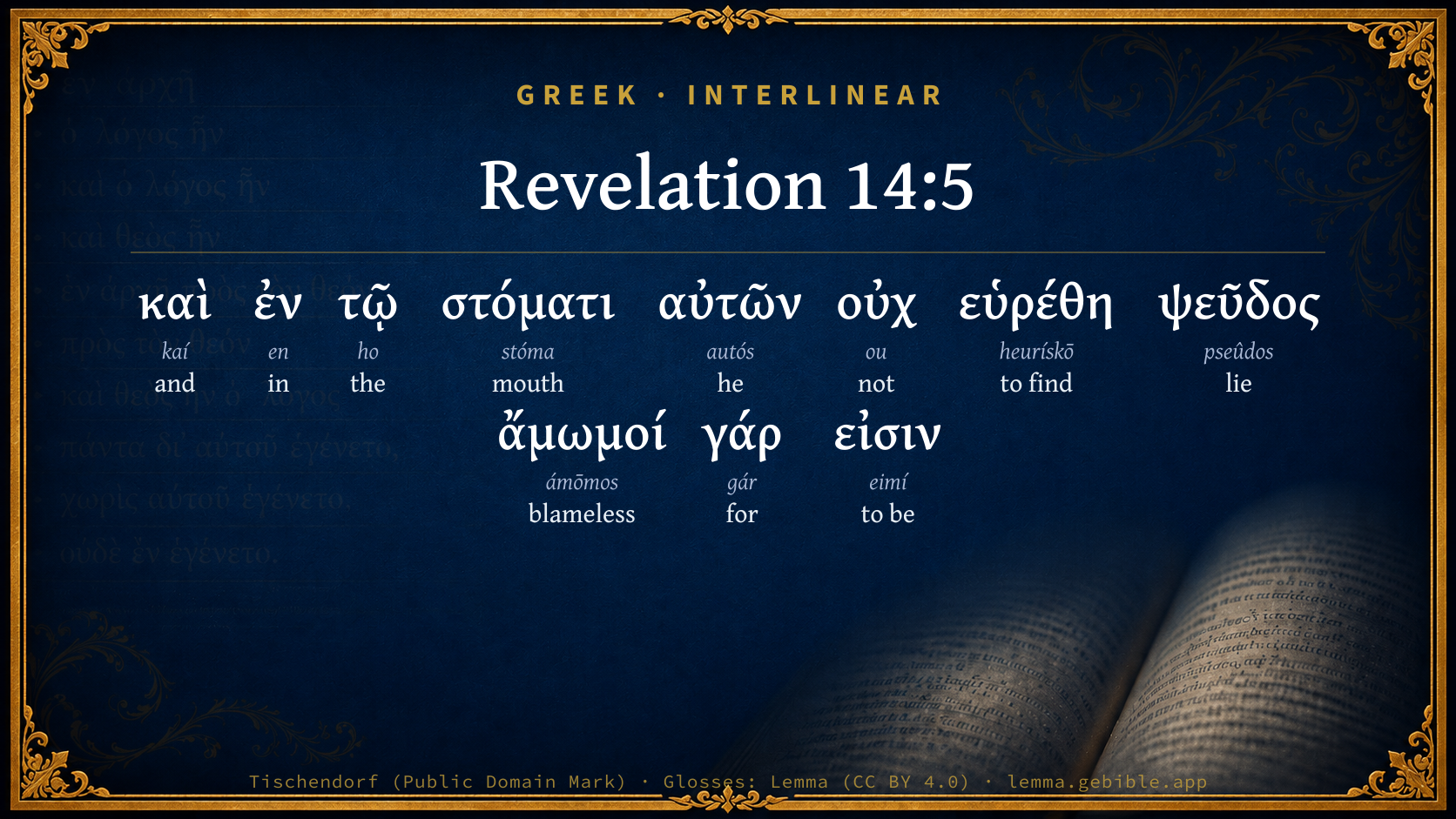
In their mouth was found no lie, for they are blameless.
World English Bible · Public Domain
Download a study sheet

One document with this verse’s original text, its word-by-word gloss line, the meaning frame, cross-references with their text, attributed commentary, and full source and license credits — printable, and it pastes into notes with its structure intact.

This verse Autodidact and up

Study sheet (.html) Plain text (.txt)

A passage Seminary Student

Up to 50 verses in one chapter. A passage sheet keeps up to 6 commentary sources and 12 cross-references per verse, in the order this page ranks them, and says so on the sheet whenever that leaves anything out. Ask for a single verse and you get the Autodidact verse sheet above.

Everything on this page stays free to read, with no account — the sheet is a download of what is already on screen, not access to it.

Want to remove ads? Support Godless Engineer
Compare translations 3

The same verse in 3 English versions, stacked beneath the original-language interlinear above. Click any original word for its lexicon entry.

Each is an independent rendering of the whole verse — the interlinear is not word-aligned to these translations.

Highlighted words mark where these versions differ — a whole-verse word diff, not a word-by-word alignment.

  • World English Bible Public Domain
    In their mouth was found no lie, for they are blameless.
  • King James Version Public Domain
    And in their mouth was found no guile: for they are without fault before the throne of God.
  • unfoldingWord Literal Text CC BY-SA 4.0
    and no lie has been found in their mouth, for they are blameless.

unfoldingWord Literal Text — © unfoldingWord, licensed CC BY-SA 4.0. Word-aligned USFM3 via Door43 (git.door43.org/unfoldingWord/en_ult).

Versions to compare (up to 4)

3 of 4 selected

Show all 19 translations

Every available English version of this verse, each an independent rendering of the whole verse.

  • World English Bible Public Domain
    In their mouth was found no lie, for they are blameless.
  • Berean Standard Bible Public Domain
    And no lie was found in their mouths; they are blameless.
  • Majority Standard Bible Public Domain
    And no lie was found in their mouths, for they are blameless.
  • King James Version Public Domain
    And in their mouth was found no guile: for they are without fault before the throne of God.
  • American Standard Version (1901) Public Domain
    And in their mouth was found no lie: they are without blemish.
  • Revised Version (1885) Public Domain
    And in their mouth was found no lie: they are without blemish.
  • Geneva Bible (1599) Public Domain
    And in their mouthes was found no guile: for they are without spot before the throne of God.
  • Douay-Rheims (1899) Public Domain
    And in their mouth there was found no lie; for they are without spot before the throne of God.
  • Young's Literal Translation Public Domain
    and in their mouth there was not found guile, for unblemished are they before the throne of God.
  • Literal Standard Version CC BY-SA 4.0
    and in their mouth there was not found guile, for they are unblemished before the throne of God.
  • Unlocked Literal Bible CC BY-SA 4.0
    No lie was found in their mouth; they are blameless.
  • unfoldingWord Literal Text CC BY-SA 4.0
    and no lie has been found in their mouth, for they are blameless.
  • Darby Bible Public Domain
    and in their mouths was no lie found; [for] they are blameless.
  • World Messianic Bible Public Domain
    In their mouth was found no lie, for they are blameless.
  • Webster's Bible Public Domain
    And in their mouth was found no guile: for they are without fault before the throne of God.
  • Free Bible Version CC BY-SA 4.0
    They speak no lies; they are without fault.
  • Bible in Basic English Public Domain
    And in their mouth there was no false word, for they are untouched by evil.
  • Text-Critical English NT CC BY 4.0
    No lie was found in their mouths, for they are blameless.
  • Tyndale New Testament (1534) Public Domain
    and in their mouthes was foude no gyle. For they - are with oute spott before the trone of god.

Literal Standard Version (2020), Covenant Press — licensed CC BY-SA 4.0. Text via the HelloAO Bible API (eBible.org). Unlocked Literal Bible (unfoldingWord) — licensed CC BY-SA 4.0. Text via the HelloAO Bible API (eBible.org). unfoldingWord Literal Text — © unfoldingWord, licensed CC BY-SA 4.0. Word-aligned USFM3 via Door43 (git.door43.org/unfoldingWord/en_ult). Free Bible Version, Dr. Jonathan Gallagher — licensed CC BY-SA 4.0. Text via the HelloAO Bible API (eBible.org).

Word by word

More ways to search: Search by grammar → Find every occurrence → Compare this word →

Practice this passage: Drill this verse → Learn its vocabulary →

About this verse

These counts appear in no published source. They are computed here, from the morphology-tagged text and Lemma’s own curated glosses. What Lemma adds →

11
words
11
distinct lemmas
Revelation
section

Notable vocabulary

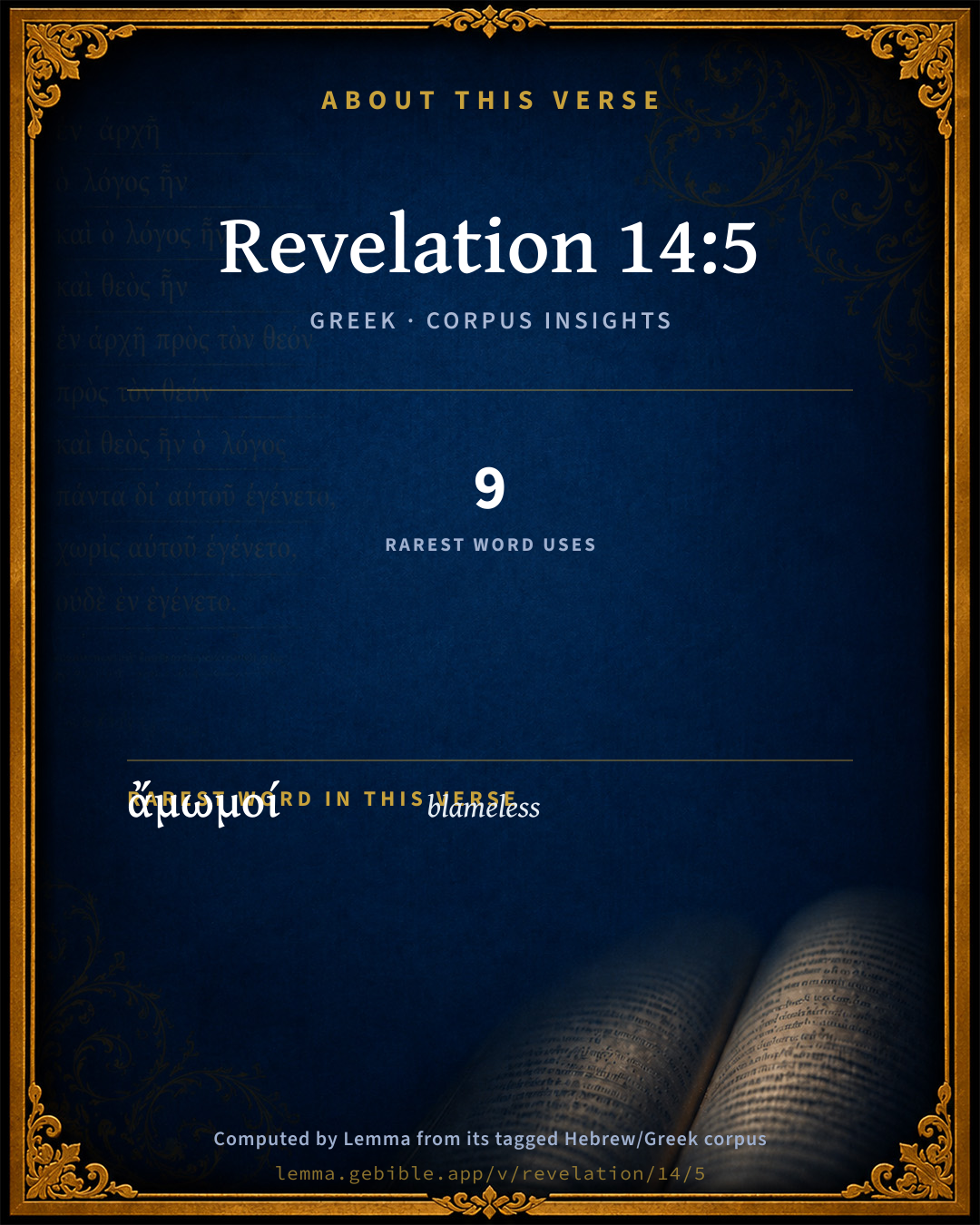
The rarest word here is ἄμωμοί blameless G299 — appearing just 9 times in the whole Greek New Testament.

Shared distinctive vocabulary

ἄμωμοί blameless G299 occurs in 9 verses of the Greek New Testament. Also found in:

Cross-references

16

Topical passages linked to Revelation 14:5 in the Treasury of Scripture Knowledge — connected by theme and wording, ordered by reader-vote popularity; previews shown in the World English Bible.

  • Ephesians 5:27 that he might present the assembly to himself gloriously, not having spot or wrinkle or any such thing; but that it should be holy and without blemish.
  • Psalms 32:2 Blessed is the man to whom Yahweh doesn't impute iniquity, In whose spirit there is no deceit.
  • Zephaniah 3:13 The remnant of Israel will not do iniquity, nor speak lies, neither will a deceitful tongue be found in their mouth, for they will feed and lie down, and no one will make them afraid."
  • John 1:47 Jesus saw Nathanael coming to him, and said about him, "Behold, an Israelite indeed, in whom is no deceit!"
  • 1 Peter 3:10 For, "He who would love life, And see good days, Let him keep his tongue from evil, And his lips from speaking deceit.
  • Jude 1:24 Now to him who is able to keep them from stumbling, and to present you faultless before the presence of his glory in great joy,
  • Psalms 34:13 Keep your tongue from evil, And your lips from speaking lies.
  • Colossians 1:22 yet now he has reconciled in the body of his flesh through death, to present you holy and without blemish and blameless before him,
  • Proverbs 8:8 All the words of my mouth are in righteousness. There is nothing crooked or perverse in them.
  • Daniel 6:4 Then the presidents and the satraps sought to find occasion against Daniel as touching the kingdom; but they could find no occasion nor fault, because he was faithful, neither was there any error or fault found in him.
  • Hosea 10:2 Their heart is divided. Now they will be found guilty. He will demolish their altars. He will destroy their sacred stones.
  • Matthew 12:34 You offspring of vipers, how can you, being evil, speak good things? For out of the abundance of the heart, the mouth speaks.
  • Luke 23:4 Pilate said to the chief priests and the multitudes, "I find no basis for a charge against this man."
  • Isaiah 53:9 They made his grave with the wicked, and with a rich man in his death; although he had done no violence, neither was any deceit in his mouth.
  • Psalms 55:11 Destructive forces are within her. Threats and lies don't depart from her streets.
  • Song of Solomon 4:7 You are all beautiful, my love. There is no spot in you.

Cross-references courtesy of OpenBible.info (CC BY 4.0).

Where the printed editions differ

1 variant

Places in this verse where the major printed Greek editions disagree on the wording in a way that affects the translation — a comparison of editions, not a manuscript-by-manuscript collation. The editions are the modern critical texts (Nestlé-Aland 28/27, SBL, Westcott-Hort, Tregelles, Tyndale House) and the traditional texts behind the KJV (the Textus Receptus and the Byzantine/Majority text). It is not a claim about which reading is original.

  1. Extra text
    ἐνώπιον τοῦ θρόνου τοῦ θεοῦ.

    “before the throne of the God.”

    In TR Not in NA28NA27TynSBLWHTregByz

    ἐνώπιον τοῦ θρόνου τοῦ θεοῦ.¶ (enōpion tou thronou tou theou) 'before the throne of the God.' is only in traditional manuscripts (TR)

Textual data: Translators Amalgamated Greek New Testament (STEPBible TAGNT) · CC BY 4.0.

Commentary

Notes on Revelation 14:5 from classic Christian and Jewish commentators (each source and its license shown beneath its notes). The classic Christian expositions comment on the surrounding passage and are grouped to its opening verse, so a note may address several verses; the Jewish commentaries on the Tanakh (Rashi and others) are per-verse, so they appear only where the commentator wrote on this verse.

Lemma curates 59 commentaries, every one of them public domain or Creative Commons licensed, each selected and text-cleaned for this edition rather than reprinted as found. About our sources →

Bengel's Gnomon

Johann Albrecht Bengel

Rev 14:5. Ψεῦδος) δόλος,[155] the text according to Andreas in Cod. Reuchl., which Erasmus follows, and in the Augustan. But the text in Andreas himself, as edited by Sylburgius, and Copt, (according to Wolf, who however defends the word δόλος), together with all the copies, is ΨΕῦΔΟς. That expression of Peter, ΟὔΤΕ ΕὙΡΈΘΗ ΔΌΛΟς ἘΝ Τῷ ΣΤΌΜΑΤΙ ΑὐΤΟῦ, plainly refers to Isa 53:9. But the phrase of the Apocalypse, although it supports itself, has something parallel in Mal 2:6, respecting the priest: ΝΌΜΟς ἈΛΗΘΕΊΑς ἮΝ ἘΝ Τῷ ΣΤΌΜΑΤΙ ΑὐΤΟῦ, ΚΑῚ ἈΔΙΚΊΑ ΟὐΧ ΕὐΡΈΘΗ ἘΝ ΧΕΊΛΕΣΙΝ ΑὐΤΟῦ. The word ΨΕῦΔΟς, with its derivatives and compounds, is of very frequent occurrence in all the writings of John.—ἌΜΩΜΟΙ ΕἸΣῚΝ) ἘΝΏΠΙΟΝ ΤΟῦ ΘΡΌΝΟΥ ΤΟῦ ΘΕΟῦ[156] was first added by the more recent Latin editions. See App. Crit. Ed. ii. on this passage. This interpolation is unsuitable to the passage. For the description of these first-fruits is beautifully fashioned like a canticle; and so these two clauses have a kind of rhythm, πάρθενοι γὰρ εἰσιν· ἄμωμοι εἰσίν· where, as we remark in passing, the particle ΓᾺΡ appears to be extended from the preceding to the latter clause. Moreover, they are virgins, with reference to their following the Lamb; they are ἄμωμοι, not with reference to their being before the throne of God, but with reference to the fact, that they are redeemed, as first-fruits to God and the Lamb. Why should I enlarge on this? No one in Greece, Asia, Syria, or Africa, nor do I hesitate to add Italy and ancient Armenia, has in this passage read the clause, before the throne of God. They had not the editions which are in common use at the present day; they had the genuine reading.

[155] ABC Vulg. Orig. read ψεῦδος: Rec. Text, without good authority, δόλος.—E.

[156] ABC Orig. omit these words. Rec. Text has them, with Vulg. Amiat. MS. alone of the oldest authorities.—E.

Bengel's Gnomon of the New Testament — English translation (T&T Clark, Edinburgh, 1860) — public domain. Text from a community e-Sword module.

Expositor's Greek Testament

ed. W. Robertson Nicoll

Rev 14:5 . ἄμωμοι , “unblemished” (a ritual term), possibly contains a sacrificial tinge, like ἀπαρχή in some of the inscriptions (= gift to deity), cf. Thieme’s Inschriften von Magnesia , 26. These adherents are redeemed. But in another aspect their qualities of purity and guilelessness form a sweet sacrifice to God. A Christian not only may be redeemed but may sacrifice himself in the interests of the Redeemer. ψεῦδος . In view of Rev 21:8 ; Rev 21:27 , Rev 22:15 it is superfluous to think of prophets or teachers specially (Weinel, 146 148) in this connexion, although the gifts of utterance and prophecy were particularly associated with asceticism (En. lxxxiii., cviii., etc.) in the early church of the first century; e.g. , “the whole yoke of the Lord” in Did. vi. may refer to celibacy (in which case τέλειος would be equivalent to ἄμωμος here). Cf. the discussion of reasons, in a Babylonian incantation (Zimmern, die Beschwörungstafeln Shurpu , 5, 6), why the sufferer was punished. “Has he for ‘no’ said ‘yes’, | For ‘yes’ said ‘no’?… Was he frank in speaking | but false in heart? | Wasit ‘yes’ with his mouth | but ‘no’ in his heart?” The Assyrian idiom for loyalty is “true speech in the mouth of the people,” neither rebellious nor seditious talk.

The Expositor's Greek Testament, edited by W. Robertson Nicoll (1897–1910) — public domain. Text from a community e-Sword module.

Jamieson, Fausset & Brown

Robert Jamieson, A. R. Fausset & David Brown

guile--So ANDREAS in one copy. But A, B, C, ORIGEN, and ANDREAS in other copies read, "falsehood." Compare with English Version reading Psa 32:2; Isa 53:9; Joh 1:47.

for--So B, Syriac, Coptic, ORIGEN, and ANDREAS read. But A and C omit.

without fault--Greek, "blameless": in respect to the sincerity of their fidelity to Him. Not absolutely, and in themselves blameless; but regarded as such on the ground of His righteousness in whom alone they trusted, and whom they faithfully served by His Spirit in them. The allusion seems to be to Psa 15:1-2. Compare Rev 14:1, "stood on Mount Sion."

before the throne of God--A, B, C, Syriac, Coptic, ORIGEN, and ANDREAS omit these words. The oldest Vulgate manuscript supports them.

Jamieson, Fausset & Brown — Commentary Critical and Explanatory on the Whole Bible (1871) — public domain (CC PDM 1.0). Text via the HelloAO Bible API.

Adam Clarke's Commentary

Verse 5. In their mouth was found no guile] When brought before kings and rulers they did not dissemble, but boldly confessed the Lord Jesus.

Adam Clarke's Commentary on the Bible (1810–1826) — public domain. Text from a community e-Sword/MySword module.

The Cambridge Bible for Schools and Colleges

gen. ed. J. J. S. Perowne

5. no guile] Read, no lie.

before the throne of God] Should be omitted; and so perhaps should “for.”

The Cambridge Bible for Schools and Colleges (gen. ed. J. J. S. Perowne; Cambridge University Press, 1878–1918) — public domain. Text from a community e-Sword module.

John Gill's Exposition

And in their mouth was found no guile,.... Or "a lie", as the Complutensian edition, the Alexandrian copy, the Vulgate Latin, and all the Oriental versions read; by which may be meant idolatry, for idols and idolatrous practices are often called lies, and lying vanities; see Jer 16:19; and the sense is, that the superstition and idolatry of the church of Rome were not among them: or it may design false doctrine, and the meaning be, that they did not speak lies in hypocrisy, as the followers of antichrist do; nor were they given up to believe a lie, as they are: the generality of copies read, "no guile"; which is expressive of the sincerity of their words; there was no deceit nor hypocrisy in them; they did not speak with flattering lips to men, nor did they draw nigh to God with their mouths, when their hearts were far from him; they were Israelites indeed, like Nathanael, in whom was no guile; though not in so strict a sense, in which this phrase is used of Christ, Pe1 1:22;

for they are without fault before the throne of God; not as considered in themselves, as if they were entirely free from sin, and never committed any; though it might be true of them, that in general they were of unblemished lives and conversations, that is, not guilty of any notorious and scandalous crimes; but rather the sense is, that they were without spot or wrinkle, or any such thing, as being washed in the blood of Christ, and so cleansed from all sin, and as being justified by his righteousness from all iniquity; and so were before the throne of God, and in the sight of divine justice, unblamable and unreproveable; see , Col 1:22; the phrase, "before the throne of God", is left out in the Alexandrian copy, and in the Syriac, Arabic, and Ethiopic versions, and in the Complutensian edition.

John Gill's Exposition of the Whole Bible (1746–1763) — public domain (CC PDM 1.0). Text via the HelloAO Bible API.

Trapp's Complete Commentary

John Trapp

5 And in their mouth was found no guile: for they are without fault before the throne of God.

Ver. 5. And in their mouth] Children they are that will not lie, Isa 63:8, neither is a deceitful tongue found in their mouth, Zep 3:13. They will rather die than lie. The officers of Merindol answered the bishop that moved them to abjure, that they marvelled much that he would go about to persuade them to lie to God and the world; affirming that they punished their children very sharply when they took them with a lie, even as if they had committed a robbery, for the devil is a liar. (Acts and Mon. fol. 866.)

For they are without fault] 1. By imputation; 2. By inchoation.

John Trapp, A Commentary or Exposition upon All the Books of the Old and New Testament (1647–1656) — public domain. Text from a community e-Sword module.

Albert Barnes' Notes on the Bible

And in their mouth was found no guile - No deceit, fraud, hypocrisy. They were sincerely and truly what they professed to be - the children of God. This is the last characteristic which is given of them as redeemed, and it is not necessary to say that this is always represented as one of the characteristics of the true children of God. See the notes on Joh 1:47.

For they are without fault before the throne of God - The word here rendered “without fault” - ἄμωμοι amōmoi - means, properly, “spotless, without blemish,” 1Pe 1:19. See the notes on Col 1:22. This cannot be construed as meaning that they were by nature pure and holy, but only that they were pure as they stood before the throne of God in heaven - “having washed their robes, and made them pure in the blood of the Lamb.” See the notes on Rev 7:14. It will be certainly true that all who stand there will be, in fact, pure, for nothing impure or unholy shall enter there, Rev 21:27.

The “design” of this portion of the chapter was evidently to comfort those to whom the book was addressed, and, in the same way, to comfort all the children of God in times of persecution and trial. Those living in the time of John were suffering persecution, and, in the previous chapters, he had described more fearful trials yet to come on the church. In these trials, therefore, present and prospective, there was a propriety in fixing the thoughts on the final triumph of the redeemed - that glorious state in heaven where all persecution shall cease, and where all the ransomed of the Lord shall stand before his throne. What could be better suited than this view to sustain the souls of the persecuted and the sorrowful? And how often since in the history of the church in the dark times of religious declension and of persecution - has there been occasion to seek consolation in this bright view of heaven? How often in the life of each believer, when sorrows come upon him like a flood, and earthly consolation is gone, is there occasion to look to that blessed world where all the redeemed shall stand before God; where all tears shall be wiped away from every face; and where there shall be the assurance that the last pang has been endured, and that the soul is to be happy forever?

Albert Barnes' Notes on the Bible (1834–1885) — public domain. Text from a community e-Sword/MySword module.

Matthew Poole's English Annotations

Not that any liveth and sinneth not against God, but it is to be understood comparatively; they are without fault in comparison of the rest of the world, they have not in them the guile of hypocrisy, they are sincere. Or, possibly by

guile is here understood a lie. All idolaters are liars, Rom 1:25, and idols are called lies, Jer 16:19; Amo 2:4. Mr. Mede expoundeth this text by Zep 3:13. The words may either more generally signify the holiness of these persons, in opposition to profaneness and hypocrisy; or more particularly, their freedom and purity from antichristian superstitions and idolatry.

Matthew Poole's English Annotations on the Holy Bible (1683–1685) — public domain. Text from a community e-Sword/MySword module.

Whedon's Commentary on the Bible

Daniel D. Whedon

5. No guile—Greek, no lie. Contrast with the “great wonders” of the second beast, “the false prophet,” who “deceiveth them that dwell on the earth,” (Rev_13:13-14,) “with all signs and lying wonders,” “with all deceivableness of unrighteousness,” “that they should believe a lie.” 2Th_1:9-11. And the work of the reappearing dragon is to “deceive the nations,” Rev_20:3; Rev_20:8. The song of this holy throng bodes no good to the powers of darkness. And still clearer omens now appear in the mid-sky.

Daniel D. Whedon (gen. ed.), Commentary on the Old and New Testaments (1874–1909) — public domain. Text from a community e-Sword module.

The Pulpit Commentary

And in their mouth was found no guile; no lie (Revised Version). They had not suffered themselves by self deceit (the second beast) to be beguiled into worship of the first beast the world. Alford very appropriately refers to Psa_15:1, Psa_15:2, "Lord, who shall abide in thy tabernacle? who shall dwell in thy holy hill? He that walketh uprightly, and worketh righteousness, and speaketh the truth in his heart." For they are without fault before the throne of God; they are without blemish.

The following phrase is omitted by nearly every authority. The word amwmov , "without blemish," reminds us of the "Lamb without blemish". (cf. 1Pe_1:19 Heb_9:14) Thus again they receive appropriate reward. While on earth they kept themselves undefiled; now they are, like the Lamb, free from blemish (see on ver. 4).

The Pulpit Commentary (1880–1919), ed. H.D.M. Spence-Jones & Joseph S. Exell — public domain. Text from a community e-Sword module.

John Wesley's Explanatory Notes

And in their mouth there was found no guile - Part for the whole. Nothing untrue, unkind, unholy. They are without fault - Having preserved inviolate a virgin purity both of soul and body.

John Wesley, Explanatory Notes Upon the Whole Bible (1754–1765) — public domain. Text via the GEBible commentary corpus.

Burkitt's Expository Notes on the New Testament

William Burkitt

Here St. John closes the description of the fore-mentioned followers of the Lamb,

1. With the character of their integrity; like the Lamb, no guile is found in their mouth, as there was none in his, 1Pe 2:22 they were free from that hypocrisy which was found amongst anti-christ’s followers, who profess to worship God, but adore their idols; sincerity and uprightness of heart towards God and man was found with them.

2. They are said to be without fault before God; which may be understood comparatively; they have no such faults as antichrist’s followers are guilty of; they worship God aright, and are approved by him: or, if absolutely, we must understand it of their glorification in heaven, where all the saints are without spot, and blameless before the throne of God, perfectly like unto God and the Lamb, as well in purity as in immortality.

William Burkitt's Expository Notes on the New Testament (1700–1703) — public domain. Text from a community e-Sword module.

The People's New Testament

B. W. Johnson

5. And in their mouth, etc. This verse states that their lives were holy and pleasing to God and the Lamb.

The Lamb on Mount Zion in the midst of these saints is a prophetic picture, and the thought should be, What do these symbols signify? These saints stand forth as the representatives of a class. “They are first fruits to God and to the Lamb.” As the first fruits, devoted to God, were representative of the whole harvest, so these stand forth as the representatives of the harvest of souls. We are to behold in them as they stand on Mount Zion with the Lamb in their midst, a picture of the Church in some age of the world. Let us observe the facts stated of them: 1. The Lamb is in their midst; a characteristic of the holy saints. 2. They are pure, unspotted, undefiled, not fornicators, nor sullied with unholy desires. 3. They follow the Lamb whithersoever he goes. They are sheep that hear the Shepherd's voice. They are obedient to all his commandments. They follow his example as well as his words. They live a Christ-like life. 4. In their mouths are found no guile, and they were without fault before the throne of God. Whenever the Church of God becomes purified, ceases unholy fornication with the world, these are the marks which it will exhibit. I believe this to be a picture of the Church, yet to come, which shall have put on the white robes and have only Christ for its King.

B. W. Johnson's The People's New Testament with Notes (1889–1891) — public domain. Electronic text from the Christian Classics Ethereal Library (CCEL) ThML edition.

Cambridge Greek Testament for Schools and Colleges

5. ψεῦδος. Text. Rec[474] has δόλος with 1.

[474] Rec. Textus Receptus as printed by Scrivener.

ἄμωμοι γάρ εἰσιν. Lachmann omits γὰρ with ACP; and Text. Rec[475] adds ἐνώπιον τοῦ θρόνου with mediæval vulgate.

[475] Rec. Textus Receptus as printed by Scrivener.

5. ἄμωμοι γάρ εἰσιν. Here, if γὰρ be retained, the argument, as in Rev 14:4, is that the higher degree of perfection includes and guarantees the lower: if γὰρ be omitted, ἅμωμοί εἰσιν would be the inference from their perfect truth, not a proof of it. Cf. St Jas 3:2.

Cambridge Greek Testament for Schools and Colleges (Cambridge University Press, 1896; 21 vols, various authors incl. Carr, Maclear, Plummer, Farrar, Lumby, Moule, M. R. James, Simcox) — public domain. Text from a community e-Sword module.

Vincent's Word Studies in the New Testament

Marvin R. Vincent

Guile [δολος] . Read yeudov lie.

Without fault [αμωμοι] . Rev., blemish. See on 1Pe 1:19.

Before the throne of God. Omit.

Marvin R. Vincent, Word Studies in the New Testament (1887–1900) — public domain. Text from a community e-Sword/MySword module.

Lesson kit

Teaching starters — assembled from the data on this page, not authored interpretation. Every prompt links to the verse data it draws on. Edit before teaching.

Revelation, in the Revelation, opens this verse with 11 words (11 distinct Greek lemmas). Its most distinctive word is ámōmos (“blameless”). A historical commentator’s framing appears above. Read the whole chapter for the surrounding context.

Discussion questions

  1. How does “blameless” (ámōmos) shape what this verse is saying?
  2. How does Ephesians 1:4, which shares the word «blameless», read alongside this verse?
  3. These translations render this verse differently. What is at stake in choosing one wording over another?
  4. Compare how Bengel's Gnomon and Expositor's Greek Testament read this verse. Where do they agree or differ?

Things to notice

Reading settings

Reading text

Shown beneath each verse's original-language words.

Old Testament
Old Testament edition

Read the OT as the Masoretic Hebrew (MT) or the Greek Septuagint (LXX).

English shown for the Greek Septuagint (in the Hebrew ↔ Greek comparison).

Comparing translations? Open the Compare panel on any verse page to stack up to four side by side.