
Acts 5:39

Greek (Tischendorf 8th ed.) Acts 5:39 appears in the Greek New Testament. The text above is from the Tischendorf 8th edition. Each word links to its Strong’s number and a concise gloss. Click any word for its full Thayer’s Greek Lexicon entry.
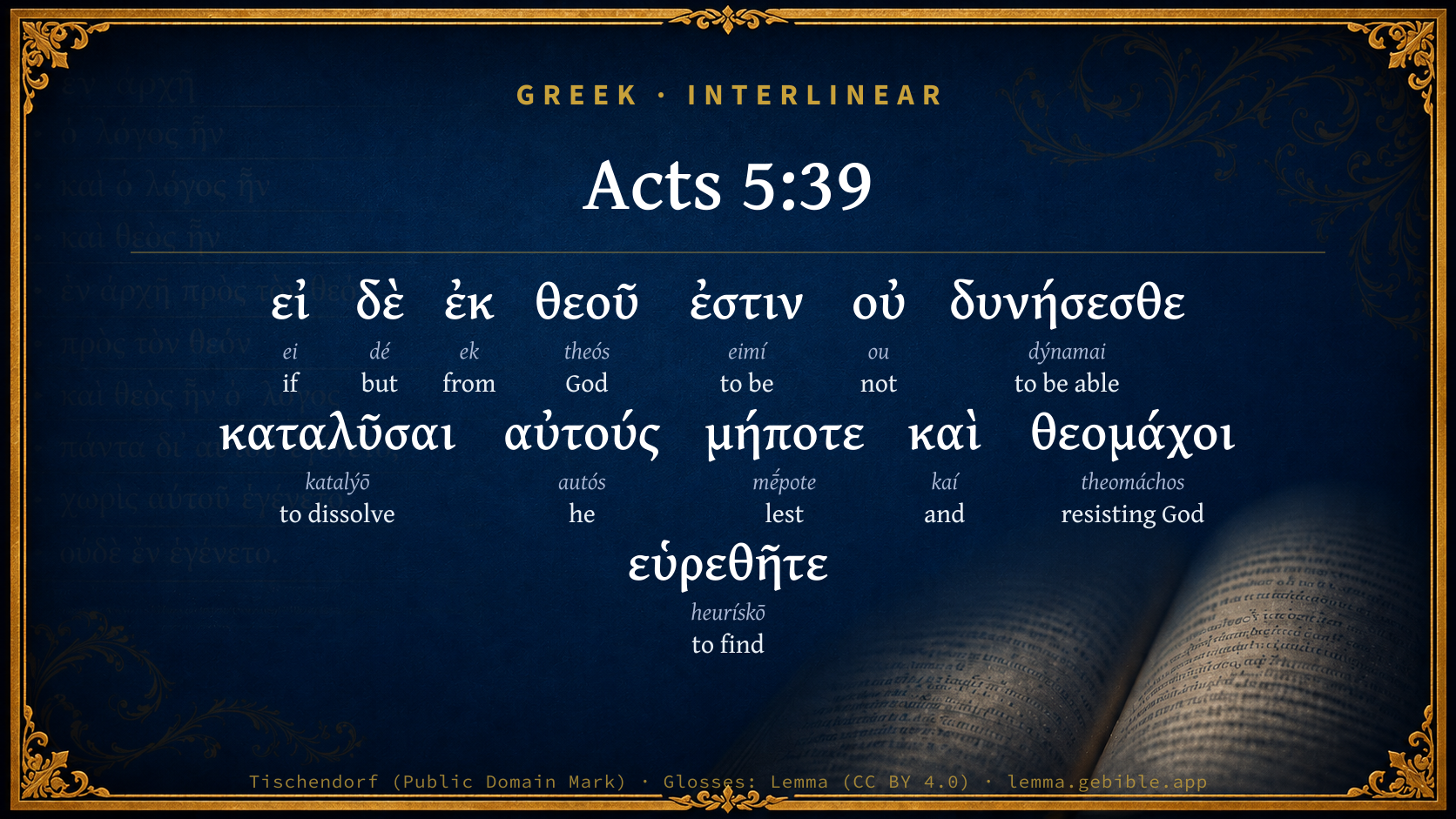
Download image
Cite this verse

Acts 5:39 (World English Bible). Public Domain. Lemma interlinear Bible study tool, https://lemma.gebible.app/v/acts/5/39.

Show BibTeX & RIS
BibTeX
RIS
English Translation
But if it is of God, you will not be able to overthrow it, and you would be found even to be fighting against God!"
World English Bible · Public Domain
Highlights
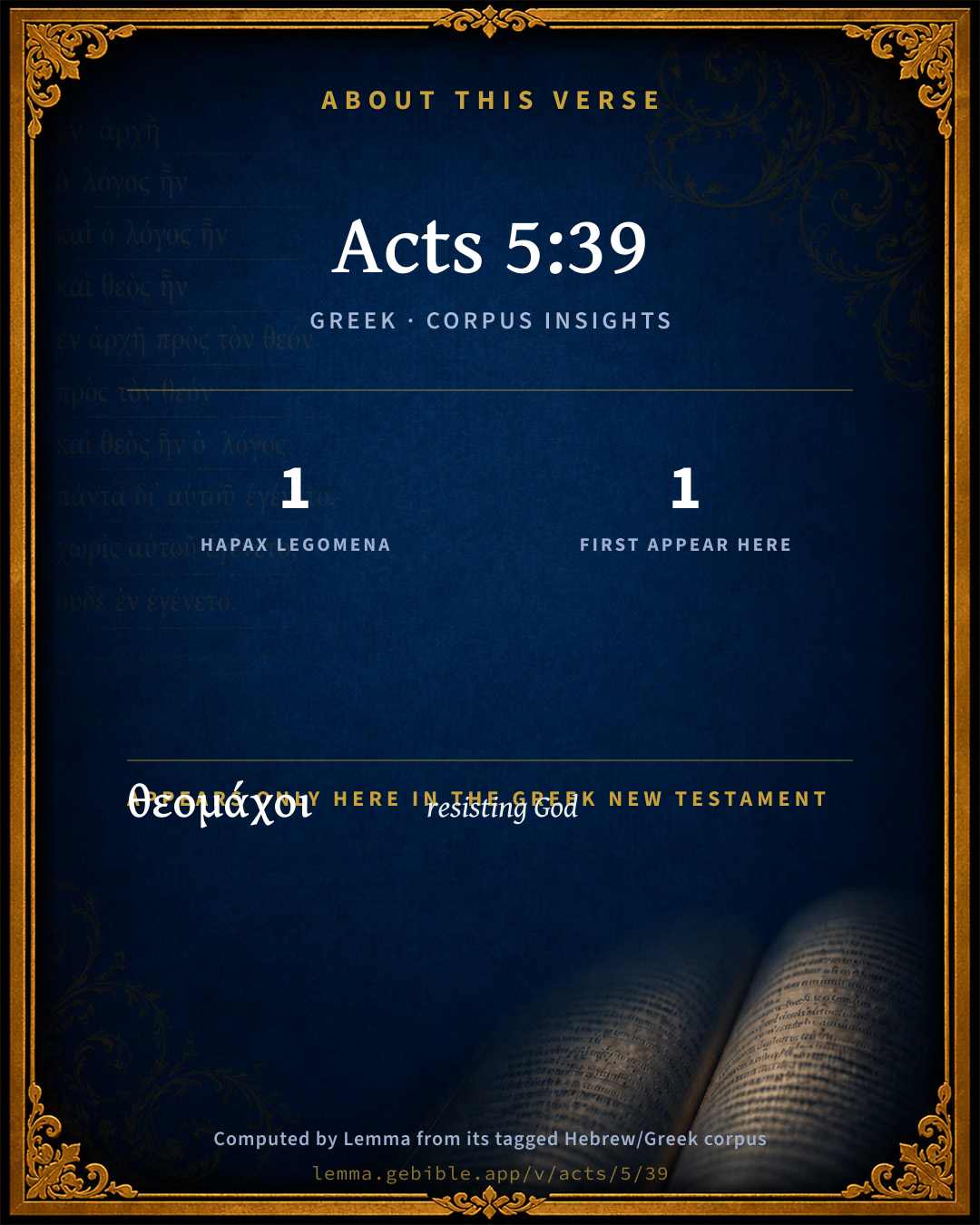
  • 1 hapax legomenon — only here in the Greek New Testament
  • 1 first appearance in the Greek New Testament
Full analysis ↓
Download a study sheet

One document with this verse’s original text, its word-by-word gloss line, the meaning frame, cross-references with their text, attributed commentary, and full source and license credits — printable, and it pastes into notes with its structure intact.

This verse Autodidact and up

Study sheet (.html) Plain text (.txt)

A passage Seminary Student

Up to 50 verses in one chapter. A passage sheet keeps up to 6 commentary sources and 12 cross-references per verse, in the order this page ranks them, and says so on the sheet whenever that leaves anything out. Ask for a single verse and you get the Autodidact verse sheet above.

Everything on this page stays free to read, with no account — the sheet is a download of what is already on screen, not access to it.

Want to remove ads? Support Godless Engineer
Compare translations 3

The same verse in 3 English versions, stacked beneath the original-language interlinear above. Click any original word for its lexicon entry.

Each is an independent rendering of the whole verse — the interlinear is not word-aligned to these translations.

Highlighted words mark where these versions differ — a whole-verse word diff, not a word-by-word alignment.

  • World English Bible Public Domain
    But if it is of God, you will not be able to overthrow it, and you would be found even to be fighting against God!"
  • King James Version Public Domain
    But if it be of God, ye cannot overthrow it; lest haply ye be found even to fight against God.
  • unfoldingWord Literal Text CC BY-SA 4.0
    but if it is from God, you will not be able to destroy them, lest you may even be found God-opposers.” And they were persuaded by him.

unfoldingWord Literal Text — © unfoldingWord, licensed CC BY-SA 4.0. Word-aligned USFM3 via Door43 (git.door43.org/unfoldingWord/en_ult).

Versions to compare (up to 4)

3 of 4 selected

Show all 19 translations

Every available English version of this verse, each an independent rendering of the whole verse.

  • World English Bible Public Domain
    But if it is of God, you will not be able to overthrow it, and you would be found even to be fighting against God!"
  • Berean Standard Bible Public Domain
    But if it is from God, you will not be able to stop them. You may even find yourselves fighting against God.”
  • Majority Standard Bible Public Domain
    But if it is from God, you cannot stop them. You may even find yourselves fighting against God.”
  • King James Version Public Domain
    But if it be of God, ye cannot overthrow it; lest haply ye be found even to fight against God.
  • American Standard Version (1901) Public Domain
    but if it is of God, ye will not be able to overthrow them; lest haply ye be found even to be fighting against God.
  • Revised Version (1885) Public Domain
    but if it is of God, ye will not be able to overthrow them; lest haply ye be found even to be fighting against God.
  • Geneva Bible (1599) Public Domain
    But if it be of God, ye can not destroy it, lest ye be found euen fighters against God.
  • Douay-Rheims (1899) Public Domain
    But if it be of God, you cannot overthrow it, lest perhaps you be found even to fight against God. And they consented to him.
  • Young's Literal Translation Public Domain
    and if it be of God, ye are not able to overthrow it, lest perhaps also ye be found fighting against God.'
  • Literal Standard Version CC BY-SA 4.0
    and if it be of God, you are not able to overthrow it, lest perhaps you are also found fighting against God.”
  • Unlocked Literal Bible CC BY-SA 4.0
    But if it is of God, you will not be able to overthrow them; you may even find that you are fighting against God.” So they were persuaded.
  • unfoldingWord Literal Text CC BY-SA 4.0
    but if it is from God, you will not be able to destroy them, lest you may even be found God-opposers.” And they were persuaded by him.
  • Darby Bible Public Domain
    but if it be from God, ye will not be able to put them down, lest ye be found also fighters against God.
  • World Messianic Bible Public Domain
    But if it is of God, you will not be able to overthrow it, and you would be found even to be fighting against God!”
  • Webster's Bible Public Domain
    But if it is from God, ye cannot overthrow it; lest haply ye be found even to fight against God.
  • Free Bible Version CC BY-SA 4.0
    But if it comes from God, you won't be able to defeat them. You could even find yourselves fighting against God!”
  • Bible in Basic English Public Domain
    But if it is of God, you will not be able to overcome them, and you are in danger of fighting against God.
  • Text-Critical English NT CC BY 4.0
    but if it is of God, you cannot put a stop to it. You will only find yourselves fighting against God.”
  • Tyndale New Testament (1534) Public Domain
    But and yf it be of God ye can not destroye it lest haply ye be founde to stryve agaynst God.

Literal Standard Version (2020), Covenant Press — licensed CC BY-SA 4.0. Text via the HelloAO Bible API (eBible.org). Unlocked Literal Bible (unfoldingWord) — licensed CC BY-SA 4.0. Text via the HelloAO Bible API (eBible.org). unfoldingWord Literal Text — © unfoldingWord, licensed CC BY-SA 4.0. Word-aligned USFM3 via Door43 (git.door43.org/unfoldingWord/en_ult). Free Bible Version, Dr. Jonathan Gallagher — licensed CC BY-SA 4.0. Text via the HelloAO Bible API (eBible.org).

Word by word

More ways to search: Search by grammar → Find every occurrence → Compare this word →

Practice this passage: Drill this verse → Learn its vocabulary →

About this verse

These counts appear in no published source. They are computed here, from the morphology-tagged text and Lemma’s own curated glosses. What Lemma adds →

13
words
13
distinct lemmas
Acts
section

Notable vocabulary

1 hapax legomenon — a word that appears only here in the entire Greek New Testament:

  • θεομάχοι resisting God G2314

First appearance in Scripture

This word makes its first canonical appearance in the Greek New Testament here:

  • θεομάχοι resisting God G2314

Shared distinctive vocabulary

καταλῦσαι to dissolve G2647 occurs in 16 verses of the Greek New Testament. Also found in:
Cross-references

23

Topical passages linked to Acts 5:39 in the Treasury of Scripture Knowledge — connected by theme and wording, ordered by reader-vote popularity; previews shown in the World English Bible.

  • Proverbs 21:30 There is no wisdom nor understanding Nor counsel against Yahweh.
  • Isaiah 46:10 declaring the end from the beginning, and from ancient times things that are not [yet] done; saying, My counsel shall stand, and I will do all my pleasure;
  • Matthew 16:18 I also tell you that you are Peter, and on this rock I will build my assembly, and the gates of Hades will not prevail against it.
  • Acts 7:51 "You stiff-necked and uncircumcised in heart and ears, you always resist the Holy Spirit! As your fathers did, so you do.
  • Acts 11:17 If then God gave to them the same gift as us, when we believed in the Lord Jesus Christ, who was I, that I could withstand God?"
  • 1 Corinthians 1:25 Because the foolishness of God is wiser than men, and the weakness of God is stronger than men.
  • Luke 21:15 for I will give you a mouth and wisdom which all your adversaries will not be able to withstand or to contradict.
  • Acts 6:10 They weren't able to withstand the wisdom and the Spirit by which he spoke.
  • Acts 9:5 He said, "Who are you, Lord?" The Lord said, "I am Jesus, whom you are persecuting.
  • Job 34:29 When he gives quietness, who then can condemn? When he hides his face, who then can see him? Alike whether to a nation, or to a man:
  • Isaiah 43:13 Yes, since the day was I am he; and there is none who can deliver out of my hand: I will work, and who can hinder it?
  • Revelation 17:12–14 The ten horns that you saw are ten kings who have received no kingdom as yet, but they receive authority as kings, with the beast, for one hour.
  • Daniel 4:35 All the inhabitants of the earth are reputed as nothing; and he does according to his will in the army of heaven, and among the inhabitants of the earth; and none can stay his hand, or tell him, What do you?
  • Exodus 10:3–7 Moses and Aaron went in to Pharaoh, and said to him, "This is what Yahweh, the God of the Hebrews, says: 'How long will you refuse to humble yourself before me? Let my people go, that they may serve me.
  • Job 15:25–27 Because he has stretched out his hand against God, And behaves himself proudly against the Almighty;
  • Acts 23:9 A great clamor arose, and some of the scribes of the Pharisees part stood up, and contended, saying, "We find no evil in this man. But if a spirit or angel has spoken to him, let's not fight against God!"
  • Job 40:9–14 Or have you an arm like God? Can you thunder with a voice like him?
  • Isaiah 45:9 Woe to him who strives with his Maker--a potsherd among the potsherds of the earth! Shall the clay ask him who fashions it, "What are you making?" or your work, "He has no hands?"
  • 1 Corinthians 10:22 Or do we provoke the Lord to jealousy? Are we stronger than he?
  • 2 Samuel 5:2 In times past, when Saul was king over us, it was you who led out and brought in Israel: and Yahweh said to you, You shall be shepherd of my people Israel, and you shall be prince over Israel.
  • 1 Kings 12:24 Thus says Yahweh, You shall not go up, nor fight against your brothers the children of Israel: return every man to his house; for this thing is of me. So they listened to the word of Yahweh, and returned and went their way, according to the word of Yahweh.
  • 2 Kings 19:22 Whom have you defied and blasphemed? and against whom have you exalted your voice and lifted up your eyes on high? [even] against the Holy One of Israel.
  • Genesis 24:50 Then Laban and Bethuel answered, "The thing proceeds from Yahweh. We can't speak to you bad or good.

Cross-references courtesy of OpenBible.info (CC BY 4.0).

Where the printed editions differ

1 variant

Places in this verse where the major printed Greek editions disagree on the wording in a way that affects the translation — a comparison of editions, not a manuscript-by-manuscript collation. The editions are the modern critical texts (Nestlé-Aland 28/27, SBL, Westcott-Hort, Tregelles, Tyndale House) and the traditional texts behind the KJV (the Textus Receptus and the Byzantine/Majority text). It is not a claim about which reading is original.

  1. Different wording
    αὐτούς,

    “them,”

    In NA28NA27TynSBLWHTreg Not in TRByz

    αὐτό (auto) 'it' occurs in traditional manuscripts (TR+Byz) instead of αὐτούς, (autous) 'them,' in older manuscripts (NA28+NA27+Tyn+SBL+WH+Treg)

Textual data: Translators Amalgamated Greek New Testament (STEPBible TAGNT) · CC BY 4.0.

Commentary

Notes on Acts 5:39 from classic Christian and Jewish commentators (each source and its license shown beneath its notes). The classic Christian expositions comment on the surrounding passage and are grouped to its opening verse, so a note may address several verses; the Jewish commentaries on the Tanakh (Rashi and others) are per-verse, so they appear only where the commentator wrote on this verse.

Lemma curates 59 commentaries, every one of them public domain or Creative Commons licensed, each selected and text-cleaned for this edition rather than reprinted as found. About our sources →

Bengel's Gnomon

Johann Albrecht Bengel

Act 5:39. Μή ποτε καὶ, lest haply even) This use of the particles implies courtesy. The even signifies, that, independently of the vainness of the attempt, they would be guilty even of reckless impiety. This clause depends on the sense of the clause immediately preceding: ye cannot, and therefore ye ought not attempt, to dissolve or overthrow it.—θεομάχοι) This word is put by Symmachus more than once for the Hebr. רפאים. The conjugates are Θεοῦ and θεομάχοι. [There is a large number of such persons.—V. g.]—εὑρέθητε, ye be found) in the issue.

Bengel's Gnomon of the New Testament — English translation (T&T Clark, Edinburgh, 1860) — public domain. Text from a community e-Sword module.

Expositor's Greek Testament

ed. W. Robertson Nicoll

Act 5:39 . ἐάν … εἰ δὲ : it has sometimes been thought that the change of mood from subjunctive to indicative, “but if it is of God,” as if indicating that the second supposition were the more probable ( cf. Gal 1:8-9 ), indicates sympathy on the part of Gamaliel. It is of course possible that he may have been rendered favourably disposed towards the Christians by their strict observance of the Law, and by their appeal to a doctrine which widely divided Pharisees and Sadducees. Others have attributed the change in mood, not to Gamaliel at all, but to the author (so Overbeck, Holtzmann), and have maintained (so Blass, Weiss, cf. Winer-Moulton, xli. 2) that the indicative may be used because the second is the case with which the Council had actually to deal, the assertion, i.e. , of the Apostles. There may also be an underlying contrast between the transitoriness of all mere human schemes, all of which would be overthrown, and the certainty of that which is “of God,” and which has Him for its Author. There cannot be the least ground for supposing that Gamaliel’s counsel was in its tenor a mere invention, as it bears the impress of a thorough Rabbinical wise saying, cf. Sayings of the Jewish Fathers , v., 24 (Taylor, p. 93, second edition). See too Herod., ix. 16; Eur., Hippol. , vi., 76; for the construction, cf. Burton, N. T. Moods and Tenses , p. 96, and Viteau, Le Grec du N. T. , pp. 103, 113 (1893), who compares LXX, Gen 44:23 ; Gen 44:26 . οὐ δύνασθε : R.V. and W.H [186] , δυνήσεσθε . καταλῦσαι with accusative of person in Xen., Cyr. , viii., 5, 24; Plato, Legg. , iv., p. 714, ., cf. 4Ma 4:16 . But without this addition it is usual to refer back to προσέχετε in Act 5:35 ( cf. Luk 21:34 ) for the construction of μήποτε ; but μήποτε … εὑρεθῆτε may be explained on the principle that a verb of fearing is sometimes unexpressed, the idea of fear being supplied by the context (in clauses where μή with the subjunctive is found), Burton, u. s. , p. 96. μήποτε , “lest haply,” its use in later Greek, Blass, Grammatik des N. G. , p. 208. καί sometimes interpreted (so Alford, Wendt, Holtzmann), as if it meant not only against man but also against God. θεομάχοι : not found elsewhere, but cf. LXX, Job 26:5 , Symm., and in Pro 9:18 ; Pro 21:16 , applying the word to the Rephaim (see B.D. 2 “Giants”); in 2Ma 7:19 we have θεομαχεῖν ἐπεχείρησας . In classical Greek the same verb is found, see Grimm and Wendt for instances; θεομαχία , Plato, Rep. , 378, D. (as certain books of the Iliad were called, especially the 19). The tolerance of the sentiments here attributed to Gamaliel is undoubtedly in perfect accordance with what we know of his character and opinions; the decisions attributed to him, e.g. , that relating to the law of the Sabbath (Hamburger, Real-Encyclopädie des Judentums , ii., 2, 237; see also Derenbourg, Histoire de la Palestine , pp. 239 246, and cf. also Renan, Apostles , p. 153, E.T.), are marked by a tendency to mildness and liberality; and perhaps a still more remarkable illustration of the same tendency is afforded by the enactment so often referred to him (Hamburger, u. s. ) to allow to the poor of the heathen, as well as of Israel, the gleaning and a participation in the corn left standing in the corner of the fields, to inquire after the welfare of the Gentile poor, to maintain them, to visit their sick, to bury their dead (the prayer against heretics belonged not to this Gamaliel, but to Gamaliel II.). But the decision of Gamaliel was not prompted by any sympathy with the Christians; it was the judgment of toleration and prudence, but certainly nothing more, although it scarcely falls under the head of “cynical”; it was rather, as Ewald called it, that of an ordinary politician. No credence whatever can be attributed to the tradition that Gamaliel became a Christian, or that he was secretly a Christian, although we may sympathise with St. Chrysostom’s words, “it cannot be that he should have continued in unbelief to the end”. The Talmud distinctly affirms that he died a Jew, and, if he had betrayed his faith, we cannot understand the honour which Jewish tradition attaches to his name, “Gamaliel,” B.D. 2 ; Schürer, Jewish People , div. ii., vol. i., p. 364. Wendt, while he refuses to admit the historical character of the speech of Gamaliel, is evidently puzzled to discover any definite grounds for St. Luke’s wilful introduction of the famous Rabban into the scene (so too Feine). He therefore supposes that the decision in Act 5:38 , in which he sees a wise saying similar to those attributed to other Rabbis, was assigned by tradition to Gamaliel, and that St. Luke, who was in possession of the further tradition that Gamaliel had given a decisive judgment in the trial of the Apostles, introduces this saying into the speech which he attributes to Gamaliel as fitting to the occasion. But there is no indication in our authorities that the sentiment thus attributed to Gamaliel was in any way different from what might have been expected of him (see Schürer, Jewish People, u. s. ). The chief objection to the speech, viz. , the alleged anachronism involved in the mention of Theudas, really begs the question as to its authenticity, and even on the supposition of an inaccuracy in the point mentioned, we cannot get rid of the fact that the attitude of Gamaliel in itself betrays no inconsistency. It was this alleged anachronism which caused Spitta to refer the incident of Gamaliel in this chapter to his inferior source ., and to refuse to adopt the solution of Weiss and Feine, who solved the difficulty involved in the mention of Theudas by introducing the hand of a reviser.

[186] Westcott and Hort’s The New Testament in Greek: Critical Text and Notes.

The Expositor's Greek Testament, edited by W. Robertson Nicoll (1897–1910) — public domain. Text from a community e-Sword module.

Adam Clarke's Commentary

Verse 39. But if it be of God, ye cannot overthrow it] Because his counsel cannot fail; and his work cannot be counteracted. If he be determined that this doctrine shall prevail, it is vain for us to attempt to suppress it.

Lest haply ye be found-to fight against God.] Μηποτε και θεομαχοι εὑρεθητε. Some have thought that they saw a parallel to these words in the speech of Diomede, when, seeing Mars, associated with Hector, oppose the Grecians, he judged farther opposition vain, and desired his troops to retire from the battle.

Τῳ δ' αιει παρα εἱς γε θεων, ὁς λοιγον αμυνει·

Και νυν οἱ παρα κεινος Αρης, βροτῳ ανδρι εοικως.

Αλλα προς Τρωας τετραμμενοι αιεν οπισσω

Εικετε, μηδε Θεοις μενεαινεμεν ιφι μαχεσθαι.

Iliad, lib. v. 603.

Protected always by some power divine;

And Mars attends this moment at his side,

In form a man. Ye therefore still retire,

But facing still your foes: nor battle wage,

However fierce, yet fruitless, with the gods.

COWPER.

Adam Clarke's Commentary on the Bible (1810–1826) — public domain. Text from a community e-Sword/MySword module.

Ellicott's Commentary for English Readers

(39) Fighters against God.—It is interesting to note the recurrence of the same phrase in the reasoning of the Pharisees who took St. Paul’s part in Act_23:9.

A Bible Commentary for English Readers, edited by Charles John Ellicott (1878–1897) — public domain. Text from a community e-Sword module.

The Cambridge Bible for Schools and Colleges

gen. ed. J. J. S. Perowne

39. but if it be of God] The verb is not in the same mood as in the previous clause, and had the construction been in classical Greek, it might have indicated some opinion on Gamaliel’s part of the truth of Christianity = “If it is [as it is] of God.” But in the N. T. the construction indicates no more than a simple conditional. Yet to mark the difference of phrase, read here, But if it is of God.

ye cannot overthrow it] The best authorities read, ye will not be able to overthrow it.

lest haply ye be found, &c.] The clause depends on, “Take heed to yourselves …” (Act_5:35).

The Cambridge Bible for Schools and Colleges (gen. ed. J. J. S. Perowne; Cambridge University Press, 1878–1918) — public domain. Text from a community e-Sword module.

John Gill's Exposition

And to him they agreed,.... They were convinced and persuaded by his reasonings, approved of his advice, and agreed to follow it:

and when they had called the apostles; into the council again, having sent their servants for them, or ordered them to be brought in:

and beaten them; or scourged and whipped them with forty stripes save one, whereby was fulfilled what Christ had foretold, Mat 10:17

they commanded they should not speak in the name of Jesus; as they had strictly commanded them before, Act 4:18. Perhaps both in this, as well as in bearing the apostles, they did not closely attend to Gamaliel's counsel, who advised them to keep their hands off of them, and not hinder them, but let them alone in what they were about: but this might be thought by them not to their reputation, nor sufficiently asserting their authority, to dismiss them, without saying or doing anything to them:

and let them go; from the council to their own company: they released them, and loosed them from their bonds; they set them at liberty, and let them go where they would; and so far they followed Gamaliel's advice.

John Gill's Exposition of the Whole Bible (1746–1763) — public domain (CC PDM 1.0). Text via the HelloAO Bible API.

Trapp's Complete Commentary

John Trapp

39 But if it be of God, ye cannot overthrow it; lest haply ye be found even to fight against God.

Ver. 39. Ye cannot overthrow it] Neither you, nor kings and tyrants to help you; so one ancient Greek copy readeth it. Diocletian laid down the empire in great discontent, because he could not, by any persecution, suppress the true Christian religion. (Beza.) So did Charles V, a political prince, and a sore enemy to the Church. He, when he had in his hand Luther dead, and Melancthon, Pomeran, and other preachers of the gospel, alive; he not only determined not anything extremely against them, or violated their graves, but also entreating them gently, sent them away; not so much as once forbidding them to publish openly the doctrine that they professed. For it is the nature of Christ’s Church, that the more that tyrants spurn against it, the more it flourisheth and increaseth.

John Trapp, A Commentary or Exposition upon All the Books of the Old and New Testament (1647–1656) — public domain. Text from a community e-Sword module.

Albert Barnes' Notes on the Bible

But if it be of God - If God is the “author” of this religion. From this it seems that Gamaliel supposed that it was at least possible that this religion was divine. He evinced a far more candid mind than did the rest of the Jews; but still it does not appear that he was entirely convinced. The arguments which could not but stagger the Jewish Sanhedrin were those drawn from the resurrection of Jesus, the miracle on the day of Pentecost, the healing of the lame man in the temple, and the release of the apostles from the prison.

Ye cannot overthrow it - Because:

God has almighty power, and can execute his purposes; Because he is unchanging, and will not be diverted from his plans, Job 23:13-14.

The plan which God forms “must” be accomplished. All the devices of man are feebleness when opposed to him, and he can dash them in pieces in an instant. The prediction of Gamaliel has been fulfilled. People have opposed Christianity in every way, but in vain. They have reviled it; have persecuted it; have resorted to argument and to ridicule; to fire, and faggot, and sword; they have called in the aid of science; but all has been in vain. The more it has been crushed, the more it has risen, and it still exists with as much life and power as ever. The “preservation” of this religion amidst so much and so varied opposition proves that it is of God. No severer trial “can” await it than it has already experienced; and as it has survived so many storms and trials, we have every evidence that, according to the predictions, it is destined to live and to fill the world. See the Mat 16:18; Isa 54:17; Isa 55:11 notes; Dan 4:35 note.

Lest - That is, if you continue to oppose it, you may be found to have been opposing God.

Haply - Perhaps. In the Greek this is “lest at any time”; that is, at some future time, when too late to retract your doings, etc.

Ye be found - It shall appear that you have been opposing God.

Even to fight against God - Greek Θεομάχοι Theomachoi, “those who contend with God.” The word occurs nowhere else in the New Testament. To fight against God is to oppose him, or to maintain an attitude of hostility against him. It is an attitude that is most fearful in its character, and will most certainly be attended with an overthrow. No condition can be more awful than such an opposition to the Almighty; no overthrow more terrible than what must follow such opposition. Compare Act 9:5; Act 23:9. Opposition to the “gospel” in the Scriptures is uniformly regarded as opposition to God, Mat 12:30; Luk 11:23. People may be said to “fight against” God in the following ways, or on the following subjects:

(1) When they oppose his “gospel,” its preaching, its plans, its influence among people; when they endeavor to prevent its diffusion, or to withdraw their families and friends from its influence.

(2) When they oppose the “doctrines” of the Bible. When they become angry that the real truths of religion are preached, and suffer themselves to be irritated and excited by an “unwillingness” that those doctrines should be true, and should be presented to people. Yet this is no uncommon thing. People by nature do not love those doctrines, and they are often indignant that they are preached. Some of the most angry feelings which people ever have arise from this source; and man can never find peace until he is “willing” that God’s truth should exert its influence on his own soul, and rejoice that it is believed and loved by others.

(3) People oppose the “Law” of God. It seems to them too “stern” and “harsh.” It condemns them; and they are unwilling that it should be applied to them. There is nothing which a sinner likes “less” than he does the pure and holy Law of God.

(4) Sinners fight against the “providence” of God. When he afflicts them they rebel. When he takes away their health, or property, or friends, they complain. They esteem him harsh and cruel; and instead of finding peace by “submission,” they greatly aggravate their sufferings, and infuse a mixture of wormwood and gall into the cup by complaining and repining. There is no peace in affliction but in the feeling that God is “right.” And until this belief is cherished, the wicked will be like the troubled sea which cannot rest, whose waters cast up mire and dirt, Isa 57:20. Such opposition to God is as wicked as it is foolish. The Lord gave, and has a right to remove our comforts; and we should be still, and know that he is God.

(5) Sinners fight against God when they resist the influences of his Spirit; when they “oppose” serious thoughts; when they seek evil or frivolous companions and pleasures rather than submit to God; and when they spurn all the entreaties of their friends to become Christians. All these may be the appeals which God is making to people to be prepared to meet him. And yet it is common for sinners thus to stifle conviction, and refuse even to think of their eternal welfare. Nothing can be an act of more direct and deliberate wickedness and folly than this. Without the aid of the Holy Spirit none can be saved; and to resist his influences is to put away the only prospect of eternal life. To do it is to do it over the grave; not knowing that another hour of life may be granted; and not knowing that “if” life is prolonged, the Spirit will ever strive again with the heart. In view of this verse, we may remark:

That the path of wisdom is to submit at once to the requirements of God. Without this, we must expect conflicts with him, and peril and ruin. No man can be “opposed” to God without endangering himself every minute. Submission to God should be entire. It should extend to every doctrine and demand; every law, and every act of the Almighty. In all his requirements, and in all afflictions, we should submit to him, for thus only shall we find peace. Infidels and scoffers will gain nothing by opposing God. They have thus far been thwarted, and unsuccessful; and they will be still. None of their plans have succeeded; and the hope of destroying the Christian religion, after the efforts of almost two thousand years, must be vain, and will recoil with tremendous vengeance on those who make them.

Albert Barnes' Notes on the Bible (1834–1885) — public domain. Text from a community e-Sword/MySword module.

Haydock's Catholic Bible Commentary

Time, and the evident success of Christ’s Church, prove it to be of God. No violence of the Jews, no persecution of heathen princes, no attempts of domestic adversaries, heretics, schismatics, or evil livers, have been able to prevail against it. Men of superior abilities have made violent attacks against it; their memory, and that of their disciples, has either been buried and forgotten, or liveth only in malediction and infamy. Let, then no Catholic be dispirited, because modern heresies continue; Arian and other heresies have continued much longer, have been more powerfully supported by temporal power, and yet have come to nothing. The Catholic religion was the first, and it will be the last religion.

George Leo Haydock (1774–1849), Haydock's Catholic Family Bible and Commentary, 1859 edition — public domain. Excludes Psalms (Douay-Rheims chapter numbering differs from Protestant) and Deuterocanonical books (Catholic canon only).

Matthew Poole's English Annotations

The other part of the dilemma.

The counsel of the Lord, that shall stand, Pro 19:21; Isa 46:10; and it must needs be so, for all power is his, in whom we live and move, Act 17:28.

Fight against God; they who afflict and contend with his people unjustly, though they little think so, set themselves against God, who will overcome at the last, and triumph over his and his people’s enemies.

Matthew Poole's English Annotations on the Holy Bible (1683–1685) — public domain. Text from a community e-Sword/MySword module.

Whedon's Commentary on the Bible

Daniel D. Whedon

39. If it be of God—Gamaliel here does suggest the possibility that Jesus was from God. It may have been a momentary sincere feeling. The real fact probably was that, knowing that the popular mind was just in this state of doubt, Gamaliel grounded himself upon it to work a defeat of the Sadducean party.

Lest—This lest depends upon the phrase let them alone in Act_5:38.

Daniel D. Whedon (gen. ed.), Commentary on the Old and New Testaments (1874–1909) — public domain. Text from a community e-Sword module.

The Pulpit Commentary

Is for be, A.V.; will not be able to for cannot, A.V.; them for it, A.V. and T.R.; to be fighting for to fight, A.V.

The Pulpit Commentary (1880–1919), ed. H.D.M. Spence-Jones & Joseph S. Exell — public domain. Text from a community e-Sword module.

McGarvey & Pendleton's Commentaries

J. W. McGarvey

See notes on verse 34

J. W. McGarvey (with Philip Y. Pendleton), Commentaries on the New Testament (The Fourfold Gospel, 1914; Acts; and the epistles) — public domain. Text from a community e-Sword/MySword module.

Cambridge Greek Testament for Schools and Colleges

39. δυνήσεσθε with אBCDE. Vulg. ‘poteritis.’

αὐτούς for αὐτό with אABCDE. Vulg. ‘illud.’

39. οὐ δυνήσεσθε καταλῦσαι αὐτούς, ye will not be able to overthrow them.

μήποτε, lest haply. The construction looks back to Act 5:35, προσέχετε ἑαυτοῖς.

Cambridge Greek Testament for Schools and Colleges (Cambridge University Press, 1896; 21 vols, various authors incl. Carr, Maclear, Plummer, Farrar, Lumby, Moule, M. R. James, Simcox) — public domain. Text from a community e-Sword module.

Alford’s Greek Testament

Henry Alford

39.] The somewhat difficult connexion of μήποτε κ. θ. εὑρ. may be explained,—not by parenthesizing ὅτι … αὐτούς, but by understanding ‘and ye will be obliged to give up your attempt’ (which thought is contained in οὐ δύνας. κατ. αὐτ.), lest ye be, &c.

καί] Opponents not only to them, but also to God:—‘even,’ in E. V., does not give the sense. As regards Gamaliel’s advice, we may remark that it was founded on a view of the issues of events, agreeing with the fatalism of the Pharisees: that it betokens no leaning towards Christianity, nor indeed very much even of worldly wisdom;—but serves to shew how low the supreme council of the Jews had sunk both in their theology and their political sagacity, if such a fallacious laissez-aller view of matters was the counsel of the wisest among them. It seems certainly, on a closer view, as if they accepted, from fear of the people (see ver. 26), this opportunity of compromising the matter, which Gamaliel had designedly afforded them.

Henry Alford, The Greek Testament (1849–1861) — public domain. Text from a community e-Sword module.

Vincent's Word Studies in the New Testament

Marvin R. Vincent

To fight against God [θεομαχοι] . Lit., to be God - fighters.

Marvin R. Vincent, Word Studies in the New Testament (1887–1900) — public domain. Text from a community e-Sword/MySword module.

Lesson kit

Teaching starters — assembled from the data on this page, not authored interpretation. Every prompt links to the verse data it draws on. Edit before teaching.

Acts, in the Acts, opens this verse with 13 words (13 distinct Greek lemmas). Its most distinctive word is theomáchos (“resisting God”). A historical commentator’s framing appears above. Read the whole chapter for the surrounding context.

Discussion questions

  1. How does “resisting God” (theomáchos) shape what this verse is saying?
  2. This verse holds 1 word here found nowhere else in the Greek New Testament. What might the rare word draw attention to?
  3. The word “resisting God” first appears here in Scripture. What is being introduced at this debut?
  4. Matthew 5:17 shares the word «to dissolve» with this verse. How do the two illuminate each other?
  5. These translations render this verse differently; the difference is in the English rendering, not the original. What questions does that raise?
  6. Reading how Bengel's Gnomon and Expositor's Greek Testament read this verse, where do the two commentators agree and where do they part?

Things to notice

  • 1 word in this verse appears nowhere else in the Greek New Testament.
  • 1 word makes its first canonical appearance in Scripture here.
  • These translations choose different wording for 16 words in this verse.
  • 13 distinct Greek lemmas span 13 words in this verse.

Reading settings

Reading text

Shown beneath each verse's original-language words.

Old Testament
Old Testament edition

Read the OT as the Masoretic Hebrew (MT) or the Greek Septuagint (LXX).

English shown for the Greek Septuagint (in the Hebrew ↔ Greek comparison).

Comparing translations? Open the Compare panel on any verse page to stack up to four side by side.