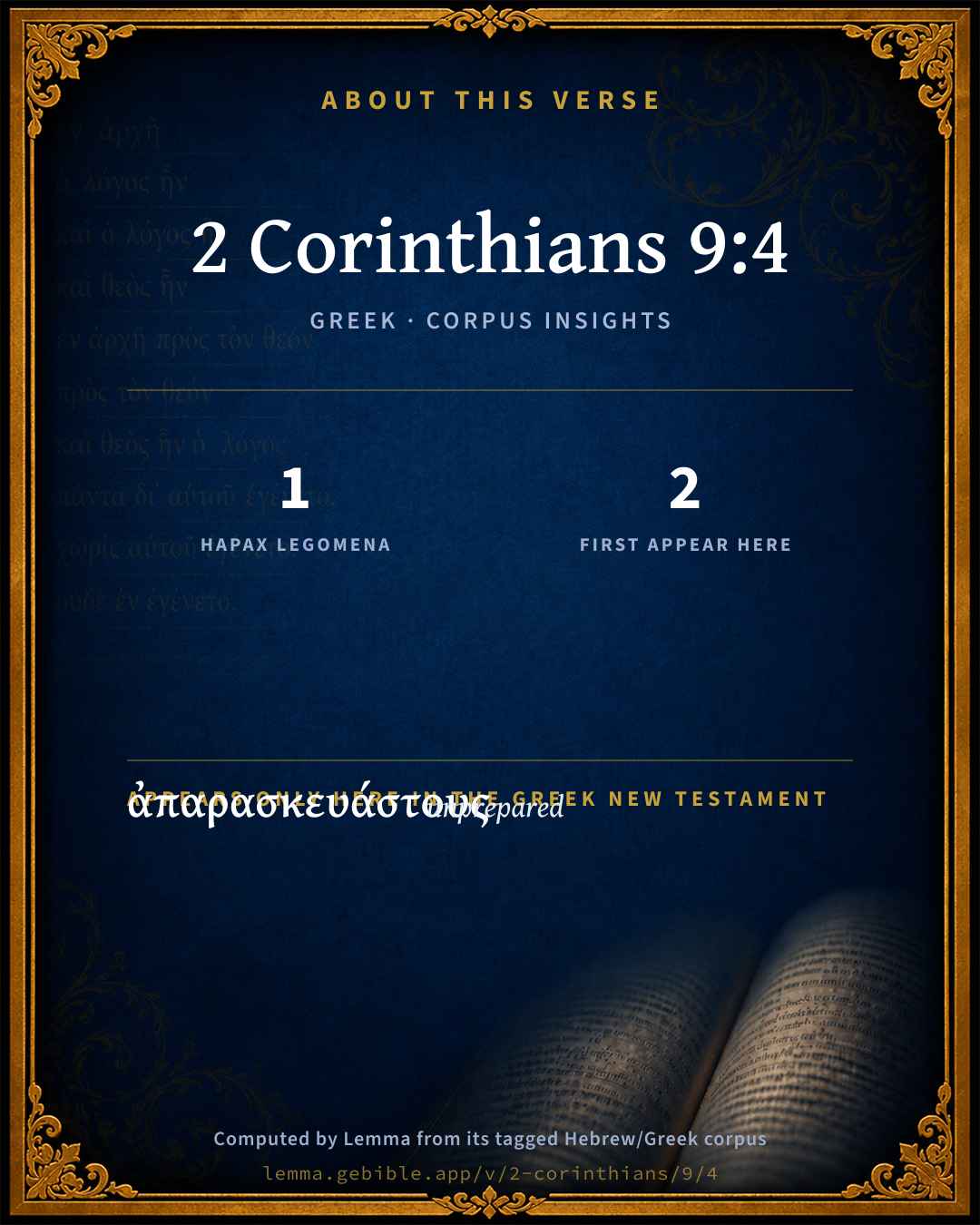
2 Corinthians 9:4

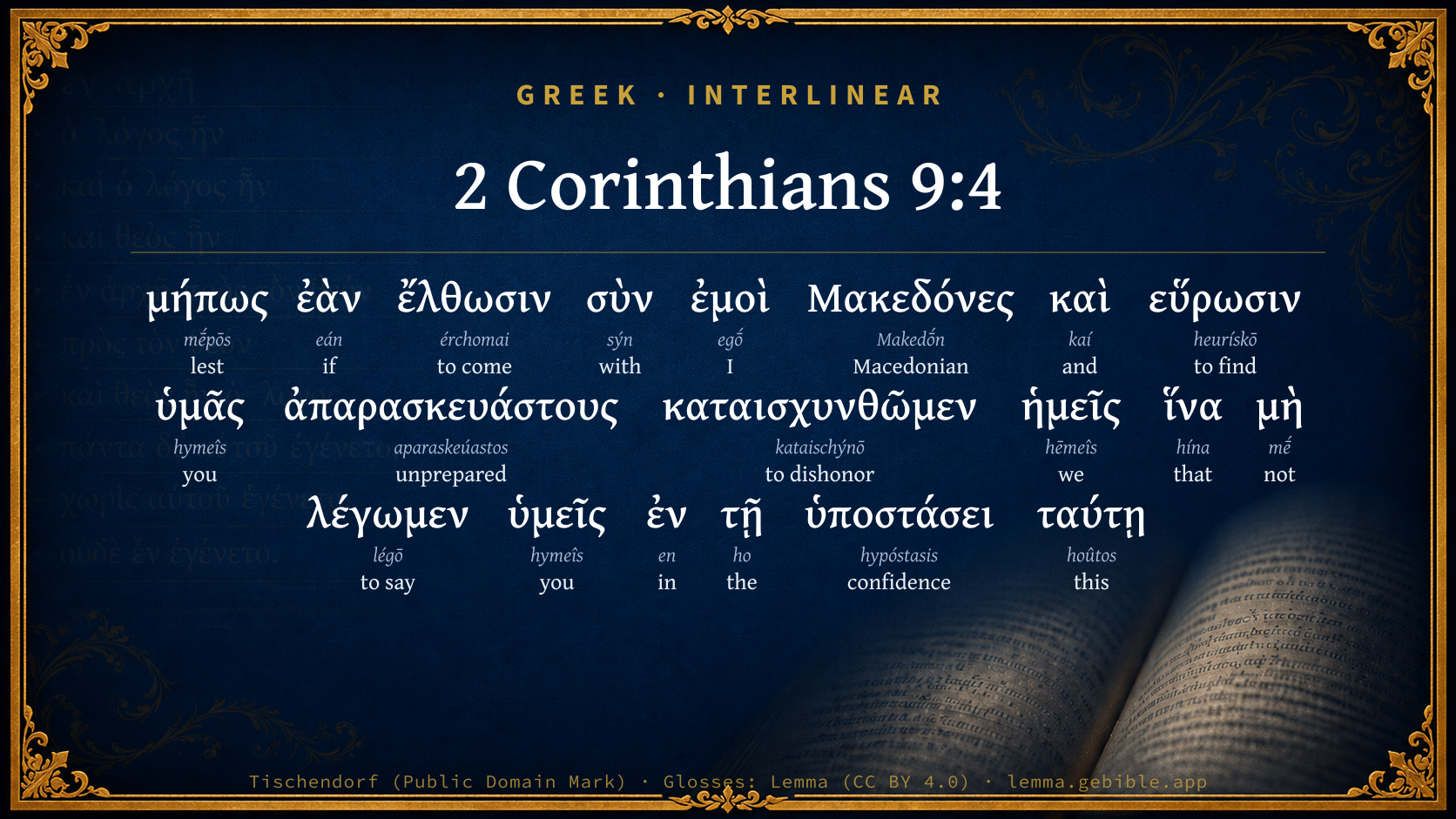
Greek (Tischendorf 8th ed.) 2 Corinthians 9:4 appears in the Greek New Testament. The text above is from the Tischendorf 8th edition. Each word links to its Strong’s number and a concise gloss. Click any word for its full Thayer’s Greek Lexicon entry.
Download image
Cite this verse

2 Corinthians 9:4 (World English Bible). Public Domain. Lemma interlinear Bible study tool, https://lemma.gebible.app/v/2-corinthians/9/4.

Show BibTeX & RIS
BibTeX
RIS
English Translation
so that I won't by any means, if there come with me any of Macedonia and find you unprepared, we (to say nothing of you) should be disappointed in this confident boasting.
World English Bible · Public Domain
Highlights
  • 1 hapax legomenon — only here in the Greek New Testament
  • 2 first appearances in the Greek New Testament
Full analysis ↓
Download a study sheet

One document with this verse’s original text, its word-by-word gloss line, the meaning frame, cross-references with their text, attributed commentary, and full source and license credits — printable, and it pastes into notes with its structure intact.

This verse Autodidact and up

Study sheet (.html) Plain text (.txt)

A passage Seminary Student

Up to 50 verses in one chapter. A passage sheet keeps up to 6 commentary sources and 12 cross-references per verse, in the order this page ranks them, and says so on the sheet whenever that leaves anything out. Ask for a single verse and you get the Autodidact verse sheet above.

Everything on this page stays free to read, with no account — the sheet is a download of what is already on screen, not access to it.

Want to remove ads? Support Godless Engineer
Compare translations 3

The same verse in 3 English versions, stacked beneath the original-language interlinear above. Click any original word for its lexicon entry.

Each is an independent rendering of the whole verse — the interlinear is not word-aligned to these translations.

Highlighted words mark where these versions differ — a whole-verse word diff, not a word-by-word alignment.

  • World English Bible Public Domain
    so that I won't by any means, if there come with me any of Macedonia and find you unprepared, we (to say nothing of you) should be disappointed in this confident boasting.
  • King James Version Public Domain
    Lest haply if they of Macedonia come with me, and find you unprepared, we (that we say not, ye) should be ashamed in this same confident boasting.
  • unfoldingWord Literal Text CC BY-SA 4.0
    Otherwise, if Macedonians might come with me and might find you unprepared, we would be ashamed—not to mention you—by this situation.

unfoldingWord Literal Text — © unfoldingWord, licensed CC BY-SA 4.0. Word-aligned USFM3 via Door43 (git.door43.org/unfoldingWord/en_ult).

Versions to compare (up to 4)

3 of 4 selected

Show all 19 translations

Every available English version of this verse, each an independent rendering of the whole verse.

  • World English Bible Public Domain
    so that I won't by any means, if there come with me any of Macedonia and find you unprepared, we (to say nothing of you) should be disappointed in this confident boasting.
  • Berean Standard Bible Public Domain
    Otherwise, if any Macedonians come with me and find you unprepared, we—to say nothing of you—would be ashamed of having been so confident.
  • Majority Standard Bible Public Domain
    Otherwise, if any Macedonians come with me and find you unprepared, we—to say nothing of you—would be ashamed of having been so confident in our boasting.
  • King James Version Public Domain
    Lest haply if they of Macedonia come with me, and find you unprepared, we (that we say not, ye) should be ashamed in this same confident boasting.
  • American Standard Version (1901) Public Domain
    lest by any means, if there come with me any of Macedonia and find you unprepared, we (that we say not, ye) should be put to shame in this confidence.
  • Revised Version (1885) Public Domain
    lest by any means, if there come with me any of Macedonia, and find you unprepared, we (that we say not, ye) should be put to shame in this confidence.
  • Geneva Bible (1599) Public Domain
    Lest if they of Macedonia come with me, and finde you vnprepared, we (that wee may not say, you) should be ashamed in this my constant boasting.
  • Douay-Rheims (1899) Public Domain
    Lest, when the Macedonians shall come with me, and find you unprepared, we (not to say ye) should be ashamed in this matter.
  • Young's Literal Translation Public Domain
    lest if Macedonians may come with me, and find you unprepared, we -- we may be put to shame (that we say not -- ye) in this same confidence of boasting.
  • Literal Standard Version CC BY-SA 4.0
    lest if Macedonians may come with me, and find you unprepared, we may be put to shame (that we do not say—you) in this same confidence of boasting.
  • Unlocked Literal Bible CC BY-SA 4.0
    Otherwise, if any Macedonians come with me and find you unprepared, we would be ashamed—I say nothing about you—for being so confident in you.
  • unfoldingWord Literal Text CC BY-SA 4.0
    Otherwise, if Macedonians might come with me and might find you unprepared, we would be ashamed—not to mention you—by this situation.
  • Darby Bible Public Domain
    lest haply, if Macedonians come with me and find you unprepared, *we*, that we say not *ye*, may be put to shame in this confidence.
  • World Messianic Bible Public Domain
    lest by any means, if anyone from Macedonia comes there with me and finds you unprepared, we (to say nothing of you) would be disappointed in this confident boasting.
  • Webster's Bible Public Domain
    Lest haply if they of Macedonia come with me, and find you unprepared, we (that we say not, ye) should be ashamed in this same confident boasting.
  • Free Bible Version CC BY-SA 4.0
    This is just in case some Macedonians should come with me and find you unprepared. We, not to mention you, would be really embarrassed if this project failed!
  • Bible in Basic English Public Domain
    For fear that, if any from Macedonia come with me, and you are not ready, we (not to say, you) might be put to shame in this thing.
  • Text-Critical English NT CC BY 4.0
    Otherwise, if any of the Macedonians were to come with me and find you unprepared, we (not to mention you) would be ashamed of this confident boasting.
  • Tyndale New Testament (1534) Public Domain
    lest paraveture yf they of Macedonia come with me and fynde you vnprepared the boost that I made in this matter shuld be a shame to vs: I saye not vnto you.

Literal Standard Version (2020), Covenant Press — licensed CC BY-SA 4.0. Text via the HelloAO Bible API (eBible.org). Unlocked Literal Bible (unfoldingWord) — licensed CC BY-SA 4.0. Text via the HelloAO Bible API (eBible.org). unfoldingWord Literal Text — © unfoldingWord, licensed CC BY-SA 4.0. Word-aligned USFM3 via Door43 (git.door43.org/unfoldingWord/en_ult). Free Bible Version, Dr. Jonathan Gallagher — licensed CC BY-SA 4.0. Text via the HelloAO Bible API (eBible.org).

Word by word

More ways to search: Search by grammar → Find every occurrence → Compare this word →

Practice this passage: Drill this verse → Learn its vocabulary →

ἀπαρασκευάστους
aparaskeúastos
G532
“unprepared”
Adjective, Accusative, Plural, Masculine
Part of Speech
Adjective
Case
Accusative
Number
Plural
Gender
Masculine
Full Thayer's Definition

Origin: from G1 (as a negative particle) and a derivative of G3903

TDNT: None

1. unprepared
  1. μήπως mḗpōs G3381 “lest” Conjunction, Negative
  2. ἐὰν eán G1437 “if” Conditional
  3. ἔλθωσιν érchomai G2064 “to come” Verb, Aorist, Active, Subjunctive, 3rd person, Plural
  4. σὺν sýn G4862 “with” Preposition
  5. ἐμοὶ egṓ G1473 “I” Personal pronoun, 1st person, Dative, Singular
  6. Μακεδόνες Makedṓn G3110 “Macedonian” Noun, Nominative, Plural, Masculine
  7. καὶ kaí G2532 “and” Conjunction
  8. εὕρωσιν heurískō G2147 “to find” Verb, Aorist, Active, Subjunctive, 3rd person, Plural
  9. ὑμᾶς hymeîs G5210 “you” Personal pronoun, 2nd person, Accusative, Plural
  10. καταισχυνθῶμεν kataischýnō G2617 “to dishonor” Verb, Aorist, Passive, Subjunctive, 1st person, Plural
  11. ἡμεῖς hēmeîs G2249 “we” Personal pronoun, 1st person, Nominative, Plural
  12. ἵνα hína G2443 “that” Conjunction
  13. μὴ mḗ G3361 “not” Particle, Negative
  14. λέγωμεν légō G3004 “to say” Verb, Present, Active, Subjunctive, 1st person, Plural
  15. ὑμεῖς hymeîs G5210 “you” Personal pronoun, 2nd person, Nominative, Plural
  16. ἐν en G1722 “in” Preposition
  17. τῇ ho G3588 “the” Article, Dative, Singular, Feminine
  18. ὑποστάσει hypóstasis G5287 “confidence” Noun, Dative, Singular, Feminine
  19. ταύτῃ hoûtos G3778 “this” Demonstrative pronoun, Dative, Singular, Feminine

About this verse

These counts appear in no published source. They are computed here, from the morphology-tagged text and Lemma’s own curated glosses. What Lemma adds →

20
words
19
distinct lemmas
Pauline Epistles
section

Notable vocabulary

1 hapax legomenon — a word that appears only here in the entire Greek New Testament:

  • ἀπαρασκευάστους unprepared G532

First appearance in Scripture

These words make their first canonical appearance in the Greek New Testament here:

  • ἀπαρασκευάστους unprepared G532
  • ὑποστάσει confidence G5287

Shared distinctive vocabulary

Μακεδόνες Macedonian G3110 occurs in 5 verses of the Greek New Testament. Also found in:

Repetition

A word recurs within this verse:

  • ὑμᾶς you G5210 ×2

Cross-references

5

Topical passages linked to 2 Corinthians 9:4 in the Treasury of Scripture Knowledge — connected by theme and wording, ordered by reader-vote popularity; previews shown in the World English Bible.

  • Romans 15:26 For it has been the good pleasure of Macedonia and Achaia to make a certain contribution for the poor among the saints who are at Jerusalem.
  • 2 Corinthians 8:1–5 Moreover, brothers, we make known to you the grace of God which has been given in the assemblies of Macedonia;
  • 2 Corinthians 8:24 Therefore show the proof of your love to them in front of the assemblies, and of our boasting on your behalf.
  • 2 Corinthians 9:2 for I know your readiness, of which I boast on your behalf to them of Macedonia, that Achaia has been prepared for a year past. Your zeal has stirred up very many of them.
  • 2 Corinthians 11:17 That which I speak, I don't speak according to the Lord, but as in foolishness, in this confidence of boasting.

Cross-references courtesy of OpenBible.info (CC BY 4.0).

Where the printed editions differ

1 variant

Places in this verse where the major printed Greek editions disagree on the wording in a way that affects the translation — a comparison of editions, not a manuscript-by-manuscript collation. The editions are the modern critical texts (Nestlé-Aland 28/27, SBL, Westcott-Hort, Tregelles, Tyndale House) and the traditional texts behind the KJV (the Textus Receptus and the Byzantine/Majority text). It is not a claim about which reading is original.

  1. Extra text
    τῆς καυχήσεως.

    “<the> of boasting.”

    In TRByz Not in NA28NA27TynSBLWHTreg

    τῆς καυχήσεως. (tēs kauchēseōs) 'of boasting.' is only in traditional manuscripts (TR+Byz)

Textual data: Translators Amalgamated Greek New Testament (STEPBible TAGNT) · CC BY 4.0.

Commentary

Notes on 2 Corinthians 9:4 from classic Christian and Jewish commentators (each source and its license shown beneath its notes). The classic Christian expositions comment on the surrounding passage and are grouped to its opening verse, so a note may address several verses; the Jewish commentaries on the Tanakh (Rashi and others) are per-verse, so they appear only where the commentator wrote on this verse.

Lemma curates 59 commentaries, every one of them public domain or Creative Commons licensed, each selected and text-cleaned for this edition rather than reprinted as found. About our sources →

Bengel's Gnomon

Johann Albrecht Bengel

2Co 9:4. Ὑμεῖς, ye) much more so [you would feel still more ashamed than we].—ὑποστάσει, stedfast confidence) [concerning your liberality], ch. 2Co 11:17.

Bengel's Gnomon of the New Testament — English translation (T&T Clark, Edinburgh, 1860) — public domain. Text from a community e-Sword module.

Meyer's Critical & Exegetical Commentary

Heinrich August Wilhelm Meyer

2Co_9:4. Lest perhaps, etc.; this is to be guarded against by the παρεσκευασμένοι ἦτε.

ἐὰν ἔλθωσι κ.τ.λ.] if there shall have come, etc., namely, as giving escort after the fashion of the ancient church. See Act_17:14-15, al.; 2Co_1:16; 1Co_16:6; Rom_15:24.

Μακεδόνες] Macedonians without the articl.

ἀπαρασκευάστους] not in readiness (often in Xen., as Anab. i. 5. 9); ἀπαράσκευος is more frequent, and the two words are often interchanged in the MSS.; see Bornemann, ad Xen. Anab. 1:1. 6. Here it is equivalent to: so that you are not ready to hand over the money; the expression is purposely chosen in reference to 2Co_9:2.

ἡμεῖς] see 2Co_9:3. But because this being put to shame in the case supposed would have involved the Corinthians as its originators, Paul with tender delicacy (not serene pleasantry, as Olshausen thinks), moving the sense of honour of the readers, adds parenthetically: ἵνα μὴ λέγωμεν ὑμεῖς.

ἐν τῇ ὑποστάσει ταύτῃ] in respect of this confidence, according to which we have maintained that you were in readiness. Comp. 2Co_11:17; Heb_3:14; Heb_11:1; LXX. Psa_39:7; Eze_19:5; Rth_1:12; and passages in Wetstein; Suicer, Thes. II. p. 1398. So Calvin, Beza, Erasmus Schmid, Calovius, Wolf, Bengel, Rosenmüller, and others, including de Wette, Osiander, Hofmann. But others take it as quite equivalent to ἐν τῷ μέρει τούτῳ, 2Co_9:3 : in hac materia, in hoc argumento (gloriationis). Comp. Vulgate: in hac substantia. So Chrysostom, Theophylact, Erasmus, Castalio, Estius, Kypke, Munthe, and others, including Schrader, Rückert, Olshausen, Ewald. Linguistically correct, no doubt (Polyb. iv. 2.1; Casaubon, ad Polyb. i. 5. 3, p. 111; Diodorus, i. 3; comp. also Heb_1:3, and Bleek, Heb. Br. II. 1, p. 61 f.), but here a point quite unnecessary to be mentioned. And why should we depart from the meaning: confidence, when this is certain in the usage of the N. T., and here, as at 2Co_11:17, is strikingly appropriate? The insertion of ἵνα μὴ λ. ὑμεῖς forms no objection (this in opposition to Rückert), since certainly the putting to shame of the apostle in regard to his confidence would have been laid to the blame of the Corinthians, because they would have frustrated this confidence; hence there is not even ground for referring that insertion merely to καταισχ. exclusive of ἐν τ. ὑποστ. τ. (Hofmann). Lastly, the explanation of Grotius: in hoc fundamento meae jactationis, has likewise, doubtless, some support in linguistic usage (Diodor. i. 66, xiii. 82, al.; LXX. Psa_69:2; Jer_23:22, al.), but falls to the ground, because τῆς καυχ. is not genuine.

Meyer — Critical and Exegetical Commentary on the New Testament — English translation by Peter Christie, edited by Frederick Crombie (T&T Clark, 1880) — public domain. Text from a community e-Sword module.

Expositor's Greek Testament

ed. W. Robertson Nicoll

2Co 9:4 . μή πως ἐὰν ἔλθωσι κ . τ . λ .: lest by any means, if there come with me any of Macedonia (not “they of Macedonia,” as A.V.; it is probably a fair inference from this verse that the unnamed “brethren” of 2Co 8:18 ; 2Co 8:22 were not Macedonians), and find you unprepared, i.e. , with the collection still incomplete, we that we say not, ye (which is what he really wishes to convey to them) should be put to shame in this confidence, i.e. , should be shamed because of our exaggerated statements. ὑπόστασις = substratum or substance (Heb 1:3 ; Heb 11:1 ) is sometimes used in the LXX as = “ground of hope” (Rth 1:12 , Psa 38:6 , Eze 19:5 ), and thus it came to mean “confidence,” as here (see reff.).

The Expositor's Greek Testament, edited by W. Robertson Nicoll (1897–1910) — public domain. Text from a community e-Sword module.

Geneva Bible (1599)

Geneva Bible translators

The word which he useth, signifieth such a stayedness and settledness of mind, as cannot be moved with any terror or fear.

Geneva Bible (1599) marginal notes — public domain. Text via Bolls.life.

Jamieson, Fausset & Brown

Robert Jamieson, A. R. Fausset & David Brown

if they of Macedonia--rather as Greek, "if Macedonians."

unprepared--with your collection; see Co2 9:2, "ready," Greek, "prepared."

we, not to say ye--Ye would naturally feel more ashamed for yourselves, than we (who boasted of you) would for you.

confident boasting--The oldest manuscripts read simply "confidence," namely, in your liberality.

Jamieson, Fausset & Brown — Commentary Critical and Explanatory on the Whole Bible (1871) — public domain (CC PDM 1.0). Text via the HelloAO Bible API.

John Calvin's Commentaries

4. In this confidence The Greek term being ὑπόστασις the Old Interpreter has rendered it substantiam, (substance.) Erasmus renders it argumentum, (subject-matter,) but neither is suitable. Budaeus, however, observes, that this term is sometimes taken to mean boldness, or confidence, as it is used by Polybius when he says, ὀυχ οὑτω την δύναμιν ὡς τὴν ὑπόστασιν καὶ τόλμαν αὐτοῦ καταπεπληγμένον τῶν εναντίων — “It was not so much his bodily strength, as his boldness and intrepidity, that proved confounding to the enemy.” Hence ὑποτατικός sometimes means one that is bold and confident. Now every one must see, how well this meaning accords with Paul’s thread of discourse. Hence it appears, that other interpreters have, through inadvertency, fallen into a mistake.

John Calvin's Commentaries (1540-1563) — public domain. Text from the Calvin Translation Society English edition (1840s-50s) via the Christian Classics Ethereal Library (ccel.org). Calvin's coverage is partial (roughly two-thirds of the Bible); uncommented books and verses are honest gaps, never fabricated. The 19th-century editor's footnotes and remarks are omitted so the notes are faithfully Calvin's own voice.

Ellicott's Commentary for English Readers

(4) Lest haply if they of Macedonia . . .—The Greek for “Macedonians” has no article, and the word is meant to stir up something like an esprit de corps. “Surely you Achaians won’t allow Macedonians to come and see that you fall short of what I told them about?” It is a probable, but not, as some have thought, a necessary inference, that neither of the two unnamed brethren of 2Co_8:18; 2Co_8:22, were of that province. What he now indicates is, that it is, at all events, probable that when he comes to pay his deferred visit he will be accompanied by Macedonians. If, then, they were still not ready, there would be shame for him; how much more for them!

In this same confident boasting.—Literally, in this confidence of boasting; but the better MSS. give “in this confidence” only. The word so translated (hypostasis), literally, “that which stands under, the base or ground of anything,” has the interest of a long subsequent history in metaphysical and theological controversies, of which we find, perhaps, the first trace in Heb_1:3, where it appears as “person,” and Heb_11:1, where it is rendered “substance.” (See Notes on those passages.) In Heb_3:14, it has the same meaning as in this passage.

A Bible Commentary for English Readers, edited by Charles John Ellicott (1878–1897) — public domain. Text from a community e-Sword module.

The Cambridge Bible for Schools and Colleges

gen. ed. J. J. S. Perowne

4. lest haply] The earlier editions have happily (paraventure, Tyndale), with the same meaning as in the text.

they of Macedonia] We should rather say in English any Macedonians. From this it has been inferred that the brethren sent previously were not Macedonians. See ch. 2Co_8:17-24.

we (that we say not, you)] The ‘we’ is emphatic. We have another instance here of what we might call the gentlemanly instinct of the Apostle. See note on ch. 2Co_7:3. ‘I should be ashamed of my confidence, and, might I not add, you also would be ashamed that I should have expressed it.’

confident boasting] The word ‘boasting’ is omitted by most recent editors. It is absent from the best MSS. and versions, and has probably been introduced from ch. 2Co_11:17. The rendering in this case must be ‘in this confidence’ i.e. which I have had in you. Some would render by ‘foundation’ or ‘substance’ (in hoc substantia, Vulg.), the latter being the literal rendering of the word (see Heb_11:1, also 2Co_1:3 where it is translated person); but in Heb_3:14, as in Classical Greek and in the LXX., it means and is rendered confidence. It means originally (1) that on which one takes one’s stand; or (2) that which stands beneath us. Hence in later Greek theology it came to mean person, as the underlying entity at the root of all apparent being. Compare our English words understand, understanding, which however, like the Latin substantia, have had a different history, and have arrived at a different signification.

The Cambridge Bible for Schools and Colleges (gen. ed. J. J. S. Perowne; Cambridge University Press, 1878–1918) — public domain. Text from a community e-Sword module.

John Gill's Exposition

Lest haply if they of Macedonia come with me,.... The apostle had determined to come himself, though he was afterwards prevented by Providence, but could not be certain of the coming of the Macedonian brethren with him; however, as it was probable that some of them would come, whose hearts were so much in this work, therefore he judged it fit and proper to send the brethren before hand, in case they should come:

and find you unprepared; not so ready for this service as had been boasted of, and the collection not finished, which had been begun a year ago.

We (that we say not, ye) should be ashamed in this same confident boasting; or "in this same substance", or "subsistence of boasting": a boasting, which, he thought, they had the most solid and substantial ground and foundation to proceed upon; which, should it come to nothing, must cause shame both in the apostles, who had so largely, and with so much assurance, boasted of them; and in the Corinthians, who must be put to the blush, when it should be told them how much they had been boasted of with respect to their readiness, and yet were unprepared: so "hope", expectation, confidence, is rendered by the Septuagint "boasting", Pro 11:7 and in Psa 39:5 the word here used. And some copies, and also the Vulgate Latin version, only read, "in this substance", or glorying, and leave out boasting as superfluous.

John Gill's Exposition of the Whole Bible (1746–1763) — public domain (CC PDM 1.0). Text via the HelloAO Bible API.

Trapp's Complete Commentary

John Trapp

3 Yet have I sent the brethren, lest our boasting of you should be in vain in this behalf; that, as I said, ye may be ready:

4 Lest haply if they of Macedonia come with me, and find you unprepared, we (that we say not, ye) should be ashamed in this same confident boasting.

Ver. 4. In this same confident boasting] Gr. "in this confidence of glorying." A metaphor from. hunters, who confidently expect the beast, and valiantly set upon him. Sic Latini dicunt, subsistere aprum. So the Latins say that the boar stands.

John Trapp, A Commentary or Exposition upon All the Books of the Old and New Testament (1647–1656) — public domain. Text from a community e-Sword module.

Albert Barnes' Notes on the Bible

Lest haply if they of Macedonia - If any of the Macedonians should happen to come with me, and should find that you had done nothing. He does not say that they would come with him, but it was by no means improbable that they would. It was customary for some of the members of the churches to travel with Paul from place to place, and the conversation was constant between Macedonia and Achaia. Paul had, therefore, every reason to suppose that some of the Macedonians would accompany him when he should go to Corinth. At all events it was probable that the Macedonians would learn from some quarter whether the Corinthians were or were not ready when Paul should go to them.

should be ashamed ...}We (that we say not, ye) should be ashamed ... - “In this,” says Bloomfield, “one cannot but recognize a most refined and delicate turn, inferior to none of the best Classical writers.” Paul had boasted confidently that the Corinthians would be ready with their collection. He had excited and stimulated the Macedonians by this consideration. He had induced them in this way to give liberally, 2Co 8:1-4. If now it should turn out after all that the Corinthians had given nothing, or had given stintedly, the character of Paul would suffer. His veracity and his judgment would be called in question, and he would be accused of trick, and artifice, and fraud in inducing them to give. Or if he should not be charged with dishonesty, yet he would be humbled and mortified himself that he had made representations which had proved to be so unfounded. But this was not all. The character of the Corinthians was also at stake. They had purposed to make the collection. They had left the impression in the mind of Paul that it would be done. They had hitherto evinced such a character as to make Paul confident that the collection would be made. If now by any means this should fail, their character would suffer, and they would have occasion to be ashamed that they had excited so confident expectations of what they would do.

Albert Barnes' Notes on the Bible (1834–1885) — public domain. Text from a community e-Sword/MySword module.

Matthew Poole's English Annotations

For if I should come, and any of the members of the churches of Macedonia, who have heard me boasting of you as a people very forward in this charitable work, and when they are come they should find you had done nothing, only talked much of your readiness, both I should be ashamed, and you also might see some cause to blush, which I, who consult your honour and reputation equally with my own, would prevent.

Matthew Poole's English Annotations on the Holy Bible (1683–1685) — public domain. Text from a community e-Sword/MySword module.

Whedon's Commentary on the Bible

Daniel D. Whedon

4. Haply—Perhaps. We…

ye—A happy stroke of delicacy!

Daniel D. Whedon (gen. ed.), Commentary on the Old and New Testaments (1874–1909) — public domain. Text from a community e-Sword module.

The Pulpit Commentary

They of Macedonia; rather, Macedonians; i.e. any friends from Macedonia. (Act_20:4) Shall Achaians have to blush before Macedonians? We, that we say not ye. Nothing can exceed the delicacy of this touch. St. Paul asks them to be ready with their contributions for his sake, not for their own; that he may not have to blush for his generous words respecting them, whereas really the discredit would be simply theirs. Confident boasting; rather, confidence. The reading "of boasting" is not genuine here. For the word hypostasis in the sense of "confidence," see 2Co_11:17; Heb_3:4. The use of the word to represent the "Persons" of the Blessed Trinity is later. The other sense of the word, "substance" (or underlying base of attributes) is found in Heb_1:3.

The Pulpit Commentary (1880–1919), ed. H.D.M. Spence-Jones & Joseph S. Exell — public domain. Text from a community e-Sword module.

McGarvey & Pendleton's Commentaries

J. W. McGarvey

lest by any means, if there come with me any of Macedonia and find you unprepared, we (that we say not, ye) should be put to shame in this confidence . [I have gloried or boasted concerning you in many respects, and have hitherto had to retract nothing which I said. That my glorying concerning your liberality may not prove an exception and require a retraction, I have sent these messengers that they might gather together the collection which you pledged, and perhaps began to take up last year. For if any Macedonians should come with me to Corinth and find the collection ungathered, I would be ashamed for having represented you as better than you were, and you would be ashamed of having been held up as a model for the emulation of those who were, in fact, better than you.]

J. W. McGarvey (with Philip Y. Pendleton), Commentaries on the New Testament (The Fourfold Gospel, 1914; Acts; and the epistles) — public domain. Text from a community e-Sword/MySword module.

The People's New Testament

B. W. Johnson

4. Lest haply if they of Macedonia. Acts 20:4 named certain brethren of Macedonia who did attend him. If these should find Corinth unprepared with the collection when Paul came, after what he had said, it would fill him with shame.

B. W. Johnson's The People's New Testament with Notes (1889–1891) — public domain. Electronic text from the Christian Classics Ethereal Library (CCEL) ThML edition.

Cambridge Greek Testament for Schools and Colleges

4. λέγωμεν (אBC2LP, f Vulg. Syrr. Copt.) rather than λέγω CDFG, d e). After ὑποστάσει ταύτῃ א3D3KLP, Syrr. Arm., followed by the Rec. and A.V., add τῆς καυχήσεως, which is doubtless a gloss from 2Co 11:17. אBCDFG, Latt. omit.

4. ἐὰν ἔλθωσιν σὺν ἑμοὶ Μακεδόνες. If any Macedonians come with me. This seems to imply that neither of the brethren who were to accompany Titus was a Macedonian. If Luke was one of these, this verse is against his being of Philippi.

ἀπαρασκευάστους. Here only in Biblical Greek and rare in classical, where MSS. sometimes vary between it and the more common form ἀπαράσκευος.

καταισχυνθῶμεν ἡμεῖς. We should be put to shame (2Co 7:14; Rom 10:11) in this confidence. See critical note. The word ὑπόστασις has a long and important history, only one or two points of which can be noted here. In classical Greek it is ‘ground’ or ‘foundation’; then ‘ground of hope’ or ‘ground of confidence’; and finally ‘hope’ or ‘confidence.’ In the LXX. it occurs 20 times and represents 15 different Hebrew words; but in some cases the Hebrew text is uncertain. Comp. ἡ ὑπόστασίς μου παρὰ σοῦ ἐστιν, ‘my ground of hope is from Thee’ (Psa 38:8); also Rth 1:12; Eze 19:5, where Theodotion has ἐλπίς. See Hatch, Essays in Biblical Greek, p. 88, and Westcott on Heb 3:14. The ‘confidence’ in this case is that of the Apostle in the Corinthian Christians. Comp. 2Co 11:17.

Cambridge Greek Testament for Schools and Colleges (Cambridge University Press, 1896; 21 vols, various authors incl. Carr, Maclear, Plummer, Farrar, Lumby, Moule, M. R. James, Simcox) — public domain. Text from a community e-Sword module.

Alford’s Greek Testament

Henry Alford

4.] lest perchance if Macedonians should come with me (to you:—to bring me on my way, or to bear the Macedonian collection.

We may infer from this expression, that neither of the two brethren above mentioned, ch. 8:18, 22, was a Macedonian), and should find you unprepared (with your collection, see ver. 2) we (who have boasted), not to say you (who were boasted of), should be put to shame, in the matter of this confidence (respecting you. ὑπόστασις, as elsewhere in N. T. and LXX, see reff., subjective: the attempt to give it here the meaning of ‘foundation,’ ‘matter boasted of,’ as Chrys., Theophyl., Erasm., Grot., al., Rück., Olsh., is unnecessary, and has probably been induced by the gloss τῆς καυχ inserted from ch. 11:17: but see there also).

Henry Alford, The Greek Testament (1849–1861) — public domain. Text from a community e-Sword module.

International Critical Commentary

4. ἐὰν ἔλθωσιν σὺν ἐμοὶ Μακεσόνες. The brethren who go with Titus may or may not have been Macedonians. Their finding the collection not yet complete does not matter so much. But it will look very badly, when St Paul comes to fetch the money, if Macedonians come with him and find that very little has been collected. There is nothing here to show that the situation is different from that in viii, —that there St Paul is not coming to Corinth very soon, and that here he is coming very soon.

ἀπαρασκευάστους. A late and rare form, here only in N.T. The usual form is ἀπαράσκευος. Neither word occurs in LXX.

καταισχυνθῶμεν ἡμεῖς. He puts his own shame first; but of course the disgrace would be theirs rather than his. He asks them to spare him, which is a better plea than appealing to their own interests, which are just touched parenthetically. Multa confusio est, si pro te qui te diligit erubescat (Pseudo-Primasius). ‘We, to say nothing of you, should be put to shame’ (7:14; Rom 10:11). See Index IV.

ἐν τῇ ὑποστάσει ταύτῃ. The word has a very varied history, but only one or two points need be noted here. From meaning ‘standing ground’ or ‘foundation’ it comes to mean ‘ground of hope or confidence’ (Rth 1:12; Eze 19:5), and hence ‘hope’ or ‘confidence.’ In LXX it represents fifteen different Hebrew words. In Heb 3:14 (see Westcott) it means the resolute confidence which resists all attack. Here it means the Apostle’s confidence in the character of his converts. They must not make people think that he has been too sure of them. Cf. 11:17; Heb 11:1. In this verse St Paul makes it quite clear that he means to visit Corinth again.

λέγωμεν (א B C 2 L P, f Vulg. Syrr. Copt.) rather than λέγω (C * D F G, d e g), After ταύτῃ, א c Dc E K L P, Syrr. Arm. Goth. add τῆς καυχήσεως from 11:17. א * B C D * G 17, 67 * *, Latt. Copt. omit.

International Critical Commentary — older volumes (1896–1929), various authors — public domain. Text from a community e-Sword module.

Vincent's Word Studies in the New Testament

Marvin R. Vincent

Confident boasting [υποστασει] . Primarily something put under, foundation, ground; so substance (sub, stans, standing under), substantial quality : thence steadiness, confidence. Compare Heb 3:14; Heb 11:1. In the Septuagint the word represents fifteen different Hebrew words.

Marvin R. Vincent, Word Studies in the New Testament (1887–1900) — public domain. Text from a community e-Sword/MySword module.

Lesson kit

Teaching starters — assembled from the data on this page, not authored interpretation. Every prompt links to the verse data it draws on. Edit before teaching.

2 Corinthians, in the Pauline Epistles, opens this verse with 20 words (19 distinct Greek lemmas). Its most distinctive word is aparaskeúastos (“unprepared”). A historical commentator’s framing appears above. Read the whole chapter for the surrounding context.

Discussion questions

  1. What does “unprepared” (aparaskeúastos) contribute to the verse as a whole?
  2. 1 word here appears nowhere else in the Greek New Testament. Why might the author reach for such rare wording?
  3. 2 words make their first appearance in Scripture here. What does this debut establish?
  4. How does Acts 16:9, which shares the word «Macedonian», read alongside this verse?
  5. What does the repetition of “you” (2× in this one verse) do in this verse?
  6. These translations render this verse differently. What is at stake in choosing one wording over another?
  7. Compare how Bengel's Gnomon and Meyer's Critical & Exegetical Commentary read this verse. Where do they agree or differ?

Things to notice

  • 1 word in this verse appears nowhere else in the Greek New Testament.
  • 2 words make their first canonical appearance in Scripture here.
  • These translations choose different wording for 24 words in this verse.
  • “you” occurs 2× in this single verse.
  • 19 distinct Greek lemmas span 20 words in this verse.

Reading settings

Reading text

Shown beneath each verse's original-language words.

Old Testament
Old Testament edition

Read the OT as the Masoretic Hebrew (MT) or the Greek Septuagint (LXX).

English shown for the Greek Septuagint (in the Hebrew ↔ Greek comparison).

Comparing translations? Open the Compare panel on any verse page to stack up to four side by side.