2 Corinthians 2:13

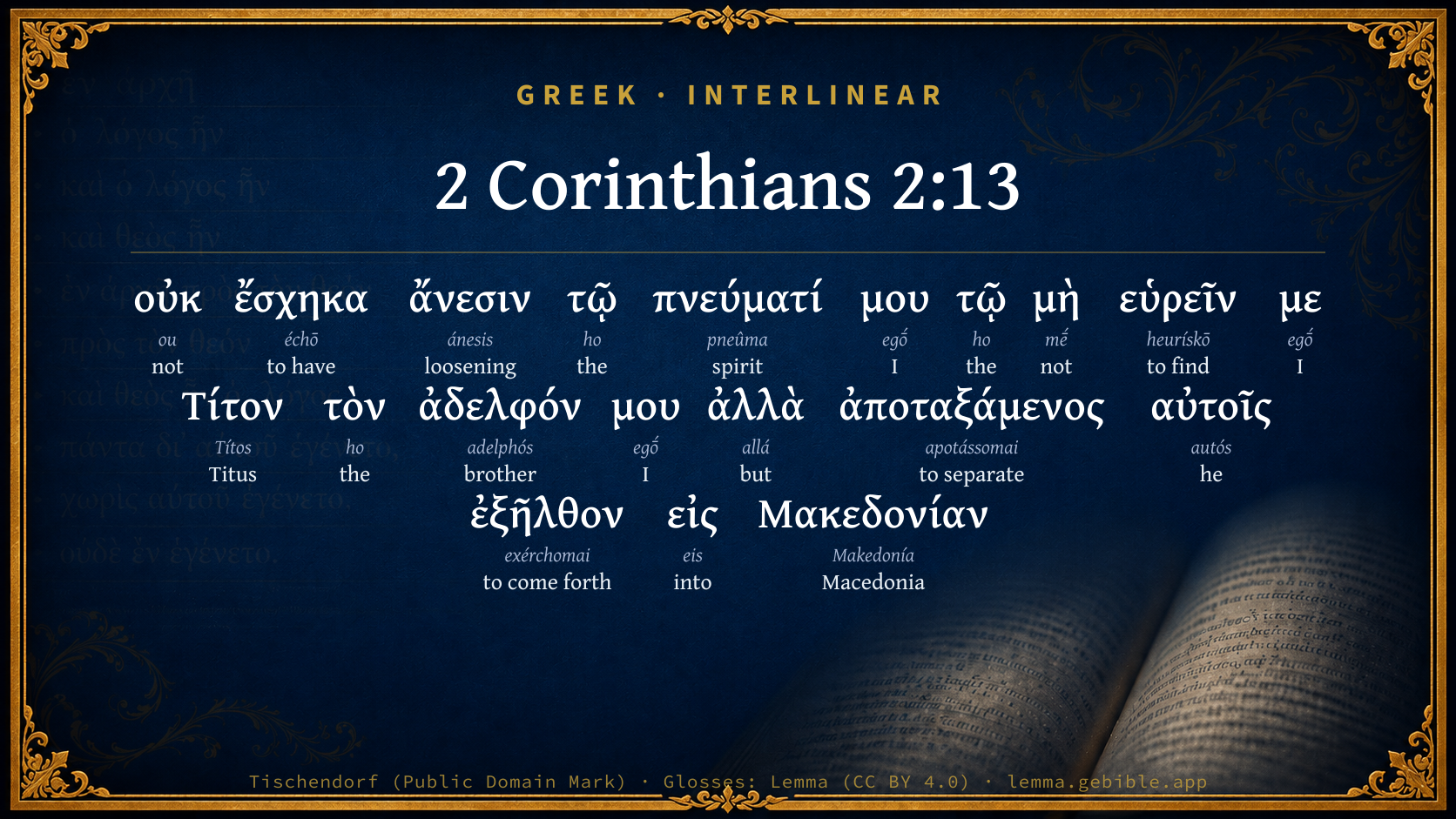
Greek (Tischendorf 8th ed.) 2 Corinthians 2:13 appears in the Greek New Testament. The text above is from the Tischendorf 8th edition. Each word links to its Strong’s number and a concise gloss. Click any word for its full Thayer’s Greek Lexicon entry.
Download image
Cite this verse

2 Corinthians 2:13 (World English Bible). Public Domain. Lemma interlinear Bible study tool, https://lemma.gebible.app/v/2-corinthians/2/13.

Show BibTeX & RIS
BibTeX
RIS
English Translation
I had no relief for my spirit, because I didn't find Titus, my brother, but taking my leave of them, I went out into Macedonia.
World English Bible · Public Domain
Download a study sheet

One document with this verse’s original text, its word-by-word gloss line, the meaning frame, cross-references with their text, attributed commentary, and full source and license credits — printable, and it pastes into notes with its structure intact.

This verse Autodidact and up

Study sheet (.html) Plain text (.txt)

A passage Seminary Student

Up to 50 verses in one chapter. A passage sheet keeps up to 6 commentary sources and 12 cross-references per verse, in the order this page ranks them, and says so on the sheet whenever that leaves anything out. Ask for a single verse and you get the Autodidact verse sheet above.

Everything on this page stays free to read, with no account — the sheet is a download of what is already on screen, not access to it.

Want to remove ads? Support Godless Engineer
Compare translations 3

The same verse in 3 English versions, stacked beneath the original-language interlinear above. Click any original word for its lexicon entry.

Each is an independent rendering of the whole verse — the interlinear is not word-aligned to these translations.

Highlighted words mark where these versions differ — a whole-verse word diff, not a word-by-word alignment.

  • World English Bible Public Domain
    I had no relief for my spirit, because I didn't find Titus, my brother, but taking my leave of them, I went out into Macedonia.
  • King James Version Public Domain
    I had no rest in my spirit, because I found not Titus my brother: but taking my leave of them, I went from thence into Macedonia.
  • unfoldingWord Literal Text CC BY-SA 4.0
    I had no relief in my spirit, as I did not find my brother Titus there. So having said farewell to them, I went on to Macedonia.

unfoldingWord Literal Text — © unfoldingWord, licensed CC BY-SA 4.0. Word-aligned USFM3 via Door43 (git.door43.org/unfoldingWord/en_ult).

Versions to compare (up to 4)

3 of 4 selected

Show all 19 translations

Every available English version of this verse, each an independent rendering of the whole verse.

  • World English Bible Public Domain
    I had no relief for my spirit, because I didn't find Titus, my brother, but taking my leave of them, I went out into Macedonia.
  • Berean Standard Bible Public Domain
    I had no peace in my spirit, because I did not find my brother Titus there. So I said goodbye to them and went on to Macedonia.
  • Majority Standard Bible Public Domain
    I had no peace in my spirit, because I did not find my brother Titus there. So I said goodbye to them and went on to Macedonia.
  • King James Version Public Domain
    I had no rest in my spirit, because I found not Titus my brother: but taking my leave of them, I went from thence into Macedonia.
  • American Standard Version (1901) Public Domain
    I had no relief for my spirit, because I found not Titus my brother: but taking my leave of them, I went forth into Macedonia.
  • Revised Version (1885) Public Domain
    I had no relief for my spirit, because I found not Titus my brother: but taking my leave of them, I went forth into Macedonia.
  • Geneva Bible (1599) Public Domain
    I had no rest in my spirit, because I founde not Titus my brother, but tooke my leaue of them, and went away into Macedonia.
  • Douay-Rheims (1899) Public Domain
    I had no rest in my spirit, because I found not Titus my brother; but bidding them farewell, I went into Macedonia.
  • Young's Literal Translation Public Domain
    I have not had rest to my spirit, on my not finding Titus my brother, but having taken leave of them, I went forth to Macedonia;
  • Literal Standard Version CC BY-SA 4.0
    I have not had rest to my spirit, on my not finding my brother Titus, but having taken leave of them, I went forth to Macedonia;
  • Unlocked Literal Bible CC BY-SA 4.0
    I had no relief in my spirit, because I did not find my brother Titus there. So I left them and went on to Macedonia.
  • unfoldingWord Literal Text CC BY-SA 4.0
    I had no relief in my spirit, as I did not find my brother Titus there. So having said farewell to them, I went on to Macedonia.
  • Darby Bible Public Domain
    I had no rest in my spirit at not finding Titus my brother; but bidding them adieu, I came away to Macedonia.
  • World Messianic Bible Public Domain
    I had no relief for my spirit, because I didn’t find Titus my brother, but taking my leave of them, I went out into Macedonia.
  • Webster's Bible Public Domain
    I had no rest in my spirit, because I found not Titus my brother; but taking my leave of them, I went from thence into Macedonia.
  • Free Bible Version CC BY-SA 4.0
    But my mind wasn't at peace because I couldn't find my brother Titus. So I said goodbye and went over to Macedonia.
  • Bible in Basic English Public Domain
    I had no rest in my spirit because Titus my brother was not there: so I went away from them, and came into Macedonia.
  • Text-Critical English NT CC BY 4.0
    But I had no rest in my spirit because I did not find my brother Titus. So I took leave of the people there and went on to Macedonia.
  • Tyndale New Testament (1534) Public Domain
    I had no rest in my sprete because I founde not Titus my brother: but toke my leave of them and went awaye into Macedonia.

Literal Standard Version (2020), Covenant Press — licensed CC BY-SA 4.0. Text via the HelloAO Bible API (eBible.org). Unlocked Literal Bible (unfoldingWord) — licensed CC BY-SA 4.0. Text via the HelloAO Bible API (eBible.org). unfoldingWord Literal Text — © unfoldingWord, licensed CC BY-SA 4.0. Word-aligned USFM3 via Door43 (git.door43.org/unfoldingWord/en_ult). Free Bible Version, Dr. Jonathan Gallagher — licensed CC BY-SA 4.0. Text via the HelloAO Bible API (eBible.org).

Word by word

More ways to search: Search by grammar → Find every occurrence → Compare this word →

Practice this passage: Drill this verse → Learn its vocabulary →

ἄνεσιν
ánesis
G425
“loosening”
Noun, Accusative, Singular, Feminine
Part of Speech
Noun
Case
Accusative
Number
Singular
Gender
Feminine
Full Thayer's Definition

Origin: from G447

TDNT: 07:07,6

1. a loosening, relaxing a. spoken of a more tolerable condition in captivity, to be held in less vigorous confinement b. relief, rest, from persecutions
  1. οὐκ ou G3756 “not” Particle, Negative
  2. ἔσχηκα échō G2192 “to have” Verb, Perfect, Active, Indicative, 1st person, Singular
  3. τῷ ho G3588 “the” Article, Dative, Singular, Neuter
  4. πνεύματί pneûma G4151 “spirit” Noun, Dative, Singular, Neuter
  5. μου egṓ G1473 “I” Personal pronoun, 1st person, Genitive, Singular
  6. τῷ ho G3588 “the” Article, Dative, Singular, Neuter
  7. μὴ mḗ G3361 “not” Particle, Negative
  8. εὑρεῖν heurískō G2147 “to find” Verb, Aorist, Active, Infinitive
  9. με egṓ G1473 “I” Personal pronoun, 1st person, Accusative, Singular
  10. Τίτον Títos G5103 “Titus” Noun, Accusative, Singular, Masculine
  11. τὸν ho G3588 “the” Article, Accusative, Singular, Masculine
  12. ἀδελφόν adelphós G80 “brother” Noun, Accusative, Singular, Masculine
  13. μου egṓ G1473 “I” Personal pronoun, 1st person, Genitive, Singular
  14. ἀλλὰ allá G235 “but” Conjunction
  15. ἀποταξάμενος apotássomai G657 “to separate” Verb, Aorist, Middle, Participle, Nominative, Singular, Masculine
  16. αὐτοῖς autós G846 “he” Personal pronoun, Dative, Plural, Masculine
  17. ἐξῆλθον exérchomai G1831 “to come forth” Verb, Aorist, Active, Indicative, 1st person, Singular
  18. εἰς eis G1519 “into” Preposition
  19. Μακεδονίαν Makedonía G3109 “Macedonia” Noun, Accusative, Singular, Feminine

About this verse

These counts appear in no published source. They are computed here, from the morphology-tagged text and Lemma’s own curated glosses. What Lemma adds →

20
words
16
distinct lemmas
Pauline Epistles
section

Notable vocabulary

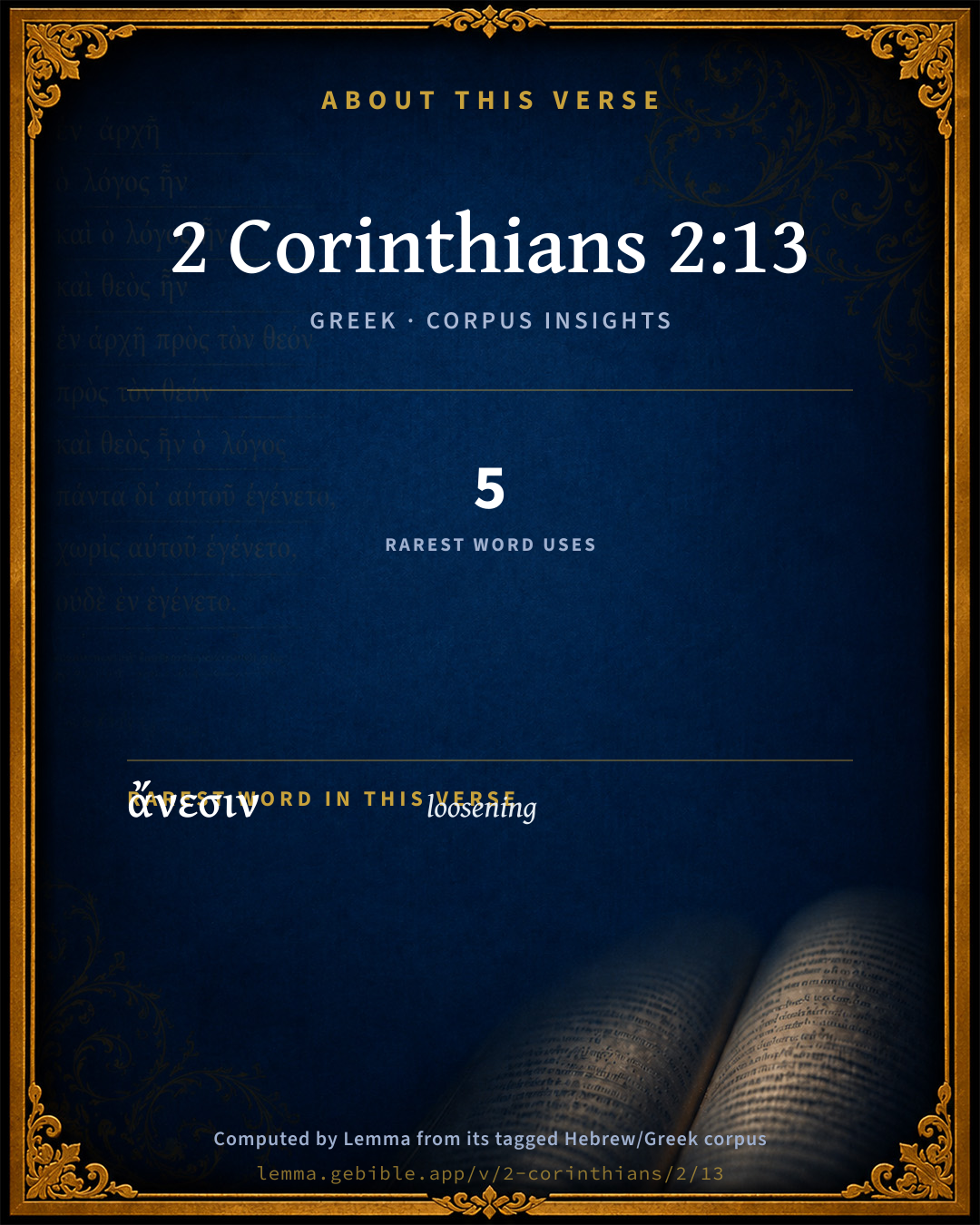
The rarest word here is ἄνεσιν loosening G425 — appearing just 5 times in the whole Greek New Testament.

Shared distinctive vocabulary

ἄνεσιν loosening G425 occurs in 5 verses of the Greek New Testament. Also found in:

Repetition

Words recur within this verse:

Cross-references

11

Topical passages linked to 2 Corinthians 2:13 in the Treasury of Scripture Knowledge — connected by theme and wording, ordered by reader-vote popularity; previews shown in the World English Bible.

  • 2 Corinthians 7:5–6 For even when we had come into Macedonia, our flesh had no relief, but we were afflicted on every side. Fightings were outside. Fear was inside.
  • 2 Corinthians 12:18 I exhorted Titus, and I sent the brother with him. Did Titus take any advantage of you? Didn't we walk in the same spirit? Didn't we walk in the same steps?
  • 2 Corinthians 8:6 So we urged Titus, that as he made a beginning before, so he would also complete in you this grace.
  • 2 Corinthians 8:16 But thanks be to God, who puts the same earnest care for you into the heart of Titus.
  • 2 Corinthians 8:23 As for Titus, he is my partner and fellow worker for you. As for our brothers, they are the apostles of the assemblies, the glory of Christ.
  • Galatians 2:1 Then after a period of fourteen years I went up again to Jerusalem with Barnabas, taking Titus also with me.
  • Galatians 2:3 But not even Titus, who was with me, being a Greek, was compelled to be circumcised.
  • 2 Timothy 4:10 for Demas left me, having loved this present world, and went to Thessalonica; Crescens to Galatia, and Titus to Dalmatia.
  • Titus 1:4 to Titus, my true child according to a common faith: Grace, mercy, and peace from God the Father and the Lord Jesus Christ our Savior.
  • Acts 20:1–2 After the uproar had ceased, Paul sent for the disciples, took leave of them, and departed to go into Macedonia.
  • 2 Corinthians 7:13 Therefore we have been comforted. In our comfort we rejoiced the more exceedingly for the joy of Titus, because his spirit has been refreshed by you all.

Cross-references courtesy of OpenBible.info (CC BY 4.0).

Commentary

Notes on 2 Corinthians 2:13 from classic Christian and Jewish commentators (each source and its license shown beneath its notes). The classic Christian expositions comment on the surrounding passage and are grouped to its opening verse, so a note may address several verses; the Jewish commentaries on the Tanakh (Rashi and others) are per-verse, so they appear only where the commentator wrote on this verse.

Lemma curates 59 commentaries, every one of them public domain or Creative Commons licensed, each selected and text-cleaned for this edition rather than reprinted as found. About our sources →

Bengel's Gnomon

Johann Albrecht Bengel

2Co 2:13. Εἰς Μακεδονίαν, to Macedonia) where I would be nearer and might be sooner informed [what was the fruit of my former epistle to you.—V. g.]—These topics are continued at 2Co 7:2; 2Co 7:5: and a most noble digression is here introduced in respect to events, which had in the meantime occurred and sufferings which had been endured by him elsewhere: the benefit of which he makes to flow even towards the Corinthians, whilst he hereby prepares the way for a defence against the false apostles.

Bengel's Gnomon of the New Testament — English translation (T&T Clark, Edinburgh, 1860) — public domain. Text from a community e-Sword module.

Expositor's Greek Testament

ed. W. Robertson Nicoll

2Co 2:13 . οὐκ ἔσχηκα ἄνεσιν τῷ πν .: I had no relief for my spirit . So he says again (2Co 7:5 ) ἐλθόντων ἡμῶν εἰς Μακεδονίαν οὐδεμίαν ἔσχηκεν ἄνεσιν ἡ σὰρξ ἡμῶν . We are not to lay much stress on πνεῦμα being used here and σάρξ there (yet cf. chap. 2Co 7:1 ); σάρξ in the later passage is used of the whole mortal nature of man, which is subject to distress and disappointment; and πνεῦμα here is a general term for the “mind” ( cf. Rom 1:9 ; Rom 8:6 ; Rom 12:11 , 1Co 2:11 ; 1Co 5:3 ; 1Co 14:14 , chap. 2Co 7:1 ; 2Co 7:13 , etc., for St. Paul’s use of πνεῦμα for the human spirit, and see on 2Co 3:6 below). For the tense of ἔσχηκα , see on 2Co 1:9 . τῷ μὴ εὑρεῖν κ . τ . λ .: because I found not Titus my brother: but taking my leave of them ( sc. , the disciples at Troas) I went forth into Macedonia . ἐξέρχεσθαι is the word used in Act 16:10 ; Act 20:1 of “going out” of Asia to Macedonia; cf. 2Co 8:17 .

The Expositor's Greek Testament, edited by W. Robertson Nicoll (1897–1910) — public domain. Text from a community e-Sword module.

Jamieson, Fausset & Brown

Robert Jamieson, A. R. Fausset & David Brown

no rest in my spirit--rather, "no rest for my spirit" (Gen 8:9). As here his "spirit" had no rest; so in Co2 7:5, his "flesh." His "spirit" under the Holy Spirit, hence, concluded that it was not necessary to avail himself of the "door" of usefulness at Troas any longer.

taking . . . leave of them--the disciples at Troas.

Jamieson, Fausset & Brown — Commentary Critical and Explanatory on the Whole Bible (1871) — public domain (CC PDM 1.0). Text via the HelloAO Bible API.

Adam Clarke's Commentary

Verse 13. I had no rest in my spirit] I was so concerned for you, through the love I bear you, that I was greatly distressed because I did not find Titus returned to give me an account of your state.

But taking my leave of them] I went thence into Macedonia, expecting to find him there; and thither he did come; and gave me a joyous account of your state. See 2Co 8:6; 2Co 8:7.

Adam Clarke's Commentary on the Bible (1810–1826) — public domain. Text from a community e-Sword/MySword module.

Ellicott's Commentary for English Readers

(13) I had no rest in my spirit.—Instead of coming himself straight from Ephesus, as he had at first intended, and had intimated probably in the lost letter of 1Co_5:9, or by Timotheus (1Co_4:17), or pressing on through Macedonia, as he purposed when he wrote the First Epistle (1Co_16:5), he had sent on Titus (himself possibly connected with Corinth: see Note on Act_18:7) to ascertain what had been the effects of that Epistle on the Corinthian Church. Titus was to return to him at Troas. Not meeting him there, St. Paul, in his eager anxiety to hear something more than Timotheus had been able to tell him, left Troas, in spite of the opening which it presented for his work as a preacher of the gospel, and hastened on into Macedonia. Taking the route that he had taken before, he would probably go to Philippi, where he would find St. Luke; and we may conjecture, without much risk of error, that it was there that he and Titus met.

A Bible Commentary for English Readers, edited by Charles John Ellicott (1878–1897) — public domain. Text from a community e-Sword module.

The Cambridge Bible for Schools and Colleges

gen. ed. J. J. S. Perowne

13. I had no rest in my spirit] i.e. the higher and nobler part of his being, superior to the soul. Cf. 1Co_2:14-15 and notes. Also 1Co_15:44-46.

because I found not Titus my brother] Titus (see ch. 2Co_8:6, 2Co_12:18) had been sent by the Apostle to superintend the ‘collection for the saints’ at Corinth (1Co_16:1). He was most probably the bearer of the former Epistle, and was anxiously expected by the Apostle (ch. 2Co_7:6) to bring information regarding the effect it had had upon the Corinthian Church. Though Titus is not mentioned in the Acts of the Apostles, he possessed in a high degree the confidence of the Apostle (ch. 2Co_8:16), as is shewn by his taking the chief place—he seems even to have held a position of greater prominence than ‘the brother whose praise is in the Gospel throughout all the Churches’ (ch. 2Co_8:18)—in this important mission. Before this, he, as a Gentile, had been the subject of some discussion between St Paul and the Judaizing party at Jerusalem. The latter maintained that Titus ought to be circumcised, the former that he ought not; but St Paul carried his point. His character seems to have been one of deep earnestness and zeal (ch. 2Co_7:13; 2Co_7:15, 2Co_8:16-17) calculated to win the confidence of the great Apostle. He was afterwards placed in charge of the church in Crete, and in this capacity received from St Paul a letter of instruction known as the Epistle to Titus. The last mention of him in point of date is in 2Ti_4:10, when he is said to have ‘departed to Dalmatia,’ doubtless on a mission. For the Apostle’s feelings on this occasion (ch. 2Co_7:5-13) compare a similar anxiety displayed at an earlier period of his Apostolic career in 1Th_3:2; 1Th_3:5-9.

I went from thence into Macedonia] Cf. Act_20:1.

The Cambridge Bible for Schools and Colleges (gen. ed. J. J. S. Perowne; Cambridge University Press, 1878–1918) — public domain. Text from a community e-Sword module.

John Gill's Exposition

I had no rest in my spirit,.... Though there was such a door opened to preach the Gospel, and such an opportunity of doing good, yet he was greatly distressed in his mind; very restless and uneasy in his spirit, and could not be satisfied to stay; which shows, that though he was so great a man, he was but a man, and of like passions with others: and the occasion of this dissatisfaction and uneasiness was,

because, says he,

I found not Titus my brother; whom he so styles, not merely because he was a fellow Christian, but because he was a fellow labourer in the Gospel; and by calling him so, puts an honour upon him, and expresses his affliction for him: now not finding him as he expected, he grew uneasy: not that he wanted him as an interpreter for him, or his assistance in preaching the Gospel at Troas, where so many were inclined to hear the word; but because he was exceedingly desirous of knowing from him the state of affairs in the church at Corinth; so that this whole account is given, to show his affectionate concern for, and care of that church: which he goes on with, saying,

but taking my leave of them; the disciples at Troas, and ordering and prescribing, as the word here used signifies, how things should be managed for the best after his departure; for as there was a door opened for the ministry of the word, it cannot be thought he would leave it thus, without fixing proper persons to go on with the work, and proper directions how to conduct themselves; and very likely he ordained Carpus to be their elder, bishop, or overseer: and having done this, he

went into Macedonia; in quest of Titus, whom he so earnestly desired to see, and by whose coming to him he was greatly refreshed and comforted; see Co2 7:5.

John Gill's Exposition of the Whole Bible (1746–1763) — public domain (CC PDM 1.0). Text via the HelloAO Bible API.

Trapp's Complete Commentary

John Trapp

13 I had no rest in my spirit, because I found not Titus my brother: but taking my leave of them, I went from thence into Macedonia.

Ver. 13. I had no rest, &c.] Gr. ανεσιν, no relaxation, viz. from my former cares and anxieties about you, because he was not yet returned to tell me how it was with you, 2Co 7:6. God’s comforts are either rational, fetched from grounds which faith ministereth; or real, from the presence of comfortable persons or things.

John Trapp, A Commentary or Exposition upon All the Books of the Old and New Testament (1647–1656) — public domain. Text from a community e-Sword module.

Albert Barnes' Notes on the Bible

I had no rest in my spirit - I was disappointed, sad, deeply anxious. Though the work in which I was engaged was that which usually gives me my highest joy, yet such was my anxiety to learn the state of things in Corinth, and the success of my letter, and to see Titus, whom I was expecting, that I had comparatively no peace, and no comfort.

But taking my leave of them - Though so many considerations urged me to stay; though there was such a promising field of labor, yet such was my anxiety to hear from you, that I left them.

I went from thence into Macedonia - see the note, Act 16:9. I went over where I expected to find Titus, and to learn the state of your affairs. This is one of the few instances in which Paul left an inviting field of labor, and where there was a prospect of signal success, to go to another place. It is adduced here to show the deep interest which he had in the church at Corinth, and his anxiety to learn what was their condition. It shows that there may be cases where it is proper for ministers to leave a field of great and inviting usefulness, to go to another field and to engage in another part of the great vineyard.

Albert Barnes' Notes on the Bible (1834–1885) — public domain. Text from a community e-Sword/MySword module.

Matthew Poole's English Annotations

He tells us, that when he came there, he was much troubled because he did not find his brother Titus; where the humility of this great apostle is considerable, in that he disdained not to call

Titus (a person, though a minister, yet much inferior to him as an apostle) brother. Several reasons are given of Paul’s trouble. That which is most probable is, that he did expect at Troas to have met with Titus come from Corinth, from whom he might more perfectly have understood the affairs of that church: not finding him there, he tells us he went forward into Macedonia; whither, after the uproar at Ephesus, he designed to go, (as we read, Act 20:1), but went first into Greece, and stayed there three months, intending to come to Macedonia in his return, 2Co 2:3.

Matthew Poole's English Annotations on the Holy Bible (1683–1685) — public domain. Text from a community e-Sword/MySword module.

Whedon's Commentary on the Bible

Daniel D. Whedon

13. No rest—Worn by the excitement of the riot at Ephesus, anxious for Titus and Corinth, Paul was for several weeks incapacitated for seizing the prize of evangelizing Troas. See on 2Co_1:8. Compare this visit with those narrated by Luke in Act_16:8-11, and in Act_20:5-12, with our notes.

Into Macedonia—Hoping, doubtless, that as Titus might have come by the land route, he might meet his brother there. Titus, then, arrived in time, and his report was on the whole such that Paul returns to the Corinthians the following joyful paragraph.

Daniel D. Whedon (gen. ed.), Commentary on the Old and New Testaments (1874–1909) — public domain. Text from a community e-Sword module.

The Pulpit Commentary

I had; literally, I have had. The perfect vividly realizes the scene through which he had passed. I had no rest. St. Paul had evidently told Titus to come from his mission to Corinth and meet him at Troas. But either St. Paul reached the town earlier than he intended, or Titus had been delayed. Now, the apostle was so intensely eager to know how his rebukes had been received the name of "Corinth" was so deeply engraven on his heart he could so ill endure the thought of being on angry terms with converts which he so deeply loved, that the non-appearance of Titus filled him with devouring anxiety and rendered him incapable of any other work. In my spirit; rather, to my spirit. It was the loftiest part of St. Paul"s nature his spirit which was utterly incapacitated from effort by the restlessness of his miserable uncertainty about the Corinthian Church. The disclosure of such feelings ought to have had a powerful influence on the Corinthians. We see from 1Th_3:5, 9 that St. Paul yearned for tidings of his converts with an intensity which can hardly be realized by less fervent and self-devoted natures. I found not Titus my brother. Not only the brother," but my brother;" the man whom in matters of this kind I most trusted as an affectionate and able fellow worker. (2Co_7:6 2Co_8:6 2Co_12:18) Titus, though not mentioned in the Acts, is the most prominent person in this Epistle, and it is evident that St. Paul felt for him a warm affection and respect (2Co_7:13, 15 8:16, 17; 2Ti_4:10) Taking my leave of them; i.e. of the Christians in Troas. The word for "taking leave" is also found in Mar_6:46. Into Macedonia. As he had intended to do (1Co_16:5; Act_20:1) He had doubtless told Titus to look out for him at Philippi, and expected to meet him there on his way to Troas.

The Pulpit Commentary (1880–1919), ed. H.D.M. Spence-Jones & Joseph S. Exell — public domain. Text from a community e-Sword module.

John Wesley's Explanatory Notes

I had no rest in my spirit - From an earnest desire to know how my letter had been received. Because I did not find Titus - In his return from you. So I went forth into Macedonia - Where being much nearer, I might more easily be informed concerning you. The apostle resumes the thread of his discourse, chap. vii, 2, interposing an admirable digression concerning what he had done and suffered elsewhere, the profit of which he by this means derives to the Corinthians also; and as a prelude to his apology against the false apostles.

John Wesley, Explanatory Notes Upon the Whole Bible (1754–1765) — public domain. Text via the GEBible commentary corpus.

McGarvey & Pendleton's Commentaries

J. W. McGarvey

I had no relief for my spirit [worrying about you], because I found not Titus my brother [who had agreed to bring me word about you, and meet me at Troas]: but taking my leave of them [the brethren at Troas], I went forth into Macedonia . [hoping to meet Titus there. For fuller details of Paul's movements and intentions see the Introduction. The relief which came to him in Macedonia when he met Titus causes him at this point to break forth into an expression of thanksgiving. But as it does not at this time suit his purpose to give a detailed statement of his reason for thankfulness, he curbs his rising emotion and directs his thought in another channel.]

J. W. McGarvey (with Philip Y. Pendleton), Commentaries on the New Testament (The Fourfold Gospel, 1914; Acts; and the epistles) — public domain. Text from a community e-Sword/MySword module.

The People's New Testament

B. W. Johnson

13. I had no rest in spirit. Because he had expected to meet Titus there and to get news concerning the state of affairs at Corinth. Hence he went on soon, hoping to meet him on the way to Macedonia.

B. W. Johnson's The People's New Testament with Notes (1889–1891) — public domain. Electronic text from the Christian Classics Ethereal Library (CCEL) ThML edition.

Cambridge Greek Testament for Schools and Colleges

13. οὐκ ἔσχηκα ἄνεσιν τῷ πνεύματί μου. Literally, I have not got relief for my spirit. As in 2Co 1:9, the perfect shows how vividly he recalls the feelings of that trying time. No one English word will represent ἄνεσις in all the places where it occurs; 2Co 7:5, 2Co 8:13; 2Th 1:7 Act 24:23. Relaxation after tension, or after close confinement, is the main idea; and τῶ̣ πν. μου is dat. comm.

τῷ μὴ εὑρεῖν με. Because I found not: dative of cause. Winer, 413. D reads ἑν τῶ̣ μή. Apparently they had agreed to meet in Troas; and there the “sense of loneliness” (Lightfoot on 1Co 2:3) and anxiety about Corinth overwhelmed S. Paul. By τὸυ ἀδελφόν μου he probably means ‘my beloved fellow-worker,’ not merely ‘my fellow-Christian.’ Theodoret suggests that his having no fellow-worker was one main reason for going. He felt that he could do nothing single-handed, συνεργὸν τῆς ἐπιμελείας οὐκ ἔχων.

ἀποταξάμενος αὐτοῖς. The disciples in Troas no doubt begged him to remain and use the ‘opened door.’ But the distracting anxiety about the effect of his severe letter prevented all satisfactory work, and therefore he ‘set himself apart from them,’ bade them farewell, and went forth to M. In N.T. ἀποτάσσω occurs only in the middle; Act 18:18; Act 18:21; Luk 9:61; Luk 14:33; Mar 6:46. The more classical phrase would be ἀσπάζεσθαί τινα. In ecclesiastical Greek ἀπόταξις, ἀποταξία, ἀποταγή, are used of renunciation of the world; see Suicer, ἀποτάσσομαι. As in Act 16:10; Act 20:1, ἐξῆλθον is used of leaving Asia for Europe; but it need mean no more than exit from the place. The crisis at Corinth was more urgent than the opportunity in Troas. Delay might be disastrous: so he goes.

Cambridge Greek Testament for Schools and Colleges (Cambridge University Press, 1896; 21 vols, various authors incl. Carr, Maclear, Plummer, Farrar, Lumby, Moule, M. R. James, Simcox) — public domain. Text from a community e-Sword module.

Alford’s Greek Testament

Henry Alford

13. ἔσχηκα ἄνεσιν] perf. in the sense of aorist, as ch. 1:9. I had not rest for my spirit (not, ‘in my spirit:’ compare οὐχ εὑροῦσα ἡ περιστερὰ ἀνάπαυσιν τοῖς ποσὶν αὐτῆς, Gen 8:9). He could not with any tranquillity prosecute the spiritual duties opened to him at Troas.

τῷ μὴ εὑρ.] by (reason of) my not finding: see reff.

Paul had sent Titus to Corinth, ch. 12:18, partly to finish the collection for the saints, but principally to bring intelligence respecting the effect of the first Epistle. Probably it had been fixed that they should meet at Troas.

τ. ἀδελ. μου implies a relation closer than merely that of Christian brotherhood—my colleague in the Apostleship.

αὐτοῖς] the disciples there: understood from the context.

Henry Alford, The Greek Testament (1849–1861) — public domain. Text from a community e-Sword module.

International Critical Commentary

13. οὐκ ἔσχηκα ἄνεσιν τῷ πνεύματί μου. ‘I had no relief for my spirit.’ He uses the same expression in 8:5, οὐδεμίαν ἔσχηκεν ἄνεσιν ἡ σὰρξ ἡμῶν, where the change from πνεῦμα to σάρξ has no special significance: it is the seat of human emotion and sensation that is meant in each case. We talk of ‘weariness of the spirit’ and ‘weariness of the flesh,’ without much change of meaning. We may explain the perf. as vividly recalling the moment when the Apostle had this experience and could say ‘I have not got relief’; but more probably this is another instance of the aoristic use of the perf. See on 1:9.

Like νόημα, ἄνεσις is specially freq. in this letter (7:5, 8:13) and occurs elsewhere in N.T. only in 2Th 1:7; Act 24:23. Vulg. usually renders it requies, but ‘relaxation’ in the sense of loosening some kind of tension or restriction is its meaning rather than ‘rest.’ Being set free from θλίψις is the main idea in this letter, as in 2 Thess. In Ecclus. 15:20, 26:10, it means freeing from wholesome restraint, licence. So also in the Epistle of Barnabas 4:2; μὴ δῶμεν τῇ ἑαυτῶν ψυχῇ ἄνεσιν ὥστε ἔχειν αὐτὴν ἐξουσίαν μετὰ ἁμαρτωλῶν καὶ πονηρῶν συντρέχειν. With the dat. ‘for my spirit,’ comp. οὐχ εὑροῦσα ἡ περιστερὰ ἀνάπαυσιν τοῖς ποσὶν αὐτῆς (Gen 8:9).

τῷ μὴ εὑρεῖν με Τίτον τὸν ἀδελφόν μου. ‘Because I found not Titus my brother.’ For some reason, he fully expected to find Titus there, and his failing to do so seems to have robbed him of the power of work; his anxiety about Corinth was so great. Chrys. thinks that St Paul may have wished to remain at Troas, but that God required him to go on. St Paul tells us that he could not endure remaining at Troas; he was so miserable there. There is no hint of any other reason. Thdrt. thinks that the Apostle felt that he must have a colleague; that a missionary working alone was wasted. What is intimated here is quite an intelligible reason. The Apostle was very human; he was so anxious about the effect of his severe letter, that he decided to shorten the time of torturing suspense by going where he could meet Titus the sooner. Moreover, he may have reasonably thought that the rescue of the Corinthian converts from disaster was more important than making new converts at Troas. We know little of Titus, except what can be gathered from 2 Cor. and Gal. St Paul evidently had the highest opinion of him. Here he calls him ‘my brother,’ and in 8:23, ‘my comrade and fellow-worker in your interest’; in 12:18 he mentions him as one who was utterly incapable of being mean or grasping. Ἕλλην ὤν, Titus is the first missionary of purely ‘Greek’ and pagan origin that is known to us (Gal 2:3). But in N.T. Ἕλλην means no more than ‘Gentile,’ and we cannot be sure of the nationality of Titus. Nevertheless, his acceptability among the Corinthians, and his success in the delicate mission which St Paul entrusted to him, are evidence of his being by race a Greek. K. Lake, Earlier Epp. pp. 146 f., 275 f. Titus is mentioned nine times in 2 Cor. and is highly praised. In 1 Cor. he is not mentioned at all. The reason may be that he was the bearer of 1 Cor. Ramsay, Paul the Traveller, p. 284.

There is no parallel in N.T. to the causal dat. τῷ μὴ εὑρεῖν, ‘by reason of my not finding’; in 1Th 3:3 the true reading is τὸ μηδένα σαίνεσθαι, not τῷ. But examples are found elsewhere; τῷ μὴ καὶ ταῦτα πανταχοῦ μηδʼ ἐν τοῖς δημοσίοις ἀποκεῖσθαι τόποις (Jos. Ant. xiv. x. 1). Moulton quotes from papyri, ἄλλως δὲ τῷ μηθένʼ ἔχειν πλὴν τοῦ Πτολεμαίον. See Winer, p. 413 for other references.

ἀποταξάμενος αὐτοῖς. The same words occur Mar 6:46, the only place in N.T. in which the verb occurs outside the writings of Paul and Luke, and where αὐτοῖς is as indefinite as here. In N.T. the mid. only is found, and its meaning is ‘to bid farewell to friends,’ in Mk. probably to the disciples, here obviously to the converts at Troas; cf. Luk 9:61, Luk 9:14:33; Act 18:18, Act 18:21. The word suggests that he left them with reluctance. In Josephus it is used of Esther’s fasting, τροφῇ καὶ ποτῷ καὶ ἡδέσιν ἀποτοξαμένη (Ant. xi. vi. 8). Hence it comes to mean ‘to renounce,’ as in the baptismal formula, ἀποτάσσομαι τῷ Σατανᾷ καὶ συντάσσομαι Χριστῷ ἀποτάσσομαί σοι, Σατανᾶ, καὶ τοῖς ἔργοις σου. Suicer gives many references. Vulg. has vale facere here and in Acts, but in Lk. renunciare. See Index IV.

ἐξῆλθον εἰς Μακεδονίαν. In Act 16:10, Act 20:1 we have ἐξελθεῖν εἰς τὴν Μακ., and in each case it is needless to ask whether ἐξελθεῖν refers to leaving the town or leaving the province. Both Asia and Macedonia were Roman provinces. See Index IV.

In these two graphic verses (12, 13), St Paul once more shows the Corinthians how erroneous it was to suppose that his not visiting them at the time proposed was due to levity or any want of care for them. For their sakes he abandoned a very promising field of missionary enterprise. He is so overwhelmed with thankfulness at the thought of the ultimate result, that, without going on with his narrative, he bursts out into a hymn of praise. We can imagine the surprise of his amanuensis, as the Apostle suddenly changed his line of thought and began to dictate the next four verses. See 7:5 f. for the narrative.

It is difficult to believe that the man who had just been freed from an agony of anxiety as to the effect of a severe letter to the Corinthians should forthwith write the severe reproaches and sarcasms contained in 10-13:10, and should send them to the Corinthians in the same letter in which he tells them of this agony of anxiety.

For τῷ μή (א3 A B C * G K) L P have τὸ μή and א* C2 have τοῦ μή, both of which may safely be disregarded, while D E 17 have ἐν τῷ μή, which Blass is inclined to adopt. Schmiedel rightly rejects the conjectures that vv. 12, 13 originally came after 1:22, or were written by Paul as a marginal note to 1:16. The conjectures are quite unnecessary.

International Critical Commentary — older volumes (1896–1929), various authors — public domain. Text from a community e-Sword module.

Vincent's Word Studies in the New Testament

Marvin R. Vincent

Rest [ανεσιν] . Rev., relief. See on liberty, Act 24:23.

Taking my leave [αποταξαμενος] . The verb means, primarily, to set apart or separate; hence to separate one's self, withdraw, and so to take leave of. The A. V. gives this sense in every case, except Mr 6:46, where it wrongly renders sent away. See Luk 9:61; Act 18:18, 21. Ignatins, ajpotaxamenov tw biw having bid farewell to the life, that is, this lower life (Epistle to Philadelphia, 11.).

Marvin R. Vincent, Word Studies in the New Testament (1887–1900) — public domain. Text from a community e-Sword/MySword module.

Lesson kit

Teaching starters — assembled from the data on this page, not authored interpretation. Every prompt links to the verse data it draws on. Edit before teaching.

2 Corinthians, in the Pauline Epistles, opens this verse with 20 words (16 distinct Greek lemmas). Its most distinctive word is ánesis (“loosening”). A historical commentator’s framing appears above. Read the whole chapter for the surrounding context.

Discussion questions

  1. What does “loosening” (ánesis) contribute to the verse as a whole?
  2. Acts 24:23 shares the word «loosening» with this verse. How do the two illuminate each other?
  3. “the” occurs 3× in this one verse. What is the effect of the repetition?
  4. These translations render this verse differently; the difference is in the English rendering, not the original. What questions does that raise?
  5. Reading how Bengel's Gnomon and Expositor's Greek Testament read this verse, where do the two commentators agree and where do they part?

Things to notice

Reading settings

Reading text

Shown beneath each verse's original-language words.

Old Testament
Old Testament edition

Read the OT as the Masoretic Hebrew (MT) or the Greek Septuagint (LXX).

English shown for the Greek Septuagint (in the Hebrew ↔ Greek comparison).

Comparing translations? Open the Compare panel on any verse page to stack up to four side by side.