
Judges 5:30

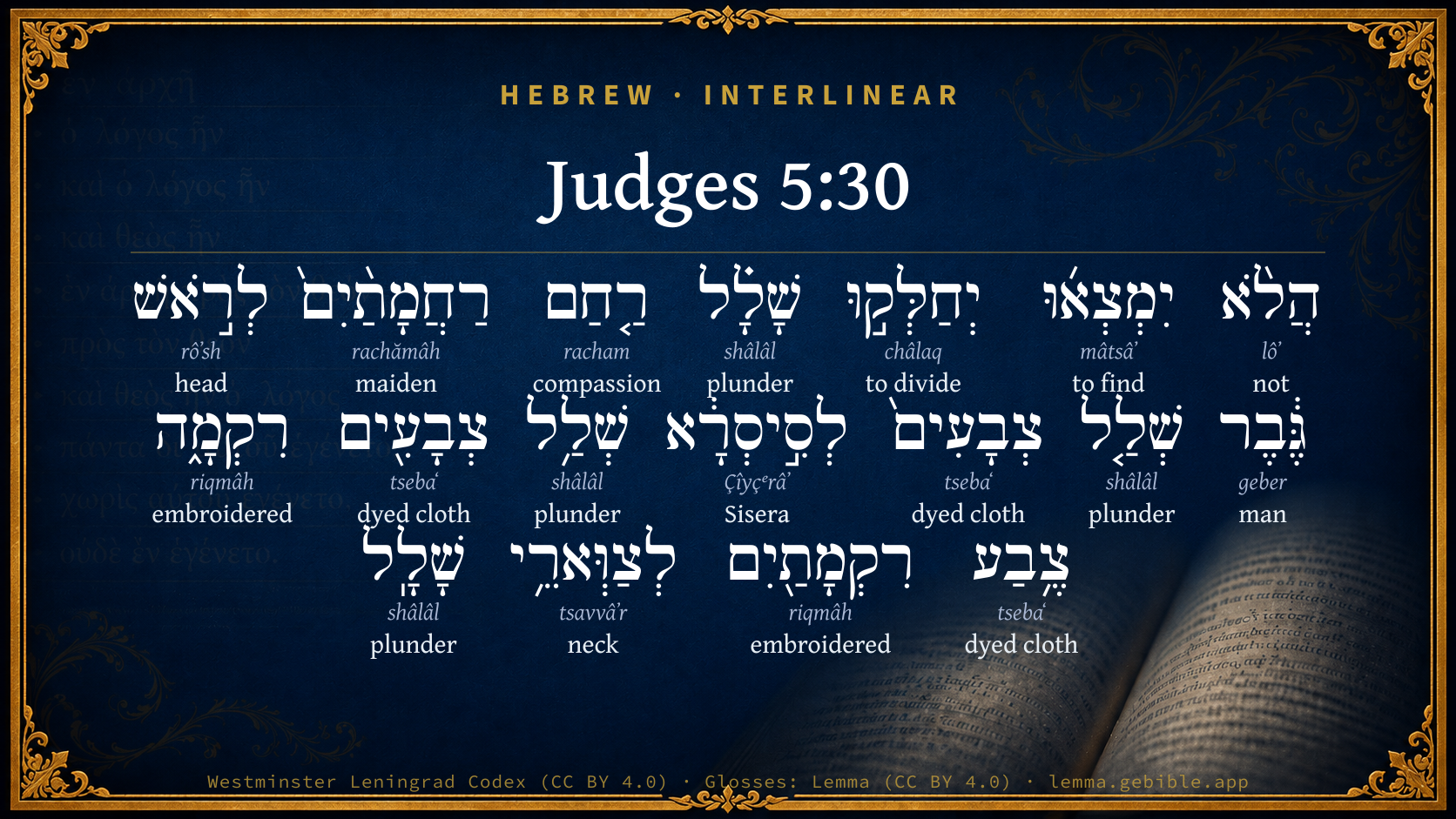
Hebrew (Westminster Leningrad Codex) Judges 5:30 appears in the Hebrew Old Testament. The text above is from the Westminster Leningrad Codex. Each word links to its Strong’s number, a concise gloss, and parsing drawn from the Open Scriptures Hebrew Bible morphology. Click any word for its full Brown-Driver-Briggs (BDB) entry.
Download image
Cite this verse

Judges 5:30 (World English Bible). Public Domain. Lemma interlinear Bible study tool, https://lemma.gebible.app/v/judges/5/30.

Show BibTeX & RIS
BibTeX
RIS
English Translation
Have they not found, have they not divided the spoil? A lady, two ladies to every man; To Sisera a spoil of dyed garments, A spoil of dyed garments embroidered, Of dyed garments embroidered on both sides, on the necks of the spoil?
World English Bible · Public Domain
Highlights
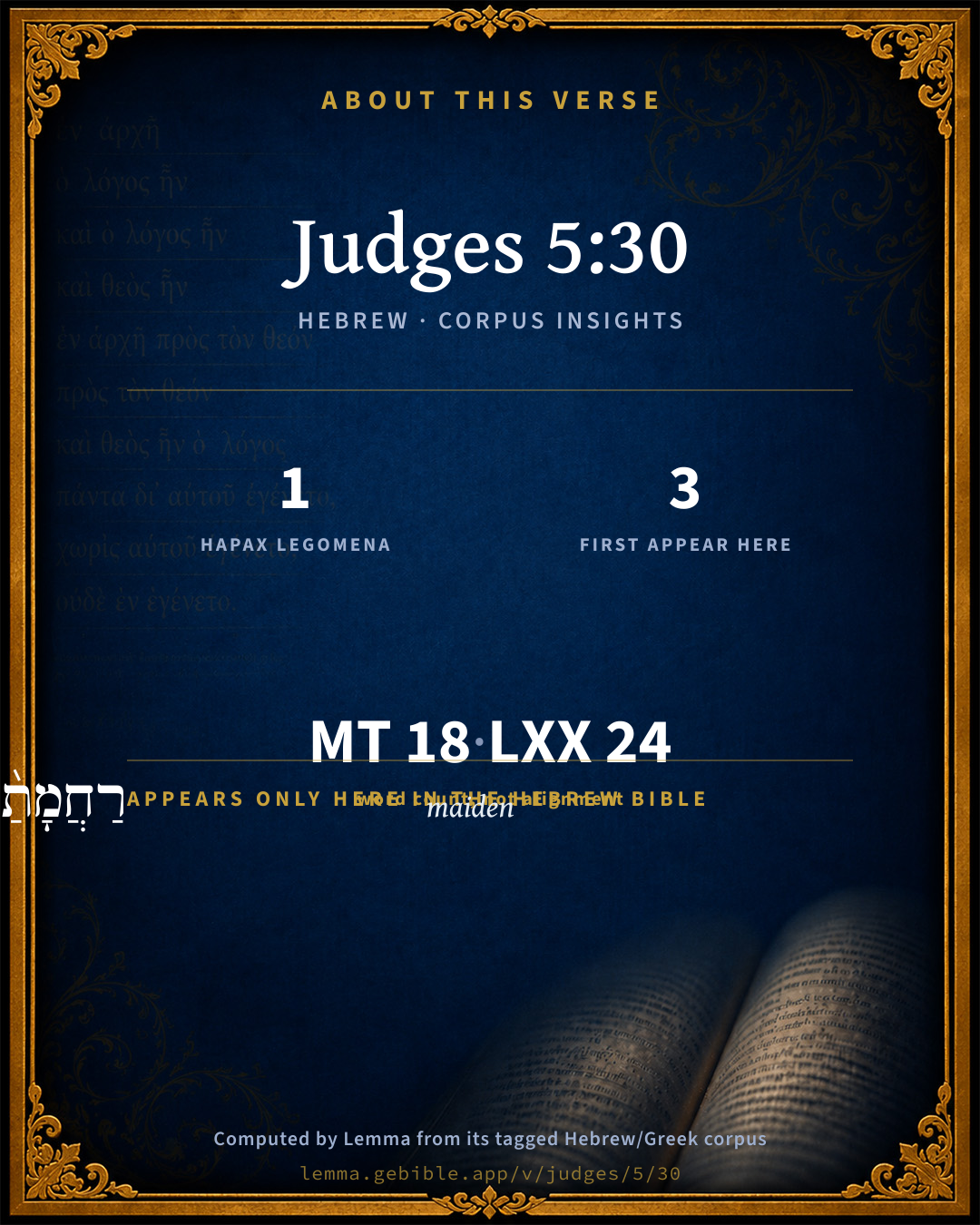
  • 1 hapax legomenon — only here in the Hebrew Bible
  • 3 first appearances in the Hebrew Bible
Full analysis ↓
Download a study sheet

One document with this verse’s original text, its word-by-word gloss line, the meaning frame, cross-references with their text, attributed commentary, and full source and license credits — printable, and it pastes into notes with its structure intact.

This verse Autodidact and up

Study sheet (.html) Plain text (.txt)

A passage Seminary Student

Up to 50 verses in one chapter. A passage sheet keeps up to 6 commentary sources and 12 cross-references per verse, in the order this page ranks them, and says so on the sheet whenever that leaves anything out. Ask for a single verse and you get the Autodidact verse sheet above.

Everything on this page stays free to read, with no account — the sheet is a download of what is already on screen, not access to it.

Want to remove ads? Support Godless Engineer
Compare translations 3

The same verse in 3 English versions, stacked beneath the original-language interlinear above. Click any original word for its lexicon entry.

Each is an independent rendering of the whole verse — the interlinear is not word-aligned to these translations.

Highlighted words mark where these versions differ — a whole-verse word diff, not a word-by-word alignment.

  • World English Bible Public Domain
    Have they not found, have they not divided the spoil? A lady, two ladies to every man; To Sisera a spoil of dyed garments, A spoil of dyed garments embroidered, Of dyed garments embroidered on both sides, on the necks of the spoil?
  • King James Version Public Domain
    Have they not sped? have they not divided the prey; to every man a damsel or two; to Sisera a prey of divers colors, a prey of divers colors of needlework, of divers colors of needlework on both sides, meet for the necks of them that take the spoil?
  • unfoldingWord Literal Text CC BY-SA 4.0
    ‘Are they not finding, they dividing spoil, a maiden, two maidens to the head of a warrior, spoil of dyed fabrics for Sisera, spoil of dyed fabrics embroidery, dyed fabric two embroideries for the necks of the spoil?’

unfoldingWord Literal Text — © unfoldingWord, licensed CC BY-SA 4.0. Word-aligned USFM3 via Door43 (git.door43.org/unfoldingWord/en_ult).

Versions to compare (up to 4)

3 of 4 selected

Show all 18 translations

Every available English version of this verse, each an independent rendering of the whole verse.

  • World English Bible Public Domain
    Have they not found, have they not divided the spoil? A lady, two ladies to every man; To Sisera a spoil of dyed garments, A spoil of dyed garments embroidered, Of dyed garments embroidered on both sides, on the necks of the spoil?
  • Berean Standard Bible Public Domain
    ‘Are they not finding and dividing the spoil—a girl or two for each warrior, a plunder of dyed garments for Sisera, the spoil of embroidered garments for the neck of the looter?’
  • Majority Standard Bible Public Domain
    ‘Are they not finding and dividing the spoil—a girl or two for each warrior, a plunder of dyed garments for Sisera, the spoil of embroidered garments for the neck of the looter?’
  • King James Version Public Domain
    Have they not sped? have they not divided the prey; to every man a damsel or two; to Sisera a prey of divers colors, a prey of divers colors of needlework, of divers colors of needlework on both sides, meet for the necks of them that take the spoil?
  • American Standard Version (1901) Public Domain
    Have they not found, have they not divided the spoil? A damsel, two damsels to every man; To Sisera a spoil of dyed garments, A spoil of dyed garments embroidered, Of dyed garments embroidered on both sides, on the necks of the spoil?
  • Revised Version (1885) Public Domain
    Have they not found, have they not divided the spoil? a damsel, two damsels to every man; to Sisera a spoil of divers colours, a spoil of divers colours of embroidery, of divers colours of embroidery on both sides, on the necks of the spoil?
  • Geneva Bible (1599) Public Domain
    Haue they not gotten, and they deuide the spoyle? euery man hath a mayde or two. Sisera hath a praye of diuers coloured garmentes, a pray of sundry colours made of needle worke: of diuers colours of needle worke on both sides, for the chiefe of the spoyle.
  • Douay-Rheims (1899) Public Domain
    Perhaps he is now dividing the spoils, and the fairest of the women is chosen out for him: garments of divers colours are given to Sisara for his prey, and furniture of different kinds is heaped together to adorn the necks.
  • Young's Literal Translation Public Domain
    Do they not find? -- they apportion spoil, A female -- two females -- for every head, Spoil of finger-work for Sisera, Spoil of embroidered finger-work, Finger-work -- a pair of embroidered things, For the necks of the spoil!
  • Literal Standard Version CC BY-SA 4.0
    Do they not find? They apportion spoil, || A female—two females—for every head, || Spoil of finger-work for Sisera, || Spoil of embroidered finger-work, || Finger-work—a pair of embroidered things, || For the necks of the spoil!
  • Unlocked Literal Bible CC BY-SA 4.0
    'Have they not found and divided up the plunder? —A womb, two wombs for every man; the plunder of dyed fabric for Sisera, the plunder of dyed fabric embroidered, two pieces of dyed fabric embroidered for the necks of those who plunder?'
  • unfoldingWord Literal Text CC BY-SA 4.0
    ‘Are they not finding, they dividing spoil, a maiden, two maidens to the head of a warrior, spoil of dyed fabrics for Sisera, spoil of dyed fabrics embroidery, dyed fabric two embroideries for the necks of the spoil?’
  • Darby Bible Public Domain
    'Are they not finding and dividing the spoil? --A maiden or two for every man; spoil of dyed stuffs for Sis'era, spoil of dyed stuffs embroidered, two pieces of dyed work embroidered for my neck as spoil?'
  • World Messianic Bible Public Domain
    ‘Have they not found, have they not divided the plunder? A lady, two ladies to every man; to Sisera a plunder of dyed garments, a plunder of dyed garments embroidered, of dyed garments embroidered on both sides, on the necks of the plunder?’
  • Webster's Bible Public Domain
    Have they not found; have they not divided the prey; to every man a damsel or two; to Sisera a prey of divers colors, a prey of divers colors of needle-work, of divers colors of needle-work on both sides, meet for the necks of them that take the spoil?
  • Free Bible Version CC BY-SA 4.0
    ‘They're busy dividing up the plunder and assigning a girl or two for each man. There'll be colorful clothes for Sisera as plunder; beautifully embroidered colorful clothes as plunder; double-embroidered clothing reaching to the neck as plunder.’
  • Bible in Basic English Public Domain
    Are they not getting, are they not parting the goods among them: a young girl or two to every man; and to Sisera robes of coloured needlework, worked in fair colours on this side and on that, for the neck of the queen?
  • JPS Tanakh (1917) Public Domain
    'Are they not finding, are they not dividing the spoil? A damsel, two damsels to every man; to Sisera a spoil of dyed garments, a spoil of dyed garments of embroidery, two dyed garments of broidery for the neck of every spoiler?'

Literal Standard Version (2020), Covenant Press — licensed CC BY-SA 4.0. Text via the HelloAO Bible API (eBible.org). Unlocked Literal Bible (unfoldingWord) — licensed CC BY-SA 4.0. Text via the HelloAO Bible API (eBible.org). unfoldingWord Literal Text — © unfoldingWord, licensed CC BY-SA 4.0. Word-aligned USFM3 via Door43 (git.door43.org/unfoldingWord/en_ult). Free Bible Version, Dr. Jonathan Gallagher — licensed CC BY-SA 4.0. Text via the HelloAO Bible API (eBible.org).

Word by word

More ways to search: Search by grammar → Find every occurrence → Compare this word →

Practice this passage: Drill this verse → Learn its vocabulary →

רַחֲמָתַ֨יִם֙
rachămâh
H7361
“maidens”
Noun, Common, Feminine, Dual, Absolute
Part of Speech
Noun
Type
Common
Gender
Feminine
Number
Dual
State
Absolute
Full BDB Definition

Origin: from H7356

TWOT: 2146a

womb - maiden, girl (by extension)
  1. הֲלֹ֨א lôʼ H3808 “not” Particle, Interrogative + Particle, Negative
  2. יִמְצְא֜וּ mâtsâʼ H4672 “to find” Verb, Qal, Imperfect, 3rd Person, Masculine, Plural
  3. יְחַלְּק֣וּ châlaq H2505 “to divide” Verb, Piel, Imperfect, 3rd Person, Masculine, Plural
  4. שָׁלָ֗ל shâlâl H7998 “plunder” Noun, Common, Masculine, Singular, Absolute
  5. רַ֤חַם racham H7356 “compassion” Noun, Common, Both, Singular, Absolute
  6. לְרֹ֣אשׁ rôʼsh H7218 “to/for · head of” Preposition + Noun, Common, Masculine, Singular, Construct
  7. גֶּ֔בֶר geber H1397 “man” Noun, Common, Masculine, Singular, Absolute
  8. שְׁלַ֤ל shâlâl H7998 “plunder of” Noun, Common, Masculine, Singular, Construct
  9. צְבָעִים֙ tsebaʻ H6648 “dyed cloths” Noun, Common, Masculine, Plural, Absolute
  10. לְסִ֣יסְרָ֔א Çîyçᵉrâʼ H5516 “to/for · Sisera” Preposition + Noun, Proper
  11. שְׁלַ֥ל shâlâl H7998 “plunder of” Noun, Common, Masculine, Singular, Construct
  12. צְבָעִ֖ים tsebaʻ H6648 “dyed cloths” Noun, Common, Masculine, Plural, Absolute
  13. רִקְמָ֑ה riqmâh H7553 “embroidered” Noun, Common, Feminine, Singular, Absolute
  14. צֶ֥בַע tsebaʻ H6648 “dyed cloth of” Noun, Common, Masculine, Singular, Construct
  15. רִקְמָתַ֖יִם riqmâh H7553 “embroidered garments” Noun, Common, Feminine, Dual, Absolute
  16. לְצַוְּארֵ֥י tsavvâʼr H6677 “to/for · necks of” Preposition + Noun, Common, Masculine, Plural, Construct
  17. שָׁלָֽל shâlâl H7998 “plunder” Noun, Common, Masculine, Singular, Absolute

About this verse

These counts appear in no published source. They are computed here, from the morphology-tagged text and Lemma’s own curated glosses. What Lemma adds →

18
words
12
distinct lemmas
Historical
section

Notable vocabulary

1 hapax legomenon — a word that appears only here in the entire Hebrew Bible:

  • רַחֲמָתַ֨יִם֙ maiden H7361

First appearance in Scripture

These words make their first canonical appearance in the Hebrew Bible here:

  • רַחֲמָתַ֨יִם֙ maiden H7361
  • צְבָעִים֙ dyed cloth H6648
  • רִקְמָ֑ה embroidered H7553

Grammatical profile

  • 2 verbs
  • 15 nouns
  • 1 particle

Verb forms

  • יִמְצְא֜וּ Qal · Imperfect
  • יְחַלְּק֣וּ Piel · Imperfect

Repetition

Words recur within this verse — often emphatic in Hebrew:

  • שָׁלָ֗ל plunder H7998 ×4
  • צְבָעִים֙ dyed cloth H6648 ×3
  • רִקְמָ֑ה embroidered H7553 ×2

Hebrew & Septuagint length

In English translation the verse runs 43 words from the Hebrew and 39 from the Septuagint (LXX English) — closely comparable.

A rough comparison of the two English renderings, which tokenize alike — not a word-level alignment.

Word counts can differ between the Hebrew and the Greek without any difference in meaning — e.g. the Hebrew direct-object marker אֵת has no separate Greek word, and Greek often adds the article ὁ.

In the original languages it is 18 Hebrew tokens and 24 Greek tokens — but the two are counted differently (Hebrew bundles its prefixes and suffixes into one token; the Greek is in lemma form), so that isn’t a like-for-like length.

Cross-references

5

Topical passages linked to Judges 5:30 in the Treasury of Scripture Knowledge — connected by theme and wording, ordered by reader-vote popularity; previews shown in the World English Bible.

  • Exodus 15:9 The enemy said, 'I will pursue, I will overtake, I will divide the spoil. My desire shall be satisfied on them. I will draw my sword, my hand shall destroy them.'
  • Genesis 37:3 Now Israel loved Joseph more than all his children, because he was the son of his old age, and he made him a coat of many colors.
  • 2 Samuel 13:18 She had a garment of various colors on her; for with such robes were the king's daughters who were virgins dressed. Then his servant brought her out, and bolted the door after her.
  • Job 20:5 That the triumphing of the wicked is short, The joy of the godless but for a moment?
  • Psalms 45:14 She shall be led to the king in embroidered work. The virgins, her companions who follow her, shall be brought to you.

Cross-references courtesy of OpenBible.info (CC BY 4.0).

Hebrew and Greek witnesses Masoretic Hebrew ↔ Greek Septuagint

The same verse in the two great witnesses to the Old Testament, shown verse-for-verse.

These are two independent witnesses, not word-aligned to each other, and the Septuagint is shown in lemma (dictionary) form.

Hebrew Judges 5:30 Masoretic · Westminster Leningrad Codex

הֲלֹ֨א יִמְצְא֜וּ יְחַלְּק֣וּ שָׁלָ֗ל רַ֤חַם רַחֲמָתַ֨יִם֙ לְרֹ֣אשׁ גֶּ֔בֶר שְׁלַ֤ל צְבָעִים֙ לְסִ֣יסְרָ֔א שְׁלַ֥ל צְבָעִ֖ים רִקְמָ֑ה צֶ֥בַע רִקְמָתַ֖יִם לְצַוְּארֵ֥י שָׁלָֽל

Have they not found, have they not divided the spoil? A lady, two ladies to every man; To Sisera a spoil of dyed garments, A spoil of dyed garments embroidered, Of dyed garments embroidered on both sides, on the necks of the spoil?

World English Bible · Public Domain

Greek LXX Judges 5:30 Septuagint · lemma form

οὐ εὑρίσκω αὐτός διαμερίζω σκῦλον οἰκτίρμων οἰκτείρω εἰς κεφαλή ἀνήρ σκῦλον βάμμα ὁ σισαρα σκῦλον βάμμα ποικιλία βάμμα ποικιλτής αὐτός ὁ τράχηλος αὐτός σκῦλον

Will they not find him dividing the spoil? he will surely be gracious to every man: there are spoils of dyed garments for Sisara, spoils of various dyed garments, dyed embroidered garments, they are the spoils for his neck.

LXX2012 (modern English Septuagint) · Public Domain

On this verse, Ellicott's Commentary for English Readers discusses the Septuagint’s reading. Read the note in Commentary ↓

Hebrew: Westminster Leningrad Codex (CC BY 4.0). Greek: Septuagint (public domain); English from LXX2012 (modern English Septuagint) (Public Domain). How the Septuagint differs from the Hebrew →

Targum (Aramaic paraphrase)

1

The Targum is the ancient Jewish Aramaic paraphrase of the Hebrew Scriptures — an interpretive translation, not the Hebrew text itself. Onkelos (literal) and Pseudo-Jonathan (expansive) render the Torah, and Jonathan the Prophets. Coverage is partial: where no permissively-licensed English translation exists for a verse, only the Aramaic is shown. This is verse-level text, not a word-by-word alignment to the Hebrew.

  1. Targum Jonathan Prophets (Joshua–Malachi)
    הֲלָא מִדְמַשְׁכְּחִין מְפַלְגִין בִּזְתָא יַהֲבִין גְבַר וּבֵיתֵיהּ כָּל חַד וְחַד בִּזָא סַגִי קֳדָם סִיסְרָא בִּזַת צִיוּרֵי צִבְעוֹנִין עַל צַוְרֵיהּ נִכְסֵי עַתִּירַיָא וּמָנֵי חֲמוּדָא קֳדָם גִבָּרוֹהִי דְבָזוּ:

    (no public-domain English translation for this verse)

    Targum Jonathan — Aramaic: “Mikraot Gedolot” (public domain). English: “Sefaria Community Translation” (CC0 1.0 (public-domain dedication)); “London "Chaldee Paraphrase," 1871” (public domain). Text via Sefaria.

Commentary

Notes on Judges 5:30 from classic Christian and Jewish commentators (each source and its license shown beneath its notes). The classic Christian expositions comment on the surrounding passage and are grouped to its opening verse, so a note may address several verses; the Jewish commentaries on the Tanakh (Rashi and others) are per-verse, so they appear only where the commentator wrote on this verse.

Lemma curates 59 commentaries, every one of them public domain or Creative Commons licensed, each selected and text-cleaned for this edition rather than reprinted as found. About our sources →

Trapp's Complete Commentary

John Trapp

Jdg 5:30 Have they not sped? have they [not] divided the prey; to every man a damsel [or] two; to Sisera a prey of divers colours, a prey of divers colours of needlework, of divers colours of needlework on both sides, [meet] for the necks of [them that take] the spoil?

Ver. 30. Have they not sped?] Yes, they are sped, they have their passport, and your hopes hop headless.

To every man a damsel or two.] The Hebrew word signifieth, vulvam vel uterum; so they call the Israelitish damsels by way of contempt, as Lavater observeth.

John Trapp, A Commentary or Exposition upon All the Books of the Old and New Testament (1647–1656) — public domain. Text from a community e-Sword module.

Geneva Bible (1599)

Geneva Bible translators

Because he was chief of the army.

Geneva Bible (1599) marginal notes — public domain. Text via Bolls.life.

Jamieson, Fausset & Brown

Robert Jamieson, A. R. Fausset & David Brown

to every man a damsel or two--Young maidens formed always a valued part of Oriental conquerors' war-spoils. But Sisera's mother wished other booty for him; namely, the gold-threaded, richly embroidered, and scarlet-colored cloaks which were held in such high esteem. The ode concludes with a wish in keeping with the pious and patriotic character of the prophetess.

Next: Judges Chapter 6

Jamieson, Fausset & Brown — Commentary Critical and Explanatory on the Whole Bible (1871) — public domain (CC PDM 1.0). Text via the HelloAO Bible API.

Ellicott's Commentary for English Readers

(30) Have they not sped? have they not divided the prey?—Literally, Are they not finding? are they not dividing the spoil? Is not the wealth of their booty the cause of their delay? (Comp. Exo_15:9 : “The enemy said, I will pursue, I will overtake, I will divide the spoil.”)

To every man.—Literally, as in the margin, to the head of a man. (Comp. Exo_16:16; Num_1:2; 1Ch_12:23.)

A damsel or two.—Literally, a maiden, two maidens; only that the word used is strongly contemptuous, as though a captive Hebrew girl could only be described by a term of scorn. In these internecine wars the men were killed and the women reserved as slaves (Num_31:17-18). Commentators quote a remarkable parallel from Gibbon (2, ch. 11), where he says that two or three Gothic female captives fell to the share of each of the soldiers of Claudius II. (“Tantum mulierum cepimus,ut binas et ternasmulieres victor sibi miles possit adjungere.”—Trebellius Pollio, 8) The reading of the Peshito is, “a heap, two heaps,” as in Jdg_15:16.

Of divers colours.—Literally, of dyed robes.

Of divers colours of needlework.—Of dyed robes of embroidered webs.

Of divers colours of needlework on both sides.—A dyed robe, two embroidered webs.

Meet for the necks of them that take the spoil?—Literally, as in the margin, for the necks of the spoil. As this gives no good sense, our version follows those which here understand “spoil” as equivalent to “spoiler.” The old versions take “spoil” in apposition to the rest of the sentence: e.g., the LXX. have, “dyed robes of embroidered webs for his neck, as spoils,” and a similar meaning is involved in the loose paraphrase of the Vulgate. Others explain it to mean that the dyed robes are to be carried on the necks of the female slaves and the captive cattle. Ewald reads shegal (“queen “) for shellal (“prey “)—a brilliant and probable conjecture; for if the booty of the soldiers and the general is mentioned, the royal ladies would be hardly likely to forget themselves. In any case, the mother of Sisera is characteristically described (as Bishop Lowth has pointed out) as talking neither of the slaughter of the enemy nor the prowess of the warriors, but only of the gay and feminine booty. (Comp. “Faemineo praedae et spoliorum arderet amore,” Æn. xi. 728.) Nothing can exceed the power and skill with which in a few words the vanity, levity, and arrogance of these “wise princesses” are described, as they idly talk of colours and embroidery, and, as it were, gloat over the description; while, at the same time, an unwomanly coarseness (racham, for “maiden”) mingles with their womanly frivolity. Only we must bear in mind that they too, like Deborah and Jael, though in an ignobler way, are the creatures of their age and circumstances.

A Bible Commentary for English Readers, edited by Charles John Ellicott (1878–1897) — public domain. Text from a community e-Sword module.

The Cambridge Bible for Schools and Colleges

gen. ed. J. J. S. Perowne

30. The verse has suffered from corrupt repetitions: spoil four times, divers colours three times. Omitting the superfluous words we may restore the text as follows:

Are they not finding, dividing the spoil?

a wench or two for each man;

a spoil of dyed garments for Sisera;

a broidered cloth or two for my neck (?).

A wench or two: the word (only here in this sense in the O.T.) is used by Mesha in his inscription of the women captured from the Israelites (Moab. St. l. 17). Spoil of dyed garments lit. ‘booty of dyes,’ i.e. dyed stuffs. A broidered cloth or two, the construction is the same as in line 2; for the word cf. Eze_16:10; Eze_16:13; Eze_16:18; Psa_45:14; strictly it means variegated work, either woven or embroidered, see Exo_38:23; spoils of this kind were much valued, cf. 2Sa_1:24. The end of the last line is obscure: the text runs for the necks of the spoil, as though these rich stuffs would be used to caparison the animals led in the triumph of the captors! The parallelism suggests a personal reference corresponding to Sisera; so LXX ‘for his neck as a spoil.’ Ewald ingeniously proposed for the last word queen (Psa_44:9; Neh_2:6), changing only one letter. On the whole it seems preferable to omit the word, and read for my neck or for his neck; but there can be no certainty about the restoration.

The Cambridge Bible for Schools and Colleges (gen. ed. J. J. S. Perowne; Cambridge University Press, 1878–1918) — public domain. Text from a community e-Sword module.

John Gill's Exposition

Have they not sped?.... Or "found" (u) the enemy, Barak and his army, or the spoil of them? no doubt they have:

have they not divided the prey? doubtless they have, which being large, and the captives many, has taken up much of their time to look over, and make an equal and proper division of, and that most certainly is the cause of the delay:

to every man a damsel or two? or "a womb or two (w)", using both unchaste and contemptuous language (x), and pleasing themselves with the virgins of Israel being abused by the common soldiers, which was too frequently the case with the Heathens at gaining a victory:

to Sisera a prey of divers colours, a prey of divers colours of needlework, of divers colours of needlework on both sides; suits of clothes of different colours, such as were the works of the women of Sidon (y), and those curiously interwoven or wrought with a needle, and that on both sides of the silk or material of which they were made; and so such as were of great worth and esteem, and such it was expected, and with confidence and assurance of it, Sisera would bring with him, and make presents of to his mother and her ladies, or which he would have for his own wear and use, or both:

meet for the necks of them that take the spoil? the general of the army, and the chief men to whom the spoil was brought, and then divided suitably to the rank and quality of every soldier. Pliny (z) says, the Phrygians first invented the art of needlework; hence the garments wrought, and those that made them, were called after their name; but it is certain it was known by the ancient Hebrews and Canaanites, see Exo 26:36.

(u) "nonne invenient", Pagninus, Montanus, Tigurine version, Vatablus (w) "vulvam vulvas duas", Piscator. (x) Vid. R. Sol. Urbin. Ohel Moed, fol. 59. 1. (y) Julian. Opera, par. 1. crat. 2. p. 94. Vid. Homer. Iliad. 6. ver. 289, 290. (z) Nat. Hist. l. 8. c. 48.

John Gill's Exposition of the Whole Bible (1746–1763) — public domain (CC PDM 1.0). Text via the HelloAO Bible API.

Albert Barnes' Notes on the Bible

Render the latter part of the verse “a booty of dyed garments for Sisera, a booty of dyed garments and of party-colored cloth, a dyed garment and two party-colored clothes for the necks of the booty,” the spoil or booty being either captive damsels, or captive cattle on whose necks these clothes are to be placed (either as ornament or as a burden; compare Jdg 8:21, Jdg 8:26). But possibly “the necks of the booty” may mean the backs or shoulders (of men or beasts) laden with booty.

Albert Barnes' Notes on the Bible (1834–1885) — public domain. Text from a community e-Sword/MySword module.

Haydock's Catholic Bible Commentary

Necks. Hebrew, "the spoils of various colours, the embroidery of divers colours, on both sides, for the necks (of the captors) of the spoil." (Haydock) --- Or more simply, "for the neck (general) of the army;" (Vatable) or "the necks of the soldiers," who will be laden with the abundance of spoils. (Calmet) --- The ladies dwell with great delight on the thought of possessing rich embroidery or needle work. How dreadfully would their hopes be blasted, when a few hours after they saw Barac at their gates, and their city in flames! (Haydock)

George Leo Haydock (1774–1849), Haydock's Catholic Family Bible and Commentary, 1859 edition — public domain. Excludes Psalms (Douay-Rheims chapter numbering differs from Protestant) and Deuterocanonical books (Catholic canon only).

Matthew Poole's English Annotations

Have they not divided the prey? i.e. it is certain they have got the prey, only they tarry to view it and distribute it, according to every man’s quality and merit.

Of them that take the spoil, Heb. of the prey; the prey put for the men of prey, those, or who take the prey; as kindred is put for a man of kindred, or a kinsman, Rth 3:2; and Belial, for a man of Belial, 2Sa 16:7; and days, for a man of days, or an old man, Job 32:7.

Matthew Poole's English Annotations on the Holy Bible (1683–1685) — public domain. Text from a community e-Sword/MySword module.

Whedon's Commentary on the Bible

Daniel D. Whedon

30. The spoil — The spoil, or booty, as the context shows, was supposed to consist of captive girls and rich garments. None but oriental females would speculate in the manner here portrayed. Their joy would be, not that the enemy was defeated, and great deeds of arms had brought glory to their country, and to their fathers, husbands, and sons, but that much spoil had been taken, and especially of that kind in which females delighted.

Two maidens, to the head of a hero — That is, one or two captive females assigned to each warrior, a common custom of the ancient times.

Dyed garments for Sisera — “The wise lady of the harem was not desirous that Sisera himself should acquire any damsels. She wished only for variegated garments and showy trappings for the triumphal procession of her lord.” — Herder.

Of double embroidery — Embroidered on both sides.

At the necks of the spoil — To be hung and carried in the triumphal procession, on the necks of the captive maidens, who were so important a part of the spoil. These ladies of the harem doubtless expected to share largely in these rich garments, but they looked to see them brought on the necks of the captive damsels. Others explain, for the neck of the spoiler, that is, Sisera; or, as English version, for the necks of them that take the spoil. Bertheau and Keil read שׁגל, queen, instead of שׁלל, spoil. But for this latter there is no authority, and the former is unnecessary, and far less simple and natural than the explanation we have given.

Daniel D. Whedon (gen. ed.), Commentary on the Old and New Testaments (1874–1909) — public domain. Text from a community e-Sword module.

The Pulpit Commentary

Sped, i.e. come across some booty. For the necks of them that take the spoil. Literally, for the necks of spoil. It is a difficult and obscure expression. The spoil may mean the camels, horses, or mules taken from the enemy, and the articles described may mean the housings and trappings for their necks. Or the necks of spoil might mean the necks of the beasts of burden laden with spoil.

The Pulpit Commentary (1880–1919), ed. H.D.M. Spence-Jones & Joseph S. Exell — public domain. Text from a community e-Sword module.

John Wesley's Explanatory Notes

Have they not, &e. - That is, it is certain they have got the prey, only they tarry to distribute it, according to every man's quality and merit.

John Wesley, Explanatory Notes Upon the Whole Bible (1754–1765) — public domain. Text via the GEBible commentary corpus.

Rashi

Rabbi Shlomo Yitzchaki (Rashi)

Are they not finding and dividing the pillage? That is the cause of the delay.

Or two [wombs] for each man. They are ravishing the attractive Yisroelite women, and each of them has, in his bed, two or three women.

Rashi on the Tanakh — English translations: “The Judaica Press complete Tanach with Rashi, translated by A. J. Rosenberg” (CC BY 4.0); “Pentateuch with Rashi's commentary by M. Rosenbaum and A.M. Silbermann, 1929-1934” (public domain); “The Metsudah Tanach series, Lakewood, N.J” (CC BY 4.0); and “The Book of Joshua, Metsudah Publications, 1997” (CC BY 4.0). Text via Sefaria.

Radak

Rabbi David Kimhi (Radak)

They found, they divided the spoil: They found much spoil in the Land of Israel, since they defeated them. So they must be dividing the spoil there among themselves. And that is why they are delaying in coming.

A wombed one: A maiden or two maidens.

Per head of a man: For each and every man, there was one maiden or two maidens from the spoil. But Yonatan translated [it] (in the Targum), "they gave a man and his household to each and every one."

Spoil of dyes: Clothes made of colorful materials.

Doubly embroidered: For they did embroidery work on both of the sides equally. And embroidery is needlework on a garment in differently colored shapes.

For the necks of the spoil: It is like, "for the heads of the spoil." Meaning, they give the clothes to the head of the spoil, to give them to the general of the army. And Yonatan [also] translated like this, "The spoil of the colored shapes, etc."

Radak on the Tanakh — English translations: “Sefaria Community Translation” (CC0 1.0 (public-domain dedication)); “Eliyahu Munk, HaChut Hameshulash” (CC BY 4.0); “Rabbi Mike Feuer, Jerusalem Anthology” (CC BY 4.0); and “R. David Kimhi on the first book of Psalms, Translated by R.G. Finch, London, 1919” (public domain). Text via Sefaria.

Lesson kit

Teaching starters — assembled from the data on this page, not authored interpretation. Every prompt links to the verse data it draws on. Edit before teaching.

Judges, in the Historical, opens this verse with 18 words (12 distinct Hebrew lemmas). Its most distinctive word is rachămâh (“maiden”). A historical commentator’s framing appears above. Read the whole chapter for the surrounding context.

Discussion questions

  1. The word rachămâh carries the sense “maiden.” How does it shape the verse?
  2. This verse holds 1 word here found nowhere else in the Hebrew Bible. What might the rare word draw attention to?
  3. 3 words here appear for the first time in Scripture. What is being introduced at this debut?
  4. Exodus 15:9 shares this passage’s theme. How do the two illuminate each other?
  5. “plunder” occurs 4× in this one verse. What is the effect of the repetition?
  6. These translations render this verse differently. What is at stake in choosing one wording over another?
  7. The verb «יִמְצְא֜וּ» is Qal Imperfect. How does its form color the action?
  8. Reading how Trapp's Complete Commentary and Geneva Bible (1599) read this verse, where do the two commentators agree and where do they part?

Things to notice

  • 1 word in this verse appears nowhere else in the Hebrew Bible.
  • 3 words make their first canonical appearance in Scripture here.
  • This verse counts 18 Hebrew ↔ 24 Greek words.
  • These translations choose different wording for 30 words in this verse.
  • “plunder” occurs 4× in this single verse.

Reading settings

Reading text

Shown beneath each verse's original-language words.

Old Testament
Old Testament edition

Read the OT as the Masoretic Hebrew (MT) or the Greek Septuagint (LXX).

English shown for the Greek Septuagint (in the Hebrew ↔ Greek comparison).

Comparing translations? Open the Compare panel on any verse page to stack up to four side by side.