

Philippians 3:9
Greek (Tischendorf 8th ed.) Philippians 3:9 appears in the Greek New Testament. The text above is from the Tischendorf 8th edition. Each word links to its Strong’s number and a concise gloss. Click any word for its full Thayer’s Greek Lexicon entry.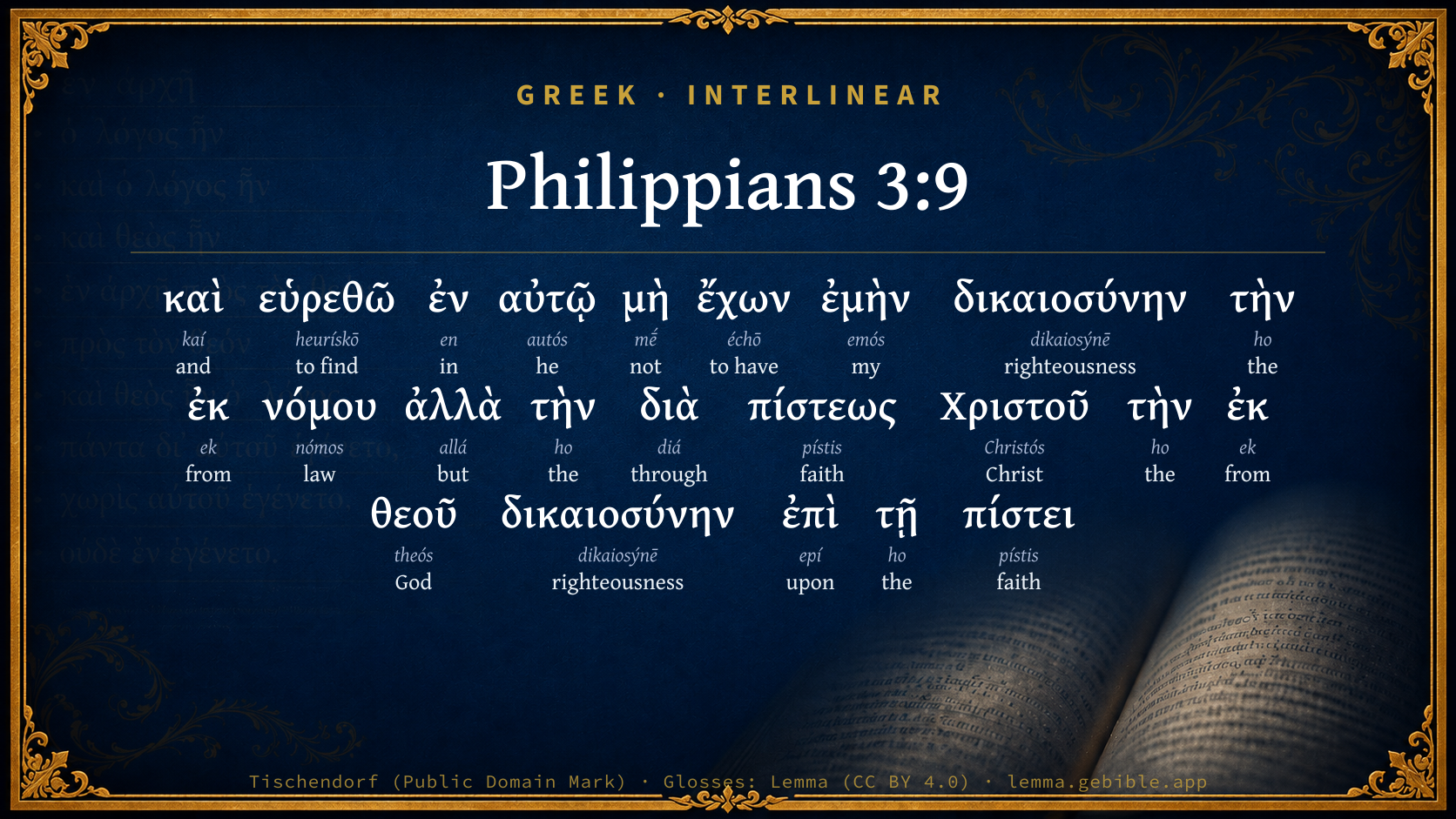
and be found in him, not having a righteousness of my own, that which is of the law, but that which is through faith in Christ, the righteousness which is from God by faith;
Download a study sheet
One document with this verse’s original text, its word-by-word gloss line, the meaning frame, cross-references with their text, attributed commentary, and full source and license credits — printable, and it pastes into notes with its structure intact.
This verse Autodidact and up
A passage Seminary Student
Up to 50 verses in one chapter. A passage sheet keeps up to 6 commentary sources and 12 cross-references per verse, in the order this page ranks them, and says so on the sheet whenever that leaves anything out. Ask for a single verse and you get the Autodidact verse sheet above.
Everything on this page stays free to read, with no account — the sheet is a download of what is already on screen, not access to it.
Compare translations 3
The same verse in 3 English versions, stacked beneath the original-language interlinear above. Click any original word for its lexicon entry.
Each is an independent rendering of the whole verse — the interlinear is not word-aligned to these translations.
Highlighted words mark where these versions differ — a whole-verse word diff, not a word-by-word alignment.
-
World English Bible Public Domain
and be found in him, not having a righteousness of my own, that which is of the law, but that which is through faith in Christ, the righteousness which is from God by faith;
-
King James Version Public Domain
And be found in him, not having mine own righteousness, which is of the law, but that which is through the faith of Christ, the righteousness which is of God by faith:
-
unfoldingWord Literal Text CC BY-SA 4.0
and be found in him, not having my own righteousness from law, but through faith in Christ—the righteousness from God by faith—
unfoldingWord Literal Text — © unfoldingWord, licensed CC BY-SA 4.0. Word-aligned USFM3 via Door43 (git.door43.org/unfoldingWord/en_ult).
Show all 19 translations
Every available English version of this verse, each an independent rendering of the whole verse.
-
World English Bible Public Domain
and be found in him, not having a righteousness of my own, that which is of the law, but that which is through faith in Christ, the righteousness which is from God by faith;
-
Berean Standard Bible Public Domain
and be found in Him, not having my own righteousness from the law, but that which is through faith in Christ, the righteousness from God on the basis of faith.
-
Majority Standard Bible Public Domain
and be found in Him, not having my own righteousness from the law, but that which is through faith in Christ, the righteousness from God on the basis of faith.
-
King James Version Public Domain
And be found in him, not having mine own righteousness, which is of the law, but that which is through the faith of Christ, the righteousness which is of God by faith:
-
American Standard Version (1901) Public Domain
and be found in him, not having a righteousness of mine own, `even' that which is of the law, but that which is through faith in Christ, the righteousness which is from God by faith:
-
Revised Version (1885) Public Domain
and be found in him, not having a righteousness of mine own, even that which is of the law, but that which is through faith in Christ, the righteousness which is of God by faith:
-
Geneva Bible (1599) Public Domain
And might bee founde in him, that is, not hauing mine owne righteousnesse, which is of the Lawe, but that which is through the faith of Christ, euen the righteousnesse which is of God through faith,
-
Douay-Rheims (1899) Public Domain
And may be found in him, not having my justice, which is of the law, but that which is of the faith of Christ Jesus, which is of God, justice in faith:
-
Young's Literal Translation Public Domain
not having my righteousness, which `is' of law, but that which `is' through faith of Christ -- the righteousness that is of God by the faith,
-
Literal Standard Version CC BY-SA 4.0
not having my righteousness, which [is] of law, but that which [is] through faith from Christ—the righteousness that is of God by faith,
-
Unlocked Literal Bible CC BY-SA 4.0
and be found in him. I do not have a righteousness of my own from the law. Instead, I have the righteousness that is through faith in Christ, the righteousness that is from God based on faith.
-
unfoldingWord Literal Text CC BY-SA 4.0
and be found in him, not having my own righteousness from law, but through faith in Christ—the righteousness from God by faith—
-
Darby Bible Public Domain
and that I may be found in him, not having my righteousness, which [would be] on the principle of law, but that which is by faith of Christ, the righteousness which [is] of God through faith,
-
World Messianic Bible Public Domain
and be found in him, not having a righteousness of my own, that which is of the law, but that which is through faith in Messiah, the righteousness which is from God by faith,
-
Webster's Bible Public Domain
And be found in him, not having my own righteousness, which is from the law, but that which is through the faith of Christ, the righteousness which is from God by faith:
-
Free Bible Version CC BY-SA 4.0
I want to be found in him, not being right because of what I've done, or what the law requires, but made right through confidence in Christ, set right by God through trusting in him.
-
Bible in Basic English Public Domain
And be seen in him, not having my righteousness which is of the law, but that which is through faith in Christ, the righteousness which is of God by faith:
-
Text-Critical English NT CC BY 4.0
and be found in him, not having a righteousness of my own that comes from the law, but the righteousness that is through faith in Christ, which comes from God on the basis of faith.
-
Tyndale New Testament (1534) Public Domain
and myght be founde in him not havynge myne awne rightewesnes which is of the lawe: But that which spryngeth of the fayth which is in Christ. I meane the rightewesnes which cometh of God thorowe fayth
Literal Standard Version (2020), Covenant Press — licensed CC BY-SA 4.0. Text via the HelloAO Bible API (eBible.org). Unlocked Literal Bible (unfoldingWord) — licensed CC BY-SA 4.0. Text via the HelloAO Bible API (eBible.org). unfoldingWord Literal Text — © unfoldingWord, licensed CC BY-SA 4.0. Word-aligned USFM3 via Door43 (git.door43.org/unfoldingWord/en_ult). Free Bible Version, Dr. Jonathan Gallagher — licensed CC BY-SA 4.0. Text via the HelloAO Bible API (eBible.org).
Word by word
More ways to search: Search by grammar → Find every occurrence → Compare this word →
Practice this passage: Drill this verse → Learn its vocabulary →
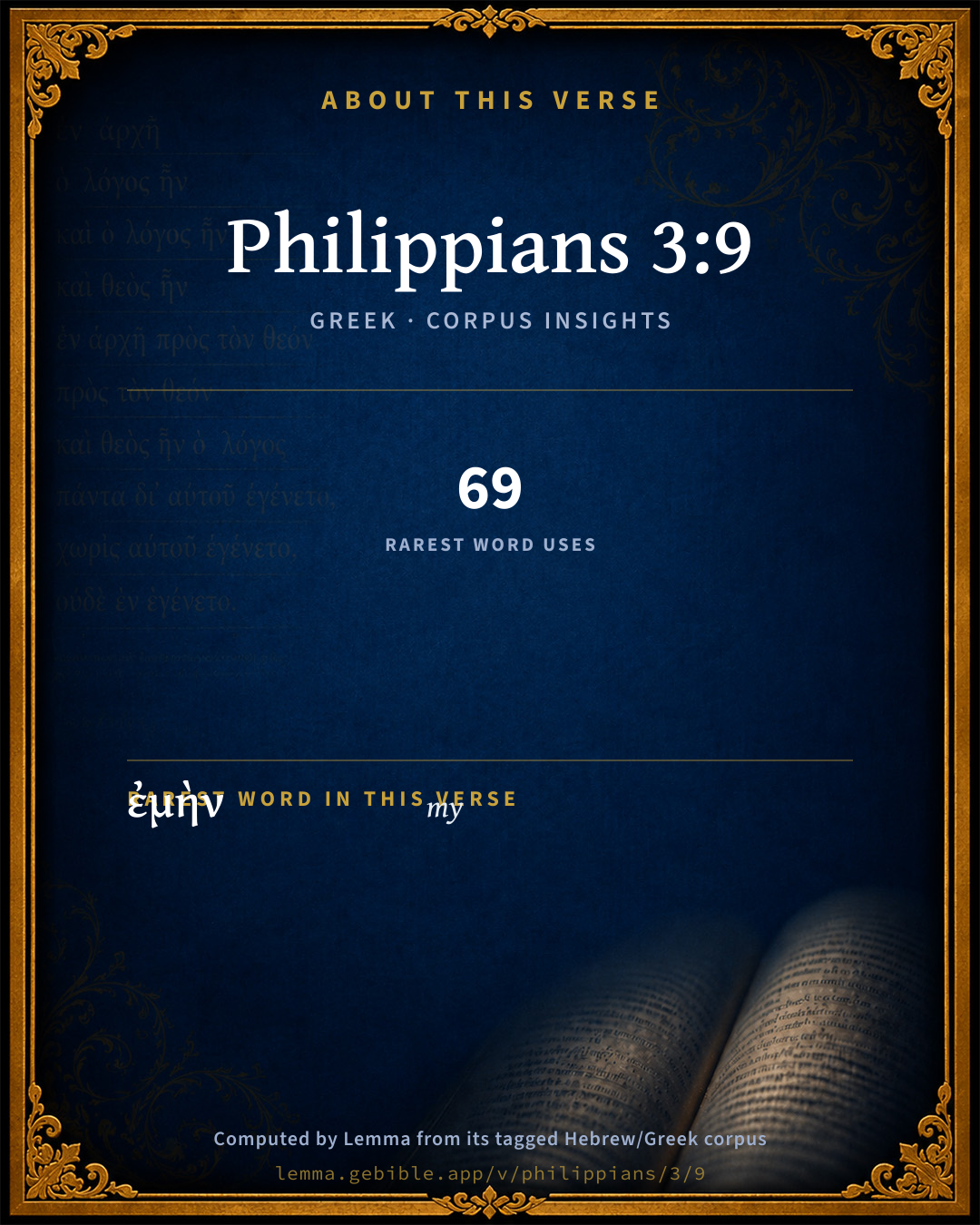
- Appears 69× in the Greek New Testament
- First appears at Matthew 18:20
- Part of Speech
- Possessive pronoun
- Person
- 1st person
- Case
- Accusative
- Number
- Singular
- Gender
- Feminine
Full Thayer's Definition
- καὶ kaí G2532 “and” Conjunction
- εὑρεθῶ heurískō G2147 “to find” Verb, Aorist, Passive, Subjunctive, 1st person, Singular
- ἐν en G1722 “in” Preposition
- αὐτῷ autós G846 “he” Personal pronoun, Dative, Singular, Masculine
- μὴ mḗ G3361 “not” Particle, Negative
- ἔχων échō G2192 “to have” Verb, Present, Active, Participle, Nominative, Singular, Masculine
- ἐμὴν emós G1699 “my” Possessive pronoun, 1st person, Accusative, Singular, Feminine
- δικαιοσύνην dikaiosýnē G1343 “righteousness” Noun, Accusative, Singular, Feminine
- τὴν ho G3588 “the” Article, Accusative, Singular, Feminine
- ἐκ ek G1537 “from” Preposition
- νόμου nómos G3551 “law” Noun, Genitive, Singular, Masculine
- ἀλλὰ allá G235 “but” Conjunction
- τὴν ho G3588 “the” Article, Accusative, Singular, Feminine
- διὰ diá G1223 “through” Preposition
- πίστεως pístis G4102 “faith” Noun, Genitive, Singular, Feminine
- Χριστοῦ Christós G5547 “Christ” Noun, Genitive, Singular, Masculine
- τὴν ho G3588 “the” Article, Accusative, Singular, Feminine
- ἐκ ek G1537 “from” Preposition
- θεοῦ theós G2316 “God” Noun, Genitive, Singular, Masculine
- δικαιοσύνην dikaiosýnē G1343 “righteousness” Noun, Accusative, Singular, Feminine
- ἐπὶ epí G1909 “upon” Preposition
- τῇ ho G3588 “the” Article, Dative, Singular, Feminine
- πίστει pístis G4102 “faith” Noun, Dative, Singular, Feminine
About this verse
These counts appear in no published source. They are computed here, from the morphology-tagged text and Lemma’s own curated glosses. What Lemma adds →
- 23
- words
- 17
- distinct lemmas
- Pauline Epistles
- section
Cross-references
56Topical passages linked to Philippians 3:9 in the Treasury of Scripture Knowledge — connected by theme and wording, ordered by reader-vote popularity; previews shown in the World English Bible.
- 2 Corinthians 5:21 For him who knew no sin he made to be sin on our behalf; so that in him we might become the righteousness of God.
- 1 Corinthians 1:30 But of him, you are in Christ Jesus, who was made to us wisdom from God, and righteousness and sanctification, and redemption:
- Galatians 2:16 yet knowing that a man is not justified by the works of the law but through the faith of Jesus Christ, even we believed in Christ Jesus, that we might be justified by faith in Christ, and not by the works of the law, because no flesh will be justified by the works of the law.
- Romans 4:5–6 But to him who doesn't work, but believes in him who justifies the ungodly, his faith is accounted for righteousness.
- Romans 4:13–15 For the promise to Abraham and to his seed that he should be heir of the world wasn't through the law, but through the righteousness of faith.
- Romans 1:17 For in it is revealed God's righteousness from faith to faith. As it is written, "But the righteous shall live by faith."
- Romans 8:1 There is therefore now no condemnation to those who are in Christ Jesus, who don't walk according to the flesh, but according to the Spirit.
- Isaiah 53:11 He shall see of the travail of his soul, [and] shall be satisfied: by the knowledge of himself shall my righteous servant justify many; and he shall bear their iniquities.
- Romans 9:30–32 What shall we say then? That the Gentiles, who didn't follow after righteousness, attained to righteousness, even the righteousness which is of faith;
- Jeremiah 23:6 In his days Judah shall be saved, and Israel shall dwell safely; and this is his name by which he shall be called: Yahweh our righteousness.
- Jeremiah 33:16 In those days shall Judah be saved, and Jerusalem shall dwell safely; and this is [the name] by which she shall be called: Yahweh our righteousness.
- Romans 3:19–22 Now we know that whatever things the law says, it speaks to those who are under the law, that every mouth may be closed, and all the world may be brought under the judgment of God.
- Romans 7:5–13 For when we were in the flesh, the sinful passions which were through the law, worked in our members to bring forth fruit to death.
- Titus 3:5 not by works of righteousness, which we did ourselves, but according to his mercy, he saved us, through the washing of regeneration and renewing by the Holy Spirit,
- Luke 10:25–29 Behold, a certain lawyer stood up and tested him, saying, "Teacher, what shall I do to inherit eternal life?"
- Romans 8:3 For what the law couldn't do, in that it was weak through the flesh, God did, sending his own Son in the likeness of sinful flesh and for sin, he condemned sin in the flesh;
- 2 Corinthians 5:17 Therefore if anyone is in Christ, he is a new creation. The old things have passed away. Behold, all things have become new.
- 2 Timothy 1:9 who saved us and called us with a holy calling, not according to our works, but according to his own purpose and grace, which was given to us in Christ Jesus before times eternal,
- Ecclesiastes 7:20 Surely there is not a righteous man on earth, who does good and doesn't sin.
- Romans 10:1–6 Brothers, my heart's desire and my prayer to God is for Israel, that they may be saved.
- Romans 10:10 For with the heart, one believes unto righteousness; and with the mouth confession is made unto salvation.
- Galatians 3:21–22 Is the law then against the promises of God? Certainly not! For if there had been a law given which could make alive, most assuredly righteousness would have been of the law.
- Philippians 3:6 concerning zeal, persecuting the assembly; concerning the righteousness which is in the law, found blameless.
- Psalms 143:2 Don't enter into judgment with your servant, For in your sight no man living is righteous.
- Isaiah 53:6 All we like sheep have gone astray; everyone has turned to his own way; and Yahweh has laid on him the iniquity of us all.
- Daniel 9:24 Seventy weeks are decreed on your people and on your holy city, to finish disobedience, and to make an end of sins, and to make reconciliation for iniquity, and to bring in everlasting righteousness, and to seal up vision and prophecy, and to anoint the most holy.
- Matthew 9:13 But you go and learn what this means: 'I desire mercy, and not sacrifice,' for I came not to call the righteous, but sinners to repentance."
- Galatians 3:10–13 For as many as are of the works of the law are under a curse. For it is written, "Cursed is everyone who doesn't continue in all things that are written in the book of the law, to do them."
- 1 Peter 3:19–20 in which he also went and preached to the spirits in prison,
- 1 John 1:8–10 If we say that we have no sin, we deceive ourselves, and the truth is not in us.
- Genesis 7:23 Every living thing was destroyed that was on the surface of the ground, including man, cattle, creeping things, and birds of the sky. They were destroyed from the earth. Only Noah was left, and those who were with him in the ark.
- 1 Kings 8:46 If they sin against you (for there is no man who doesn't sin), and you are angry with them, and deliver them to the enemy, so that they carry them away captive to the land of the enemy, far off or near;
- 2 Chronicles 32:25 But Hezekiah didn't render again according to the benefit done to him; for his heart was lifted up: therefore there was wrath on him, and on Judah and Jerusalem.
- Job 10:14–15 If I sin, then you mark me. You will not acquit me from my iniquity.
- Psalms 14:3 They have all gone aside. They have together become corrupt. There is none who does good, no, not one.
- Psalms 19:12 Who can discern his errors? Forgive me from hidden errors.
- Psalms 130:3–4 If you, Yah, kept a record of sins, Lord, who could stand?
- John 16:8–11 When he has come, he will convict the world about sin, about righteousness, and about judgment;
- Deuteronomy 19:3–4 You shall prepare you the way, and divide the borders of your land, which Yahweh your God causes you to inherit, into three parts, that every manslayer may flee there.
- Deuteronomy 27:26 Cursed be he who doesn't confirm the words of this law to do them. All the people shall say, Amen.
- 2 Chronicles 32:31 However in [the business of] the ambassadors of the princes of Babylon, who sent to him to inquire of the wonder that was done in the land, God left him, to try him, that he might know all that was in his heart.
- Job 9:28–31 I am afraid of all my sorrows, I know that you will not hold me innocent.
- Job 15:14–16 What is man, that he should be clean? He who is born of a woman, that he should be righteous?
- Job 42:5–6 I had heard of you by the hearing of the ear, But now my eye sees you.
- Isaiah 6:5 Then I said, "Woe is me! For I am undone, because I am a man of unclean lips, and I dwell in the midst of a people of unclean lips: for my eyes have seen the King, Yahweh of Hosts!"
- Isaiah 45:24–25 Only in Yahweh, it is said of me, is righteousness and strength; even to him shall men come; and all those who were incensed against him shall be disappointed.
- Isaiah 46:13 I bring near my righteousness, it shall not be far off, and my salvation shall not wait; and I will place salvation in Zion for Israel my glory.
- Isaiah 64:5–6 You meet him who rejoices and works righteousness, those who remember you in your ways: behold, you were angry, and we sinned: in them [have we been] of long time; and shall we be saved?
- Romans 5:21 that as sin reigned in death, even so might grace reign through righteousness to eternal life through Jesus Christ our Lord.
- Romans 16:7 Greet Andronicus and Junias, my relatives and my fellow prisoners, who are notable among the apostles, who also were in Christ before me.
- Hebrews 6:18 that by two immutable things, in which it is impossible for God to lie, we may have a strong encouragement, who have fled for refuge to take hold of the hope set before us.
- James 2:9–11 But if you show partiality, you commit sin, being convicted by the law as transgressors.
- James 3:2 For in many things we all stumble. If anyone doesn't stumble in word, the same is a perfect man, able to bridle the whole body also.
- 2 Peter 1:1 Simon Peter, a servant and apostle of Jesus Christ, to those who have obtained a like precious faith with us in the righteousness of our God and Savior, Jesus Christ:
- 1 John 3:4 Everyone who sins also commits lawlessness. Sin is lawlessness.
- Psalms 71:15–16 My mouth will tell about your righteousness, And of your salvation all day, Though I don't know its full measure.
Cross-references courtesy of OpenBible.info (CC BY 4.0).
Lesson kit
Teaching starters — assembled from the data on this page, not authored interpretation. Every prompt links to the verse data it draws on. Edit before teaching.
Philippians, in the Pauline Epistles, opens this verse with 23 words (17 distinct Greek lemmas). Its most distinctive word is emós (“my”). A historical commentator’s framing appears above. Read the whole chapter for the surrounding context.
Discussion questions
- What does “my” (emós) contribute to the verse as a whole?
- How does 2 Corinthians 5:21, which shares this passage’s theme, read alongside this verse?
- What does the repetition of “righteousness” (2× in this one verse) do in this verse?
- These translations render this verse differently; the difference is in the English rendering, not the original. What questions does that raise?
- Compare how Matthew Henry's Commentary and The Cambridge Bible for Schools and Colleges read this verse. Where do they agree or differ?
Things to notice
- These translations choose different wording for 4 words in this verse.
- “righteousness” occurs 2× in this single verse.
- 17 distinct Greek lemmas span 23 words in this verse.
Commentary
Notes on Philippians 3:9 from classic Christian and Jewish commentators (each source and its license shown beneath its notes). The classic Christian expositions comment on the surrounding passage and are grouped to its opening verse, so a note may address several verses; the Jewish commentaries on the Tanakh (Rashi and others) are per-verse, so they appear only where the commentator wrote on this verse.
Lemma curates 59 commentaries, every one of them public domain or Creative Commons licensed, each selected and text-cleaned for this edition rather than reprinted as found. About our sources →
Matthew Henry's Commentary
Matthew Henry's Commentary on the Whole Bible (1708–1710) — public domain (CC PDM 1.0). Text via the HelloAO Bible API.
The Cambridge Bible for Schools and Colleges
gen. ed. J. J. S. Perowne
The Cambridge Bible for Schools and Colleges (gen. ed. J. J. S. Perowne; Cambridge University Press, 1878–1918) — public domain. Text from a community e-Sword module.
The Biblical Illustrator
Joseph S. Exell
The Biblical Illustrator, edited by Joseph S. Exell (c. 1880s–1900s) — public domain. Text from a community e-Sword module.
The Preacher's Complete Homiletical Commentary
Joseph S. Exell (gen. ed.)
The Preacher's Complete Homiletical Commentary (gen. ed. Joseph S. Exell; Funk & Wagnalls, c. 1892) — public domain (pre-1929). A full-Bible homiletical/sermon-outline anthology covering 65 of 66 books (2 John is absent from the source module). Text from a community e-Sword module.
The Expositor's Bible
William Robertson Nicoll, ed., The Expositor's Bible (London: Hodder & Stoughton, 1887–1910) — public domain. 65 of 66 books (1 Corinthians is not separately keyed, as that volume carries no machine-parseable verse references); section-level commentary keyed to the opening verse. Introductory and overview sections not keyed to a specific passage are excluded.
Tyndale Open Study Notes
Tyndale Open Resources
Tyndale Open Study Notes — © Tyndale Open Resources, licensed CC BY-SA 4.0. Text via the HelloAO Bible API.
Bengel's Gnomon
Johann Albrecht Bengel
Bengel's Gnomon of the New Testament — English translation (T&T Clark, Edinburgh, 1860) — public domain. Text from a community e-Sword module.
Meyer's Critical & Exegetical Commentary
Heinrich August Wilhelm Meyer
Meyer — Critical and Exegetical Commentary on the New Testament — English translation by Peter Christie, edited by Frederick Crombie (T&T Clark, 1880) — public domain. Text from a community e-Sword module.
Expositor's Greek Testament
ed. W. Robertson Nicoll
The Expositor's Greek Testament, edited by W. Robertson Nicoll (1897–1910) — public domain. Text from a community e-Sword module.
Cambridge Greek Testament for Schools and Colleges
Cambridge Greek Testament for Schools and Colleges (Cambridge University Press, 1896; 21 vols, various authors incl. Carr, Maclear, Plummer, Farrar, Lumby, Moule, M. R. James, Simcox) — public domain. Text from a community e-Sword module.
Geneva Bible (1599)
Geneva Bible translators
Geneva Bible (1599) marginal notes — public domain. Text via Bolls.life.
Jamieson, Fausset & Brown
Robert Jamieson, A. R. Fausset & David Brown
Jamieson, Fausset & Brown — Commentary Critical and Explanatory on the Whole Bible (1871) — public domain (CC PDM 1.0). Text via the HelloAO Bible API.
Adam Clarke's Commentary
Adam Clarke's Commentary on the Bible (1810–1826) — public domain. Text from a community e-Sword/MySword module.
John Calvin's Commentaries
John Calvin's Commentaries (1540-1563) — public domain. Text from the Calvin Translation Society English edition (1840s-50s) via the Christian Classics Ethereal Library (ccel.org). Calvin's coverage is partial (roughly two-thirds of the Bible); uncommented books and verses are honest gaps, never fabricated. The 19th-century editor's footnotes and remarks are omitted so the notes are faithfully Calvin's own voice.
Ellicott's Commentary for English Readers
A Bible Commentary for English Readers, edited by Charles John Ellicott (1878–1897) — public domain. Text from a community e-Sword module.
John Gill's Exposition
John Gill's Exposition of the Whole Bible (1746–1763) — public domain (CC PDM 1.0). Text via the HelloAO Bible API.
Trapp's Complete Commentary
John Trapp
John Trapp, A Commentary or Exposition upon All the Books of the Old and New Testament (1647–1656) — public domain. Text from a community e-Sword module.
Albert Barnes' Notes on the Bible
Albert Barnes' Notes on the Bible (1834–1885) — public domain. Text from a community e-Sword/MySword module.
Haydock's Catholic Bible Commentary
George Leo Haydock (1774–1849), Haydock's Catholic Family Bible and Commentary, 1859 edition — public domain. Excludes Psalms (Douay-Rheims chapter numbering differs from Protestant) and Deuterocanonical books (Catholic canon only).
Matthew Poole's English Annotations
Matthew Poole's English Annotations on the Holy Bible (1683–1685) — public domain. Text from a community e-Sword/MySword module.
Whedon's Commentary on the Bible
Daniel D. Whedon
Daniel D. Whedon (gen. ed.), Commentary on the Old and New Testaments (1874–1909) — public domain. Text from a community e-Sword module.
The Pulpit Commentary
The Pulpit Commentary (1880–1919), ed. H.D.M. Spence-Jones & Joseph S. Exell — public domain. Text from a community e-Sword module.
John Wesley's Explanatory Notes
John Wesley, Explanatory Notes Upon the Whole Bible (1754–1765) — public domain. Text via the GEBible commentary corpus.
Scofield Reference Notes
C. I. Scofield
The Scofield Reference Bible (1917 edition), notes by C. I. Scofield — public domain. Text from a community e-Sword module.
Burkitt's Expository Notes on the New Testament
William Burkitt
William Burkitt's Expository Notes on the New Testament (1700–1703) — public domain. Text from a community e-Sword module.
The People's New Testament
B. W. Johnson
B. W. Johnson's The People's New Testament with Notes (1889–1891) — public domain. Electronic text from the Christian Classics Ethereal Library (CCEL) ThML edition.
International Critical Commentary
International Critical Commentary — older volumes (1896–1929), various authors — public domain. Text from a community e-Sword module.
Vincent's Word Studies in the New Testament
Marvin R. Vincent
Marvin R. Vincent, Word Studies in the New Testament (1887–1900) — public domain. Text from a community e-Sword/MySword module.