
Acts 8:40

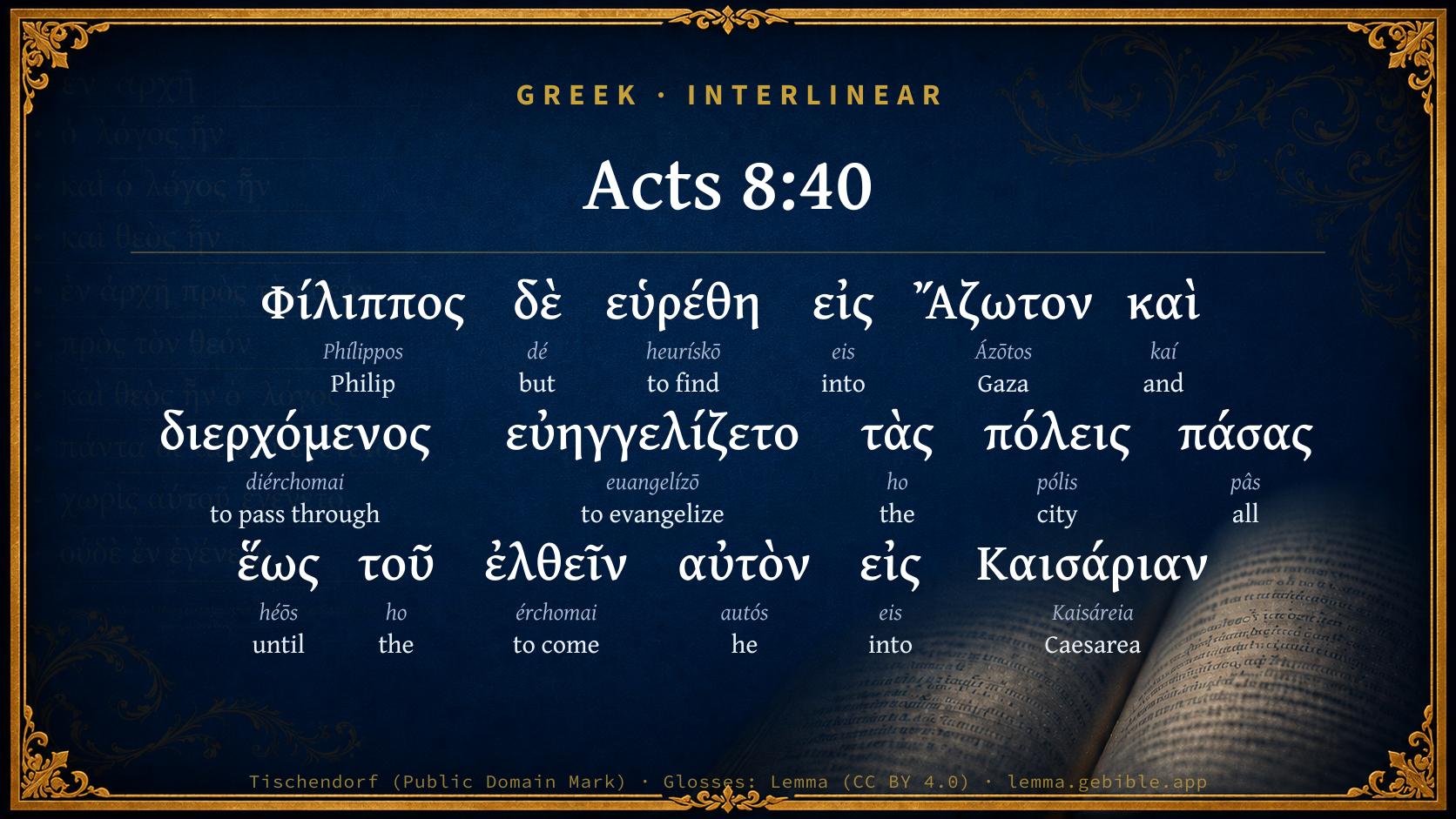
Greek (Tischendorf 8th ed.) Acts 8:40 appears in the Greek New Testament. The text above is from the Tischendorf 8th edition. Each word links to its Strong’s number and a concise gloss. Click any word for its full Thayer’s Greek Lexicon entry.
Download image
Cite this verse

Acts 8:40 (World English Bible). Public Domain. Lemma interlinear Bible study tool, https://lemma.gebible.app/v/acts/8/40.

Show BibTeX & RIS
BibTeX
RIS
English Translation
But Philip was found at Azotus. Passing through, he preached the Gospel to all the cities, until he came to Caesarea.
World English Bible · Public Domain
Highlights
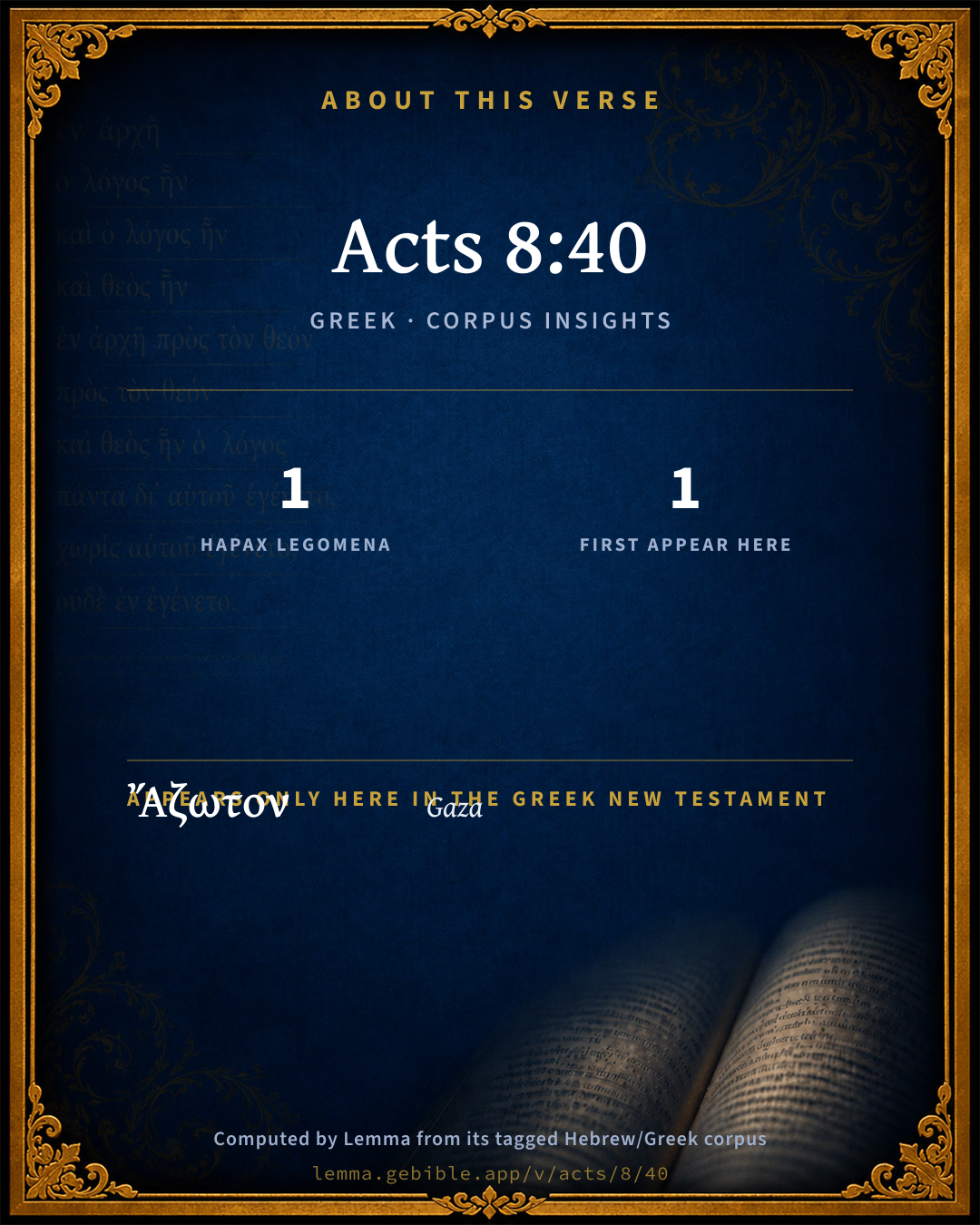
  • 1 hapax legomenon — only here in the Greek New Testament
  • 1 first appearance in the Greek New Testament
Full analysis ↓
Download a study sheet

One document with this verse’s original text, its word-by-word gloss line, the meaning frame, cross-references with their text, attributed commentary, and full source and license credits — printable, and it pastes into notes with its structure intact.

This verse Autodidact and up

Study sheet (.html) Plain text (.txt)

A passage Seminary Student

Up to 50 verses in one chapter. A passage sheet keeps up to 6 commentary sources and 12 cross-references per verse, in the order this page ranks them, and says so on the sheet whenever that leaves anything out. Ask for a single verse and you get the Autodidact verse sheet above.

Everything on this page stays free to read, with no account — the sheet is a download of what is already on screen, not access to it.

Want to remove ads? Support Godless Engineer
Compare translations 3

The same verse in 3 English versions, stacked beneath the original-language interlinear above. Click any original word for its lexicon entry.

Each is an independent rendering of the whole verse — the interlinear is not word-aligned to these translations.

Highlighted words mark where these versions differ — a whole-verse word diff, not a word-by-word alignment.

  • World English Bible Public Domain
    But Philip was found at Azotus. Passing through, he preached the Gospel to all the cities, until he came to Caesarea.
  • King James Version Public Domain
    But Philip was found at Azotus: and passing through he preached in all the cities, till he came to Caesarea.
  • unfoldingWord Literal Text CC BY-SA 4.0
    But Philip was found at Azotus and, passing through, he was proclaiming the gospel to all the cities until he came to Caesarea.

unfoldingWord Literal Text — © unfoldingWord, licensed CC BY-SA 4.0. Word-aligned USFM3 via Door43 (git.door43.org/unfoldingWord/en_ult).

Versions to compare (up to 4)

3 of 4 selected

Show all 19 translations

Every available English version of this verse, each an independent rendering of the whole verse.

  • World English Bible Public Domain
    But Philip was found at Azotus. Passing through, he preached the Gospel to all the cities, until he came to Caesarea.
  • Berean Standard Bible Public Domain
    But Philip appeared at Azotus and traveled through that region, preaching the gospel in all the towns until he came to Caesarea.
  • Majority Standard Bible Public Domain
    But Philip appeared at Azotus and traveled through that region, preaching the gospel in all the towns until he came to Caesarea.
  • King James Version Public Domain
    But Philip was found at Azotus: and passing through he preached in all the cities, till he came to Caesarea.
  • American Standard Version (1901) Public Domain
    But Philip was found at Azotus: and passing through he preached the gospel to all the cities, till he came to Caesarea.
  • Revised Version (1885) Public Domain
    But Philip was found at Azotus: and passing through he preached the gospel to all the cities, till he came to Caesarea.
  • Geneva Bible (1599) Public Domain
    But Philippe was found at Azotus, and he walked to and from preaching in all the cities, till he came to Cesarea.
  • Douay-Rheims (1899) Public Domain
    But Philip was found in Azotus; and passing through, he preached the gospel to all the cities, till he came to Caesarea.
  • Young's Literal Translation Public Domain
    and Philip was found at Azotus, and passing through, he was proclaiming good news to all the cities, till his coming to Cesarea.
  • Literal Standard Version CC BY-SA 4.0
    and Philip was found at Azotus, and passing through, he was proclaiming good news to all the cities, until his coming to Caesarea.
  • Unlocked Literal Bible CC BY-SA 4.0
    But Philip appeared at Azotus and he went through that region, proclaiming the gospel to all the cities until he came to Caesarea.
  • unfoldingWord Literal Text CC BY-SA 4.0
    But Philip was found at Azotus and, passing through, he was proclaiming the gospel to all the cities until he came to Caesarea.
  • Darby Bible Public Domain
    And Philip was found at Azotus, and passing through he announced the glad tidings to all the cities till he came to Caesarea.
  • World Messianic Bible Public Domain
    But Philip was found at Azotus. Passing through, he preached the Good News to all the cities until he came to Caesarea.
  • Webster's Bible Public Domain
    But Philip was found at Azotus: and passing through, he preached in all the cities, till he came to Cesarea.
  • Free Bible Version CC BY-SA 4.0
    He spread the good news in all the towns along the way until he arrived at Caesarea.
  • Bible in Basic English Public Domain
    But Philip came to Azotus, and went through all the towns, preaching the good news, till he came to Caesarea.
  • Text-Critical English NT CC BY 4.0
    Philip, however, found himself at Azotus, and as he passed through that region, he preached the gospel in all the towns until he came to Caesarea.
  • Tyndale New Testament (1534) Public Domain
    but Philip was founde at Azotus. And he walked thorow out the countre preachynge in their cities tyll he came to Cesarea.

Literal Standard Version (2020), Covenant Press — licensed CC BY-SA 4.0. Text via the HelloAO Bible API (eBible.org). Unlocked Literal Bible (unfoldingWord) — licensed CC BY-SA 4.0. Text via the HelloAO Bible API (eBible.org). unfoldingWord Literal Text — © unfoldingWord, licensed CC BY-SA 4.0. Word-aligned USFM3 via Door43 (git.door43.org/unfoldingWord/en_ult). Free Bible Version, Dr. Jonathan Gallagher — licensed CC BY-SA 4.0. Text via the HelloAO Bible API (eBible.org).

Word by word

More ways to search: Search by grammar → Find every occurrence → Compare this word →

Practice this passage: Drill this verse → Learn its vocabulary →

Ἄζωτον
Ázōtos
G108
“Gaza”
Noun, Accusative, Singular, Feminine
Part of Speech
Noun
Case
Accusative
Number
Singular
Gender
Feminine
Full Thayer's Definition

Origin: of hebrew origin H795

TDNT: None

Ashdod or Azotus = "a stronghold" 1. one of the five chief cities of the Philistines, lying between Ashkelon and Jamnia and near the Mediterranean
  1. Φίλιππος Phílippos G5376 “Philip” Noun, Nominative, Singular, Masculine
  2. δὲ dé G1161 “but” Conjunction
  3. εὑρέθη heurískō G2147 “to find” Verb, Aorist, Passive, Indicative, 3rd person, Singular
  4. εἰς eis G1519 “into” Preposition
  5. καὶ kaí G2532 “and” Conjunction
  6. διερχόμενος diérchomai G1330 “to pass through” Verb, Present, Middle or Passive deponent, Participle, Nominative, Singular, Masculine
  7. εὐηγγελίζετο euangelízō G2097 “to evangelize” Verb, Imperfect, Middle, Indicative, 3rd person, Singular
  8. τὰς ho G3588 “the” Article, Accusative, Plural, Feminine
  9. πόλεις pólis G4172 “city” Noun, Accusative, Plural, Feminine
  10. πάσας pâs G3956 “all” Adjective, Accusative, Plural, Feminine
  11. ἕως héōs G2193 “until” Adverb
  12. τοῦ ho G3588 “the” Article, Genitive, Singular, Neuter
  13. ἐλθεῖν érchomai G2064 “to come” Verb, Aorist, Active, Infinitive
  14. αὐτὸν autós G846 “he” Personal pronoun, Accusative, Singular, Masculine
  15. εἰς eis G1519 “into” Preposition
  16. Καισάριαν Kaisáreia G2542 “Caesarea” Noun, Accusative, Singular, Feminine

About this verse

These counts appear in no published source. They are computed here, from the morphology-tagged text and Lemma’s own curated glosses. What Lemma adds →

17
words
15
distinct lemmas
Acts
section

Notable vocabulary

1 hapax legomenon — a word that appears only here in the entire Greek New Testament:

  • Ἄζωτον Gaza G108

First appearance in Scripture

This word makes its first canonical appearance in the Greek New Testament here:

  • Ἄζωτον Gaza G108

Shared distinctive vocabulary

Καισάριαν Caesarea G2542 occurs in 17 verses of the Greek New Testament. Also found in:
Repetition

Words recur within this verse:

Cross-references

17

Topical passages linked to Acts 8:40 in the Treasury of Scripture Knowledge — connected by theme and wording, ordered by reader-vote popularity; previews shown in the World English Bible.

  • Acts 21:8 On the next day, we, who were Paul's companions, departed, and came to Caesarea. We entered into the house of Philip the evangelist, who was one of the seven, and stayed with him.
  • Acts 10:1 Now there was a certain man in Caesarea, Cornelius by name, a centurion of what was called the Italian Regiment,
  • Acts 23:23 He called to himself two of the centurions, and said, "Prepare two hundred soldiers to go as far as Caesarea, with seventy horsemen, and two hundred men armed with spears, at the third hour of the night."
  • Acts 23:33 When they came to Caesarea and delivered the letter to the governor, they also presented Paul to him.
  • Acts 25:4 However Festus answered that Paul should be kept in custody at Caesarea, and that he himself was about to depart shortly.
  • 1 Samuel 5:1 Now the Philistines had taken the ark of God, and they brought it from Ebenezer to Ashdod.
  • Joshua 15:46–47 from Ekron even to the sea, all that were by the side of Ashdod, with their villages.
  • Zechariah 9:6 Foriegners will dwell in Ashdod, And I will cut off the pride of the Philistines.
  • Luke 10:1–2 Now after these things, the Lord also appointed seventy others, and sent them two by two ahead of him into every city and place, where he was about to come.
  • Acts 8:25 They therefore, when they had testified and spoken the word of the Lord, returned to Jerusalem, and preached the Gospel to many villages of the Samaritans.
  • Acts 10:24 On the next day they entered into Caesarea. Cornelius was waiting for them, having called together his relatives and his near friends.
  • Acts 12:19 When Herod had sought for him, and didn't find him, he examined the guards, and commanded that they should be put to death. He went down from Judea to Caesarea, and stayed there.
  • Acts 21:16 Some of the disciples from Caesarea also went with us, bringing one Mnason of Cyprus, an early disciple, with whom we would stay.
  • Acts 25:1 Festus therefore, having come into the province, after three days went up to Jerusalem from Caesarea.
  • Acts 25:6 When he had stayed among them more than ten days, he went down to Caesarea, and on the next day he sat on the judgment seat, and commanded Paul to be brought.
  • Acts 25:13 Now when some days had passed, Agrippa the King and Bernice arrived at Caesarea, and greeted Festus.
  • Romans 15:19 in the power of signs and wonders, in the power of God's Spirit; so that from Jerusalem, and around as far as to Illyricum, I have fully preached the Gospel of Christ;

Cross-references courtesy of OpenBible.info (CC BY 4.0).

Commentary

Notes on Acts 8:40 from classic Christian and Jewish commentators (each source and its license shown beneath its notes). The classic Christian expositions comment on the surrounding passage and are grouped to its opening verse, so a note may address several verses; the Jewish commentaries on the Tanakh (Rashi and others) are per-verse, so they appear only where the commentator wrote on this verse.

Lemma curates 59 commentaries, every one of them public domain or Creative Commons licensed, each selected and text-cleaned for this edition rather than reprinted as found. About our sources →

Joseph Benson's Commentary

Act 8:40. But Philip — Quickly after he was separated from the eunuch; was found at Azotus — Or Ashdod, a city that was more than thirty miles from Gaza. Probably none saw him from the time of his leaving the eunuch till he was there. And passing through — That part of the country; he preached in all the cities — Namely, Joppa, Lydda, Saron, and all the other cities along the coast of the Mediterranean sea; till he came to Cesarea — Namely, Cesarea in Palestine, a city far distant from Cesarea Philippi, (mentioned Mat 16:13, where see the notes,) which was situate to the north of the tribe of Naphtali, and near the sources of Jordan. Wherever the word Cesarea occurs without Philippi, the former place is intended. It was anciently called Stratonice, or Straton’s Tower, and was rebuilt by Herod the Great in honour of Augustus Cesar, and greatly enlarged and beautified with many fine edifices of polished marble; but the greatest and most beneficial of all his works here was the harbour, which he made equal in largeness to the Piræus at Athens. The beauty of this Cesarea, and the conveniences of its situation, were so great, that when the Romans reduced Judea into the form of a province, they made it the seat of their government, in preference even to Jerusalem itself. It appears that Philip settled here for some time, probably for life, for we find him long after this residing here with his four unmarried daughters, who were prophetesses, and entertaining Paul and his company many days at his house, when on their way to Jerusalem. See Act 21:8-9. It is likely, therefore, that his itinerant mission ended here. It is reasonable to suppose, however, that he still continued to preach the gospel to those Jews who were disposed to attend his ministry, and that he made, at least, some converts among them. He doubtless also performed the work of an evangelist in some other places in those parts.

Joseph Benson's Commentary on the Old and New Testaments (1811–1818) — public domain. Text from a community e-Sword module.

Bengel's Gnomon

Johann Albrecht Bengel

Act 8:40. Εὐρέθη, was found) On the way, neither Philip himself seems to have known where he was, or what was happening to him, nor did any one else see him.—τὰς πόλεις, the cities) Between Gaza and Cæsarea; as, for instance, Joppa, Lydda, etc. Here too, as in the city of Samaria, he prepared hearers for the apostles: ch. Act 9:32.—εἰς Καισάμειαν, Cæsarea) In this remarkable city lie fixed his residence, being about therein to minister to the supply of the saints on their journey: ch. Act 21:8-9, “We (Paul, Luke, etc.) entered into the house of Philip the Evangelist, one of the seven, and abode with him.”

Bengel's Gnomon of the New Testament — English translation (T&T Clark, Edinburgh, 1860) — public domain. Text from a community e-Sword module.

Expositor's Greek Testament

ed. W. Robertson Nicoll

Act 8:40 . εὑρέθη εἰς Ἄ .: constructio prægnans = was borne to and found at, cf. Act 21:13 ; or, as εἰς means more than ἐν , implying that he had come into the city and was staying there, cf. Est 1:5 ; marg. Hebrew “found,” A. V., εὑρίσκω , מָצָא , is very often found in the LXX in similar phrases, e.g. , 1Ch 29:17 , 2Ch 31:1 , 1Sa 13:15 , etc. The word may imply, however, much more than the fact that Philip was present at Azotus, and Alford sees in it a probable reference to 2Ki 2:17 ( cf. passages in O.T. above), where the same word is used, εὑρέθη . Blass takes it to mean “vento quasi ibi dejectus,” but see above on Act 8:39 . Ἄζωτον , אַשְׁדּוֹד : only mentioned here in N.T., but in LXX Ashdod, Jos 11:22 ; Jos 13:3 ; Jos 15:46 , 1Sa 5:5 , 2Ch 26:6 , Neh 4:7 ; Neh 13:20 , Jer 25:20 ; Jer 47:5 , Amo 1:8 , Zep 2:4 , Zec 9:6 ; Azotus in 1Ma 5:18 ; 1Ma 10:84 ; Herod., ii., 157: Herod, speaks of the siege of the twenty-nine years under Psammetichus as the longest in history ( ζ = σδ , as in Ὠρομάζης , Ahuramazda , Blass, in loco ). An old Philistine town, and one of the five chief cities it might be regarded as the half-way station on the great road between Gaza and Joppa. Schürer holds that the population was Jewish to a considerable extent, as we find that Vespasian was obliged to place a garrison there (Jos., B. J. , iv., 3, 2); it is now a mere village of no importance, and still bearing the name Esdûd . Schürer, Jewish People , div. ii., vol. i., pp. 62, 67 ff., E.T.; G. A. Smith, Hist. Geog. of the Holy Land , pp. 192, 193; Hamburger, Real-Encyclopädie des Judentums , i., 1, 124, “Ashdod,” B.D. 2 , “Azotus,” and also Col. Conder sub v. , Hastings’ B.D. διερχόμενος εὐηγγελ ., see above on Act 8:4 and also Act 13:6 , and cf. Luk 9:6 for a similar combination of the two verbs. τὰς πόλεις πάσας : from their position between Azotus and Cæsarea, Lydda and Joppa may well have been included, cf. Act 9:32 ; Act 9:36 , in which we may see something of the effects of St. Philip’s preaching, “hic quoque, uti in urbe Samariæ, Apostolis auditores præparavit,” Bengel. Καισαρείαν (mentioned no less than fifteen times in Acts): its full name was Καισαρεία Σεβαστή , so named by Herod the Great in honour of Augustus (Jos., Ant. , xvi., 5, 1); sometimes also παράλιος or ἡ ἐπὶ θαλάττῃ (Jos., B. J. , iii., 9, 1; vii., 1, 3); it was also called “Straton’s Tower” ( cf. Κ . ἡ Στράτωνος , Apost. Const. , vi., 12), although it was virtually a fresh site. Schürer derives this latter name from Straton, the name of one or more of the last kings of Sidon, who towards the end of the Persian period were probably in possession of the strip of coast upon which the tower was built (Schürer, u. s. , div. ii., vol. i., p. 84 ff.). Herod’s lavish expenditure and enlargement gave it such importance that it came to be called Caput Judaeæ , Tacitus, Hist. , ii. 79, i.e. , of the Roman Province, for it never could be called truly Judæan. For its magnificence, see Jos., Ant. , xv., 9; B. J. , i., 21, cf. Ant. , xvi., 5. It was a seaport suited to his taste, which Herod wanted, and in Cæsarea he found it “Joppa, Jerusalem’s port, was Jewish, national, patriotic; Cæsarea, Herodian, Roman in obedience, Greek in culture”. The buildings were magnificent a temple with its two statues of Augustus and of Rome, a theatre, an amphitheatre; but above all, the haven was the chief work of art, Sebastos Limen, so large and important that the name of the city was even dwarfed beside it (see especially Dr. G. A. Smith, u. s. , p. 140). Here the Roman procurators had their abode, both before and after Agrippa’s reign; here, too, was the chief garrison of the troops of the province. The population was chiefly heathen, but with a considerable mixture of Jews, and so both Gentile and Jew had equal rights, while each claimed exclusive powers. In the time of Felix things came to such a pass that bloodshed ensued, and Felix exasperated the Jews by leaving the sole direction of the town in the hands of the heathen party. It was this which in the first place provoked the great rising of the Jews, A.D. 66 (Jos., Ant. , xx., 8, 7, 9; B. J. , ii., 13, 7; 14, 4, 5). The war broke out, and, according to Josephus, all the Jewish inhabitants, habitants, twenty thousand in number, were massacred in an hour. Here the famous Rabbi Akiba met a martyr’s death, here Eusebius of Cæsarea and Procopius were born, and hither Origen fled. See Schürer, u. s.; Hamburger, Real-Encyclopädie des Judentums , ii., 1, 123; G. A. Smith, u. s. , pp. 138, 143 ff., B.D. 2 ; Edersheim, History of the Jewish Nation , pp. 21, 23, 156, 199, 251, 265, etc. Among the Jews Cæsarea was called by the same name by which we know it, but sometimes from its fortifications, Migdal Shur, or after its harbour, Migdal Shina, or after both, and once by its ancient name, “Straton’s Tower” ( cf. also Strabo , xvi., p. 758), but as the seat of the Roman power, and for its preponderating heathen population, it was specially hated; and so it was designated “the daughter of Edom,” although the district, so rich and fertile, was still called “the land of life”. Edersheim, Jewish Social Life , pp. 24, 72, 202, and Hamburger, u. s. Cæsarea is mentioned in the verse before us not because of its political and commercial importance, but because it became the after home of Philip, Act 21:8 . But it also might be named here as marking a further and interesting stage in the progress of the Gospel (see also below on chap. 10). We cannot say whether at the time of the narrative in chap. 10. Philip had already settled and worked in Cæsarea.

The Expositor's Greek Testament, edited by W. Robertson Nicoll (1897–1910) — public domain. Text from a community e-Sword module.

Jamieson, Fausset & Brown

Robert Jamieson, A. R. Fausset & David Brown

Philip was found--that is, "found himself," "made his appearance": an expression confirming the miraculous manner of his transportation.

at Azotus--the ancient Ashdod.

preached in all the cities--along the coast, proceeding northward.

till he came to Cæsarea--fifty-five miles northwest of Jerusalem, on the Mediterranean, just south of Mount Carmel; and so named by Herod, who rebuilt it, in honor of Cæsar Augustus. Henceforth we lose sight of zealous and honored Philip, as by and by we shall lose sight even of Peter. As the chariot of the Gospel rolls on, other agents are raised up, each suited to his work. But "he that soweth and he that reapeth shall rejoice together." (See on Joh 4:31-38).

Next: Acts Chapter 9

Jamieson, Fausset & Brown — Commentary Critical and Explanatory on the Whole Bible (1871) — public domain (CC PDM 1.0). Text via the HelloAO Bible API.

Adam Clarke's Commentary

Verse 40. Philip was found at Azotus] Prom the time he left the eunuch, he was not heard of till he got to Azotus, which, according to Dr. Lightfoot, was about 34 miles from Gaza, and probably it was near Gaze that Philip met the eunuch. The Azotus of the New Testament is the Ashdod of the old. It was given by Joshua to the tribe of Judah, Jos 15:47. It was one of the five lordships which belonged to the Philistines, and is a seaport town on the Mediterranean Sea, between Gaza on the south, and Joppa or Jaffa on the north. Herodotus reports, lib. ii. cap. 157, that Psammeticus, king of Egypt, besieged this city 29 years, which, if true, is the longest siege which any city or fortress ever endured.

Preached in all the cities, till he cams to Caesarea.] This was Caesarea in Palestine, formerly called Strato's Tower, built by Herod the Great in honour of Augustus. There was an excellent harbour here made by Herod; and, after the destruction of Jerusalem, it became the capital of the whole land of Judea. It must be always distinguished from Caesarea Philippi, which was an inland town not far from the springs of Jordan. Whenever the word Caesarea occurs without Philippi, the former is intended. As Philip preached in all the cities of Palestine till he came to Caesarea, he must have preached in the different cities of the Philistine country, Ashdod, Akkaron, and Jamnia, and also in the principal parts of Samaria, as these lay in his way from Gaza to Caesarea. As there was a readier disposition to receive the word in those places, the Spirit of the Lord, under whose guidance he acted, did not suffer him to accompany the eunuch to Abyssinia. It appears, from Ac 21:8, that Philip settled at Caesarea, where he had a house and family, four of his unmarried daughters being prophetesses. It is likely that his itinerant mission ended here; though he continued occasionally to perform the work of an evangelist, and to bring up his family in the knowledge and fear of God, which is the most imperious duty that any master of a family can be called on to perform, and which it is impossible for any man to accomplish by substitute; and which none can neglect without endangering his own salvation.

Adam Clarke's Commentary on the Bible (1810–1826) — public domain. Text from a community e-Sword/MySword module.

John Calvin's Commentaries

40. He was found at Azotus. It is well known, out of the book of Joshua 11:22, that Azotus was one of the cities out of which the sons of Anak could not be expelled. It is distant from Ascalon almost two hundred furlongs; the Hebrews call it Ashdod. Thither was Philip carried; there began he to take his journey on foot after the manner of men, sowing the seed of the gospel wheresoever he became, [passed.] This is surely rare and wonderful stoutness, that he spreadeth the name of godliness in his journey. And whereas Luke saith expressly that he preached in all cities until he came to Cesarea, and doth not declare that he returned to Samaria, we may thereby conjecture that he staid at Cesarea for a time; and yet I leave this indifferent.

John Calvin's Commentaries (1540-1563) — public domain. Text from the Calvin Translation Society English edition (1840s-50s) via the Christian Classics Ethereal Library (ccel.org). Calvin's coverage is partial (roughly two-thirds of the Bible); uncommented books and verses are honest gaps, never fabricated. The 19th-century editor's footnotes and remarks are omitted so the notes are faithfully Calvin's own voice.

Ellicott's Commentary for English Readers

(40) Philip was found at Azotus.—The city so named, the Ashdod of the Old Testament, was, like Gaza, one of the cities of the Philistines, about three miles from the sea, and half-way between Gaza and Joppa. Like Gaza its history was chiefly marked by successive sieges: by Tartan, the Assyrian General B.C. 716 (Isa_20:1); by Psammetichus, B.C. 630, (Herod. ii. 157); the Maccabees (1Ma_5:68; 1Ma_10:34). It was restored by the Roman general Gabinius in B.C. 55. In remoter times it had been one of the headquarters of the worship of Dagon (1Sa_5:5), The old name lingers in the modern Esdud, but the city has sunk into a decayed village. The narrative suggests the thought that here also Philip continued his work as an evangelist. Philistia was, as of old, to be joined with Ethiopia in furnishing the city of God with converts who should be written among the people (Psa_87:4).

He preached in all the cities.—The route which Philip would naturally take on this journey led through Lydda and Joppa, and we may probably trace the effect of his labours in the appearance in Act_9:32; Act_9:36, of organised and apparently flourishing Christian societies in both these towns.

Till he came to Cæsarea.—The historical importance of the city, lying on the line of the great road from Tyre to Egypt, dates, as its name shows, from the Roman period. As described by Strabo, it was known only as Strato’s Tower, with a landing place for ships. It rose to magnificence, however, under Herod the Great, who built theatres, amphitheatres, and temples, and constructed a harbour as large as the Piræus at Athens. In honour of his imperial patron he named it Cæsarea Sebaste (the latter word meaning Augusta) (Jos. Ant. xvi. 5, § 1). It became, after the deposition of Archelaus, the official residence of the Roman Procurator, and is, as the sequel shows, prominent in the early history of the Church. Tacitus (Hist. ii. 79) speaks of it as the chief city—the caput of Judæa. It appears from Act_21:8 that Philip took up his abode there and made it the head-quarters of his work as an evangelist. In ecclesiastical history it became famous as the scene for a time of the labours of the great Origen, and as the home of the historian-bishop Eusebius.

A Bible Commentary for English Readers, edited by Charles John Ellicott (1878–1897) — public domain. Text from a community e-Sword module.

The Cambridge Bible for Schools and Colleges

gen. ed. J. J. S. Perowne

40. But Philip was found at Azotus] That is, he appeared again and continued the work of his ministry. The expression is a translation of a Hebrew verb which is often rendered in A.V. “to be present.” Cp. Est_1:5, “that were present,” and in the margin, Heb. “found.”

Azotus is the ancient Ashdod (1Sa_5:1-7), one of the five chief cities of the Philistines when the Israelites settled in Canaan.

till he came to Cesarea] This was Cæsarea Sebaste, so called in honour of Augustus (Greek, Sebastos) Cæsar (Joseph. Antiq. xvi. 5. 1). It was the chief city of Palestine under the Roman rule, and lay at the extreme north of the plain of Sharon. It is mentioned in the Acts as the place at which Cornelius was stationed (Act_10:1), and it seems that Philip made his home there (Act_21:8).

The Cambridge Bible for Schools and Colleges (gen. ed. J. J. S. Perowne; Cambridge University Press, 1878–1918) — public domain. Text from a community e-Sword module.

Trapp's Complete Commentary

John Trapp

40 But Philip was found at Azotus: and passing through he preached in all the cities, till he came to Caesarea.

Ver. 40. At Azotus] A city of Palestine, called anciently Ashdod, whence the Anakims could not be driven out, Jos 11:22.

John Trapp, A Commentary or Exposition upon All the Books of the Old and New Testament (1647–1656) — public domain. Text from a community e-Sword module.

Albert Barnes' Notes on the Bible

But Philip was found - That is, he came to Azotus, or he was not heard of until he reached Azotus. The word is often used in this sense. See 1Ch 29:17, margin; 2Ch 29:29, margin; Gen 2:20; see also Luk 17:18; Rom 7:10. In all these places the word is used in the sense of to be, or to be present. It does not mean here that there was any miracle in the case, but that Philip, after leaving the eunuch, came to or was in Azotus.

Azotus - This is the Greek name of the city which by the Hebrews was called Ashdod. It was one of the cities which were not taken by Joshua, and which remained in the possession of the Philistines. It was to this place that the ark of God was sent when it was taken by the Philistines from the Israelites; and here Dagon was cast down before it, 1Sa 5:2-3. Uzziah, King of Judah, broke down its wall, and built cities or watch-towers around it, 2Ch 26:6. It was a place of great strength and consequence. It was distant about thirty miles from Gaza. It was situated on the coast of the Mediterranean, and had a seaport, which has now entirely disappeared. The sea is now some two miles distant, and the intervening space is a desert of moving sand, which has reached the outskirts of the town (Land and the Book, Dr. Thomson, vol. ii, p. 320). Prof. Hackett (Illustrations of Scripture, pp. 142, 143) says of this place: “A little village called Esdud perpetuates the ancient name. Ashdod was one of the chief cities of the Philistines, but is now utterly forsaken. The prophet’s sentence has been executed upon it to the letter: ‘I will cut off the inhabitant from Ashdod’ Amo 1:8. The only marks of antiquity which I could discover were a high mound, where the old city stood, covered now with fragments of pottery; two or three cellars or cisterns that seemed to have been recently laid open; two marble columns, one prostrate in the court of a neighboring khan, and the other made into a drinking-trough; several broken pieces of columns or tablets, mostly built into a sakieh, or watering machine; and a few traces of masonry near the Jaffa road, which may have belonged to the city walls. These last are so concealed as to be found only with special pains.”

He preached in all the cities - Joppa, Lydda, Askelon, Arimarthea, etc., lying along the coast of the Mediterranean.

Cesarea - This city was formerly called Strato’s Tower. It is situated on the coast of the Mediterranean, at the mouth of a small river, and has a fine harbor. It is 36 miles south of Acre, and about 62 miles northwest of Jerusalem, and about the same distance northeast of Azotus. The city is supposed by some to be the Hazor mentioned in Jos 11:1. It was rebuilt by Herod the Great, and named Caesarea in honor of Augustus Caesar. The city was dedicated to him, and was called Sebaste, the Greek word for Augustus. It was adorned with most splendid houses; and the Temple of Caesar was erected by Herod over against the mouth of the haven, in which was placed the statue of the Roman emperor. It became the seat of the Roman governor while Judea was a Roman province, Act 23:33; Act 25:6, Act 25:13. Philip afterward resided at this place. See Act 21:8-9. Caesarea at present is inhabited only by jackals and beasts of prey. “Perhaps,” says Dr. Clarke, “there has not been in the history of the world an example of any city that in so short a space of time rose to such an extraordinary height of splendor as did this of Caesarea, or that exhibits a more awful contrast to its former magnificence by the present desolate appearance of its ruins. Not a single inhabitant remains. Of its gorgeous palaces and temples, enriched with the choicest works of art, scarcely a trace can be discerned. Within the space of 10 years after laying the foundation, from an obscure fortress, it became the most flourishing and celebrated city of all Syria.” Now it is in utter desolation. See Robinson’s Calmet, “Caesarea.”

Albert Barnes' Notes on the Bible (1834–1885) — public domain. Text from a community e-Sword/MySword module.

Matthew Poole's English Annotations

Philip was set down by the Spirit at Ashdod of the Philistines, which is called by the Septuagint

Azotus: names of persons and places do in tract of time vary. This place had been famous for the idol Dagon, 1Sa 5:3, and for being a chief place of the Philistines, those enemies to God’s church; but Christ, when he comes, can cast Satan out of his strongest holds. This Azotus is accounted thirty-four miles from Gaza.

Matthew Poole's English Annotations on the Holy Bible (1683–1685) — public domain. Text from a community e-Sword/MySword module.

The Pulpit Commentary

He preached the gospel to all the cities for he preached in all the cities, A.V. The sudden rapture of Philip by the Spirit, and his transportation to Azotus, or Ashdod, reminds us forcibly ofrcomai 1Ki_18:12, and of the successive journeys of Elijah just prior to his translation. In Philip"s case we may suppose a kind of trance, which was not ended till he found himself at Azotus. Passing through. For die (there rendered "went about"), see ver. 4, note. To Caesarea; where we find him domiciled. (Act_21:8) Such coincidences, appearing in the narrative without any explanation, are strong marks of truth. "He journeyed northward from Ashdod, perhaps through Ekron, Ramah, Joppa, and the plain of Sharon" (Meyer).

The Pulpit Commentary (1880–1919), ed. H.D.M. Spence-Jones & Joseph S. Exell — public domain. Text from a community e-Sword module.

John Wesley's Explanatory Notes

But Philip was found at Azotus - Probably none saw him, from his leaving the eunuch, till he was there.

John Wesley, Explanatory Notes Upon the Whole Bible (1754–1765) — public domain. Text via the GEBible commentary corpus.

Godbey's Commentary on the New Testament

William B. Godbey

40. After the manner of the old prophets the Spirit of the Lord caught away Philip from the presence of his happy Ethiopian convert, dropping him down at Azotus, which is another name for the old city of Ashdod, a Philistine capital. It seems that Philip never returned to honor the office of deacon in the Jerusalem church. God put him in a better work, i. e., preaching the gospel. We are here informed that he continued his evangelistic peregrinations northward, “preaching in many cities till he arrived in Caesarea.” It seems that he settled in this metropolis of the Mediterranean, making it henceforth his residence, from which he radiated out in his evangelistic work, as we hear no more of him till twenty-three years have rolled away and Paul stops in his home in Caesarea (Act 21:9), while on his last journey to Jerusalem in May, A. D. 58. We now find his evangelistic force augmented by four preaching daughters, whom God has given him to assist him in his labors of love.

William B. Godbey, Commentary on the New Testament (1896–1900) — public domain. Text from a community e-Sword module.

McGarvey & Pendleton's Commentaries

J. W. McGarvey

40. The historian brings the present section of his narrative to a close by a brief notice of the subsequent labors of Philip. (40) " But Philip was found at Azotus; and, passing along, he preached the gospel in all the cities till he came to Cæsarea. " The town of Azotus, the Ashdod of the Old Testament, was westward of the route the eunuch was pursuing, on the shore of the Mediterranean. Philip's further tour extended northward, along the sea-shore, to Cæsarea. We are not yet prepared to bid him a final adieu; but will meet him again, after the shifting scenes of many years, to say farewell amid many tears. [112]

J. W. McGarvey (with Philip Y. Pendleton), Commentaries on the New Testament (The Fourfold Gospel, 1914; Acts; and the epistles) — public domain. Text from a community e-Sword/MySword module.

Cambridge Greek Testament for Schools and Colleges

40. Φίλιππος δὲ εὑρέθη, but Philip was found, i.e. he appeared again and continued the work of his ministry. Εὑρέθη is the exact translation of a Hebrew verb which in the A.V. is often rendered ‘to be present.’ Cf. Est 1:5 ‘that were present,’ and in the margin ‘Hebrew, found.’

εἰς Ἄζωτον, at Azotus. The preposition εἰς, = into, in such a connexion may be explained as implying ‘he had come into the city and was staying there.’ The LXX. text of the passage from Esther alluded to in the last note is a good illustration of this sentence, ἐποίησεν ὁ βασιλεὺς πότον τοῖς ἔθνεσιν τοῖς εὑρεθεῖσιν εἰς τὴν πόλιν. See above on Act 8:23 and Winer-Moulton, p. 516.

Azotus is the ancient Ashdod (1Sa 5:1-7), one of the five chief cities of the Philistines when the Israelites settled in Canaan.

εἰς Καισάρειαν, to Cæsarea. This was Cæsarea Sebaste, so called in honour of Augustus (Greek, Σεβαστός) Cæsar (Joseph. Ant. XVI. 5. 1). It was the chief city of Palestine under the Roman rule, and lay at the extreme north of the plain of Sharon. It is mentioned in the Acts as the place at which Cornelius was stationed (Act 10:1), and it seems that Philip subsequently made his home there (Act 21:8).

Cambridge Greek Testament for Schools and Colleges (Cambridge University Press, 1896; 21 vols, various authors incl. Carr, Maclear, Plummer, Farrar, Lumby, Moule, M. R. James, Simcox) — public domain. Text from a community e-Sword module.

Alford’s Greek Testament

Henry Alford

40. εὑρ. εἰς Ἄζ.] A constr. prægnans,—was borne to, and found at. The word εὑρέθη again appears to refer to 4 Kings 2:17.

Azotus or Ashdod (Jos 13:3; 1Sa 5:5 al.) was one of the five principal cities of the Philistines, never, though nominally in Judah, thoroughly subjugated by the Jews:—it was taken by Tartan the Assyrian general (Isa 20:1),—again by Psammetichus, Herod. ii. 157; Jer 25:20,—again by Judas Maccabæus (1 Macc. 5:68) and Jonathan (ib. 10:84), and by the latter destroyed;—rebuilt by Gabinius (Jos. Antt. xiv. 5. 3. B. J. i. 7. 7), and belonged to the kingdom of Herod, who left it in his will to his sister Salome (Antt. xvii. 8. 1; 11. 5). At present, it is a small village, retaining the name Esdud, but no remains. (Robinson, ii. 629; iii. 1, 232. Winer, Realw.)

τὰς πόλεις πάσας] viz. Ekron, Jamnia, Joppa, Apollonia, on the direct road: or, if he deviated somewhat for the purpose, Lydda also (which seems implied ch. 9:32).

καισάρειαν] See note, ch. 10:1.

\

Henry Alford, The Greek Testament (1849–1861) — public domain. Text from a community e-Sword module.

Lesson kit

Teaching starters — assembled from the data on this page, not authored interpretation. Every prompt links to the verse data it draws on. Edit before teaching.

Acts, in the Acts, opens this verse with 17 words (15 distinct Greek lemmas). Its most distinctive word is Ázōtos (“Gaza”). A historical commentator’s framing appears above. Read the whole chapter for the surrounding context.

Discussion questions

  1. The word Ázōtos carries the sense “Gaza.” How does it shape the verse?
  2. 1 word here appears nowhere else in the Greek New Testament. Why might the author reach for such rare wording?
  3. This is the first place “Gaza” appears in Scripture (first appears here). What does its debut here establish?
  4. How does Matthew 16:13, which shares the word «Caesarea», read alongside this verse?
  5. What does the repetition of “into” (2× in this one verse) do in this verse?
  6. These translations render this verse differently; the difference is in the English rendering, not the original. What questions does that raise?
  7. Compare how Joseph Benson's Commentary and Bengel's Gnomon read this verse. Where do they agree or differ?

Things to notice

  • 1 word in this verse appears nowhere else in the Greek New Testament.
  • 1 word makes its first canonical appearance in Scripture here.
  • These translations choose different wording for 5 words in this verse.
  • “into” occurs 2× in this single verse.
  • 15 distinct Greek lemmas span 17 words in this verse.

Reading settings

Reading text

Shown beneath each verse's original-language words.

Old Testament
Old Testament edition

Read the OT as the Masoretic Hebrew (MT) or the Greek Septuagint (LXX).

English shown for the Greek Septuagint (in the Hebrew ↔ Greek comparison).

Comparing translations? Open the Compare panel on any verse page to stack up to four side by side.