

Luke 15:5
Greek (Tischendorf 8th ed.) Luke 15:5 appears in the Greek New Testament. The text above is from the Tischendorf 8th edition. Each word links to its Strong’s number and a concise gloss. Click any word for its full Thayer’s Greek Lexicon entry.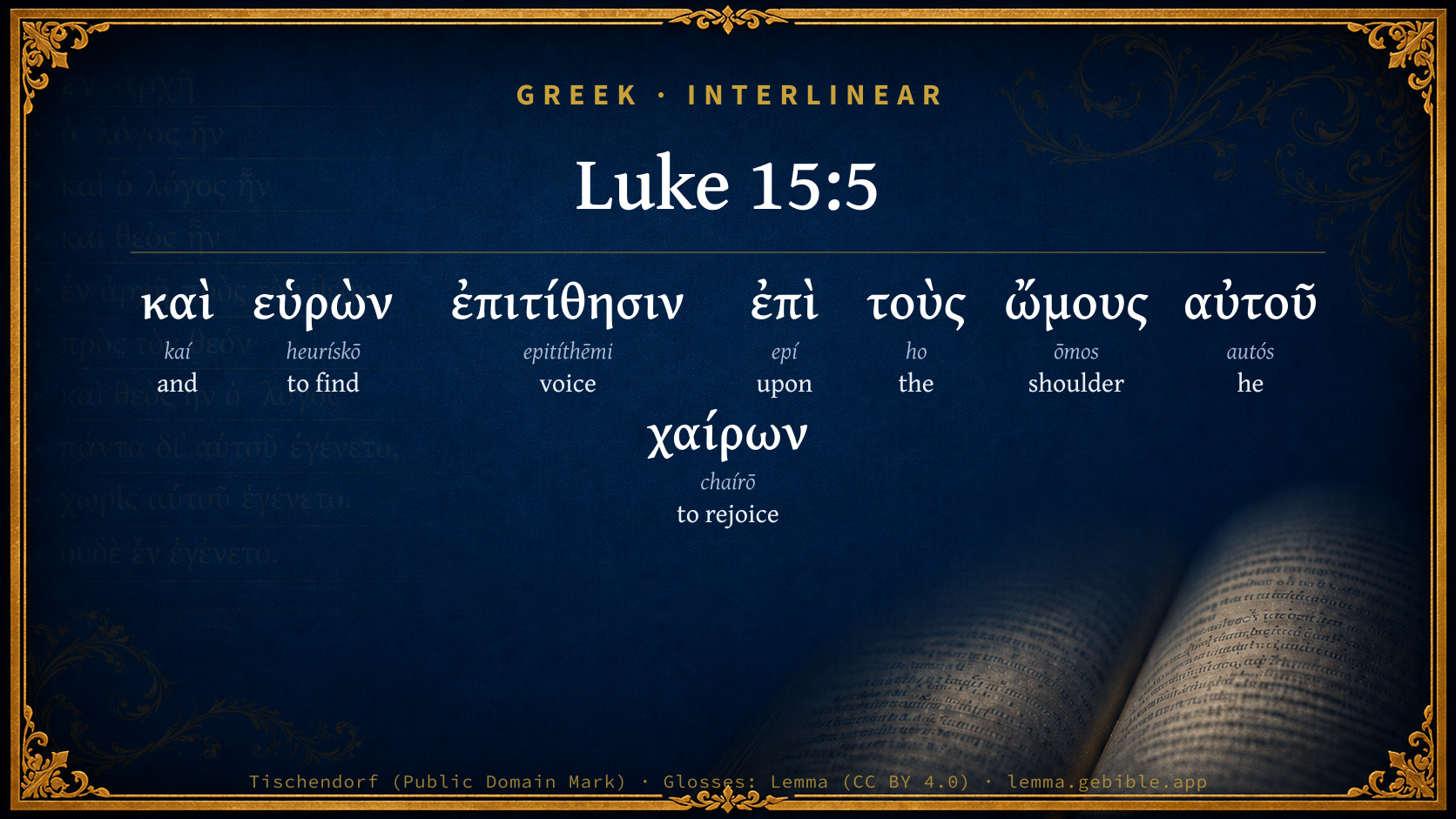
When he has found it, he carries it on his shoulders, rejoicing.
Download a study sheet
One document with this verse’s original text, its word-by-word gloss line, the meaning frame, cross-references with their text, attributed commentary, and full source and license credits — printable, and it pastes into notes with its structure intact.
This verse Autodidact and up
A passage Seminary Student
Up to 50 verses in one chapter. A passage sheet keeps up to 6 commentary sources and 12 cross-references per verse, in the order this page ranks them, and says so on the sheet whenever that leaves anything out. Ask for a single verse and you get the Autodidact verse sheet above.
Everything on this page stays free to read, with no account — the sheet is a download of what is already on screen, not access to it.
Compare translations 3
The same verse in 3 English versions, stacked beneath the original-language interlinear above. Click any original word for its lexicon entry.
Each is an independent rendering of the whole verse — the interlinear is not word-aligned to these translations.
Highlighted words mark where these versions differ — a whole-verse word diff, not a word-by-word alignment.
-
World English Bible Public Domain
When he has found it, he carries it on his shoulders, rejoicing.
-
King James Version Public Domain
And when he hath found it, he layeth it on his shoulders, rejoicing.
-
unfoldingWord Literal Text CC BY-SA 4.0
And having found, he lays on his shoulders, rejoicing.
unfoldingWord Literal Text — © unfoldingWord, licensed CC BY-SA 4.0. Word-aligned USFM3 via Door43 (git.door43.org/unfoldingWord/en_ult).
Show all 19 translations
Every available English version of this verse, each an independent rendering of the whole verse.
-
World English Bible Public Domain
When he has found it, he carries it on his shoulders, rejoicing.
-
Berean Standard Bible Public Domain
And when he finds it, he joyfully puts it on his shoulders,
-
Majority Standard Bible Public Domain
And when he finds it, he joyfully puts it on his shoulders,
-
King James Version Public Domain
And when he hath found it, he layeth it on his shoulders, rejoicing.
-
American Standard Version (1901) Public Domain
And when he hath found it, he layeth it on his shoulders, rejoicing.
-
Revised Version (1885) Public Domain
And when he hath found it, he layeth it on his shoulders, rejoicing.
-
Geneva Bible (1599) Public Domain
And when he hath found it, he laieth it on his shoulders with ioye.
-
Douay-Rheims (1899) Public Domain
And when he hath found it, lay it upon his shoulders, rejoicing:
-
Young's Literal Translation Public Domain
and having found, he doth lay `it' on his shoulders rejoicing,
-
Literal Standard Version CC BY-SA 4.0
And having found, he lays [it] on his shoulders rejoicing,
-
Unlocked Literal Bible CC BY-SA 4.0
Then when he has found it, he lays it across his shoulders and rejoices.
-
unfoldingWord Literal Text CC BY-SA 4.0
And having found, he lays on his shoulders, rejoicing.
-
Darby Bible Public Domain
and having found it, he lays it upon his own shoulders, rejoicing;
-
World Messianic Bible Public Domain
When he has found it, he carries it on his shoulders, rejoicing.
-
Webster's Bible Public Domain
And when he hath found it, he layeth it on his shoulders, rejoicing.
-
Free Bible Version CC BY-SA 4.0
When he finds it, he joyfully puts it on his shoulders.
-
Bible in Basic English Public Domain
And when he has got it again, he takes it in his arms with joy.
-
Text-Critical English NT CC BY 4.0
And when he does find it, he rejoices as he lays it on his shoulders.
-
Tyndale New Testament (1534) Public Domain
And when he hath founde him he putteth him on his shulders with ioye:
Literal Standard Version (2020), Covenant Press — licensed CC BY-SA 4.0. Text via the HelloAO Bible API (eBible.org). Unlocked Literal Bible (unfoldingWord) — licensed CC BY-SA 4.0. Text via the HelloAO Bible API (eBible.org). unfoldingWord Literal Text — © unfoldingWord, licensed CC BY-SA 4.0. Word-aligned USFM3 via Door43 (git.door43.org/unfoldingWord/en_ult). Free Bible Version, Dr. Jonathan Gallagher — licensed CC BY-SA 4.0. Text via the HelloAO Bible API (eBible.org).
Word by word
More ways to search: Search by grammar → Find every occurrence → Compare this word →
Practice this passage: Drill this verse → Learn its vocabulary →
- Appears 2× in the Greek New Testament
- First appears at Matthew 23:4
- Part of Speech
- Noun
- Case
- Accusative
- Number
- Plural
- Gender
- Masculine
Full Thayer's Definition
- καὶ kaí G2532 “and” Conjunction
- εὑρὼν heurískō G2147 “to find” Verb, Aorist, Active, Participle, Nominative, Singular, Masculine
- ἐπιτίθησιν epitíthēmi G2007 “voice” Verb, Present, Active, Indicative, 3rd person, Singular
- ἐπὶ epí G1909 “upon” Preposition
- τοὺς ho G3588 “the” Article, Accusative, Plural, Masculine
- ὤμους ōmos G5606 “shoulder” Noun, Accusative, Plural, Masculine
- αὐτοῦ autós G846 “he” Personal pronoun, Genitive, Singular, Masculine
- χαίρων chaírō G5463 “to rejoice” Verb, Present, Active, Participle, Nominative, Singular, Masculine
About this verse
These counts appear in no published source. They are computed here, from the morphology-tagged text and Lemma’s own curated glosses. What Lemma adds →
- 8
- words
- 8
- distinct lemmas
- Gospels
- section
Cross-references
29Topical passages linked to Luke 15:5 in the Treasury of Scripture Knowledge — connected by theme and wording, ordered by reader-vote popularity; previews shown in the World English Bible.
- Hebrews 12:2 looking to Jesus, the author and perfecter of faith, who for the joy that was set before him endured the cross, despising shame, and has sat down at the right hand of the throne of God.
- Isaiah 40:10–11 Behold, the Lord Yahweh will come as a mighty one, and his arm will rule for him: Behold, his reward is with him, and his recompense before him.
- Isaiah 46:3–4 Listen to me, house of Jacob, and all the remnant of the house of Israel, that have been borne [by me] from their birth, that have been carried from the womb;
- Micah 7:18 Who is a God like you, who pardons iniquity, And passes over the disobedience of the remnant of his heritage? He doesn't retain his anger forever, Because he delights in loving kindness.
- Luke 19:9 Jesus said to him, "Today, salvation has come to this house, because he also is a son of Abraham.
- Isaiah 53:10–11 Yet it pleased Yahweh to bruise him; he has put him to grief: when you shall make his soul an offering for sin, he shall see [his] seed, he shall prolong his days, and the pleasure of Yahweh shall prosper in his hand.
- Isaiah 62:5 For as a young man marries a virgin, so shall your sons marry you; and as the bridegroom rejoices over the bride, so shall your God rejoice over you.
- Isaiah 63:9 In all their affliction he was afflicted, and the angel of his presence saved them: in his love and in his pity he redeemed them; and he bore them, and carried them all the days of old.
- Ezekiel 18:23 Have I any pleasure in the death of the wicked? says the Lord Yahweh; and not rather that he should return from his way, and live?
- Micah 5:4 He shall stand, and shall shepherd in the strength of Yahweh, In the majesty of the name of Yahweh his God: And they will live, for then he will be great to the ends of the earth.
- Zephaniah 3:17 Yahweh, your God, is in the midst of you, a mighty one who will save. He will rejoice over you with joy. He will rest in his love. He will rejoice over you with singing.
- Luke 15:32 But it was appropriate to celebrate and be glad, for this, your brother, was dead, and is alive again. He was lost, and is found.'"
- Luke 23:43 Jesus said to him, "Assuredly I tell you, today you will be with me in Paradise."
- John 4:34–35 Jesus said to them, "My food is to do the will of him who sent me, and to accomplish his work.
- Ephesians 2:3–6 among whom we also all once lived in the lust of our flesh, doing the desires of the flesh and of the mind, and were by nature children of wrath, even as the rest.
- Titus 3:3–7 For we were also once foolish, disobedient, deceived, serving various lusts and pleasures, living in malice and envy, hateful, and hating one another.
- Isaiah 62:12 They shall call them The holy people, The redeemed of Yahweh: and you shall be called Sought out, A city not forsaken.
- Jeremiah 32:41–42 Yes, I will rejoice over them to do them good, and I will plant them in this land assuredly with my whole heart and with my whole soul.
- Ezekiel 33:11 Tell them, As I live, says the Lord Yahweh, I have no pleasure in the death of the wicked; but that the wicked turn from his way and live: turn you, turn you from your evil ways; for why will you die, house of Israel?
- Luke 15:23–24 Bring the fattened calf, kill it, and let us eat, and celebrate;
- John 15:11 I have spoken these things to you, that my joy may remain in you, and that your joy may be made full.
- Acts 9:1–16 But Saul, still breathing threats and slaughter against the disciples of the Lord, went to the high priest,
- Romans 10:20–21 Isaiah is very bold, and says, "I was found by those who didn't seek me. I was revealed to those who didn't ask for me."
- Ephesians 1:19–20 and what is the exceeding greatness of his power toward us who believe, according to that working of the strength of his might
- Ephesians 2:10 For we are his workmanship, created in Christ Jesus for good works, which God prepared before that we would walk in them.
- Ephesians 3:7 of which I was made a servant, according to the gift of that grace of God which was given me according to the working of his power.
- 1 Thessalonians 1:5 and that our Gospel came to you not in word only, but also in power, and in the Holy Spirit, and with much assurance. You know what kind of men we showed ourselves to be among you for your sake.
- 2 Timothy 2:26 and they may recover themselves out of the devil's snare, having been taken captive by him to his will.
- 1 Peter 1:5 who by the power of God are guarded through faith for a salvation ready to be revealed in the last time.
Cross-references courtesy of OpenBible.info (CC BY 4.0).
Lesson kit
Teaching starters — assembled from the data on this page, not authored interpretation. Every prompt links to the verse data it draws on. Edit before teaching.
Luke, in the Gospels, opens this verse with 8 words (8 distinct Greek lemmas). Its most distinctive word is ōmos (“shoulder”). A historical commentator’s framing appears above. Read the whole chapter for the surrounding context.
Discussion questions
- The word ōmos carries the sense “shoulder.” How does it shape the verse?
- Matthew 23:4 shares the word «shoulder» with this verse. How do the two illuminate each other?
- These translations render this verse differently. What is at stake in choosing one wording over another?
- Reading how Bengel's Gnomon and Expositor's Greek Testament read this verse, where do the two commentators agree and where do they part?
Things to notice
- These translations choose different wording for 6 words in this verse.
- 8 distinct Greek lemmas span 8 words in this verse.
Commentary
Notes on Luke 15:5 from classic Christian and Jewish commentators (each source and its license shown beneath its notes). The classic Christian expositions comment on the surrounding passage and are grouped to its opening verse, so a note may address several verses; the Jewish commentaries on the Tanakh (Rashi and others) are per-verse, so they appear only where the commentator wrote on this verse.
Lemma curates 59 commentaries, every one of them public domain or Creative Commons licensed, each selected and text-cleaned for this edition rather than reprinted as found. About our sources →
Bengel's Gnomon
Johann Albrecht Bengel
Bengel's Gnomon of the New Testament — English translation (T&T Clark, Edinburgh, 1860) — public domain. Text from a community e-Sword module.
Expositor's Greek Testament
ed. W. Robertson Nicoll
The Expositor's Greek Testament, edited by W. Robertson Nicoll (1897–1910) — public domain. Text from a community e-Sword module.
Ellicott's Commentary for English Readers
A Bible Commentary for English Readers, edited by Charles John Ellicott (1878–1897) — public domain. Text from a community e-Sword module.
The Cambridge Bible for Schools and Colleges
gen. ed. J. J. S. Perowne
The Cambridge Bible for Schools and Colleges (gen. ed. J. J. S. Perowne; Cambridge University Press, 1878–1918) — public domain. Text from a community e-Sword module.
John Gill's Exposition
John Gill's Exposition of the Whole Bible (1746–1763) — public domain (CC PDM 1.0). Text via the HelloAO Bible API.
Trapp's Complete Commentary
John Trapp
John Trapp, A Commentary or Exposition upon All the Books of the Old and New Testament (1647–1656) — public domain. Text from a community e-Sword module.
Whedon's Commentary on the Bible
Daniel D. Whedon
Daniel D. Whedon (gen. ed.), Commentary on the Old and New Testaments (1874–1909) — public domain. Text from a community e-Sword module.
Cambridge Greek Testament for Schools and Colleges
Cambridge Greek Testament for Schools and Colleges (Cambridge University Press, 1896; 21 vols, various authors incl. Carr, Maclear, Plummer, Farrar, Lumby, Moule, M. R. James, Simcox) — public domain. Text from a community e-Sword module.
Alford’s Greek Testament
Henry Alford
Henry Alford, The Greek Testament (1849–1861) — public domain. Text from a community e-Sword module.
International Critical Commentary
International Critical Commentary — older volumes (1896–1929), various authors — public domain. Text from a community e-Sword module.
Vincent's Word Studies in the New Testament
Marvin R. Vincent
Marvin R. Vincent, Word Studies in the New Testament (1887–1900) — public domain. Text from a community e-Sword/MySword module.