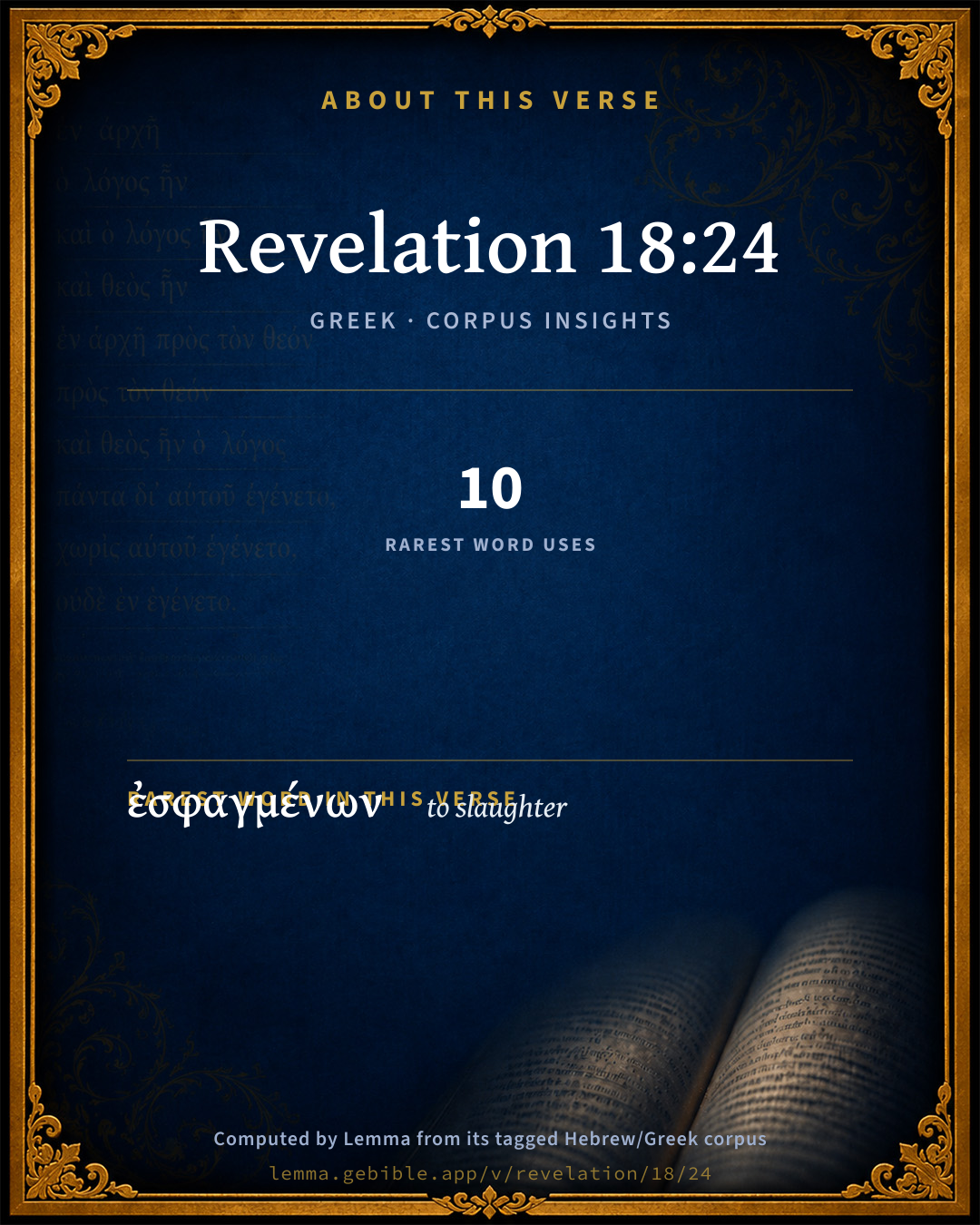
Revelation 18:24

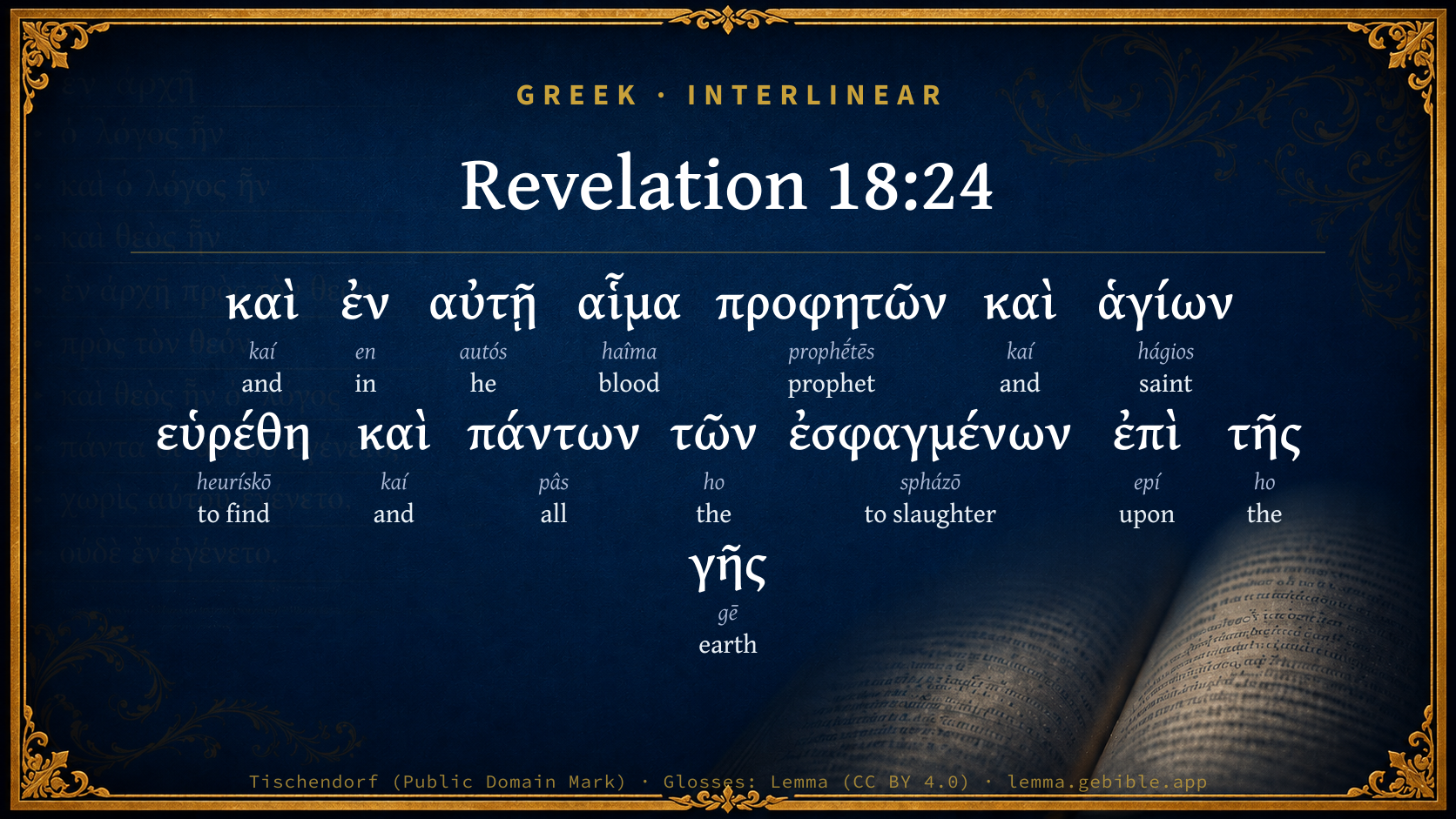
Greek (Tischendorf 8th ed.) Revelation 18:24 appears in the Greek New Testament. The text above is from the Tischendorf 8th edition. Each word links to its Strong’s number and a concise gloss. Click any word for its full Thayer’s Greek Lexicon entry.
Download image
Cite this verse

Revelation 18:24 (World English Bible). Public Domain. Lemma interlinear Bible study tool, https://lemma.gebible.app/v/revelation/18/24.

Show BibTeX & RIS
BibTeX
RIS
English Translation
In her was found the blood of prophets and of saints, and of all who have been slain on the earth."
World English Bible · Public Domain
Download a study sheet

One document with this verse’s original text, its word-by-word gloss line, the meaning frame, cross-references with their text, attributed commentary, and full source and license credits — printable, and it pastes into notes with its structure intact.

This verse Autodidact and up

Study sheet (.html) Plain text (.txt)

A passage Seminary Student

Up to 50 verses in one chapter. A passage sheet keeps up to 6 commentary sources and 12 cross-references per verse, in the order this page ranks them, and says so on the sheet whenever that leaves anything out. Ask for a single verse and you get the Autodidact verse sheet above.

Everything on this page stays free to read, with no account — the sheet is a download of what is already on screen, not access to it.

Want to remove ads? Support Godless Engineer
Compare translations 3

The same verse in 3 English versions, stacked beneath the original-language interlinear above. Click any original word for its lexicon entry.

Each is an independent rendering of the whole verse — the interlinear is not word-aligned to these translations.

Highlighted words mark where these versions differ — a whole-verse word diff, not a word-by-word alignment.

  • World English Bible Public Domain
    In her was found the blood of prophets and of saints, and of all who have been slain on the earth."
  • King James Version Public Domain
    And in her was found the blood of prophets, and of saints, and of all that were slain upon the earth.
  • unfoldingWord Literal Text CC BY-SA 4.0
    And in her was found the blood of prophets and saints and of all the ones having been slain on the earth.”

unfoldingWord Literal Text — © unfoldingWord, licensed CC BY-SA 4.0. Word-aligned USFM3 via Door43 (git.door43.org/unfoldingWord/en_ult).

Versions to compare (up to 4)

3 of 4 selected

Show all 19 translations

Every available English version of this verse, each an independent rendering of the whole verse.

  • World English Bible Public Domain
    In her was found the blood of prophets and of saints, and of all who have been slain on the earth."
  • Berean Standard Bible Public Domain
    And there was found in her the blood of prophets and saints, and of all who had been slain on the earth.
  • Majority Standard Bible Public Domain
    And there was found in her the blood of prophets and saints, and of all who had been slain on the earth.
  • King James Version Public Domain
    And in her was found the blood of prophets, and of saints, and of all that were slain upon the earth.
  • American Standard Version (1901) Public Domain
    And in her was found the blood of prophets and of saints, and of all that have been slain upon the earth.
  • Revised Version (1885) Public Domain
    And in her was found the blood of prophets and of saints, and of all that have been slain upon the earth.
  • Geneva Bible (1599) Public Domain
    And in her was found the blood of the Prophets, and of the Saints, and of all that were slaine vpon the earth.
  • Douay-Rheims (1899) Public Domain
    And in her was found the blood of prophets and of saints, and of all that were slain upon the earth.
  • Young's Literal Translation Public Domain
    and in her blood of prophets and of saints was found, and of all those who have been slain on the earth.'
  • Literal Standard Version CC BY-SA 4.0
    and in her blood of prophets and of holy ones was found, and of all those who have been slain on the earth.”
  • Unlocked Literal Bible CC BY-SA 4.0
    In her the blood of prophets and saints was found, and the blood of all who have been killed on the earth.”
  • unfoldingWord Literal Text CC BY-SA 4.0
    And in her was found the blood of prophets and saints and of all the ones having been slain on the earth.”
  • Darby Bible Public Domain
    And in her was found [the] blood of prophets and saints, and of all the slain upon the earth.
  • World Messianic Bible Public Domain
    In her was found the blood of prophets and of holy ones, and of all who have been slain on the earth.”
  • Webster's Bible Public Domain
    And in her was found the blood of prophets, and of saints, and of all that were slain upon the earth.
  • Free Bible Version CC BY-SA 4.0
    In her the blood of prophets and believers was found, and of all those who have been killed on the earth.”
  • Bible in Basic English Public Domain
    And in her was seen the blood of prophets and of saints, and of all who have been put to death on the earth.
  • Text-Critical English NT CC BY 4.0
    And in her was found the blood of prophets and of saints and of all who have been slain on the earth.
  • Tyndale New Testament (1534) Public Domain
    and in her was founde the bloude of the prophettes and of the saynctes and of all that were slayne apon the erth.

Literal Standard Version (2020), Covenant Press — licensed CC BY-SA 4.0. Text via the HelloAO Bible API (eBible.org). Unlocked Literal Bible (unfoldingWord) — licensed CC BY-SA 4.0. Text via the HelloAO Bible API (eBible.org). unfoldingWord Literal Text — © unfoldingWord, licensed CC BY-SA 4.0. Word-aligned USFM3 via Door43 (git.door43.org/unfoldingWord/en_ult). Free Bible Version, Dr. Jonathan Gallagher — licensed CC BY-SA 4.0. Text via the HelloAO Bible API (eBible.org).

Word by word

More ways to search: Search by grammar → Find every occurrence → Compare this word →

Practice this passage: Drill this verse → Learn its vocabulary →

ἐσφαγμένων
spházō
G4969
“to slaughter”
Verb, Perfect, Passive, Participle, Genitive, Plural, Masculine
Part of Speech
Verb
Tense
Perfect
Voice
Passive
Mood
Participle
Case
Genitive
Number
Plural
Gender
Masculine
Full Thayer's Definition

Origin: a primary verb

TDNT: 22:25,1

1. to slay, slaughter, butcher 2. to put to death by violence 3. mortally wounded
  1. καὶ kaí G2532 “and” Conjunction
  2. ἐν en G1722 “in” Preposition
  3. αὐτῇ autós G846 “he” Personal pronoun, Dative, Singular, Feminine
  4. αἷμα haîma G129 “blood” Noun, Nominative, Singular, Neuter
  5. προφητῶν prophḗtēs G4396 “prophet” Noun, Genitive, Plural, Masculine
  6. καὶ kaí G2532 “and” Conjunction
  7. ἁγίων hágios G40 “saint” Adjective, Genitive, Plural, Masculine
  8. εὑρέθη heurískō G2147 “to find” Verb, Aorist, Passive, Indicative, 3rd person, Singular
  9. καὶ kaí G2532 “and” Conjunction
  10. πάντων pâs G3956 “all” Adjective, Genitive, Plural, Masculine
  11. τῶν ho G3588 “the” Article, Genitive, Plural, Masculine
  12. ἐπὶ epí G1909 “upon” Preposition
  13. τῆς ho G3588 “the” Article, Genitive, Singular, Feminine
  14. γῆς gē G1093 “earth” Noun, Genitive, Singular, Feminine

About this verse

These counts appear in no published source. They are computed here, from the morphology-tagged text and Lemma’s own curated glosses. What Lemma adds →

15
words
12
distinct lemmas
Revelation
section

Notable vocabulary

The rarest word here is ἐσφαγμένων to slaughter G4969 — appearing just 10 times in the whole Greek New Testament.

Shared distinctive vocabulary

ἐσφαγμένων to slaughter G4969 occurs in 9 verses of the Greek New Testament. Also found in:

Repetition

Words recur within this verse:

Cross-references

15

Topical passages linked to Revelation 18:24 in the Treasury of Scripture Knowledge — connected by theme and wording, ordered by reader-vote popularity; previews shown in the World English Bible.

  • Revelation 17:6 I saw the woman drunken with the blood of the saints, and with the blood of the martyrs of Jesus. When I saw her, I wondered with great amazement.
  • Revelation 16:6 For they poured out the blood of the saints and the prophets, and you have given them blood to drink. They deserve this."
  • Jeremiah 51:49 As Babylon has caused the slain of Israel to fall, so at Babylon shall fall the slain of all the land.
  • Acts 7:52 Which of the prophets didn't your fathers persecute? They killed those who foretold the coming of the Righteous One, of whom you have now become betrayers and murderers.
  • Revelation 19:2 for true and righteous are his judgments. For he has judged the great prostitute, who corrupted the earth with her sexual immorality, and he has avenged the blood of his servants at her hand."
  • Matthew 23:27 "Woe to you, scribes and Pharisees, hypocrites! For you are like whitened tombs, which outwardly appear beautiful, but inwardly are full of dead men's bones, and of all uncleanness.
  • Daniel 7:21 I saw, and the same horn made war with the saints, and prevailed against them;
  • Matthew 23:35 that on you may come all the righteous blood shed on the earth, from the blood of righteous Abel to the blood of Zachariah son of Barachiah, whom you killed between the sanctuary and the altar.
  • Revelation 11:7 When they have finished their testimony, the beast that comes up out of the abyss will make war with them, and overcome them, and kill them.
  • Jeremiah 2:34 Also in your skirts is found the blood of the souls of the innocent poor: you did not find them breaking in; but it is because of all these things.
  • Ezekiel 22:9 Slanderous men have been in you to shed blood; and in you they have eaten on the mountains: in the midst of you they have committed lewdness.
  • Ezekiel 22:12 In you have they taken bribes to shed blood; you have taken interest and increase, and you have greedily gained of your neighbors by oppression, and have forgotten me, says the Lord Yahweh.
  • Ezekiel 22:27 Her princes in the midst of it are like wolves ravening the prey, to shed blood, [and] to destroy souls, that they may get dishonest gain.
  • Luke 11:47–51 Woe to you! For you build the tombs of the prophets, and your fathers killed them.
  • 1 Thessalonians 2:15 who killed both the Lord Jesus and their own prophets, and drove us out, and didn't please God, and are contrary to all men;

Cross-references courtesy of OpenBible.info (CC BY 4.0).

Commentary

Notes on Revelation 18:24 from classic Christian and Jewish commentators (each source and its license shown beneath its notes). The classic Christian expositions comment on the surrounding passage and are grouped to its opening verse, so a note may address several verses; the Jewish commentaries on the Tanakh (Rashi and others) are per-verse, so they appear only where the commentator wrote on this verse.

Lemma curates 59 commentaries, every one of them public domain or Creative Commons licensed, each selected and text-cleaned for this edition rather than reprinted as found. About our sources →

Bengel's Gnomon

Johann Albrecht Bengel

Rev 18:24. Ἐν αὐτῇ, in her) The angel speaks this also; and yet he does not say, in thee, but, in her (comp. Mat 23:37), namely, in the deceiver of the nations, who is now so overthrown, that she does not hear the last part of this address.—πάντων τῶν ἐσφαγμένων, of all, who have been slain) Aringhus, T. i. of the work above quoted, f. 125, shows, that all the theatres of the Roman empire were marked by the slaughter of Christians; and he also says, f. 132, that Rome alone became as it were the GENERAL SHAMBLES for slaying the sheep of Christ. Pagan Rome shed much blood, papal Rome not less. From A. 1518 to 1548, more than fifteen millions of Protestants were put to death through the instrumentality of the Inquisition, according to the opinion of some, as is related in my Germ. Exeg. on this passage. This vast number is even doubled from A. 1550 to 1580, in Hoe on Ap. xvii. qu. 234. Neither of these calculations is probable. More than 900,000 are calculated to have been slain from A. 1540, or 1550, to 1580, by Fred. Seyler, in his Rome Drunken, pp. 339, 340. The true number, whatever it is, is stupendous.

Bengel's Gnomon of the New Testament — English translation (T&T Clark, Edinburgh, 1860) — public domain. Text from a community e-Sword module.

Expositor's Greek Testament

ed. W. Robertson Nicoll

Rev 18:24 . Again, as at Rev 18:20 , the change of style (here from an apostrophe to a description) and spirit (Rev 17:6 ) marks an insertion by the final editor, unless the verse originally lay after Rev 18:3 . The triple rhythm corresponds to that of Rev 18:20 . Rome has now succeeded Jerusalem (Mat 23:35 , etc.) as the arch-enemy of the faithful. The climax of her iniquities is couched in terms of the primitive Semitic idea (Gen 4:10 ) that exposed and discovered blood is a cry for vengeance [ 2Ma 8:3 f.]; blood violently shed wails till it is appeased by the punishment of the murderers. By a natural hyperbole, Rome is held responsible for the murders, judicial and otherwise, of saints and prophets and the slain of Israel in general substituted here for the “apostles” of Rev 18:20 , probably to include the Jews killed in the recent war as well as pre-Christian martyrs like the Maccabees of whom Augustine finely says: nondum quidem erat mortuus Christus, sed martyres eos fecit moriturus Christus (Heb 1:11 to Heb 12:1 ). Rome here is the last and worst exponent of persecution. Her collapse is attributed to their blood drawing down God’s utter retribution. “My blood be on the inhabitants of Chaldea, shall Jerusalem say” (Jer 51:35 , imprecating successfully the divine revenge, Jer 51:36 ; Jer 51:49 ). As Chrysostom called Psalms 109. a prophecy in the shape of a curse, this vehement, sensitive oracle against Rome’s insolence and cruelty may be termed a curse in the form of a prophecy. A similar idea underlay the view of certain pious people who, according to Josephus ( cf. Eus. H. E. ii. 23. 20 21), considered the fall of Jerusalem a retribution for the foul murder of James the Just nearly ten years before.

The doom-song is followed by an outburst of celestial triumph (Rev 19:1-8 ) in answer to Rev 18:20 . The conclusion as well as the commencement of the victory (Rev 12:12 f.) is hymned in heaven. The stern, exultant anthem, which is morally superior to the delight voiced by En. xlvii. 4, forms an overture to the final movement of the Apocalypse, as well as (like Rev 7:9 f., Rev 14:1-5 ) a relief to the sombre context. 8 b is a prosaic editorial gloss, probably due to the liturgical use of the book, and the last clause of 10 ( ἡ γὰρ … προφητείας ) might be the same ( cf. 1Co 15:56 ), as many editors think, were it not for the genuinely Johannine ring of the words. In any case it is an after-thought, probably (so Baljon, Barth, etc.) added by the author himself, in order to bring out here what is brought out in Rev 22:9 by the explicit mention of the prophets, since ἐχ . τ . μ . Ἰησοῦ alone would mean Christians in general. The presence of 9b 10 here, however, is not motived as at Rev 22:8-9 , where it comes in naturally at the finalê of the revelations and after a distinct allusion (Rev 22:1 ) to the revealing angel. Here the angel of the second λέγει (at least) has not been mentioned since Rev 17:1 ; Rev 17:7 ; Rev 17:15 , and no reason at all is given for the superstitious impulse to worship. The passage is certainly Johannine, but probably misplaced (like Rev 18:14 , etc.). Can it have originally lain at the end of 17., where the hierophant angel is speaking ( cf. also Rev 17:17 , words of God and Rev 19:9 b)? Such technical dislocations and derangements are common enough in primitive literature ( cf. my Historical New Testament , pp. xxxix. 676, 690). The passage must have been shifted to its present site either by accident or more probably by a scribe who saw that the similar assurance in Rev 21:5 , Rev 22:6 related primarily to future bliss rather than to judgment; perhaps he also took the first λέγει not as a divine saying ( cf. Rev 21:5 ) but as angelic (Rev 22:6 , cf. Rev 1:10-11 ; Rev 1:19 , and note on Rev 22:10 ), and sought to harmonise the same order as in Rev 14:13 (command to write, beatitude, asseverance). Otherwise 1 10 is a unity as it stands. The change of situation in 1 3, 4 10 does not prove any combination of sources; it is simply another of the inconsequences and transitions characteristic of the whole book. The marriage-idea of 7, 8 is a proleptic hint which is not developed till later (21), while the supper (9) is only mentioned to be dropped unless the grim vision of 17 21 (for which cf. Gressmann’s Ursprung d. Isr.-jüd. Eschatologie , 136 f.) is meant to be a foil to it (so Sabatier and Schön).

The Expositor's Greek Testament, edited by W. Robertson Nicoll (1897–1910) — public domain. Text from a community e-Sword module.

Geneva Bible (1599)

Geneva Bible translators

That is shed by bloody massacres, and calling for vengeance.

That is, proved and found out, as if God had appointed a just inquiry, concerning the impiety, unnaturalness and injustice of those men.

Geneva Bible (1599) marginal notes — public domain. Text via Bolls.life.

Jamieson, Fausset & Brown

Robert Jamieson, A. R. Fausset & David Brown

Applied by Christ (Mat 23:35) to apostate Jerusalem, which proves that not merely the literal city Rome, and the Church of Rome (though the chief representative of the apostasy), but the WHOLE of the faithless Church of both the Old and New Testament is meant by Babylon the harlot; just as the whole Church (Old and New Testament) is meant by "the woman" (Rev 12:1). As to literal city, ARINGHUS in BENGEL says, Pagan Rome was the "general shambles" for slaying the sheep of Jesus. FRED. SEYLER in BENGEL calculates that papal Rome, between A.D. 1540 and 1580, slew more than nine hundred thousand Protestants. Three reasons for the harlot's downfall are given: (1) The worldly greatness of her merchants, which was due to unholy traffic in spiritual things. (2) Her sorceries, or juggling tricks, in which the false prophet that ministers to the beast in its last form shall exceed her; compare "sorcerers" (Rev 21:8; Rev 22:15), specially mentioned among those doomed to the lake of fire. (3) Her persecution of (Old Testament) "prophets" and (New Testament) "saints."

Next: Revelation Chapter 19

Jamieson, Fausset & Brown — Commentary Critical and Explanatory on the Whole Bible (1871) — public domain (CC PDM 1.0). Text via the HelloAO Bible API.

Adam Clarke's Commentary

Verse 24. In her was found the blood of prophets, c.] She was the persecutor and murderer of prophets and of righteous men.

And of all that were slain upon the earth.] This refers to her counsels and influence, exciting other nations and people to persecute and destroy the real followers of God. There is no city to which all these things are yet applicable, therefore we may presume that the prophecy remains yet to be fulfilled.

Bishop Bale, who applies this, as before, to the Romish Church, has, on Re 18:22, given some information to the curious antiquary.

"But be certaine," says he, "and sure, thou myserable Church, that thou shalt no longer enjoy the commodious pleasures of a free cittye.-The merry noyes of them that play upon harpes, lutes, and fidels the sweet voice of musicians that sing with virginals, vials, and chimes; the armony of them that pipe in recorders, flutes, and drums; and the shirle showt of trumpets, waits, and shawmes, shall no more be heard in thee to the delight of men. Neyther shall the sweet organs containing the melodious noyse of all maner of instruments and byrdes be plaied upon, nor the great belles be rong after that, nor yet the fresh discant, prick-song, counter-point, and faburden be called for in thee, which art the very sinagog of Sathan. Thy lascivious armonye, and delectable musique, much provoking the weake hartes of men to meddle in thy abhominable whordom, by the wantonnes of idolatry in that kinde, shall perish with thee for ever. No cunning artificer, carver, paynter, nor gilder, embroderer, goldsmith, nor silk-worker; with such other like of what occupacion soever they be, or have bene to thy commodity, shall never more be found so agayne.

"Copes, cruettes, candelstickes, miters, crosses, sensers, crismatoris, corporasses, and chalices, which for thy whorishe holines might not somtime be touched, will than for thy sake be abhorred of all men. Never more shall be builded for marchants of thi livery and mark, palaces, temples, abbeys, collages, covents, chauntries, fair houses, and horcherds of plesure. The clapping noise of neyther wyndmil, horsemil, nor watermil, shal any more be heard to the gluttenous feeding of thy puffed up porklings, for the maintenaunce of thine idle observacions and ceremonies. For thy mitred marchaunts were sumtimes princes of the earth, whan they reigned in their roialty. Thy shorn shavelinges were lordes over the multitude whan they held their priestly authority over the soules and bodies of men. Yea, and with thy privy legerdemain, with thy juggling castes, with thy craftes and inchauntmentes of thy subtile charmes, were all nacions of the world deceyved."

This is very plain language, and thus on all hands a monstrous system of superstition and idolatry was attacked by our Reformers; and with these unfurbished weapons, directed by the Spirit of the living God, popery was driven from the throne, from the bench, from the universities, and from the churches of this favoured kingdom. And by a proper application of Scripture, and by the universal diffusion of the word of God, it may be soon driven from the face of the universe. And when the inventions of men are separated from that Church, and it becomes truly regenerated, (and of this it is highly capable, as, among its monstrous errors and absurdities, it contains all the essential truths of God,) it will become a praise and a glory in the earth. Protestants wish not its destruction, but its reformation.

Some there may be, who, in their zeal for truth, would pull the whole edifice to pieces; but this is not God's method: he destroys what is evil, and saves what is good. It is reformation, not annihilation, that this Church needs.

Adam Clarke's Commentary on the Bible (1810–1826) — public domain. Text from a community e-Sword/MySword module.

Ellicott's Commentary for English Readers

(24) And in her was found . . .—It is not by seductiveness only that her guilt is measured: her hands are defiled with blood: the blood of prophets, who had witnessed against her: of saints, whose holy lives were a protest against her sins, and so hateful to her; and “of all who have been slain on the earth.” (Comp. Rev_17:6, and Note there.) It is not meant that literally all the blood shed by violence had been shed by Rome, or any other single city of which Babylon is type: all that is meant is that Babylon, the world city, is founded on those principles, the logical outcome of which is violence, bloodshed, and hostility to the highest right: those who die by her hands, few or many, are the evidence that the whole tendency of her power is against holiness and truth. In the earthly view, we are guilty of the acts we do: in the heavenly view, we are guilty of all that the spirit and sin of our conduct tends to do. The spirit of transgression is seen in one act as well as in many, and as it is the attitude of the spirit that God looks upon, so in a single act may be gathered up the transgression of the whole law. (Comp. Rev_17:6, and Note there; see also Jas_2:10). It is the fatal failure to perceive this which leads man to make light of sin, and to undervalue the Cross of Christ.

A Bible Commentary for English Readers, edited by Charles John Ellicott (1878–1897) — public domain. Text from a community e-Sword module.

The Cambridge Bible for Schools and Colleges

gen. ed. J. J. S. Perowne

24. And in her] St John passes from recording the angel’s denunciation to the impression made on his own mind by the judgement he witnessed.

of all that were slain upon the earth] Cf. Jer_51:49, where however, if the A. V. be right, the sense is rather different. “The slain of all the earth” here seem to mean “the slain of (the spiritual) Israel,” there, the allies of Babylon who share in her fall.

The Cambridge Bible for Schools and Colleges (gen. ed. J. J. S. Perowne; Cambridge University Press, 1878–1918) — public domain. Text from a community e-Sword module.

Trapp's Complete Commentary

John Trapp

24 And in her was found the blood of prophets, and of saints, and of all that were slain upon the earth.

Ver. 24. And in her was found] Rome hath ever been the slaughter house of the saints, as Jerusalem was before her, Mat 23:34-39.

And of all that were slain] For she hath a hand in all the wars of Europe, besides all the Christian blood shed by her instigation, in those holy wars, as they called them, for the recovery of the land of Canaan.

John Trapp, A Commentary or Exposition upon All the Books of the Old and New Testament (1647–1656) — public domain. Text from a community e-Sword module.

Albert Barnes' Notes on the Bible

And in her - When she came to be destroyed, and her real character was seen.

Was found the blood of prophets - Of the public teachers of the true religion. On the word “prophets” see the notes on Rev 18:20.

And of saints - Of the holy. See the notes on Rev 18:20.

And of all that were slain upon the earth - So numerous have been the slain, so constant and bloody have been the persecutions there, that it may be said that all the blood ever shed has been poured out there. Compare the notes on Mat 23:35. No one can doubt the propriety of this representation with respect to pagan and papal Rome.

In regard to the general meaning and application of this chapter the following remarks may be made:

(1) It refers to papal Rome, and is designed to describe the final overthrow of that formidable anti-Christian power. The whole course of the interpretation of the previous chapters demands such an application, and the chapter itself naturally suggests it.

(2) If it be asked why so much of this imagery is derived from the condition of a maritime power, or pertains to commerce, since both Babylon and Rome were at some distance from the sea, and neither could with propriety be regarded as seaport towns, it may be replied:

(a)That the main idea in the mind of John was that of a rich and magnificent city;

(b)That all the things enumerated were doubtless found, in fact, in both Babylon and Rome;

(c)That though not properly seaport towns, they were situated on rivers that opened into seas, and were therefore not unfavorably situated for commerce; and,

(d)That, in fact, they traded with all parts of the earth.

The leading idea is that of a great and luxurious city, and this is filled up and decorated with images of what is commonly found in large commercial towns. We are not, therefore, to look for a literal application of this, and it is not necessary to attempt to find all these things, in fact, in the city referred to. Much of the description may be for the mere sake of keeping, or ornament.

(3) If this refers to Rome, as is supposed, then, in accordance with the previous representations, it shows that the destruction of the papal power is to be complete and final. The image which John had in his eye as illustrating that was undoubtedly ancient Babylon as prophetically described in Isa. 13–14, and the destruction of the power here referred to is to be as complete as was the destruction described there. It would not be absolutely necessary in the fulfillment of this to suppose that Rome itself is to become a heap of ruins like Babylon, whatever may be true on that point, but that the papal power, as such, is to be so utterly destroyed that the ruins of desolate Babylon would properly represent it.

(4) If this interpretation is correct, then the Reformation was in entire accordance with what God would have his people do, and was demanded by solemn duty to him. Thus, in Rev 18:4, his people are expressly commanded to “come out of her, that they might not be partakers of her sins, nor of her plagues.” If it had been the design of the Reformers to perform a work that should be in all respects a fulfilling of the command of God, they could have done nothing that would have more literally met the divine requirement. Indeed, the church has never performed a duty more manifestly in accordance with the divine will, and more indispensable for its own purity, prosperity, and safety, than the act of separating entirely and forever from papal Rome.

(5) The Reformation was a great movement in human affairs. It was the index of great progress already reached, and the pledge of still greater. The affairs of the world were at that period placed on a new footing, and from the period of the Reformation, and just in proportion as the principles of the Reformation are acted on, the destiny of mankind is onward.

(6) The fall of papal Rome, as described in this chapter, will remove one of the last obstructions to the final triumph of the gospel. In the notes on Rev 16:10-16, we saw that one great hindrance to the spread of the true religion would be taken away by the decline and fall of the Turkish power. A still more formidable hindrance will be taken away by the decline and fall of the papal power; for that power holds more million of the race under its subjection, and with a more consummate art, and a more powerful spell. The papal influence has been felt, and still is felt, in a considerable part of the world. It has churches, and schools, and colleges, in almost all lands. It exercises a vast influence over governments. It has powerful societies organized for the purpose of propagating its opinions; and it so panders to some of the most powerful passions of our nature, and so converts to its own purposes all the resources of superstition, as still to retain a mighty, though a waning hold on the human mind. When this power shall finally cease, anyone can see that perhaps the most mighty obstruction which has ever been on the earth for a thousand years to the spread of the gospel will have been removed, and the way will be prepared for the introduction of the long-hoped-for millennium.

Albert Barnes' Notes on the Bible (1834–1885) — public domain. Text from a community e-Sword/MySword module.

Matthew Poole's English Annotations

In the rubbish of Rome, when destroyed, will be found the blood of all those holy servants of God, whether ministers of the gospel, or professors of it, who ever since the year 606, when the pope came first to his power, have been put to death for the testimony of Christ, and a faithful adherence to the purity of doctrine by him delivered, the purity of worship by him prescribed and directed, or the purity of discipline by his direction set up. As it is storied, that upon the dissolution of abbeys, and monasteries, and nunneries here in England, there were found in holes of walls, and ponds, the skulls and bones of many infants, the supposed bastards of those fathers: so, though men cannot or will not see it now, yet when the papacy shall have its period, men shall understand, that no prophet nor righteous man hath violently been put to death for the truth out of Rome, that is, out of the jurisdiction and influence of Rome; but though it may be they have been no professed papists that have been the cause or instruments of their death, yet they have done it as influenced from that bloody city; and the principles have been perfectly popish and antichristian which madly hurried them on to such cruelties. It was one of Luthers reasons why he would have none put to death for heresy, (as they call it), because he would have this particular character reserved for that antichristian synagogue.—But ah, Lord Jesus! When shall these things be? Or who shall live when the wise providence of God shall effect them, to join with the whole church, both triumphant and militant, in the song which we have prophesied of upon this occasion in the next chapter.

It is not for us to know the times or the seasons, which the Father hath put in his own power, Act 1:7.

Matthew Poole's English Annotations on the Holy Bible (1683–1685) — public domain. Text from a community e-Sword/MySword module.

Whedon's Commentary on the Bible

Daniel D. Whedon

24. Prophets—The prophets were slain by Rome only as she is identical with the antichrist of the Old Testament ages, with Babylon, and even with the antichrist in the material, literal Jerusalem. And this is transparently true of the last clause—all the good that were slain upon the earth. And the fact that the Romish Babylon is type and inheritress of all the great antichristic systems, being the complete beast of all the seven in one total eighth, explains the commercial figures imported into this bold chant. The city is figure of the profane, spiritual, and secular antichristic world-power. The theological and moral debauchery of all the antichristic ages was identical with all their pomp and trade and commercial intercourse. Prophecy mingles them all in one, and consigns them to the same ruin.

Then shall a new system arise, in which righteousness and purity shall reign.

Daniel D. Whedon (gen. ed.), Commentary on the Old and New Testaments (1874–1909) — public domain. Text from a community e-Sword module.

The Pulpit Commentary

And in her was found the blood of prophets, and of saints, and of all that were slain upon the earth. At first sight it seems difficult to understand that these words are spoken not only of Babylon, but of the faithless portion of the Church, symbolized by the harlot. But we must remember

(1) that he who is guilty in respect of one commandment, is guilty of the whole Law;

(2) similar words are addressed by Jeremiah to Judah: (Jer_2:34) "Also in thy skirts is found the blood of the souls of the poor innocents". (see on Rev_17:1) Auberlen remarks, "Wherever true, faithful Christians are neglected and oppressed by the rulers of the Church, from avowed or secret antipathy to God"s truth; where a false theology and science robs youth of its faith; where a pastor neglects, and keeps at a distance, the true living Christians in his flock, on account of the signum crucis which they bear; wherever we refuse or are ashamed to bear the reproach of Jesus Christ, our heavenly Master, even as he bore it, there we commit murder against the saints of God.

Here is concluded the pronouncement of the judgment of Babylon; which may be said to answer the prayer in Rev_6:10; and which forms the conclusion of the revelation commencing at Re 17.

The Pulpit Commentary (1880–1919), ed. H.D.M. Spence-Jones & Joseph S. Exell — public domain. Text from a community e-Sword module.

John Wesley's Explanatory Notes

And in her was found the blood of the prophets and saints - The same angel speaks still, yet he does not say "in thee," but in her, now so sunk as not to hear these last words. And of all that had been slain - Even before she was built. See Matt. xxiii, 35. There is no city under the sun which has so clear a title to catholic blood-guiltiness as Rome. The guilt of the blood shed under the heathen emperors has not been removed under the Popes, but hugely multiplied. Nor is Rome accountable only for that which hath been shed in the city, but for that shed in all the earth. For at Rome under the Pope, as well as under the heathen emperors, were the bloody orders and edicts given: and wherever the blood of holy men was shed, there were the grand rejoicings for it. And what immense quantities of blood have been shed by her agents! Charles IX., of France, in his letter to Gregory XIII., boasts, that in and not long after the massacre of Paris, he had destroyed seventy thousand Hugonots. Some have computed, that, from the year 1518, to 1548, fifteen millions of Protestants have perished by the Inquisition. This may be overcharged; but certainly the number of them in those thirty years, as well as since, is almost incredible. To these we may add innumerable martyrs, in ancient, middle, and late ages, in Bohemia, Germany, Holland, France, England, Ireland, and many other parts of Europe, Afric, and Asia.

John Wesley, Explanatory Notes Upon the Whole Bible (1754–1765) — public domain. Text via the GEBible commentary corpus.

The People's New Testament

B. W. Johnson

24. And in her was found the blood of the prophets. It is because she has slain the saints of the Most High that these judgments come upon her. As Jerusalem in the time of Christ filled up the measure of the sins of Israel (see Matt. 23:29, 35, 36; Luke 11:51; 13:33), so the spiritual Babylon, the great persecutor, fills up the measure of the sins of the beast and false prophet, and is required to account for the blood of slaughtered prophets and saints of all ages.

B. W. Johnson's The People's New Testament with Notes (1889–1891) — public domain. Electronic text from the Christian Classics Ethereal Library (CCEL) ThML edition.

Cambridge Greek Testament for Schools and Colleges

24. αἶμα. Tisch[684] reads αἴματα with B2 and And. comm[685]

[684] Tischendorf: eighth edition; where the text aud notes differ the latter are cited.

[685] comm. Andreas’ Commentary: the text of the MSS. differs.

24. καὶ ἐν αὐτῇ. As in the beginning of the Angel’s speech Babylon is spoken of in the third person, it is possible that he returns to the third person at the end: possibly also St John passes from recording the Angel’s denunciation to the impression made on his own mind by the judgement he witnessed.

πάντων … τῆς γῆς. Cf. Jer 51:49, where however, if the A. V[694] be right, the sense is rather different. “The slain of all the earth” here seems to mean “the slain of (the spiritual) Israel,” or at any rate the victims of her tyranny, there, the allies of Babylon who share in her fall.

[694] Authorised Version.

Cambridge Greek Testament for Schools and Colleges (Cambridge University Press, 1896; 21 vols, various authors incl. Carr, Maclear, Plummer, Farrar, Lumby, Moule, M. R. James, Simcox) — public domain. Text from a community e-Sword module.

Lesson kit

Teaching starters — assembled from the data on this page, not authored interpretation. Every prompt links to the verse data it draws on. Edit before teaching.

Revelation, in the Revelation, opens this verse with 15 words (12 distinct Greek lemmas). Its most distinctive word is spházō (“to slaughter”). A historical commentator’s framing appears above. Read the whole chapter for the surrounding context.

Discussion questions

  1. The word spházō carries the sense “to slaughter.” How does it shape the verse?
  2. 1 John 3:12 shares the word «to slaughter» with this verse. How do the two illuminate each other?
  3. “and” occurs 3× in this one verse. What is the effect of the repetition?
  4. The translations on this page render this verse differently — a whole-verse word diff, not a word-by-word alignment. What might account for the different wordings?
  5. Reading how Bengel's Gnomon and Expositor's Greek Testament read this verse, where do the two commentators agree and where do they part?

Things to notice

Reading settings

Reading text

Shown beneath each verse's original-language words.

Old Testament
Old Testament edition

Read the OT as the Masoretic Hebrew (MT) or the Greek Septuagint (LXX).

English shown for the Greek Septuagint (in the Hebrew ↔ Greek comparison).

Comparing translations? Open the Compare panel on any verse page to stack up to four side by side.