Revelation 20:15

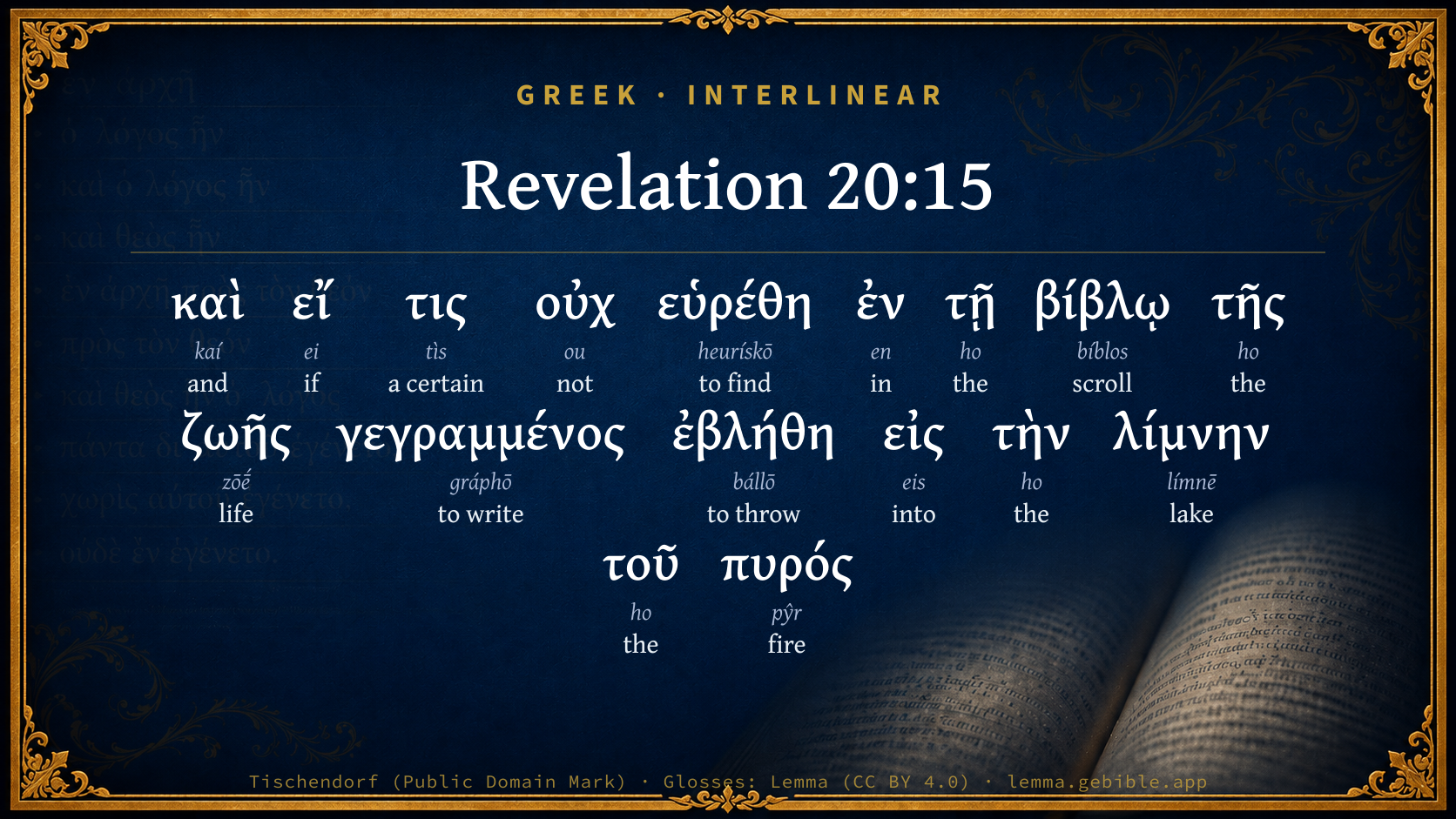
Greek (Tischendorf 8th ed.) Revelation 20:15 appears in the Greek New Testament. The text above is from the Tischendorf 8th edition. Each word links to its Strong’s number and a concise gloss. Click any word for its full Thayer’s Greek Lexicon entry.
Download image
Cite this verse

Revelation 20:15 (World English Bible). Public Domain. Lemma interlinear Bible study tool, https://lemma.gebible.app/v/revelation/20/15.

Show BibTeX & RIS
BibTeX
RIS
English Translation
If anyone was not found written in the book of life, he was cast into the lake of fire.
World English Bible · Public Domain
Download a study sheet

One document with this verse’s original text, its word-by-word gloss line, the meaning frame, cross-references with their text, attributed commentary, and full source and license credits — printable, and it pastes into notes with its structure intact.

This verse Autodidact and up

Study sheet (.html) Plain text (.txt)

A passage Seminary Student

Up to 50 verses in one chapter. A passage sheet keeps up to 6 commentary sources and 12 cross-references per verse, in the order this page ranks them, and says so on the sheet whenever that leaves anything out. Ask for a single verse and you get the Autodidact verse sheet above.

Everything on this page stays free to read, with no account — the sheet is a download of what is already on screen, not access to it.

Want to remove ads? Support Godless Engineer
Compare translations 3

The same verse in 3 English versions, stacked beneath the original-language interlinear above. Click any original word for its lexicon entry.

Each is an independent rendering of the whole verse — the interlinear is not word-aligned to these translations.

Highlighted words mark where these versions differ — a whole-verse word diff, not a word-by-word alignment.

  • World English Bible Public Domain
    If anyone was not found written in the book of life, he was cast into the lake of fire.
  • King James Version Public Domain
    And whosoever was not found written in the book of life was cast into the lake of fire.
  • unfoldingWord Literal Text CC BY-SA 4.0
    And if anyone was not found written in the Book of Life, he was thrown into the lake of fire.

unfoldingWord Literal Text — © unfoldingWord, licensed CC BY-SA 4.0. Word-aligned USFM3 via Door43 (git.door43.org/unfoldingWord/en_ult).

Versions to compare (up to 4)

3 of 4 selected

Show all 19 translations

Every available English version of this verse, each an independent rendering of the whole verse.

  • World English Bible Public Domain
    If anyone was not found written in the book of life, he was cast into the lake of fire.
  • Berean Standard Bible Public Domain
    And if anyone was found whose name was not written in the Book of Life, he was thrown into the lake of fire.
  • Majority Standard Bible Public Domain
    And if anyone was found whose name was not written in the Book of Life, he was thrown into the lake of fire.
  • King James Version Public Domain
    And whosoever was not found written in the book of life was cast into the lake of fire.
  • American Standard Version (1901) Public Domain
    And if any was not found written in the book of life, he was cast into the lake of fire.
  • Revised Version (1885) Public Domain
    And if any was not found written in the book of life, he was cast into the lake of fire.
  • Geneva Bible (1599) Public Domain
    And whosoeuer was not found written in the booke of life, was cast into the lake of fire.
  • Douay-Rheims (1899) Public Domain
    And whosoever was not found written in the book of life, was cast into the pool of fire.
  • Young's Literal Translation Public Domain
    and if any one was not found written in the scroll of the life, he was cast to the lake of the fire.
  • Literal Standard Version CC BY-SA 4.0
    and if anyone was not found written in the Scroll of Life, he was cast into the lake of the fire.
  • Unlocked Literal Bible CC BY-SA 4.0
    If anyone's name was not found written in the Book of Life, he was thrown into the lake of fire.
  • unfoldingWord Literal Text CC BY-SA 4.0
    And if anyone was not found written in the Book of Life, he was thrown into the lake of fire.
  • Darby Bible Public Domain
    And if any one was not found written in the book of life, he was cast into the lake of fire.
  • World Messianic Bible Public Domain
    If anyone was not found written in the book of life, he was cast into the lake of fire.
  • Webster's Bible Public Domain
    And whoever was not found written in the book of life was cast into the lake of fire.
  • Free Bible Version CC BY-SA 4.0
    Anyone whose name was not found written in the book of life was thrown into the lake of fire.
  • Bible in Basic English Public Domain
    And if anyone's name was not in the book of life, he went down into the sea of fire.
  • Text-Critical English NT CC BY 4.0
    If anyone's name was not found written in the book of life, he was thrown into the lake of fire.
  • Tyndale New Testament (1534) Public Domain
    And whosoever was not founde written in the boke of lyfe was cast into the lake of fyre.

Literal Standard Version (2020), Covenant Press — licensed CC BY-SA 4.0. Text via the HelloAO Bible API (eBible.org). Unlocked Literal Bible (unfoldingWord) — licensed CC BY-SA 4.0. Text via the HelloAO Bible API (eBible.org). unfoldingWord Literal Text — © unfoldingWord, licensed CC BY-SA 4.0. Word-aligned USFM3 via Door43 (git.door43.org/unfoldingWord/en_ult). Free Bible Version, Dr. Jonathan Gallagher — licensed CC BY-SA 4.0. Text via the HelloAO Bible API (eBible.org).

Word by word

More ways to search: Search by grammar → Find every occurrence → Compare this word →

Practice this passage: Drill this verse → Learn its vocabulary →

βίβλῳ
bíblos
G976
“scroll”
Noun, Dative, Singular, Feminine
Part of Speech
Noun
Case
Dative
Number
Singular
Gender
Feminine
Full Thayer's Definition

Origin: primitive root

TDNT: 11:15,1

1. a written book, a roll, a scroll
  1. καὶ kaí G2532 “and” Conjunction
  2. εἴ ei G1487 “if” Conditional
  3. τις tìs G5100 “a certain” Indefinite pronoun, Nominative, Singular, Masculine
  4. οὐχ ou G3756 “not” Particle, Negative
  5. εὑρέθη heurískō G2147 “to find” Verb, Aorist, Passive, Indicative, 3rd person, Singular
  6. ἐν en G1722 “in” Preposition
  7. τῇ ho G3588 “the” Article, Dative, Singular, Feminine
  8. τῆς ho G3588 “the” Article, Genitive, Singular, Feminine
  9. ζωῆς zōḗ G2222 “life” Noun, Genitive, Singular, Feminine
  10. γεγραμμένος gráphō G1125 “to write” Verb, Perfect, Passive, Participle, Nominative, Singular, Masculine
  11. ἐβλήθη bállō G906 “to throw” Verb, Aorist, Passive, Indicative, 3rd person, Singular
  12. εἰς eis G1519 “into” Preposition
  13. τὴν ho G3588 “the” Article, Accusative, Singular, Feminine
  14. λίμνην límnē G3041 “lake” Noun, Accusative, Singular, Feminine
  15. τοῦ ho G3588 “the” Article, Genitive, Singular, Neuter
  16. πυρός pŷr G4442 “fire” Noun, Genitive, Singular, Neuter

About this verse

These counts appear in no published source. They are computed here, from the morphology-tagged text and Lemma’s own curated glosses. What Lemma adds →

17
words
14
distinct lemmas
Revelation
section

Notable vocabulary

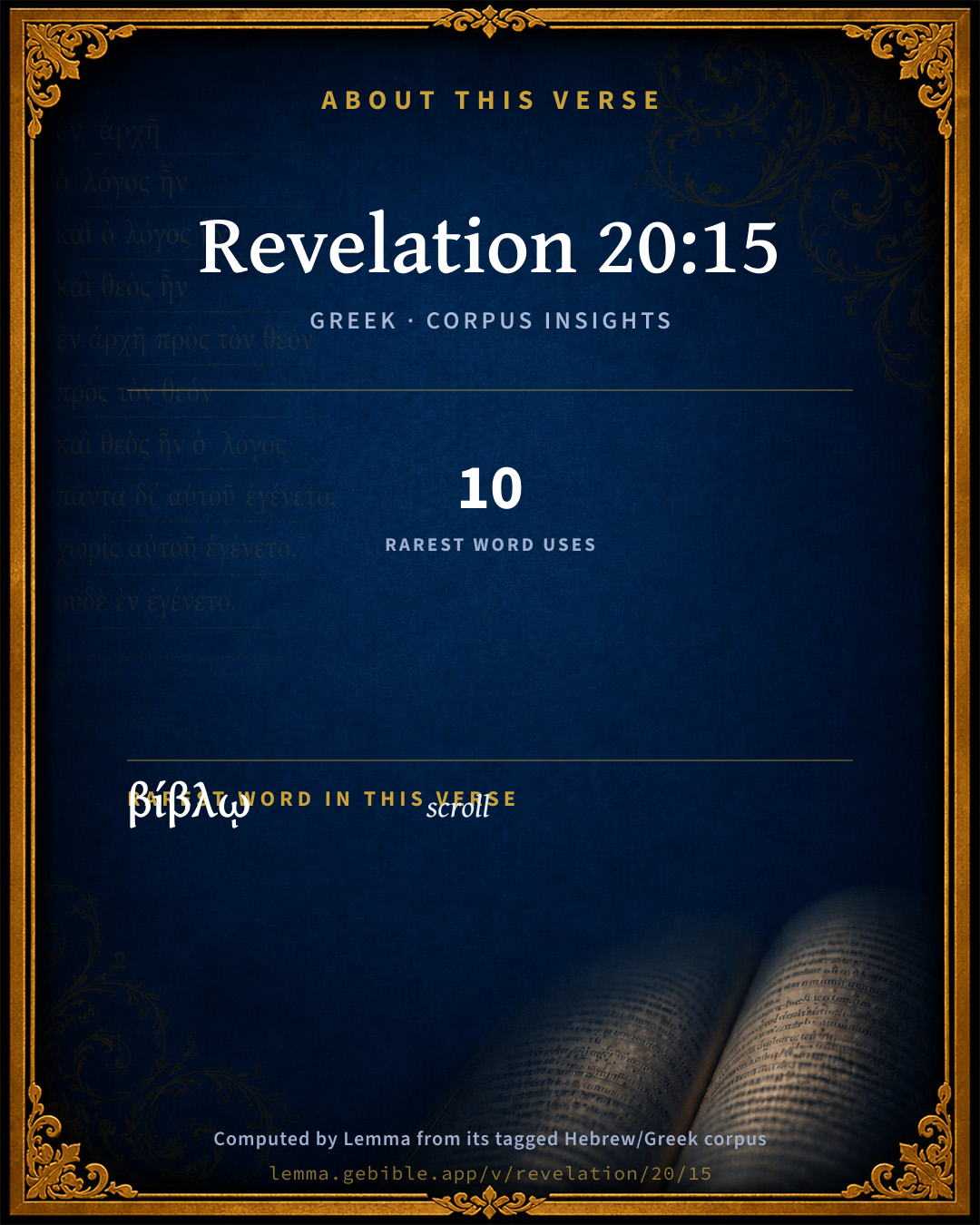
The rarest word here is βίβλῳ scroll G976 — appearing just 10 times in the whole Greek New Testament.

Shared distinctive vocabulary

βίβλῳ scroll G976 occurs in 10 verses of the Greek New Testament. Also found in:

Repetition

A word recurs within this verse:

Cross-references

14

Topical passages linked to Revelation 20:15 in the Treasury of Scripture Knowledge — connected by theme and wording, ordered by reader-vote popularity; previews shown in the World English Bible.

  • John 3:36 One who believes in the Son has eternal life, but one who disobeys the Son won't see life, but the wrath of God remains on him."
  • Matthew 13:50 and will cast them into the furnace of fire. There will be the weeping and the gnashing of teeth."
  • Matthew 25:41 Then he will say also to those on the left hand, 'Depart from me, you cursed, into the eternal fire which is prepared for the devil and his angels;
  • John 14:6 Jesus said to him, "I am the way, the truth, and the life. No one comes to the Father, except through me.
  • Acts 4:12 There is salvation in none other, for neither is there any other name under heaven, that is given among men, by which we must be saved!"
  • 1 John 5:11–12 The testimony is this, that God gave to us eternal life, and this life is in his Son.
  • John 3:18–19 He who believes in him is not judged. He who doesn't believe has been judged already, because he has not believed in the name of the one and only Son of God.
  • Hebrews 2:3 how will we escape if we neglect so great a salvation-- which at the first having been spoken through the Lord, was confirmed to us by those who heard;
  • Hebrews 12:25 See that you don't refuse him who speaks. For if they didn't escape when they refused him who warned on the Earth, how much more will we not escape who turn away from him who warns from heaven,
  • Revelation 19:20 The beast was taken, and with him the false prophet who worked the signs in his sight, with which he deceived those who had received the mark of the beast and those who worshiped his image. These two were thrown alive into the lake of fire that burns with sulfur.
  • Revelation 20:12 I saw the dead, the great and the small, standing before the throne, and they opened books. Another book was opened, which is the book of life. The dead were judged out of the things which were written in the books, according to their works.
  • Mark 16:16 He who believes and is baptized will be saved; but he who disbelieves will be condemned.
  • Mark 9:43–48 If your hand causes you to stumble, cut it off. It is better for you to enter into life maimed, rather than having your two hands to go into Gehenna, into the unquenchable fire,
  • Matthew 13:42 and will cast them into the furnace of fire. There will be weeping and the gnashing of teeth.

Cross-references courtesy of OpenBible.info (CC BY 4.0).

Commentary

Notes on Revelation 20:15 from classic Christian and Jewish commentators (each source and its license shown beneath its notes). The classic Christian expositions comment on the surrounding passage and are grouped to its opening verse, so a note may address several verses; the Jewish commentaries on the Tanakh (Rashi and others) are per-verse, so they appear only where the commentator wrote on this verse.

Lemma curates 59 commentaries, every one of them public domain or Creative Commons licensed, each selected and text-cleaned for this edition rather than reprinted as found. About our sources →

Expositor's Greek Testament

ed. W. Robertson Nicoll

In Enoch (xxxviii. 5, xlviii. 9) the wicked are handed over by God to the saints, before whom they burn like straw in fire and sink like lead in water. The milder spirit of the Christian prophet abstains from making the saints thus punish or witness the punishment of the doomed ( cf. on Rev 14:10 ). In Apoc. Pet. 25 the souls of the murdered gaze on the torture of their former persecutors, crying ὁ θεὸς , δικαία σου ἡ κρίσις . These features, together with those of torturing angels (Dieterich, 60 f.) and Dantesque gradations of punishment (Dieterich, 206 f.), are conspicuous by their absence from John’s Apocalypse. There is a stern simplicity about the whole description, and just enough pictorial detail is given to make the passage morally suggestive. As gehenna, like paradise (4 Ezr 3:4 ), was created before the world, according to rabbinic belief (Gfrörer, ii. 42 46), it naturally survived the collapse of the latter (Rev 20:11 ). Contrast with this passage the relentless spirit of 4. Esd. 7:49 f. (“I will not mourn over the multitude of the perishing … they are set on fire and burn hotly and are quenched”). If John betrays no pity for the doomed, he exhibits no callous scorn for their fate. The order of Rev 20:13-15 and Rev 21:1 f. is the same as in the haggadic pseudo-Philonic De Biblic. Anti-quitatibus (after 70 A.D.) where the judgment (“reddet infernus debitum suum et perditio restituet paratecen suam, ut reddam unicuique secundum opera sua”) is followed by the renewal of all things (“et exstinguetur mors et infernus claudet os suum … et erit terra alia et caelum aliud habitaculum sempiternum”).

So much for the doomed. The bliss of saints occupies the closing vision (Rev 21:1 to Rev 22:5 ). From the smoke and pain and heat it is a relief to pass into the clear, clean atmosphere of the eternal morning where the breath of heaven is sweet and the vast city of God sparkles like a diamond in the radiance of his presence. The dominant idea of the passage is that surroundings must be in keeping with character and prospects; consequently, as the old universe has been hopelessly sullied by sin, a new order of things must be formed, once the old scene of trial and failure is swept aside. This hope of the post-exilic Judaism ( cf. Isa 65:17 ; Isa 66:22 ) was originally derived from the Persian religion, in which the renovation of the universe was a cardinal tenet; it is strongly developed in Enoch (xci. 16, civ. 2, new heaven only) and 4 Esd. 4:27 f. (“if the place where the evil is sown pass not away, there cannot come the field where the good is sown”). The expectation ( cf on Rom 8:28 f.) that the loss sustained at the fall of Adam would now be made good, is handly the same as this eschatological transformation; the latter prevailed whenever the stern exigencies of the age seemed to demand a clean sweep of the universe, and the apocalyptic attitude towards nature seldom had anything of the tenderness and pathos, e.g. , of 4 Esd. 8:42 48 ( cf. 7:31). The sequence of Rev 20:11 f. and Rev 21:1 f. therefore follows the general eschatological programme, as e.g. in Apoc. Bar. xxi. 23 f., where, after death is ended (very mildly), the new world promised by God appears as the dwelling-place of the saints ( cf. also 32:1 f.). The earthly Jerusalem is good enough for the millennium but not for the final bliss; the new order (Rev 21:5 ) of latter ( cf. above) coincides, as in Oriental religion (Jeremiah , 45 f.), with the new year ( i.e. , spring) festival of the god’s final victory. The literary problem is more intricate. With Rev 21:1-8 , which is evidently the prophet’s own composition, the Apocalypse really closes. The rest of the vision, down to Rev 22:5 , is little more than a poetical repetition and elaboration ol Rev 21:1-8 , to which Rev 22:6 f. forms the appropriate conclusion, just as the doublet Rev 19:9 b , Rev 19:10 (in its present position) does to Rev 19:1-8 . When Rev 19:9 b , Rev 19:10 is transferred to the end of 17 (see above), the parallelism becomes even closer. Both 17 (the vision of the harlot-Babylon, with her evil influence on the world, and her transient empire) and Rev 21:9 to Rev 22:5 (the vision of the Lamb’s pure bride, with her endless empire) are introduced alike ( cf. Rev 17:1 , Rev 21:9 ) and ended alike, though Rev 22:6-8 has been slightly expanded in view of its special position as a climax to the entire Apocalypse. As 17. represents John’s revision of an earlier source, this suggests, but does not prove, a similar origin for Rev 21:9 to Rev 22:5 . He might have sketched the latter as an antithesis to the former; certainly the “editorial” brushwork in Rev 21:9 to Rev 22:5 is not nearly so obvious and abrupt as, e.g. , in 18. Upon the other hand there are touches and traits which have been held to imply the revision of a source or sources, especially of a. Jewish character (so variously Vischer, Weyland, Ménégoz, Spitta, Sabatier, Briggs, Schmidt, S. Davidson, von Soden, de Faye, Kohler, Baljon, J. Weiss, and Forbes), delineating the new Jerusalem ( cf. Rev 21:1-2 ). In this event the Christian editor’s hand would be visible, not necessarily in Rev 21:22 (see note), but in the ἀρνίον -allusions, in Rev 21:14 b , Rev 21:23 ( cf. Rev 22:5 ), 25 b (= Rev 22:5 a ), and 27 (= Rev 20:15 , Rev 21:8 , Rev 22:3 a ). Another set of features (Rev 21:12 ; Rev 21:16 ; Rev 21:24-27 a , Rev 22:2 c , Rev 22:3 a , Rev 22:5 ) is explicable apart from the hypothesis of a Jewish source, or indeed of any source at all. Literally taken, they are incongruous. But since Rev 21:9 to Rev 22:5 may be equivalent not so much to a Jewish ideal conceived sub specie Christiana as to a Christian ideal expressed in the imaginative terms of a Jewish tradition which originally depicted an earthly Jerusalem surrounded by the respectful nations of the world, a number of traits in the latter sketch would obviously be inapplicable in the new setting to which they were transferred. These are retained, however, not only for the sake of their archaic associations but in order to lend pictorial completeness to the description of the eternal city. The author, in short, is a religious poet, not a theologian or a historian. But while these archaic details need not involve the use of a Jewish source (so rightly Schön and Wellhausen), much less a reference of the whole vision to the millennial Jerusalem (Zahn), or the ascription of it to Cerinthus (Völter) or a chiliastic Jewish Christian editor (Bruston), may not the repetitions and parallelisms, especially in view of Rev 22:6 f., indicate a composite Christian origin, as is suggested, e.g., by Erbes (A = Rev 21:1-4 , Rev 22:3-17 ; Rev 22:20-21 , [920] = Rev 21:5-27 , Rev 22:1-2 ; Rev 22:18-19 ) and Selwyn (Rev 22:16-21 , the conclusion of [921] = Rev 21:2 , Rev 22:3-5 , Rev 21:3-6 a , Rev 22:7 , Rev 21:6-8Rev 21:6-8Rev 21:6-8 , or of [922] = Rev 21:9 to Rev 22:2 , Rev 22:6 ; Rev 22:8-15 )? Some dislocation of the original autograph or scribal additions may be conjectured with reason in Rev 22:6-21 (see below), at least. But the reiterations are intelligible enough as the work of a single writer, whose aim is to impress an audience rather than to produce a piece of literature. The likelihood is that John composed Rev 21:9 f. as an antithesis to the description of the evil city which he had reproduced from a source in 17, and that he repeated the incident of Rev 22:8-9 (as Rev 19:9-10 at the end of 17), adapting it to its position at the close of the whole book as well as of the immediately preceding oracle.

[920] Codex Vaticanus (sæc. iv.), published in photographic facsimile in 1889 under the care of the Abbate Cozza-Luzi.

[921] Codex Alexandrinus (sæc. v.), at the British Museum, published in photographic facsimile by Sir E. M. Thompson (1879).

[922] Codex Vaticanus (sæc. iv.), published in photographic facsimile in 1889 under the care of the Abbate Cozza-Luzi.

The Expositor's Greek Testament, edited by W. Robertson Nicoll (1897–1910) — public domain. Text from a community e-Sword module.

Jamieson, Fausset & Brown

Robert Jamieson, A. R. Fausset & David Brown

The blissful lot of the righteous is not here specially mentioned as their bliss had commenced before the final judgment. Compare, however, Mat 25:34, Mat 25:41, Mat 25:46.

Next: Revelation Chapter 21

Jamieson, Fausset & Brown — Commentary Critical and Explanatory on the Whole Bible (1871) — public domain (CC PDM 1.0). Text via the HelloAO Bible API.

Adam Clarke's Commentary

Verse 15. Written in the book of life] Only those who had continued faithful unto death were taken to heaven. All whose names were not found in the public registers, who either were not citizens, or whose names had been erased from those registers because of crimes against the state, could claim none of those emoluments or privileges which belong to the citizens; so those who either did not belong to the new and spiritual Jerusalem, or who had forfeited their rights and privileges by sin, and had died in that state, were cast into the lake of fire.

THIS is the way in which God, at the day of judgment, will proceed with sinners and apostates. Reader, see that thy name be written in the sacred register; and, if written in, see that it never be blotted out.

Adam Clarke's Commentary on the Bible (1810–1826) — public domain. Text from a community e-Sword/MySword module.

The Cambridge Bible for Schools and Colleges

gen. ed. J. J. S. Perowne

15. And whosoever &c.] “By the works of the Law shall no flesh be justified.” Any who are not in the number of those saved by God’s free grace, are sure to have sins recorded against them, sufficient for a judgement “out of those things which were written in the books” to end in this terrible sentence. Cf. St Mat_25:41.

The Cambridge Bible for Schools and Colleges (gen. ed. J. J. S. Perowne; Cambridge University Press, 1878–1918) — public domain. Text from a community e-Sword module.

John Gill's Exposition

And whosoever was not found written in the book of life,.... Upon the opening of it, Rev 20:12 as all that worship the beast, and wonder after him, Rev 13:8 and all wicked men, everyone of them:

was cast into the lake of fire; where are the devil, beast, and false prophet, Rev 19:20. It is a saying of R. Isaac (m),

"woe to the wicked, who are not written "in the book", for they shall perish in hell for ever and ever:''

and in the Targum on Eze 13:9 it is said of the false prophets,

"that , "in the writing of eternal life" (or in the book of eternal life), which is written for the righteous of the house of Israel, they shall not be written.''

There seems to be some allusion in the phrase used here, and in the preceding verse, and elsewhere in this book, to the lake Asphaltites, a sulphurous lake, where Sodom and Gomorrah stood, which the Jews call the salt sea, or the bituminous lake; and whatsoever was useless, or rejected, or abominable, or accursed, they used to say, to show their rejection and detestation of it, let it be cast into the sea of salt, or the bituminous lake; thus, for instance,

"any vessels that had on them the image of the sun, or of the moon, or of a dragon, , "let them cast them into the salt sea", or bituminous lake (n).''

(m) Tosaphta in Zohar in Gen. fol. 78. 2. (n) T. Bab. Avoda Zara, fol. 42. 2. Vid. ib. fol. 49. 1. &. 53. 1. & 71. 2. & Nazir, fol. 24. 2. & 26. 1, 2. Bava Metzia, fol. 52. 2. Temura, fol. 22. 2. & Meila, fol. 9. 2. & 10. 1.

Next: Revelation Chapter 21

John Gill's Exposition of the Whole Bible (1746–1763) — public domain (CC PDM 1.0). Text via the HelloAO Bible API.

Trapp's Complete Commentary

John Trapp

15 And whosoever was not found written in the book of life was cast into the lake of fire.

Ver. 15. And whosoever] As those priests were cashiered that could not prove their pedigree, Ezr 2:62-63.

John Trapp, A Commentary or Exposition upon All the Books of the Old and New Testament (1647–1656) — public domain. Text from a community e-Sword module.

Albert Barnes' Notes on the Bible

And whosoever - All persons, of all ranks, ages, and conditions. No word could be more comprehensive than this. The single condition here stated, as being what would save any from being cast into the lake of fire, is, that they are “found written in the book of life.” All besides these, princes, kings, nobles, philosophers, statesmen, conquerors; rich men and poor men; the bond and the free; the young and the aged; the frivolous, the vain, the proud, and the sober; the modest and the humble, will be doomed to the lake of fire. Unlike in all other things, they will be alike in the only thing on which their eternal destiny will depend - that they have not so lived that their names have become recorded in the book of life. As they will also be destitute of true religion, there will be a propriety that they shall share the same doom in the future world.

Written in the book of life - See the notes on Rev 3:5.

Was cast into the lake of fire - See the notes on Mat 25:41. That is, they will be doomed to a punishment which will be well represented by their lingering in a sea of fire forever. This is the termination of the judgment - the winding up of the affairs of men. The vision of John here rests for a moment on the doom of the wicked, and then turns to a more full contemplation of the happy lot of the righteous, as detailed in the two closing chapters of the book.

Section e. - Condition of things referred to in Rev 20:11-15;

(1) There will be a general resurrection of the dead - of the righteous and the wicked. This is implied by the statement that the “dead, small and great,” were seen to stand before God; that “the sea gave up the dead which were in it”; that “Death and Hades gave up their dead.” All were there whose names were or were not written in the book of life.

(2) There will be a solemn and impartial judgment. How long a time this will occupy is not said, and is not necessary to be known - for time is of no consequence where there is an eternity of devotion - but it is said that they will be all judged “according to their works” - that is, strictly according to their character. They will receive no arbitrary doom; they will have no sentence which will not be just. See Mat. 25:31-46.

(3) This will be the “final” judgment. After this, the affairs of the race will be put on a different footing. This will be the end of the present arrangements; the end of the present dispensations; the end of human probation. The great question to be determined in regard to our world will have been settled; what the plan of redemption was intended to accomplish on the earth will have been accomplished; the agency of the Divine Spirit in converting sinners will have come to an end; and the means of grace, as such, will be employed no more. There is not here or elsewhere an intheation that beyond this period any of these things will exist, or that the work of redemption, as such, will extend into the world beyond the judgment. As there is no intheation that the condition of the righteous will be changed, so there is none that the condition of the wicked will be; as there is no hint that the righteous will ever be exposed to temptation, or to the danger of falling into sin, so there is none that the offers of salvation will ever again be made to the wicked. On the contrary, the whole representation is, that all beyond this will be fixed and unchangeable forever. See the notes on Rev 22:11.

(4) The wicked will be destroyed, in what may be properly called the “second” death. As remarked in the notes, this does not mean that this death will in all respects resemble the first death, but there will be so many points of resemblance that it will be proper to call it “death.” It does not mean that they will be “annihilated,” for “death” never implies that. The meaning is, that this will be a cutting off from what is properly called “life,” from hope, from happiness, and from peace, and a subjection to pain and agony, which it will be proper to call “death” - death in the most fearful form; death that will continue for ever. No statements in the Bible are more clear than those which are made on this point; no affirmation of the eternal punishment of the wicked “could be” more explicit than those which occur in the sacred Scriptures. See the Mat 25:46 note, and 2Th 1:9 note.

(5) This will be the end of the woes and calamities produced in the kingdom of God by sin. The reign of Satan and of Death, so far as the Redeemer’s kingdom is concerned, will be at an end and henceforward the church will be safe from all the arts and efforts of its foes. Religion will be triumphant, and the affairs of the universe be reduced to permanent order.

(6) The preparation is thus made for the final triumph of the righteous - the state to which all things tend. The writer of this book has conducted the prospective history through all the times of persecution which awaited the church, and stated the principal forms of error which would prevail, and foretold the conflicts through which the church would pass, and described its eventful history to the millennial period, and to the final triumph of truth and righteousness; and now nothing remains to complete the plan of the work but to give a rapid sketch of the final condition of the redeemed. This is done in the two following chapters, and with this the work is ended.

Albert Barnes' Notes on the Bible (1834–1885) — public domain. Text from a community e-Sword/MySword module.

Matthew Poole's English Annotations

The book of life: See Poole on "Rev 20:12".

Matthew Poole's English Annotations on the Holy Bible (1683–1685) — public domain. Text from a community e-Sword/MySword module.

Whedon's Commentary on the Bible

Daniel D. Whedon

15. Book of life—There was no book of death. Heaven has a glorious citizenship, and a glorious census-book of its citizens. But gehenna is an anarchy, without record and without citizenship.

Daniel D. Whedon (gen. ed.), Commentary on the Old and New Testaments (1874–1909) — public domain. Text from a community e-Sword module.

The Pulpit Commentary

And whosoever was not found written in the book of life was east into the lake of fire; and if any was not, etc. This is practically a reiteration of what has been twice before solemnly asserted (see vers. 12, 13).

The Pulpit Commentary (1880–1919), ed. H.D.M. Spence-Jones & Joseph S. Exell — public domain. Text from a community e-Sword module.

The People's New Testament

B. W. Johnson

15. And whosoever was not found written … was cast into the lake of fire. Into the same lake of fire, that prison house to which have gone the false prophet and the beast, to which has been consigned the dragon, “that old serpent the devil,” the “eternal fire which has been prepared for the devil and his angels.” There shall also be banished those whose “names are not written in the book of life.” This is the second death. As far as Inspiration throws its light upon the sad lot of those consigned to that “lake of fire,” theirs is an eternal fate. When some one has shown that doors of this final prison of the Universe have opened to permit the escape of those who have been consigned to its keeping, then we may perhaps indulge some hope that its prisoners will, in the lapse of endless years, escape from their sad environment.

B. W. Johnson's The People's New Testament with Notes (1889–1891) — public domain. Electronic text from the Christian Classics Ethereal Library (CCEL) ThML edition.

Cambridge Greek Testament for Schools and Colleges

15. εὑρεθη. א εὑρεθήσεται.

15. καὶ εἴ τις.… May either be a parallel to Gal 2:16 or a reference to ch. Rev 14:10-11 implying that ordinary sinners will be punished with the Devil, the False Prophet, the Beast and his worshippers. Cf. St Mat 25:41 sqq.

Cambridge Greek Testament for Schools and Colleges (Cambridge University Press, 1896; 21 vols, various authors incl. Carr, Maclear, Plummer, Farrar, Lumby, Moule, M. R. James, Simcox) — public domain. Text from a community e-Sword module.

Vincent's Word Studies in the New Testament

Marvin R. Vincent

And whosoever [ει τις] . Lit., if any. So Rev.

Marvin R. Vincent, Word Studies in the New Testament (1887–1900) — public domain. Text from a community e-Sword/MySword module.

Lesson kit

Teaching starters — assembled from the data on this page, not authored interpretation. Every prompt links to the verse data it draws on. Edit before teaching.

Revelation, in the Revelation, opens this verse with 17 words (14 distinct Greek lemmas). Its most distinctive word is bíblos (“scroll”). A historical commentator’s framing appears above. Read the whole chapter for the surrounding context.

Discussion questions

  1. What does “scroll” (bíblos) contribute to the verse as a whole?
  2. How does Matthew 1:1, which shares the word «scroll», read alongside this verse?
  3. What does the repetition of “the” (4× in this one verse) do in this verse?
  4. The translations on this page render this verse differently — a whole-verse word diff, not a word-by-word alignment. What might account for the different wordings?
  5. Compare how Expositor's Greek Testament and Jamieson, Fausset & Brown read this verse. Where do they agree or differ?

Things to notice

Reading settings

Reading text

Shown beneath each verse's original-language words.

Old Testament
Old Testament edition

Read the OT as the Masoretic Hebrew (MT) or the Greek Septuagint (LXX).

English shown for the Greek Septuagint (in the Hebrew ↔ Greek comparison).

Comparing translations? Open the Compare panel on any verse page to stack up to four side by side.