

Acts 12:19
Greek (Tischendorf 8th ed.) Acts 12:19 appears in the Greek New Testament. The text above is from the Tischendorf 8th edition. Each word links to its Strong’s number and a concise gloss. Click any word for its full Thayer’s Greek Lexicon entry.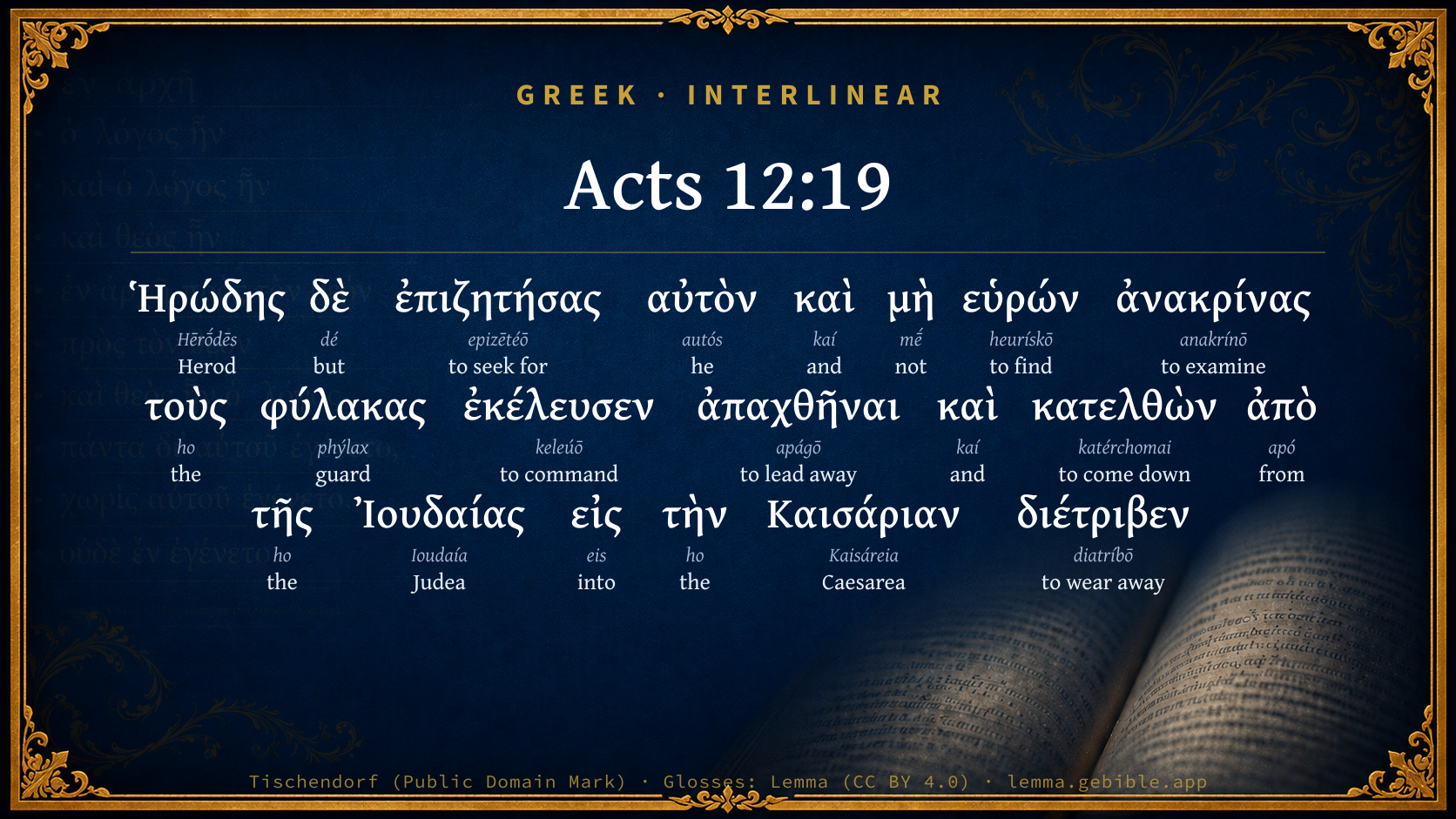
When Herod had sought for him, and didn't find him, he examined the guards, and commanded that they should be put to death. He went down from Judea to Caesarea, and stayed there.
Download a study sheet
One document with this verse’s original text, its word-by-word gloss line, the meaning frame, cross-references with their text, attributed commentary, and full source and license credits — printable, and it pastes into notes with its structure intact.
This verse Autodidact and up
A passage Seminary Student
Up to 50 verses in one chapter. A passage sheet keeps up to 6 commentary sources and 12 cross-references per verse, in the order this page ranks them, and says so on the sheet whenever that leaves anything out. Ask for a single verse and you get the Autodidact verse sheet above.
Everything on this page stays free to read, with no account — the sheet is a download of what is already on screen, not access to it.
Compare translations 3
The same verse in 3 English versions, stacked beneath the original-language interlinear above. Click any original word for its lexicon entry.
Each is an independent rendering of the whole verse — the interlinear is not word-aligned to these translations.
Highlighted words mark where these versions differ — a whole-verse word diff, not a word-by-word alignment.
-
World English Bible Public Domain
When Herod had sought for him, and didn't find him, he examined the guards, and commanded that they should be put to death. He went down from Judea to Caesarea, and stayed there.
-
King James Version Public Domain
And when Herod had sought for him, and found him not, he examined the keepers, and commanded that they should be put to death. And he went down from Judaea to Caesarea, and there abode.
-
unfoldingWord Literal Text CC BY-SA 4.0
And Herod, having searched for him and not having found him, having questioned the guards, ordered them to be put to death. And having gone down from Judea to Caesarea, he was staying there.
unfoldingWord Literal Text — © unfoldingWord, licensed CC BY-SA 4.0. Word-aligned USFM3 via Door43 (git.door43.org/unfoldingWord/en_ult).
Show all 19 translations
Every available English version of this verse, each an independent rendering of the whole verse.
-
World English Bible Public Domain
When Herod had sought for him, and didn't find him, he examined the guards, and commanded that they should be put to death. He went down from Judea to Caesarea, and stayed there.
-
Berean Standard Bible Public Domain
After Herod had searched for him unsuccessfully, he examined the guards and ordered that they be executed. Then he went down from Judea to Caesarea and spent some time there.
-
Majority Standard Bible Public Domain
After Herod had searched for him unsuccessfully, he examined the guards and ordered that they be executed. Then he went down from Judea to Caesarea and spent some time there.
-
King James Version Public Domain
And when Herod had sought for him, and found him not, he examined the keepers, and commanded that they should be put to death. And he went down from Judaea to Caesarea, and there abode.
-
American Standard Version (1901) Public Domain
And when Herod had sought for him, and found him not, he examined the guards, and commanded that they should be put to death. And he went down from Judaea to Caesarea, and tarried there.
-
Revised Version (1885) Public Domain
And when Herod had sought for him, and found him not, he examined the guards, and commanded that they should be put to death. And he went down from Judaea to Caesarea, and tarried there.
-
Geneva Bible (1599) Public Domain
And when Herod had sought for him, and found him not, he examined the keepers, and commanded them to be led to be punished. And he went downe from Iudea to Cesarea, and there abode.
-
Douay-Rheims (1899) Public Domain
And when Herod had sought for him, and found him not; having examined the keepers, he commanded they should be put to death; and going down from Judea to Caesarea, he abode there.
-
Young's Literal Translation Public Domain
and Herod having sought for him, and not having found, having examined the guards, did command `them' to be led away to punishment, and having gone down from Judea to Cesarea, he was abiding `there'.
-
Literal Standard Version CC BY-SA 4.0
and Herod having sought for him, and having not found, having examined the guards, commanded [them] to be led away to punishment, and having gone down from Judea to Caesarea, he was abiding [there].
-
Unlocked Literal Bible CC BY-SA 4.0
After Herod had searched for him and could not find him, he questioned the guards and ordered them to be put to death. Then he went down from Judea to Caesarea and stayed there.
-
unfoldingWord Literal Text CC BY-SA 4.0
And Herod, having searched for him and not having found him, having questioned the guards, ordered them to be put to death. And having gone down from Judea to Caesarea, he was staying there.
-
Darby Bible Public Domain
And Herod having sought him and not found him, having examined the guards, commanded [them] to be executed. And he went down from Judaea to Caesarea and stayed [there].
-
World Messianic Bible Public Domain
When Herod had sought for him and didn’t find him, he examined the guards, then commanded that they should be put to death. He went down from Judea to Caesarea, and stayed there.
-
Webster's Bible Public Domain
And when Herod had sought for him, and found him not, he examined the keepers, and commanded that they should be put to death. And he went down from Judea to Cesarea, and there abode.
-
Free Bible Version CC BY-SA 4.0
Herod had a thorough search made for him, but he couldn't be found. After interrogating the guards, Herod ordered that they should be executed. Then Herod left Judea and went to stay in Caesarea.
-
Bible in Basic English Public Domain
And Herod, when he sent for him, and he was not there, after questioning the watchmen, gave orders that they were to be put to death. Then he went down from Judaea to Caesarea for a time.
-
Text-Critical English NT CC BY 4.0
When Herod searched for him but did not find him, he questioned the guards and ordered them to be led away and executed. Then he went down from Judea to Caesarea and spent time there.
-
Tyndale New Testament (1534) Public Domain
When Herode had called for him and founde him not he examined the kepers and commaunded to departe. And he descended from Iewry to Cesarea and ther abode.
Literal Standard Version (2020), Covenant Press — licensed CC BY-SA 4.0. Text via the HelloAO Bible API (eBible.org). Unlocked Literal Bible (unfoldingWord) — licensed CC BY-SA 4.0. Text via the HelloAO Bible API (eBible.org). unfoldingWord Literal Text — © unfoldingWord, licensed CC BY-SA 4.0. Word-aligned USFM3 via Door43 (git.door43.org/unfoldingWord/en_ult). Free Bible Version, Dr. Jonathan Gallagher — licensed CC BY-SA 4.0. Text via the HelloAO Bible API (eBible.org).
Word by word
More ways to search: Search by grammar → Find every occurrence → Compare this word →
Practice this passage: Drill this verse → Learn its vocabulary →
- Appears 3× in the Greek New Testament
- First appears at Acts 5:23
- Part of Speech
- Noun
- Case
- Accusative
- Number
- Plural
- Gender
- Masculine
Full Thayer's Definition
- Ἡρώδης Hērṓdēs G2264 “Herod” Noun, Nominative, Singular, Masculine
- δὲ dé G1161 “but” Conjunction
- ἐπιζητήσας epizētéō G1934 “to seek for” Verb, Aorist, Active, Participle, Nominative, Singular, Masculine
- αὐτὸν autós G846 “he” Personal pronoun, Accusative, Singular, Masculine
- καὶ kaí G2532 “and” Conjunction
- μὴ mḗ G3361 “not” Particle, Negative
- εὑρών heurískō G2147 “to find” Verb, Aorist, Active, Participle, Nominative, Singular, Masculine
- ἀνακρίνας anakrínō G350 “to examine” Verb, Aorist, Active, Participle, Nominative, Singular, Masculine
- τοὺς ho G3588 “the” Article, Accusative, Plural, Masculine
- φύλακας phýlax G5441 “guard” Noun, Accusative, Plural, Masculine
- ἐκέλευσεν keleúō G2753 “to command” Verb, Aorist, Active, Indicative, 3rd person, Singular
- ἀπαχθῆναι apágō G520 “to lead away” Verb, Aorist, Passive, Infinitive
- καὶ kaí G2532 “and” Conjunction
- κατελθὼν katérchomai G2718 “to come down” Verb, Aorist, Active, Participle, Nominative, Singular, Masculine
- ἀπὸ apó G575 “from” Preposition
- τῆς ho G3588 “the” Article, Genitive, Singular, Feminine
- Ἰουδαίας Ioudaía G2449 “Judea” Noun, Genitive, Singular, Feminine
- εἰς eis G1519 “into” Preposition
- τὴν ho G3588 “the” Article, Accusative, Singular, Feminine
- Καισάριαν Kaisáreia G2542 “Caesarea” Noun, Accusative, Singular, Feminine
- διέτριβεν diatríbō G1304 “to wear away” Verb, Imperfect, Active, Indicative, 3rd person, Singular
About this verse
These counts appear in no published source. They are computed here, from the morphology-tagged text and Lemma’s own curated glosses. What Lemma adds →
- 21
- words
- 18
- distinct lemmas
- Acts
- section
Cross-references
17Topical passages linked to Acts 12:19 in the Treasury of Scripture Knowledge — connected by theme and wording, ordered by reader-vote popularity; previews shown in the World English Bible.
- Acts 16:27 The jailer, being roused out of sleep and seeing the prison doors open, drew his sword and was about to kill himself, supposing that the prisoners had escaped.
- Psalms 37:32–33 The wicked watches the righteous, And seeks to kill him.
- John 12:10–11 But the chief priests conspired to put Lazarus to death also,
- 1 Samuel 23:14 David abode in the wilderness in the strongholds, and remained in the hill-country in the wilderness of Ziph. Saul sought him every day, but God didn't deliver him into his hand.
- 1 Kings 20:43 The king of Israel went to his house sullen and angry, and came to Samaria.
- Esther 6:12 Mordecai came again to the king's gate. But Haman hurried to his house, mourning and having his head covered.
- Daniel 2:11–13 It is a rare thing that the king requires, and there is no other who can show it before the king, except the gods, whose dwelling is not with flesh.
- Matthew 2:13 Now when they had departed, behold, an angel of the Lord appeared to Joseph in a dream, saying, "Arise and take the young child and his mother, and flee into Egypt, and stay there until I tell you, for Herod will seek the young child to destroy him."
- Acts 8:40 But Philip was found at Azotus. Passing through, he preached the Gospel to all the cities, until he came to Caesarea.
- Acts 12:4 When he had arrested him, he put him in prison, and delivered him to four squads of four soldiers each to guard him, intending to bring him out to the people after the Passover.
- Acts 12:6 The same night when Herod was about to bring him out, Peter was sleeping between two soldiers, bound with two chains. Guards in front of the door kept the prison.
- Acts 21:8 On the next day, we, who were Paul's companions, departed, and came to Caesarea. We entered into the house of Philip the evangelist, who was one of the seven, and stayed with him.
- Jeremiah 36:26 The king commanded Jerahmeel the king's son, and Seraiah the son of Azriel, and Shelemiah the son of Abdeel, to take Baruch the scribe and Jeremiah the prophet; but Yahweh hid them.
- Matthew 2:16 Then Herod, when he saw that he was mocked by the wise men, was exceedingly angry, and sent out, and killed all the male children who were in Bethlehem and in all the surrounding countryside, from two years old and under, according to the exact time which he had learned from the wise men.
- Matthew 28:11–15 Now while they were going, behold, some of the guards came into the city, and told the chief priests all the things that had happened.
- Acts 25:13 Now when some days had passed, Agrippa the King and Bernice arrived at Caesarea, and greeted Festus.
- Acts 27:42 The soldiers' counsel was to kill the prisoners, so that none of them would swim out and escape.
Cross-references courtesy of OpenBible.info (CC BY 4.0).
Lesson kit
Teaching starters — assembled from the data on this page, not authored interpretation. Every prompt links to the verse data it draws on. Edit before teaching.
Acts, in the Acts, opens this verse with 21 words (18 distinct Greek lemmas). Its most distinctive word is phýlax (“guard”). A historical commentator’s framing appears above. Read the whole chapter for the surrounding context.
Discussion questions
- What does “guard” (phýlax) contribute to the verse as a whole?
- Acts 5:23 shares the word «guard» with this verse. How do the two illuminate each other?
- “the” occurs 3× in this one verse. What is the effect of the repetition?
- These translations render this verse differently. What is at stake in choosing one wording over another?
- Reading how The Biblical Illustrator and Bengel's Gnomon read this verse, where do the two commentators agree and where do they part?
Things to notice
- These translations choose different wording for 22 words in this verse.
- “the” occurs 3× in this single verse.
- 18 distinct Greek lemmas span 21 words in this verse.
Commentary
Notes on Acts 12:19 from classic Christian and Jewish commentators (each source and its license shown beneath its notes). The classic Christian expositions comment on the surrounding passage and are grouped to its opening verse, so a note may address several verses; the Jewish commentaries on the Tanakh (Rashi and others) are per-verse, so they appear only where the commentator wrote on this verse.
Lemma curates 59 commentaries, every one of them public domain or Creative Commons licensed, each selected and text-cleaned for this edition rather than reprinted as found. About our sources →
The Biblical Illustrator
Joseph S. Exell
The Biblical Illustrator, edited by Joseph S. Exell (c. 1880s–1900s) — public domain. Text from a community e-Sword module.
Bengel's Gnomon
Johann Albrecht Bengel
Bengel's Gnomon of the New Testament — English translation (T&T Clark, Edinburgh, 1860) — public domain. Text from a community e-Sword module.
Expositor's Greek Testament
ed. W. Robertson Nicoll
The Expositor's Greek Testament, edited by W. Robertson Nicoll (1897–1910) — public domain. Text from a community e-Sword module.
Jamieson, Fausset & Brown
Robert Jamieson, A. R. Fausset & David Brown
Jamieson, Fausset & Brown — Commentary Critical and Explanatory on the Whole Bible (1871) — public domain (CC PDM 1.0). Text via the HelloAO Bible API.
Adam Clarke's Commentary
Adam Clarke's Commentary on the Bible (1810–1826) — public domain. Text from a community e-Sword/MySword module.
Ellicott's Commentary for English Readers
A Bible Commentary for English Readers, edited by Charles John Ellicott (1878–1897) — public domain. Text from a community e-Sword module.
The Cambridge Bible for Schools and Colleges
gen. ed. J. J. S. Perowne
The Cambridge Bible for Schools and Colleges (gen. ed. J. J. S. Perowne; Cambridge University Press, 1878–1918) — public domain. Text from a community e-Sword module.
John Gill's Exposition
John Gill's Exposition of the Whole Bible (1746–1763) — public domain (CC PDM 1.0). Text via the HelloAO Bible API.
Trapp's Complete Commentary
John Trapp
John Trapp, A Commentary or Exposition upon All the Books of the Old and New Testament (1647–1656) — public domain. Text from a community e-Sword module.
Albert Barnes' Notes on the Bible
Albert Barnes' Notes on the Bible (1834–1885) — public domain. Text from a community e-Sword/MySword module.
Haydock's Catholic Bible Commentary
George Leo Haydock (1774–1849), Haydock's Catholic Family Bible and Commentary, 1859 edition — public domain. Excludes Psalms (Douay-Rheims chapter numbering differs from Protestant) and Deuterocanonical books (Catholic canon only).
Matthew Poole's English Annotations
Matthew Poole's English Annotations on the Holy Bible (1683–1685) — public domain. Text from a community e-Sword/MySword module.
Whedon's Commentary on the Bible
Daniel D. Whedon
Daniel D. Whedon (gen. ed.), Commentary on the Old and New Testaments (1874–1909) — public domain. Text from a community e-Sword module.
The Pulpit Commentary
The Pulpit Commentary (1880–1919), ed. H.D.M. Spence-Jones & Joseph S. Exell — public domain. Text from a community e-Sword module.
John Wesley's Explanatory Notes
John Wesley, Explanatory Notes Upon the Whole Bible (1754–1765) — public domain. Text via the GEBible commentary corpus.
McGarvey & Pendleton's Commentaries
J. W. McGarvey
J. W. McGarvey (with Philip Y. Pendleton), Commentaries on the New Testament (The Fourfold Gospel, 1914; Acts; and the epistles) — public domain. Text from a community e-Sword/MySword module.
Cambridge Greek Testament for Schools and Colleges
Cambridge Greek Testament for Schools and Colleges (Cambridge University Press, 1896; 21 vols, various authors incl. Carr, Maclear, Plummer, Farrar, Lumby, Moule, M. R. James, Simcox) — public domain. Text from a community e-Sword module.
Alford’s Greek Testament
Henry Alford
Henry Alford, The Greek Testament (1849–1861) — public domain. Text from a community e-Sword module.
Vincent's Word Studies in the New Testament
Marvin R. Vincent
Marvin R. Vincent, Word Studies in the New Testament (1887–1900) — public domain. Text from a community e-Sword/MySword module.