John 7:34

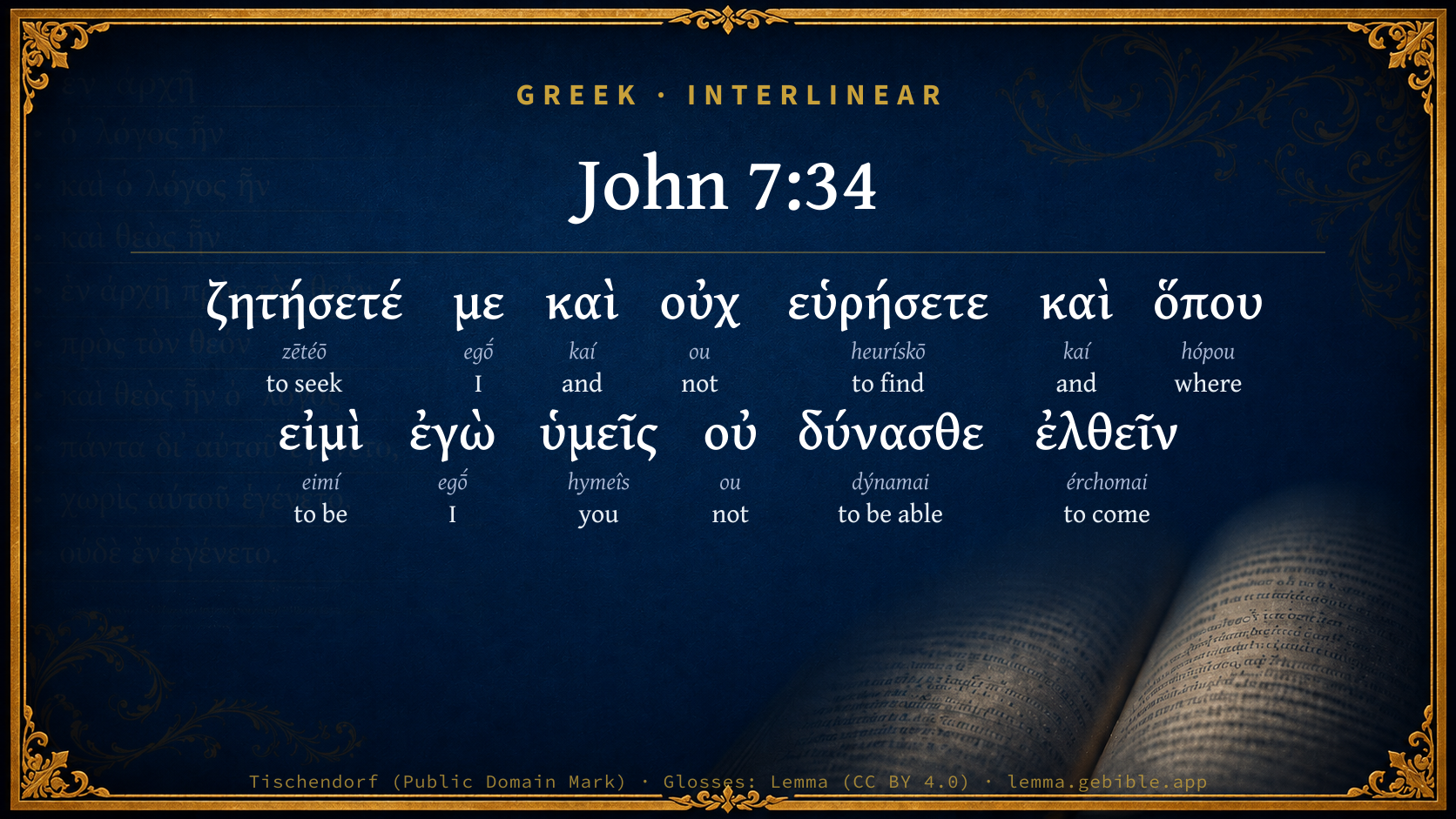
Greek (Tischendorf 8th ed.) John 7:34 appears in the Greek New Testament. The text above is from the Tischendorf 8th edition. Each word links to its Strong’s number and a concise gloss. Click any word for its full Thayer’s Greek Lexicon entry.
Download image
Cite this verse

John 7:34 (World English Bible). Public Domain. Lemma interlinear Bible study tool, https://lemma.gebible.app/v/john/7/34.

Show BibTeX & RIS
BibTeX
RIS
English Translation
You will seek me, and won't find me; and where I am, you can't come."
World English Bible · Public Domain
Download a study sheet

One document with this verse’s original text, its word-by-word gloss line, the meaning frame, cross-references with their text, attributed commentary, and full source and license credits — printable, and it pastes into notes with its structure intact.

This verse Autodidact and up

Study sheet (.html) Plain text (.txt)

A passage Seminary Student

Up to 50 verses in one chapter. A passage sheet keeps up to 6 commentary sources and 12 cross-references per verse, in the order this page ranks them, and says so on the sheet whenever that leaves anything out. Ask for a single verse and you get the Autodidact verse sheet above.

Everything on this page stays free to read, with no account — the sheet is a download of what is already on screen, not access to it.

Want to remove ads? Support Godless Engineer
Compare translations 3

The same verse in 3 English versions, stacked beneath the original-language interlinear above. Click any original word for its lexicon entry.

Each is an independent rendering of the whole verse — the interlinear is not word-aligned to these translations.

Highlighted words mark where these versions differ — a whole-verse word diff, not a word-by-word alignment.

  • World English Bible Public Domain
    You will seek me, and won't find me; and where I am, you can't come."
  • King James Version Public Domain
    Ye shall seek me, and shall not find me: and where I am, thither ye cannot come.
  • unfoldingWord Literal Text CC BY-SA 4.0
    You will seek me, but you will not find, and where I am, you will not be able to come.”

unfoldingWord Literal Text — © unfoldingWord, licensed CC BY-SA 4.0. Word-aligned USFM3 via Door43 (git.door43.org/unfoldingWord/en_ult).

Versions to compare (up to 4)

3 of 4 selected

Show all 19 translations

Every available English version of this verse, each an independent rendering of the whole verse.

  • World English Bible Public Domain
    You will seek me, and won't find me; and where I am, you can't come."
  • Berean Standard Bible Public Domain
    You will look for Me, but you will not find Me; and where I am, you cannot come.”
  • Majority Standard Bible Public Domain
    You will look for Me, but you will not find Me; and where I am, you cannot come.”
  • King James Version Public Domain
    Ye shall seek me, and shall not find me: and where I am, thither ye cannot come.
  • American Standard Version (1901) Public Domain
    Ye shall seek me, and shall not find me: and where I am, ye cannot come.
  • Revised Version (1885) Public Domain
    Ye shall seek me, and shall not find me: and where I am, ye cannot come.
  • Geneva Bible (1599) Public Domain
    Ye shall seeke me, and shall not finde me, and where I am, can ye not come.
  • Douay-Rheims (1899) Public Domain
    You shall seek me, and shall not find me: and where I am, thither you cannot come.
  • Young's Literal Translation Public Domain
    ye will seek me, and ye shall not find; and where I am, ye are not able to come.'
  • Literal Standard Version CC BY-SA 4.0
    you will seek Me, and you will not find; and where I am, you are not able to come.”
  • Unlocked Literal Bible CC BY-SA 4.0
    You will seek me but you will not find me; where I go, you will not be able to come.”
  • unfoldingWord Literal Text CC BY-SA 4.0
    You will seek me, but you will not find, and where I am, you will not be able to come.”
  • Darby Bible Public Domain
    Ye shall seek me and shall not find [me], and where I am ye cannot come.
  • World Messianic Bible Public Domain
    You will seek me and won’t find me. You can’t come where I am.”
  • Webster's Bible Public Domain
    Ye will seek me, and will not find me: and where I am, thither ye cannot come.
  • Free Bible Version CC BY-SA 4.0
    You'll search for me but you won't find me; and you can't come where I'm going.”
  • Bible in Basic English Public Domain
    You will be looking for me, and you will not see me: and where I am you may not come.
  • Text-Critical English NT CC BY 4.0
    You will seek me, but you will not find me; and where I am going, you cannot come.”
  • Tyndale New Testament (1534) Public Domain
    Ye shall seke me and shall not fynde me: and where I am thyther can ye not come.

Literal Standard Version (2020), Covenant Press — licensed CC BY-SA 4.0. Text via the HelloAO Bible API (eBible.org). Unlocked Literal Bible (unfoldingWord) — licensed CC BY-SA 4.0. Text via the HelloAO Bible API (eBible.org). unfoldingWord Literal Text — © unfoldingWord, licensed CC BY-SA 4.0. Word-aligned USFM3 via Door43 (git.door43.org/unfoldingWord/en_ult). Free Bible Version, Dr. Jonathan Gallagher — licensed CC BY-SA 4.0. Text via the HelloAO Bible API (eBible.org).

Word by word

More ways to search: Search by grammar → Find every occurrence → Compare this word →

Practice this passage: Drill this verse → Learn its vocabulary →

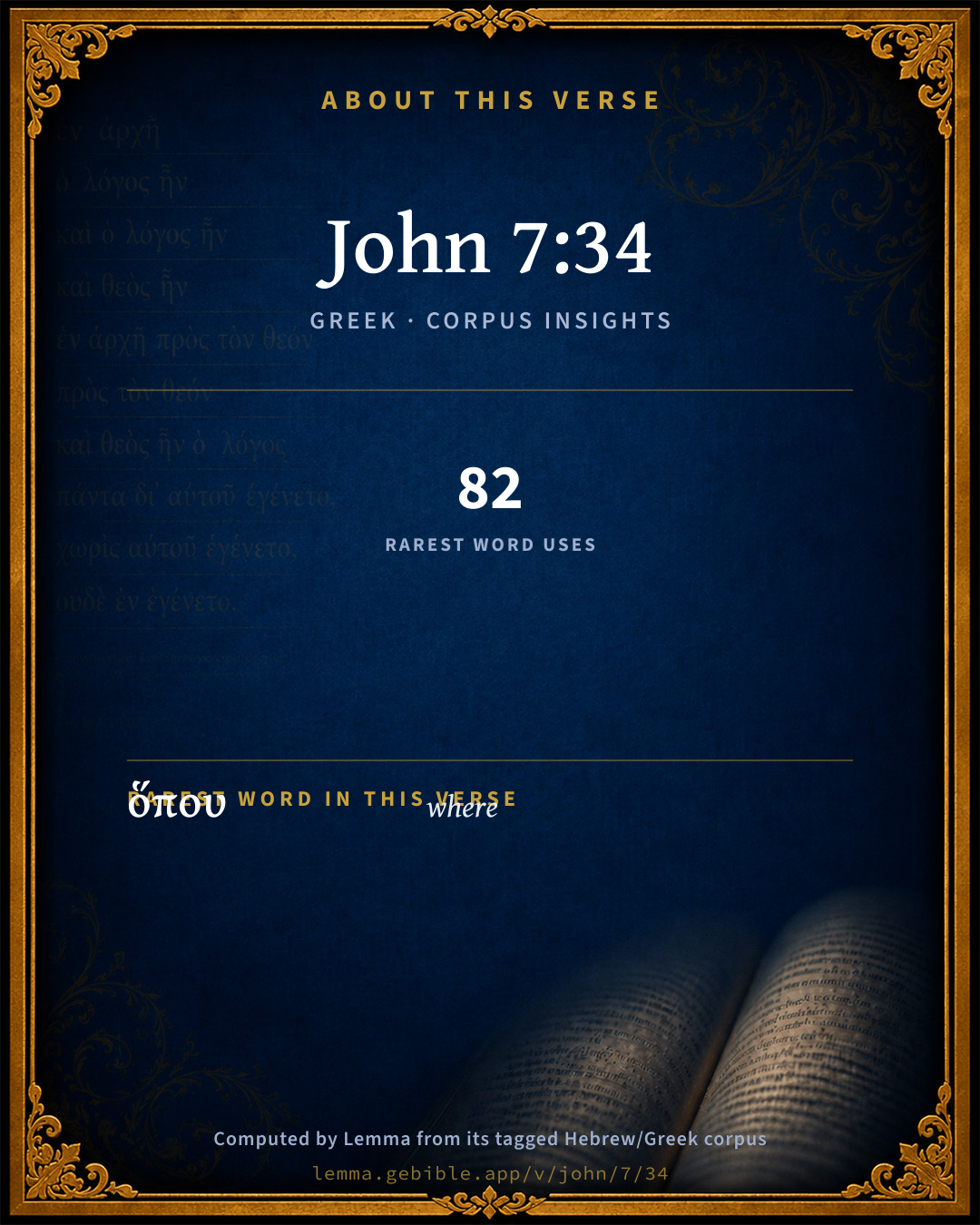
About this verse

These counts appear in no published source. They are computed here, from the morphology-tagged text and Lemma’s own curated glosses. What Lemma adds →

13
words
10
distinct lemmas
Gospels
section

Repetition

Words recur within this verse:

Cross-references

11

Topical passages linked to John 7:34 in the Treasury of Scripture Knowledge — connected by theme and wording, ordered by reader-vote popularity; previews shown in the World English Bible.

  • Proverbs 1:24–31 Because I have called, and you have refused; I have stretched out my hand, and no one has paid attention;
  • John 13:33–36 Little children, I will be with you a little while longer. You will seek me, and as I said to the Jews, 'Where I am going, you can't come,' so now I tell you.
  • Hosea 5:6 They will go with their flocks and with their herds to seek Yahweh; But they won't find him. He has withdrawn himself from them.
  • Luke 13:34–35 "Jerusalem, Jerusalem, that kills the prophets, and stones those who are sent to her! How often I wanted to gather your children together, like a hen gathers her own brood under her wings, and you refused!
  • John 8:21–24 Jesus said therefore again to them, "I am going away, and you will seek me, and you will die in your sins. Where I go, you can't come."
  • John 14:3 If I go and prepare a place for you, I will come again, and will receive you to myself; that where I am, you may be there also.
  • John 14:6 Jesus said to him, "I am the way, the truth, and the life. No one comes to the Father, except through me.
  • John 17:24 Father, I desire that they also whom you have given me be with me where I am, that they may see my glory, which you have given me, for you loved me before the foundation of the world.
  • Matthew 23:39 For I tell you, you will not see me from now on, until you say, 'Blessed is he who comes in the name of the Lord!'"
  • Luke 13:24–25 "Strive to enter in by the narrow door, for many, I tell you, will seek to enter in, and will not be able.
  • Luke 17:22–23 He said to the disciples, "The days will come, when you will desire to see one of the days of the Son of Man, and you will not see it.

Cross-references courtesy of OpenBible.info (CC BY 4.0).

Commentary

Notes on John 7:34 from classic Christian and Jewish commentators (each source and its license shown beneath its notes). The classic Christian expositions comment on the surrounding passage and are grouped to its opening verse, so a note may address several verses; the Jewish commentaries on the Tanakh (Rashi and others) are per-verse, so they appear only where the commentator wrote on this verse.

Lemma curates 59 commentaries, every one of them public domain or Creative Commons licensed, each selected and text-cleaned for this edition rather than reprinted as found. About our sources →

Bengel's Gnomon

Johann Albrecht Bengel

Joh 7:34. [203] ΖΗΤΉΣΕΤΈ ΜΕ, ye shall seek Me) Me, whom ye now see, and despise. These words are a kind of text, on which the discourses of this and the following chapter are built as a superstructure; ch. Joh 8:21, “I go My way, and ye shall seek Me, and shall die in your sins; whither I go, ye cannot come,” etc. Such a text occurs also, ch. Joh 16:16, “A little while, and ye shall not see Me, and again a little while and ye shall see me, because I go to the Father.”—καὶ οὐχ εὑρήσετε, and ye shall not find Me) Afterwards He speaks more sternly, “ye shall die in your sin,” ch. Joh 8:21.—ὅπου, whither) namely, to heaven: ch. Joh 3:13, “No man hath ascended up to heaven, but He that came down from heaven, even the Son of Man, which is in heaven.” The Lord sometimes put forth a discourse of such a nature, as that a meaning of it, in some degree, was, for the time being, apparent to His hearers: the deeper meaning became so subsequently. Comp. with this passage ch. Joh 13:33, “Yet a little while, I am with you. Ye shall seek Me; and as I said unto the Jews, Whither I go, ye cannot come, so now I say to you.” Such a discourse also occurs, ch. Joh 13:16, “The servant is not greater than his lord.” Comp. ch. Joh 15:20.

[203] μικρὸν χοόνον, a little time) It proved to be truly so; for hardly the half of a year elapsed from this discourse to the time of His passion.—Harm., p. 355.

Joh 7:34; Joh 7:36. Εἶμι, I go) Very many read εἰμί, I am.[204] By all means I grant, the Saviour says, ὅπου εἰμὶ ἐγώ, in ch. Joh 12:26, Joh 14:3, Joh 17:24, in which passages there follows ἔσται, ἦτε, ὦσι. But here ὄπου εἶμι ἐγώ ought to be read, because here there follow ἐλθεῖν, and πορεύεσθαι, and the Lord, in repeating [to His disciples] this statement, addressed to the Jews, saith ὑπάγω, ch. Joh 8:21, Joh 13:33. Also εἶμι is employed in prose, by the Septuag., Exo 32:26, ἴτω πρός με, Pro 6:6, ἴθι πρὸς τόν μύρμηκα. Plato has ἴωμεν in the Phædrus, in the last part, and Chrysost. περὶ ιἑρως., l. vi. c. 12, p. 348, ed. Stutg. Camerarius notes down instances from Thucydides and Xenophon, in his Comm. utr. Linguæ,” p. 452. Add Herodian. It was necessary to make this remark, inasmuch as εἶμι is rejected, as a poetical form, by some. Nor indeed is this observation an unprofitable one. Whither I go, was the language of our Lord, when He was somewhat farther off from the time of His departure: where I am, was His language, on the very week of His passion, among His very last words. All the passages lately pointed out prove this distinction in the selection of His phraseology; nor is the passage, Joh 13:33; Joh 13:36 [where, though it was His last passion week, whither I go, and not where I am, is used], opposed to this view; for at Joh 7:33 His former speech to the Jews is quoted; and at Joh 7:36 the reference is to the question of Peter, Lord, whither goest thou?

[204] Engl. Vers. “Where I am.” The Versions acd Memph. render it go: which ch. Joh 13:33, ὄπου ὑπάγω, seems to favour. But Vulg. “ubi sum”—E. and T.

Bengel's Gnomon of the New Testament — English translation (T&T Clark, Edinburgh, 1860) — public domain. Text from a community e-Sword module.

Expositor's Greek Testament

ed. W. Robertson Nicoll

Joh 7:34 . In Joh 7:34 He views with pity ( cf. “O Jerusalem, Jerusalem,” etc.) their too late awakening to a sense of their need: ζητήσετέ με καὶ οὐκ εὑρήσετε . “The tragic history of the Jewish people since their rejection of Jesus as Christ is condensed into these words,” Reith. Cf. Luk 17:22 , “The days will come when ye shall desire to see one of the days of the Son of Man, and ye shall not see it”; also Luk 19:43-44 ; and Isa 55:6 . εἰκὸς γὰρ πολλοὺς … ζητεῖν αὐτὸν βοηθὸν καὶ μᾶλλον ἁλισκομένων Ἱεροσολύμων , Euthymius. Even though they may then know where He has gone, they cannot follow Him, ὅπου εἰμὶ ἐγώ ὑμεῖς οὐ δύνασθε ἐλθεῖν , “where I am” [not εἶμι , “I will go”], i.e. , in the presence of Him that sent me, “ye cannot,” as ye now are and by your own strength, “come”. For the full meaning see chap. Joh 8:21-24 .

The Expositor's Greek Testament, edited by W. Robertson Nicoll (1897–1910) — public domain. Text from a community e-Sword module.

Adam Clarke's Commentary

Verse 34. Ye shall seek me, and shall not find me] When the Roman armies come against you, you will vainly seek for a deliverer. But ye shall be cut off in your sins, because ye did not believe in me; and where I am-in the kingdom of glory, ye cannot come; for nothing that is unholy shall enter into the new Jerusalem. In this, and the thirty-sixth verse, ειμ, I am, is read by several ειμι, I came, as in the twenty-ninth verse; and in these two last places the AEthiopic, Arabic, three copies of the Itala, Nonnus, and Theophylact, agree. See Clarke on Joh 7:29.

Adam Clarke's Commentary on the Bible (1810–1826) — public domain. Text from a community e-Sword/MySword module.

John Calvin's Commentaries

34. You shall seek me. They sought Christ, to put him to death. Here Christ alludes to the ambiguous signification of the word seek, for soon they shall seek him in another manner; as if he had said, “My presence, which is now irksome and intolerable to you, will last for a short time; but ere long you shall seek me in vain, for, far removed from you, not only by my body, but also by my power, I shall behold from heaven your destruction.” But here a question may be put, of what nature was this seeking of Christ? For it is plain enough that Christ speaks of the reprobate, whose obstinacy in rejecting Christ had reached the utmost point. Some refer it to doctrine, because the Jews, by foolishly pursuing the righteousness of works, did not obtain what they desired, (Romans 9:31.) Many understand it as referring to the person of the Messiah, because the Jews, reduced to extremities, in vain implored a Redeemer. But for my own part, I explain it as merely denoting the groans of distress uttered by the wicked, when, compelled by necessity, they look in some manner towards God.

And shall not find me. When they seek him, they do not seek him; for unbelief and obstinacy — by shutting up their hearts, as it were — hinders them from approaching to God. They would desire, indeed, that God should aid them, and should be their Redeemer, but, by impenitence and hardness of heart, they obstruct their path. We have a very striking example in Esau, who, on account of having lost his birthright, not only is oppressed with grief, but groans and gnashes his teeth, and breaks out into furious indignation, (Genesis 27:38; Hebrews 12:17.) But yet so far is he from the right way of seeking the blessing, that, at the very time when he is seeking it, he renders himself more unworthy of it. In this manner God usually punishes the contempt of his grace in the reprobate, so that, either afflicted by severe punishments, or oppressed by a conviction of their misery, or reduced to other extremities, they complain, and cry, and howl, but without reaping any advantage; for, being always like themselves, they nourish within their hearts the same cruelty which they formerly displayed, and do not go to God, but rather wish that he were changed, since they cannot destroy him. Hence let us learn that we ought to receive Christ without delay, while he is still present with us, that the opportunity of enjoying him may not pass away from us; for if the door be once shut, it will be vain for us to try to open it.

Seek the Lord, says Isaiah, while he may be found; call upon him, while he is near, (Isaiah 55:6.)

We ought therefore to go to God early, while the time of his good pleasure lasts, as the prophet speaks, (Isaiah 49:8;) for we know not how long God will bear with our negligence. In these words, where I am, you cannot come, he employs the present tense instead of the future, where I shall be, you shall not be able to come

John Calvin's Commentaries (1540-1563) — public domain. Text from the Calvin Translation Society English edition (1840s-50s) via the Christian Classics Ethereal Library (ccel.org). Calvin's coverage is partial (roughly two-thirds of the Bible); uncommented books and verses are honest gaps, never fabricated. The 19th-century editor's footnotes and remarks are omitted so the notes are faithfully Calvin's own voice.

Ellicott's Commentary for English Readers

(34) Ye shall seek me, and shall not find me.—These words are to be interpreted in connection with Joh_8:21, where they are repeated, and with Joh_13:33, where they are quoted and applied to the disciples. This will exclude any special reference, such as to the destruction of Jerusalem and to the seeking Him in the miseries which should follow, which most expositors have found here. The words refer rather to the more general truth now present to His mind, and applicable to all alike, that the time was at hand when He would return to the Father, and His bodily presence would be unapproachable, alike by those who should seek in hatred, or those who should seek in love.

A Bible Commentary for English Readers, edited by Charles John Ellicott (1878–1897) — public domain. Text from a community e-Sword module.

The Cambridge Bible for Schools and Colleges

gen. ed. J. J. S. Perowne

34. Ye shall seek me] From Joh_13:33 it seems almost certain that these words are not to be understood of seeking His life: rather of seeking for help at His hands. Comp. Joh_8:21. It is best, however, not to limit their application to any particular occasion, such as the destruction of Jerusalem, the great hour of Jewish need.

where I am, thither ye cannot come] ‘Thither’ is not in the Greek and is perhaps better omitted, so as to bring out the emphatic opposition between ‘I’ and ‘ye.’

The Cambridge Bible for Schools and Colleges (gen. ed. J. J. S. Perowne; Cambridge University Press, 1878–1918) — public domain. Text from a community e-Sword module.

John Gill's Exposition

Then said the Jews among themselves,.... That is, the unbelieving, scoffing Jews; it may be the officers, at least some of them, that were sent to take him:

whither will he go that we shall not find him? what distant, or obscure part of the world will he betake himself to, and there hide himself, that so he cannot be found?

will he go unto the dispersed among the Gentiles? or Greeks; and so may design the Jews, who were scattered abroad in the times of the Grecian monarchy, under the successors of Alexander, and particularly Antiochus, in distinction from the Babylonish dispersion; or the strangers scattered through Pontus Galatia, &c. to whom Peter writes, Pe1 1:1. The Arabic version renders it, "the sect of the Greeks" by which the Hellenistic Jews seem to be meant: or the Jews in general, wherever, and by whomsoever scattered, who might be thought to be more ignorant than the Jews in Judea, and therefore more easily to be imposed upon: hence, in a flouting manner, they inquire, whether he will go to those when he is rejected by them. The Syriac and Ethiopic versions read, "will he go into the countries, or country of the Gentiles"; into Heathen countries, not to the Jews there, but to the Gentiles themselves:

and teach the Gentiles? suggesting, that he was more fit to be a teacher of them, than of the Jews, and might meet with more encouragement and success among them, who would not be able to detect him.

John Gill's Exposition of the Whole Bible (1746–1763) — public domain (CC PDM 1.0). Text via the HelloAO Bible API.

Trapp's Complete Commentary

John Trapp

34 Ye shall seek me, and shall not find me: and where I am, thither ye cannot come.

Ver. 34. Ye shall seek me, &c.] Because ye shall die in your sins, which is worse than to die in a ditch.

John Trapp, A Commentary or Exposition upon All the Books of the Old and New Testament (1647–1656) — public domain. Text from a community e-Sword module.

Albert Barnes' Notes on the Bible

Ye shall seek me - This probably means simply, Ye shall seek the Messiah. Such will be your troubles, such the calamities that will come on the nation, that you will earnestly desire the coming of the Messiah. You will seek for a Deliverer, and will look for feign that he may bring deliverance. This does not mean that they would seek for Jesus and not be able to find him, but that they would desire the aid and comfort of the Messiah, and would be disappointed. Jesus speaks of himself as the Messiah, and his own name as synonymous with the Messiah. See the notes at Mat 23:39.

Shall not find me - Shall not find the Messiah. He will not come, according to your expectations, to aid you. See the notes at Matt. 24.

Where I am - This whole clause is to be understood as future, though the words AM and cannot are both in the present tense. The meaning is, Where I shall be you will not be able to come. That is, he, the Messiah, would be in heaven; and though they would earnestly desire his presence and aid to save the city and nation from the Romans, yet they would not be able to obtain it - represented here by their not being able to come to him. This does not refer to their individual salvation, but to the deliverance of their nation. It is not true of individual sinners that they seek Christ in a proper manner and are not able to find him; but it was true of the Jewish nation that they looked for the Messiah, and sought his coming to deliver them, but he did not do it.

Albert Barnes' Notes on the Bible (1834–1885) — public domain. Text from a community e-Sword/MySword module.

Haydock's Catholic Bible Commentary

And shall not find me. Some understand it, you shall wish me conversing with you, as at present, healing diseases, &c. but as I shall suffer death shortly, you shall not find me. Others expound it, you shall seek for your Messias, but not owning me, who am truly he, you shall not find your Messias; and you cannot come to me in my kingdom of glory, because you will not believe in me. (Witham) --- Or where I shall be. The present tense is not unfrequently used for the future, by the hagiographers. See Chap. xiii. 33.

George Leo Haydock (1774–1849), Haydock's Catholic Family Bible and Commentary, 1859 edition — public domain. Excludes Psalms (Douay-Rheims chapter numbering differs from Protestant) and Deuterocanonical books (Catholic canon only).

Matthew Poole's English Annotations

Some think the meaning is, Ye shall seek me to execute your malice upon me, but to no purpose, for you

shall not find me. Or, You shall seek me to destroy me in my church, and to root out my name; but to no purpose. But the most probable sense is this: You wicked Jews, that now contemn the means of grace by me offered to you, shall one day be in distress and calamity enough; and when you are so, then you will wish I were again amongst you; but I shall be ascended to my Father, and as deaf to your prayers as above the reach of your malice. There is much the same thing said in Mat 23:39. That he here speaketh of his ascension is plain from Joh 13:33. He speaketh of heaven as a place where he was at that time, for so he was as to his Divine nature. It is υπαγω, whither I go, which makes some think it should not here be ειμι, but ειμι, vado. But others reject it, because it is a poetical word, hardly used in the New Testament.

Matthew Poole's English Annotations on the Holy Bible (1683–1685) — public domain. Text from a community e-Sword/MySword module.

Whedon's Commentary on the Bible

Daniel D. Whedon

34. Seek me—But not seek him aright. Their day of revelation having been abused, in the day of their desolation they would seek the Messiah’s aid in blindness that none but the Messiah they reject can relieve.

Where I am— Am at the time of your desolation.

Daniel D. Whedon (gen. ed.), Commentary on the Old and New Testaments (1874–1909) — public domain. Text from a community e-Sword module.

The Pulpit Commentary

Ye shall seek me, and shall not find me. Many interpretations are given of this.

(1) Origen and Grotius refer it to a hostile search for him which would not be gratified; but the whole story of the arrest which follows, as well as the quotation of these words in Joh_13:33, prove that this was not his meaning.

(2) Augustine and others imagine penitential seeking when it would be too late. This is not justified by the connection. The limitation of the day of grace for seeking souls is not the theme of this address, and it is, save under special circumstances, no teaching of the New Testament.

(3) The ideas of Hengstenberg and others, so largely built on the great texts in Pro_1:28 and Amo_8:12, show that the Messiah would be sought by them when they had utterly rejected Jesus. We do not believe that a genuine search for the Lord will ever be disappointed, but a vicious and vain search may be possible when the opportunity for due approach has gone by forever. Moments, catastrophes, did arrive in their tragic history when they had passionately desired, but in vain, to see one of the days of the Son of man. The individuals who turned to him found the veil which concealed him taken away. (2Co_3:16) The nation as a whole was blinded; they crucified their King, the Lord of glory; and they brought uttermost extinction on themselves as a nation. "They sought their Messiah in vain" (Weiss). Where I am in the glory in which I dwell, and to which I belong, and to which I am now inviting youyou cannot come. "The door will be shut;" you will not "have known the day of your visitation." "How often would I have gathered you, but ye would not!" The seeking cannot be the search of penitence, but of unavailing despair. You have the opportunity now. In a little while I go, and then you will find it impossible to follow me.

The Pulpit Commentary (1880–1919), ed. H.D.M. Spence-Jones & Joseph S. Exell — public domain. Text from a community e-Sword module.

John Wesley's Explanatory Notes

Ye shall seek me - Whom ye now despise. These words are, as it were, the text which is commented upon in this and the following chapter. Where I am - Christ's so frequently saying while on earth, where I am, when he spake of his being in heaven, intimates his perpetual presence there in his Divine nature: though his going thither was a future thing, with regard to his human nature.

John Wesley, Explanatory Notes Upon the Whole Bible (1754–1765) — public domain. Text via the GEBible commentary corpus.

Cambridge Greek Testament for Schools and Colleges

34. ζητήσετέ με. In spite of Joh 7:1; Joh 7:19-20; Joh 7:25; Joh 7:30, Joh 5:18, Joh 8:37; Joh 8:40, Joh 10:39, Joh 11:8, it seems clear from Joh 13:33 that these words are not to be understood of seeking His life: no infinitive is added here; in all the other cases we have ἀποκτεῖναι, πιάσαι, or λιθάσαι. Nor can repentance be meant; repentance could not be in vain. Rather distress is meant; they will seek for help at His hands and not find it (comp. Joh 8:21). But it is best not to limit the application to any particular occasion, such as the destruction of Jerusalem, the great hour of Jewish need.

ὅπου εἰμὶ ἐγώ, ὑμεῖς. The pronouns are again in emphatic opposition as in Joh 7:28-29; comp. Joh 7:7-8. Εἰμί, not εἶμι, which does not occur in N.T. Winer, p. 61. The present tense implies His continual presence with the Father; ‘where I am,’ not ‘where I shall be.’

οὐ δύνασθε. It is morally impossible: see on Joh 7:7.

Ποῦ οὗτος μέλλει. Where is this fellow (Joh 3:26, Joh 6:42; Joh 6:52) about to (Joh 6:71) go, seeing that we shall not find Him. Is He about to go unto the Dispersion among the Gentiles? Ἡ διασπορά τ. Ἑλλ. means those Jews who were dispersed among the heathen outside Palestine; the abstract for the concrete, like ἡ περιτομή for the Jews generally. Διασπορά occurs Jas 1:1 and 1Pe 1:1 (see notes there), and nowhere else in N.T. There were three chief colonies of these ‘dispersed’ or ‘scattered’ Jews, in Babylonia, Egypt, and Syria, whence they spread over the whole world. ‘Moses from generations of old hath in every city them that preach him,’ Act 15:21. These opponents of Christ, therefore, suggest that He means to go to the Jews scattered among the Gentiles in order to reach the Gentiles and teach them—the very mode of proceeding afterwards adopted by the Apostles; so that their saying, like that of Caiaphas (Joh 11:50), was an involuntary prophecy. But here it is spoken in sarcasm. Christ’s utter disregard of Jewish exclusiveness and apparent non-observance of the ceremonial law gave a handle to the sneer; which would be pointless if Ἑλλήνων were rendered ‘Hellenists,’ i.e. Grecised Jews. Ἕλληνες in N.T. always means Gentiles or heathen. see on Joh 12:20.

Cambridge Greek Testament for Schools and Colleges (Cambridge University Press, 1896; 21 vols, various authors incl. Carr, Maclear, Plummer, Farrar, Lumby, Moule, M. R. James, Simcox) — public domain. Text from a community e-Sword module.

Alford’s Greek Testament

Henry Alford

34.] The omission or insertion of αὐτοῖς makes very little difference. The words were spoken, not to the officers only, but to all the people.

ἔτι χρ. μικ …] This appears to be said in reference to ver. 30, to shew them the uselessness of their attempting to lay hands on Him till His hour was come, which it soon would be.

πρὸς τ. πέμψ. με] It has been asked, ‘If Jesus thus specified where He was going, how could the Jews ask the question in ver. 35?’ but De Wette answers well, that the Jews knew not τὸν πέμψαντα αὐτόν, and therefore the saying was a dark one to them.

ζητ. με, κ. οὐχ εὑρ.] These words must not be pressed too much, as has been done by many interpreters (Chrysost., Theophyl., Euthym., Meyer, Tholuck, but not in his 6th edn.), who would make them mean, ‘Ye shall seek My help and not find it’ (viz. in your need, at the destruction of Jerusalem); for this would not be true even of the Jews, any one of whom might have at any time turned and looked on Him whom he had pierced, by faith,—and have been saved;—nor again must it be taken as meaning, ‘Ye shall seek to lay hands on Me, and shall not be able’ (, Grot.),—which is vapid and unmeaning. Neither of these interpretations, nor their cognates, will agree with the parallel place, ch. 13:33, where the same words are used to the disciples. The meaning is simply (as in reff.), ‘My bodily presence will be withdrawn from you; I shall be personally in a place inaccessible to you:’ see ch. 13:36.

εἰμί, am; not εἶμι, ‘go,’ which is never used in the N.T. Nor need we supply τότε; the present tense is used in the solemn sense of ch. 1:18, and ch. 3:13, to signify essential truth. Compare οὐ δύνασθε addressed to the Jews, with οὐ δύνασαί μοι νῦν ἀκολ., ἀκολουθήσεις δὲ ὕστερον to Peter, ch. 13:36, and it will be evident that the Lord had their spiritual state in view: ‘Ye cannot, as ye are now, enter there.’

On the whole, see Luk 17:22.

35,

Henry Alford, The Greek Testament (1849–1861) — public domain. Text from a community e-Sword module.

International Critical Commentary

34. ζητήσετε. This is certainly the true text, only two MSS., II and 69, reading ζητεῖτε. None the less, the Vulgate has quaeritis, this being one of the renderings which suggest to some that Jerome followed a type of Greek manuscript of which we know little.1

With vv. 33, 34, must be compared at every point 8:21 and 13:33.

ζητήσετέ με καὶ οὐχ εὑρήσετε. BTN add μέ after εὑρήσετε:om. אDLWΓΔΘ. “Seek and ye shall find” (Mat 7:7) is the promise of Jesus; but the seeking may be so long delayed that the promise cannot be claimed. Cf. Luk 17:22 and Pro 1:28. So, here, the warning is of the danger of delay. “Ye shall seek me,” sc. (not, as at v. 30, to kill me, but) as the Messiah for your deliverance, “and ye shall not find,” for Jesus will not be present in the body, as He was then.

καὶ ὅπου εἰμὶ ἐγώ κτλ., “and where I am,” sc. in my essential being, in the spiritual world, “you cannot come.” There is no contradiction between μεθʼ ὑμῶν εἰμί of v. 33 and this statement; for the former only asserted His visible, bodily presence, whereas the latter (εἰμὶ ἐγώ) spoke of His spiritual home. This can be shared only by those who are in spiritual touch with Him (12:26, 17:24), as the Jews were not (cf. 8:21). Even His disciples, as He reminded them later, could not follow Him to the heavenly places while they were still in the body (13:33, 36).

International Critical Commentary — older volumes (1896–1929), various authors — public domain. Text from a community e-Sword module.

Vincent's Word Studies in the New Testament

Marvin R. Vincent

Ye shall seek me. Not as now, for disputation or violence, but for help.

Where I am. In absolute, eternal being and fellowship with the Father. I am [εγω ειμι] is the formula of the divine existence (viii. 58). The phrase carries a hint of the essential nature of Jesus, and thus prepares the way for ye cannot come (see on ver. 7). The difference in character will make it essentially impossible.

Marvin R. Vincent, Word Studies in the New Testament (1887–1900) — public domain. Text from a community e-Sword/MySword module.

Lesson kit

Teaching starters — assembled from the data on this page, not authored interpretation. Every prompt links to the verse data it draws on. Edit before teaching.

John, in the Gospels, opens this verse with 13 words (10 distinct Greek lemmas). Its most distinctive word is hópou (“where”). A historical commentator’s framing appears above. Read the whole chapter for the surrounding context.

Discussion questions

  1. The word hópou carries the sense “where.” How does it shape the verse?
  2. How does Proverbs 1:24–31, which shares this passage’s theme, read alongside this verse?
  3. What does the repetition of “I” (2× in this one verse) do in this verse?
  4. The translations on this page render this verse differently — a whole-verse word diff, not a word-by-word alignment. What might account for the different wordings?
  5. Compare how Bengel's Gnomon and Expositor's Greek Testament read this verse. Where do they agree or differ?

Things to notice

Reading settings

Reading text

Shown beneath each verse's original-language words.

Old Testament
Old Testament edition

Read the OT as the Masoretic Hebrew (MT) or the Greek Septuagint (LXX).

English shown for the Greek Septuagint (in the Hebrew ↔ Greek comparison).

Comparing translations? Open the Compare panel on any verse page to stack up to four side by side.