Philippians 2:7

Greek (Tischendorf 8th ed.) Philippians 2:7 appears in the Greek New Testament. The text above is from the Tischendorf 8th edition. Each word links to its Strong’s number and a concise gloss. Click any word for its full Thayer’s Greek Lexicon entry.
Download image
Cite this verse

Philippians 2:7 (World English Bible). Public Domain. Lemma interlinear Bible study tool, https://lemma.gebible.app/v/philippians/2/7.

Show BibTeX & RIS
BibTeX
RIS
English Translation
but emptied himself, taking the form of a servant, being made in the likeness of men.
World English Bible · Public Domain
Download a study sheet

One document with this verse’s original text, its word-by-word gloss line, the meaning frame, cross-references with their text, attributed commentary, and full source and license credits — printable, and it pastes into notes with its structure intact.

This verse Autodidact and up

Study sheet (.html) Plain text (.txt)

A passage Seminary Student

Up to 50 verses in one chapter. A passage sheet keeps up to 6 commentary sources and 12 cross-references per verse, in the order this page ranks them, and says so on the sheet whenever that leaves anything out. Ask for a single verse and you get the Autodidact verse sheet above.

Everything on this page stays free to read, with no account — the sheet is a download of what is already on screen, not access to it.

Want to remove ads? Support Godless Engineer
Compare translations 3

The same verse in 3 English versions, stacked beneath the original-language interlinear above. Click any original word for its lexicon entry.

Each is an independent rendering of the whole verse — the interlinear is not word-aligned to these translations.

Highlighted words mark where these versions differ — a whole-verse word diff, not a word-by-word alignment.

  • World English Bible Public Domain
    but emptied himself, taking the form of a servant, being made in the likeness of men.
  • King James Version Public Domain
    But made himself of no reputation, and took upon him the form of a servant, and was made in the likeness of men:
  • unfoldingWord Literal Text CC BY-SA 4.0
    Instead, he emptied himself, having taken the form of a servant, having been born in the likeness of men, and having been found in appearance as a man,

unfoldingWord Literal Text — © unfoldingWord, licensed CC BY-SA 4.0. Word-aligned USFM3 via Door43 (git.door43.org/unfoldingWord/en_ult).

Versions to compare (up to 4)

3 of 4 selected

Show all 19 translations

Every available English version of this verse, each an independent rendering of the whole verse.

  • World English Bible Public Domain
    but emptied himself, taking the form of a servant, being made in the likeness of men.
  • Berean Standard Bible Public Domain
    but emptied Himself, taking the form of a servant, being made in human likeness.
  • Majority Standard Bible Public Domain
    but emptied Himself, taking the form of a servant, being made in human likeness.
  • King James Version Public Domain
    But made himself of no reputation, and took upon him the form of a servant, and was made in the likeness of men:
  • American Standard Version (1901) Public Domain
    but emptied himself, taking the form of a servant, being made in the likeness of men;
  • Revised Version (1885) Public Domain
    but emptied himself, taking the form of a servant, being made in the likeness of men;
  • Geneva Bible (1599) Public Domain
    But he made himself of no reputation, and tooke on him ye forme of a seruant, and was made like vnto men, and was founde in shape as a man.
  • Douay-Rheims (1899) Public Domain
    But emptied himself, taking the form of a servant, being made in the likeness of men, and in habit found as a man.
  • Young's Literal Translation Public Domain
    but did empty himself, the form of a servant having taken, in the likeness of men having been made,
  • Literal Standard Version CC BY-SA 4.0
    but emptied Himself, having taken the form of a servant, having been made in the likeness of men,
  • Unlocked Literal Bible CC BY-SA 4.0
    Instead, he emptied himself by taking the form of a servant, and he was born in the likeness of men.
  • unfoldingWord Literal Text CC BY-SA 4.0
    Instead, he emptied himself, having taken the form of a servant, having been born in the likeness of men, and having been found in appearance as a man,
  • Darby Bible Public Domain
    but emptied himself, taking a bondman's form, taking his place in [the] likeness of men;
  • World Messianic Bible Public Domain
    but emptied himself, taking the form of a servant, being made in the likeness of men.
  • Webster's Bible Public Domain
    But made himself of no reputation, and took upon him the form of a servant, and was made in the likeness of men:
  • Free Bible Version CC BY-SA 4.0
    Instead he emptied himself, taking the nature of a servant, becoming like a human being.
  • Bible in Basic English Public Domain
    But he made himself as nothing, taking the form of a servant, being made like men;
  • Text-Critical English NT CC BY 4.0
    but emptied himself by taking the form of a servant and being born in the likeness of men.
  • Tyndale New Testament (1534) Public Domain
    Neverthelesse he made him silfe of no reputacion and toke on him the shape of a servaunte and became lyke vnto men

Literal Standard Version (2020), Covenant Press — licensed CC BY-SA 4.0. Text via the HelloAO Bible API (eBible.org). Unlocked Literal Bible (unfoldingWord) — licensed CC BY-SA 4.0. Text via the HelloAO Bible API (eBible.org). unfoldingWord Literal Text — © unfoldingWord, licensed CC BY-SA 4.0. Word-aligned USFM3 via Door43 (git.door43.org/unfoldingWord/en_ult). Free Bible Version, Dr. Jonathan Gallagher — licensed CC BY-SA 4.0. Text via the HelloAO Bible API (eBible.org).

Word by word

More ways to search: Search by grammar → Find every occurrence → Compare this word →

Practice this passage: Drill this verse → Learn its vocabulary →

σχήματι
schēma
G4976
“appearance”
Noun, Dative, Singular, Neuter
Part of Speech
Noun
Case
Dative
Number
Singular
Gender
Neuter
Full Thayer's Definition

Origin: from the alternate of G2192

TDNT: 22:54,1

1. the habitus, as comprising everything in a person which strikes the senses, the figure, bearing, discourse, actions, manner of life etc.
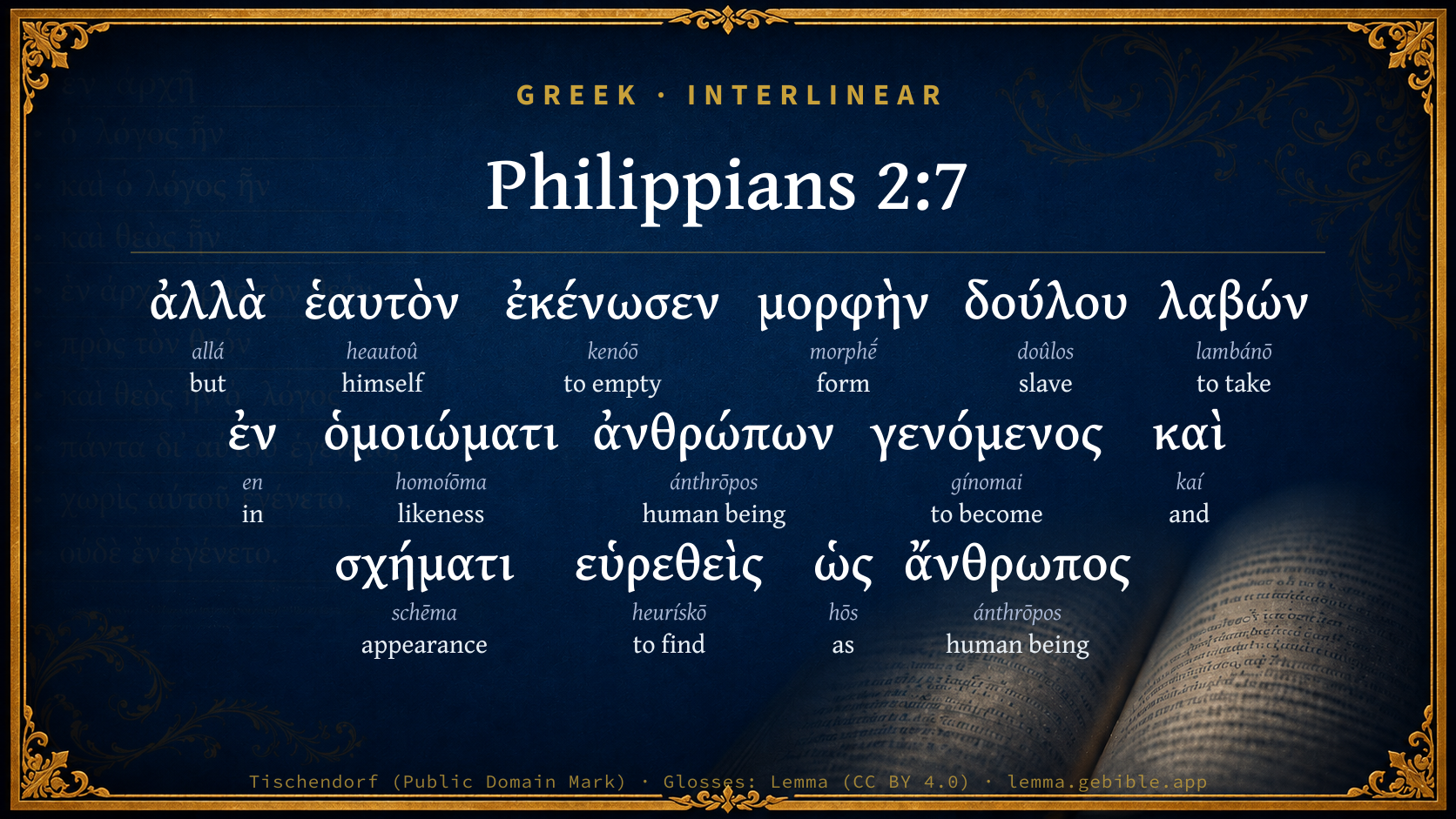
  1. ἀλλὰ allá G235 “but” Conjunction
  2. ἑαυτὸν heautoû G1438 “himself” Reflexive pronoun, 3rd person, Accusative, Singular, Masculine
  3. ἐκένωσεν kenóō G2758 “to empty” Verb, Aorist, Active, Indicative, 3rd person, Singular
  4. μορφὴν morphḗ G3444 “form” Noun, Accusative, Singular, Feminine
  5. δούλου doûlos G1401 “slave” Noun, Genitive, Singular, Masculine
  6. λαβών lambánō G2983 “to take” Verb, Aorist, Active, Participle, Nominative, Singular, Masculine
  7. ἐν en G1722 “in” Preposition
  8. ὁμοιώματι homoíōma G3667 “likeness” Noun, Dative, Singular, Neuter
  9. ἀνθρώπων ánthrōpos G444 “human being” Noun, Genitive, Plural, Masculine
  10. γενόμενος gínomai G1096 “to become” Verb, Aorist, Middle deponent, Participle, Nominative, Singular, Masculine
  11. καὶ kaí G2532 “and” Conjunction
  12. εὑρεθεὶς heurískō G2147 “to find” Verb, Aorist, Passive, Participle, Nominative, Singular, Masculine
  13. ὡς hōs G5613 “as” Adverb
  14. ἄνθρωπος ánthrōpos G444 “human being” Noun, Nominative, Singular, Masculine

About this verse

These counts appear in no published source. They are computed here, from the morphology-tagged text and Lemma’s own curated glosses. What Lemma adds →

15
words
14
distinct lemmas
Pauline Epistles
section

Notable vocabulary

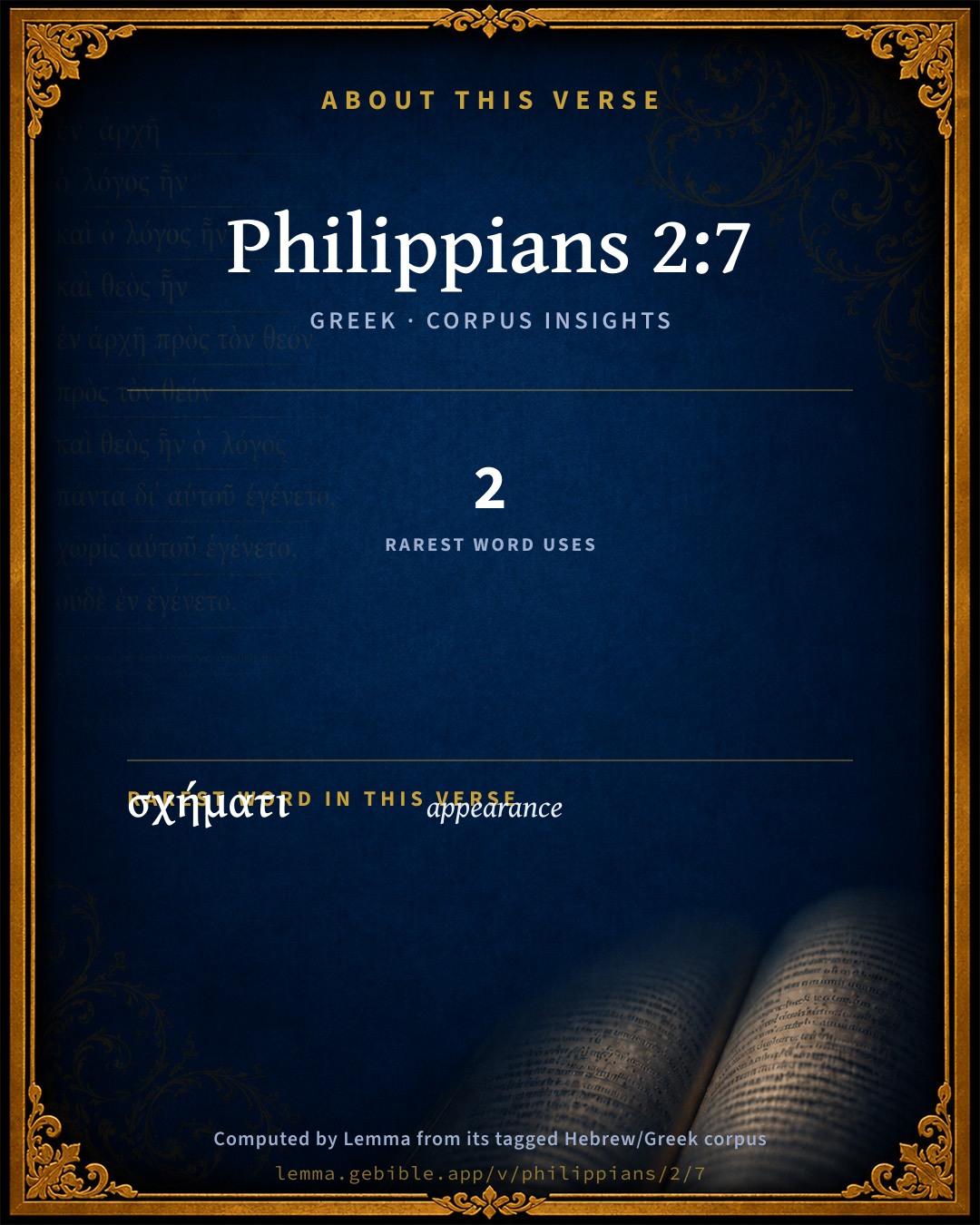
The rarest word here is σχήματι appearance G4976 — appearing just 2 times in the whole Greek New Testament.

Shared distinctive vocabulary

σχήματι appearance G4976 occurs in 2 verses of the Greek New Testament. Also found in:

Repetition

A word recurs within this verse:

  • ἀνθρώπων human being G444 ×2

Cross-references

30

Topical passages linked to Philippians 2:7 in the Treasury of Scripture Knowledge — connected by theme and wording, ordered by reader-vote popularity; previews shown in the World English Bible.

  • 2 Corinthians 8:9 For you know the grace of our Lord Jesus Christ, that, though he was rich, yet for your sakes he became poor, that you through his poverty might become rich.
  • Matthew 20:28 even as the Son of Man came not to be served, but to serve, and to give his life as a ransom for many."
  • John 1:14 The Word became flesh, and lived among us. We saw his glory, such glory as of the one and only Son of the Father, full of grace and truth.
  • Romans 8:3 For what the law couldn't do, in that it was weak through the flesh, God did, sending his own Son in the likeness of sinful flesh and for sin, he condemned sin in the flesh;
  • Isaiah 53:2–3 For he grew up before him as a tender plant, and as a root out of a dry ground: he has no form nor comeliness; and when we see him, there is no beauty that we should desire him.
  • Galatians 4:4 But when the fullness of the time came, God sent out his Son, born to a woman, born under the law,
  • Romans 15:3 For even Christ didn't please himself. But, as it is written, "The reproaches of those who reproached you fell on me."
  • Hebrews 4:15 For we don't have a high priest who can't be touched with the feeling of our infirmities, but one who has been in all points tempted like we are, yet without sin.
  • Isaiah 53:11 He shall see of the travail of his soul, [and] shall be satisfied: by the knowledge of himself shall my righteous servant justify many; and he shall bear their iniquities.
  • Mark 10:44–45 Whoever of you wants to become first among you, shall be bondservant of all.
  • Luke 22:27 For who is greater, one who sits at the table, or one who serves? Isn't it he who sits at the table? But I am in the midst of you as one who serves.
  • Hebrews 12:2 looking to Jesus, the author and perfecter of faith, who for the joy that was set before him endured the cross, despising shame, and has sat down at the right hand of the throne of God.
  • Isaiah 50:5–6 The Lord Yahweh has opened my ear, and I was not rebellious, neither turned away backward.
  • Philippians 2:6 who, existing in the form of God, didn't consider it robbery to be equal with God,
  • Isaiah 52:13–14 Behold, my servant shall deal wisely, he shall be exalted and lifted up, and shall be very high.
  • Isaiah 42:1 Behold, my servant, whom I uphold; my chosen, in whom my soul delights: I have put my Spirit on him; he will bring forth justice to the Gentiles.
  • Hebrews 2:9–18 But we see him who has been made a little lower than the angels, Jesus, because of the suffering of death crowned with glory and honor, that by the grace of God he should taste of death for everyone.
  • Zechariah 9:9 Rejoice greatly, daughter of Zion! Shout, daughter of Jerusalem! Behold, your king comes to you! He is righteous, and having salvation; Lowly, and riding on a donkey, Even on a colt, the foal of a donkey.
  • Romans 15:8 Now I say that Christ has been made a minister of the circumcision for the truth of God, that he might confirm the promises given to the fathers,
  • Psalms 22:6 But I am a worm, and no man; A reproach of men, and despised by the people.
  • John 13:3–14 Jesus, knowing that the Father had given all things into his hands, and that he came forth from God, and was going to God,
  • Isaiah 49:6–7 yes, he says, It is too light a thing that you should be my servant to raise up the tribes of Jacob, and to restore the preserved of Israel: I will also give you for a light to the Gentiles, that you may be my salvation to the end of the earth.
  • Matthew 12:18 "Behold, my servant whom I have chosen; My beloved in whom my soul is well pleased: I will put my Spirit on him. He will proclaim justice to the Gentiles.
  • Mark 9:12 He said to them, "Elijah indeed comes first, and restores all things. How is it written about the Son of Man, that he should suffer many things and be despised?
  • Romans 1:3 concerning his Son, who was born of the seed of David according to the flesh,
  • Hebrews 13:3 Remember those who are in bonds, as bound with them; and those who are ill-treated, since you are also in the body.
  • Isaiah 49:3 and he said to me, You are my servant; Israel, in whom I will be glorified.
  • Ezekiel 34:23–24 I will set up one shepherd over them, and he shall feed them, even my servant David; he shall feed them, and he shall be their shepherd.
  • Daniel 9:26 After the sixty-two weeks the Anointed One shall be cut off, and shall have nothing: and the people of the prince who shall come shall destroy the city and the sanctuary; and the end of it shall be with a flood, and even to the end shall be war; desolations are determined.
  • Zechariah 3:8 Hear now, Joshua the high priest, you and your fellows who sit before you; for they are men who are a sign: for, behold, I will bring forth my servant, the Branch.

Cross-references courtesy of OpenBible.info (CC BY 4.0).

Commentary

Notes on Philippians 2:7 from classic Christian and Jewish commentators (each source and its license shown beneath its notes). The classic Christian expositions comment on the surrounding passage and are grouped to its opening verse, so a note may address several verses; the Jewish commentaries on the Tanakh (Rashi and others) are per-verse, so they appear only where the commentator wrote on this verse.

Lemma curates 59 commentaries, every one of them public domain or Creative Commons licensed, each selected and text-cleaned for this edition rather than reprinted as found. About our sources →

Matthew Poole's English Annotations

But; some expound this particle as a discretive, others an adversative, or redditive.

Made himself of no reputation; i.e. most wittingly emptied himself, or abated himself, of the all fulness of glory he had equally with God the Father, that, considering the disproportion between the creature and the Creator, he, in the eyes of those amongst whom he tabernacled, appeared to have nothing of reputation left him, Dan 9:26. It is not said the form of God was cut off, or did empty itself; but he who did suffer in the form of God, made himself of no account, did empty, abate, or abase himself, (so the apostle elsewhere actively and passively useth the word, 1Co 11:15, with 2Co 9:3), and that indeed while subsisting in the form of God, (according to agreement, Zec 6:15; 13:7), not by laying aside the nature of God, but in some other way, i.e. his own way, kept secret till he was pleased to manifest it, Rom 16:25; Col 1:26; by freely coming in the flesh, 1Ti 3:16; Heb 10:7; which is such an astonishing wonder, and mysterious abasement, as gains the greatest veneration from his saints. Thus for a little time laying aside, at his own pleasure withdrawing, and going aside from his glorious majesty, he lessened himself for the salvation of his people. He had a liberty not to show his majesty, fulness, and glory during his pleasure, so that he could (as to our eyes) contract and shadow it, Joh 1:14; Col 2:9. His condescension was free, and unconstrained with the consent of his Father, Joh 3:13; so that thongh the Scripture saith: The Most High dwelleth not in temples made with hands, 1Ki 8:27; Isa 66:1; Mar 5:7; Act 7:48, yet the Son of the Highest can, at his own pleasure, show or eclipse his own glorious brightness, abate or let out his fulness, exalt or abase himself in respect of us. However, in his own simple and absolute nature, he be without variableness or shadow of turning, Jam 1:17 being his Father’s equal, and so abides most simple and immutable; yet respectively to his state, and what he had to manage for the redemption of lost man, with regard to the discovery he made of himself in the revelation of his Divine properties, the acknowledgment and celebration of them by the creatures, he emptied himself, not by ceasing to be what he was before, equal with his Father, or laying down the essential form of God, according to which he was equal to God; but by taking

the form of a servant, wherein he was like to men, i.e. assuming something to himself he had not before, viz. the human nature; veiling himself, as the sun is said to be veiled, not in itself but in regard of the intervening cloud, Mat 27:39-45; what could hinder that he should not manifest his excellency now more, then less clearly; men one while acknowledging and praising it, another while neither acknowledging nor praising of it, then again praising of it, yet more sparingly? He, by taking the form of a mean man, might so obscure the dignity of his person, as to the acknowledgment of him to be the Son of God, equal with his Father, that in vouching himself to be so he might be accounted a blasphemer; Joh 10:36; and, during that appearance, not seem to be the Most High; even as a king, by laying aside the tokens of his royalty, and putting on the habit of a merchant, when all the while he ceaseth not to be king, or the highest in his own dominions. Hence the Most High may be considered, either in regard of his nature, wherein he holdeth the highest degree of perfection, or in regard of those personal acts he performs in the business of our salvation. In the former, Christ is the Most High; in the latter, our Mediator. So the form of God was the term from which, and the form of a servant the term to which, he moved in his demission, or abasement; which did not simply lie in an assumption or union of the human nature to the Divine, for this doth abide still in Christ highly exalted, but in taking the form of a servant, which with the human nature he took, by being sent forth, made of a woman, under the law, Gal 4:4, but by his resurrection and glorification, lest that relation or habit of a servant, (being such a one who was also a Son, and a Lord, Heb 1:2, with Heb 3:6), when yet he retains the human nature still. As therefore he was of the seed of David according to the flesh, Rom 1:3, though before he had not flesh; so he took the form of a servant in the likeness of man, according to his human nature, although before he took that form he could not have human nature: he did not annihilate any thing he was before, only, of his own accord, bowed down himself, and veiled his own glory, in taking our nature, therein to be a servant unto death.

And took upon him the form of a servant; taking, (in the Greek, without any copulative and before it), in opposition to being, or subsisting; he was in the form of God, which he had before, and took this, which he had not then, into the unity of his subsistence, by a personal union, Heb 2:16. He was the servant of God, Isa 42:1; Mat 20:28, in the whole work of his condescension, which was gradual, else the apostle’s art to engage the Philippians to condescension had not been cogent from Christ’s example. For:

1. He being increate, did assume to himself a created (not angelical, but) human nature with no reputation, in that regard taking the form of a servant, wherein he was like a man, as the next clause explains this. It was an infinite, inconceivable condescension of the Son of God, to take our nature into union with himself, whereby he who was very God, in all things like unto his Father, became like unto us in all things, sin only excepted, Rom 8:3; Heb 2:17. Hence:

2. He did not immediately advance the nature he took into glory, but became a servant in it to his Father, to perform the most difficult service that ever God had to do in the world; he was not only

in the likeness of sinful flesh, as soon as a man, Rom 8:3, of the seed of Abraham, Heb 2:11-16; but subject to the law, Luk 2:42,51; Ga 4:4, in a mean condition from his birth, despicable in the judgment of the world, his mother poor, &c., Isa 53:2,3; Mt 2:14; 8:20; 13:55; Mar 6:3; Luk 2:7,22,24; 22:27; so that in finishing his work he was exposed to scorn, Psa 22:6,7; Isa 53:1,2; however, all the relation of his service was to God the Father, as his antecedent correlate.

To the further clearing of what went before, the apostle adds, in the likeness, or habit, of men, without any copulative particle, by apposition for fuller explication, (compare forecited parallel places), connoting his employment, (rather than condition), having a true body and a reasonable soul for this purpose, according to the prophecy, to be servant to his Father, Isa 42:1. And if the adversaries say: He only took on him the form of a servant, when he suffered himself to be beaten, &c.; it is easily answered: These were only consequents upon the form of a servant; one may be a servant, and yet not beaten; and when they so treated our Saviour, he acconnted it dealing with him as a malefactor, Luk 22:52. Christ obeyed not men, but God the Father, to whom alone he was servant, when made man, Psa 40:6-8. It is the nature of lord and servant, to relate to each other. Every servant is a man (brutes are not servants). Labouring in service accompanies the human nature, which is common to Christ with other men, on whom it crept by the fall: Christ regards none others’ will but the will of his Father, how hard soever it was, even to the laying down of his life for the reconciling of his church to him. And be sure he died as a man, and not only in the habit of a servant. Only in human nature could he (as it follows without a particle in the Greek) be made like unto men, or in the likeness and habit of men. The Hellenists do use words of similitude, when they design sameness, or the thing itself, and that indeed essentially. For however it be urged, that likeness be opposed to the same, and that which is true, Joh 9:9, yet not always; as one egg is like to another, there is convenience in quality, and that in substance is included. Christ is like to other men in human properties, and an afflicted state, so that sameness of nature cannot be denied, Rom 8:3; Heb 2:16,17; or rather sameness of kind, though not of number, it being by a synecdoche to be understood generally, Gen 1:3; Mat 1:16; Joh 1:14; Heb 4:15; 1Jo 1:1; 1Jo 4:2,3. The properties of human nature are of the essence he took, who was found in habit as a man, when yet he was separate from sinners, 2Co 5:21, with Heb 7:26; yet the apostle’s business here, is not of Christ’s sinlessness in that condition, but of his condescending love, in taking on him that condition, being sent in the likeness of sinful flesh, yet without sin. It is a likeness of nature to all men, and not a likeness of innocency only to the first, Gen 5:1, that Paul here speaks of: And as it is said, Joh 1:14; The Word was made flesh; so here, Christ is made in the likeness of men, that we may understand it is the same numerical person, who was in the form of God, that was made man; the abasement of God-man being so great, that he was made like to man, i.e. to mere and bare man, though he was more. Nor only did he appear in many forms, (as might be under the Old Testament), or was joined to man, but personally assumed a true body and a reasonable soul, and so was very man, as well as very God. For when it is not said simply made man, but with that addition, in the likeness, it is done to a notable limitation of his station on each part; on God’s part it imports, Christ did not lay aside the Divine nature, but only (veiled) his majesty and power; on man’s, to exclude sin, viz. that he was true man, yet only like to all other men. But what is now the natural affection of all men from the fall of Adam, and is an infirmity and abatement, as to that, he was without sin, and only in the likeness of sinful flesh.

Matthew Poole's English Annotations on the Holy Bible (1683–1685) — public domain. Text from a community e-Sword/MySword module.

The Biblical Illustrator

Joseph S. Exell

Php_2:7

But made Himself of no reputation

The humiliation of Christ

I.

How far Christ was lessened.

1. His Godhead was obscured by the interposing veil of our flesh. He emptied Himself of the Divine glory, not by ceasing to be what He was, but by assuming something He was not before.

2. His dignity was lessened. It was a condescension of God to take notice of mans misery (Psa_113:6), much more to take part in it. Three steps in this condescension may be noted.

(1) He who thought it no robbery to be equal with God is made less than God (Joh_14:28), as Mediator.

(2) He was not only lesser than God, but lesser than the angels (Heb_2:7).

(3) In the human nature He was depressed beyond the ordinary condition of man (Psa_22:6; Isa_53:3; Mar_9:12). Born of a poor virgin, His cradle a manger, etc., lived a life of poverty, etc.

II. This was His own voluntary act. This is in no way inconsistent with the action of the Father in sending Him.

1. What He was to do and undergo was proposed to Him and willingly accepted (Heb_10:6-7; Isa_7:5; Pro_8:31).

2. The Scripture assigneth this work to the love and condescension of Christ Himself as the immediate cause of His performance of it (Gal_2:20; Eph_5:25-26; Rev_1:5-6; 2Co_8:9).

III. This work was for our sakes.

1. As our Mediator.

(1) He emptied Himself that we might be filled with all grace.

(2) He was born of a woman that we might be born of God (Gal_4:4-5).

(3) He was made a curse that we might have a blessing (Gal_3:13-14).

(4) He was made poor for us that by His poverty we might be made rich (2Co_8:9).

(5) There are some things in the mediation of Christ which belong to ministry and others to authority. Those which belong to ministry as to be in servants form, and to die; he must be a man for that. Those which belong to authority as to bring us to God convey to us the spirit; and He must be God for that.

2. As our pattern (Php_2:5).

(1) The power of Christs example is general.

(a) It is perfect, for His life is religion exemplified, a visible commentary on Gods Word.

(b) Engaging. Christs submission to a duty should make it engaging to us (Joh_13:14; 1Jn_2:6). Alexander the Great achieved most of his exploits by his example. When hard beset, he would make the first in every action.

(c) Effectual (2Co_3:18).

(d) Encouraging (Heb_2:18; Heb_4:15).

(e) An armour of proof against all temptations (Php_2:5; 1Pe_4:1).

(2) What He teacheth us by making Himself of no reputation.

(a) Patience under indignities undergone for Gods sake (1Pe_2:21; Heb_12:2). Consider if Christ had been unwilling to suffer for us what had been our condition to all eternity! We cannot lose so much for Him as He hath for us (2Co_8:9). We are gainers by Him if we love the world for His sake (Mat_10:29-30.)

(b) Humility. We are far inferior to Christ, and shall we stand so much on our reputation (Mat_11:29; Mat_20:28; Joh_13:3).

(c) More exact obedience (Php_2:8; Heb_5:8-9).

(d) Self-denial (Rom_15:3; Joh_12:27-28; Php_1:20).

(e) Contempt of the world and the glory thereof. (T. Manton, D. D.)

Took upon Him the form of a servant--

The mystery of Christ in the form of a servant

Christ is expressly called Gods servant (Isa_42:1; cf. Mat_12:18), and bondservant (Psa_11:6; cf. Exo_21:6).

I. To whom He became a servant. To mans great Lord and Master (Isa_49:3). It was with His Father He entered into the contract of service (Psa_40:6). It was His Fathers business He was employed in (Luk_2:49; Joh_9:4).

II. For whom He became a servant. For and instead of those who were bound to service, but utterly unable for it.

III. The necessity of His becoming a servant for us for our salvation.

1. Mankind were constituted Gods hired servants by the first covenant, viz., of works, and extend to that in their head the first Adam. Their work was perfect obedience to the holy law; their hire was life (Rom_10:1). The penalty of breaking away from their Master was perpetual bondage under the curse (Gal_3:10).

2. They never made out their service. Through the solicitation of the great runaway servant, the devil, they violated the covenant, and broke away from their Master. So they lost all plea for the hire, and justly became bondmen under the curse of the broken covenant of works (Gal_4:24). Their falling under this curse inferred the loss of their liberty, and constituted them bondmen (Gen_9:25; Jos_9:23).

3. By the breaking of that covenant they lost all their ability for their service, and were left without strength (Rom_5:6). They had no suffering strength to bear their punishment, and so must have perished under it. They had no working strength, for their work arm, once sufficient, was broken; nay, they had neither hand nor heart for their work again (Rom_8:7; Jos_24:19).

4. Howbeit the punishment due to them behoved to be borne, and the service to be made out according to the original contract, the covenant of works; or else they could never have life and salvation (Gen_2:7; Isa_42:21; Gen_28:15).

5. Since all this behoved to be done, and they could not do it, it was necessary for their life and salvation that Christ should come under the curse for them, accept their service, and fully serve it out for them (Gal_3:3-5; Gal_3:13).

IV. The contract of the service--the covenant of grace made between the Father and Christ. Heavens device in this case was that Christ should be the worker for life and salvation to poor sinners; and that they should get life and salvation, through Him, by His grace, and so work from life and salvation received, as sons entitled to the inheritance antecedently to all their working (Rom_6:23; Rom_4:4-5). Here consider--

(1) The contract was entered into from eternity (Tit_1:2).

(2) Its design was--

(a) To illustrate the Divine glory much darkened by the hired servants of Gods own house by sin (Isa_49:3).

(b) To save lost sinners (Isa_49:6).

(3) The service which in this contract He undertook to perform was to fulfil the whole law for them (Heb_10:9).

(4) The covenanted reward of the service was a glorious exaltation to Himself, and eternal life for them (Php_2:9; Tit_1:2).

V. The fulfilling of the service according to the contract. It was a hard service, but He went through with it (Php_2:8).

1. He entered into this service by His being born holy for us, and remained so to the end. Thus He answered the demand which the law had upon them for original holiness as a condition of life (Isa_9:6; Luk_1:35).

2. He went on in His service in the righteousness of His life, being obedient unto death (Php_2:8; Joh_16:4).

3. Having suffered all His life long, He completed and finished His service in His death and burial; thus answering for them the laws demand of satisfaction for sin (Joh_19:30). The term of His continuance in this state of servitude was, according to the covenant, till death, but no longer (Joh_9:4; Job_3:19; Rom_4:9).

VI. Wherefore he engaged in this service.

1. Love to God and man (Exo_21:5).

2. He took it on Him for releasing us from that state of bondage into which our father Adam, by his mismanagement, had brought all mankind. What Judah offered to do in the case of Benjamin (Gen_44:33), Christ really performed in the case of His brethren.

3. To bring them into a state of adoption in the family of God. He became a bondservant that they might become sons and daughters (Gal_4:1-5).

VII. The use.

1. To all strangers to Jesus Christ: ye are bondmen under the law, and so--

(1) It lies upon you to fulfil the service to which man was bound by the covenant of works, viz., perfect obedience under the pain of the curse (Rom_3:19). As you are unable for this you can never be saved while out of Christ.

2. It lies upon you to bear the punishment due to you for breaking away from your Lord and Master (Gen_2:17).

2. Let all be exhorted to flee to Christ, and by faith embrace Him, and the service performed by Him as their only plea for life and salvation. Surely it will be glad tidings to the poor broken hearted sinner, who sees that he cannot serve the Lord according to the demand of the law, to know that there is a service performed by the Mediator for him which is perfect in the eye of the law, and that a way of reconciliation is opened.

VIII. Improvement.

1. If you have any part or lot in this matter of Christs service, let it be the business of your life to serve the Lord Christ. Consider--

(1) He was in the form of God who served for you, and delivered you from the worst of masters.

(2) He has no need of your service, but ye were in absolute need of His service for you.

(3) The service He rendered you was hard service; the yoke He puts upon you is easy, and the burden light.

(4) Christ fulfilled all righteousness for you to the end that you might serve Him in holiness and righteousness.

(5) Christ served you ungrudgingly, do not grudge what you give or do for Him.

(6) As Christ was highly exalted after His service so will you be after yours. Be faithful therefore.

2. Redeemed by Christ.

(1) In what spirit are we to serve Him.

(a) Not as slaves, but as children (Gal_4:7). This is the only acceptable service.

(b) Out of love for Him (Heb_6:10; 2Co_5:14; 2Ti_1:7).

(c) Universally (Col_4:12).

(d) Constantly (Psa_119:112).

(2) How are we to serve Him.

(a) By being of a loving disposition towards our brethren.

(b) By doing good as we have opportunity (Gal_6:10).

(c) Put on bowels of mercies towards those who are in distress (Col_3:12).

(d) Show a strict regard for justice in your dealings with men as Christ did in His dealings towards God for you.

(e) Be humble (Joh_13:14-15). (T. Boston, D. D.)

Christ a slave

The word servant does not convey to us the degree of degradation which it meant centuries ago. For service has been dignified since Christ was a servant. We know nothing now more honourable than Christian service. But He first taught us to call our servants friends.

I. Look at some of the laws respecting Jewish slaves so as to estimate the humiliation of Jesus; and these were mild compared with those that obtained among the Romans.

1. No slave could have any right as a citizen. If injured he had no redress. As for our Saviour, when subjected to the most outrageous wrong, no arm of the law was outstretched for His defence. His judgment was taken away.

2. The slave could hold no property. The Servant of servants had not where to lay His head; no money to pay His taxes; no clothes but such as privileged hands had made for Him.

3. The slave, in the eye of the law, was a mere chattel, which could be bought and sold; for the base sum of less than three pounds Judas sold his Lord.

4. At death the slave might be scourged and tortured as none other might, and the bitterest and vilest death was assigned to Him. See Jesus under the lash and on the cross the slave.

5. The law said the slave was nothing less than a dead man; Christ was a worm and no man.

II. As a slave Christ had two duties to execute.

1. To His Father.

(1) God had made the power of Jesus to do His work depend on His faithfulness. By His knowledge shall my righteous servant justify many. Had He not been righteous as a servant, He could not have justified the sinner.

(2) But how perfect was His course of servitude, how continuous, laborious, devoted (Psa_40:1-17; cf. Heb_10:1-39): The Jewish slave wishing, for the love he bare his master, to continue in his service, had his ear fastened for a while with an awl to his masters door in token of his abiding always in his service. So Christ, in the language of the slave, loves to say, Mine ears hast Thou opened, and adds the reason, I delight, etc.

2. To His people. His time while He lived on earth was not His own but theirs. He was at every ones call. His day was all work for the creature; His night communion with the Creator. The smallest things were not beneath His attention (Joh_13:1-38.).

III. Inferences.

1. Of all the names a Christian can wear there is not one which places him so near his Master as this--a servant of God. St. Paul put it above his apostleship.

2. To own that title you must not regard it as a figure of speech.

(1) Your time is not your own.

(2) Your possessions--money, talents, power.

(3) Be clothed therefore with humility, and gird yourself with energy. (J. Vaughan, M. A.)

Made in the likeness of men--

Christ a man

1. As soon as the Saviour had resolved to take upon Him the form of a servant, it followed that He should be made in the likeness of men. Fallen man is the most servile thing in Gods universe--a bond slave of Satan, Sold under sin--the servant of uncleanness. His passions are his masters, his fears his chains, death his cruel tyrant.

2. We must be careful not to suffer our conviction of the Deity of Christ to weaken our apprehension of His perfect manhood. For if Christ be not absolutely a man, if His divinity come in, in the least degree, to qualify His humanity, then He practically ceases to be an example, and, indeed, a substitute.

I. It was not the body of Christ only which was human while His soul was divine, but that soul and body were equally in the likeness of men.

1. His bodily presence stood forth always visibly and palpably a man. In the likeness of the infant He lay in the manger, of the boy He sat in the temple, of the man He walked the length and breadth of the land. The labouring man has the privilege of resemblance, for it is not unlikely that He worked at His fathers trade. Rest and clothes and food and warmth He needed like us.

2. Let us trace on the likeness into His spiritual being.

(1) It is a law of the mind that it grows. Jesus grew in wisdom.

(2) That we are conscious of joy and sorrow. Once Christ rejoiced in Spirit, and twice shed tears.

(3) That we must lean on some one, our God and our friend. So did Jesus.

(4) That we should be tempted. He imitated us in His conflict with the prince of darkness.

(5) In deep thoughts he had the counterpart of ours, the shrinking back of the obedient and willing spirit as it recoils from natures throes.

(6) He was utterly blameless; yet He knew sin by experience, for He bore it.

II. The manhood Christ assumed is full of the deepest comfort to His Church.

1. All the nature of our race was gathered and concentrated into that one human life. He stood forth as the great representative man.

2. Thus it was that Christ went down to His grave, and when He rose and was glorified the great representative principle went on. He is not the solitary conqueror entered into His rest; but the forerunner and earnest of His saints. He holds ground for us till, in due time, we shall come.

3. And so long as the needful processes of the preparation go on He there lives, and intercedes, and rules, and wears the very form in which He suffered. How certain, then, His sympathy.

III. Therefore reverence manhood. Respect a body which has such fellowships; be tender to the corporeal wants of the members of the body of Christ. (J. Vaughan, M. A.)

The humiliation of Christ

I. In His incarnation. The Ruler of all brought to the state of a creature.

1. To the state of an inferior creature, a man, not an angel,

2. At a time when this nature was stained by sin.

3. To be scorned by men.

4. Deprived of the joys of heaven.

5. The offspring of a poor woman.

II. In His life.

1. Born in a stable.

2. Tempted of Satan.

3. Inured to poverty.

4. Ungratefully received by His own and by the world.

III. In His death--that of a malefactor. (J. Flavel.)

The possibility of Christs humiliation

We have no difficulty in conceiving how a man of highest virtue, and noblest birth, and clearest intelligence, could assume an outward garb which would completely belie or hide his real character. A king need not always wear the royal robes and sit on a throne. He may become a shepherd on the him, a sailor before the mast, a servant of his own servants. Missionaries--and in this case the moral analogy is more perfect--after learning the language of a barbarous people, have gone among them, conforming to all their habits as far as they could, living a dark, rude life, submitting to every kind of trial and privation, in order to a great and beneficent end. Is it then to be said, in the ignorance of our pride, in the supercilious presumption of our poor narrow thought, that the Infinite One must always be in Divine state and glory, in one manifestation, in one form of His infinite life, that whatever transpires in the history of the world or the universe, He can do nothing except what He has been forever doing--speak no new word--make no new revelation of Himself? The assertion that God cannot lay aside some of what we may call the accidents of His being, and invest Himself in another way, is almost to assert that He is not God at all. (A. Raleigh, D. D.)

Emptied Himself

All His attributes He veiled and hid; His infinity, to abide, like other unborn babes, within the virgins womb; His eternity, to receive birth in time, younger than His creatures; His unchangeableness, to grow in stature, and (as it would seem) for His earthly form to decay, and be worn by His sufferings; His wisdom, for our sake and among us to be ignorant, as man, of that which, as Lord, He knew; His self-sufficingness, that He, who had all things, became as though He had nothing. He forewent not things without Him only; He forewent Himself He, the Creator, not only made Himself to need the creatures which He had formed, and was without them--He was hungry and thirsty, and wearied--but even in the things which He wrought, He depended not alone on the Godhead within Him but on the Father. His works were not His own works but His Fathers. He came not to do His own will, but His Fathers. He prayed, and praying was heard, though He Himself was God. He was strengthened as man, by the angel, whom, as God, He created. Again, how must He have emptied Himself of His majesty, who, when, with a word, He could have destroyed the ungodly, and with the breath of His mouth have slain the wicked, was Himself sold into their hands for the price of a bondslave. He hid not His face from shame and spitting, before whom angels veil their faces. He emptied Himself of His immortality, and the immortal died. He became subject to death, the penalty of sin. But what seems yet more amazing, He was content to veil even that, in Himself, wherein, so to say, God is most God, the glory of the divinity, His holy being, whereby He hateth all iniquity. He who is the Truth, was contented to be called that deceiver. He hid His holiness, so that His apostate angel shrank not from approaching Him, to tempt Him. He veiled the very humility wherewith He humbled Himself to be obedient, so that Satan thought that He might be tempted through pride. He was content to he thought able to covet the creatures which He had made, and, like us, to prefer them to the Father; yea, and the very lowest of the creatures, which even man can despise. They called Him a gluttonous man, and a wine bibber. We know, say they, that this man is a sinner. They reproached Him for disobedience to the Father, and breaking the law which He gave. So wholly was He made like unto us in all things, sin only excepted, that man could not discern that He, the holy God, was not (shocking to say) unholy man. (E. B. Pusey, D. D.)

Condescension of Christ

During one of the campaigns in the American Civil War, when the winter weather was very severe, some of Stonewall Jacksons men having crawled out in the morning from their snow-laden blankets, half frozen, began to curse him as the cause of their sufferings. He lay close by under a tree, also snowed under, and heard all this: but, without noticing it, presently crawled out too, and, shaking off the snow, made some jocular remark to the nearest men, who had no idea he had ridden up in the night and lain down amongst them! The incident ran through the army in a few hours, and reconciled his followers to all the hardships of the expedition, and fully reestablished his popularity. (M. O. Mackay.)

The humanity of Christ

From eternity there was the idea and image of a man in the mind of God. That man was perfect. Adam was created in his innocence a type or shadow of that man. When Adam lost the likeness, the great design of God was to restore it. To this end, Christ, who was always the real original of that man as he lay in the purposes of God, determined to take our nature. From time to time, in earnest of His future purpose, He appeared as a man to the Old Testament saints. At last, when the appointed period arrived, Christ came after the flesh, born of a woman. He was not at first that perfect man which lay in the intention of the Father before all ages, but He was like it, as the shadow is to the substance; and He gradually grew into it. By successive processes He attained it. First, He was natural; then, after His resurrection, He was spiritual; then, after His ascension, He was glorious; and now, still a man, entirely a man, wearing our framework, and carrying our affections, He is that very eternal man conceived in the bosom of God, and of which both Adam in Paradise and He in Bethlehem were made to be the copy and the likeness. (J. Vaughan, M. A.)

And being found in fashion as a man.--

The Saviours fashion

I. The fashion in which Christ was found--that of a man.

1. Real, not in appearance only.

2. Perfect, both body and soul, with all the attributes of our humanity.

3. Sinless. It was needful for Him to assume this fashion.

(1) Otherwise our sins could not be atoned for.

(2) Nor could He have become the Head of the Church. It is impossible to admire this fashion too much.

II. What He endured in that fashion.

1. He humbled Himself to teach us the sin and folly of pride and the duty of humility.

2. He became obedient to teach us passive and active obedience to Gods will.

(1) This obedience was perfect--to death.

(2) Acceptable.

(3) He endured the cross to teach us self-denial.

III. The permanence of that fashion. Other fashions change. This never. He wears the body that will be His through eternity. Conclusion:

1. This is the only fashion in which salvation can be found.

2. This is the only pattern for our holiness. (J. Irons.)

Christ degraded

1. The expressions which assert Christs incarnation imply His Deity. Who would say of any merely human being that he was found in fashion as a man.

2. Christ might have been man without humiliation: e.g., had He assumed the glorious body He now wears.

3. The most beautiful feature about Christs humiliation was that it was never prominent, but always self-forgetful. The grace of a humble mind is that it is too humble to look humble. Our Lords humiliation may be regarded in four stages.

I. In His incarnation. How imperceptible that was. No parade. Never did infant enter life with less consequence.

II. In His preministerial life.

1. There was the humiliation of the flight and exile into Egypt.

2. His choice of Nazareth as a home, the name of which fastened a stigma and a prejudice upon Him all His days.

3. His life of subjection and labour.

III. In His public ministry.

1. His submission to baptism. John was struck with the self-abasement of this act. Ordinances, however precious, are humbling because the badge of a fallen state.

2. His temptation. There are things we come in contact with which, though not hurtful, leave a feeling of debasement.

3. His poverty and privation.

4. His intercourse with the coarse and the sinful.

5. His subjection to the cavil of the unbeliever, and the jest of the profane.

IV. In His death.

1. The circumstances of His arrest and trial.

2. The character of His punishment.

3. His dissolution. It was humiliation indeed for God to become man; much more, being man, to die. (J. Vaughan, M. A.)

The humiliation of Christ

In the text we have--

1. The depth of Christs humiliation.

(1) Specified--death.

(2) Aggravated death of the cross.

2. The manner thereof.

(1) Voluntary--humbled Himself.

(2) Obedient.

The Scripture marks the special stages of His humiliation.

1. He stooped to become a man. Had Christ been made an angel it had been infinitely below Himself.

2. He condescended to put His neck under the yoke of the law. (Gal_4:4). A creature is indispensably subjected to the law of its Maker, by virtue of its creatureship and dependence, and is involved in no humiliation. But the Son of God is the Law Maker. He submitted to the ceremonial law in His circumcision, and to the moral law in His life; all which subjection was not a debt to God, but a voluntary subscription. The law is not made, in some sense, for a righteous man (1Ti_1:9), but is not made in any sense for the glorious God.

3. He appeared in the likeness of sinful flesh (Rom_8:3). He trod not one step awry in sin, but many of the footsteps of sin appeared upon Him: e.g.

(1) Poverty. Sin was the great bankrupt that brought all to beggary, and so poverty is the likeness of sin.

(2) Sorrow (Isa_53:3). The same Hebrew word stands for both.

(3) Shame and reproach. Sin was the inlet of shame (Gen_3:7). So Christ (Isa_53:3; Psa_27:6).

(4) The withdrawment of the Father and clouding the light of His countenance (Mat_27:46, cf. Isa_59:2).

(4) Death. In amplification of this, the principal act of Christs humiliation, note--

I. What kind of death Christ humbled Himself unto. Not a natural death, nor a mere violent death, but a violent death having three embittering circumstances.

1. Pain. The easiest death is painful, however downy the bed. The first mention of Christs death is that of bruising (Gen_3:15; Isa_53:10). So painful was it in thought that Christ shrunk from it (Mat_26:39). Three things made the actual death painful.

(1) The piercing His hands and feet, those sinews and sensitive parts.

(2) The extension and distortion of His body.

(3) The slowness and gradual approach of death. Six complete hours in the heat of the day was Christ in dying (Mar_15:25; cf. verse 34).

2. Shame. There is nothing so sharp and intolerable, not even pain, to a noble spirit as shame (Heb_12:2). The cross was an ignominious death, and Christ endured it amidst circumstances of aggravated ignominy, nakedness, and scorn. All his offices were derided: His Priestly (Mat_27:42); His prophetical (Luk_22:64); His Kingly (Joh_19:2-3). Notorious villains were crucified with Him. He suffered without the gate (Heb_12:12; Lev_24:14).

3. Curse. Pain was bad, shame worse, curse worst of all (Deu_21:23; Gal_3:13; Act_5:30).

II. In what manner Christ underwent this death.

1. Willingly. His sacrifice was a free-wilt offering. Neither the Fathers ordination nor mens violence constituted the sacrifice (Psa_40:7-8; Joh_10:17-18). He might have avoided it (Mat_26:53), but so far from that He anticipated His executioners (Joh_19:33). But He was more than willing (Luk_12:50).

2. Obediently. It was His will to die; and yet He died not of His own will, but of His Fathers. The two are conjoined in Heb_10:7, and Joh_10:18. This obedience was the best part of His sacrifice (1Sa_15:22; Mat_26:39).

3. Humbly and meekly--(Isa_53:7)--from His expostulation with Judas (Mat_26:50) to His last prayer (Luk_23:34) all is that of One who, when He suffered He threatened not (1Pe_2:23).

III. Upon what grounds Christ thus humbled Himself to death.

1. That Scripture prophecies might be accomplished (Isa_63:1; Gen_3:15; Luk_24:25-26).

2. That Scripture types might be fulfilled--Isaac, the offerings, the brazen serpent, etc.

3. That His will and testament might be firm and effectual (Heb_9:16-17; Luk_22:20).

4. That justice might be satisfied (Heb_9:22; Rom_3:25-26).

5. That He that hath the power of death might be destroyed (Heb_2:14).

6. To take away the meritorious cause of death, namely, sin (Rom_8:3; Rom_6:10-11; Dan_9:24-26). Application: Three uses may be made of this doctrine.

1. For information.

(1) This lets us see the transcendent and inexpressible love of Christ to poor sinners (Gal_2:20).

(2) The horrible and cursed evil of sin to need such a remedy.

(3) The exact and impartial justice of God and His most righteous remedy against sin. Rather than that sin should go unpunished He spared not His own Son (Rom_3:25).

(4) This is sad and dreadful news to all impenitent sinners (Heb_10:29).

2. For exhortation. If Christ shed His blood for sin

(1) let us shed the blood of sin (Rom_6:10-11; Gal_5:24).

(2) Let our lives run out for Christ in a vigorous activity (2Co_5:14-15; Tit_2:14).

(3) Let us praise Him exceedingly, and raise Him in our esteem above everything and every one else (1Pe_2:7; 1Co_2:2; Php_3:8; Mat_10:37).

(4) Let us prize highly our own souls that were purchased at such a price (1Pe_1:18).

(5) Let us be willing, if need be, to shed our blood for Him (Act_20:24; Rev_12:11; Heb_12:4).

(6) By faith and hearty acceptance of Christ, let us put in for a share of, and get an interest in Christs blood (Rom_3:25; Heb_9:14).

3. For comfort.

(1) Your enemies are foiled. The justice of God is satisfied; the law is fulfilled; Satan is subdued; sin is abolished as it binds over to punishment, and is reflected in the conscience by way of accusation; death is slain.

(2) Your person is accepted.

(3) Christ is willing to do anything for thee.

(4) Heaven is opened to thee (Heb_10:19). (J. Meriton, D. D.)

The obedience of Christ

I. Its characteristics.

1. Produced by the Spirit. He was tempted and overcame by the Holy Ghost.

2. Perfectly human, or it would be no example to us.

3. Progressive. Though He were a Son, etc. It grew with the growth of obligations.

4. Active and passive.

II. Its nature.

1. He obeyed the law. Thy law is within my heart was the language of His whole life.

(1) As an antitype He fulfilled the whole law of sacrifice.

(2) As a devout Jew, He fulfilled the whole ceremonial law.

(3) As citizen of the world He fulfilled the political law by paying taxes.

(4) As a man, He fulfilled the whole moral law.

(5) As a child of God He fulfilled the spiritual law.

2. Christ was always obeying inward principle. His outward life was the reflection of His sense of duty. How often was I must upon His lips.

3. Christ always set His life to the meridian of Scripture--It is written.

4. He was the most obedient of Sons to His heavenly Father--I can of Myself do nothing.

III. The harmonious adjustment of its two-fold obligations.

1. As a child He was subject to His mother--but if interfered with in His work there were the Woman; what have I to do with thee? or Who is My mother?

2. As a subject of the state He pays the tribute at the same moment that He asserts His claim and privilege as the Son of God. Render unto Caesar, etc.

IV. Its development.

1. As an infant He was obedient to circumcision.

2. His childhood and early manhood were subject to parental authority.

3. At thirty His argument for baptism is Thus it becometh us, etc.

4. In obedience to the Holy Ghost He goes into the desert and conquers by It is written, etc.

5. The yoke He imposes on His disciples is His own--obedience.

6. He is Lord of the Sabbath, but obeys the Sabbath.

7. The Transfiguration speaks of Sonship and service.

8. His death was the completion of His life of obedience. (J. Vaughan, M. A.)

Obedient unto death

The phrase states the landing place of Christs career of humiliation, the antipodes of the contrast, the nadir below which it was impossible for Him to go.

I. What is death--especially as expressive of the condition to which Jesus humbled Himself? Our modern conception of death has been so illumined by the doctrine of Christian immortality that we are inclined to conceive of the death of Christ simply as an analogue of ours. But death, in the person of Jesus, was the culminating catastrophe in the history of the Man of sorrows. To us death is the chalice whose poison has been changed by the chemistry of redeeming love into nectar; to Jesus it was a cup full of the concentrated dregs of woe. To us it is a shaft whose sting has been removed; to Him it was an arrow envenomed by the wrath of God against sin. To us it is a victory over the last and mightiest form of evil; to Him it was a surrender to the masterful forces of disorganization and ruin. To us it is an introduction into the presence and companionship of God; to Him it was an abandonment into darkness unrelieved by a ray of Divine light, and whose solitude was unblessed by a whisper of Divine love. The Atonement was no compromise between the demands of justice and the pleadings of mercy. Justice was exacted of Jesus, and mercy was proffered to man. The Deity of Christ gave inconceivable sensitiveness to the agonized consciousness of Jesus; and who shall say that, in that brief hour, Jesus did not experience a sense of the awful demerit of sin and of the fierceness of Gods wrath against it transcending the anguish of a lost soul?

II. Jesus became obedient unto death in that--

1. Death was the objective end of His mission. He came in order to do. It is possible to conceive that Jesus might have assumed our nature without submitting to the law of death. In becoming a man He did not necessarily become mortal, for mortality is not an essential condition of humanity. Adam was human, but he was not created mortal. Mortality, with Him, was a consequence of disobedience; and so Jesus, in becoming human, had He seen fit, might have been exempt from the law of death, or might have passed away by a translation, such as is recorded of Enoch and Elijah, and such as did transpire in His own history after He had risen, to die no more. But neither of these possibilities were consistent with the mission of Jesus. Without dying, His object in coming into the world would have failed of being accomplished. In this respect His death differed from ours; we are not brought into this world simply for the purpose of dying; we die because we cannot help dying. But it behoved Jesus to die. He became obedient unto death. If His object in coming into the world was to save men by the lustre of His living and by the splendour of His philosophy, why need He to have died, and why, especially, need He always have insisted upon the necessity of His death, in order that by dying He might accomplish the object which He had undertaken?

2. By the voluntary surrender of His life. Death, to us, is a surrender to an inevitable, from which we would prefer to be exempt, and at the best in most cases, it is a passive submission to a necessity, but the death of Jesus was Jesus in action.

3. In that His dying was the supreme expression of His submission to the will of the Father. It was the fitting crown of a life whose explanation was My meat is to do the will, etc.

III. Why, in the economy of God was it needful that Jesus should submit to death?

1. Because His subjection to the law of death was the highest, and an exhaustive test of the absolute subordination of His will to the will of His Father.

2. The obedience of Jesus unto death became the exhaustive ground on which God could justly remit the penalty pronounced against the sinner.

3. As the reward of His obedience Jesus was empowered with the prerogative of bestowing the gift of eternal life on all that believe on His name. (R. Jefferey, D. D.)

The death of the cross was--

I. A voluntary death.

II. A death of infinite love.

III. A death of kingly power.

IV. A death of terrible bodily pain and mysterious mental anguish.

V. A death of calm assurance. (R. H. Giles, B. A.)

The passion of our blessed Saviour

1. When in consequence of original apostasy from God man had forfeited the Divine amity, when having deserted his natural Lord, other lords had got dominion over him, when according to an eternal rule of justice he stood adjudged to destruction, when all the world stood guilty before God and no remedy did appear, God out of infinite goodness designed our redemption.

2. How could this happy design be compassed in consistence with the glory, justice, and truth of God?

3. God was pleased to prosecute it, as thereby no wise to impair but rather to advance His glory. He accordingly would be sued for mercy, nor would he grant it without compensation, and so did find us a Mediator and furnish us with means to satisfy Him.

4. But how? Where was there a Mediator worthy to intercede on our behalf? Where amongst men, one, however innocent, sufficient to do more than satisfy for himself? Where among angels, seeing that they cannot discharge more than their own debts of gratitude and service?

4. Wherefore seeing that a superabundant dignity of person was required Gods arm brought salvation.

5. But how could God undertake the business? Could He become a suitor to His offended self? No, man must concur in the transaction: some amends must issue from him as the offending party. So the Eternal Word assumed human flesh and merited Gods favour to us by a perfect obedience to the law, and satisfying Divine justice by pouring forth His blood in sacrifice for our sins. In this kind of passion (the death of the cross) consider divers notable adjuncts.

I. Its being in appearance criminal, as in semblance being an execution of justice on Him. He was numbered among the transgressors. Made sin for us. He was impeached of the highest crimes, and, although innocent, for them suffered death. But why such a death, since any would have been sufficient; and why such a death odious alike to Jew and Gentile?

1. As our Saviour freely undertook a life of the greatest meanness and hardship, so we might be pleased to undergo such a death.

(1) It has been well said that no man expresses such a devotion to virtue as he who forfeits the repute of being a good man, that he may not lose the conscience of being such. So our Lord was content not only to expose His life, but His fame, for the interest of goodness.

(2) Had He died otherwise, He might have seemed to purchase our welfare at a somewhat easier rate. He industriously shunned a death such as might have brought Him honour when exposed to it by the malignity of the Pharisees. Accordingly this death did not fall on Him by surprise or chance. He foresaw it from the beginning, and regarded it with satisfaction.

2. This death best suited the character of His undertaking. We deserve open condemnation and exemplary punishment, wherefore He was pleased to undergo not only an equivalent pain for us, but in a sort equal blame before God and man.

3. Seeing that our Lords death was a satisfaction to Divine justice, it was most fit that it should be in a way wherein Gods right is most nearly concerned and plainly discernible. All judgment, as Moses says, is Gods, or is administered by authority derived from Him, magistrates being His officers. So our Lord, as His answer to Pilate testifies, received the human judgment as Gods. Had He suffered by private malice, His obedience had been less remarkable.

4. Our Saviour in any other way could hardly have displayed so many virtues to such advantage. His constancy, meekness, charity, etc., were seen by vast multitudes, and made matters of the greatest notoriety. Plato says that to approve a man righteous, he must be scourged, tortured, bound, have his eyes burnt out, and, at the close, having suffered all evils, must be impaled. The Greeks, then, in consistence with their own wisdom, could not reasonably scorn the Cross, which Christ freely chose to recommend the most excellent virtues to imitation.

II. Its being most painful, which demonstrated--

1. The vehemence of His love.

2. The heinousness of our sins.

3. The value of the compensation.

4. The exemplification of the hardest duties of obedience and patience.

III. Its being most shameful--a Roman punishment reserved for slaves, answering to the Jewish punishment of hanging up dead bodies. Cursed is every one that hangeth on a tree.

1. This, ignominious in itself, exposed the sufferer to the scorn of the rude vulgar.

2. We need not doubt that our Saviour, as a man, endowed with human sensibilities, felt these indignities; and not only so, but the infinite dignity of His person and the perfect innocency of His life must have enhanced His sufferings. And so we read, See if there be any sorrow like my sorrow.

3. And further, there was the shameful burden of sin which He bore.

IV. Its peculiar advantageousness to the designs of our Lord in suffering.

1. It was very notorious, and lasted a competent time. Had He been privately or suddenly dispatched, no great notice would have been taken of it, nor would it have been so fully proved.

2. The nature of His kingdom was thereby signified. None but a spiritual kingdom could He have designed who submitted to this suffering.

3. It was a most convenient touchstone to prove the genuine disposition and work of men, so as to discriminate those who can discern and love true goodness though so disfigured, and not be scandalized by the Cross.

4. By it Gods special providence was discovered, and His glory illustrated in the propagation of the gospel; for how could such a sufferer gain so general an opinion in the world of being the Lord of life and glory without Gods miraculous aid?

V. Its practical efficacy. No point is more fruitful in wholesome instruction, more forcible to kindle devout affections, more efficacious in affording incentives to a pious life.

1. We are hence obliged with affection and gratitude to adore each person in the blessed Trinity.

(1) The Father giving the Son.

(2) The Son giving Himself.

(3) The Spirit assisting the Son to offer Himself without spot.

2. What surer ground can there be of faith and hope in God If God spared not His own Son, etc. Who can doubt of Gods goodness, despair of Gods mercy, after this.

3. It should yield great joy to know that Christ hung there not only as a resolute sufferer, but as a noble conqueror over the devil, the world, the flesh, death, wrath, enmity, and strife, etc.

4. It should give us a humbling sense of our weakness and vileness to know that we needed such succour. Pride is madness in the presence of Him who made Himself of no reputation.

5. But as this contemplation doth breed sober humility, it should also preserve us from base abjectness of mind; for had not God esteemed us, He would not have debased Himself.

6. Can we reflect on this event without detestation of sin, which brought such a death on the Redeemer.

7. What in reason can be more powerful towards working penitential sorrow and religious fear, and stimulating true obedience?

8. It affords strong engagements to charity, to know that out of compassion for us Christ suffered.

9. It should breed a disregard for the world and its vanities, and reconcile us to even the worst condition? For who can suffer as Christ suffered. 10. It will incline us to submit cheerfully to Gods will to remember that Christ learned obedience by the things He suffered. (L. Barrow, D. D.)

The Cross the fountain of merit

I. The nature of Christs merit.

1. Let us gain a clear idea of a meritorious act.

(1) It must be good. Actions claiming the highest regards of God are those which have an intrinsic perfectness, and which, when looked at on all sides, are in entire correspondence with the mind and will of God. Christs actions in perfectness contrast with those of the creature. Their peculiar goodness arises from the absence of any stain of sin and any material defect: our good actions have both these drawbacks.

(2) It must be voluntary. Even an heroic action loses its moral value if necessitated. Personal effort freely made lies at the root of all sacrifice. Christs actions were of this character (Rom_15:36; Luk_22:42).

(3) Our Lords actions could have obtained no merit, whatever their perfection, had they resulted only from His natural powers. Nature, even when pure, cannot purchase a supernatural reward. Grace must aid and enrich the operation of the human faculties. Even in Christ grace imparted worth to His natural actions (Joh_5:19). Christ as man had within Himself the foundations of a true merit, and by His Divine personality communicated to His actions an infinite value.

2. Yet after all, with this combination of natural, super natural, and Divine energies in the work of Christ, its claim on Divine retribution must rest on some covenant or promise. Merit in the sense of an action to which a reward is due on grounds of justice can only exist where there is some stipulation. The merit which appeals to goodness sets up no claim; that which rests on fidelity involves a promise; that which trusts to the justice of the rewarder implies a covenant. Not to reward in the one case may be churlishness; in the other it would be to break ones word; whilst in the third there would be positive dishonesty. For God therefore to be liable to any claim, He must have graciously condescended to involve Himself in an obligation. Such a covenant was made with Abraham (Heb_6:17-18). The entering into covenant and confirming by an oath were human types and shadows of the great covenant between God and man in Christ (Heb_7:21). God has entered into covenant with man in Christ to crown with a reward those works which Christ first wrought in Himself, and after wards by His grace should work through His members. All is traceable to Divine mercy as its first source (Psa_62:12), yet it is the Divine justice which is represented as under an obligation to repay the services which are rendered (Heb_6:10). There is nothing derogatory to the sacred manhood of Christ in this covenant. If the Son could address the Father, and say, Lo, I come, etc., we can conceive the human will of Christ in fulfilling the Fathers will as resting on the Divine promise (Psa_16:10-11; Act_1:4).

II. The cross as its fountain.

1. The merit of the Cross rested on the whole of His life: as He foresaw His passion, so He accepted it.

2. The Cross is the great instrument in the acquirement of merit on two grounds. Merit may be calculated by the condition of the person who merits, or by the difficulty of the action. Thus if Adam in Paradise, and some of His fallen descendants were to perform the same virtuous action, the act of the former would have more merit in the one sense; the act of the latter in the other. In the latter sense the Cross outstrips all other portions of our Saviours life in its value. In it the activities of endurance were taxed to the utmost limit. To bear up under fierce pain for a few hours is a greater test of moral strength than the lifelong efforts of a healthy person. Not, however, that suffering in itself is acceptable to God; the thief suffered; it was the way in which the purpose for which it was borne which made it acceptable.

3. The Cross completed the treasure of merit. The Cross was the ultimate limit of those labours which purchased a reward. The resurrection, ascension, etc., could add nothing. Merit ceased with the Cross: what follows is reward (Joh_19:30).

4. The atoning value of the Cross lay in the removal of a hindrance: its meritoriousness acquired a positive gain. The removal of sin was the preliminary to Divine communications. Human nature was not left in a state of neutrality, as if God should look upon it without wrath or favour, hut was again to become the subject of Divine complacency.

III. The object for whom this merit was acquired.

1. For Himself (verse 9; Heb_2:9; Luk_24:26; Luk_24:46; Psa_110:7; Heb_12:2). It was not simply glory for His body that He purchased, but exaltation and kingly power; a name above every name.

2. For all. He took the nature of all, and thus merited for all (Heb_2:14). But although He merited for all, all do not receive the grace He purchased. A fountain is useless to the thirsty unless they drink. What is necessary therefore is for us to become the recipients of His grace? We must have union with Christ for pardon and life (Joh_15:16; Joh_1:16; 2Pe_1:4). Christ saves by becoming a new principle of life in the soul through the action of the Divine Spirit. (W. H. Hutchings, M. A.)

Christs humiliation and exaltation

(text and following):--

I. For this cause.

1. A cause there is. God ever exalts for a cause. Here on earth it is otherwise. Some men as Shebna, Haman, Sanballat, are exalted no man knows wherefor.

2. For what cause? His humility. Of all causes not for that, says the world. The word was not in the list of heathen virtues. Yet this last virtue is the ground of Christ exulting.

(1) He humbled--so great a person. For one of mean estate to be humble is no great praise, it were a fault were he not; but for a king, nay the King of kings to show this great humility, is a cause indeed.

(2) Himself. Of His own accord. One may be humbled and not humble. Pharaoh was humbled by His ten plagues. Simon was compelled to humble his neck under the Cross. But here is true humility.

(3) It was not Absaloms humility, in show, his heart being full of pride and rebellion. And yet it is a glory for humility that even proud men take a pride to shroud themselves in her mantle. But it is not humble courtesy, but humble obedience here.

(4) But there is an obedience which cometh from natural reason; but some other there be wherein there is no other reason but the will of a lawful superior. All look to the former, very few to the latter; but even so obeyed Christ.

(5) The extent of our obedience is a matter considerable. Obedience in some petty matter is little worth. How far obedient? Until what? Unto humanity had been enough, to servitude were more. But Christs obedience was unto--

(a) Death. That staggers the best of us. We love obedience in a whole skin. And why should obedience come to that? Death is the wages of sin. Obedient and yet put to death? Even so; rather than lose His obedience He lost His life.

(b) The worst death. Nay, if He must die, let Him die a honest fair death. Not so.

II. God hath highly exalted Him. This exaltation is--

1. Personal.

(1) From whence. From death. His humiliation had been to the ground, into the lowest parts of it; His exaltation was from thence.

(2) Whither. From death to life, from shame to glory, from the form of a servant to the dignity of a sovereign. Not to Lazarus life again, but to life immortal; from shame to the glory of the Father which shall never fade, as all here shall.

2. The exaltation of His name, the amends for the Cross. Without a name what is exalting? Things that are exalted seem not to be so until their name go abroad in the world. And when men are so high that they cannot get higher there is no way to exalt them but to dilate their names, which every noble generous spirit had rather have than any dignity. How will they jeopard dignity and even life but to leave a glorious name behind them. But what name was given here? the name of Jesus.

(1) Of this giving three doubts arise.

(a) How given. Him and others had it also (Heb_4:8; Hag_1:1). They had it of men, He of God. All these Jesuses had need of and were glad to lay hold of the skirts of this Jesus to be saved by Him.

(b) He had it before. True, but by a kind of anticipation, for it never had its perfect verification till after the crucifixion.

(c) But if given Him ἐχαρίσατο of grace, where is the merit then? Answer. That which is due may be cheerfully parted with as though it were a gift. But this grace is not the grace of adoption, but that of union.

(2) How is this name above all names.

(a) To Him. It is esteemed more than any other title of Deity by Him; because His glory is in it joined to our safety.

(b) To us. For it is the only name by which we can be saved. With this name there is comfort in the name of God; without it none at all.

3. That at the name of Jesus, etc. God, though He have so exalted it, yet reckons it not exalted until we exalt it too. So we are to esteem it above every name, and to show our esteem by bowing with the knee and confessing with the tongue.

(1) These are outward acts: so the exalting of the soul is not enough. Our body is to afford her part, and not the upper parts, the tongue in the head, but also the lower, the knee in the leg.

(2) Every knee--

(a) Shall bow, for what better way to exalt Him than by our humility, who for His humility was exalted. This honour is awarded Christ for the death of the Cross; shall we, then, rob Him of it? And He will not have us worship Him like elephants, as if we had no joints in our knees; He will have more honour of men than of pillars in the Church.

(b) Bow to His name. His person is out of sight, but His name is left behind that we may do reverence to it. But why to this name rather than to that of Christ? Christ cannot be the name of God, for God cannot be anointed. Christ was anointed that He might be Jesus--Saviour. But it is not to the syllables of the name that we are to bow. The name is not the sound but the sense--Him who is named. Of course a superstitious use has been made of this act; so there has of hearing sermons. Shall we therefore abandon hearing as well as kneeling? No! Remove the superstition and retain both. It is well to drive away superstition, but it will be well not to drive away reverence with it.

(3) He farther requires somewhat from the tongue. And reason: that member of all others is our glory (Psa_57:8), our peculiarity above the beasts; they will be taught to bow, we have tongues to do something more than they. Besides the knee is only dumb acknowledgment, but a vocal confession utters our mind plainly, and this He calls ἐξομολόγησις. Three things are in it. λόγος we must say somewhat; ὀμοῦ, do it together, not some speak and others keep mute; εξ, speak out, not whisper. And it was the praise of the primitive Church that they did it jointly and aloud; that their Amen, as Jerome saith, was like a clap of thunder, and their Hallelujah as the roaring of the sea.

(b) Why the knee first--because we thereby put ourselves in mind of due regard to Him in reverence, and are therefore the fitter to speak of and to Him with respect.

(c) Every knee and tongue. They in heaven cast down their crowns and fall down and confess Him singing (Rev_4:10); they under the earth are thrown down and made His footstool (Psa_110:1); they on earth, as in the midst, partake of both. The better sort get to their knees gladly, and cheerfully confess Him. Infidels and Christians little better are forced to fall backward, and in the end to cry Vicisti Galilaee, though they guard their tongues when they have done.

(d) See our lot. Exalted He shall be with our wills or without them. Either fall on our knees now, or be cast on our faces then; either confess Him with saints and angels, or with devils and damned spirits.

(e) Every tongue shall do this, i.e., every speech and dialect in the world. Where are they, then, who deny any tongue the faculty here granted, or bar any of them the duty here enjoined, that lock up the public confession in some one tongue or two?

4. But though thus many tongues, one confession that Jesus Christ is Lord.

(1) Lord whereof? (Mat_16:19; Rev_3:7; Rev_1:18; Rev_20:2-3).

(2) No man can confess this but by the Holy Ghost.

(3) Confess what? that Jesus is a Lord to save (Mat_14:30), and a Lord to serve (Act_9:6). The first we like well, but the latter not so (Luk_6:46).

5. To the glory of the Father, whose great glory it is that His Son is Lord of such servants, that men shall say, see what servants He hath. How full of reverence to His name! How free and forward to do His will. (Bishop Andrewes.)

Humility

The flower of humility fills the air with perfume, but its leaves lie hidden in the shade. (J. Vaughan, M. A.)

Christs obedience unto death

His was no mere resignation, for that is the attitude of the soul toward the inevitable, h creature may risk his life, indeed, provided the aim be a true and noble one; but no right is his to throw it away. He is, on the contrary, bound to conserve it, if he car, do so without the sacrifice of higher interests. But Christ Jesus in His perfect obedience died, because He so willed, and when and as He willed. There stands in a Strasburg church a monument suggestive in its sculptured group. It is the figure of a warrior before an open grave. Death at his side is touching him with his inevitable dart, and he is represented as descending with manly step, but saddened brow, into the sepulchre yawning at his feet. Thus is depicted the lot of our common humanity. It is appointed unto men once to die, and when death comes, he comes resistlessly. Thus are depicted, further, the noble submission and fortitude with which the brave man, brave because he is good, meets death. But with the Captain of our salvation it was far otherwise. He had His life either to give or to keep. He gave His life with all its preciousness, a freewill offering, a priceless sacrifice of a sweet-smelling savour unto God. (J. Hutchinson, D. D.)

Obedient unto death

During the wars of the first Napoleon, in a naval engagement, the son of the captain of a vessel was placed by his father at a certain post and charged to keep it till his return. The captain was killed, and his vessel given over to the enemy. The boys position became dangerous, and he was urged to quit it. No, said he, my father told me to stay till he came back. And so listening in vain for the voice which alone he would obey, he perished in the explosion of the ship. (W. Harris.)

The Biblical Illustrator, edited by Joseph S. Exell (c. 1880s–1900s) — public domain. Text from a community e-Sword module.

Joseph Benson's Commentary

Php 2:7. But — Or, nevertheless, as αλλα frequently signifies, and is rendered in our version, particularly Mar 14:36; Joh 11:15; 1Co 9:12; Gal 4:30; 2Ti 1:12. This is mentioned, because the critics, who would render the last clause, he did not covet, or catch at, a likeness to, or equality with God, build much of their argument on the opposition of the two clauses, and the force of this particle αλλα; as if the sense were, He did not affect this equality, but humbled himself; an interpretation which, as Bishop Burnet well observes, “is extremely cold and insipid, as if it were a mighty argument of humility, that though Christ wrought miracles, which they strangely think to be signified by the phrase of being in the form of God, yet he did not set up for Supreme Deity!” But the truth is, the power of working miracles is never, in Scripture, styled the form of God; and, indeed, were this all that was intended by that phrase, both Moses and Elias, and our Lord’s apostles, might, upon that account, be said to have been in the form of God; seeing both Moses and Elias wrought many miracles on earth; and Christ declared concerning his disciples, that they should work greater miracles than he had wrought. Made himself of no reputation — Greek, εαυτον εκενωσε, literally, he emptied himself; divested himself both of the form of God, and of the worship due to him as God, when he was made in the likeness of men. In other words, he was so far from tenaciously insisting upon, that he willingly relinquished, his claim: he was content to forego the glories of the Creator, and to appear in the form of a creature: nay, to be made in the likeness of the fallen creatures; and not only to share in the disgrace, but to suffer the punishment due to the meanest and vilest of them all. He emptied himself: for though in a sense he remained full, (Joh 1:14,) yet he appeared as if he had been empty; for he veiled his fulness, at least from the sight of men; yea, he not only veiled, but in some sense renounced the glory which he had before the world was: taking, and by that very act emptying himself, the form of a servant — To his Father and to his Father’s creatures; yea, to men, even to poor and mean men, being among his disciples as one that served. And was made — Or born, as γενομενος may be properly rendered; in the likeness of men — Subject to all our wants and infirmities, and resembling us in all things but sin. And hereby he took the form of a servant; and his doing this would have been astonishing humiliation, even if he had appeared possessed of the wealth, power, and glory of the greatest monarch; but it was much more so, as he assumed human nature in a state of poverty, reproach, and suffering. This expression, it must be observed, born in the likeness of men, does not imply that Christ had only the appearance of a man: for the word ομοιωμα, rendered likeness, often denotes sameness of nature. Thus Adam is said, (Gen 5:3,) to beget a son in his own likeness, after his image; and Christ, ομοιωθηναι, to be made like his brethren in all things, by partaking of flesh and blood, Heb 2:14-17. Or, In the likeness of men, may mean in the likeness of sinful men, as it is expressed Rom 8:3; made subject to all those pains, diseases, and evils which sinful men endure. The antithesis in this passage is elegant. Formerly, Christ was in the form of God; but, when born into the world, he appeared in the form of a servant, and in the likeness of men.

Joseph Benson's Commentary on the Old and New Testaments (1811–1818) — public domain. Text from a community e-Sword module.

Tyndale Open Study Notes

Tyndale Open Resources

2:7 he gave up his divine privileges (literally he emptied himself): The rest of 2:7-8 explains this ultimate expression of divine self-denial (cp. 2 Cor 8:9). • the humble position of a slave (or the form of a slave): Paul might have been thinking of Isa 52:13–53:12. • and was born as a human: See John 1:14; 1 Tim 3:16.

Tyndale Open Study Notes — © Tyndale Open Resources, licensed CC BY-SA 4.0. Text via the HelloAO Bible API.

Bengel's Gnomon

Johann Albrecht Bengel

Php 2:7. Ἀλλʼ, but) To this word the two clauses refer: He emptied Himself, to which the form of a servant belongs; and He humbled Himself, on which His obedience depends. The former is opposed privatively, the latter also in direct contrariety to being equal with God; wherefore these two words are used in the way of gradation, and He humbled is put before Himself.[18] (Comp. Jas 2:18, note). For, to take an example, when Philip V. ceased to be King of Spain, whose doings were agitating the public mind while we were engaged in these meditations, he so far emptied himself, yet he did not equally humble himself: he laid down the government of a kingdom, but he did not become a subject.—ἑαυτὸν ἐκένωσε, He emptied Himself) החסיר, LXX., ΚΕΝῸΝ ΠΟΙῆΣΑΙ, Isa 32:6, where the matter discussed is indeed quite different, but yet Paul, when he uses ἘΚΈΝΩΣΕΝ, translates by it the verb חסר, Psa 8:5, with which comp. Heb 2:7. Wherever there is emptying, there is a thing containing and a thing contained. The thing containing, in the emptying of Christ, is Himself; the thing contained was that fulness, which He received in His exaltation. He remained full, Joh 1:14: and yet He bore Himself in the same way as if He were empty; for He avoided the observation, so far as it was expedient, of men and angels, nay, even of His own self: Rom 15:3: and therefore not only avoided observation, but also denied Himself, and abstained from His rights.—ΜΟΡΦῊΝ, form) These three words, μορφὴ, ὁμοίωμα, σχῆμα,[19] form, likeness, fashion, are not synonymous, nor even can they be interchanged the one for the other; but yet they are closely related: form signifies something absolute; likeness denotes a relation to other things of the same condition; fashion is to be referred to the sight and sense.—λαβὼν, having taken) The act of emptying carries with it [contains in it] His taking the form of a servant. Moreover He was able to take it, because He was in the likeness of men.—ὁμοιώματι ἀνθρώπων, in the likeness of men) He was made like men, a true man.

[18] ἑαυτὸν ἐκένωσεν (the ἑαυτὸν coming first, because HIMSELF, viewed in respect to what He had heretofore been, is the emphatic word and thought); but ἐταπείνωσεν ἑαυτὸν (the ἑαντὸν coming second, and ἐταπείνωσεν first, because the emphatic word is ἐταπείνωσεν, which forms a climax to the previous ἐκένωσεν, He not only emptied Himself of what He was and had, but submitted to positive humiliation).—ED.

[19] The word σχῆμα, habitus (Th. σχῶ habeo., ‘condition,’ ‘appearance,’ ‘bearing,’ has a wider application than μορφή, forma. Ὁμοιότης is the similarity itself: Ὁμοίωσις the image or likeness according to which anything is conformed: Ὁμοίωμα the thing itself so conformed or made like.—ED.

Bengel's Gnomon of the New Testament — English translation (T&T Clark, Edinburgh, 1860) — public domain. Text from a community e-Sword module.

Meyer's Critical & Exegetical Commentary

Heinrich August Wilhelm Meyer

Php_2:7. Ἀλλʼ ἑαυτὸν ἐκένωσε] The emphatically prefixed ἑαυτόν is correlative to the likewise emphatic ἁρπαγμόν in Php_2:6. Instead of the ἁρπάζειν, by which he would have entered upon a foreign domain, He has, on the contrary, emptied Himself, and that, as the context places beyond doubt, of the divine μορφή, which He possessed but now exchanged for a μορφὴ δούλου; He renounced the divine glorious form which, prior to His incarnation, was the form of appearance of His God-equal existence, took instead of it the form of a servant, and became as a man. Those who have already taken Php_2:6 as referring to the incarnate Christ (see on ὅς, Php_2:6) are at once placed in a difficulty by ἐκένωσε, and explain away its simple and distinct literal meaning; as, for instance, Calvin: supprimendo … deposuit; Calovius (comp. Form. Conc. pp. 608, 767): veluti (?) deposuit, quatenus eam (gloriam div.) non perpetuo manifestavit atque exseruit; Clericus: non magis ea usus est, quam si ea destitutus fuisset; comp. Quenstedt, Bos, Wolf, Bengel, Rheinwald, and many others. Beyschlag also finds expressed here merely the idea of the self-denial exercised on principle by Christ in His earthly life, consequently substituting the N. T. idea of ἀπαρνεῖσθαι ἑαυτόν. De Wette, in accordance with his distinction between μορφὴ Θεοῦ and εἶναι ἴσα Θεῷ (comp. Schneckenburger, p. 336), referring it only to the latter (so also Corn. Müller, Philippi, Beyschlag, and others), would have this εἶναι ἴσα Θεῷ meant merely in so far as it would have stood in Jesus power, not in so far as He actually possessed it, so that the ἑαυτ. ἐκέν. amounts only to a renunciation of the εἶναι ἴσα Θεῷ, which He might have appropriated to Himself; while others, like Grotius, alter the signification of κενοῦν itself, some making it mean: He led a life of poverty (Grotius, Baumgarten-Crusius), and others: depressit (van Hengel, Corn. Müller, following Tittmann, Opusc. p. 642 f., Keil, comp. Chrysostom, Theodoret, and others). Augustine: Non amittens quod erat, sed accipiens quod non erat; forma servi accessit, non forma Dei discessit. But ἐκένωσε means nothing but exinanivit (Vulgate) (see Rom_4:14; 1Co_1:17; 1Co_9:15; 2Co_9:3; and the passages in the LXX. cited by Schleusner; Plat. Conv. p. 197 C, Rep. p. 560 D, Phil. p. 35 E; Soph. O. R. 29; Eur. Rhes. 914; Thuc. viii. 57. 1; Xen. Oec. 8. 7),[111] and is here purposely selected, because it corresponds with the idea of the ἁρπαγμός (Php_2:6) all the more, that the latter also falls under the conception of ΚΕΝΟῦΝ (as emptying of that which is affected by the ἁρπαγμός; comp. LXX. Jer_15:9; Plat. Rep. p. 560 D; Sir_13:5; Sir_13:7). The specific reference of the meaning to making poor (Grotius) must have been suggested by the context (comp. 2Co_8:9; Ecclus. l.c.), as if some such expression as ἐν πλούτῳ Θεοῦ ὑπάρχ. had been previously used. Figuratively, the renunciation of the divine μορφή might have been described as a putting it off (ἐκδύεσθαι).

The more precise, positive definition of the mode in which He emptied Himself, is supplied by μορφὴν δούλου λαβών, and the latter then receives through ἘΝ ὉΜ. ἈΝΘΡ. ΓΕΝΌΜΕΝΟς ΚΑῚ ΣΧΉΜ. ΕὙΡ. Ὡς ἌΝΘΡ. its specification of mode, correlative to ΕἾΝΑΙ ἼΣΑ ΘΕῷ. This specification is not co-ordinate (de Wette, Baumgarten-Crusius, Weiss, Schenkel), but subordinate to ΜΟΡΦῊΝ ΔΟΎΛ. ΛΑΒΏΝ, hence no connecting particle is placed before ἘΝ ὉΜ., and no punctuation is to be placed before ΚΑῚ ΣΧΉΜΑΤΙ, but a new topic is to be entered upon with ἘΤΑΠΕΊΝΩΣΕΝ in Php_2:8 (comp. Luther). The division, by which a stop is placed before ΚΑῚ ΣΧΉΜΑΤΙ … ἌΝΘΡΩΠΟς, and these words are joined to ἘΤΑΠΕΊΝΩΣΕΝ Κ.Τ.Λ. (Castalio, Beza, Bengel, and others; including Hoelemann, Rilliet, van Hengel, Lachmann, Wiesinger, Ewald, Rich. Schmidt, J. B. Lightfoot, Grimm), is at variance with the purposely-chosen expressions ΣΧΉΜΑΤΙ and ΕὙΡΕΘΕΊς, both of which correspond to the idea of ΜΟΡΦΉ, and thereby show that Κ. ΣΧ. ΕὙΡ. Ὡς ἌΝΘΡ. is still a portion of the modal definition of ΜΟΡΦῊΝ ΔΟΎΛΟΥ ΛΑΒΏΝ. Nor is the ΣΧΉΜ. ΕὙΡ. Ὡς ἌΝΘΡ. something following the ΚΈΝΩΣΙς (Grimm), but the empirical appearance, which was an integral part of the manner in which the act of self-emptying was completed. Besides, ἘΤΑΠΕΊΝΩΣΕΝ ἙΑΥΤΌΝ has its own more precise definition following; hence by the proposed connection the symmetry of structure in the two statements, governed respectively by ἑαυτὸν ἐκένωσε and ἘΤΑΠΕΊΝΩΣΕΝ ἙΑΥΤΌΝ, would be unnecessarily disturbed. This applies also in opposition to Hofmann, who (comp. Grotius) even connects ἘΝ ὉΜΟΙΏΜΑΤΙ ἌΝΘΡ. ΓΕΝΌΜ. with ἘΤΑΠΕΊΝΩΣΕΝ ἙΑΥΤΌΝ, whereby no less than three participial definitions are heaped upon the latter. And when Hofmann discovers in ἘΝ ὉΜΟΙΏΜΑΤΙ Κ.Τ.Λ. a second half of the relative sentence attached to ΧΡΙΣΤῷ ἸΗΣΟῦ, it is at variance with the fact, that Paul does not by the intervention of a particle (or by Ὃς ΚΑΊ, or even by the bare Ὅς) supply any warrant for such a division, which is made, therefore, abruptly and arbitrarily, simply to support the scheme of thought which Hofmann groundlessly assumes: (1) that Jesus, when He was in the divine μορφή, emptied Himself; and (2) when He had become man, humbled Himself. Comp. in opposition to this, Grimm, p. 46, and Kolbe in the Luther. Zeitschr. 1873, p. 314.

μορφὴν δούλου λαβών] so that He took slave-form, now making this lowly form of existence and condition His own, instead of the divine form, which He had hitherto possessed. How this was done, is stated in the sequel. The aorist participle denotes, not what was previous to the ἑαυτ. ἐκέν., but what was contemporaneous with it. See on Eph_1:9. So also do the two following participles, which are, however, subordinated to the μορφὴν δούλου λαβών, as definitions of manner. That Paul, in the word ΔΟΎΛΟΥ, thought not of the relation of one serving in general (with reference to God and men, Matthies, Rheinwald, Rilliet, de Wette, comp. Calvin and others), or that of a servant of others, as in Mat_20:28 (Schneckenburger, Beyschlag, Christol. p. 236, following Luther and others), or, indefinitely, that of one subject to the will of another (Hofmann), but of a slave of God (comp. Act_3:13; Isaiah 52), as is self-evident from the relation to God described in Php_2:6, is plain, partly from the fact that subsequently the assumption of the slave-form is more precisely defined by ἐν ὁμοιώμ. ἀνθρ. γενόμ. (which, regarded in itself, puts Jesus only on the same line with men, but in the relation of service towards God), and partly from ὑπήκοος in Php_2:8. To generalize the definite expression, and one which corresponds so well to the connection, into miseram sortem, qualis esse servorum solet (Heinrichs, comp. Hoelemann; and already, Beza, Piscator, Calovius, Wolf, Wetstein, and others), is pure caprice, which Erasmus, following Ambrosiaster (comp. Beyschlag, 1860, p. 471), carries further by the arbitrary paraphrase: servi nocentis, cum ipsa esset innocentia, comp. Rom_8:3.

ἐν ὁμοιώμ. ἀνθρ. γενόμ. κ.τ.λ.] the manner of this ΜΟΡΦ. ΔΟΎΛΟΥ ΛΑΒΕῖΝ: so that He came in the likeness of man, that is, so that He entered into a form of existence, which was not different from that which men have. In opposition to Hofmann, who connects ἐν ὁμοιώματι κ.τ.λ. with ἘΤΑΠΕΊΝΩΣΕΝ Κ.Τ.Λ., see above. On ΓΊΝΕΣΘΑΙ ἘΝ, in the sense, to come into a position, into a state, comp. 2Co_3:7; 1Ti_2:14; Luk_22:44; Act_22:17; 1Ma_1:27; 2Ma_7:9; Sir_44:20; and frequently in Greek authors after Homer (Xen. Anab. i. 9. 1; Herodian, iii. 7. 19, ii. 13. 21); see Nägelsbach, zur Ilias, p. 295 f. ed. 3. This entrance into an existence like that of men was certainly brought about by human birth; still it would not be appropriate to explain γενόμ. by natus (Gal_4:4; Rilliet; comp. Gess, p. 295; Lechler, p. 66), or as an expression for the beginning of existence (Hofmann), since this fact, in connection with which the miraculous conception is, notwithstanding Rom_1:3, also thought to be included, was really human, as it is also described in Gal_4:4. Paul justly says: ἐν ὁμοιώματι ἀνθρ., because, in fact, Christ, although certainly perfect man (Rom_5:15; 1Co_15:21; 1Ti_2:5), was, by reason of the divine nature (the ἼΣΑ ΕἾΝΑΙ ΘΕῷ) present in Him, not simply and merely man, not a purus putus homo, but the incarnate Son of God (comp. Rom_1:3; Gal_4:4; and the Johannine ὁ λόγος σὰρξ ἐγένετο), ὃς ἐφανερώθη ἐν σαρκί (1Ti_3:16), so that the power of the higher divine nature was united in Him with the human appearance, which was not the case in other men. The nature of Him who had become man was, so far, not fully identical with, but substantially conform (ἐν ὁμοιώμ.) to, that which belongs to man.[112] Comp. on Rom_8:3; Rom_1:3 f., and respecting the idea of ὁμοίωμα, which does not convey merely the conception of analogy, see on Rom_1:23; Rom_5:14; Rom_6:5; Rom_8:3. The expression is based, not upon the conception of a quasi-man, but upon the fact that in the man Jesus Christ (Rom_5:15) there was the superhuman life-basis of divine ἰσότης, the ΕἾΝΑΙ ἼΣΑ ΘΕῷ not indwelling in other men. Justice, however, is not done to the intentionally used ὉΜΟΙΏΜΑΤΙ (comp. afterwards ΣΧΉΜΑΤΙ), if, with de Wette, we find merely the sense that He (not appearing as divine Ruler) was found in a human condition,a consequence of the fact that even Php_2:6 was referred to the time after the incarnation. This drove also the ancient dogmatic expositors to adopt the gloss, which is here out of place, that Christ assumed the accidentales infirmitates corporis (yet without sin), not ex naturae necessitate, but ex οἰκονομίας libertate (Calovius).[113] By others, the characteristic of debile et abjectum (Hoelemann, following older expositors) is obtruded upon the word ἀνθρώπων, which is here to be taken in a purely generic sense; while Grotius understood ἀνθρ. as referring to the first human beings, and believed that the sinlessness of Jesus was meant. It is not at all specially this (in opposition also to Castalio, Lünemann, Schenkel, and others), but the whole divine nature of Jesus, the μορφή of which He laid aside at His incarnation, which constitutes the point of difference that lies at the bottom of the expression ἐν ὁμοιώματι (ΔΙᾺ ΤῸ ΜῊ ΨΙΛῸΝ ἌΝΘΡΩΠΟΝ ΕἾΝΑΙ, Theophylact, comp. Chrysostom), and gives to it the definite reference of its meaning. The explanation of the expression by the unique position of Christ as the second Adam (Weiss) is alien from the context, which presents to us the relation, not of the second man to the first man, but of the God-man to ordinary humanity.

καὶ σχήμ. εὑρ. ὡς ἄνθρωπ.] to be closely connected with the preceding participial affirmation, the thought of which is emphatically exhausted: and in fashion was found as a man, so that the divine nature (the Logos-nature) was not perceived in Him. σχῆμα, habitus, which receives its more precise reference from the context (Pflugk, ad Eur. Hec. 619), denotes here the entire outwardly perceptible mode and form, the whole shape of the phenomenon apparent to the senses, 1Co_7:31; comp. τὸ τῆς θεοῦ σχῆμα κ. ἄγαλμα, Plat. Crit. p. 110 B; τύραννον σχῆμα, Soph. Ant. 1154; Eur. Med. 1039; Plat. Polit. p. 267 C: σχῆμα βασιλικόν, p. 290 D: ΤῶΝ ἹΕΡΈΩΝ ΣΧῆΜΑ; Dem. 690. 21: ὑπηρέτου σχῆμα; Lucian, Cyn. 17: τὸ ἐμὸν σχῆμα τὸ δʼ ὑμέτερον; also, in the plural, Xen. Mem. iii. 10. 7; Lucian, D. M. xx. 5. Men saw in Christ a human form, bearing, language, action, mode of life, wants and their satisfaction, etc., in general the state and relations of a human being, so that in the entire mode of His appearance He made Himself known and was recognised (εὑρεθ.) as a man. In His external character, after He had laid aside the divine form which He had previously had,[114] there was observed no difference between His appearance and that of a man, although the subject of His appearance was at the same time essentially divine. The ὡς with ἌΝΘΡ. does not simply indicate what He was recognised to be (Weiss); this would have been expressed by ἄνθρ. alone; but He was found as a man, not invested with other qualities. The Vulgate well renders it, inventus ut homo. This included, in particular, that He presented and manifested in Himself the human σάρξ, human weakness and susceptibility of death (2Co_13:4; Rom_6:9; Act_26:23).

[111] Comp. Hasse in the Jahrb. f. Deutsche Theol. 1858, p. 394 f. (in opposition to Dorners reference of the idea to that of ἐξουθενεῖν). Dorner, in the same Jahrb. 1856, p. 395, is likewise driven to reduce the idea of the κένωσις merely to that of the renunciation of the appearance of majesty, which would have been befitting the divine form and parity, this inner greatness and dignity of Jesus Christ.

[112] Our passage contains no trace of Docetism, even if Paul had, instead of ἀνθρώπων, used the singular, which he might just as well have written here as ὡς ἄνθρωπος in the sequel, in place of which he might also have used ὡς ἄνθρωποι. This applies in opposition to Lange, apost. Zeitalt. I. p. 131, and Lechler, p. 66. Even Philippi, Glaubensl. IV. 1, p. 472, is of opinion that the above-named interpretation amounts to Docetism. But Christ was in fact, although perfect man, nevertheless something so much more exalted, that the phrase ἐν ὁμοιώμ. ἀνθρ. must have vindicated itself to the believing consciousness of the readers without any misconception, and especially without that of Docetism, which Baur introduces into it (neutest. Theol. p. 269), particularly when we consider the thoroughly ethical occasion and basis of the passage as an exhibition of the loftiest example of humility (comp. Rich. Schmidt, p. 178). Nevertheless, Beyschlag has repeated that objection.

[113] To this also amounts the not so precisely and methodically expressed explanation of Philippi: Since Christ remained in the divine form, His assumption of the slave-form consisted in the withdrawal of the rays of the divine glory which continued to dwell in His flesh, and which He only veiled and subdued with the curtain of the flesh. Thus also does Calvin depict it: the carnis humilitas was instar veli, quo divina majestas tegebatur.

[114] Comp. Test. XII. Patr. p. 644 f.: ὄψεσθε Θεὸν ἐν σχήματι ἀνθρώπου. Comp. p. 744: τὸν βασιλέα τῶν οὐρανῶν, τὸν ἐπὶ γῆς φανέντα ἐν μορφῇ ἀνθρώπου ταπεινώσεως. How these passages agree with the Nazaraic character of the book, is not a point for discussion here.

Meyer — Critical and Exegetical Commentary on the New Testament — English translation by Peter Christie, edited by Frederick Crombie (T&T Clark, 1880) — public domain. Text from a community e-Sword module.

Expositor's Greek Testament

ed. W. Robertson Nicoll

Phi 2:7 . A question arises as to punctuation. W.H. punctuate as in the text. Calvin, Weiffenb. and Haupt would place a comma after γενόμ . and a colon after ἄνθρωπος of Phi 2:8 . This would coordinate these three clauses and make a new sentence begin with ἐταπείνωσεν . The division does not seem natural or necessary. μ . δούλου λ . The clause defines ἐκένωσε . Christ’s assumption of the “form” of a δοῦλος does not imply that the innermost basis of His personality, His “ego,” was changed, although, indeed, “there was more in this emptying of Himself than we can think or say” (Rainy, op. cit. , p. 119). [1] δ . simply describes the humility to which He condescended. It is needless to ask whose δοῦλος He became. The question is not before the Apostle. ἐν ὁμοιώ . ἀνθ . γεν . γεν . as opposed to ὑπάρχων , “becoming” as opposed to “being by nature”. This clause, in turn, defines μ . δ . λ . “Being made in the likeness of men.” ὁμοι . expresses with great accuracy the Apostle’s idea. Christ walked this earth in the real likeness of men. This was no mere phantom, no mere incomplete copy of humanity. And yet Paul feels that it did not express the whole of Christ’s nature. It was not “an hereditary likeness of being” (Hltzm [2] See N.T. Th. , ii., pp. 70 72). It was, in a sense, borrowed. ἀνθρ . Almost = “mankind,” “humanity”.

[1] Codex Sangallensis

[2]ltzm. Holtzmann.

The Expositor's Greek Testament, edited by W. Robertson Nicoll (1897–1910) — public domain. Text from a community e-Sword module.

Cambridge Greek Testament for Schools and Colleges

7. ἀλλὰ. “But”; not “yet,” which would require ἀλλʼ ὅμως. (See note on ἁρπαγμὸν above.) The word introduces the infinitely gracious action of the Saviour as not what He would have done had He “thought His Equality a prize.” See Ellicott’s careful note here.

ἑαυτὸν ἐκένωσεν. Ἑαυτὸν is slightly emphasized by position, with a stress on the sacred freedom of the Lord’s will.

R.V. “emptied himself”; Vulg. semetipsum exinanivit, following which the Rhemish (Romanist) Version, 1582, renders, “exinanited Himself”; Wyclif, “lowide him silf.”

From the verb, the noun κένωσις has passed into theology, appearing here and there in the Fathers (e.g. Cyril. Alex., dial. V. de SS. Trin. p. 571; ἦν γὰρ φύσει καὶ ἀληθὼς Θεὸς καὶ πρὸ τῶν τῆς κενώσεως χρόνων), and in many modern treatises. Of late years much has been said on this great mystery by way of proving or suggesting that “in the days of His Flesh” (Heb 5:7) our Lord (practically) parted with His Deity, and became the (Incarnate) Son of God only in His glorification after death. In particular it is suggested that He accepted all the limits and defects of humanity as it is in us, moral defects excepted (and this exception is not always adequately made); and so was liable not only to hunger, fatigue, and agitation, but also to mistakes about fact, even in so great a matter as the nature of the O. T. Scriptures. On such inferences it must be enough here (see further Appendix G.) to say first that they can be connected only remotely with this passage, which practically explains the κένωσις to mean His becoming the truly Human Bondservant of the Father; and then that they are little in harmony with the whole tone of the Gospels, which present to us the Lord Jesus on earth as “meek and lowly” indeed, but always mysteriously majestic; dependent indeed on the Father, and upheld by the Spirit, but always addressing man with the manner of absolute knowledge and of sovereign power to meet his needs.

It is enough for us to know that this κένωσις was for him unspeakably real; that He was pleased, as to His holy Manhood, to “live by the Spirit,” as we are to do; yet that the inalienable basis of His Personality was always, eternally, presently, Divine. The ultimate and reasoned analysis of that unique Phenomenon, God and Man, One Christ, is HIS matter, not ours. It is for us to accept Him in its good and certain results, at once our Brother and our God. Lightfoot says here nearly all that can be said with reverent confidence: “ ‘He divested Himself’ not of His Divine nature, for this was impossible, but of the glories, the prerogatives, of Deity. This He did by taking upon Him the form of a servant.”

μορφὴν δούλου λαβών. Ἐκένωσε λαβών naturally means “He emptied (Himself) in taking”; not as if there were two acts, but two aspects of one act. The κενῶσαι lay in the λαβεῖν, not in something before it, or after it.

μορφὴν δούλου. On μορφή see note on Php 2:6 above. It points to an essential and manifested reality, not to a mere semblance or make-believe. As He was Θεός, essentially and in manifestation, so He became δοῦλος essentially and in manifestation. And in what respect δοῦλος? In that He stooped to serve men? Or in that He undertook, in the act of becoming Man, that essential condition of humanity—bondservice to God? The order of thought is in favour of the latter. The Apostle goes on to say that His taking μορφὴν δούλου was coincident with His coming to be ἐν ὁμοιώματι ἀνθρώπων, “just like men.” But men as men are not each others δοῦλοι, while they are, as men, δοῦλοι Θεοῦ. To God, as Lord of Man, the Incarnate Christ ἐδούλευσε, and was in this, as in all things, the Archetype of His disciples.

True, He made Himself the Helper of all. And on one occasion (John 13.) He literally took a menial’s place; a fact to which Chrysostom here alludes. But at that very moment He took care to assert Himself Κύριος all the while. Literal “slavery” to man He certainly never accepted; royally descended, working as a free artificer, and speaking always with authority.

ἐν ὁμοιώματι ἀνθρώπων. Two facts are suggested here: (a) He was really like men, as He was truly man; accepting a truly human exterior, with its liabilities to trial and suffering; (b) He was also more than men, without which fact there would be no significance in the ὁμοίωμα, for there would be simple identity. See Rom 8:3, for a somewhat similar suggestion in the word; ἐν ὁμοιώματι σαρκὸς ἁμαρτίας.

ἀνθρώπων, not ἀνθρώπου. The thought given is as concrete as possible; He was like, not abstract Man, but men as we see men.

γενόμενος. “Becoming.” Another aorist participle, closely connected, like λαβών just before, with the aorist ἐκένωσε. These aspects of the Humiliation are given as coincident.

G. THE ‘KENOSIS’ OF THE SON OF GOD. (CH. Php 2:7)

“IF we seek the true import of the word Kenosis, as applied to our Incarnate Lord, the Philippian passage (Php 2:7), its original source for us, must be consulted. And it seems to guide us in a line exactly opposite to that which would make fallibility an element in our Lord’s Humiliation. Ἐκένωσεν ἑαυτὸν μορφὴν δούλου λαβών. If we interpret the Greek by well recognised facts of idiom, we should take the aorist verb, ἐκένωσεν, and the aorist participle, λαβών, as conspiring to give us, from two sides, one idea. ‘He made Himself void,’ not anyhow, but thus—‘taking Bondservant’s form.’ The ‘making void’ was in fact just this—the ‘taking.’ It was—the assumption of the creaturely Nature, the becoming, in Augustine’s words (ad Dardanum), ‘Creature, as Man’ (quoad hominem, creatura); and the assumption of it in just this respect, that in it, and by the fact of it, He became δοῦλος, Bondservant. Now what is the implication of that unique, that absolute, unreserved, unhindered Bondservice of the Incarnate Son? What does it say to us about His capacity to do the Father’s work, and convey His mind and message? The absolute subjection of the Perfect Bondservant gives us an absolute warrant—not of the precariousness but of the perfection of His deliverance of His commission from His Father and Master. ‘He whom God hath sent speaketh the words of God.’

“His own servant Paul was one day to claim complete authority as messenger because of the absoluteness of his slavery to the Lord. ‘Let no man trouble me, for I bear in my body the στίγματα, the brands, of the Master, Jesus.’ The supreme Bondservant, the Bearer of the Stigmata of the Cross, has He not as such the right to claim our unreserved, our worshipping silence, when He speaks? He, in perfect relation to His Sender, perfectly conveys His Sender’s mind. He says nothing otherwise than as His Sender bids Him say it. ‘He whom God hath sent, speaketh the words of God.’ ”

Cambridge Greek Testament for Schools and Colleges (Cambridge University Press, 1896; 21 vols, various authors incl. Carr, Maclear, Plummer, Farrar, Lumby, Moule, M. R. James, Simcox) — public domain. Text from a community e-Sword module.

Geneva Bible (1599)

Geneva Bible translators

By taking our manhood upon him.

He brought himself from all things, as it were to nothing.

Geneva Bible (1599) marginal notes — public domain. Text via Bolls.life.

Jamieson, Fausset & Brown

Robert Jamieson, A. R. Fausset & David Brown

made himself of no reputation, and . . . and--rather as the Greek, "emptied Himself, taking upon him the form of a servant, being made in the likeness of men." The two latter clauses (there being no conjunctions, "and . . . and," in the Greek) expresses in what Christ's "emptying of Himself" consists, namely, in "taking the form of a servant" (see on Heb 10:5; compare Exo 21:5-6, and Psa 40:6, proving that it was at the time when He assumed a body, He took "the form of a servant"), and in order to explain how He took "the form of a servant," there is added, by "being made in the likeness of men." His subjection to the law (Luk 2:21; Gal 4:4) and to His parents (Luk 2:51), His low state as a carpenter, and carpenter's reputed son (Mat 13:55; Mar 6:3), His betrayal for the price of a bond-servant (Exo 21:32), and slave-like death to relieve us from the slavery of sin and death, finally and chiefly, His servant-like dependence as man on God, while His divinity was not outwardly manifested (Isa 49:3, Isa 49:7), are all marks of His "form as a servant." This proves: (1) He was in the form of a servant as soon as He was made man. (2) He was "in the form of God" before He was "in the form of a servant." (3) He did as really subsist in the divine nature, as in the form of a servant, or in the nature of man. For He was as much "in the form of God" as "in the form of a servant"; and was so in the form of God as "to be on an equality with God"; He therefore could have been none other than God; for God saith, "To whom will ye liken Me and make Me equal?" (Isa 46:5), [BISHOP PEARSON]. His emptying Himself presupposes His previous plenitude of Godhead (Joh 1:14; Col 1:19; Col 2:9). He remained full of this; yet He bore Himself as if He were empty.

Jamieson, Fausset & Brown — Commentary Critical and Explanatory on the Whole Bible (1871) — public domain (CC PDM 1.0). Text via the HelloAO Bible API.

Adam Clarke's Commentary

Verse 7. But made himself of no reputation] εαυτονεκενωσε. He emptied himself - did not appear in his glory, for he assumed the form of a servant, being made in the likeness of man. And his being made in the likeness of man, and assuming the form of a servant, was a proof that he had emptied himself - laid aside the effulgence of his glory.

Adam Clarke's Commentary on the Bible (1810–1826) — public domain. Text from a community e-Sword/MySword module.

John Calvin's Commentaries

7 Emptied himself. This emptying is the same as the abasement, as to which we shall see afterwards. The expression, however, is used, ευμφατικωτέρως, (more emphatically,) to mean, — being brought to nothing. Christ, indeed, could not divest himself of Godhead; but he kept it concealed for a time, that it might not be seen, under the weakness of the flesh. Hence he laid aside his glory in the view of men, not by lessening it, but by concealing it.

It is asked, whether he did this as man? Erasmus answers in the affirmative. But where was the form of God before he became man? Hence we must reply, that Paul speaks of Christ wholly, as he was God manifested in the flesh, (1 Timothy 3:16;) but, nevertheless, this emptying is applicable exclusive to his humanity, as if I should say of man, “Man being mortal, he is exceedingly senseless if he thinks of nothing but the world,” I refer indeed to man wholly; but at the same time I ascribe mortality only to a part of him, namely, to the body. As, then, Christ has one person, consisting of two natures, it is with propriety that Paul says, that he who was the Son of God, — in reality equal to God, did nevertheless lay aside his glory, when he in the flesh manifested himself in the appearance of a servant.

It is also asked, secondly, how he can be said to be emptied, while he, nevertheless, invariably proved himself, by miracles and excellences, to be the Son of God, and in whom, as John testifies, there was always to be seen a glory worthy of the Son of God? (John 1:14.) I answer, that the abasement of the flesh was, notwithstanding, like a vail, by which his divine majesty was concealed. On this account he did not wish that his transfiguration should be made public until after his resurrection; and when he perceives that the hour of his death is approaching, he then says, Father, glorify thy Son. (John 17:1.) Hence, too, Paul teaches elsewhere, that he was declared to be the Son of God by means of his resurrection. (Romans 1:4.) He also declares in another place, (2 Corinthians 13:4,) that he suffered through the weakness of the flesh. In fine, the image of God shone forth in Christ in such a manner, that he was, at the same time, abased in his outward appearance, and brought down to nothing in the estimation of men; for he carried about with him the form of a servant, and had assumed our nature, expressly with the view of his being a servant of the Father, nay, even of men. Paul, too, calls him the Minister of the Circumcision, (Romans 15:8;) and he himself testifies of himself, that he came to minister, (Matthew 20:28;) and that same thing had long before been foretold by Isaiah — Behold my servant, etc.

In the likeness of men Γενόμενος is equivalent here to constitutus — (having been appointed.) For Paul means that he had been brought down to the level of mankind, so that there was in appearance nothing that differed from the common condition of mankind. The Marcionites perverted this declaration for the purpose of establishing the phantasm of which they dreamed. They can, however, be refuted without any great difficulty, inasmuch as Paul is treating here simply of the manner in which Christ manifested himself, and the condition with which he was conversant when in the world. Let one be truly man, he will nevertheless be reckoned unlike others, if he conducts himself as if he were exempt from the condition of others. Paul declares that it was not so as to Christ, but that he lived in such a manner, that he seemed as though he were on a level with mankind, and yet he was very different from a mere man, although he was truly man. The Marcionites therefore shewed excessive childishness, in drawing an argument from similarity of condition for the purpose of denying reality of nature.

Found means here, known or seen. For he treats, as has been observed, of estimation. In other words, as he had affirmed previously that he was truly God, the equal of the Father, so he here states, that he was reckoned, as it were, abject, and in the common condition of mankind. We must always keep in view what I said a little ago, that such abasement was voluntary.

John Calvin's Commentaries (1540-1563) — public domain. Text from the Calvin Translation Society English edition (1840s-50s) via the Christian Classics Ethereal Library (ccel.org). Calvin's coverage is partial (roughly two-thirds of the Bible); uncommented books and verses are honest gaps, never fabricated. The 19th-century editor's footnotes and remarks are omitted so the notes are faithfully Calvin's own voice.

Ellicott's Commentary for English Readers

(7) But made himself . . .—This verse needs more exact translation. It should be, But emptied (or, stripped) Himself of His glory by having taken on Him the form of a slave and having been made (or, born) in likeness of men. The “glory” is the “glory which He had with the Father before the world was” (Joh_17:5; comp. Php_1:14), clearly corresponding to the Shechinah of the Divine Presence. Of this He stripped Himself in the Incarnation, taking on Him the “form (or, nature) of a servant” of God. He resumed it for a moment in the Transfiguration; He was crowned with it anew at the Ascension.

Made in the likeness of man.—This clause, at first sight, seems to weaken the previous clause, for it does not distinctly express our Lord’s true humanity. But we note that the phrase is “the likeness of men,” i.e., of men in general, men as they actually are. Hence the key to the meaning is to be found in such passages as Rom_8:3, God sent His own Son in “the likeness of sinful flesh;” or Heb_2:17; Heb_4:15, “It behoved Him to be made like unto His brethren,” “in all points tempted like as we are, yet without sin.” It would have been an infinite humiliation to have assumed humanity, even in unique and visible glory; but our Lord went beyond this, by deigning to seem like other men in all things, one only of the multitude, and that, too, in a station, which confused Him with the commoner types of mankind. The truth of His humanity is expressed in the phrase “form of a servant;” its unique and ideal character is glanced at when it is said to have worn only the “likeness of men.”

A Bible Commentary for English Readers, edited by Charles John Ellicott (1878–1897) — public domain. Text from a community e-Sword module.

The Cambridge Bible for Schools and Colleges

gen. ed. J. J. S. Perowne

7. But made himself of no reputation] “But” here introduces the infinitely gracious action of the Saviour as the contrary to what it would have been had He “thought His Equality with God a prize.” We may paraphrase, “That He did not so think of it, He shewed by making Himself,” &c. See Bp Ellicott’s careful note here, in which this explanation is advocated against that which would paraphrase, “Although He thought it no usurpation to be equal with God, yet He made, &c.”

“Himself” is slightly emphatic by position, laying a stress on the sacred free will of the Lord in His Humiliation.

“Made himself of no reputation:”—lit., as R.V., emptied Himself. The (Romanist) Rhemish Version, 1582, verbally following the Vulgate (semetipsum exinanivit), has, “exinanited Himself.” From the Greek the word kenôsis (κένωσις) has passed into theological language, appearing here and there in the Fathers, frequently in modern treatises. Of recent years much has been said upon this great mystery in the direction of proving or suggesting that during “the days of His Flesh” (Heb_5:7) the Lord (practically) parted with His Deity; becoming the (Incarnate) Son of God only in His glorification after death. Such a view seems to contravene many plain testimonies of the Gospels, and most of all the pervading tone of the Gospels, as they present to us in the Lord Jesus on earth a Figure “meek and lowly” indeed, but always infinitely and mysteriously majestic; significantly dependent indeed on the Father, and on the Spirit, but always speaking to man in the manner of One able to deal sovereignly with all man’s needs.

It is enough for us to know that His Humiliation, or to use the word here, Exinanition, Kenôsis, was profoundly real; that He was pleased, as to His holy Manhood, to live in dependence on the Spirit; while yet we are sure that the inalienable basis of His Personality was always, eternally, presently, Divine. The ultimate and reasoned analysis of the unique Phenomenon, God and Man, One Christ, is, as to its actual consciousness, if we may use the word, a matter more for His knowledge than our enquiry. Bp Lightfoot’s brief note here says nearly all that can be said with reverent certainty: “ ‘He divested Himself’ not of His Divine nature, for this was impossible, but of the glories, the prerogatives, of Deity. This He did by taking upon Him the form of a servant.”

and took upon him] Lit. and better, with R.V., taking. The thought is that the Exinanition was the “taking”; not a process previous to it. In the word “taking” the Lord’s free choice and action is again in view.

the form of a servant] Lit. and better, of a bondservant, a slave. The word rendered “form” is the same as that in Php_2:6, on which see note. Here, as there, the thing implied is not semblance but manifestation. He became in reality, and in consequent appearance, a bondservant.

With what special reference is the word “bondservant” here used? Does it point to His stooping to serve men in great humiliation? Or to His undertaking, in the act of becoming Man, that essential condition of man’s true life—bondservice to God? The order of words and thought is in favour of the latter. The Apostle goes on to say, in effect, that His taking the slave’s “form” was coincident with His coming “in the likeness of men” generally, not of specially humiliated or oppressed men. As Man He was “bondservant”. And this points to a bondservice related directly to God, as Lord of man. In this as in other things He was the archetype of all His true followers.

True, our blessed Lord made Himself the servant of all, and on one occasion (John 13) took literally the place and work of a menial attendant; a fact to which much allusion is made by St Chrysostom here. But all the while He was far more Lord than servant, certainly than bondservant, in His relations with men, even in His most tender and gracious relations. Literal “slavery” to man He certainly did not enter upon; royally descended as He was, and toiling as a free artificer, and commanding and teaching always with authority.

and was made] Lit., coming to be, becoming. The fact is stated as coincident with the last statement. See previous note.

in the likeness of men] A double suggestion lies in the words; (a) that He was really like man, as He truly was man; accepting the conditions involved in a truly human exterior, with its liabilities to trial and suffering; and (b) that He was also more than man, other than man, without which fact there would be not resemblance but mere identity. Cp. a somewhat similar case, Rom_8:3, where lit. “in the likeness of the flesh of sin.”

“Of men,” not “of man:”—as if to make the statement as concrete as possible. He appeared not in the likeness of some transcendent and glorified Manhood, but like men as they are.

The Cambridge Bible for Schools and Colleges (gen. ed. J. J. S. Perowne; Cambridge University Press, 1878–1918) — public domain. Text from a community e-Sword module.

John Gill's Exposition

But made himself of no reputation,.... Or "nevertheless emptied himself"; not of that fulness of grace which was laid up in him from everlasting, for with this he appeared when he was made flesh, and dwelt among men; nor of the perfections of his divine nature, which were not in the least diminished by his assumption of human nature, for all the fulness of the Godhead dwelt in him bodily; though he took that which he had not before, he lost nothing of what he had; the glory of his divine nature was covered, and out of sight; and though some rays and beams of it broke out through his works and miracles, yet his glory, as the only begotten of the Father, was beheld only by a few; the minds of the far greater part were blinded, and their hearts hardened, and they saw no form nor comeliness in him to desire him; the form of God in which he was, was hid from them; they reputed him as a mere man, yea, as a sinful man, even as a worm, and no man: and to be thus esteemed, and had in such account, he voluntarily subjected himself, though infinitely great and glorious; as he did not assume deity by rapine, he was not thrust down into this low estate by force; as the angels that sinned when they affected to be as God, were drove from their seats of glory, and cast down into hell; and when man, through the instigation of Satan, was desirous of the same, he was turned out of Eden, and became like the beasts that perish; but this was Christ's own act and deed, he willingly assented to it, to lay aside as it were his glory for a while, to have it veiled and hid, and be reckoned anything, a mere man, yea, to have a devil, and not be God: O wondrous humility! astonishing condescension!

and took upon him the form of a servant; this also was voluntary; he "took upon him", was not obliged, or forced to be in the form of a servant; he appeared as one in human nature, and was really such; a servant to his Father, who chose, called, sent, upheld, and regarded him as a servant; and a very prudent, diligent, and faithful one he was unto him: and he was also a servant to his people, and ministered to men; partly by preaching the Gospel to them, and partly by working miracles, healing their diseases, and going about to do good, both to the bodies and souls of men; and chiefly by obtaining eternal redemption for his chosen ones, by being made sin and a curse for them; which though a very toilsome and laborious piece of service, yet as he cheerfully engaged in it, he diligently attended it, until he had finished it: so he was often prophesied of as a servant, in Isa 42:1, in which several places he is called in the Targum, , "my servant the Messiah": put these two together, "the form of God", and "the form of a servant", and admire the amazing stoop!

and was made in the likeness of men; not of the first Adam, for though, as he, he was without sin, knew none, nor did any; yet he was rather like to sinful men, and was sent in the likeness of sinful flesh, and was traduced and treated as a sinner, and numbered among transgressors; he was like to men, the most mean and abject, such as were poor, and in lower life, and were of the least esteem and account among men, on any score: or he was like to men in common, and particularly to his brethren the seed of Abraham, and children of God that were given him; he partook of the same flesh and blood, he had a true body, and a reasonable soul, as they; he was subject to the like sorrows and griefs, temptations, reproaches, and persecutions; and was like them in everything, excepting sin: a strange and surprising difference this, that he who was "equal to God", should be "like to sinful men!"

John Gill's Exposition of the Whole Bible (1746–1763) — public domain (CC PDM 1.0). Text via the HelloAO Bible API.

Trapp's Complete Commentary

John Trapp

7 But made himself of no reputation, and took upon him the form of a servant, and was made in the likeness of men:

Ver. 7. But made himself. &c.] Gr. εκενωσεν, "emptied himself," suspended and laid aside his glory and majesty, and became a sinner both by imputation (for God made the iniquity of us all to meet upon him, Isa 53:6) and by reputation, for he was reckoned not only among men, but among malefactors, Php 2:9. Hence he is said to be sent in the likeness of sinful flesh, Rom 8:3.

And took upon him the form of a servant] Yea, of an evil servant, that was to be beaten.

In the likeness of men] Yea, he was a worm and no man, nullificamen populi, as Tertullian hath it. Christ vilified, nullified himself to the utmost, ex omni seipsum ad nihil redegit, as Beza expounds the former part of this verse, of everything he became nothing.

John Trapp, A Commentary or Exposition upon All the Books of the Old and New Testament (1647–1656) — public domain. Text from a community e-Sword module.

Albert Barnes' Notes on the Bible

But made himself of no reputation - This translation by no means conveys the sense of the original According to this it would seem that he consented to be without distinction or honor among people; or that he was willing to be despised or disregarded. The Greek is ἑαυτον ἐκένωσεν heauton ekenōsen. The word κενόω kenoō means literally, to empty, “to make empty, to make vain or void.” It is rendered: “made void” in Rom 4:14; “made of none effect,” 1Co 1:17; “make void,” 1Co 9:15; “should be vain,” 2Co 9:3. The word does not occur elsewhere in the New Testament, except in the passage before us. The essential idea is that of bringing to emptiness, vanity, or nothingness; and, hence, it is applied to a case where one lays aside his rank and dignity, and becomes in respect to that as nothing; that is, he assumes a more humble rank and station. In regard to its meaning here, we may remark:

(1) That it cannot mean that he literally divested himself of his divine nature and perfections, for that was impossible. He could not cease to be omnipotent, and omnipresent, and most holy, and true, and good.

(2) It is conceivable that he might have laid aside, for a time, the symbols or the manifestation of his glory, or that the outward expressions of his majesty in heaven might have been withdrawn. It is conceivable for a divine being to intermit the exercise of his almighty power, since it cannot be supposed that God is always exerting his power to the utmost. And in like manner there might be for a time a laying aside or intermitting of these manifestations or symbols, which were expressive of the divine glory and perfections. Yet,

(3) This supposes no change in the divine nature, or in the essential glory of the divine perfections. When the sun is obscured by a cloud, or in an eclipse, there is no real change of its glory, nor are his beams extinguished, nor is the sun himself in any measure changed. His luster is only for a time obscured. So it might have been in regard to the manifestation of the glory of the Son of God. Of course there is much in regard to this which is obscure, but the language of the apostle undoubtedly implies more than that he took an humble place, or that he demeaned himself in an humble manner. In regard to the actual change respecting his manifestations in heaven, or the withdrawing of the symbols of his glory there, the Scriptures are nearly silent, and conjecture is useless - perhaps improper. The language before us fairly implies that he laid aside that which was expressive of his being divine - that glory which is involved in the phrase “being in the form of God” - and took upon himself another form and manifestation in the condition of a servant.

And took upon him the form of a servant - The phrase “form of a servant,” should be allowed to explain the phrase “form of God,” in Phi 2:6. The “form of a servant” is that which indicates the condition of a servant, in contradistinction from one of higher rank. It means to appear as a servant, to perform the offices of a servant, and to be regarded as such. He was made like a servant in the lowly condition which he assumed. The whole connection and force of the argument here demands this interpretation. Storr and Rosenmuller interpret this as meaning that he became the servant or minister of God, and that in doing it, it was necessary that he should become a man. But the objection to this is obvious. It greatly weakens the force of the apostle’s argument. His object is to state the depth of humiliation to which he descended, and this was best done by saying that he descended to the lowest condition of humanity and appeared in the most humble garb. The idea of being a “servant or minister of God” would not express that, for this is a term which might be applied to the highest angel in heaven. Though the Lord Jesus was not literally a servant or slave, yet what is here affirmed was true of him in the following respects:

(1) He occupied a most lowly condition in life.

(2) He condescended to perform such acts as are appropriate only to those who are servants. “I am among you as he that serveth;” Luk 22:27; compare Joh 13:4-15.

And was made in the likeness of men - Margin, habit. The Greek word means likeness, resemblance. The meaning is, he was made like unto people by assuming such a body as theirs; see the notes at Rom 8:3.

Albert Barnes' Notes on the Bible (1834–1885) — public domain. Text from a community e-Sword/MySword module.

Haydock's Catholic Bible Commentary

But debased himself: divested himself of all the marks of greatness, for the love of mankind. The Greek text signifies, he made himself void;[2] on which account Dr. Wells, instead of made himself of no reputation, as in the Protestant translation, has changed it into emptied himself; not but that the true Son of God must always remain truly God, as well as by his incarnation truly man, but that in him as man appeared no marks of his divine power and greatness. --- Made to the likeness [3] of men, not only as to an exterior likeness and appearance, but at the same time truly man by uniting his divine person to the nature of man. --- In shape [4] (or habit) found as a man: not clothed exteriorly only, as a man is clothed with a garment or coat, but found both as to shape and nature a man; and, as St. John Chrysostom says, with the appearance of a sinful man, if we consider him persecuted by the Jews, and nailed to an infamous cross. (Witham)

===============================

[BIBLIOGRAPHY]

Exinanivit Semetipsum, Greek: ekenose, evacuavit, a kenos, vacuus. See St. John Chrysostom, hom. vii.

===============================

[BIBLIOGRAPHY]

In similitudinem hominum factus, Greek: en omoiomati. St. John Chrysostom, p. 40. Greek: log. x. See Romans viii. in similitudinem carnis peccati.

===============================

[BIBLIOGRAPHY]

Et habitu inventus ut homo, Greek: schemati euretheis os anthropos. St. John Chrysostom, ibid. i.e. habitu factus est.

George Leo Haydock (1774–1849), Haydock's Catholic Family Bible and Commentary, 1859 edition — public domain. Excludes Psalms (Douay-Rheims chapter numbering differs from Protestant) and Deuterocanonical books (Catholic canon only).

The Pulpit Commentary

But made himself of no reputation; rather, as R.V, but emptied himself; not, he indeed, of the Godhead, which could not be, but of its manifestation, its glory. This he did once for all, as the aorist implies, at the Incarnation. The word "emptied" involves a previous fullness, "a precedent plenitude" (Pearson on the Creed, 2:25). The Divine majesty of which he emptied himself was his own, his own rightful prerogative; and his humiliation was his own voluntary act he emptied himself. "He used his equality with God as an opportunity, not for self-exaltation, but for sell abasement" (Alford). Manebat plenus, Joh_1:14, et tureen perinde se gessit ac si esset" (Bengel). And took upon him the form of a servant; rather, as R.V, taking the form. The two clauses refer to the same act of self-humiliation regarded from its two sides. He emptied himself of his glory, taking at the same time the form (morfhn as in Ver. 6, the essential attributes) of a servant, literally, of a slave. Observe, he was originally (uparcwn) in the form of God; he took (labwn) the form of a slave. The Godhead was his by right, the manhood by his own voluntary act: both are equally real; he is perfect died and perfect Man. Isaiah prophesied of Christ (Isa 49 and Isa 52; comp. Act_2:13, in the Greek or R.V) as the Servant of Jehovah; he came to do the Father"s will, submitting his own will in all things: "Not as I will, but as thou wilt". (comp. Mat_20:27, 28 Mar_10:44, 45) And was made in the likeness of men; translate, becoming, or, as R.V, being made (aorist participle). This clause is another description of the one act of the Incarnation he was God, he became man. Form (morfh) asserts the reality of our Lord"s human nature. Likeness (omoiwma) refers only to external appearance: this word, of course, does not imply that our Lord was not truly man, but, as Chrysostom says ("Hom.," 8:247), he was more. than man; "We are soul and body, but he is God and soul and body." The likeness of men; because Christ is the Representative of humanity: he took upon him, not a human person, but human nature. He is one person in two natures. As Bishop Lightfoot says, "Christ, as the second Adam, represents, not the individual man, bat the human race."

The Pulpit Commentary (1880–1919), ed. H.D.M. Spence-Jones & Joseph S. Exell — public domain. Text from a community e-Sword module.

John Wesley's Explanatory Notes

Yet - He was so far from tenaciously insisting upon, that he willingly relinquished, his claim. He was content to forego the glories of the Creator, and to appear in the form of a creature; nay, to be made in the likeness of the fallen creatures; and not only to share the disgrace, but to suffer the punishment, due to the meanest and vilest among them all. He emptied himself - Of that divine fulness, which he received again at his exaltation. Though he remained full, John i, 14, yet he appeared as if he had been empty; for he veiled his fulness from the sight of men and angels. Yea, he not only veiled, but, in some sense, renounced, the glory which he had before the world began. Taking - And by that very act emptying himself. The form of a servant - The form, the likeness, the fashion, though not exactly the same, are yet nearly related to each other. The form expresses something absolute; the likeness refers to other things of the same kind; the fashion respects what appears to sight and sense. Being made in the likeness of men - A real man, like other men. Hereby he took the form of a servant.

John Wesley, Explanatory Notes Upon the Whole Bible (1754–1765) — public domain. Text via the GEBible commentary corpus.

The People's New Testament

B. W. Johnson

7. Emptied himself. Of the divine form and glory, and took the form of a servant, of our own race, a race whose duty it is to serve God. The divine glory was exchanged for human lowliness.

B. W. Johnson's The People's New Testament with Notes (1889–1891) — public domain. Electronic text from the Christian Classics Ethereal Library (CCEL) ThML edition.

Alford’s Greek Testament

Henry Alford

7.] but emptied Himself (ἑαυτόν emphatic,—not ἐκένωο εν ἑαυτόν.

ἐκένωσεν, contrast to ἁρπαγμὸν ἡγήσ.—he not only did not enrich himself, but he emptied himself:—He used His equality with God as an opportunity, not for self-exaltation, but for self-abasement. And the word simply and literally means, ‘exinanivit’ (vulg.) as above. He emptied Himself of the μορφὴ θεοῦ (not His essential glory, but its manifested possession: see on the words above: the glory which He had with the Father before the world began, Joh 17:5, and which He resumed at His glorification)—He ceased, while in this state of exinanition, to reflect the glory which He had with the Father. Those who understand ὅς above of the incarnate Saviour, are obliged to explain away this powerful word: thus Calv., ‘inanitio hæc eadem est cum humiliatione de qua postea videbimus:’ Calov., ‘veluti deposuit:’ Le Clerc, ‘non magis ea usus est, quam si ea destitutus fuisset:’ De W., ‘the manner and form of the κένωσις is given by the three following participles’ (λαβών, γενόμενος, εὑρεθείς): alii aliter) by taking the form of a servant (specification of the method in which He emptied Himself: not co-ordinate with (as De W., al.) but subordinate to ἐκένωσεν ἑαυτόν.

The participle λαβών does not point to that which has preceded ἑαυτ. ἐκέν., but to a simultaneous act, = as in εὖ γʼ ἐποίησας ἀναμνήσας με (Plato, Phæd. p. 60 d), see Bernhardy, Synt. p. 383, and Harless on Eph 1:13. And so of γενόμενος below. The δοῦλος is contrasted with ‘equality with God’—and imports ‘a servant of God,’—not a servant generally, nor a servant of man and God. And this state, of a servant of God, is further defined by what follows) being made (by birth into the world,—‘becoming:’ but we must not render the general, γενόμενος, by the particular, ‘being born’) in the likeness of men (cf. ἐν ὁμοιώματι σαρκὸς ἁμαρτίας, Rom 8:3. He was not a man, purus putus homo (Mey.), but the Son of God manifest in the flesh and nature of men. On the interpretation impugned above, which makes all these clauses refer to acts of Christ, in our nature, this word ὁμοιώματι loses all meaning. But on the right interpretation, it becomes forcible in giving another subordinate specification to μορφὴν δούλου λαβών—viz. that He was made in like form to men, who are θεοῦ δοῦλοι).

Henry Alford, The Greek Testament (1849–1861) — public domain. Text from a community e-Sword module.

International Critical Commentary

7. ἀλλὰ ἑαυτὸν ἐκένωσεν: ‘but emptied himself.’ For the verb, comp. Rom 4:14; 1Co 1:17, 1Co 1:9:15; 2Co 9:3; LXX; Jer 14:2, Jer 15:9. Not used or intended here in a metaphysical sense to define the limitations of Christ’s incarnate state, but as a strong and graphic expression of the completeness of his self-renunciation. It includes all the details of humiliation which follow, and is defined by these. Further definition belongs to speculative theology. On Baur’s attempt to show traces of Gnostic teaching in these words, see Introd. vi.

μορφὴν δούλου λαβών: ‘having taken the form of a bondservant.’ Characterising ἑαυ. ἐκ. generally. The participle is explanatory, ‘by taking.’ (Comp. Eph 1:9; and see Burt. 145, and Win. xlv.) Μορφὴν, as in vs. 6, an expression or manifestation essentially characteristic of the subject. Christ assumed that form of being which completely answered to and characteristically expressed the being of a bondservant. Only μορφὴ δούλου must not be taken as implying a slave-condition, but a condition of service as contrasted with the condition of equality with God.

Some, as Mey., Ellic., supply θεοῦ, ‘servant of God.’ But this limits the phrase unduly. He was not servant of God only, but of men also. (Comp. Mat 20:27, Mat 20:28; Mar 10:44, Mar 10:45; Luk 12:37; Joh 13:1-5, Joh 13:13-17.)

ἐν ὁμοιώματι ἀνθρώπων γενόμενος: ‘having become (been made) in the likeness of men.’ Defining μορ. δού. λαβ. more specifically. Ὁμοιώματι does not imply the reality of Christ’s humanity as μορφὴ θε. implied the reality of his deity. The former fact is stated in ἐν μορ. δού. As that phrase expressed the inmost reality of Christ’s servantship,—the fact that he really became the servant of men, —so ἐν ὁμ. ἀνθ. expresses the fact that his mode of manifestation resembled what men are. This leaves room for the other side of his nature, the divine, in the likeness of which he did not appear. His likeness to men was real, but it did not express his whole self. The totality of his being could not appear to men, for that would involve the μορ. θε. The apostle views him solely as he could appear to men. All that was possible was a real and complete likeness to humanity. (Comp. Rom 5:14, Rom 6:5, Rom 8:3.) “To affirm likeness is at once to assert similarity and to deny sameness” (Dickson, Baird Lect., 1883).

γενόμενος: Contrasted with ὑπάρχων. He entered into a new state. (Comp. Joh 1:14; Gal 4:4; 1Ti 3:16.) For the phrase γενόμενος ἐν, see Luk 22:44; Act 22:17; Rom 16:7; 2Co 3:7.

καὶ σχήματι εὑρεθεὶς ὡς ἄνθρωπος: ‘and being found in fashion as a man.’ Σχῆμα is the outward fashion which appeals to the senses. The ‘form of a bondservant’ expresses the fact that the manifestation as a servant corresponded to the real fact that Christ came as a servant of men. In ἐν ὁμ. ἄνθ. the thought is still linked with that of his essential nature, which rendered an absolute identity with men impossible. In σχῆμ. εὑρ. the thought is confined to the outward guise as it appealed to human observation. Σχῆμα denotes something changeable as well as external. It is an accident of being. (See 1Co 7:31.) The compounds of μορφὴ and σχῆμα bring out the difference between the inward and the outward. Thus συμμόρφους, Rom 8:29; συμμορφιζόμενος, Php 3:10; μεταμορφούμεθα (οῦσθε), 2Co 3:18; Rom 12:2; μορφωθῇ, Gal 4:19; —all of an inner, spiritual process, while συσχηματίζεσθαι (Rom 12:2; 1Pe 1:14) marks a process affecting that which is outward. See the two together in Php 3:21. See Lightf.’s note on the synonyms μορφὴ and σχῆμα (Comm. p. 127).

Mey. and De W. take καὶ σχ. … ἄνθ. with the preceding clause: ‘becoming in the likeness of men and (so) found in fashion,’ etc. This is plausible, but it makes the next sentence very abrupt, and breaks the progression. Εὑρεθεὶς introduces a new portion of the history. The laying aside of the form of God—the self—emptying—consisted in his taking the form of a servant and becoming in the likeness of men. In this condition he is found. In this new guise he first becomes apprehensible to human perception; and on this stage, where he is seen by men, other acts of humiliation follow. (Comp. Isa 53:2.)

Εὑρεθεὶς is not a Hebraism, nor does it stand for εἶναι. Εἶναι expresses the quality of a person or thing in itself; εὑρ. the quality as it is discovered and recognised. (Comp. Mat 1:18; Luk 17:18; Act 5:39; Rom 7:10; 2Co 11:12; and see Win. lxv.)

ὡς: not what he was recognised to be, which would have been expressed by ἄνθρωπος alone; but as, keeping up the idea of semblance expressed in ὁμοιώματι.

International Critical Commentary — older volumes (1896–1929), various authors — public domain. Text from a community e-Sword module.

Vincent's Word Studies in the New Testament

Marvin R. Vincent

Made Himself of no reputation [εαυτον εκενωσεν] . 179 Lit., emptied Himself. The general sense is that He divested Himself of that peculiar mode of existence which was proper and peculiar to Him as one with God. He laid aside the form of God. In so doing, He did not divest Himself of His divine nature. The change was a change of state : the form of a servant for the form of God. His personality continued the same. His self - emptying was not self - extinction, nor was the divine Being changed into a mere man. In His humanity He retained the consciousness of deity, and in His incarnate state carried out the mind which animated Him before His incarnation. He was not unable to assert equality with God. He was able not to assert it.

Form of a servant [μορφην δουλου] . The same word for form as in the phrase form of God, and with the same sense. The mode of expression of a slave 's being is indeed apprehensible, and is associated with human shape, but it is not this side of the fact which Paul is developing. It is that Christ assumed that mode of being which answered to, and was the complete and characteristic expression of, the slave 's being. The mode itself is not defined. This is appropriately inserted here as bringing out the contrast with counted not equality with God, etc. What Christ grasped at in His incarnation was not divine sovereignty, but service.

Was made in the likeness of men [εν ομοιωματι ανθρωπων γενομενος] . Lit., becoming in, etc. Notice the choice of the verb, not was, but became : entered into a new state. Likeness. The word does not imply the reality of our Lord 's humanity, morfh form implied the reality of His deity. That fact is stated in the form of a servant. Neither is eijkwn image employed, which, for our purposes, implies substantially the same as morfh. See on Col 1:15. As form of a servant exhibits the inmost reality of Christ 's condition as a servant - that He became really and essentially the servant of men (Luk 22:27) - so likeness of men expresses the fact that His mode of manifestation resembled what men are. This leaves room for the assumption of another side of His nature - the divine - in the likeness of which He did not appear. As He appealed to men, He was like themselves, with a real likeness; but this likeness to men did not express His whole self. The totality of His being could not appear to men, for that involved the form of God. Hence the apostle views Him solely as He could appear to men. All that was possible was a real and complete likeness to humanity. What He was essentially and eternally could not enter into His human mode of existence. Humanly He was like men, but regarded with reference to His whole self, He was not identical with man, because there was an element of His personality which did not dwell in them - equality with God. Hence the statement of His human manifestation is necessarily limited by this fact, and is confined to likeness and does not extend to identity. "To affirm likeness is at once to assert similarity and to deny sameness" (Dickson). See on Rom 8:3.

Marvin R. Vincent, Word Studies in the New Testament (1887–1900) — public domain. Text from a community e-Sword/MySword module.

Lesson kit

Teaching starters — assembled from the data on this page, not authored interpretation. Every prompt links to the verse data it draws on. Edit before teaching.

Philippians, in the Pauline Epistles, opens this verse with 15 words (14 distinct Greek lemmas). Its most distinctive word is schēma (“appearance”). A historical commentator’s framing appears above. Read the whole chapter for the surrounding context.

Discussion questions

  1. How does “appearance” (schēma) shape what this verse is saying?
  2. 1 Corinthians 7:31 shares the word «appearance» with this verse. How do the two illuminate each other?
  3. “human being” occurs 2× in this one verse. What is the effect of the repetition?
  4. The translations on this page render this verse differently — a whole-verse word diff, not a word-by-word alignment. What might account for the different wordings?
  5. Reading how Matthew Poole's English Annotations and The Biblical Illustrator read this verse, where do the two commentators agree and where do they part?

Things to notice

  • These translations choose different wording for 16 words in this verse.
  • “human being” occurs 2× in this single verse.
  • 14 distinct Greek lemmas span 15 words in this verse.

Reading settings

Reading text

Shown beneath each verse's original-language words.

Old Testament
Old Testament edition

Read the OT as the Masoretic Hebrew (MT) or the Greek Septuagint (LXX).

English shown for the Greek Septuagint (in the Hebrew ↔ Greek comparison).

Comparing translations? Open the Compare panel on any verse page to stack up to four side by side.