John 6:25

Greek (Tischendorf 8th ed.) John 6:25 appears in the Greek New Testament. The text above is from the Tischendorf 8th edition. Each word links to its Strong’s number and a concise gloss. Click any word for its full Thayer’s Greek Lexicon entry.
Download image
Cite this verse

John 6:25 (World English Bible). Public Domain. Lemma interlinear Bible study tool, https://lemma.gebible.app/v/john/6/25.

Show BibTeX & RIS
BibTeX
RIS
English Translation
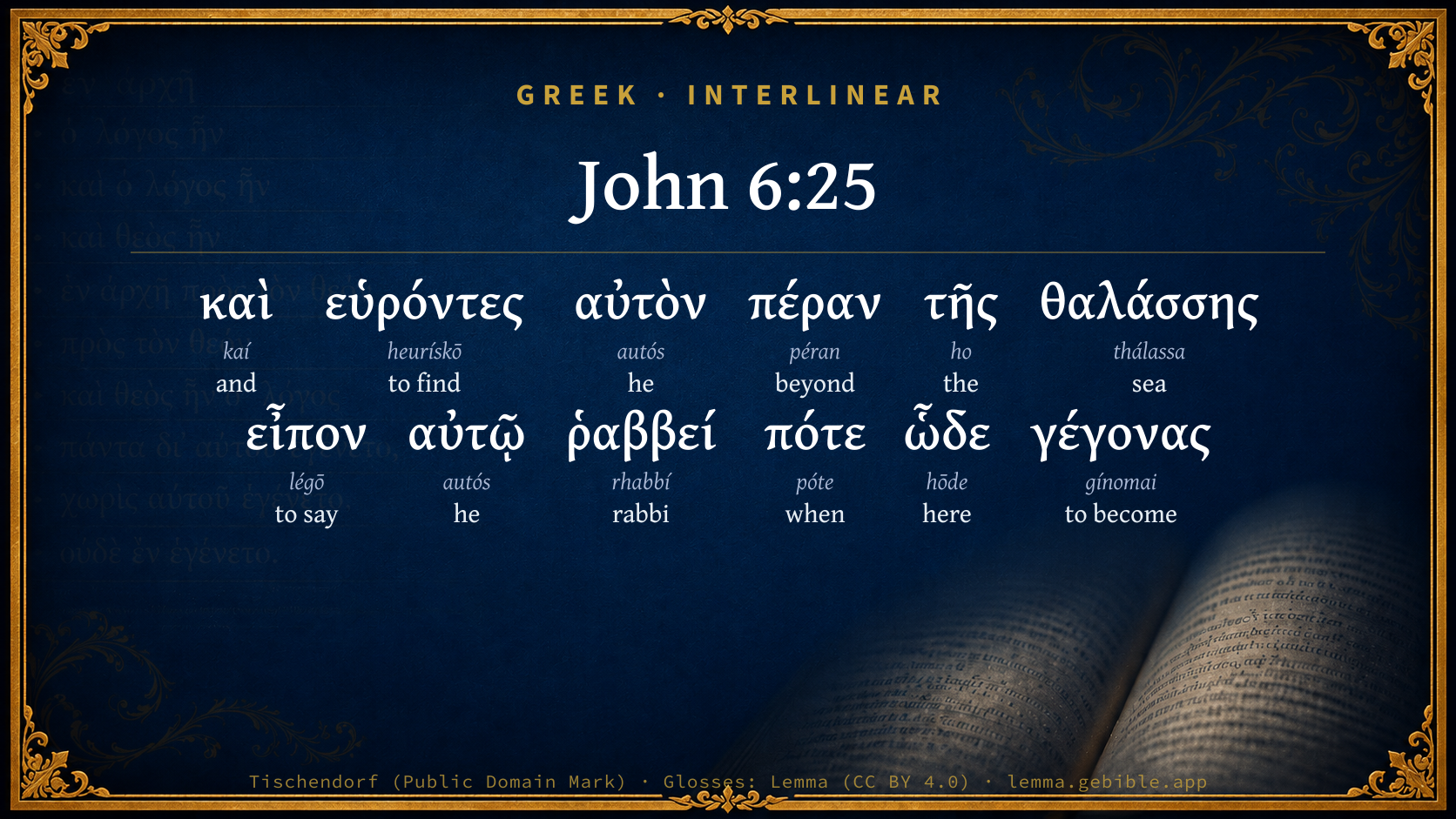
When they found him on the other side of the sea, they asked him, "Rabbi, when did you come here?"
World English Bible · Public Domain
Download a study sheet

One document with this verse’s original text, its word-by-word gloss line, the meaning frame, cross-references with their text, attributed commentary, and full source and license credits — printable, and it pastes into notes with its structure intact.

This verse Autodidact and up

Study sheet (.html) Plain text (.txt)

A passage Seminary Student

Up to 50 verses in one chapter. A passage sheet keeps up to 6 commentary sources and 12 cross-references per verse, in the order this page ranks them, and says so on the sheet whenever that leaves anything out. Ask for a single verse and you get the Autodidact verse sheet above.

Everything on this page stays free to read, with no account — the sheet is a download of what is already on screen, not access to it.

Want to remove ads? Support Godless Engineer
Compare translations 3

The same verse in 3 English versions, stacked beneath the original-language interlinear above. Click any original word for its lexicon entry.

Each is an independent rendering of the whole verse — the interlinear is not word-aligned to these translations.

Highlighted words mark where these versions differ — a whole-verse word diff, not a word-by-word alignment.

  • World English Bible Public Domain
    When they found him on the other side of the sea, they asked him, "Rabbi, when did you come here?"
  • King James Version Public Domain
    And when they had found him on the other side of the sea, they said unto him, Rabbi, when camest thou hither?
  • unfoldingWord Literal Text CC BY-SA 4.0
    And having found him on the other side of the sea, they said to him, “Rabbi, when did you come here?”

unfoldingWord Literal Text — © unfoldingWord, licensed CC BY-SA 4.0. Word-aligned USFM3 via Door43 (git.door43.org/unfoldingWord/en_ult).

Versions to compare (up to 4)

3 of 4 selected

Show all 19 translations

Every available English version of this verse, each an independent rendering of the whole verse.

  • World English Bible Public Domain
    When they found him on the other side of the sea, they asked him, "Rabbi, when did you come here?"
  • Berean Standard Bible Public Domain
    When they found Him on the other side of the sea, they asked Him, “Rabbi, when did You get here?”
  • Majority Standard Bible Public Domain
    When they found Him on the other side of the sea, they asked Him, “Rabbi, when did You get here?”
  • King James Version Public Domain
    And when they had found him on the other side of the sea, they said unto him, Rabbi, when camest thou hither?
  • American Standard Version (1901) Public Domain
    And when they found him on the other side of the sea, they said unto him, Rabbi, when camest thou hither?
  • Revised Version (1885) Public Domain
    And when they found him on the other side of the sea, they said unto him, Rabbi, when camest thou hither?
  • Geneva Bible (1599) Public Domain
    And when they had founde him on the other side of the sea, they sayde vnto him, Rabbi, when camest thou hither?
  • Douay-Rheims (1899) Public Domain
    And when they had found him on the other side of the sea, they said to him: Rabbi, when camest thou hither?
  • Young's Literal Translation Public Domain
    and having found him on the other side of the sea, they said to him, `Rabbi, when hast thou come hither?'
  • Literal Standard Version CC BY-SA 4.0
    and having found Him on the other side of the sea, they said to Him, “Rabbi, when have You come here?”
  • Unlocked Literal Bible CC BY-SA 4.0
    After they found him on the other side of the sea, they said to him, “Rabbi, when did you come here?”
  • unfoldingWord Literal Text CC BY-SA 4.0
    And having found him on the other side of the sea, they said to him, “Rabbi, when did you come here?”
  • Darby Bible Public Domain
    And having found him the other side of the sea, they said to him, Rabbi, when art thou arrived here?
  • World Messianic Bible Public Domain
    When they found him on the other side of the sea, they asked him, “Rabbi, when did you come here?”
  • Webster's Bible Public Domain
    And when they had found him on the other side of the sea, they said to him, Rabbi, when camest thou hither?
  • Free Bible Version CC BY-SA 4.0
    When they found him on the other side of the sea, they asked him, “Rabbi, when did you get here?”
  • Bible in Basic English Public Domain
    And when they came across him on the other side of the sea they said, Rabbi, when did you come here?
  • Text-Critical English NT CC BY 4.0
    When they found him on the other side of the sea, they said to him, “Rabbi, when did yoʋ get here?”
  • Tyndale New Testament (1534) Public Domain
    And when they had founde him on the other syde of the see they sayd vnto him: Rabbi when camest thou hidder?

Literal Standard Version (2020), Covenant Press — licensed CC BY-SA 4.0. Text via the HelloAO Bible API (eBible.org). Unlocked Literal Bible (unfoldingWord) — licensed CC BY-SA 4.0. Text via the HelloAO Bible API (eBible.org). unfoldingWord Literal Text — © unfoldingWord, licensed CC BY-SA 4.0. Word-aligned USFM3 via Door43 (git.door43.org/unfoldingWord/en_ult). Free Bible Version, Dr. Jonathan Gallagher — licensed CC BY-SA 4.0. Text via the HelloAO Bible API (eBible.org).

Word by word

More ways to search: Search by grammar → Find every occurrence → Compare this word →

Practice this passage: Drill this verse → Learn its vocabulary →

About this verse

These counts appear in no published source. They are computed here, from the morphology-tagged text and Lemma’s own curated glosses. What Lemma adds →

12
words
11
distinct lemmas
Gospels
section

Notable vocabulary

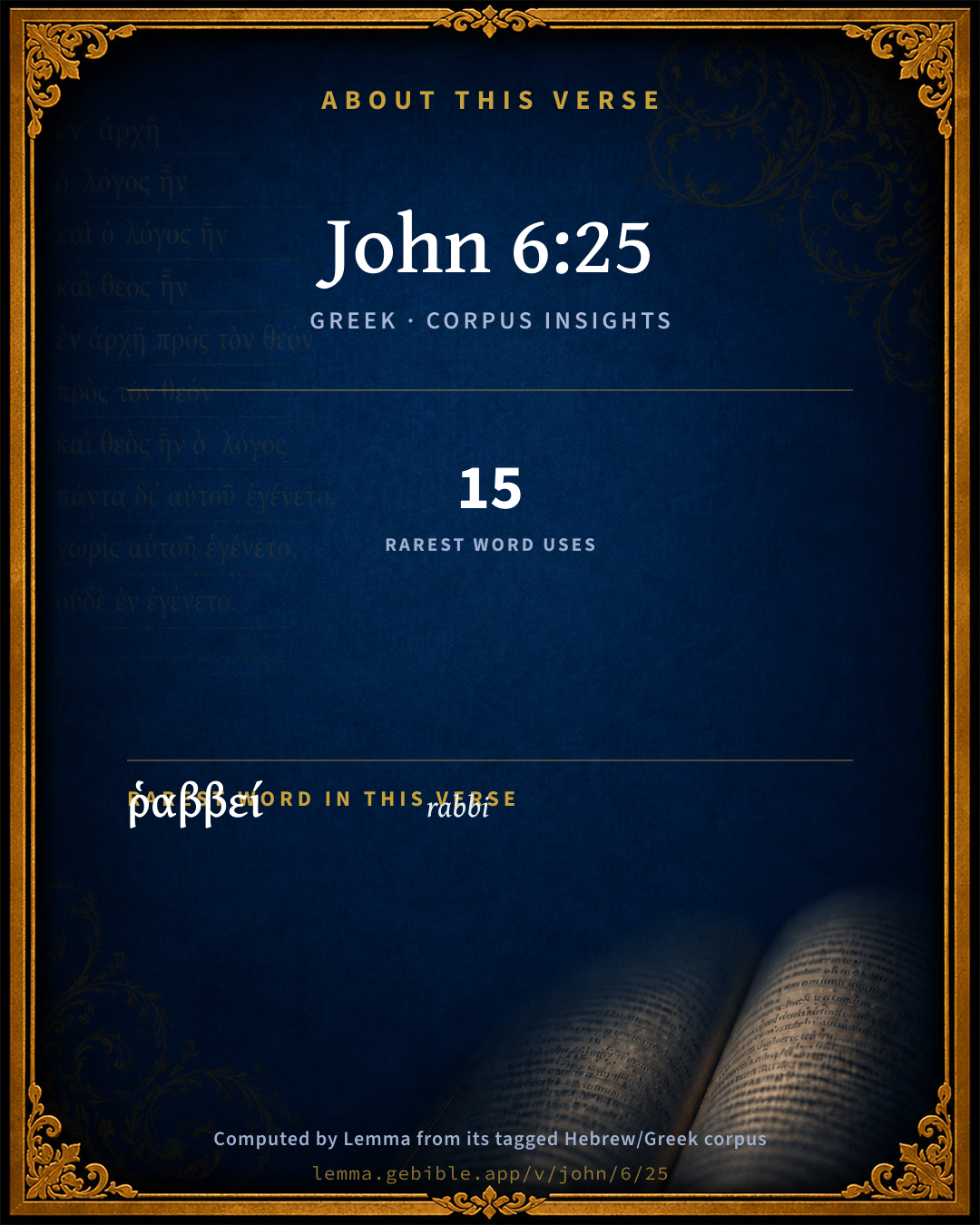
The rarest word here is ῥαββεί rabbi G4461 — appearing just 15 times in the whole Greek New Testament.

Shared distinctive vocabulary

ῥαββεί rabbi G4461 occurs in 15 verses of the Greek New Testament. Also found in:

Repetition

A word recurs within this verse:

  • αὐτὸν he G846 ×2

Cross-references

2

Topical passages linked to John 6:25 in the Treasury of Scripture Knowledge — connected by theme and wording, ordered by reader-vote popularity; previews shown in the World English Bible.

  • Matthew 23:7 the salutations in the marketplaces, and to be called 'Rabbi, Rabbi' by men.
  • John 1:38–39 Jesus turned, and saw them following, and said to them, "What are you looking for?" They said to him, "Rabbi" (which is to say, being interpreted, Teacher), "where are you staying?"

Cross-references courtesy of OpenBible.info (CC BY 4.0).

Commentary

Notes on John 6:25 from classic Christian and Jewish commentators (each source and its license shown beneath its notes). The classic Christian expositions comment on the surrounding passage and are grouped to its opening verse, so a note may address several verses; the Jewish commentaries on the Tanakh (Rashi and others) are per-verse, so they appear only where the commentator wrote on this verse.

Lemma curates 59 commentaries, every one of them public domain or Creative Commons licensed, each selected and text-cleaned for this edition rather than reprinted as found. About our sources →

Joseph Benson's Commentary

Joh 6:25-27. When they had found him on the other side — Namely, in the synagogue of Capernaum, as appears from Joh 6:59; they said unto him — As soon as the worship was over, and even before they quitted the place; Rabbi, when camest thou hither? — They ask this question because, as Jesus did not go on the preceding evening with his disciples, they expected to have found him on the other side of the sea, and could not conceive when he could come, or what imaginable means he could have of crossing the water. Jesus, modestly waiving the recital of those extraordinary circumstances which attended his passage, diverted the discourse to a more important and edifying subject; and knowing, by an intimate penetration of their very hearts, that they were governed only by carnal motives in this attendance upon him, humble and zealous as it might appear, he said — With great solemnity, Verily, ye seek me, not because ye saw the miracles — Because, having been eye-witnesses of the miracles which I performed, you are convinced by them that I am a divine teacher, and are now disposed to hearken unto and obey my doctrine: but because ye did eat of the loaves, and were filled — And have from thence concluded, that you shall gain great secular advantages by following me: having been once fed, you expect that I will feed you frequently by a miracle; and the satisfaction you have found in that meal has made you conceive great hopes of temporal felicity under my administration. These are the views with which you are following me; but you are entirely mistaken in them, for your happiness does not consist in the meat that perisheth, neither is it that sort of meat which the Messiah will give you. Hitherto Christ had been gathering hearers; he now begins to try their sincerity by a figurative discourse concerning his passion, and the fruit of it to be received by faith. Labour not for the meat which perisheth — For bodily food, or for any merely temporal blessing; not for that only, not chiefly: not at all, but in subordination to divine knowledge and grace, faith and love; the meat that endureth to everlasting life — Which, by invigorating all the faculties of the soul, and making it wise and good, holy and happy, renders it incorruptible and immortal, entitled to, and prepared for, everlasting felicity. Which meat, or which life, the Son of man shall give you — If with sincerity, earnestness, and faith, you apply to him for it. It is his gift, χαρισμα, a gift of grace, Rom 6:23: and yet we are commanded to labour for it, as if it were to be procured by our own industry, and sold upon that valuable consideration. But when we have laboured with the utmost diligence for it, still we have not merited it as our hire, but the Son of man gives it. And it is an encouragement, that he who has the giving of it is the Son of man, our kinsman and brother; for, in consequence of that, we may hope that the sons of men, who seek it and labour for it, shall not fail to obtain it. For him hath God the Father sealed — By this very miracle, as well as by his whole testimony concerning him. Having given him authority, he has given us assurance of it; having intrusted him with unlimited powers, he hath satisfied us by undoubted proofs that he has done so. Sealing a writing is a mark of the authenticity of it. God the Father sealed his Son, or manifested that he had commissioned him to be the Teacher, Redeemer, Saviour, and Governor of his church, by causing his Holy Spirit to rest on him, by the voice from heaven uttered once and again, and by the testimony he bore to him in signs and wonders.

Joseph Benson's Commentary on the Old and New Testaments (1811–1818) — public domain. Text from a community e-Sword module.

Bengel's Gnomon

Johann Albrecht Bengel

Joh 6:25. Πότε, when) [They ask in astonishment, How could He accomplish] in so short a time, so long a way? The question as to time includes the question as to the manner.

Bengel's Gnomon of the New Testament — English translation (T&T Clark, Edinburgh, 1860) — public domain. Text from a community e-Sword module.

Meyer's Critical & Exegetical Commentary

Heinrich August Wilhelm Meyer

Joh_6:25-26.[232] Πέραν τ. θαλάσσ.] in the synagogue at Capernaum, Joh_6:59. But πέραν τ. θαλ. has importance pragmatically, as showing that it formed a subject of amazement to them to find Him already on the western shore.

πότε] when? for it must have been, at the earliest, after the arrival of the disciples (Joh_6:22); and in this lay the incomprehensible how? no other boat having crossed, and the journey round by land being too far. They have a dim impression of something miraculous; quaestio de tempore includit quaestionem de modo, Bengel. Jesus does not enter upon their question, nor gratify their curiosity, but immediately charges them with the unspiritual motive that prompted them to seek Him, in order to point them to higher spiritual food. For γέγονας, venisti, see on Joh_1:15.

οὐχ … ἀλλ.] not non tam … quam (Kuinoel, etc.); the ὅτι εἴδετε σημ. is absolutely denied. Comp. Fritzsche, ad Marc. Exc. II. p. 773. In the miraculous feeding they should have seen a divinely significant reference to the higher Messianic bread of life, and this ought to have led them to seek Jesus; but it was only the material satisfaction derived from the miraculous feeding that brought them to Him, as they hoped that He would further satisfy their carnal Messianic notions.

σημεῖα] They had seen the outward miracle, the mere event itself, but not the spiritual significance of it,that wherein the real essence of the σημεῖον, in the true conception of it, consisted. The plural is not intended to include the healings of the sick, Joh_6:2 (Bengel, Lücke, and most others), against which see Joh_6:4, but refers only to the feeding, as the antithesis ἀλλʼ ὅτι shows, and it is therefore to be taken generically, as the plural of category.

[232] See, concerning all the occurrences, ver. 26 ff., Harless, Luther. Zeitschrift, 1867, p. 116 ff.

Meyer — Critical and Exegetical Commentary on the New Testament — English translation by Peter Christie, edited by Frederick Crombie (T&T Clark, 1880) — public domain. Text from a community e-Sword module.

Godet's Commentaries

Frédéric Louis Godet

1. Vv. 25-40.

This first phase is made up of four brief dialogues, each including a question of the Jews and an answer of Jesus. The last of these answers is more fully developed; Jesus expresses in it, with restrained emotion, the impressions with which the condition of His hearers filled His soul.

1. Joh 6:25-27. The contrast between the food which perishes and that which abides.

Vv. 25, 26. “And having found him on the other side of the sea, they said unto him: rabbi, when camest thou hither? 26. Jesus answered them and said: Verily, verily, I say unto you, You seek me, not because you saw signs, but because you did eat of those loaves and were filled.”

We have seen that the motive for the action of the multitude was the seeking for Jesus; this is recalled to mind by the first words of this passage: “And having found him.” The question: when (not: how) camest thou? arises from the fact that they think it impossible that Jesus had made the journey on foot over the road which separates Bethsaida Julias from Capernaum (two to three leagues). The presence of Jesus produces on them the effect of an apparition. He replies, as on every occasion when He is questioned in the way of curiosity, not to the question of the interlocutor, but to the feeling which dictates it.

Comp. Joh 2:4; Joh 3:3, etc. He unveils to these Jews what is false and fleshly in their way of seeking Him. As there is here a revelation of their inward feelings, of which they were themselves unconscious, He uses the emphatic affirmation,amen, amen. Jesus contrasts here with the false and vain seeking after His person, which aims only at the satisfaction of the earthly man (Joh 6:26), that salutary seeking which tends to fill the wants of the spiritual man (Joh 6:27). His miracles were the visible signs of the blessings of salvation which He brings to mankind. It will be necessary, therefore, not to rest in the material relief which they procure; it will be necessary to rise by their means to the desire of the superior gifts of which they are the pledge and the image; it will be necessary, before and above all, to believe on Him whom God points out to the world by giving to Him to do such works. We see how necessary it is to avoid translating the word σημεῖα, signs, here by miracles (Ostervald, Arnaud, Rilliet). It is precisely on the meaningsigns that the whole force of this saying depends. The multitudes interpreted the multiplication of the loaves as the beginning of a series of wonders of the same nature, the inauguration of an era of miracles more and more brilliant and satisfying to the flesh. “Instead of seeing,” as Lange says, “in the bread the sign, they had seen in the sign only the bread.” This gross want of understanding is what gives to their search for Jesus a false, earthly, sensual, animal character.

This tendency it is which Jesus points out to them from the very first word of the conversation, and particularly by the expression which betrays a sort of disgust: and because you were filled. What a difference between these people, who come with their gross aspirations, their earthly appetites, and the spiritual Israel which the Old Testament was intended to prepare and which cries out: “My soul thirsts after thee, oh living God!” This Israel would say to Him who multiplied the loaves: Give us more still! Do to-day for our hearts what thou didst yesterday for our bodies! The plural, signs, refers either to the two miracles related in the former part of the chapter, or rather to the miracles in general, which had been no better understood by the multitudes than the one of multiplying the loaves. We have rendered the article τῶν before ἄρτων by the demonstrative pronoun: “those loaves,” because the word the contains an evident allusion to the loaves of the preceding day.

ADDITIONAL NOTES BY THE AMERICAN EDITOR.

Vv. 25-40.

1. The abruptness in the turn of thought from the question of the people to the answer of Jesus may indicate an omission of some intermediate words in the report of the conversation. These words, however, must have revealed to the mind of Jesus that their thoughts were moving in the sphere of earthly curiosity and earthly desire, and so, as everywhere in this Gospel (and to some extent the same thing is noticeable in the earlier gospels), He turns them away at once from the earthly to the spiritual things.

2. Joh 6:26 does not seem to intimate that they came to Jesus now for the purpose of having food provided for them again, as it had been on the day before, but that, in view of the fact that they had had such provision for temporal wants in one line, they hoped to find in Jesus one who would, as the great prophet, bring them the blessings which might belong to a temporal and earthly kingdom. They saw the miracle of the preceding day and were impressed by it. They said, Of a truth this is the prophet. But they did not see in it a true σημεῖον, in the sense in which Jesus intended it. They did not have the faith which took hold of the inner life. Hence they asked (Joh 6:30) for a sign, when He called for this faith, as if no sign had been already given.

3. Faith is presented in this passage as an ἔργον, and as the one comprehensiveἔργον . But this seems to be rather incidental to the form of the sentence than indicative of a doctrine of faith as a work. As they called on Him to tell them what they must do in working for the meat which abides to eternal life, He tells them that the sum of what they have to do is gathered up into believing in Him. But this believing is set forth in the following discourse as involving the closest union with Jesus, the feeding upon him, and thus it is represented as a working and transforming power renewing the whole life of the soul.

4. In the demand which they make for a new sign it is probable that the miracle wrought on the preceding day may have led them to refer to the manna, rather than any other wonderful manifestation in the Old Testament history. Not a mere provision for a day, like that which He had just given, but something great and continuous, such as had come through Moses, might reasonably, as they thought, be asked for, before they should accept Him as one on whom eternal life for themselves should so wholly depend.

5. The progress of thought from Joh 6:32 to Joh 6:35 is as follows: Jesus first donies that the bread which answers to the true idea of bread which He now has in mind (ἀληθινόν) was given by Moses, and affirms that it is given by God (Joh 6:32); secondly, He gives the proof of the affirmative statement—it is God who gives the true bread, because the bread of God is that which descends and gives life to the world, and that which thus gives life can alone be the ἀληθινὸς ἄρτος (Joh 6:33); thirdly, He declares that He is Himself this bread (Joh 6:35). The construction of Joh 6:33 is in accordance with the order of the words, ἄρτοςbeing the subject and ὁ καταβ. κ.τ.λ. the predicate. The fact that God’s bread is that which gives life is the proof that not Moses, but God, gives the ideal bread. The emphasis of the last clause of Joh 6:33 is especially on the wordsζωὴν διδοὺς τῷ κόσμῳ. The ideal bread must be the life-giving bread. The close connection between Joh 6:35 and Joh 6:33 seems to show that the gentitive ζωῆς is to be explained as equivalent to διδοὺς ζωήν.

6. The reference in the word εἶπον of Joh 6:36 is supposed by Weiss, Keil, Milligan and Moulton, among the most recent commentators, to be to the words of Joh 6:26. Westcott says: “The thought is contained in Joh 6:26, and the reference may be to those words; but more probably the reference is to other words like them, spoken at some earlier time.” The general character and plan of John’s Gospel makes it probable that in such cases there is an allusion to something which he has himself recorded, and, if this be the fact in this case, the reference to Joh 6:26 is somewhat more probable than that to Joh 5:37 ff.

7. The emphasis in Joh 6:37 ff. is on the word πᾶν . It is, therefore, the universality of the blessing with reference to those who believe, rather than the question of Divine election as limiting it only to them, which is here in mind.

8. Joh 6:37-40 are closely connected in thought with Joh 6:35. As Christ is the life-giving bread, the one who comes to Him and believes on Him will never hunger or thirst (Joh 6:35), because every such person is a gift to Christ according to the will of the Father, and this will is that the gift, when once made, should never be lost. Four points may be noticed here:

(a) The emphasis which is laid on the absolute security of the continuous and ever-enduring blessing.

(b) The foundation of this security in the fact that Christ’s mission to earth is to do the Father’s will—there can be no selfish or arbitrary action on His part, therefore, with reference to those who come to Him by the Father’s gift.

(c) The gift of the Father is immediately united with the existence of faith in the one who comes to Christ (comp. Joh 6:39-40 in their parallelism, and the relation of the latter to the former through the particle γάρ); the Father draws (Joh 6:44), and the susceptible soul comes with faith by reason of the drawing influence.

(d) The experience of those who thus come is set forth from the beginning to the end—first, they are none of them rejected when they come; secondly, they are none of them lost afterwards, but are all kept safely; thirdly, they have eternal life from the moment of believing, and it is in this life that they are kept; fourthly, the consummation at the end is the resurrection. The whole is a development of life, in the carrying out of the Divine will by Christ, which naturally and necessarily moves forward to its completeness.

9. The connection of ἔχη ζωὴν αἰώνιον (Joh 6:40) with μὴ ἀπολέσω (Joh 6:39) points to the idea of duration in αἰώνιον (the quantitative idea); the contrast of the ἔχη and ἀναστήσω, on the other hand, points to the present possession of the life, and thus to the qualitative idea. The two elements are united in the Johannean thought.

Frédéric Louis Godet — Commentaries on Luke, John, Romans, and 1 Corinthians — English translation (T&T Clark, Edinburgh, 1870s–1890s) — public domain. Text from a community e-Sword module.

Jamieson, Fausset & Brown

Robert Jamieson, A. R. Fausset & David Brown

when they had found him on the other side--at Capernaum.

they said, &c.--astonished at His being there, and wondering how He could have accomplished it, whether by land or water, and when He came; for being quite unaware of His having walked upon the sea and landed with the disciples in the ship, they could not see how, unless He had travelled all night round the head of the lake alone, He could have reached Capernaum, and even then, how He could have arrived before themselves.

Jamieson, Fausset & Brown — Commentary Critical and Explanatory on the Whole Bible (1871) — public domain (CC PDM 1.0). Text via the HelloAO Bible API.

Adam Clarke's Commentary

Verse 25. On the other side of the sea] That is, on the sea coast, to the northward of it, where Capernaum lies in the land of Genesaret: but see the note, on Joh 6:17; Joh 6:22. It was in one of the synagogues of Capernaum that he delivered the following discourse: see Joh 6:59.

Adam Clarke's Commentary on the Bible (1810–1826) — public domain. Text from a community e-Sword/MySword module.

John Calvin's Commentaries

25. On the other side of the sea. We have already said that Capernaum was not situated on the opposite shore; for Tiberias is situated on that part of the lake where it is broadest, Bethsaida follows next, and Capernaum lies near the lowest part, not far from where the river Jordan issues from the lake. Now, when John places it on the other side of the lake itself, we must not understand him as if its position were directly across, but because, at the lower extremity, the lake made a large winding, and, on account of the bay that intervened, it was impossible to go by land without a very circuitous journey. The Evangelist therefore says, on the other side of the sea, adopting the mode of expression used by the common people, because the only direct and ordinary mode of conveyance was by a boat.

John Calvin's Commentaries (1540-1563) — public domain. Text from the Calvin Translation Society English edition (1840s-50s) via the Christian Classics Ethereal Library (ccel.org). Calvin's coverage is partial (roughly two-thirds of the Bible); uncommented books and verses are honest gaps, never fabricated. The 19th-century editor's footnotes and remarks are omitted so the notes are faithfully Calvin's own voice.

Ellicott's Commentary for English Readers

(25) Rabbi, when camest thou hither?—This discourse took place in the synagogue at Capernaum (Joh_6:59). They are amazed to find Him here. When and how could He have come? He had not gone in the boat with the disciples, and no other boats had crossed but those in which they themselves came. On the title Rabbi, see Note on Joh_1:38.

A Bible Commentary for English Readers, edited by Charles John Ellicott (1878–1897) — public domain. Text from a community e-Sword module.

The Cambridge Bible for Schools and Colleges

gen. ed. J. J. S. Perowne

25. on the other side of the sea] This now means the western shore; in Joh_6:22 it meant the eastern. From Joh_6:59 we have the locality fixed very distinctly as the synagogue at Capernaum.

when camest thou] Including how? they suspect something miraculous. Christ does not gratify their curiosity: if the feeding of the 5000, which they had witnessed, taught them nothing, what good would it do them to hear of the crossing of the sea? ‘Camest Thou hither’ is literally ‘hast Thou come to be here:’ comp. Joh_1:15.

The Cambridge Bible for Schools and Colleges (gen. ed. J. J. S. Perowne; Cambridge University Press, 1878–1918) — public domain. Text from a community e-Sword module.

John Gill's Exposition

Jesus answered them and said,.... Not by replying to their question, or giving a direct answer to that, which he could have done, by telling them that he walked upon the water, and found his disciples in great distress, and delivered them, and came early that morning with them to the land of Gennesaret, and so to Capernaum: but not willing to gratify their curiosity; and knowing from what principles, and with what views they sought after him, and followed him; and willing to let them know that he knew them, being the searcher of hearts, and to reprove them for them, thus addressed them:

verily, verily, I say unto you; this is a certain truth, and was full well known to Christ, and what their own consciences must attest:

ye seek me not because ye saw the miracles; of feeding so large a number with so small a quantity of food, and of healing them that needed it, Luk 9:11. Not but that they did regard the miracles of Christ, and concluded from thence he must be that prophet that was to come, and were for taking him by force, and proclaiming him king; but then they had a greater respect to their own worldly interest, and their carnal appetites, than to these, as follows:

but because ye did eat of the loaves, and were filled; they regarded their own bellies more than the honour and glory of Christ, and even than the good of their immortal souls, and the spiritual and eternal salvation of them: and it is to be feared that this is the case of too many who make a profession of religion; their view being their own worldly advantages, and not the spiritual and everlasting good of their souls, and the real interest of a Redeemer: hence the following advice.

John Gill's Exposition of the Whole Bible (1746–1763) — public domain (CC PDM 1.0). Text via the HelloAO Bible API.

Trapp's Complete Commentary

John Trapp

25 And when they had found him on the other side of the sea, they said unto him, Rabbi, when camest thou hither?

Ver. 25. Rabbi, when camest thou hither?] This question they moved, not so much to learn what they knew not, as to make show of what they knew before. But two things make a man truly virtuous, -good actions and good aims. Finibus non officiis a vitiis discernuntur virtutes, saith Augustine: The end maketh or marreth the act. Christus opera nostra non tam actibus quam finibus pensat, saith another. The glory of God should consume all sinister ends, as the sunlight puts out the fire, or as Moses’ serpent swallowed up the sorcerers’ serpents.

John Trapp, A Commentary or Exposition upon All the Books of the Old and New Testament (1647–1656) — public domain. Text from a community e-Sword module.

Matthew Poole's English Annotations

They asked him, When camest thou hither? A curious and impertinent question, to which he doth not think fit to give an apposite answer, but at first letteth them know, that he knew their hearts, and what designs they had in following him; which was not to see the miraculous effects of the Divine power, the credentials of his commission from heaven, and to receive him as the true Messiah, and believe his doctrine; but they came upon so low an account as to be fed by him.

Matthew Poole's English Annotations on the Holy Bible (1683–1685) — public domain. Text from a community e-Sword/MySword module.

Whedon's Commentary on the Bible

Daniel D. Whedon

25. When they had found him—Jesus first landed at the plain of Gennesaret; but before these pursuers found him he had arrived in the synagogue of Capernaum. See notes on Mat_14:34-36.

Daniel D. Whedon (gen. ed.), Commentary on the Old and New Testaments (1874–1909) — public domain. Text from a community e-Sword module.

The Pulpit Commentary

When they had found him on the other side of the sea (other side than that on which the miracle took place, and yet near Capernaum. This contradicts the exposition which would make the site of the feeding to be on the Western side), they said unto him, Rabbi, when earnest thou? and how happens it that thou art here? The pote wde gegonav ; is difficult to translate. The when? practically includes the how? also. The difficulty lay in the time. They were sure that Jesus had not started before the disciples, and they knew that there was no method by which the lake itself would have been available, and they want explanation. The news of his crossing the water after some fashion that would ally him to Moses, Joshua, Elijah, may easily have got disseminated, one report or another being rapidly circulated.

The Pulpit Commentary (1880–1919), ed. H.D.M. Spence-Jones & Joseph S. Exell — public domain. Text from a community e-Sword module.

The People's New Testament

B. W. Johnson

25. Rabbi, when camest thou hither? He had not crossed the sea with his disciples; he had not come with them; how and when did he come? The day was the Sabbath, they had sought him in the synagogue, the question was asked there, and the discourse that follows was spoken there (see verse 59).

B. W. Johnson's The People's New Testament with Notes (1889–1891) — public domain. Electronic text from the Christian Classics Ethereal Library (CCEL) ThML edition.

Cambridge Greek Testament for Schools and Colleges

25. πέραν τ. θ. This is now the western shore, Capernaum (Joh 6:59).

πότε ὧδε γ.; Comp. Joh 1:15. They suspect something miraculous, but He does not gratify their curiosity. If the feeding of the 5000 taught them nothing, what good would it do them to hear of the crossing of the lake?

Cambridge Greek Testament for Schools and Colleges (Cambridge University Press, 1896; 21 vols, various authors incl. Carr, Maclear, Plummer, Farrar, Lumby, Moule, M. R. James, Simcox) — public domain. Text from a community e-Sword module.

Alford’s Greek Testament

Henry Alford

25.] πέραν τ. θαλ. is now the west bank;—we have been crossing the sea with the multitude.

πότε, as Stier remarks, includes πῶς in its meaning. Our Lord leaves the question unanswered, because it was not for a sign to these people that He had miraculously crossed the lake.

Henry Alford, The Greek Testament (1849–1861) — public domain. Text from a community e-Sword module.

International Critical Commentary

25. εὐρόντες αὐτόν. Jesus had reached Capernaum with His disciples (cf. vv. 17, 59), and the crowds found Him there πέραν τῆς θαλάσσης, that is, now on the western side of the lake, the side opposite to that from which they started.

For “Rabbi,” the title by which these excited followers addressed Him, see on 1:38.

πότε ὧδε γέγονας; “When did you get here?” See on v. 19. Jesus gives no answer to their question, but rebukes them for their lack of understanding (v. 26).

Discourse: Jesus the Bread of Life, Which is Given by the Father (Vv. 26-40)

International Critical Commentary — older volumes (1896–1929), various authors — public domain. Text from a community e-Sword module.

Lesson kit

Teaching starters — assembled from the data on this page, not authored interpretation. Every prompt links to the verse data it draws on. Edit before teaching.

John, in the Gospels, opens this verse with 12 words (11 distinct Greek lemmas). Its most distinctive word is rhabbí (“rabbi”). A historical commentator’s framing appears above. Read the whole chapter for the surrounding context.

Discussion questions

  1. The word rhabbí carries the sense “rabbi.” How does it shape the verse?
  2. Matthew 23:7 shares the word «rabbi» with this verse. How do the two illuminate each other?
  3. “he” occurs 2× in this one verse. What is the effect of the repetition?
  4. The translations on this page render this verse differently — a whole-verse word diff, not a word-by-word alignment. What might account for the different wordings?
  5. Reading how Joseph Benson's Commentary and Bengel's Gnomon read this verse, where do the two commentators agree and where do they part?

Things to notice

Reading settings

Reading text

Shown beneath each verse's original-language words.

Old Testament
Old Testament edition

Read the OT as the Masoretic Hebrew (MT) or the Greek Septuagint (LXX).

English shown for the Greek Septuagint (in the Hebrew ↔ Greek comparison).

Comparing translations? Open the Compare panel on any verse page to stack up to four side by side.