Genesis 33:8

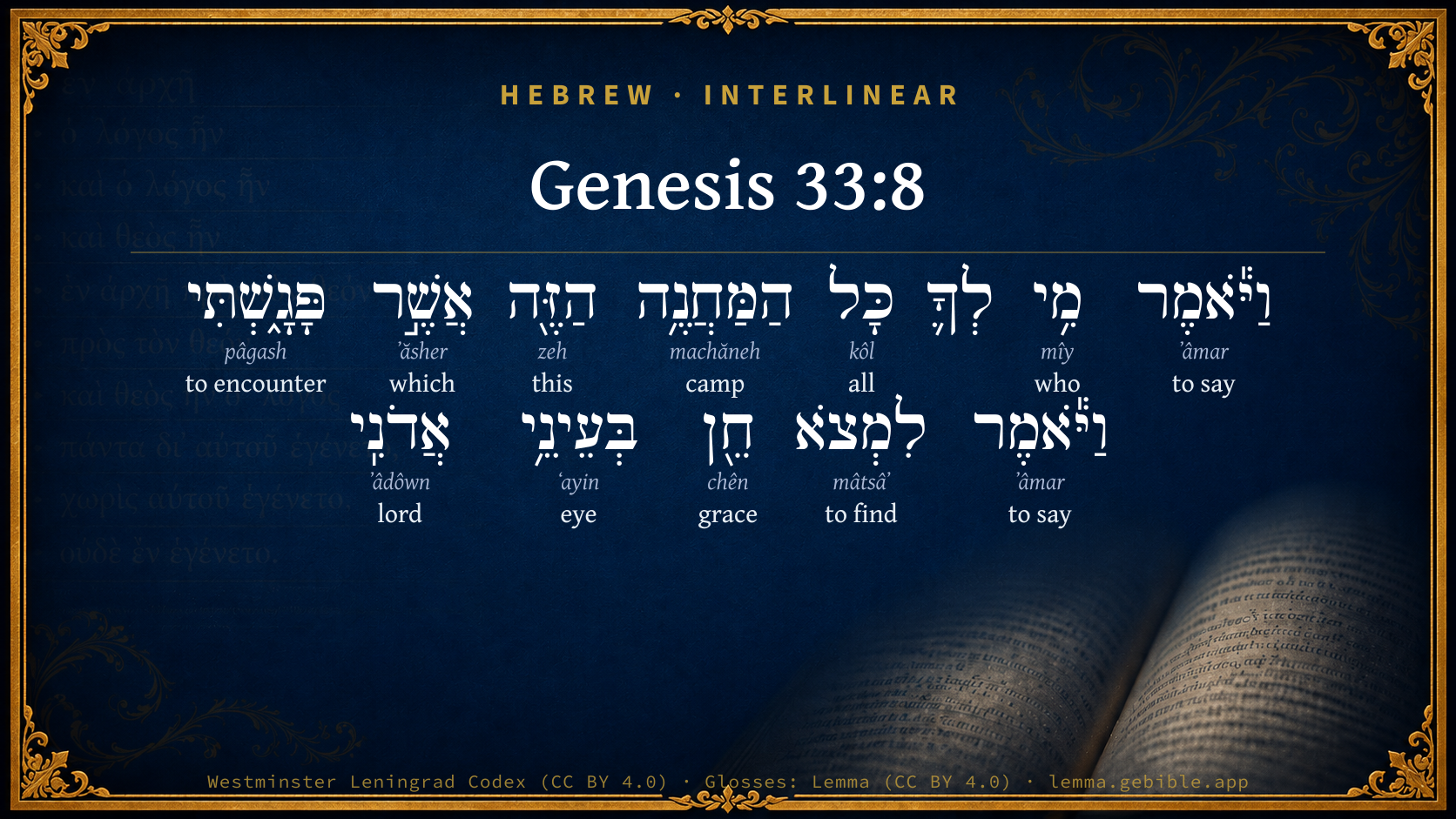
Hebrew (Westminster Leningrad Codex) Genesis 33:8 appears in the Hebrew Old Testament. The text above is from the Westminster Leningrad Codex. Each word links to its Strong’s number, a concise gloss, and parsing drawn from the Open Scriptures Hebrew Bible morphology. Click any word for its full Brown-Driver-Briggs (BDB) entry.
Download image
Cite this verse

Genesis 33:8 (World English Bible). Public Domain. Lemma interlinear Bible study tool, https://lemma.gebible.app/v/genesis/33/8.

Show BibTeX & RIS
BibTeX
RIS
English Translation
Esau said, "What do you mean by all this company which I met?" Jacob said, "To find favor in the sight of my lord."
World English Bible · Public Domain
Download a study sheet

One document with this verse’s original text, its word-by-word gloss line, the meaning frame, cross-references with their text, attributed commentary, and full source and license credits — printable, and it pastes into notes with its structure intact.

This verse Autodidact and up

Study sheet (.html) Plain text (.txt)

A passage Seminary Student

Up to 50 verses in one chapter. A passage sheet keeps up to 6 commentary sources and 12 cross-references per verse, in the order this page ranks them, and says so on the sheet whenever that leaves anything out. Ask for a single verse and you get the Autodidact verse sheet above.

Everything on this page stays free to read, with no account — the sheet is a download of what is already on screen, not access to it.

Want to remove ads? Support Godless Engineer
Compare translations 3

The same verse in 3 English versions, stacked beneath the original-language interlinear above. Click any original word for its lexicon entry.

Each is an independent rendering of the whole verse — the interlinear is not word-aligned to these translations.

Highlighted words mark where these versions differ — a whole-verse word diff, not a word-by-word alignment.

  • World English Bible Public Domain
    Esau said, "What do you mean by all this company which I met?" Jacob said, "To find favor in the sight of my lord."
  • King James Version Public Domain
    And he said, What meanest thou by all this drove which I met? And he said, These are to find grace in the sight of my lord.
  • unfoldingWord Literal Text CC BY-SA 4.0
    Then he said, “What to you all these groups that I met?” And he said, “To find favor in the eyes of my lord.”

unfoldingWord Literal Text — © unfoldingWord, licensed CC BY-SA 4.0. Word-aligned USFM3 via Door43 (git.door43.org/unfoldingWord/en_ult).

Versions to compare (up to 4)

3 of 4 selected

Show all 18 translations

Every available English version of this verse, each an independent rendering of the whole verse.

  • World English Bible Public Domain
    Esau said, "What do you mean by all this company which I met?" Jacob said, "To find favor in the sight of my lord."
  • Berean Standard Bible Public Domain
    “What do you mean by sending this whole company to meet me?” asked Esau. “To find favor in your sight, my lord,” Jacob answered.
  • Majority Standard Bible Public Domain
    “What do you mean by sending this whole company to meet me?” asked Esau. “To find favor in your sight, my lord,” Jacob answered.
  • King James Version Public Domain
    And he said, What meanest thou by all this drove which I met? And he said, These are to find grace in the sight of my lord.
  • American Standard Version (1901) Public Domain
    And he said, What meanest thou by all this company which I met? And he said, To find favor in the sight of my lord.
  • Revised Version (1885) Public Domain
    And he said, What meanest thou by all this company which I met? And he said, To find grace in the sight of my lord.
  • Geneva Bible (1599) Public Domain
    Then he said, What meanest thou by all this droue, which I met? Who answered, I haue sent it, that I may finde fauour in the sight of my lorde:
  • Douay-Rheims (1899) Public Domain
    And Esau said: What are the droves that I met? He answered: That I might find favor before my lord.
  • Young's Literal Translation Public Domain
    And he saith, `What to thee `is' all this camp which I have met?' and he saith, `To find grace in the eyes of my lord.'
  • Literal Standard Version CC BY-SA 4.0
    And he says, “What to you [is] all this camp which I have met?” And he says, “To find grace in the eyes of my lord.”
  • Unlocked Literal Bible CC BY-SA 4.0
    Esau said, “What do you mean by all these groups that I met?” Jacob said, “To find favor in the sight of my master.”
  • unfoldingWord Literal Text CC BY-SA 4.0
    Then he said, “What to you all these groups that I met?” And he said, “To find favor in the eyes of my lord.”
  • Darby Bible Public Domain
    And he said, What [meanest] thou by all the drove which I met? And he said, To find favour in the eyes of my lord.
  • World Messianic Bible Public Domain
    Esau said, “What do you mean by all this company which I met?” Jacob said, “To find favor in the sight of my lord.”
  • Webster's Bible Public Domain
    And he said, What meanest thou by all this drove which I met? And he said, these are to find grace in the sight of my lord.
  • Free Bible Version CC BY-SA 4.0
    “What were all the livestock for that I met on the way?” Esau asked. “They're a gift to you my lord so you'd treat me well,” Jacob answered.
  • Bible in Basic English Public Domain
    And he said, What were all those herds which I saw on the way? And Jacob said, They were an offering so that I might have grace in my lord's eyes.
  • JPS Tanakh (1917) Public Domain
    And he said: 'What meanest thou by all this camp which I met?' And he said: 'To find favour in the sight of my lord.'

Literal Standard Version (2020), Covenant Press — licensed CC BY-SA 4.0. Text via the HelloAO Bible API (eBible.org). Unlocked Literal Bible (unfoldingWord) — licensed CC BY-SA 4.0. Text via the HelloAO Bible API (eBible.org). unfoldingWord Literal Text — © unfoldingWord, licensed CC BY-SA 4.0. Word-aligned USFM3 via Door43 (git.door43.org/unfoldingWord/en_ult). Free Bible Version, Dr. Jonathan Gallagher — licensed CC BY-SA 4.0. Text via the HelloAO Bible API (eBible.org).

Word by word

More ways to search: Search by grammar → Find every occurrence → Compare this word →

Practice this passage: Drill this verse → Learn its vocabulary →

פָּגָ֑שְׁתִּי
pâgash
H6298
“to encounter”
Verb, Qal, Perfect, 1st Person, Common, Singular
Part of Speech
Verb
Stem
Qal
Form
Perfect
Person
1st Person
Gender
Common
Number
Singular
Full BDB Definition

Origin: a primitive root

TWOT: 1733

to meet, join, encounter - (Qal) to meet, encounter - (Niphal) to meet together, meet each other - (Piel) to meet, encounter
  1. וַיֹּ֕אמֶר ʼâmar H559 “and · to say” Conjunction + Verb, Qal, Sequential Imperfect, 3rd Person, Masculine, Singular
  2. מִ֥י mîy H4310 “who” Particle, Interrogative
  3. כָּל kôl H3605 “all of” Noun, Common, Masculine, Singular, Construct
  4. הַמַּחֲנֶ֥ה machăneh H4264 “the · camp” Particle, Definite Article + Noun, Common, Both, Singular, Absolute
  5. הַזֶּ֖ה zeh H2088 “the · this” Particle, Definite Article + Pronoun, Demonstrative, Masculine, Singular
  6. אֲשֶׁ֣ר ʼăsher H834 “which” Particle, Relative
  7. וַיֹּ֕אמֶר ʼâmar H559 “and · to say” Conjunction + Verb, Qal, Sequential Imperfect, 3rd Person, Masculine, Singular
  8. לִמְצֹא mâtsâʼ H4672 “to find” Preposition + Verb, Qal, Infinitive Construct
  9. חֵ֖ן chên H2580 “grace” Noun, Common, Masculine, Singular, Absolute
  10. בְּעֵינֵ֥י ʻayin H5869 “in/at · eyes of” Preposition + Noun, Common, Both, Dual, Construct
  11. אֲדֹנִֽי ʼâdôwn H113 “lord · my” Noun, Common, Masculine, Singular, Construct + Suffix, Personal, 1st Person, Common, Singular

About this verse

These counts appear in no published source. They are computed here, from the morphology-tagged text and Lemma’s own curated glosses. What Lemma adds →

13
words
11
distinct lemmas
Pentateuch
section

Notable vocabulary

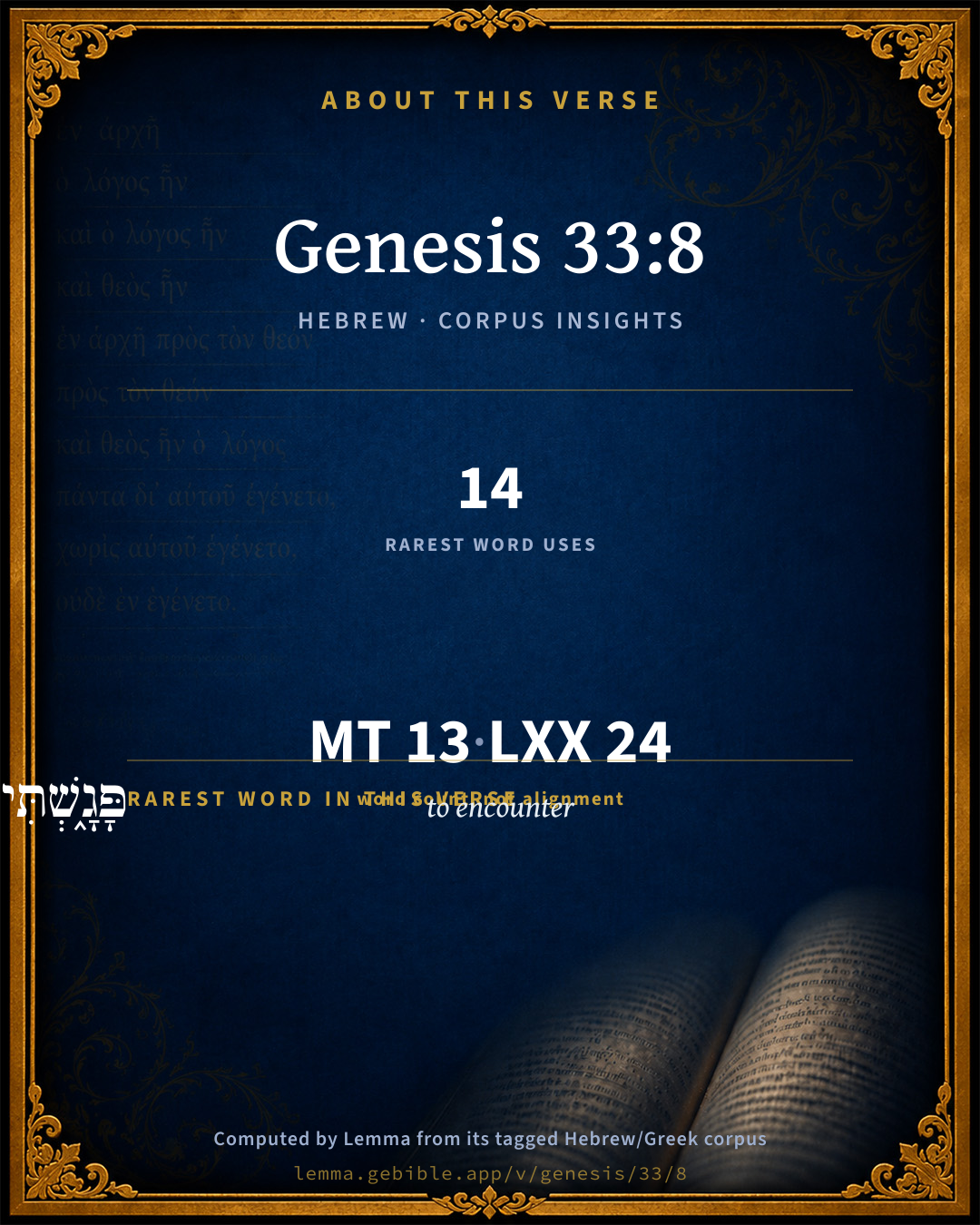
The rarest word here is פָּגָ֑שְׁתִּי to encounter H6298 — appearing just 14 times in the whole Hebrew Bible.

Shared distinctive vocabulary

פָּגָ֑שְׁתִּי to encounter H6298 occurs in 14 verses of the Hebrew Bible. Also found in:

Grammatical profile

  • 4 verbs
  • 5 nouns
  • 1 pronoun
  • 1 preposition
  • 2 particles

Verb forms

  • וַיֹּ֕אמֶר Qal · Sequential Imperfect
  • פָּגָ֑שְׁתִּי Qal · Perfect
  • וַיֹּ֕אמֶר Qal · Sequential Imperfect
  • לִמְצֹא Qal · Infinitive Construct

Repetition

A word recurs within this verse — often emphatic in Hebrew:

  • וַיֹּ֕אמֶר to say H559 ×2

Hebrew & Septuagint length

In English translation the verse runs 24 words from the Hebrew and 30 from the Septuagint (LXX English) — closely comparable.

A rough comparison of the two English renderings, which tokenize alike — not a word-level alignment.

Word counts can differ between the Hebrew and the Greek without any difference in meaning — e.g. the Hebrew direct-object marker אֵת has no separate Greek word, and Greek often adds the article ὁ.

In the original languages it is 13 Hebrew tokens and 24 Greek tokens — but the two are counted differently (Hebrew bundles its prefixes and suffixes into one token; the Greek is in lemma form), so that isn’t a like-for-like length.

Cross-references

4

Topical passages linked to Genesis 33:8 in the Treasury of Scripture Knowledge — connected by theme and wording, ordered by reader-vote popularity; previews shown in the World English Bible.

  • Genesis 32:5 I have oxen, donkeys, flocks, men-servants, and maid-servants. I have sent to tell my lord, that I may find favor in your sight.'"
  • Genesis 32:13–20 He lodged there that night, and took from that which he had with him, a present for Esau, his brother:
  • Genesis 39:5 It happened from the time that he made him overseer in his house, and over all that he had, that Yahweh blessed the Egyptian's house for Joseph's sake; and the blessing of Yahweh was on all that he had, in the house and in the field.
  • Esther 2:17 The king loved Esther above all the women, and she obtained favor and kindness in his sight more than all the virgins; so that he set the royal crown on her head, and made her queen instead of Vashti.

Cross-references courtesy of OpenBible.info (CC BY 4.0).

Hebrew and Greek witnesses Masoretic Hebrew ↔ Greek Septuagint

The same verse in the two great witnesses to the Old Testament, shown verse-for-verse.

These are two independent witnesses, not word-aligned to each other, and the Septuagint is shown in lemma (dictionary) form.

Hebrew Genesis 33:8 Masoretic · Westminster Leningrad Codex

וַיֹּ֕אמֶר מִ֥י לְךָ֛ כָּל הַמַּחֲנֶ֥ה הַזֶּ֖ה אֲשֶׁ֣ר פָּגָ֑שְׁתִּי וַיֹּ֕אמֶר לִמְצֹא חֵ֖ן בְּעֵינֵ֥י אֲדֹנִֽי

Esau said, "What do you mean by all this company which I met?" Jacob said, "To find favor in the sight of my lord."

World English Bible · Public Domain

Greek LXX Genesis 33:8 Septuagint · lemma form

καί εἶπον τίς οὗτος σύ εἰμί πᾶς ὁ παρεμβολή οὗτος ὅς ἀποἀντάω ὁ δέ εἶπον ἵνα εὑρίσκω ὁ παῖς σύ χάρις ἐναντίον σύ κύριος

And he said, What are these things to you, all these companies that I have met? And he said, That your servant might find grace in your sight, my lord.

LXX2012 (modern English Septuagint) · Public Domain

Hebrew: Westminster Leningrad Codex (CC BY 4.0). Greek: Septuagint (public domain); English from LXX2012 (modern English Septuagint) (Public Domain). How the Septuagint differs from the Hebrew →

Targum (Aramaic paraphrase)

2

The Targum is the ancient Jewish Aramaic paraphrase of the Hebrew Scriptures — an interpretive translation, not the Hebrew text itself. Onkelos (literal) and Pseudo-Jonathan (expansive) render the Torah, and Jonathan the Prophets. Coverage is partial: where no permissively-licensed English translation exists for a verse, only the Aramaic is shown. This is verse-level text, not a word-by-word alignment to the Hebrew.

  1. Targum Onkelos Torah (Genesis–Deuteronomy)
    וַאֲמַר מָן לָךְ כָּל מַשְׁרִיתָא הָדֵין דִּי עֲרָעִית וַאֲמַר לְאַשְׁכָּחָא רַחֲמִין בְּעֵינֵי רִבּוֹנִי

    (no public-domain English translation for this verse)

    Targum Onkelos — Aramaic: “Onkelos Genesis” (public domain); “Onkelos Exodus” (public domain); “Onkelos Leviticus” (public domain); “Onkelos Numbers” (public domain); “Onkelos Deuteronomy” (public domain). English: “Sefaria Community Translation” (CC0 1.0 (public-domain dedication)); “J.W. Etheridge. The Targums of Onkelos and Jonathan Ben Uzziel on the Pentateuch. London: Longmans, Green, 1862” (public domain). Text via Sefaria.

  2. Targum Pseudo-Jonathan Torah (Genesis–Deuteronomy)
    וַאֲמַר מַן לָךְ כָּל מַשְׁרֵי הָדֵין דְאַרְעִית וַאֲמַר דוֹרוֹן הוּא דְשַׁדְרִית לְאַשְׁכָּחָא רַחֲמִין בְּעֵינֵי רִבּוֹנִי

    And he said, What to thee is all this troop that I have met? And he said, It is a present I have sent to find mercy in the eyes of my lord.

    Targum Pseudo-Jonathan — Aramaic: “Targum Jonathan on Genesis” (public domain); “Targum Jonathan on Exodus” (public domain); “Targum Jonathan on Leviticus” (public domain); “Targum Jonathan on Numbers” (public domain); “Targum Jonathan on Deuteronomy” (public domain). English: “The Targum of Jonathan ben Uzziel, trans. J. W. Etheridge, London, 1862” (public domain). Text via Sefaria.

Commentary

Notes on Genesis 33:8 from classic Christian and Jewish commentators (each source and its license shown beneath its notes). The classic Christian expositions comment on the surrounding passage and are grouped to its opening verse, so a note may address several verses; the Jewish commentaries on the Tanakh (Rashi and others) are per-verse, so they appear only where the commentator wrote on this verse.

Lemma curates 59 commentaries, every one of them public domain or Creative Commons licensed, each selected and text-cleaned for this edition rather than reprinted as found. About our sources →

Trapp's Complete Commentary

John Trapp

Gen 33:8 And he said, What [meanest] thou by all this drove which I met? And he said, [These are] to find grace in the sight of my lord.

Ver. 9. I have enough, my brother.] Here is no mention of God: God is not in all the wicked man’s thoughts: he contents himself with a natural use of the creature, as brute beasts do. The godly taketh all as from God, and findeth no such sweetness, as in tasting how good the Lord is, in the creature. Tam Dei meminisse, opus est, quam respirare, saith one. But profane Esaus will neither have God in their heads, {Psa 10:4} nor hearts, {Psa 14:1} nor ways, {Tit 1:16} nor words. {Psa 12:4} They stand in a posture of distance, nay, of defiance to God.

John Trapp, A Commentary or Exposition upon All the Books of the Old and New Testament (1647–1656) — public domain. Text from a community e-Sword module.

John Calvin's Commentaries

8. What meanest thou by all this drove? He does not inquire as if he were altogether ignorant; seeing he had heard from the servants, that oxen and camels and asses and other cattle were sent him as a present; but for the purpose of refusing the gift offered to him: for when anything does not please us, we are wont to make inquiry as concerning a thing unknown to us. Jacob, however; is urgent; nor does he cease to ask, till he induces his brother to receive the gift: for this was as a pledge of reconciliation. Besides, for the purpose of persuading his brother, he declares, that it would be taken as a great kindness not to refuse what was given. For we do not willingly receive anything but what we certainly know to be offered to us freely and with a ready mind. And because it is not possible that we should willingly honor any but those we love, Jacob says that he rejoiced in the sigh of his brother as if he had seen God or an angel: by which words he means, not only that he truly loved his brother, but also that he held him in esteem. But it may seem, that he does wrong to God, in comparing Him with a reprobate man; and that he speaks falsely, because had the choice been given him, he would have desired nothing more earnestly than to avoid this meeting with his brother. Both these knots are easily untied. It is an accustomed form of speaking among the Hebrews, to call whatever is excellent, divine. And certainly Esau being thus changed, was no obscure figure of the favor of God: so that Jacob might properly say, that he had been exhilarated by that friendly and fraternal reception, as if he had seen God or an angel; that is, as if God had given some sign of his presence. And, indeed, he does not speak feignedly, nor pretend something different from what he has in his mind. For, being himself perfectly free from all hatred, it was his chief wish, to discharge whatever duty he could towards his brother; provided that Esau, in return, would show himself a brother to him.

John Calvin's Commentaries (1540-1563) — public domain. Text from the Calvin Translation Society English edition (1840s-50s) via the Christian Classics Ethereal Library (ccel.org). Calvin's coverage is partial (roughly two-thirds of the Bible); uncommented books and verses are honest gaps, never fabricated. The 19th-century editor's footnotes and remarks are omitted so the notes are faithfully Calvin's own voice.

Ellicott's Commentary for English Readers

(8) What meanest thou by all this drove . . .? Heb., What is all this camp of thine that I met? From the time of Jacob’s coming to Mahanaim, the word mahaneh, “camp,” is used in a very remarkable way. It is the word translated bands in Gen_32:7, and company in Gen_32:8; Gen_32:21. It is the proper word for an encampment of pastoral people with their flocks, and might be used not unnaturally of the five droves; for they would remind Esau of the cattle driven in at evening to the place where they were to pass the night.

A Bible Commentary for English Readers, edited by Charles John Ellicott (1878–1897) — public domain. Text from a community e-Sword module.

The Cambridge Bible for Schools and Colleges

gen. ed. J. J. S. Perowne

8. all this company] Lit. “all this camp.” Esau refers to the droves sent on ahead as a present by Jacob (Gen_32:13-22). The word “camp” (mahaneh) is an additional reference to Mahanaim.

The Cambridge Bible for Schools and Colleges (gen. ed. J. J. S. Perowne; Cambridge University Press, 1878–1918) — public domain. Text from a community e-Sword module.

John Gill's Exposition

And he said, what meanest thou by all this drove which I met?.... Not as being ignorant of the design of it; for no doubt the several drovers, according to their instructions from Jacob, had acquainted him with it; but he chose not to take the present on what they said, but was willing to have it from Jacob's own mouth, and that he might have the opportunity of refusing it:

and he said, these are to find grace in the sight of my lord; to gain his favour and good will; and which, as it was a token of Jacob's good will to him, so, by his acceptance of it, he would know that he bore the same to him also. It was usual in the eastern countries to carry presents to friends, and especially to great men, whenever visits were paid, as all travellers in general testify to be still the usage in those parts, to this day.

John Gill's Exposition of the Whole Bible (1746–1763) — public domain (CC PDM 1.0). Text via the HelloAO Bible API.

Haydock's Catholic Bible Commentary

Favour. Esau had already heard from the servants. But he asks again, meaning to excuse himself from receiving them. (Haydock) --- This civil and unexpected behaviour, filled the breast of Jacob with such gratitude and love, that he made use of an hyperbole, I have seen, &c. ...of God. Chaldean, "of a prince," Syriac, "of an angel," Elohim. See 2 Kings xix. 27; Esther xv. 16. (Calmet) --- A little present. Hebrew monee, or mincha, calculated to shew the subjection of the giver. (Menochius)

George Leo Haydock (1774–1849), Haydock's Catholic Family Bible and Commentary, 1859 edition — public domain. Excludes Psalms (Douay-Rheims chapter numbering differs from Protestant) and Deuterocanonical books (Catholic canon only).

Matthew Poole's English Annotations

He knew his meaning before from the servants’ mouths; but he asks, that he might both be more certainly informed of the truth, and have an occasion for a civil refusal of the gift.

Matthew Poole's English Annotations on the Holy Bible (1683–1685) — public domain. Text from a community e-Sword/MySword module.

The Pulpit Commentary

And he said, What meanest thou by all this drove literally, What to thee all this camp (Mahaneh) which I met?i.e. yesterday, referring to the droves which had been sent on by Jacob as a present to my lord Esau. (Gen_32:16) And he said, These are to find grace in the sight of my lord. (vide Gen_32:5)

The Pulpit Commentary (1880–1919), ed. H.D.M. Spence-Jones & Joseph S. Exell — public domain. Text from a community e-Sword module.

Keil & Delitzsch

C. F. Keil & F. Delitzsch

And he said, These are to find grace in the sight of my lord.

Esau then inquired about the camp that had met him, i.e., the presents of cattle that were sent to meet him, and refused to accept them, until Jacob's urgent persuasion eventually induced him to do so.

Keil & Delitzsch — Biblical Commentary on the Old Testament (1861–1891) — public domain (CC PDM 1.0). Text via the HelloAO Bible API. (Old Testament only.)

Kretzmann's Popular Commentary

Paul E. Kretzmann

Jacob presses his gifts upon Esau

v. 8. And he said, What meanest thou by all this drove which I met? And he said, These are to find grace in the sight of my lord. Jacob’s answer to Esau’s question as to the meaning of the train of small caravans which he had met is not an act of fawning servility, of cringing humility, but rather an expression by which he hoped to be restored fully to the favor of his brother, somewhat strongly accented, perhaps, after the Oriental manner.

v. 9. And Esau said, I have enough, my brother; keep that thou hast unto thyself. The kindness and courtesy of Esau are now apparent throughout: he addresses Jacob with the tender "my brother," he gently urges him to keep his unusually large gift, he states that he is provided with all that he needs.

v. 10. And Jacob said, Nay, I pray thee, if now I have found grace in thy sight, then receive my present at my hand; for therefore I have seen thy face, as though I had seen the face of God, and thou wast pleased with me. Although colored by Oriental courtesy, the words of Jacob were altogether sincere. He had found favor in the sight of Esau, in the friendly face of his brother he saw again the evidence of God’s friendly watching over his life’s path, all of which filled him with an intense joy.

v. 11. Take, I pray thee, my blessing that is brought to thee; because God hath dealt graciously with me, and because I have enough. God’s favor and goodness had blessed Jacob so richly that he had all he needed and to spare. And he urged him, and he took it. Thus the new bond of friendliness and brotherliness was strengthened.

v. 12. And he said, Let us take our journey, and let us go, and I will go before thee. Here Esau offered to accompany Jacob’s caravan in the role of protector. This offer was a proof of the genuineness of his reconciliation; he was anxious to have the relation between himself and Jacob restored to the intimacy of their youth and early manhood.

v. 13. And he said unto him, my lord knoweth that the children are tender, and the flocks and herds with young are with me; and if men should overdrive them one day, all the flock will die.

v. 14. Let my lord, I pray thee, pass over before his servant; and I will lead on softly, according as the cattle that goeth before me and the children be able to endure, until I come unto my lord unto Seir, which he hoped to visit some day. The objections of Jacob to his brother’s plan were well founded and backed up by his experience in handling cattle for many years. His intention to travel only as fast as the feet of the cattle were able to progress was based upon the fact that a single day’s overdriving, with the attendant total exhaustion, would result in an entire loss.

v. 15. And Esau said, Let me now leave with thee, set at thy disposal, some of the folk that are with me. And he said, What needeth it? Let me find grace in the sight of my lord. So Jacob courteously, but firmly, refused even a small company of protecting Bedouins. There was no need of it, and therefore Jacob did not want to bother Esau nor put himself under heavy obligations to him. Jacob knew, for one thing, that the host of the Lord’s angels was with him. But he also did not want to become too intimate with the people of Esau, who undoubtedly did not all share their leader’s sentiments. Christians will try to live peaceably with all men, but they will always avoid an intimate union with such as are distinct from them in spiritual matters.

Paul E. Kretzmann, Popular Commentary of the Bible (1921–1924) — public domain. Text from a community e-Sword module.

Rashi

Rabbi Shlomo Yitzchaki (Rashi)

מי לך כל המחנה WHAT MEANEST THOU BY ALL THIS CAMP? — What is all this camp that I have met which belongs to you — as much as to say: what do you intend by it? Scripture really uses the word המחנה in reference to those who were bringing the present. A Midrashic explanation is: He had met companies of angels who thrust him and his men aside, asking them, “Who are you?” These replied, “We belong to Esau”. Whereupon the angels exclaimed, “Smite, smite!” They (Esau’s men) then said, “Let him alone; he is a son of Isaac”. They took no notice of this. “He is a grandson of Abraham”. Again they took no notice of this. “He is Jacob’s brother". Whereupon they said: if this be so, you are one with us” (Genesis Rabbah 78:11).

Rashi on the Tanakh — English translations: “The Judaica Press complete Tanach with Rashi, translated by A. J. Rosenberg” (CC BY 4.0); “Pentateuch with Rashi's commentary by M. Rosenbaum and A.M. Silbermann, 1929-1934” (public domain); “The Metsudah Tanach series, Lakewood, N.J” (CC BY 4.0); and “The Book of Joshua, Metsudah Publications, 1997” (CC BY 4.0). Text via Sefaria.

Ramban (Nachmanides)

Rabbi Moshe ben Nachman (Ramban / Nachmanides)

WHAT MEANEST THOU BY ALL THIS CAMP WHICH I MET? Now Jacob’s servants did everything he had commanded them, but Esau refused to accept the explanation from them. Perhaps due to his haughtiness and his arrogance he did not speak to them and did not ask them, Whose art thou? and whither goest thou? and they were afraid to approach him. And so he now said, What meanest thou by all this camp? for he thought that they belonged to Jacob on the basis of the words of the first messengers [whom Jacob had originally sent to inform Esau of his coming]. It may be that these messengers had so related in Esau’s camp, and it was then conveyed to Esau. Perhaps because there was no other individual on that road that had these things, [he assumed that they belonged to Jacob]. The intent of What meanest thou by all this camp? is: “Who is this person to you that you send him all these?” That is to say, “Who is this superior of yours that you send him all these?” And he answered him, “To find favour in the sight of my lord, for in my eyes, you are the superior and lord.”

Ramban (Nachmanides) on the Tanakh — English translation: “Commentary on the Torah by Ramban (Nachmanides). Translated and annotated by Charles B. Chavel. New York, Shilo Pub. House, 1971-1976” (CC BY 4.0). Text via Sefaria.

Sforno

Rabbi Ovadia Sforno

Who are these to you. Are they your children or your servants?

Sforno on the Tanakh — English translation: “Yalkut, Sifsei Chachomim Chumash, Metsudah Publications, 2009” (CC BY 4.0). Text via Sefaria.

Radak

Rabbi David Kimhi (Radak)

?ויאמר מי לך, “to whom belong?” In other words, “to whom did you send this whole camp which is at your disposal, and to who did you send all these sheep and cattle?”

למצוא חן בעיניך אדוני I have sent it to you my lord in the hope that by accepting it you would do me a favour.

Radak on the Tanakh — English translations: “Sefaria Community Translation” (CC0 1.0 (public-domain dedication)); “Eliyahu Munk, HaChut Hameshulash” (CC BY 4.0); “Rabbi Mike Feuer, Jerusalem Anthology” (CC BY 4.0); and “R. David Kimhi on the first book of Psalms, Translated by R.G. Finch, London, 1919” (public domain). Text via Sefaria.

Lesson kit

Teaching starters — assembled from the data on this page, not authored interpretation. Every prompt links to the verse data it draws on. Edit before teaching.

Genesis, in the Pentateuch, opens this verse with 13 words (11 distinct Hebrew lemmas). Its most distinctive word is pâgash (“to encounter”). A historical commentator’s framing appears above. Read the whole chapter for the surrounding context.

Discussion questions

  1. The word pâgash carries the sense “to encounter.” How does it shape the verse?
  2. Genesis 32:17 shares the word «to encounter» with this verse. How do the two illuminate each other?
  3. “to say” occurs 2× in this one verse. What is the effect of the repetition?
  4. These translations render this verse differently; the difference is in the English rendering, not the original. What questions does that raise?
  5. The verb «וַיֹּ֕אמֶר» is Qal Sequential Imperfect. How does its form color the action?
  6. Reading how Trapp's Complete Commentary and John Calvin's Commentaries read this verse, where do the two commentators agree and where do they part?

Things to notice

Reading settings

Reading text

Shown beneath each verse's original-language words.

Old Testament
Old Testament edition

Read the OT as the Masoretic Hebrew (MT) or the Greek Septuagint (LXX).

English shown for the Greek Septuagint (in the Hebrew ↔ Greek comparison).

Comparing translations? Open the Compare panel on any verse page to stack up to four side by side.