
Acts 4:21

Greek (Tischendorf 8th ed.) Acts 4:21 appears in the Greek New Testament. The text above is from the Tischendorf 8th edition. Each word links to its Strong’s number and a concise gloss. Click any word for its full Thayer’s Greek Lexicon entry.
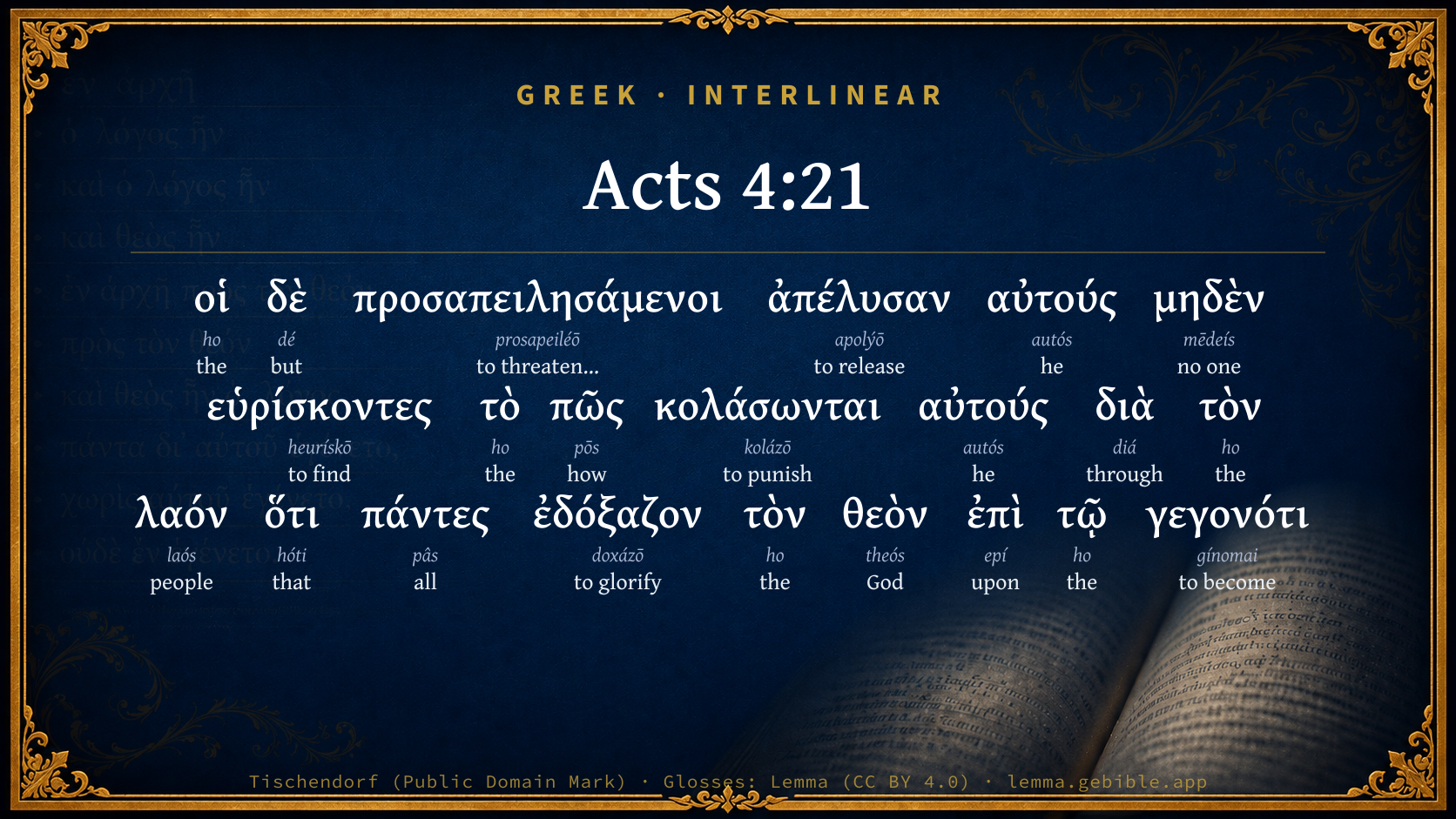
Download image
Cite this verse

Acts 4:21 (World English Bible). Public Domain. Lemma interlinear Bible study tool, https://lemma.gebible.app/v/acts/4/21.

Show BibTeX & RIS
BibTeX
RIS
English Translation
When they had further threatened them, they let them go, finding no way to punish them, because of the people; for everyone glorified God for that which was done.
World English Bible · Public Domain
Highlights
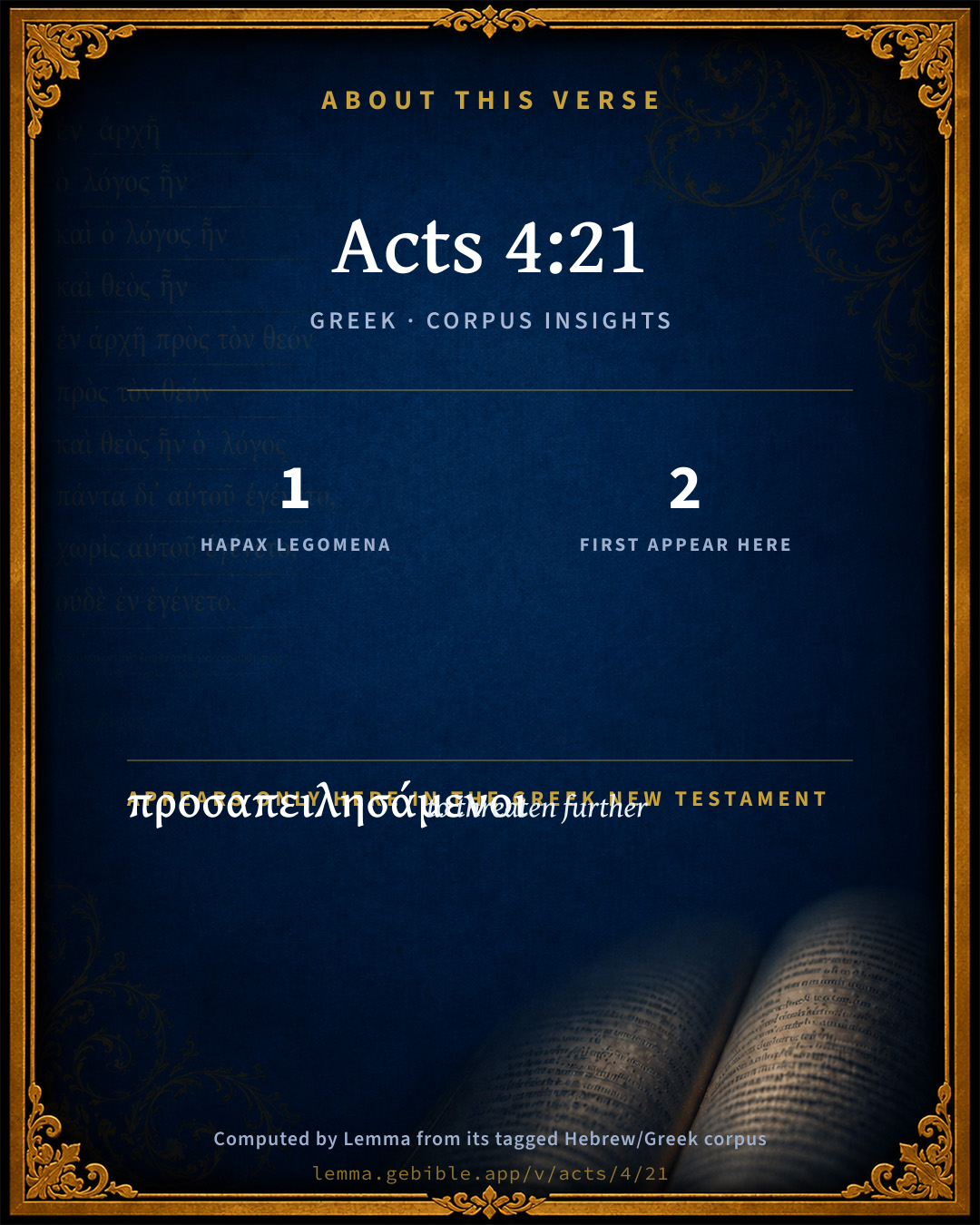
  • 1 hapax legomenon — only here in the Greek New Testament
  • 2 first appearances in the Greek New Testament
Full analysis ↓
Download a study sheet

One document with this verse’s original text, its word-by-word gloss line, the meaning frame, cross-references with their text, attributed commentary, and full source and license credits — printable, and it pastes into notes with its structure intact.

This verse Autodidact and up

Study sheet (.html) Plain text (.txt)

A passage Seminary Student

Up to 50 verses in one chapter. A passage sheet keeps up to 6 commentary sources and 12 cross-references per verse, in the order this page ranks them, and says so on the sheet whenever that leaves anything out. Ask for a single verse and you get the Autodidact verse sheet above.

Everything on this page stays free to read, with no account — the sheet is a download of what is already on screen, not access to it.

Want to remove ads? Support Godless Engineer
Compare translations 3

The same verse in 3 English versions, stacked beneath the original-language interlinear above. Click any original word for its lexicon entry.

Each is an independent rendering of the whole verse — the interlinear is not word-aligned to these translations.

Highlighted words mark where these versions differ — a whole-verse word diff, not a word-by-word alignment.

  • World English Bible Public Domain
    When they had further threatened them, they let them go, finding no way to punish them, because of the people; for everyone glorified God for that which was done.
  • King James Version Public Domain
    So when they had further threatened them, they let them go, finding nothing how they might punish them, because of the people: for all men glorified God for that which was done.
  • unfoldingWord Literal Text CC BY-SA 4.0
    So, having warned them further, they released them, finding nothing for which they might punish them, on account of the people, for they were all glorifying God for what had happened.

unfoldingWord Literal Text — © unfoldingWord, licensed CC BY-SA 4.0. Word-aligned USFM3 via Door43 (git.door43.org/unfoldingWord/en_ult).

Versions to compare (up to 4)

3 of 4 selected

Show all 19 translations

Every available English version of this verse, each an independent rendering of the whole verse.

  • World English Bible Public Domain
    When they had further threatened them, they let them go, finding no way to punish them, because of the people; for everyone glorified God for that which was done.
  • Berean Standard Bible Public Domain
    After further threats they let them go. They could not find a way to punish them, because all the people were glorifying God for what had happened.
  • Majority Standard Bible Public Domain
    After further threats they let them go. They could not find a way to punish them, because all the people were glorifying God for what had happened.
  • King James Version Public Domain
    So when they had further threatened them, they let them go, finding nothing how they might punish them, because of the people: for all men glorified God for that which was done.
  • American Standard Version (1901) Public Domain
    And they, when they had further threatened them, let them go, finding nothing how they might punish them, because of the people; for all men glorified God for that which was done.
  • Revised Version (1885) Public Domain
    And they, when they had further threatened them, let them go, finding nothing how they might punish them, because of the people; for all men glorified God for that which was done.
  • Geneva Bible (1599) Public Domain
    So they threatened them, and let them goe, and found nothing how to punish them, because of the people: for all men praised God for that which was done.
  • Douay-Rheims (1899) Public Domain
    But they threatening, sent them away, not finding how they might punish them, because of the people; for all men glorified what had been done, in that which had come to pass.
  • Young's Literal Translation Public Domain
    And they having further threatened `them', let them go, finding nothing how they may punish them, because of the people, because all were glorifying God for that which hath been done,
  • Literal Standard Version CC BY-SA 4.0
    And they having further threatened [them], let them go, finding no way how they may punish them, because of the people, because all were glorifying God for that which has been done,
  • Unlocked Literal Bible CC BY-SA 4.0
    After further warning Peter and John, they let them go. They were unable to find any excuse to punish them, because all of the people were praising God for what had been done.
  • unfoldingWord Literal Text CC BY-SA 4.0
    So, having warned them further, they released them, finding nothing for which they might punish them, on account of the people, for they were all glorifying God for what had happened.
  • Darby Bible Public Domain
    But they, having further threatened them, let them go, finding no way how they might punish them, on account of the people, because all glorified God for what had taken place;
  • World Messianic Bible Public Domain
    When they had further threatened them, they let them go, finding no way to punish them, because of the people; for everyone glorified God for that which was done.
  • Webster's Bible Public Domain
    So when they had further threatened them, they let them go, finding nothing how they might punish them, because of the people: for all men glorified God for that which was done.
  • Free Bible Version CC BY-SA 4.0
    After making more threats they let them go. They couldn't work out how to punish them because everyone was glorifying God for what had happened.
  • Bible in Basic English Public Domain
    And when they had said more sharp words to them, they let them go, not seeing what punishment they might give them, because of the people; for all men were giving praise to God for what had taken place.
  • Text-Critical English NT CC BY 4.0
    So after threatening Peter and John further, they released them, finding no way to punish them, because all the people were glorifying God for what had happened.
  • Tyndale New Testament (1534) Public Domain
    So threatened they them and let them goo and founde no thinge how to punysshe them because of the people. For all me lauded God for the myracle which was done:

Literal Standard Version (2020), Covenant Press — licensed CC BY-SA 4.0. Text via the HelloAO Bible API (eBible.org). Unlocked Literal Bible (unfoldingWord) — licensed CC BY-SA 4.0. Text via the HelloAO Bible API (eBible.org). unfoldingWord Literal Text — © unfoldingWord, licensed CC BY-SA 4.0. Word-aligned USFM3 via Door43 (git.door43.org/unfoldingWord/en_ult). Free Bible Version, Dr. Jonathan Gallagher — licensed CC BY-SA 4.0. Text via the HelloAO Bible API (eBible.org).

Word by word

More ways to search: Search by grammar → Find every occurrence → Compare this word →

Practice this passage: Drill this verse → Learn its vocabulary →

προσαπειλησάμενοι
prosapeiléō
G4324
“to threaten further”
Verb, Aorist, Middle, Participle, Nominative, Plural, Masculine
Part of Speech
Verb
Tense
Aorist
Voice
Middle
Mood
Participle
Case
Nominative
Number
Plural
Gender
Masculine
Full Thayer's Definition

Origin: from G4314 and G546

TDNT: None

1. to add threats, threaten further
  1. οἱ ho G3588 “the” Article, Nominative, Plural, Masculine
  2. δὲ dé G1161 “but” Conjunction
  3. ἀπέλυσαν apolýō G630 “to release” Verb, Aorist, Active, Indicative, 3rd person, Plural
  4. αὐτούς autós G846 “he” Personal pronoun, Accusative, Plural, Masculine
  5. μηδὲν mēdeís G3367 “no one” Adjective, Accusative, Singular, Neuter, Negative
  6. εὑρίσκοντες heurískō G2147 “to find” Verb, Present, Active, Participle, Nominative, Plural, Masculine
  7. τὸ ho G3588 “the” Article, Accusative, Singular, Neuter
  8. πῶς pōs G4459 “how” Adverb, Interrogative
  9. κολάσωνται kolázō G2849 “to punish” Verb, Aorist, Middle, Subjunctive, 3rd person, Plural
  10. αὐτούς autós G846 “he” Personal pronoun, Accusative, Plural, Masculine
  11. διὰ diá G1223 “through” Preposition
  12. τὸν ho G3588 “the” Article, Accusative, Singular, Masculine
  13. λαόν laós G2992 “people” Noun, Accusative, Singular, Masculine
  14. ὅτι hóti G3754 “that” Conjunction
  15. πάντες pâs G3956 “all” Adjective, Nominative, Plural, Masculine
  16. ἐδόξαζον doxázō G1392 “to glorify” Verb, Imperfect, Active, Indicative, 3rd person, Plural
  17. τὸν ho G3588 “the” Article, Accusative, Singular, Masculine
  18. θεὸν theós G2316 “God” Noun, Accusative, Singular, Masculine
  19. ἐπὶ epí G1909 “upon” Preposition
  20. τῷ ho G3588 “the” Article, Dative, Singular, Neuter
  21. γεγονότι gínomai G1096 “to become” Verb, Perfect, Active, Participle, Dative, Singular, Neuter

About this verse

These counts appear in no published source. They are computed here, from the morphology-tagged text and Lemma’s own curated glosses. What Lemma adds →

22
words
17
distinct lemmas
Acts
section

Notable vocabulary

1 hapax legomenon — a word that appears only here in the entire Greek New Testament:

  • προσαπειλησάμενοι to threaten further G4324

First appearance in Scripture

These words make their first canonical appearance in the Greek New Testament here:

  • προσαπειλησάμενοι to threaten further G4324
  • κολάσωνται to punish G2849

Shared distinctive vocabulary

κολάσωνται to punish G2849 occurs in 2 verses of the Greek New Testament. Also found in:
Repetition

Words recur within this verse:

  • οἱ the G3588 ×5
  • αὐτούς he G846 ×2

Cross-references

16

Topical passages linked to Acts 4:21 in the Treasury of Scripture Knowledge — connected by theme and wording, ordered by reader-vote popularity; previews shown in the World English Bible.

  • Acts 5:26 Then the captain went with the officers, and brought them without violence, for they were afraid that the people might stone them.
  • Matthew 9:8 But when the multitudes saw it, they marveled and glorified God, who had given such authority to men.
  • Matthew 21:46 When they sought to seize him, they feared the multitudes, because they considered him to be a prophet.
  • Luke 20:6 But if we say, 'From men,' all the people will stone us, for they are persuaded that John was a prophet."
  • Luke 20:19 The chief priests and the scribes sought to lay hands on Him that very hour, but they feared the people--for they knew He had spoken this parable against them.
  • Luke 22:2 The chief priests and the scribes sought how they might put him to death, for they feared the people.
  • Matthew 9:33 When the demon was cast out, the mute man spoke. The multitudes marveled, saying, "Nothing like this has ever been seen in Israel!"
  • Matthew 15:31 so that the multitude wondered when they saw the mute speaking, injured whole, lame walking, and blind seeing--and they glorified the God of Israel.
  • Matthew 26:5 But they said, "Not during the feast, lest a riot occur among the people."
  • Luke 5:26 Amazement took hold on all, and they glorified God. They were filled with fear, saying, "We have seen strange things today."
  • Luke 13:17 As he said these things, all his adversaries were disappointed, and all the multitude rejoiced for all the glorious things that were done by him.
  • Luke 19:47–48 He was teaching daily in the temple, but the chief priests and the scribes and the leading men among the people sought to destroy him.
  • John 12:18–19 For this cause also the multitude went and met him, because they heard that he had done this sign.
  • Acts 3:6–9 But Peter said, "Silver and gold have I none, but what I have, that I give you. In the name of Jesus Christ of Nazareth, get up and walk!"
  • Acts 4:17 But so that this spreads no further among the people, let's threaten them, that from now on they don't speak to anyone in this name."
  • Acts 5:40 They agreed with him. Summoning the apostles, they beat them and charged them not to speak in the name of Jesus, and let them go.

Cross-references courtesy of OpenBible.info (CC BY 4.0).

Commentary

Notes on Acts 4:21 from classic Christian and Jewish commentators (each source and its license shown beneath its notes). The classic Christian expositions comment on the surrounding passage and are grouped to its opening verse, so a note may address several verses; the Jewish commentaries on the Tanakh (Rashi and others) are per-verse, so they appear only where the commentator wrote on this verse.

Lemma curates 59 commentaries, every one of them public domain or Creative Commons licensed, each selected and text-cleaned for this edition rather than reprinted as found. About our sources →

Joseph Benson's Commentary

Act 4:21-22. So when they had further threatened them — Namely, in severer terms than before; they let them go — Not thinking it proper, all circumstances considered, to proceed to any further extremities at that time; since they could find nothing in their conduct for which they could punish them with any show of reason; because of the people — Whose resentment they feared. For all men glorified God for that which was done — So much wiser were they than those who ruled over them. For the man — Who had been a cripple from his birth; was above forty years old — So that hardly any thing could have appeared to human judgment to be a more desperate case, than so inveterate and confirmed a lameness.

Joseph Benson's Commentary on the Old and New Testaments (1811–1818) — public domain. Text from a community e-Sword module.

Bengel's Gnomon

Johann Albrecht Bengel

Act 4:21. Προσαπειλησάμενοι) having further threatened them.—πάντες, all men) Often the people is sounder than those who rule.

Bengel's Gnomon of the New Testament — English translation (T&T Clark, Edinburgh, 1860) — public domain. Text from a community e-Sword module.

Expositor's Greek Testament

ed. W. Robertson Nicoll

Act 4:21 . προσαπειλησάμενοι : “when they had further threatened them” R.V., or the word may mean “ added threats to their warning” Act 4:18 (“prius enim tantum præceperunt,” Erasmus). So Wendt as against Meyer; cf. in LXX, Sir 13:3 , ., and Dem., p. 544, 26. ἀπέλυσαν : “dimiserunt [Act 3:13 ] non absolverunt,” Blass; see St. Chrysostom’s striking contrast between the boldness of the Apostles and the fear of their judges ( Hom. , xi.). τὸ πῶς : finding nothing, namely ( τὸ ), how they might, etc.; this use of the article is quite classical, drawing attention to the proposition introduced by it and making of it a compound substantive expressing one idea, most commonly with an interrogation; it is used by St. Luke and St. Paul, and both in St. Luke’s Gospel and in the Acts, cf. Luk 1:62 ; Luk 9:46 ; Luk 19:48 ; Luk 22:2 ; Luk 22:4 ; Luk 22:23-24 , Act 22:30 , Rom 8:26 , 1Th 4:1 , cf. Mar 9:23 . So here the Sanhedrists are represented as asking themselves τὸ πῶς κολ . (Friedrich and Lekebusch both draw attention to this characteristic of St. Luke’s writings). See Viteau, Le Grec du N. T. , pp. 67, 68 (1893). κολ . only here and in 2Pe 2:9 in N.T.; cf. 3Ma 7:3 , where it is also used in middle, expressing to cause to be punished, cf. 1Ma 7:7 , AS. διὰ τὸν λαόν belongs not to ἀπέλυσαν , but rather to μὴ εὑρίσκ . κ . τ . λ . ἐδόξαζον : see on Act 2:46 ; cf. Luk 2:20 , 2Co 9:13 , for the construction; the verb never has in Biblical Gr [160] mere classical meaning of to think, suppose, entertain an opinion (but cf. Polyb., vi., 53, 10; δεδοξασμένοι ἐπʼ ἀρετῇ ); in the LXX very frequently of glory ascribed to God, see Plummer’s note on Luk 2:20 .

[160] Greek, or Grotius’ Annotationes in N.T.

The Expositor's Greek Testament, edited by W. Robertson Nicoll (1897–1910) — public domain. Text from a community e-Sword module.

Geneva Bible (1599)

Geneva Bible translators

So far off are the wicked from doing what they list, that contrariwise God useth even that to the setting forth of his glory, which he giveth them leave to do.

Geneva Bible (1599) marginal notes — public domain. Text via Bolls.life.

Jamieson, Fausset & Brown

Robert Jamieson, A. R. Fausset & David Brown

finding nothing how they might punish them, because of the people--not at a loss for a pretext, but at a loss how to do it so as not to rouse the opposition of the people.

Jamieson, Fausset & Brown — Commentary Critical and Explanatory on the Whole Bible (1871) — public domain (CC PDM 1.0). Text via the HelloAO Bible API.

Adam Clarke's Commentary

Verse 21. When they had farther threatened them] προσαπειλησαμενοι, When they had added to their former threatenings, repeating the former menaces, and adding new penalties.

Finding nothing how they might punish them] Or, as the Codex Bezae reads, μηεὑρισκοντες αιτιαν, πως κολασωνται, not finding, a cause why they might punish them. This reading is supported by the Syriac and Arabic. Bp. Pearce says, "This is better sense and better Greek."

Because of the people] The people saw the miracle, confessed the finger of God, believed on the Lord Jesus, and thus became converts to the Christian faith; and the converts were now so numerous that the sanhedrin was afraid to proceed to any extremities, lest an insurrection should be the consequence.

Adam Clarke's Commentary on the Bible (1810–1826) — public domain. Text from a community e-Sword/MySword module.

John Calvin's Commentaries

21. And when they had threatened them. And here is the end of sedition, that the wicked cease not to breathe out their fury, yet are they bridled by the secret power of God, so that they cannot tell how to do any hurt. How is it that being content with threatenings, they do not also rage against their bodies, save only because the power of God doth bind them as a chain? Not that the fear of God doth prevail with them, for it is the regard of the people alone which hindereth them; but the Lord doth bind them with his bonds, though they be ignorant thereof. Luke commendeth unto us the providence of God in preserving his children; and though it be hidden from the wicked, yet we may behold the same with the eyes of faith, Furthermore, the wonderful counsel of God doth show itself here, in that the glory of Christ is furthered by those which are his most deadly enemies. For whereas the priests do assemble themselves together, it is not done without great rumor. All men wait for some rare and singular event; the apostles depart, being let loose and acquitted. Therefore, the adversaries are not only vanquished, but they confirm the gospel against their will. Notwithstanding, it is expedient for us to mark again, that the faithful do so get the victory, that they are always humbled under the cross. For they are threatened again, and straitly charged, that they teach not henceforth in the name of Christ. Therefore, they do not so get the upper hand that they do not triumph, save only under the reproach of the cross. Whereas Luke saith that they did all glorified God, he noteth the fruit of the miracle now the second time, although it may be that they were not all brought unto the perfect end. For that man which is touched with the feeling of the power of God, and doth not come unto Christ, neither hath his faith confirmed by the miracle he stayeth, as it were, in the midway. Yet this was some thing, though not all, that the power of God was acknowledged in the healing of the man, so that the adversaries being ashamed, did cease off from their fury, or at least give back a little.

John Calvin's Commentaries (1540-1563) — public domain. Text from the Calvin Translation Society English edition (1840s-50s) via the Christian Classics Ethereal Library (ccel.org). Calvin's coverage is partial (roughly two-thirds of the Bible); uncommented books and verses are honest gaps, never fabricated. The 19th-century editor's footnotes and remarks are omitted so the notes are faithfully Calvin's own voice.

Ellicott's Commentary for English Readers

(21) All men glorified God . . .—The tense implies continued action. It is specially characteristic of St. Luke thus to note the impression made upon the people by signs and wonders (Luk_2:20; Luk_4:15; and in seven other passages).

A Bible Commentary for English Readers, edited by Charles John Ellicott (1878–1897) — public domain. Text from a community e-Sword module.

The Cambridge Bible for Schools and Colleges

gen. ed. J. J. S. Perowne

21. further threatened] This was all they could venture on, because the multitude knew that the lame man had been healed, and that there was no charge against the Apostles for which they deserved punishment. They could not say that the miracle was untrue, for there was the man standing by, and proving its reality; and they could not inflict a punishment “for a good deed,” nor could they find any ground for a charge in the declaration that the man had been healed in the name of Jesus.

how they might punish] = on what pretext, or, in what way, without enraging the populace.

all men glorified God] St Peter’s speech had made it clear whence the power to heal was given. See Act_3:13.

The Cambridge Bible for Schools and Colleges (gen. ed. J. J. S. Perowne; Cambridge University Press, 1878–1918) — public domain. Text from a community e-Sword module.

John Gill's Exposition

So when they had further threatened them,.... Either repeated the same, as before; or added some more severe ones, to terrify them, if possible; not being able to answer their arguments, or invalidate their reasoning:

they let them go; they did not acquit them as innocent persons, but dismissed them from custody:

finding nothing how they might punish them; not being able, though they sought most diligently for it, to fix anything upon them, which might be a cause, or occasion, or pretence of inflicting any punishment upon them:

because of the people: they would not have stuck at the injustice of it, or have been under any concern about offending God; but they were afraid of the people, of losing their credit among them, and lest they should rise up against them, and on the side of the apostles:

for all men glorified God for that which was done; they saw the hand of God in it, and ascribed it to his mercy, goodness, and power, and gave him the glory of it; and therefore to punish the instruments of so great and good a work, would have been esteemed barbarous and wicked, and would have been highly resented by them; since, on the contrary, they judged them worthy of great honour and respect.

John Gill's Exposition of the Whole Bible (1746–1763) — public domain (CC PDM 1.0). Text via the HelloAO Bible API.

Trapp's Complete Commentary

John Trapp

21 So when they had further threatened them, they let them go, finding nothing how they might punish them, because of the people: for all men glorified God for that which was done.

Ver. 21. Finding nothing how] With what face they could do anything against them, though their fingers even itched to be doing something. Bucer so carried himself here in England, that neither his friends could sufficiently praise, nor his foes find any fault with him. And for Luther, Non leve praeiudicium est, said Erasmus, tantam esse morum integritatem, ut nec hostes reperiant quod calumnientur. His life is so unblamable that his greatest enemies cannot blemish him.

Because of the people] Those that are most terrible to others are not without their terrors. Dionysius the tyrant dared not be barbed but by his own daughters. Masinissa, king of Numidia, committed the guard of his body to dogs; which he could sooner trust than men, whom he had by his cruelty displeased and provoked.

John Trapp, A Commentary or Exposition upon All the Books of the Old and New Testament (1647–1656) — public domain. Text from a community e-Sword module.

Albert Barnes' Notes on the Bible

Finding nothing ... - That is, not being able to devise any way of punishing them without exciting a tumult among the people, and endangering their own authority. The Sanhedrin was frequently influenced by this fear; and it shows that their own authority was much dependent on the caprice of the multitude. Compare Mat 21:26.

All men - That is, the great mass or body of the people.

Glorified God - Praised God for the miracle. This implies:

That they believed that the miracle was genuine.

(2)That they were grateful to God for so signal a mercy in conferring health and comfort on a man who had been long afflicted. We may add further, that here is the highest evidence of the reality of the miracle. Even the Sanhedrin, with all their prejudice and opposition, did not call it in question; and the common people, who had doubtless been acquainted with this man for years, were convinced that it was real. It would have been impossible to impose on keensighted and jealous adversaries in this manner if this had been an imposture.

Albert Barnes' Notes on the Bible (1834–1885) — public domain. Text from a community e-Sword/MySword module.

Haydock's Catholic Bible Commentary

Threatening them. Here commences the history of the first persecution of religious opinion, which the passions of men have continued, and swelled to such a frightful length. But on this, as on all other occasions, it has defeated its own purpose, by adding firmness and constancy to the persecuted. Truth is not to be overpowered by violence. In vain have the kings and princes of the earth risen up against the Lord, and against his Christ. --- When will men learn, that charity is the principle of conversion! --- That is an unheard-of kind of preaching, said the great Pope, St. Gregory, which exacts belief by stripes. He was on this occasion reprehending the false zeal of certain indiscreet Christians at Rome, who were for compelling the Jews to become converts. (Haydock) --- The amiable Fenelon, in a letter to Prince Charles, the son of our James the Second, says: "No human power can force the impenetrable intrenchments of the human mind. Compulsion never persuades---it only makes hypocrites. When kings interfere in matters of religion, they do not protect it; they enslave it. Give civil liberty to all; not by approving all religions, as indifferent, but, by permitting in others, what God permits."

George Leo Haydock (1774–1849), Haydock's Catholic Family Bible and Commentary, 1859 edition — public domain. Excludes Psalms (Douay-Rheims chapter numbering differs from Protestant) and Deuterocanonical books (Catholic canon only).

Matthew Poole's English Annotations

They let them go for the present; for amongst them no acquittal was so peremptory or asolute, but that they might be tried again for the same fact upon further evidence.

Because of the people; it was not the sense of the evil or sin, nor the apprehensions of God’s displeasure and wrath, which deterred them; but the fear or favour of the people. The corruptions that are in the world are overruled for the good of God’s children in it.

All men glorified God; not only such as believed, but others also, could not but confess that this was the hand of God which had made the lame to walk, and rejoice in it, and by consequence have a very great veneration for the apostles, who were the instruments of it.

Matthew Poole's English Annotations on the Holy Bible (1683–1685) — public domain. Text from a community e-Sword/MySword module.

Whedon's Commentary on the Bible

Daniel D. Whedon

21. Because of the people—The highest dignitaries of the nation had assembled upon the case; but a cold stiffness seems to paralyze all their movements. So far have they committed themselves that they can neither go forward nor back out. They are in the irresolute condition of men not without moral sensibility in a dilemma between the right and self-interest.

And then the people, who have no self-interest to oppose their convictions, are all in full tide with the apostles. The result of their action is disheartening failure.

All men—The word men, as its italics indicate, is added by the translators. The sense, of course, is that the feeling of the people was unanimous, not in affirming that Christianity is true against Judaism, but that this Nazarenism is compatible with true Judaism.

Daniel D. Whedon (gen. ed.), Commentary on the Old and New Testaments (1874–1909) — public domain. Text from a community e-Sword module.

The Pulpit Commentary

And they when they, etc., let them go for so when they, etc., they let them go, A.V.

The Pulpit Commentary (1880–1919), ed. H.D.M. Spence-Jones & Joseph S. Exell — public domain. Text from a community e-Sword module.

John Wesley's Explanatory Notes

They all glorified God - So much wiser were the people than those who were over them.

John Wesley, Explanatory Notes Upon the Whole Bible (1754–1765) — public domain. Text via the GEBible commentary corpus.

MacLaren's Expositions of Holy Scripture

Alexander MacLaren

Acts

OBEDIENT DISOBEDIENCE

Act 4:19 - Act 4:31.

The only chance for persecution to succeed is to smite hard and swiftly. If you cannot strike, do not threaten. Menacing words only give courage. The rulers betrayed their hesitation when the end of their solemn conclave was but to ‘straitly threaten’; and less heroic confessors than Peter and John would have disregarded the prohibition as mere wind. None the less the attitude of these two Galilean fishermen is noble and singular, when their previous cowardice is remembered. This first collision with civil authority gives, as has been already noticed, the main lines on which the relations of the Church to hostile powers have proceeded.

I. The heroic refusal of unlawful obedience.

We shall probably not do injustice to John if we suppose that Peter was spokesman. If so, the contrast of the tone of his answer with all previously recorded utterances of his is remarkable. Warm-hearted impulsiveness, often wrong-headed and sometimes illogical, had been their mark; but here we have calm, fixed determination, which, as is usually its manner, wastes no words, but in its very brevity impresses the hearers as being immovable. Whence did this man get the power to lay down once for all the foundation principles of the limits of civil obedience, and of the duty of Christian confession? His words take rank with the ever-memorable sayings of thinkers and heroes, from Socrates in his prison telling the Athenians that he loved them, but that he must ‘obey God rather than you,’ to Luther at Worms with his ‘It is neither safe nor right to do anything against conscience. Here I stand; I can do nothing else. God help me! Amen.’ Peter’s words are the first of a long series.

This first instance of persecution is made the occasion for the clear expression of the great principles which are to guide the Church. The answer falls into two parts, in the first of which the limits of obedience to civil authority are laid down in a perfectly general form to which even the Council are expected to assent, and in the second an irresistible compulsion to speak is boldly alleged as driving the two Apostles to a flat refusal to obey.

It was a daring stroke to appeal to the Council for an endorsement of the principle in Act 4:19, but the appeal was unanswerable; for this tribunal had no other ostensible reason for existence than to enforce obedience to the law of God, and to Peter’s dilemma only one reply was possible. But it rested on a bold assumption, which was calculated to irritate the court; namely, that there was a blank contradiction between their commands and God’s, so that to obey the one was to disobey the other. When that parting of the ways is reached, there remains no doubt as to which road a religious man must take.

The limits of civil obedience are clearly drawn. It is a duty, because ‘the powers that be are ordained of God,’ and obedience to them is obedience to Him. But if they, transcending their sphere, claim obedience which can only be rendered by disobedience to Him who has appointed them, then they are no longer His ministers, and the duty of allegiance falls away. But there must be a plain conflict of commands, and we must take care lest we substitute whims and fancies of our own for the injunctions of God. Peter was not guided by his own conceptions of duty, but by the distinct precept of his Master, which had bid him speak. It is not true that it is the cause which makes the martyr, but it is true that many good men have made themselves martyrs needlessly. This principle is too sharp a weapon to be causelessly drawn and brandished. Only an unmistakable opposition of commandments warrants its use; and then, he has little right to be called Christ’s soldier who keeps the sword in the scabbard.

The articulate refusal in Act 4:20 bases itself on the ground of irrepressible necessity: ‘We cannot but speak.’ The immediate application was to the facts of Christ’s life, death, and glory. The Apostles could not help speaking of these, both because to do so was their commission, and because the knowledge of them and of their importance forbade silence. The truth implied is of wide reach. Whoever has a real, personal experience of Christ’s saving power, and has heard and seen Him, will be irresistibly impelled to impart what he has received. Speech is a relief to a full heart. The word, concealed in the prophet’s heart, burned there ‘like fire in his bones, and he was weary of forbearing.’ So it always is with deep conviction. If a man has never felt that he must speak of Christ, he is a very imperfect Christian. The glow of his own heart, the pity for men who know Him not, his Lord’s command, all concur to compel speech. The full river cannot be dammed up.

II. The lame and impotent conclusion of the perplexed Council.

How plain the path is when only duty is taken as a guide, and how vigorously and decisively a man marches along it! Peter had no hesitation, and his resolved answer comes crashing in a straight course, like a cannon-ball. The Council had a much more ambiguous oracle to consult in order to settle their course, and they hesitate accordingly, and at last do a something which is a nothing. They wanted to trim their sails to catch popular favour, and so they could not do anything thoroughly. To punish or acquit was the only alternative for just judges. But they were not just; and as Jesus had been crucified, not because Pilate thought Him guilty, but to please the people, so His Apostles were let off, not because they were innocent, but for the same reason. When popularity-hunters get on the judicial bench, society must be rotten, and nearing its dissolution. To ‘decree unrighteousness by a law’ is among the most hideous of crimes. Judges ‘willing to wound, and yet afraid to strike,’ are portents indicative of corruption. We may remark here how the physician’s pen takes note of the patient’s age, as making his cure more striking, and manifestly miraculous.

III. The Church’s answer to the first assault of the world’s power.

How beautifully natural that is, ‘Being let go, they went to their own,’ and how large a principle is expressed in the naive words! The great law of association according to spiritual affinity has much to do in determining relations here. It aggregates men, according to sorts; but its operation is thwarted by other conditions, so that companionship is often misery. But a time comes when it will work unhindered, and men will be united with their like, as the stones on some sea-beaches are laid in rows, according to their size, by the force of the sea. Judas ‘went to his own place,’ and, in another world, like will draw to like, and prevailing tendencies will be increased by association with those who share them.

The prayer of the Church was probably the inspired outpouring of one voice, and all the people said ‘Amen,’ and so made it theirs. Whose voice it was which thus put into words the common sentiment we should gladly have known, but need not speculate. The great fact is that the Church answered threats by prayer. It augurs healthy spiritual life when opposition and danger neither make cheeks blanch with fear nor flush with anger. No man there trembled nor thought of vengeance, or of repaying threats with threats. Every man there instinctively turned heavenwards, and flung himself, as it were, into God’s arms for protection. Prayer is the strongest weapon that a persecuted Church can use. Browning makes a tyrant say, recounting how he had tried to crush a man, that his intended victim

‘Stood erect, caught at God’s skirts, and prayed,

So I was afraid.’

The contents of the prayer are equally noteworthy. Instead of minutely studying it verse by verse, we may note some of its salient points. Observe its undaunted courage. That company never quivered or wavered. They had no thought of obeying the mandate of the Council. They were a little army of heroes. What had made them so? What but the conviction that they had a living Lord at God’s right hand, and a mighty Spirit in their spirits? The world has never seen a transformation like that. Unique effects demand unique causes for their explanation, and nothing but the historical truth of the facts recorded in the last pages of the Gospels and first of the Acts accounts for the demeanour of these men.

Their courage is strikingly marked by their petition. All they ask is ‘boldness’ to speak a word which shall not be theirs, but God’s. Fear would have prayed for protection; passion would have asked retribution on enemies. Christian courage and devotion only ask that they may not shrink from their duty, and that the word may be spoken, whatever becomes of the speakers. The world is powerless against men like that. Would the Church of to-day meet threats with like unanimity of desire for boldness in confession? If not, it must be because it has not the same firm hold of the Risen Lord which these first believers had. The truest courage is that which is conscious of its weakness, and yet has no thought of flight, but prays for its own increase.

We may observe, too, the body of belief expressed in the prayer. First it lays hold on the creative omnipotence of God, and thence passes to the recognition of His written revelation. The Church has begun to learn the inmost meaning of the Old Testament, and to find Christ there. David may not have written the second Psalm. Its attribution to him by the Church stands on a different level from Christ’s attribution of authorship, as, for instance, of the hundred and tenth Psalm. The prophecy of the Psalm is plainly Messianic, however it may have had a historical occasion in some forgotten revolt against some Davidic king; and, while the particular incidents to which the prayer alludes do not exhaust its far-reaching application, they are rightly regarded as partly fulfilling it. Herod is a ‘king of the earth,’ Pilate is a ‘ruler’; Roman soldiers are Gentiles; Jewish rulers are the representatives of ‘the people.’ Jesus is ‘God’s Anointed.’ The fact that such an unnatural and daring combination of rebels was predicted in the Psalm bears witness that even that crime at Calvary was foreordained to come to pass, and that God’s hand and counsel ruled. Therefore all other opposition, such as now threatened, will turn out to be swayed by that same Mighty Hand, to work out His counsel. Why, then, should the Church fear? If we can see God’s hand moving all things, terror is dead for us, and threats are like the whistling of idle wind.

Mark, too, the strong expression of the Church’s dependence on God. ‘Lord’ here is an unusual word, and means ‘Master,’ while the Church collectively is called ‘Thy servants,’ or properly, ‘slaves.’ It is a different word from that of ‘servant’ {rather than ‘child’} applied to Jesus in Act 4:27 - Act 4:30. God is the Master, we are His ‘slaves,’ bound to absolute obedience, unconditional submission, belonging to Him, not to ourselves, and therefore having claims on Him for such care as an owner gives to his slaves or his cattle. He will not let them be maltreated nor starved. He will defend them and feed them; but they must serve him by life, and death if need be. Unquestioning submission and unreserved dependence are our duties. Absolute ownership and unshared responsibility for our well-being belong to Him.

Further, the view of Christ’s relationship to God is the same as occurs in other of the early chapters of the Acts. The title of ‘Thy holy Servant Jesus’ dwells on Christ’s office, rather than on His nature. Here it puts Him in contrast with David, also called ‘Thy servant.’ The latter was imperfectly what Jesus was perfectly. His complete realisation of the prophetic picture of the Servant of the Lord in Isaiah is emphasised by the adjective ‘holy,’ implying complete devotion or separation to the service of God, and unsullied, unlimited moral purity. The uniqueness of His relation in this aspect is expressed by the definite article in the original. He is the Servant, in a sense and measure all His own. He is further the Anointed Messiah. This was the Church’s message to Israel and the stay of its own courage, that Jesus was the Christ, the Anointed and perfect Servant of the Lord, who was now in heaven, reigning there. All that this faith involved had not yet become clear to their consciousness, but the Spirit was guiding them step by step into all the truth; and what they saw and heard, not only in the historical facts of which they were the witnesses, but in the teaching of that Spirit, they could not but speak.

The answer came swift as the roll of thunder after lightning. They who ask for courage to do God’s will and speak Christ’s name have never long to wait for response. The place ‘was shaken,’ symbol of the effect of faithful witness-bearing, or manifestation of the power which was given in answer to their prayer. ‘They were all filled with the Holy Ghost,’ who now did not, as before, confer ability to speak with other tongues, but wrought no less worthily in heartening and fitting them to speak ‘in their own tongue, wherein they were born,’ in bold defiance of unlawful commands.

The statement of the answer repeats the petition verbatim: ‘With all boldness they spake the word.’ What we desire of spiritual gifts we get, and God moulds His replies so as to remind us of our petitions, and to show by the event that these have reached His ear and guided His giving hand.

Alexander MacLaren, Expositions of Holy Scripture (1904–1910) — public domain. Text from a community e-Sword module.

Burkitt's Expository Notes on the New Testament

William Burkitt

Here observe, 1. That notwithstanding this rational plea, which the apostles used, the council added further threatenings and so dismissed them, because of the people, who looked upon the miracle with admiration, and glorified God for working it by the apostles’ hands.

Where note, That it was not the sense of sin, nor any apprehensions of God’s displeasure that influenced the council to set the apostles at liberty; but either the fear or favour of the people. Thus God made the people a restraint to the ruler’s rage.

Observe, 2. That the apostles thus dismissed, went immediately to their own company, (that-is, to the hundred and twenty mentioned, Act 1:15) and acquainted them both with their danger and deliverance, the better to prepare them for sufferings, and encourage them to hope for the like support under them.

Observe, 3. What use the church makes thereof: they hearing how their enemies lay in wait to persecute and destroy them, apply themselves to God by fervent prayer.

Thence learn, That it is the church’s duty when enemies combine together to do mischief, to give themselves much unto prayer. Thus did the church here, and the like, Act 12:1-12.

Observe, 4. The prayer itself, which they jointly put up at the throne of grace, with one heart and spirit.

And here note, 1. They began their prayer with invocation, and a reverent compellation, suitable to their present sufferings; adoring God’s omnipotency in creating and governing of the word. Lord ! thou art God, who hast made heaven and earth, and the sea, and all that is therein.

Whence learn, That the power and wisdom of God in creating and governing the world, doth afford singular support and comfort under the sense of present of future sufferings. He that made all things by his power, will over-rule all things by his providence for his own glory and his church’s good.

Note, 2. The apostles used scripture-language and expressions in their prayer: they allude to Psalms 2 and acknowledge that all that enraged malice of men and devils against the Messias, which was foretold long ago by the prophet David, was now come to pass: For both the Jewish council and the Roman governors had combined together against Christ, and in opposing him, had opposed the Father that sent him. Of a truth against thy holy child Jesus are they gathered together, to do what thy hand and thy counsel had determined before to be done.

Where we see, 1. That all the sufferings of Christ were fore-ordained and determined by God the Father; God from all eternity decreed that Christ should die a sacrifice for sin.

2. That this decree of God did not necessitate the Jews to sin; but they acted freely and voluntarily, according to the wicked determinations of their own wills. God foresaw and permitted it, but no ways influenced or compelled them to it. He over-ruled those evil instruments to fulfil his holy purposes, while they intended only to fulfil their own wicked counsels.

Observe lastly, They close their prayer with a fervent petition, that God would strengthen them, and glorify his Son.

1. That God would strengthen them against their fears; steel them with courage, and fortify them ith impregnable resolution; Grant that with all boldness we may speak thy word. Boldness to preach the gospel, when unjustly forbidden, is a special gift of God, and a great effect of God’s grace unto his servants.

2. They request that God would magnify, not them, but his Son by them, in giving them power to work miraculous cures in the name of Jesus, for confirming of the gospel, Grant that signs and wonders may be done by the name of the holy child Jesus.

Where note, That the gift of miracles, though promised by Christ, is yet prayed for by the apostles. God will have the performance of his promises to be the answer of our prayers.

William Burkitt's Expository Notes on the New Testament (1700–1703) — public domain. Text from a community e-Sword module.

McGarvey & Pendleton's Commentaries

J. W. McGarvey

21, 22. It was a sore trial to the haughty spirits of the Sanhedrim to brook such defiance; but a desire to conciliate the people, mingled, no doubt, with a secret fear of the consequences of putting to death men who had exercised such power, restrained their wrath. (21) " And when they had further threatened them, they let them go, not finding how they might punish them, because of the people; for all glorified God for what was done. (22) For the man on whom this miracle of healing was wrought was more than forty years of age. "

J. W. McGarvey (with Philip Y. Pendleton), Commentaries on the New Testament (The Fourfold Gospel, 1914; Acts; and the epistles) — public domain. Text from a community e-Sword/MySword module.

The People's New Testament

B. W. Johnson

21, 22. Let them go. With threats, afraid to punish them lest they should exasperate the people.

Above forty years old. Therefore known to everybody as a life-long cripple.

B. W. Johnson's The People's New Testament with Notes (1889–1891) — public domain. Electronic text from the Christian Classics Ethereal Library (CCEL) ThML edition.

unfoldingWord translationNotes

Door43 World Missions Community

General Information:

Verse 22 gives background information about the age of the lame man who was healed. (See: Background Information)

After further warning

The Jewish leaders again threatened to punish Peter and John.

They were unable to find any excuse to punish them

Although the Jewish leaders threatened Peter and John, they could not find a reason to punish them without causing the people to riot.

for what had been done

This can be stated in active form. AT: "for what Peter and John had done" (See: Active or Passive)

The man who had experienced this miracle of healing

"The man whom Peter and John had miraculously healed"

translationWords

punish

praise

miracle

cure

unfoldingWord translationNotes — © Distant Shores Media and the Door43 World Missions Community, licensed CC BY-SA 4.0. Source: git.door43.org/Door43/en_tn.

Cambridge Greek Testament for Schools and Colleges

21. προσαπειλησάμενοι, having further threatened. The first threats must have been made as soon as the Apostles were called back into the council-hall, as was suggested in Act 4:17. They did not see their way to do more than threaten, because the people were sure that the lame man had been healed and that there was no charge against the Apostles for which they deserved punishment. They could not say that the miracle was untrue, for there was the man standing by, and proving its reality; and they could not inflict a punishment’ for a good deed,’ nor could they find any ground for an accusation in the declaration that the man had been healed in the name of Jesus.

On the contrast between the courage of the Apostles and the terror of the Sanhedrin Chrysostom says: τοιοῦτον ἡ φιλοσοφία. ἐκεῖοι ἐν ἀπορίᾳ, οὗτοι ἐν εὐφροσύνῃ· ἐκεῖνοι πολλῆς γέμοντες αἰσχύνης, οὗτοι μετὰ παῤῥησίας πάντα πράττοντες· ἐκεῖνοι ἐν τῷ δεδοικέναι, οὗτοι ἐν τῷ θαῤῥεῖν. τίνες γὰρ ἦσαν, εἰπέ μοι, οἱ φοβούμενοι; οἱ λέγοντες ἵνα μὴ ἐπὶ πλέον διανεμηθῇ εἰς τὸν λαὸν ἢ οἱ λέγοντες οὐ δυνάμεθα ἃ εἴδαμεν καὶ ἠκούσαμεν μὴ λαλεῖν; καὶ ἐν ἡδονῇ καὶ ἐν παῤῥσίᾳ καὶ ἐν εὐφροσύνῃ μείζονι πάντων οὗτοι· ἐκεῖνοι ἐν ἀθυμίᾳ ἐν αἰσχύνῃ ἐν φόβῳ. τὸν γὰρ λαὸν ἐδεδοίκεσαν. ἃ ἐβούλοντο ἐφθέγξαντο οὗτοι, ἐκεῖνοι ἃ ἐβούλοντο οὐκ ἐποίησαν. τίνες ἦσαν ἐν δεσμοῖς καὶ ἐν κινδύνοις;

τὸ πῶς κολάσωνται, i.e. on what pretext, or in what way they might punish them, without enraging the multitude. For the form of the sentence cf. 1Th 4:1 παρελάβετε παρ’ ἡμῶν τὸ πῶς δεῖ ὑμᾶς περιπατεῖν.

Cambridge Greek Testament for Schools and Colleges (Cambridge University Press, 1896; 21 vols, various authors incl. Carr, Maclear, Plummer, Farrar, Lumby, Moule, M. R. James, Simcox) — public domain. Text from a community e-Sword module.

Alford’s Greek Testament

Henry Alford

21.] προσαπειλ., having threatened them in addition;—with threats superadded to the inhibition of ver. 18.

μηδέν, no means: not μηδὲν αἴτιον, see Joh 14:30. The difficulty with the Sanhedrim was, to find any means of punishing them which should not stir up the people; διὰ τὸν λαόν belongs to this clause, not to ἀπέλυσαν αὐτ.

Henry Alford, The Greek Testament (1849–1861) — public domain. Text from a community e-Sword module.

Vincent's Word Studies in the New Testament

Marvin R. Vincent

Punish [κολασωνται] . Originally, to curtail or dock; to prune as trees : thence to check, keep in bounds, punish.

Marvin R. Vincent, Word Studies in the New Testament (1887–1900) — public domain. Text from a community e-Sword/MySword module.

Lesson kit

Teaching starters — assembled from the data on this page, not authored interpretation. Every prompt links to the verse data it draws on. Edit before teaching.

Acts, in the Acts, opens this verse with 22 words (17 distinct Greek lemmas). Its most distinctive word is prosapeiléō (“to threaten further”). A historical commentator’s framing appears above. Read the whole chapter for the surrounding context.

Discussion questions

  1. The word prosapeiléō carries the sense “to threaten further.” How does it shape the verse?
  2. This verse holds 1 word here found nowhere else in the Greek New Testament. What might the rare word draw attention to?
  3. 2 words here appear for the first time in Scripture. What is being introduced at this debut?
  4. 2 Peter 2:9 shares the word «to punish» with this verse. How do the two illuminate each other?
  5. “the” occurs 5× in this one verse. What is the effect of the repetition?
  6. These translations render this verse differently; the difference is in the English rendering, not the original. What questions does that raise?
  7. Reading how Joseph Benson's Commentary and Bengel's Gnomon read this verse, where do the two commentators agree and where do they part?

Things to notice

  • 1 word in this verse appears nowhere else in the Greek New Testament.
  • 2 words make their first canonical appearance in Scripture here.
  • These translations choose different wording for 21 words in this verse.
  • “the” occurs 5× in this single verse.
  • 17 distinct Greek lemmas span 22 words in this verse.

Reading settings

Reading text

Shown beneath each verse's original-language words.

Old Testament
Old Testament edition

Read the OT as the Masoretic Hebrew (MT) or the Greek Septuagint (LXX).

English shown for the Greek Septuagint (in the Hebrew ↔ Greek comparison).

Comparing translations? Open the Compare panel on any verse page to stack up to four side by side.