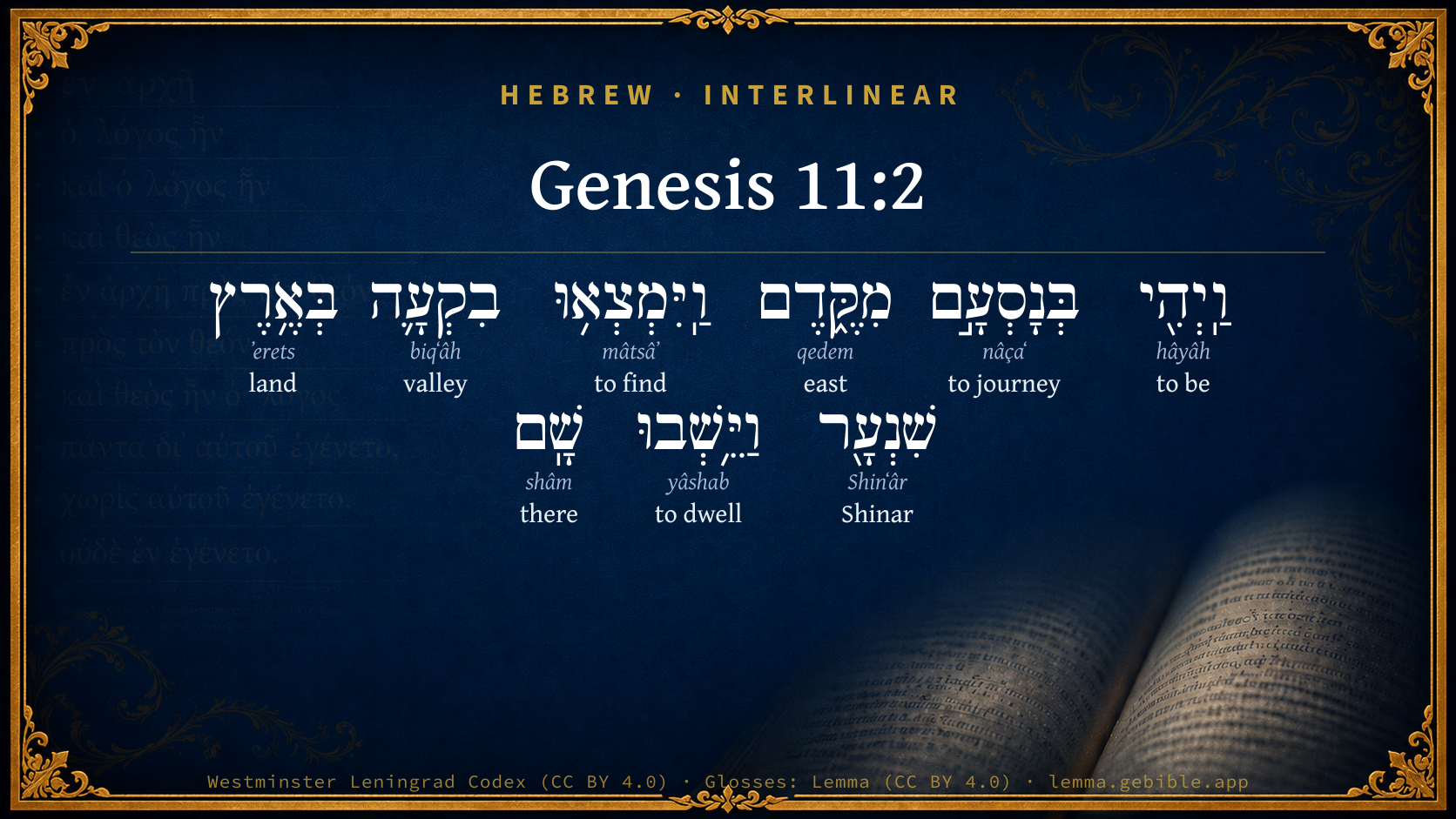
Genesis 11:2

Hebrew (Westminster Leningrad Codex) Genesis 11:2 appears in the Hebrew Old Testament. The text above is from the Westminster Leningrad Codex. Each word links to its Strong’s number, a concise gloss, and parsing drawn from the Open Scriptures Hebrew Bible morphology. Click any word for its full Brown-Driver-Briggs (BDB) entry.
Download image
Cite this verse

Genesis 11:2 (World English Bible). Public Domain. Lemma interlinear Bible study tool, https://lemma.gebible.app/v/genesis/11/2.

Show BibTeX & RIS
BibTeX
RIS
English Translation
It happened, as they traveled east, that they found a plain in the land of Shinar; and they lived there.
World English Bible · Public Domain
Highlights
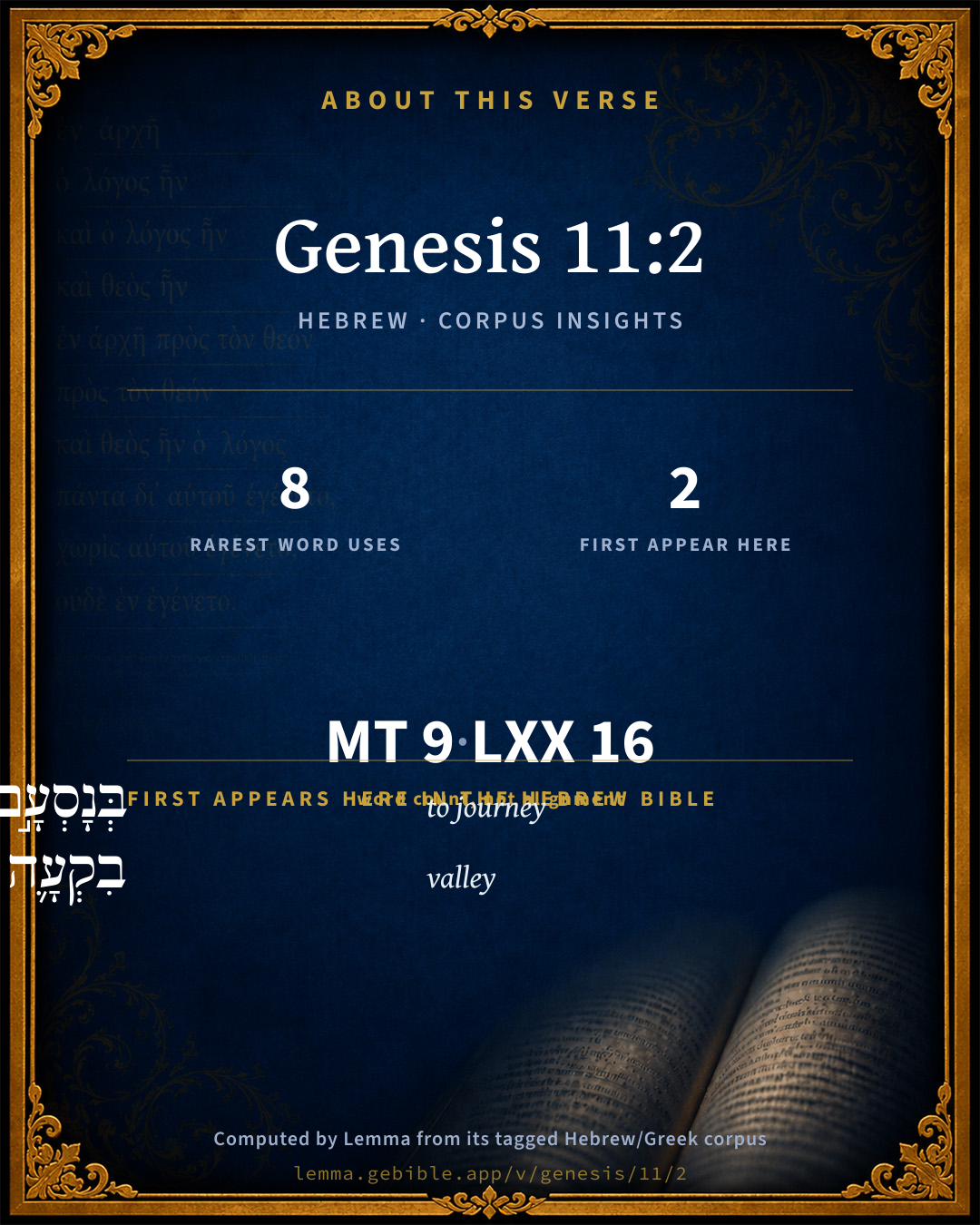
  • 2 first appearances in the Hebrew Bible
Full analysis ↓
Download a study sheet

One document with this verse’s original text, its word-by-word gloss line, the meaning frame, cross-references with their text, attributed commentary, and full source and license credits — printable, and it pastes into notes with its structure intact.

This verse Autodidact and up

Study sheet (.html) Plain text (.txt)

A passage Seminary Student

Up to 50 verses in one chapter. A passage sheet keeps up to 6 commentary sources and 12 cross-references per verse, in the order this page ranks them, and says so on the sheet whenever that leaves anything out. Ask for a single verse and you get the Autodidact verse sheet above.

Everything on this page stays free to read, with no account — the sheet is a download of what is already on screen, not access to it.

Want to remove ads? Support Godless Engineer
Compare translations 3

The same verse in 3 English versions, stacked beneath the original-language interlinear above. Click any original word for its lexicon entry.

Each is an independent rendering of the whole verse — the interlinear is not word-aligned to these translations.

Highlighted words mark where these versions differ — a whole-verse word diff, not a word-by-word alignment.

  • World English Bible Public Domain
    It happened, as they traveled east, that they found a plain in the land of Shinar; and they lived there.
  • King James Version Public Domain
    And it came to pass, as they journeyed from the east, that they found a plain in the land of Shinar; and they dwelt there.
  • unfoldingWord Literal Text CC BY-SA 4.0
    And it happened as they migrated from the east, that they found a plain in the land of Shinar and settled there.

unfoldingWord Literal Text — © unfoldingWord, licensed CC BY-SA 4.0. Word-aligned USFM3 via Door43 (git.door43.org/unfoldingWord/en_ult).

Versions to compare (up to 4)

3 of 4 selected

Show all 18 translations

Every available English version of this verse, each an independent rendering of the whole verse.

  • World English Bible Public Domain
    It happened, as they traveled east, that they found a plain in the land of Shinar; and they lived there.
  • Berean Standard Bible Public Domain
    And as people journeyed eastward, they found a plain in the land of Shinar and settled there.
  • Majority Standard Bible Public Domain
    And as people journeyed eastward, they found a plain in the land of Shinar and settled there.
  • King James Version Public Domain
    And it came to pass, as they journeyed from the east, that they found a plain in the land of Shinar; and they dwelt there.
  • American Standard Version (1901) Public Domain
    And it came to pass, as they journeyed east, that they found a plain in the land of Shinar; and they dwelt there.
  • Revised Version (1885) Public Domain
    And it came to pass, as they journeyed east, that they found a plain in the land of Shinar; and they dwelt there.
  • Geneva Bible (1599) Public Domain
    And as they went from the East, they found a plaine in the land of Shinar, and there they abode.
  • Douay-Rheims (1899) Public Domain
    And when they removed from the east, they found a plain in the land of Sennaar, and dwelt in it.
  • Young's Literal Translation Public Domain
    and it cometh to pass, in their journeying from the east, that they find a valley in the land of Shinar, and dwell there;
  • Literal Standard Version CC BY-SA 4.0
    and it comes to pass, in their journeying from the east, that they find a valley in the land of Shinar and dwell there;
  • Unlocked Literal Bible CC BY-SA 4.0
    As they journeyed in the east, they found a plain in the land of Shinar and they settled there.
  • unfoldingWord Literal Text CC BY-SA 4.0
    And it happened as they migrated from the east, that they found a plain in the land of Shinar and settled there.
  • Darby Bible Public Domain
    And it came to pass as they journeyed from the east, that they found a plain in the land of Shinar, and dwelt there.
  • World Messianic Bible Public Domain
    As they traveled east, they found a plain in the land of Shinar, and they lived there.
  • Webster's Bible Public Domain
    And it came to pass as they journeyed from the east, that they found a plain in the land of Shinar, and they dwelt there.
  • Free Bible Version CC BY-SA 4.0
    As they moved east they discovered a plain in the land of Shinar so they settled there.
  • Bible in Basic English Public Domain
    And it came about that in their wandering from the east, they came to a stretch of flat country in the land of Shinar, and there they made their living-place.
  • JPS Tanakh (1917) Public Domain
    And it came to pass, as they journeyed east, that they found a plain in the land of Shinar; and they dwelt there.

Literal Standard Version (2020), Covenant Press — licensed CC BY-SA 4.0. Text via the HelloAO Bible API (eBible.org). Unlocked Literal Bible (unfoldingWord) — licensed CC BY-SA 4.0. Text via the HelloAO Bible API (eBible.org). unfoldingWord Literal Text — © unfoldingWord, licensed CC BY-SA 4.0. Word-aligned USFM3 via Door43 (git.door43.org/unfoldingWord/en_ult). Free Bible Version, Dr. Jonathan Gallagher — licensed CC BY-SA 4.0. Text via the HelloAO Bible API (eBible.org).

Word by word

More ways to search: Search by grammar → Find every occurrence → Compare this word →

Practice this passage: Drill this verse → Learn its vocabulary →

About this verse

These counts appear in no published source. They are computed here, from the morphology-tagged text and Lemma’s own curated glosses. What Lemma adds →

9
words
9
distinct lemmas
Pentateuch
section

Notable vocabulary

The rarest word here is שִׁנְעָ֖ר Shinar H8152 — appearing just 8 times in the whole Hebrew Bible.

First appearance in Scripture

These words make their first canonical appearance in the Hebrew Bible here:

  • בְּנָסְעָ֣ם to journey H5265
  • בִקְעָ֛ה valley H1237

Shared distinctive vocabulary

שִׁנְעָ֖ר Shinar H8152 occurs in 8 verses of the Hebrew Bible. Also found in:

Grammatical profile

  • 4 verbs
  • 4 nouns
  • 1 adverb

Verb forms

  • וַֽיְהִ֖י Qal · Sequential Imperfect
  • בְּנָסְעָ֣ם Qal · Infinitive Construct
  • וַֽיִּמְצְא֥וּ Qal · Sequential Imperfect
  • וַיֵּ֥שְׁבוּ Qal · Sequential Imperfect

Hebrew & Septuagint length

In English translation the verse runs 20 words from the Hebrew and 24 from the Septuagint (LXX English) — closely comparable.

A rough comparison of the two English renderings, which tokenize alike — not a word-level alignment.

Word counts can differ between the Hebrew and the Greek without any difference in meaning — e.g. the Hebrew direct-object marker אֵת has no separate Greek word, and Greek often adds the article ὁ.

In the original languages it is 9 Hebrew tokens and 16 Greek tokens — but the two are counted differently (Hebrew bundles its prefixes and suffixes into one token; the Greek is in lemma form), so that isn’t a like-for-like length.

Cross-references

7

Topical passages linked to Genesis 11:2 in the Treasury of Scripture Knowledge — connected by theme and wording, ordered by reader-vote popularity; previews shown in the World English Bible.

  • Genesis 10:10 The beginning of his kingdom was Babel, Erech, Accad, and Calneh, in the land of Shinar.
  • Daniel 1:2 The Lord gave Jehoiakim king of Judah into his hand, with part of the vessels of the house of God; and he carried them into the land of Shinar to the house of his god: and he brought the vessels into the treasure-house of his god.
  • Genesis 14:1 It happened in the days of Amraphel, king of Shinar, Arioch, king of Ellasar, Chedorlaomer, king of Elam, and Tidal, king of Goiim,
  • Isaiah 11:11 It shall happen in that day, that the Lord will set his hand again the second time to recover the remnant of his people, who shall remain, from Assyria, and from Egypt, and from Pathros, and from Cush, and from Elam, and from Shinar, and from Hamath, and from the islands of the sea.
  • Zechariah 5:11 He said to me, "To build her a house in the land of Shinar. When it is prepared, she will be set there in her own place."
  • Genesis 13:11 So Lot chose the Plain of the Jordan for himself. Lot traveled east, and they separated themselves the one from the other.
  • Genesis 11:9 Therefore the name of it was called Babel, because Yahweh confused the language of all the earth, there. From there, Yahweh scattered them abroad on the surface of all the earth.

Cross-references courtesy of OpenBible.info (CC BY 4.0).

Hebrew and Greek witnesses Masoretic Hebrew ↔ Greek Septuagint

The same verse in the two great witnesses to the Old Testament, shown verse-for-verse.

These are two independent witnesses, not word-aligned to each other, and the Septuagint is shown in lemma (dictionary) form.

Hebrew Genesis 11:2 Masoretic · Westminster Leningrad Codex

וַֽיְהִ֖י בְּנָסְעָ֣ם מִקֶּ֑דֶם וַֽיִּמְצְא֥וּ בִקְעָ֛ה בְּאֶ֥רֶץ שִׁנְעָ֖ר וַיֵּ֥שְׁבוּ שָֽׁם

It happened, as they traveled east, that they found a plain in the land of Shinar; and they lived there.

World English Bible · Public Domain

Greek LXX Genesis 11:2 Septuagint · lemma form

καί γίγνομαι ἐν ὁ κινέω αὐτός ἀπό ἀνατολή εὑρίσκω πεδίον ἐν γῆ σεννααρ καί καταοἰκέω ἐκεῖ

And it came to pass as they moved from the east, they found a plain in the land of Senaar, and they lived there.

LXX2012 (modern English Septuagint) · Public Domain

On this verse, The Cambridge Bible for Schools and Colleges discusses the Septuagint’s reading. Read the note in Commentary ↓

Hebrew: Westminster Leningrad Codex (CC BY 4.0). Greek: Septuagint (public domain); English from LXX2012 (modern English Septuagint) (Public Domain). How the Septuagint differs from the Hebrew →

Targum (Aramaic paraphrase)

2

The Targum is the ancient Jewish Aramaic paraphrase of the Hebrew Scriptures — an interpretive translation, not the Hebrew text itself. Onkelos (literal) and Pseudo-Jonathan (expansive) render the Torah, and Jonathan the Prophets. Coverage is partial: where no permissively-licensed English translation exists for a verse, only the Aramaic is shown. This is verse-level text, not a word-by-word alignment to the Hebrew.

  1. Targum Onkelos Torah (Genesis–Deuteronomy)
    וַהֲוָה בְּמִטַּלְהוֹן בְּקַדְמֵיתָא וְאַשְׁכָּחוּ בִקְעֲתָא בְּאַרְעָא דְבָבֶל וִיתִיבוּ תַמָּן

    And it was in their migrations at the beginning, that they found a plain in the land of Babel, and dwelt there.

    Targum Onkelos — Aramaic: “Onkelos Genesis” (public domain); “Onkelos Exodus” (public domain); “Onkelos Leviticus” (public domain); “Onkelos Numbers” (public domain); “Onkelos Deuteronomy” (public domain). English: “Sefaria Community Translation” (CC0 1.0 (public-domain dedication)); “J.W. Etheridge. The Targums of Onkelos and Jonathan Ben Uzziel on the Pentateuch. London: Longmans, Green, 1862” (public domain). Text via Sefaria.

  2. Targum Pseudo-Jonathan Torah (Genesis–Deuteronomy)
    וַהֲוָה בְּמֵיטַלְהוֹן מִמַדִינְחָא וְאַשְׁכָּחוּ בִּקְעֲתָא בְּאַרְעָא דְבָּבֶל וְיָתִיבוּ תַּמָן

    And it was while they were journeying from the east that they found a plain in the land of Bavel, and dwelt there.

    Targum Pseudo-Jonathan — Aramaic: “Targum Jonathan on Genesis” (public domain); “Targum Jonathan on Exodus” (public domain); “Targum Jonathan on Leviticus” (public domain); “Targum Jonathan on Numbers” (public domain); “Targum Jonathan on Deuteronomy” (public domain). English: “The Targum of Jonathan ben Uzziel, trans. J. W. Etheridge, London, 1862” (public domain). Text via Sefaria.

Commentary

Notes on Genesis 11:2 from classic Christian and Jewish commentators (each source and its license shown beneath its notes). The classic Christian expositions comment on the surrounding passage and are grouped to its opening verse, so a note may address several verses; the Jewish commentaries on the Tanakh (Rashi and others) are per-verse, so they appear only where the commentator wrote on this verse.

Lemma curates 59 commentaries, every one of them public domain or Creative Commons licensed, each selected and text-cleaned for this edition rather than reprinted as found. About our sources →

Trapp's Complete Commentary

John Trapp

Gen 11:2 And it came to pass, as they journeyed from the east, that they found a plain in the land of Shinar; and they dwelt there.

Ver. 2. In the land of Shinar.] Which was a part of the garden of Eden, as most geographers think, fat and fruitful still above belief (Herodot. lib. i. cap. 93; Plin. lib. vi. cap. 26).

John Trapp, A Commentary or Exposition upon All the Books of the Old and New Testament (1647–1656) — public domain. Text from a community e-Sword module.

Tyndale Open Study Notes

Tyndale Open Resources

11:2 migrated to the east: See study note on 3:24. • Babylonia was located in southern Mesopotamia, the region of Nimrod’s later empire and city-building campaign (see 10:10; Isa 11:11; Dan 1:2; Zech 5:11).

Tyndale Open Study Notes — © Tyndale Open Resources, licensed CC BY-SA 4.0. Text via the HelloAO Bible API.

Geneva Bible (1599)

Geneva Bible translators

In the year one hundred and thirty after the flood.

Which was afterward called Chaldea.

That is, from Armenia where the Ark stayed.

To wit, Nimrod and his company.

Geneva Bible (1599) marginal notes — public domain. Text via Bolls.life.

Jamieson, Fausset & Brown

Robert Jamieson, A. R. Fausset & David Brown

land of Shinar--The fertile valley watered by the Euphrates and Tigris was chosen as the center of their union and the seat of their power.

Jamieson, Fausset & Brown — Commentary Critical and Explanatory on the Whole Bible (1871) — public domain (CC PDM 1.0). Text via the HelloAO Bible API.

Adam Clarke's Commentary

Verse 2. As they journeyed from the east] Assyria, Mesopotamia, and the country on the borders and beyond the Euphrates, are called the east in the sacred writings. Balaam said that the king of Moab had brought him from the mountains of the east, Nu 23:7.

Now it appears, from Nu 22:5, that Balaam dwelt at Pethor, on the river Euphrates. And it is very probable that it was from this country that the wise men came to adore Christ; for it is said they came from the east to Jerusalem, Mt 2:1. Abraham is said to have come from the east to Canaan, Isa 41:2; but it is well known that he came from Mesopotamia and Chaldea. Isa 46:11, represents Cyrus as coming from the east against Babylon. And the same prophet represents the Syrians as dwelling eastward of Jerusalem, Isa 9:12: The Syrians before, מקדם mikkedem, from the east,the same word which Moses uses here. Daniel Da 11:44, represents Antiochus as troubled at news received from the east; i.e. of a revolt in the eastern provinces, beyond the Euphrates.

Noah and his family, landing after the flood on one of the mountains of Armenia, would doubtless descend and cultivate the valleys: as they increased, they appear to have passed along the banks of the Euphrates, till, at the time specified here, they came to the plains of Shinar, allowed to be the most fertile country in the east. See Calmet. That Babel was built in the land of Shinar we have the authority of the sacred text to prove; and that Babylon was built in the same country we have the testimony of Eusebius, Praep. Evang., lib. ix., c. 15; and Josephus, Antiq., lib. i., c. 5.

Adam Clarke's Commentary on the Bible (1810–1826) — public domain. Text from a community e-Sword/MySword module.

John Calvin's Commentaries

2. They found a plain in the land of Shinar. It may be conjectured from these words, that Moses speaks of Nimrod and of the people whom he had collected around him. If, however, we grant that Nimrod was the chief leader in the construction of so great a pile, for the purpose of erecting a formidable monument of his tyranny: yet Moses expressly relates, that the work was undertaken not by the counsel or the will of one man only, but that all conspired together, so that the blame cannot be cast exclusively upon one, nor even upon a few.

John Calvin's Commentaries (1540-1563) — public domain. Text from the Calvin Translation Society English edition (1840s-50s) via the Christian Classics Ethereal Library (ccel.org). Calvin's coverage is partial (roughly two-thirds of the Bible); uncommented books and verses are honest gaps, never fabricated. The 19th-century editor's footnotes and remarks are omitted so the notes are faithfully Calvin's own voice.

Ellicott's Commentary for English Readers

(2) As they journeyed.—The word literally refers to the pulling up of the tent-pegs, and sets the human family before us as a band of nomads, wandering from place to place, and shifting their tents as their cattle needed fresh pasture.

From the east.—So all the versions. Mount Ararat was to the north-west of Shinar, and while so lofty a mountain could not have been the spot where the ark rested, yet neither could any portion of Armenia or of the Carduchian mountains be described as to the east of Babylonia. The Chaldean legends make the ark rest on Mount Nizir, or Elwend, on the east of Assyria; and though Ararat may possibly signify Aryaverta, “Holy Land,” yet the transference of the name from Elwend to Armenia is not easily explicable. Moreover, the Bible elsewhere seems to point to Armenia as the cradle of the human race. Most modern commentators, therefore, translate eastward, and such certainly is the meaning of the word in Gen_13:11, where also the versions, excepting our own, render from the east.

Land of Shinar.—See on Gen_10:10. The whole of Chaldea is a level plain, and the soil immensely rich, as it is an alluvial deposit, which still goes on forming at the head of the Persian Gulf, at the rate of a mile in a period estimated at from seventy to thirty years (Rawlinson, Anc. Mon., i. 4). A strip of land 130 miles in breadth has been added to the country, by the deposit of the earth washed down by the Tigris and Euphrates, since the time when Ur of the Chaldees was a great port.

A Bible Commentary for English Readers, edited by Charles John Ellicott (1878–1897) — public domain. Text from a community e-Sword module.

The Cambridge Bible for Schools and Colleges

gen. ed. J. J. S. Perowne

2. as they journeyed] We are not told who are here spoken of, nor whence they come. This is an indication that this passage (1–9) is derived from an independent tradition distinct from the thread of the foregoing narrative. Like Gen_4:17-24, and Gen_6:1-4, it is probably a fragment of tradition which had no knowledge of the story of the Flood, or of the dispersion of the peoples through the sons of Noah.

journeyed] A word denoting the progress of nomads from one place of encampment to another.

east] Better, as marg., in the east. The Hebrew word means literally “from the east,” as also LXX ἀπὸ ἀνατολῶν, and Lat. de oriente, and here probably signifies “in the east,” i.e. on the east side from the writer’s point of view. Some translate “eastward,” as in Gen_13:11, where Lot, on leaving Abram, is described as journeying “eastward.” But, as we do not know who are referred to, or where they started from, the uncertainty as to the rendering remains.

a plain in the land of Shinar] For Shinar, probably denoting the ancient Babylonia, “Sumer and Akkad,” see Gen_10:10. The word “plain” (biḳ‘ah) means the wide open expanse of a river valley. Here it is used of the Euphrates Valley. The expression, “found a plain in the land of Shinar,” does not suggest close knowledge of Babylonia; but rather the general terms of popular and defective information respecting a distant country. Babylonia is one vast plain.

The Cambridge Bible for Schools and Colleges (gen. ed. J. J. S. Perowne; Cambridge University Press, 1878–1918) — public domain. Text from a community e-Sword module.

John Gill's Exposition

And it came to pass, as they journeyed from the east,.... That is, the inhabitants of the whole earth; not Ham and his posterity only, or Nimrod and his company; but as all the sons of Noah and his posterity for a while dwelt together, or at least very near each other, and finding the place where they were too scanty for them, as their several families increased, they set out in a body from the place where they were, to seek for a more convenient one: it seems a little difficult how to interpret this phrase, "from the east", since if they came from Ararat in Armenia, where the ark rested, as that lay north of Shinar or Babylon, they might rather be said to come from the north than from the east, and rather came to it than from it: so some think the phrase should be rendered, "to the east" (b), or eastward, as in Gen 13:11. Jarchi thinks this refers to Gen 10:30 "and their dwelling was", &c. at "the mountain of the east"; from whence he supposes they journeyed, to find out a place that would hold them all, but could find none but Shinar; but then this restrains it to Joktan's sons, and besides, their dwelling there was not until after the confusion and dispersion. But it is very probable the case was this, that when Noah and his sons came out of the ark, in a little time they betook themselves to their former habitation, from whence they had entered into the ark, namely, to the east of the garden of Eden, where was the appearance of the divine Presence, or Shechinah; and from hence it was that these now journeyed: and so it was as they were passing on:

that they found a plain in the land of Shinar; which the Targum of Jonathan paraphrases the land of Babylon; and Hestiaeus (c), a Phoenician historian, calls it Sennaar of Babylon; there are plain traces of this name in the Singara of Ptolemy (d) and Pliny (e), the Hebrew letter being sometimes pronounced as "G", as in Gaza and Gomorrah; the first of these place a city of this name in Mesopotamia, near the Tigris, and that of the other is reckoned a capital of the Rhetavi, a tribe of the Arabs, near Mesopotamia. This plain was very large, fruitful, and delightful, and therefore judged a fit place for a settlement, where they might have room enough, and which promised them a sufficient sustenance:

and they dwelt there; and provided for their continuance, quickly beginning to build a city and tower, afterwards called Babylon: and that Babylon was built in a large plain is not only here asserted, but is confirmed by Herodotus (f), who says of it, that it lay , in a vast plain, and so Strabo (g); which was no other than the plain of Shinar.

(b) "ad Orientem, sive Orientem versus"; so some in Schmidt. Vid. Drusium in loc. & Fuller. Miscell. Sacr. l. 1. c. 4. (c) Apud Joseph. Antiqu. l. 1. c. 4. sect. 3. (d) Geograph. l. 5. c. 18. (e) Nat. Hist. l. 5. c. 24. (f) Clio sive, l. 1. c. 178. (g) Geograph. l. 16. p. 508.

John Gill's Exposition of the Whole Bible (1746–1763) — public domain (CC PDM 1.0). Text via the HelloAO Bible API.

Haydock's Catholic Bible Commentary

The East: Armenia, which lies to the eastward of Babylonia, whither they directed their course in quest of provisions for themselves and cattle, being now grown pretty numerous. (Menochius)

George Leo Haydock (1774–1849), Haydock's Catholic Family Bible and Commentary, 1859 edition — public domain. Excludes Psalms (Douay-Rheims chapter numbering differs from Protestant) and Deuterocanonical books (Catholic canon only).

Matthew Poole's English Annotations

As they journeyed from the east, i.e. Nimrod and the rest of his confederates of Ham's posterity; not from Armenia, where the ark rested, which was north from Babel, and is called north in Scripture, as Jer 25:9; 26, &c.; but from Assyria, into which they had before come from the mountains of Ararat for more convenient habitation. It may be rendered to the east; but that manner of translation is neither usual nor necessary here.

The land of Shinar, where Babel was, Gen 10:10.

Matthew Poole's English Annotations on the Holy Bible (1683–1685) — public domain. Text from a community e-Sword/MySword module.

Whedon's Commentary on the Bible

Daniel D. Whedon

2. As they journeyed — Literally, in their breaking up (their encampments;) as they struck their tents and slowly moved with flocks and herds from day to day. The word sets forth the leisurely movements of a nomadic company. It is not necessary to suppose that the whole human race were in this movement. Noah and Shem, who were probably living at the time, would hardly sympathize in the godless enterprise about to be described.

From the east — Or better, as the margin, eastward. Comp. Jos_7:2; Jdg_8:11. They slowly moved from the table-land of Armenia, eastwardly and southerly, along the Euphrates valley to the rich alluvial plain… of Shinar, the region afterwards known as Chaldea and Babylonia. Here was a fertile country in a genial climate, offering a delightful place for permanent residence.

Daniel D. Whedon (gen. ed.), Commentary on the Old and New Testaments (1874–1909) — public domain. Text from a community e-Sword module.

The Pulpit Commentary

And it came to pass, as they journeyed. Literally, in their journeyings. The root (qg; to pull up, as, e.g., the stakes of a tent when a camp moves, (Isa_33:20) suggests the idea of the migration of nomadic hordes (cf. Gen_12:9 Gen_33:17) From the east. Ab oriente (Ancient Versions, Calvin, et alii), meaning either that they started from Armenia, which was in the east respectu terrae Canaan (Luther), or from that portion of the Assyrian empire which was east of the Tigris, and called Orientalis, as distinguished from the Occidentalis on the west (Bochart); or that they first traveled westwards, following the direction of the Euphrates in one of its upper branches (Bush); or that, having roamed to the east of Shinar, they ultimately returned occidentem versus (Junius). The phrase, however, is admitted to be more correctly rendered ad orientem (Drusius, Lange, Keil, Murphy), as in Gen_13:11. Kalisch interprets generally in oriente, agreeing with Luther that the migrations are viewed by the writer as taking place in the east; while T. Lewis prefers to read from one front part (the original meaning of kedem) to another onwards. That they found a plain hqBi not a valley between mountain ranges, as in Deu_8:7 Deu_11:11; on Psa_104:8, but a widely-extended plain (pedi LXX), like that in which Babylon was situated (Herod., lib. 1:178, keetai ejn pediw megalw; cf. Strabo, lib. 2:109). In the land of Shinar. Babylonia (cf. Gen_10:10) The derivation of the term is unknown (Gesenius), though it probably meant the land of the two rivers (Alford). Its absence from ancient monuments (Rawlinson) suggests that it was the Jewish name for Chaldaea. And they dwelt there.

Ver. 2. Note

1. The benefit of a wandering condition. It sometimes prevents the rise of sinful thoughts and wicked deeds. So long as the primitive nomads were travelling from station to station they did not think of either rebellion or ambition. So Israel followed God fully in the wilderness.

2. The danger of a settled state. Established in the fat plain of Shinar, they wanted a city and a tower. So Israel in Canaan waxed fat and kicked. So Moab, having been at ease from his youth, retained his scent unchanged. So comfortable surroundings often lead men from God. W.

The Pulpit Commentary (1880–1919), ed. H.D.M. Spence-Jones & Joseph S. Exell — public domain. Text from a community e-Sword module.

John Wesley's Explanatory Notes

And they found a plain in the land of Shinar - A spacious plain, able to contain them all.

John Wesley, Explanatory Notes Upon the Whole Bible (1754–1765) — public domain. Text via the GEBible commentary corpus.

Keil & Delitzsch

C. F. Keil & F. Delitzsch

As men multiplied they moved from the land of Ararat "eastward," or more strictly to the south-east, and settled in a plain. בּקעה does not denote a valley between mountain ranges, but a broad plain, πεδίον μέγα, as Herodotus calls the neighbourhood of Babylon. There they resolved to build an immense tower; and for this purpose they made bricks and burned them thoroughly (לשׂרפה "to burning" serves to intensify the verb like the inf. absol.), so that they became stone; whereas in the East ordinary buildings are constructed of bricks of clay, simply dried in the sun. For mortar they used asphalt, in which the neighbourhood of Babylon abounds. From this material, which may still be seen in the ruins of Babylon, they intended to build a city and a tower, whose top should be in heaven, i.e., reach to the sky, to make to themselves a name, that they might not be scattered over the whole earth. שׁם לו עשׂה denotes, here and everywhere else, to establish a name, or reputation, to set up a memorial (Isa 63:12, Isa 63:14; Jer 32:20, etc.). The real motive therefore was the desire for renown, and the object was to establish a noted central point, which might serve to maintain their unity. The one was just as ungodly as the other. For, according to the divine purpose, men were to fill the earth, i.e., to spread over the whole earth, not indeed to separate, but to maintain their inward unity notwithstanding their dispersion. But the fact that they were afraid of dispersion is a proof that the inward spiritual bond of unity and fellowship, not only "the oneness of their God and their worship," but also the unity of brotherly love, was already broken by sin. Consequently the undertaking, dictated by pride, to preserve and consolidate by outward means the unity which was inwardly lost, could not be successful, but could only bring down the judgment of dispersion.

Keil & Delitzsch — Biblical Commentary on the Old Testament (1861–1891) — public domain (CC PDM 1.0). Text via the HelloAO Bible API. (Old Testament only.)

Rashi

Rabbi Shlomo Yitzchaki (Rashi)

בנסעם מקדם AS THEY JOURNEYED FROM THE EAST where they were then dwelling, as it is written above, (Genesis 10:30) “And their dwelling place was … the mountain of the East”. From there they journeyed to search out for themselves a place that would accommodate them all, but they found none except Shinar (Genesis Rabbah 38:7).

Rashi on the Tanakh — English translations: “The Judaica Press complete Tanach with Rashi, translated by A. J. Rosenberg” (CC BY 4.0); “Pentateuch with Rashi's commentary by M. Rosenbaum and A.M. Silbermann, 1929-1934” (public domain); “The Metsudah Tanach series, Lakewood, N.J” (CC BY 4.0); and “The Book of Joshua, Metsudah Publications, 1997” (CC BY 4.0). Text via Sefaria.

Ramban (Nachmanides)

Rabbi Moshe ben Nachman (Ramban / Nachmanides)

AS THEY JOURNEYED FROM THE EAST. Rashi comments: “They journeyed from where they were then dwelling, as it is written above, And their dwelling was from Mesha, as thou goest toward Sephar, unto the mountain of the east. From there they journeyed to search out for themselves a place that would accomodate them all, but they found none except Shinar.” But this is not correct for this is the account of the children of Shem only, concerning whom it was so said [that they dwelled at “the mountain of the east”], and why should Scripture attribute the dispersion to the descendants of Shem when the children of Japheth and of Ham were more numerous than they? Besides, their habitation in their countries was from Mesha to the mountain of the east, and the dispersion of the nations took place before they settled there, for the children of Japheth surely did not come from the isles of the sea, Verse 5. to the land of Shinar; rather, it was during the dispersion that G-d scattered them abroad upon the face of all the earth, and at that time they were settled in their lands, after their nations. And Rabbi Abraham ibn Ezra explained that the mountains of Ararat are in the east. [Thus the verse before us which states, as they journeyed from the east, means as they journeyed from the mountains of Ararat.] That which he said is correct for the mountains of Ararat are in the east near Assyria, as it is said, And they escaped into the land of Ararat. And when Noah came down from the mountain [upon which the ark had rested], he and his sons settled in those lands, and when they increased they journeyed from there to this valley called Shinar.According to our Rabbis, the men of the dispersion rebelled against their Creator. But those who pursue the plain meaning of Scripture say that their idea was only to be closely united, for Scripture declares their intention, lest we be scattered, and does not relate any other matter [motive] concerning them. But if it be as those commentators say, then the men of the dispersion were fools for how could one city and one tower suffice for all people of the world? Or perhaps they thought that they would not be fruitful and multiply, as it is written, and the seed of the wicked will be cut off. However, he who knows the meaning of the word “name” — as they said, and we will make for us a name — will understand their intent and will know the extent of their evil intention in constructing the tower. And then he will understand the whole subject, namely, that theirs was an evil thought, and the punishment that came over them — to be dispersed in their languages and countries — was meted out measure for measure for “they mutilated the shoots” [of faith by seeking to undermine the principle of the Unity]. Thus their sin was comparable to that of their father Adam. Perhaps on account of this the Sages expounded: “And the Eternal came down to see… which the children of men had built. Said Rabbi Berachyah, ‘[Whose children could they have been but the children of men?] Perhaps the children of donkeys or camels? Rather it means the children of the first man, etc.’” Contemplate further that in the entire subject of the flood, Scripture mentions Elokim (G-d), while in the entire matter of the dispersion it mentions the Tetragrammaton; the flood came on account of the corruption of the land, and the dispersion came because “they mutilated the shoots” of faith and therefore their punishment was meted out by His Great Name. This explains the “coming down” and also the Divine measure meted out in Sodom. The student learned [in the mystic lore of the Cabala] will understand.

Ramban (Nachmanides) on the Tanakh — English translation: “Commentary on the Torah by Ramban (Nachmanides). Translated and annotated by Charles B. Chavel. New York, Shilo Pub. House, 1971-1976” (CC BY 4.0). Text via Sefaria.

Radak

Rabbi David Kimhi (Radak)

ויהי בנסעם מקדם, from the east, for this is where they had lived previously, and this was where G’d had created man before He placed him in Gan Eden. When Noach had come out of the ark he proceeded to the place where he had lived before the onset of the deluge. Also the mountain range of Arrarat is in an easterly direction (eastern Turkey and Georgia in southern Caucasus) Traveling eastward, the people had came to the valley of the Euphrates and Tigris which they found very much to their liking, a land which was called the land of Shinor. This land had already been mentioned in 10,10 as Nimrod’s first power base. We already explained that what is reported in that chapter actually referred to events after the Tower and the dispersal of mankind. Although the Torah did not elaborate on the meaning of the name Shinor, our sages in Shabbat 113 explain that the dead bodies (skeletons) of the people who had perished during the deluge had been swept down there by the rivers. It was the lowest place on earth far and wide.

Radak on the Tanakh — English translations: “Sefaria Community Translation” (CC0 1.0 (public-domain dedication)); “Eliyahu Munk, HaChut Hameshulash” (CC BY 4.0); “Rabbi Mike Feuer, Jerusalem Anthology” (CC BY 4.0); and “R. David Kimhi on the first book of Psalms, Translated by R.G. Finch, London, 1919” (public domain). Text via Sefaria.

Lesson kit

Teaching starters — assembled from the data on this page, not authored interpretation. Every prompt links to the verse data it draws on. Edit before teaching.

Genesis, in the Pentateuch, opens this verse with 9 words (9 distinct Hebrew lemmas). Its most distinctive word is Shinʻâr (“Shinar”). A historical commentator’s framing appears above. Read the whole chapter for the surrounding context.

Discussion questions

  1. How does “Shinar” (Shinʻâr) shape what this verse is saying?
  2. 2 words here appear for the first time in Scripture. What is being introduced at this debut?
  3. Genesis 10:10 shares the word «Shinar» with this verse. How do the two illuminate each other?
  4. The translations on this page render this verse differently — a whole-verse word diff, not a word-by-word alignment. What might account for the different wordings?
  5. The verb «וַֽיְהִ֖י» is Qal Sequential Imperfect. How does its form color the action?
  6. Reading how Trapp's Complete Commentary and Tyndale Open Study Notes read this verse, where do the two commentators agree and where do they part?

Things to notice

Reading settings

Reading text

Shown beneath each verse's original-language words.

Old Testament
Old Testament edition

Read the OT as the Masoretic Hebrew (MT) or the Greek Septuagint (LXX).

English shown for the Greek Septuagint (in the Hebrew ↔ Greek comparison).

Comparing translations? Open the Compare panel on any verse page to stack up to four side by side.