Hebrews 4:16

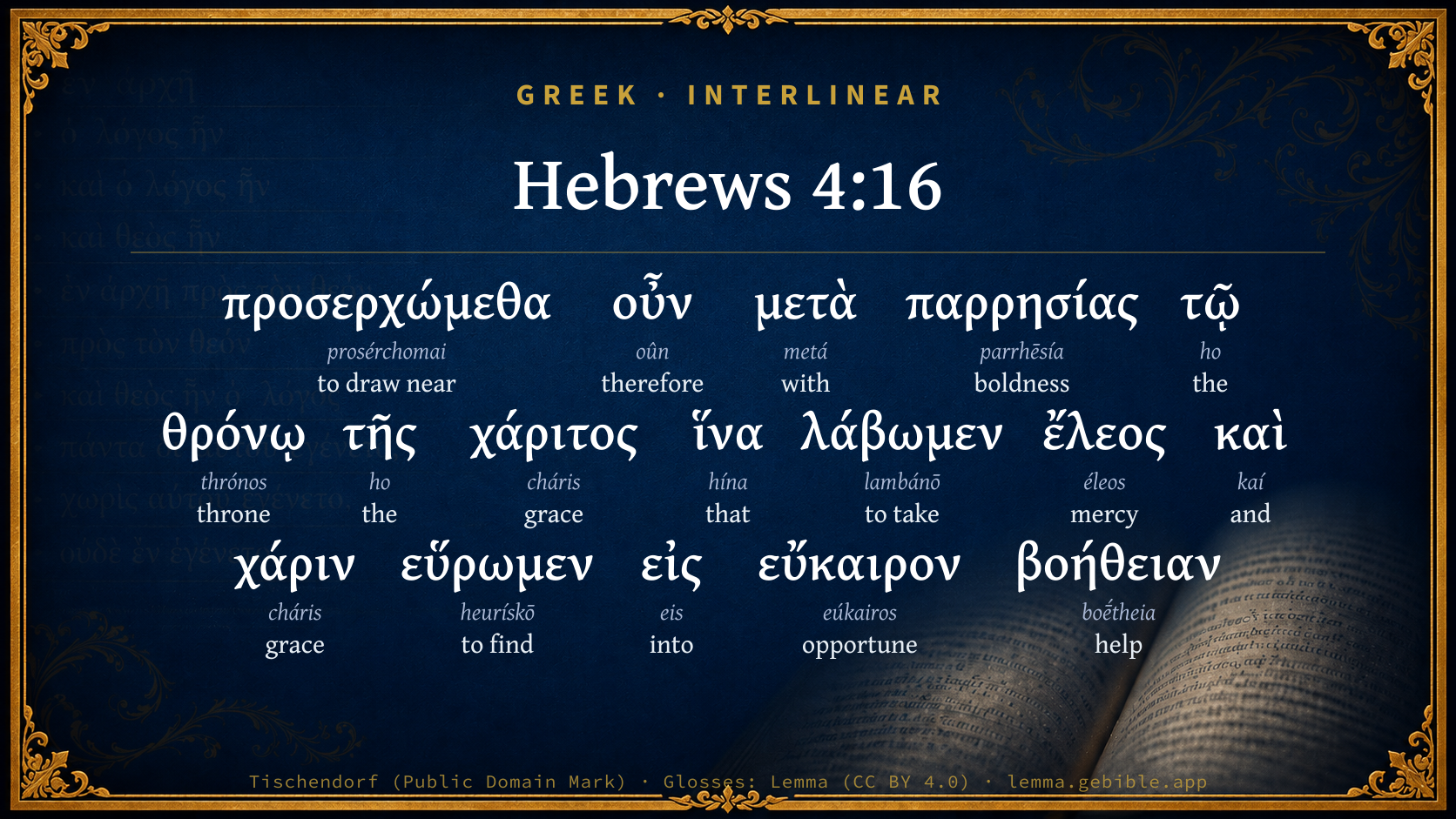
Greek (Tischendorf 8th ed.) Hebrews 4:16 appears in the Greek New Testament. The text above is from the Tischendorf 8th edition. Each word links to its Strong’s number and a concise gloss. Click any word for its full Thayer’s Greek Lexicon entry.
Download image
Cite this verse

Hebrews 4:16 (World English Bible). Public Domain. Lemma interlinear Bible study tool, https://lemma.gebible.app/v/hebrews/4/16.

Show BibTeX & RIS
BibTeX
RIS
English Translation
Let us therefore draw near with boldness to the throne of grace, that we may receive mercy, and may find grace for help in time of need.
World English Bible · Public Domain
Download a study sheet

One document with this verse’s original text, its word-by-word gloss line, the meaning frame, cross-references with their text, attributed commentary, and full source and license credits — printable, and it pastes into notes with its structure intact.

This verse Autodidact and up

Study sheet (.html) Plain text (.txt)

A passage Seminary Student

Up to 50 verses in one chapter. A passage sheet keeps up to 6 commentary sources and 12 cross-references per verse, in the order this page ranks them, and says so on the sheet whenever that leaves anything out. Ask for a single verse and you get the Autodidact verse sheet above.

Everything on this page stays free to read, with no account — the sheet is a download of what is already on screen, not access to it.

Want to remove ads? Support Godless Engineer
Compare translations 3

The same verse in 3 English versions, stacked beneath the original-language interlinear above. Click any original word for its lexicon entry.

Each is an independent rendering of the whole verse — the interlinear is not word-aligned to these translations.

Highlighted words mark where these versions differ — a whole-verse word diff, not a word-by-word alignment.

  • World English Bible Public Domain
    Let us therefore draw near with boldness to the throne of grace, that we may receive mercy, and may find grace for help in time of need.
  • King James Version Public Domain
    Let us therefore come boldly unto the throne of grace, that we may obtain mercy, and find grace to help in time of need.
  • unfoldingWord Literal Text CC BY-SA 4.0
    Let us then approach with confidence to the throne of grace so that we may receive mercy and find grace for timely help.

unfoldingWord Literal Text — © unfoldingWord, licensed CC BY-SA 4.0. Word-aligned USFM3 via Door43 (git.door43.org/unfoldingWord/en_ult).

Versions to compare (up to 4)

3 of 4 selected

Show all 19 translations

Every available English version of this verse, each an independent rendering of the whole verse.

  • World English Bible Public Domain
    Let us therefore draw near with boldness to the throne of grace, that we may receive mercy, and may find grace for help in time of need.
  • Berean Standard Bible Public Domain
    Let us then approach the throne of grace with confidence, so that we may receive mercy and find grace to help us in our time of need.
  • Majority Standard Bible Public Domain
    Let us then approach the throne of grace with confidence, so that we may receive mercy and find grace to help us in our time of need.
  • King James Version Public Domain
    Let us therefore come boldly unto the throne of grace, that we may obtain mercy, and find grace to help in time of need.
  • American Standard Version (1901) Public Domain
    Let us therefore draw near with boldness unto the throne of grace, that we may receive mercy, and may find grace to help `us' in time of need.
  • Revised Version (1885) Public Domain
    Let us therefore draw near with boldness unto the throne of grace, that we may receive mercy, and may find grace to help us in time of need.
  • Geneva Bible (1599) Public Domain
    Let vs therefore goe boldly vnto ye throne of grace, that we may receiue mercy, and finde grace to helpe in time of neede.
  • Douay-Rheims (1899) Public Domain
    Let us go therefore with confidence to the throne of grace: that we may obtain mercy, and find grace in seasonable aid.
  • Young's Literal Translation Public Domain
    we may come near, then, with freedom, to the throne of the grace, that we may receive kindness, and find grace -- for seasonable help.
  • Literal Standard Version CC BY-SA 4.0
    we may come near, then, with freedom, to the throne of grace, that we may receive kindness, and find grace—for seasonable help.
  • Unlocked Literal Bible CC BY-SA 4.0
    Let us then go with confidence to the throne of grace, so that we may receive mercy and find grace to help in time of need.
  • unfoldingWord Literal Text CC BY-SA 4.0
    Let us then approach with confidence to the throne of grace so that we may receive mercy and find grace for timely help.
  • Darby Bible Public Domain
    Let us approach therefore with boldness to the throne of grace, that we may receive mercy, and find grace for seasonable help.
  • World Messianic Bible Public Domain
    Let’s therefore draw near with boldness to the throne of grace, that we may receive mercy and may find grace for help in time of need.
  • Webster's Bible Public Domain
    Let us therefore come boldly to the throne of grace, that we may obtain mercy, and find grace to help in time of need.
  • Free Bible Version CC BY-SA 4.0
    So we should go confidently to God on his throne of grace so we can receive mercy, and discover grace to help us when we really need it.
  • Bible in Basic English Public Domain
    Then let us come near to the seat of grace without fear, so that mercy may be given to us, and we may get grace for our help in time of need.
  • Text-Critical English NT CC BY 4.0
    Therefore let us draw near to the throne of grace with confidence, so that we may receive mercy and find grace to help us in our time of need.
  • Tyndale New Testament (1534) Public Domain
    Let vs therfore goo boldely vnto the seate of grace that we maye receave mercy and fynde grace to helpe in tyme of nede.

Literal Standard Version (2020), Covenant Press — licensed CC BY-SA 4.0. Text via the HelloAO Bible API (eBible.org). Unlocked Literal Bible (unfoldingWord) — licensed CC BY-SA 4.0. Text via the HelloAO Bible API (eBible.org). unfoldingWord Literal Text — © unfoldingWord, licensed CC BY-SA 4.0. Word-aligned USFM3 via Door43 (git.door43.org/unfoldingWord/en_ult). Free Bible Version, Dr. Jonathan Gallagher — licensed CC BY-SA 4.0. Text via the HelloAO Bible API (eBible.org).

Word by word

More ways to search: Search by grammar → Find every occurrence → Compare this word →

Practice this passage: Drill this verse → Learn its vocabulary →

εὔκαιρον
eúkairos
G2121
“opportune”
Adjective, Accusative, Singular, Feminine
Part of Speech
Adjective
Case
Accusative
Number
Singular
Gender
Feminine
Full Thayer's Definition

Origin: from G2095 and G2540

TDNT: 10:42,4

1. seasonable, timely, opportune
  1. προσερχώμεθα prosérchomai G4334 “to draw near” Verb, Present, Middle or Passive deponent, Subjunctive, 1st person, Plural
  2. οὖν oûn G3767 “therefore” Conjunction
  3. μετὰ metá G3326 “with” Preposition
  4. παρρησίας parrhēsía G3954 “boldness” Noun, Genitive, Singular, Feminine
  5. τῷ ho G3588 “the” Article, Dative, Singular, Masculine
  6. θρόνῳ thrónos G2362 “throne” Noun, Dative, Singular, Masculine
  7. τῆς ho G3588 “the” Article, Genitive, Singular, Feminine
  8. χάριτος cháris G5485 “grace” Noun, Genitive, Singular, Feminine
  9. ἵνα hína G2443 “that” Conjunction
  10. λάβωμεν lambánō G2983 “to take” Verb, Aorist, Active, Subjunctive, 1st person, Plural
  11. ἔλεος éleos G1656 “mercy” Noun, Accusative, Singular, Neuter
  12. καὶ kaí G2532 “and” Conjunction
  13. χάριν cháris G5485 “grace” Noun, Accusative, Singular, Feminine
  14. εὕρωμεν heurískō G2147 “to find” Verb, Aorist, Active, Subjunctive, 1st person, Plural
  15. εἰς eis G1519 “into” Preposition
  16. βοήθειαν boḗtheia G996 “help” Noun, Accusative, Singular, Feminine

About this verse

These counts appear in no published source. They are computed here, from the morphology-tagged text and Lemma’s own curated glosses. What Lemma adds →

17
words
15
distinct lemmas
General Epistles
section

Notable vocabulary

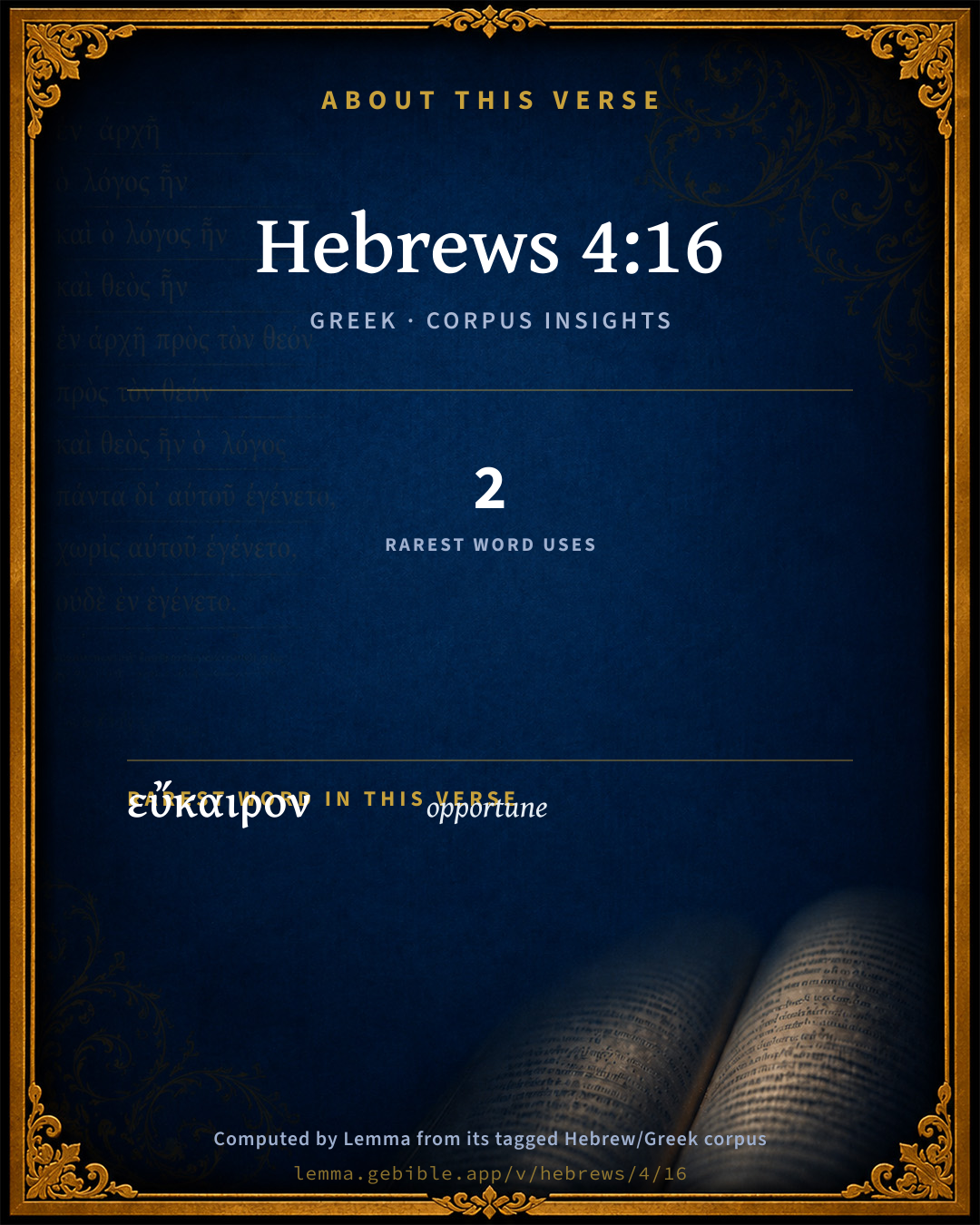
The rarest word here is εὔκαιρον opportune G2121 — appearing just 2 times in the whole Greek New Testament.

Shared distinctive vocabulary

εὔκαιρον opportune G2121 occurs in 2 verses of the Greek New Testament. Also found in:

Repetition

Words recur within this verse:

  • χάριτος grace G5485 ×2
  • τῷ the G3588 ×2

Cross-references

17

Topical passages linked to Hebrews 4:16 in the Treasury of Scripture Knowledge — connected by theme and wording, ordered by reader-vote popularity; previews shown in the World English Bible.

  • Ephesians 3:12 in whom we have boldness and access in confidence through our faith in him.
  • Hebrews 7:25 Therefore he is also able to save to the uttermost those who draw near to God through him, seeing he ever lives to make intercession for them.
  • Hebrews 10:19–23 Having therefore, brothers, boldness to enter into the holy place by the blood of Jesus,
  • Hebrews 13:6 So that with good courage we say, "The Lord is my helper. I will not fear. What can man do to me?"
  • Philippians 4:6–7 In nothing be anxious, but in everything, by prayer and petition with thanksgiving, let your requests be made known to God.
  • Isaiah 55:6–7 Seek you Yahweh while he may be found; call you on him while he is near:
  • Ephesians 2:18 For through him we both have our access in one Spirit to the Father.
  • Matthew 7:7–11 "Ask, and it will be given you. Seek, and you will find. Knock, and it will be opened for you.
  • 1 Peter 2:10 who in time past were no people, but now are God's people, who had not obtained mercy, but now have obtained mercy.
  • 2 Corinthians 12:8–10 Concerning this thing, I begged the Lord three times that it might depart from me.
  • Romans 8:15–17 For you didn't receive the spirit of bondage again to fear, but you received the Spirit of adoption, by whom we cry, "Abba! Father!"
  • Hebrews 7:19 (for the law made nothing perfect), and a bringing in thereupon of a better hope, through which we draw near to God.
  • Leviticus 16:2 and Yahweh said to Moses, "Tell Aaron your brother, not to come at all times into the Most Holy Place within the veil, before the mercy seat which is on the ark; lest he die: for I will appear in the cloud on the mercy seat.
  • Hebrews 9:5 and above it cherubim of glory overshadowing the mercy seat, of which things we can't now speak in detail.
  • Exodus 25:17–22 You shall make a mercy seat of pure gold. Two and a half cubits shall be its length, and a cubit and a half its breadth.
  • 1 Chronicles 28:11 Then David gave to Solomon his son the pattern of the porch [of the temple], and of the houses of it, and of the treasuries of it, and of the upper rooms of it, and of the inner chambers of it, and of the place of the mercy seat;
  • Isaiah 27:11 When the boughs of it are withered, they shall be broken off; the women shall come, and set them on fire; for it is a people of no understanding: therefore he who made them will not have compassion on them, and he who formed them will show them no favor.

Cross-references courtesy of OpenBible.info (CC BY 4.0).

Commentary

Notes on Hebrews 4:16 from classic Christian and Jewish commentators (each source and its license shown beneath its notes). The classic Christian expositions comment on the surrounding passage and are grouped to its opening verse, so a note may address several verses; the Jewish commentaries on the Tanakh (Rashi and others) are per-verse, so they appear only where the commentator wrote on this verse.

Lemma curates 59 commentaries, every one of them public domain or Creative Commons licensed, each selected and text-cleaned for this edition rather than reprinted as found. About our sources →

Joseph Benson's Commentary

Heb 4:16. Let us therefore come boldly — Without any doubt or fear, trusting in his sacrifice and intercession for acceptance; unto the throne of grace — The throne of our reconciled Father, which grace erected, and where it reigns and dispenses all blessings in a way of unmerited favour; that we may obtain mercy — To pardon all our past sins, and compassionate our condition, amidst our various infirmities and sufferings; and find grace to help in time of need — Or, for a seasonable help; according to our respective necessities, as εις ευκαιρον βοηθειαν implies. The latter word properly signifies help obtained in consequence of crying aloud, or strong crying for it. Observe, reader, though every time may be properly termed a time of need, in which we want supplies of grace, yet some times are peculiarly such: as seasons of affliction, of persecution, and temptation; or times when God, to chastise us for our lukewarmness and sloth, our hypocrisy and formality, or pride, self-will, discontent, or impatience; our neglect of prayer and watchfulness, our levity and folly, or any other fault or failing, withdraws his presence from us: or when we are called to the performance of any great and signal duty, as it was with Abraham when he was called first to leave his country, and afterward to sacrifice his son: or to something that is new, and in which we are yet inexperienced; a duty against which there is great opposition, or for which we may seem to be very unfit, or in which the glory of God is in an especial manner concerned. And, above all, the time of death will be such a season. To part with all present things and present hopes, to give up one’s departing soul, entering the invisible world, an unchangeable eternity, into the hands of our sovereign Lord, are duties which require strength beyond our own, for their right and comfortable performance. And at such seasons, as we have peculiar need to make application to the throne of grace, here spoken of, for the purpose of obtaining seasonable help; so, if we apply in faith, and with sincere and earnest desire and persevering diligence, we shall not apply in vain.

Joseph Benson's Commentary on the Old and New Testaments (1811–1818) — public domain. Text from a community e-Sword module.

MacLaren's Expositions of Holy Scripture

Alexander MacLaren

Hebrews

THE THRONE OF GRACE

Heb 4:16

IN the context are three great exhortations which bear a very remarkable and distinct relation to each other: ‘Let us labour to enter into rest’; ‘Let us hold fast our profession’; Let us come boldly to the throne of grace.

It is a hard thing to labour to enter into rest. How is it to be done? The second exhortation helps us to answer, ‘Let us hold fast our profession,’ which being translated into other words, is this: our true way of labour is to cling in faith to Him whom we acknowledge; but knowing the weakness of our own hearts, and how they waywardly fluctuate and pass away from the one confidence and happiest trust, it is with profound wisdom that the ultimate injunction is held out for the foundation of all - ‘Let us come to the throne of grace.’ There we get the strength that will enable our slack and benumbed fingers to grasp again the thing we hold. There we shall get that fresh grip of Christ which will quicken us for the labour of entering into rest. And so this portion of exhortation interposed between the doctrinal and theological parts of this letter is addressed to every one in the Christian profession. I ask you, then, to look at this exhortation, which covers the whole ground of Christian duty and strength.

Now, first, here is a very remarkable and beautiful expression - ‘the throne of grace.’ Grace, of course, as I do not need to explain, is the New Testament word for the undeserved favour and loving regard of God to man considered as weak, sinful, and unworthy; it is love which has its own motive, apart from any regard to worthiness in the object upon which it falls. Grace is its own real impulse and motive, and grace is set in Scripture as the opposite of desert; it is of grace, not of works, and so forth. It is set as the antagonist of sin and unrighteousness and all evil, and so runs up to the idea that it expresses the unmerited, self-originated, loving regard of God to us poor miserable creatures, who, if dealt with on the ground of right and retribution, would receive something very different indeed. But my text says the throne of grace is the throne of God. I wonder if it is too picturesque to take that word grace here as a kind of synonym of God? Think of the figure that was in the writer’s mind, as being that grace itself was the occupant of the throne, that there she sits, regal, sovereign, enthroned in the heart of the universe, queen of all things, and giving from her full and generous hand to every creature all that which the creature requires. And then if we take the more prosaic notion - which perhaps is the safer one - and think that the metaphor is not that grace is queen and sovereign, but only that the throne is based and established, as it were, in grace, out of which this undeserved love flows in broad, full streams. Even if we take the metaphor thus, we come to the same thought, that whatever else there may he in the divine nature, the ruling sovereign element in Deity is unmerited love and mercy and kindly regard to us poor, ignorant, sinful creatures, which keeps pouring itself out over all the world. God is King, and the kingly thing in God is infinite grace.

Then we can scarcely but bring into connection with this grand idea the other phases which the Old Testament gives to the same thought. Read such words as these: - ‘Justice and judgment are the habitation of His throne’ - ‘God sitteth on the throne of His holiness’ - ‘The throne of Thy glory.’ Yes, the throne of justice and of judgment. White and sparkling - cold and repellent. The throne of glory - flashing and dazzling, coruscating and blinding, glittering and shimmering - ready to smite the diseased eye. The throne of Thy holiness. Yes, lofty, far up there, towering above us in its pure completeness, and we poor creatures, being ourselves blinded and dazed, and far away from Him, down amidst the lowlands and materialities, and all that majesty in the heavens - the justice and judgment, the holiness and glory - all that is only the envelope and wrappage, the living centre and heart of it is a pure, lambent glow of tenderness, and the throne is truly the throne of grace. The ‘throne’ gives us all ideas of majesty, sovereignty, dominion, infinitude, greatness. The thought that it is ‘the throne of grace’ sheathes all these in the softest, tenderest, most blessed folds of love - unmerited, free, spontaneous - simply because He is God, and not on account of any goodness in us. Bearing in mind this great conception of true love, ruling, dominant, the sovereign element in the divine nature, let us ask, How do we reach it? Are we warranted in believing it? Read the verses that come before: ‘For we have not a High Priest that cannot be touched with the feeling of our infirmities, but was in all points tempted as we are, yet without sin.’ Turn that doctrinal statement into a statement of principle and it just comes to this: that our certitude that God’s throne is a throne of love and grace, is all involved in, dependent upon, and built upon, the work of Christ, the High Priest of our profession. That is to say, not ‘thank God’ that His work makes God’s throne a throne of grace - that is not the teaching of the Scripture - but that He, as High Priest, and, therefore, as the revealer to us of God as He is, shows us in His life and death, in the gentleness of His character, in the tenderness of His compassion, in the depth of His sympathy on earth, in the tenderness that touched the little children in their innocence and the harlots in their filth, and in the death He died upon the Cross for the sake of the world - the very heart of God is cut open, as it were, and the two halves fall apart as when we cut some rich fruit to lay hare the inmost pulp. God is manifested to us, God declares Himself to us, in the sympathy of the humanity, in the life, in the death upon the Cross; and the Priest, in His sacrifice, and by His sacrifice, shows us that between the cherubim throned above the mercy-seat shimmers the Shekinah of power, with its white centre of love and peace. And then, on the other side, that same great thought of the priesthood of Christ influences this conception of the throne of God in another fashion still; for, as it seems to me, there is no understanding of the depth and meaning of the work of Jesus Christ, our Lord, unless we heartily accept this, that His great sacrifice for us, in which mainly He is the Priest of our profession, is the means and channel and medium and condition through which all the love of God expresses itself to the world, and has communicated to sinful man all His goodness and all His pity and His tenderness, supplying all our necessities, and is all things to us through Christ our Lord. Seen through Him the throne is white with tenderness; flowing through Him from the throne proceeds the river of the water of life, and so, in both ways, the throne of grace is such by reason of the priesthood of Christ.

Look for a moment, in the next place, at the temper and disposition with which we come to this throne. ‘Let us come boldly.’ Now boldly is a somewhat incongruous word; it neither conveys the original, nor does it correspond to our sense of propriety. The thought would be far more beautiful and far more naturally represented by a more literal translation - ‘Let us come with frank confidence’ to the throne of grace. The word literally means, if we go to the etymology of it, speaking everything. You can easily understand how naturally that becomes an expression for the unembarrassed, unrestrained full out-pouring of a heart. You cannot pour out your heart in the fullest confidence to a person you do not respect, but if you get with some one you entirely trust, how swiftly the words flow. and how very easy it is to tell out the whole heart. Just so with this great word of the writer of this Epistle, descriptive of the temper and disposition with which men are to go to God - with confidence, full, cheerful, and unembarrassed, and which expresses itself in full trust, exactly as one of the old Psalms says - ‘Ye people, pour out your heart before Him.’ Yes, let it all flow out, just as you would do to husband or wife, or lover, or friend, or the chosen companion to whom we can tell everything. Ah, but there is no such person - there is nobody, not a soul, could stand the turning inside out of a man! There is no one able to do it to another, even supposing the other could bear it! But my text says ‘come,’ and is so gentle in its love, so strong in its grace, sweetly wooing us to the freest and frankest outpourings of all our hearts before the throne. Let us then come with confidence, because Jesus’ work as our High Priest is in the writer’s mind. You remember the vision in the Revelation where the seer beholds the angel coming with a censer, and he takes incense from off the golden altar, and he goes on to say, that this much incense was offered in the censer with prayers of saints. That is a picturesque and graphic representation of this same idea; my poor cry, the devotions of my trembling, unfaithful heart, the halting, limping approach of my sluggish spirit, these go along with, and are offered through, that Great High Priest.

‘Let the much incense of Thy prayer On my behalf ascend.’

Truly we have a loving High Priest; let us therefore come boldly to the throne of grace. Let us not use as a mere empty form those words ‘for Christ’s sake,’ but let us remember that these words do hold the very secret of all acceptable approach to God, and that’ no man cometh to the Father but by Me. There is reason enough, God knows, in your heart and mine, and in our poor, miserable, wretched, conventional, formal chatterings called prayers, for diffidence and distrust. Well, then, let us fully look that fact in the face, entertain untremblingly the fullest consciousness of the insufficiency and unworthiness of all we do, and all we are, and all we feel, and all we seek, and then wrenching ourselves away as it were from the contemplation of our own selves, which only land us in diffidence and despair, let us turn to Him, that we may have boldness and confidence in our access to the feet of Him who is our Great High Priest, passed into the heavens, and who now sits on the ‘throne of grace.’

And now, lastly, a word about the issue and result of this confidence of access to the throne of grace, the throne of spontaneous love. ‘That we may obtain mercy,’ says the writer, ‘and find grace to help in time of need.’ It is noteworthy, I think, to consider that the writer here is evidently thinking, not about a communion with God which is not prayer, but a communion with God which, on our side, is the lifting up of an empty hand, and on His side the bestowing a large, full gift. There is no fellowship with God possible on the footing of what people call ‘disinterested communion.’ No, we have always to go to Him to get something from Him. The question is, What do we expect to get? My text tells us, not the temporal blessings, not the answers to foolish desires, not the taking away of thorns in the flesh, but mercy and grace to help - inward and spiritual blessings. But what are these? Well, I don’t know whether it is too nice or too microscopic criticism to say that I seem to see a difference between obtaining mercy and finding grace. I take it grace is used in what I call its secondary sense, not meaning so much the love of God unmerited, but rather signifying the consequences of that love in the gifts bestowed upon us, and you know that is a usage of the word common in the New Testament, thus making the word into a plural, ‘graces’ - the manifold gifts that love bestows upon us. So that, I take it, this word is here used in the secondary sense, and if that be so, we may shape a difference between the two phrases, ‘obtaining mercy’ and ‘finding grace.’

I do not think I can put that better than by using a metaphor. The one expresses the heart of God, the other expresses the hand of God. We may obtain mercy as a suppliant coming boldly, confidently, frankly, with faith in the Great High Priest, to the throne of grace. There we get the full heart of God. I stand before Him in my filth, in my weakness, with conscience gnawing at me in the sense of many infirmities, many a sin and shortcoming and omission, and on the throne, if I may so say, is a shoot of tender love from God’s heart to me, and I get for all my weakness and sin pity and pardon, and find mercy of the Lord in that day. And then in getting the full heart of God, with all its divine abundance and pardoning grace and tender, gracious pity, I get, of course, the full hand of God to obtain mercy, and find grace, the bestowment of the needful blessings, the obtaining of grace in time of need, the right grace No blunders in the equipment with which He supplies us. He does not give me the parcel that was meant for you; there is no error in the delivery. He does not send His soldiers to the North Pole equipped for warfare in Africa. He does not give this man a blessing that the man’s circumstances would not require. No, no; blessed be God, He cannot err. We fall back upon the words that precede my text, ‘And there is no creature concealed from His sight, for all things are naked, and open to the eyes Of Him to whom we must give an account.’ That may be, and is terrible, unless we take it along with the other word, ‘We have not a High Priest who cannot sympathise with our weakness.’ We see a divine omniscience shining upon us through the merits of the great High Priest, full of light and hope, and because all things are naked and open to the eyes of Him who is our High Priest; therefore the right grace will be most surely given to me to help me in time of need, or, as the words may perhaps be more vigorously and correctly translated, find grace for timely aid, grace punctually and precisely at the very nick of time, at the very exact time determined by heaven’s chronometer, not by ours. It will not come as quickly as impatience might think it ought, it will not come so soon as to prevent an agony of prayer, it will not come in time enough for our impatience, for murmuring, for presumptuous desires; but it will come in time to do all that is needed. Ah, and it will come before Peter has gone below the water, though not until Peter has felt the cold waves rise to his knees, and has cried out, ‘Lord, save me, I perish.’ ‘Master, he whom Thou lovest is sick,’ and He abode still two days in the same place where He was, and when He came, ‘Lord, if Thou hadst been here my brother had not died.’ ‘Said I not unto thee, that if thou didst believe thou shouldest see the glory of God.’ ‘God is in the midst of her, she shall not be moved, the Lord shall help her, and that right early.’ You remember the narrative of that great final battle on the plains of Waterloo. For long weary days brave men died by the thousands - the afternoon of the last day was wearing rapidly away, the thin red living line getting thinner and thinner, the squares smaller and smaller at each returning charge - but at last, just before the daylight faded, just before endurance could do no more, there comes old Blucher at last and gives the order, and the whole line bore down upon the enemy and scattered them. Ah, help came at the right time, not so soon but that the courage of our brave soldiers had been tested, but before despair had settled upon the ranks, and in time for a great and perfect victory. Oh, my friends, ‘Let us come boldly to the Throne of Grace, that we may obtain mercy and find grace for every time of need.’

Through waves and clouds and storms

He gently clears thy way;

Wait thou His time - thy darkest night

Shall end in brightest day.’

Alexander MacLaren, Expositions of Holy Scripture (1904–1910) — public domain. Text from a community e-Sword module.

Tyndale Open Study Notes

Tyndale Open Resources

4:16 The verb translated let us come could be translated to indicate ongoing action: let us continually come. • As our compassionate High Priest, Jesus has opened the way for people to enter God’s presence boldly (see 6:19-20; 10:19-23), where we can obtain his mercy and grace to help us when we need it most.

Tyndale Open Study Notes — © Tyndale Open Resources, licensed CC BY-SA 4.0. Text via the HelloAO Bible API.

Bengel's Gnomon

Johann Albrecht Bengel

Heb 4:16. Προσερχώμεθα, let us draw near) The same word occurs, ch. Heb 7:25, Heb 10:1; Heb 10:22, Heb 11:6, Heb 12:18; Heb 12:22: in like manner, ἐγγίζειν, ch. Heb 7:19: εἰσέρχεσθαι, ch. Heb 6:19: εἴσοδος, ch. Heb 10:19. So Paul also, Rom 5:2, προσαγωγή.—τῷ θρόνῳ, to the throne) ch. Heb 8:1, Heb 12:2; Isa 16:5.—τῆς χάριτος, of grace) This word is also of frequent occurrence in this epistle.—λάβωμεν, κ.τ.λ.) The mercy of Christ being shown, is obtained (is taken, λάβωμεν): and further, the grace of God is found (εὕρωμεν). The appropriate verb is put before the one noun, and put after the other: Chiasmus.[28]—ἜΛΕΟΝ, mercy) This refers to touched with a fellow-feeling.—χάριν, grace) This refers to of grace.—εὔκαιρον, in the needful time, seasonable) Believers do not feel at once the preparations of grace made for a long time to come;[29] but when the time comes, they find it present with them; and this seasonableness especially falls on the times of the New Testament, Rom 3:26; Rom 5:6, and under it on the times of persecution (the cross).—ΒΟΉΘΕΙΑΝ, help) ch. Heb 2:18.

[28] See Append.

[29] A supply of grace is in store for believers against all future needs: but believers are not permitted to know and feel it all at once, but only according as the need arises.—ED.

—————

Bengel's Gnomon of the New Testament — English translation (T&T Clark, Edinburgh, 1860) — public domain. Text from a community e-Sword module.

Meyer's Critical & Exegetical Commentary

Heinrich August Wilhelm Meyer

Heb_4:16. Encouragement, derived from the character of the High Priest of the New Testament, as brought into relief, Heb_4:15.

προσέρχεσθαι] approach, draw near, in order to have community with something. Comp. Heb_7:25, Heb_10:1; Heb_10:22, Heb_11:6, Heb_12:18; Heb_12:22. Too specially Delitzsch, Kurtz, and Ewald, who explain: drawing near in prayer for aid or succour.

μετὰ παῤῥησίας] with confidence, (Heb_3:6), inasmuch as we possess, in the very office of intercessor, a High Priest who is not only exalted, but also full of sympathy, who thus has not only the power, but also the will to help.

θρόνος τῆς χάριτος] not: Christ Himself (Gerhard, S. Schmidt, Carpzov, Ernesti, al.), not: the throne of Christ (Primasius [also Tena, arguing from the Vulgate of Heb_2:9], Schlichting, Limborch, Chr. Fr. Schmid, al.), but the throne of God, at whose right hand Christ is seated. Comp. Heb_8:1, Heb_12:2 [Eph_2:18]. It is called, however, the throne of grace, because the nature of the New Covenant has, as its presupposition, not strictly judicial retribution, according to the works of men, but compassion and grace on the part of God; the believer feels himself united to God as a loving Father, who has remitted to him the guilt and punishment of sin. A reference for the rest to the cover of the ark of the covenant, regarded as the seat of the Godhead in the sanctuary (the כַּפֹּרֶת or ἱλαστήριον of the Old Covenant), assumed by Piscator, Schöttgen, Wolf, Carpzov, Cramer, Abresch, Kuinoel, Paulus, al., and still in recent times by Bloomfield and Bisping (comp. also Kurtz ad loc.), in connection with the expression: ὁ θρόνος τῆς χάριτος, is not indicated by anything in the text.

To obtain mercy and find grace (Luk_1:30; Act_7:46; comp. מָצָא חֵן, Gen_6:8; Gen_18:3, and frequently) are synonymous terms. All distinctions, as that of Böhme: ἔλεος magis id appellat, quo indigebant calamitatibus oppressi lectores, χάρις, quo peccatis non carentes; of Stein, that ἔλεος relates to compassion towards the sinner, χάρις to every manifestation of grace; of Bisping, that ἔλεος refers more to the forgiveness of sins and deliverance from sufferings, while χάρις refers to the communication of higher gifts of grace; of Hofmann, that χάριν εὑρίσκειν means to be brought into a state of favour with any one, to become an object of his good-will; λαμβάνειν ἔλεος, on the other hand, is a receiving of that which the kind and gracious One accords to those in need of His kindness, just on account of their need, and many others, are untenable.

εἰς εὔκαιρον βοήθειαν] for timely help, i.e. in order that we may in this manner attain to a help which appears on the scene, while it is still the right time, before it is yet too late (Heb_3:13). Wrongly Tholuck, Delitzsch, Moll, Kurtz, and Hofmann: before the one in conflict with the temptations succumbs; and others (also Riehm, Lehrbegr. des Hebräerbr. p. 740): as often as we stand in need of the βοήθεια.

Meyer — Critical and Exegetical Commentary on the New Testament — English translation by Peter Christie, edited by Frederick Crombie (T&T Clark, 1880) — public domain. Text from a community e-Sword module.

Expositor's Greek Testament

ed. W. Robertson Nicoll

Heb 4:16 . προσερχώμεθα οὖν .… “Let us, therefore [ i.e. , seeing that we have this sympathetic and victorious High Priest] with confidence approach the throne of grace”. προσέρχεσθαι is used in a semi-technical sense for the approach of a worshipper to God, as in LXX frequently. Thus in Lev 21:17 it is said of any blemished son of Aaron οὐ προσελεύσεται προσφέρειν τὰ δῶρα τοῦ Θεοῦ αὐτοῦ , and in the 23rd ver. ἐγγιεῖ is used as an equivalent, cf. Heb 7:19 . The word is found only once in St. Paul, 1Ti 6:3 , and there in a peculiar sense; but in Heb. it occurs seven times, and generally in its more technical sense, Heb 7:25 , Heb 10:1 ; Heb 10:22 , Heb 11:6 . It had become so much a technical term of divine worship that it can be used, as in Heb 10:1 ; Heb 10:22 , without an object. Here, as in Heb 7:25 , it is followed by a dative τῷ θρόνῳ τῆς χάριτος , the seat of supreme authority which by Christ’s intercession is now characterised as the source from which grace is dispensed. Premonitions of this are found in O.T.; for although in Psa 96 (97.) 2 and elsewhere we find δικαιοσύνη καὶ κρίμα κατόρθωσις τοῦ θρόνου αὐτοῦ , yet in Isa 16:5 we read διορθωθήσεται μετʼ ἐλέους θρόνος . Philo encourages men to draw near to God by representing “the merciful, and gentle, and compassionate nature of Him who is invoked, who would always rather have mercy than punishment” ( De Exsecr. , c. ix). There is also something in Theophylact’s remark: Δύο γὰρ θρόνοι εἰσὶν , ὁ μὲν νῦν χάριτος , … ὁ δὲ τῆς δευτέρας παρουσίας θρόνος οὐ χάριτος … ἀλλὰ κρίσεως . Similarly Atto: “Modo tempus est donorum: nemo de se ipso desperet”. They are to approach μετὰ παρρησίας , for as Philo says ( Quis. Rer. Div. Haer. , 4): φιλοδεσπότοις ἀναγκαιότατον ἡ παρρησία κτῆμα ; and in c. 5. παρρησία φιλίας συγγενές . The purpose of the approach is expressed in two clauses which Bleek declares to be “ganz synonym”. This, however, is scarcely correct. As is apparent from the next verse, the “obtaining mercy” refers to the pardon of sins, while the “finding grace” implies assistance given. So Primasius, quoted by Westcott “ut misericordiam consequamur, id est remissionem peccatorum, et gratiam donorum Spiritus Sancti”. ἔλεος and χάρις are, however, constantly conjoined ( v . Hort on 1Pe 1:2 ). The close connection of χάριν with βοήθειαν suggests that ἔλεος is the more general and comprehensive term, and that χάρις is becoming already more associated with particular manifestations of ἔλεος . There may be ἔλεος , where there is no χάρις . We first obtain mercy and then find grace. εὑρίσκειν is everywhere in LXX used with χάριν in this sense, translating מָצָא . εἰς εὔκαιρον βοήθειαν “for timely help”; assistance in hours of temptation must be timely or it is useless. For βοήθεια cf. Heb 2:18 ; and for the whole verse, see Bishop Wilson’s Maxim : “The most dangerous of all temptations is to believe, that one can avoid or overcome them by our own strength, and without asking the help of God”.

The Expositor's Greek Testament, edited by W. Robertson Nicoll (1897–1910) — public domain. Text from a community e-Sword module.

Jamieson, Fausset & Brown

Robert Jamieson, A. R. Fausset & David Brown

come--rather as Greek, "approach," "draw near."

boldly--Greek, "with confidence," or "freedom of speech" (Eph 6:19).

the throne of grace--God's throne is become to us a throne of grace through the mediation of our High Priest at God's right hand (Heb 8:1; Heb 12:2). Pleading our High Priest Jesus' meritorious death, we shall always find God on a throne of grace. Contrast Job's complaint (Job 23:3-8) and Elihu's " IF," &c. (Job 33:23-28).

obtain--rather, "receive."

mercy--"Compassion," by its derivation (literally, fellow feeling from community of suffering), corresponds to the character of our High Priest "touched with the feeling of our infirmities" (Heb 4:15).

find grace--corresponding to "throne of grace." Mercy especially refers to the remission and removal of sins; grace, to the saving bestowal of spiritual gifts [ESTIUS]. Compare "Come unto Me . . . and I will give you rest (the rest received on first believing). Take My yoke on you . . . and ye shall find rest (the continuing rest and peace found in daily submitting to Christ's easy yoke; the former answers to "receive mercy" here; the latter, to "find grace," Mat 11:28-29).

in time of need--Greek, "seasonably." Before we are overwhelmed by the temptation; when we most need it, in temptations and persecutions; such as is suitable to the time, persons, and end designed (Psa 104:27). A supply of grace is in store for believers against all exigencies; but they are only supplied with it according as the need arises. Compare "in due time," Rom 5:6. Not, as ALFORD explains, "help in time," that is, to-day, while it is yet open to us; the accepted time (Co2 6:2).

help--Compare Heb 2:18, "He is able to succor them that are tempted."

Next: Hebrews Chapter 5

Jamieson, Fausset & Brown — Commentary Critical and Explanatory on the Whole Bible (1871) — public domain (CC PDM 1.0). Text via the HelloAO Bible API.

Adam Clarke's Commentary

Verse 16. Let us therefore come boldly unto the throne of grace] The allusion to the high priest, and his office on the day of atonement, is here kept up. The approach mentioned here is to the כפרת kapporeth, ιλαστηριον, the propitiatory or mercy-seat. This was the covering of the ark of the testimony or covenant, at each end of which was a cherub, and between them the shechinah, or symbol of the Divine Majesty, which appeared to, and conversed with, the high priest. Here the apostle shows the great superiority of the privileges of the new testament above those of the old; for there the high priest only, and he with fear and trembling, was permitted to approach; and that not without the blood of the victim; and if in any thing he transgressed, he might expect to be struck with death. The throne of grace in heaven answers to this propitiatory, but to this ALL may approach who feel their need of salvation; and they may approach μετα παρρησιας, with freedom, confidence, liberty of speech, in opposition to the fear and trembling of the Jewish high priest. Here, nothing is to be feared, provided the heart be right with God, truly sincere, and trusting alone in the sacrificial blood.

That we may obtain mercy] ινα λαβωμεν ελεον. That we may take mercy - that we may receive the pardon of all our sins; there is mercy for the taking. As Jesus Christ tasted death for every man, so every man may go to that propitiatory, and take the mercy that is suited to his degree of guilt.

And find grace] Mercy refers to the pardon of sin, and being brought into the favour of God. Grace is that by which the soul is supported after it has received this mercy, and by which it is purified from all unrighteousness, and upheld in all trials and difficulties, and enabled to prove faithful unto death.

To help in time of need.] εις ευκαιρον βοηθειαν. For a seasonable support; that is, support when necessary, and as necessary, and in due proportion to the necessity. The word βονθεια is properly rendered assistance, help, or support; but it is an assistance in consequence of the earnest cry of the person in distress, for the word signifies to run at the cry, θειν εις βοην, or επιβοηνθειν. So, even at the throne of grace, or great propitiatory, no help can be expected where there is no cry, and where there is no cry there is no felt necessity; for he that feels he is perishing will cry aloud for help, and to such a cry the compassionate High Priest will run; and the time of need is the time in which God will show mercy; nor will he ever delay it when it is necessary. We are not to cry to-day to be helped to-morrow, or at some indefinite time, or at the hour of death. We are to call for mercy and grace when we need them; and we are to expect to receive them when we call. This is a part of our liberty or boldness; we come up to the throne, and we call aloud for mercy, and God hears and dispenses the blessing we need.

That this exhortation of the apostle may not be lost on us, let us consider: -

1. That there is a throne of grace, i.e. a propitiatory, the place where God and man are to meet.

2. That this propitiatory or mercy-seat is sprinkled with the atoning blood of that Lamb of God which taketh away the sin of the world.

3. That we must come up, προσερχωμεθα, to this throne; and this implies faith in the efficacy of the sacrifice.

4. That we must call aloud on God for his mercy, if we expect him to run to our assistance.

5. That we must feel our spiritual necessities, in order to our calling with fervency and earnestness.

6. That calling thus we shall infallibly get what we want; for in Christ Jesus, as a sacrificial offering, God is ever well pleased; and he is also well pleased with all who take refuge in the atonement which he has made.

7. That thus coming, feeling, and calling, we may have the utmost confidence; for we have boldness, liberty of access, freedom of speech; may plead with our Maker without fear; and expect all that heaven has to bestow; because Jesus, who died, sitteth upon the throne! Hallelujah! the Lord God Omnipotent reigneth.

8. All these are reasons why we should persevere.

Adam Clarke's Commentary on the Bible (1810–1826) — public domain. Text from a community e-Sword/MySword module.

John Calvin's Commentaries

16. Let us therefore come boldly, or, with confidence, etc. He draws this conclusion, — that an access to God is open to all who come to him relying on Christ the Mediator; nay, he exhorts the faithful to venture without any hesitation to present themselves before God. And the chief benefit of divine teaching is a sure confidence in calling on God, as, on the other hand, the whole of religion falls to the ground, and is lost when this certainty is taken away from consciences.

It is hence obvious to conclude, that under the Papacy the light of the Gospel is extinct, for miserable men are bidden to doubt whether God is propitious to them or is angry with them. They indeed say that God is to be sought; but the way by which it is possible to come to him is not pointed out, and the gate is barred by which alone men can enter. They confess in words that Christ is a Mediator, but in reality they make the power of his priesthood of none effect, and deprive him of his honor.

For we must hold this principle, — that Christ is not really known as a Mediator except all doubt as to our access to God is removed; otherwise the conclusion here drawn would not stand, “We have a high priest Who is willing to help us; therefore we may come bold and without any hesitation to the throne of grace.” And were we indeed fully persuaded that Christ is of his own accord stretching forth his hand to us, who of us would not come in perfect confidence? It is then true what I said, that its power is taken away from Christ’s priesthood whenever men have doubts, and are anxiously seeking for mediators, as though that one were not sufficient, in whose patronage all they who really trust, as the Apostle here directs them, have the assurance that their prayers are heard.

The ground of this assurance is, that the throne of God is not arrayed in naked majesty to confound us, but is adorned with a new name, even that of grace, which ought ever to be remembered whenever we shun the presence of God. For the glory of God, when we contemplate it alone, can produce no other effect than to fill us with despair; so awful is his throne. The Apostle, then, that he might remedy our diffidence, and free our minds from all fear and trembling, adorns it with “grace,” and gives it a name which can allure us by its sweetness, as though he had said, “Since God has affirmed to his throne as it were the banner of ‘grace’ and of his paternal love towards us, there are no reasons why his majesty should drive us away.”

The import of the whole is, that we are to call upon God without fear, since we know that he is propitious to us, and that this may be done is owing to the benefit conferred on us by Christ, as we find from Ephesians 3:12; for when Christ receives us under his protection and patronage, he covers with his goodness the majesty of God, which would otherwise be terrible to us, so that nothing appears there but grace and paternal favor.

That we may obtain mercy, etc. This is not added without great reason; it is for the purpose of encouraging as it were by name those who feel the need of mercy, lest any one should be cast down by the sense of his misery, and close up his way by his own diffidence. This expression, “that we may obtain mercy”, contains especially this most delightful truth, that all who, relying on the advocacy of Christ, pray to God, are certain to obtain mercy; yet on the other hand the Apostle indirectly, or by implication, holds out a threatening to all who take not this way, and intimates that God will be inexorable to them, because they disregard the only true way of being reconciled to him.

He adds, To help in time of need, or, for a seasonable help; that is, if we desire to obtain all things necessary for our salvation. Now, this seasonableness refers to the time of calling, according to those words of Isaiah, which Paul accommodates to the preaching of the Gospel, “Behold, now is the accepted time,” etc., (Isaiah 49:8; 2 Corinthians 6:2;) for the Apostle refers to that “today,” during which God speaks to us. If we defer hearing until tomorrow, when God is speaking to us today, the unseasonable night will come, when what now may be done can no longer be done; and we shall in vain knock when the door is closed.

John Calvin's Commentaries (1540-1563) — public domain. Text from the Calvin Translation Society English edition (1840s-50s) via the Christian Classics Ethereal Library (ccel.org). Calvin's coverage is partial (roughly two-thirds of the Bible); uncommented books and verses are honest gaps, never fabricated. The 19th-century editor's footnotes and remarks are omitted so the notes are faithfully Calvin's own voice.

Ellicott's Commentary for English Readers

(16) Obtain mercy.—The real meaning is, receive compassion (Heb_2:17) in our weakness and trials. The thought of obtaining mercy for guilt is not in these words, taken by themselves; but “grace” meets every need. If the last verse brought evidence that our High Priest has perfect knowledge of the help required, this gives the assurance that the help shall be given as needed, and in the time of need.

A Bible Commentary for English Readers, edited by Charles John Ellicott (1878–1897) — public domain. Text from a community e-Sword module.

The Cambridge Bible for Schools and Colleges

gen. ed. J. J. S. Perowne

16. Let us therefore come boldly] Rather, “let us then approach with confidence.” The notion of “approach” to God (προσέρχεσθαι) in the Levitical service (Lev_21:17; Lev_22:3) is prominent in this Epistle (Heb_7:25, Heb_10:1; Heb_10:22, Heb_11:6, Heb_12:18-22). In St Paul it only occurs once (1Ti_6:13), and then in a different sense. His ideal of the Christian life is not “access to God” (though he does also allude to this in one Epistle, Eph_2:18; Eph_3:12) but “oneness with Christ” “Boldly,” literally, “with confidence” (Heb_3:6).

throne of grace] Comp. Heb_8:1. This throne was typified in the mercy-seat above the Ark (Exo_25:21), over which the Shechinah shone between the wings of the cherubim.

obtain mercy, and find grace] Mercy in our wretchedness, and free favour, though it is undeserved.

to help in time of need] Lit. “for a seasonable succour.” Seasonable because “it is still called to-day” (Heb_3:17), and because the help is so deeply needed (Heb_2:18),

The Cambridge Bible for Schools and Colleges (gen. ed. J. J. S. Perowne; Cambridge University Press, 1878–1918) — public domain. Text from a community e-Sword module.

Trapp's Complete Commentary

John Trapp

16 Let us therefore come boldly unto the throne of grace, that we may obtain mercy, and find grace to help in time of need.

Ver. 16. Let us therefore come boldly] In the sense of sin to wrap ourselves in Christ’s righteousness, and so go boldly to the throne of grace; this (saith a reverend man) is an honour to Christ our high priest. Luther prayed reverently to God, and yet boldly, as to his friend.

Throne of grace] The altar of incense stood against the mercy seat, but yet there was a veil between them. We, when we pray, must act our faith upon the throne of grace, though we see it not.

John Trapp, A Commentary or Exposition upon All the Books of the Old and New Testament (1647–1656) — public domain. Text from a community e-Sword module.

Albert Barnes' Notes on the Bible

Let us therefore come boldly unto the throne of grace - “The throne of grace!” What a beautiful expression. A throne is the seat of a sovereign; a throne of grace is designed to represent a sovereign seated to dispense mercy and pardon. The illustration or comparison here may have been derived from the temple service. In that service God is represented as seated in the most holy place on the mercy seat. The high priest approaches that seat or throne of the divine majesty with the blood of the atonement to make intercession for the people, and to plead for pardon; see the notes on Heb 9:7-8. That scene was emblematic of heaven. God is seated on a throne of mercy. The great High Priest of the Christian calling, having shed his own blood to make expiation, is represented as approaching, God and pleading for the pardon of people. To a God willing to show mercy he comes with the merits of a sacrifice sufficient for all, and pleads for their salvation. We may, therefore, come with boldness and look for pardon. We come not depending on our own merits, but we come where a sufficient sacrifice has been offered for human guilt; and where we are assured that God is merciful. We may, therefore, come without hesitancy, or trembling, and ask for all the mercy that we need.

That we may obtain mercy - This is what we want first. We need pardon - as the first thing when we come to God. We are guilty and self-condemned - and our first cry should be for “mercy” - “mercy.” A man who comes to God not feeling his need of mercy must fail of obtaining the divine favor; and he will be best prepared to obtain that favor who has the deepest sense of his need of forgiveness.

And find grace - Favor - strength, help, counsel, direction, support, for the various duties and trials of life. This is what we next need - we all need - we always need. Even when pardoned, we need grace to keep us from sin, to aid us in duty, to preserve us in the day of temptation. And feeling our need of this, we may come and ask of God “all” that we want for this purpose. Such is the assurance given us; and to this bold approach to the throne of grace all are freely invited. In view of it, let us,

(1) Rejoice that there “is” a throne of grace. What a world would this be if God sat on a throne of “justice” only, and if no mercy were ever to be shown to people! Who is there who would not be overwhelmed with despair? But it is not so. He is on a throne of grace. By day and by night; from year to year; from generation to generation; he is on such a throne. In every land he may be approached, and in as many different languages as people speak, may they plead for mercy. In all times of our trial and temptation we may be assured that he is seated on that throne, and wherever we are, we may approach him with acceptance.

(2) We “need” the privilege of coming before such a throne. We are sinful - and need mercy; we are feeble, and need grace to help us. There is not a day of our lives in which we do not need pardon; not an hour in which we do not need grace.

(3) How obvious are the propriety and necessity of prayer! Every man is a sinner - and should pray for pardon; every man is weak, feeble, dependent, and should pray for grace. Not until a man can prove that he has never done any sin, should he maintain that he has no need of pardon; not until he can show that he is able alone to meet the storms and temptations of life, should he feel that he has no need to ask for grace. Yet who can feel this? And how strange it is that all people do not pray!

(4) It is easy to be forgiven. All that needs to be done is to plead the merits of our Great High Priest, and God is ready to pardon. Who would not be glad to be able to pay a debt in a manner so easy? Yet how few there are who are willing to pay the debt to justice thus!

(5) It is easy to obtain all the grace that we need. We have only to “ask for it” - and it is done. How easy then to meet temptation if we would! How strange that any should rely on their own strength, when they may lean on the arm of God!

(6) If people are not pardoned, and if they fall into sin and ruin, they alone are to blame. There is a throne of grace. It is always accessible. There is A God. He is always ready to pardon. There is A Redeemer. He is the Great High Priest of people. He is always interceding. His merits may always be pleaded as the ground of our salvation. Why then, O why, should any remain unforgiven and perish? On them alone the blame must lie. In their own bosoms is the reason why they are not saved.

Albert Barnes' Notes on the Bible (1834–1885) — public domain. Text from a community e-Sword/MySword module.

Haydock's Catholic Bible Commentary

Le us often contemplate Jesus Christ on his two thrones, that of his mercy, and that of his justice; of his mercy, where at present he is seated as our compassionate high priest, to bestow on us the riches of his grace; of his justice, where he will one day sit as judge, to examine most rigorously both our faith and our practice. Our separated brethren pretend to prove from this text that we need no help of saints to obtain any favour. But by this argument they may as well take away the helps and prayers of the living for one another. For we do not require the help of either the saints in heaven, or of our brethren on earth, through any mistrust of God’s mercy, but on account of our own unworthiness, convinced that the prayer of a just man availeth more with Him, that the desire of a grievous sinner; and of a number making intercession together, rather than of one alone. This they cannot deny, except they deny the holy Scriptures. Neither do we come less to Him, or with less confidence, when we come accompanied with the prayers of Angels, saints, priests, or just men, with us, as they fondly imagine and pretend; but with much more confidence in his grace, mercy, and merits, than if we prayed ourselves alone. (Bristow)

George Leo Haydock (1774–1849), Haydock's Catholic Family Bible and Commentary, 1859 edition — public domain. Excludes Psalms (Douay-Rheims chapter numbering differs from Protestant) and Deuterocanonical books (Catholic canon only).

Matthew Poole's English Annotations

Let us therefore come boldly unto the throne of grace: since our High Priest hath a sense of our infirmities, hath experienced our trials, and no sin is in him to shut up his bowels of compassion, therefore haste we to him, as those who desire to reach favours from our Sovereign, as our poor, guilty, needy souls want them. It is a soul-motion by faith and love, breathed forth in strong cries to his God and Father and ours, constantly approaching God in every duty by him: compare Heb 10:19-22; and that with open face, boldness, and assurance, without any shame or dismay, coming in the name and with the person of our great High Priest, who takes our duties and persons, and presents them, perfumed with the incense of his merits, to him. Away now with all unbelief, doubtings, or fears in our approach to him; admission to him, and hearing by him, is now certain unto the believer, Rom 5:1,2; Eph 2:18; 3:12; 1Jo 3:21,22; 5:14,15. For his throne, now the Father is propitiated by him, is from a throne of strict justice made a throne of grace, of which the propitiatory seat over the ark of the covenant in the holy of holiest, both in the tabernacle and temple, was a type. All the terror and dread of it is now done away by Christ. Thunderings, and lightnings, and voices, and the sound of a trumpet are now ceased; the still voice of pardon, peace, purging and saving sinners, proceeds from it; grace in reference to believers, sits in all its glory, and majesty, and power only, Rev 5:1,6,13; compare Heb 8:1; 12:2; Eph 1:20. Christ now takes us by the hand, brings us thither, and pleads by his own blood for us, so as we may approach to it with greatest confidence.

That we may obtain mercy, and find grace to help in time of need; that we may actually partake of the fruits of Christ’s purchase and intercession from the Father of mercy; pity suitable to our misery, pardon for our guilty souls, and relief for us under all our afflictions, Isa 63:7-9, and all grace necessary for us at all times for a seasonable help, but especially in times of greatest need. It is most opportune, when most helpful: when infirmities, afflictions, temptations, and the snares of sin, beset us with grievous persecutions, then may we by prayer, through our High Priest, have recourse to this throne of grace for our suitable and sufficient supply, without which there is no holding fast our profession, or possibility of entrance into God’s rest.

Matthew Poole's English Annotations on the Holy Bible (1683–1685) — public domain. Text from a community e-Sword/MySword module.

Whedon's Commentary on the Bible

Daniel D. Whedon

16. Therefore—In view of this glorious tenderness of our great high priest.

Come boldly—With free and confident utterance.

Throne—Of God, to which we have access through him.

Mercy—For our past sins.

Grace—For future holiness.

Grace to help in time of need—Literally, grace for timely (suited to the demand) aid; that is, against weakness and trial.

Daniel D. Whedon (gen. ed.), Commentary on the Old and New Testaments (1874–1909) — public domain. Text from a community e-Sword module.

The Pulpit Commentary

Let us therefore come boldly (literally, with boldness) unto the throne of grace, that we may obtain mercy, and find grace to help in time of need.

The Christian"s approach to the throne of grace.

"Let us therefore come boldly unto the throne, etc. Our text suggests the following observations:

I MAN"S GREAT NEED IS MERCY. "That we may receive mercy" is our great requirement. This will be obvious if we reflect for a moment on our position in relation to the government of God. Intelligent beings who have maintained their integrity and their loyalty to God, and are fulfilling his design concerning them, do not need mercy. Mercy implies demerit or ill desert on the part of those to whom it is granted. It is the mode of the Divine goodness to the unworthy and the evil. Because we are sinners we require mercy. We have no claim to God"s favor; we do not merit the blessings of his goodness; by sin we have forfeited our title to his favor, and have deserved his wrath. "Every sinner stands in need of forbearing mercy. The sentence of death is upon all; all are under condemnation. Each sinner stands in need of preventing mercy. Inclined to evil from nature and habit, unless held back by preventing grace, he is continually falling into sin. The sinner stands in need of forgiving mercy. If he obtain not this, he must perish." All our salvation may be said to flow from the mercy of God. How great, then, is our need of mercy! Without it, we are lost. Having it, we have salvation.

II MAN HAS SEASONS OF SPECIAL NEED. "And find grace to help in time of need." Alford: "Grace to help while yet there is time." Rendall: "Grace for timely help." The meaning is, to find grace for seasonable or opportune help; and thus suggesting the truth that there are seasons when man specially requires the help of Divine grace. We are ever dependent upon the mercy of God; but not infrequently we are pressed by temptations, or beset by danger, or assailed by dark doubts, or standing in slippery places, and at such times we specially need the mercy and grace of God.

1. There are times of temptation to sin, when our moral weakness is extreme, and our spiritual foes are persistent, and the tendency to sin which is within us is roused into activity. In such seasons how pressing is our need of succoring grace!

2. There are trials arising from worldly prosperity. Prosperity in temporal affairs has occasioned spiritual injury to many. It brings with it temptations to luxury, and to guilty conformity to the world, and to spiritual sloth, and false security, and presumptuous self-reliance. It is a season of special need.

3. There are trials arising from temporal adversity. In the hour of failure and defeat many a good man has felt with Asaph, "Verily I have cleansed my heart in vain," etc. With poverty there come, sometimes, temptations to reproach God, or to despair of his goodness, or to resort to unlawful or unworthy means to obtain temporal supplies. Hence our need of grace.

4. There are trials arising from bodily afflictions. Sanctified sufferings are a blessing; unsanctified, they are only an evil, and a very great evil. If we rebel against the hand that afflicts us, we shall grow hard in heart, bitter in temper, impatient and distrustful, and probably some one will suggest to us that we "curse God, and die." Here is a season of peculiar need.

5. Trials arising from the bereavements of friendship. When death comes very near to us, it is accompanied with temptations to doubt the reality of the life beyond, to question the wisdom and love of God, etc.

6. Trials of our own dying hour. Great is the mystery which surrounds death. The moment of dissolution must be very solemn. Who can overcome then without "grace for timely help"?

III THERE IS A THRONE WHENCE THE MERCY AND GRACE WE NEED MAY BE OBTAINED. "The throne of grace" is the throne of God; but of God, not as an august and awful Ruler, but as a gracious Father. It is the throne whence he bestows the blessings of mercy and grace to those who seek him. The treasures of his mercy and grace are inexhaustible, and he delights in communicating them to others. We have not to overcome any disinclination to bless us on his part. He gives freely; he gives bountifully; he delights in giving.

IV WE HAVE AMPLE ENCOURAGEMENT TO APPROACH THE THRONE OF GRACE. "Let us therefore draw near with boldness unto the throne of grace." We have freedom of access to the throne, and we may have freedom of speech with him who sits thereon. We may draw near to God with confidence. This we have, or may have, through our great High Priest. He has revealed the infinite love of the Father toward us, and his delight in blessing us; he is the perfect "Mediator between God and man;" he was "in all points tempted like as we are, yet without sin," and he is able "to sympathize with our infirmities;" and he now wears our nature in heaven by his Father"s throne. "Let us therefore draw near with boldness," etc. W.J.

The Pulpit Commentary (1880–1919), ed. H.D.M. Spence-Jones & Joseph S. Exell — public domain. Text from a community e-Sword module.

John Wesley's Explanatory Notes

Let us therefore come boldly - Without any doubt or fear. Unto the throne of God, our reconciled Father, even his throne of grace - Grace erected it, and reigns there, and dispenses all blessings in a way of mere, unmerited favour.

John Wesley, Explanatory Notes Upon the Whole Bible (1754–1765) — public domain. Text via the GEBible commentary corpus.

Scofield Reference Notes

C. I. Scofield

throne of grace

Grace (imparted). Heb 12:15; Heb 12:28; Rom 6:1; 2Pe 3:18.

The Scofield Reference Bible (1917 edition), notes by C. I. Scofield — public domain. Text from a community e-Sword module.

Burkitt's Expository Notes on the New Testament

William Burkitt

These words are an inference drawn from the apostle’s foregoing discourse, "Seeing we have such an High Priest as is before described, let us come with boldness, with freedom and liberty to the throne of grace, &c."

Note here, 1. There is a throne of grace which believers may come unto; God has a throne of justice, and a throne of grace: If he look upon man according to the law of works, he must needs sit upon the throne of justice as a severe Lord, and strict Judge, to condemn us; but being propitiated and atoned by the blood of Christ, his throne is a throne of grace and mercy, from which he represents himself to us as a God in Christ, as a God of forgivenes, as a God in covenent, and as a God that will have communion with us.

Note, 2. That believers may come boldly, and with confidence to this throne of grace; they have liberty to do it, they have authority to do it, and may have confidence and assurance of audience in the doing of it.

Note, 3. That all help succour, and spiritual assistance in every time of need, is found with God, and proceeds from mere mercy and grace in God, That we may obtain mercy, and find grace to help in time of need.

Note, 4. That the way to obtain mercy, and find grace to help in every time of need is by a due application of our souls for it to the throne of grace; Let us come boldly to the throne of grace, that we may find help in time of need.

William Burkitt's Expository Notes on the New Testament (1700–1703) — public domain. Text from a community e-Sword module.

The People's New Testament

B. W. Johnson

16. Let us therefore come boldly. Because our high priest can be touched by our infirmities.

The throne of grace. The Jewish high priest interceded before the mercy-seat. We may come boldly to the mercy-seat, knowing that our loving Elder Brother is our high priest in the heavens. Hence we may always have confidence when we ask for grace to help in time of need.

The practical lesson of the chapter is that the True Rest promised remains. It was not the Sabbath day, nor was it Canaan. It is the heavenly rest of which these are types. Unbelieving disobedience excluded the Israelites from the typical rest of Canaan. So, too, it will exclude those who have started to enter into the heavenly rest if they refuse to hear Christ through unbelief. The believing Joshua and Caleb entered into Canaan. So, too, the true and faithful believers who follow Christ will enter into the rest above.

B. W. Johnson's The People's New Testament with Notes (1889–1891) — public domain. Electronic text from the Christian Classics Ethereal Library (CCEL) ThML edition.

Cambridge Greek Testament for Schools and Colleges

16. ἔλεος אABCD, a less correct form than ἔλεον but the one which is most common in the LXX. and N.T. (where ἔλεος is made neut.).

16. προσερχώμεθα οὖν μετὰ παρρησίας, “let us then approach with confidence.” The notion of “approach” to God (προσέρχεσθαι) in the Levitical service (Lev 21:17; Lev 22:3) is prominent in this Epistle (Heb 7:25, Heb 10:1; Heb 10:22, Heb 11:6, Heb 12:18-22). In St Paul it only occurs once (1Ti 6:13), and then in a different sense. His ideal of the Christian life is not “access to God” (though he does also allude to this in one Epistle, Eph 2:18; Eph 3:12) but “oneness with Christ.”

τῷ θρόνῳ τῆς χάριτος. Comp. Heb 8:1. This throne was typified in the mercy-seat above the Ark (Exo 25:21), over which the Shechinah shone between the wings of the cherubim.

ἔλεος καὶ χάριν. Mercy in our wretchedness, and free favour, though it is undeserved.

εἰς εὔκαιρον βοήθειαν, “for a seasonable succour.” Seasonable because “it is still called to-day” (Heb 3:13), and because the help is so deeply needed (Heb 2:18).

Cambridge Greek Testament for Schools and Colleges (Cambridge University Press, 1896; 21 vols, various authors incl. Carr, Maclear, Plummer, Farrar, Lumby, Moule, M. R. James, Simcox) — public domain. Text from a community e-Sword module.

Alford’s Greek Testament

Henry Alford

16.] Exhortation to confidence, even in our guilt and need, grounded on this sympathy of our great High Priest. Let us therefore approach (προσέρχεσθαι, only once used by St. Paul, 1Ti 6:3, and that in a totally different sense, προσέρχεσθαι ὑγιαίνουσιν λόγοις, is a favourite word in this Epistle, cf. ch. 7:25; 10:1, 22; 11:6; 12:18, 22, and generally in the same sense as here, that of approach to God, either, as under the O. T., by sacrifices, or, as under the N. T., by the one sacrifice of Christ. The same idea is expressed Eph 2:18; Eph 3:12, by the word προσαγωγή: see also reff.) with confidence (ref. and note there) to the throne of grace (i. e. not, as Seb. Schmidt, al., Christ Himself,—nor, as Chrys., Œc., Thl., Thdrt., Primasius, Limborch, al., the throne of Christ,—nor is there any allusion to the lid of the ark of the covenant as the mercy-seat, which both would here be alien from the immediate context, and would introduce a confusion of metaphors in a purely spiritual passage: but, by the analogy of this Epistle, it is the throne of God, at the right hand of which (ἐν δεξιᾷ τοῦ θρόνου τῆς μεγαλωσύνης, ch. 8:1; ἐν δεξ. τ. θρόνου τοῦ θεοῦ, 12:2) Jesus our Forerunner is seated. That it is here called the throne of grace, is owing to the complexion of the passage, in which the grace and mercy of our reconciled God are described as ensured to us by the sympathy and power of our great High Priest), that we may receive (λαμβάνειν here clearly in its passive recipient sense, as ch. 2:2 al.) compassion (corresponding to that συμπάθεια of our High Priest above spoken of: but extending further than our ἀσθένειαι, to the forgiveness of our sins by God’s mercy in Christ), and may find grace (we have εὑρίσκειν ἔλεος, in ref. 2 Tim. εὑρ. χάριν is common in the LXX. The meaning is not very different from λαβεῖν ἔλεος. Many distinctions have been set up, but none appear to hold. Both, the receiving ἔλεος and finding χάριν, apply to the next clause) for help in time (i. e. σήμερον, while it is yet open to us: as Chrys., ἂν νῦν προσέλθῃς, φησί, λήψῃ καὶ χάριν καὶ ἔλεον· εὐκαίρως γὰρ προσέρχῃ· ἂν δέ ποτε προσέλθῃς, οὐκέτι· ἄκαιρος γὰρ ἡ πρόσοδος· οὐ γάρ ἐστι τότε. θρόνος χάριτος· θρόνος χάριτός ἐστιν ἕως κάθηται χαριζόμενος ὁ βασιλεύς, ὅταν δὲ ἡ συντέλεια γένηται, τότε ἐγείρεται εἰς κρίσιν,—Thl., Calvin, referring to 2Co 6:2 (from Isa 49:8), καιρῷ δεκτῷ ἐπήκουσά σου.… ἰδοὺ νῦν καιρὸς εὐπρόσδεκτος,—Estius, al., Bleek, De W., Lünem., Ebrard, Tholuck. This is decidedly the right interpretation, and not as many Commentators and the E. V., “in time of need,” “as often as we want it,” which would be both flat, and hardly justified by usage, cf. ref. Mark. Delitzsch objects to the above view as weder dem Ausdruck noch der Situation recht entsprechend: but his own, that they were to apply for help which might come in good time, before the danger which surrounded them became so pressing that they must sink under it from inability to resist,—surely comes nearly to the same. There is no reason why the two should not be united: εὔκαιρον,—while the throne of grace is open, and you yourselves not overwhelmed by the danger).

Henry Alford, The Greek Testament (1849–1861) — public domain. Text from a community e-Sword module.

Vincent's Word Studies in the New Testament

Marvin R. Vincent

Come - unto (προσερχώμεθα)

oP., often in Hebrews, and commonly in the same sense as here - approach to God through the O.T. sacrifices or the sacrifice of Christ. Paul's word προσαγωγή access expresses the same idea. See Eph 2:18; Eph 3:12. The phrase come boldly expresses a thought which the Epistle emphasizes - that Christianity is the religion of free access to God. Comp. 2Cos 3:12-13.

Unto the throne of grace (τῷ θρόνῳ τῆς χάριτος)

The phrase N.T.o Throne of glory, Mat 19:28; Mat 25:31: of majesty, Hebrews 8:1. In Revelation throne occurs over forty times, either the throne, or his throne, or throne of God. Once throne of the beast, Rev 16:10. Throne of grace expresses grace as the gift of divine power.

Mercy - grace (ἔλεος - χάριν)

Mercy for past sins; grace for future work, trial, and resistance to temptation.

To help in time of need (εἰς εὔκαιρον βοήθειαν)

Lit. for seasonable help, or help in good time; before it is too late; while there is still time to seek God's rest. Others, however, explain, when it is needed; or, before temptation leads to sin.

Marvin R. Vincent, Word Studies in the New Testament (1887–1900) — public domain. Text from a community e-Sword/MySword module.

Westcott on Hebrews & the Epistles of John

Brooke Foss Westcott

16. προσερχώμεθα ody...) Tho vision of the High-priest Who is not Priest only but King, Who is not only Son of God but Son of man, suggests the conclusion that believers, clinging to their confession, can and must use the infinite privileges which their Lord has gained for them. The minds of writer and readers are full of the imagery of the Levitical system, and of the ceremonial of the Highpricatly atonomont; and tho form of the oxhortation suggests the grandeur of the position in which the Christian is placed as compared with that of the Jew: ‘Let us therefore, trusting the divine power and the human sympathy of ‘Jesus the Son of God,’ drato near, as pricats ourselves in fellowship with our High-pricst,—and not remain standing afar off as the congregation of Israel,—to the throne of grace, no symbolic mercy-seat, but the very contre of divine sovereignty and love...

προσερχώμεθα) The word occurs here for the first time in the Epistle (comp. vii. 25 note; x. I, 22; xi. 6). It is usod in the LXxx. for tho pricatly approach to God in service: eg. Lev. xxi. 17, 21; xxii. 3, though it has also a wider application. That right of priestly approach is now extended to all Christians. Comp. Apoc, i. 6; v. 10; (xx. 6); 1 Pet. ii. 5,9. See aleo ἐγγίζομεν, vii. 19, note,

The power of sympathy in our High Priest is made effective by the power of help: per hoc enim quod similia passus est potest compati; et per hoc quod Deus est in utraque substantia potest misereri (Primas. ad c. V.).

μετὰ παρρησίας) Latt. cum Aducia. (The Syr. Pesh. gives, as elsewhere,

πρόσοδος (Chrys. followod by tho lator commentators).

Comp. Gen. xxxv. 3. One of the names of Ahura Masda is ‘the One of whom questions are asked’ (Zendavesta 8.B.E. ii. p. 24 and note). Philo’s description of ‘the Divine Word’ as High-priest in ‘the soul of man is worthy of stady: de prof. §§ 20, 21 (i. pp. 562 f. M.).

Brooke Foss Westcott (1825–1901), The Epistle to the Hebrews (1889) and The Epistles of St John (1883) — public domain (pre-1929). Text recovered from Internet Archive / Google Books OCR scans. Westcott’s Gospel of John commentary is not included (its OCR lost the chapter running-heads required for reliable verse-keying). Some Greek quoted in the Hebrews volume is imperfectly rendered by the OCR.

Lesson kit

Teaching starters — assembled from the data on this page, not authored interpretation. Every prompt links to the verse data it draws on. Edit before teaching.

Hebrews, in the General Epistles, opens this verse with 17 words (15 distinct Greek lemmas). Its most distinctive word is eúkairos (“opportune”). A historical commentator’s framing appears above. Read the whole chapter for the surrounding context.

Discussion questions

  1. The word eúkairos carries the sense “opportune.” How does it shape the verse?
  2. How does Mark 6:21, which shares the word «opportune», read alongside this verse?
  3. What does the repetition of “grace” (2× in this one verse) do in this verse?
  4. These translations render this verse differently. What is at stake in choosing one wording over another?
  5. Compare how Joseph Benson's Commentary and MacLaren's Expositions of Holy Scripture read this verse. Where do they agree or differ?

Things to notice

Reading settings

Reading text

Shown beneath each verse's original-language words.

Old Testament
Old Testament edition

Read the OT as the Masoretic Hebrew (MT) or the Greek Septuagint (LXX).

English shown for the Greek Septuagint (in the Hebrew ↔ Greek comparison).

Comparing translations? Open the Compare panel on any verse page to stack up to four side by side.