
2 Samuel 7:27

Hebrew (Westminster Leningrad Codex) 2 Samuel 7:27 appears in the Hebrew Old Testament. The text above is from the Westminster Leningrad Codex. Each word links to its Strong’s number, a concise gloss, and parsing drawn from the Open Scriptures Hebrew Bible morphology. Click any word for its full Brown-Driver-Briggs (BDB) entry.
Download image
Cite this verse

2 Samuel 7:27 (World English Bible). Public Domain. Lemma interlinear Bible study tool, https://lemma.gebible.app/v/2-samuel/7/27.

Show BibTeX & RIS
BibTeX
RIS
English Translation
For you, Yahweh of Hosts, the God of Israel, have revealed to your servant, saying, I will build you a house: therefore has your servant found in his heart to pray this prayer to you.
World English Bible · Public Domain
Highlights
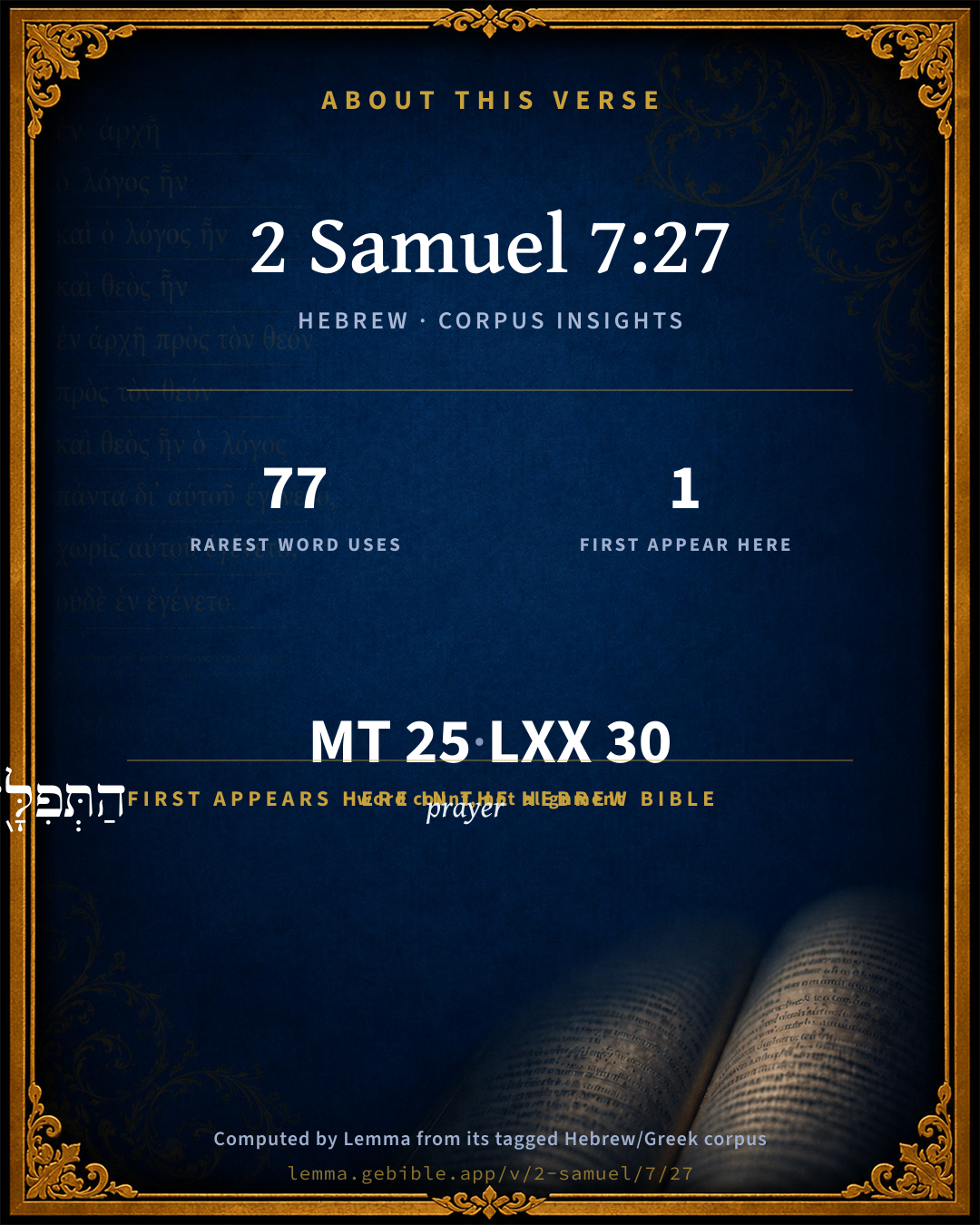
  • 1 first appearance in the Hebrew Bible
Full analysis ↓
Download a study sheet

One document with this verse’s original text, its word-by-word gloss line, the meaning frame, cross-references with their text, attributed commentary, and full source and license credits — printable, and it pastes into notes with its structure intact.

This verse Autodidact and up

Study sheet (.html) Plain text (.txt)

A passage Seminary Student

Up to 50 verses in one chapter. A passage sheet keeps up to 6 commentary sources and 12 cross-references per verse, in the order this page ranks them, and says so on the sheet whenever that leaves anything out. Ask for a single verse and you get the Autodidact verse sheet above.

Everything on this page stays free to read, with no account — the sheet is a download of what is already on screen, not access to it.

Want to remove ads? Support Godless Engineer
Compare translations 3

The same verse in 3 English versions, stacked beneath the original-language interlinear above. Click any original word for its lexicon entry.

Each is an independent rendering of the whole verse — the interlinear is not word-aligned to these translations.

Highlighted words mark where these versions differ — a whole-verse word diff, not a word-by-word alignment.

  • World English Bible Public Domain
    For you, Yahweh of Hosts, the God of Israel, have revealed to your servant, saying, I will build you a house: therefore has your servant found in his heart to pray this prayer to you.
  • King James Version Public Domain
    For thou, O LORD of hosts, God of Israel, hast revealed to thy servant, saying, I will build thee an house: therefore hath thy servant found in his heart to pray this prayer unto thee.
  • unfoldingWord Literal Text CC BY-SA 4.0
    For you, Yahweh of Armies, the God of Israel. You have uncovered the ear of your servant, saying, ‘I will build a house for you.’ Therefore, your servant has found his heart to pray this prayer to you.

unfoldingWord Literal Text — © unfoldingWord, licensed CC BY-SA 4.0. Word-aligned USFM3 via Door43 (git.door43.org/unfoldingWord/en_ult).

Versions to compare (up to 4)

3 of 4 selected

Show all 18 translations

Every available English version of this verse, each an independent rendering of the whole verse.

  • World English Bible Public Domain
    For you, Yahweh of Hosts, the God of Israel, have revealed to your servant, saying, I will build you a house: therefore has your servant found in his heart to pray this prayer to you.
  • Berean Standard Bible Public Domain
    For You, O LORD of Hosts, the God of Israel, have revealed this to Your servant when You said, ‘I will build a house for you.’ Therefore Your servant has found the courage to offer this prayer to You.
  • Majority Standard Bible Public Domain
    For You, O LORD of Hosts, the God of Israel, have revealed this to Your servant when You said, ‘I will build a house for you.’ Therefore Your servant has found the courage to offer this prayer to You.
  • King James Version Public Domain
    For thou, O LORD of hosts, God of Israel, hast revealed to thy servant, saying, I will build thee an house: therefore hath thy servant found in his heart to pray this prayer unto thee.
  • American Standard Version (1901) Public Domain
    For thou, O Jehovah of hosts, the God of Israel, hast revealed to thy servant, saying, I will build thee a house: therefore hath thy servant found in his heart to pray this prayer unto thee.
  • Revised Version (1885) Public Domain
    For thou, O LORD of hosts, the God of Israel, hast revealed to thy servant, saying, I will build thee an house: therefore hath thy servant found in his heart to pray this prayer unto thee.
  • Geneva Bible (1599) Public Domain
    For thou, O Lord of hostes, God of Israel, hast reueiled vnto thy seruant, saying, I will build thee an house: therefore hath thy seruant bene bold to pray this prayer vnto thee.
  • Douay-Rheims (1899) Public Domain
    Because thou, O Lord of hosts, God of Israel, hast revealed to the ear of thy servant, saying: I will build thee a house: therefore hath thy servant found in his heart to pray this prayer to thee.
  • Young's Literal Translation Public Domain
    For Thou, Jehovah of Hosts, God of Israel, Thou hast uncovered the ear of Thy servant, saying, A house I build for thee, therefore hath Thy servant found his heart to pray unto Thee this prayer;
  • Literal Standard Version CC BY-SA 4.0
    for You, YHWH of Hosts, God of Israel, have uncovered the ear of Your servant, saying, I build a house for you, therefore Your servant has found his heart to pray this prayer to You.
  • Unlocked Literal Bible CC BY-SA 4.0
    For you, Yahweh of hosts, the God of Israel, have revealed to your servant that you will build him a house. That is why I, your servant, have found courage to pray to you.
  • unfoldingWord Literal Text CC BY-SA 4.0
    For you, Yahweh of Armies, the God of Israel. You have uncovered the ear of your servant, saying, ‘I will build a house for you.’ Therefore, your servant has found his heart to pray this prayer to you.
  • Darby Bible Public Domain
    For thou, Jehovah of hosts, the God of Israel, hast revealed to thy servant, saying, I will build thee a house; therefore hath thy servant found in his heart to pray this prayer unto thee.
  • World Messianic Bible Public Domain
    For you, LORD of Hosts, the God of Israel, have revealed to your servant, saying, ‘I will build you a house.’ Therefore your servant has found in his heart to pray this prayer to you.
  • Webster's Bible Public Domain
    For thou, O LORD of hosts, God of Israel, hast revealed to thy servant, saying, I will build thee a house: therefore hath thy servant found in his heart to pray this prayer to thee.
  • Free Bible Version CC BY-SA 4.0
    Lord Almighty, God of Israel, you have revealed this to me, your servant, telling me, ‘I will build a house for you.’ That's why your servant has had the courage to pray this prayer to you.
  • Bible in Basic English Public Domain
    For you, O Lord of armies, the God of Israel, have clearly said to your servant, I will make you the head of a family of kings: and so it has come into your servant's heart to make this prayer to you.
  • JPS Tanakh (1917) Public Domain
    For Thou, O LORD of hosts, the God of Israel, hast revealed to Thy servant, saying: I will build thee a house; therefore hath Thy servant taken heart to pray this prayer unto Thee.

Literal Standard Version (2020), Covenant Press — licensed CC BY-SA 4.0. Text via the HelloAO Bible API (eBible.org). Unlocked Literal Bible (unfoldingWord) — licensed CC BY-SA 4.0. Text via the HelloAO Bible API (eBible.org). unfoldingWord Literal Text — © unfoldingWord, licensed CC BY-SA 4.0. Word-aligned USFM3 via Door43 (git.door43.org/unfoldingWord/en_ult). Free Bible Version, Dr. Jonathan Gallagher — licensed CC BY-SA 4.0. Text via the HelloAO Bible API (eBible.org).

Word by word

More ways to search: Search by grammar → Find every occurrence → Compare this word →

Practice this passage: Drill this verse → Learn its vocabulary →

הַתְּפִלָּ֖ה
tᵉphillâh
H8605
“the · prayer”
Particle, Definite Article + Noun, Common, Feminine, Singular, Absolute
Part of Speech
Particle + Noun
Type
Common
Gender
Feminine
Number
Singular
State
Absolute
Full BDB Definition

Origin: from H6419

TWOT: 1776a

prayer - prayer - pray a prayer - house of prayer - hear prayer - in Psalm titles (of poetic or liturgical prayer)
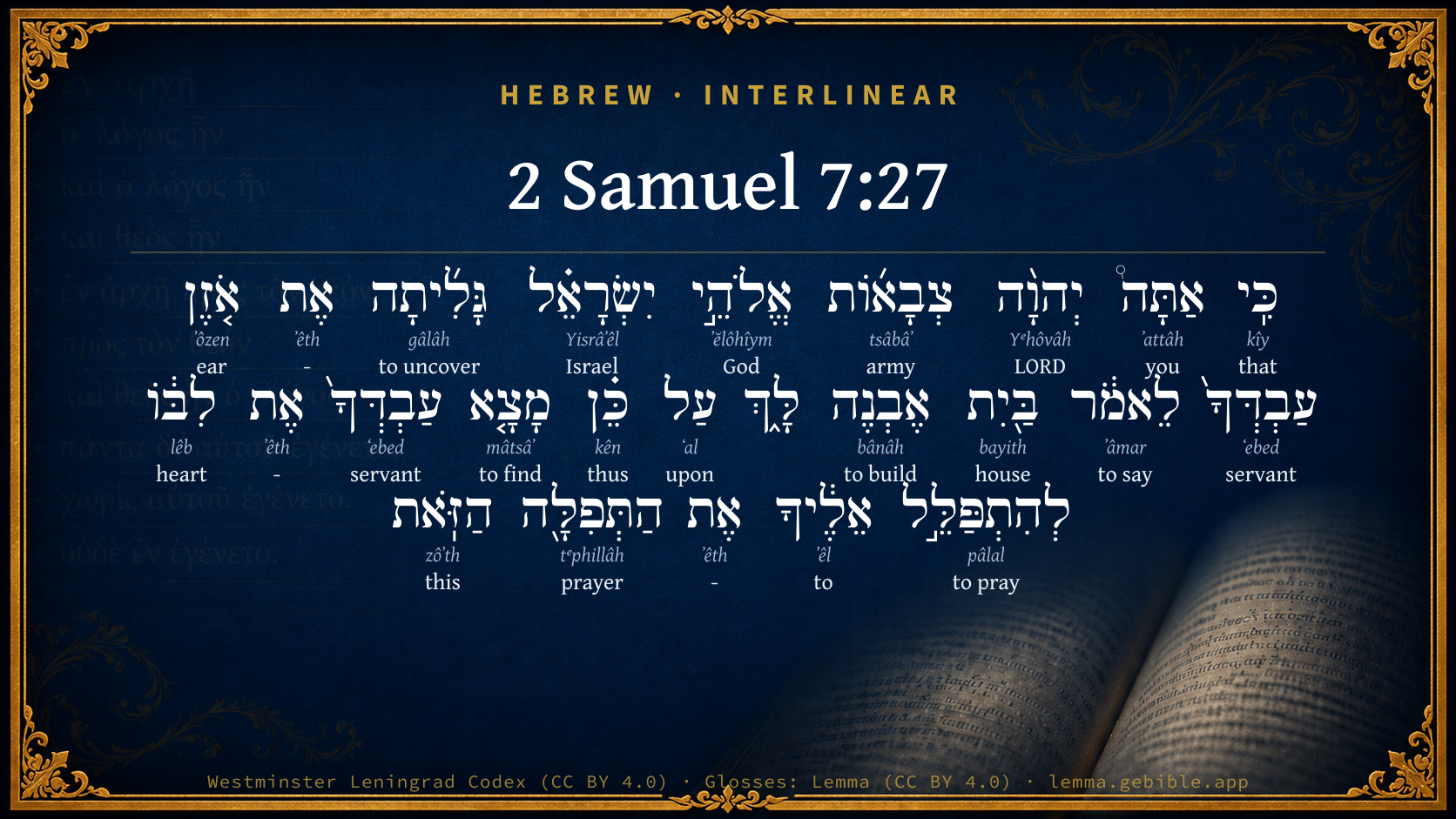
  1. כִּֽי kîy H3588 “that” Conjunction
  2. אַתָּה֩ ʼattâh H859 “you” Pronoun, Personal, 2nd Person, Masculine, Singular
  3. יְהוָ֨ה Yᵉhôvâh H3068 “LORD” Noun, Proper
  4. צְבָא֜וֹת tsâbâʼ H6635 “armies” Noun, Common, Both, Plural, Absolute
  5. אֱלֹהֵ֣י ʼĕlôhîym H430 “God(s) of” Noun, Common, Masculine, Plural, Construct
  6. יִשְׂרָאֵ֗ל Yisrâʼêl H3478 “Israel” Noun, Proper
  7. גָּלִ֜יתָה gâlâh H1540 “to uncover” Verb, Qal, Perfect, 2nd Person, Masculine, Singular
  8. אֶת ʼêth H853 “-” Particle, Direct Object
  9. אֹ֤זֶן ʼôzen H241 “ear of” Noun, Common, Feminine, Singular, Construct
  10. עַבְדְּךָ֙ ʻebed H5650 “servant · your” Noun, Common, Masculine, Singular, Construct + Suffix, Personal, 2nd Person, Masculine, Singular
  11. לֵאמֹ֔ר ʼâmar H559 “to say” Preposition + Verb, Qal, Infinitive Construct
  12. בַּ֖יִת bayith H1004 “house” Noun, Common, Masculine, Singular, Absolute
  13. אֶבְנֶה bânâh H1129 “to build” Verb, Qal, Imperfect, 1st Person, Common, Singular
  14. עַל ʻal H5921 “upon” Preposition
  15. כֵּ֗ן kên H3651 “thus” Particle, Demonstrative
  16. מָצָ֤א mâtsâʼ H4672 “to find” Verb, Qal, Perfect, 3rd Person, Masculine, Singular
  17. עַבְדְּךָ֙ ʻebed H5650 “servant · your” Noun, Common, Masculine, Singular, Construct + Suffix, Personal, 2nd Person, Masculine, Singular
  18. אֶת ʼêth H853 “-” Particle, Direct Object
  19. לִבּ֔וֹ lêb H3820 “heart · his” Noun, Common, Masculine, Singular, Construct + Suffix, Personal, 3rd Person, Masculine, Singular
  20. לְהִתְפַּלֵּ֣ל pâlal H6419 “to pray” Preposition + Verb, Hithpael, Infinitive Construct
  21. אֵלֶ֔יךָ ʼêl H413 “to · you” Preposition + Suffix, Personal, 2nd Person, Masculine, Singular
  22. אֶת ʼêth H853 “-” Particle, Direct Object
  23. הַזֹּֽאת zôʼth H2063 “the · this” Particle, Definite Article + Pronoun, Demonstrative, Feminine, Singular

About this verse

These counts appear in no published source. They are computed here, from the morphology-tagged text and Lemma’s own curated glosses. What Lemma adds →

25
words
21
distinct lemmas
Historical
section

First appearance in Scripture

This word makes its first canonical appearance in the Hebrew Bible here:

  • הַתְּפִלָּ֖ה prayer H8605

Grammatical profile

  • 5 verbs
  • 10 nouns
  • 2 pronouns
  • 3 prepositions
  • 1 conjunction
  • 4 particles

Verb forms

  • גָּלִ֜יתָה Qal · Perfect
  • לֵאמֹ֔ר Qal · Infinitive Construct
  • אֶבְנֶה Qal · Imperfect
  • מָצָ֤א Qal · Perfect
  • לְהִתְפַּלֵּ֣ל Hithpael · Infinitive Construct

Repetition

A word recurs within this verse — often emphatic in Hebrew:

  • עַבְדְּךָ֙ servant H5650 ×2

Hebrew & Septuagint length

In English translation the verse runs 35 words from the Hebrew and 34 from the Septuagint (LXX English) — closely comparable.

A rough comparison of the two English renderings, which tokenize alike — not a word-level alignment.

Word counts can differ between the Hebrew and the Greek without any difference in meaning — e.g. the Hebrew direct-object marker אֵת has no separate Greek word, and Greek often adds the article ὁ.

In the original languages it is 25 Hebrew tokens and 30 Greek tokens — but the two are counted differently (Hebrew bundles its prefixes and suffixes into one token; the Greek is in lemma form), so that isn’t a like-for-like length.

Cross-references

5

Topical passages linked to 2 Samuel 7:27 in the Treasury of Scripture Knowledge — connected by theme and wording, ordered by reader-vote popularity; previews shown in the World English Bible.

  • 1 Chronicles 17:25–26 For you, my God, have revealed to your servant that you will build him a house: therefore has your servant found [in his heart] to pray before you.
  • Psalms 10:17 Yahweh, you have heard the desire of the humble. You will prepare their heart. You will cause your ear to hear,
  • Ruth 4:4 I thought to disclose it to you, saying, Buy it before those who sit here, and before the elders of my people. If you will redeem it, redeem it: but if you will not redeem it, then tell me, that I may know; for there is none to redeem it besides you; and I am after you. He said, I will redeem it.
  • 1 Samuel 9:15 Now Yahweh had revealed to Samuel a day before Saul came, saying,
  • Psalms 40:6 Sacrifice and offering you didn't desire. You have opened my ears: Burnt offering and sin offering you have not required.

Cross-references courtesy of OpenBible.info (CC BY 4.0).

Hebrew and Greek witnesses Masoretic Hebrew ↔ Greek Septuagint

The same verse in the two great witnesses to the Old Testament, shown verse-for-verse.

These are two independent witnesses, not word-aligned to each other, and the Septuagint is shown in lemma (dictionary) form.

Hebrew 2 Samuel 7:27 Masoretic · Westminster Leningrad Codex

כִּֽי אַתָּה֩ יְהוָ֨ה צְבָא֜וֹת אֱלֹהֵ֣י יִשְׂרָאֵ֗ל גָּלִ֜יתָה אֶת אֹ֤זֶן עַבְדְּךָ֙ לֵאמֹ֔ר בַּ֖יִת אֶבְנֶה לָּ֑ךְ עַל כֵּ֗ן מָצָ֤א עַבְדְּךָ֙ אֶת לִבּ֔וֹ לְהִתְפַּלֵּ֣ל אֵלֶ֔יךָ אֶת הַתְּפִלָּ֖ה הַזֹּֽאת

For you, Yahweh of Hosts, the God of Israel, have revealed to your servant, saying, I will build you a house: therefore has your servant found in his heart to pray this prayer to you.

World English Bible · Public Domain

Greek LXX 2 Samuel 7:27 Septuagint · lemma form

κύριος παντοκράτωρ θεός ἰσραήλ ἀποκαλύπτω ὁ ὠτίον ὁ δοῦλος σύ λέγω οἶκος οἰκοδομέω σύ διά οὗτος εὑρίσκω ὁ δοῦλος σύ ὁ καρδία ἑαυτοῦ ὁ προςεὔχομαι πρός σύ ὁ προσευχή οὗτος

Almighty Lord God of Israel, you have uncovered the ear of your servant, saying, I will build you a house: therefore your servant has found in his heart to pray this prayer to you.

LXX2012 (modern English Septuagint) · Public Domain

Hebrew: Westminster Leningrad Codex (CC BY 4.0). Greek: Septuagint (public domain); English from LXX2012 (modern English Septuagint) (Public Domain). How the Septuagint differs from the Hebrew →

Targum (Aramaic paraphrase)

1

The Targum is the ancient Jewish Aramaic paraphrase of the Hebrew Scriptures — an interpretive translation, not the Hebrew text itself. Onkelos (literal) and Pseudo-Jonathan (expansive) render the Torah, and Jonathan the Prophets. Coverage is partial: where no permissively-licensed English translation exists for a verse, only the Aramaic is shown. This is verse-level text, not a word-by-word alignment to the Hebrew.

  1. Targum Jonathan Prophets (Joshua–Malachi)
    אֲרֵי אַתְּ יְיָ צְבָאוֹת אֱלָהָא דְיִשְׂרָאֵל חֲוֵיתָא לְעַבְדָךְ לְמֵימָר מַלְכוּ אֲקַיֵם לָךְ עַל כֵּן הֲוָת בְּלִבָּא דְעַבְדָךְ לְצַלָאָה קֳדָמָךְ יַת צְלוֹתָא הָדֵין:

    (no public-domain English translation for this verse)

    Targum Jonathan — Aramaic: “Mikraot Gedolot” (public domain). English: “Sefaria Community Translation” (CC0 1.0 (public-domain dedication)); “London "Chaldee Paraphrase," 1871” (public domain). Text via Sefaria.

Commentary

Notes on 2 Samuel 7:27 from classic Christian and Jewish commentators (each source and its license shown beneath its notes). The classic Christian expositions comment on the surrounding passage and are grouped to its opening verse, so a note may address several verses; the Jewish commentaries on the Tanakh (Rashi and others) are per-verse, so they appear only where the commentator wrote on this verse.

Lemma curates 59 commentaries, every one of them public domain or Creative Commons licensed, each selected and text-cleaned for this edition rather than reprinted as found. About our sources →

Trapp's Complete Commentary

John Trapp

2Sa 7:27 For thou, O LORD of hosts, God of Israel, hast revealed to thy servant, saying, I will build thee an house: therefore hath thy servant found in his heart to pray this prayer unto thee.

Ver. 27. Therefore hath thy servant found in his heart.] Or, as some read it, and the original will well bear it, Therefore hath thy servant found his heart - viz., thus well-affected, and all the powers of his soul concentred in the making of this prayer unto thee. He light of such a heart by hap, as we say, or upon serious and long seeking of such a heart; for the Hebrew word will bear both.

John Trapp, A Commentary or Exposition upon All the Books of the Old and New Testament (1647–1656) — public domain. Text from a community e-Sword module.

Joseph Benson's Commentary

2Sa 7:27-29. Thy servant found it in his heart to pray this prayer — That prayer which is found in the tongue only will not please God; it must be found in the heart, which must be lifted up to God, and poured out before him. Thou art that God — Who hast declared thyself to be Israel’s God, and in particular my God. And thy words be true — Thus he relies with unshaken faith on the truth of all that God had said, and confidently expects the accomplishment of God’s promises to him. And hence, it seems, these and some other clauses of this prayer are not so much to be considered as petitions, as the overflowings of a grateful heart, touched with a sense of the greatness of these mercies, and therefore dwelling on them, and thereby showing how much it desired them. For after God had promised David these things by a prophet sent to him on purpose, it is hardly to be supposed that he would immediately begin to offer to God petitions for them in any other sense than as expressions of the very high estimation in which he held them. Indeed it is easy to see, as Delaney observes, that “his heart was wholly possessed with a subject which he did not know how to quit, because he did not know how to do justice to his own sense of the inestimable blessings poured down upon himself, and promised to his posterity; and much less to the infinite bounty of his benefactor.” That it may continue for ever before thee — When Christ for ever sat down on the right hand of God, and received all possible assurance that his seed and throne should be as the days of heaven, then this prayer was abundantly answered.

Joseph Benson's Commentary on the Old and New Testaments (1811–1818) — public domain. Text from a community e-Sword module.

Geneva Bible (1599)

Geneva Bible translators

Hebrew, found his heart disposed.

Geneva Bible (1599) marginal notes — public domain. Text via Bolls.life.

Ellicott's Commentary for English Readers

(27) Therefore hath thy servant.—The ground of the believer’s prayer must ever be the lovingkindness and promises of God.

A Bible Commentary for English Readers, edited by Charles John Ellicott (1878–1897) — public domain. Text from a community e-Sword module.

The Cambridge Bible for Schools and Colleges

gen. ed. J. J. S. Perowne

27. hast revealed to thy servant] Lit. hast uncovered the ear of thy servant, a figure of speech said to be derived from the practice of removing the hair or a corner of the turban from another’s ear in order to whisper a secret into it. Cp. 1Sa_9:15.

therefore] The promise justified a prayer which otherwise would have seemed presumptuous.

found in his heart] Lit. found his heart; i.e. found courage. Cp. the phrase “to take heart.”

The Cambridge Bible for Schools and Colleges (gen. ed. J. J. S. Perowne; Cambridge University Press, 1878–1918) — public domain. Text from a community e-Sword module.

John Gill's Exposition

For thou, O Lord of hosts, God of Israel,.... As he is called in Sa2 7:26,

hast revealed to thy servant; which he otherwise could not have known:

saying, I will build thee an house; see Sa2 7:11,

therefore hath thy servant found in his heart to pray this prayer unto thee; found his heart disposed to this service, or found freedom and boldness in him to put up this prayer to God; what encouraged and emboldened him to do it was the gracious promise of God, that he would build up his family, and establish his kingdom; or otherwise he could not have taken such liberty, and used such boldness with God in prayer, as to have requested it of him.

John Gill's Exposition of the Whole Bible (1746–1763) — public domain (CC PDM 1.0). Text via the HelloAO Bible API.

Albert Barnes' Notes on the Bible

Therefore hath thy servant found in his heart ... - The promises of God are the true guide to the prayers of His people. We may dare to ask anything, how great soever it may be, which God has promised to give. In this and the two following verses David expresses the same wonder at the riches of God’s grace, and the same expectation founded on that grace, which Paul does. in such passages as Eph 1:5-7; Eph 2:7, etc. marginal references.

Albert Barnes' Notes on the Bible (1834–1885) — public domain. Text from a community e-Sword/MySword module.

Haydock's Catholic Bible Commentary

In his heart. Literally, "has found his heart," (Haydock) following the inspirations of divine grace, to pray with attention and love, (Calmet) and confidence. (Haydock)

George Leo Haydock (1774–1849), Haydock's Catholic Family Bible and Commentary, 1859 edition — public domain. Excludes Psalms (Douay-Rheims chapter numbering differs from Protestant) and Deuterocanonical books (Catholic canon only).

Matthew Poole's English Annotations

Because thy promise hath given me encouragement to pray, and assurance of answer.

Found in his heart, or, found his heart, i.e. taken courage; as a man is said to lose his heart when he wants courage.

Matthew Poole's English Annotations on the Holy Bible (1683–1685) — public domain. Text from a community e-Sword/MySword module.

The Pulpit Commentary

Thou hast revealed to thy servant; Hebrew, thou hast uncovered the ear of thy servant. (see note on 1Sa_9:15) Hath thy servant found in his heart; Hebrew, hath found his heart. The word "heart" has a wide meaning in Hebrew, embracing both our intellectual and our moral powers. Here it simply means "courage," as in, 1Sa_17:32. The Revised Version puts this in the margin: "Therefore hath thyservant been bold to pray this prayer.

Ver. 27. (ZION.)

A prayer found in the heart.

When a prayer such as David"s is found in the heart, it is:

1. Found in the right place. If only on the tongue it is not really found at all Its proper abode is the heart; yet it is not always found there, even when renewed, as the heart must be for its dwelling.

2. Possessed of priceless worth; in contrast with other things that are often found in the heart. (Mat_15:19) A rare flower among weeds, a fountain in the desert, a treasure in poverty, a friend in need! "I have no earthly friend," said one; "but I have a praying heart.

3. Derived from a Divine source. It is not indigenous. Its orion is in "the Father of lights," from whom comes "every good gift and every perfect boon;" its production is due to the teaching of his Word and the operation of his Spirit. (Zec_12:10)

4. Destined for a proper use. Not to be neglected, repressed, or restrained; (Job_15:4) but appreciated, guarded, cherished, freely and fully "poured out" at the feet of the Giver, that he may be glorified. D.

Prayer induced and encouraged by promise.

David gives the promise of God to him as a reason for praying that his house might be established forever. He intimates that otherwise he would not have found it in his heart to do so. In like manner, the promises of God to Christians incite and encourage them to pray for bestowments that they would not have otherwise ventured to ask for.

I THE GREATNESS OF GOD"S PROMISES. They set before us blessings so precious, vast, and enduring, that, apart from the declarations of God, we should never have dared to think of them as possible for us, or to pray for them. From the goodness and power of God in general we might have ventured to hope and pray for some blessings, hut not such as are now the common subjects of Christian prayer. Look in this view at some of the Divine promises, or declarations which are equivalent to promises.

1. As to the believer himself. Promises as to:

(1) Pardon of great and numerous sins, long practised. Repeated pardons.

(2) Renewal of nature and character. Deliverance from slavery to sins the most natural, the most habitual. "A new heart," etc.

(3) Adoption into the family of God. The Spirit of adoption. Participation of the Divine nature. Free access to God. Fellowship with him.

(4) Victory over the mightiest enemies.

(5) "Grace sufficient" for all circumstances, and highest good from them.

(6) Fulness of spiritual life, of knowledge, holiness, strength, joy. "Filled unto the fulness of God;" "Filled with the Spirit" The indwelling in the heart of Christ, of God, by the Holy Spirit. Truly there are heights of godliness, goodness, and blessedness attainable in this life, to which most of us are strangers.

(7) Heaven. Seeing God face to face; being with Christ, being like him in body, soul, condition; reigning with him as kings; experiencing "fulness of joy, pleasures forevermore." Let any one examine the statements of Holy Scripture on these subjects, and consider what they mean; and he must perceive that they set forth blessings which, apart from the assurances thus given, men could not have conceived of, much less imagined that they could ever be their own.

2. As to the future of the kingdom of God on earth. The attraction of all men to Christ; the universal spread of the knowledge, worship, and service of God; and consequently of peace, union, and brotherhood; obedience on earth to God"s will as it is obeyed in heaven. In opposition to such a prospect is the whole history and experience of the world, with the exception of a small fraction; the depravity of mankind, the power of error, superstition, idolatry, priestcraft, old habits of wickedness, etc. Such a vision could never have appeared to men; or, if it had occurred to an active imagination, could never have been regarded as a matter for serious prayer and endeavour, if God had not given it by his prophets and by his Son.

II THE EFFECT WHICH THESE PROMISES SHOULD HAVE ON OUR PRAYERS. They should:

1. Impel us to pray. Not lead us to neglect prayer, as if the Divine purpose and promise superseded all need for prayer. "Thus saith the Lord God: I will yet for this be inquired of by the house of Israel, to do it for them". (Eze_36:37) The blessings promised are for these who seek them.

1. Enrich and enlarge our prayers. The measure in which we receive is according to the measure in which we desire and ask (Luk_11:5-13; 2Ki_13:18, 2Ki_13:19)

2. Greatly encourage them. Leading us to pray with confidence and importunity. Petitions that would have been presumptuous without the promises are now sober and reasonable. We need not and ought not to be deterred either by:

(1) Our sinfulness and God"s holiness and threatenings.

(2) Our insignificance and God"s majesty.

(3) The greatness of the blessings promised, and our or incapacity to receive them; the difficulties in the way of the fulfilment of the

(4) the difficulties in the way of the fulfilment of the promises.

Sufficient that they are the promises of God, and he

(1) "Jehovah of hosts," having all things under his control, unchanging and eternal and;

(2) "God of Israel," our God, our covenant God, who has taken us to be his, and given himself to be ours in Christ Jesus. All that he has promised appears only to befit such a sublime relationship. (See further in homily on ver. 25.) G.W.

The Pulpit Commentary (1880–1919), ed. H.D.M. Spence-Jones & Joseph S. Exell — public domain. Text from a community e-Sword module.

John Wesley's Explanatory Notes

This prayer, &c. - That prayer that is found in the tongue only will not please God. It must be found in the heart. That must be lifted up and poured out before God.

John Wesley, Explanatory Notes Upon the Whole Bible (1754–1765) — public domain. Text via the GEBible commentary corpus.

unfoldingWord translationNotes

Door43 World Missions Community

to your servant that you will build him a house

David refers to himself as "your servant." AT: "to me that you will build me a house" (See: First, Second, or Third Person)

that you will build him a house

Here the metonym "house" refers to David's ancestors continuing on as the rulers of Israel. In 2 Samuel 7:4 Yahweh asked David if he would be the one to build a house for Yahweh. There "house" represented a temple. If your language has a word that can express both ideas, use it here and in 2Sa 7:4. (See: Metonymy)

Now

This does not mean "at this moment," but is used to draw attention to the important point that follows.

your words are trustworthy

"I trust what you say"

with your blessing your servant's house will be blessed forever

This can be stated in active form. AT: "you will continue to bless my family forever" (See: Active or Passive)

your servant's house

Here David refers to himself as "your servant." AT: "my house" or "my family" (See: First, Second, or Third Person)

house

Here "house" represents David's family. (See: Metonymy)

translationWords

Yahweh of hosts

God

Israel

reveal

servant

house

courage

pray

word of God

trust

promise

bless

unfoldingWord translationNotes — © Distant Shores Media and the Door43 World Missions Community, licensed CC BY-SA 4.0. Source: git.door43.org/Door43/en_tn.

Lesson kit

Teaching starters — assembled from the data on this page, not authored interpretation. Every prompt links to the verse data it draws on. Edit before teaching.

2 Samuel, in the Historical, opens this verse with 25 words (21 distinct Hebrew lemmas). Its most distinctive word is tᵉphillâh (“prayer”). A historical commentator’s framing appears above. Read the whole chapter for the surrounding context.

Discussion questions

  1. The word tᵉphillâh carries the sense “prayer.” How does it shape the verse?
  2. This is the first place “prayer” appears in Scripture (first appears here). What does its debut here establish?
  3. How does 1 Chronicles 17:25–26, which shares this passage’s theme, read alongside this verse?
  4. What does the repetition of “servant” (2× in this one verse) do in this verse?
  5. These translations render this verse differently. What is at stake in choosing one wording over another?
  6. «גָּלִ֜יתָה» is a Qal Perfect verb. How does that grammatical form shape the action described?
  7. Compare how Trapp's Complete Commentary and Joseph Benson's Commentary read this verse. Where do they agree or differ?

Things to notice

Reading settings

Reading text

Shown beneath each verse's original-language words.

Old Testament
Old Testament edition

Read the OT as the Masoretic Hebrew (MT) or the Greek Septuagint (LXX).

English shown for the Greek Septuagint (in the Hebrew ↔ Greek comparison).

Comparing translations? Open the Compare panel on any verse page to stack up to four side by side.