1 Peter 1:7

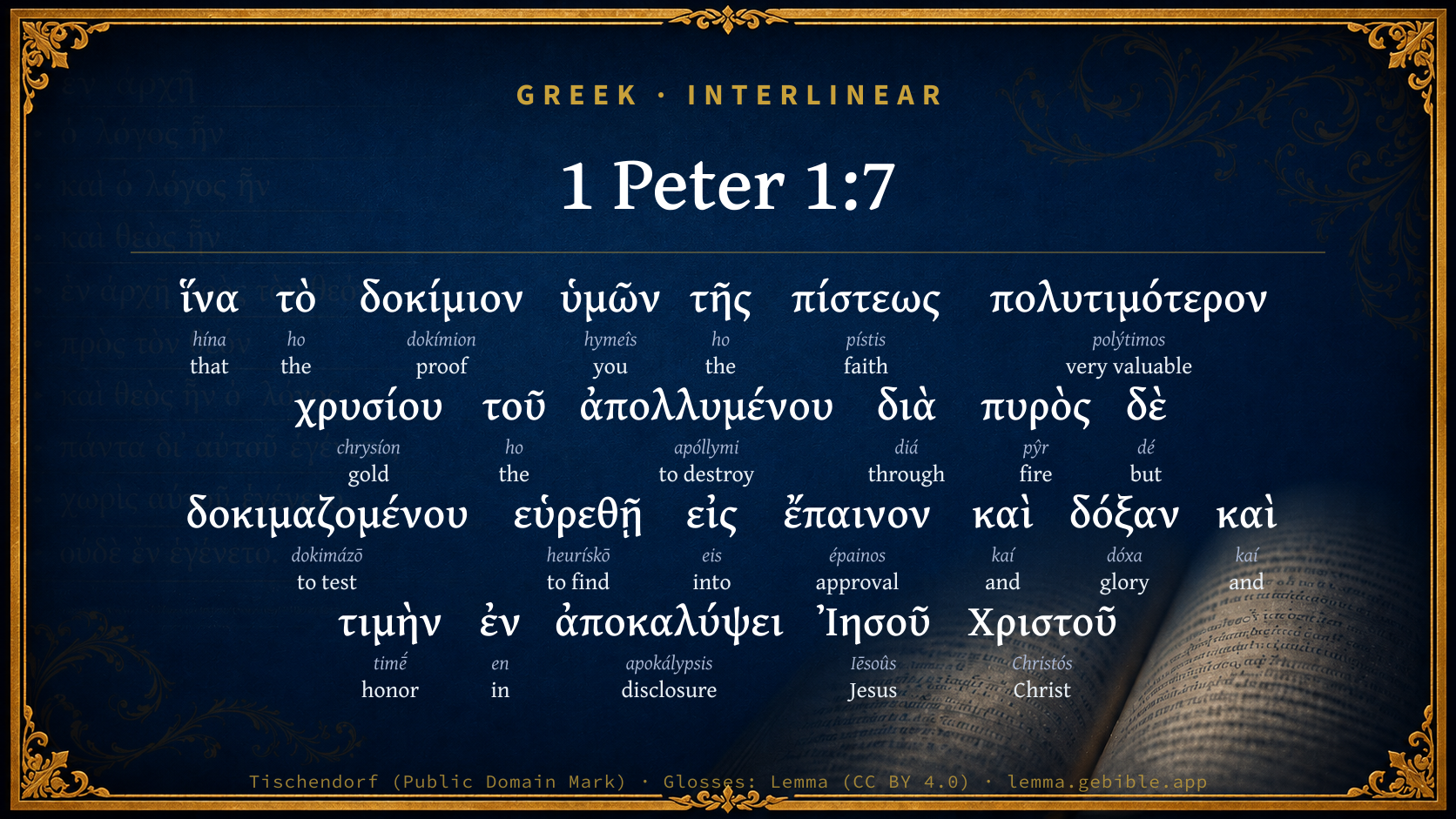
Greek (Tischendorf 8th ed.) 1 Peter 1:7 appears in the Greek New Testament. The text above is from the Tischendorf 8th edition. Each word links to its Strong’s number and a concise gloss. Click any word for its full Thayer’s Greek Lexicon entry.
Download image
Cite this verse

1 Peter 1:7 (World English Bible). Public Domain. Lemma interlinear Bible study tool, https://lemma.gebible.app/v/1-peter/1/7.

Show BibTeX & RIS
BibTeX
RIS
English Translation
that the proof of your faith, which is more precious than gold that perishes even though it is tested by fire, may be found to result in praise, glory, and honor at the revelation of Jesus Christ--
World English Bible · Public Domain
Download a study sheet

One document with this verse’s original text, its word-by-word gloss line, the meaning frame, cross-references with their text, attributed commentary, and full source and license credits — printable, and it pastes into notes with its structure intact.

This verse Autodidact and up

Study sheet (.html) Plain text (.txt)

A passage Seminary Student

Up to 50 verses in one chapter. A passage sheet keeps up to 6 commentary sources and 12 cross-references per verse, in the order this page ranks them, and says so on the sheet whenever that leaves anything out. Ask for a single verse and you get the Autodidact verse sheet above.

Everything on this page stays free to read, with no account — the sheet is a download of what is already on screen, not access to it.

Want to remove ads? Support Godless Engineer
Compare translations 3

The same verse in 3 English versions, stacked beneath the original-language interlinear above. Click any original word for its lexicon entry.

Each is an independent rendering of the whole verse — the interlinear is not word-aligned to these translations.

Highlighted words mark where these versions differ — a whole-verse word diff, not a word-by-word alignment.

  • World English Bible Public Domain
    that the proof of your faith, which is more precious than gold that perishes even though it is tested by fire, may be found to result in praise, glory, and honor at the revelation of Jesus Christ--
  • King James Version Public Domain
    That the trial of your faith, being much more precious than of gold that perisheth, though it be tried with fire, might be found unto praise and honour and glory at the appearing of Jesus Christ:
  • unfoldingWord Literal Text CC BY-SA 4.0
    so that the genuineness of your faith—more precious than perishing gold, but being tested by fire—might be found to result in praise and glory and honor at the revelation of Jesus Christ,

unfoldingWord Literal Text — © unfoldingWord, licensed CC BY-SA 4.0. Word-aligned USFM3 via Door43 (git.door43.org/unfoldingWord/en_ult).

Versions to compare (up to 4)

3 of 4 selected

Show all 19 translations

Every available English version of this verse, each an independent rendering of the whole verse.

  • World English Bible Public Domain
    that the proof of your faith, which is more precious than gold that perishes even though it is tested by fire, may be found to result in praise, glory, and honor at the revelation of Jesus Christ--
  • Berean Standard Bible Public Domain
    so that the proven character of your faith—more precious than gold, which perishes even though refined by fire—may result in praise, glory, and honor at the revelation of Jesus Christ.
  • Majority Standard Bible Public Domain
    so that the proven character of your faith—more precious than gold, which perishes even though refined by fire—may result in praise, honor, and glory at the revelation of Jesus Christ.
  • King James Version Public Domain
    That the trial of your faith, being much more precious than of gold that perisheth, though it be tried with fire, might be found unto praise and honour and glory at the appearing of Jesus Christ:
  • American Standard Version (1901) Public Domain
    that the proof of your faith, `being' more precious than gold that perisheth though it is proved by fire, may be found unto praise and glory and honor at the revelation of Jesus Christ:
  • Revised Version (1885) Public Domain
    that the proof of your faith, being more precious than gold that perisheth though it is proved by fire, might be found unto praise and glory and honour at the revelation of Jesus Christ:
  • Geneva Bible (1599) Public Domain
    That the triall of your faith, being much more precious then golde that perisheth (though it be tried with fire) might bee founde vnto your praise, and honour and glorie at the appearing of Iesus Christ:
  • Douay-Rheims (1899) Public Domain
    That the trial of your faith (much more precious than gold which is tried by the fire) may be found unto praise and glory and honour at the appearing of Jesus Christ:
  • Young's Literal Translation Public Domain
    that the proof of your faith -- much more precious than of gold that is perishing, and through fire being approved -- may be found to praise, and honour, and glory, in the revelation of Jesus Christ,
  • Literal Standard Version CC BY-SA 4.0
    so that the proof of your faith—much more precious than gold that is perishing, and being approved through fire—may be found to [result in] praise, and honor, and glory, at the revelation of Jesus Christ,
  • Unlocked Literal Bible CC BY-SA 4.0
    This is for the proving of your faith, which is more precious than gold that perishes, even though it is tested by fire. This happens so that your faith will be found to result in praise, glory, and honor at the revealing of Jesus Christ.
  • unfoldingWord Literal Text CC BY-SA 4.0
    so that the genuineness of your faith—more precious than perishing gold, but being tested by fire—might be found to result in praise and glory and honor at the revelation of Jesus Christ,
  • Darby Bible Public Domain
    that the proving of your faith, much more precious than of gold which perishes, though it be proved by fire, be found to praise and glory and honour in [the] revelation of Jesus Christ:
  • World Messianic Bible Public Domain
    that the proof of your faith, which is more precious than gold that perishes, even though it is tested by fire, may be found to result in praise, glory, and honor at the revelation of Yeshua the Messiah—
  • Webster's Bible Public Domain
    That the trial of your faith, being much more precious than of gold that perisheth, though tried with fire, might be found to praise, and honor, and glory, at the appearing of Jesus Christ:
  • Free Bible Version CC BY-SA 4.0
    These prove that your trust in God is genuine, just as fire is used to prove if gold is genuine—even though that too can be destroyed—and your faith is more valuable than gold! In this way your trust in God will be recognized and you will receive praise, glory, and honor when Jesus Christ appears.
  • Bible in Basic English Public Domain
    So that the true metal of your faith, being of much greater value than gold (which, though it comes to an end, is tested by fire), may come to light in praise and glory and honour, at the revelation of Jesus Christ:
  • Text-Critical English NT CC BY 4.0
    so that the proven character of your faith—far more precious than gold that perishes even though it is tested by fire—may result in praise, honor, and glory when Jesus Christ is revealed.
  • Tyndale New Testament (1534) Public Domain
    that youre fayth once tried beinge moche more precious then golde that perissheth (though it be tried with fyre) myght be founde vnto lawde glory and honoure at the apperinge of Iesus Christ:

Literal Standard Version (2020), Covenant Press — licensed CC BY-SA 4.0. Text via the HelloAO Bible API (eBible.org). Unlocked Literal Bible (unfoldingWord) — licensed CC BY-SA 4.0. Text via the HelloAO Bible API (eBible.org). unfoldingWord Literal Text — © unfoldingWord, licensed CC BY-SA 4.0. Word-aligned USFM3 via Door43 (git.door43.org/unfoldingWord/en_ult). Free Bible Version, Dr. Jonathan Gallagher — licensed CC BY-SA 4.0. Text via the HelloAO Bible API (eBible.org).

Word by word

More ways to search: Search by grammar → Find every occurrence → Compare this word →

Practice this passage: Drill this verse → Learn its vocabulary →

δοκίμιον
dokímion
G1383
“proof”
Noun, Nominative, Singular, Neuter
Part of Speech
Noun
Case
Nominative
Number
Singular
Gender
Neuter
Full Thayer's Definition

Origin: a presumed derivative of G1382

TDNT: 06:15,2

1. the proving 2. that by which something is tried or proved, a test
  1. ἵνα hína G2443 “that” Conjunction
  2. τὸ ho G3588 “the” Article, Nominative, Singular, Neuter
  3. ὑμῶν hymeîs G5210 “you” Personal pronoun, 2nd person, Genitive, Plural
  4. τῆς ho G3588 “the” Article, Genitive, Singular, Feminine
  5. πίστεως pístis G4102 “faith” Noun, Genitive, Singular, Feminine
  6. πολυτιμότερον polýtimos G4186 “very valuable” Adjective, Nominative, Singular, Neuter, Comparative
  7. χρυσίου chrysíon G5553 “gold” Noun, Genitive, Singular, Neuter
  8. τοῦ ho G3588 “the” Article, Genitive, Singular, Neuter
  9. ἀπολλυμένου apóllymi G622 “to destroy” Verb, Present, Middle, Participle, Genitive, Singular, Neuter
  10. διὰ diá G1223 “through” Preposition
  11. πυρὸς pŷr G4442 “fire” Noun, Genitive, Singular, Neuter
  12. δὲ dé G1161 “but” Conjunction
  13. δοκιμαζομένου dokimázō G1381 “to test” Verb, Present, Passive, Participle, Genitive, Singular, Neuter
  14. εὑρεθῇ heurískō G2147 “to find” Verb, Aorist, Passive, Subjunctive, 3rd person, Singular
  15. εἰς eis G1519 “into” Preposition
  16. ἔπαινον épainos G1868 “approval” Noun, Accusative, Singular, Masculine
  17. καὶ kaí G2532 “and” Conjunction
  18. δόξαν dóxa G1391 “glory” Noun, Accusative, Singular, Feminine
  19. καὶ kaí G2532 “and” Conjunction
  20. τιμὴν timḗ G5092 “honor” Noun, Accusative, Singular, Feminine
  21. ἐν en G1722 “in” Preposition
  22. ἀποκαλύψει apokálypsis G602 “disclosure” Noun, Dative, Singular, Feminine
  23. Ἰησοῦ Iēsoûs G2424 “Jesus” Noun, Genitive, Singular, Masculine
  24. Χριστοῦ Christós G5547 “Christ” Noun, Genitive, Singular, Masculine

About this verse

These counts appear in no published source. They are computed here, from the morphology-tagged text and Lemma’s own curated glosses. What Lemma adds →

25
words
22
distinct lemmas
General Epistles
section

Notable vocabulary

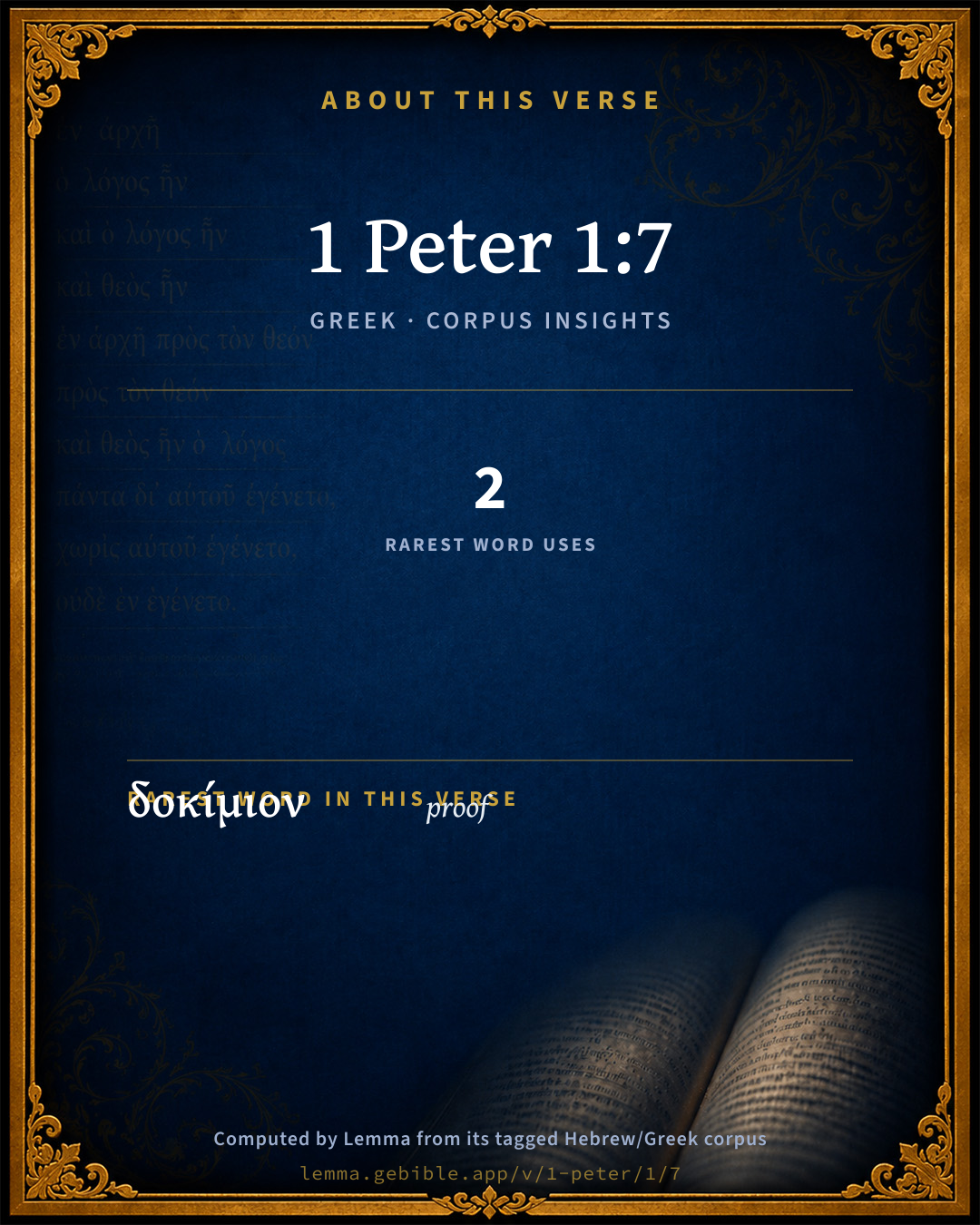
The rarest word here is δοκίμιον proof G1383 — appearing just 2 times in the whole Greek New Testament.

Shared distinctive vocabulary

δοκίμιον proof G1383 occurs in 2 verses of the Greek New Testament. Also found in:

Repetition

Words recur within this verse:

Cross-references

42

Topical passages linked to 1 Peter 1:7 in the Treasury of Scripture Knowledge — connected by theme and wording, ordered by reader-vote popularity; previews shown in the World English Bible.

  • Job 23:10 But he knows the way that I take. When he has tried me, I shall come forth like gold.
  • James 1:12 Blessed is the man who endures temptation, for when he has been approved, he will receive the crown of life, which the Lord promised to those who love him.
  • Isaiah 48:10 Behold, I have refined you, but not as silver; I have chosen you in the furnace of affliction.
  • 1 Peter 4:12 Beloved, don't be astonished at the fiery trial which has come upon you, to test you, as though a strange thing happened to you.
  • James 1:3–4 knowing that the testing of your faith produces endurance.
  • Zechariah 13:9 I will bring the third part into the fire, And will refine them as silver is refined, And will test them like gold is tested. They will call on my name, and I will hear them. I will say, 'It is my people;' And they will say, 'Yahweh is my God.'"
  • Proverbs 17:3 The refining pot is for silver, and the furnace for gold, But Yahweh tests the hearts.
  • Romans 2:7 to those who by patience in well-doing seek for glory and honor and incorruptibility, eternal life;
  • Romans 5:3–4 Not only this, but we also rejoice in our sufferings, knowing that suffering works perseverance;
  • Malachi 3:3 and he will sit as a refiner and purifier of silver, and he will purify the sons of Levi, and refine them as gold and silver; and they shall offer to Yahweh offerings in righteousness.
  • 1 Corinthians 3:13 each man's work will be revealed. For the Day will declare it, because it is revealed in fire; and the fire itself will test what sort of work each man's work is.
  • Psalms 66:10–12 For you, God, have tested us. You have refined us, as silver is refined.
  • Jude 1:24 Now to him who is able to keep them from stumbling, and to present you faultless before the presence of his glory in great joy,
  • Jeremiah 9:7 Therefore thus says Yahweh of Hosts, Behold, I will melt them, and try them; for how [else] should I do, because of the daughter of my people?
  • 2 Thessalonians 1:7–12 and to give relief to you that are afflicted with us, when the Lord Jesus is revealed from heaven with his mighty angels in flaming fire,
  • 2 Peter 1:4 by which he has granted to us his precious and exceedingly great promises; that through these you may become partakers of the divine nature, having escaped from the corruption that is in the world by lust.
  • Matthew 25:21 "His lord said to him, 'Well done, good and faithful servant. You have been faithful over a few things, I will set you over many things. Enter into the joy of your lord.'
  • 1 Peter 2:4 coming to him, a living stone, rejected indeed by men, but chosen by God, precious.
  • 1 Samuel 2:30 Therefore Yahweh, the God of Israel, says, I said indeed that your house, and the house of your father, should walk before me forever: but now Yahweh says, Be it far from me; for those who honor me I will honor, and those who despise me shall be lightly esteemed.
  • Proverbs 8:19 My fruit is better than gold, yes, than fine gold; My yield than choice silver.
  • Proverbs 16:16 How much better it is to get wisdom than gold! Yes, to get understanding is to be chosen rather than silver.
  • Ecclesiastes 5:14 Those riches perish by misfortune, and if he has fathered a son, there is nothing in his hand.
  • Jeremiah 48:36 Therefore my heart sounds for Moab like pipes, and my heart sounds like pipes for the men of Kir Heres: therefore the abundance that he has gotten is perished.
  • Matthew 25:23 "His lord said to him, 'Well done, good and faithful servant. You have been faithful over a few things, I will set you over many things. Enter into the joy of your lord.'
  • Luke 12:33 Sell that which you have, and give gifts to the needy. Make for yourselves purses which don't grow old, a treasure in the heavens that doesn't fail, where no thief approaches, neither moth destroys.
  • John 5:44 How can you believe, who receive glory from one another, and you don't seek the glory that comes from the only God?
  • John 12:26 If anyone serves me, let him follow me. Where I am, there will my servant also be. If anyone serves me, the Father will honor him.
  • 1 Corinthians 4:5 Therefore judge nothing before the time, until the Lord comes, who will both bring to light the hidden things of darkness, and reveal the counsels of the hearts. Then each man will get his praise from God.
  • 2 Peter 3:10–12 But the day of the Lord will come as a thief in the night; in which the heavens will pass away with a great noise, and the elements will be dissolved with fervent heat, and the earth and the works that are in it will be burned up.
  • Revelation 1:7 Behold, he is coming with the clouds, and every eye will see him, including those who pierced him. All the tribes of the earth will mourn over him. Even so, Amen.
  • Revelation 2:10 Don't be afraid of the things which you are about to suffer. Behold, the devil is about to throw some of you into prison, that you may be tested; and you will have oppression for ten days. Be faithful to death, and I will give you the crown of life.
  • Revelation 18:16–17 saying, 'Woe, woe, the great city, she who was dressed in fine linen, purple, and scarlet, and decked with gold and precious stones and pearls!
  • Matthew 19:28 Jesus said to them, "Most assuredly I tell you that you who have followed me, in the regeneration when the Son of Man will sit on the throne of his glory, you also will sit on twelve thrones, judging the twelve tribes of Israel.
  • Revelation 3:10 Because you kept my command to endure, I also will keep you from the hour of testing, which is to come on the whole world, to test those who dwell on the earth.
  • Revelation 3:18 I counsel you to buy from me gold refined by fire, that you may become rich; and white garments, that you may clothe yourself, and that the shame of your nakedness may not be revealed; and eye salve to anoint your eyes, that you may see.
  • 1 Peter 2:7 For you therefore who believe is the honor, but for such as are disobedient, "The stone which the builders rejected, Has become the chief cornerstone,"
  • 2 Peter 1:1 Simon Peter, a servant and apostle of Jesus Christ, to those who have obtained a like precious faith with us in the righteousness of our God and Savior, Jesus Christ:
  • Proverbs 3:13–15 Happy is the man who finds wisdom, The man who gets understanding.
  • Luke 12:20–21 "But God said to him, 'You foolish one, tonight your soul is required of you. The things which you have prepared--whose will they be?'
  • Acts 8:20 But Peter said to him, "May your silver perish with you, because you thought you could obtain the gift of God with money!
  • James 5:2–3 Your riches are corrupted and your garments are moth-eaten.
  • 1 Peter 1:5 who by the power of God are guarded through faith for a salvation ready to be revealed in the last time.

Cross-references courtesy of OpenBible.info (CC BY 4.0).

Commentary

Notes on 1 Peter 1:7 from classic Christian and Jewish commentators (each source and its license shown beneath its notes). The classic Christian expositions comment on the surrounding passage and are grouped to its opening verse, so a note may address several verses; the Jewish commentaries on the Tanakh (Rashi and others) are per-verse, so they appear only where the commentator wrote on this verse.

Lemma curates 59 commentaries, every one of them public domain or Creative Commons licensed, each selected and text-cleaned for this edition rather than reprinted as found. About our sources →

Matthew Poole's English Annotations

That the trial of your faith; i.e. your faith when tried. He compares the faith of the saints with gold, and argues from the less to the greater: q.d. If men do so far esteem their gold, that they will make the excellency and preciousness of it appear by trying it in the fire, which purgeth away the dross, and discovers the goodness of the metal; no wonder if God will have the faith of the saints (more precious to him than gold is to men) tried by afflictions, that the excellency of it may more fully be discovered.

Being much more precious than of gold; i.e. than the trial of gold; or gold tried, compared with faith tried.

That perisheth; is worn away, and consumed by use, as many particles of it likewise may be in the very trial of it, 1Pe 1:18; whereas faith is not consumed nor wasted, but increased by being used, and made more conspicuous by being tried.

Might be found unto praise and honour and glory; i.e. may be found to be, or to have turned, to praise, &c., the dignity of it being by that means evidenced. These several words show whither present trials tend, and in what they issue; they may be reproachful and ignominious now, Heb 12:2, but they end in glory. We need not be critical about the difference of these three words, praise, honour, and glory, which may be synonymous expressions (by way of amplification) of the same thing, yet they are mentioned distinctly with relation to believers elsewhere; praise, 1Co 4:5, honour, 1Sa 2:30; Joh 12:26, glory, as well as honour, Rom 2:10.

At the appearing of Jesus Christ; i.e. at the day of judgment, frequently so called, as 1Pe 1:13; 5:4; Col 3:4; 2Th 1:7. Christ’s glory is at present hid and obscured, while he is instructing his elect, and training them up unto patience, and defers his judging of his enemies; but at last it will be fully manifested in the face of the world, when he cometh with clouds, and every eye shall see him, &c., Rev 1:7.

Matthew Poole's English Annotations on the Holy Bible (1683–1685) — public domain. Text from a community e-Sword/MySword module.

MacLaren's Expositions of Holy Scripture

Alexander MacLaren

1 Peter

THE TRUE GOLD AND ITS TESTING

1Pe 1:7

The Apostle is fond of that word ‘precious.’ In both his letters he uses it as an epithet for diverse things. According to one translation, he speaks of Christ as ‘precious to you which believe.’ He certainly speaks of ‘the precious blood of Christ,’ and of ‘exceeding great and precious promises,’ and here in my text, as well as in the Second Epistle, he speaks about ‘precious faith.’ It is a very wide general term, not expressing anything very characteristic beyond the one notion of value. But in the text, according to our Authorised Version, it looks at first sight as if it were not the faith, but the trial of the faith that the Apostle regards as thus valuable. There are difficulties of rendering which I need not trouble you with. Suffice it to say that, speaking roughly and popularly, the ‘trial of your faith’ here seems to mean rather the result of that trial, and might be fairly represented by the slightly varied expression, ‘your faith having been tried, might be found,’ etc.

I must not be tempted to discourse about the reasons why such a rendering seems to express the Apostle’s meaning more fully, but, taking it for granted, there are just three things to notice--the true wealth, the testing of the wealth, and the discovery at last of the preciousness of the wealth.

I. Peter pits against each other faith that has been tried, and ‘gold that perisheth’; he puts away all the other points of comparison and picks out one, and that is that the one lasts and the other does not.

Now I must not be seduced into going beyond the limits of my text to dilate upon the other points of contrast and pre-eminence; but I would just notice in a sentence that everybody admits, yet next to nobody acts upon, the admission that inward good is far more valuable than outward good. ‘Wisdom is more precious than rubies,’ say people, and yet they will choose the rubies, and take no trouble to get the wisdom. Now the very same principles of estimating value which set cultivated understandings and noble hearts above great possessions and large balances at the bankers, set the life of faith high above all others. And the one thought which Peter wishes to drive into our heads and hearts is that there is only one kind of wealth that will never be separated from its possessor. Nothing is truly ours that remains outside of us.

‘‘Twas mine, ‘tis his, and has been slave to thousands.’

Nothing that is there whilst I am here is really mine. I do not own it if it is possible that I shall lose it. And so with profound meaning our Lord speaks about ‘that which is another’s’ in comparison with ‘that which is your own.’ It is another’s because it passes, like quicksilver under pressure, from hand to hand, and no man really holds it, but it leaps away from his grasp. And if a man retains it all his days, still, according to the grim old proverb, ‘shrouds have no pockets,’ and when he dies his hands open, or sometimes they clutch together, but there is nothing inside the palms, and they only close upon themselves. Dear brethren, if there is anything that can be filched away from us, anything about which it is true that, on the one hand, ‘moth and rust’--natural processes--’do corrupt’ it, on the other hand, ‘thieves break through and steal’--accidents of human conduct can deprive us of it, then we may call it ours, but it is not ours. It possesses us, if we are devoted to it as our best good, and fighting and toiling, and sometimes lying and cheating, and flinging the whole fierce energy of our nature into first gripping and then holding it; it possesses us; we do not possess it. But if there is anything that can become so interwoven and interlaced with the very fibres of a man’s heart that they and it cannot be parted, if there is anything that empty hands will clasp the closer, because they are emptied of earth’s vanities, then that is truly possessed by its possessor. And our faith, which will not be trodden in the grave, but will go with us into the world beyond, and though it be lost in one aspect, in sight, it will be eternal as trust, will be ours, imperishable as ourselves, and as God. Therefore, do not give all the energy of your lives to amassing the second-best riches. Seek the highest things most. ‘Covet earnestly the best gifts,’ and let the coveting regulate your conduct. And do not be put off with wealth that will fail you sooner or later.

II. Note, again, the testing of the wealth.

I need not dwell upon that very familiar metaphor of the furnace for gold, and the fining-pot for silver, only remember that there are two purposes for which metallurgists apply fire to metals. The one is to test them, and the other is to cleanse them, or, to use technical words, one is for the purpose of assaying them, and the other is for the purpose of refining them. And so, linking the words of my text with the words of the previous verse, we find that the Apostle lays it down that the purpose of all the diverse trials, or ‘temptations’ as he calls them, that come to us, is this one thing, that our faith should be ‘tried,’ and ‘found, unto praise and honour and glory.’ The fire carries away the dross; it makes the pure metal glow in its lustre. It burns up the ‘wood, hay, stubble’; it makes the gold gleam and the precious stones coruscate and flash.

And so note this general notion here of the intention of all life’s various aspects being to test character is specialised into this, that it is meant to test faith, first of all. Of course it is meant to test many other things. A man’s whole character is tested by the experiences of his daily life, all that is good and all that is evil in him, and we might speak about the effect of life’s discipline upon a great many different sides of our nature. But here the whole stress is put upon the effect of life in testing and clarifying and strengthening one part of a Christian’s character, and that is his faith. Why does Peter pick out faith? Why does he not say ‘trial of your hope,’ of your ‘love,’ of your ‘courage,’ of half a dozen other graces? Why ‘the trial of your faith?’ For this reason, because as the man’s faith is, so is the man. Because faith is the tap-root, in the view of the New Testament, of all that is good and strong and noble in humanity. Because if you strengthen a man’s trust you strengthen everything that comes from it. Reinforce the centre and all is reinforced. Your faith is the vital point from which your whole life as Christians is developed, and whatever strengthens that strengthens you. And, therefore, although everything that befalls you calls for the exercise of, and therefore tests, and therefore, rightly undergone, strengthens a great many various virtues and powers and beauties in a human character, the main good of it all is that it deepens, if the man is right, his simple trust in God manifested by his trust in and love to Jesus Christ: and so it reinforces the faith which works by love, and thus tends to make all things in life good and fair.

Now if thus the main end of life is to strengthen faith, let us remember that we have to give a wider meaning to the word ‘trials’ than ‘afflictions.’ Ah! there is as sharp a trial of my faith in prosperity as in any adversity. People say, ‘It is easy to trust God when things are going well with us.’ That is quite true. But it is a great deal easier to stop trusting God, or thinking about Him, when things are going well with us, and we do not seem to need Him so much, as in the hours of darkness. You remember the old story about the traveller, when the sun and the wind tried which could make him take off his cloak; and the sun did it. Some of us, I daresay, have found out that the faith which gripped God when we felt we needed Him, because we had not anything else but Him, is but too apt to lose hold of Him when fleeting delights and apparent treasures come and whisper invitations in our hearts. There are diseases that are proper to the northern, dark, ice-bound regions of the earth. Yes! and there are a great many more that belong to the tropics; as there is such a thing as sunstroke, which is, perhaps, as dangerous as the cramping cold from the icebergs of the north. Some of us should understand what that Scripture means: ‘Because they have no changes, therefore they fear not God.’ Prosperity, untroubled lives, lives even as the lives of those of the majority of mankind now, have their own most searching trials of faith.

But on the other hand, if there are ‘ships that have gone down at sea, when heaven was all tranquillity,’ there come also dark and nights of wild tempest when we have to lay to and ride out the gale with a tremendous strain on the cable. Our sorrows, our disappointments, our petty annoyances, and the great irrevocable griefs that sooner or later darken the very earth, are all to be classified under this same purpose, ‘that the trial of your faith ... might be found unto praise and honour and glory.’ And so, I beseech you, open your eyes to the meaning of life, and do not suppose that you have found the last word to say about it when you say ‘I am afflicted,’ or ‘I am at ease.’ The affliction and the ease, like two wheels in some great machine working in opposite directions, fit with their cogs into one another and move something beyond them in one uniform direction. And affliction and ease cooperate to this end, that we might be partakers of His holiness.

I believe experience teaches the most of us, if we will lay its lessons to heart, that the times when Christian people grow most in the divine life is in their times of sorrow. One of the old divines says, ‘Grace grows best in winter’; and there are edible plants which need a touch of frost before they are good to eat. So it is with our faith. Only let us take care that the fire does not burn it up, as ‘wood, hay, stubble,’ but irradiates it and glorifies it, as ‘gold, silver, and precious stones.’

III. Now a word, lastly, about the ultimate discovery.

‘Might be found unto praise and honour and glory.’ Note these three words, which I think are often neglected, and sometimes misunderstood--’praise, honour, glory.’ Whose? People sometimes say ‘God’s,’ since His people’s ultimate salvation redounds to His praise; but it is much better to understand the praise as given to the Christians whose faith has stood the testing fires. ‘Well done, good and faithful servant’--is not that praise from lips, praise from which is praise indeed? As Paul says, ‘then shall every man have praise of God.’ We are far too much afraid of recognising the fact that Jesus Christ in Heaven, like Jesus Christ on earth, will praise the deeds that come from love to Him, though the deeds themselves may be very imperfect. Do you remember ‘She hath wrought a good work on Me,’ said about a woman that had done a perfectly useless thing, which was open to a great many very shrewd objections? But Jesus Christ accepted it. Why? Because it was the pure utterance of a loving heart. And, depend upon it, though we have to say ‘Unclean! unclean! We are unprofitable servants,’ He will say ‘Come! ye blessed of My Father.’ Praise from Christ is praise indeed.

‘Honour.’ That suggests bystanders, a public opinion, if I may so say; it suggests ‘have thou authority over ten cities,’ and that men will have their deeds round them as a halo, in that other world. As ‘praise’ suggests the redeemed man’s relation to his Lord, so ‘honour’ suggests the redeemed man’s relation to the fellow-citizens of the New Jerusalem. ‘Glory’ speaks of the man himself as transfigured and lifted up into the light and lustre of communion with, and conformity to, the image of the Lord. ‘Then shall we appear with Him in glory. Then shall the righteous blaze forth like the sun in My heavenly Father’s Kingdom.’

‘Shall be found.’ Ah! there will be many surprises yonder. Do you remember that profound revelation of our Master when He represents those on whom He lavishes His eulogies as the Judge, as turning to Him and saying, ‘Lord! when saw we Thee in ... prison and visited thee?’ They do not recognise themselves or their acts in Christ’s account of them. They have found that their lives were diviner than they knew. There will be surprises there. As one of the prophets represents the ransomed Israel, to her amazement, surrounded by clinging troops of children, and asking, ‘These! Where have they been? I was left alone,’ so many a poor, humble soul, fighting along in this world, having no recognition on earth, and the lowliest estimate of all its own actions, will be astonished at the last when it receives ‘praise, and honour, and glory, at the appearing of Jesus Christ.’

Alexander MacLaren, Expositions of Holy Scripture (1904–1910) — public domain. Text from a community e-Sword module.

Scofield Reference Notes

C. I. Scofield

might

Suffering, in First Peter, is set in the light of:

(1) assured salvation, 1Pe 1:2-5.

(2) the greater glory at Christ’s appearing, 1Pe 1:7;

(3) Christ’s sufferings and coming glories, 1Pe 1:11

(4) the believer’s association with Him in both, 1Pe 2:20; 1Pe 2:21; 1Pe 3:17; 1Pe 3:18 1Pe 4:12; 1Pe 4:13.

(5) the purifying effect of suffering, 1Pe 1:7; 1Pe 4:1; 1Pe 4:2; 1Pe 5:10.

(6) that Christ is now glorified in the believer’s patient suffering, 1Pe 4:16.

(7) that suffering is disciplinary, 1Pe 4:17-19; 1Co 11:31; 1Co 11:32; Heb 12:5-13.

The Scofield Reference Bible (1917 edition), notes by C. I. Scofield — public domain. Text from a community e-Sword module.

Tyndale Open Study Notes

Tyndale Open Resources

1:7 will show that your faith is genuine: Faith, like gold, is purified as it is tested. • The NLT understands praise and glory and honor as being given by God to the faithful Christian. The phrase could also mean that a faithful Christian life brings praise and glory and honor to God.

Tyndale Open Study Notes — © Tyndale Open Resources, licensed CC BY-SA 4.0. Text via the HelloAO Bible API.

Bengel's Gnomon

Johann Albrecht Bengel

1Pe 1:7. Δοκίμιον, the trial) That is, your faith, which is thus tried; for it is compared with gold.—πολυτιμότερον, much more precious) The epithet belongs to the subject.—τοῦ ἀπολλυμένου, which perisheth) Gold perishes with the world, 1Pe 1:18; nor will it then profit any one. The same participle occurs, Joh 6:27.—δὲ, but[7]) Faith is compared with gold, not with reference to the perishing of gold, but with reference to its being tried by fire.—εὑρεθῇ, may be found) For it does not now appear; but it will appear when other things shall perish.—ἔπαινον, praise) in words.—τιμὴν, honour) in deeds.—δόξαν, glory) in the award bestowed at the judgment.—ἀποκαλύψει, at the revelation) 1Pe 1:13.

[7] The δέ is held a good reading in the judgment of Ed. 2, rather than according to the larger Ed., although it is not given in the Germ. Vers.

ABC Rec. Text have διὰ πυρὸς δὲ δοκιμαζομένου. Vulg. Omits ἀπολλυμένον, and therefore also δέ. Orig. has καὶ διὰ κυρὸς δεδοκιμαομένου.—E.

Bengel's Gnomon of the New Testament — English translation (T&T Clark, Edinburgh, 1860) — public domain. Text from a community e-Sword module.

Meyer's Critical & Exegetical Commentary

Heinrich August Wilhelm Meyer

1Pe_1:7. ἵνα] states the aim of the λυπηθῆναι ἐν … πειρασμοῖς, in order to console the readers with respect to it, that the approvedness of your faith may be found more precious than (that) of gold, which perisheth, yet it is tried by fire, to (your) praise, and glory, and honour at the revelation of Jesus Christ.

δοκίμιον here, as in Jam_1:3 (cf. in loco), equal to δοκιμή, the approvedness as the result of the trial (Rom_5:3-4; 2Co_2:9; 2Co_9:13; Php_2:22).[64] The strict signification medium of proof is inappropriate, inasmuch as the aim of the λυπηθῆναι ἐν πειρασμοῖς cannot be stated as the glorification of these ΠΕΙΡΑΣΜΟΊ, but as only that of faith in its approvedness (in opposition to Steinmeyer). Unsuitable, too, is the interpretation trial (Brückner, Wiesinger), ΤῸ ΔΟΚΊΜΙΟΝ Τῆς ΠΊΣΤΕΩς being taken for Ἡ ΠΊΣΤΙς ΔΟΚΙΜΑΖΟΜΈΝΗ, inasmuch as it is not the trial of the faith, but the faith being tried that is to be compared with the gold. This substitution of ideas is not justifiable, inasmuch as the process applied to an object cannot be put for the object itself to which it is applied. Only if δοκίμιον denote a quality of faith, can a substitution of this kind take place. δοκίμιον must be taken as: approvedness, and by approvedness of faith, the approved, or rather the faith approving itself.[65]

[64] δοκιμή in the N. T. has either an active or a passive signification; in the former it means: the trial which leads to approvedness, as in 2Co_8:2; in the latter: the approvedness effected by trial, as in the passages quoted; or better still: a distinction must be drawn between a present and a perfect force, in that δοκιμή has a reflexive sense, either, then, the having approved itself, or the approving itself, Cremer, s.v.

[65] Brückner raises the following objections to this interpretation:(1) That δοκίμιον can linguistically only be understood as: means of proof, trial; and (2) That the part, pres., standing in opposition to χρυσίου (δοκιμαζομένου), does not presuppose the purification of the gold to have already taken place, and that, consequently, the πίστις δοκιμαζομένη only can be considered as compared with χρυσίον δοκιμαζόμενον. But against this it must be observed that δοκίμιον has only the signification of means of proof, not of trial; and (3) That in the above interpretation it is not the already approved faith, but that faith which is being approved, or approving itself in tribulation, which is contrasted with gold which is being tried.

REMARK.

What Schott had formerly alleged with respect to δοκίμιον is repeated by Hofmann, only by him it is carried further. By an highly artificial interpretation of Psa_11:7, LXX., and by the application of the rule established by him, that the neuter of the adjective does not stand in the place of an abstract attributive, but expresses the condition of something as a concrete reality, and in conjunction with a genitive denotes the object thereby named in this its condition, Hofmann makes out that it is here affirmed that at the revelation of Christ it will be found that the faith of the readers has been subjected to purification, and is in consequence free from dross. This whole interpretation is a pure matter of fancy, for δοκίμιονa circumstance which both Schott and Hofmann have left unnoticedis not an adjective, but a real substantive; for δοκιμεῖον.

Cremer explains: δοκ. is not the touchstone only, in and for itself, but the trace left behind on it by the metal; therefore τὸ δοκ. τῆς πίστεως is that which results from the contact of πίστις with πειρασμοῖς, that by which faith is recognised as genuine, equal to the proof of faith. But in opposition to this it must be remarked that fire and not touchstone is here conceived as the means of testing.

πολυτιμότερον κ.τ.λ.] is by most interpreters closely connected with εὑρεθῇ, by others again (Wolf, Pott, Steinmeyer, Wiesinger, Hofmann) separated from it, and considered as in apposition to τὸ δοκίμιον ὑμ. τ. πιστ. The following facts, however, are decisive against the latter construction: (1) Thatas Wiesinger admitsthis appositional clause expresses something understood of itself. (2) That the intention here is not to make an observation on faith, but to state what is the design of sorrow, namely, that the faith which is approving itself may be found to be one πολύτιμος. (3) That thus εὑρεθῇ would be deprived of any nearer definition, in that the subsequent εἰς has reference not to εὑρεθῇ alone, but to the whole idea expressed. Yet it cannot well dispense with a nearer definition (in opposition to Hofmann).

The genitive χρυσίου is, as almost all the interpreters take it, to be joined in sense directly with the comparative: than the gold, so that the δοκίμιον of the faith is compared with the gold. Some commentators, like Beza, Grotius, Vorstius, Steinmeyer, Hofmann, assume an ellipsis (cf. Winer, p. 230 [E. T. 307]), supplying before χρυσίου the words ἢ τὸ δοκίμιον. In opposition it may be urged, however, not precisely that this is cumbrous (Brückner), but that the point of comparison is not properly the approval of faith, but the faith in the act of approving itself. Whilst comparing the faith with the gold, the apostle places the former above the latter; the reason of this he states in the attribute τοῦ ἀπολλυμένου connected with χρυσίου, by which reference is made to the imperishable nature of faith. To this first attribute he subjoins the second: διὰ πυρὸς δὲ δοκιμαζομένου, in order to name here also the medium of proving, to which the πειρασμοί, with respect to faith, correspond. Accordingly Wiesinger and Steinmeyer are wrong in asserting that in the interpretation here given the attribute τοῦ ἀπολλυμένου is inappropriate.

ἀπολλύμενος: φθαρτός, cf. 1Pe_1:18; 1Pe_1:23; also Joh_6:27. For the position of the adjective with art. after an anarthrous subst., see Winer, p. 131 f. [E. T. 174].

διὰ πυρὸς δὲ δοκιμαζομένου] The particle δέ seems to place this second adjunct in antithesis to the first (ἀπολλυμένου) (thus de Wette: which is perishable, and yet is proved by fire; so also Hofmann). But opposed to this view is the circumstance that the trial and purification of what is perishable is by no means anything to occasion surprise; it is therefore more correct to find the purpose of the adjunct in this, that by it the idea of the δοκιμάζεσθαι is brought prominently forward. Vorstius remarks to the point: aurum igni committitur non ad iteritum, sed ad gloriam, sic fides cruci ad gloriam subjicitur.

For this comparison, see Job_23:10; Pro_17:3; Zec_13:9.

εὑρεθῇ εἰς ἔπαινον καὶ δόξαν καὶ τιμήν] The verb εὑρεθῆναι, to be found to be, is more significant than εἶναι (cf. Winer, p. 572 f. [E. T. 769 f.]), and has reference to the judicial investigation on the last day of judgment. The words following form an adjunct to the whole preceding thought: ἵνα … εὑρεθῇ. Beza rightly: hic agitur de ipsorum electorum laude, etc.; thus: to your praise, glory, and honour. Schott quite arbitrarily interprets ἔπαινος as in itself: the judicial recognition (as opposed to this, cf. Php_1:11; Php_4:8); τιμή: the moral estimation of the person arising therefrom (as opposed to this, cf. 1Pe_3:7), and δόξα: the form of glory (as opposed to this, cf. Gal_1:5; Php_1:11). Steinmeyer incorrectly applies the words not to the persons, but to their faith. δόξα and τιμή in the N. T. stand frequently together; in connection with ἔπαινος, here only. The juxtaposition of these synonymous expressions serves to give prominence to the one idea of honourable recognition common to them all. Standing as δίξα does between ἔπαινος and τιμή, it cannot signify: the allotment of the possession of glory (Wiesinger), but it is: glory, praise.

ἐν ἀποκαλύψει Ἰησοῦ Χριστοῦ] not: through, but: at, the revelation of Jesus Christ, that is, on the day of His return, which is at once the ἀποκάλυψις δικαιοκρισίας τοῦ Θεοῦ (Rom_2:5) and the ἀποκάλυψις τῶν υἱῶν τοῦ Θεοῦ (Rom_8:19).

Meyer — Critical and Exegetical Commentary on the New Testament — English translation by Peter Christie, edited by Frederick Crombie (T&T Clark, 1880) — public domain. Text from a community e-Sword module.

Expositor's Greek Testament

ed. W. Robertson Nicoll

1Pe 1:7 . τὸ δοκίμιον . The evidence of the papyri (Deissmann, Bible Studies , pp. 259 ff.) shows that δοκίμιος is a bye form of the adjective δόκιμος approved ; so Psa 12:7 , ἀργύριον πεπυρωμένον δοκίμιον ( cf. 1 Chron. 39:4; Zec 11:3 , where it occurs as v.l. for δόκιμον ). Hence the phrase (here and in Jas 1:3 ?) corresponds exactly to St. Paul’s τὸ τῆς ὑμετέρας ἀγάπης γνήσιον “the genuineness of your faith or “the approvedness”). So Arethas on Rev 9:4 , οἱ δὲ τὸ δοκίμιον ἑαυτῶν διὰ πυρὸς παρεχόμενοι . The substantive δ . = “means of trial, testing” which does not suit this context, or a specimen of metal to be tested. πολυτιμότερον , to justify the common rendering (A.V., R.V.) according to which π . κ . τ . λ . are taken as in apposition to τὸ δοκ ., ὄν , must be supplied as if omitted by haplography after πολ . But there is no need for emendation, if πολ . be taken as predicate thrown forward for the sake of emphasis. χρυσοῦ κ . τ . λ . St. Peter adapts the familiar comparison of man’s suffering to the fining-pot of precious metal, insisting on the superiority of the spiritual to the material gold. The stress lies on διὰ πυρός . True faith is tested by trials, just as gold is proved by fire. It is more valuable than gold which is perishable. If men test gold thus, much more will God test faith which outlives the present age, cf. Heb 9:23 . Cf. use of πύρωσις , 1Pe 4:12 . For the image, Zec 13:9 , δοκιμῶ αὐτοὺς ὡς δοκιμάζεται τὸ χρυσίον ; Psa 66:10 ; Pro 17:3 ; Sir 2:5 , etc. Τοῦ ἀπολλυμένου , cf. Joh 6:27 , τὴν βρῶσιν τὴν ἀπ . (contrasted with imperishable food; here gold generally is contrasted with faith) and φθαρτοῖς ἀργυρίῳ καὶ χροσίῳ below. εὑρεθῇ , cf. 2Pe 3:14 , σπουδάσατε ἄσπιλοι καὶ ἀμώμητοι αὐτῷ εὑρεθῆναι ἐν εἰρήνῃ ; Psa 17:3 , ἐδοκίμασας τὴν καρδίαν μου … καὶ οὐχ εὑρέθη ἐν ἐμοὶ ἀδικία . εἰς ἔπαινον … must be taken with the whole sentence, unless ὂν be supplied. So εἰς might introduce the predicate (better stronger) of εὑρ ., cf. Rom 7:10 . εἰς taken as = ל expressing transition into a new state or condition (as Rom 7:10 ). ἔπαινον is the verdict. “Well done good and faithful servant; enter thou into the joy of thy Lord.” The Christian is the true Jew and receives at last the praise which the name Judah signifies. In Rom 2:29 , ὁ ἐν τῷ κρυπτῷ Ἰουδαῖος … οὗ ὁ ἔπαινος οὐκ ἐξ ἀνθρωπων ᾀλλʼ ἐκ τοῦ θεοῦ , Paul follows the alteration of the original ἐξομολόγησις (Gen 29:35 , LXX, and Philo) consequent upon the transference of the praise ( תודה ) from God to men ( cf. Gen 49:8 , Ἰούδα σε αἰνέσαισαν οἱ ἀδελφοί σου ). The old Israel set their hope on praise from the congregation ( Sir 39:10 ) or glory from men, Joh 5:44 ; Joh 12:42 f. The new Israel looked for praise from God to balance the dispraise of men (Mat 5:11 f.); so St. Peter adds ἐπ . to the usual formula δόξαν καὶ τιμήν , Rom 2:7 ; Rom 2:10 (Psa 8:6 ) δόξῃ καὶ τιμῄ ἐστεφάνωσας ἄνθρωπον , cf. σκεῦος εἰς τιμήν , Rom 9:21 , for the less obvious word. Hort compares Marcus Aurelius 12:11, μὴ ποιεῖν ἅλλο ἢ ὅπερ μέλλει ὁ θεὸς ἐπαινεῖν . ἐν ἀποκαλύψει Ιυ . Χυ ., when Jesus Christ is revealed . The expression is derived from the saying κατὰ τὰ αὐτὰ ἔσται ᾗ ἡμέρᾳ ὁ υἱὸς τοῦ ἀνθρώπου ἀποκαλύπτεται (Luk 17:30 ). As Judge He will pronounce the verdict of approval and bestow glory and honour. The reference to present glorified joy in the midst of trial suggests that the writer has advanced beyond the simple belief in a final theophany and contemplates a spiritual revelation of Jesus Christ as each Christian ( cf. Gal 1:16 ) realises the meaning of His Resurrection; but cf. μὴ ὁρῶντες below.

1Pe 1:7 . The Christians addressed were not personal disciples of Jesus but converts of the Apostles (12). As such they could claim Beatitude μακάριοι οἱ μὴ ἰδόντες καὶ πιστεύσαντες (Joh 20:29 ). Their love began and continues without sight of Him; even now when they expect His coming they must still believe without seeing Him and exult. The Latin version of Augustine, gives three distinct clauses referring to the past, the present and the future climax whom you knew not; in whom now not seeing ye believe; whom when you see you will exult . But for lack of support it must be set aside in favour of the Greek text (which regards present as leading up to future culmination without a break) as being a redaction of the passage for separate use. εἰς ὃν , with πιστεύοντες , μὴ ὁρῶντες being parenthesis added to explain force of πιστ . (Heb 11:1 ; Rom 8:24 ). χαρᾷ ἀνεκλαλήτῳ καὶ δεδοξασμένῃ . Their faith enables them to pass beyond their present sufferings to the joy which belongs to the subsequent glories. Thus their joy being heavenly is unspeakable and glorified . Language cannot express the communion with God which the Christian like St. Paul may enjoy (2Co 12:3 f.); compare Rom 8:26 , αὐτὸ τὸ πνεῦμα ὑπερεντυγχάνει στεναγμοῖς ἀλαλήτοις . And this joy is glorified because it is an earnest of the glory which shall be revealed; cf. 1Pe 4:14 .

The Expositor's Greek Testament, edited by W. Robertson Nicoll (1897–1910) — public domain. Text from a community e-Sword module.

Cambridge Greek Testament for Schools and Colleges

7. τὸ δοκίμιον. It is commonly stated that τὸ δοκίμιον must be a substantive and is equivalent to δοκιμεῖον = a means of testing. It certainly has that meaning in Pro 27:21, δοκίμιον ἀργυρίῳ καὶ χρυσῷ πύρωσις = fire is the test for silver and gold, from which passage St Peter probably borrows the word πύρωσις in 1Pe 4:12.

In Jas 1:3, from which St Peter is probably borrowing, the meaning process of testing would give a good sense, but in St Peter the meaning required is the approved character which is the result of testing. Dr Hort therefore prefers the reading given in four cursive MSS. 25, 56, 69, 110, τὸ δόκιμον (neuter adjective) = the approved element or genuineness of your faith—as opposed to spurious faith which proves to be dross. For such a construction cf. 2Co 8:8, τὸ τῆς ὑμετέρας ἀγάπης γνήσιον. But Deissmann, Bible Studies, pp. 259–262, shews that in the Fayyûm Papyrus documents δοκίμιος or δοκιμεῖος occurs several times as an adjective applied to gold and was a recognized variant for δόκιμος (cf. ἐλευθέριος for ἐλεύθερος, καθάριος for καθαρός). He would therefore regard δοκίμιον as an adjective in Psa 12:6, τὰ λόγια κυρίου λόγια ἅγνα ἀργύριον πεπυρωμένον δοκίμιον τῇ γῇ κεκαθαρισμένον ἑπταπλασίως = “the words of the Lord are pure words, genuine silver, purified by fire, seven times refined, for the land.” So in 1Ch 29:4, Zec 11:13, some MSS. of the LXX. read δοκιμίου, δοκίμιον or δοκίμειον for δοκίμου and δόκιμον.

Arethas on Rev 9:4 (Cramer Cat. p. 315) probably uses οἱ δὲ τὸ δοκίμιον ἑαυτῶν διὰ πυρὸς παρεχόμενοι to mean those who prove their genuineness. So Oecumenius interprets τὸ δοκίμιον as meaning τὸ κεκριμένον, τὸ δεδοκιμασμένον, τὸ καθαρόν. Probably therefore both in St Peter and in St James τὸ δοκίμιον is a neuter adjective and means proved genuineness. In this case the passage in St James is more closely allied to Rom 5:4, but whereas St Paul regards patient endurance as productive of approved genuineness (δοκιμή), St James reverses the process and regards faith already tested and proved genuine as a ground for future endurance.

χρυσίου τοῦ ἀπολλυμένου, i.e. gold, a property of which it is to perish. The meaning may be either: Gold, despite its perishable character, is not destroyed but only purified by the fire, so a fortiori your faith will survive and will only he purified by trials; or, If it is worth while to employ trial by fire to test a perishable substance like gold, a fortiori such a process may be employed to arrive at a far more valuable result, viz. to prove the purity of your faith. Therefore suffering is not a strange chance but part of God’s loving purpose (cf. 1Pe 4:12).

εὑρεθῇ may be taken with εἰς ἔπαινον = result in praise, etc., or better with πολυτιμότερον. The purity of your faith discovered by this trial by fire is a far more valuable discovery than that of the purity of refined gold. The discovery is made by God as the refiner.

ἔπαινον δόξαν τιμήν might refer either to men or to God, that those who emerge from the trial will receive praise, glory and honour from God, or that the approved character of His children will redound to God’s own glory. Possibly both ideas are included, for God is always glorified when men attain His loving purpose.

ἐν ἀποκαλύψει Ἰησοῦ Χριστοῦ (objective genitive). The phrase is certainly sometimes used of the final revelation of Christ at the Second Advent (cf. 1Co 1:7; 2Th 1:7; and (?) Rev 1:1).

The absence of the article does not preclude the meaning “the revelation of Jesus Christ,” because where the noun in the genitive is anarthrous the noun which governs it frequently becomes anarthrous also, e.g. θελήματι θεοῦ, 1Pe 4:2, but to τὸ θέλημα τοῦ θεοῦ, 1Pe 3:17; cf. διʼ ἀναστάσεως Ἰ. X., 1Pe 1:3; πρὸ καταβολῆς κόσμου, 1Pe 1:20.

But that final revelation is only the climax of a long series of progressive revelations whenever Christ is revealed to or in any of His members (cf. 2Co 12:1; Gal 1:12; Gal 1:16; and (?) Rev 1:1), and this thought is not excluded here though it culminates in the final revelation. So there are many “comings of the Son of Man” in various crises of history but all lead up to His final Coming.

Cambridge Greek Testament for Schools and Colleges (Cambridge University Press, 1896; 21 vols, various authors incl. Carr, Maclear, Plummer, Farrar, Lumby, Moule, M. R. James, Simcox) — public domain. Text from a community e-Sword module.

Geneva Bible (1599)

Geneva Bible translators

He speaketh of the second coming of Christ.

Geneva Bible (1599) marginal notes — public domain. Text via Bolls.life.

Jamieson, Fausset & Brown

Robert Jamieson, A. R. Fausset & David Brown

Aim of the "temptations."

trial--testing, proving. That your faith so proved "may be found (aorist; once for all, as the result of its being proved on the judgment-day) unto (eventuating in) praise," &c., namely, the praise to be bestowed by the Judge.

than that of gold--rather, "than gold."

though--"which perisheth, YET is tried with fire." If gold, though perishing (Pe1 1:18), is yet tried with fire in order to remove dross and test its genuineness, how much more does your faith, which shall never perish, need to pass through a fiery trial to remove whatever is defective, and to test its genuineness and full value?

glory--"Honor" is not so strong as "glory." As "praise" is in words, so "honor" is in deeds: honorary reward.

appearing--Translate as in Pe1 1:13, "revelation." At Christ's revelation shall take place also the revelation of the sons of God (Rom 8:19, "manifestation," Greek, "revelation"; Jo1 3:2, Greek, "manifested . . . manifested," for "appear . . . appear").

Jamieson, Fausset & Brown — Commentary Critical and Explanatory on the Whole Bible (1871) — public domain (CC PDM 1.0). Text via the HelloAO Bible API.

Adam Clarke's Commentary

Verse 7. That the trial of your faith, being much more precious than of gold] As by the action of fire gold is separated from all alloy and heterogeneous mixtures, and is proved to be gold by its enduring the action of the fire without losing any thing of its nature, weight, colour, or any other property, so genuine faith is proved by adversities, especially such as the primitive Christians were obliged to pass through. For the word was then, "Renounce Jesus and live," "Cleave to him and die;" for every Christian was in continual danger of losing his life. He then who preferred Christianity to his life gave full proof, not only of his own sincerity, but also of the excellency of the principle by which he was influenced; as his religion put him in possession of greater blessings, and more solid comforts, than any thing the earth could afford.

Though it be tried with fire] That is: Though gold will bear the action of the fire for any given time, even millions of years, were they possible, without losing the smallest particle of weight or value, yet even gold, in process of time, will wear away by continual use; and the earth, and all its works, will be burnt up by that supernatural fire whose action nothing can resist. But on that day the faith of Christ's followers will be found brighter, and more glorious. The earth, and universal nature, shall be dissolved; but he who doeth the will of God shall abide for ever, and his faith shall then be found to the praise of God's grace, the honour of Christ, and the glory or glorification of his own soul throughout eternity. God himself will praise such faith, angels and men will hold it in honour, and Christ will crown it with glory. For some remarks on the nature and properties of gold see at the end of the chapter.

Adam Clarke's Commentary on the Bible (1810–1826) — public domain. Text from a community e-Sword/MySword module.

John Calvin's Commentaries

7. Much more precious than of gold The argument is from the less to the greater; for if gold, a corruptible metal, is deemed of so much value that we prove it by fire, that it may become really valuable, what wonder is it that God should require a similar trial as to faith, since faith is deemed by him so excellent? And though the words seem to have a different meaning, he yet compares faith to gold, and makes it more precious than gold, that hence he might draw the conclusion, that it ought to be fully proved. It is moreover uncertain how far he extends the meaning of the words, “tried” δοκιμάζεσθαι and “trial” δοκίμιον

Gold is, indeed, tried twice by fire; first, when it is separated from its dross; and then, when a judgment is to be formed of its purity. Both modes of trial may very suitably be applied to faith; for when there is much of the dregs of unbelief remaining in us, and when by various afflictions we are refined as it were in God’s furnace, the dross of our faith is removed, so that it becomes pure and clean before God; and, at the same time, a trial of it is made, as to whether it be true or fictitious. I am disposed to take these two views, and what immediately follows seems to favor this explanation; for as silver is without honor or value before it be refined, so he intimates that our faith is not to be honored and crowned by God until it be duly proved.

At the appearing of Jesus Christ, or, when Jesus Christ shall be revealed. This is added, that the faithful might learn to hold on courageously to the last day. For our life is now hidden in Christ, and will remain hidden, and as it were buried, until Christ shall appear from heaven; and the whole course of our life leads to the destruction of the external man, and all the things we suffer are, as it were, the preludes of death. It is hence necessary, that we should cast our own eyes on Christ, if we wish in our afflictions to behold glory and praise. For trials as to us are full of reproach and shame, and they become glorious in Christ; but that glory in Christ is not yet plainly seen, for the day of consolation is not yet come.

John Calvin's Commentaries (1540-1563) — public domain. Text from the Calvin Translation Society English edition (1840s-50s) via the Christian Classics Ethereal Library (ccel.org). Calvin's coverage is partial (roughly two-thirds of the Bible); uncommented books and verses are honest gaps, never fabricated. The 19th-century editor's footnotes and remarks are omitted so the notes are faithfully Calvin's own voice.

Ellicott's Commentary for English Readers

(7) That the trial of your faith.—This depends grammatically on “having been grieved.” The purpose of God’s providence in sending the griefs is “that the trial of your faith might be found unto praise.” The word “trial” here does not mean exactly the same as in the passage of St. James; in that passage it signifies the active testing of faith, here it has rather the meaning of the cognate word translated “assurance” in Rom_5:4, “proof” in 2Co_2:9, Php_2:22, i.e., the attested worth, the genuine character. This seems necessitated by the comparison of the trial with the gold itself, as we shall see. You cannot compare an act or process with gold, but you can compare “the genuine character” brought out by the process properly enough. Besides, that which you wish to “praise” at Christ’s coming is not the process by which the faith was proved, but the worth of the faith itself. “Faith” seems to mean the same as in 1Pe_1:5.

Being much more precious than of gold.—There is no reason, or indeed any grammatical right, to insert the “of.” It should be, more exceedingly valuable than gold. He does not say “your faith is more valuable than gold,” but “your faith’s genuineness is more valuable than gold.” It is worth anything to establish the true character of your faith; it would be a most serious loss to leave a chance of an imputation upon your Christianity.

That perisheth, though it be tried with fire.—Rather, which is a thing that perisheth, and yet is tried through fire. The argument is this. Gold is a perishable thing, and comes to an end with the rest of the world, or is worn away with handling and is lost; and yet men take great pains to test it and show that it contains no dross, and do so by means of fire. How much more may we expect a fiery trial (1Pe_4:12) to test the character of our belief in the unseen Christ, when that belief is never to come to an end (1Co_13:13), and on its freedom from alloy everything depends!

Might be found.—That is, might clearly prove to be. The time will come when the gold will be inspected, and the Judge, and all the spectators, will “find” that the testing was sufficient and the character satisfactory. “Found unto praise,” or, found for a praise, is a Hebraism, meaning “found to be a matter of praise.” St. Peter is fond of heaping up words of like signification. (See 1Pe_1:4, and 1Pe_5:10.) “Praise” is the language that will be used about these men’s faith; “honour,” the rank in which they will be placed; “glory,” the fervent admiration accorded to them: the three words correspond to the regions of word, act, and feeling.

At the appearing of Jesus Christ.—Revelation would have been better, as the word in the Greek is the same as in 1Pe_1:5. This gives the date at which the trial will have done its work: it is the same as the “last time” when the “deliverance” will be revealed. Remember that all through the afflictions and assaults the men are “being guarded by the power of God.” There are several words and thoughts in this whole passage which would suggest that Daniel 12 was before the mind of the Apostle more or less consciously.

A Bible Commentary for English Readers, edited by Charles John Ellicott (1878–1897) — public domain. Text from a community e-Sword module.

The Cambridge Bible for Schools and Colleges

gen. ed. J. J. S. Perowne

7. that the trial of your faith] The use of the self-same phrase as in Jas_1:3 strengthens the conclusion suggested in the previous note as to St Peter’s knowledge of this Epistle. Test, perhaps even proof or probation, would better express the force of the Greek word. Faith is not known to be what it is until it is tested by suffering.

being much more precious than of gold that perisheth] The words suggest at once a natural similitude and point out its incompleteness. That “gold is tried and purified by fire” was a familiar analogy, as in Pro_17:3; Pro_27:21, Sir_2:5, 1Co_3:13, but the gold so purified belongs still to the category of perishable things, while the faith which is purified by suffering takes its place among those that are imperishable.

might be found unto praise and honour and glory] The words stand somewhat vaguely in the Greek as in the English, and might possibly express that what men suffer is for God’s glory. The context, however, and the parallelism of Rom_2:7, make it certain that they refer to the “praise” [found here only in conjunction with the familiar combination (Rom_2:7; Rom_2:10, 1Ti_1:17) of “honour and glory”] which men shall receive (comp. 1Co_4:5), when sufferings rightly borne have done their work, in and at the revelation of Jesus Christ in His Second Coming as the Judge of all men.

The Cambridge Bible for Schools and Colleges (gen. ed. J. J. S. Perowne; Cambridge University Press, 1878–1918) — public domain. Text from a community e-Sword module.

John Gill's Exposition

That the trial of your faith,.... This is the principal end which God has in afflictive providences, to try the faith of his people; so the faith of Abraham, Job, Habakkuk, and others, have been tried:

being much more precious than of gold that perisheth: the grace of faith is much more precious than gold; since that perisheth by using, but faith does not; and since it is so valuable as not to be obtained by it; and since those that have it, though poor in this world, are rich, and heirs of a kingdom: but the trying of it is abundantly more precious than gold; for not only as gold being tried in the fire is purged from its dross, and is proved to be genuine and shines the brighter, so faith, being tried in the fire of afflictions, is purged from unbelief; and the believer is purged from his dross and tin, and his iniquity is purged, and the fruit of all is to take away sin; and he is tried and proved to be a true believer, and his faith shines the more illustriously, as in the above instances; yea, the very trying of it has an influence on other graces, for great usefulness; for the trying of faith works patience, and that, experience, and that, hope:

though it be tried with fire: either though gold be tried with fire, and so is greatly refined, yet it is more precious than that; or though faith be tried with the fire of afflictions, yet it is precious, and more precious than gold: and it is tried for this purpose,

that it might be found unto praise and honour and glory at the appearing of Jesus Christ; who is now in the highest heavens, and out of sight, but will appear a second time without sin unto salvation, and every eye shall see him; and when the believer will be found in him, and his faith be found unto praise by him, he will have praise of him himself; it will be said unto him, "Well done, good and faithful servant"; his faith will be praised for its steadiness and constancy, notwithstanding all persecutions and tribulations; and his good works, the fruits of faith, will be taken notice of by him with commendation; he will be honoured, by being placed on the right hand of Christ, and by being set down with him in his throne, and having a crown of righteousness given to him; and he will be glorified both in soul and body; his body will be made like to Christ's glorious body, and his soul will have a glory revealed in it; and in his whole person he shall appear, when Christ does, with him in glory.

John Gill's Exposition of the Whole Bible (1746–1763) — public domain (CC PDM 1.0). Text via the HelloAO Bible API.

Trapp's Complete Commentary

John Trapp

7 That the trial of your faith, being much more precious than of gold that perisheth, though it be tried with fire, might be found unto praise and honour and glory at the appearing of Jesus Christ:

Ver. 7. That the trial of your faith] If affliction (which is the trial of our faith) be so exceeding precious, what is faith then, and the promises whereon faith lays hold? There are those who by the trial of faith understand here a well tried faith, which is called "gold tried in the fire," Rev 3:18.

John Trapp, A Commentary or Exposition upon All the Books of the Old and New Testament (1647–1656) — public domain. Text from a community e-Sword module.

Albert Barnes' Notes on the Bible

That the trial of your faith - The putting of your religion to the test, and showing what is its real nature. Compare Jam 1:3, Jam 1:12.

Being much more precious than of gold - This does not mean that their faith was much more precious than gold, but that the testing of it, (δοκίμιον dokimion,) the process of showing whether it was or was not genuine, was a much more important and valuable process than that of testing gold in the fire. More important results were to be arrived at by it, and it was more desirable that it should be done.

That perisheth - Not that gold perishes by the process of being tried in the fire, for this is not the fact, and the connection does not demand this interpretation. The idea is, that gold, however valuable it is, is a perishable thing. It is not an enduring, imperishable, indestructible thing, like religion. It may not perish in the fire, but it will in some way, for it will not endure forever.

Though it be tried with fire - This refers to the gold. See the Greek. The meaning is, that gold, though it will bear the action of fire, is yet a destructible thing, and will not endure forever. It is more desirable to test religion than it is gold, because it is more valuable. It pertains to that which is eternal and indestructible, and it is therefore of more importance to show its true quality, and to free it from every improper mixture.

Might be found unto praise - That is, might be found to be genuine, and such as to meet the praise or commendation of the final judge.

And honor - That honor might be done to it before assembled worlds.

And glory - That it might be rewarded with that glory which will be then conferred on all who have shown, in the various trials of life, that they had true religion.

At the appearing of Jesus Christ - To judge the world. Compare Mat 25:31; Act 1:11; 1Th 4:16; 2Th 2:8; 1Ti 6:14; 2Ti 4:1, 2Ti 4:8; Tit 2:13. From these two verses 1Pe 1:6-7 we may learn:

I. That it is desirable that the faith of Christians should be tried:

(a) It is desirable to know whether that which appears to be religion is genuine, as it is desirable to know whether that which appears to be gold is genuine. To gold we apply the action of intense heat, that we may know whether it is what it appears to be; and as religion is of more value than gold, so it is more desirable that it should be subjected to the proper tests, that its nature may be ascertained. There is much which appears to be gold, which is of no value, as there is much which appears to be religion, which is of no value. The one is worth no more than the other, unless it is genuine.

(b) It is desirable in order to show its true value. It is of great importance to know what that which is claimed to be gold is worth for the purposes to which gold is usually applied; and so it is in regard to religion. Religion claims to be of more value to man than anything else. It asserts its power to do that for the intellect and the heart which nothing else can do; to impart consolation in the various trials of life which nothing else can impart; and to give a support which nothing else can on the bed of death. It is very desirable, therefore, that in these various situations it should show its power; that is, that its friends should be in these various conditions, in order that they may illustrate the true value of religion.

(c) It is desirable that true religion should be separated from all alloy. There is often much alloy in gold, and it is desirable that it should be separated from it, in order that it may be pure. So it is in religion. It is often combined with much that is unholy and impure; much that dims its lustre and mars its beauty; much that prevents its producing the effect which it would otherwise produce. Gold is, indeed, often better, for some purposes, for having some alloy mixed with it; but not so with religion. It is never better for having a little pride, or vanity, or selfishness, or meanness, or worldliness, or sensuality mingled with it; and that which will remove these things from our religion will be a favor to us.

II. God takes various methods of trying his people, with a design to test the value of their piety, and to separate it from all impure mixtures:

(1) He tries his people by prosperity - often as decisive a test of piety as can be applied to it. There is much pretended piety, which will bear adversity, but which will not bear prosperity. The piety of a man is decisively tested by popularity; by the flatteries of the world; by a sudden increase of property; and in such circumstances it is often conclusively shown that there is no true religion in the soul.

(2) He tries his people in adversity. He lays his hand on them heavily, to show:

(a)Whether they will bear up under their trials, and persevere in his service;

(b)To show whether their religion will keep them from murmuring or complaining;

(c)To show whether it is adapted to comfort and sustain the soul.

(3) He tries his people by sudden transition from one to the other. We get accustomed to a uniform course of life, whether it be joy or sorrow; and the religion which is adapted to a uniform course may be little suited to transitions from one condition of life to another. In prosperity we may have shown that we were grateful, and benevolent, and disposed to serve God; but our religion will be subjected to a new test, if we are suddenly reduced to poverty. In sickness and poverty, we learn to be patient and resigned, and perhaps even happy. But the religion which we then cultivated may be little adapted to a sudden transition to prosperity; and in such a transition, there would be a new trial of our faith. That piety which shone so much on a bed of sickness, might be little suited to shine in circumstances of sudden prosperity. The human frame may become accustomed either to the intense cold of the polar regions, or to the burning heats of the equator; but in neither case might it bear a transition from one to the other. It is such a transition that is a more decisive test of its powers of endurance than either intense heat or cold, if steadily prolonged.

III. Religion will bear any trial which may be applied to it, just as gold will bear the action of fire.

IV. Religion is imperishable in its nature. Even the most pure gold will perish. Time will corrode it, or it will be worn away by use, or it will be destroyed at the universal conflagration; but time and use will not wear out religion, and it will live on through the fires that will consume everything else.

V. Christians should be willing to pass through trials:

They will purify their religion, just as the fire will remove dross from gold. They will make it shine more brightly, just as gold does when it comes out of the furnace. They will disclose more fully its value. They will furnish an evidence that we shall be saved; for that religion which will bear the tests that God applies to it in the present life, will bear the test of the final trial.

Albert Barnes' Notes on the Bible (1834–1885) — public domain. Text from a community e-Sword/MySword module.

Haydock's Catholic Bible Commentary

At the appearing of Jesus Christ. Literally, in the revelation; i.e. when he shall be revealed, manifested, and appear at the day of judgment. (Witham)

George Leo Haydock (1774–1849), Haydock's Catholic Family Bible and Commentary, 1859 edition — public domain. Excludes Psalms (Douay-Rheims chapter numbering differs from Protestant) and Deuterocanonical books (Catholic canon only).

Whedon's Commentary on the Bible

Daniel D. Whedon

7. That the trial—It is a part of God’s plan that the faith of his people shall be tested and proved. So Abraham was tried, (Heb_11:17,) and Jesus himself underwent the terrible ordeal. The troubles and afflictions incident to all earthly conditions fall under this head, as do also the allurements of the world, and whatever would draw us from Christ. As gold, which is destroyed in the using, is so precious in the eyes of men that they nevertheless prove and purify it with fire, so faith, in God’s sight much more precious than gold, must undergo a like fiery ordeal; and the faith that endures the test will be found at the judgment to be pure and genuine, and will receive, as the result, praise, honour, and glory from the Judge.

Daniel D. Whedon (gen. ed.), Commentary on the Old and New Testaments (1874–1909) — public domain. Text from a community e-Sword module.

The Pulpit Commentary

That the trial of your faith. The words of ver. 6, "if need be," point to the purpose and end of the temptations. St. Peter proceeds to develop his meaning. The word rendered "trial" (dokimion or dukimeion) means rather "test or proof;" it is explained by Dionysius of Halicarnassus ("Rhet.," I1) as that at which, when one looks, he is able to form a judgment. Cremer says it is "not only the means of proof itself, e.g. the touchstone, but also the trace of the metal left thereon. Hence here and in Jam_1:3 to dokimion thv pistewv is the result of the contact of faith with temptations, that in virtue of which faith is recognized as genuine the verification of faith." Dr. Heft ("Notes on Select Readings") prefersthe reading tokimon, which is given by two of the better cursives. He says, "tomion is the instrument of trial, not even the process of trial, much less the thing fried; while it is only the thing tried that can be compared, as here, to gold refined in the fire." Compare the use of the cognate word dokimh in 2Co_2:9; Rom_5:4; Php_2:22. Being much more precious than of gold that perisheth, though it be tried with fire; rather, as in the Revised Version, more precious than gold. Gold is the most precious of metals, faith is more precious far; the proof of faith is more momentous beyond all comparison than the proof of gold. Gold perishes; "Consumitur annulus usu," says the poet; "Aurum cummundo perit," says Bengel; but "Now abideth faith, hope, charity," says the apostle. Gold is tried with fire; as by the purifying fire gold is purged of dross, (Isa_1:25) so by the refining fire of temptations the faithful are cleansed from pride and self-reliance and the pollutions of sin. Might be found unto praise and honor and glory at the appearing of Jesus Christ; "might be found" at the judgment, in the searching investigation of the great day. - Praise; in words, "Well (lone, good and faithful servant." He, our; in the distinctions granted to the faithful the crown of righteousness, the white robe, the palm. Glory; the glory which was Christ"s before the world was, which he giveth to his chosen. (Joh_17:22) At the appearing; rather, revelation. Now we see him only by faith; then his elect shall see him as he is the veil will be withdrawn (see ver. 5).

The Pulpit Commentary (1880–1919), ed. H.D.M. Spence-Jones & Joseph S. Exell — public domain. Text from a community e-Sword module.

John Wesley's Explanatory Notes

That the trial of your faith - That is, your faith which is tried. Which is much more precious than gold - For gold, though it bear the fire, yet will perish with the world. May be found - Though it doth not yet appear. Unto praise - From God himself. And honour - From men and angels. And glory - Assigned by the great Judge.

John Wesley, Explanatory Notes Upon the Whole Bible (1754–1765) — public domain. Text via the GEBible commentary corpus.

The People's New Testament

B. W. Johnson

7. That the trial of your faith. These persecutions try their faith as gold is tried by the fire, and the faith that stands the test, more precious than gold, will bear fruit unto praise and honor and glory at the appearing. “The present afflictions work out a far more exceeding and eternal weight of glory.”

B. W. Johnson's The People's New Testament with Notes (1889–1891) — public domain. Electronic text from the Christian Classics Ethereal Library (CCEL) ThML edition.

Alford’s Greek Testament

Henry Alford

7.] that (end and aim of these temptations) the proof (see on ref. James) of your faith (= the fact of your faith being proved, and so, by an easy transition, the result of that proof, the purified and proved faith itself), more precious than gold which perisheth (πολυτιμότερον is in apposition with δοκίμιον above, forming part of the subject of εὑρεθῇ, not a predicate after it. No supply before ‘gold,’ such as “of,” E. V., or ‘that of,’ is legitimate. It is not ‘the proof’ which is precious, though the literal construction at first sight seems to be this, but the faith itself: see above), yet is (usually, habitually) proved by fire (the δέ in this clause brings out this, that gold though perishable yet needs fire to try it—the inference lying in the background, how much more does your faith, which is being proved for eternity, not for mere temporary use, need a fiery trial?), may be found (finally and once for all, aor., as the result of the judicial trial at that day = ‘evadat.’ εὑρ. εἰς, see ref. Rom.) unto (having as its result: εἰς belongs to εὑρεθῇ, not (De W.) to the whole sentence) praise and glory and honour (whose? “Hic agitur de ipsorum electorum laude,” Beza, rightly: and so most of the Commentators. Some have pressed the meanings of the separate words: ἔπαινος being the praise from the Judge, His εὖγε δοῦλε ἀγαθέ: δόξα, admission into His glory, ch. 5:1, 10: τιμή, the dignity and personal honour thence accruing, ch. 3:7. But perhaps, as in Rom 2:7, we should rather regard them here as cumulative) in (i. e. ‘at the day of:’ the element, in time, in which it shall be manifested) the revelation of Jesus Christ (i. e. His return, who is now withdrawn from our sight, but shall then appear again: and with His ἀποκάλυψις shall come also the ἀποκάλυψις τῶν υἱῶν τοῦ θεοῦ, Rom 8:19: 1Jn 3:2):

Henry Alford, The Greek Testament (1849–1861) — public domain. Text from a community e-Sword module.

Vincent's Word Studies in the New Testament

Marvin R. Vincent

Trial [δοκιμιον] . Only here and Jas 1:3. Rev., proof. The word means a test. As the means of proof, however, is not only the touchstone itself, but the trace of the metal left upon it, the sense here is the result of the contact of faith with trial, and hence the verification of faith. The expression is equivalent to your approved faith. Compare Rom 2:7, 10. Than of gold. Omit the of, and read than gold. The comparison is between the approved faith and the gold; not between the faith and the proof of the gold.

Though it be tried [δοκιμαζομενου] . Kindred with dokimion, proof, and better rendered by Rev., proved. The verb is used in classical Greek of assaying or testing metals, and means, generally, to approve or sanction upon test. It is radically akin to decesqai, to receive, and hence implies a proof with a view to determine whether a thing be worthy to be received. Compare 1Co 3:13; Gal 6:4; 1Jo 4:1. It thus differs from peirazein, to try or tempt (see on peirasmoiv, ver. 6), in that that verb indicates simply a putting to proof to discover what good or evil is in a person; and from the fact that such scrutiny so often develops the existence any energy of evil, the word acquired a predominant sense of putting to the proof with the design or hope of breaking down the subject under the proof - in other words, of temptation in the ordinary sense. Hence Satan is called oJ peirazwn, the tempter, Mt 4:3; 1Th 3:5. See on Mt 6:13. Archbishop Trench observes that "dokimazein could not be used of Satan, since he never proves that he may approve, nor tests that he may accept."

Might be found [ευρεθη] . In accord with the preceding expressions, and indicating discovery as the result of scrutiny.

Praise and glory and honor. Such is the order of the best texts, and so. Rev. Glory and honor often occur together in the New Testament, as Rom 2:7, 10; 1Ti 1:17. Only here with praise. Compare spirit of glory, ch. 4 14.

Marvin R. Vincent, Word Studies in the New Testament (1887–1900) — public domain. Text from a community e-Sword/MySword module.

Lesson kit

Teaching starters — assembled from the data on this page, not authored interpretation. Every prompt links to the verse data it draws on. Edit before teaching.

1 Peter, in the General Epistles, opens this verse with 25 words (22 distinct Greek lemmas). Its most distinctive word is dokímion (“proof”). A historical commentator’s framing appears above. Read the whole chapter for the surrounding context.

Discussion questions

  1. How does “proof” (dokímion) shape what this verse is saying?
  2. How does James 1:3, which shares the word «proof», read alongside this verse?
  3. What does the repetition of “the” (3× in this one verse) do in this verse?
  4. These translations render this verse differently. What is at stake in choosing one wording over another?
  5. Compare how Matthew Poole's English Annotations and MacLaren's Expositions of Holy Scripture read this verse. Where do they agree or differ?

Things to notice

Reading settings

Reading text

Shown beneath each verse's original-language words.

Old Testament
Old Testament edition

Read the OT as the Masoretic Hebrew (MT) or the Greek Septuagint (LXX).

English shown for the Greek Septuagint (in the Hebrew ↔ Greek comparison).

Comparing translations? Open the Compare panel on any verse page to stack up to four side by side.