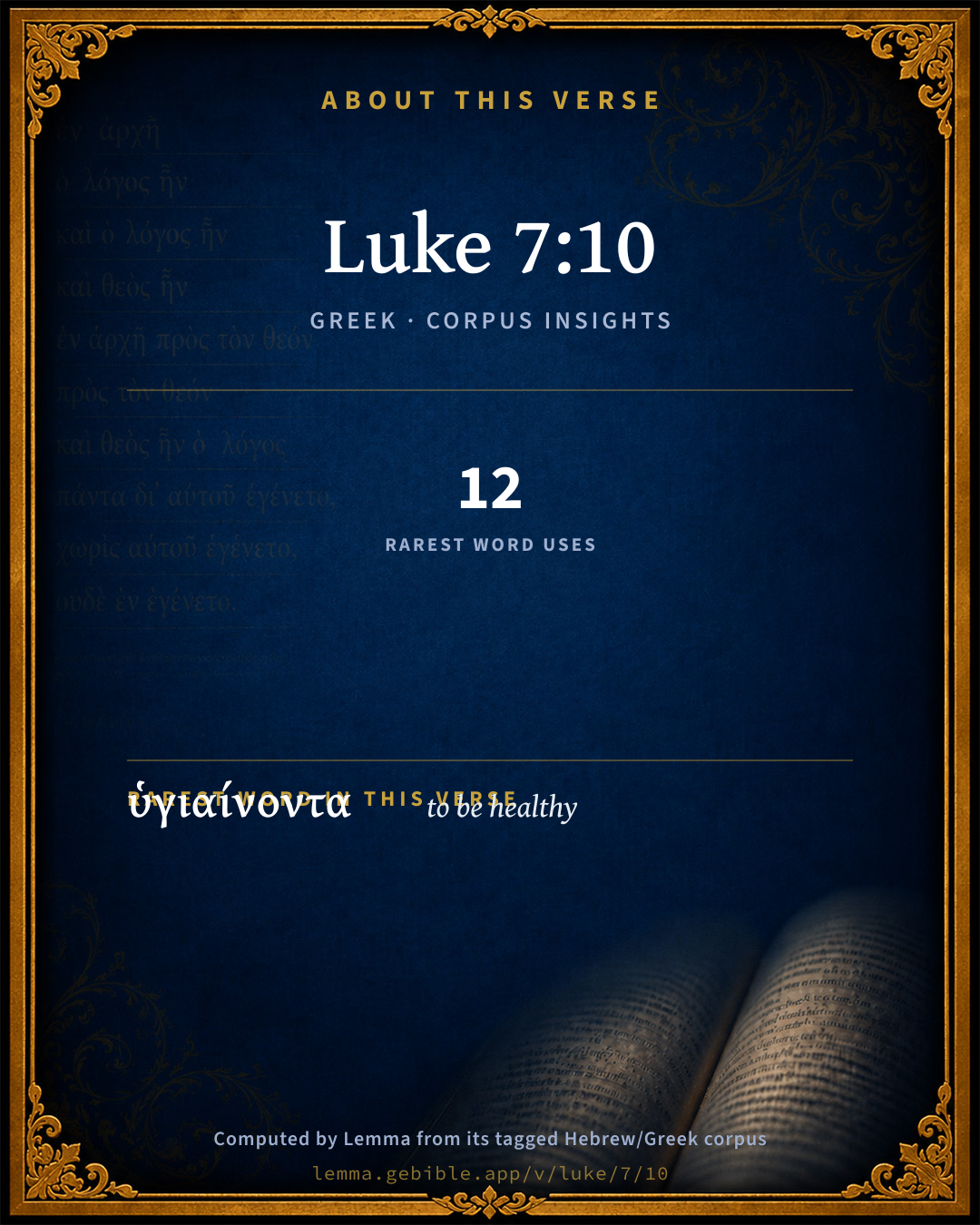
Luke 7:10

Greek (Tischendorf 8th ed.) Luke 7:10 appears in the Greek New Testament. The text above is from the Tischendorf 8th edition. Each word links to its Strong’s number and a concise gloss. Click any word for its full Thayer’s Greek Lexicon entry.

Download image
Cite this verse

Luke 7:10 (World English Bible). Public Domain. Lemma interlinear Bible study tool, https://lemma.gebible.app/v/luke/7/10.

Show BibTeX & RIS
BibTeX
RIS
English Translation
Those who were sent, returning to the house, found that the servant who had been sick was well.
World English Bible · Public Domain
Download a study sheet

One document with this verse’s original text, its word-by-word gloss line, the meaning frame, cross-references with their text, attributed commentary, and full source and license credits — printable, and it pastes into notes with its structure intact.

This verse Autodidact and up

Study sheet (.html) Plain text (.txt)

A passage Seminary Student

Up to 50 verses in one chapter. A passage sheet keeps up to 6 commentary sources and 12 cross-references per verse, in the order this page ranks them, and says so on the sheet whenever that leaves anything out. Ask for a single verse and you get the Autodidact verse sheet above.

Everything on this page stays free to read, with no account — the sheet is a download of what is already on screen, not access to it.

Want to remove ads? Support Godless Engineer
Compare translations 3

The same verse in 3 English versions, stacked beneath the original-language interlinear above. Click any original word for its lexicon entry.

Each is an independent rendering of the whole verse — the interlinear is not word-aligned to these translations.

Highlighted words mark where these versions differ — a whole-verse word diff, not a word-by-word alignment.

  • World English Bible Public Domain
    Those who were sent, returning to the house, found that the servant who had been sick was well.
  • King James Version Public Domain
    And they that were sent, returning to the house, found the servant whole that had been sick.
  • unfoldingWord Literal Text CC BY-SA 4.0
    And having returned to the house, the ones having been sent found the servant was well.

unfoldingWord Literal Text — © unfoldingWord, licensed CC BY-SA 4.0. Word-aligned USFM3 via Door43 (git.door43.org/unfoldingWord/en_ult).

Versions to compare (up to 4)

3 of 4 selected

Show all 19 translations

Every available English version of this verse, each an independent rendering of the whole verse.

  • World English Bible Public Domain
    Those who were sent, returning to the house, found that the servant who had been sick was well.
  • Berean Standard Bible Public Domain
    And when the messengers returned to the house, they found the servant in good health.
  • Majority Standard Bible Public Domain
    And when the messengers returned to the house, they found the ailing servant in good health.
  • King James Version Public Domain
    And they that were sent, returning to the house, found the servant whole that had been sick.
  • American Standard Version (1901) Public Domain
    And they that were sent, returning to the house, found the servant whole.
  • Revised Version (1885) Public Domain
    And they that were sent, returning to the house, found the servant whole.
  • Geneva Bible (1599) Public Domain
    And when they that were sent, turned backe to the house, they founde the seruant that was sicke, whole.
  • Douay-Rheims (1899) Public Domain
    And they who were sent, being returned to the house, found the servant whole who had been sick.
  • Young's Literal Translation Public Domain
    and those sent, having turned back to the house, found the ailing servant in health.
  • Literal Standard Version CC BY-SA 4.0
    and those sent, having turned back to the house, found the ailing servant in health.
  • Unlocked Literal Bible CC BY-SA 4.0
    When those who had been sent returned to the house, they found the servant was well.
  • unfoldingWord Literal Text CC BY-SA 4.0
    And having returned to the house, the ones having been sent found the servant was well.
  • Darby Bible Public Domain
    And they who had been sent returning to the house found the bondman, who was ill, in good health.
  • World Messianic Bible Public Domain
    Those who were sent, returning to the house, found that the servant who had been sick was well.
  • Webster's Bible Public Domain
    And they that were sent, returning to the house, found the servant well that had been sick.
  • Free Bible Version CC BY-SA 4.0
    Then the centurion's friends returned to the house and found the servant in good health.
  • Bible in Basic English Public Domain
    And when those who were sent came back to the house they saw that the servant was well.
  • Text-Critical English NT CC BY 4.0
    Then the men the centurion had sent returned to the house and found that the servant who had been sick was well.
  • Tyndale New Testament (1534) Public Domain
    And they that were sent turned backe home agayne and founde the servaunt that was sicke whoole.

Literal Standard Version (2020), Covenant Press — licensed CC BY-SA 4.0. Text via the HelloAO Bible API (eBible.org). Unlocked Literal Bible (unfoldingWord) — licensed CC BY-SA 4.0. Text via the HelloAO Bible API (eBible.org). unfoldingWord Literal Text — © unfoldingWord, licensed CC BY-SA 4.0. Word-aligned USFM3 via Door43 (git.door43.org/unfoldingWord/en_ult). Free Bible Version, Dr. Jonathan Gallagher — licensed CC BY-SA 4.0. Text via the HelloAO Bible API (eBible.org).

Word by word

More ways to search: Search by grammar → Find every occurrence → Compare this word →

Practice this passage: Drill this verse → Learn its vocabulary →

ὑγιαίνοντα
hygiaínō
G5198
“to be healthy”
Verb, Present, Active, Participle, Accusative, Singular, Masculine
Part of Speech
Verb
Tense
Present
Voice
Active
Mood
Participle
Case
Accusative
Number
Singular
Gender
Masculine
Full Thayer's Definition

Origin: from G5199

TDNT: 13:08,1

1. to be sound, to be well, to be in good health 2. metaph. a. of Christians whose opinions are free from any mixture of error b. of one who keeps the graces and is strong
  1. καὶ kaí G2532 “and” Conjunction
  2. ὑποστρέψαντες hypostréphō G5290 “to turn back” Verb, Aorist, Active, Participle, Nominative, Plural, Masculine
  3. εἰς eis G1519 “into” Preposition
  4. τὸν ho G3588 “the” Article, Accusative, Singular, Masculine
  5. οἶκον oîkos G3624 “house” Noun, Accusative, Singular, Masculine
  6. οἱ ho G3588 “the” Article, Nominative, Plural, Masculine
  7. πεμφθέντες pémpō G3992 “to send” Verb, Aorist, Passive, Participle, Nominative, Plural, Masculine
  8. εὗρον heurískō G2147 “to find” Verb, Aorist, Active, Indicative, 3rd person, Plural
  9. τὸν ho G3588 “the” Article, Accusative, Singular, Masculine
  10. δοῦλον doûlos G1401 “slave” Noun, Accusative, Singular, Masculine

About this verse

These counts appear in no published source. They are computed here, from the morphology-tagged text and Lemma’s own curated glosses. What Lemma adds →

11
words
9
distinct lemmas
Gospels
section

Notable vocabulary

The rarest word here is ὑγιαίνοντα to be healthy G5198 — appearing just 12 times in the whole Greek New Testament.

Shared distinctive vocabulary

ὑγιαίνοντα to be healthy G5198 occurs in 12 verses of the Greek New Testament. Also found in:

Repetition

A word recurs within this verse:

Cross-references

4

Topical passages linked to Luke 7:10 in the Treasury of Scripture Knowledge — connected by theme and wording, ordered by reader-vote popularity; previews shown in the World English Bible.

  • Matthew 8:13 Jesus said to the centurion, "Go your way. Let it be done for you as you have believed." His servant was healed in that hour.
  • John 4:50–53 Jesus said to him, "Go your way. Your son lives." The man believed the word that Jesus spoke to him, and he went his way.
  • Matthew 15:28 Then Jesus answered her, "Woman, great is your faith! Be it done to you even as you desire." And her daughter was healed from that hour.
  • Mark 9:23 Jesus said to him, "If you can believe, all things are possible to him who believes."

Cross-references courtesy of OpenBible.info (CC BY 4.0).

Where the printed editions differ

1 variant

Places in this verse where the major printed Greek editions disagree on the wording in a way that affects the translation — a comparison of editions, not a manuscript-by-manuscript collation. The editions are the modern critical texts (Nestlé-Aland 28/27, SBL, Westcott-Hort, Tregelles, Tyndale House) and the traditional texts behind the KJV (the Textus Receptus and the Byzantine/Majority text). It is not a claim about which reading is original.

  1. Extra text
    ἀσθενοῦντα

    “ailing”

    In TRByz Not in NA28NA27TynSBLWHTreg

    ἀσθενοῦντα (asthenounta) 'ailing' is only in traditional manuscripts (TR+Byz)

Textual data: Translators Amalgamated Greek New Testament (STEPBible TAGNT) · CC BY 4.0.

Commentary

Notes on Luke 7:10 from classic Christian and Jewish commentators (each source and its license shown beneath its notes). The classic Christian expositions comment on the surrounding passage and are grouped to its opening verse, so a note may address several verses; the Jewish commentaries on the Tanakh (Rashi and others) are per-verse, so they appear only where the commentator wrote on this verse.

Lemma curates 59 commentaries, every one of them public domain or Creative Commons licensed, each selected and text-cleaned for this edition rather than reprinted as found. About our sources →

Bengel's Gnomon

Johann Albrecht Bengel

Luk 7:10. Ὑγιαίνοντα) not merely whole and sound (ὑγιῆ), but using the health and soundness given him [ὑγιαίνοντα].

Bengel's Gnomon of the New Testament — English translation (T&T Clark, Edinburgh, 1860) — public domain. Text from a community e-Sword module.

Adam Clarke's Commentary

Verse 10. Found the servant whole] This cure was the effect of the faith, prayer, and humility of the centurion, through which the almighty energy of Jesus Christ was conveyed to the sick man. But these very graces in the centurion were the products of grace. It is God himself who, by the gifts of his mercy, disposes the soul to receive its cure; and nothing can contribute to the reception of his grace but what is the fruit of grace itself. The apostle says, The grace of God that bringeth salvation hath appeared unto all men, Tit 2:11. It should therefore be our concern, not to resist the operations of this grace: for though we cannot endue ourselves with by gracious disposition, yet we can quench the Spirit, by whose agency these are produced in the soul. The centurion had not received the grace of God in vain.

Adam Clarke's Commentary on the Bible (1810–1826) — public domain. Text from a community e-Sword/MySword module.

Ellicott's Commentary for English Readers

(10) Found the servant whole.—Note St. Luke’s characteristic use, as in Luk_5:31, of a technical term for “healthy” or “convalescent.”

A Bible Commentary for English Readers, edited by Charles John Ellicott (1878–1897) — public domain. Text from a community e-Sword module.

The Cambridge Bible for Schools and Colleges

gen. ed. J. J. S. Perowne

10. found the servant whole] Rather, convalescent, a medical word which is found also in Luk_15:27 (and in a metaphorical sense in Tit_1:13; 1Ti_1:10; 1Ti_6:3; 2Ti_1:13; 2Ti_4:3).

that had been sick] These words should probably be omitted.

The Cambridge Bible for Schools and Colleges (gen. ed. J. J. S. Perowne; Cambridge University Press, 1878–1918) — public domain. Text from a community e-Sword module.

John Gill's Exposition

And they that were sent,.... Both the elders of the Jews, and the friends of the centurion:

returning to the house; of the centurion, where his servant lay, and from whence they came:

found the servant whole that had been sick; for he was healed directly, as soon as the centurion had expressed his faith, and Christ had declared that it should be according to it, Mat 8:13.

John Gill's Exposition of the Whole Bible (1746–1763) — public domain (CC PDM 1.0). Text via the HelloAO Bible API.

Trapp's Complete Commentary

John Trapp

10 And they that were sent, returning to the house, found the servant whole that had been sick.

Ver. 10. See Mat 8:13.

John Trapp, A Commentary or Exposition upon All the Books of the Old and New Testament (1647–1656) — public domain. Text from a community e-Sword module.

The Pulpit Commentary

Returning to the house, found the servant whole that had been sick. Farrar suggests "convalescent" as a more accurate rendering than "whole." The Greek equivalent is one of the medical words we find in this Gospel of St. Luke. The words, "that had been sick," do not occur in the other authorities. They are omitted in the Revised Version.

Vers. 18-35. The deputation from John.

Jesus pursued a policy of mercy and of salvation. He healed all who asked for healing or were brought to him; he raised the dead; he was a Philanthropist rather than a Judge. The fame of his miracles was spread abroad, and made its way to the castle and its keep, where John the Baptist was now Herod"s prisoner. The result is a deputation of two disciples sent by the illustrious prisoner to Jesus. We are to study the interview and the subsequent panegyric on John.

I CONSIDER JOHN"S DIFFICULTY. John had preached about a coming One, according to such prophecies as that of Malachi. He had preached that Jesus was coming to judgment. His fan was to be in his hand; he was throughly to purge his floor; he was to gather the wheat into his garner; and he was to burn up the chaff with unquenchable fire. (Luk_3:17) And in the spirit of the Old Testament, which was largely a dispensation of judgment, John looked for Messiah to be mainly a Messiah of judgment. The kingdom of Messiah was to be set up, John thought, like all world-kingdoms, by "the thunder of the captains and the shouting," by some remarkable series of judgments; but now that Jesus is devoting himself to philanthropy pure and simple, John thinks that perhaps another messenger is to be looked for, who will make judgment his role. John"s difficulty is what we all experience when we imagine that a more impressive and decisive method of advancing God"s cause might be adopted. Human nature has great faith in blows!

II OUR LORD"S RESPONSE. (Vers. 21-23) This consisted of:

1. Miracles of mercy. All that needed healing in the crowd received it in presence of John"s disciples. He cured many of their infirmities and plagues, and of evil spirits; and many blind ones received their sight. The Healer was there; philanthropy was in full swing.

2. He preached the gospel to the poor. He backed up the miracles by a message; he made his mercies to the body the texts from which he preached deliverance to the souls of men.

3. He directed the disciples to report to John what they had seem and heard, with the additional warning, "Blessed is he whosoever shall not be offended in me." His policy was one of love, of disinterestedness; and John was to study it more thoroughly and come to a better conclusion. We thus learn that the best defence of a suspected work is the patient performance of it. It will vindicate itself in due season, if it be good and genuine. Christ came not to wade through seas of blood to a temporal throne, but by persevering love to win men"s hearts and rule over their lives from within!

III HIS PANEGYRIC UPON JOHN. (Vers. 24-28) It was after the deputation had departed that Jesus pronounced John"s panegyric. Most people would have pronounced it in their hearing, that they might carry it to John; but Jesus says the good and noble things behind John"s back, having given all the warning he needed before, so to speak, his face. It partakes, as Godet remarks, of the nature of a funeral oration. Like Jesus himself, John is anointed with considerate praise before his burial. And here we have to notice the order of the panegyric.

1. Christ describes John negatively. Borrowing his simile from the desert, where the reeds bow before the breeze and do not break, he insists that John was not like one of these. In other words, he was a man of unflinching integrity, who would break rather than bend before the breeze of opposition. He preferred to be Herod"s prisoner in the dungeon rather than his fawning sycophant in the palace. Nor, again, was John a courtier gaily and silkenly clad. The Camel"s hair garment was a perpetual protest in the castle, before he was thrust down into the dungeon, against the effeminacy of the court. If he had come to be "court preacher" to Herod, he had come to be one in earnest.

2. He describes John positively. He was a "prophet." Great honour was it to be recipients and communicators of revelations. John was charged, like other Old Testament prophets, with messages from God. But he was more he was the forerunner of Messiah. In applying to John the prophecy in Malachi, Jesus was asserting his own Messiahship and Divinity. This was a great honour for John to be the immediate predecessor of the Lord. Still further, our Lord asserts that of woman-born there has not been a greater prophet than the Baptist. This is unstinted praise. And it is just. When we consider all John attempted and the means he had at hand, when we consider that he attempted the regeneration of his country and asked no miraculous power to accomplish it, then he comes before us in moral grandeur exceeding that of the first Elias.

3. He describes him candidly. The panegyric is judicious. Our Lord declares that, great though John undoubtedly is, he is surpassed by "the least in the kingdom of God." This may mean that the least Christian has greater insight into the nature of the kingdom than John. Or it may, perhaps, rather mean that he who is consciously the least in the kingdom of God, by whom we must understand the most advanced spiritually, is greater than John. The insight of a Paul, for instance, who felt himself to be less than the least of all saints, was greater than that of John, climax though he was of Old Testament prophecy. Or, finally, may it not mean Jesus himself, who was the meekest and lowliest in the Kingdom of God.

IV THE CHARACTER OF JOHN"S SUCCESS WAS LIKE THAT OF JESUS. (Vers. 29, 30) The evangelist seems to add the significant words that it was among the common people, the publicans and the poor, not among the Pharisees and lawyers, that he secured his penitents. So that John"s revival was really among the humbler classes, where the work of Jesus was being now wisely prosecuted. The self-righteous rejected John"s appeal for repentance; the common people and the publicans embraced it, and "justified God" by repenting before him. For we must acknowledge God"s perfect justice in condemning us for our sins, before we can appreciate his justice and mercy in forgiving us for his Son"s sake. Luke"s observation, then, makes Christ"s panegyric a perfect picture.

V THE TWO ASPECTS OF TRUTH, AND THE GENERAL REJECTION OF BOTH, (Vers. 31-35) Jesus, in these verses, contrasts John"s ministry with his own. Little children at play sometimes find their fellows utterly intractable. Tried by a funeral, they will not join in the mournful procession; tried by a marriage, they will not join in the bridal party. They are too ill-natured to take part in either. Nothing pleases them. So was it with the Pharisees in their attitude to the preaching of John and to the preaching of Jesus. John presented the truth in its severe and mournful aspects. He was unsocial, to lead men to a sense of sin and to repent of it. But the Pharisees would not believe the self-denying preacher from the desert. Jesus presented the truth in all its winsomeness and attractiveness; but they found as much fault with Jesus as they did with John. John had a devil, and Jesus was a glutton and a wine-bibber. Neither could please these prim, self-satisfied ones. But the vindication of wisdom was on its way. The penitents of John and the joyful disciples of Jesus would yet justify the truth which John and Jesus preached. The Pharisees might reject both missions, but the common people who received them justified the truth in both by lives and conversations becoming the gospel. We may in the same way leave our work with confidence to the verdict of the future, if we feel that it is true. Opposition from a self-righteous party is itself a vindication of the truth which we have embodied or declared. R.M.E.

The Pulpit Commentary (1880–1919), ed. H.D.M. Spence-Jones & Joseph S. Exell — public domain. Text from a community e-Sword module.

Cambridge Greek Testament for Schools and Colleges

10. ἀσθενοῦντα is added by ACD &c., but omitted in אBL, Copt., &c. La[145] Ti[146] W.H[147]

[145] La. Lachmann.

[146] Ti. Tischendorf.

[147] W.H. Westcott and Hort.

10. ὑγιαίνοντα. A medical word which is found also in Luk 15:27 (and in a metaphorical sense in Tit 1:13; 1Ti 1:10; 1Ti 6:3; 2Ti 1:13; 2Ti 4:3).

ἀσθενοῦντα. This word should probably be omitted. It has a certain picturesqueness, for it implies that the friends of the centurion found the slave sound whom they regarded as sick. On the one hand, it may be regarded as an explanatory gloss; on the other hand, it may have been omitted as involving a contradiction.

Cambridge Greek Testament for Schools and Colleges (Cambridge University Press, 1896; 21 vols, various authors incl. Carr, Maclear, Plummer, Farrar, Lumby, Moule, M. R. James, Simcox) — public domain. Text from a community e-Sword module.

Alford’s Greek Testament

Henry Alford

10.] Here Matt. simply states the fact of the healing, [apparently] not knowing of the οἱ πεμφθ.

Henry Alford, The Greek Testament (1849–1861) — public domain. Text from a community e-Sword module.

International Critical Commentary

10. ὑποστρέψαντες . See on 1:56 and 4:14. Lk.’s ὑγιαίνοντα is stronger than the ἰάθη of Mt. The servant was not only cured, but “in good health.” Non modo sanum, sed sanitate utentem (Beng.) Hobart remarks that Lk. “is the only N.T. writer who uses ὑγιαίνειν in this its primary sense, ‘to be in sound health,’ with the exception of S. John, 3 Eph_2. For this meaning it is the regular word in the medical writers” (p. 10). See on 5:31 and comp. 15:27. Here and 5:31 Vulg. has sanus; in 15:27, salvus.

The identification of this miracle with that of the healing of the son of the royal official (βασιλικός) in Joh_4. is not probable: it involves an amount of misinformation or carelessness on one side or the other which would be very startling. Irenæus seems to be in favour of it; but “centurion” with him may be a slip of memory or a misinterpretation of βασιλικός. Origen and Chrysostom contend against the identification. Is there any difficulty in supposing that on more than one occasion Jesus healed without being present? The difficulty is to explain one such instance, without admitting the possession of supernatural powers: this Strauss has shown, and the efforts of Keim and Schenkel to explain it by a combination of moral and psychical causes are not satisfying. There is no parallel to it in O.T., for (as Keim points out) the healing of Naaman is not really analogous.

International Critical Commentary — older volumes (1896–1929), various authors — public domain. Text from a community e-Sword module.

Vincent's Word Studies in the New Testament

Marvin R. Vincent

Whole [υγιαινοντα] . See on ch. Luk 5:31. The best texts omit that had been sick.

11 - 17. Peculiar to Luke.

Marvin R. Vincent, Word Studies in the New Testament (1887–1900) — public domain. Text from a community e-Sword/MySword module.

Lesson kit

Teaching starters — assembled from the data on this page, not authored interpretation. Every prompt links to the verse data it draws on. Edit before teaching.

Luke, in the Gospels, opens this verse with 11 words (9 distinct Greek lemmas). Its most distinctive word is hygiaínō (“to be healthy”). A historical commentator’s framing appears above. Read the whole chapter for the surrounding context.

Discussion questions

  1. What does “to be healthy” (hygiaínō) contribute to the verse as a whole?
  2. How does Luke 5:31, which shares the word «to be healthy», read alongside this verse?
  3. What does the repetition of “the” (3× in this one verse) do in this verse?
  4. These translations render this verse differently. What is at stake in choosing one wording over another?
  5. Compare how Bengel's Gnomon and Adam Clarke's Commentary read this verse. Where do they agree or differ?

Things to notice

  • These translations choose different wording for 9 words in this verse.
  • “the” occurs 3× in this single verse.
  • 9 distinct Greek lemmas span 11 words in this verse.

Reading settings

Reading text

Shown beneath each verse's original-language words.

Old Testament
Old Testament edition

Read the OT as the Masoretic Hebrew (MT) or the Greek Septuagint (LXX).

English shown for the Greek Septuagint (in the Hebrew ↔ Greek comparison).

Comparing translations? Open the Compare panel on any verse page to stack up to four side by side.