

Revelation 18:14
Greek (Tischendorf 8th ed.) Revelation 18:14 appears in the Greek New Testament. The text above is from the Tischendorf 8th edition. Each word links to its Strong’s number and a concise gloss. Click any word for its full Thayer’s Greek Lexicon entry.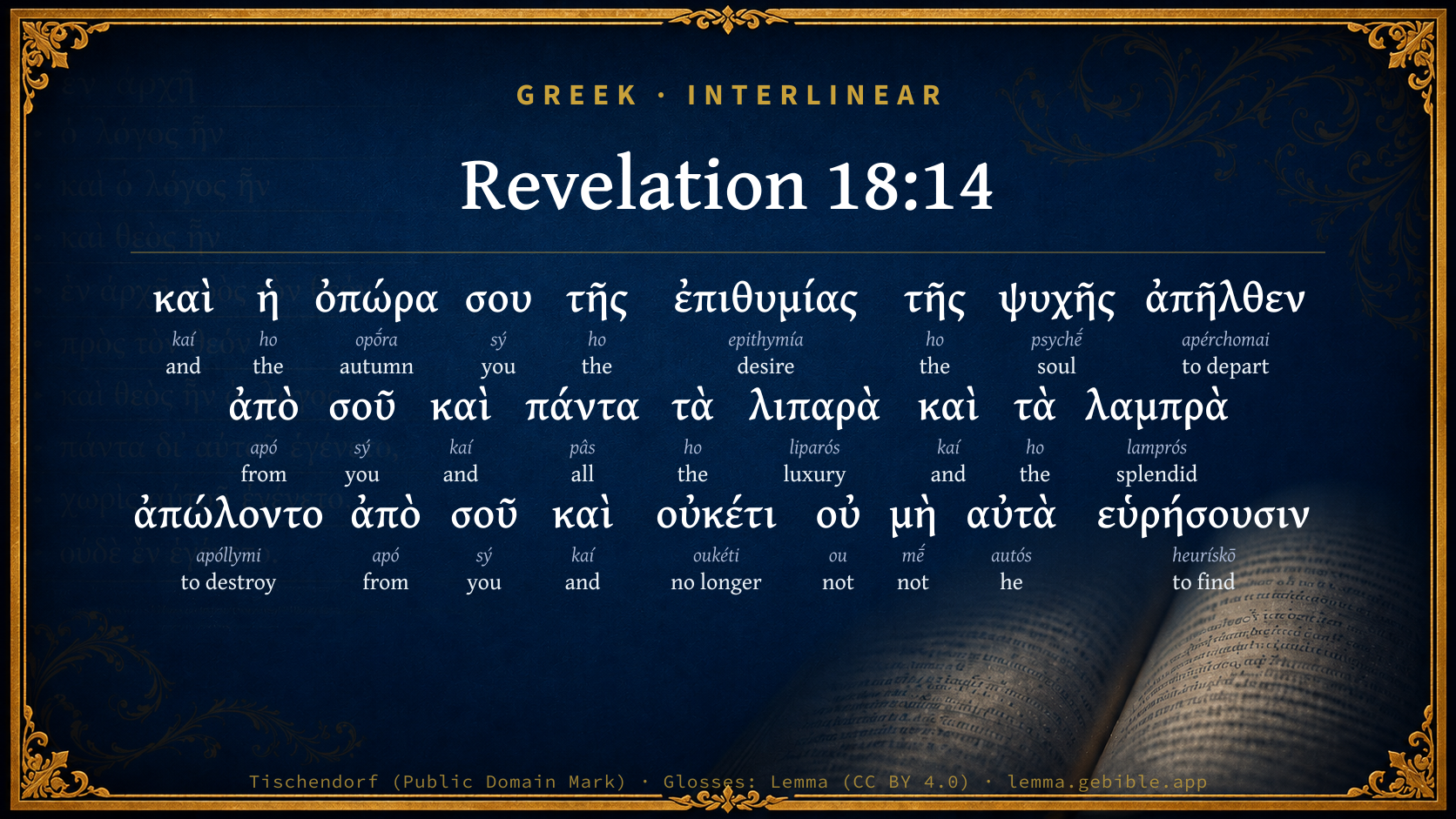
The fruits which your soul lusted after have been lost to you, and all things that were dainty and sumptuous have perished from you, and you will find them no more at all.
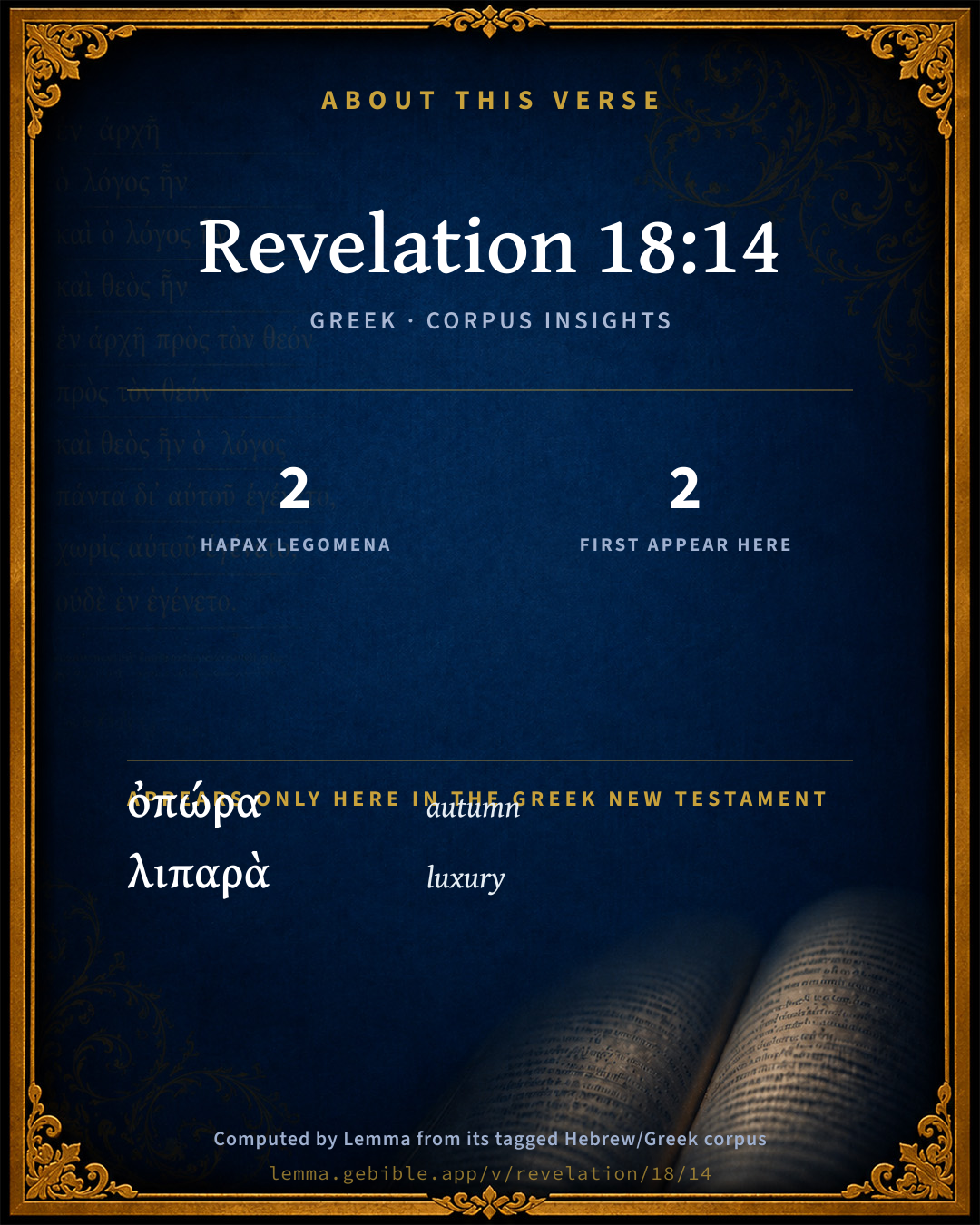
- 2 hapax legomena — only here in the Greek New Testament
- 2 first appearances in the Greek New Testament
Download a study sheet
One document with this verse’s original text, its word-by-word gloss line, the meaning frame, cross-references with their text, attributed commentary, and full source and license credits — printable, and it pastes into notes with its structure intact.
This verse Autodidact and up
A passage Seminary Student
Up to 50 verses in one chapter. A passage sheet keeps up to 6 commentary sources and 12 cross-references per verse, in the order this page ranks them, and says so on the sheet whenever that leaves anything out. Ask for a single verse and you get the Autodidact verse sheet above.
Everything on this page stays free to read, with no account — the sheet is a download of what is already on screen, not access to it.
Compare translations 3
The same verse in 3 English versions, stacked beneath the original-language interlinear above. Click any original word for its lexicon entry.
Each is an independent rendering of the whole verse — the interlinear is not word-aligned to these translations.
Highlighted words mark where these versions differ — a whole-verse word diff, not a word-by-word alignment.
-
World English Bible Public Domain
The fruits which your soul lusted after have been lost to you, and all things that were dainty and sumptuous have perished from you, and you will find them no more at all.
-
King James Version Public Domain
And the fruits that thy soul lusted after are departed from thee, and all things which were dainty and goodly are departed from thee, and thou shalt find them no more at all.
-
unfoldingWord Literal Text CC BY-SA 4.0
And your autumn fruit of the desire of soul has gone away from you, and all the luxurious and the splendid has perished from you, and they will certainly not be found any longer.
unfoldingWord Literal Text — © unfoldingWord, licensed CC BY-SA 4.0. Word-aligned USFM3 via Door43 (git.door43.org/unfoldingWord/en_ult).
Show all 19 translations
Every available English version of this verse, each an independent rendering of the whole verse.
-
World English Bible Public Domain
The fruits which your soul lusted after have been lost to you, and all things that were dainty and sumptuous have perished from you, and you will find them no more at all.
-
Berean Standard Bible Public Domain
And they will say: “The fruit of your soul’s desire has departed from you; all your luxury and splendor have vanished, never to be seen again.”
-
Majority Standard Bible Public Domain
And they will say: “The fruit of your soul’s desire has departed from you; all your luxury and splendor have vanished, never to be seen again.”
-
King James Version Public Domain
And the fruits that thy soul lusted after are departed from thee, and all things which were dainty and goodly are departed from thee, and thou shalt find them no more at all.
-
American Standard Version (1901) Public Domain
And the fruits which thy soul lusted after are gone from thee, and all things that were dainty and sumptuous are perished from thee, and `men' shall find them no more at all.
-
Revised Version (1885) Public Domain
And the fruits which thy soul lusted after are gone from thee, and all things that were dainty and sumptuous are perished from thee, and men shall find them no more at all.
-
Geneva Bible (1599) Public Domain
(And the apples that thy soule lusted after, are departed from thee, and all things which were fatte and excellent, are departed from thee, and thou shalt finde them no more)
-
Douay-Rheims (1899) Public Domain
And the fruits of the desire of thy soul are departed from thee, and all fat and goodly things are perished from thee, and they shall find them no more at all.
-
Young's Literal Translation Public Domain
`And the fruits of the desire of thy soul did go away from thee, and all things -- the dainty and the bright -- did go away from thee, and no more at all mayest thou find them.
-
Literal Standard Version CC BY-SA 4.0
And the fruits of the desire of your soul went away from you, and all things—the sumptuous and the radiant—went away from you, and no more at all may you find them.
-
Unlocked Literal Bible CC BY-SA 4.0
The fruit that you longed for with all your might is gone from you. All your luxury and splendor have vanished, never to be found again.
-
unfoldingWord Literal Text CC BY-SA 4.0
And your autumn fruit of the desire of soul has gone away from you, and all the luxurious and the splendid has perished from you, and they will certainly not be found any longer.
-
Darby Bible Public Domain
And the ripe fruits which were the lust of thy soul have departed from thee, and all fair and splendid things have perished from thee, and they shall not find them any more at all.
-
World Messianic Bible Public Domain
The fruits which your soul lusted after have been lost to you. All things that were dainty and sumptuous have perished from you, and you will find them no more at all.
-
Webster's Bible Public Domain
And the fruits that thy soul lusted after have departed from thee, and all things which were dainty and goodly have departed from thee, and thou shalt find them no more at all.
-
Free Bible Version CC BY-SA 4.0
You've lost the sweet pleasures you loved so much; all your luxurious, glittering possessions are gone—you'll never get any of them back.
-
Bible in Basic English Public Domain
And the fruit of your soul's desire has gone from you, and all things delicate and shining have come to an end and will never again be seen.
-
Text-Critical English NT CC BY 4.0
“The ripe fruit that was the desire of yoʋr soul is gone from yoʋ, and all yoʋr delicacies and splendors are lost to yoʋ; yoʋ will never find them again!”
-
Tyndale New Testament (1534) Public Domain
And the apples that thy soule lusted after are departed from the. And all thynges which were deyntie and had in pryce are departed from the and thou shalt fynde them no more.
Literal Standard Version (2020), Covenant Press — licensed CC BY-SA 4.0. Text via the HelloAO Bible API (eBible.org). Unlocked Literal Bible (unfoldingWord) — licensed CC BY-SA 4.0. Text via the HelloAO Bible API (eBible.org). unfoldingWord Literal Text — © unfoldingWord, licensed CC BY-SA 4.0. Word-aligned USFM3 via Door43 (git.door43.org/unfoldingWord/en_ult). Free Bible Version, Dr. Jonathan Gallagher — licensed CC BY-SA 4.0. Text via the HelloAO Bible API (eBible.org).
Word by word
More ways to search: Search by grammar → Find every occurrence → Compare this word →
Practice this passage: Drill this verse → Learn its vocabulary →
- Appears 1× in the Greek New Testament
- First appears here
- Part of Speech
- Noun
- Case
- Nominative
- Number
- Singular
- Gender
- Feminine
Full Thayer's Definition
- καὶ kaí G2532 “and” Conjunction
- ἡ ho G3588 “the” Article, Nominative, Singular, Feminine
- ὀπώρα opṓra G3703 “autumn” Noun, Nominative, Singular, Feminine
- σου sý G4771 “you” Personal pronoun, 2nd person, Genitive, Singular
- τῆς ho G3588 “the” Article, Genitive, Singular, Feminine
- ἐπιθυμίας epithymía G1939 “desire” Noun, Genitive, Singular, Feminine
- τῆς ho G3588 “the” Article, Genitive, Singular, Feminine
- ψυχῆς psychḗ G5590 “soul” Noun, Genitive, Singular, Feminine
- ἀπῆλθεν apérchomai G565 “to depart” Verb, Aorist, Active, Indicative, 3rd person, Singular
- ἀπὸ apó G575 “from” Preposition
- σοῦ sý G4771 “you” Personal pronoun, 2nd person, Genitive, Singular
- καὶ kaí G2532 “and” Conjunction
- πάντα pâs G3956 “all” Adjective, Nominative, Plural, Neuter
- τὰ ho G3588 “the” Article, Nominative, Plural, Neuter
- λιπαρὰ liparós G3045 “luxury” Adjective, Nominative, Plural, Neuter
- καὶ kaí G2532 “and” Conjunction
- τὰ ho G3588 “the” Article, Nominative, Plural, Neuter
- λαμπρὰ lamprós G2986 “splendid” Adjective, Nominative, Plural, Neuter
- ἀπώλοντο apóllymi G622 “to destroy” Verb, Aorist, Middle, Indicative, 3rd person, Plural
- ἀπὸ apó G575 “from” Preposition
- σοῦ sý G4771 “you” Personal pronoun, 2nd person, Genitive, Singular
- καὶ kaí G2532 “and” Conjunction
- οὐκέτι oukéti G3765 “no longer” Adverb, Negative
- οὐ ou G3756 “not” Particle, Negative
- μὴ mḗ G3361 “not” Particle, Negative
- αὐτὰ autós G846 “he” Personal pronoun, Accusative, Plural, Neuter
- εὑρήσουσιν heurískō G2147 “to find” Verb, Future, Active, Indicative, 3rd person, Plural
About this verse
These counts appear in no published source. They are computed here, from the morphology-tagged text and Lemma’s own curated glosses. What Lemma adds →
- 27
- words
- 17
- distinct lemmas
- Revelation
- section
Notable vocabulary
2 hapax legomena — words that appear only here in the entire Greek New Testament:
First appearance in Scripture
These words make their first canonical appearance in the Greek New Testament here:
Shared distinctive vocabulary
λαμπρὰ splendid G2986 occurs in 9 verses of the Greek New Testament. Also found in:
Cross-references
9Topical passages linked to Revelation 18:14 in the Treasury of Scripture Knowledge — connected by theme and wording, ordered by reader-vote popularity; previews shown in the World English Bible.
- 1 Corinthians 10:6 Now these things were our examples, to the intent we should not lust after evil things, as they also lusted.
- Numbers 11:4 The mixed multitude that was among them lusted exceedingly: and the children of Israel also wept again, and said, Who shall give us flesh to eat?
- Psalms 78:18 They tempted God in their heart By asking food according to their desire.
- Psalms 106:14 But gave in to craving in the desert, And tested God in the wasteland.
- Luke 12:20 "But God said to him, 'You foolish one, tonight your soul is required of you. The things which you have prepared--whose will they be?'
- Luke 16:25 "But Abraham said, 'Son, remember that you, in your lifetime, received your good things, and Lazarus, in like manner, bad things. But now here he is comforted and you are in anguish.
- James 4:2 You lust, and don't have. You kill, covet, and can't obtain. You fight and make war. You don't have, because you don't ask.
- 1 John 2:16–17 For all that is in the world, the lust of the flesh, the lust of the eyes, and the pride of life, isn't the Father's, but is the world's.
- Numbers 11:34 The name of that place was called Kibrothhattaavah, because there they buried the people who lusted.
Cross-references courtesy of OpenBible.info (CC BY 4.0).
Lesson kit
Teaching starters — assembled from the data on this page, not authored interpretation. Every prompt links to the verse data it draws on. Edit before teaching.
Revelation, in the Revelation, opens this verse with 27 words (17 distinct Greek lemmas). Its most distinctive word is opṓra (“autumn”). A historical commentator’s framing appears above. Read the whole chapter for the surrounding context.
Discussion questions
- What does “autumn” (opṓra) contribute to the verse as a whole?
- 2 words here appear nowhere else in the Greek New Testament. Why might the author reach for such rare wording?
- 2 words make their first appearance in Scripture here. What does this debut establish?
- How does Luke 23:11, which shares the word «splendid», read alongside this verse?
- What does the repetition of “the” (5× in this one verse) do in this verse?
- These translations render this verse differently. What is at stake in choosing one wording over another?
- Compare how Tyndale Open Study Notes and Bengel's Gnomon read this verse. Where do they agree or differ?
Things to notice
- 2 words in this verse appear nowhere else in the Greek New Testament.
- 2 words make their first canonical appearance in Scripture here.
- These translations choose different wording for 29 words in this verse.
- “the” occurs 5× in this single verse.
- 17 distinct Greek lemmas span 27 words in this verse.
Commentary
Notes on Revelation 18:14 from classic Christian and Jewish commentators (each source and its license shown beneath its notes). The classic Christian expositions comment on the surrounding passage and are grouped to its opening verse, so a note may address several verses; the Jewish commentaries on the Tanakh (Rashi and others) are per-verse, so they appear only where the commentator wrote on this verse.
Lemma curates 59 commentaries, every one of them public domain or Creative Commons licensed, each selected and text-cleaned for this edition rather than reprinted as found. About our sources →
Tyndale Open Study Notes
Tyndale Open Resources
Tyndale Open Study Notes — © Tyndale Open Resources, licensed CC BY-SA 4.0. Text via the HelloAO Bible API.
Bengel's Gnomon
Johann Albrecht Bengel
Bengel's Gnomon of the New Testament — English translation (T&T Clark, Edinburgh, 1860) — public domain. Text from a community e-Sword module.
Geneva Bible (1599)
Geneva Bible translators
Geneva Bible (1599) marginal notes — public domain. Text via Bolls.life.
Jamieson, Fausset & Brown
Robert Jamieson, A. R. Fausset & David Brown
Jamieson, Fausset & Brown — Commentary Critical and Explanatory on the Whole Bible (1871) — public domain (CC PDM 1.0). Text via the HelloAO Bible API.
Adam Clarke's Commentary
Adam Clarke's Commentary on the Bible (1810–1826) — public domain. Text from a community e-Sword/MySword module.
Ellicott's Commentary for English Readers
A Bible Commentary for English Readers, edited by Charles John Ellicott (1878–1897) — public domain. Text from a community e-Sword module.
The Cambridge Bible for Schools and Colleges
gen. ed. J. J. S. Perowne
The Cambridge Bible for Schools and Colleges (gen. ed. J. J. S. Perowne; Cambridge University Press, 1878–1918) — public domain. Text from a community e-Sword module.
John Gill's Exposition
John Gill's Exposition of the Whole Bible (1746–1763) — public domain (CC PDM 1.0). Text via the HelloAO Bible API.
Trapp's Complete Commentary
John Trapp
John Trapp, A Commentary or Exposition upon All the Books of the Old and New Testament (1647–1656) — public domain. Text from a community e-Sword module.
Albert Barnes' Notes on the Bible
Albert Barnes' Notes on the Bible (1834–1885) — public domain. Text from a community e-Sword/MySword module.
Whedon's Commentary on the Bible
Daniel D. Whedon
Daniel D. Whedon (gen. ed.), Commentary on the Old and New Testaments (1874–1909) — public domain. Text from a community e-Sword module.
The Pulpit Commentary
The Pulpit Commentary (1880–1919), ed. H.D.M. Spence-Jones & Joseph S. Exell — public domain. Text from a community e-Sword module.
John Wesley's Explanatory Notes
John Wesley, Explanatory Notes Upon the Whole Bible (1754–1765) — public domain. Text via the GEBible commentary corpus.
The People's New Testament
B. W. Johnson
B. W. Johnson's The People's New Testament with Notes (1889–1891) — public domain. Electronic text from the Christian Classics Ethereal Library (CCEL) ThML edition.
unfoldingWord translationNotes
Door43 World Missions Community
unfoldingWord translationNotes — © Distant Shores Media and the Door43 World Missions Community, licensed CC BY-SA 4.0. Source: git.door43.org/Door43/en_tn.
Cambridge Greek Testament for Schools and Colleges
Cambridge Greek Testament for Schools and Colleges (Cambridge University Press, 1896; 21 vols, various authors incl. Carr, Maclear, Plummer, Farrar, Lumby, Moule, M. R. James, Simcox) — public domain. Text from a community e-Sword module.
Alford’s Greek Testament
Henry Alford
Henry Alford, The Greek Testament (1849–1861) — public domain. Text from a community e-Sword module.
Vincent's Word Studies in the New Testament
Marvin R. Vincent
Marvin R. Vincent, Word Studies in the New Testament (1887–1900) — public domain. Text from a community e-Sword/MySword module.