Acts 24:5

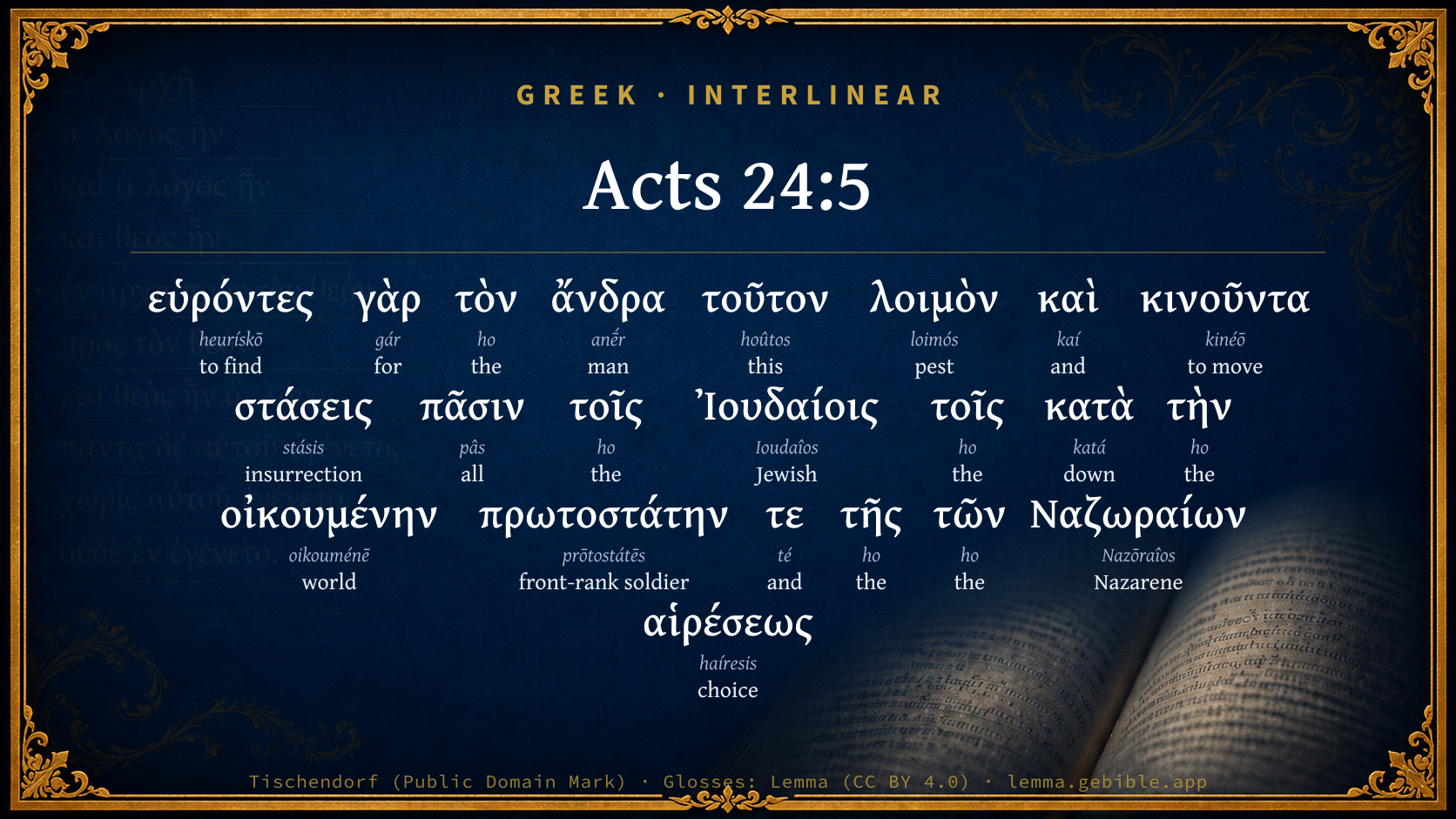
Greek (Tischendorf 8th ed.) Acts 24:5 appears in the Greek New Testament. The text above is from the Tischendorf 8th edition. Each word links to its Strong’s number and a concise gloss. Click any word for its full Thayer’s Greek Lexicon entry.
Download image
Cite this verse

Acts 24:5 (World English Bible). Public Domain. Lemma interlinear Bible study tool, https://lemma.gebible.app/v/acts/24/5.

Show BibTeX & RIS
BibTeX
RIS
English Translation
For we have found this man to be a plague, an instigator of insurrections among all the Jews throughout the world, and a ringleader of the sect of the Nazarenes.
World English Bible · Public Domain
Highlights
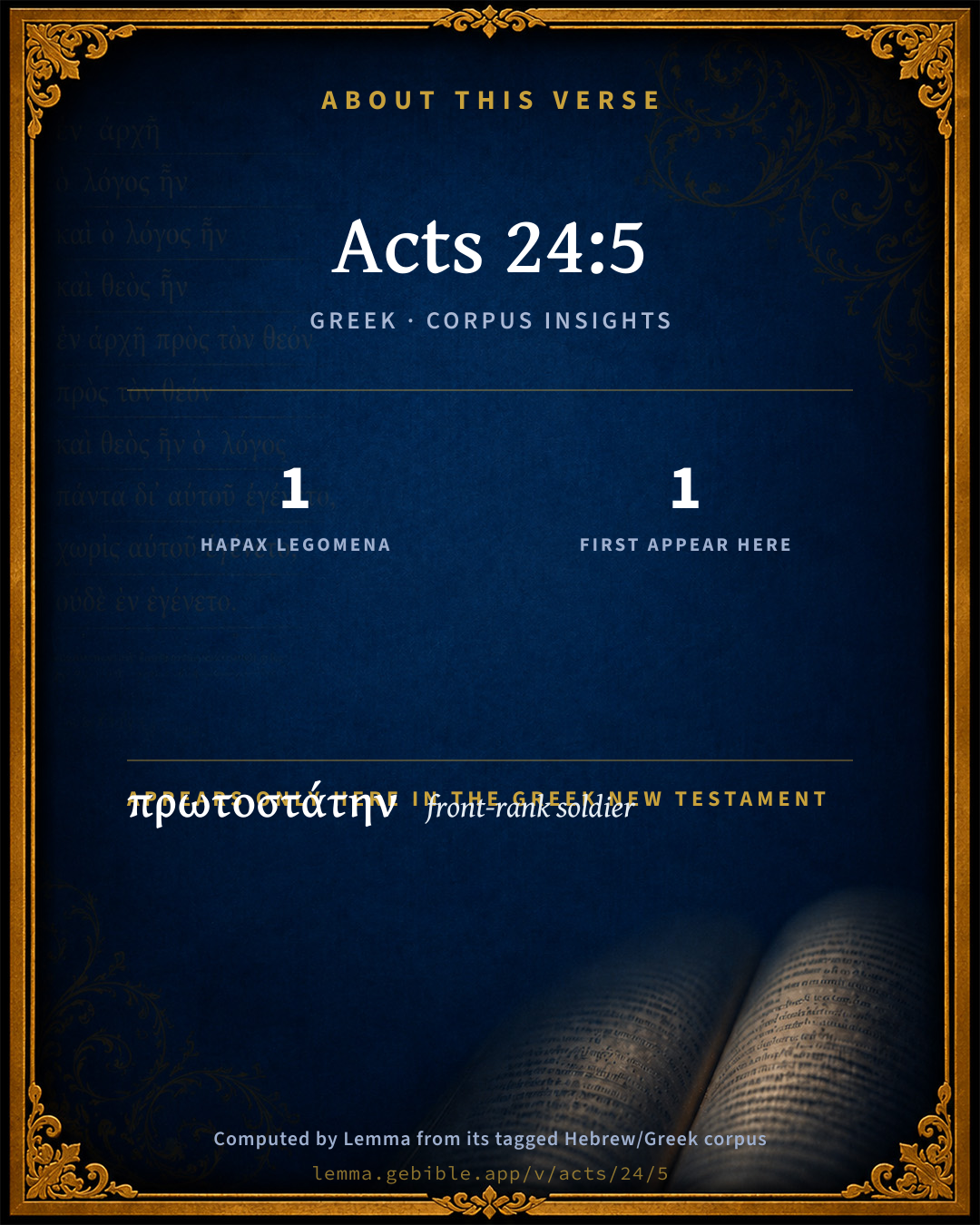
  • 1 hapax legomenon — only here in the Greek New Testament
  • 1 first appearance in the Greek New Testament
Full analysis ↓
Download a study sheet

One document with this verse’s original text, its word-by-word gloss line, the meaning frame, cross-references with their text, attributed commentary, and full source and license credits — printable, and it pastes into notes with its structure intact.

This verse Autodidact and up

Study sheet (.html) Plain text (.txt)

A passage Seminary Student

Up to 50 verses in one chapter. A passage sheet keeps up to 6 commentary sources and 12 cross-references per verse, in the order this page ranks them, and says so on the sheet whenever that leaves anything out. Ask for a single verse and you get the Autodidact verse sheet above.

Everything on this page stays free to read, with no account — the sheet is a download of what is already on screen, not access to it.

Want to remove ads? Support Godless Engineer
Compare translations 3

The same verse in 3 English versions, stacked beneath the original-language interlinear above. Click any original word for its lexicon entry.

Each is an independent rendering of the whole verse — the interlinear is not word-aligned to these translations.

Highlighted words mark where these versions differ — a whole-verse word diff, not a word-by-word alignment.

  • World English Bible Public Domain
    For we have found this man to be a plague, an instigator of insurrections among all the Jews throughout the world, and a ringleader of the sect of the Nazarenes.
  • King James Version Public Domain
    For we have found this man a pestilent fellow, and a mover of sedition among all the Jews throughout the world, and a ringleader of the sect of the Nazarenes:
  • unfoldingWord Literal Text CC BY-SA 4.0
    For having found this man a pest and one inciting rebellion among all the Jews throughout the world and a leader of the sect of the Nazarenes,

unfoldingWord Literal Text — © unfoldingWord, licensed CC BY-SA 4.0. Word-aligned USFM3 via Door43 (git.door43.org/unfoldingWord/en_ult).

Versions to compare (up to 4)

3 of 4 selected

Show all 19 translations

Every available English version of this verse, each an independent rendering of the whole verse.

  • World English Bible Public Domain
    For we have found this man to be a plague, an instigator of insurrections among all the Jews throughout the world, and a ringleader of the sect of the Nazarenes.
  • Berean Standard Bible Public Domain
    We have found this man to be a pestilence, stirring up dissension among the Jews all over the world. He is a ringleader of the sect of the Nazarenes,
  • Majority Standard Bible Public Domain
    We have found this man to be a pestilence, stirring up dissension among the Jews all over the world. He is a ringleader of the sect of the Nazarenes,
  • King James Version Public Domain
    For we have found this man a pestilent fellow, and a mover of sedition among all the Jews throughout the world, and a ringleader of the sect of the Nazarenes:
  • American Standard Version (1901) Public Domain
    For we have found this man a pestilent fellow, and a mover of insurrections among all the Jews throughout the world, and a ringleader of the sect of the Nazarenes:
  • Revised Version (1885) Public Domain
    For we have found this man a pestilent fellow, and a mover of insurrections among all the Jews throughout the world, and a ringleader of the sect of the Nazarenes:
  • Geneva Bible (1599) Public Domain
    Certainely we haue found this man a pestilent fellowe, and a moouer of sedition among all the Iewes throughout the world, and a chiefe maintainer of the secte of the Nazarites:
  • Douay-Rheims (1899) Public Domain
    We have found this to be a pestilent man, and raising seditions among all the Jews throughout the world, and author of the sedition of the sect of the Nazarenes.
  • Young's Literal Translation Public Domain
    for having found this man a pestilence, and moving a dissension to all the Jews through the world -- a ringleader also of the sect of the Nazarenes --
  • Literal Standard Version CC BY-SA 4.0
    for having found this man a pestilence, and moving a dissension to all the Jews through the world—also a ringleader of the sect of the Nazarenes—
  • Unlocked Literal Bible CC BY-SA 4.0
    For we have found this man to be a pest and one who causes all the Jews throughout the world to rebel. He is a leader of the Nazarene sect.
  • unfoldingWord Literal Text CC BY-SA 4.0
    For having found this man a pest and one inciting rebellion among all the Jews throughout the world and a leader of the sect of the Nazarenes,
  • Darby Bible Public Domain
    For finding this man a pest, and moving sedition among all the Jews throughout the world, and a leader of the sect of the Nazaraeans;
  • World Messianic Bible Public Domain
    For we have found this man to be a plague, an instigator of insurrections among all the Jews throughout the world, and a ringleader of the sect of the Nazarenes.
  • Webster's Bible Public Domain
    For we have found this a pestilent man, and a mover of sedition among all the Jews throughout the world, and a ring-leader of the sect of the Nazarenes:
  • Free Bible Version CC BY-SA 4.0
    We discovered that this man is a real pest, stirring up rebellions among Jews all over the world, a ringleader of the Nazarene sect.
  • Bible in Basic English Public Domain
    For this man, in our opinion, is a cause of trouble, a maker of attacks on the government among Jews through all the empire, and a chief mover in the society of the Nazarenes:
  • Text-Critical English NT CC BY 4.0
    For we have found this man to be a pestilent fellow, an instigator of dissension among all the Jews throughout the world, and a ringleader of the sect of the Nazarenes.
  • Tyndale New Testament (1534) Public Domain
    We have founde this man a pestilent felowe and a mover of debate vnto all the Iewes thorowe out the worlde and a mayntayner of the secte of the Nazarites

Literal Standard Version (2020), Covenant Press — licensed CC BY-SA 4.0. Text via the HelloAO Bible API (eBible.org). Unlocked Literal Bible (unfoldingWord) — licensed CC BY-SA 4.0. Text via the HelloAO Bible API (eBible.org). unfoldingWord Literal Text — © unfoldingWord, licensed CC BY-SA 4.0. Word-aligned USFM3 via Door43 (git.door43.org/unfoldingWord/en_ult). Free Bible Version, Dr. Jonathan Gallagher — licensed CC BY-SA 4.0. Text via the HelloAO Bible API (eBible.org).

Word by word

More ways to search: Search by grammar → Find every occurrence → Compare this word →

Practice this passage: Drill this verse → Learn its vocabulary →

πρωτοστάτην
prōtostátēs
G4414
“front-rank soldier”
Noun, Accusative, Singular, Masculine, Superlative
Part of Speech
Noun
Case
Accusative
Number
Singular
Gender
Masculine
Degree
Superlative
Full Thayer's Definition

Origin: from G4413 and G2476

TDNT: None

1. one who stands in the front rank a. a leader, chief, champion
  1. εὑρόντες heurískō G2147 “to find” Verb, Aorist, Active, Participle, Nominative, Plural, Masculine
  2. γὰρ gár G1063 “for” Conjunction
  3. τὸν ho G3588 “the” Article, Accusative, Singular, Masculine
  4. ἄνδρα anḗr G435 “man” Noun, Accusative, Singular, Masculine
  5. τοῦτον hoûtos G3778 “this” Demonstrative pronoun, Accusative, Singular, Masculine
  6. λοιμὸν loimós G3061 “pest” Noun, Accusative, Singular, Masculine
  7. καὶ kaí G2532 “and” Conjunction
  8. κινοῦντα kinéō G2795 “to move” Verb, Present, Active, Participle, Accusative, Singular, Masculine
  9. στάσεις stásis G4714 “insurrection” Noun, Accusative, Plural, Feminine
  10. πᾶσιν pâs G3956 “all” Adjective, Dative, Plural, Masculine
  11. τοῖς ho G3588 “the” Article, Dative, Plural, Masculine
  12. Ἰουδαίοις Ioudaîos G2453 “Jewish” Adjective, Dative, Plural, Masculine
  13. τοῖς ho G3588 “the” Article, Dative, Plural, Masculine
  14. κατὰ katá G2596 “down” Preposition
  15. τὴν ho G3588 “the” Article, Accusative, Singular, Feminine
  16. οἰκουμένην oikouménē G3625 “world” Noun, Accusative, Singular, Feminine
  17. τε té G5037 “and” Particle
  18. τῆς ho G3588 “the” Article, Genitive, Singular, Feminine
  19. τῶν ho G3588 “the” Article, Genitive, Plural, Masculine
  20. Ναζωραίων Nazōraîos G3480 “Nazarene” Noun, Genitive, Plural, Masculine
  21. αἱρέσεως haíresis G139 “choice” Noun, Genitive, Singular, Feminine

About this verse

These counts appear in no published source. They are computed here, from the morphology-tagged text and Lemma’s own curated glosses. What Lemma adds →

22
words
17
distinct lemmas
Acts
section

Notable vocabulary

1 hapax legomenon — a word that appears only here in the entire Greek New Testament:

  • πρωτοστάτην front-rank soldier G4414

First appearance in Scripture

This word makes its first canonical appearance in the Greek New Testament here:

  • πρωτοστάτην front-rank soldier G4414

Shared distinctive vocabulary

λοιμὸν pest G3061 occurs in 2 verses of the Greek New Testament. Also found in:

Repetition

A word recurs within this verse:

Cross-references

28

Topical passages linked to Acts 24:5 in the Treasury of Scripture Knowledge — connected by theme and wording, ordered by reader-vote popularity; previews shown in the World English Bible.

  • Acts 28:22 But we desire to hear from you what you think. For, as concerning this sect, it is known to us that everywhere it is spoken against."
  • Acts 24:14 But this I confess to you, that after the Way, which they call a sect, so I serve the God of our fathers, believing all things which are according to the law, and which are written in the prophets;
  • Acts 15:5 But some of the sect of the Pharisees who believed rose up, saying, "It is necessary to circumcise them, and to charge them to keep the law of Moses."
  • Acts 21:28 crying out, "Men of Israel, help! This is the man who teaches all men everywhere against the people, and the law, and this place. Moreover, he also brought Greeks into the temple, and has defiled this holy place!"
  • Acts 26:5 having known me from the first, if they are willing to testify, that after the strictest sect of our religion I lived a Pharisee.
  • Luke 23:2 They began to accuse him, saying, "We found this man perverting the nation, forbidding paying taxes to Caesar, and saying that he himself is Christ, a king."
  • Acts 5:17 But the high priest rose up, and all those who were with him (which is the sect of the Sadducees), and they were filled with jealousy,
  • Acts 16:20–21 When they had brought them to the magistrates, they said, "These men, being Jews, are agitating our city,
  • Acts 17:6–7 When they didn't find them, they dragged Jason and certain brothers before the rulers of the city, crying, "These who have turned the world upside down have come here also,
  • 1 Corinthians 4:13 Being defamed, we entreat. We are made as the filth of the world, the dirt wiped off by all, even until now.
  • 1 Samuel 22:7–9 Saul said to his servants who stood about him, Hear now, you Benjamites; will the son of Jesse give everyone of you fields and vineyards, will he make you all captains of thousands and captains of hundreds,
  • 1 Kings 18:17–18 It happened, when Ahab saw Elijah, that Ahab said to him, Is it you, you troubler of Israel?
  • Ezra 4:12–19 Be it known to the king, that the Jews who came up from you are come to us to Jerusalem; they are building the rebellious and the bad city, and have finished the walls, and repaired the foundations.
  • Nehemiah 6:5–8 Then sent Sanballat his servant to me in like manner the fifth time with an open letter in his hand,
  • Esther 3:8 Haman said to king Ahasuerus, There is a certain people scattered abroad and dispersed among the peoples in all the provinces of your kingdom; and their laws are diverse from [those of] every people; neither keep they the king's laws: therefore it is not for the king's profit to allow them.
  • Jeremiah 38:4 Then the princes said to the king, Let this man, we pray you, be put to death; because he weakens the hands of the men of war who remain in this city, and the hands of all the people, in speaking such words to them: for this man doesn't seek the welfare of this people, but the hurt.
  • Amos 7:10 Then Amaziah the priest of Beth El sent to Jeroboam king of Israel, saying, "Amos has conspired against you in the midst of the house of Israel. The land is not able to bear all his words.
  • Matthew 2:23 and came and lived in a city called Nazareth; that it might be fulfilled which was spoken through the prophets: "He will be called a Nazarene."
  • Matthew 5:11–12 "Blessed are you when people reproach you, persecute you, and say all kinds of evil against you falsely, for my sake.
  • Matthew 10:25 It is enough for the disciple that he be like his teacher, and the servant like his lord. If they have called the master of the house Beelzebul, how much more those of his household!
  • Luke 23:5 But they insisted, saying, "He stirs up the people, teaching throughout all Judea, beginning from Galilee even to this place."
  • Luke 23:19 one who was thrown into prison for a certain revolt in the city, and for murder.
  • Luke 23:25 He released him who had been thrown into prison for insurrection and murder, for whom they asked, but he delivered Jesus up to their will.
  • Acts 6:13 and set up false witnesses who said, "This man never stops speaking blasphemous words against this holy place and the law.
  • Acts 22:22 They listened to him until he said that; then they lifted up their voice, and said, "Rid the earth of this fellow, for he isn't fit to live!"
  • 1 Corinthians 11:19 For there also must be factions among you, that those who are approved may be revealed among you.
  • 1 Peter 2:12–15 having good behavior among the nations, so in that which they speak against you as evil-doers, they may by your good works, which they see, glorify God in the day of visitation.
  • 1 Peter 2:19 For it is commendable if someone endures pain, suffering unjustly, because of conscience toward God.

Cross-references courtesy of OpenBible.info (CC BY 4.0).

Where the printed editions differ

1 variant

Places in this verse where the major printed Greek editions disagree on the wording in a way that affects the translation — a comparison of editions, not a manuscript-by-manuscript collation. The editions are the modern critical texts (Nestlé-Aland 28/27, SBL, Westcott-Hort, Tregelles, Tyndale House) and the traditional texts behind the KJV (the Textus Receptus and the Byzantine/Majority text). It is not a claim about which reading is original.

  1. Different wording
    στάσεις

    “insurrections”

    In NA28NA27TynSBLWHTreg Not in TRByz

    στάσιν (stasin) 'insurrection' occurs in traditional manuscripts (TR+Byz) instead of στάσεις (staseis) 'insurrections' in older manuscripts (NA28+NA27+Tyn+SBL+WH+Treg)

Textual data: Translators Amalgamated Greek New Testament (STEPBible TAGNT) · CC BY 4.0.

Commentary

Notes on Acts 24:5 from classic Christian and Jewish commentators (each source and its license shown beneath its notes). The classic Christian expositions comment on the surrounding passage and are grouped to its opening verse, so a note may address several verses; the Jewish commentaries on the Tanakh (Rashi and others) are per-verse, so they appear only where the commentator wrote on this verse.

Lemma curates 59 commentaries, every one of them public domain or Creative Commons licensed, each selected and text-cleaned for this edition rather than reprinted as found. About our sources →

The Biblical Illustrator

Joseph S. Exell

Act_24:5

We have found this man … a ringleader of the sect of the Nazarenes.

The Nazarene and the sect of the Nazarenes

(text, and Mat_2:23):--

1. Our Saviour, though born at Bethlehem, was commonly known as Jesus of Nazareth, because Nazareth was the place where He was brought up. This was a place very much despised, and the people were the boors of the country. More than that, you will generally find everywhere some town made the butt of ridicule. The name signifies sprouts, and the Jews, who were great at puns upon names, threw it as a jest at the people who came from that town. And Matthew refers to Isa_11:1, where it is said that a rod shall come out of the stem of Jesse, and a Netzar, a Nazarene, a Branch shall grow out of his roots. Perhaps Nazareth was called branch because trees flourished there, and not much else; or because they thought the people rather verdant, and they therefore called them sprouts and greens, as the vulgar do at this day when they wish to express contempt.

2. As Nazarene was a term of contempt in the olden times, so it has continued to be. The apostate emperor Julian always called our Lord the Galilean; and when he died, he cried, O Galilean, Thou hast vanquished me. This is still the name given to our Lord by the Jews, and Christians are called among Mahometans, Nazarenes.

3. Our Lord was never ashamed of this name: He called Himself Jesus of Nazareth after He had risen from the dead. Notice our Redeemers condescension. It was a marvel that He should live on this earth at all; but if He must, why is He born in Judaea? Why not in Rome? Yet if born in Judaea, why must He live in Galilee? And if He must live in Galilee, why not at Capernaum? Why choose Nazareth, and be a carpenters son, and be rejected by His fellow townsmen? Was there ever such condescension as this? Verily He emptied Himself. Nothing was left Him of honour or respect.

I. Our Master, the Nazarene, was, and is despised.

1. He was despised because--

(1) In His person, parentage, state, habits, etc., there was nothing grand. He was no popularity hunter, flatterer of the great, or man of strife.

(2) His followers and chosen friends were common fishermen--unlearned and ignorant men. He was not a preacher that attracted the elite of society. Those highly cultured minds went to hear Rabbi Simeon, the Pharisee, who expounded points of no earthly importance; but Jesus was one of whom it is written, The common people heard Him gladly. And so the wise ones ran Him down as a Nazarene.

(3) His doctrine was unpalatable. He told a learned Rabbi, Except a man be born again, etc. They could not bear His levelling teaching. He went further, and dared to tell the Scribes and Pharisees that all their outside religion was a lie unless the inner part of the soul was cleansed.

2. Christ is as much despised as ever. How frequently you will find in newspapers, and magazines contempt poured on the doctrine of justification by faith, the Atonement, etc.

II. Christs followers must expect to bear a measure of the indignities poured upon their Leader. If you follow Christ fully you will be sure to be called by some ill name. They will say--

1. How singular you are! Mine inheritance, says God, is unto Me as a speckled bird. The birds round about her are against her.

2. How old-fashioned! You believe those old Puritanical doctrines. Do you not know that the world has made a great progress and has entered upon the nineteenth century? Will you never move with the times? Will you get as far as Moses, and Jesus, and John, and stick there?

3. How credulous! They say, You simple-minded people have great capacity for believing! We are far too sensible to feel sure about anything. As to this Spirit of God that you trust in, it is sheer enthusiasm. Be rational.

4. How enslaved! You dare not go to the theatre; you dare not drink. No; but you need not say that we have no liberty because we do not feed out of the swine trough, for such liberty we never desired. We have liberty to serve God and do good, and this is the freedom which we covet.

5. What company you keep! Keep to society, and society will smile upon you; but if you attend meetings where so long as people love Christ you count them the best of company, then you are low and vulgar, a Philistine, or a Nazarene.

III. There is, after all, nothing despicable in either Christ or His people.

1. What is there to be ashamed of in Him? He is the Son of the Highest. His is the sublimest of all lives, and even His enemies have been struck dumb by the splendour of the love that moved Him to stoop so low.

2. There is nothing to be ashamed of in being a Christian. I am afraid that there are some Christians that we have need to be ashamed of, and that we ourselves do many unworthy things. Christians ought to be reflections of Christ, but I fear they often cast reflections upon Christ. But the fact is that the ungodly usually revile those who are true to Christ. Well, when they do, there is nothing in that to be ashamed of. Shall I be ashamed because I try to do what is right? Shall I be ashamed of chastity and truth? (C. H. Spurgeon.)

Prejudice in authority

On the occasion of some visits to Ireland, when Charles Wesley and other preachers were furiously assaulted by the mob, the depositions of the victims were laid before a grand jury. That body, after considering them, came to the following conclusion: We find and present Charles Wesley to be a person of ill fame, a vagabond, and a common disturber of His Majestys peace; and we pray he may be transported. (J. F. B. Tinling, B. A.)

The Biblical Illustrator, edited by Joseph S. Exell (c. 1880s–1900s) — public domain. Text from a community e-Sword module.

Tyndale Open Study Notes

Tyndale Open Resources

24:5 Troublemaker (or agitator) was a charge of political sedition. A Roman court would have taken this charge very seriously (see 16:21; 17:7; 18:13). Similar accusations were made against Jesus before Pilate (Luke 23:2, 5, 14). • The term cult (or party, or sect) is used here in a negative sense to put Paul’s religion under a pallor of suspicion if not illegality (see also Acts 24:14).

Tyndale Open Study Notes — © Tyndale Open Resources, licensed CC BY-SA 4.0. Text via the HelloAO Bible API.

Bengel's Gnomon

Johann Albrecht Bengel

Act 24:5. Εὑρόντες) for εὕρομεν.—ἄνδρα λοιμὸν) So 1Ma 15:3, ἄνδρες λοιμοί.—στάσεις) So the best MSS.[136] Others read ΣΤΆΣΙΝ. Sedition was an invidious term among the Romans and Jews.—πρωτοστάτην) a ringleader.—Ναζωραίων, of the Nazarenes) A name (nickname) of Christians, taken from the surname applied to our Lord, which Paul does not refuse: Act 24:14.

[136] Therefore in this passage both the margin of Ed. 2 withdraws from the larger Ed., and the Germ. Vers. agrees with the more recent decision.—E. B.

Στάσεις is the reading of ABEe Vulg. Memph. None of the oldest authorities, except both Syr. Versions and Theb., support the στάσιν of Rec. Text and Tisck.—E. and T.

Bengel's Gnomon of the New Testament — English translation (T&T Clark, Edinburgh, 1860) — public domain. Text from a community e-Sword module.

Meyer's Critical & Exegetical Commentary

Heinrich August Wilhelm Meyer

Act_24:5-8. Καὶ κατὰ … ἐπὶ σέ is to be deleted. See the critical remarks.

εὑρόντες γὰρ κ.τ.λ.] The structure of the sentence is anacoluthic, as Grotius already saw. Luke has departed from the construction; instead of continuing, Act_24:6, with ἐκρατήσαμεν αὐτόν, he, led astray by the preceding relative construction, brings the principal verb also into connection with the relative. Comp. Winer, pp. 330, 528 [E. T. 442, 710]; Buttmann, p. 252 [E. T. 293]. Comp. on Rom_16:27. The γάρ is namely; see on Mat_1:18.

Examples of λοιμός and pestis, as designating men bringing destruction, may be seen in Grotius and Wetstein. Grimm on 1Ma_10:61.

τὴν οἰκουμ.] is here, in the mouth of a Roman, before a Roman tribunal, to be understood of the Roman orbis terrarum. See on Luk_2:1.

πρωτοστάτην] front-rank man, file-leader. Thuc. v. 71. 2, and Krüger in loc.

τῶν Ναζωραίων] a contemptuous appellation of Christians as the followers of Jesus of Nazareth, whose presumed descent from Nazareth stamped Him as a false Messiah (Joh_7:42).

ὃς καὶ τ. ἱερὸν κ.τ.λ.] who even the temple, etc. Comp. ἔτι τε καί, Act_21:28.

Act_24:8. παρʼ οὗ] refers, as the preceding mention of Lysias is spurious, to Paul, to whom, however, it could not have been referred, were the preceding portion genuine, in opposition to Cornelius a Lapide, Grotius, Limborch, Rosenmüller, who have, moreover, arbitrarily understood ἀνακρίνας of a quaestio per tormenta; it denotes judicial examination generally.

ὧν] = ἅ a by attraction.

That we have not before us the speech of Tertullus in a quite exact reproduction is obvious of itself, as the source of the narrative could only be the communication of Paul. The beginning, so much in contrast with the rest, is doubtless most faithfully reproduced, impressing itself, as it naturally did, alike as the commencement of the imposing trial and by reason of the singularly pompous flattery, with the most literal precision on the recollection of the apostle and, through his communication, on the memory of Luke.

Meyer — Critical and Exegetical Commentary on the New Testament — English translation by Peter Christie, edited by Frederick Crombie (T&T Clark, 1880) — public domain. Text from a community e-Sword module.

Expositor's Greek Testament

ed. W. Robertson Nicoll

Act 24:5 . εὑρόντες γὰρ τὸν ἄνδρα … ὂς καὶ … ὅν καὶ ἐκρατ .: on the anacolouthon, Blass, Gram. des N.G. , p. 277, Winer-Moulton, xlv., 6 b . Blass remarks that Luke gives no address so carelessly as that of Tertullus, but may not the anacolouthon here be the exact expression of the orator’s invective? see critical note. λοιμόν : 1Sa 2:12 ; 1Sa 10:27 ; 1Sa 25:17 ; 1Sa 25:25 , Psa 1:1 (plural), 1Ma 15:21 ; 1Ma 10:61 ; 1Ma 15:3 R, ἄνδρες λοιμοί ( cf. Pro 24:9 ; Pro 29:8 A). So in classical Greek Dem., and in Latin pestis , Ter., Cic., Sallust. In 1Ma 10:6 A, ἄνδρες παράνομοι is a further description of “the pestilent fellows” (so 1Sa 2:12 , υἱοὶ λοιμοί = ἀνὴρ ὁ παράνομος , 2Sa 16:7 ). κινοῦντα στασιν , cf. Jos., B.J. , ii., 9, 4. κιν . ταραχήν .: not against the Romans but amongst the Jews themselves such a charge would be specially obnoxious to Felix, who prided himself on keeping order. τὴν οἰκ .: the Roman empire, see on p. 270, cf. Act 17:6 , and Act 21:28 ; see addition in [378] text. πρωτοστάτης : the τε closely connecting the thought that the prisoner does all this as the leader, etc., literally one who stands in the front rank, so often in classical Greek, in LXX, Job 15:24 , AB. τῶν Ναζ .: “the disciple is not above his Master,” and the term is applied as a term of contempt to the followers of Jesus, as it had been to Jesus Himself, Who was stamped in the eyes of the Jews as a false Messiah by His reputed origin from Nazareth, Joh 1:46 ; Joh 7:41-42 ; see for the modern employment of the name amongst Jews and Mohammedans Plumptre, in loco , and further, Harnack, History of Dogma , i., 301, E.T. Blass compares the contemptuous term used by the Greeks, Χρηστιανοί , Act 11:26 . αἱρέσεως , see above on Act 5:17 , all references to the question of law, Act 23:6 ; Act 23:29 , were purposely kept in the background, and stress laid upon all which threatened to destroy the boasted “peace” (Weiss).

[378] R(omana), in Blass, a first rough copy of St. Luke.

The Expositor's Greek Testament, edited by W. Robertson Nicoll (1897–1910) — public domain. Text from a community e-Sword module.

Geneva Bible (1599)

Geneva Bible translators

So they called the Christians scoffingly of the town’s name where they thought that Christ was born, whereupon it came that Julian the Apostate called him Galilean.

Word for word, a plague.

As you would say, a ringleader, or ensign bearer.

Geneva Bible (1599) marginal notes — public domain. Text via Bolls.life.

Jamieson, Fausset & Brown

Robert Jamieson, A. R. Fausset & David Brown

a pestilent fellow--a plague, or pest.

and a mover of sedition among all the Jews--by exciting disturbances among them.

throughout the world--(See on Luk 2:1). This was the first charge; and true only in the sense explained on Act 16:20.

a ringleader of the sect of the Nazarenes--the second charge; and true enough.

Jamieson, Fausset & Brown — Commentary Critical and Explanatory on the Whole Bible (1871) — public domain (CC PDM 1.0). Text via the HelloAO Bible API.

Adam Clarke's Commentary

Verse 5. For we have found this man, c.] Here the proposition of the orator commences. He accuses Paul, ant his accusation includes four particulars:-

1. He is a pest, λοιμος an exceedingly bad and wicked man.

2. He excites disturbances and seditions against the Jews.

3. He is the chief of the sect of the Nazarenes, who are a very bad people, and should not be tolerated.

4. He has endeavoured to pollute and profane the temple, and we took him in the fact.

A pestilent fellow] The word λοιμος, pestis - the plague or pestilence, is used by both Greek and Roman authors to signify a very bad and profligate man; we have weakened the force of the word by translating the substantive adjectively. Tertullus did not say that Paul was a pestilent fellow, but he said that he was the very pestilence itself. As in that of Martial, xi. 92:-

Non vitiosus homo es, Zoile, sed vitium.

"Thou art not a vicious man, O Zoilus, but thou

art vice itself." The words λοιμος, and pestis, are thus frequently used.-See Wetstein, Bp. Pearce, and Kypke.

A mover of sedition] Instead of στασιν, sedition, ABE, several others, with the Coptic, Vulgate, Chrysostom, Theophylact, and OEcumenius, read στασεις, commotions, which is probably the true reading.

Among all the Jews] Bp. Pearce contends that the words should be understood thus-one that stirreth up tumults AGAINST all the Jews; for, if they be understood otherwise, Tertullus may be considered as accusing his countrymen, as if they, at Paul's instigation, were forward to make insurrections every where. On the contrary, he wishes to represent them as a persecuted and distressed people, by means of Paul and his Nazarenes.

A ringleader] πρωτοστατην. This is a military phrase, and signifies the officer who stands on the right of the first rank; the captain of the front rank of the sect of the Nazarenes; της των ναζωραιων αἱρεσεως, of the heresy of the Nazarenes. This word is used six times by St. Luke; viz. in this verse, and in Ac 24:14, and in Ac 5:17; Ac 15:5; Ac 26:5; Ac 28:22; but in none of them does it appear necessarily to include that bad sense which we generally assign to the word heresy.-See Clarke on Ac 5:17, where the subject is largely considered; and see farther on Ac 24:14.

Adam Clarke's Commentary on the Bible (1810–1826) — public domain. Text from a community e-Sword/MySword module.

John Calvin's Commentaries

5. For we found this man. Tertullus doth aim at a double mark. The first is this, that Paul may be delivered to the Jews, because they be very skillful in matters which concern the worship of God and the law of Moses. But and if he deny this, he layeth to his charge a crime worthy of death, because he procured contention among the people. They knew that the Romans did hate nothing more, therefore they urge that the sorest against Paul. This doth Tertullus amplify when he saith, that Paul had moved the Jews throughout the whole world. But I wonder why he addeth that he is the author or chief of the sect of the Nazarites, which we know was rather a praise than a dispraise among the Jews. I think that they mean not those who, according to the old and lawful custom of the law, did consecrate themselves to God, but those troublesome murderers who did also vaunt and boast that they were zealous men. Some think that Nazarites are here put for Christians, which may very well be. But if we like the former exposition better, he doth craftily lay to Paul’s charge that he was one of that sect which the Romans did hate. For whereas these zealous men would above all other have been counted for notable observers of the law, they advanced a color of zeal as a banner to stir up the minds of the common people. Nevertheless, these good men, who are so zealous over their liberty, do not spare the chiefest maintainers thereof, so they may cause Paul to be hated by means of them. They would have commended the Nazarites as courageous defenders of the law, if it had not been in this matter, but now, as if they did infect the whole world, they seek to bring upon Paul great reproach by saying that he is one of them. Moreover, they slander Paul impudently, for no man did think that he was guilty of that crime. Therefore they lay to his charge, no less wickedly than maliciously, a crime which they take up at their foot, and invent without all color. But such is the careless security of hypocrites, that they think they may do whatsoever they will, so they color their doings with zeal.

John Calvin's Commentaries (1540-1563) — public domain. Text from the Calvin Translation Society English edition (1840s-50s) via the Christian Classics Ethereal Library (ccel.org). Calvin's coverage is partial (roughly two-thirds of the Bible); uncommented books and verses are honest gaps, never fabricated. The 19th-century editor's footnotes and remarks are omitted so the notes are faithfully Calvin's own voice.

Ellicott's Commentary for English Readers

(5) We have found this man a pestilent fellow.—The Greek gives the more emphatic substantive, a pestilence, a plague. The advocate passes from flattering the judge to invective against the defendant, and lays stress on the fact that he is charged with the very crimes which Felix prided himself on repressing. St. Paul, we may well believe, did not look like a sicarius, or brigand, but Tertullus could not have used stronger language had he been caught red-handed in the fact.

A mover of sedition among all the Jews throughout the world.—The “world” is, of course, here, as elsewhere, the Roman empire. (See Note on Luk_2:1.) The language may simply be that of vague invective, but we may perhaps read between the lines some statements gathered, in preparing the case, from the Jews of Thessalonica (Act_17:6) and Ephesus (Act_21:28) who had come to keep the Feast of Pentecost at Jerusalem.

A ringleader of the sect of the Nazarenes.—This is the first appearance of the term of reproach as transferred from the Master to the disciples. (Comp. Note on Joh_1:46.) It has continued to be used by both Jews and Mahometans; and it has been stated (Smith’s Dict. of Bible, Art. “Nazarene”), that during the Indian Mutiny of 1855 the Mahometan rebels relied on a supposed ancient prophecy that the Nazarenes would be expelled from the country after ruling for a hundred years.

A Bible Commentary for English Readers, edited by Charles John Ellicott (1878–1897) — public domain. Text from a community e-Sword module.

The Cambridge Bible for Schools and Colleges

gen. ed. J. J. S. Perowne

5. For we have found this man a pestilent fellow] The Greek literally says “a pestilence.” The same word in the plural is translated “pestilent fellows” in 1Ma_10:61, and it is further explained there by “men of a wicked life.” When they say “we have found” it is implied that they have already spent some pains in detecting the evil ways of the prisoner.

and a mover of sedition] (insurrections, with oldest MSS. and Rev. Ver.). The first charge had been one of general depravity. On coming to particulars Tertullus puts that first which would most touch the Roman power, and against which Felix had already shewn himself to be severe. Insurrections were of such common occurrence that one man might at this time be readily the prime mover in many.

among all the Jews throughout the world] We must bear in mind that Paul had been assailed at a time when Jerusalem was full of strangers come to the feast. It is not improbable that from some of the Jewish visitors particulars had been gathered about the Apostle’s troubles at Philippi, Corinth, Ephesus and elsewhere, which in the minds and on the lips of his accusers would be held for seditious conduct, conduct which had brought him at times under the notice of the tribunals. This Tertullus would put forward in its darkest colours. “The world” at this time meant “the whole Roman Empire.” Cp. Cæsar’s decree (Luk_2:1) that “all the world” should be taxed.

a ringleader] The word is used in classical Greek of the front-rank men in an army.

of the sect of the Nazarenes] The adjective is used as a term of reproach equivalent to “the followers of him of Nazareth,” which origin was to the mind of the Jews enough to stamp Jesus as one of the many false Messiahs. Cp. on the despised character of Nazareth, Joh_1:46.

The Cambridge Bible for Schools and Colleges (gen. ed. J. J. S. Perowne; Cambridge University Press, 1878–1918) — public domain. Text from a community e-Sword module.

John Gill's Exposition

For we have found this man a pestilent fellow,.... Pointing to Paul, the prisoner at the bar; the word here used signifies the "pest" or "plague" itself; and it was usual with orators among the Romans, when they would represent a man as a very wicked man, as dangerous to the state, and unworthy to live in it, to call him the pest of the city, or of the country, or of the empire, as may be observed in several places in Cicero's Orations.

And a mover of sedition among all the Jews throughout the world: sedition was severely punished by the Romans, being what they carefully watched and guarded against, and was what the Jews were supposed to be very prone unto; and Tertullus would suggest, that the several riots, and tumults, and seditions, fomented by the Jews, in the several parts of the Roman empire, here called the world, were occasioned by the apostle: the crime charged upon him is greatly aggravated, as that not only he was guilty of sedition, but that he was the mover of it, and that he stirred up all the Jews to it, and that in every part of the world, or empire, than which nothing was more false; the Jews often raised up a mob against him, but he never rioted them, and much less moved them against the Roman government: and to this charge he adds,

and a ringleader of the sect of the Nazarenes; not Nazarites, as Calvin seems to understand the passage; for these were men of great repute among the Jews, and for Paul to be at the head of them would never be brought against him as a charge: but Nazarenes, that is, Christians, so called by way of contempt and reproach, from Jesus of Nazareth; which name and sect being contemptible among the Romans, as well as Jews, are here mentioned to make the apostle more odious.

John Gill's Exposition of the Whole Bible (1746–1763) — public domain (CC PDM 1.0). Text via the HelloAO Bible API.

Trapp's Complete Commentary

John Trapp

5 For we have found this man a pestilent fellow, and a mover of sedition among all the Jews throughout the world, and a ringleader of the sect of the Nazarenes:

Ver. 5. A pestilent fellow] Gr. λοιμον, a botch, sicut Scelus pro scelerato: Tubulus quidam, paulo supra Ciceronem, Praetor fuit, homo tam Proiecte improbus, ut eius nomen non hominis sed vitii esse videretur. (Lips., Antiq. Lect.) Now if so precious a man as Paul (than whom, saith Chrysostom, the earth never bare a better since it bore Christ) were counted and called a pest, let not us think much to be so esteemed.

And a mover of sedition] So Elias was held, and called the "troubler of Israel," Luther Tuba rebelllonis, the trumpet of turmoil. So it was said to one Singleton, sometime chaplain to the Lady Ann Boleyn, that he was the murderer of Packington, and afterwards that he was a stirrer up of sedition and commotion, who also suffered as a traitor for the same; where in very deed the true cause was nothing else but for preaching the gospel, saith Master Fox. And he might as safely say as Mr Latimer did in his third sermon before King Edward VI, "As for sedition, for aught that I know, methinks I should not need Christ, if I might so say." (Acts and Mon.)

Of the sect of the Nazarenes] Who stirred up the people to stand up for their liberty against the Romans, saith an interpreter.

John Trapp, A Commentary or Exposition upon All the Books of the Old and New Testament (1647–1656) — public domain. Text from a community e-Sword module.

Albert Barnes' Notes on the Bible

We have found this man a pestilent fellow - λοιμὸν loimon This word is commonly applied to a plague or pestilence, and then to a man who corrupts the morals of others, or who is turbulent, and an exciter of sedition. Our translation somewhat weakens the force of the original expression. Tertullus did not say that he was a pestilent fellow, but that he was the very pestilence itself. In this he referred to their belief that he had been the cause of extensive disturbances everywhere among the Jews.

And a mover of sedition - An exciter of tumult. This they pretended he did by preaching doctrines contrary to the laws and customs of Moses, and exciting the Jews to tumult and disorder.

Throughout the world - Throughout the Roman empire, and thus leading the Jews to violate the laws, and to produce tumults, riots, and disorder.

And a ringleader - πρωτοστάτην prōtostatēn. This word occurs nowhere else in the New Testament. It is properly a military word, and denotes “one who stands first in an army, a standard-bearer, a leader, a commander.” The meaning is, that Paul had been so active, and so prominent in preaching the gospel, that he had been a leader, or the principal person in extending the sect of the Nazarenes.

Of the sect - The original word here αἱρέσεως haireseōs is the word from which we have derived the term “heresy.” It is, however, properly translated “sect, or party,” and should have been so translated in Act 24:14. See the notes on Act 5:17.

Of the Nazarenes - This was the name usually given to Christians by way of contempt. They were so called because Jesus was of Nazareth.

Albert Barnes' Notes on the Bible (1834–1885) — public domain. Text from a community e-Sword/MySword module.

Haydock's Catholic Bible Commentary

A pestilent,[2] or pernicious, and pestiferous man; Greek, one that is a plague. --- Author, or ringleader of the seditious sect, &c. (Witham)

===============================

[BIBLIOGRAPHY]

Hominem pestiferum, Greek: loimon, pestem.

George Leo Haydock (1774–1849), Haydock's Catholic Family Bible and Commentary, 1859 edition — public domain. Excludes Psalms (Douay-Rheims chapter numbering differs from Protestant) and Deuterocanonical books (Catholic canon only).

Matthew Poole's English Annotations

A pestilent fellow; a pest, or plague, the abstract being put for the concrete, as implying, that no word he could use could properly signify the mischievousness of that man, whom he falsely charges with

sedition (not that the Jews would have disliked him for that, had it been true, but) to make St. Paul the more odious, and in danger of his life.

The sect, or heresy, which in common use was then taken more favourably, for any doctrine.

Of the Nazarenes; of the Christians; for they who out of Judea were called Christians, in Judea were called Nazarenes. The Jews did call our Saviour and his followers thus, it being accounted an ignominious term; and they who were born at Nazareth disgraced by it, as appears by Nathanael’s question, Can there any good thing come out of Nazareth? Joh 1:46. Yet this name is most glorious, as imposed upon our Saviour by God himself, Mat 2:23.

Matthew Poole's English Annotations on the Holy Bible (1683–1685) — public domain. Text from a community e-Sword/MySword module.

The Pulpit Commentary

Insurrection for sedition, A.V. and T.R. We have found (euJrontev). The construction of the sentence is an anacoluthon. The participle is not followed, as it should be, by a finite verb, ejkrathsamen (in ver. 6), but the construction is changed by the influence of the interposed sentence, "who moreover assayed to profane the temple," and so, instead of ejkrathsamen aujton, we have on kaisamen. A pestilent fellow (loimon); literally, a pestilence ; as we say, "a pest," "a plague," or "a nuisance," like the Latin pestis. It only occurs here in the New Testament, but is of frequent use in the LXX, as e.g. 1Sa_2:12, 1Sa_10:27, and 1Sa_25:25, uiJoi loimoi, "sons of Belial;" RAPC 1Ma 10:61; 15:3 and rev loimoi: and RAPC 1Ma 15:21, simply loimoi (rendered "pestilent fellows" in the A.V.), and elsewhere as the rendering of other Hebrew words. It is occasionally used also in this sense by classical writers. A mover of insurrections (staseiv, R.T.). This was the charge most likely to weigh with a Roman procurator in the then disturbed and turbulent state of the Jewish mind. (comp. Luk_23:2; Joh_19:12) Felix himself had had large experience of Jewish insurrections. The Jewish riots at Philippi, (Act_16:20) at Thessalonica, (Act_17:6) at Corinth, (Act_18:12) at Ephesus, (Act_19:29) and at Jerusalem, (Act_21:30) would give color to the accusation. The world (h oijkoumenh). The Roman, or civilized, world. (Luk_4:1; Luk_4:5, etc.) Ringleader; prwtostathv, only here in the New Testament, but used by the LXX in Job_15:24, and not uncommon in classical Greek, as a military term, equivalent to the first, i.e. the right-hand man in the line. Also, in the plural, the soldiers in the front rank. The sect of the Nazarenes. As our Lord was contemptuously called "The Nazarene", (Mat_26:71) so the Jews designated his disciples" Nazarenes." They would not admit that they were Christians, i.e. disciples of the Messiah.

HOMILIES BY P.C. BARKER Ver. 5. The indictment that was a self-indictment.

The preparations for the indictment of Paul before Felix had been well considered. Somewhat formidable, save to the strong heart, and that divinely refreshed, (Act_23:11) most concerned in the matter, must the legal phalanx have appeared, when Ananias the high priest, and the elders, and their practiced professional helper Tertullus, and others of the Jews, made their appearance. The speech containing the accusation against Paul, which began with flattery for a Felix, not unnaturally culminates in falsehood hurled at Paul, and mockery flung at the Nazarene. The portraiture of perverseness such as this is no novelty; yet some peculiarity in the featuring may be found here, A new touch or two fails not to give some new expression to the countenance. What a mournful commentary on human nature, that it is necessary to contemplate its worst expression of countenance, and to study, not the model to copy, but the type false and debased to avoid! Consider, therefore

I WHAT IT IS THAT IS UNDERLYING THE FACT THAT THE FAITHFUL TEACHER OF CHRIST IS DESCRIBED AS "PESTILENT." These are the two things that underlie the ugly fact.

1. That it is the depths of a muddy nature that are reached.

2. That it is something that has the undisputed power to reach those depths that is present and working. The "pestilence" was all subjective to Tertullus and friends. The strong force was the force of Christ.

II WHAT IT IS THAT UNDERLIES THE FACT THAT THE DEVELOPING MANIFESTATIONS OF GOD"S MIND TO THE WORLD HAVE SO UNIFORMLY FROM THE FIRST PROVOKED NOT A FEW TO VOTE THEM NOTHING BETTER THAN THE SIGNS OF SEDITION. These are at least some of the things that underlie the fact.

1. That the unfolding of God"s mind and purpose to the world always means war with its inertness. The keen appetites of the world are not to true knowledge, not to godly activity, not to wisdom"s perfect work.

2. That the growing manifestation of God to mankind always means a summons to simpler, purer, more determined holiness and height of life. The stir and report that swell round the echoes of the voice summoning men in this sort are indeed sedition to their stifled order of life and of habit and of affection. It is not in them to "seek for honor, glory, and immortality." God"s greater, better, clearer gifts necessarily postulate a truer human return of them, and a correcter reflection.

III WHAT IT IS THAT UNDERLIES THE FACT THAT THE PUREST FOLLOWING OF THE PUREST TRUTH AND OF THE HIGHEST IDEAL WHICH GOD HAS GIVEN TO MEN HAS SO OFTEN GATHERED OVER ITS INNOCENT HEAD THE WORST ACCUMULATIONS OF MISCONSTRUCTION, MISREPRESENTATION, AND FALSEHOOD. A notable instance is here before us. The polished orator, the trained and keen lawyer, heaps the epithets, every one ill or of ill omen, "pestilence," "sedition," "ringleader," "sect," "the Nazarenes." These were the fruit of a tongue rather than merely a pen "dipped in gall." And false is the word stamped, as a monogram is stamped, on every one of them. These are some at least of the causes at work under the fact.

1. That reason, opportunities of knowledge, convictions, conscience injured, ignored, insulted, know terrible ways of revenge, and a terrible force of revenge. Obscurity becomes thick darkness; mistake becomes willful preference for the wrong; one sin becomes a multitude.

2. That a certain sort of heart, once deeply conscious, without the slightest readiness to acknowledge it, that it is losing, loses also itself, loses its self-control, and finds itself drifted, hurried, hounded on to senseless lengths. Heaven"s sweetest beneficence for this it has nothing but the vocabulary of traducing slander.

CONCLUSION. These things are not the necessities and inevitable things of human nature. They are results of permitted unfaithfulness, condoned infidelities, encouraged willfulness, and deliberate defiance of truth, in place of devoted affiance to it. Deep need the roots of them to be sought, that without mercy they may be uprooted and exterminated. And they need the prayer earnestly offered, "Search me, O God, and know my heart: try me, and know my thoughts: and see if there be any wicked way in me, and lead me in the way everlasting. B.

The Pulpit Commentary (1880–1919), ed. H.D.M. Spence-Jones & Joseph S. Exell — public domain. Text from a community e-Sword module.

Scofield Reference Notes

C. I. Scofield

world

"oikoumene" = inhabited earth. (See Scofield "Luk 2:1").

The Scofield Reference Bible (1917 edition), notes by C. I. Scofield — public domain. Text from a community e-Sword module.

Kretzmann's Popular Commentary

Paul E. Kretzmann

The charges against Paul:

v. 5. For we have found this man a pestilent fellow and a mover of sedition among all the Jews throughout the world and a ringleader of the sect of the Nazarenes;

v. 6. who also hath gone about to profane the Temple; whom we took and would have judged according to our Law.

v. 7. But the chief captain Lysias came upon us, and with great violence took him away out of our hands,

v. 8. commanding his accusers to come unto thee; by examining of whom thyself mayest take knowledge of all these things whereof we accuse him.

v. 9. And the Jews also assented, saying that these things were so.

After the rhetorical promise of the introduction, the statement of the charges against Paul is all the weaker by contrast. Tertullus declares that the Jews found this man a regular pest, an exceedingly bad and wicked person; an inciter of seditions to all the Jews in the whole world, throughout the length and breadth of the Roman Empire, a destroyer of all peace and order by creating bickerings; a ringleader of the sect of Nazarenes, the contemptuous epithet applied to the followers of Jesus. This man, against whom these charges were preferred, had, as the crowning indignity of his career and as an expression of the low character ascribed to him, made an attempt to profane the Temple. The Jews had thereupon apprehended, arrested him, with the intention, as Tertullus asserts, of giving him a fair trial according to their Law. That was again straining the truth with a vengeance, for the affair in the Temple had been the action of the mob violence of the people, and could be interpreted in no other way. But Lysias, the chiliarch, as the attorney states with a great show of outraged justice, had come upon them and had led the prisoner away, out of their hands, with great force, with armed violence, thus interfering, as Tertullus implied, with the Law according to which the Jews were permitted by the Romans to put any person to death that profaned the Temple. And then Lysias had commanded the accusers of Paul to go to the governor, and the latter could now,—so the attorney concludes his speech,—by examining the prisoner, gain an understanding, come to a conclusion, in regard to the accusations which they brought against him. His decision, as the tone of Tertullus implies, could not possibly be made otherwise than in favor of the Jews. It was a fine fabric of lies which the skillful lawyer had constructed by distorting the facts, adding motives that had not existed at the time when certain deeds were performed, and making statements concerning the character of the prisoner which were nothing but calumnies. But the Jews joined in the charge, confirming their lawyer’s words, and falsely alleging that all those things were true, that such were the facts in the case. By such means do unbelievers and enemies of Christ attempt to hinder and destroy the truth.

Paul E. Kretzmann, Popular Commentary of the Bible (1921–1924) — public domain. Text from a community e-Sword module.

Burkitt's Expository Notes on the New Testament

William Burkitt

Tertullus having prepared the judge, presently falls upon the matter, and charges St. Paul with being a pestilent fellow, a seditious person, a disturber of the nation, a profaner of the temple, a ring-leader of the sect of the Nazarenes.

And adds, that out of mere zeal to the Jewish religion, they had themselves before now dispatched him out of the way, but that he was violently rescued out of their hands by Lysias, the chief captain, and brought thither to be tried.

Concluding, that these things which he had spoken were the sense of all those that came down with him as witnesses, The Jews also assented, and said that these things were so. Act 24:9

Here note, 1. What an heavy load of reproaches and false accusations our innocent apostle laboured under; he is accounted, and called, a walking pestilence. Thus the holy and faithful servants of God are esteemed by the world, the plague and bane of the place and nation where they live: although it is really for their sakes that God staves off plagues and judgments from falling upon the world; We have found this man a pestilant fellow.

It is not the greatest holiness towards God, nor righteousness towards men, that can sufficiently shield and defend a saint from censure and slander, from calumny and false accusation.

Note, 2. Besides the general charge that the apostle was the very pest and plague of mankind; we have a threefold accusation brought against him, That he was a mover of sedition, a profaner of the temple, and a ringleader of the sect of the Nazarenes.

Lord, how should thy faithful ministers and ambassadors prepare themselves for, and comfort themselves under, the most hellish reproaches, when we find the great apostle, (whom St. Chrysostom honours with this character, "That the earth never bare a better man since it bare our Redeemer,") yet thus miscalled and accounted a pest, a plague, the filth of the world, and the offscouring of all things!

O why should such worthless worms as we murmur, when we meet with much less reproaches! Lord! help us in imitation of thy example, for the joy that is set before us, to despise the shame, as well as to endure the cross. The best men that ever the world had, have fallen under the lashes of envenomed tongues. What foul aspersions hath malice cast upon innocency itself! Our blessed Saviour, in the clearest act of innocency, his casting out of devils, suffered the most horrid imputation, even of casting out devils through Beelzebub, the prince of devils, Mat 9:34.

Now the servant must not expect to be above his master: if Christ thus suffered, needs must Christianity, needs must Christians, needs must ministers and ambassadors.

William Burkitt's Expository Notes on the New Testament (1700–1703) — public domain. Text from a community e-Sword module.

McGarvey & Pendleton's Commentaries

J. W. McGarvey

See notes on verse 2

J. W. McGarvey (with Philip Y. Pendleton), Commentaries on the New Testament (The Fourfold Gospel, 1914; Acts; and the epistles) — public domain. Text from a community e-Sword/MySword module.

Cambridge Greek Testament for Schools and Colleges

5. στάσεις with אABE. Vulg. ‘seditiones.’

5. εὑρόντες γὰρ … λοιμόν, for having found this man a pestilent fellow. The Greek is literally ‘a pestilence.’ But the word is used of persons, 1Ma 10:61, καὶ ἐπισυνήχθησαν πρὸς αὐτὸν ἄνδρες λοιμοὶ ἐξ Ἰσραήλ, where, as here, the A.V. gives ‘pestilent fellows.’ In the Greek there, the phrase is further defined by ἅνδρες παράνομοι. Cf. also υἱοὶ λοιμοί, 1Sa 2:12; 1Sa 10:27, and λοιμή used of Hannah, 1Sa 1:16.

By εὑρόντες Tertullus would convey the impression that they have already spent some pains in detecting the evil ways of the accused.

καὶ κινοῦντα στάσεις, and a mover of seditions. The first charge made was one of general depravity. On coming to particulars Tertullus puts that first which would most touch the Roman power, and against which Felix had already shewn himself to be severe. Insurrections were of such common occurrence that one man might at this time be readily the prime mover in many.

It should be noticed that εὑρόντες in this sentence is left entirely in suspense, the construction never being completed. It should run, ‘having found him &c.… we &c.,’ but the conclusion is forgotten in the orator’s accumulation of wrongdoings.

πᾶσιν τοῖς Ἰουδαίοις τοῖς κατὰ τὴν οἰκουμένην, among all the Jews throughout the world. We must bear in mind that Paul had been assailed at a time when Jerusalem was full of strangers who had come to the feast. It is not improbable that from some of the Jewish visitors particulars had been gathered about the Apostle’s troubles at Philippi, Corinth, Ephesus and elsewhere, which in the minds and on the lips of his accusers would be held for seditious conduct, conduct which had brought him at times under the notice of the tribunals. This Tertullus would put forward in its darkest colours. ἡ οἰκουμένη at this time meant ‘the whole Roman Empire.’ Cf. Cæsar’s decree (Luk 2:1) that ‘all the world’ should be taxed.

πρωτοστάτην τε, and a ringleader. The word is used in classical Greek of the front-rank men in an army. It is found in LXX. (Job 15:24), ὤσπερ στρατηγὸς πρωτοστάτης πίπτων, where the Hebrew describes a man fitted for the battle.

τῆς τῶν Ναζωραίων αἱρέσεως, of the sect of the Nazarenes. The adjective is used as a term of reproach equivalent to ‘the followers of Him of Nazareth,’ which origin was to the mind of the Jews enough to stamp Jesus as one of the many false Messiahs. Cf. on the despised character of Nazareth, Joh 1:46.

Cambridge Greek Testament for Schools and Colleges (Cambridge University Press, 1896; 21 vols, various authors incl. Carr, Maclear, Plummer, Farrar, Lumby, Moule, M. R. James, Simcox) — public domain. Text from a community e-Sword module.

Alford’s Greek Testament

Henry Alford

5. λοιμόν] See reff. and Demosth. p. 794. 5, οὗτος οὖν αὐτὸν ἐξαιτήσεται ὁ φαρμακός, ὁ λοιμὸς … The construction here is an anacoluthon, there being nothing to follow up the part. εὑρόντες. The part. cannot be taken for the finite verb. See Winer, edn. 6, § 45. 6. b.

ἡ οἰκουμένη] would here mean the Roman ‘orbis terrarum.’

Ναζωρ.] This is the only place in the N. T. where the Christians are so called. The Jews could not call them by any name answering to Christians, as the hope of a Messiah was professed by themselves.

[

Henry Alford, The Greek Testament (1849–1861) — public domain. Text from a community e-Sword module.

Vincent's Word Studies in the New Testament

Marvin R. Vincent

Pestilent fellow [λοιμον] . Lit., a plague or pest.

Ringleader [πρωτοστατην] . Originally, one who stands first on the right of a line; a file - leader. Thus Thucydides says that all armies when engaging are apt to thrust outward their right wing; and adds, "The first man in the front rank [ο πρωτοστατης] of the right wing is originally responsible for the deflection" (v., 71). Here, of course, metaphorically, as A. V. and Rev. Only here in New Testament.

Sect [αιρεσεως] . See on heresies, 2Pe 2:1.

Nazarenes. The only passage in scripture where this term is used to denote the Christians. See on Mt 2:23.

Marvin R. Vincent, Word Studies in the New Testament (1887–1900) — public domain. Text from a community e-Sword/MySword module.

Lesson kit

Teaching starters — assembled from the data on this page, not authored interpretation. Every prompt links to the verse data it draws on. Edit before teaching.

Acts, in the Acts, opens this verse with 22 words (17 distinct Greek lemmas). Its most distinctive word is prōtostátēs (“front-rank soldier”). A historical commentator’s framing appears above. Read the whole chapter for the surrounding context.

Discussion questions

  1. How does “front-rank soldier” (prōtostátēs) shape what this verse is saying?
  2. This verse holds 1 word here found nowhere else in the Greek New Testament. What might the rare word draw attention to?
  3. The word “front-rank soldier” first appears here in Scripture. What is being introduced at this debut?
  4. Luke 21:11 shares the word «pest» with this verse. How do the two illuminate each other?
  5. “the” occurs 6× in this one verse. What is the effect of the repetition?
  6. These translations render this verse differently; the difference is in the English rendering, not the original. What questions does that raise?
  7. Reading how The Biblical Illustrator and Tyndale Open Study Notes read this verse, where do the two commentators agree and where do they part?

Things to notice

  • 1 word in this verse appears nowhere else in the Greek New Testament.
  • 1 word makes its first canonical appearance in Scripture here.
  • These translations choose different wording for 16 words in this verse.
  • “the” occurs 6× in this single verse.
  • 17 distinct Greek lemmas span 22 words in this verse.

Reading settings

Reading text

Shown beneath each verse's original-language words.

Old Testament
Old Testament edition

Read the OT as the Masoretic Hebrew (MT) or the Greek Septuagint (LXX).

English shown for the Greek Septuagint (in the Hebrew ↔ Greek comparison).

Comparing translations? Open the Compare panel on any verse page to stack up to four side by side.