
Luke 4:17

Greek (Tischendorf 8th ed.) Luke 4:17 appears in the Greek New Testament. The text above is from the Tischendorf 8th edition. Each word links to its Strong’s number and a concise gloss. Click any word for its full Thayer’s Greek Lexicon entry.
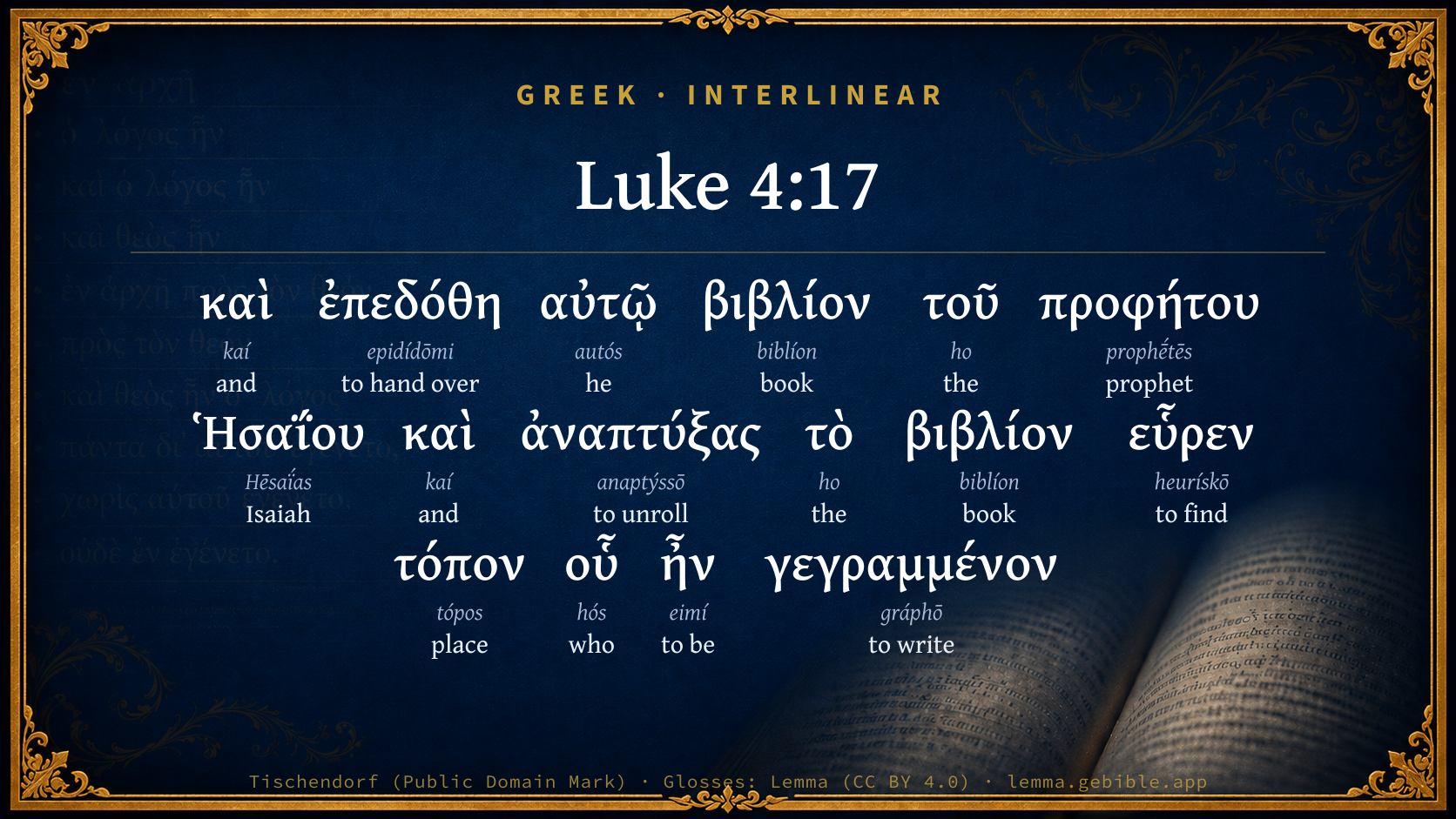
Download image
Cite this verse

Luke 4:17 (World English Bible). Public Domain. Lemma interlinear Bible study tool, https://lemma.gebible.app/v/luke/4/17.

Show BibTeX & RIS
BibTeX
RIS
English Translation
The book of the prophet Isaiah was handed to him. He opened the book, and found the place where it was written,
World English Bible · Public Domain
Highlights
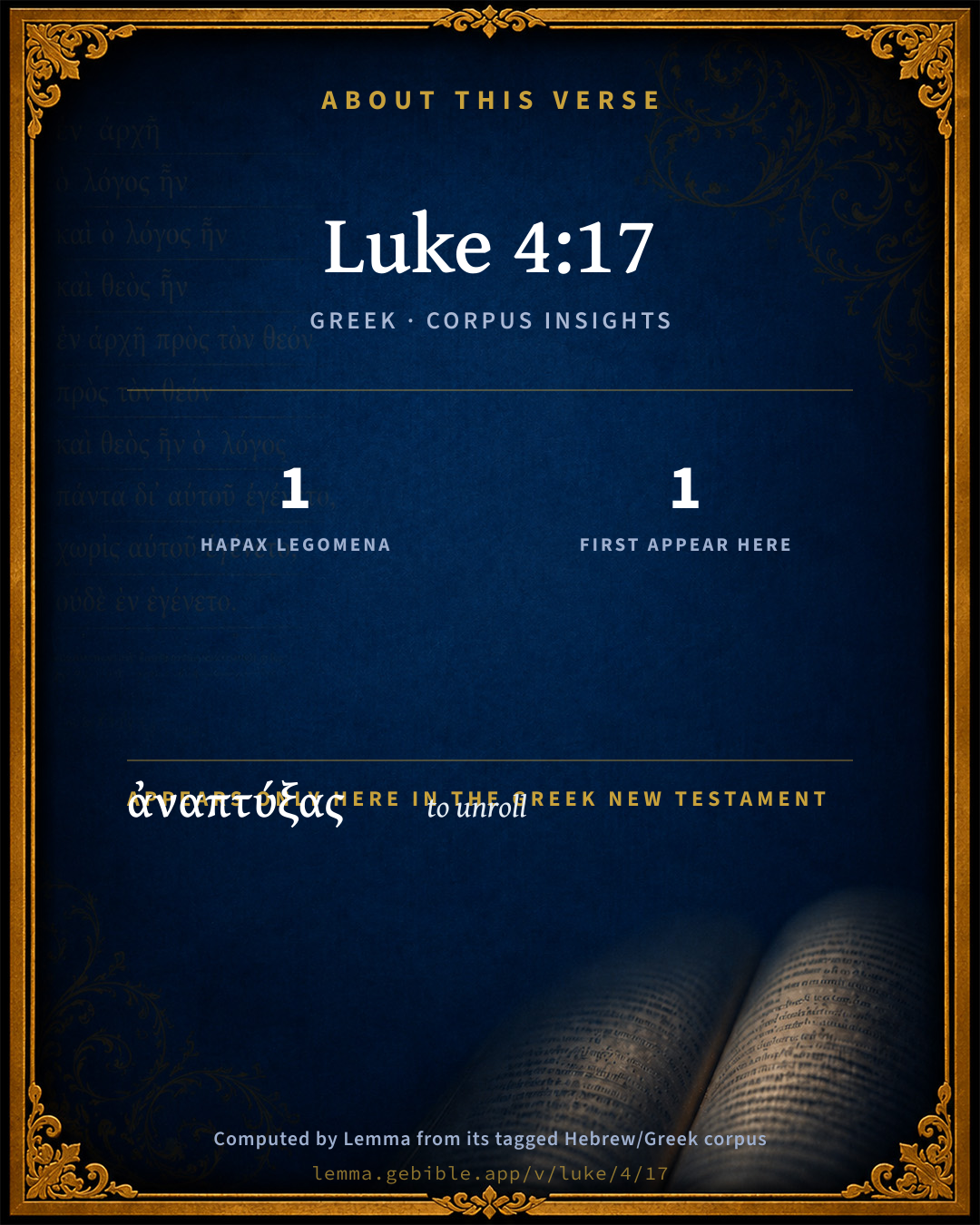
  • 1 hapax legomenon — only here in the Greek New Testament
  • 1 first appearance in the Greek New Testament
Full analysis ↓
Download a study sheet

One document with this verse’s original text, its word-by-word gloss line, the meaning frame, cross-references with their text, attributed commentary, and full source and license credits — printable, and it pastes into notes with its structure intact.

This verse Autodidact and up

Study sheet (.html) Plain text (.txt)

A passage Seminary Student

Up to 50 verses in one chapter. A passage sheet keeps up to 6 commentary sources and 12 cross-references per verse, in the order this page ranks them, and says so on the sheet whenever that leaves anything out. Ask for a single verse and you get the Autodidact verse sheet above.

Everything on this page stays free to read, with no account — the sheet is a download of what is already on screen, not access to it.

Want to remove ads? Support Godless Engineer
Compare translations 3

The same verse in 3 English versions, stacked beneath the original-language interlinear above. Click any original word for its lexicon entry.

Each is an independent rendering of the whole verse — the interlinear is not word-aligned to these translations.

Highlighted words mark where these versions differ — a whole-verse word diff, not a word-by-word alignment.

  • World English Bible Public Domain
    The book of the prophet Isaiah was handed to him. He opened the book, and found the place where it was written,
  • King James Version Public Domain
    And there was delivered unto him the book of the prophet Esaias. And when he had opened the book, he found the place where it was written,
  • unfoldingWord Literal Text CC BY-SA 4.0
    And the scroll of the prophet Isaiah was handed to him and, opening the scroll, he found the place where it was written,

unfoldingWord Literal Text — © unfoldingWord, licensed CC BY-SA 4.0. Word-aligned USFM3 via Door43 (git.door43.org/unfoldingWord/en_ult).

Versions to compare (up to 4)

3 of 4 selected

Show all 19 translations

Every available English version of this verse, each an independent rendering of the whole verse.

  • World English Bible Public Domain
    The book of the prophet Isaiah was handed to him. He opened the book, and found the place where it was written,
  • Berean Standard Bible Public Domain
    the scroll of the prophet Isaiah was handed to Him. Unrolling it, He found the place where it was written:
  • Majority Standard Bible Public Domain
    the scroll of Isaiah the prophet was handed to Him. Unrolling it, He found the place where it was written:
  • King James Version Public Domain
    And there was delivered unto him the book of the prophet Esaias. And when he had opened the book, he found the place where it was written,
  • American Standard Version (1901) Public Domain
    And there was delivered unto him the book of the prophet Isaiah. And he opened the book, and found the place where it was written,
  • Revised Version (1885) Public Domain
    And there was delivered unto him the book of the prophet Isaiah. And he opened the book, and found the place where it was written,
  • Geneva Bible (1599) Public Domain
    And there was deliuered vnto him the booke of the Prophet Esaias: and when hee had opened the booke, hee founde the place, where it was written,
  • Douay-Rheims (1899) Public Domain
    And the book of Isaias the prophet was delivered unto him. And as he unfolded the book, he found the place where it was written:
  • Young's Literal Translation Public Domain
    and there was given over to him a roll of Isaiah the prophet, and having unfolded the roll, he found the place where it hath been written:
  • Literal Standard Version CC BY-SA 4.0
    and there was given over to Him a scroll of Isaiah the prophet, and having unfolded the scroll, He found the place where it has been written:
  • Unlocked Literal Bible CC BY-SA 4.0
    The scroll of the prophet Isaiah was handed to him. He opened the scroll and found the place where it was written,
  • unfoldingWord Literal Text CC BY-SA 4.0
    And the scroll of the prophet Isaiah was handed to him and, opening the scroll, he found the place where it was written,
  • Darby Bible Public Domain
    And [the] book of the prophet Esaias was given to him; and having unrolled the book he found the place where it was written,
  • World Messianic Bible Public Domain
    The scroll of the prophet Isaiah was handed to him. He opened the scroll, and found the place where it was written,
  • Webster's Bible Public Domain
    And there was delivered to him the book of the prophet Isaiah. And when he had opened the book, he found the place where it was written,
  • Free Bible Version CC BY-SA 4.0
    The scroll of the prophet Isaiah was handed to him. Jesus unrolled the scroll and found the place where it's written:
  • Bible in Basic English Public Domain
    And the book of the prophet Isaiah was given to him and, opening the book, he came on the place where it is said,
  • Text-Critical English NT CC BY 4.0
    The scroll of the prophet Isaiah was handed to him, so he unrolled the scroll and found the place where it is written,
  • Tyndale New Testament (1534) Public Domain
    And ther was delyvered vnto him the boke of the Prophete Esaias. And when he had opened the boke he founde the place where it was written.

Literal Standard Version (2020), Covenant Press — licensed CC BY-SA 4.0. Text via the HelloAO Bible API (eBible.org). Unlocked Literal Bible (unfoldingWord) — licensed CC BY-SA 4.0. Text via the HelloAO Bible API (eBible.org). unfoldingWord Literal Text — © unfoldingWord, licensed CC BY-SA 4.0. Word-aligned USFM3 via Door43 (git.door43.org/unfoldingWord/en_ult). Free Bible Version, Dr. Jonathan Gallagher — licensed CC BY-SA 4.0. Text via the HelloAO Bible API (eBible.org).

Word by word

More ways to search: Search by grammar → Find every occurrence → Compare this word →

Practice this passage: Drill this verse → Learn its vocabulary →

ἀναπτύξας
anaptýssō
G380
“to unroll”
Verb, Aorist, Active, Participle, Nominative, Singular, Masculine
Part of Speech
Verb
Tense
Aorist
Voice
Active
Mood
Participle
Case
Nominative
Number
Singular
Gender
Masculine
Full Thayer's Definition

Origin: from G303 (in the sense of reversal) and G4428

TDNT: None

1. to unroll a. the books of the Hebrews were rolls fastened to [one or] two smooth rods and furnished with handles, so that they could be rolled up and unrolled
  1. καὶ kaí G2532 “and” Conjunction
  2. ἐπεδόθη epidídōmi G1929 “to hand over” Verb, Aorist, Passive, Indicative, 3rd person, Singular
  3. αὐτῷ autós G846 “he” Personal pronoun, Dative, Singular, Masculine
  4. βιβλίον biblíon G975 “book” Noun, Nominative, Singular, Neuter
  5. τοῦ ho G3588 “the” Article, Genitive, Singular, Masculine
  6. προφήτου prophḗtēs G4396 “prophet” Noun, Genitive, Singular, Masculine
  7. Ἡσαΐου Hēsaḯas G2268 “Isaiah” Noun, Genitive, Singular, Masculine
  8. καὶ kaí G2532 “and” Conjunction
  9. τὸ ho G3588 “the” Article, Accusative, Singular, Neuter
  10. βιβλίον biblíon G975 “book” Noun, Accusative, Singular, Neuter
  11. εὗρεν heurískō G2147 “to find” Verb, Aorist, Active, Indicative, 3rd person, Singular
  12. τόπον tópos G5117 “place” Noun, Accusative, Singular, Masculine
  13. οὗ hós G3739 “who” Adverb
  14. ἦν eimí G1510 “to be” Verb, Imperfect, Active, Indicative, 3rd person, Singular
  15. γεγραμμένον gráphō G1125 “to write” Verb, Perfect, Passive, Participle, Nominative, Singular, Neuter

About this verse

These counts appear in no published source. They are computed here, from the morphology-tagged text and Lemma’s own curated glosses. What Lemma adds →

16
words
13
distinct lemmas
Gospels
section

Notable vocabulary

1 hapax legomenon — a word that appears only here in the entire Greek New Testament:

  • ἀναπτύξας to unroll G380

First appearance in Scripture

This word makes its first canonical appearance in the Greek New Testament here:

  • ἀναπτύξας to unroll G380

Shared distinctive vocabulary

ἐπεδόθη to hand over G1929 occurs in 9 verses of the Greek New Testament. Also found in:
Repetition

Words recur within this verse:

  • βιβλίον book G975 ×2
  • καὶ and G2532 ×2
  • τοῦ the G3588 ×2

Cross-references

3

Topical passages linked to Luke 4:17 in the Treasury of Scripture Knowledge — connected by theme and wording, ordered by reader-vote popularity; previews shown in the World English Bible.

  • Isaiah 61:1–3 The Spirit of the Lord Yahweh is on me; because Yahweh has anointed me to preach good news to the humble; he has sent me to bind up the broken-hearted, to proclaim liberty to the captives, and the opening [of the prison] to those who are bound;
  • Acts 13:15 After the reading of the law and the prophets, the rulers of the synagogue sent to them, saying, "Brothers, if you have any word of exhortation for the people, speak."
  • Acts 7:42 But God turned, and gave them up to serve the host of the sky, as it is written in the book of the prophets, 'Did you offer to me slain animals and sacrifices Forty years in the wilderness, O house of Israel?

Cross-references courtesy of OpenBible.info (CC BY 4.0).

Commentary

Notes on Luke 4:17 from classic Christian and Jewish commentators (each source and its license shown beneath its notes). The classic Christian expositions comment on the surrounding passage and are grouped to its opening verse, so a note may address several verses; the Jewish commentaries on the Tanakh (Rashi and others) are per-verse, so they appear only where the commentator wrote on this verse.

Lemma curates 59 commentaries, every one of them public domain or Creative Commons licensed, each selected and text-cleaned for this edition rather than reprinted as found. About our sources →

Joseph Benson's Commentary

Luk 4:17-19. There was delivered to him the book of Esaias — A paragraph of the law having, according to custom, been read before. See on Act 13:15. When he had opened the book — Αναπτυξας, having unrolled the volume of the book. The books of the ancients, as is well known, consisted of one long sheet of paper or parchment, which they rolled up neatly on a round piece of wood. When a book of this kind was to be read, they unrolled it gradually as they read it, and put what was read round another piece of wood of the same sort with the former. He found the place — The expression, ευρε τον τοπον, seems to imply, that upon unrolling the book, the passage here mentioned immediately met his eye, by the particular providence of God. Many commentators, however, think, that as the Scriptures were read in order, the passage mentioned was that which fell of course to be read in the synagogue that day. And according to the custom of all the synagogues, this passage was to be read with the fiftieth section of the law, appointed for the last sabbath of the sixth, or the first of the seventh month, answering to our August and September. So that if our Lord read this passage as the ordinary lesson for the day, the chronology of this part of the history is thereby determined. The Spirit of the Lord is upon me — This was said of the prophets, when they were under an immediate afflatus of the Holy Spirit; but it was here, doubtless, primarily meant of the Messiah: because he hath anointed me — That is, hath commissioned me with authority, qualified me with gifts, and set me apart for the important offices here mentioned. The expression is used in allusion to the Jewish prophets, priests, and kings, who were consecrated to their offices by anointing them with oil. The unction of the Messiah was the Holy Spirit, which he had without measure. To preach the gospel to the poor — The reason why I, the Messiah, enjoy so great a degree of inspiration, and am endowed with the power of working such astonishing miracles is, because God hath commissioned me to preach the glad tidings of salvation to the poor, and by so doing, to heal the broken-hearted — That is, to relieve and comfort all those, without distinction, whose hearts are broken by sharp convictions of sin, and fears of future punishment. The passage of Isaiah here quoted, in our translation stands thus: To preach good tidings to the meek — But the word ענוים, signifies more properly persons in a low and afflicted condition. It is certainly an unspeakable recommendation of the gospel dispensation, that it offers the pardon of sin, and salvation, to all on the same terms. The rich, here, have no pre- eminence over the poor; as they seem to have had under the law, which prescribed such costly sacrifices for the atonement of sin as were very burdensome to the poor. The Prophet Isaiah, therefore, in describing the happiness of gospel times, very fitly introduces the Messiah mentioning this as one of the many blessings which would accrue to the world from his coming, that the glad tidings of salvation were to be preached by him and his ministers to the poor, and consequently were to be offered to them without money and without price. To preach deliverance to the captives — To proclaim to the captives of sin and Satan liberty from the power of their tyrannical masters, on the terms of repentance toward God, and faith in the Messiah, now manifested: and to confer that liberty on such as complied with these terms. And recovering of sight to the blind — Not merely to confer bodily sight on a few blind individuals, but to open the eyes of the understanding of millions, and cure their spiritual blindness, by imparting to them the spirit of wisdom and revelation. Thus, Isa 42:6-7, the Messiah is said to be given for a covenant of the people, for a light of the Gentiles, to open the blind eyes. And the commission given to Paul, as recorded, Act 26:18, was, I send thee to open their eyes, and to turn them from darkness to light: in both which passages spiritual illumination is undoubtedly solely intended. To set at liberty them that are bruised — With the heavy load of their fetters and chains; with the guilt and power of their iniquities, and the condemnation and wrath due to them on that account. Here is a beautiful gradation, in comparing the spiritual state of man to the miserable state of those captives who were not only cast into prison, but, like Zedekiah, had their eyes put out, and were laden and bruised with chains of iron. To preach the acceptable year of the Lord — To proclaim that happy period of the divine dispensations toward mankind, in which a full and free remission of all their offences was to be offered to them, and which might be fitly represented in prophecy by the Jewish jubilee, wherein debts were forgiven, slaves released, and inheritances restored to their original owners. For a further explanation of this passage, see the notes on Isa 61:1-3; and Isa 42:6-7.

Joseph Benson's Commentary on the Old and New Testaments (1811–1818) — public domain. Text from a community e-Sword module.

Bengel's Gnomon

Johann Albrecht Bengel

Luk 4:17. Βίβλιον Ἡσαΐου, the book of Isaiah) The Haphtara or publicly-read portion for that Sabbath was from Isaiah: moreover the table which was usually attached to the Hebrew Bibles (Scripture-rolls) of the Jews, connects most of the portions read from Isaiah with those read from Deuteronomy: from which it may be inferred what was the time of year when this Sabbath occurred.—ἀναπτύξας, having unrolled [the scroll on which Isaiah’s prophecies were written]) So the form of the books of that age required.—εὗρε, He found) immediately, and as it were accidentally. The mode of dispensing the Divine word is marvellous: but we ought not to tempt God by casting lots;[45] comp. Act 8:32. The pious use of Biblical ‘sortes’ or lots, is better than that of Homeric or Virgilian ‘sortes.’ See E. Neuhus. i. 3, fatid. Sacror., ch. ix, pp. 329, 330. J. C. Pfaff. Diss. de Evang. § 25.

[45] i.e. Opening the Bible hap-hazard, in hopes that God would work a miracle by making some passage present itself to solve our difficulties, just as the heathen consulted the oracular ‘sortes.’—ED. and TRANSL.

Bengel's Gnomon of the New Testament — English translation (T&T Clark, Edinburgh, 1860) — public domain. Text from a community e-Sword module.

Meyer's Critical & Exegetical Commentary

Heinrich August Wilhelm Meyer

Luk_4:17. Ἐπεδόθη] it was given up to Himthat is to say, by the officer of the synagogue, Lightfoot, p. 763.

Ἡσαΐου] the reading of the Parascha (section out of the law), which preceded that of the Haphthara (prophetic section), appears to have been already concluded, and perhaps there was actually in the course a Haphthara from Isaiah.[84] But in accordance with His special character (as κύριος τοῦ σαββάτου, Mat_12:8), Jesus takes the section which He lights upon as soon as it is unrolled (ἈΝΑΠΤ., comp. Herod. i. 48, 125), and this was a very characteristic Messianic passage, describing by very definite marks the Messiahs person and work. By ἈΝΑΠΤΎΞΑς ΤῸ ΒΙΒΛ. and ΕὟΡΕ the lighting exactly on this passage is represented as fortuitous, but just on that account as being divinely ordered (according to Theophylact: not κατὰ συντυχίαν, but ΑὐΤΟῦ ΘΕΛΉΣΑΝΤΟς).

[84] The arrangement of the present Haphtharas was not yet settled at the time of Jesus. See Zunz, Gottesd. Vorträge d. Juden, p. 6.

Meyer — Critical and Exegetical Commentary on the New Testament — English translation by Peter Christie, edited by Frederick Crombie (T&T Clark, 1880) — public domain. Text from a community e-Sword module.

Expositor's Greek Testament

ed. W. Robertson Nicoll

Luk 4:17 . Ἡσαίου : the second lesson, Haphtarah , was from the prophets; the first, Parashah , from the Law, which was foremost in Rabbinical esteem. Not so in the mind of Jesus. The prophets had the first place in His thoughts, though without prejudice to the Law. No more congenial book than Isaiah (second part especially) could have been placed in His hand. Within the Law He seems to have specially loved Deuteronomy, prophetic in spirit (vide the temptation ). εὗρε τόπον : by choice, or in due course, uncertain which; does not greatly matter. The choice would be characteristic, the order of the day providential as giving Jesus just the text He would delight to speak from. The Law was read continuously, the prophets by free selection (Holtz., H. C.).

The Expositor's Greek Testament, edited by W. Robertson Nicoll (1897–1910) — public domain. Text from a community e-Sword module.

Geneva Bible (1599)

Geneva Bible translators

Their books in those days were rolled up as scrolls upon a ruler: and so Christ unrolled, or unfolded it, which is here called opened.

Geneva Bible (1599) marginal notes — public domain. Text via Bolls.life.

Adam Clarke's Commentary

Verse 17. And when he had opened the book] αναπτυζας, When he had unrolled it. The Sacred Writings used to this day, in all the Jewish synagogues, are written on skins of basil, parchment, or vellum, sewed end to end, and rolled on two rollers, beginning at each end; so that, in reading from right to left, they roll off with the left, while they roll on with the right. Probably the place in the Prophet Isaiah, here referred to, was the lesson for that day; and Jesus unrolled the manuscript till he came to the place: then, after having read, he rolled it up again, and returned it to the officer, Lu 4:20, the ruler of the synagogue, or his servant, whose business it was to take care of it. The place that he opened was probably the section for the day. See the table at the end of Deuteronomy, and the note at the end of that table.

Adam Clarke's Commentary on the Bible (1810–1826) — public domain. Text from a community e-Sword/MySword module.

Ellicott's Commentary for English Readers

(17) The book of the prophet Esaias.—The Law—i.e., the Pentateuch—was commonly written on one long roll. The other books, in like manner—singly or combined, according to their length—were written on rolls of parchment, and were unrolled from the cylinder to which they were fastened. Here, it is clear, Isaiah formed a roll by itself. It is a natural inference from the fact that it was given to Him, that it contained the prophetic lesson for the day. In the calendar of modern Jews, the lessons from Isaiah run parallel with those from Deuteronomy. The chapter which He read stands as the second lesson for the day of Atonement. We cannot prove that the existing order obtained in the time of our Lord’s ministry, but everything in Judaism rests mainly on old traditions; and there is therefore nothing extravagant in the belief that it was on the day of Atonement that the great Atoner thus struck what was the key-note of His whole work.

When he had opened the book.—Better, when He had unrolled.

A Bible Commentary for English Readers, edited by Charles John Ellicott (1878–1897) — public domain. Text from a community e-Sword module.

The Cambridge Bible for Schools and Colleges

gen. ed. J. J. S. Perowne

17. there was delivered unto him] Literally, “there was further handed to Him.” The expression means that after He, or another, had read the Parashah, or First Lesson, which was always from the Pentateuch, the clerk handed to him the Roll of Isaiah, which contained the Haphtarah, or Second Lesson.

when he had opened the book] If anaptuxas is the true reading, it means ‘unrolling.’ The Thorah, or Law, was written on a parchment between two rollers, and was always left unrolled at the column for the day’s lesson; but the Megilloth of the Prophets, &c., were on single rollers, and the right place had to be found by the reader (Maphtir).

he found] The word heure leaves it uncertain whether the ‘finding’ was what man calls ‘accidental,’ or whether it was the regular haphtarah of the day. It is now the Second Lesson for the great day of Atonement; but according to Zunz (the highest Jewish authority on the subject) the present order of the Lessons in the Synagogue worship belongs to a later period than this.

the place where it was written] Isa_61:1-2. Our Lord, according to the custom of the Synagogue, must have read the passage in Hebrew, and then—either by Himself, or by an interpreter (Methurgeman)—it must have been translated to the congregation in Aramaic or Greek, since Hebrew was at this time a dead and learned language. The quotation is here freely taken by the Evangelist from the LXX., possibly from memory, and with reminiscences, intentional or otherwise, of other passages.

The Cambridge Bible for Schools and Colleges (gen. ed. J. J. S. Perowne; Cambridge University Press, 1878–1918) — public domain. Text from a community e-Sword module.

John Gill's Exposition

And there was delivered unto him,.... By the "Chazan", or minister, to whom he gave it again, Luk 4:20, for the "Chazan" of the synagogue, was, "the minister" (r); one part of whose business was, to deliver the book of the law to, and take it from him that read: when an high priest read, the method taken was this (s);

"the "Chazan", or minister of the synagogue, took the book of the law, and gave it to the ruler of the synagogue, and the ruler of the synagogue gave it to the "Sagan", and the "Sagan" gave it to the high priest, and the high priest stood and received, and read standing.''

The same method was observed, when a king read in the book of the law (t); but when a common priest, or an inferior person read, so much ceremony was not used, as to hand the book from one to another: the manner in their synagogues and schools, was this (u);

"the "Chazan" brought out the book of the law, and the priest read, and after him a Levite; then the "Chazan" of the synagogue brought the book of the law down, to the head of the captivity, and all the people stood; and he took the book of the law into his hands, and "stood and read" in it; and the heads of the schools stood with him, and the head of the university of Sofa interpreted it; and returned the book of the law to the "Chazan", and he returned it to the chest.''

That part of the sacred volume which was delivered unto Jesus at this time, was

the book of the prophet Esaias; it is very likely, that the lesson out of the prophets for that day, was to be read out of the prophecy of Isaiah; and it seems probable, that it was the single book of Isaiah, or that prophecy rolled up by itself, in one volume, that was delivered to Christ; as the law was divided, into five parts, each fifth part was sometimes in a book, or volume by itself: hence a fifth part of the law, is by the Jews interpreted (w), "a book" of the law, in which there is but one fifth part; so might the prophets be in separate and distinct books, and it as if they sometimes were, by the following account (x) a man may

"join together the law, the prophets, and the holy writings, as one, the words of R. Meir. R. Juda says, the law by itself, the prophets by themselves, and the holy writings by themselves; and the wise men say, each by themselves (i.e. each book by itself;) and says R. Judah, it happened to Baithus ben Zunin, that he had eight prophets joined together as one; and there are that say, that he had not, but, , "every one by itself."''

And when he had opened the book; or unrolled it, for books formerly were written in rolls of paper and parchment; and in this form, is the book of the law with the Jews, in their synagogues, to this day:

"all books, they say (y), are rolled from the beginning to the end of them, but the book of the law is rolled to the middle of it, and a pillar, or column, is made for it here and there; says R. Eliezer with R. Zadok, so the writers of books in Jerusalem made their books: the Rabbins teach, that they do not make the book of the law its length, more than its circumference, nor its circumference more than its length.''

Such a roll, or volume, of the prophet Isaiah, Christ unrolled, till he came to the place he intended to read: it is a rule with the Jews (z) that

"they do not unroll the book of the law in the congregation, because of the glory of the congregation.''

It may therefore be asked, whether Christ did not break this rule, since he unrolled the book that was given him, publicly in the synagogue? To which it may be replied, that it was lawful to unroll the book of the prophets, which was what Christ did, but not the law; for so runs another of their rules, (a).

"they skip in the prophets, but not in the law, because, , "that they unroll a prophet publicly", but they do not unroll the law publicly.''

Christ having thus unrolled the volume of the prophet Isaiah, which was put into his hands by the "Chazan", or minister,

he found the place where it was written; as is expressed in the following verse, and which is to be seen in Isa 61:1, and which was either the lesson of the day, or what Christ particularly sought for, and looked out; or was providentially directed to, as what was pertinent to himself, and proper to read and insist on at this time; for it was not by chance that he hit on this place, and read it, but it was according to purpose, and with design. Before the reading of the prophets, a blessing used to be said, which was in this form (b);

"blessed art thou, O Lord our God, the king of the world, Who hath chosen the good prophets, and art well pleased with their words, which are said in truth; blessed art thou, O Lord, who hast chosen the law, Moses his servant, and Israel his people, and the prophets of truth and righteousness.''

Whether this was delivered by Christ, is not certain; however, he read the following passage.

(r) Jarchi & Battenora in Misn. Sota, c. 7. sect. 7. & Yoma, c. 7. 1. (s) Misn. Yoma, c. 7. sect. 1. Maimon. Yom Haccippurim, c. 3. sect. 10. (t) Misn. Sota, c. 7. sect. 8. (u) Juchasin, fol. 123. 1. (w) Gloss. in T. Bab. Megilla, fol. 27. 1. (x) T. Bab. Bava Bathra, fol. 13. 2. & Massechet Sopherim, c. 3. sect 1, 5. (y) T. Bab. Bava Bathra, fol. 14. 1. (z) T. Bab. Yoma, fol. 70. 1. Maimon. Hilch, Tephilla, c. 12. sect. 23. (a) Massecheth Sepherim, c. 11. sect. 2. (b) Seder Tephillot, fol. 127. 2. Ed. Basil.

John Gill's Exposition of the Whole Bible (1746–1763) — public domain (CC PDM 1.0). Text via the HelloAO Bible API.

Trapp's Complete Commentary

John Trapp

17 And there was delivered unto him the book of the prophet Esaias. And when he had opened the book, he found the place where it was written,

Ver. 17. He found the place] Whether he looked for it, or it so happened by a providence, it is uncertain. Origen, after his fall, lighting on that text, Psa 50:16. "What hast thou to do to take my words," &c., fell into a passion of weeping, and came out of the pulpit, as not able to speak to the people. Augustine hearing from heaven, Tolle, lege, and happening upon that place, Rom 13:14; "Put ye on the Lord Jesus Christ," &c., was presently converted thereby. So was Cyprian, by reading the prophecy of Jonah.

John Trapp, A Commentary or Exposition upon All the Books of the Old and New Testament (1647–1656) — public domain. Text from a community e-Sword module.

Albert Barnes' Notes on the Bible

There was delivered unto him - By the minister of the synagogue, or the keeper of the sacred books. They were kept in an “ark” or chest, not far from the pulpit, and the minister gave them to whomsoever he chose, to read them publicly.

The book - The volume contained the prophecy of Isaiah. It would seem, from this, that the books were kept separate, and not united into one as with us.

When he had opened the book - Literally, when he had “unrolled” the book. Books, among the ancients, were written on parchments or vellum that is, skins of beasts, and were “rolled” together on two rollers, beginning at each end, so that while reading they rolled off from one to the other. Different forms of books were indeed used, but this was the most common. When used the reader unrolled the manuscript as far as the place which he wished to find, and kept before him just so much as he would read. When the roller was done with, it was carefully deposited in a case.

The place where it was written - Isa 61:1-2.

Albert Barnes' Notes on the Bible (1834–1885) — public domain. Text from a community e-Sword/MySword module.

Haydock's Catholic Bible Commentary

As he unfolded the book: and again, (ver. 20) when he had folded the book. Books at that time where not like our now-a-days, but were skins or parchments, rolled or folded up. (Witham) --- Some are of opinion that the Jews of Nazareth, having heard of the miracles and fame of Jesus, and that he was accustomed to teach in the synagogues, though he had never been instructed in any learning, when he rose to speak, purposely gave him the book of Isaias, which was esteemed the most difficult to be explained, in order to try his learning; though it is probable that it was done by the all-directing interposition of Divine Providence. (Maldonatus)

George Leo Haydock (1774–1849), Haydock's Catholic Family Bible and Commentary, 1859 edition — public domain. Excludes Psalms (Douay-Rheims chapter numbering differs from Protestant) and Deuterocanonical books (Catholic canon only).

Matthew Poole's English Annotations

The words differ in some things from the words of the prophet out of which they are quoted, Isa 61:1, where is nothing of recovering of sight to the blind; but they exactly agree with the Septuagint version, only, Luk 4:19, they have καλεσαι, to call, and Luke hath κηρυξαι, to preach, according to which probably the copies of the Septuagint in use with them were. It was their manner in the synagogues for the minister (an officer appointed to that purpose, see Luk 4:20) to bring the book of the law or of the prophets which was to be read, and to deliver it to him that officiated for that time, who, when he had read, redelivered it to the same officer to be laid up. Their writers tell us, that the books of Moses were divided into several portions, which they were tied to read in order; but for the books of the prophets, he that officiated was more at liberty to read in what place and proportion he pleased. Our Lord readeth Isa 61:1, which, according to the Septuagint copy, was as Luke here translated; and by the way, this custom of the writers of the New Testament, (writing in Greek), to quote texts out of the Old Testament, very often according to that Septuagint translation, may, first, give us some account of the difficulty we met with Luk 3:1-38, where Sala was made the son of Cainan, and the grandchild of Arphaxad, whereas Moses mentions no Cainan, Gen 11:1-32 Luke, taking the quotation of the Septuagint, might put it in according to them, for they have it in Gen 11:12. Secondly, it may learn us not to be too curious as to minute things in Scripture, for had it been a thing of moment, the Holy Spirit of God had certainly never suffered Luke to write after their copy, either there or here. God never had a church in any place, but he soon stirred up some to make an interpretation of the Scriptures for their use, and so far assisted them, that though they might differ from the Hebrew text, or the Greek, in some minute things, yet they differed not in any thing of moment necessary for us to know and believe in order to salvation. And the frequent quotations we have in the New Testament out of the Septuagint, incline us to think that it is the will of God, that particular persons in churches should make use of such versions, and take them for the Holy Scriptures, not lightly and ordinarily varying from them; the translating of Scriptures, being not an ordinary ministerial gift, but the work of some stirred up by God unto it, and whom he more than ordinarily so assists, as that they have not erred in any momentous thing. If this may be admitted, we need not lay the fault upon those who transcribed Luke’s copy. But let us come to the text itself.

The Spirit of the Lord is upon me, because he hath anointed me. Anointing may signify two things:

1. The endowment of the person with gifts and abilities fit for his work. Thus, 1Jo 2:27, the anointing is said to teach us all things; and Christ is said, Psa 45:7; Heb 1:9, to be anointed with the oil of gladness above his fellows, which the Baptist seemeth to interpret, Joh 3:34, God giveth not the Spirit by measure unto him.

2. Anointing also was a symbol of God’s calling out and sending a person to the execution of an office, 2Ki 9:6.

3. I find also anointing used as a symbol of God’s purpose and designation of a person to an employment, to the performance of which he did not presently call him; thus David was anointed, 1Sa 16:13.

By

the Spirit of the Lord is upon me, I conceive is meant, exciting and quickening Christ to the present execution of that office to which God had anointed him; that is:

1. Of old designed him;

2. Fitted him, giving him the Spirit not by measure;

3. Now called him to the exercise of it: and because the Lord had so designed him, so prepared, and now so called him, the Spirit now excited and quickened him.

God stirreth up none to take upon them the office of the ministry, whom he hath not fitted with gifts for the discharge of it. But what was this employment to which Christ was anointed? ευαγγελιζεσθαι, to preach the gospel to the poor. This was the great work of our Lord and Saviour, to preach. And what? The gospel, the glad tidings of salvation. To whom? ητωχοις: it is used to signify those that are mean in the world, and, by a figure, those that are miserable and afflicted; and this I should take to be the sense here, in conformity to that other phrase which our Saviour useth to John’s disciples, Mat 6:5, and to that of the apostle, 1Co 1:27. Christ was first sent to the lost sheep of the house of Israel, who were all at this time in a poor afflicted state and condition, and amongst them chiefly to the meaner sort. The rulers believed not on him, Joh 7:48; to teach ministers what Erasmus saith, Nulla nobis anima vilis videri debet, pro qua Dominus gloriae mori non est dedignatus, That they are too proud that despise the poor, and that we ought not to count any soul vile for which he who was the Lord of glory disdained not to die: we may add, to which the great Minister of the circumcision took himself to be anointed to preach.

I had rather thus understand it, than of such as are poor in spirit; which seem to be understood in the next words, he hath sent me to heal the broken hearted, whether wounded in the sense of sin, or melted in the sense of mercy: the whole hearted are such as see no need of repentance, no need of a Saviour; Christ came not to heal these; The whole need not a physician.

It followeth, to preach deliverance to the captives; to let them know, that are yet slaves to sin and to their lusts, that there is a way for their deliverance.

And recovering of sight to the blind; to let all blind sinners know, that there is an eye salve discovered, which if applied will recover their spiritual sight.

To set at liberty them that are bruised: it is of the same significance with binding up the broken in heart.

To preach the acceptable year of the Lord; the true jubilee, when every soul may be set free from the bonds of its sins, 2Co 6:17; the year of God’s good will; that the time was now come, when in every nation he that feared God, and wrought righteousness, should be accepted with him, Act 10:35.

Matthew Poole's English Annotations on the Holy Bible (1683–1685) — public domain. Text from a community e-Sword/MySword module.

Whedon's Commentary on the Bible

Daniel D. Whedon

17. Delivered unto him—The chazan, or superintendent of service, hands him the book or roll, taken from the chest or closet where it was, as was customarily done to any person in the estimation of the superintendent qualified to read the exercise. The “fame of him” (Luk_4:14-15) had encompassed Nazareth, and the curiosity of the audience amply justified the chazan in giving him liberty of speech. The book was a roll, as described in our note upon Mat_1:1. It was opened by unrolling, and shut by rolling up again. The place may have been the regular lesson of the day, and the roll containing Isaiah may have been handed him; but it is not certain that such division of the lesson at that time existed.

Found the place—By revolving the roll so as to reach it. No place could be more appropriate. The passage is in Isa_61:1-2.

Daniel D. Whedon (gen. ed.), Commentary on the Old and New Testaments (1874–1909) — public domain. Text from a community e-Sword module.

The Pulpit Commentary

And there was delivered unto him the Book of the Prophet Esaias. In the sabbath service there were two lessons read. The first was always taken from the Pentateuch (the Law). The five books of Moses were written on parchment, (usually) between two rollers, and the day"s lesson was left unrolled for the reader"s convenience. The Prophets were on single rollers, no special portion being left open. It has been suggested that the great and famous Messianic passage read by our Lord was the lesson for the day. This is quite uncertain; indeed, it is more probable that Jesus, when the roll of Isaiah was handed to him by the ruler of the synagogue, specially selected the section containing this passage.

The Pulpit Commentary (1880–1919), ed. H.D.M. Spence-Jones & Joseph S. Exell — public domain. Text from a community e-Sword module.

John Wesley's Explanatory Notes

He found - It seems, opening upon it, by the particular providence of God.

John Wesley, Explanatory Notes Upon the Whole Bible (1754–1765) — public domain. Text via the GEBible commentary corpus.

The People's New Testament

B. W. Johnson

17. The book of … Isaiah. There were regular readings for each Sabbath, and that of this one was partly in Isaiah. The book was a roll of manuscript. He found. Isa. 61:1–3. A passage that refers to the Messiah. All will note how accurately it describes his work.

B. W. Johnson's The People's New Testament with Notes (1889–1891) — public domain. Electronic text from the Christian Classics Ethereal Library (CCEL) ThML edition.

Cambridge Greek Testament for Schools and Colleges

17. ἀναπτύξας. Ἀνοίξας (ABL, La[93]) is perhaps an explanation. τόπον, so אL.

[93] La. Lachmann.

17. ἐπεδόθη αὐτῷ. Literally, “there was further handed to Him.” The expression means that after He, or another, had read the Parashah, or First Lesson, which was always from the Pentateuch, the clerk handed to him the roll of Isaiah, which contained the Haphtarah, or Second Lesson.

καὶ ἀναπτύξας τὸ βιβλίον. If this is the true reading, it means ‘unrolling.’ The Thorah, or Law, was written on a parchment between two rollers, and was always left unrolled at the column for the day’s lesson; but the Megilloth of the Prophets, &c. were on single rollers, and the right place had to be found by the reader (Maphtir).

εὗρεν. The word leaves it uncertain whether the ‘finding’ was what man calls ‘accidental,’ or whether it was the regular haphtarah of the day. It is now the Second Lesson for the great day of Atonement; but according to Zunz (the highest Jewish authority on the subject) the present order of the Lessons in the Synagogue worship belongs to a later period than this. (Zunz, Gottesd. Vorträge, 6).

τόπον οὗ ἦν γεγραμμένον. Isa 61:1-2. Our Lord, according to the custom of the Synagogue, must have read the passage in Hebrew, and then—either by Himself, or by an interpreter (Methurgeman)—it must have been translated to the congregation in Aramaic or Greek, since Hebrew was at this time a dead and learned language. The quotation is here freely taken by the Evangelist from the LXX[99], possibly from memory, and with reminiscences, intentional or otherwise, of other passages.

[99] LXX. Septuagint.

Cambridge Greek Testament for Schools and Colleges (Cambridge University Press, 1896; 21 vols, various authors incl. Carr, Maclear, Plummer, Farrar, Lumby, Moule, M. R. James, Simcox) — public domain. Text from a community e-Sword module.

Alford’s Greek Testament

Henry Alford

17.] It is doubtful whether the Rabbinical cycle of Sabbath readings, or lessons from the law and prophets, were as yet in use: but some regular plan was adopted; and according to that plan, after the reading of the law, which always preceded, the portion from the prophets came to be read (see Act 13:15), which, for that sabbath, fell in the prophet Isaiah. The roll containing that book (probably, that alone) was given to the Lord. But it does not appear that He read any part of the lesson for the day; but when He had unrolled the scroll, found (the fortuitous, i.e. providential, finding is the most likely interpretation, not the searching for and finding) the passage which follows.

No inference can be drawn as to the time of the year from this narrative; partly on account of the uncertainty above mentioned, and partly because it is not quite clear whether the roll contained only Isaiah, or other books also.

Henry Alford, The Greek Testament (1849–1861) — public domain. Text from a community e-Sword module.

International Critical Commentary

17. ἐπεδόθη. “Was handed” to Him, “was given over by handing”: comp. ἐπεζήτουν (ver. 42). It does not mean “was handed to Him in addition, ” implying that something else had been handed to Him previously. This meaning is not common, and is not found elsewhere in N.T. The reading of the Parascha, or section from the Law, had probably preceded, and had been read possibly by someone else. This was the Haphthara, or prophetic section (Act 13:15). That Isa 61:1, Isa 61:2 was the lesson appointed for the day is quite uncertain. We do not even know whether there was at that time any cycle of prophetical lessons, nor whether it would be strictly adhered to, if there was such. Apparently Isaiah was handed to Him without His asking for it; but that also is uncertain. The cycle of lessons now in use is of much later origin; and therefore to employ the Jewish lectionary in order to determine the day on which this took place is futile. On the other hand, there is no evidence that “Jesus takes the section which He lights upon as soon as it is unrolled”; for εὖρε quite as easily may mean the opposite;—that He intentionally found a passage which had been previously selected.

The more definite ἀναπτύξας (א D) is probably a correction of ἀνοίξαι (A B L and most versions). The former occurs nowhere in N.T., while the latter is very common: see esp. Rev 5:2, Rev 5:3, Rev 5:4, Rev 5:5, Rev 5:10:2, Rev 5:8, 20:12. Fond as Lk. is of analytical tenses, ἦν γεγραμμεινον occurs nowhere else in his writings: ἕστι γεγραμ. is common in Jn. (2:17, 6:31, 45, 10:34, 12:14, 16).

International Critical Commentary — older volumes (1896–1929), various authors — public domain. Text from a community e-Sword module.

Vincent's Word Studies in the New Testament

Marvin R. Vincent

The book [βιβλιον] . A diminutive of biblov, the inner bark of the papyrus, used for writing. Hence, a roll. The word is also used to denote a division of a work, and is therefore appropriate here to mark the writings of a single prophet as related to the whole body of the prophetic writings. Opened [αναπτυξας] . Lit., unrolled. Both this and the simple verb ptussw, to close, (verse 30), occure only once in the New Testament. The former word was used in medical language of the opening out of various parts of the body, and the latter of the rolling up of bandages. The use of these terms by Luke the physician is the more significant from the fact that elsewhere in the New Testament ajnoigw, is used for the opening of a book (Rev 5:2 - 5; Rev 10:2, 8; Rev 20:12) and eijlissw, for rolling it up (Rev 6:14).

Found. As if by chance : reading at the place where the roll opened of itself, and trusting to divine guidance.

Was written [ην γεγραμμενον] . Lit., was having been written; i e., stood written.

Marvin R. Vincent, Word Studies in the New Testament (1887–1900) — public domain. Text from a community e-Sword/MySword module.

Lesson kit

Teaching starters — assembled from the data on this page, not authored interpretation. Every prompt links to the verse data it draws on. Edit before teaching.

Luke, in the Gospels, opens this verse with 16 words (13 distinct Greek lemmas). Its most distinctive word is anaptýssō (“to unroll”). A historical commentator’s framing appears above. Read the whole chapter for the surrounding context.

Discussion questions

  1. The word anaptýssō carries the sense “to unroll.” How does it shape the verse?
  2. 1 word here appears nowhere else in the Greek New Testament. Why might the author reach for such rare wording?
  3. This is the first place “to unroll” appears in Scripture (first appears here). What does its debut here establish?
  4. How does Matthew 7:9, which shares the word «to hand over», read alongside this verse?
  5. What does the repetition of “book” (2× in this one verse) do in this verse?
  6. The translations on this page render this verse differently — a whole-verse word diff, not a word-by-word alignment. What might account for the different wordings?
  7. Compare how Joseph Benson's Commentary and Bengel's Gnomon read this verse. Where do they agree or differ?

Things to notice

  • 1 word in this verse appears nowhere else in the Greek New Testament.
  • 1 word makes its first canonical appearance in Scripture here.
  • These translations choose different wording for 11 words in this verse.
  • “book” occurs 2× in this single verse.
  • 13 distinct Greek lemmas span 16 words in this verse.

Reading settings

Reading text

Shown beneath each verse's original-language words.

Old Testament
Old Testament edition

Read the OT as the Masoretic Hebrew (MT) or the Greek Septuagint (LXX).

English shown for the Greek Septuagint (in the Hebrew ↔ Greek comparison).

Comparing translations? Open the Compare panel on any verse page to stack up to four side by side.