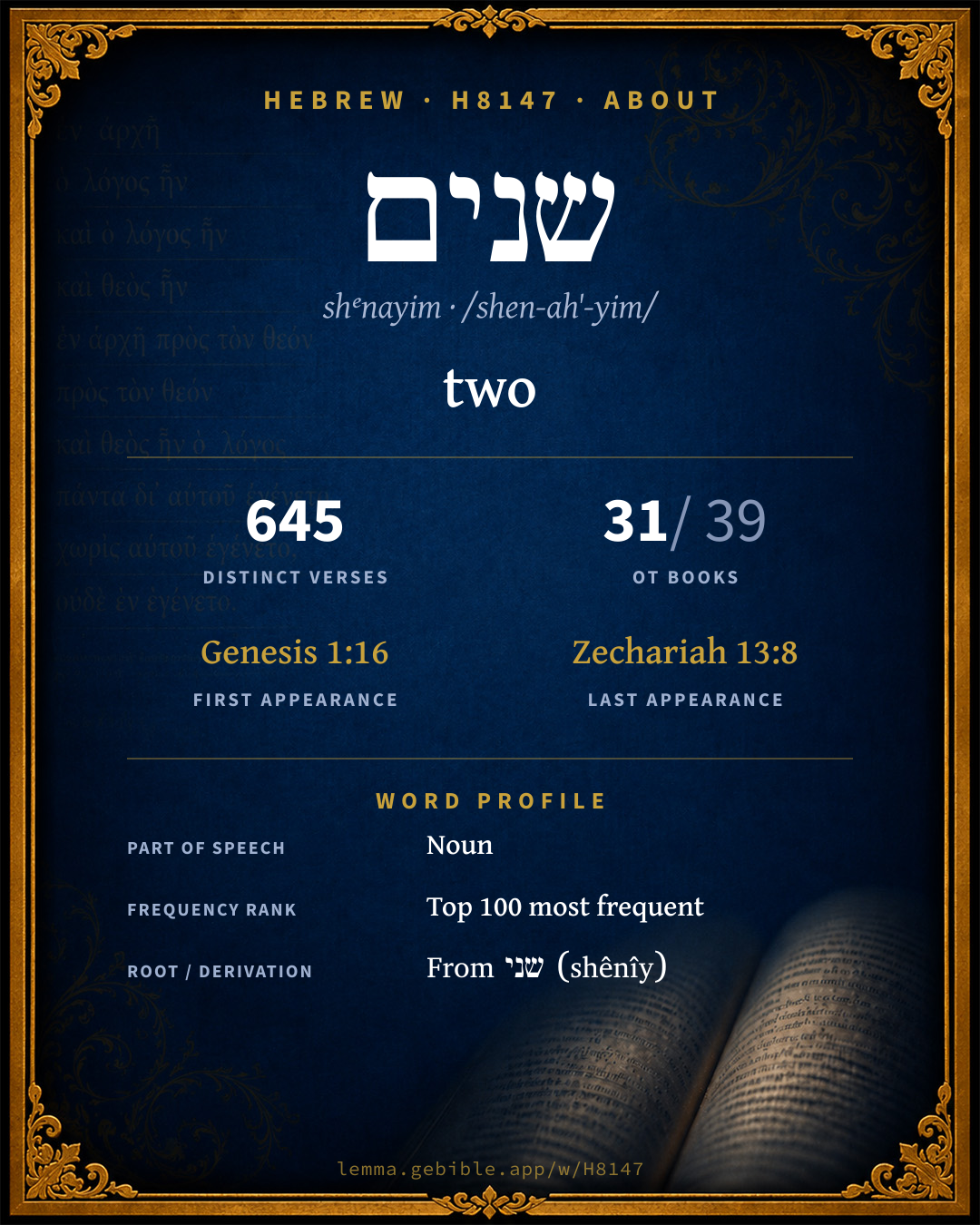
שְׁנַ֫יִם
two
‘two’ is one of 5 main senses fuller range ↓
Full lexicon entry — Brown-Driver-Briggs (BDB)
From Brown-Driver-Briggs (BDB)
Where this word appears
See every Construct-state word in the Hebrew Bible →
Grammar key — what these labels mean
Part of speech
- Adjective
- A word that describes or qualifies a noun.
State
- Absolute
- The independent form of a noun, not bound to a following word.
- Construct
- A noun bound to a following noun in a possessive / “of” relationship (the construct chain).
Gender
- Masculine
- Grammatically masculine.
- Feminine
- Grammatically feminine.
Number
- Dual
- Exactly two — for natural pairs and some measures of time.
Grammatical forms
- Adjective, Cardinal number, Masculine, Dual, Construct 275 times (36%)
- Adjective, Cardinal number, Masculine, Dual, Absolute 241 times (31%)
- Adjective, Cardinal number, Feminine, Dual, Construct 142 times (18%)
- Adjective, Cardinal number, Feminine, Dual, Absolute 110 times (14%)
Parsed forms decoded from the imported morphology (morphhb / Westminster Leningrad Codex — WLC text public domain, morphhb tagging CC BY 4.0), counted across 768 parsed occurrences — not distinct verses.
Page 1 of 4 — showing verses 1–200 of 645 distinct verses where H8147 appears, across 31 books. Click any verse to open its interlinear word-by-word view. Verse text shown in the World English Bible for context — . Each verse’s Hebrew form is shown with its reference; the English is not keyword-highlighted, since the data carries no word-level English alignment. Use “Compare translations” on any verse to read it across multiple English versions. This concordance covers the Hebrew Bible; Septuagint (Greek Old Testament) occurrences are not indexed here.
Genesis 58 verses
- Genesis 1:16 שְׁנֵ֥י adj Cardinal number md cs God made the two great lights: the greater light to rule the day, and the lesser light to rule the night. He also made the stars.
- Genesis 2:25 שְׁנֵי/הֶם֙ adj Cardinal number md cs + sfx pers 3mp They were both naked, the man and his wife, and were not ashamed.
- Genesis 3:7 שְׁנֵי/הֶ֔ם adj Cardinal number md cs + sfx pers 3mp Both of their eyes were opened, and they knew that they were naked. They sewed fig leaves together, and made themselves aprons.
- Genesis 4:19 שְׁתֵּ֣י adj Cardinal number fd cs Lamech took two wives: the name of the one was Adah, and the name of the other Zillah.
- Genesis 5:8 שְׁתֵּ֤ים adj Cardinal number fd All the days of Seth were nine hundred twelve years, then he died.
- Genesis 5:18 שְׁתַּ֧יִם adj Cardinal number fd Jared lived one hundred sixty-two years, and became the father of Enoch.
- Genesis 5:20 שְׁתַּ֤יִם adj Cardinal number fd All the days of Jared were nine hundred sixty-two years, then he died.
- Genesis 5:26 שְׁתַּ֤יִם adj Cardinal number fd Methuselah lived after he became the father of Lamech seven hundred eighty-two years, and became the father of sons and daughters.
- Genesis 5:28 שְׁתַּ֧יִם adj Cardinal number fd Lamech lived one hundred eighty-two years, and became the father of a son,
- Genesis 6:19 שְׁנַ֧יִם adj Cardinal number md Of every living thing of all flesh, you shall bring two of every sort into the ark, to keep them alive with you. They shall be male and female.
- Genesis 6:20 שְׁנַ֧יִם adj Cardinal number md Of the birds after their kind, of the cattle after their kind, of every creeping thing of the ground after its kind, two of every sort shall come to you, to keep them alive.
- Genesis 7:2 שְׁנַ֖יִם adj Cardinal number md You shall take seven pairs of every clean animal with you, the male and his female. Of the animals that are not clean, take two, the male and his female.
- Genesis 7:9 שְׁנַ֨יִם שְׁנַ֜יִם adj Cardinal number md adj Cardinal number md went by pairs to Noah into the ark, male and female, as God commanded Noah.
- Genesis 7:15 שְׁנַ֤יִם שְׁנַ֨יִם֙ adj Cardinal number md adj Cardinal number md They went to Noah into the ark, by pairs of all flesh with the breath of life in them.
- Genesis 9:22 לִ/שְׁנֵֽי prep + Adjective Cardinal number md cs Ham, the father of Canaan, saw the nakedness of his father, and told his two brothers outside.
- Genesis 9:23 שְׁנֵי/הֶ֔ם adj Cardinal number md cs + sfx pers 3mp Shem and Japheth took a garment, and laid it on both their shoulders, went in backwards, and covered the nakedness of their father. Their faces were backwards, and they didn't see their father's nakedness.
- Genesis 10:25 שְׁנֵ֣י adj Cardinal number md cs To Eber were born two sons. The name of the one was Peleg, for in his days was the earth divided. His brother's name was Joktan.
- Genesis 11:20 שְׁתַּ֥יִם adj Cardinal number fd Reu lived thirty-two years, and became the father of Serug.
- Genesis 14:4 שְׁתֵּ֤ים adj Cardinal number fd Twelve years they served Chedorlaomer, and in the thirteenth year, they rebelled.
- Genesis 17:20 שְׁנֵים adj Cardinal number md As for Ishmael, I have heard you. Behold, I have blessed him, and will make him fruitful, and will multiply him exceedingly. He will become the father of twelve princes, and I will make him a great nation.
- Genesis 19:1 שְׁנֵ֨י adj Cardinal number md cs The two angels came to Sodom at evening. Lot sat in the gate of Sodom. Lot saw them, and rose up to meet them. He bowed himself with his face to the earth,
- Genesis 19:8 שְׁתֵּ֣י adj Cardinal number fd cs See now, I have two virgin daughters. Please let me bring them out to you, and do you to them as is good in your eyes. Only don't do anything to these men, because they have come under the shadow of my roof."
- Genesis 19:15 שְׁתֵּ֤י adj Cardinal number fd cs When the morning arose, then the angels hurried Lot, saying, "Arise, take your wife, and your two daughters who are here, lest you be consumed in the iniquity of the city."
- Genesis 19:16 שְׁתֵּ֣י adj Cardinal number fd cs But he lingered; and the men laid hold on his hand, and on the hand of his wife, and on the hand of his two daughters, Yahweh being merciful to him; and they took him out, and set him outside of the city.
- Genesis 19:30 וּ/שְׁתֵּ֤י וּ/שְׁתֵּ֥י conj + Adjective Cardinal number fd cs conj + Adjective Cardinal number fd cs Lot went up out of Zoar, and lived in the mountain, and his two daughters with him; for he was afraid to live in Zoar. He lived in a cave with his two daughters.
- Genesis 19:36 שְׁתֵּ֥י adj Cardinal number fd cs Thus both of Lot's daughters were with child by their father.
- Genesis 21:27 שְׁנֵי/הֶ֖ם adj Cardinal number md cs + sfx pers 3mp Abraham took sheep and oxen, and gave them to Abimelech. Those two made a covenant.
- Genesis 21:31 שְׁנֵי/הֶֽם adj Cardinal number md cs + sfx pers 3mp Therefore he called that place Beersheba, because they both swore there.
- Genesis 22:3 שְׁנֵ֤י adj Cardinal number md cs Abraham rose early in the morning, and saddled his donkey, and took two of his young men with him, and Isaac his son. He split the wood for the burnt offering, and rose up, and went to the place of which God had told him.
- Genesis 22:6 שְׁנֵי/הֶ֖ם adj Cardinal number md cs + sfx pers 3mp Abraham took the wood of the burnt offering and laid it on Isaac his son. He took in his hand the fire and the knife. They both went together.
- Genesis 22:8 שְׁנֵי/הֶ֖ם adj Cardinal number md cs + sfx pers 3mp Abraham said, "God will provide himself the lamb for a burnt offering, my son." So they both went together.
- Genesis 24:22 וּ/שְׁנֵ֤י conj + Adjective Cardinal number md cs It happened, as the camels had done drinking, that the man took a golden ring of half a shekel weight, and two bracelets for her hands of ten shekels weight of gold,
- Genesis 25:16 שְׁנֵים adj Cardinal number md These are the sons of Ishmael, and these are their names, by their villages, and by their encampments: twelve princes, according to their nations.
- Genesis 25:23 שְׁנֵ֤י וּ/שְׁנֵ֣י adj Cardinal number md cs conj + Adjective Cardinal number md cs Yahweh said to her, Two nations are in your womb, Two peoples will be separated from your body. The one people will be stronger than the other people. The elder will serve the younger.
- Genesis 27:9 שְׁנֵ֛י adj Cardinal number md cs Go now to the flock, and get me from there two good kids of the goats. I will make them savory food for your father, such as he loves.
- Genesis 27:45 שְׁנֵי/כֶ֖ם adj Cardinal number md cs + sfx pers 2mp until your brother's anger turn away from you, and he forgets what you have done to him. Then I will send, and get you from there. Why should I be bereaved of you both in one day?"
- Genesis 29:16 שְׁתֵּ֣י adj Cardinal number fd cs Laban had two daughters. The name of the elder was Leah, and the name of the younger was Rachel.
- Genesis 31:33 שְׁתֵּ֥י adj Cardinal number fd cs Laban went into Jacob's tent, into Leah's tent, and into the tent of the two maid-servants; but he didn't find them. He went out of Leah's tent, and entered into Rachel's tent.
- Genesis 31:37 שְׁנֵֽי/נוּ adj Cardinal number md cs + sfx pers 1cp Now that you have felt around in all my stuff, what have you found of all your household stuff? Set it here before my relatives and your relatives, that they may judge between us two.
- Genesis 31:41 בִּ/שְׁתֵּ֣י prep + Adjective Cardinal number fd cs These twenty years have I been in your house. I served you fourteen years for your two daughters, and six years for your flock, and you have changed my wages ten times.
- Genesis 32:7 לִ/שְׁנֵ֥י prep + Adjective Cardinal number md cs Then Jacob was greatly afraid and was distressed: and he divided the people who were with him, and the flocks, and the herds, and the camels, into two companies;
- Genesis 32:10 לִ/שְׁנֵ֥י prep + Adjective Cardinal number md cs I am not worthy of the least of all the loving kindnesses, and of all the truth, which you have shown to your servant; for with just my staff I passed over this Jordan; and now I have become two companies.
- Genesis 32:22 שְׁתֵּ֤י שְׁתֵּ֣י adj Cardinal number fd cs adj Cardinal number fd cs He rose up that night, and took his two wives, and his two handmaids, and his eleven sons, and passed over the ford of the Jabbok.
- Genesis 33:1 שְׁתֵּ֥י adj Cardinal number fd cs Jacob lifted up his eyes, and looked, and, behold, Esau was coming, and with him four hundred men. He divided the children between Leah, Rachel, and to the two handmaids.
- Genesis 34:25 שְׁנֵֽי adj Cardinal number md cs It happened on the third day, when they were sore, that two of Jacob's sons, Simeon and Levi, Dinah's brothers, each took his sword, came upon the unsuspecting city, and killed all the males.
- Genesis 35:22 שְׁנֵ֥ים adj Cardinal number md It happened, while Israel lived in that land, that Reuben went and lay with Bilhah, his father's concubine, and Israel heard of it. Now the sons of Jacob were twelve.
- Genesis 40:2 שְׁנֵ֣י adj Cardinal number md cs Pharaoh was angry with his two officers, the chief cupbearer and the chief baker.
- Genesis 40:5 שְׁנֵי/הֶ֜ם adj Cardinal number md cs + sfx pers 3mp They both dreamed a dream, each man his dream, in one night, each man according to the interpretation of his dream, the cupbearer and the baker of the king of Egypt, who were bound in the prison.
- Genesis 41:50 שְׁנֵ֣י adj Cardinal number md cs To Joseph were born two sons before the year of famine came, whom Asenath, the daughter of Potiphera priest of On, bore to him.
- Genesis 42:13 שְׁנֵ֣ים adj Cardinal number md They said, "We, your servants, are twelve brothers, the sons of one man in the land of Canaan; and, behold, the youngest is this day with our father, and one is no more."
- Genesis 42:32 שְׁנֵים adj Cardinal number md We are twelve brothers, sons of our father; one is no more, and the youngest is this day with our father in the land of Canaan.'
- Genesis 42:37 שְׁנֵ֤י adj Cardinal number md cs Reuben spoke to his father, saying, "Kill my two sons, if I don't bring him to you. Deliver him into my hand, and I will bring him to you again."
- Genesis 44:27 שְׁנַ֖יִם adj Cardinal number md Your servant, my father, said to us, 'You know that my wife bore me two sons:
- Genesis 46:27 שְׁנָ֑יִם adj Cardinal number md The sons of Joseph, who were born to him in Egypt, were two souls. All the souls of the house of Jacob, who came into Egypt, were seventy.
- Genesis 48:1 שְׁנֵ֤י adj Cardinal number md cs It happened after these things, that someone said to Joseph, "Behold, your father is sick." He took with him his two sons, Manasseh and Ephraim.
- Genesis 48:5 שְׁנֵֽי adj Cardinal number md cs Now your two sons, who were born to you in the land of Egypt before I came to you into Egypt, are mine; Ephraim and Manasseh, even as Reuben and Simeon, will be mine.
- Genesis 48:13 שְׁנֵי/הֶם֒ adj Cardinal number md cs + sfx pers 3mp Joseph took them both, Ephraim in his right hand toward Israel's left hand, and Manasseh in his left hand toward Israel's right hand, and brought them near to him.
- Genesis 49:28 שְׁנֵ֣ים adj Cardinal number md All these are the twelve tribes of Israel, and this is what their father spoke to them and blessed them. He blessed everyone according to his blessing.
Exodus 66 verses
- Exodus 2:13 שְׁנֵֽי adj Cardinal number md cs He went out the second day, and, behold, two men of the Hebrews were fighting with each other. He said to him who did the wrong, "Why do you strike your fellow?"
- Exodus 4:9 לִ/שְׁנֵ֨י prep + Adjective Cardinal number md cs It will happen, if they will not believe even these two signs, neither listen to your voice, that you shall take of the water of the river, and pour it on the dry land. The water which you take out of the river will become blood on the dry land."
- Exodus 12:7 שְׁתֵּ֥י adj Cardinal number fd cs They shall take some of the blood, and put it on the two side-posts and on the lintel, on the houses in which they shall eat it.
- Exodus 12:22 שְׁתֵּ֣י adj Cardinal number fd cs You shall take a bunch of hyssop, and dip it in the blood that is in the basin, and strike the lintel and the two side-posts with the blood that is in the basin; and none of you shall go out of the door of his house until the morning.
- Exodus 12:23 שְׁתֵּ֣י adj Cardinal number fd cs For Yahweh will pass through to strike the Egyptians; and when he sees the blood on the lintel, and on the two side-posts, Yahweh will pass over the door, and will not allow the destroyer to come in to your houses to strike you.
- Exodus 15:27 שְׁתֵּ֥ים adj Cardinal number fd They came to Elim, where there were twelve springs of water, and seventy palm trees: and they encamped there by the waters.
- Exodus 16:22 שְׁנֵ֥י adj Cardinal number md cs It happened that on the sixth day they gathered twice as much bread, two omers for each one, and all the rulers of the congregation came and told Moses.
- Exodus 18:3 שְׁנֵ֣י adj Cardinal number md cs and her two sons. The name of one son was Gershom, for Moses said, "I have lived as a foreigner in a foreign land".
- Exodus 18:6 וּ/שְׁנֵ֥י conj + Adjective Cardinal number md cs He said to Moses, I, your father-in-law Jethro, have come to you with your wife, and her two sons with her.
- Exodus 22:4 שְׁנַ֖יִם adj Cardinal number md If the stolen property is found in his hand alive, whether it is ox, donkey, or sheep, he shall pay double.
- Exodus 22:7 שְׁנָֽיִם adj Cardinal number md "If a man delivers to his neighbor money or stuff to keep, and it is stolen out of the man's house; if the thief is found, he shall pay double.
- Exodus 22:9 שְׁנֵי/הֶ֑ם שְׁנַ֖יִם adj Cardinal number md cs + sfx pers 3mp adj Cardinal number md For every matter of trespass, whether it be for ox, for donkey, for sheep, for clothing, or for any kind of lost thing, about which one says, 'This is mine,' the cause of both parties shall come before God. He whom God condemns shall pay double to his neighbor.
- Exodus 22:11 שְׁנֵי/הֶ֔ם adj Cardinal number md cs + sfx pers 3mp the oath of Yahweh shall be between them both, whether he hasn't put his hand to his neighbor's goods; and the owner of it shall accept it, and he shall not make restitution.
- Exodus 24:4 וּ/שְׁתֵּ֤ים לִ/שְׁנֵ֥ים conj + Adjective Cardinal number fd prep + Adjective Cardinal number md Moses wrote all the words of Yahweh, and rose up early in the morning, and built an altar under the mountain, and twelve pillars for the twelve tribes of Israel.
- Exodus 25:12 וּ/שְׁתֵּ֣י וּ/שְׁתֵּי֙ conj + Adjective Cardinal number fd cs conj + Adjective Cardinal number fd cs You shall cast four rings of gold for it, and put them in its four feet. Two rings shall be on the one side of it, and two rings on the other side of it.
- Exodus 25:18 שְׁנַ֥יִם מִ/שְּׁנֵ֖י adj Cardinal number md prep + Adjective Cardinal number md cs You shall make two cherubim of hammered gold. You shall make them at the two ends of the mercy seat.
- Exodus 25:19 שְׁנֵ֥י adj Cardinal number md cs Make one cherub at the one end, and one cherub at the other end. You shall make the cherubim on its two ends of one piece with the mercy seat.
- Exodus 25:22 שְׁנֵ֣י adj Cardinal number md cs There I will meet with you, and I will tell you from above the mercy seat, from between the two cherubim which are on the ark of the testimony, all that I command you for the children of Israel.
- Exodus 25:35 שְׁנֵ֨י שְׁנֵ֤י שְׁנֵ֥י adj Cardinal number md cs adj Cardinal number md cs adj Cardinal number md cs and a bud under two branches of one piece with it, and a bud under two branches of one piece with it, and a bud under two branches of one piece with it, for the six branches going out of the lampstand.
- Exodus 26:17 שְׁתֵּ֣י adj Cardinal number fd cs There shall be two tenons in each board, joined to one another: thus shall you make for all the boards of the tent.
- Exodus 26:19 שְׁנֵ֨י לִ/שְׁתֵּ֣י וּ/שְׁנֵ֧י לִ/שְׁתֵּ֥י adj Cardinal number md cs prep + Adjective Cardinal number fd cs conj + Adjective Cardinal number md cs prep + Adjective Cardinal number fd cs You shall make forty sockets of silver under the twenty boards; two sockets under one board for its two tenons, and two sockets under another board for its two tenons.
- Exodus 26:21 שְׁנֵ֣י וּ/שְׁנֵ֣י adj Cardinal number md cs conj + Adjective Cardinal number md cs and their forty sockets of silver; two sockets under one board, and two sockets under another board.
- Exodus 26:23 וּ/שְׁנֵ֤י conj + Adjective Cardinal number md cs Two boards shall you make for the corners of the tent in the far part.
- Exodus 26:24 לִ/שְׁנֵי/הֶ֔ם לִ/שְׁנֵ֥י prep + Adjective Cardinal number md cs + sfx pers 3mp prep + Adjective Cardinal number md cs They shall be double beneath, and in like manner they shall be entire to the top of it to one ring: thus shall it be for them both; they shall be for the two corners.
- Exodus 26:25 שְׁנֵ֣י וּ/שְׁנֵ֣י adj Cardinal number md cs conj + Adjective Cardinal number md cs There shall be eight boards, and their sockets of silver, sixteen sockets; two sockets under one board, and two sockets under another board.
- Exodus 27:7 שְׁתֵּ֛י adj Cardinal number fd cs Its poles shall be put into the rings, and the poles shall be on the two sides of the altar, when carrying it.
- Exodus 28:7 שְׁתֵּ֧י שְׁנֵ֥י adj Cardinal number fd cs adj Cardinal number md cs It shall have two shoulder-pieces joined to the two ends of it, that it may be joined together.
- Exodus 28:9 שְׁתֵּ֖י adj Cardinal number fd cs You shall take two onyx stones, and engrave on them the names of the children of Israel:
- Exodus 28:11 שְׁתֵּ֣י adj Cardinal number fd cs With the work of an engraver in stone, like the engravings of a signet, shall you engrave the two stones, according to the names of the children of Israel: you shall make them to be enclosed in settings of gold.
- Exodus 28:12 שְׁתֵּ֣י שְׁתֵּ֥י adj Cardinal number fd cs adj Cardinal number fd cs You shall put the two stones on the shoulder-pieces of the ephod, to be stones of memorial for the children of Israel: and Aaron shall bear their names before Yahweh on his two shoulders for a memorial.
- Exodus 28:14 וּ/שְׁתֵּ֤י conj + Adjective Cardinal number fd cs and two chains of pure gold; you make them like cords shall, of braided work: and you shall put the braided chains on the settings.
- Exodus 28:21 שְׁתֵּ֥ים לִ/שְׁנֵ֥י adj Cardinal number fd prep + Adjective Cardinal number md cs The stones shall be according to the names of the children of Israel, twelve, according to their names; like the engravings of a signet, everyone according to his name, they shall be for the twelve tribes.
- Exodus 28:23 שְׁתֵּ֖י שְׁתֵּי֙ שְׁנֵ֖י adj Cardinal number fd cs adj Cardinal number fd cs adj Cardinal number md cs You shall make on the breastplate two rings of gold, and shall put the two rings on the two ends of the breastplate.
- Exodus 28:24 שְׁתֵּי֙ שְׁתֵּ֖י adj Cardinal number fd cs adj Cardinal number fd cs You shall put the two braided chains of gold in the two rings at the ends of the breastplate.
- Exodus 28:25 שְׁתֵּ֤י שְׁתֵּ֣י שְׁתֵּ֣י adj Cardinal number fd cs adj Cardinal number fd cs adj Cardinal number fd cs The other two ends of the two braided chains you shall put on the two settings, and put them on the shoulder-pieces of the ephod in the forepart of it.
- Exodus 28:26 שְׁתֵּי֙ שְׁנֵ֖י adj Cardinal number fd cs adj Cardinal number md cs You shall make two rings of gold, and you shall put them on the two ends of the breastplate, on its edge, which is toward the side of the ephod inward.
- Exodus 28:27 שְׁתֵּ֣י שְׁתֵּי֩ adj Cardinal number fd cs adj Cardinal number fd cs You shall make two rings of gold, and shall put them on the two shoulder-pieces of the ephod underneath, in the forepart of it, close by the coupling of it, above the skillfully woven band of the ephod.
- Exodus 29:1 שְׁנַ֖יִם adj Cardinal number md "This is the thing that you shall do to them to make them holy, to minister to me in the priest's office: take one young bull and two rams without blemish,
- Exodus 29:3 שְׁנֵ֥י adj Cardinal number md cs You shall put them into one basket, and bring them in the basket, with the bull and the two rams.
- Exodus 29:13 שְׁתֵּ֣י adj Cardinal number fd cs You shall take all the fat that covers the innards, the cover of the liver, the two kidneys, and the fat that is on them, and burn them on the altar.
- Exodus 29:22 שְׁתֵּ֣י adj Cardinal number fd cs Also you shall take some of the ram's fat, the fat tail, the fat that covers the innards, the cover of the liver, the two kidneys, the fat that is on them, and the right thigh (for it is a ram of consecration),
- Exodus 29:38 שְׁנַ֥יִם adj Cardinal number md "Now this is that which you shall offer on the altar: two lambs a year old day by day continually.
- Exodus 30:4 וּ/שְׁתֵּי֩ שְׁתֵּ֣י שְׁנֵ֣י conj + Adjective Cardinal number fd cs adj Cardinal number fd cs adj Cardinal number md cs You shall make two golden rings for it under its molding; on its two ribs, on its two sides you shall make them; and they shall be for places for poles with which to bear it.
- Exodus 31:18 שְׁנֵ֖י adj Cardinal number md cs He gave to Moses, when he finished speaking with him on Mount Sinai, the two tablets of the testimony, stone tablets, written with God's finger.
- Exodus 32:15 וּ/שְׁנֵ֛י מִ/שְּׁנֵ֣י conj + Adjective Cardinal number md cs prep + Adjective Cardinal number md cs Moses turned, and went down from the mountain, with the two tablets of the testimony in his hand; tablets that were written on both their sides; on the one side and on the other they were written.
- Exodus 34:1 שְׁנֵֽי adj Cardinal number md cs Yahweh said to Moses, "Chisel two stone tablets like the first: and I will write on the tablets the words that were on the first tablets, which you broke.
- Exodus 34:4 שְׁנֵֽי שְׁנֵ֖י adj Cardinal number md cs adj Cardinal number md cs He chiseled two tablets of stone like the first; and Moses rose up early in the morning, and went up to Mount Sinai, as Yahweh had commanded him, and took in his hand two stone tablets.
- Exodus 34:29 וּ/שְׁנֵ֨י conj + Adjective Cardinal number md cs It happened, when Moses came down from Mount Sinai with the two tablets of the testimony in Moses' hand, when he came down from the mountain, that Moses didn't know that the skin of his face shone by reason of his speaking with him.
- Exodus 36:22 שְׁתֵּ֣י adj Cardinal number fd cs Each board had two tenons, joined one to another. He made all the boards of the tent this way.
- Exodus 36:24 שְׁנֵ֨י לִ/שְׁתֵּ֣י וּ/שְׁנֵ֧י לִ/שְׁתֵּ֥י adj Cardinal number md cs prep + Adjective Cardinal number fd cs conj + Adjective Cardinal number md cs prep + Adjective Cardinal number fd cs He made forty sockets of silver under the twenty boards; two sockets under one board for its two tenons, and two sockets under another board for its two tenons.
- Exodus 36:26 שְׁנֵ֣י וּ/שְׁנֵ֣י adj Cardinal number md cs conj + Adjective Cardinal number md cs and their forty sockets of silver; two sockets under one board, and two sockets under another board.
- Exodus 36:28 וּ/שְׁנֵ֤י conj + Adjective Cardinal number md cs He made two boards for the corners of the tent in the far part.
- Exodus 36:29 לִ/שְׁנֵי/הֶ֔ם לִ/שְׁנֵ֖י prep + Adjective Cardinal number md cs + sfx pers 3mp prep + Adjective Cardinal number md cs They were double beneath, and in like manner they were all the way to the top of it to one ring. He did thus to both of them in the two corners.
- Exodus 36:30 שְׁנֵ֤י שְׁנֵ֣י adj Cardinal number md cs adj Cardinal number md cs There were eight boards, and their sockets of silver, sixteen sockets; under every board two sockets.
- Exodus 37:3 וּ/שְׁתֵּ֣י וּ/שְׁתֵּי֙ conj + Adjective Cardinal number fd cs conj + Adjective Cardinal number fd cs He cast four rings of gold for it, in its four feet; even two rings on its one side, and two rings on its other side.
- Exodus 37:7 שְׁנֵ֥י מִ/שְּׁנֵ֖י adj Cardinal number md cs prep + Adjective Cardinal number md cs He made two cherubim of gold. He made them of beaten work them, at the two ends of the mercy seat;
- Exodus 37:8 מִ/שְּׁנֵ֥י prep + Adjective Cardinal number md cs one cherub at the one end, and one cherub at the other end. He made the cherubim of one piece with the mercy seat at its two ends.
- Exodus 37:21 שְׁנֵ֨י שְׁנֵ֤י שְׁנֵ֥י adj Cardinal number md cs adj Cardinal number md cs adj Cardinal number md cs and a bud under two branches of one piece with it, and a bud under two branches of one piece with it, and a bud under two branches of one piece with it, for the six branches going out of it.
- Exodus 37:27 וּ/שְׁתֵּי֩ שְׁתֵּ֣י שְׁנֵ֣י conj + Adjective Cardinal number fd cs adj Cardinal number fd cs adj Cardinal number md cs He made two golden rings for it under its molding crown, on its two ribs, on its two sides, for places for poles with which to carry it.
- Exodus 39:4 שְׁנֵ֥י adj Cardinal number md cs They made shoulder-pieces for it, joined together. At the two ends it was joined together.
- Exodus 39:14 שְׁתֵּ֥ים לִ/שְׁנֵ֥ים adj Cardinal number fd prep + Adjective Cardinal number md The stones were according to the names of the children of Israel, twelve, according to their names; like the engravings of a signet, everyone according to his name, for the twelve tribes.
- Exodus 39:16 שְׁתֵּי֙ וּ/שְׁתֵּ֖י שְׁתֵּי֙ שְׁנֵ֖י adj Cardinal number fd cs conj + Adjective Cardinal number fd cs adj Cardinal number fd cs adj Cardinal number md cs They made two settings of gold, and two gold rings, and put the two rings on the two ends of the breastplate.
- Exodus 39:17 שְׁתֵּי֙ שְׁתֵּ֖י adj Cardinal number fd cs adj Cardinal number fd cs They put the two braided chains of gold in the two rings at the ends of the breastplate.
- Exodus 39:18 שְׁתֵּ֤י שְׁתֵּ֣י שְׁתֵּ֣י adj Cardinal number fd cs adj Cardinal number fd cs adj Cardinal number fd cs The other two ends of the two braided chains they put on the two settings, and put them on the shoulder-pieces of the ephod, in the front of it.
- Exodus 39:19 שְׁתֵּי֙ שְׁנֵ֖י adj Cardinal number fd cs adj Cardinal number md cs They made two rings of gold, and put them on the two ends of the breastplate, on the edge of it, which was toward the side of the ephod inward.
- Exodus 39:20 שְׁתֵּ֣י שְׁתֵּי֩ adj Cardinal number fd cs adj Cardinal number fd cs They made two rings of gold, and put them on the two shoulder-pieces of the ephod underneath, in the front of it, close by its coupling, above the skillfully woven band of the ephod.
Leviticus 33 verses
- Leviticus 3:4 שְׁתֵּ֣י adj Cardinal number fd cs and the two kidneys, and the fat that is on them, which is by the loins, and the cover on the liver, with the kidneys, he shall take away.
- Leviticus 3:10 שְׁתֵּ֣י adj Cardinal number fd cs and the two kidneys, and the fat that is on them, which is by the loins, and the cover on the liver, with the kidneys, he shall take away.
- Leviticus 3:15 שְׁתֵּ֣י adj Cardinal number fd cs and the two kidneys, and the fat that is on them, which is by the loins, and the cover on the liver, with the kidneys, he shall take away.
- Leviticus 4:9 שְׁתֵּ֣י adj Cardinal number fd cs and the two kidneys, and the fat that is on them, which is by the loins, and the cover on the liver, with the kidneys, he shall take away,
- Leviticus 5:7 שְׁתֵּ֥י שְׁנֵ֥י adj Cardinal number fd cs adj Cardinal number md cs "'If he can't afford a lamb, then he shall bring his trespass offering for that in which he has sinned, two turtledoves, or two young pigeons, to Yahweh; one for a sin offering, and the other for a burnt offering.
- Leviticus 5:11 לִ/שְׁתֵּ֣י לִ/שְׁנֵ֣י prep + Adjective Cardinal number fd cs prep + Adjective Cardinal number md cs "'But if he can't afford two turtledoves, or two young pigeons, then he shall bring his offering for that in which he has sinned, the tenth part of an ephah of fine flour for a sin offering. He shall put no oil on it, neither shall he put any frankincense on it, for it is a sin offering.
- Leviticus 7:4 שְׁתֵּ֣י adj Cardinal number fd cs and the two kidneys, and the fat that is on them, which is by the loins, and the cover on the liver, with the kidneys, shall he take away;
- Leviticus 8:2 שְׁנֵ֣י adj Cardinal number md cs "Take Aaron and his sons with him, and the garments, and the anointing oil, and the bull of the sin offering, and the two rams, and the basket of unleavened bread;
- Leviticus 8:16 שְׁתֵּ֥י adj Cardinal number fd cs He took all the fat that was on the innards, and the cover of the liver, and the two kidneys, and their fat; and Moses burned it on the altar.
- Leviticus 8:25 שְׁתֵּ֥י adj Cardinal number fd cs He took the fat, and the fat tail, and all the fat that was on the innards, and the cover of the liver, and the two kidneys, and their fat, and the right thigh;
- Leviticus 12:8 שְׁתֵּֽי שְׁנֵי֙ adj Cardinal number fd cs adj Cardinal number md cs If she cannot afford a lamb, then she shall take two turtledoves, or two young pigeons; the one for a burnt offering, and the other for a sin offering: and the priest shall make atonement for her, and she shall be clean.'"
- Leviticus 14:4 שְׁתֵּֽי adj Cardinal number fd cs then the priest shall command them to take for him who is to be cleansed two living clean birds, and cedar wood, and scarlet, and hyssop.
- Leviticus 14:10 שְׁנֵֽי adj Cardinal number md cs "On the eighth day he shall take two male lambs without blemish, and one ewe lamb a year old without blemish, and three tenths of an ephah of fine flour for a meal offering, mingled with oil, and one log of oil.
- Leviticus 14:22 וּ/שְׁתֵּ֣י שְׁנֵי֙ conj + Adjective Cardinal number fd cs adj Cardinal number md cs and two turtledoves, or two young pigeons, such as he is able to afford; and the one shall be a sin offering, and the other a burnt offering.
- Leviticus 14:49 שְׁתֵּ֣י adj Cardinal number fd cs To cleanse the house he shall take two birds, and cedar wood, and scarlet, and hyssop.
- Leviticus 15:14 שְׁתֵּ֣י שְׁנֵ֖י adj Cardinal number fd cs adj Cardinal number md cs "'On the eighth day he shall take two turtledoves, or two young pigeons, and come before Yahweh to the door of the Tent of Meeting, and give them to the priest:
- Leviticus 15:29 שְׁתֵּ֣י שְׁנֵ֖י adj Cardinal number fd cs adj Cardinal number md cs On the eighth day she shall take two turtledoves, or two young pigeons, and bring them to the priest, to the door of the Tent of Meeting.
- Leviticus 16:1 שְׁנֵ֖י adj Cardinal number md cs Yahweh spoke to Moses, after the death of the two sons of Aaron, when they drew near before Yahweh, and died;
- Leviticus 16:5 שְׁנֵֽי adj Cardinal number md cs He shall take from the congregation of the children of Israel two male goats for a sin offering, and one ram for a burnt offering
- Leviticus 16:7 שְׁנֵ֣י adj Cardinal number md cs He shall take the two goats, and set them before Yahweh at the door of the Tent of Meeting.
- Leviticus 16:8 שְׁנֵ֥י adj Cardinal number md cs Aaron shall cast lots for the two goats; one lot for Yahweh, and the other lot for the scapegoat.
- Leviticus 16:21 שְׁתֵּ֣י adj Cardinal number fd cs Aaron shall lay both his hands on the head of the live goat, and confess over him all the iniquities of the children of Israel, and all their transgressions, even all their sins; and he shall put them on the head of the goat, and shall send him away into the wilderness by the hand of a man who is in readiness.
- Leviticus 20:11 שְׁנֵי/הֶ֖ם adj Cardinal number md cs + sfx pers 3mp The man who lies with his father's wife has uncovered his father's nakedness: both of them shall surely be put to death; their blood shall be upon them.
- Leviticus 20:12 שְׁנֵי/הֶ֑ם adj Cardinal number md cs + sfx pers 3mp "'If a man lies with his daughter-in-law, both of them shall surely be put to death: they have committed a perversion; their blood shall be upon them.
- Leviticus 20:13 שְׁנֵי/הֶ֑ם adj Cardinal number md cs + sfx pers 3mp If a man lies with a male, as with a woman, both of them have committed an abomination: they shall surely be put to death; their blood shall be upon them.
- Leviticus 20:18 שְׁנֵי/הֶ֖ם adj Cardinal number md cs + sfx pers 3mp "'If a man lies with a woman having her monthly period, and uncovers her nakedness; he has made naked her fountain, and she has uncovered the fountain of her blood: and both of them shall be cut off from among their people.
- Leviticus 23:13 שְׁנֵ֨י adj Cardinal number md cs The meal offering with it shall be two tenth parts of an ephah of fine flour mingled with oil, an offering made by fire to Yahweh for a sweet savor; and the drink offering with it shall be of wine, the fourth part of a hin.
- Leviticus 23:17 שְׁ֚תַּיִם שְׁנֵ֣י adj Cardinal number fd adj Cardinal number md cs You shall bring out of your habitations two wave-loaves of two tenth parts of an ephah: they shall be of fine flour, they shall be baked with yeast, for first fruits to Yahweh.
- Leviticus 23:18 שְׁנָ֑יִם adj Cardinal number md You shall present with the bread seven lambs without blemish a year old, one young bull, and two rams. Yhey shall be a burnt offering to Yahweh, with their meal offering, and their drink offerings, even an offering made by fire, of a sweet aroma to Yahweh.
- Leviticus 23:19 וּ/שְׁנֵ֧י conj + Adjective Cardinal number md cs You shall offer one male goat for a sin offering, and two male lambs a year old for a sacrifice of peace offerings.
- Leviticus 23:20 שְׁנֵ֖י adj Cardinal number md cs The priest shall wave them with the bread of the first fruits for a wave offering before Yahweh, with the two lambs. They shall be holy to Yahweh for the priest.
- Leviticus 24:5 שְׁתֵּ֥ים שְׁנֵי֙ adj Cardinal number fd adj Cardinal number md cs "You shall take fine flour, and bake twelve cakes of it: two tenth parts of an ephah shall be in one cake.
- Leviticus 24:6 שְׁתַּ֥יִם adj Cardinal number fd You shall set them in two rows, six on a row, on the pure gold table before Yahweh.
Numbers 77 verses
- Numbers 1:35 שְׁנַ֧יִם adj Cardinal number md those who were numbered of them, of the tribe of Manasseh, were thirty-two thousand two hundred.
- Numbers 1:39 שְׁנַ֧יִם adj Cardinal number md those who were numbered of them, of the tribe of Dan, were sixty-two thousand seven hundred.
- Numbers 1:44 שְׁנֵ֥ים adj Cardinal number md These are those who were numbered, whom Moses and Aaron numbered, and the princes of Israel, being twelve men: they were each one for his fathers' house.
- Numbers 2:21 שְׁנַ֧יִם adj Cardinal number md His division, and those who were numbered of them, were thirty-two thousand two hundred.
- Numbers 2:26 שְׁנַ֧יִם adj Cardinal number md His division, and those who were numbered of them, were sixty-two thousand seven hundred.
- Numbers 3:39 שְׁנַ֥יִם adj Cardinal number md All who were numbered of the Levites, whom Moses and Aaron numbered at the commandment of Yahweh, by their families, all the males from a month old and upward, were twenty-two thousand.
- Numbers 3:43 שְׁנַ֤יִם adj Cardinal number md All the firstborn males according to the number of names, from a month old and upward, of those who were numbered of them, were twenty-two thousand two hundred seventy-three.
- Numbers 6:10 שְׁתֵּ֣י שְׁנֵ֖י adj Cardinal number fd cs adj Cardinal number md cs On the eighth day he shall bring two turtledoves or two young pigeons to the priest, to the door of the Tent of Meeting.
- Numbers 7:3 וּ/שְׁנֵ֣י שְׁנֵ֥י conj + Adjective Cardinal number md cs adj Cardinal number md cs and they brought their offering before Yahweh, six covered wagons, and twelve oxen; a wagon for every two of the princes, and for each one an ox: and they presented them before the tabernacle.
- Numbers 7:7 שְׁתֵּ֣י adj Cardinal number fd cs He gave two wagons and four oxen to the sons of Gershon, according to their service:
- Numbers 7:13 שְׁנֵי/הֶ֣ם adj Cardinal number md cs + sfx pers 3mp and his offering was: one silver platter, the weight of which was one hundred thirty shekels, one silver bowl of seventy shekels, after the shekel of the sanctuary; both of them full of fine flour mixed with oil for a meal offering;
- Numbers 7:17 שְׁנַיִם֒ adj Cardinal number md and for the sacrifice of peace offerings, two oxen, five rams, five male goats, and five male lambs a year old. This was the offering of Nahshon the son of Amminadab.
- Numbers 7:19 שְׁנֵי/הֶ֣ם adj Cardinal number md cs + sfx pers 3mp He offered for his offering: one silver platter, the weight of which was one hundred thirty shekels, one silver bowl of seventy shekels, after the shekel of the sanctuary; both of them full of fine flour mixed with oil for a meal offering;
- Numbers 7:23 שְׁנַיִם֒ adj Cardinal number md and for the sacrifice of peace offerings, two oxen, five rams, five male goats, five male lambs a year old. This was the offering of Nethanel the son of Zuar.
- Numbers 7:25 שְׁנֵי/הֶ֣ם adj Cardinal number md cs + sfx pers 3mp gave his offering: one silver platter, the weight of which was a hundred and thirty shekels, one silver bowl of seventy shekels, after the shekel of the sanctuary; both of them full of fine flour mixed with oil for a meal offering;
- Numbers 7:29 שְׁנַיִם֒ adj Cardinal number md and for the sacrifice of peace offerings, two oxen, five rams, five male goats, and five male lambs a year old. This was the offering of Eliab the son of Helon.
- Numbers 7:31 שְׁנֵי/הֶ֣ם adj Cardinal number md cs + sfx pers 3mp gave his offering: one silver platter, the weight of which was one hundred thirty shekels, one silver bowl of seventy shekels, after the shekel of the sanctuary; both of them full of fine flour mixed with oil for a meal offering;
- Numbers 7:35 שְׁנַיִם֒ adj Cardinal number md and for the sacrifice of peace offerings, two oxen, five rams, five male goats, and five male lambs a year old. This was the offering of Elizur the son of Shedeur.
- Numbers 7:37 שְׁנֵי/הֶ֣ם adj Cardinal number md cs + sfx pers 3mp gave his offering: one silver platter, the weight of which was one hundred thirty shekels, one silver bowl of seventy shekels, after the shekel of the sanctuary; both of them full of fine flour mixed with oil for a meal offering;
- Numbers 7:41 שְׁנַיִם֒ adj Cardinal number md and for the sacrifice of peace offerings, two oxen, five rams, five male goats, and five male lambs a year old: this was the offering of Shelumiel the son of Zurishaddai.
- Numbers 7:43 שְׁנֵי/הֶ֣ם adj Cardinal number md cs + sfx pers 3mp gave his offering: one silver platter, the weight of which was one hundred thirty shekels, one silver bowl of seventy shekels, after the shekel of the sanctuary; both of them full of fine flour mixed with oil for a meal offering;
- Numbers 7:47 שְׁנַיִם֒ adj Cardinal number md and for the sacrifice of peace offerings, two oxen, five rams, five male goats, and five male lambs a year old. This was the offering of Eliasaph the son of Deuel.
- Numbers 7:49 שְׁנֵי/הֶ֣ם adj Cardinal number md cs + sfx pers 3mp gave his offering: one silver platter, the weight of which was one hundred thirty shekels, one silver bowl of seventy shekels, after the shekel of the sanctuary; both of them full of fine flour mixed with oil for a meal offering;
- Numbers 7:53 שְׁנַיִם֒ adj Cardinal number md and for the sacrifice of peace offerings, two oxen, five rams, five male goats, and five male lambs a year old. This was the offering of Elishama the son of Ammihud.
- Numbers 7:55 שְׁנֵי/הֶ֣ם adj Cardinal number md cs + sfx pers 3mp gave his offering: one silver platter, the weight of which was one hundred thirty shekels, one silver bowl of seventy shekels, after the shekel of the sanctuary; both of them full of fine flour mixed with oil for a meal offering;
- Numbers 7:59 שְׁנַיִם֒ adj Cardinal number md and for the sacrifice of peace offerings, two oxen, five rams, five male goats, and five male lambs a year old. This was the offering of Gamaliel the son of Pedahzur.
- Numbers 7:61 שְׁנֵי/הֶ֣ם adj Cardinal number md cs + sfx pers 3mp gave his offering: one silver platter, the weight of which was one hundred thirty shekels, one silver bowl of seventy shekels, after the shekel of the sanctuary; both of them full of fine flour mixed with oil for a meal offering;
- Numbers 7:65 שְׁנַיִם֒ adj Cardinal number md and for the sacrifice of peace offerings, two oxen, five rams, five male goats, and five male lambs a year old. This was the offering of Abidan the son of Gideoni.
- Numbers 7:67 שְׁנֵי/הֶ֣ם adj Cardinal number md cs + sfx pers 3mp gave his offering: one silver platter, the weight of which was one hundred thirty shekels, one silver bowl of seventy shekels, after the shekel of the sanctuary; both of them full of fine flour mixed with oil for a meal offering;
- Numbers 7:71 שְׁנַיִם֒ adj Cardinal number md and for the sacrifice of peace offerings, two oxen, five rams, five male goats, and five male lambs a year old. This was the offering of Ahiezer the son of Ammishaddai.
- Numbers 7:73 שְׁנֵי/הֶ֣ם adj Cardinal number md cs + sfx pers 3mp gave his offering: one silver platter, the weight of which was one hundred thirty shekels, one silver bowl of seventy shekels, after the shekel of the sanctuary; both of them full of fine flour mixed with oil for a meal offering;
- Numbers 7:77 שְׁנַיִם֒ adj Cardinal number md and for the sacrifice of peace offerings, two oxen, five rams, five male goats, and five male lambs a year old. This was the offering of Pagiel the son of Ochran.
- Numbers 7:78 שְׁנֵ֣ים adj Cardinal number md On the twelfth day Ahira the son of Enan, prince of the children of Naphtali
- Numbers 7:79 שְׁנֵי/הֶ֣ם adj Cardinal number md cs + sfx pers 3mp gave his offering: one silver platter, the weight of which was one hundred thirty shekels, one silver bowl of seventy shekels, after the shekel of the sanctuary; both of them full of fine flour mixed with oil for a meal offering;
- Numbers 7:83 שְׁנַיִם֒ adj Cardinal number md and for the sacrifice of peace offerings, two oxen, five rams, five male goats, and five male lambs a year old. This was the offering of Ahira the son of Enan.
- Numbers 7:84 שְׁתֵּ֣ים שְׁנֵ֣ים שְׁתֵּ֥ים adj Cardinal number fd adj Cardinal number md adj Cardinal number fd This was the dedication of the altar, on the day when it was anointed, by the princes of Israel: twelve silver platters, twelve silver bowls, twelve golden ladles;
- Numbers 7:86 שְׁתֵּים adj Cardinal number fd the twelve golden ladles, full of incense, weighing ten shekels apiece, after the shekel of the sanctuary; all the gold of the ladles weighed one hundred twenty shekels;
- Numbers 7:87 שְׁנֵ֧ים שְׁנֵים שְׁנֵ֥ים שְׁנֵ֥ים adj Cardinal number md adj Cardinal number md adj Cardinal number md adj Cardinal number md all the oxen for the burnt offering twelve bulls, the rams twelve, the male lambs a year old twelve, and their meal offering; and the male goats for a sin offering twelve;
- Numbers 7:89 שְׁנֵ֣י adj Cardinal number md cs When Moses went into the Tent of Meeting to speak with Yahweh, he heard his voice speaking to him from above the mercy seat that was on the ark of the Testimony, from between the two cherubim: and he spoke to him.
- Numbers 10:2 שְׁתֵּי֙ adj Cardinal number fd cs Make you two trumpets of silver; of beaten work shall you make them: and you shall use them for the calling of the congregation, and for the journeying of the camps.
- Numbers 11:26 שְׁנֵֽי adj Cardinal number md cs But there remained two men in the camp, the name of the one was Eldad, and the name of the other Medad: and the Spirit rested on them; and they were of those who were written, but had not gone out to the Tent; and they prophesied in the camp.
- Numbers 12:5 שְׁנֵי/הֶֽם adj Cardinal number md cs + sfx pers 3mp Yahweh came down in a pillar of cloud, and stood at the door of the Tent, and called Aaron and Miriam; and they both came forth.
- Numbers 13:23 בִּ/שְׁנָ֑יִם prep + Adjective Cardinal number md They came to the valley of Eshcol, and cut down from there a branch with one cluster of grapes, and they bore it on a staff between two; [they brought] also of the pomegranates, and of the figs.
About this entry
At a glance — auto-summarized from this page’s data, not written by a person. Every figure links to its source below. This summary describes the numbers; it doesn’t interpret them.
At its core, שנים (shᵉnayim) means “two.” Not a single-sense word: explore its full sense range. Spanning 645 verses in 31 books, it ranks among the most common words of the Hebrew Bible. It first appears in Genesis 1:16. Sharing its root, it stands alongside שני, תנין and תרין. Each statement above links to its evidence; the full detail follows below.
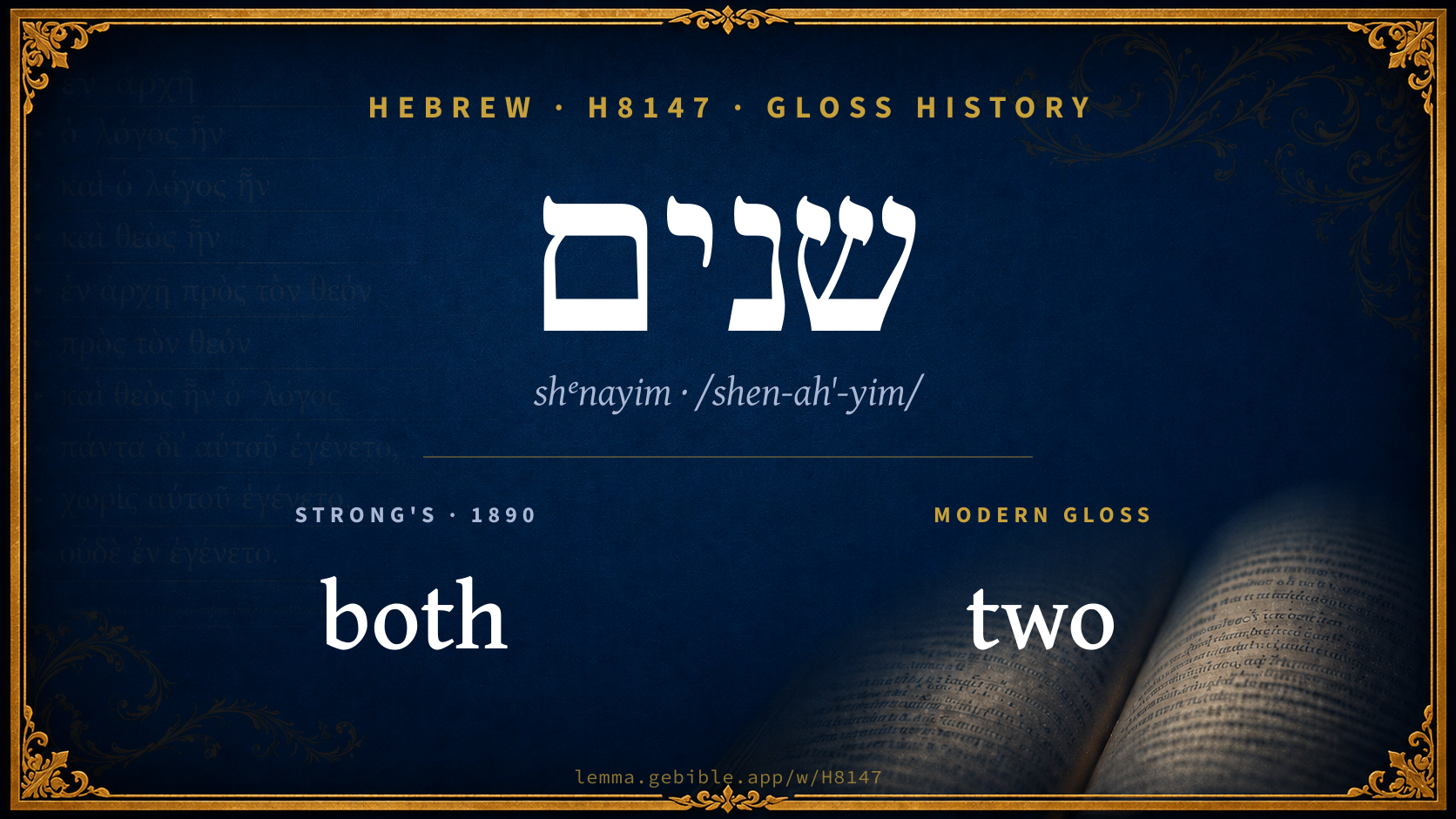
Gloss history
Strong's 1890 vs modern scholarship
About this word
Strong's H8147 catalogs a Hebrew word from the Hebrew Old Testament.
These counts are not copied from any lexicon or concordance. They are computed here, from the morphology-tagged Hebrew Old Testament. What Lemma adds →
- 645
- distinct verses
- The word appears in 645 distinct verses.
- 31 / 39
- OT books
- The word appears in 31 of 39 Old Testament books.
- #63
- by frequency
- Top 100 most frequent Hebrew words (rank 63 of 8,640 Hebrew words by occurrence).
View all 645 occurrences in the concordance →
By section of the Old Testament
By traditional corpus
Conventional, traditional groupings — biblical authorship is debated, so this is a traditional corpus grouping, not an authorship claim. Each share is this word’s portion of its verses in that division of the Hebrew canon. Each figure is a share of the word’s 645 distinct verses.
- Torah (Pentateuch) 256 verses · 40%
- Prophets (Nevi'im) 240 verses · 37%
- Writings (Ketuvim) 149 verses · 23%
How translations render this word
Counts come from each version’s own published word-to-Strong’s tagging or interlinear alignment — an approximate guide to how each version renders this word, not a word-level alignment the data otherwise carries. Because each total is that version’s own tagged count, the per-version totals vary from one another and need not match the appearance or distinct-verse counts above. These counts may also differ from a printed concordance because Lemma counts each distinctly tagged rendering and does not collapse phrase taggings into a single head-word total. This is a fixed set of word-tagged versions (KJV, ASV, BSB, ULT) and does not change with the reading translation you choose elsewhere. Each version’s license is shown beside its name below (and on Sources).
- King James Version: Two 430×, Both 54×, Twelve 51×
- American Standard Version: Two 396×, Twelve 70×, Both 47×
- Berean Standard Bible: Two 342×, Twelve 57×, Both 48×
- unfoldingWord Literal Text: Two 393×, Two of them 51×, Two of 39×
King James Version Public Domain
Renders H8147 across 754 tagged occurrences — most commonly:
Plus other, less common renderings. Plus 86 renderings that appear only once — usually multi-word phrases or single function words the recovered tagging swept in, not distinct renderings. Not rendered by a distinct English word in 15 further occurrences.
American Standard Version Public Domain
Renders H8147 across 749 tagged occurrences — most commonly:
Plus other, less common renderings. Plus 112 renderings that appear only once — usually multi-word phrases or single function words the recovered tagging swept in, not distinct renderings.
Berean Standard Bible Public Domain
Renders H8147 across 603 tagged occurrences — most commonly:
Plus other, less common renderings. Plus 53 renderings that appear only once — usually multi-word phrases or single function words the recovered tagging swept in, not distinct renderings. Not rendered by a distinct English word in 159 further occurrences.
unfoldingWord Literal Text CC BY-SA 4.0
Renders H8147 across 706 tagged occurrences — most commonly:
Plus other, less common renderings. Plus 36 renderings that appear only once — usually multi-word phrases or single function words the recovered tagging swept in, not distinct renderings. Not rendered by a distinct English word in 120 further occurrences.
Senses in the full BDB
What do BDB’s symbols mean?
BDB uses these scholarly abbreviations:
| Symbol | Meaning |
|---|---|
| 𝔊 | the Septuagint (the ancient Greek translation, LXX) |
| 𝔙 | the Vulgate (the Latin translation) |
| 𝔖 | the Syriac version (the Peshitta) |
| 𝔗 | the Targum (the Aramaic translation) |
| ψ | the Psalms |
| √ | root (the underlying root or stem) |
| ‖ | parallel passage (a synonymous or contrasted parallel) |
| † | the dagger: every passage where the word occurs is cited |
The 5 senses and sub-senses the full Brown-Driver-Briggs lexicon distinguishes for this word, in lexicon order (not ranked by frequency), with BDB’s own verbatim wording and sub-sense lettering. Shown in Hebrew script with BDB’s own scholarly abbreviations. The condensed entry is in the Lexicon Entry tab. See also the Forms in the corpus table below.
- 1. no other num.:
- a. usually cstr. before n.pl. (צְמִידִים) שְׁנֵי Gn 24:22 + 194 times + 2 S 23:20 ‖ 1 Ch 11:22 (ins. בְּנֵי 𝔊 Th mod., otherwise RSSem. i. 469, 2nd ed., 488); (נָשִׁים) שְׁתֵּי Gn 4:19 + 132 times, 1 S 10:4 ins. כִּכְּרוֹת Klo HPS Bu Now; Lv 16:21 read du. יָדָיו Qr, + Ju 16:28 (v. supr.) + שְׁתֵּי־אֵלֶּה Is 47:9 both these thing; before n.sg., שְׁנֵי Ex 16:22 (Ges§ 134e); sf. שְׁנֵיהֶם the two of them Gn 2:25 + 62 times, + Pr 24:22 (> their years 𝔖 𝔗 De al.; prob. crpt., v. Toy), שְׁנֵינוּ Gn 31:37 + 2 times, שְׁנֵיכֶם †Gn 27:45; שְׁתֵּיהֶם (msf.! Ges§ 135 o) †Ru 1:19; 4:11, יהֶן—ֵ †1 S 25:43; Ez 23:13. e.g. Genesis 24:22
- b. abs. (1) שְׁנַ֫יִם (90 times), before n.pl. Ju 11:37 + 26 times; after n.pl. 2 S 1:1; Ex 29:1 + 21 times (usually P Chr), n.sg. (coll.) Gn 46:27 Nu 7:17 + 11 times Nu 17; n. om. Gn 7:2; 44:27 + 26 times; שׁ׳ שׁ׳ distrib. Gn 7:9 +; לִשׁ׳ cut in two †2 K 3:25; Je 34:18; = double amount †Ex 22:3, 6, 8 (E); פִּי שׁ׳ †Dt 21:17 two-thirds, + בְּרוּחֲךָ †2 K 2:9 in (of) thy spirit, + בָּהּ †Zc 13:8; (2) שְׁתַּ֫יִם (55 times), bef. n.pl.; 1 K 3:16 + 16 times; after n.pl. (usually P and late) 2 Ch 24:3 + 9 times; n. om., = two things †Is 51:19 Jb 13:20 Pr 30:7; שְׁתַּיִם = twice †2 K 6:10 Jb 40:5 ψ 62:12 (or as Pr 30:7), בִּשׁ׳ Jb 33:14 either so, or in two ways RVm (v. De); as ordin. בִּשְׁנַת שְׁתַּיִם לְ 1 K 15:25 + 9 times, etc.; (3) as round number, שְׁנַיִם עֵצִים 1 K 17:12 a few sticks (Germ. ‘ein paar’), cf. 2 K 9:32 Is 17:6; שְׁתַּיִם שָׁלשׁ Am 4:8, פַּעַם וּשְׁתָּ֑יִם Ne 13:20, cf. Je 3:14 אֶחָד מֵעִיר וּשְׁנַיִם מִמִּשְׁפָחָה = a small no.; Ezr 10:13 not for one or two days (but for many), 2 K 6:10. e.g. Judges 11:37
- 2. twelve: c. n.m. שְׁנֵים עָשָׂר Gn 42:13 + 87 times, לִשְׁנֵי עָשָׂר Ex 28:21 + 4 times; c. n.f. שְׁתֵּים עֶשְׂרֵה Ex 24:4 + 34 times, שְׁתֵּי עֶשְׂרֵה †Ez 32:1, 17; 33:21; before n.pl. Gn 17:20; Ex 15:27 +; after n.pl. Nu 7:84(×2) +; before n.sg. Ex 28:21 +, Gn 14:4 (12 year) +, etc.; as ord., בְּיוֹם שְׁנֵים עָשָׂר יוֹם Nu 7:78, בִּשְׁתֵּי עֶשְׂרֵה שָׁנָה Ez 32:1 +, etc. e.g. Genesis 42:13
- 3. with large num.: 10 (etc.) + 2, 2 S 8:5; Ju 10:3 + 56 times; 2 + 10 (etc.) Nu 1:35 (P), 2 Ch 22:2 + 18 times (Köii. 1, 215 ff. Ges§ 97 f.); 200 + 2 + 30, 1 K 20:15; 50 + 2 as ord. 2 K 15:27 + 2 times; cf. 2 + 20, 1 Ch 24:17. e.g. 2 Samuel 8:5
Senses from the full Brown-Driver-Briggs lexicon (Brown, Driver, Briggs; Oxford 1906 — public domain), digitized via Sefaria, supplemented by the OpenScriptures HebrewLexicon (CC BY 4.0). Full attribution on Sources.
Word origin
(PhilipiZMG xlix (1895), 202 Ges§ 97b note)768 n.m. et f.du. two (NH id.; Ph. אשנם (and שני second), Pun. שנם Lzb380; Arabic اِثنَانِ; Sab. תֿני HomChr 47, Aramaic תְּרֵין, ܬܪܶܝܢ (תִּנְיָנָא, ܬܶܢܝܳܢܳܐ second); Nab. תרין, Palm. f. תרתן, תרתיא, Lzb388; Assyrian šinâ; on etym v. √, and especially PhilippiZMG xxxii (1878), 21–98);—m. (c. n.m.) שְׁנַיִם Am 3:3 +; cstr. שְׁנֵי Is 7:16 +, sf. שְׁנֵיהֶם Gn 2:25 +, etc.; f. (c. n.f.) שְׁתַּיִם Am 4:8 +; cstr. שְׁתֵּי Gn 4:19, וּשְׁתֵּי Is 7:21 +, etc., מִשְּׁתֵֿי Ju 16:28 (v. GFM); sfs. v. infr. (2 + 10 = 12, v. infr.); Hex chiefly P:—two:
— Brown-Driver-Briggs (Oxford 1906, public domain), digitized via Sefaria, supplemented by the OpenScriptures HebrewLexicon (CC BY 4.0). See Sources.
Derived from שני (shênîy) (H8145) — second.
Jastrow Dictionary
A second Hebrew/Aramaic lexicon for comparison, covering Aramaic and post-biblical (Talmudic, Targumic, Midrashic) usage that the biblical-Hebrew BDB does not. Matched by lemma rather than by Strong’s number, so a lemma may carry more than one Jastrow headword (shown separately below), and the entries cover usage well beyond the Bible.
שָׁנִי
- (b. h.) scarlet; תולעת ש׳, v. תֹּולֵעָה.—Pl. שָׁנִים. Sabb. 89ᵇ (ref. to Is. I, 18) כשנים כשני מיבעי ליה וכ׳ kasshanim? it ought to read kasshani (as scarlet) &c.; Yalk. Is. 256; a. e., v. שָׁנָה II. e.g. Isaiah 1:18
שְׁנַיִם
- (b. h.) two. Ber. 8ᵃ ש׳ מקרא ואחד תרגום reading the Scriptural portion of the week twice, and the Targum once. Ib. שיעור ש׳ פתחים a distance of two gates. Zeb. V, 4, v. מַתָּנָה. Sabb. I, 1 ש׳ שהן ארבע two ways of transfer from place to place, which become four (by rabbinical addition). Ib. שְׁנֵיהֶם פטורין both of them are free. Snh. V, 3 בש׳ בחדש on the second day of the month. Ib. בש׳ שעות in the second hour of the day. Men. III, 3. Ib. 6; a. v. fr.—שְׁנֵים עָשָׂר, שְׁתֵּים עֶשְׂרֵה twelve. Nidd. 69ᵇ. Ab. Zar. 3ᵇ; a. fr.
A Dictionary of the Targumim, the Talmud Babli and Yerushalmi, and the Midrashic Literature (Marcus Jastrow; London, Luzac, 1903) — Public Domain. Digitized via Sefaria. Digitized via Sefaria. Full attribution on Sources.
Forms in the corpus
The 182 distinct written forms H8147 takes in the Hebrew Bible, most frequent first — each parse links to that state’s occurrences in the concordance. Hebrew forms include their vowel points and cantillation, so a single lemma takes many written forms.
The 60 most common forms are shown; 122 rarer forms follow in the full concordance.
Same root — word family
Other BDB entries built from the same root as H8147, grouped by Strong’s listed origin. These share a root / origin per the lexicon — not necessarily a shared meaning. Each links to that word’s own entry.
Derives from
Derived from this word
Compare all same-root words → They share a root, not necessarily a meaning.
Septuagint verse parallels
This word appears in 611 verses that also exist in the Greek Old Testament (Septuagint), out of the 645 Hebrew verses it occurs in. You can read those verses in Greek by switching the Old Testament edition to the Septuagint.
Read these verses in the Septuagint
- Genesis 1:16
- Exodus 2:13
- Leviticus 3:4
- Numbers 1:35
- Deuteronomy 1:23
- Joshua 2:1
- Judges 3:16
- Ruth 1:1
- 1 Samuel 1:2
- 2 Samuel 1:1
- 1 Kings 2:5
- 2 Kings 1:14
This is a verse-level parallel only — the same verses exist in both the Hebrew and Greek Old Testaments. No word-level Hebrew↔Greek correspondence is claimed: the data carries no such alignment, so no Greek word is shown as this Hebrew word’s translation. Coverage is not total — the Septuagint omits the deuterocanon and renumbers the Psalms, so some Hebrew verses have no direct Greek parallel.