Leviticus 16:5

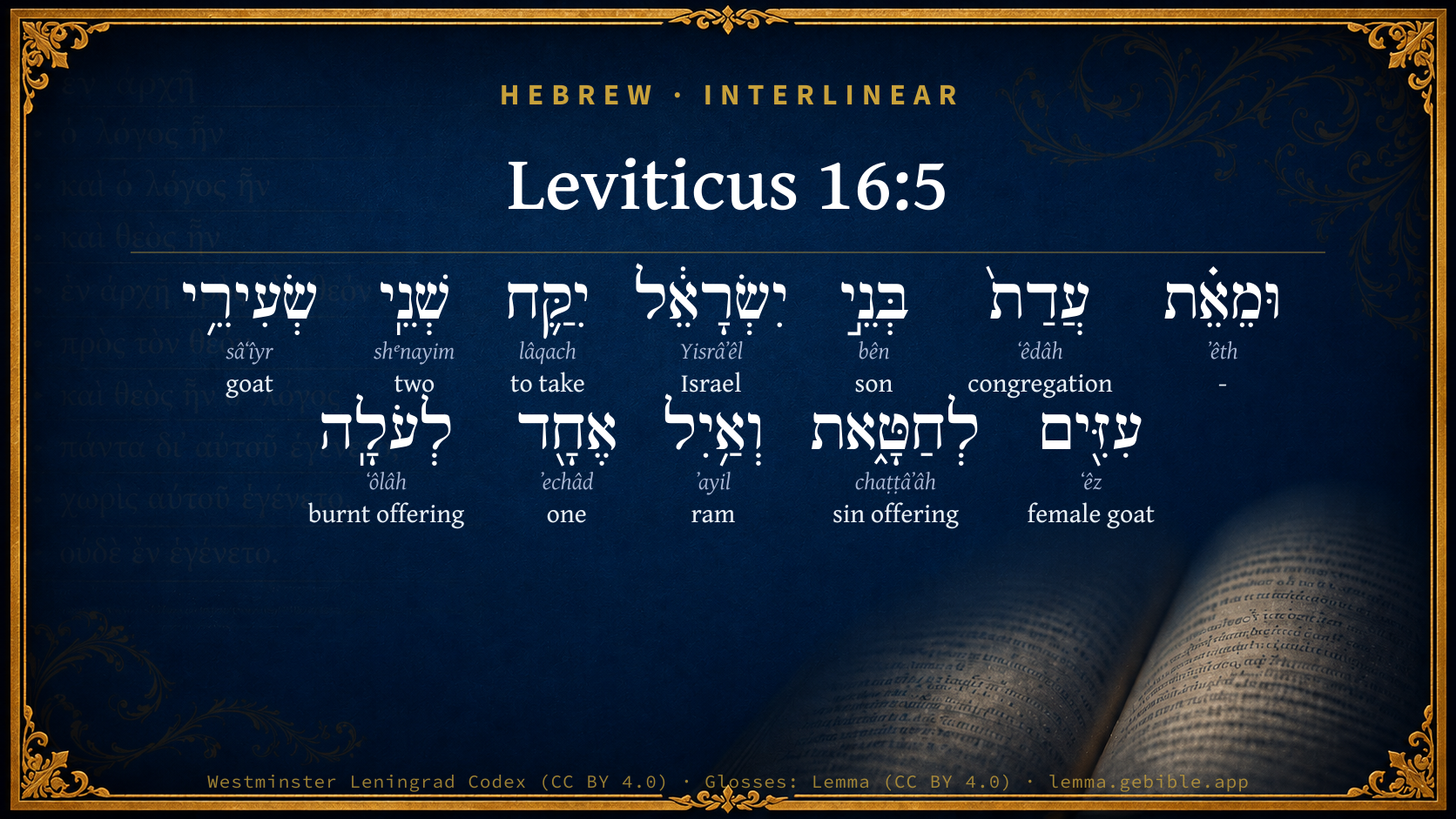
Hebrew (Westminster Leningrad Codex) Leviticus 16:5 appears in the Hebrew Old Testament. The text above is from the Westminster Leningrad Codex. Each word links to its Strong’s number, a concise gloss, and parsing drawn from the Open Scriptures Hebrew Bible morphology. Click any word for its full Brown-Driver-Briggs (BDB) entry.
Download image
Cite this verse

Leviticus 16:5 (World English Bible). Public Domain. Lemma interlinear Bible study tool, https://lemma.gebible.app/v/leviticus/16/5.

Show BibTeX & RIS
BibTeX
RIS
English Translation
He shall take from the congregation of the children of Israel two male goats for a sin offering, and one ram for a burnt offering
World English Bible · Public Domain
Download a study sheet

One document with this verse’s original text, its word-by-word gloss line, the meaning frame, cross-references with their text, attributed commentary, and full source and license credits — printable, and it pastes into notes with its structure intact.

This verse Autodidact and up

Study sheet (.html) Plain text (.txt)

A passage Seminary Student

Up to 50 verses in one chapter. A passage sheet keeps up to 6 commentary sources and 12 cross-references per verse, in the order this page ranks them, and says so on the sheet whenever that leaves anything out. Ask for a single verse and you get the Autodidact verse sheet above.

Everything on this page stays free to read, with no account — the sheet is a download of what is already on screen, not access to it.

Want to remove ads? Support Godless Engineer
Compare translations 3

The same verse in 3 English versions, stacked beneath the original-language interlinear above. Click any original word for its lexicon entry.

Each is an independent rendering of the whole verse — the interlinear is not word-aligned to these translations.

Highlighted words mark where these versions differ — a whole-verse word diff, not a word-by-word alignment.

  • World English Bible Public Domain
    He shall take from the congregation of the children of Israel two male goats for a sin offering, and one ram for a burnt offering
  • King James Version Public Domain
    And he shall take of the congregation of the children of Israel two kids of the goats for a sin offering, and one ram for a burnt offering.
  • unfoldingWord Literal Text CC BY-SA 4.0
    And from the congregation of the sons of Israel he shall take two bucks of goats as a sin offering and one ram as a burnt offering.

unfoldingWord Literal Text — © unfoldingWord, licensed CC BY-SA 4.0. Word-aligned USFM3 via Door43 (git.door43.org/unfoldingWord/en_ult).

Versions to compare (up to 4)

3 of 4 selected

Show all 18 translations

Every available English version of this verse, each an independent rendering of the whole verse.

  • World English Bible Public Domain
    He shall take from the congregation of the children of Israel two male goats for a sin offering, and one ram for a burnt offering
  • Berean Standard Bible Public Domain
    And he shall take from the congregation of Israel two male goats for a sin offering and one ram for a burnt offering.
  • Majority Standard Bible Public Domain
    And he shall take from the congregation of Israel two male goats for a sin offering and one ram for a burnt offering.
  • King James Version Public Domain
    And he shall take of the congregation of the children of Israel two kids of the goats for a sin offering, and one ram for a burnt offering.
  • American Standard Version (1901) Public Domain
    And he shall take of the congregation of the children of Israel two he-goats for a sin-offering, and one ram for a burnt-offering.
  • Revised Version (1885) Public Domain
    And he shall take of the congregation of the children of Israel two he-goats for a sin offering, and one ram for a burnt offering.
  • Geneva Bible (1599) Public Domain
    And hee shall take of the Congregation of the children of Israel, two hee goates for a sinne offring, and a ramme for a burnt offring.
  • Douay-Rheims (1899) Public Domain
    And he shall receive from the whole multitude of the children of Israel two buck goats for sin, and one ram for a holocaust.
  • Young's Literal Translation Public Domain
    `And from the company of the sons of Israel he taketh two kids of the goats for a sin-offering, and one ram for a burnt-offering;
  • Literal Standard Version CC BY-SA 4.0
    And from the congregation of the sons of Israel he takes two kids of the goats for a sin-offering and one ram for a burnt-offering;
  • Unlocked Literal Bible CC BY-SA 4.0
    He must take from the assembly of the people of Israel two male goats as a sin offering and one ram as a burnt offering.
  • unfoldingWord Literal Text CC BY-SA 4.0
    And from the congregation of the sons of Israel he shall take two bucks of goats as a sin offering and one ram as a burnt offering.
  • Darby Bible Public Domain
    And of the assembly of the children of Israel shall he take two bucks of the goats for a sin-offering, and one ram for a burnt-offering.
  • World Messianic Bible Public Domain
    He shall take from the congregation of the children of Israel two male goats for a sin offering, and one ram for a burnt offering.
  • Webster's Bible Public Domain
    And he shall take of the congregation of the children of Israel two kids of the goats for a sin-offering, and one ram for a burnt-offering.
  • Free Bible Version CC BY-SA 4.0
    From the people of Israel he is to bring two male goats for a sin offering, and a ram for a burnt offering.
  • Bible in Basic English Public Domain
    And let him take from the children of Israel two he-goats for a sin-offering and one male sheep for a burned offering.
  • JPS Tanakh (1917) Public Domain
    And he shall take of the congregation of the children of Israel two he-goats for a sin-offering, and one ram for a burnt-offering.

Literal Standard Version (2020), Covenant Press — licensed CC BY-SA 4.0. Text via the HelloAO Bible API (eBible.org). Unlocked Literal Bible (unfoldingWord) — licensed CC BY-SA 4.0. Text via the HelloAO Bible API (eBible.org). unfoldingWord Literal Text — © unfoldingWord, licensed CC BY-SA 4.0. Word-aligned USFM3 via Door43 (git.door43.org/unfoldingWord/en_ult). Free Bible Version, Dr. Jonathan Gallagher — licensed CC BY-SA 4.0. Text via the HelloAO Bible API (eBible.org).

Word by word

More ways to search: Search by grammar → Find every occurrence → Compare this word →

Practice this passage: Drill this verse → Learn its vocabulary →

שְׂעִירֵ֥י
sâʻîyr
H8163
“goats of”
Noun, Common, Masculine, Plural, Construct
Part of Speech
Noun
Type
Common
Gender
Masculine
Number
Plural
State
Construct
Full BDB Definition

Origin: from H8175

TWOT: 2274c , 2274e

hairy (adjective) - he-goat, buck (noun masculine) - as sacrificial animal - satyr, may refer to a demon possessed goat like the swine of Gadara ( Mat 8:30-32 )
  1. וּמֵאֵ֗ת ʼêth H853 “and · from · -” Conjunction + Preposition + Particle, Direct Object
  2. עֲדַת֙ ʻêdâh H5712 “congregation of” Noun, Common, Feminine, Singular, Construct
  3. בְּנֵ֣י bên H1121 “sons of” Noun, Common, Masculine, Plural, Construct
  4. יִשְׂרָאֵ֔ל Yisrâʼêl H3478 “Israel” Noun, Proper
  5. יִקַּ֛ח lâqach H3947 “to take” Verb, Qal, Imperfect, 3rd Person, Masculine, Singular
  6. שְׁנֵֽי shᵉnayim H8147 “two” Adjective, Cardinal number, Masculine, Dual, Construct
  7. עִזִּ֖ים ʻêz H5795 “female goats” Noun, Common, Feminine, Plural, Absolute
  8. לְחַטָּ֑את chaṭṭâʼâh H2403 “to/for · sin offering” Preposition + Noun, Common, Feminine, Singular, Absolute
  9. וְאַ֥יִל ʼayil H352 “and · ram” Conjunction + Noun, Common, Masculine, Singular, Absolute
  10. אֶחָ֖ד ʼechâd H259 “one” Adjective, Cardinal number, Masculine, Singular, Absolute
  11. לְעֹלָֽה ʻôlâh H5930 “to/for · burnt offering” Preposition + Noun, Common, Feminine, Singular, Absolute

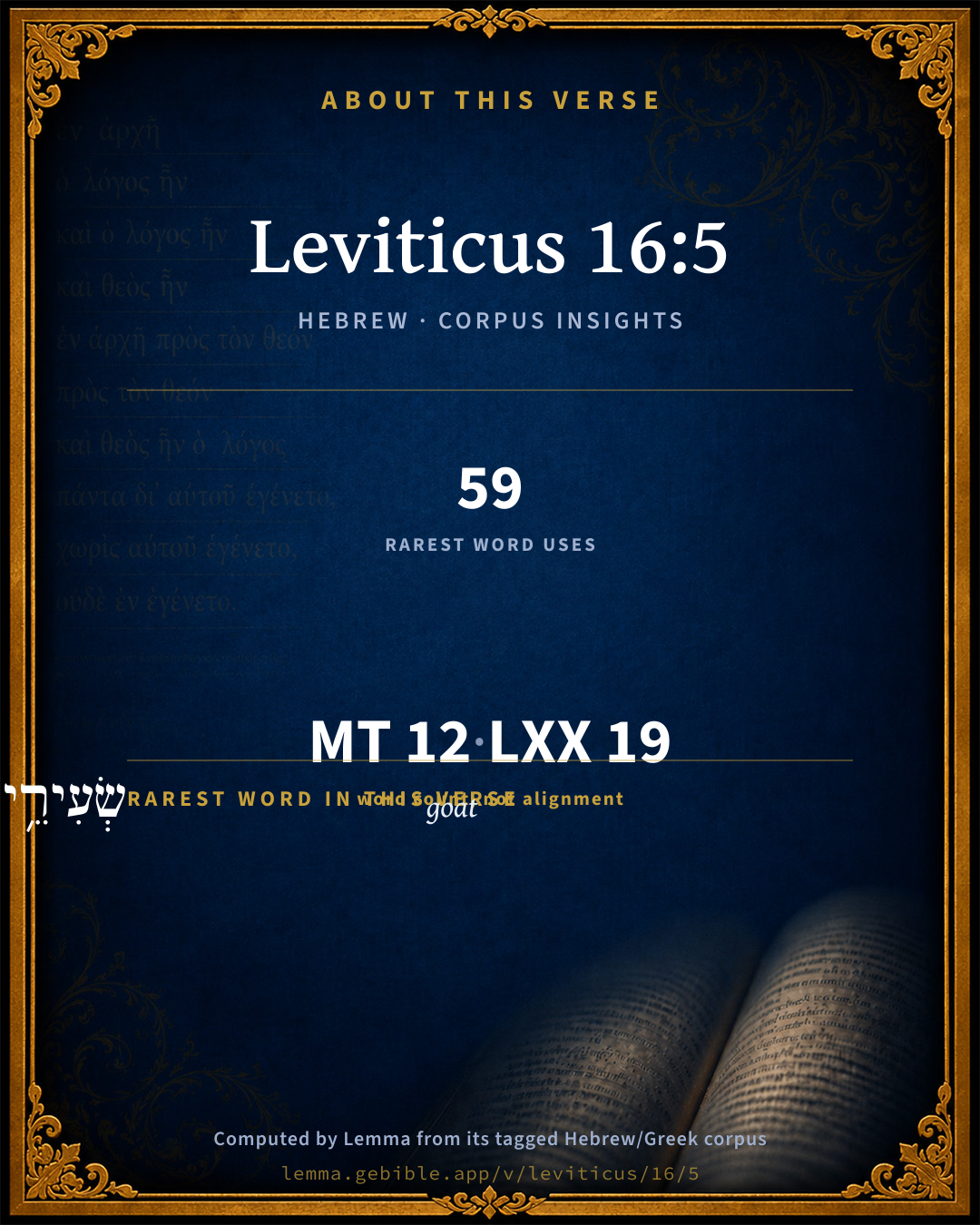
About this verse

These counts appear in no published source. They are computed here, from the morphology-tagged text and Lemma’s own curated glosses. What Lemma adds →

12
words
12
distinct lemmas
Pentateuch
section

Shared distinctive vocabulary

שְׂעִירֵ֥י goat H8163 occurs in 57 verses of the Hebrew Bible. Also found in:

Grammatical profile

  • 1 verb
  • 8 nouns
  • 2 adjectives
  • 1 particle

Verb forms

  • יִקַּ֛ח Qal · Imperfect

Hebrew & Septuagint length

In English translation the verse runs 25 words from the Hebrew and 28 from the Septuagint (LXX English) — closely comparable.

A rough comparison of the two English renderings, which tokenize alike — not a word-level alignment.

Word counts can differ between the Hebrew and the Greek without any difference in meaning — e.g. the Hebrew direct-object marker אֵת has no separate Greek word, and Greek often adds the article ὁ.

In the original languages it is 12 Hebrew tokens and 19 Greek tokens — but the two are counted differently (Hebrew bundles its prefixes and suffixes into one token; the Greek is in lemma form), so that isn’t a like-for-like length.

Cross-references

11

Topical passages linked to Leviticus 16:5 in the Treasury of Scripture Knowledge — connected by theme and wording, ordered by reader-vote popularity; previews shown in the World English Bible.

  • 2 Chronicles 29:21 They brought seven bulls, and seven rams, and seven lambs, and seven male goats, for a sin-offering for the kingdom and for the sanctuary and for Judah. He commanded the priests the sons of Aaron to offer them on the altar of Yahweh.
  • Leviticus 8:2 "Take Aaron and his sons with him, and the garments, and the anointing oil, and the bull of the sin offering, and the two rams, and the basket of unleavened bread;
  • Numbers 29:11 one male goat for a sin-offering; besides the sin-offering of atonement, and the continual burnt offering, and the meal-offering of it, and their drink-offerings.
  • Ezra 6:17 They offered at the dedication of this house of God one hundred bulls, two hundred rams, four hundred lambs; and for a sin-offering for all Israel, twelve male goats, according to the number of the tribes of Israel.
  • Leviticus 4:13–21 "'If the whole congregation of Israel sins, and the thing is hidden from the eyes of the assembly, and they have done any of the things which Yahweh has commanded not to be done, and are guilty;
  • Leviticus 8:14 He brought the bull of the sin offering, and Aaron and his sons laid their hands on the head of the bull of the sin offering.
  • Leviticus 9:8–16 So Aaron drew near to the altar, and killed the calf of the sin offering, which was for himself.
  • Ezekiel 45:22–23 On that day shall the prince prepare for himself and for all the people of the land a bull for a sin-offering.
  • Romans 8:3 For what the law couldn't do, in that it was weak through the flesh, God did, sending his own Son in the likeness of sinful flesh and for sin, he condemned sin in the flesh;
  • Hebrews 7:27–28 who doesn't need, like those high priests, to daily offer up sacrifices, first for his own sins, and then for the sins of the people. For this he did once for all, when he offered up himself.
  • Hebrews 10:5–14 Therefore when he comes into the world, he says, "Sacrifice and offering you didn't desire, But a body did you prepare for me;

Cross-references courtesy of OpenBible.info (CC BY 4.0).

Hebrew and Greek witnesses Masoretic Hebrew ↔ Greek Septuagint

The same verse in the two great witnesses to the Old Testament, shown verse-for-verse.

These are two independent witnesses, not word-aligned to each other, and the Septuagint is shown in lemma (dictionary) form.

Hebrew Leviticus 16:5 Masoretic · Westminster Leningrad Codex

וּמֵאֵ֗ת עֲדַת֙ בְּנֵ֣י יִשְׂרָאֵ֔ל יִקַּ֛ח שְׁנֵֽי שְׂעִירֵ֥י עִזִּ֖ים לְחַטָּ֑את וְאַ֥יִל אֶחָ֖ד לְעֹלָֽה

He shall take from the congregation of the children of Israel two male goats for a sin offering, and one ram for a burnt offering

World English Bible · Public Domain

Greek LXX Leviticus 16:5 Septuagint · lemma form

καί παρά ὁ συναγωγή ὁ υἱός ἰσραήλ λαμβάνω δύο χίμαρος ἐκ αἴξ περί ἁμαρτία καί κριός εἷς εἰς ὁλοκαύτωμα

And he shall take of the congregation of the children of Israel two kids of the goats for a sin-offering, and one lamb for a whole burnt offering.

LXX2012 (modern English Septuagint) · Public Domain

Hebrew: Westminster Leningrad Codex (CC BY 4.0). Greek: Septuagint (public domain); English from LXX2012 (modern English Septuagint) (Public Domain). How the Septuagint differs from the Hebrew →

Targum (Aramaic paraphrase)

2

The Targum is the ancient Jewish Aramaic paraphrase of the Hebrew Scriptures — an interpretive translation, not the Hebrew text itself. Onkelos (literal) and Pseudo-Jonathan (expansive) render the Torah, and Jonathan the Prophets. Coverage is partial: where no permissively-licensed English translation exists for a verse, only the Aramaic is shown. This is verse-level text, not a word-by-word alignment to the Hebrew.

  1. Targum Onkelos Torah (Genesis–Deuteronomy)
    וּמִן כְּנִשְׁתָּא דִבְנֵי יִשְׂרָאֵל יִסַב תְּרֵין צְפִירֵי עִזִין לְחַטָאתָא וּדְכַר חַד לַעֲלָתָא

    (no public-domain English translation for this verse)

    Targum Onkelos — Aramaic: “Onkelos Genesis” (public domain); “Onkelos Exodus” (public domain); “Onkelos Leviticus” (public domain); “Onkelos Numbers” (public domain); “Onkelos Deuteronomy” (public domain). English: “Sefaria Community Translation” (CC0 1.0 (public-domain dedication)); “J.W. Etheridge. The Targums of Onkelos and Jonathan Ben Uzziel on the Pentateuch. London: Longmans, Green, 1862” (public domain). Text via Sefaria.

  2. Targum Pseudo-Jonathan Torah (Genesis–Deuteronomy)
    וּמִן כְּנִישְׁתָּא דִבְנֵי יִשְרָאֵל יִסַב תְּרֵין צְפִירֵי בְּנֵי עִזֵי דְלָא עֵירוּבִין לְקָרְבַּן חַטָאתָא וּדְכַר חַד לַעֲלָתָא

    And from the congregation of the sons of Israel let him take two kids of the goats, without mixture, for a sin offering, and one ram for a burnt offering.

    Targum Pseudo-Jonathan — Aramaic: “Targum Jonathan on Genesis” (public domain); “Targum Jonathan on Exodus” (public domain); “Targum Jonathan on Leviticus” (public domain); “Targum Jonathan on Numbers” (public domain); “Targum Jonathan on Deuteronomy” (public domain). English: “The Targum of Jonathan ben Uzziel, trans. J. W. Etheridge, London, 1862” (public domain). Text via Sefaria.

Commentary

Notes on Leviticus 16:5 from classic Christian and Jewish commentators (each source and its license shown beneath its notes). The classic Christian expositions comment on the surrounding passage and are grouped to its opening verse, so a note may address several verses; the Jewish commentaries on the Tanakh (Rashi and others) are per-verse, so they appear only where the commentator wrote on this verse.

Lemma curates 59 commentaries, every one of them public domain or Creative Commons licensed, each selected and text-cleaned for this edition rather than reprinted as found. About our sources →

Trapp's Complete Commentary

John Trapp

Lev 16:5 And he shall take of the congregation of the children of Israel two kids of the goats for a sin offering, and one ram for a burnt offering.

Ver. 5. Two kids of the goats.] Both of them types of Christ: who though he died not for wicked goats, yet he seemed rejected of God, and was reckoned among malefactors. {Isa 53:9}

John Trapp, A Commentary or Exposition upon All the Books of the Old and New Testament (1647–1656) — public domain. Text from a community e-Sword module.

Matthew Henry's Commentary

The Jewish writers say that for seven days before the day of expiation the high priest was to retire from his own house, and to dwell in a chamber of the temple, that he might prepare himself for the service of this great day. During those seven days he himself did the work of the inferior priests about the sacrifices, incense, etc., that he might have his hand in for this day: he must have the institution read to him again and again, that he might be fully apprised of the whole method. 1. He was to begin the service of the day very early with the usual morning sacrifice, after he had first washed his whole body before he dressed himself, and his hands and feet again afterwards. He then burned the daily incense, dressed the lamps, and offered the extraordinary sacrifice appointed for this day (not here, but Num 29:8), a bullock, a ram, and seven lambs, all for burnt-offerings. This he is supposed to have done in his high priest's garments. 2. He must now put off his rich robes, bathe himself, put on the linen garments, and present unto the Lord his own bullock, which was to be a sin-offering for himself and his own house, Lev 16:6. The bullock was set between the temple and the altar, and the offering of him mentioned in this verse was the making of a solemn confession of his sins and the sins of his house, earnestly praying for the forgiveness of them, and this with his hands on the head of the bullock. 3. He must then cast lots upon the two goats, which were to make (both together) one sin-offering for the congregation. One of these goats must be slain, in token of a satisfaction to be made to God's justice for sin, the other must be sent away, in token of the remission or dismission of sin by the mercy of God. Both must be presented together to God (Lev 16:7) before the lot was cast upon them, and afterwards the scape-goat by itself, Lev 16:10. Some think that goats were chosen for the sin-offering because, by the disagreeableness of their smell, the offensiveness of sin is represented: others think, because it was said that the demons which the heathens then worshipped often appeared to their worshippers in the form of goats, God therefore obliged his people to sacrifice goats, that they might never be tempted to sacrifice to goats. 4. The next thing to be done was to kill the bullock for the sin-offering for himself and his house, Lev 16:11. "Now," say the Jews, "he must again put his hands on the head of the bullock, and repeat the confession and supplication he had before made, and kill the bullock with his own hands, to make atonement for himself first (for how could he make reconciliation for the sins of the people till he was himself first reconciled?) and for his house, not only his own family, but all the priests, who are called the house of Aaron," Psa 135:19. This charity must begin at home, though it must not end there. The bullock being killed, he left one of the priests to stir the blood, that it might not thicken, and then, 5. He took a censer of burning coals (that would not smoke) in one hand, and a dish full of the sweet incense in the other, and then went into the holy of holies through the veil, and went up towards the ark, set the coals down upon the floor, and scattered the incense upon them, so that the room was immediately filled with smoke. The Jews say that he was to go in side-ways, that he might not look directly upon the ark where the divine glory was, till it was covered with smoke; then he must come out backwards, out of reverence to the divine majesty; and, after a short prayer, he was to hasten out of the sanctuary, to show himself to the people, that they might not suspect that he had misbehaved himself and died before the Lord. 6. He then fetched the blood of the bullock from the priest whom he had left stirring it, and took that in with him the second time into the holy of holies, which was now filled with the smoke of the incense, and sprinkled with his finger of that blood upon, or rather towards, the mercy-seat, once over against the top of it and then seven times towards the lower part of it, Lev 16:14. But the drops of blood (as the Jews expound it) all fell upon the ground, and none touched the mercy-seat. Having done this, he came out of the most holy place, set the basin of blood down in the sanctuary, and went out.

Matthew Henry's Commentary on the Whole Bible (1708–1710) — public domain (CC PDM 1.0). Text via the HelloAO Bible API.

Jamieson, Fausset & Brown

Robert Jamieson, A. R. Fausset & David Brown

shall take of the congregation . . . two kids of the goats . . . and one ram--The sacrifices were to be offered by the high priest, respectively for himself and the other priests, as well as for the people. The bullock (Lev 16:3) and the goats were for sin offerings and the rams for burnt offerings. The goats, though used in different ways, constituted only one offering. They were both presented before the Lord, and the disposal of them determined by lot, which Jewish writers have thus described: The priest, placing one of the goats on his right hand and the other on his left, took his station by the altar, and cast into an urn two pieces of gold exactly similar, inscribed, the one with the words "for the Lord," and the other for "Azazel" (the scapegoat). After having well shaken them together, he put both his hands into the box and took up a lot in each: that in his right hand he put on the head of the goat which stood on his right, and that in his left he dropped on the other. In this manner the fate of each was decided.

Jamieson, Fausset & Brown — Commentary Critical and Explanatory on the Whole Bible (1871) — public domain (CC PDM 1.0). Text via the HelloAO Bible API.

Ellicott's Commentary for English Readers

(5) And he shall take of the congregation.—On this occasion the high priest himself had to officiate, by virtue of his being the chief mediator between God and His people.

Two kids of the goats.—Better, two shaggy he-goats. (See Lev_4:23.) These two goats, which were the sin offering for the people, and the ram, which was their burnt offering, were purchased with the money of the public some time before the Day of Atonement. During the second Temple the two goats had to be alike in value, equal in size, and of the same colour. If one of them happened to die after the decision of the lot, a new pair had to be purchased, and the surviving one of the original pair was kept and properly fed till it became ritually defective, whereupon it was sold, and the money paid into the sacred treasury.

A Bible Commentary for English Readers, edited by Charles John Ellicott (1878–1897) — public domain. Text from a community e-Sword module.

The Cambridge Bible for Schools and Colleges

gen. ed. J. J. S. Perowne

5. The two he-goats are described as one Sin-Offering.

The Cambridge Bible for Schools and Colleges (gen. ed. J. J. S. Perowne; Cambridge University Press, 1878–1918) — public domain. Text from a community e-Sword module.

John Gill's Exposition

And he shall take of the congregation of the children of Israel,.... With whom only the high priest had to do on the day of atonement; as Christ our high priest has only with the Israel of God, the elect, given him by the Father, for whom he offered up himself, and for whose sins he made reconciliation:

two kids of the goats for a sin offering; the one of which was killed, and the other let go alive, and both were but one offering, typical of Christ in both his natures, divine and human, united in one person; and who was made sin, and became a sin offering for his people:

and one ram for a burnt offering; a type of Christ, mighty to save, this creature being a strong one; and of his dolorous sufferings, this offering being burnt; and of God's gracious acceptance of his sacrifice, which was of a sweet smelling savour to him; the burnt offering following by way of thanksgiving for atonement made by the sin offering graciously accepted by the Lord.

John Gill's Exposition of the Whole Bible (1746–1763) — public domain (CC PDM 1.0). Text via the HelloAO Bible API.

Albert Barnes' Notes on the Bible

Take of the congregation - i. e. they were to be supplied at the public cost.

Two kids of the goats - This should be, two shaggy he-goats (Lev 4:23 note), of the same color, size, and value.

Albert Barnes' Notes on the Bible (1834–1885) — public domain. Text from a community e-Sword/MySword module.

Whedon's Commentary on the Bible

Daniel D. Whedon

5. Two kids of the goats — This expression in the Hebrew is usually understood to mean” he-goats,” (R.V.,) which were used as sin offerings for princes and for the people on high festival seasons. See Lev_23:19, note.

For a sin offering — It is worthy of note that both the goats are for a sin offering, though only one of them is to be slain.

Daniel D. Whedon (gen. ed.), Commentary on the Old and New Testaments (1874–1909) — public domain. Text from a community e-Sword module.

The Pulpit Commentary

And he shall take of the congregation of the children of Israel two kids of the goats. It was necessary that the sacrifice offered for a person or class of persons should be provided by the offerer or offerers. The two kids of the goats, or rather the two he-goats, constituted together but one sin offering. This is important for the understanding of the sequel.

Vers. 5-28. The sacrifices of the Day of Atonement.

Upon ordinary occasions sacrifices might be offered by common priests, who might act as representatives of the high priest or as representatives of the people, and so be types of Christ, or types of Christians. But upon this day the high priest must act in person, which leaves no doubt as to these transactions being eminently emblematical of Christ and of his great work. We notice

I THE OFFERINGS FOR AARON AND HIS HOUSE. (See verse 6)

1. In these Christ is viewed in his relation to his Church.

(1) The Christian Church is the house or family of Jesus. (Heb_3:6) (See Psa_135:19, where the "house of Aaron," as opposed to the "house of Israel," may be spiritually construed to denote the Christian as opposed to the Hebrew Church.)

(2) To his Church Jesus stands in the relations of

(a) Priest,

(b) Sacrifice,

(c) Bondsman.

He bears our sin in his own person, and dies for us, as Aaron would have died for his own sin and that of his house, had not the sin sacrifices been substituted to procure the forbearance of God until our competent Aaron should appear to satisfy all the claims of justice and mercy.

(3) Aaron, in making atonement for himself and his house, evinced that Christ should be a priest having compassion. (see Heb_5:2, Heb_5:3) For though Jesus had no sin of his own, yet did he take upon him our nature, with its curse, so as to be "touched with the feeling of our infirmities". (comp. Heb_7:28, Heb_2:18 Heb_4:15) What a blessed assurance for us!

2. But Christ cannot be of the family of Aaron.

(1) Aaron for himself and for all his house needed sacrifices to atone for their own sins; how then could they put away sin from others? This they could only do typically and ceremonially. (see Heb_7:26, Heb_7:27)

(2) Provision was made in the family of Aaron for the transmission of the priesthood from hand to hand; it was therefore never contemplated that any member of that house should have the priesthood in perpetuity. But this we must have in the office of a perfect Priest. His intercession must have no interruption. (see Heb_7:23-25)

(3) To fulfill these conditions, Christ is come, a high priest after the order of Melchisedec. (Psa_110:4 Heb_7:15-22) He sprang from Judah, of which tribe Moses spake nothing concerning priesthood. (Heb_7:11-14) We may praise God for the perfection of the priesthood of Christ, which needs no supplement in the offices of mortals.

II THE OFFERINGS FOR THE PEOPLE.

1. There was the burnt offering.

(1) This, under ordinary circumstances, for the individual might be a bullock, or a ram, or a he-goat, or, in case of poverty, a pigeon; but in this case for the nation, as in the consecration of the priests, the ram is specified. (Lev_1:3, Lev_1:10, 14 8:18) It is suggested that this animal was chosen for the offensiveness of its smell, in order to represent the odiousness of sin.

(2) In this case also the high priest in person, and alone, officiated. No one was to remain with him in the tabernacle of the congregation (verse 17). What an expressive figure of Christ! (see Isa_63:3, 5 Zec_13:7 Mat_26:31, 56 Joh_16:32) No one could help Jesus in his great work of atonement.

2. The sacrifice of the two goats now claims attention.

(1) Two are brought, to foreshadow what one could not adequately, viz. that one part only of the compound person of Christ could die, while both parts were necessary for his making atonement. The animal on which the lot fell to be the scapegoat was to stand alive before the Lord, to make atonement with him (verse 10; see Heb_8:3 1Pe_3:18). The "somewhat" which our high priest has to offer is his humanity, which his Godhead supported and rendered infinitely efficacious for the expiation of sin.

(2) In casting lots upon the goats, one for the Lord, and the other for the scapegoat, we are taught that the sufferings of Christ were ordered by the providence of God. (see Act_4:28) This is amply evinced in the wonderfully detailed anticipations of prophecy.

(3) Aaron laid his two hands upon the head of the creature that was to be the scapegoat, and confessed the sins of the congregation. These were such as may not have been atoned for by the usual sacrifices. And they are summed up as "iniquities" and "transgressions" and "sins" (verse 21). Laden with these,

(4) he was sent away "by the hand of a man of opportunity" (verse 21, margin). Such was Simon the Cyrenian, who bore the cross on which the atonement was to be made for sin. (Mat_27:32; see Gal_6:14 Eph_2:16 Col_2:14) Jesus was hurried along to his execution by the rabble rather than by any officer appointed to lead him. And as the man of opportunity was to be unclean until he had bathed his flesh and washed his clothes, so will the blood of the murder of Jesus be upon the Jews until it is cleansed by their repentance and faith. (comp. Mat_27:25 and Joe_3:21)

(5) The scapegoat was to go away with its burden into a "a land not inhabited," or "land of separation," a "wilderness," a place in which it might be lost sight of. This was designed to teach us how effectually our sins are borne away into oblivion by Christ. (Psa_103:12 Isa_38:17 Mic_7:19 Joh_1:29 Heb_8:12) To set forth this important truth, it was also ordered that the bodies of those beasts whose blood was brought into the sanctuary by the high priest for sin, were burnt without the camp. (verse 27; Heb_13:11, Heb_13:12) So, like the "man of opportunity," whoever burnt the sin offering became unclean, and so remained until he had washed. (see Zec_13:1) Have we been purified from all complicity in the guilt of the crucifixion of Jesus? J.A.M.

The Pulpit Commentary (1880–1919), ed. H.D.M. Spence-Jones & Joseph S. Exell — public domain. Text from a community e-Sword module.

Scofield Reference Notes

C. I. Scofield

goats

The two goats. The offering of the high priest for himself has no anti-type in Christ Heb 7:26; Heb 7:27. The typical interest centres upon the two goats and the high priest. Typically

(1) all is done by the high priest Heb 1:3 "by Himself"), the people only bring the sacrifice; Mat 26:47; Mat 27:24; Mat 27:25.

(2) The goat slain (Jehovah’s lot) is that aspect of Christ’s work which vindicates the holiness and righteousness of God as expressed in the law Rom 3:24-26 and is expiatory.

(3) The living goat typifies that aspect of Christ’s work which puts away our sins from before God Heb 9:26; Rom 8:33; Rom 8:34.

(4) The high priest entering the holiest, typifies Christ entering "heaven itself" with "His own blood" for us Heb 9:11; Heb 9:12. His blood makes that to be a "throne of grace," and "mercy seat" which else must have been a throne of judgment.

(5) For us, the priests of the New Covenant, there is what Israel never had, a rent veil Mat 27:51; Heb 10:19; Heb 10:20. So that, for worship and blessing, we enter, in virtue of His blood, where He is, into the holiest; Heb 4:14-16; Heb 10:19-22. The atonement of Christ, as interpreted by the O.T. sacrificial types, has these necessary elements:

(1) It is substitutionary--the offering takes the offerer’s place in death.

(2) The law is not evaded but honored--every sacrificial death was an execution of the sentence of the law.

(3) The sinlessness of Him who bore our sins is expressed in every animal sacrifice--it must be without blemish.

(4) The effect of the atoning work of Christ is typified

(a) in the promises, "it shall be forgiven him"; and (b) in the peace-offering, the expression of fellowship--the highest privilege of the saint. (See Scofield "Exo 29:33")

The Scofield Reference Bible (1917 edition), notes by C. I. Scofield — public domain. Text from a community e-Sword module.

Lesson kit

Teaching starters — assembled from the data on this page, not authored interpretation. Every prompt links to the verse data it draws on. Edit before teaching.

Leviticus, in the Pentateuch, opens this verse with 12 words (12 distinct Hebrew lemmas). Its most distinctive word is sâʻîyr (“goat”). A historical commentator’s framing appears above. Read the whole chapter for the surrounding context.

Discussion questions

  1. How does “goat” (sâʻîyr) shape what this verse is saying?
  2. Genesis 27:11 shares the word «goat» with this verse. How do the two illuminate each other?
  3. These translations render this verse differently. What is at stake in choosing one wording over another?
  4. The verb «יִקַּ֛ח» is Qal Imperfect. How does its form color the action?
  5. Reading how Trapp's Complete Commentary and Matthew Henry's Commentary read this verse, where do the two commentators agree and where do they part?

Things to notice

Reading settings

Reading text

Shown beneath each verse's original-language words.

Old Testament
Old Testament edition

Read the OT as the Masoretic Hebrew (MT) or the Greek Septuagint (LXX).

English shown for the Greek Septuagint (in the Hebrew ↔ Greek comparison).

Comparing translations? Open the Compare panel on any verse page to stack up to four side by side.