
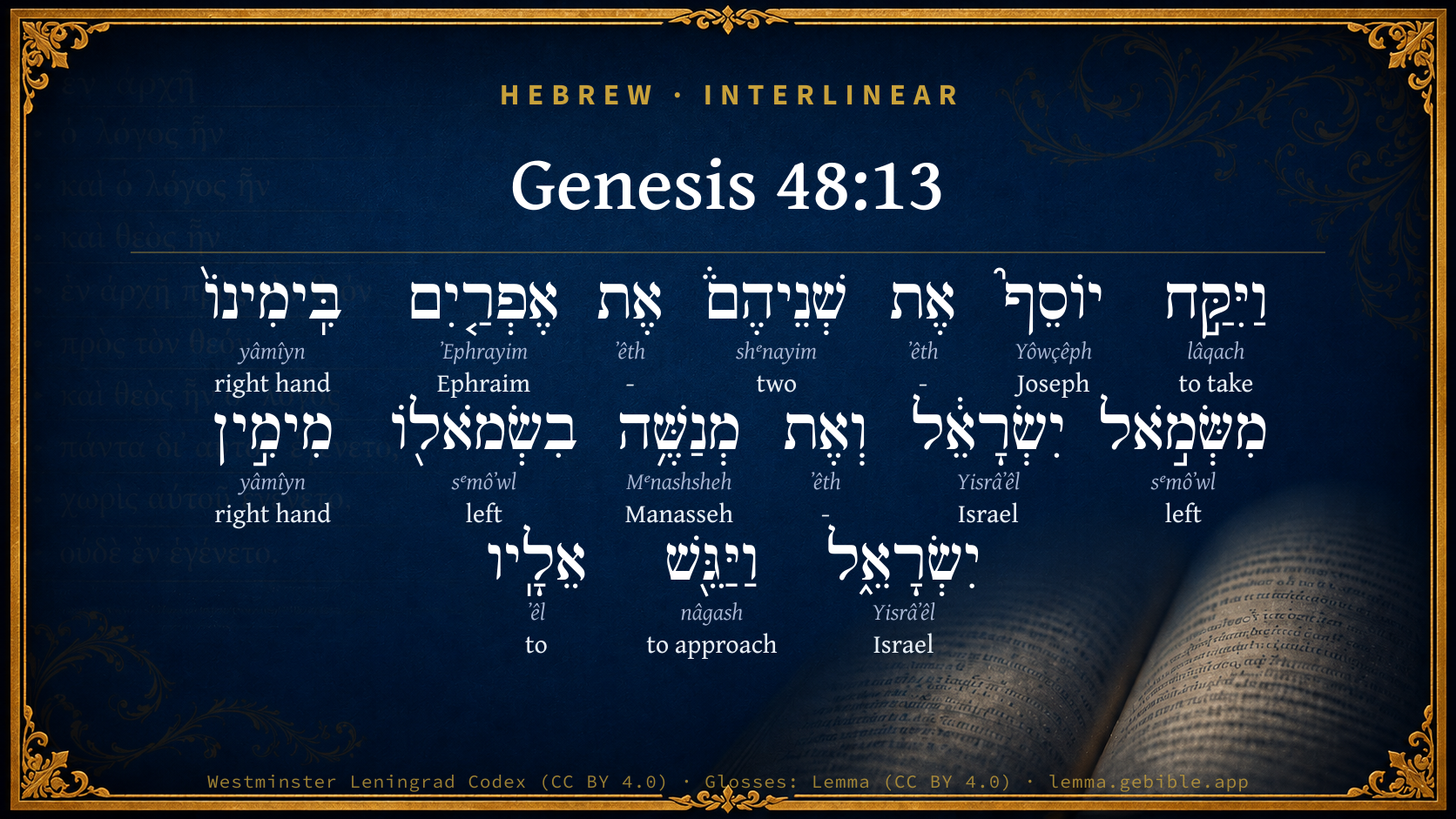
Genesis 48:13

Hebrew (Westminster Leningrad Codex) Genesis 48:13 appears in the Hebrew Old Testament. The text above is from the Westminster Leningrad Codex. Each word links to its Strong’s number, a concise gloss, and parsing drawn from the Open Scriptures Hebrew Bible morphology. Click any word for its full Brown-Driver-Briggs (BDB) entry.
Download image
Cite this verse

Genesis 48:13 (World English Bible). Public Domain. Lemma interlinear Bible study tool, https://lemma.gebible.app/v/genesis/48/13.

Show BibTeX & RIS
BibTeX
RIS
English Translation
Joseph took them both, Ephraim in his right hand toward Israel's left hand, and Manasseh in his left hand toward Israel's right hand, and brought them near to him.
World English Bible · Public Domain
Download a study sheet

One document with this verse’s original text, its word-by-word gloss line, the meaning frame, cross-references with their text, attributed commentary, and full source and license credits — printable, and it pastes into notes with its structure intact.

This verse Autodidact and up

Study sheet (.html) Plain text (.txt)

A passage Seminary Student

Up to 50 verses in one chapter. A passage sheet keeps up to 6 commentary sources and 12 cross-references per verse, in the order this page ranks them, and says so on the sheet whenever that leaves anything out. Ask for a single verse and you get the Autodidact verse sheet above.

Everything on this page stays free to read, with no account — the sheet is a download of what is already on screen, not access to it.

Want to remove ads? Support Godless Engineer
Compare translations 3

The same verse in 3 English versions, stacked beneath the original-language interlinear above. Click any original word for its lexicon entry.

Each is an independent rendering of the whole verse — the interlinear is not word-aligned to these translations.

Highlighted words mark where these versions differ — a whole-verse word diff, not a word-by-word alignment.

  • World English Bible Public Domain
    Joseph took them both, Ephraim in his right hand toward Israel's left hand, and Manasseh in his left hand toward Israel's right hand, and brought them near to him.
  • King James Version Public Domain
    And Joseph took them both, Ephraim in his right hand toward Israel's left hand, and Manasseh in his left hand toward Israel's right hand, and brought them near unto him.
  • unfoldingWord Literal Text CC BY-SA 4.0
    Then Joseph took both of them, Ephraim on his right toward Israel’s left and Manasseh on his left toward Israel’s right, and brought near to him.

unfoldingWord Literal Text — © unfoldingWord, licensed CC BY-SA 4.0. Word-aligned USFM3 via Door43 (git.door43.org/unfoldingWord/en_ult).

Versions to compare (up to 4)

3 of 4 selected

Show all 18 translations

Every available English version of this verse, each an independent rendering of the whole verse.

  • World English Bible Public Domain
    Joseph took them both, Ephraim in his right hand toward Israel's left hand, and Manasseh in his left hand toward Israel's right hand, and brought them near to him.
  • Berean Standard Bible Public Domain
    And Joseph took both of them—with Ephraim in his right hand toward Israel’s left hand, and Manasseh in his left hand toward Israel’s right hand—and brought them close to him.
  • Majority Standard Bible Public Domain
    And Joseph took both of them—with Ephraim in his right hand toward Israel’s left hand, and Manasseh in his left hand toward Israel’s right hand—and brought them close to him.
  • King James Version Public Domain
    And Joseph took them both, Ephraim in his right hand toward Israel's left hand, and Manasseh in his left hand toward Israel's right hand, and brought them near unto him.
  • American Standard Version (1901) Public Domain
    And Joseph took them both, Ephraim in his right hand toward Israel's left hand, and Manasseh in his left hand toward Israel's right hand, and brought them near unto him.
  • Revised Version (1885) Public Domain
    And Joseph took them both, Ephraim in his right hand toward Israel’s left hand, and Manasseh in his left hand toward Israel’s right hand, and brought them near unto him.
  • Geneva Bible (1599) Public Domain
    Then tooke Ioseph them both, Ephraim in his right hand towarde Israels left hand, and Manasseh in his left hand toward Israels right hand, so he brought them vnto him.
  • Douay-Rheims (1899) Public Domain
    And he set Ephraim on his right bend, that is, towards the left hand of Israel; but Manasses on his left hand, to wit, towards his father's right hand, and brought them near to him.
  • Young's Literal Translation Public Domain
    and Joseph taketh them both, Ephraim in his right hand towards Israel's left, and Manasseh in his left towards Israel's right, and bringeth `them' nigh to him.
  • Literal Standard Version CC BY-SA 4.0
    and Joseph takes them both, Ephraim in his right hand toward Israel’s left, and Manasseh in his left toward Israel’s right, and brings [them] near to him.
  • Unlocked Literal Bible CC BY-SA 4.0
    Joseph took them both, Ephraim in his right hand toward Israel's left hand, and Manasseh in his left hand toward Israel's right hand, and brought them close to him.
  • unfoldingWord Literal Text CC BY-SA 4.0
    Then Joseph took both of them, Ephraim on his right toward Israel’s left and Manasseh on his left toward Israel’s right, and brought near to him.
  • Darby Bible Public Domain
    And Joseph took them both, Ephraim in his right hand toward Israel's left hand, and Manasseh in his left hand toward Israel's right hand, and brought [them] near to him.
  • World Messianic Bible Public Domain
    Joseph took them both, Ephraim in his right hand toward Israel’s left hand, and Manasseh in his left hand toward Israel’s right hand, and brought them near to him.
  • Webster's Bible Public Domain
    And Joseph took them both, Ephraim in his right hand towards Israel's left hand, and Manasseh in his left hand towards Israel's right hand, and brought them near to him.
  • Free Bible Version CC BY-SA 4.0
    Then Joseph placed Ephraim on his right so he would be on Israel's left, and Manasseh on his left so he would be on Israel's right, and then brought them over to Israel.
  • Bible in Basic English Public Domain
    Then taking Ephraim with his right hand, Joseph put him at Israel's left side, and with his left hand he put Manasseh at Israel's right side, placing them near him.
  • JPS Tanakh (1917) Public Domain
    And Joseph took them both, Ephraim in his right hand toward Israel's left hand, and Manasseh in his left hand toward Israel's right hand, and brought them near unto him.

Literal Standard Version (2020), Covenant Press — licensed CC BY-SA 4.0. Text via the HelloAO Bible API (eBible.org). Unlocked Literal Bible (unfoldingWord) — licensed CC BY-SA 4.0. Text via the HelloAO Bible API (eBible.org). unfoldingWord Literal Text — © unfoldingWord, licensed CC BY-SA 4.0. Word-aligned USFM3 via Door43 (git.door43.org/unfoldingWord/en_ult). Free Bible Version, Dr. Jonathan Gallagher — licensed CC BY-SA 4.0. Text via the HelloAO Bible API (eBible.org).

Word by word

More ways to search: Search by grammar → Find every occurrence → Compare this word →

Practice this passage: Drill this verse → Learn its vocabulary →

מִשְּׂמֹ֣אל
sᵉmôʼwl
H8040
“from · left of”
Preposition + Noun, Common, Masculine, Singular, Construct
Part of Speech
Preposition + Noun
Type
Common
Gender
Masculine
Number
Singular
State
Construct
Full BDB Definition

Origin: a primitive word [rather perhaps from the same as H8071 (by insertion of the aleph) through the idea of wrapping up]

TWOT: 2267a

the left, the left hand, the left side - left - left hand - north (as one faces east)
  1. וַיִּקַּ֣ח lâqach H3947 “and · to take” Conjunction + Verb, Qal, Sequential Imperfect, 3rd Person, Masculine, Singular
  2. יוֹסֵף֮ Yôwçêph H3130 “Joseph” Noun, Proper
  3. אֶת ʼêth H853 “-” Particle, Direct Object
  4. שְׁנֵיהֶם֒ shᵉnayim H8147 “two · their” Adjective, Cardinal number, Masculine, Dual, Construct + Suffix, Personal, 3rd Person, Masculine, Plural
  5. אֶת ʼêth H853 “-” Particle, Direct Object
  6. אֶפְרַ֤יִם ʼEphrayim H669 “Ephraim” Noun, Proper
  7. בִּֽימִינוֹ֙ yâmîyn H3225 “in/at · right hand · his” Preposition + Noun, Common, Feminine, Singular, Construct + Suffix, Personal, 3rd Person, Masculine, Singular
  8. יִשְׂרָאֵ֔ל Yisrâʼêl H3478 “Israel” Noun, Proper
  9. וְאֶת ʼêth H853 “and · -” Conjunction + Particle, Direct Object
  10. מְנַשֶּׁ֥ה Mᵉnashsheh H4519 “Manasseh” Noun, Proper
  11. בִשְׂמֹאל֖וֹ sᵉmôʼwl H8040 “in/at · left · his” Preposition + Noun, Common, Masculine, Singular, Construct + Suffix, Personal, 3rd Person, Masculine, Singular
  12. מִימִ֣ין yâmîyn H3225 “from · right hand of” Preposition + Noun, Common, Feminine, Singular, Construct
  13. יִשְׂרָאֵ֑ל Yisrâʼêl H3478 “Israel” Noun, Proper
  14. וַיַּגֵּ֖שׁ nâgash H5066 “and · to approach” Conjunction + Verb, Hiphil, Sequential Imperfect, 3rd Person, Masculine, Singular
  15. אֵלָֽיו ʼêl H413 “to · him” Preposition + Suffix, Personal, 3rd Person, Masculine, Singular

About this verse

These counts appear in no published source. They are computed here, from the morphology-tagged text and Lemma’s own curated glosses. What Lemma adds →

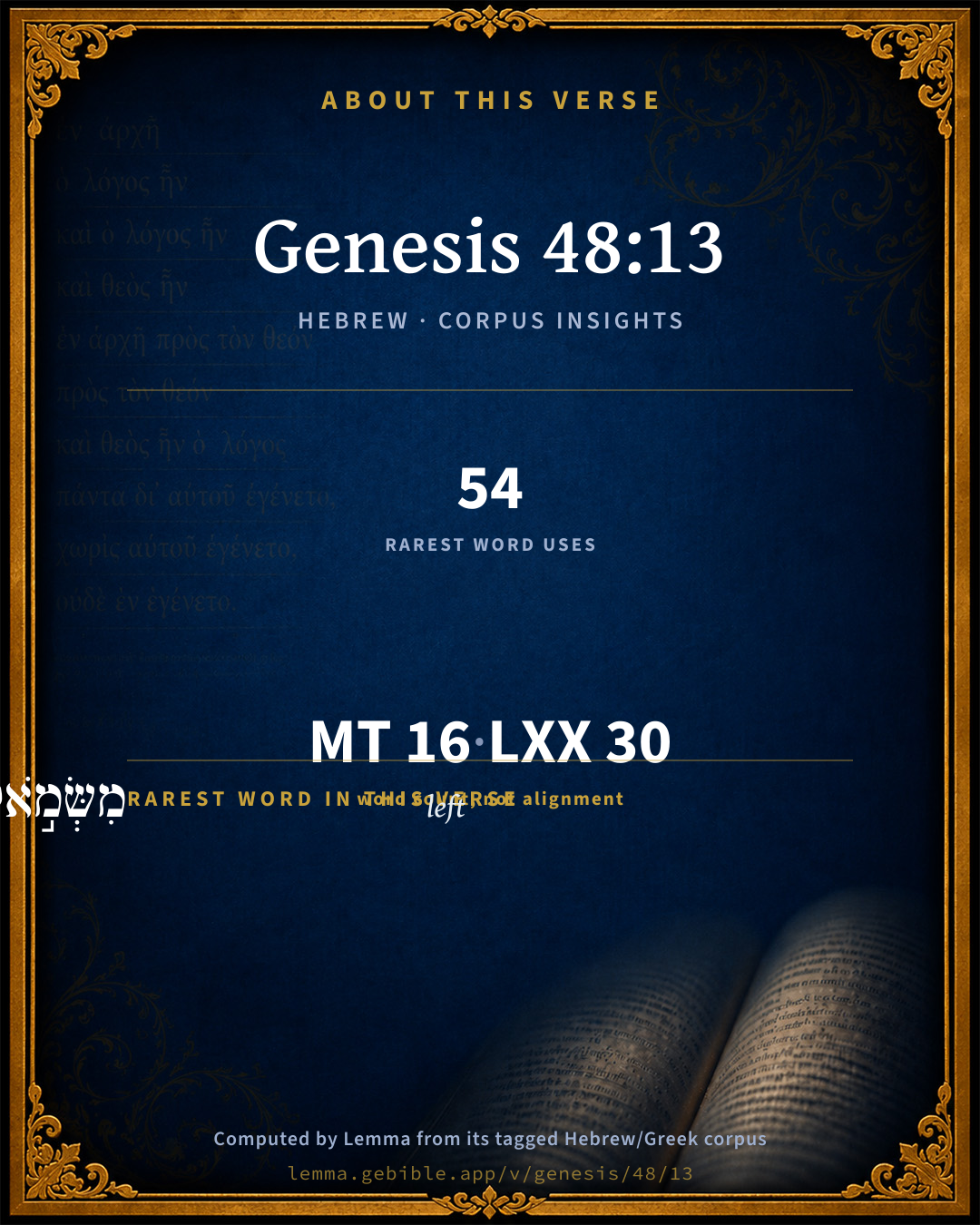
16
words
11
distinct lemmas
Pentateuch
section

Shared distinctive vocabulary

מִשְּׂמֹ֣אל left H8040 occurs in 53 verses of the Hebrew Bible. Also found in:

Grammatical profile

  • 2 verbs
  • 9 nouns
  • 1 adjective
  • 1 preposition
  • 3 particles

Verb forms

  • וַיִּקַּ֣ח Qal · Sequential Imperfect
  • וַיַּגֵּ֖שׁ Hiphil · Sequential Imperfect

Repetition

Words recur within this verse — often emphatic in Hebrew:

  • בִּֽימִינוֹ֙ right hand H3225 ×2
  • מִשְּׂמֹ֣אל left H8040 ×2
  • יִשְׂרָאֵ֔ל Israel H3478 ×2

Hebrew & Septuagint length

In English translation the verse runs 29 words from the Hebrew and 36 from the Septuagint (LXX English) — closely comparable.

A rough comparison of the two English renderings, which tokenize alike — not a word-level alignment.

Word counts can differ between the Hebrew and the Greek without any difference in meaning — e.g. the Hebrew direct-object marker אֵת has no separate Greek word, and Greek often adds the article ὁ.

In the original languages it is 16 Hebrew tokens and 30 Greek tokens — but the two are counted differently (Hebrew bundles its prefixes and suffixes into one token; the Greek is in lemma form), so that isn’t a like-for-like length.

Hebrew and Greek witnesses Masoretic Hebrew ↔ Greek Septuagint

The same verse in the two great witnesses to the Old Testament, shown verse-for-verse.

These are two independent witnesses, not word-aligned to each other, and the Septuagint is shown in lemma (dictionary) form.

Hebrew Genesis 48:13 Masoretic · Westminster Leningrad Codex

וַיִּקַּ֣ח יוֹסֵף֮ אֶת שְׁנֵיהֶם֒ אֶת אֶפְרַ֤יִם בִּֽימִינוֹ֙ מִשְּׂמֹ֣אל יִשְׂרָאֵ֔ל וְאֶת מְנַשֶּׁ֥ה בִשְׂמֹאל֖וֹ מִימִ֣ין יִשְׂרָאֵ֑ל וַיַּגֵּ֖שׁ אֵלָֽיו

Joseph took them both, Ephraim in his right hand toward Israel's left hand, and Manasseh in his left hand toward Israel's right hand, and brought them near to him.

World English Bible · Public Domain

Greek LXX Genesis 48:13 Septuagint · lemma form

λαμβάνω δέ ιωσηφ ὁ δύο υἱός αὐτός ὁ τε ἐφράιμ ἐν ὁ δεξιός ἐκ ἀριστερός δέ ἰσραήλ ὁ δέ μανασσή ἐν ὁ ἀριστερός ἐκ δεξιός δέ ἰσραήλ ἐγγίζω αὐτός αὐτός

And Joseph took his two sons, both Ephraim in his right hand, but on the left of Israel, and Manasse on his left hand, but on the right of Israel, and brought them near to him.

LXX2012 (modern English Septuagint) · Public Domain

Hebrew: Westminster Leningrad Codex (CC BY 4.0). Greek: Septuagint (public domain); English from LXX2012 (modern English Septuagint) (Public Domain). How the Septuagint differs from the Hebrew →

Targum (Aramaic paraphrase)

2

The Targum is the ancient Jewish Aramaic paraphrase of the Hebrew Scriptures — an interpretive translation, not the Hebrew text itself. Onkelos (literal) and Pseudo-Jonathan (expansive) render the Torah, and Jonathan the Prophets. Coverage is partial: where no permissively-licensed English translation exists for a verse, only the Aramaic is shown. This is verse-level text, not a word-by-word alignment to the Hebrew.

  1. Targum Onkelos Torah (Genesis–Deuteronomy)
    וּדְבַר יוֹסֵף יָת תַּרְוֵיהוֹן יָת אֶפְרַיִם בִּימִינֵהּ מִשְׂמָאלָא דְיִשְׂרָאֵל וְיָת מְנַשֶּׁה בִשְׂמָאלֵהּ מִימִינָא דְיִשְׂרָאֵל וְקָרֵיב לְוָתֵהּ

    (no public-domain English translation for this verse)

    Targum Onkelos — Aramaic: “Onkelos Genesis” (public domain); “Onkelos Exodus” (public domain); “Onkelos Leviticus” (public domain); “Onkelos Numbers” (public domain); “Onkelos Deuteronomy” (public domain). English: “Sefaria Community Translation” (CC0 1.0 (public-domain dedication)); “J.W. Etheridge. The Targums of Onkelos and Jonathan Ben Uzziel on the Pentateuch. London: Longmans, Green, 1862” (public domain). Text via Sefaria.

  2. Targum Pseudo-Jonathan Torah (Genesis–Deuteronomy)
    וּדְבַר יוֹסֵף יַת תַּרְוֵיהוֹם יַת אֶפְרַיִם מִן צְטַר יְמִינֵיהּ דְהוּא שְמָאלֵיהּ דְיִשְרָאֵל וְיַת מְנַשֶׁה מִן צְטַר שְמָאלֵיהּ דְהוּא יְמִינָא דְיִשְרָאֵל וּקְרֵיב לְוָותֵיהּ

    And Joseph took both of them, Ephraim on his right side, which was Israel's left, and Menasheh on his left side, which was Israel's right, and brought them to him.

    Targum Pseudo-Jonathan — Aramaic: “Targum Jonathan on Genesis” (public domain); “Targum Jonathan on Exodus” (public domain); “Targum Jonathan on Leviticus” (public domain); “Targum Jonathan on Numbers” (public domain); “Targum Jonathan on Deuteronomy” (public domain). English: “The Targum of Jonathan ben Uzziel, trans. J. W. Etheridge, London, 1862” (public domain). Text via Sefaria.

Commentary

Notes on Genesis 48:13 from classic Christian and Jewish commentators (each source and its license shown beneath its notes). The classic Christian expositions comment on the surrounding passage and are grouped to its opening verse, so a note may address several verses; the Jewish commentaries on the Tanakh (Rashi and others) are per-verse, so they appear only where the commentator wrote on this verse.

Lemma curates 59 commentaries, every one of them public domain or Creative Commons licensed, each selected and text-cleaned for this edition rather than reprinted as found. About our sources →

Trapp's Complete Commentary

John Trapp

Gen 48:13 And Joseph took them both, Ephraim in his right hand toward Israel’s left hand, and Manasseh in his left hand toward Israel’s right hand, and brought [them] near unto him.

Ver. 13. Both, Ephraim in his right hand.] The right hand hath the pre-eminence of the left among most people: yet not so among the Turks; their soldiery especially. The right hand they hold uppermost ibr the clergy, and the left for a soldier: because it gives a man possession of his companion’s sword. Thus do both orders converse without the depression of either, saith mine author. {a}

{a} Sir Henry Blunt’s Voyage.

John Trapp, A Commentary or Exposition upon All the Books of the Old and New Testament (1647–1656) — public domain. Text from a community e-Sword module.

Jamieson, Fausset & Brown

Robert Jamieson, A. R. Fausset & David Brown

Joseph took them both--The very act of pronouncing the blessing was remarkable, showing that Jacob's bosom was animated by the spirit of prophecy.

Jamieson, Fausset & Brown — Commentary Critical and Explanatory on the Whole Bible (1871) — public domain (CC PDM 1.0). Text via the HelloAO Bible API.

The Cambridge Bible for Schools and Colleges

gen. ed. J. J. S. Perowne

13. Ephraim in his right hand] i.e. so that the right hand of Jacob might rest on Manasseh the elder. The gesture of benediction, by the laying on of hands, signified the communication of rights and privileges. As in the story of Isaac (ch. 27), the blessing by the head of the house, on his deathbed, was irrevocable. The person who received it could not be deprived of it.

The Cambridge Bible for Schools and Colleges (gen. ed. J. J. S. Perowne; Cambridge University Press, 1878–1918) — public domain. Text from a community e-Sword module.

John Gill's Exposition

And Joseph took them both, Ephraim in his right hand toward Israel's left hand,.... He took Ephraim his youngest son in his right hand, and led him up to his father, by which means he would stand in a right position to have his grandfather's left hand put upon him:

and Manasseh in his left hand toward Israel's right hand; Manasseh his eldest son he took in his left hand, and brought him to his father, and so was in a proper position to have his right hand laid upon him, as seniority of birth required, and as he was desirous should be the case:

and brought them near unto him; in the above manner, so near as that he could lay his hands on them.

John Gill's Exposition of the Whole Bible (1746–1763) — public domain (CC PDM 1.0). Text via the HelloAO Bible API.

The Pulpit Commentary

And Joseph took them both, Ephraim in his right hand toward Israel"s left hand, and Manasseh in his left hand toward Israel"s right hand, and brought them near unto him. Joseph naturally expected that Jacob s right hand would fall upon the head of Manasseh, as the firstborn, although with regard to even this a doubt might have been suggested if he had remembered how Isaac had been preferred to Ishmael, and Jacob to Esau.

The Pulpit Commentary (1880–1919), ed. H.D.M. Spence-Jones & Joseph S. Exell — public domain. Text from a community e-Sword module.

Rashi

Rabbi Shlomo Yitzchaki (Rashi)

את אפרים בימינו משמאל ישראל EPHRAIM ON HIS RIGHT HAND TOWARDS ISRAEL’S LEFT — If one is moving towards another person his right hand is opposite the other’s left. Now since he (Manasseh) was the first-born he was marked out for the blessing and should have been placed at Jacob’s right hand.

Rashi on the Tanakh — English translations: “The Judaica Press complete Tanach with Rashi, translated by A. J. Rosenberg” (CC BY 4.0); “Pentateuch with Rashi's commentary by M. Rosenbaum and A.M. Silbermann, 1929-1934” (public domain); “The Metsudah Tanach series, Lakewood, N.J” (CC BY 4.0); and “The Book of Joshua, Metsudah Publications, 1997” (CC BY 4.0). Text via Sefaria.

Radak

Rabbi David Kimhi (Radak)

בימינו, on Joseph’s right, which was the left side of Yaakov (Yisrael)

Radak on the Tanakh — English translations: “Sefaria Community Translation” (CC0 1.0 (public-domain dedication)); “Eliyahu Munk, HaChut Hameshulash” (CC BY 4.0); “Rabbi Mike Feuer, Jerusalem Anthology” (CC BY 4.0); and “R. David Kimhi on the first book of Psalms, Translated by R.G. Finch, London, 1919” (public domain). Text via Sefaria.

Lesson kit

Teaching starters — assembled from the data on this page, not authored interpretation. Every prompt links to the verse data it draws on. Edit before teaching.

Genesis, in the Pentateuch, opens this verse with 16 words (11 distinct Hebrew lemmas). Its most distinctive word is sᵉmôʼwl (“left”). A historical commentator’s framing appears above. Read the whole chapter for the surrounding context.

Discussion questions

  1. How does “left” (sᵉmôʼwl) shape what this verse is saying?
  2. Genesis 13:9 shares the word «left» with this verse. How do the two illuminate each other?
  3. “right hand” occurs 2× in this one verse. What is the effect of the repetition?
  4. The translations on this page render this verse differently — a whole-verse word diff, not a word-by-word alignment. What might account for the different wordings?
  5. The verb «וַיִּקַּ֣ח» is Qal Sequential Imperfect. How does its form color the action?
  6. Reading how Trapp's Complete Commentary and Jamieson, Fausset & Brown read this verse, where do the two commentators agree and where do they part?

Things to notice

Reading settings

Reading text

Shown beneath each verse's original-language words.

Old Testament
Old Testament edition

Read the OT as the Masoretic Hebrew (MT) or the Greek Septuagint (LXX).

English shown for the Greek Septuagint (in the Hebrew ↔ Greek comparison).

Comparing translations? Open the Compare panel on any verse page to stack up to four side by side.