
Leviticus 12:8

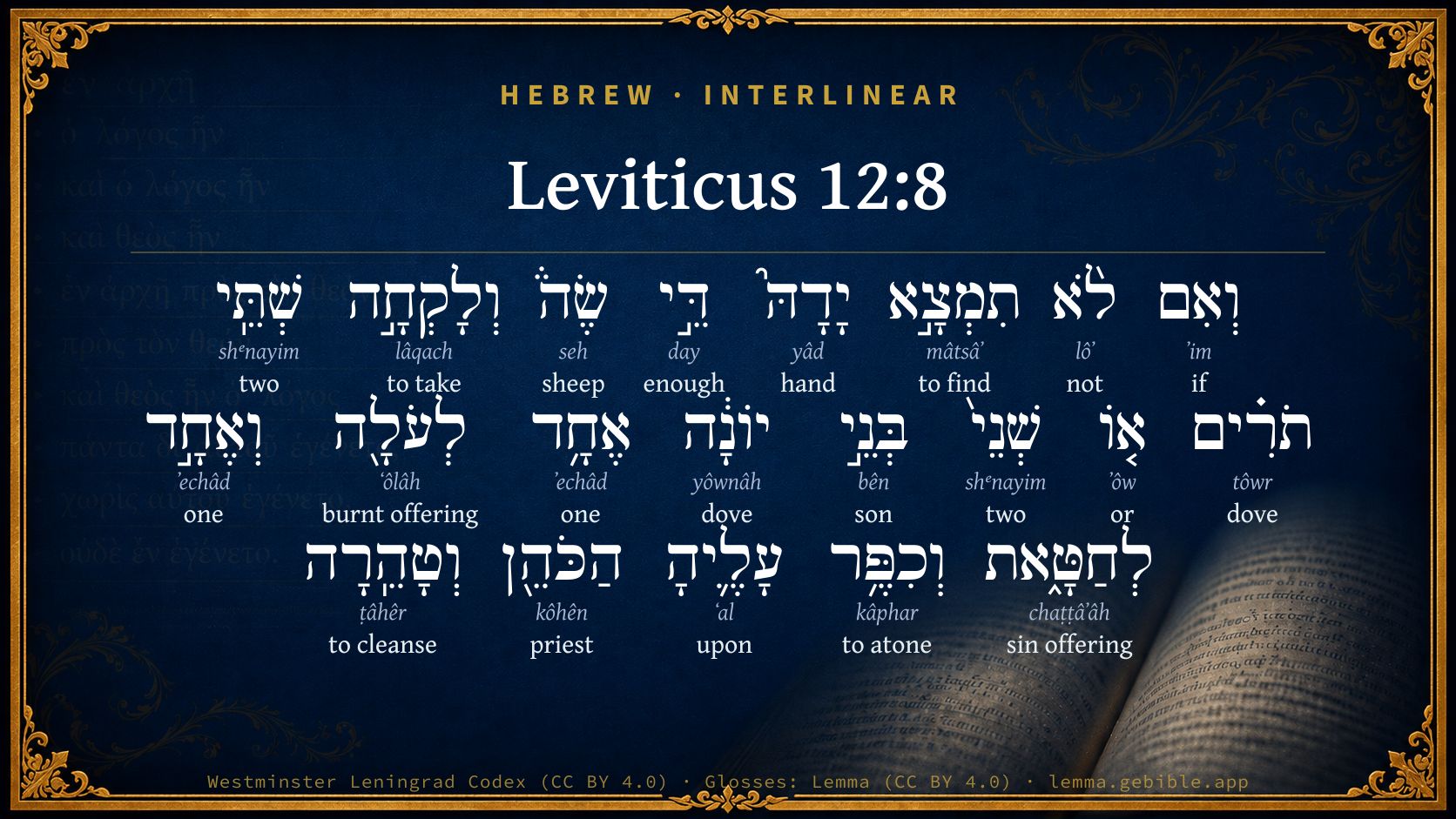
Hebrew (Westminster Leningrad Codex) Leviticus 12:8 appears in the Hebrew Old Testament. The text above is from the Westminster Leningrad Codex. Each word links to its Strong’s number, a concise gloss, and parsing drawn from the Open Scriptures Hebrew Bible morphology. Click any word for its full Brown-Driver-Briggs (BDB) entry.
Download image
Cite this verse

Leviticus 12:8 (World English Bible). Public Domain. Lemma interlinear Bible study tool, https://lemma.gebible.app/v/leviticus/12/8.

Show BibTeX & RIS
BibTeX
RIS
English Translation
If she cannot afford a lamb, then she shall take two turtledoves, or two young pigeons; the one for a burnt offering, and the other for a sin offering: and the priest shall make atonement for her, and she shall be clean.'"
World English Bible · Public Domain
Download a study sheet

One document with this verse’s original text, its word-by-word gloss line, the meaning frame, cross-references with their text, attributed commentary, and full source and license credits — printable, and it pastes into notes with its structure intact.

This verse Autodidact and up

Study sheet (.html) Plain text (.txt)

A passage Seminary Student

Up to 50 verses in one chapter. A passage sheet keeps up to 6 commentary sources and 12 cross-references per verse, in the order this page ranks them, and says so on the sheet whenever that leaves anything out. Ask for a single verse and you get the Autodidact verse sheet above.

Everything on this page stays free to read, with no account — the sheet is a download of what is already on screen, not access to it.

Want to remove ads? Support Godless Engineer
Compare translations 3

The same verse in 3 English versions, stacked beneath the original-language interlinear above. Click any original word for its lexicon entry.

Each is an independent rendering of the whole verse — the interlinear is not word-aligned to these translations.

Highlighted words mark where these versions differ — a whole-verse word diff, not a word-by-word alignment.

  • World English Bible Public Domain
    If she cannot afford a lamb, then she shall take two turtledoves, or two young pigeons; the one for a burnt offering, and the other for a sin offering: and the priest shall make atonement for her, and she shall be clean.'"
  • King James Version Public Domain
    And if she be not able to bring a lamb, then she shall bring two turtles, or two young pigeons; the one for the burnt offering, and the other for a sin offering: and the priest shall make an atonement for her, and she shall be clean.
  • unfoldingWord Literal Text CC BY-SA 4.0
    And if her hand does not find enough a sheep, then she shall take two turtledoves or two young doves, one for a burnt offering and one for a sin offering. And the priest shall make atonement for her, and she will be pure.’”

unfoldingWord Literal Text — © unfoldingWord, licensed CC BY-SA 4.0. Word-aligned USFM3 via Door43 (git.door43.org/unfoldingWord/en_ult).

Versions to compare (up to 4)

3 of 4 selected

Show all 18 translations

Every available English version of this verse, each an independent rendering of the whole verse.

  • World English Bible Public Domain
    If she cannot afford a lamb, then she shall take two turtledoves, or two young pigeons; the one for a burnt offering, and the other for a sin offering: and the priest shall make atonement for her, and she shall be clean.'"
  • Berean Standard Bible Public Domain
    But if she cannot afford a lamb, she shall bring two turtledoves or two young pigeons, one for a burnt offering and the other for a sin offering. Then the priest will make atonement for her, and she will be clean.’”
  • Majority Standard Bible Public Domain
    But if she cannot afford a lamb, she shall bring two turtledoves or two young pigeons, one for a burnt offering and the other for a sin offering. Then the priest will make atonement for her, and she will be clean.’”
  • King James Version Public Domain
    And if she be not able to bring a lamb, then she shall bring two turtles, or two young pigeons; the one for the burnt offering, and the other for a sin offering: and the priest shall make an atonement for her, and she shall be clean.
  • American Standard Version (1901) Public Domain
    And if her means suffice not for a lamb, then she shall take two turtle-doves, or two young pigeons; the one for a burnt-offering, and the other for a sin-offering: and the priest shall make atonement for her, and she shall be clean.
  • Revised Version (1885) Public Domain
    And if her means suffice not for a lamb, then she shall take two turtledoves, or two young pigeons; the one for a burnt offering, and the other for a sin offering: and the priest shall make atonement for her, and she shall be clean.
  • Geneva Bible (1599) Public Domain
    But if she bee not able to bring a lambe, she shall bring two turtles, or two yong pigeons: the one for a burnt offring, and the other for a sinne offring: and the Priest shall make an atonement for her: so she shall be cleane.
  • Douay-Rheims (1899) Public Domain
    And if her hand find not sufficiency, and she is not able to offer a lamb, she shall take two turtles, or two young pigeons, one for a holocaust, and another for sin: and the priest shall pray for her, and so she shall be cleansed.
  • Young's Literal Translation Public Domain
    `And if her hand find not the sufficiency of a sheep, then she hath taken two turtle-doves, or two young pigeons, one for a burnt-offering, and one for a sin-offering, and the priest hath made atonement for her, and she hath been cleansed.'
  • Literal Standard Version CC BY-SA 4.0
    And if her hand does not find the sufficiency of a sheep, then she has taken two turtle-doves or two young pigeons, one for a burnt-offering and one for a sin-offering, and the priest has made atonement for her, and she has been cleansed.”
  • Unlocked Literal Bible CC BY-SA 4.0
    If she is not able to afford a lamb, then she must take two doves or two young pigeons, one as a burnt offering and the other as a sin offering, and the priest will make atonement for her; then she will be clean.'”
  • unfoldingWord Literal Text CC BY-SA 4.0
    And if her hand does not find enough a sheep, then she shall take two turtledoves or two young doves, one for a burnt offering and one for a sin offering. And the priest shall make atonement for her, and she will be pure.’”
  • Darby Bible Public Domain
    And if her hand cannot find what is sufficient for a sheep, she shall bring two turtle-doves or two young pigeons; one for a burnt-offering, and the other for a sin-offering; and the priest shall make atonement for her; and she shall be clean.
  • World Messianic Bible Public Domain
    If she cannot afford a lamb, then she shall take two turtledoves or two young pigeons: the one for a burnt offering, and the other for a sin offering. The priest shall make atonement for her, and she shall be clean.’”
  • Webster's Bible Public Domain
    And if she shall not be able to bring a lamb, then she shall bring two turtles, or two young pigeons; the one for the burnt-offering, and the other for a sin-offering: and the priest shall make an atonement for her, and she shall be clean.
  • Free Bible Version CC BY-SA 4.0
    If a woman can't afford to bring a lamb, she is to bring two turtledoves or two young pigeons. One is for the burnt offering and the other for the purification offering. The priest will offer them to purify her, and she will be clean.”
  • Bible in Basic English Public Domain
    And if she has not money enough for a lamb, then let her take two doves or two young pigeons, one for a burned offering and the other for a sin-offering, and the priest will take away her sin and she will be clean,
  • JPS Tanakh (1917) Public Domain
    And if her means suffice not for a lamb, then she shall take two turtle-doves, or two young pigeons: the one for a burnt-offering, and the other for a sin-offering; and the priest shall make atonement for her, and she shall be clean.

Literal Standard Version (2020), Covenant Press — licensed CC BY-SA 4.0. Text via the HelloAO Bible API (eBible.org). Unlocked Literal Bible (unfoldingWord) — licensed CC BY-SA 4.0. Text via the HelloAO Bible API (eBible.org). unfoldingWord Literal Text — © unfoldingWord, licensed CC BY-SA 4.0. Word-aligned USFM3 via Door43 (git.door43.org/unfoldingWord/en_ult). Free Bible Version, Dr. Jonathan Gallagher — licensed CC BY-SA 4.0. Text via the HelloAO Bible API (eBible.org).

Word by word

More ways to search: Search by grammar → Find every occurrence → Compare this word →

Practice this passage: Drill this verse → Learn its vocabulary →

תֹרִ֗ים
tôwr
H8449
“doves”
Noun, Common, Both, Plural, Absolute
Part of Speech
Noun
Type
Common
Gender
Both
Number
Plural
State
Absolute
Full BDB Definition

Origin: probably the same as H8447

TWOT: 2500c

dove, turtledove
  1. וְאִם ʼim H518 “and · if” Conjunction + Conjunction
  2. לֹ֨א lôʼ H3808 “not” Particle, Negative
  3. תִמְצָ֣א mâtsâʼ H4672 “to find” Verb, Qal, Imperfect, 3rd Person, Feminine, Singular
  4. יָדָהּ֮ yâd H3027 “hand · her” Noun, Common, Both, Singular, Construct + Suffix, Personal, 3rd Person, Feminine, Singular
  5. דֵּ֣י day H1767 “enough of” Noun, Common, Masculine, Singular, Construct
  6. שֶׂה֒ seh H7716 “sheep” Noun, Common, Both, Singular, Absolute
  7. וְלָקְחָ֣ה lâqach H3947 “and · to take” Conjunction + Verb, Qal, Sequential Perfect, 3rd Person, Feminine, Singular
  8. שְׁתֵּֽי shᵉnayim H8147 “two” Adjective, Cardinal number, Feminine, Dual, Construct
  9. א֤וֹ ʼôw H176 “or” Conjunction
  10. שְׁנֵי֙ shᵉnayim H8147 “two” Adjective, Cardinal number, Masculine, Dual, Construct
  11. בְּנֵ֣י bên H1121 “sons of” Noun, Common, Masculine, Plural, Construct
  12. יוֹנָ֔ה yôwnâh H3123 “dove” Noun, Common, Feminine, Singular, Absolute
  13. אֶחָ֥ד ʼechâd H259 “one” Adjective, Cardinal number, Masculine, Singular, Absolute
  14. לְעֹלָ֖ה ʻôlâh H5930 “to/for · burnt offering” Preposition + Noun, Common, Feminine, Singular, Absolute
  15. וְאֶחָ֣ד ʼechâd H259 “and · one” Conjunction + Adjective, Cardinal number, Masculine, Singular, Absolute
  16. לְחַטָּ֑את chaṭṭâʼâh H2403 “to/for · sin offering” Preposition + Noun, Common, Feminine, Singular, Absolute
  17. וְכִפֶּ֥ר kâphar H3722 “and · to atone” Conjunction + Verb, Piel, Sequential Perfect, 3rd Person, Masculine, Singular
  18. עָלֶ֛יהָ ʻal H5921 “upon · her” Preposition + Suffix, Personal, 3rd Person, Feminine, Singular
  19. הַכֹּהֵ֖ן kôhên H3548 “the · priest” Particle, Definite Article + Noun, Common, Masculine, Singular, Absolute
  20. וְטָהֵֽרָה ṭâhêr H2891 “and · to cleanse” Conjunction + Verb, Qal, Sequential Perfect, 3rd Person, Feminine, Singular

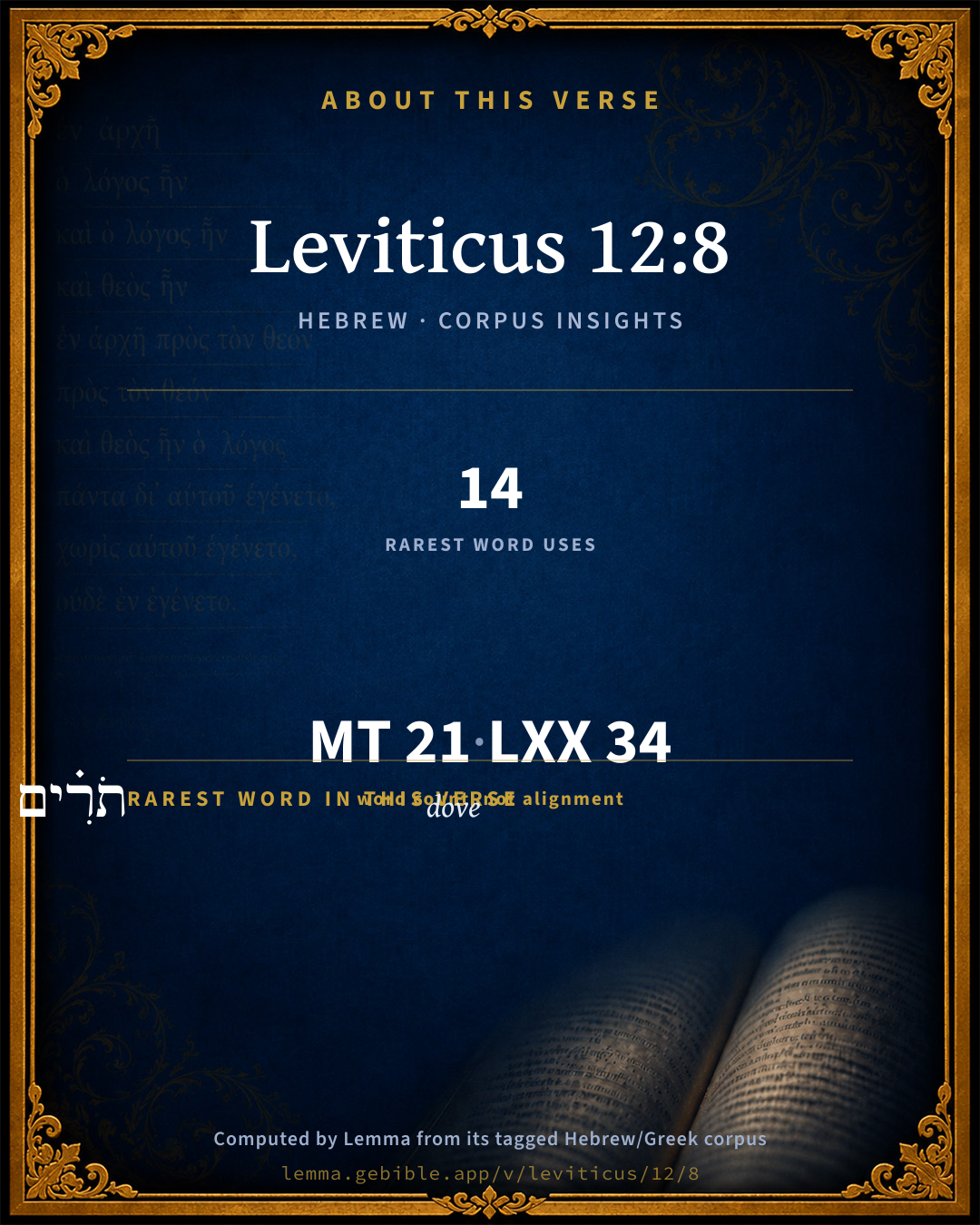
About this verse

These counts appear in no published source. They are computed here, from the morphology-tagged text and Lemma’s own curated glosses. What Lemma adds →

21
words
19
distinct lemmas
Pentateuch
section

Notable vocabulary

The rarest word here is תֹרִ֗ים dove H8449 — appearing just 14 times in the whole Hebrew Bible.

Shared distinctive vocabulary

תֹרִ֗ים dove H8449 occurs in 14 verses of the Hebrew Bible. Also found in:

Grammatical profile

  • 4 verbs
  • 9 nouns
  • 4 adjectives
  • 1 preposition
  • 2 conjunctions
  • 1 particle

Verb forms

  • תִמְצָ֣א Qal · Imperfect
  • וְלָקְחָ֣ה Qal · Sequential Perfect
  • וְכִפֶּ֥ר Piel · Sequential Perfect
  • וְטָהֵֽרָה Qal · Sequential Perfect

Repetition

Words recur within this verse — often emphatic in Hebrew:

  • שְׁתֵּֽי two H8147 ×2
  • אֶחָ֥ד one H259 ×2

Hebrew & Septuagint length

In English translation the verse runs 42 words from the Hebrew and 41 from the Septuagint (LXX English) — closely comparable.

A rough comparison of the two English renderings, which tokenize alike — not a word-level alignment.

Word counts can differ between the Hebrew and the Greek without any difference in meaning — e.g. the Hebrew direct-object marker אֵת has no separate Greek word, and Greek often adds the article ὁ.

In the original languages it is 21 Hebrew tokens and 34 Greek tokens — but the two are counted differently (Hebrew bundles its prefixes and suffixes into one token; the Greek is in lemma form), so that isn’t a like-for-like length.

Cross-references

8

Topical passages linked to Leviticus 12:8 in the Treasury of Scripture Knowledge — connected by theme and wording, ordered by reader-vote popularity; previews shown in the World English Bible.

  • Leviticus 5:7 "'If he can't afford a lamb, then he shall bring his trespass offering for that in which he has sinned, two turtledoves, or two young pigeons, to Yahweh; one for a sin offering, and the other for a burnt offering.
  • Leviticus 4:26 All its fat he shall burn on the altar, like the fat of the sacrifice of peace offerings; and the priest shall make atonement for him concerning his sin, and he will be forgiven.
  • Leviticus 1:14 "'If his offering to Yahweh is a burnt offering of birds, then he shall offer his offering of turtledoves, or of young pigeons.
  • Leviticus 14:22 and two turtledoves, or two young pigeons, such as he is able to afford; and the one shall be a sin offering, and the other a burnt offering.
  • Luke 2:22–24 When the days of their purification according to the law of Moses were fulfilled, they brought him up to Jerusalem, to present him to the Lord
  • Leviticus 15:14 "'On the eighth day he shall take two turtledoves, or two young pigeons, and come before Yahweh to the door of the Tent of Meeting, and give them to the priest:
  • Leviticus 15:29 On the eighth day she shall take two turtledoves, or two young pigeons, and bring them to the priest, to the door of the Tent of Meeting.
  • 2 Corinthians 8:9 For you know the grace of our Lord Jesus Christ, that, though he was rich, yet for your sakes he became poor, that you through his poverty might become rich.

Cross-references courtesy of OpenBible.info (CC BY 4.0).

Hebrew and Greek witnesses Masoretic Hebrew ↔ Greek Septuagint

The same verse in the two great witnesses to the Old Testament, shown verse-for-verse.

These are two independent witnesses, not word-aligned to each other, and the Septuagint is shown in lemma (dictionary) form.

Hebrew Leviticus 12:8 Masoretic · Westminster Leningrad Codex

וְאִם לֹ֨א תִמְצָ֣א יָדָהּ֮ דֵּ֣י שֶׂה֒ וְלָקְחָ֣ה שְׁתֵּֽי תֹרִ֗ים א֤וֹ שְׁנֵי֙ בְּנֵ֣י יוֹנָ֔ה אֶחָ֥ד לְעֹלָ֖ה וְאֶחָ֣ד לְחַטָּ֑את וְכִפֶּ֥ר עָלֶ֛יהָ הַכֹּהֵ֖ן וְטָהֵֽרָה

If she cannot afford a lamb, then she shall take two turtledoves, or two young pigeons; the one for a burnt offering, and the other for a sin offering: and the priest shall make atonement for her, and she shall be clean.'"

World English Bible · Public Domain

Greek LXX Leviticus 12:8 Septuagint · lemma form

ἐάν δέ μή εὑρίσκω ὁ χείρ αὐτός ὁ ἱκανός εἰς ἀμνός καί λαμβάνω δύο τρυγών ἤ δύο νεοσσός περιστερά εἷς εἰς ὁλοκαύτωμα καί εἷς περί ἁμαρτία καί ἐκἱλάσκομαι περί αὐτός ὁ ἱερεύς καί καθαρίζω

And if she can’t afford a lamb, then shall she take two turtledoves or two young pigeons, one for a whole burnt offering, and one for a sin-offering; and the priest shall make atonement for her, and she shall be purified.

LXX2012 (modern English Septuagint) · Public Domain

Hebrew: Westminster Leningrad Codex (CC BY 4.0). Greek: Septuagint (public domain); English from LXX2012 (modern English Septuagint) (Public Domain). How the Septuagint differs from the Hebrew →

Targum (Aramaic paraphrase)

2

The Targum is the ancient Jewish Aramaic paraphrase of the Hebrew Scriptures — an interpretive translation, not the Hebrew text itself. Onkelos (literal) and Pseudo-Jonathan (expansive) render the Torah, and Jonathan the Prophets. Coverage is partial: where no permissively-licensed English translation exists for a verse, only the Aramaic is shown. This is verse-level text, not a word-by-word alignment to the Hebrew.

  1. Targum Onkelos Torah (Genesis–Deuteronomy)
    וְאִם לָא תַשְׁכַּח יְדַהּ כְּמִסַת אִמְרָא וְתִסַב תַּרְתֵּין שַׁפְנִינִין אוֹ תְרֵין בְּנֵי יוֹנָה חַד לַעֲלָתָא וְחַד לְחַטָאתָא וִיכַפֵּר עֲלַהּ כַּהֲנָא וְתִדְכֵּי

    (no public-domain English translation for this verse)

    Targum Onkelos — Aramaic: “Onkelos Genesis” (public domain); “Onkelos Exodus” (public domain); “Onkelos Leviticus” (public domain); “Onkelos Numbers” (public domain); “Onkelos Deuteronomy” (public domain). English: “Sefaria Community Translation” (CC0 1.0 (public-domain dedication)); “J.W. Etheridge. The Targums of Onkelos and Jonathan Ben Uzziel on the Pentateuch. London: Longmans, Green, 1862” (public domain). Text via Sefaria.

  2. Targum Pseudo-Jonathan Torah (Genesis–Deuteronomy)
    וְאִין לָא הַשְׁכַּח יְדָהּ הֵי כְמִיסַת לְמִיתוֹיָיא אִימְרָא וְתִיסַב תְּרֵין שַׁפְנִינִין אוֹ תְרֵין גוֹזְלִין בְּנֵי יוֹנָן חַד לַעֲלָתָא וְחַד לְחַטָאתָא וִיכַפֵּר עֲלָהּ כַּהֲנָא וְתִידְכֵּי

    But if she find not her hand sufficient to bring a lamb, let her bring two turtle doves or two young pigeons; one for the burnt offering, and one for the sin offering, and the priest shall make atonement for her, and she shall be clean.

    Targum Pseudo-Jonathan — Aramaic: “Targum Jonathan on Genesis” (public domain); “Targum Jonathan on Exodus” (public domain); “Targum Jonathan on Leviticus” (public domain); “Targum Jonathan on Numbers” (public domain); “Targum Jonathan on Deuteronomy” (public domain). English: “The Targum of Jonathan ben Uzziel, trans. J. W. Etheridge, London, 1862” (public domain). Text via Sefaria.

Commentary

Notes on Leviticus 12:8 from classic Christian and Jewish commentators (each source and its license shown beneath its notes). The classic Christian expositions comment on the surrounding passage and are grouped to its opening verse, so a note may address several verses; the Jewish commentaries on the Tanakh (Rashi and others) are per-verse, so they appear only where the commentator wrote on this verse.

Lemma curates 59 commentaries, every one of them public domain or Creative Commons licensed, each selected and text-cleaned for this edition rather than reprinted as found. About our sources →

Trapp's Complete Commentary

John Trapp

Lev 12:8 And if she be not able to bring a lamb, then she shall bring two turtles, or two young pigeons; the one for the burnt offering, and the other for a sin offering: and the priest shall make an atonement for her, and she shall be clean.

Ver. 8. And if she be not able.] As the blessed Virgin was not. {Luk 2:22; Luk 2:24} Who now can despise any one for want, when the mother of our Lord was not rich enough to bring a lamb for her purification? We may be as happy in russet {a}, as in tissue.

{a} A coarse homespun woollen cloth of a reddish-brown, grey or neutral colour, formerly used for the dress of peasants and country folk

John Trapp, A Commentary or Exposition upon All the Books of the Old and New Testament (1647–1656) — public domain. Text from a community e-Sword module.

Joseph Benson's Commentary

Lev 12:8. The morality of this law obliges women who have received mercies from God in child-bearing, with all thankfulness to acknowledge his goodness to them, owning themselves unworthy of it, and (which is the best purification) to continue in faith, and love, and holiness, with sobriety.

Joseph Benson's Commentary on the Old and New Testaments (1811–1818) — public domain. Text from a community e-Sword module.

Tyndale Open Study Notes

Tyndale Open Resources

12:8 cannot afford to bring a lamb: The alternative offering provided for the poorer class of society (see 5:7-13; cp. Luke 2:22-24).

Tyndale Open Study Notes — © Tyndale Open Resources, licensed CC BY-SA 4.0. Text via the HelloAO Bible API.

Geneva Bible (1599)

Geneva Bible translators

Hebrew, if her hand find not the worth of a lamb.

Geneva Bible (1599) marginal notes — public domain. Text via Bolls.life.

Jamieson, Fausset & Brown

Robert Jamieson, A. R. Fausset & David Brown

bring two turtles, &c.--(See on Lev 5:6). This was the offering made by Mary, the mother of Jesus, and it affords an incontestable proof of the poor and humble condition of the family (Luk 2:22-24).

Next: Leviticus Chapter 13

Jamieson, Fausset & Brown — Commentary Critical and Explanatory on the Whole Bible (1871) — public domain (CC PDM 1.0). Text via the HelloAO Bible API.

Adam Clarke's Commentary

Verse 8. And if she be not able to bring a lamb, then she shall bring two turtles, or two young pigeons] As the Virgin Mary brought only the latter, hence it is evident that she was not able, i. e., she was not rich enough to provide the former; for such a holy woman would not have brought the less offering had she been capable of bringing the greater. How astonishing is this! The only heir to the throne of David was not able to bring a lamb to offer in sacrifice to God! How abominable must SIN be when it required him who was in the form of God thus to empty and to humble himself, yea, even to the death of the cross, in order to make an atonement for it, and to purify the soul from all defilement!

The priest shall make an atonement for her] Every act of man is sinful, but such as proceed from the influence of the grace and mercy of God. Her sorrow in conception, and her pain in bringing forth children, reminded the woman of her original offence; an offence which deserved death, an offence which she could not expiate, and for which a sacrifice must be offered: and in reference to better things the life of an animal must be offered as a ransom for her life. And being saved in childbed, though she deserved to die, she is required, as soon as the days of her separation were ended, to bring a sacrifice according to her ability to the priest, that he might offer it to God as an atonement for her. Thus, wherever God keeps up the remembrance of sin, he keeps up also the memorial of sacrifice, to show that the state of a sinner, howsoever deplorable, is not hopeless, for that he himself has found out a ransom. Every where, in the law and in the Gospel, in every ordinance and in every ceremony, we may see both the justice and the mercy of God. Hence, while we have the knowledge of our sin we have also the knowledge of our cure.

Reader, whilst thou art confessing thy own misery do not forget the Lord's mercy; and remember, be saves to the uttermost all that come through Christ unto him.

Adam Clarke's Commentary on the Bible (1810–1826) — public domain. Text from a community e-Sword/MySword module.

Ellicott's Commentary for English Readers

(8) And if she be not able.—As a merciful provision for those who were too poor to bring a lamb, the law permits them to bring a turtle-dove or a pigeon for a burnt offering, provided only it is the same kind of bird as the one brought for a sin offering; that is, they must either be both turtle-doves or both pigeons, and not one turtle-dove and one pigeon. Turtle-doves and pigeons were plentiful and cheap in Palestine (see Lev_1:14). It was therefore the poor woman’s sacrifice which the mother of our Lord offered, when, in accordance with this commutation, she offered a pair of turtle-doves or two young pigeons, on presenting herself for purification at the Temple with the child Jesus, on the expiration of the prescribed term of uncleanness (Luk_2:24), and the priest, after sprinkling her with the blood of the humble sacrifice, declared her cleansed.

A Bible Commentary for English Readers, edited by Charles John Ellicott (1878–1897) — public domain. Text from a community e-Sword module.

The Cambridge Bible for Schools and Colleges

gen. ed. J. J. S. Perowne

8. if her means suffice not for a lamb] ‘if she be not able to bring,’ A.V. Its mg. ‘If her hand find not sufficiency of,’ is the literal rendering of the Heb.

The Cambridge Bible for Schools and Colleges (gen. ed. J. J. S. Perowne; Cambridge University Press, 1878–1918) — public domain. Text from a community e-Sword module.

Haydock's Catholic Bible Commentary

Lamb. This was the case of the blessed Virgin: (Luke ii. 24,); so poor was she! (Menochius) --- It seems difficult to conceive, how all the women of Palestine could present themselves before the tabernacle, 40 or 80 days after the childbirth. Perhaps the law regarded those only who lived in the neighbourhood. The priests explained to the rest what they had to do, whether they might defer bringing their offering till the next great festival, or they might send it by another hand. We read that Anna came to the temple after she had weaned Samuel, 1 Kings i. 21. (Calmet)

George Leo Haydock (1774–1849), Haydock's Catholic Family Bible and Commentary, 1859 edition — public domain. Excludes Psalms (Douay-Rheims chapter numbering differs from Protestant) and Deuterocanonical books (Catholic canon only).

Whedon's Commentary on the Bible

Daniel D. Whedon

8. If she be not able — The law of God adjusts itself to our natural and gracious ability. Nevertheless, where grace has been slighted and withdrawn, the demand of the law continues after ability had ceased. The mother of our Lord in her poverty availed herself of this concession to the poor. Luk_2:22-24.

Turtles or pigeons — For the supply of these in the wilderness and in Palestine, see Introduction, (4.)

Daniel D. Whedon (gen. ed.), Commentary on the Old and New Testaments (1874–1909) — public domain. Text from a community e-Sword module.

The Pulpit Commentary

If she be not able to bring a lamb. A concession is made to poverty, which in later times appears to have been largely acted on. It was, as we know, taken advantage of by the mother of our Lord. (Luk_2:24)

Some fifteen hundred years after this law of purification after childbirth had been given to and by Moses, a man child was born in a country which did not at the time of the legislation of Moses belong to the Israelites, and which those whom Moses addressed had never seen. The country was Palestine, the city Bethlehem. The birth took place in a stable, for the mother was poor. For eight days she remained unclean, and on the eighth day the child was circumcised, and "his name was called Jesus". (Luk_2:21) For thirty-three days longer she continued "in the blood of her purifying", (Lev_12:4) and then "when the days of their purification according to the Law of Moses were accomplished, they brought him to Jerusalem, to present him to the Lord, and to offer a sacrifice, according to that which is said in the Law of the Lord". (Luk_2:22, Luk_2:24) Had the mother been wealthy, she would have offered a lamb for a burnt offering, and a young pigeon, or turtle-dove, for a sin offering, but though of the house and lineage of David, she was poor, and her sacrifice was therefore "a pair of turtledoves, or two young pigeons one of the birds being for a burnt offering, betokening the devotion of her life afresh to God after the peril that she had gone through; the other for a sin offering, recognizing her share in the penalty of Eve as partaker in original sin. "On bringing her offering, she would enter the temple through "the gate of the firstborn," and stand in waiting at the gate of Nicanor, from the time that the incense was kindled on the golden altar. Behind her, in the court of the women, was the crowd of worshippers, while she herself, at the top of the Levites" steps, which led up to the great court, would witness all that passed in the sanctuary. At last one of the officiating priests would come to her at the gate of Nicanor, and take from her hand the poor"s offering, which she had brought. The morning sacrifice was ended, and but few would linger behind while the offering for her purification was actually made. She who brought it mingled prayer and thanksgiving with the service. And now the priest once more approached her, and, sprinkling her with the sacrificial blood, declared her cleansed. Her "firstborn" was next redeemed at the hand of the priest with five shekels of silver; two benedictions being at the same time pronounced one for the happy event which had enriched the family with a firstborn, the other for the law of redemption" (Edersheim, "Temple Service"). It was probably as she descended the steps that Simeon took the babe from her arms, and blessed God and them, and that Anna "gave thanks likewise unto the Lord, and spake of him to all them that looked for redemption in Jerusalem". (Luk_2:38) "And when they had performed all things according to the Law of the Lord, they returned into Galilee, to their own city Nazareth". (Luk_2:39) Thus obediently did the virgin mother of the Lord submit herself to the regulations of the Levitical Law, and thus humbly and graciously did the infant Saviour begin from the day of his birth to "fulfill all righteousness" (Mat_3:15) in his own person, though by the hands of others.

Lessons

1. To obey the positive laws and to submit to the positive institutions of the religious community to which we belong,

2. To take measures, when we have even involuntarily and without sin on our part ceased to be in open communion with God and God"s people, to recover that communion.

3. To see that the measures which we take with this end are appointed by God or by his authority, and are in accordance with his will.

4. To be sure that such steps as we take be accompanied by an acknowledgment of sin and a throwing ourselves for acceptance on the merits of the sacrifice of the cross (which is our sin offering), and a consecration of ourselves to God"s service (which is our burnt offering).

The Pulpit Commentary (1880–1919), ed. H.D.M. Spence-Jones & Joseph S. Exell — public domain. Text from a community e-Sword module.

John Wesley's Explanatory Notes

The morality of this law obliges women who have received mercies from God in child-bearing, with all thankfulness to acknowledge his goodness to them, owning themselves unworthy of it, and (which is the best purification) to continue in faith, and love, and holiness, with sobriety.

John Wesley, Explanatory Notes Upon the Whole Bible (1754–1765) — public domain. Text via the GEBible commentary corpus.

Rashi

Rabbi Shlomo Yitzchaki (Rashi)

אחד לעלה ואחד לחטאת THE ONE FOR A BURNT-OFFERING AND THE OTHER FOR A SIN-OFFERING — Scripture puts it (the עולה) first only by way of mention, but so far as offering it is concerned the sin-offering precedes the burnt-offering; thus do we learn in the Treatise Zevachim 90a, in the chapter commencing כל התדיר.

Rashi on the Tanakh — English translations: “The Judaica Press complete Tanach with Rashi, translated by A. J. Rosenberg” (CC BY 4.0); “Pentateuch with Rashi's commentary by M. Rosenbaum and A.M. Silbermann, 1929-1934” (public domain); “The Metsudah Tanach series, Lakewood, N.J” (CC BY 4.0); and “The Book of Joshua, Metsudah Publications, 1997” (CC BY 4.0). Text via Sefaria.

Lesson kit

Teaching starters — assembled from the data on this page, not authored interpretation. Every prompt links to the verse data it draws on. Edit before teaching.

Leviticus, in the Pentateuch, opens this verse with 21 words (19 distinct Hebrew lemmas). Its most distinctive word is tôwr (“dove”). A historical commentator’s framing appears above. Read the whole chapter for the surrounding context.

Discussion questions

  1. The word tôwr carries the sense “dove.” How does it shape the verse?
  2. How does Genesis 15:9, which shares the word «dove», read alongside this verse?
  3. What does the repetition of “two” (2× in this one verse) do in this verse?
  4. These translations render this verse differently; the difference is in the English rendering, not the original. What questions does that raise?
  5. «תִמְצָ֣א» is a Qal Imperfect verb. How does that grammatical form shape the action described?
  6. Compare how Trapp's Complete Commentary and Joseph Benson's Commentary read this verse. Where do they agree or differ?

Things to notice

Reading settings

Reading text

Shown beneath each verse's original-language words.

Old Testament
Old Testament edition

Read the OT as the Masoretic Hebrew (MT) or the Greek Septuagint (LXX).

English shown for the Greek Septuagint (in the Hebrew ↔ Greek comparison).

Comparing translations? Open the Compare panel on any verse page to stack up to four side by side.