Exodus 22:4

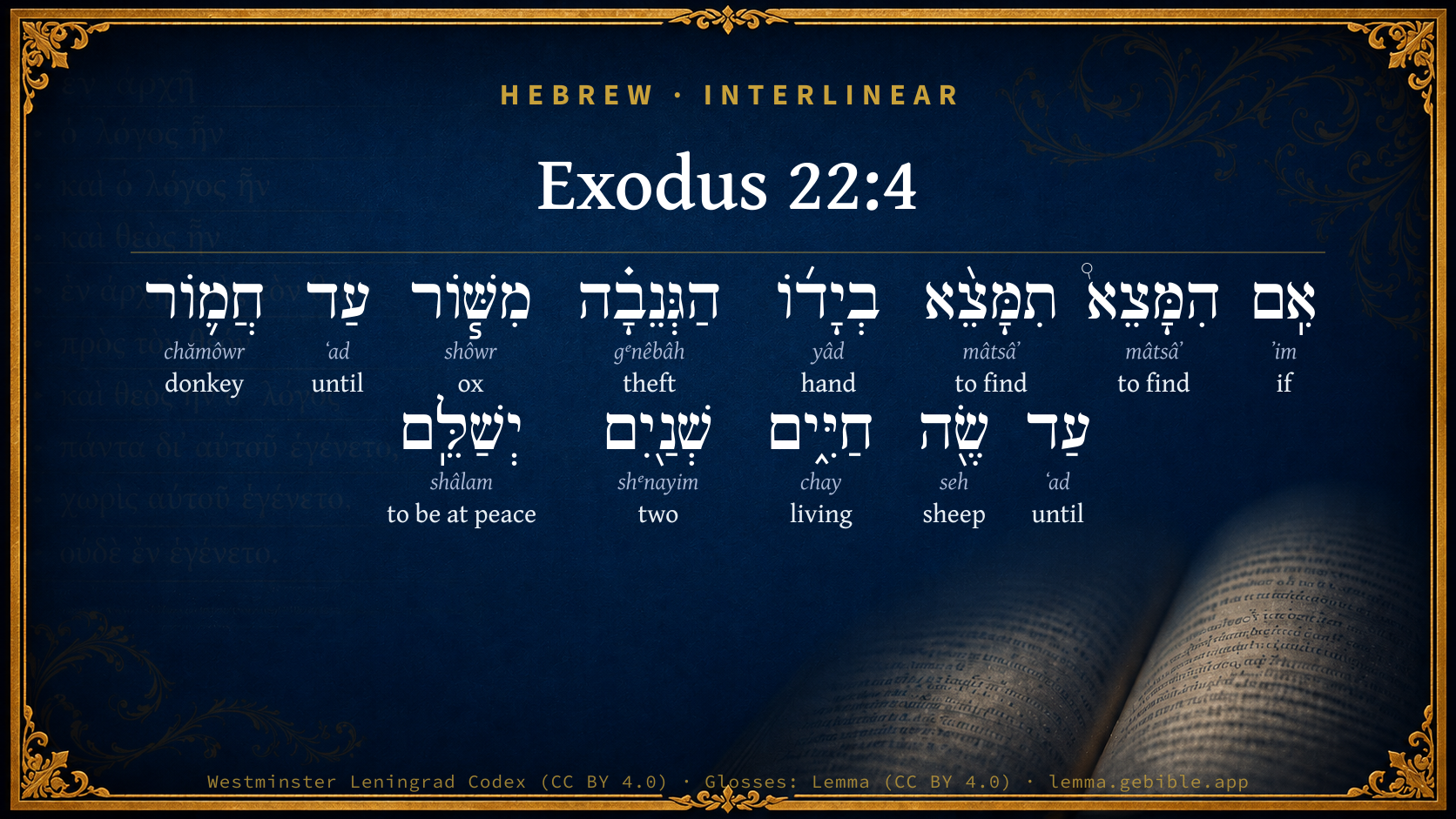
Hebrew (Westminster Leningrad Codex) Exodus 22:4 appears in the Hebrew Old Testament. The text above is from the Westminster Leningrad Codex. Each word links to its Strong’s number, a concise gloss, and parsing drawn from the Open Scriptures Hebrew Bible morphology. Click any word for its full Brown-Driver-Briggs (BDB) entry.
Download image
Cite this verse

Exodus 22:4 (World English Bible). Public Domain. Lemma interlinear Bible study tool, https://lemma.gebible.app/v/exodus/22/4.

Show BibTeX & RIS
BibTeX
RIS
English Translation
If the stolen property is found in his hand alive, whether it is ox, donkey, or sheep, he shall pay double.
World English Bible · Public Domain
Download a study sheet

One document with this verse’s original text, its word-by-word gloss line, the meaning frame, cross-references with their text, attributed commentary, and full source and license credits — printable, and it pastes into notes with its structure intact.

This verse Autodidact and up

Study sheet (.html) Plain text (.txt)

A passage Seminary Student

Up to 50 verses in one chapter. A passage sheet keeps up to 6 commentary sources and 12 cross-references per verse, in the order this page ranks them, and says so on the sheet whenever that leaves anything out. Ask for a single verse and you get the Autodidact verse sheet above.

Everything on this page stays free to read, with no account — the sheet is a download of what is already on screen, not access to it.

Want to remove ads? Support Godless Engineer
Compare translations 3

The same verse in 3 English versions, stacked beneath the original-language interlinear above. Click any original word for its lexicon entry.

Each is an independent rendering of the whole verse — the interlinear is not word-aligned to these translations.

Highlighted words mark where these versions differ — a whole-verse word diff, not a word-by-word alignment.

  • World English Bible Public Domain
    If the stolen property is found in his hand alive, whether it is ox, donkey, or sheep, he shall pay double.
  • King James Version Public Domain
    If the theft be certainly found in his hand alive, whether it be ox, or ass, or sheep; he shall restore double.
  • unfoldingWord Literal Text CC BY-SA 4.0
    If the stolen thing is actually found alive in his hand, from an ox to a donkey to a sheep, he shall compensate double.

unfoldingWord Literal Text — © unfoldingWord, licensed CC BY-SA 4.0. Word-aligned USFM3 via Door43 (git.door43.org/unfoldingWord/en_ult).

Versions to compare (up to 4)

3 of 4 selected

Show all 18 translations

Every available English version of this verse, each an independent rendering of the whole verse.

  • World English Bible Public Domain
    If the stolen property is found in his hand alive, whether it is ox, donkey, or sheep, he shall pay double.
  • Berean Standard Bible Public Domain
    If what was stolen is actually found alive in his possession—whether ox or donkey or sheep—he must pay back double.
  • Majority Standard Bible Public Domain
    If what was stolen is actually found alive in his possession—whether ox or donkey or sheep—he must pay back double.
  • King James Version Public Domain
    If the theft be certainly found in his hand alive, whether it be ox, or ass, or sheep; he shall restore double.
  • American Standard Version (1901) Public Domain
    If the theft be found in his hand alive, whether it be ox, or ass, or sheep, he shall pay double.
  • Revised Version (1885) Public Domain
    If the theft be found in his hand alive, whether it be ox, or ass, or sheep; he shall pay double.
  • Geneva Bible (1599) Public Domain
    If the theft bee founde with him, aliue, (whether it be oxe, asse, or sheepe) he shall restore the double.
  • Douay-Rheims (1899) Public Domain
    If that which he stole be found with him, alive, either ox, or ass, or sheep: he shall restore double.
  • Young's Literal Translation Public Domain
    if the theft is certainly found in his hand alive, whether ox, or ass, or sheep -- double he repayeth.
  • Literal Standard Version CC BY-SA 4.0
    if the theft is certainly found alive in his hand, whether ox, or donkey, or sheep—he repays double.
  • Unlocked Literal Bible CC BY-SA 4.0
    If the stolen animal is found alive in his possession, whether it is an ox, a donkey, or a sheep, he must pay back double.
  • unfoldingWord Literal Text CC BY-SA 4.0
    If the stolen thing is actually found alive in his hand, from an ox to a donkey to a sheep, he shall compensate double.
  • Darby Bible Public Domain
    If the stolen thing be actually found alive in his hand, whether it be ox, or ass, or sheep, he shall restore double.
  • World Messianic Bible Public Domain
    If the stolen property is found in his hand alive, whether it is ox, donkey, or sheep, he shall pay double.
  • Webster's Bible Public Domain
    If the theft shall be certainly found in his hand alive, whether an ox, or ass, or sheep; he shall restore double.
  • Free Bible Version CC BY-SA 4.0
    If what was stolen is a live animal he still has, whether it's an ox, donkey, or sheep, he must pay back double.
  • Bible in Basic English Public Domain
    If he still has what he had taken, whatever it is, ox or ass or sheep, he is to give twice its value.
  • JPS Tanakh (1917) Public Domain
    (22-3) If the theft be found in his hand alive, whether it be ox, or ass, or sheep, he shall pay double.

Literal Standard Version (2020), Covenant Press — licensed CC BY-SA 4.0. Text via the HelloAO Bible API (eBible.org). Unlocked Literal Bible (unfoldingWord) — licensed CC BY-SA 4.0. Text via the HelloAO Bible API (eBible.org). unfoldingWord Literal Text — © unfoldingWord, licensed CC BY-SA 4.0. Word-aligned USFM3 via Door43 (git.door43.org/unfoldingWord/en_ult). Free Bible Version, Dr. Jonathan Gallagher — licensed CC BY-SA 4.0. Text via the HelloAO Bible API (eBible.org).

Word by word

More ways to search: Search by grammar → Find every occurrence → Compare this word →

Practice this passage: Drill this verse → Learn its vocabulary →

הַגְּנֵבָ֗ה
gᵉnêbâh
H1591
“the · theft”
Particle, Definite Article + Noun, Common, Feminine, Singular, Absolute
Part of Speech
Particle + Noun
Type
Common
Gender
Feminine
Number
Singular
State
Absolute
Full BDB Definition

Origin: from H1589

TWOT: 364a

thing stolen, theft
  1. אִֽם ʼim H518 “if” Conjunction
  2. הִמָּצֵא֩ mâtsâʼ H4672 “to find” Verb, Niphal, Infinitive Absolute
  3. תִמָּצֵ֨א mâtsâʼ H4672 “to find” Verb, Niphal, Imperfect, 3rd Person, Feminine, Singular
  4. בְיָד֜וֹ yâd H3027 “in/at · hand · his” Preposition + Noun, Common, Both, Singular, Construct + Suffix, Personal, 3rd Person, Masculine, Singular
  5. מִשּׁ֧וֹר shôwr H7794 “from · ox” Preposition + Noun, Common, Masculine, Singular, Absolute
  6. עַד ʻad H5704 “until” Preposition
  7. חֲמ֛וֹר chămôwr H2543 “donkey” Noun, Common, Both, Singular, Absolute
  8. עַד ʻad H5704 “until” Preposition
  9. שֶׂ֖ה seh H7716 “sheep” Noun, Common, Both, Singular, Absolute
  10. חַיִּ֑ים chay H2416 “living” Adjective, Adjective, Masculine, Plural, Absolute
  11. שְׁנַ֖יִם shᵉnayim H8147 “two” Adjective, Cardinal number, Masculine, Dual, Absolute
  12. יְשַׁלֵּֽם shâlam H7999 “to be at peace” Verb, Piel, Imperfect, 3rd Person, Masculine, Singular

About this verse

These counts appear in no published source. They are computed here, from the morphology-tagged text and Lemma’s own curated glosses. What Lemma adds →

13
words
11
distinct lemmas
Pentateuch
section

Notable vocabulary

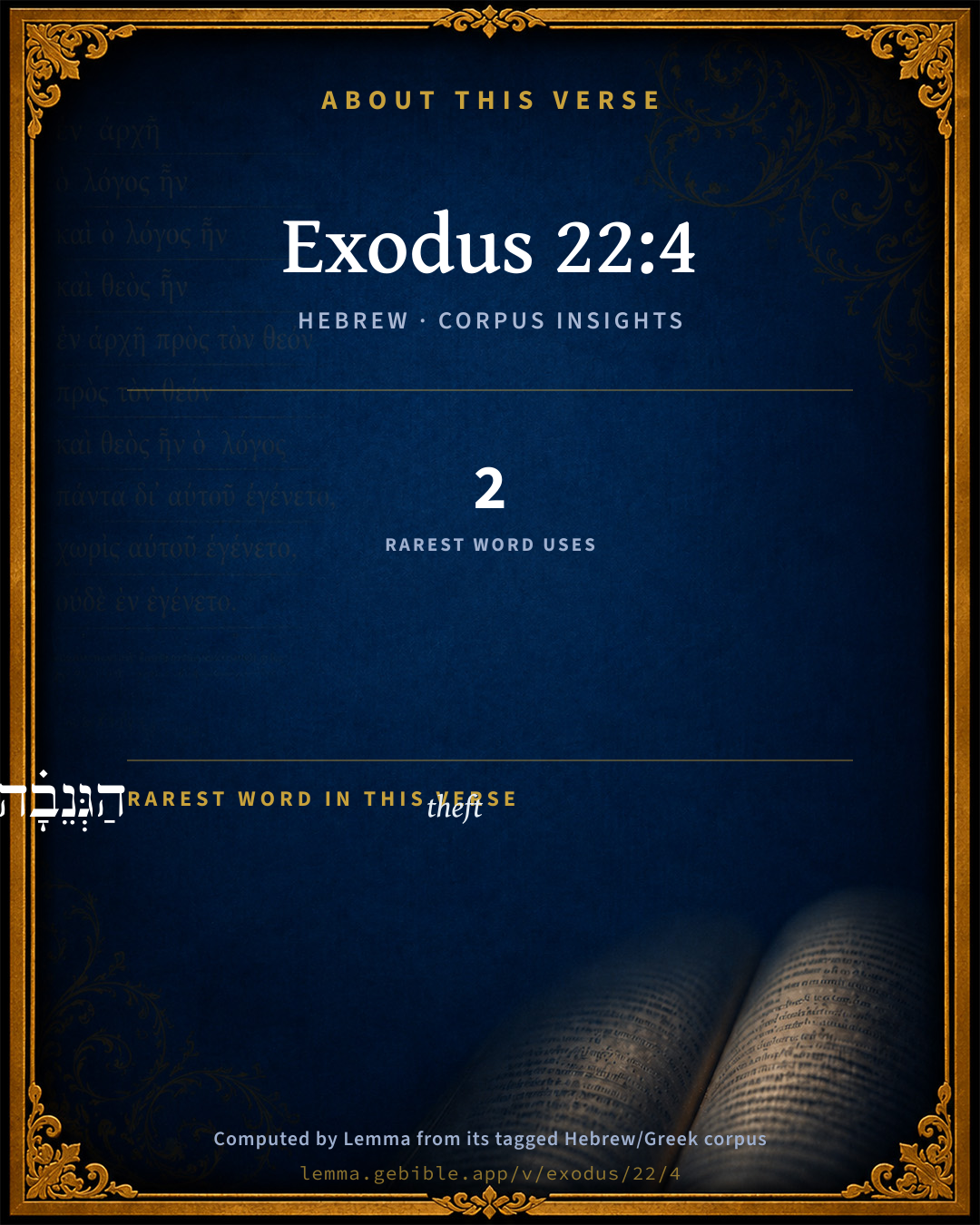
The rarest word here is הַגְּנֵבָ֗ה theft H1591 — appearing just 2 times in the whole Hebrew Bible.

Shared distinctive vocabulary

הַגְּנֵבָ֗ה theft H1591 occurs in 2 verses of the Hebrew Bible. Also found in:

Grammatical profile

  • 3 verbs
  • 5 nouns
  • 2 adjectives
  • 2 prepositions
  • 1 conjunction

Verb forms

  • הִמָּצֵא֩ Niphal · Infinitive Absolute
  • תִמָּצֵ֨א Niphal · Imperfect
  • יְשַׁלֵּֽם Piel · Imperfect

Repetition

Words recur within this verse — often emphatic in Hebrew:

  • הִמָּצֵא֩ to find H4672 ×2
  • עַד until H5704 ×2

Hebrew & Septuagint length

In English translation the verse runs 21 words from the Hebrew and 22 from the Septuagint (LXX English) — closely comparable.

A rough comparison of the two English renderings, which tokenize alike — not a word-level alignment.

Word counts can differ between the Hebrew and the Greek without any difference in meaning — e.g. the Hebrew direct-object marker אֵת has no separate Greek word, and Greek often adds the article ὁ.

Cross-references

8

Topical passages linked to Exodus 22:4 in the Treasury of Scripture Knowledge — connected by theme and wording, ordered by reader-vote popularity; previews shown in the World English Bible.

  • Exodus 22:1 "If a man steals an ox or a sheep, and kills it, or sells it; he shall pay five oxen for an ox, and four sheep for a sheep.
  • Exodus 22:7 "If a man delivers to his neighbor money or stuff to keep, and it is stolen out of the man's house; if the thief is found, he shall pay double.
  • Exodus 21:16 "Anyone who kidnaps someone and sells him, or if he is found in his hand, he shall surely be put to death.
  • Exodus 22:9 For every matter of trespass, whether it be for ox, for donkey, for sheep, for clothing, or for any kind of lost thing, about which one says, 'This is mine,' the cause of both parties shall come before God. He whom God condemns shall pay double to his neighbor.
  • Proverbs 6:31 But if he is found, he shall restore seven times. He shall give all the wealth of his house.
  • Revelation 18:6 Return to her just as she returned, and repay her double as she did, and according to her works. In the cup which she mixed, mix to her double.
  • Jeremiah 16:18 First I will recompense their iniquity and their sin double, because they have polluted my land with the carcasses of their detestable things, and have filled my inheritance with their abominations.
  • Isaiah 40:2 Speak comfortably to Jerusalem; and cry to her, that her warfare is accomplished, that her iniquity is pardoned, that she has received of Yahweh's hand double for all her sins.

Cross-references courtesy of OpenBible.info (CC BY 4.0).

Hebrew and Greek witnesses Masoretic Hebrew ↔ Greek Septuagint

The same verse in the two great witnesses to the Old Testament, shown verse-for-verse.

These are two independent witnesses, not word-aligned to each other, and the Septuagint is shown in lemma (dictionary) form.

Hebrew Exodus 22:4 Masoretic · Westminster Leningrad Codex

אִֽם הִמָּצֵא֩ תִמָּצֵ֨א בְיָד֜וֹ הַגְּנֵבָ֗ה מִשּׁ֧וֹר עַד חֲמ֛וֹר עַד שֶׂ֖ה חַיִּ֑ים שְׁנַ֖יִם יְשַׁלֵּֽם

If the stolen property is found in his hand alive, whether it is ox, donkey, or sheep, he shall pay double.

World English Bible · Public Domain

Greek LXX Exodus 22:4 Septuagint · lemma form

ἐάν δέ καταβόσκω τις ἀγρός ἤ ἀμπελών καί ἀποἵημι ὁ κτῆνος αὐτός καταβόσκω ἀγρός ἕτερος ἀποτίνω ἐκ ὁ ἀγρός αὐτός κατά ὁ γένημα αὐτός ἐάν δέ πᾶς ὁ ἀγρός καταβόσκω ὁ βελτίων ὁ ἀγρός αὐτός καί ὁ βελτίων ὁ ἀμπελών αὐτός ἀποτίνω

And if the thing stolen be left and be in his hand alive, whether ox or sheep, he shall restore them two-fold.

LXX2012 (modern English Septuagint) · Public Domain

Hebrew: Westminster Leningrad Codex (CC BY 4.0). Greek: Septuagint (public domain); English from LXX2012 (modern English Septuagint) (Public Domain). How the Septuagint differs from the Hebrew →

Targum (Aramaic paraphrase)

2

The Targum is the ancient Jewish Aramaic paraphrase of the Hebrew Scriptures — an interpretive translation, not the Hebrew text itself. Onkelos (literal) and Pseudo-Jonathan (expansive) render the Torah, and Jonathan the Prophets. Coverage is partial: where no permissively-licensed English translation exists for a verse, only the Aramaic is shown. This is verse-level text, not a word-by-word alignment to the Hebrew.

  1. Targum Onkelos Torah (Genesis–Deuteronomy)
    אֲרֵי יאכִיל גְבַר חֲקַל אוֹ כְרָם וִישַׁלַח יָת בְּעִירֵהּ וְיֵיכוּל בַּחֲקַל אָחֳרָן שְׁפַר חַקְלֵהּ וּשְׁפַר כַּרְמֵהּ יְשַׁלֵם:

    (no public-domain English translation for this verse)

    Targum Onkelos — Aramaic: “Onkelos Genesis” (public domain); “Onkelos Exodus” (public domain); “Onkelos Leviticus” (public domain); “Onkelos Numbers” (public domain); “Onkelos Deuteronomy” (public domain). English: “Sefaria Community Translation” (CC0 1.0 (public-domain dedication)); “J.W. Etheridge. The Targums of Onkelos and Jonathan Ben Uzziel on the Pentateuch. London: Longmans, Green, 1862” (public domain). Text via Sefaria.

  2. Targum Pseudo-Jonathan Torah (Genesis–Deuteronomy)
    אֲרוּם יִפְקַר גְּבַר חֲקִיל אוֹ כַּרְמָא וִישַׁלַח יַת בְּעִירֵיהּ וְיֵיכוּל בַּחֲקַל גְּבַר אוֹחֲרָן שְׁפַר חַקְלֵיהּ וּשְׁפַר כַּרְמֵיהּ יְשַׁלֵּם

    If a man break in upon a field or a vineyard, and send in his beast to feed in another man's field, the best of his field and the best of his vineyard he shall restore.

    Targum Pseudo-Jonathan — Aramaic: “Targum Jonathan on Genesis” (public domain); “Targum Jonathan on Exodus” (public domain); “Targum Jonathan on Leviticus” (public domain); “Targum Jonathan on Numbers” (public domain); “Targum Jonathan on Deuteronomy” (public domain). English: “The Targum of Jonathan ben Uzziel, trans. J. W. Etheridge, London, 1862” (public domain). Text via Sefaria.

Commentary

Notes on Exodus 22:4 from classic Christian and Jewish commentators (each source and its license shown beneath its notes). The classic Christian expositions comment on the surrounding passage and are grouped to its opening verse, so a note may address several verses; the Jewish commentaries on the Tanakh (Rashi and others) are per-verse, so they appear only where the commentator wrote on this verse.

Lemma curates 59 commentaries, every one of them public domain or Creative Commons licensed, each selected and text-cleaned for this edition rather than reprinted as found. About our sources →

Trapp's Complete Commentary

John Trapp

Exo 22:4 If the theft be certainly found in his hand alive, whether it be ox, or ass, or sheep; he shall restore double.

Ver. 4. He shall restore double.] In Solomon’s time it was sevenfold. {Pro 6:31}

John Trapp, A Commentary or Exposition upon All the Books of the Old and New Testament (1647–1656) — public domain. Text from a community e-Sword module.

Geneva Bible (1599)

Geneva Bible translators

Hebrew, in his hand.

Geneva Bible (1599) marginal notes — public domain. Text via Bolls.life.

Adam Clarke's Commentary

Verse 4. He shall restore double.] In no case of theft was the life of the offender taken away; the utmost that the law says on this point is, that, if when found breaking into a house, he should be smitten so as to die, no blood should be shed for him; Ex 22:2. If he had stolen and sold the property, then he was to restore four or fivefold, Ex 22:1; but if the animal was found alive in his possession, he was to restore double.

Adam Clarke's Commentary on the Bible (1810–1826) — public domain. Text from a community e-Sword/MySword module.

Ellicott's Commentary for English Readers

(4) If the theft be certainly found in his hand.—If he had not converted it, consumed it, or, if it were an animal, killed it, then, instead of the four-fold or five-fold restitution of Exo_22:1, a restoration of double was to suffice.

A Bible Commentary for English Readers, edited by Charles John Ellicott (1878–1897) — public domain. Text from a community e-Sword module.

The Cambridge Bible for Schools and Colleges

gen. ed. J. J. S. Perowne

4. If the stolen animal be not killed, or sold (v. 1), but still alive his possession, he only repays double, i.e. the stolen animal itself, and a second as a fine. The same principle of double restitution recurs vv. 7, 9; it was adopted also ‘in the laws of Manu (viii. 329), at least in the case of things of small value; by Solon, for theft; in Athenian law, in cases of damage (βλάβη) done intentionally (Dem. adv. Mid. § 43, p. 528: in unintentional βλάβη simple restitution was prescribed); by Plato, Legg. ix., p. 857 a, for theft; in both the XII. Tables (Gell. XI. 18. 15) and the later Roman law, for theft, when the thief was not caught in the act’ (Kn.); and by Hạmmurabi in various cases of fraudulent claim (§§ 101, 120, 124, 160, 161); cf. DB. v. 596b.

The Cambridge Bible for Schools and Colleges (gen. ed. J. J. S. Perowne; Cambridge University Press, 1878–1918) — public domain. Text from a community e-Sword module.

John Gill's Exposition

If the theft be certainly found in his hand alive,.... Or, "in finding be found" (i), be plainly and evidently found upon him, before witnesses, as the Targum of Jonathan; so that there is no doubt of the theft; and it is a clear case that he had neither as yet killed nor sold the creature he had stolen, and to could be had again directly, and without any damage well as it would appear by this that he was not an old expert thief, and used to such practices, since he would soon have made away with this theft in some way or another:

whether it be ox, or ass, or sheep, or any other creature; and even, as Jarchi thinks, anything else, as raiment, goods, &c.

he shall restore double; two oxen for an ox, two asses for an ass, and two sheep for a sheep: and, as the same commentator observes, two living ones, and not dead ones, or the price of two living ones: so Solon made theft, by his law, punishable with death, but with a double restitution (k); and the reason why here only a double restitution and not fourfold is insisted on, as in Exo 22:1 is, because there the theft is persisted in, here not; but either the thief being convicted in his own conscience of his evil, makes confession, or, however, the creatures are found with alive, and so more useful being restored, and, being had again sooner, the loss is not quite so great.

(i) "inveniendo inventum fuerit", Pagninus, Montanus, Piscator. (k) A. Gell, l. 11. c. 18.

John Gill's Exposition of the Whole Bible (1746–1763) — public domain (CC PDM 1.0). Text via the HelloAO Bible API.

Haydock's Catholic Bible Commentary

Double. This is an exception from the general law, ver. 1, (Calmet) because he can more easily make restitution, as he has not sold or destroyed the thing. (Du Hamel)

George Leo Haydock (1774–1849), Haydock's Catholic Family Bible and Commentary, 1859 edition — public domain. Excludes Psalms (Douay-Rheims chapter numbering differs from Protestant) and Deuterocanonical books (Catholic canon only).

Matthew Poole's English Annotations

Alive; not killed, nor sold, as Exo 22:1.

Double; not more,

1. Because in that case it was presumed, either that he intended to restore it, or at least that he was but raw and unexercised in the trade of stealing, and so should be more gently punished.

2. Because the right owner recovered his goods with less charge and trouble. Or,

3. Because it was but a single crime, whereas the other, Exo 22:1, was an aggravated and complicated crime, where one sin and injury was added to another.

Object. It is said, he shall restore sevenfold, Pro 6:31.

Answ. 1.

Sevenfold is put for abundantly, as that word is oft used, as Gen 4:24; Psa 12:6; 79:12; and a learned man observes, it is never used for that definite number.

Answ. 2. This sevenfold, or seven times, may relate not to the proportion of his restitution, but to the number of his thefts, or rather of his detections; and the sense is this, Though he be found guilty of theft seven times, all his punishment is, that he shall restore as the law prescribes. Whereas adultery, of which he there speaks in the following verses, is a crime of that nature, that if a man be once found guilty of it, restitution cannot be made, nor will it serve his turn, but he falls into all the mischiefs there reckoned up.

Matthew Poole's English Annotations on the Holy Bible (1683–1685) — public domain. Text from a community e-Sword/MySword module.

The Pulpit Commentary

If the theft be certainly found in his hand. If he be caught in flagrante delicto, with the thing stolen in his possession, "whether it be ox, or ass, or small cattle," he shall restore double. The law of theft in the Mosaic legislation is altogether of a mild character, as compared with the Roman, or even with the English law, until the present century. Double restitution was a sort of "retaliation it involved a man losing the exact amount which he had expected to gain

The Pulpit Commentary (1880–1919), ed. H.D.M. Spence-Jones & Joseph S. Exell — public domain. Text from a community e-Sword module.

John Wesley's Explanatory Notes

In his hand alive - Not killed, nor sold, as ver. 1, so that the owner recover it with less charge and trouble.

John Wesley, Explanatory Notes Upon the Whole Bible (1754–1765) — public domain. Text via the GEBible commentary corpus.

Rashi

Rabbi Shlomo Yitzchaki (Rashi)

כי יבער … בעירה ובער All these terms are connected with the word בעיר which signifies “cattle”, as in (Numbers 20:4) אנחנו ובעירנו “we and our cattle".

כי יבער means accordingly, he takes his cattle into the field or the vineyard of his fellow-man and causes damage to him by one of these two ways: either by the mere fact that he lets his cattle go (tread) there (ושלח את בעירו), or by letting it graze there (ובער). Our Rabbis explained (Bava Kamma 2b), that ושלח refers to the damage done by “treading” (Rashi uses a Biblical phrase Deuteronomy 5:1. “treading of the hollow of the foot”) and ובער to the damage caused by the tooth that eats up and removes (מבערת) the crops (grazing).

בשדה אחר means בשדה של אחר IN THE FIELD OF ANOTHER MAN (not “in another field”, when it would be punctuated בְּשָׂדֶה, for בִּשְׁדֵה is the construct form).

מיטב שדהו … ישלם THE BEST OF HIS FIELD SHALL HE PAY — We assess the damage, and if the defendant proposes to make restitution to him for the damage he has suffered with “land’” then he has to pay him with the best of his fields. If for instance the damage amounted to a Sela he has to give him a Sela-worth of the best of the fields he possesses). Scripture teaches you that in cases of damages (which it is proposed to pay with land) we assess and collect them from the best land of the defendant (Mekhilta; Bava Kamma 6b).

Rashi on the Tanakh — English translations: “The Judaica Press complete Tanach with Rashi, translated by A. J. Rosenberg” (CC BY 4.0); “Pentateuch with Rashi's commentary by M. Rosenbaum and A.M. Silbermann, 1929-1934” (public domain); “The Metsudah Tanach series, Lakewood, N.J” (CC BY 4.0); and “The Book of Joshua, Metsudah Publications, 1997” (CC BY 4.0). Text via Sefaria.

Lesson kit

Teaching starters — assembled from the data on this page, not authored interpretation. Every prompt links to the verse data it draws on. Edit before teaching.

Exodus, in the Pentateuch, opens this verse with 13 words (11 distinct Hebrew lemmas). Its most distinctive word is gᵉnêbâh (“theft”). A historical commentator’s framing appears above. Read the whole chapter for the surrounding context.

Discussion questions

  1. What does “theft” (gᵉnêbâh) contribute to the verse as a whole?
  2. Exodus 22:3 shares the word «theft» with this verse. How do the two illuminate each other?
  3. “to find” occurs 2× in this one verse. What is the effect of the repetition?
  4. These translations render this verse differently. What is at stake in choosing one wording over another?
  5. The verb «הִמָּצֵא֩» is Niphal Infinitive Absolute. How does its form color the action?
  6. Reading how Trapp's Complete Commentary and Geneva Bible (1599) read this verse, where do the two commentators agree and where do they part?

Things to notice

Reading settings

Reading text

Shown beneath each verse's original-language words.

Old Testament
Old Testament edition

Read the OT as the Masoretic Hebrew (MT) or the Greek Septuagint (LXX).

English shown for the Greek Septuagint (in the Hebrew ↔ Greek comparison).

Comparing translations? Open the Compare panel on any verse page to stack up to four side by side.